Reading view

There are new articles available, click to refresh the page.

NASA Completes Nancy Grace Roman Space Telescope Construction

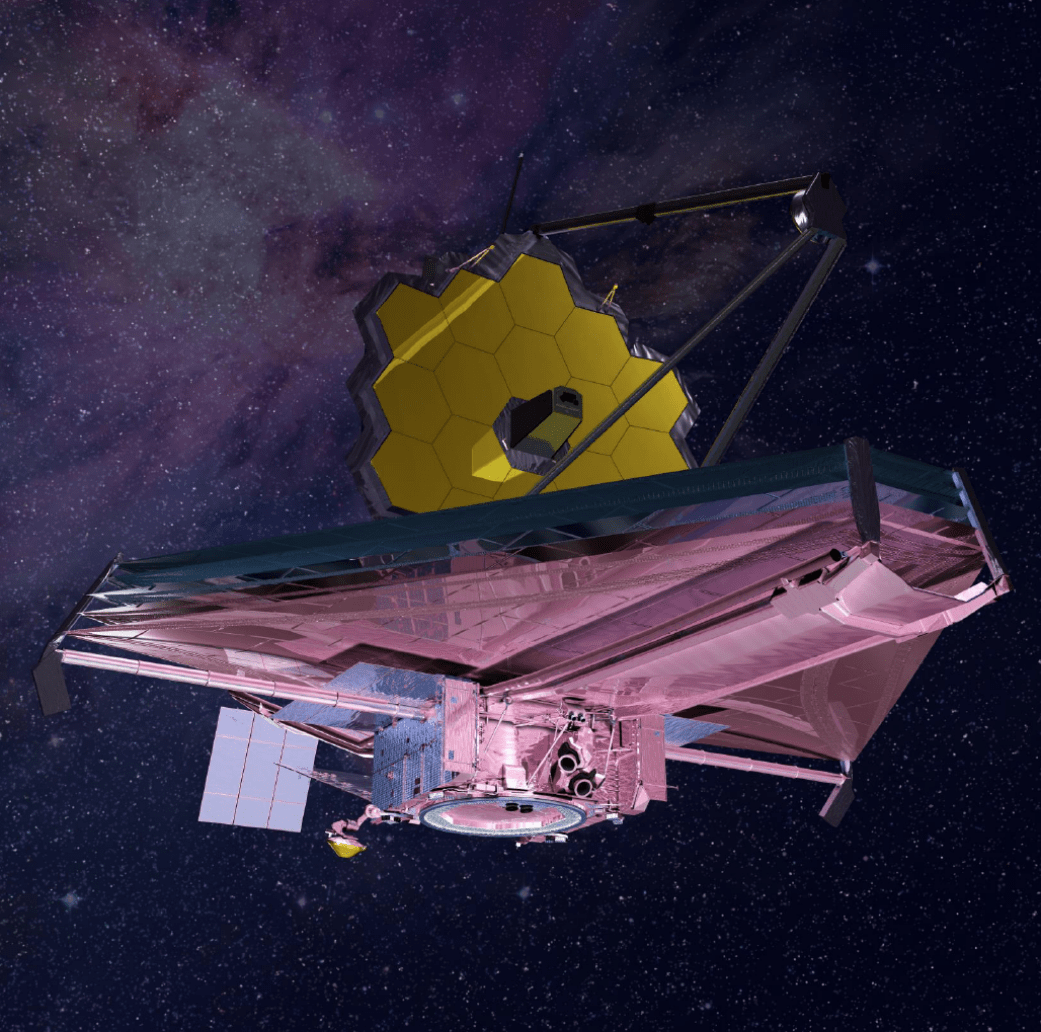
NASA’s next big eye on the cosmos is now fully assembled. On Nov. 25, technicians joined the inner and outer portions of the Nancy Grace Roman Space Telescope in the largest clean room at the agency’s Goddard Space Flight Center in Greenbelt, Maryland.
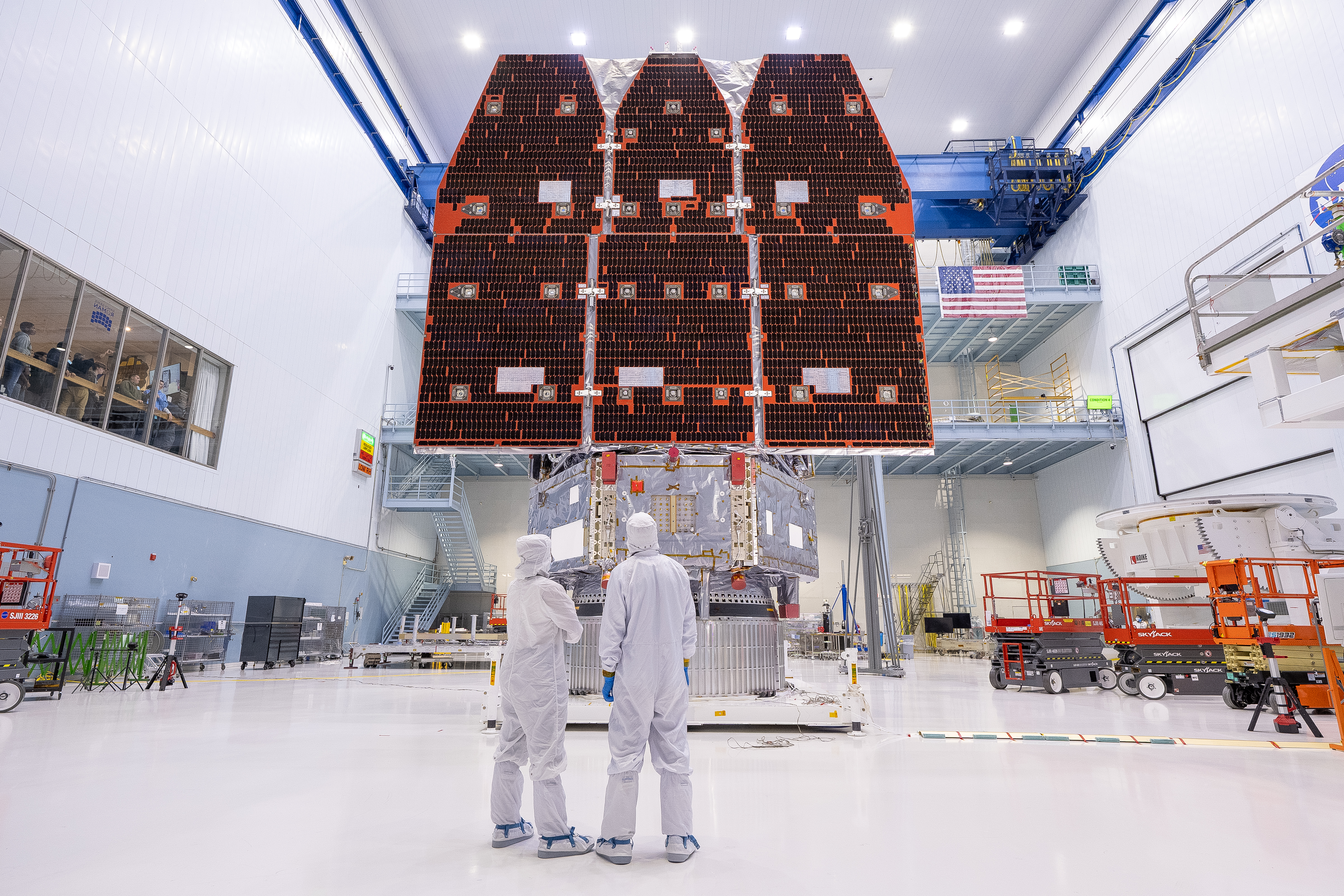
The complete observatory in a clean room
NASA’s Nancy Grace Roman Space Telescope is now fully assembled following the integration of its two major segments on Nov. 25 at the agency’s Goddard Space Flight Center in Greenbelt, Md. The mission is slated to launch by May 2027, but the team is on track for launch as early as fall 2026.
Credit: NASA/Jolearra Tshiteya

“Completing the Roman observatory brings us to a defining moment for the agency,” said NASA Associate Administrator Amit Kshatriya. “Transformative science depends on disciplined engineering, and this team has delivered—piece by piece, test by test—an observatory that will expand our understanding of the universe. As Roman moves into its final stage of testing following integration, we are focused on executing with precision and preparing for a successful launch on behalf of the global scientific community.”

After final testing, Roman will move to the launch site at NASA’s Kennedy Space Center in Florida for launch preparations in summer 2026. Roman is slated to launch by May 2027, but the team is on track for launch as early as fall 2026. A SpaceX Falcon Heavy rocket will send the observatory to its final destination a million miles from Earth.

“With Roman’s construction complete, we are poised at the brink of unfathomable scientific discovery,” said Julie McEnery, Roman’s senior project scientist at NASA Goddard. “In the mission’s first five years, it’s expected to unveil more than 100,000 distant worlds, hundreds of millions of stars, and billions of galaxies. We stand to learn a tremendous amount of new information about the universe very rapidly after Roman launches.”
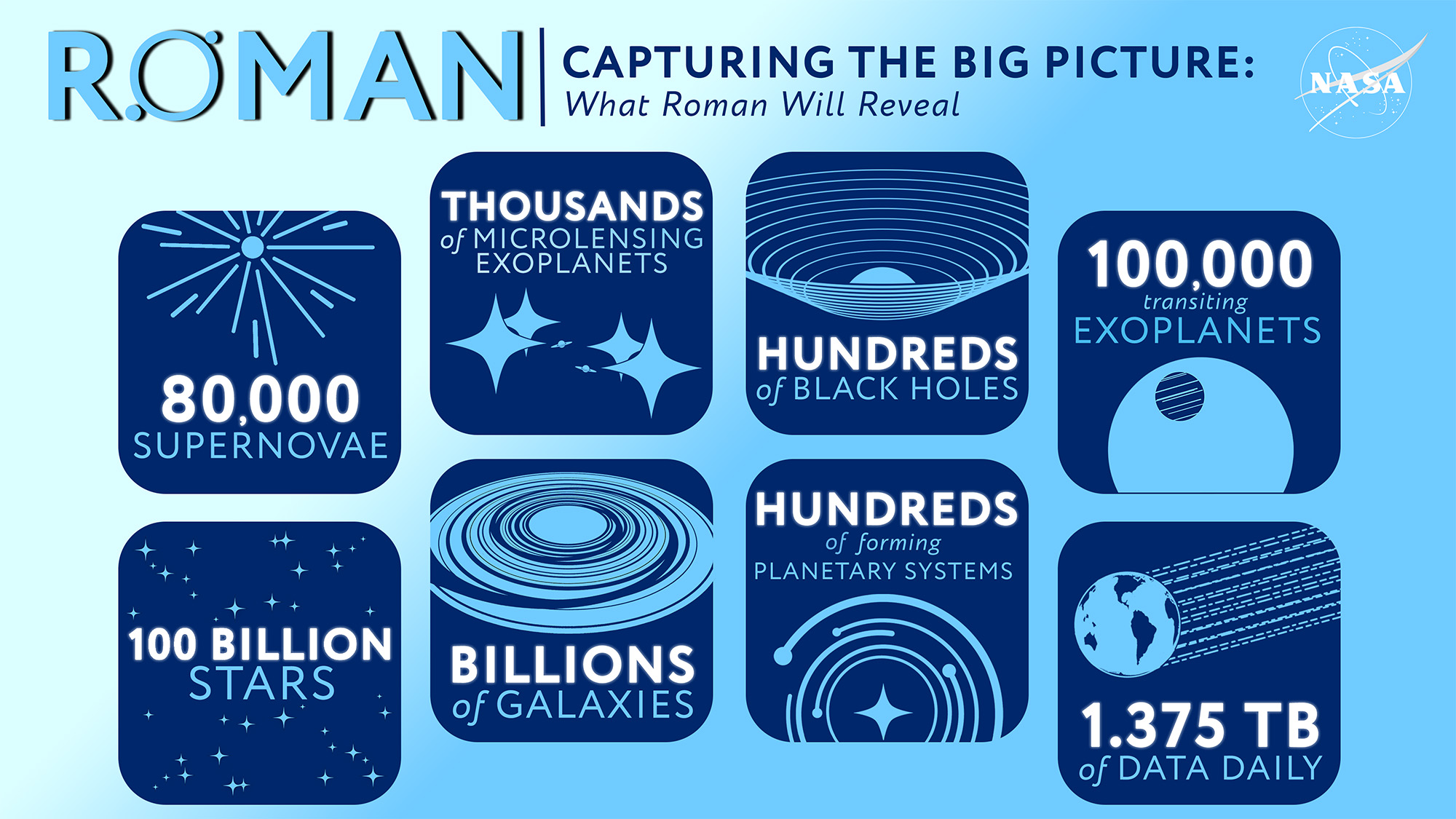
An infographic tallying up several things Roman will observe
NASA’s Nancy Grace Roman Space Telescope will survey vast swaths of sky during its five-year primary mission. During that time, scientists expect it to see an incredible number of new objects, including stars, galaxies, black holes and planets outside our solar system, known as exoplanets. This infographic previews some of the discoveries scientists anticipate from Roman’s data deluge.
Credit: NASA’s Goddard Space Flight Center

Observing from space will make Roman very sensitive to infrared light — light with a longer wavelength than our eyes can see — from far across the cosmos. Pairing its crisp infrared vision with a sweeping view of space will allow astronomers to explore myriad cosmic topics, from dark matter and dark energy to distant worlds and solitary black holes, and conduct research that would take hundreds of years using other telescopes.

“Within our lifetimes, a great mystery has arisen about the cosmos: why the expansion of the universe seems to be accelerating. There is something fundamental about space and time we don’t yet understand, and Roman was built to discover what it is,” said Nicky Fox, associate administrator, Science Mission Directorate, NASA Headquarters in Washington. “With Roman now standing as a complete observatory, which keeps the mission on track for a potentially early launch, we are a major step closer to understanding the universe as never before. I couldn’t be prouder of the teams that have gotten us to this point.”

Double vision

Roman is equipped with two instruments: the Wide Field Instrument and the Coronagraph Instrument technology demonstration.

The coronagraph will demonstrate new technologies for directly imaging planets around other stars. It will block the glare from distant stars and make it easier for scientists to see the faint light from planets in orbit around them. The Coronagraph aims to photograph worlds and dusty disks around nearby stars in visible light to help us see giant worlds that are older, colder, and in closer orbits than the hot, young super-Jupiters direct imaging has mainly revealed so far.

“The question of ‘Are we alone?’ is a big one, and it’s an equally big task to build tools that can help us answer it,” said Feng Zhao, the Roman Coronagraph Instrument manager at NASA’s Jet Propulsion Laboratory in Southern California. “The Roman Coronagraph is going to bring us one step closer to that goal. It’s incredible that we have the opportunity to test this hardware in space on such a powerful observatory as Roman.”

The coronagraph team will conduct a series of pre-planned observations for three months spread across the mission’s first year-and-a-half of operations, after which the mission may conduct additional observations based on scientific community input.

The Wide Field Instrument is a 288-megapixel camera that will unveil the cosmos all the way from our solar system to near the edge of the observable universe. Using this instrument, each Roman image will capture a patch of the sky bigger than the apparent size of a full moon. The mission will gather data hundreds of times faster than NASA’s Hubble Space Telescope, adding up to 20,000 terabytes (20 petabytes) over the course of its five-year primary mission.

“The sheer volume of the data Roman will return is mind-boggling and key to a host of exciting investigations,” said Dominic Benford, Roman’s program scientist at NASA Headquarters.

Over the course of several hours, technicians meticulously connected the inner and outer segments of NASA’s Nancy Grace Roman Space Telescope, as shown in this time-lapse. Next, Roman will undergo final testing prior to moving to the launch site at NASA’s Kennedy Space Center in Florida for launch preparations in summer 2026.
Credit: NASA/Sophia Roberts

Survey trifecta

Using the Wide Field Instrument, Roman will conduct three core surveys which will account for 75% of the primary mission. The High-Latitude Wide-Area Survey will combine the powers of imaging and spectroscopy to unveil more than a billion galaxies strewn across a wide swath of space and time. Astronomers will trace the evolution of the universe to probe dark matter — invisible matter detectable only by how its gravity affects things we can see — and trace the formation of galaxies and galaxy clusters over time.

The High-Latitude Time-Domain Survey will probe our dynamic universe by observing the same region of the cosmos repeatedly. Stitching these observations together to create movies will allow scientists to study how celestial objects and phenomena change over time periods of days to years. That will help astronomers study dark energy — the mysterious cosmic pressure thought to accelerate the universe’s expansion — and could even uncover entirely new phenomena that we don’t yet know to look for.

Roman’s Galactic Bulge Time-Domain Survey will look inward to provide one of the deepest views ever of the heart of our Milky Way galaxy. Astronomers will watch hundreds of millions of stars in search of microlensing signals — gravitational boosts of a background star’s light caused by the gravity of an intervening object. While astronomers have mainly discovered star-hugging worlds, Roman’s microlensing observations can find planets in the habitable zone of their star and farther out, including worlds like every planet in our solar system except Mercury. Microlensing will also reveal rogue planets—worlds that roam the galaxy untethered to a star — and isolated black holes. The same dataset will reveal 100,000 worlds that transit, or pass in front of, their host stars.

The remaining 25% of Roman’s five-year primary mission will be dedicated to other observations that will be determined with input from the broader scientific community. The first such program, called the Galactic Plane Survey, has already been selected.

Because Roman’s observations will enable such a wide range of science, the mission will have a General Investigator Program designed to support astronomers to reveal scientific discoveries using Roman data. As part of NASA’s commitment to Gold Standard Science, NASA will make all of Roman’s data publicly available with no exclusive use period. This ensures multiple scientists and teams can use data at the same time, which is important since every Roman observation will address a wealth of science cases.

NASA’s freshly assembled Nancy Grace Roman Space Telescope will revolutionize our understanding of the universe with its deep, crisp, sweeping infrared views of space. The mission will transform virtually every branch of astronomy and bring us closer to understanding the mysteries of dark energy, dark matter, and how common planets like Earth are throughout our galaxy. Roman is on track for launch by May 2027, with teams working toward a launch as early as fall 2026. Credit: NASA’s Goddard Space Flight Center

Roman’s namesake — Dr. Nancy Grace Roman, NASA’s first chief astronomer — made it her personal mission to make cosmic vistas readily accessible to all by paving the way for telescopes based in space.

“The mission will acquire enormous quantities of astronomical imagery that will permit scientists to make groundbreaking discoveries for decades to come, honoring Dr. Roman’s legacy in promoting scientific tools for the broader community,” said Jackie Townsend, Roman’s deputy project manager at NASA Goddard. “I like to think Dr. Roman would be extremely proud of her namesake telescope and thrilled to see what mysteries it will uncover in the coming years.”

The Nancy Grace Roman Space Telescope is managed at NASA’s Goddard Space Flight Center in Greenbelt, Maryland, with participation by NASA’s Jet Propulsion Laboratory in Southern California; Caltech/IPAC in Pasadena, California; the Space Telescope Science Institute in Baltimore; and a science team comprising scientists from various research institutions. The primary industrial partners are BAE Systems Inc. in Boulder, Colorado; L3Harris Technologies in Rochester, New York; and Teledyne Scientific & Imaging in Thousand Oaks, California.

To learn about the Roman Space Telescope, visit:

https://www.nasa.gov/roman

By Ashley Balzer
NASA’s Goddard Space Flight Center, Greenbelt, Md.

Media contact:

Claire Andreoli
NASA’s Goddard Space Flight Center, Greenbelt, Md.
301-286-1940
Share

Details

Last Updated
Dec 04, 2025
Editor
Ashley Balzer
Contact
Location
Goddard Space Flight Center

Discovery Alert: ‘Baby’ Planet Photographed in a Ring around a Star for the First Time! 

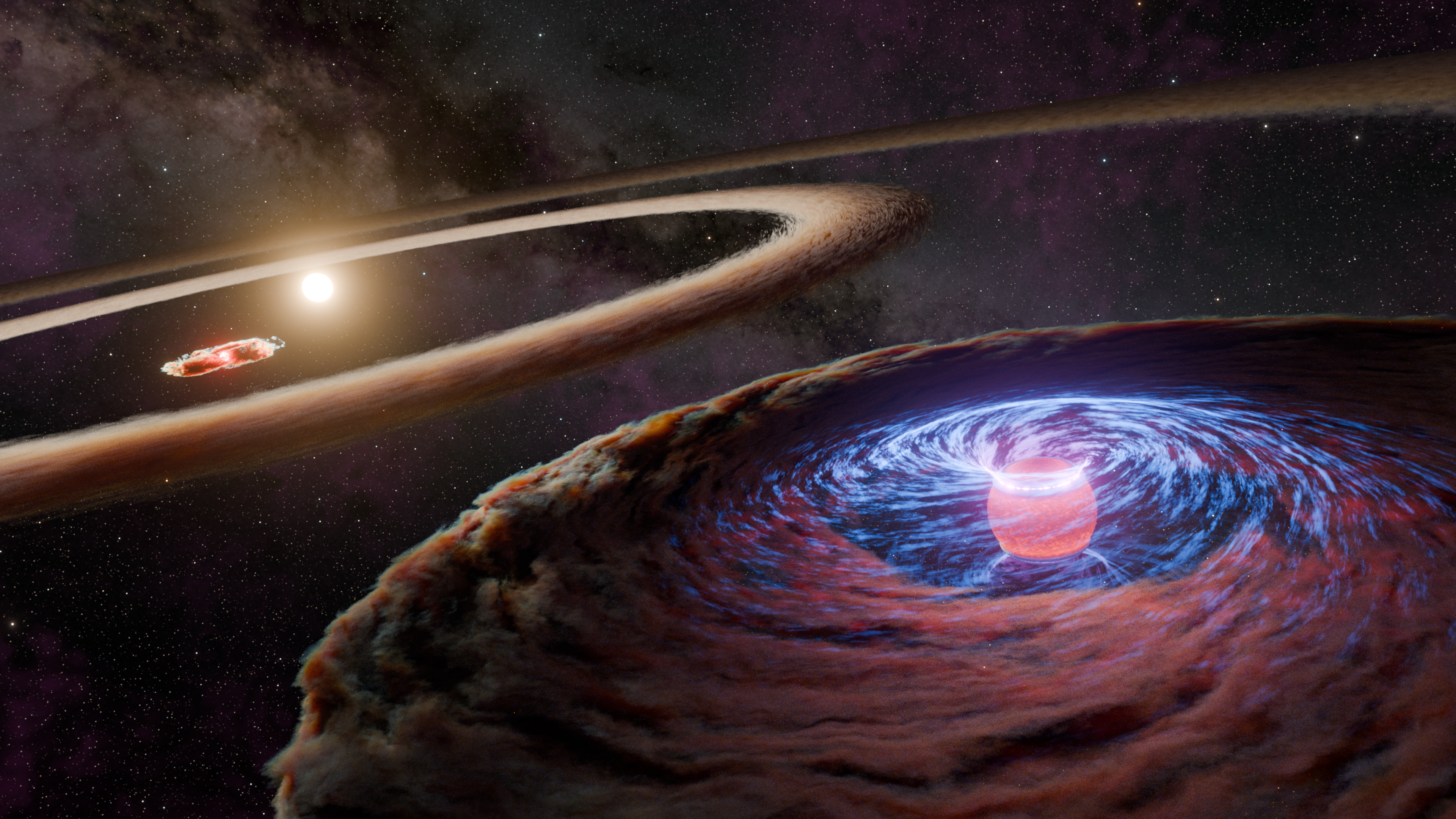
This artist's concept depicts the protoplanet WISPIT 2b accreting matter as it orbits around its star, WISPIT 2.
This artist’s concept depicts the protoplanet WISPIT 2b accreting matter as it orbits around its star, WISPIT 2.
NASA/JPL-Caltech/R. Hurt (IPAC)

The (Proto) Planet: 

WISPIT 2b 

The Discovery: 

Researchers have discovered a young protoplanet called WISPIT 2b embedded in a ring-shaped gap in a disk encircling a young star. While theorists have thought that planets likely exist in these gaps (and possibly even create them), this is the first time that it has actually been observed.

This image of the WISPIT 2 system was captured by the Magellan Telescope in Chile and the Large Binocular Telescope in Arizona. The protoplanet WISPIT 2b is a small purple dot to the right of a bright white ring of dust surrounding the system's star. A fainter white ring outside of WISPIT 2b can be seen.
This image of the WISPIT 2 system was captured by the Magellan Telescope in Chile and the Large Binocular Telescope in Arizona. The protoplanet WISPIT 2b is a small purple dot to the right of a bright white ring of dust surrounding the system’s star. A fainter white ring outside of WISPIT 2b can be seen.
Laird Close, University of Arizona

Key Takeaway: 

Researchers have directly detected – essentially photographed – a new planet called WISPIT 2b, labeled a protoplanet because it is an astronomical object that is accumulating material and growing into a fully-realized planet. However, even in its “proto” state, WISPIT 2b is a gas giant about 5 times as massive as Jupiter. This massive protoplanet is just about 5 million years old, or almost 1,000 times younger than the Earth, and about 437 light-years from Earth. 

Being a giant and still-growing baby planet, WISPIT 2b is interesting to study on its own, but its location in this protoplanetary disk gap is even more fascinating. Protoplanetary disks are made of gas and dust that surround young stars and function as the birthplace for new planets. 

Within these disks, gaps or clearings in the dust and gas can form, appearing as empty rings. Scientists have long suggested that these growing planets are likely responsible for clearing the material in these gaps, pushing and scattering dusty disk material outwards and greeting the ring gaps in the first place. Our own solar system was once just a protoplanetary disk, and it’s possible that Jupiter and Saturn may have cleared ring gaps like this in that disk  many, many years ago. 

But despite continued observation of stars with these kinds of disks, there was never any direct evidence of a growing planet found in one of these ring gaps. That is, until now. As reported in this paper, WISPIT 2b was directly observed in one of the ring gaps around its star, WISPIT 2. 

Another interesting aspect of this discovery is that WISPIT 2b appears to have formed where it was found, it didn’t form elsewhere and move into the gap somehow. 

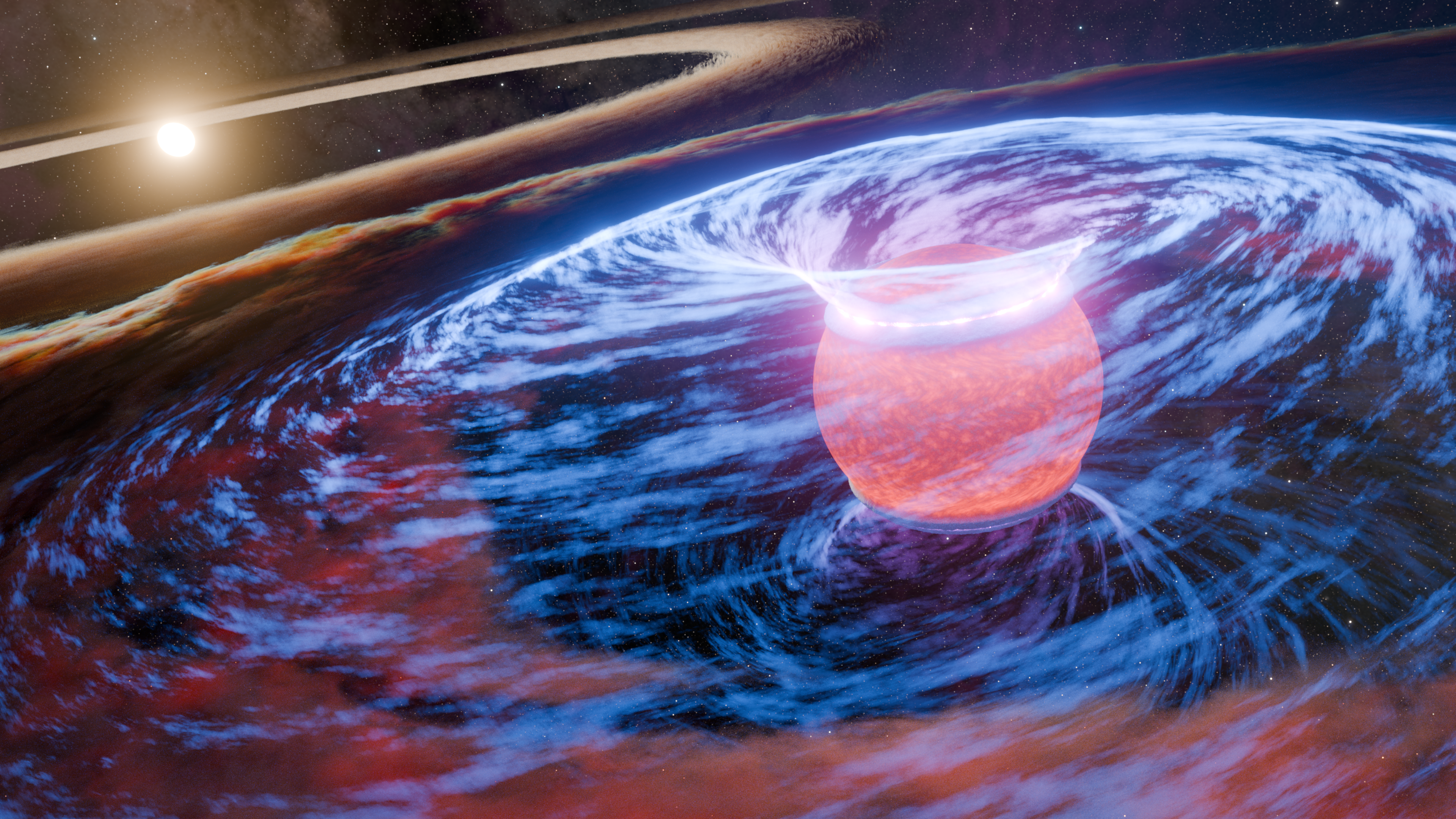
This artist's concept depicts a close-up of the protoplanet WISPIT 2b accreting matter as it orbits around its star, WISPIT 2.
This artist’s concept depicts a close-up of the protoplanet WISPIT 2b accreting matter as it orbits around its star, WISPIT 2.
NASA/JPL-Caltech/R. Hurt (IPAC)

Details: 

The star WISPIT 2 was first observed using VLT-SPHERE (Very Large Telescope – Spectro-Polarimetric High-contrast Exoplanet REsearch), a ground-based telescope in northern Chile operated by the European Southern Observatory. In these observations, the rings and gap around this star were first seen. 

Following these observations of the system, researchers looked at WISPIT 2, and spotted the planet WISPIT 2b for the first time, using the University of Arizona’s MagAO-X extreme adaptive optics system, a high-contrast exoplanet imager at the Magellan 2 (Clay) Telescope at Las Campanas Observatory in Chile. 

This technology adds another unique layer to this discovery. The MagAO-X instrument captures direct images, so it didn’t just detect WISPIT 2b, it essentially captured a photograph of the protoplanet.    

The team used this technology to study the WISPIT 2 system in what is called H-alpha, or Hydrogen-alpha, light. This is a type of visible light that is emitted when hydrogen gas falls from a protoplanetary disk onto young, growing planets. This could look like a ring of super heated plasma circling the planet. This plasma emits the H-alpha light that MagAO-X is specially designed to detect (even if it is a very faint signal compared to the bright star nearby). 

When looking at the system in H-alpha light, the team spotted a clear dot in one of the dark ring gaps in the disk around WISPIT 2. This dot? The planet WISPIT 2b. 

In addition to observing the protoplanet’s H-alpha emission using MagAO-X, the team also studied the protoplanet in other wavelengths of infrared light using the LMIRcam detector as part of the The Large Binocular Telescope Interferometer instrument on the University of Arizona’s Large Binocular Telescope.

Fun Facts: 

In addition to discovering WISPIT 2b, this team spotted a second dot in one of the other dark ring gaps even closer to the star WISPIT 2. This second dot has been identified as another candidate planet that will likely be investigated in future studies of the system. 

The Discoverers: 

WISPIT-2b was discovered by a team led by University of Arizona astronomer Laird Close and Richelle van Capelleveen, an astronomy graduate student at Leiden Observatory in the Netherlands. This followed the recent discovery of the WISPIT 2 disk and ring system using the VLT, which was led by van Capelleveen. 

This discovery was detailed in the paper “Wide Separation Planets in Time (WISPIT): Discovery of a Gap Hα Protoplanet WISPIT 2b with MagAO-X,” published August 26, 2025 in the Astrophysical Journal Letters. A second paper led by van Capelleveen and the University of Galway published on the same day in the Astrophysical Journal Letters. 

This research was partially supported by a grant from the NASA eXoplanet Research Program. MagAO-X was developed in part by a grant from the U.S. National Science Foundation with support from the Heising-Simons Foundation.

NASA’s Webb Telescope Studies Moon-Forming Disk Around Massive Planet

 
4 Min Read

NASA’s Webb Telescope Studies Moon-Forming Disk Around Massive Planet

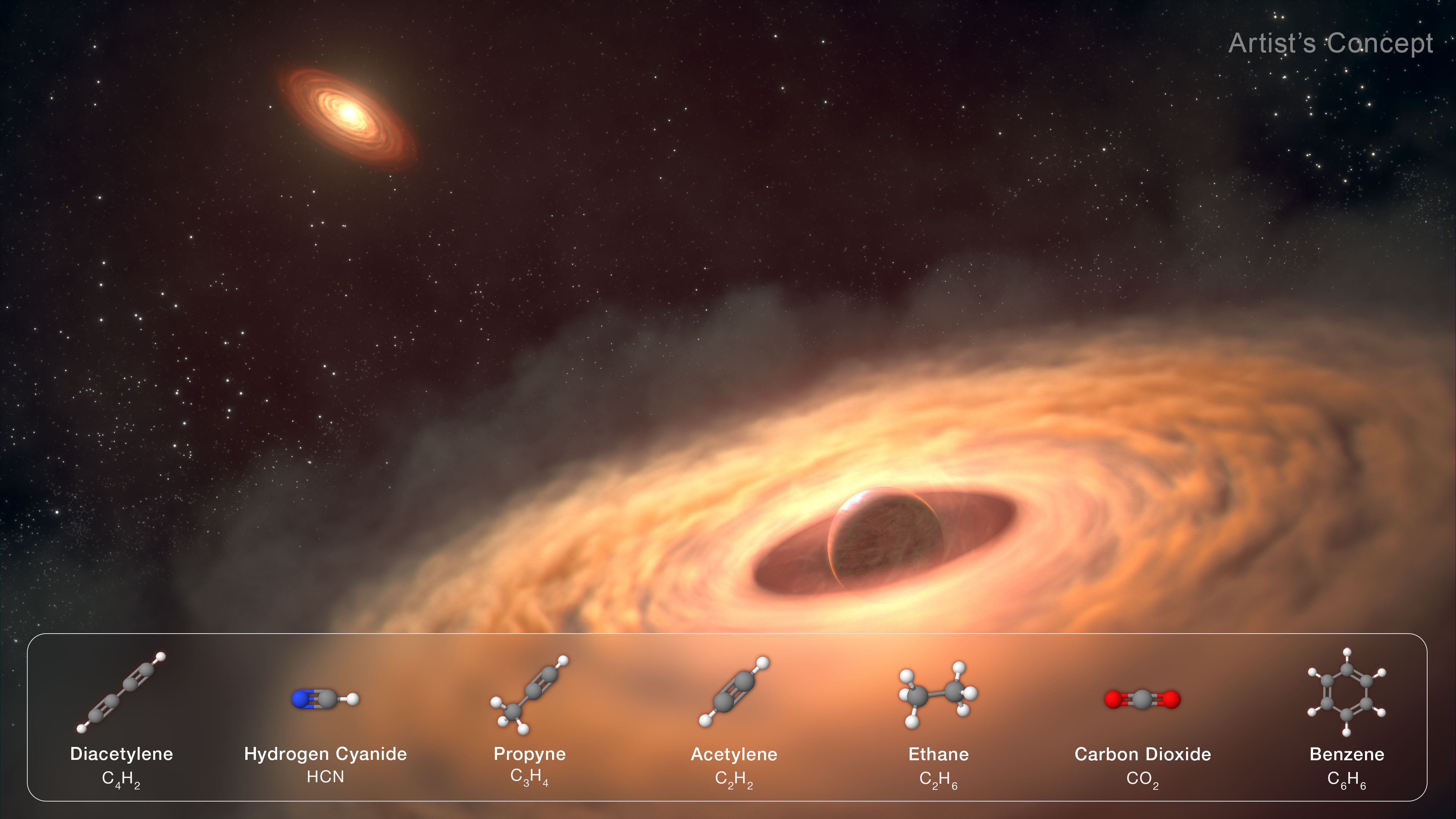
An illustration of a young planet with a surrounding disk of dust and gas potentially forming moons. The planet, which appears dark red, is shown at lower right, circled by a cloudy, clumpy reddish orange-colored disk. The host star appears at upper left, and glows yellow, with its own reddish disk of debris. The disk that surrounds the planet takes up about half the illustration. The black background of space is speckled with stars. The words Artist’s Concept appear at upper right.
An artistic rendering of a dust and gas disk encircling the young exoplanet, CT Cha b, 625 light-years from Earth. Full image, annotation, and caption shown below.
Credits:
Illustration: NASA, ESA, CSA, STScI, Gabriele Cugno (University of Zürich, NCCR PlanetS), Sierra Grant (Carnegie Institution for Science), Joseph Olmsted (STScI), Leah Hustak (STScI)

NASA’s James Webb Space Telescope has provided the first direct measurements of the chemical and physical properties of a potential moon-forming disk encircling a large exoplanet. The carbon-rich disk surrounding the world called CT Cha b, which is located 625 light-years away from Earth, is a possible construction yard for moons, although no moons are detected in the Webb data.

The results published today in The Astrophysical Journal Letters.

The young star the planet orbits is only 2 million years old and still accreting circumstellar material. However, the circumplanetary disk discovered by Webb is not part of the larger accretion disk around the central star. The two objects are 46 billion miles apart. 

Observing planet and moon formation is fundamental to understanding the evolution of planetary systems across our galaxy. Moons likely outnumber planets, and some might be habitats for life as we know it. But we are only now entering an era where we can witness their formation.

This discovery fosters a better understanding of planet and moon formation, say researchers. Webb’s data is invaluable for making comparisons to our solar system’s birth over 4 billion years ago.

“We can see evidence of the disk around the companion, and we can study the chemistry for the first time. We’re not just witnessing moon formation — we’re also witnessing this planet’s formation,” said co-lead author Sierra Grant of the Carnegie Institution for Science in Washington. 

“We are seeing what material is accreting to build the planet and moons,” added main lead author Gabriele Cugno of the University of Zürich and member of the National Center of Competence in Research PlanetS.

Image A: Circumplanetary Disk (Artist’s Concept)

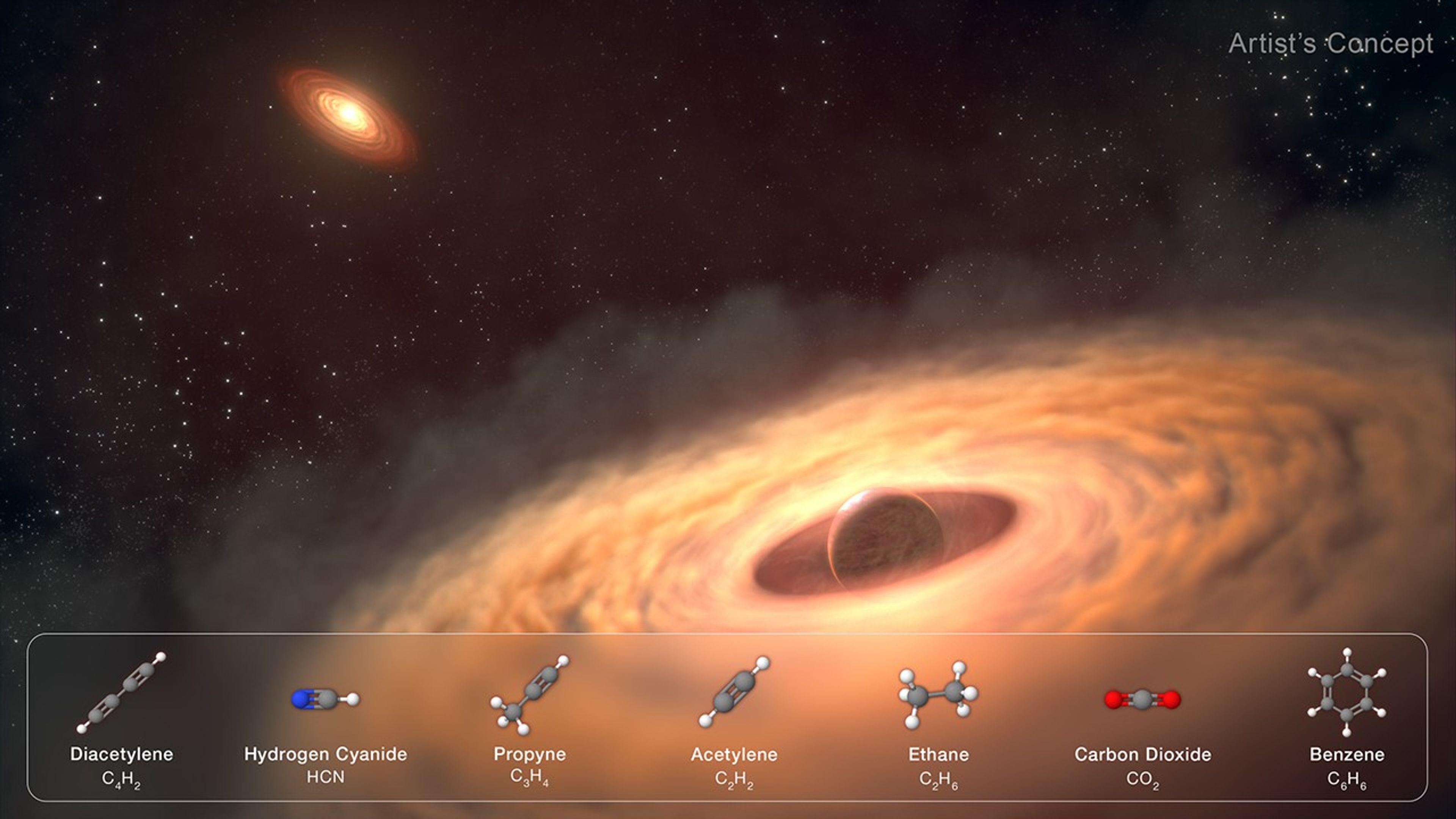
An illustration of a young planet with a surrounding disk of dust and gas potentially forming moons. The planet, which appears dark red, is shown at lower right, circled by a cloudy, clumpy reddish orange-colored disk. The host star appears at upper left, and glows yellow, with its own reddish disk of debris. The disk that surrounds the planet takes up about half the illustration. The black background of space is speckled with stars. At the bottom of the illustration, graphics of molecules are listed in the following order: diacetylene, hydrogen cyanide, propyne, acetylene, ethane, carbon dioxide, benzene. The words Artistu2019s Concept appear at upper right.
An artistic rendering of a dust and gas disk encircling the young exoplanet, CT Cha b, 625 light-years from Earth. Spectroscopic data from NASA’s James Webb Space Telescope suggests the disk contains the raw materials for moon formation: diacetylene, hydrogen cyanide, propyne, acetylene, ethane, carbon dioxide, and benzene. The planet appears at lower right, while its host star and surrounding circumstellar disk are visible in the background.
Illustration: NASA, ESA, CSA, STScI, Gabriele Cugno (University of Zu00fcrich, NCCR PlanetS), Sierra Grant (Carnegie Institution for Science), Joseph Olmsted (STScI), Leah Hustak (STScI)

Dissecting starlight

Infrared observations of CT Cha b were made with Webb’s MIRI (Mid-Infrared Instrument) using its medium resolution spectrograph. An initial look into Webb’s archival data revealed signs of molecules within the circumplanetary disk, which motivated a deeper dive into the data. Because the planet’s faint signal is buried in the glare of the host star, the researchers had to disentangle the light of the star from the planet using high-contrast methods. 

“We saw molecules at the location of the planet, and so we knew that there was stuff in there worth digging for and spending a year trying to tease out of the data. It really took a lot of perseverance,” said Grant.

Ultimately, the team discovered seven carbon-bearing molecules within the planet’s disk, including acetylene (C2H2) and benzene (C6H6). This carbon-rich chemistry is in stark contrast to the chemistry seen in the disk around the host star, where the researchers found water but no carbon. The difference between the two disks offers evidence for their rapid chemical evolution over only 2 million years.

Genesis of moons

A circumplanetary disk has long been hypothesized as the birthplace of Jupiter’s four major moons. These Galilean satellites must have condensed out of such a flattened disk billions of years ago, as evident in their co-planar orbits about Jupiter. The two outermost Galilean moons, Ganymede and Callisto, are 50% water ice. But they presumably have rocky cores, perhaps either of carbon or silicon.

“We want to learn more about how our solar system formed moons. This means that we need to look at other systems that are still under construction. We’re trying to understand how it all works,” said Cugno. “How do these moons come to be? What are their ingredients? What physical processes are at play, and over what timescales? Webb allows us to witness the drama of moon formation and investigate these questions observationally for the first time.”

In the coming year, the team will use Webb to perform a comprehensive survey of similar objects, to better understand the diversity of physical and chemical properties in the disks around young planets.

The James Webb Space Telescope is the world’s premier space science observatory. Webb is solving mysteries in our solar system, looking beyond to distant worlds around other stars, and probing the mysterious structures and origins of our universe and our place in it. Webb is an international program led by NASA with its partners, ESA (European Space Agency) and CSA (Canadian Space Agency).

To learn more about Webb, visit:

https://science.nasa.gov/webb

Related Information

Read more: NASA’s Webb Finds Planet-Forming Disks Lived Longer in Early Universe

Explore more: ViewSpace Detecting Other Worlds: Direct Imaging

Explore more: How to Study Exoplanets: Webb and Challenges

Read more: Webb’s Star Formation Discoveries

More Webb News

More Webb Images

Webb Science Themes

Webb Mission Page

Related For Kids

What is the Webb Telescope?

SpacePlace for Kids

Related Images & Videos

An illustration of a young planet with a surrounding disk of dust and gas potentially forming moons. The planet, which appears dark red, is shown at lower right, circled by a cloudy, clumpy reddish orange-colored disk. The host star appears at upper left, and glows yellow, with its own reddish disk of debris. The disk that surrounds the planet takes up about half the illustration. The black background of space is speckled with stars. At the bottom of the illustration, graphics of molecules are listed in the following order: diacetylene, hydrogen cyanide, propyne, acetylene, ethane, carbon dioxide, benzene. The words Artistu2019s Concept appear at upper right.

Circumplanetary Disk (Artist’s Concept)

An artistic rendering of a dust and gas disk encircling the young exoplanet (lower right), CT Cha b, 625 light-years from Earth. Spectroscopic data from Webb suggests the disk contains the raw materials for moon formation.


Share

Details

Last Updated
Sep 30, 2025
Contact
Media

Laura Betz
NASA’s Goddard Space Flight Center
Greenbelt, Maryland
laura.e.betz@nasa.gov

Ray Villard
Space Telescope Science Institute
Baltimore, Maryland

Christine Pulliam
Space Telescope Science Institute
Baltimore, Maryland

NASA’s Webb Telescope Studies Moon-Forming Disk Around Massive Planet

 
4 Min Read

NASA’s Webb Telescope Studies Moon-Forming Disk Around Massive Planet

An illustration of a young planet with a surrounding disk of dust and gas potentially forming moons. The planet, which appears dark red, is shown at lower right, circled by a cloudy, clumpy reddish orange-colored disk. The host star appears at upper left, and glows yellow, with its own reddish disk of debris. The disk that surrounds the planet takes up about half the illustration. The black background of space is speckled with stars. The words Artist’s Concept appear at upper right.
An artistic rendering of a dust and gas disk encircling the young exoplanet, CT Cha b, 625 light-years from Earth. Full image, annotation, and caption shown below.
Credits:
Illustration: NASA, ESA, CSA, STScI, Gabriele Cugno (University of Zürich, NCCR PlanetS), Sierra Grant (Carnegie Institution for Science), Joseph Olmsted (STScI), Leah Hustak (STScI)

NASA’s James Webb Space Telescope has provided the first direct measurements of the chemical and physical properties of a potential moon-forming disk encircling a large exoplanet. The carbon-rich disk surrounding the world called CT Cha b, which is located 625 light-years away from Earth, is a possible construction yard for moons, although no moons are detected in the Webb data.

The results published today in The Astrophysical Journal Letters.

The young star the planet orbits is only 2 million years old and still accreting circumstellar material. However, the circumplanetary disk discovered by Webb is not part of the larger accretion disk around the central star. The two objects are 46 billion miles apart.

Observing planet and moon formation is fundamental to understanding the evolution of planetary systems across our galaxy. Moons likely outnumber planets, and some might be habitats for life as we know it. But we are only now entering an era where we can witness their formation.

This discovery fosters a better understanding of planet and moon formation, say researchers. Webb’s data is invaluable for making comparisons to our solar system’s birth over 4 billion years ago.

“We can see evidence of the disk around the companion, and we can study the chemistry for the first time. We’re not just witnessing moon formation — we’re also witnessing this planet’s formation,” said co-lead author Sierra Grant of the Carnegie Institution for Science in Washington.

“We are seeing what material is accreting to build the planet and moons,” added main lead author Gabriele Cugno of the University of Zürich and member of the National Center of Competence in Research PlanetS.

Image A: Circumplanetary Disk (Artist’s Concept)

An illustration of a young planet with a surrounding disk of dust and gas potentially forming moons. The planet, which appears dark red, is shown at lower right, circled by a cloudy, clumpy reddish orange-colored disk. The host star appears at upper left, and glows yellow, with its own reddish disk of debris. The disk that surrounds the planet takes up about half the illustration. The black background of space is speckled with stars. At the bottom of the illustration, graphics of molecules are listed in the following order: diacetylene, hydrogen cyanide, propyne, acetylene, ethane, carbon dioxide, benzene. The words Artist’s Concept appear at upper right.
An artistic rendering of a dust and gas disk encircling the young exoplanet, CT Cha b, 625 light-years from Earth. Spectroscopic data from NASA’s James Webb Space Telescope suggests the disk contains the raw materials for moon formation: diacetylene, hydrogen cyanide, propyne, acetylene, ethane, carbon dioxide, and benzene. The planet appears at lower right, while its host star and surrounding circumstellar disk are visible in the background.
Illustration: NASA, ESA, CSA, STScI, Gabriele Cugno (University of Zürich, NCCR PlanetS), Sierra Grant (Carnegie Institution for Science), Joseph Olmsted (STScI), Leah Hustak (STScI)

Dissecting starlight

Infrared observations of CT Cha b were made with Webb’s MIRI (Mid-Infrared Instrument) using its medium resolution spectrograph. An initial look into Webb’s archival data revealed signs of molecules within the circumplanetary disk, which motivated a deeper dive into the data. Because the planet’s faint signal is buried in the glare of the host star, the researchers had to disentangle the light of the star from the planet using high-contrast methods.

“We saw molecules at the location of the planet, and so we knew that there was stuff in there worth digging for and spending a year trying to tease out of the data. It really took a lot of perseverance,” said Grant.

Ultimately, the team discovered seven carbon-bearing molecules within the planet’s disk, including acetylene (C2H2) and benzene (C6H6). This carbon-rich chemistry is in stark contrast to the chemistry seen in the disk around the host star, where the researchers found water but no carbon. The difference between the two disks offers evidence for their rapid chemical evolution over only than 2 million years.

Genesis of moons

A circumplanetary disk has long been hypothesized as the birthplace of Jupiter’s four major moons. These Galilean satellites must have condensed out of such a flattened disk billions of years ago, as evident in their co-planar orbits about Jupiter. The two outermost Galilean moons, Ganymede and Callisto, are 50% water ice. But they presumably have rocky cores, perhaps either of carbon or silicon.

“We want to learn more about how our solar system formed moons. This means that we need to look at other systems that are still under construction. We’re trying to understand how it all works,” said Cugno. “How do these moons come to be? What are their ingredients? What physical processes are at play, and over what timescales? Webb allows us to witness the drama of moon formation and investigate these questions observationally for the first time.”

In the coming year, the team will use Webb to perform a comprehensive survey of similar objects, to better understand the diversity of physical and chemical properties in the disks around young planets.

The James Webb Space Telescope is the world’s premier space science observatory. Webb is solving mysteries in our solar system, looking beyond to distant worlds around other stars, and probing the mysterious structures and origins of our universe and our place in it. Webb is an international program led by NASA with its partners, ESA (European Space Agency) and CSA (Canadian Space Agency).

To learn more about Webb, visit:

https://science.nasa.gov/webb

Related Information

Read more: NASA’s Webb Finds Planet-Forming Disks Lived Longer in Early Universe

Explore more: ViewSpace Detecting Other Worlds: Direct Imaging

Explore more: How to Study Exoplanets: Webb and Challenges

Read more: Webb’s Star Formation Discoveries

More Webb News

More Webb Images

Webb Science Themes

Webb Mission Page

Related For Kids

What is the Webb Telescope?

SpacePlace for Kids

Share

Details

Last Updated
Sep 29, 2025
Editor
Marty McCoy
Contact

NASA’s Tally of Planets Outside Our Solar System Reaches 6,000

6 min read

Preparations for Next Moonwalk Simulations Underway (and Underwater)

It’s been 30 years since the discovery of the first planet around another star like our Sun. With every new discovery, scientists move closer to answering whether there are other planets like Earth that could host life as we know it. NASA/JPL-Caltech

The milestone highlights the accelerating rate of discoveries, just over three decades since the first exoplanets were found.

The official number of exoplanets — planets outside our solar system — tracked by NASA has reached 6,000. Confirmed planets are added to the count on a rolling basis by scientists from around the world, so no single planet is considered the 6,000th entry. The number is monitored by NASA’s Exoplanet Science Institute (NExScI), based at Caltech’s IPAC in Pasadena, California. There are more than 8,000 additional candidate planets awaiting confirmation, with NASA leading the world in searching for life in the universe.

“This milestone represents decades of cosmic exploration driven by NASA space telescopes — exploration that has completely changed the way humanity views the night sky,” said Shawn Domagal-Goldman, acting director, Astrophysics Division, NASA Headquarters in Washington. “Step by step, from discovery to characterization, NASA missions have built the foundation to answering a fundamental question: Are we alone? Now, with our upcoming Nancy Grace Roman Space Telescope and Habitable Worlds Observatory, America will lead the next giant leap — studying worlds like our own around stars like our Sun. This is American ingenuity, and a promise of discovery that unites us all.”

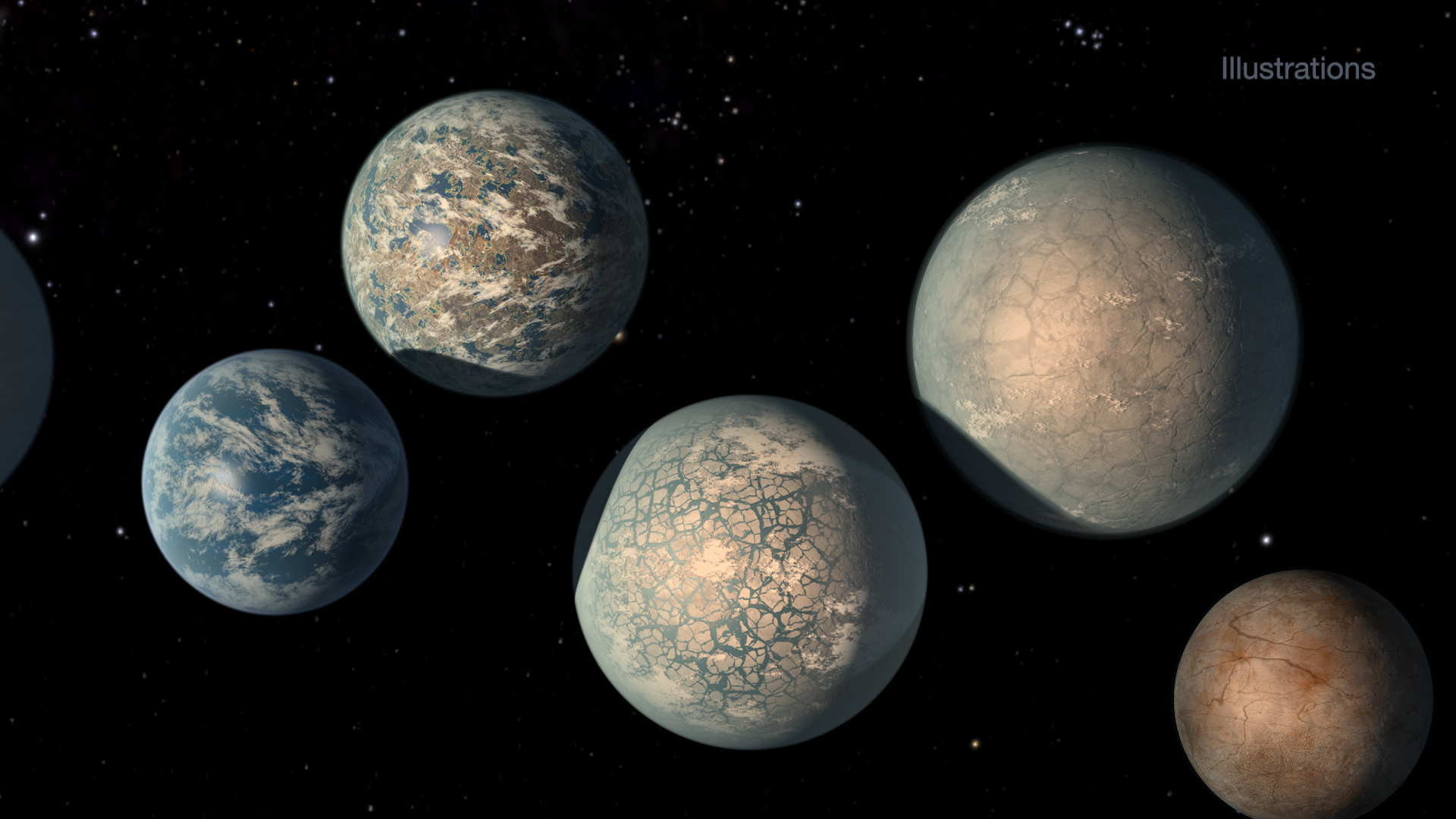
Artist’s concept, from small, rocky worlds and gas giants
Scientists have found thousands of exoplanets (planets outside our solar system) throughout the galaxy. Most can be studied only indirectly, but scientists know they vary widely, as depicted in this artist’s concept, from small, rocky worlds and gas giants to water-rich planets and those as hot as stars.
NASA’s Goddard Space Flight Center

The milestone comes 30 years after the first exoplanet was discovered around a star similar to our Sun, in 1995. (Prior to that, a few planets had been identified around stars that had burned all their fuel and collapsed.) Although researchers think there are billions of planets in the Milky Way galaxy, finding them remains a challenge. In addition to discovering many individual planets with fascinating characteristics as the total number of known exoplanets climbs, scientists are able to see how the general planet population compares to the planets of our own solar system.

For example, while our solar system hosts an equal number of rocky and giant planets, rocky planets appear to be more common in the universe. Researchers have also found a range of planets entirely different from those in our solar system. There are Jupiter-size planets that orbit closer to their parent star than Mercury orbits the Sun; planets that orbit two stars, no stars, and dead stars; planets covered in lava; some with the density of Styrofoam; and others with clouds made of gemstones.

“Each of the different types of planets we discover gives us information about the conditions under which planets can form and, ultimately, how common planets like Earth might be, and where we should be looking for them,” said Dawn Gelino, head of NASA’s Exoplanet Exploration Program (ExEP), located at the agency’s Jet Propulsion Laboratory in Southern California. “If we want to find out if we’re alone in the universe, all of this knowledge is essential.” 

Searching for other worlds

Fewer than 100 exoplanets have been directly imaged, because most planets are so faint they get lost in the light from their parent star. The other four methods of planet detection are indirect. With the transit method, for instance, astronomers look for a star to dim for a short period as an orbiting planet passes in front of it.

To account for the possibility that something other than an exoplanet is responsible for a particular signal, most exoplanet candidates must be confirmed by follow-up observations, often using an additional telescope, and that takes time. That’s why there is a long list of candidates in the NASA Exoplanet Archive (hosted by NExScI) waiting to be confirmed.

“We really need the whole community working together if we want to maximize our investments in these missions that are churning out exoplanets candidates,” said Aurora Kesseli, the deputy science lead for the NASA Exoplanet Archive at IPAC. “A big part of what we do at NExScI is build tools that help the community go out and turn candidate planets into confirmed planets.”

The rate of exoplanet discoveries has accelerated in recent years (the database reached 5,000 confirmed exoplanets just three years ago), and this trend seems likely to continue. Kesseli and her colleagues anticipate receiving thousands of additional exoplanet candidates from the ESA (European Space Agency) Gaia mission, which finds planets through a technique called astrometry, and NASA’s upcoming Nancy Grace Roman Space Telescope, which will discover thousands of new exoplanets primarily through a technique called gravitational microlensing.

Artists concept of various exoplanet missions
Many telescopes contribute to the search for and study of exoplanets, including some in space (artists concepts shown here) and on the ground. Doing the work are organizations around the world, including ESA (European Space Agency), CSA (Canadian Space Agency), and NSF (National Science Foundation).
NASA/JPL-Caltech

Future exoplanets

At NASA, the future of exoplanet science will emphasize finding rocky planets similar to Earth and studying their atmospheres for biosignatures — any characteristic, element, molecule, substance, or feature that can be used as evidence of past or present life. NASA’s James Webb Space Telescope has already analyzed the chemistry of over 100 exoplanet atmospheres.

But studying the atmospheres of planets the size and temperature of Earth will require new technology. Specifically, scientists need better tools to block the glare of the star a planet orbits. And in the case of an Earth-like planet, the glare would be significant: The Sun is about 10 billion times brighter than Earth — which would be more than enough to drown out our home planet’s light if viewed by a distant observer.

NASA has two main initiatives to try overcoming this hurdle. The Roman telescope will carry a technology demonstration instrument called the Roman Coronagraph that will test new technologies for blocking starlight and making faint planets visible. At its peak performance, the coronagraph should be able to directly image a planet the size and temperature of Jupiter orbiting a star like our Sun, and at a similar distance from that star. With its microlensing survey and coronagraphic observations, Roman will reveal new details about the diversity of planetary systems, showing how common solar systems like our own may be across the galaxy.

Additional advances in coronagraph technology will be needed to build a coronagraph that can detect a planet like Earth. NASA is working on a concept for such a mission, currently named the Habitable Worlds Observatory.

More about ExEP, NExScI 

NASA’s Exoplanet Exploration Program is responsible for implementing the agency’s plans for the discovery and understanding of planetary systems around nearby stars. It acts as a focal point for exoplanet science and technology and integrates cohesive strategies for future discoveries. The science operations and analysis center for ExEP is NExScI, based at IPAC, a science and data center for astrophysics and planetary science at Caltech. JPL is managed by Caltech for NASA.

/

News Media Contact

Calla Cofield
Jet Propulsion Laboratory, Pasadena, Calif.
626-808-2469
calla.e.cofield@jpl.nasa.gov

2025-119

💾

The official number of exoplanets, planets outside our solar system, confirmed by NASA has reached 6,000.Thirty years ago, the first exoplanet was discovered a...

This Week in Space: Scylla, Moon Dust, and Space Plumbing

GMT033_EHDC3_1157

Good morning, readers, and happy Friday. Welcome to This Week in Space, our Friday morning roundup of the week’s most important space news. Today we’ve got a bunch of good news, including a newfound exoplanet and a dozen new moons orbiting Jupiter. We’ve also got a report of an absolutely wild idea — a literal moonshot — for fighting climate change with moon dust.

SpaceX Starship Aces Static Fire Test

Thursday afternoon, SpaceX ran a successful static fire test of its gigantic Starship rocket. With 33 separate Raptor engines, Starship has the most engines of any rocket ever. Together, their thrust is twice that of a Saturn V or the Space Launch System. Is anyone else amazed the struts can hold that thing on the gantry?

Only 31 of the 33 engines fired. However, that’s actually good news because it means Starship can handle multiple engine failures.

Views from drone of Booster 7's static fire test pic.twitter.com/KN4sk1nohf

— SpaceX (@SpaceX) February 9, 2023

SpaceX hopes to attempt a test flight for Starship in March. “That first flight test is going to be really exciting. It’s going to happen in the next month or so,” said Gwynne Shotwell, SpaceX’s president and chief operating officer.

“We will go for a test flight and we will learn from the test flight and we will do more test flights,” Shotwell added. “The real goal is to not blow up the launch pad. That is success.”

ISS Astronauts Work On Plasma Crystals, Space Plumbing

We’ve talked about how the folks aboard the International Space Station have to become polymaths to keep up with the demands of life in orbit. This winter, among many other pursuits, NASA astronauts on the ISS have been tending tomatoes and working on avant-garde methods of space propulsion. But the most recent projects in low-earth orbit make space tomatoes sound outdated. Over the past few days, crew on the ISS have been working on plasma crystals, servicing jetpacks, and… doing space plumbing.

NASA astronaut Frank Rubio and JAXA astronaut Koichi Wakata spent Thursday doing maintenance on the station’s water recovery system and orbital plumbing for the station’s bathroom, respectively. Meanwhile, station commander Sergey Prokopyev worked inside the Columbus lab “configuring video hardware that records how clouds of highly charged particles, or plasma crystals, behave in microgravity.”

Hubble Captures New Portrait of Tarantula Nebula

The Tarantula Nebula is the brightest star-forming region in our cosmic neighborhood. It’s not even in our galaxy — it’s in the Large Magellanic Cloud, one of the Milky Way’s satellite galaxies. But it’s so bright that it dazzles even at that distance. Astronomers recently used the Hubble space telescope to capture this image of the Tarantula Nebula in all its splendor:

What you see here is actually a joint effort between two different astronomy projects. One team sought to analyze the properties of dust grains floating between stars — a proposal dubbed Scylla by the Hubble team. Those dust grains create the dark, wispy clouds spread across the frame. The other, called Ulysses, studies interstellar dust and starlight interactions.

Curiosity Finds Clues to Mars’ Watery Past

NASA’s Perseverance rover went to Mars with a plan: Scour the planet’s surface for evidence that can teach us about Mars’ history and tell us whether the Red Planet might once have supported life. During its two years on Mars, the rover has found silicate clay and other minerals, signs that liquid water once flowed across Mars’ surface. But none of its discoveries have had evidence of water as visually obvious as a photograph that the agency’s Curiosity rover recently captured. The rover caught a photo of sandstone rock with ripples carved out of its surface, showing that the rock was once at the bottom of a lake.

The ripples support our observations of Mars’ weather and climate. Gentle, constant winds create standing ripple patterns like these. This fits with the constant prevailing winds and planetwide dust storms we’ve seen on Mars. It’s also exciting evidence that Mars indeed had liquid water once upon a time.

Russia Launches Progress Spacecraft to International Space Station

Russia successfully launched a Progress capsule aboard a Soyuz rocket this week, bound for the International Space Station. The rocket launched from Russia’s Baikonur aerodrome early Thursday morning, local time. This capsule, ISS Progress 83 (83P), carries about three tons of supplies, including food, water, and air. It will dock with the Russian Zvezda module on Saturday morning, replacing the Progress capsule that left Monday afternoon.

What happens to Progress 82 once it departs? Progress capsules are expendable. This means that the crew on the ISS loads the capsules with trash from the station while it’s docked. Then, hours or days after the capsule undocks, it burns up in the atmosphere.

CAPSTONE Lunar Satellite Reports In After 11-Day Glitch

NASA’s CAPSTONE satellite is finally responding to hails after nearly two weeks incommunicado. A software glitch left the probe unresponsive on Jan. 26 until it rebooted itself Monday.

“The spacecraft remained overall healthy and on-course throughout the issue,” NASA said in a blog post. “On Feb. 6, an automatic command-loss timer rebooted CAPSTONE, clearing the issue and restoring two-way communications between CAPSTONE and the ground.”

The satellite has made twelve successful circuits in its near-rectilinear halo orbit (NRHO) — twice what its original mission expected. That’s great news for NASA. CAPSTONE is trying out the fancy new NRHO orbit because it’s more fuel efficient than other lunar orbits we’ve used. In twelve orbits, CAPSTONE has only had to fire its engine twice. This smashing success means the agency may use the new orbital pattern for lunar support satellites under the aegis of its Artemis project.

Rolls-Royce Building Nuclear Engine For Spaceships

Did you know Ball makes Mason jars — and parts for space telescopes? Ball made parts for Hubble and the mirrors for the JWST. In a similar fashion, Rolls-Royce appears to be branching out. Way out. The luxury automaker’s subsidiary, Rolls-Royce Holdings, has announced plans to build a nuclear engine for deep space exploration.

(Image: Rolls-Royce Holdings)

According to Rolls-Royce, the micro-reactor will use uranium as fuel for nuclear fission. The company hopes to use the micro-reactor as an energy source for trips to the Moon, Mars, and beyond.

Webb Telescope Breaks Own ‘Speed Limit’ Tracking DART Impact

NASA’s Guaranteed Time Observation program gives a certain amount of telescope time to those who worked on the JWST. One GTO project: Making observations of NASA’s DART kinetic asteroid redirect test. However, the project brought an unlooked-for surprise. Wednesday, JWST deputy project scientist Stefanie Milam explained how the telescope broke its own speed limit watching the asteroid impact.

Webb launched with the ability to track objects moving through the sky as fast as Mars. But scientists who study fast-moving small bodies like asteroids, comets, and interstellar objects “really wanted to study objects that moved faster than Mars,” said Milam. So, the team set out to show that not only could Webb exceed this “notional speed limit,” it could go much faster. Their efforts paid off when it came time to observe the DART asteroid impact.

NASA’s DART kinetic asteroid redirect test, as seen by the JWST. Image: NASA/JPL

The video Webb captured of the Dimorphos impact showed that the telescope can move its field of regard at more than triple its original maximum speed. Most of the time, though, Milam says the telescope will confine itself to double its original turning speed. Darn.

Chris Hadfield Meets With King Charles III

On Thursday, Canada’s favorite astronaut, Chris Hadfield, met with King Charles III at Buckingham Palace. The two sat down to discuss “efforts to encourage sustainability in space,” according to the Royal Family’s official Twitter.

“What a pleasure and privilege to be asked to advise and assist, and make the King laugh,” Hadfield wrote afterward.

What a pleasure and privilege to be asked to advise and assist. And make the King laugh :) https://t.co/3dGxNLCkUJ pic.twitter.com/DH9dgkq9t9

— Chris Hadfield (@Cmdr_Hadfield) February 9, 2023

While we don’t yet have specifics, Charles is a longtime environmentalist. Could it be that the King is interested in cleaning up space junk?

A Shield of Lunar Dust Could Help Cool Earth

Astrophysicists are pondering the pros and cons of a literal moonshot to blunt the effects of climate change. In a recent study, a group of researchers proposed launching moon dust into orbit around Earth to create a dusty shield that would reduce Earth’s exposure to the Sun. Evidently, lunar dust grains are just the right size and composition to block some of the solar energy that would hit the Earth.

For six days out of the year, the researchers say, the dust cloud would shield Earth from a few percent of the Sun’s radiation. To carry out this plan, the researchers’ numbers require dredging up some 22 billion pounds of lunar dust. They could fire the dust into orbit from the Moon or a platform in orbit — potato, poterrible idea. Surely there is some lower-hanging fruit?

Scientists Find a Dozen New Moons Orbiting Jupiter

In October 2019, astronomers at the Carnegie Institution for Science found 20 new moons orbiting Saturn. This made Saturn the “moon king” of the Solar System, with a total of 83. However, the same team has announced they’ve found a dozen new moons orbiting Jupiter.

Jupiter – Unsplash

Stealing the crown back from Saturn, Jupiter now has 92 known moons. Nine of the twelve new moons are retrograde, meaning they orbit “backward” against Jupiter’s orbit. All the new moons are quite small, and they had been lost in Jupiter’s glare until now.

Astronomers Spot Nearby, Potentially Habitable Exoplanet

An international team of astronomers has reported a newfound exoplanet in our cosmic backyard. The new planet, Wolf 1069 b, is between 1 and 1.4 Earth masses and just 8% bigger. Calling it Earth-like might be a stretch: Wolf 1069 b zips around its low-mass red dwarf star in just 15 Earth days. However, it’s just 31 light-years away.

Unlike our nearest neighbor, Proxima Centauri, Wolf 1069 doesn’t show the characteristic bursts of violent flares we frequently see in red dwarf stars. This could mean it has managed to retain an atmosphere. If so, the planet’s surface temperature could be about 55 degrees Fahrenheit. If not, it’s more likely an iceball, too cold to sustain liquid water.

Skywatchers Corner

Comet C/2022 E3 (ZTF) is a once-in-an-epoch visitor from the outer solar system. We haven’t seen it since the time of the Neanderthals, but it’s come back for one last visit. The outbound comet passed close to Earth last week. Now, it’s buzzing Mars.

It's green! Comet C/2022 E3 (ZTF) and its twin tails. Image: NASA

It’s green! Comet C/2022 E3 (ZTF) and its twin tails. Image: NASA

The green comet will be near Mars in the constellation of Taurus for the next several days. After sunset, look high in the sky for the best shot at catching it through binoculars or a telescope. After Feb. 14, the comet will start heading toward Orion and Eridanus.

If you don’t have a good shot at viewing the comet where you are, you can still catch it online. This weekend, the Virtual Telescope Project is webcasting a free livestream of the comet’s approach to the Red Planet. The livestream will begin this Saturday, Feb. 11, at 2 p.m. EST (1900 GMT). You can watch it on the project’s website and YouTube channel.

Feature image: This week’s waning gibbous moon, taken from the International Space Station. Courtesy of NASA HQ Flickr.

Now Read:

❌