Reading view

There are new articles available, click to refresh the page.

Bitcoin Price Slides Below $90,000 – Is A Retest Of The November Lows Near?

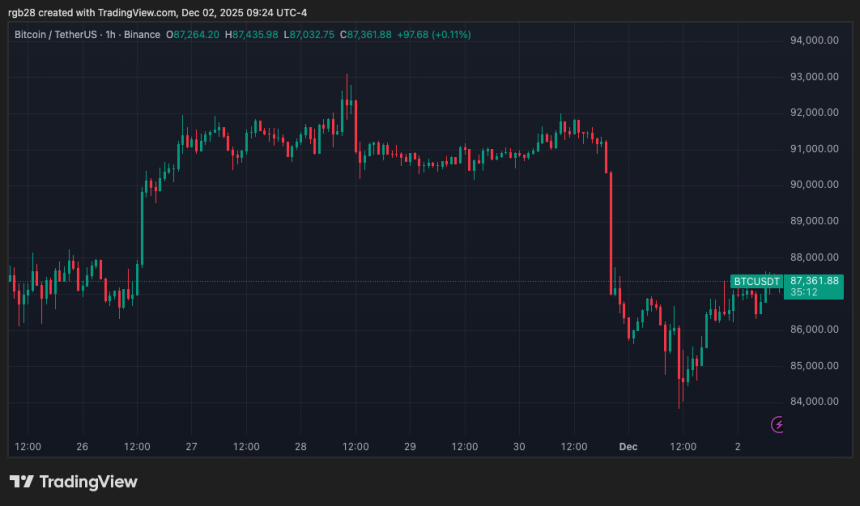
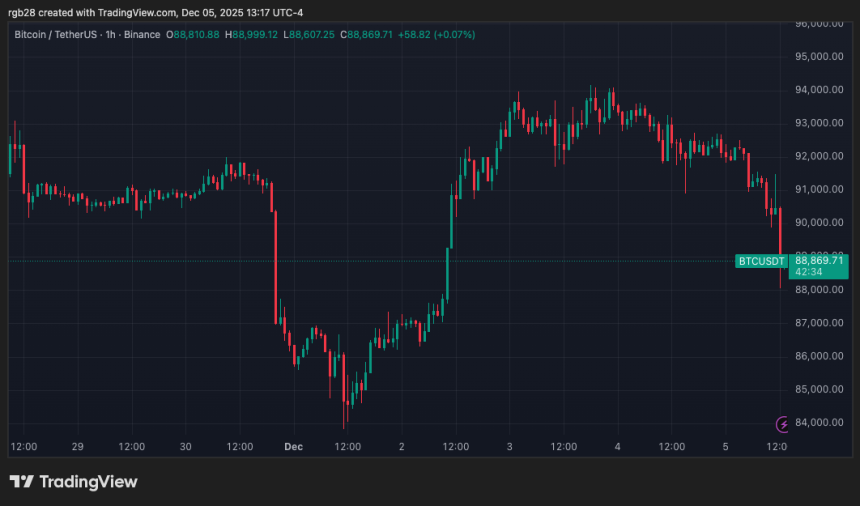
Bitcoin (BTC) is retesting a crucial support area after its price slid 5% from the recent highs and fell below the $90,000 barrier. Some analysts have suggested that the cryptocurrency’s structure remains intact, but warned that it must bounce quickly or risk retesting the November lows.

Bitcoin Retests $88,000 After Rejection

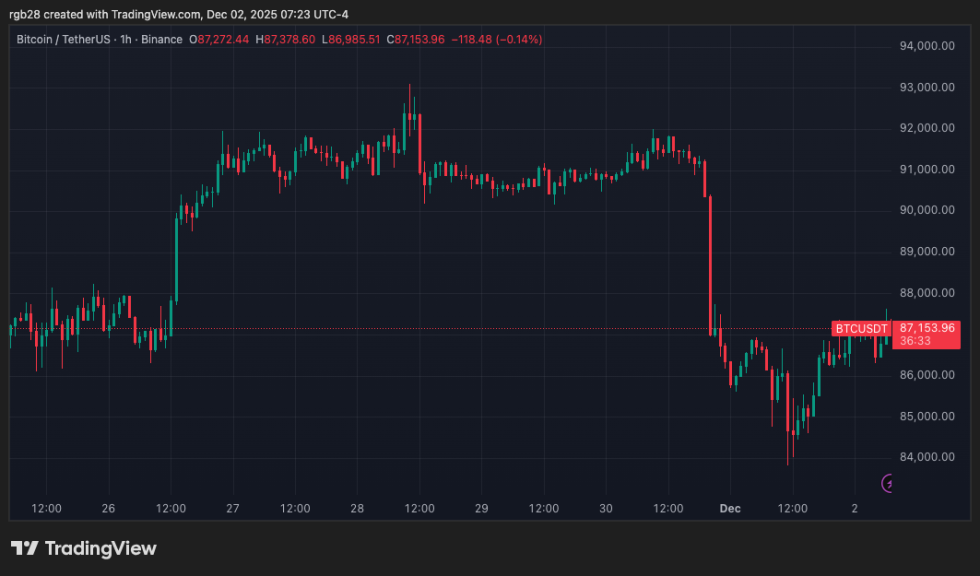
On Friday, Bitcoin lost the recently reclaimed $90,000 level, falling to a key support area before stabilizing. The flagship crypto has been attempting to recover from the November market correction, which sent its price to a seven-month low of $80,600.

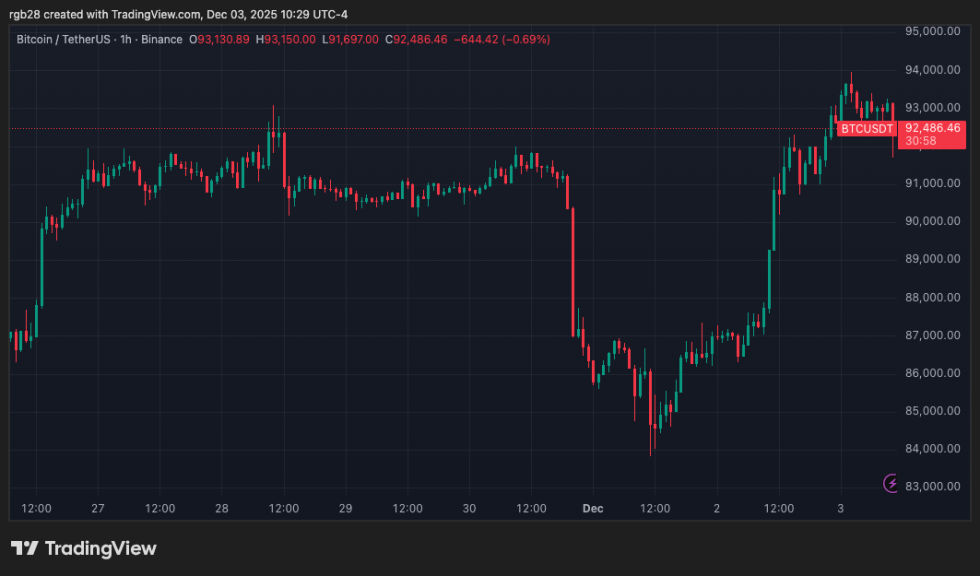
Since reaching its local lows two weeks ago, the cryptocurrency has traded within a macro re-accumulation range, between $82,000 and $93,500, attempting to break out of this zone on Wednesday, when it reached a multi-week high of $94,150.

However, as the first week of December approaches its end, BTC has lost the upper area of its local range again, falling below its monthly open and tapping the $88,000 support.

Amid the drop, Analyst Ted Pillows noted that BTC has been struggling to reclaim the $94,000 resistance, adding that price “wants to go lower here before another breakout attempt.”  Therefore, he suggested that a bounce back from the $88,000-$89,000 support zone is likely.

Altcoin Sherpa affirmed that the ongoing retest would confirm whether the recent bounce was “just lower highs and price is going lower or if we actually have any juice to bounce to like 100k or something.”

The analyst outlined two potential outcomes. In the first scenario, the flagship crypto would retrace to the $87,000-$89,000 area and bounce above the $93,000-$94,000 resistance levels.

In the second scenario, Bitcoin would continue to move sideways below the local resistance before eventually sliding to the November lows and potentially lower levels. Per the analysis, the leading cryptocurrency must bottom quickly, or it will risk the second outcome.

BTC Shows Shallowing Pullback Tendency

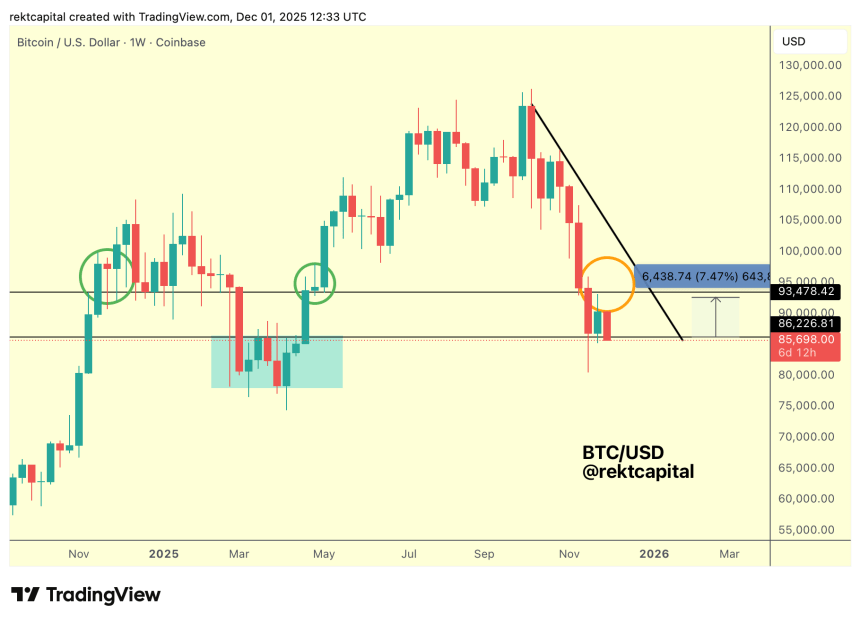
Analyst Rekt Capital also pointed out that Bitcoin continues to face rejection from the range high resistance. However, he considers that investors should not worry as long as the pullback isn’t as big as the previous ones.

If “the rejection is shallower than the previous two, then this resistance will continue to weaken until eventually breached,” he explained, adding that “as long as this weakening continues, BTC should be able to finally breach this resistance over time & try to challenge the multi-week Downtrend above.”

Earlier this week, the analyst affirmed that BTC’s consolidation structure will remain intact as long as Bitcoin closes the week above the range lows. He also noted that its Macro Downtrend, which “has been dictating resistance throughout this phase of the cycle,” remains the dominant structural barrier and the level to break.

As the price stabilized between the $88,500-$89,350 area, the analyst added that today’s retracement “continues to be a shallower pullback than the previous two,” which keeps the range “‘retrace shallowing’ tendency” intact.

He noted that Bitcoin could technically drop into the ascending two-week support trendline, or tap the $86,000 level and still perform a shallower correction than the recent 10% drop.

As of this writing, Bitcoin is trading at $89,400, a 2.9% decline in the daily timeframe.
Bitcoin, btc, btcusdt

S&P Welcomes Top Exchange’s Native Token To Five Key Crypto Indices

European exchange WhiteBIT announced the inclusion of its native token in major digital asset benchmarks by leading global provider of financial market indices, S&P Dow Jones Indices, marking a significant step for the platform and the region’s crypto infrastructure sector.

WhiteBIT Included In Major Crypto Indices

On Thursday, top crypto exchange WhiteBIT announced that its token, WBT, has been added to the S&P Cryptocurrency Broad Digital Market (BDM) Index, curated by S&P Dow Jones Indices (DJI).

The S&P BDM Index is designed to track the performance of crypto assets that meet strict institutional criteria, including liquidity, market capitalization, governance, transparency, and risk controls, and are listed on recognized open digital exchanges.

This marks an important milestone for both WhiteBIT and the broader fintech landscape in Central and Eastern Europe, the exchange noted, as it reinforces “the platform’s growing role in the global crypto economy” and highlights the industry’s move toward regulated, infrastructure-level players.

In a statement, Volodymyr Nosov, CEO of WhiteBIT, affirmed that “being recognized by S&P DJI is more than an index inclusion — it signals that crypto infrastructure from our region has reached global institutional standards.”

The announcement also revealed that WBT was added to the other four S&P Dow Jones digital-asset indices, including the S&P Cryptocurrency Broad Digital Asset (BDA) Index, S&P Cryptocurrency Financials Index, S&P Cryptocurrency LargeCap Ex-MegaCap Index, and the S&P Cryptocurrency LargeCap Index.

Notably, index providers have been expanding coverage beyond protocol-layer tokens as the industry matures, acknowledging the systemic role of exchanges and financial infrastructure platforms, positioning these companies within the global map of institutional-grade digital asset providers.

The exchange underscored that the classifications require a remarkable record of liquidity stability, transparent price formation, and consistent market cap behavior. “This is a turning point not only for our company but also for the evolution of compliant crypto services worldwide,” Nosov continued.

WhiteBIT’s Expansion And WBT’s Momentum

The S&P index inclusions follow a strong market performance from WBT, which rallied around 50% over the last three months, despite recent market volatility that sent many leading tokens to multi-month lows in the past few weeks.

In mid-November, the altcoin reached an all-time high (ATH) of $62.96, fueled by last month’s positive developments. As reported by Bitcoinist, WhiteBIT unveiled its entry into the Argentine and Brazilian markets, building on its expansion to Australia, Croatia, Italy, and Kazakhstan.

The move is expected to integrate local fiat providers and add support for local currencies, aiming to further enhance accessibility and convenience for domestic users in the two largest countries in South America.

Moreover, the exchange signed a strategic cooperation agreement with Durrah AlFodah Holding, represented by His Royal Highness Prince Naif Bin Abdullah Bin Saud Bin Abdulaziz Al Saud, to drive the Kingdom’s development in blockchain technology, digital finance, and data infrastructure.

Under the strategic agreement, WhiteBIT is set to provide technological expertise and infrastructure design. Meanwhile, Durrah AlFodah will facilitate the exchange’s market entry, regulatory engagement, and partnership development across Saudi Arabia.

Now, being part of S&P’s indices offers WBT a clear benchmark, the announcement added, facilitating its use in future financial products and long-term investment strategies.

This expanded representation marks an important shift for WBT: from a utility token into a component integrated into global benchmark structures used by investment firms, ETF/ETN designers, and quantitative research platforms. Its presence in multiple institutional models means that WBT is now incorporated into the analytical frameworks that guide long-term allocation strategies, diversified exposure construction, and risk-adjusted portfolio modelling.

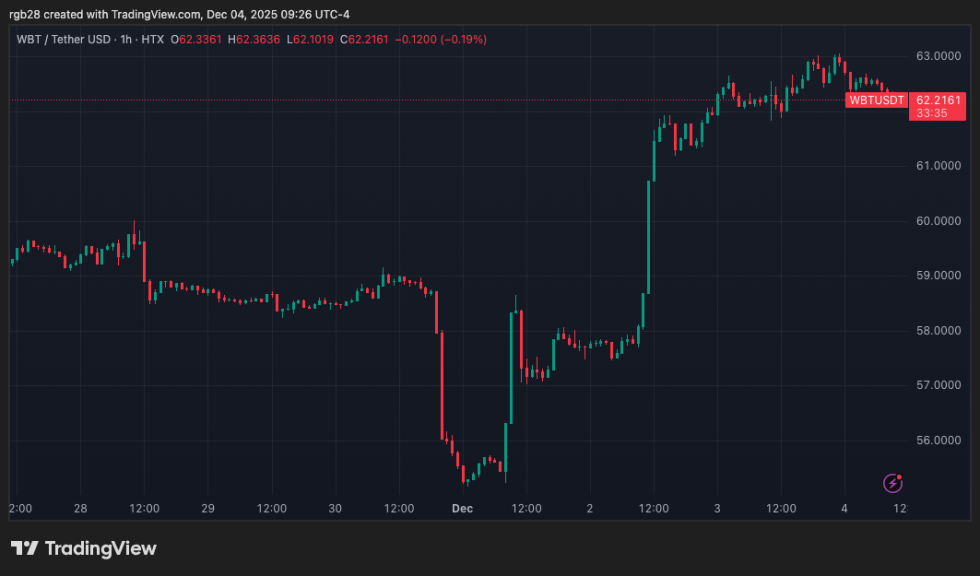
In the late hours of December 3, WBT rallied to a new ATH of $63.05 before stabilizing around the $62 mark, according to CoinGecko data. This represents a 14.5% increase from the recent lows and a 9% surge in the weekly timeframe.

crypto, WBT, WBTUSDT

XRP ETFs Record 13-Day Streak As SOL Funds See Largest Outflows Since Launch

As institutional demand intensifies and the crypto market recovers, US spot XRP Exchange-Traded Funds (ETFs) continue to lead the sector with a 13-day streak and over $200 million in positive net flows this week, outshining Solana (SOL) ETFs, which recorded their third day of outflows in seven days.

XRP Funds Lead Crypto ETF Inflows

Spot XRP exchange-traded funds have extended their record-breaking streak after registering their thirteenth consecutive day of positive net flows, with $50.27 million in inflows on December 3.

The investment products have seen a remarkable performance since the launch of Canary Capital’s XRPC, the first single-token XRP spot ETF, on November 13, positioning the funds as the fastest-growing altcoin-based category.

Notably, XRPC surpassed all initial expectations and debuted on Nasdaq with a total volume of $58 million, recording around $357.54 million in positive net flows in 13 days. Last week, the second group of XRP funds went live, becoming the largest US ETF launches of 2025 with over $60 million in net inflows each during their first day.

Moreover, the category, led by Grayscale’s GXRP and Franklin Templeton’s XRPZ, surpassed other major ETFs in single-day inflows, including those based on the largest cryptocurrencies by market capitalization, Solana, Bitcoin (BTC), and Ether (ETH).

Amid this week’s market recovery, XRP ETFs saw $89.65 million on Monday, $67.7 million the following day, and an additional $50.27 million on Wednesday, for a cumulative net inflow of $207.66 million during the first three days of December.

As a result, the leading category surpassed both Bitcoin ETFs’ $52.4 million and Ethereum ETFs’ $51.3 million positive net flows, respectively, during the same three-day period.

With a total of $874.28 million in inflows in 13 days, spot XRP ETFs have surpassed the $618.62 million total inflows of SOL ETFs, which held the record among the second wave of altcoin-based investment products.

Solana ETFs Demand Loses Steam

While XRP ETFs take the spotlight, Solana funds’ momentum has slowed, seeing their largest days of outflows this week. According to SoSovalue data, the investment products recorded $32.9 million in outflows on December 3, marking their third negative net flows day since the category debuted on October 28.

Despite pulling out positive net flows, Bitwise’s BSOL, Fidelity’s FSOL, and Grayscale’s GSOL were unable to absorb 21Shares’ TSOL $41.8 million in outflows. This performance also marks the fourth negative day for TSOL over the past week.

As reported by NewsBTC, Solana ETFs experienced a record performance in November despite the market correction, with $613 million in inflows during their 22 consecutive day positive streak.

However, the remarkable streak ended a week ago when TSOL registered negative net flows for the first time, and the category was unable to absorb them, recording outflows of $8.1 million.

SOL-based investment products started December with outflows worth $13.5 million, which were followed by strong inflows worth $45.77 million on Tuesday. On December 3, the funds registered $32.19 million in outflows, amounting to a negative net flow of $700,000 for the first half of the week, despite the altcoin’s recent price recovery.

XRP, XRPUSDT

Solana Eyes Major Resistance After $140 Reclaim, But Analyst Questions SOL’s Strength

As the market rebounds, Solana (SOL) is retesting a crucial area that has served as resistance since the November pullbacks. Some market watchers suggest that a short-term rally is likely, while others have highlighted potential signs of weakness.

Solana Eyes $144 Resistance

Solana is attempting to turn the $140 area into support while nearing a key local resistance for the third time in a month. The cryptocurrency has been trading between the $120-$144 levels since mid-November, struggling to hold the high zone of its local range amid the recent market volatility.

Last week, it bounced 10% toward the $140-$144 area but plunged to the range lows after Sunday’s correction, hitting a one-week low of $123 on Monday. As a result, it tested an ascending trendline that has served as support since 2023.

Ali Martinez explained that during the pullbacks, SOL has retested this key support trendline. Notably, each time the cryptocurrency has tapped this trendline, it has registered strong rebounds in the following months, suggesting that the price could rally more than 80% in the mid-term if this support holds.

Following Tuesday’s market rebound, SOL climbed back to the range’s highs, attempting to break above the local range once more. Market observer More Crypto Online affirmed that Wednesday’s rejection from $144 was expected, as it has been a strong resistance for weeks.

The trader considers that investors should not worry as long as the mid-zone of its range, between the $134-$139 levels, holds as support. “It’s not really a breakdown yet; we just have a first sharp pullback,” he affirmed, emphasizing that there’s no evidence that bears are taking the lead.

He noted that breaking below the mid-zone of its range would open the door to a retest of the recent lows and potentially risk a drop to the $117 area or lower. Nonetheless, if bulls take the lead and reclaim the $144 level as support, it will open the door to a retest of higher levels, including the $163 level, where the major next sell wall for SOL is situated.

Is SOL’s Crucial Support Weakening?

Meanwhile, Rekt Capital shared an analysis on longer timeframes, pointing out that Solana has been moving within a clear macro range, situated between the $123 and $296 levels, in the monthly timeframe, clustering in this area since early 2024.

Per the analyst, the cluster has been developing for an extended period, and the potential for distribution and its function as a re-accumulation structure decreases the longer it continues.

Despite this, he emphasized that the focus is on the 21-month horizontal support level. As the analysis noted, Solana recorded a 140% rally during the first major rebound from the region in Q3 and Q4, 2024.

In the second rebound from this support, which started in Q3 2025, SOL saw a significantly smaller rally, surging around 100% to its September local high. Now, the cryptocurrency is rebounding from this level, which could confirm a decreasing trend for the altcoin and raise the alarm about its strength.

“While it is positive to see this rebound, if the move turns into a weaker rebound than the previous ones, then questions will arise regarding the strength of this support,” Rekt Capital asserted.

To prevent this, Solana must breach the one-year downtrend or the multi-week downtrend on the weekly timeframe. “Failing to break either of these trendlines would produce a smaller rally because the prior rebound — the one that rallied around 100% — would fall short and reject from these downtrends instead.”

The analyst concluded that a sequence of progressively smaller bounces “would imply increasing weakness into that support, which in turn would favour the potential for distribution in Solana over time.”

Solana, SOL, SOLUSDT

Taiwan Eyes First Stablecoin Debut In 2026 As Regulatory Framework Advances

As the sector continues to gain global momentum, Taiwanese authorities have announced that a locally issued stablecoin could be launched next year, pending the imminent approval of the country’s regulatory crypto framework and related legislation.

First Local Stablecoin To Debut Next Year

On Wednesday, Taiwan’s Financial Supervisory Commission (FSC) Chairman Peng Jin-long revealed that the island’s first regulated stablecoin could debut in the latter half of 2026, local news outlet Focus Taiwan reported.

The FSC chair affirmed that the Virtual Assets Service Act (VASA), which incorporates stablecoin regulation, could be passed during its third hearing in the next legislative session, scheduled for this week, after clearing initial reviews with a “high level of consensus.”

After the framework’s approval, stablecoin-centered regulations would be developed within six months, setting the launch of a locally issued token pegged to the New Taiwan Dollar (NTD) or the US Dollar (USD) to the second half of the year.

The VASA supports the efforts by Taiwanese authorities to establish a comprehensive crypto framework that promotes industry growth and safeguards investors. Last year, the FSC announced an overhaul of the Anti-Money Laundering (AML) framework to include crypto businesses, introducing stricter AML guidelines for Virtual Asset Service Providers (VASPs) and requiring all crypto firms to complete the AML registration by September 2025.

In January, Peng stated that investors could have a “convenient” entrance to crypto assets in the future through stablecoins, which could serve as a bridge between the country’s legal tender and virtual currency.

In March, the FSC published the finalized draft of its landmark crypto legislation, which the VASA’s draft proposed authorizing banks to issue stablecoins pegged to the New Taiwan Dollar or the US Dollar.

Meanwhile, Premier Cho Jung-tai and Central Bank Governor Yang Chin-long recently expressed support for a formal Bitcoin (BTC) policy, pledging to study the flagship cryptocurrency as a strategic reserve asset, accelerate pro-BTC rulemaking, and pilot treasury exposure through government-seized assets.

Taiwan Sets Financial Institutions’ Role

At the legislative hearing, the FSC’s chair highlighted that the bill’s draft draws from the European Union (EU)’s Markets in Crypto-Assets Regulation (MiCA). He explained that the Virtual Assets Service Act doesn’t require stablecoins to be issued exclusively by financial institutions, which has been a divisive topic in other jurisdictions.

As reported by Bitcoinist, South Korea’s long-awaited stablecoin legislation could be delayed until next year as the Korean Financial Services Commission clashes with the Bank of Korea (BOK) over the role of banks in the sector.

A local news media outlet recently noted that the BOK and regulators agree that financial institutions must be involved in the issuance of won-pegged tokens, but differ on the extent of their role.

The central bank is pushing for a consortium of banks owning at least 51% of any stablecoin issuer seeking regulatory approval. Meanwhile, regulators are concerned that giving a majority stake to banks could reduce participation from tech companies and limit the market’s innovation. Earlier this week, authorities set December 10 as the deadline for the government to deliver a draft bill.

Unlike South Korea’s financial authorities, Focus Taiwan reported that the regulator and the central bank have agreed that only financial institutions will be allowed to issue stablecoins in the initial stage to reduce risk management, suggesting that companies could join at a later stage of the project.

stablecoin, bitcoin, btc, btcusdt

Poland’s President Vetoes Crypto Market Bill Due To ‘Overregulation’ Concerns

The President of Poland has vetoed a controversial bill that aimed to set strict rules on the crypto assets market, following multiple concerns of a startup exodus, “overregulation” of the sector, and stifling market innovation.

Poland’s President Vetoes Divisive Crypto Bill

On Monday, Poland’s President Karol Nawrocki refused to sign a crypto market legislation over concerns that it could pose a real threat to the freedoms of Poles, the stability of the state, and market innovation.

In an official statement, the president’s office announced Nawrocki’s decision to veto the Crypto-Asset Market Act, introduced in June, to prevent “overregulation” and abuse of the “legal mess” proposed by the Polish government.

As reported by Bitcoinist, Poland’s crypto community previously raised concerns about the legislation in September, noting that the bill exceeded the European Union (EU)’s minimum regulatory requirements and could drive small businesses and startups abroad.

Notably, the bill’s text required all Crypto Asset Service Providers to obtain a license from the Polish Financial Supervision Authority (KNF) to operate in the market. It also proposed heavy fines and potential prison time for participants who breached the law.

Rafal Leśkiewicz, Press Secretary of the President, listed on X three main reasons for Nawrocki’s decision to reject the bill. He asserted that the legislation risks power abuse and overreach, as some provisions allow the government to shut down websites of companies offering crypto services “with a single click.”

“This is unacceptable. Most European Union countries use a simple list of warnings that protects consumers without blocking entire websites,” he noted.

In addition, the regulation’s size and lack of transparency risked overregulation, noting that countries like the Czech Republic, Slovakia, and Hungary implemented concise and comprehensive frameworks. Meanwhile, Poland’s text surpasses the one-hundred-page mark.

He argued that “Overregulation is a straight path to driving companies abroad—to the Czech Republic, Lithuania, or Malta—instead of creating conditions for them to earn money and pay taxes in Poland.”

Lastly, the Press Secretary listed the amount of supervisory fees as an issue, affirming that the government set them at a level that would have prevented small businesses and startups from developing, favoring foreign corporations and banks. To him, “this is a reversal of logic, killing the competitive market and posing a serious threat to innovation.”

Community Praises The ‘Necessary Decision’

Leśkiewicz emphasized that regulation is necessary, but added that it must oversee the market in a way that’s “reasonable, proportionate, and safe” for users, rather than overreaching and potentially harming the Polish economy.

“The government had two years to prepare a bill in line with the European MiCA regulation on the crypto-asset market in the European Union. Instead, it produced a legal mess that hurts Poles and Polish companies,” he asserted. “The decision to veto was necessary and was made responsibly. The president will defend the economic security of Poles.”

Polish economist Krzysztof Piech praised the president’s decision to veto the crypto bill, affirming that it was “a very bad law” that “violated the Polish Constitution and was contrary to the EU regulation it was supposed to implement in Poland.”

Piech also refuted claims that Poland will become a “paradise” for criminals and fraudsters, who will “be grateful” to President Nawrocki for “a crypto market without state supervision.”

The economist asserted that the government’s version of the bill “did not provide for any assistance to victims of fraudsters,” adding that, “as of July 1, 2026, the entire Polish market will be regulated and supervised — even without any legislation. After all, we are in the EU.”

crypto, bitcoin, btc, btcusdt

Bitcoin (BTC) Price In A ‘Vulnerable Technical Environment’ – Key Levels To Watch

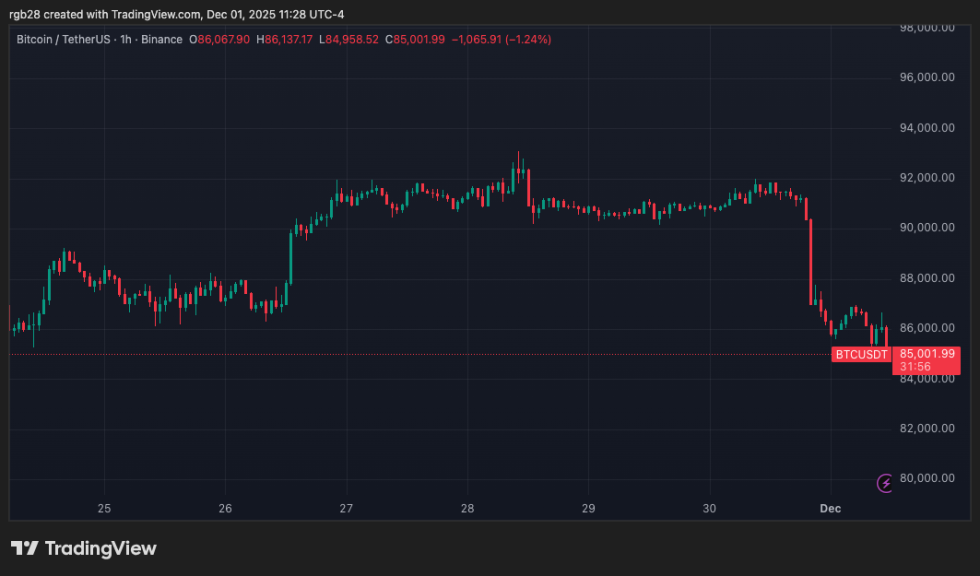
Bitcoin (BTC) began the week dropping nearly 10% from the recent highs and retesting the $84,000 area before bouncing. As price risks more downside with early bear market signals, a market observer suggested that the upcoming weeks will be crucial for BTC’s future path.

Bitcoin Holds Key Weekly Range

Last week, Bitcoin led the brief market recovery, surging from its seven-month low of $80,600 toward the $93,000 area, retesting a key weekly re-accumulation range between these two levels. However, the Sunday correction sent the price back to the range lows, raising concerns about the flagship crypto’s short-term future.

Analyst Rekt Capital highlighted that BTC is stabilizing within its weekly range, holding its position above the $82,000 range low. This area marks the top of an early 2025 liquidity cluster that developed around the 50-Week EMA, where the price has tapped with three downside wicks over the past month.

“Last week’s Weekly Close above the Range Low enabled a relief move toward $93,500,” the analyst explained, “but that level acted as clean resistance,” after Friday’s rejection. To the analyst, maintaining stability around the weekly range lows is important because further downside wicking into the cluster is probable.

Bitcoin

However, he noted that the consolidation structure remains intact as long as BTC’s price continues to hold above the range low in the weekly timeframe. Rekt Capital added that Bitcoin continues to trade below a sharply declining Macro Downtrend that “has been dictating resistance throughout this phase of the cycle.”

Per the analysis, “A breakout soon would require reclaiming higher price levels, whereas a later attempt would meet the trendline at lower valuations, narrowing the distance between the current price and resistance.”

“In either case, the Macro Downtrend remains the dominant structural barrier, and Bitcoin’s path forward depends on whether consolidation near the Weekly Range Low can bring price closer to a meaningful test of this sharply descending level,” he continued.


BTC’s Vulnerable Technical Environment Raises Alarms

Rekt Capital also highlighted that BTC remains below the 21-Week EMA and 50-Week EMA, which could pose a problem for its future price action as the distance between these moving averages continues to narrow.

As he detailed, when these EMAs compress and ultimately cross, it tends to precede further downside. Although it usually takes weeks after the crossover for price acceleration to “fully unfold,” it still implies that the crossover risk is increasing.

The two EMAs currently represent potential resistance levels on future relief attempts, with the 50-Week EMA retest “leaving room for a future rejection if price revisits it.”

This position, the analyst explained, places BTC in a “vulnerable technical environment” as “the convergence of the EMAs toward the Macro Downtrend creates a layered zone of resistance that will be difficult to overcome unless price can reclaim one of these moving averages and stabilise above it.”

Until Bitcoin successfully turns one of the EMAs into support, “the structure resembles the early-stage clustering seen in prior cycles where EMAs compressed before a broader bearish continuation,” the analyst concluded.

As of this writing, Bitcoin is trading at $88,294, a 2.3% increase in the daily timeframe.

Bitcoin, btc, btcusdt

Zcash (ZEC) Leads Market Pullback With 24% Drop, Analysts Warn Of Another Crash Ahead

As the whole crypto market bled, Zcash (ZEC) started December with a massive one-day pullback, leading the losses among top cryptocurrencies. While some market observers suggest that the altcoin is positioned for a major move, others have warned that the price risks another major correction in the coming weeks.

Zcash Loses Key Support Levels Amid Crash

Following the late Sunday market correction, Zcash has lost crucial levels and fallen to one-month lows. Over the past three months, the cryptocurrency has seen a parabolic rally, surging over 1,775% to its all-time high (ATH) of $750 in early November.

Since its ATH rally, the altcoin has been trading within the $440-$720 levels, bouncing between the range’s upper and lower boundaries amid the recent market volatility. However, the end-of-November pullback saw ZEC’s price unsuccessfully retest its key support area, closing the day below this area for the first time in nearly a month.

After losing this zone, Zcash continued to drop below other key support levels, breaking down the $400 barrier and hitting a local low of $328 on Monday morning before bouncing to the $340 area.

Amid this performance, some market observers warned that the altcoin could be in trouble and further bleeding may occur in the coming weeks. Sjuul from AltCryptoGems highlighted that ZEC registers the biggest price drops in the weekly and daily timeframes, with declines of 40.2% and 24%, respectively.

The analyst previously pointed out that the cryptocurrency lost its uptrend after falling below the EMA200, recording “a perfect bearish retest followed by a strong rejection” last week. As a result, Sjuul suggested that if Zcash did not reclaim the key moving average, the cryptocurrency would be positioned for a breakdown to lower support levels.

Similarly, Altcoin Sherpa considers that ZEC could drop another 30%-40% to the $200 area after losing the crucial $440 support. Nonetheless, he added that the price will likely see short-term bounces during its retracement.

ZEC’s Correction: Nothing To Worry About?

Mert Mumtaz, Helius co-founder and CEO, affirmed that a correction after a 700% rally “is normal,” adding that the privacy token “looks great” on higher timeframes. Notably, the cryptocurrency still shows 700% and 485% increases on the three-month and one-year timeframes.

The CEO also highlighted Zcash’s strengths: “privacy is not a narrative, private money is the entire purpose of crypto,” suggesting that the altcoin is positioned to challenge other leading cryptocurrencies like XRP in the future.

Meanwhile, another pseudonym market watcher considers that Zcash is preparing for a big move despite the correction. According to X analyst Make Sense, the cryptocurrency is at a make-or-break level after falling to the $320 mark, its first major support area below the November range.

If ZEC holds the current range, the price could reclaim its recently lost range and bounce to its $500-$600 mid-range. On the contrary, if it loses its current levels, the cryptocurrency could retest the $280 and even $200 area, he affirmed, before a trend reversal.

“This is where market makers decide the next trend: bounce early → mid-range rally or deep sweep → full trend reversal. Either way, volatility is about to explode,” he explained.

As of this writing, Zcash is trading at $338, a 20% decline in the monthly timeframe.

Zcash, ZEC, ZECUSDT

Hong Kong Stablecoin Hub Ambitions At Risk Following Beijing’s Latest Crypto Warning – Report

Hong Kong’s stablecoin hub dreams have reportedly taken a hit after the People’s Bank of China (PBOC) singled out the sector for the first time while reaffirming its long-standing position on the crypto industry.

Beijing’s Latest Warning Targets Stablecoins

Legal experts and analysts suggested that Beijing authorities have clouded Hong Kong’s ambitions to become a key regulated hub for stablecoins following the PBOC’s explicit crackdown on the sector last week.

As reported by Bitcoinist, the People’s Bank of China, alongside other top financial regulators, affirmed on Friday that stablecoins do not qualify as legal tender in the mainland, as they fail to meet regulatory requirements and pose a risk of being used for illegal activities.

“Virtual currency-related business activities constitute illegal financial activities. Stablecoins are a form of virtual currency, and currently cannot effectively meet requirements for customer identification and anti-money laundering, posing a risk of being used for illegal activities such as money laundering, fundraising fraud, and illegal cross-border fund transfers,” the PBOC stated.

According to the South China Morning Post (SCMP), the recent pronouncement sank previous hopes that Beijing might have softened its stance on cryptocurrencies amid the global regulatory shift toward the sector, led by the United States. Moreover, it could affect Hong Kong’s efforts to become a hub for the stablecoin sector, analysts recently stated.

In a blog post cited by SCMP, Liu Honglin, founder of Shanghai-based Mankun Law Firm, affirmed that “all the ambiguity, speculation and room for wishful thinking surrounding stablecoins over the past few years has vanished as of today.”

Similarly, Brian Tang, founding director of the Law, Innovation, Technology and Entrepreneurship Lab at the University of Hong Kong’s Faculty of Law, told the news media outlet that Beijing’s latest stance means that applicants for Hong Kong’s stablecoin licenses would need to “‘carefully reconsider’ whether the use cases they had submitted to the HKMA ‘touch mainland China issuers and users.’”

Hong Kong Licenses Approval Risks Delay

The statement also adds to the challenges that Hong Kong’s stablecoin push faces, the report noted. Earlier this year, the Hong Kong Monetary Authority (HKMA) enacted the Stablecoins Ordinance, which directs any individual or entity seeking to issue a fiat-referenced stablecoin (FRS) in the jurisdiction, or any Hong Kong Dollar (HKD)-pegged token, to obtain a license from the financial regulator.

Following the rollout, multiple companies have applied for the license, with more than 30 applications filed, according to SCMP, including logistics technology firm Reitar Logtech and the overseas arm of Chinese mainland financial technology giant Ant Group.

E-commerce giant JD.com, through its fintech arm JD Coinlink, started testing HKD-pegged tokens under the regulator’s sandbox program earlier this year. In August, Wang Hua, CFO and Board Secretary of PetroChina, also disclosed that the company is closely monitoring the latest developments regarding the HKMA Stablecoins Ordinance.

It’s worth noting that Hong Kong’s regulatory agency previously affirmed that the first batch of stablecoin issuer licenses would be approved at the start of 2026. However, some industry players told the news media outlet that the PBOC’s recent declarations could delay HKMA’s timeline.

An HKMA spokesperson stated that the regulator is currently reviewing the application and aims to begin with a few permits. Nonetheless, the spokesperson added that even if Hong Kong proceeds with the original schedule, projects involving the yuan or mainland Chinese institutions could be delayed.

“I do not think we will see offshore yuan stablecoin projects [in Hong Kong] within the next one or two years … as that conflicts with the current tone,” he said. Meanwhile, Syed Musheer Ahmed, founder of FinStep Asia, concluded that institutions from the mainland “will have to wait” before issuing stablecoins in the city.

stablecoin, bitcoin, btc, btcusdt

House Democrats Allege Trump Administration Is ‘World’s Most Corrupt Crypto Startup Operation’ – Report

Democratic lawmakers from the US House of Representatives have accused President Donald Trump and his administration of using the White House to enrich the presidential family through their crypto businesses, calling on Congress to fight corruption.

House Democrats Call Out ‘New Age of Corruption’

In a recent report from the House Judiciary Committee, Democratic Representative Jamie Raskin claimed that President Trump had allegedly “exploited” the presidency and transformed the White House into “a personal money-making operation” that has added billions of dollars to his net worth through his crypto ventures.

The 27-page document, named “Trump, Crypto, and a New Age of Corruption,” compiled multiple news media outlet reports affirming that the US President has seen his family’s crypto holdings surge to $11.6 billion since he stepped into office in January, making over $800 million from the sale of digital assets in the first half of 2025.

As reported by Bitcoinist, a Financial Times investigation released in October claimed that the Trump family’s crypto fortune has surged to over $1 billion from his multiple digital asset ventures since his return to the White House.

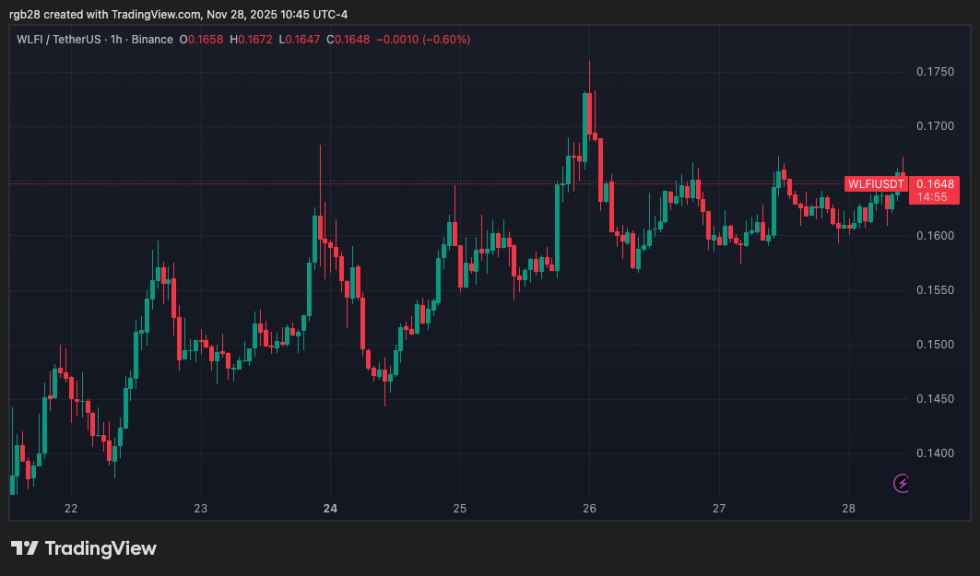
The investigation explained that Trump’s digital asset businesses have significantly boosted the US President’s net worth on paper by billions of dollars, but only calculated the potential income from the realized profits of World Liberty Financial’s WLFI token and USD1 stablecoin, and the official TRUMP and MELANIA memecoins.

According to FT calculations, the TRUMP and MELANIA memecoins made around $362 million and $65 million, respectively, for a total of $427 million in sales and trading fees. Moreover, the WLFI token had generated approximately $550 million by the time of the investigation, while the USD1 stablecoin, which recorded $2.71 billion in total sales, potentially $42 million.

“Donald Trump has turned the Oval Office into the world’s most corrupt crypto startup operation, minting staggering personal fortunes for him and his family in less than a year.” Representative Raskin affirmed in a Press Release.

“We don’t know where all the money is coming from yet, but America has never seen corruption on this scale take place inside the White House. This Report shows how Trump’s so-called ‘pro-crypto agenda’ is just one more Trump family self-enrichment plan, built on pay-to-play deals and corrupt foreign interests seeking secret channels of access and influence,” he continued.

Trump’s Crypto Ventures Expose ‘Weaknesses’ Of US System

Raskin also stated that the Trump administration has “dismantled” federal oversight and safeguards that were set to protect Americans from fraud, scams, and financial exploitation. “Trump has been pardoning criminals who commit fraud through crypto and dismantling the regulations that protect legitimate American investors.”

The report presented a list of actions that advanced “Trump and his family’s personal financial interests at the expense of the law, ethics, and national security.” The evidence exposed in the document included claims that the President’s crypto ventures have “attracted substantial investments from foreign nationals and state-linked entities seeking to curry favor with the Administration.”

Last week, Democratic Senators expressed concerns about potential national security risks related to World Liberty Financial over token sales allegedly linked to illicit actors. In a letter, the lawmakers requested that Attorney General Pam Bondi and Treasury Secretary Scott Bessent investigate allegations that the Trump-backed company had sold tokens to sanctioned entities or individuals with ties to illicit actors in Russia and North Korea.

They also argued that World Liberty Financial and its token “lacks adequate safeguards to prevent bad actors from moving funds or gaining influence over its governance,” which raises concerns over a potential conflict of interest.

The Committee’s report highlighted that the Trump Administration has paused or ended most investigations and enforcement actions involving major crypto companies and disbanded multiple federal-level crypto enforcement units. In addition, it expressed concern about the controversial pardons issue to key industry players, like Binance’s co-founder, Changpeng Zhao.

Ultimately, the document warned that Trump’s crypto moves seemingly expose “severe weaknesses” in the US’s campaign finance, conflict-of-interest, and anti-bribery laws. “Congress must expose this dangerous grift, and defend the rule of law against the profiteers and criminals who would destroy it,” Raskin concluded.

crypto, WLFI, WLFIUSDT

Will Bitcoin (BTC) End 2025 In Green? November Close May Hold The Key

While the crypto market bounces from last week’s correction, Bitcoin (BTC) is attempting to reclaim a crucial area as support to continue its recovery rally. As the flagship crypto faces some resistance, some market watchers have suggested that this week’s close may be key for its end-of-year performance.

Bitcoin Faces Rejection Ahead Of November Close

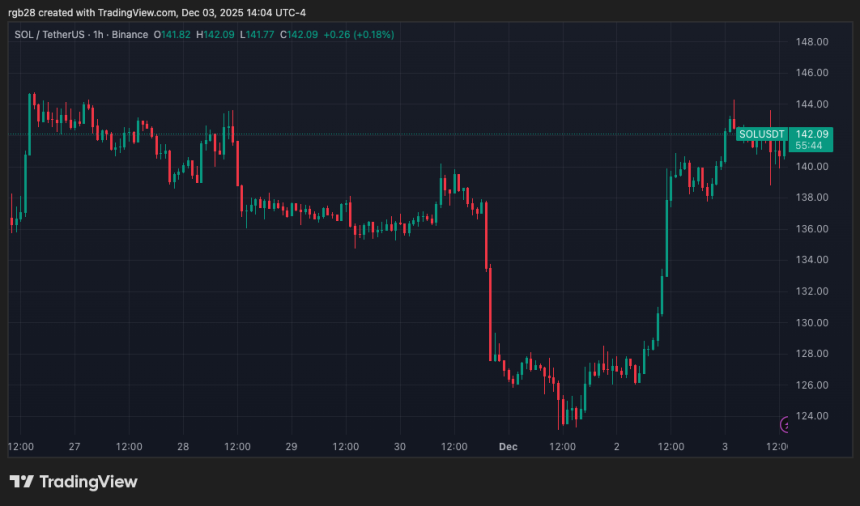
Bitcoin has retested a crucial resistance level for the first time in a week, hitting a one-week high of $93,092 on Friday morning before retracing. The flagship crypto has failed to hold crucial support levels throughout the November corrections, trading below $100,000 for nearly two weeks.

A week ago, BTC plunged below $90,000 during the latest market correction, reaching a seven-month low of $80,600. However, the cryptocurrency led this week’s broader recovery, reclaiming key levels over the past few days.

Amid its recent performance, some market observers have noted that Bitcoin is currently retesting a crucial re-accumulation region, between $82,000 and $93,000, where the price consolidated after previous pullbacks, including the Q1 market correction.

Analyst Rekt Capital highlighted that BTC rebounded more than 7% from the local bottom and has revisited the range high resistance during Friday’s recovery. Now, Bitcoin is attempting to hold the high zone of its local range, retesting the $90,000-$91,000 area as support after being rejected from the key resistance.

Previously, he pointed out that last week’s weekly close aligned with the flagship crypto’s monthly range, setting the stage for a potential floor around the $86,000 area, which would develop a new range between this level and the $93,000 resistance.

To the analyst, Bitcoin must close the week, which also coincides with November’s monthly close, above $93,5000 and turn this level into support if it wants to further build on its newfound momentum and potentially revisit its two-month downtrend line, which currently sits near the $96,000 mark.

“The ~$93500 level happens to be a Four-Year Cycle level. History suggests price should be able to find a way to 12-month close above ~$93500 to finish 2025 green,” Rekt Capital added on X.

$98,000 Rally or $88,000 Drop Next?

Market watcher Ted Pillows discussed BTC’s short-term future as it faces some resistance around the $92,000-$93,000 levels. To the analysts, reclaiming this area could propel the price towards the $98,000-$100,000 barrier in the coming weeks.

On the contrary, he suggested that failing to reclaim this level will send Bitcoin’s price below the $88,000 mark. Earlier this week, Ted warned that this was one of the most important levels to reclaim and hold as support in the short term, as a rejection from this area could trigger a significant drop below the recent lows.

Similarly, Daan Crypto Trades noted that the constant sell-off of the past few weeks has created “a ton of marginally lower highs, creating such a big liquidity pocket” between the $97,000-$98,000 zone.

This region also aligns with key horizontal price levels in bigger timeframes, making it a “good area to watch,” as BTC continues to consolidate in a relatively tight range.

The trader considers that if BTC’s price breaks down, the $88,000 mark could be a good place for a higher low. However, if the price holds above the $91,800 level, it may trigger another retest of the $93,000 resistance.

Ultimately, He warned that the market could likely see a “Choppy environment in the short-term surrounding Thanksgiving, which always sees pretty low volume & liquidity.”

As of this writing, Bitcoin is trading at $90,500, a 1.1% decline in the daily timeframe.
bitcoin, BTC, BTCUSDT

Solana Reclaims Crucial Resistance Despite First SOL ETF Outflows – 25% Rally Ahead?

As the crypto market rebounds from the recent lows, Solana (SOL) has reclaimed a crucial level, nearing a key resistance area that could set the stage for a long-awaited price recovery rally, according to some market watchers.

Solana Bounces Despite ETF Outflows

The crypto market has surged above the $3 trillion mark for the first time in a week, with Bitcoin, Ethereum, and most leading cryptocurrencies reclaiming crucial support levels lost during the latest market pullback.

Solana joined the market rally and jumped from the recently recovered $135-$140 area to the upper zone of its local range on Wednesday afternoon. Notably, the altcoin has been trading between the $130-$145 price range over the past two weeks, briefly losing the lower boundary during last week’s correction.

This week, SOL’s price has reclaimed some crucial ground, surging over 10% since Monday’s opening and nearing the $145 resistance. Amid this performance, analyst Ted Pillows noted institutional participation, as SOL treasury companies have started to show early signs of recovery.

He also highlighted that Solana Exchange-Traded Funds (ETFs) have experienced record inflows this month despite the correction. According to Farside Investors’ data, the SOL-based investment products have registered $613 million in inflows since their launch on October 28.

It’s worth noting that throughout the recent pullbacks, Solana funds have seen a strong demand, with a 22-day positive streak while the altcoin’s price descended to multi-month lows.

However, as its price recovered, SOL’s ETFs registered their first negative in nearly a month. 21Shares’ TSOL, which launched a week ago, saw $34 million in outflows on Wednesday, outshining the over $13 million and $10 million in inflows of Bitwise’s BSOL and Grayscale’s GSOL. As a result, the whole category recorded net outflows of $8.1 million.

In his analysis, Ted Pillows also noted that “It seems like SOL has bottomed for a while, but institutional buying needs to accelerate here. Otherwise, it won’t take long for Solana to make new lows.”

SOL Ready For December Recovery?

Analyst Ali Martinez suggested that Solana’s pain might be over as its price “usually bottoms when investors capitulate… And for the past two weeks, that’s exactly what’s been happening.”

According to the chart, SOL’s price has historically found a floor when the Net Unrealized Profit/Loss (NUPL) indicator reaches the capitulation zone, which it has recently fallen to. Meanwhile, Crypto Patel highlighted that Solana is breaking out of a one-month downtrend, which could trigger a 25% recovery rally near the key $180 barrier in the coming weeks.

Another market observer warned that the altcoin is “walking straight into the lion’s den” as its price nears the $144-$146 resistance levels. Trader Mr. Ape noted that Solana’s price has been rejected three times from this heavy supply area, and momentum “is slowing again as we hit the zone.”

To the trader, this is the crucial level to watch, as another rejection could send the price to the $132 support, where strong demand lies from the previous bounce. On the contrary, a successful breakout from this level and reclaiming it as support could confirm the shift and trigger a surge to the $157 area.

As of this writing, Solana is trading at $142, a 7.7% increase on the weekly timeframe.

Solana, sol, solusdt

Terra Founder Do Kwon Requests Five-Year Prison Term Ahead Of December 11 Sentencing

The lawyers of Terraform Labs’ co-founder are reportedly seeking a lesser sentence for the South Korean crypto entrepreneur’s role in the multi-billion-dollar collapse, claiming that he has already “suffered substantially” for his crimes.

Terra’s Do Kwon Says Five Years In Prison Will Suffice

On Wednesday, Terraform Labs’ co-founder and former CEO, Do Kwon, requested a maximum five-year prison term for his involvement in the $40 billion collapse of TerraUSD (UST) stablecoin in 2022.

According to the sentencing recommendation reviewed by Bloomberg, Kwon’s legal team affirmed that the Terraform co-founder should receive a five-year sentence, as he has already spent nearly three years locked up, “with more than half that time in brutal conditions in Montenegro.”

The former CEO’s lawyers argued that he had “suffered substantially for his crimes,” and the requested prison term would suffice, adding that the prosecutor’s expected recommendation of a 12-year sentence is “‘far greater than necessary’ to achieve justice.”

Moreover, the court filing reportedly stressed that Kwon had already agreed to forfeit more than $19 million and some properties as part of the August plea deal. As reported by Bitcoinist, Kwon pleaded guilty in August to two of the nine charges indicted by US authorities.

Notably, he initially pleaded not guilty in January to a nine-count indictment that charged him with securities fraud, wire fraud, commodities fraud, and conspiracy to commit money laundering. However, he changed his stance in August, pleading guilty to conspiracy to defraud and wire fraud.

At the time, Kwon also apologized for his actions, affirming that he “made false and misleading statements” about why TerraUSD regained its peg in 2021 by “failing to disclose a trading firm’s role in restoring that peg,” adding, “What I did was wrong.”

Prosecutors are expected to file their sentencing recommendation soon. As part of the plea deal, they previously agreed not to seek more than 12 years in prison for the Terraform Labs co-founder. The sentencing by US District Judge Paul Engelmayer is scheduled for December 11, 2025, in Manhattan.


South Korea’s Prosecution Pending

In the sentencing recommendation, Kwon’s lawyers stressed that the former CEO still faces trial in his home country, South Korea, for the same conduct, noting that local prosecutors there are seeking a prison term of up to 40 years.

Following the collapse of Terraform Labs, both South Korean and US authorities sought to bring Kwon to justice. Nonetheless, he had been on the run for months, fleeing his home country and Singapore ahead of the company’s downfall.

In March 2023, Montenegrin authorities detained him along with Terraform Lab’s former finance officer, Han Chang-joon, for trying to travel with fake documents at the Podgorica Airport. Notably, Kwon was under Montenegro’s custody for over a year and a half and faced a four-month sentence, later receiving an extra two months at the request of the US and South Korea.

The two countries entered a prolonged battle to bring the crypto entrepreneur to trial in each country. Initially, Montenegrin authorities approved South Korea’s extradition request, but he was ultimately extradited to the US on December 31, 2024, after Montenegro’s interior ministry signed their request.

Terra, TOTAL

❌