Reading view

There are new articles available, click to refresh the page.

Android expands pilot for in-call scam protection for financial apps

Posted by Aden Haussmann, Associate Product Manager and Sumeet Sharma, Play Partnerships Trust & Safety Lead

Android uses the best of Google AI and our advanced security expertise to tackle mobile scams from every angle. Over the last few years, we’ve launched industry-leading features to detect scams and protect users across phone calls, text messages and messaging app chat notifications.

These efforts are making a real difference in the lives of Android users. According to a recent YouGov survey1 commissioned by Google, Android users were 58% more likely than iOS users to report they had not received any scam texts in the prior week2.

But our work doesn’t stop there. Scammers are continuously evolving, using more sophisticated social engineering tactics to trick users into sharing their phone screen while on the phone to visit malicious websites, reveal sensitive information, send funds or download harmful apps. One popular scam involves criminals impersonating banks or other trusted institutions on the phone to try to manipulate victims into sharing their screen in order to reveal banking information or make a financial transfer.

To help combat these types of financial scams, we launched a pilot earlier this year in the UK focused on in-call protections for financial apps.

How the in-call scam protection works on Android

When you launch a participating financial app while screen sharing and on a phone call with a number that is not saved in your contacts, your Android device3 will automatically warn you about the potential dangers and give you the option to end the call and to stop screen sharing with just one tap. The warning includes a 30-second pause period before you’re able to continue, which helps break the ‘spell’ of the scammer's social engineering, disrupting the false sense of urgency and panic commonly used to manipulate you into a scam.

Bringing in-call scam protections to more users on Android

The UK pilot of Android’s in-call scam protections has already helped thousands of users end calls that could have cost them a significant amount of money. Following this success, and alongside recently launched pilots with financial apps in Brazil and India, we’ve now expanded this protection to most major UK banks.

We’ve also started to pilot this protection with more app types, including peer-to-peer (P2P) payment apps. Today, we’re taking the next step in our expansion by rolling out a pilot of this protection in the United States4 with a number of popular fintechs like Cash App and banks, including JPMorganChase.

We are committed to collaborating across the ecosystem to help keep people safe from scams. We look forward to learning from these pilots and bringing these critical safeguards to even more users in the future.

Notes


  1. Google/YouGov survey, July-August, n=5,100 (1,700 each in the US, Brazil and India), with adults who use their smartphones daily and who have been exposed to a scam or fraud attempt on their smartphone. Survey data have been weighted to smartphone population adults in each country.  

  2. Among users who use the default texting app on their smartphone.  

  3. Compatible with Android 11+ devices 

  4. US users of the US versions of the apps; rollout begins Dec. 2025 

Android Quick Share Support for AirDrop: A Secure Approach to Cross-Platform File Sharing

Posted by Dave Kleidermacher, VP, Platforms Security & Privacy, Google

Technology should bring people closer together, not create walls. Being able to communicate and connect with friends and family should be easy regardless of the phone they use. That’s why Android has been building experiences that help you stay connected across platforms.

As part of our efforts to continue to make cross-platform communication more seamless for users, we've made Quick Share interoperable with AirDrop, allowing for two-way file sharing between Android and iOS devices, starting with the Pixel 10 Family. This new feature makes it possible to quickly share your photos, videos, and files with people you choose to communicate with, without worrying about the kind of phone they use.

Most importantly, when you share personal files and content, you need to trust that it stays secure. You can share across devices with confidence knowing we built this feature with security at its core, protecting your data with strong safeguards that have been tested by independent security experts.

Secure by Design

We built Quick Share’s interoperability support for AirDrop with the same rigorous security standards that we apply to all Google products. Our approach to security is proactive and deeply integrated into every stage of the development process. This includes:

  • Threat Modeling: We identify and address potential security risks before they can become a problem.
  • Internal Security Design and Privacy Reviews: Our dedicated security and privacy teams thoroughly review the design to ensure it meets our high standards.
  • Internal Penetration Testing: We conduct extensive in-house testing to identify and fix vulnerabilities.

This Secure by Design philosophy ensures that all of our products are not just functional but also fundamentally secure.

This feature is also protected by a multi-layered security approach to ensure a safe sharing experience from end-to-end, regardless of what platform you’re on.

  • Secure Sharing Channel: The communication channel itself is hardened by our use of Rust to develop this feature. This memory-safe language is the industry benchmark for building secure systems and provides confidence that the connection is protected against buffer overflow attacks and other common vulnerabilities.
  • Built-in Platform Protections: This feature is strengthened by the robust built-in security of both Android and iOS. On Android, security is built in at every layer. Our deep investment in Rust at the OS level hardens the foundation, while proactive defenses like Google Play Protect work to keep your device safe. This is complemented by the security architecture of iOS that provides its own strong safeguards that mitigate malicious files and exploitation. These overlapping protections on both platforms work in concert with the secure connection to provide comprehensive safety for your data when you share or receive.
  • You’re in Control: Sharing across platforms works just like you're used to: a file requires your approval before being received, so you're in control of what you accept.

The Power of Rust: A Foundation of Secure Communication

A key element of our security strategy for the interoperability layer between Quick Share and AirDrop is the use of the memory-safe Rust programming language. Recognized by security agencies around the world, including the NSA and CISA, Rust is widely considered the industry benchmark for building secure systems because it eliminates entire classes of memory-safety vulnerabilities by design.

Rust is already a cornerstone of our broader initiative to eliminate memory safety bugs across Android. Its selection for this feature was deliberate, driven by the unique security challenges of cross-platform communication that demanded the most robust protections for memory safety.

The core of this feature involves receiving and parsing data sent over a wireless protocol from another device. Historically, when using a memory-unsafe language, bugs in data parsing logic are one of the most common sources of high-severity security vulnerabilities. A malformed data packet sent to a parser written in a memory-unsafe language can lead to buffer overflows and other memory corruption bugs, creating an opportunity for code execution.

This is precisely where Rust provides a robust defense. Its compiler enforces strict ownership and borrowing rules at compile time, which guarantees memory safety. Rust removes entire classes of memory-related bugs. This means our implementation is inherently resilient against attackers attempting to use maliciously crafted data packets to exploit memory errors.

Secure Sharing Using AirDrop's "Everyone" Mode

To ensure a seamless experience for both Android and iOS users, Quick Share currently works with AirDrop's "Everyone for 10 minutes" mode. This feature does not use a workaround; the connection is direct and peer-to-peer, meaning your data is never routed through a server, shared content is never logged, and no extra data is shared. As with "Everyone for 10 minutes" mode on any device when you’re sharing between non-contacts, you can ensure you're sharing with the right person by confirming their device name on your screen with them in person.

This implementation using "Everyone for 10 minutes” mode is just the first step in seamless cross-platform sharing, and we welcome the opportunity to work with Apple to enable “Contacts Only” mode in the future.

Tested by Independent Security Experts

After conducting our own secure product development, internal threat modeling, privacy reviews, and red team penetration tests, we engaged with NetSPI, a leading third-party penetration testing firm, to further validate the security of this feature and conduct an independent security assessment. The assessment found the interoperability between Quick Share and AirDrop is secure, is “notably stronger” than other industry implementations and does not leak any information.

Based on these internal and external assessments, we believe our implementation provides a strong security foundation for cross-platform file sharing for both Android and iOS users. We will continue to evaluate and enhance the implementation’s security in collaboration with additional third-party partners.

To complement this deep technical audit, we also sought expert third-party perspective on our approach from Dan Boneh, a renowned security expert and professor at Stanford University:

“Google’s work on this feature, including the use of memory safe Rust for the core communications layer, is a strong example of how to build secure interoperability, ensuring that cross-platform information sharing remains safe. I applaud the effort to open more secure information sharing between platforms and encourage Google and Apple to work together more on this."

The Future of File-Sharing Should Be Interoperable

This is just the first step as we work to improve the experience and expand it to more devices. We look forward to continuing to work with industry partners to make connecting and communicating across platforms a secure, seamless experience for all users.

Rust in Android: move fast and fix things

Posted by Jeff Vander Stoep, Android

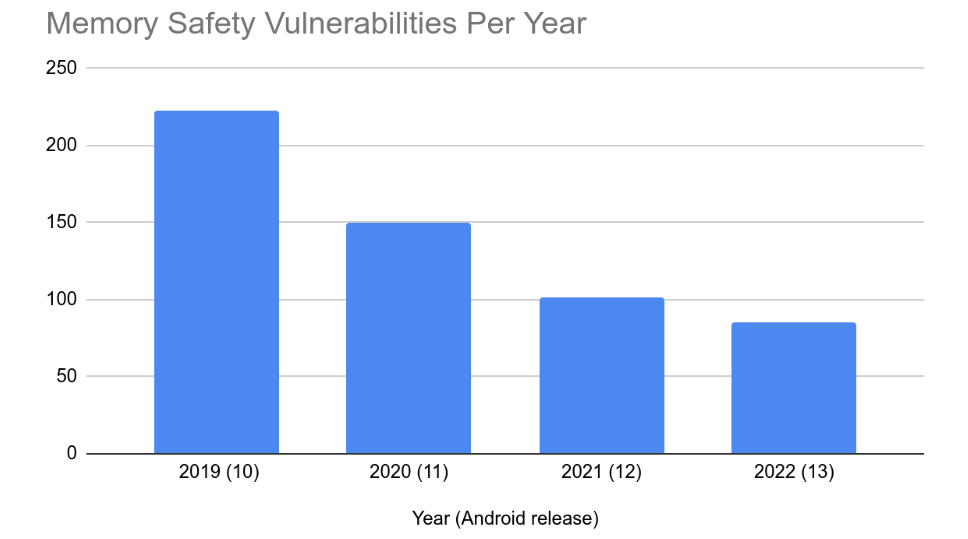
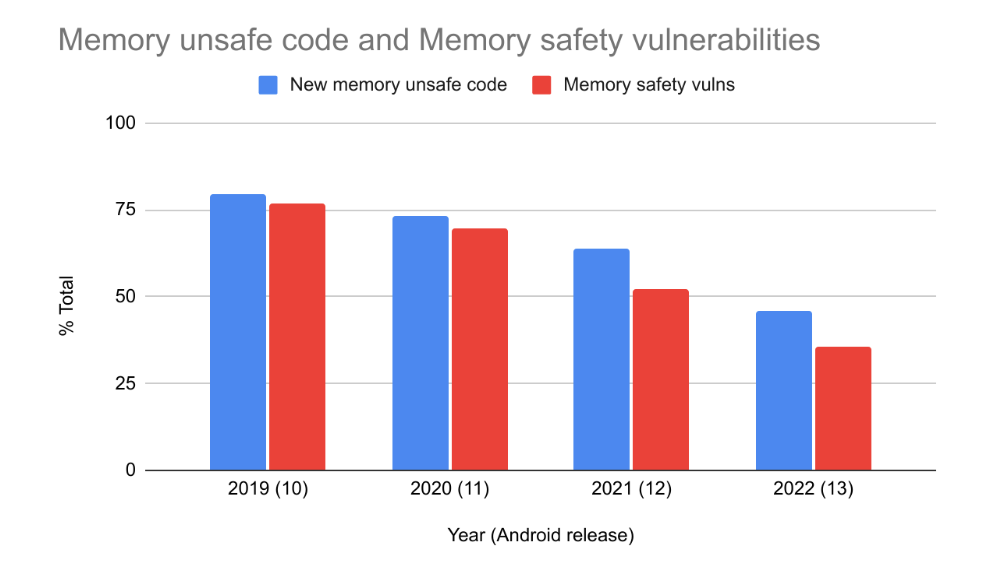
Last year, we wrote about why a memory safety strategy that focuses on vulnerability prevention in new code quickly yields durable and compounding gains. This year we look at how this approach isn’t just fixing things, but helping us move faster.

The 2025 data continues to validate the approach, with memory safety vulnerabilities falling below 20% of total vulnerabilities for the first time.

Updated data for 2025. This data covers first-party and third-party (open source) code changes to the Android platform across C, C++, Java, Kotlin, and Rust. This post is published a couple of months before the end of 2025, but Android’s industry-standard 90-day patch window means that these results are very likely close to final. We can and will accelerate patching when necessary.

We adopted Rust for its security and are seeing a 1000x reduction in memory safety vulnerability density compared to Android’s C and C++ code. But the biggest surprise was Rust's impact on software delivery. With Rust changes having a 4x lower rollback rate and spending 25% less time in code review, the safer path is now also the faster one.

In this post, we dig into the data behind this shift and also cover:

  • How we’re expanding our reach: We're pushing to make secure code the default across our entire software stack. We have updates on Rust adoption in first-party apps, the Linux kernel, and firmware.
  • Our first rust memory safety vulnerability...almost: We'll analyze a near-miss memory safety bug in unsafe Rust: how it happened, how it was mitigated, and steps we're taking to prevent recurrence. It’s also a good chance to answer the question “if Rust can have memory safety issues, why bother at all?”

Building Better Software, Faster

Developing an operating system requires the low-level control and predictability of systems programming languages like C, C++, and Rust. While Java and Kotlin are important for Android platform development, their role is complementary to the systems languages rather than interchangeable. We introduced Rust into Android as a direct alternative to C and C++, offering a similar level of control but without many of their risks. We focus this analysis on new and actively developed code because our data shows this to be an effective approach.

When we look at development in systems languages (excluding Java and Kotlin), two trends emerge: a steep rise in Rust usage and a slower but steady decline in new C++.

Net lines of code added: Rust vs. C++, first-party Android code.
This chart focuses on first-party (Google-developed) code (unlike the previous chart that included all first-party and third-party code in Android.) We only include systems languages, C/C++ (which is primarily C++), and Rust.

The chart shows that the volume of new Rust code now rivals that of C++, enabling reliable comparisons of software development process metrics. To measure this, we use the DORA1 framework, a decade-long research program that has become the industry standard for evaluating software engineering team performance. DORA metrics focus on:

  • Throughput: the velocity of delivering software changes.
  • Stability: the quality of those changes.

Cross-language comparisons can be challenging. We use several techniques to ensure the comparisons are reliable.

  • Similar sized changes: Rust and C++ have similar functionality density, though Rust is slightly denser. This difference favors C++, but the comparison is still valid. We use Gerrit’s change size definitions.
  • Similar developer pools: We only consider first-party changes from Android platform developers. Most are software engineers at Google, and there is considerable overlap between pools with many contributing in both.
  • Track trends over time: As Rust adoption increases, are metrics changing steadily, accelerating the pace, or reverting to the mean?

Throughput

Code review is a time-consuming and high-latency part of the development process. Reworking code is a primary source of these costly delays. Data shows that Rust code requires fewer revisions. This trend has been consistent since 2023. Rust changes of a similar size need about 20% fewer revisions than their C++ counterparts.

In addition, Rust changes currently spend about 25% less time in code review compared to C++. We speculate that the significant change in favor of Rust between 2023 and 2024 is due to increased Rust expertise on the Android team.

While less rework and faster code reviews offer modest productivity gains, the most significant improvements are in the stability and quality of the changes.

Stability

Stable and high-quality changes differentiate Rust. DORA uses rollback rate for evaluating change stability. Rust's rollback rate is very low and continues to decrease, even as its adoption in Android surpasses C++.

For medium and large changes, the rollback rate of Rust changes in Android is ~4x lower than C++. This low rollback rate doesn't just indicate stability; it actively improves overall development throughput. Rollbacks are highly disruptive to productivity, introducing organizational friction and mobilizing resources far beyond the developer who submitted the faulty change. Rollbacks necessitate rework and more code reviews, can also lead to build respins, postmortems, and blockage of other teams. Resulting postmortems often introduce new safeguards that add even more development overhead.

In a self-reported survey from 2022, Google software engineers reported that Rust is both easier to review and more likely to be correct. The hard data on rollback rates and review times validates those impressions.

Putting it all together

Historically, security improvements often came at a cost. More security meant more process, slower performance, or delayed features, forcing trade-offs between security and other product goals. The shift to Rust is different: we are significantly improving security and key development efficiency and product stability metrics.

Expanding Our Reach

With Rust support now mature for building Android system services and libraries, we are focused on bringing its security and productivity advantages elsewhere.

  • Kernel: Android’s 6.12 Linux kernel is our first kernel with Rust support enabled and our first production Rust driver. More exciting projects are underway, such as our ongoing collaboration with Arm and Collabora on a Rust-based kernel-mode GPU driver.
  • Firmware: The combination of high privilege, performance constraints, and limited applicability of many security measures makes firmware both high-risk, and challenging to secure. Moving firmware to Rust can yield a major improvement in security. We have been deploying Rust in firmware for years now, and even released tutorials, training, and code for the wider community. We’re particularly excited about our collaboration with Arm on Rusted Firmware-A.
  • First-party applications: Rust is ensuring memory safety from the ground up in several security-critical Google applications, such as:
    • Nearby Presence: The protocol for securely and privately discovering local devices over Bluetooth is implemented in Rust and is currently running in Google Play Services.
    • MLS: The protocol for secure RCS messaging is implemented in Rust and will be included in the Google Messages app in a future release.
    • Chromium: Parsers for PNG, JSON, and web fonts have been replaced with memory-safe implementations in Rust, making it easier for Chromium engineers to deal with data from the web while following the Rule of 2.


These examples highlight Rust's role in reducing security risks, but memory-safe languages are only one part of a comprehensive memory safety strategy. We continue to employ a defense-in-depth approach, the value of which was clearly demonstrated in a recent near-miss.

Our First Rust Memory Safety Vulnerability...Almost

We recently avoided shipping our very first Rust-based memory safety vulnerability: a linear buffer overflow in CrabbyAVIF. It was a near-miss. To ensure the patch received high priority and was tracked through release channels, we assigned it the identifier CVE-2025-48530. While it’s great that the vulnerability never made it into a public release, the near-miss offers valuable lessons. The following sections highlight key takeaways from our postmortem.

Scudo Hardened Allocator for the Win

A key finding is that Android’s Scudo hardened allocator deterministically rendered this vulnerability non-exploitable due to guard pages surrounding secondary allocations. While Scudo is Android’s default allocator, used on Google Pixel and many other devices, we continue to work with partners to make it mandatory. In the meantime, we will issue CVEs of sufficient severity for vulnerabilities that could be prevented by Scudo.

In addition to protecting against overflows, Scudo’s use of guard pages helped identify this issue by changing an overflow from silent memory corruption into a noisy crash. However, we did discover a gap in our crash reporting: it failed to clearly show that the crash was a result of an overflow, which slowed down triage and response. This has been fixed, and we now have a clear signal when overflows occur into Scudo guard pages.

Unsafe Review and Training

Operating system development requires unsafe code, typically C, C++, or unsafe Rust (for example, for FFI and interacting with hardware), so simply banning unsafe code is not workable. When developers must use unsafe, they should understand how to do so soundly and responsibly

To that end, we are adding a new deep dive on unsafe code to our Comprehensive Rust training. This new module, currently in development, aims to teach developers how to reason about unsafe Rust code, soundness and undefined behavior, as well as best practices like safety comments and encapsulating unsafe code in safe abstractions.

Better understanding of unsafe Rust will lead to even higher quality and more secure code across the open source software ecosystem and within Android. As we'll discuss in the next section, our unsafe Rust is already really quite safe. It’s exciting to consider just how high the bar can go.

Comparing Vulnerability Densities

This near-miss inevitably raises the question: "If Rust can have memory safety vulnerabilities, then what’s the point?"

The point is that the density is drastically lower. So much lower that it represents a major shift in security posture. Based on our near-miss, we can make a conservative estimate. With roughly 5 million lines of Rust in the Android platform and one potential memory safety vulnerability found (and fixed pre-release), our estimated vulnerability density for Rust is 0.2 vuln per 1 million lines (MLOC).

Our historical data for C and C++ shows a density of closer to 1,000 memory safety vulnerabilities per MLOC. Our Rust code is currently tracking at a density orders of magnitude lower: a more than 1000x reduction.

Memory safety rightfully receives significant focus because the vulnerability class is uniquely powerful and (historically) highly prevalent. High vulnerability density undermines otherwise solid security design because these flaws can be chained to bypass defenses, including those specifically targeting memory safety exploits. Significantly lowering vulnerability density does not just reduce the number of bugs; it dramatically boosts the effectiveness of our entire security architecture.

The primary security concern regarding Rust generally centers on the approximately 4% of code written within unsafe{} blocks. This subset of Rust has fueled significant speculation, misconceptions, and even theories that unsafe Rust might be more buggy than C. Empirical evidence shows this to be quite wrong.

Our data indicates that even a more conservative assumption, that a line of unsafe Rust is as likely to have a bug as a line of C or C++, significantly overestimates the risk of unsafe Rust. We don’t know for sure why this is the case, but there are likely several contributing factors:

  • unsafe{} doesn't actually disable all or even most of Rust’s safety checks (a common misconception).
  • The practice of encapsulation enables local reasoning about safety invariants.
  • The additional scrutiny that unsafe{} blocks receive.

Final Thoughts

Historically, we had to accept a trade-off: mitigating the risks of memory safety defects required substantial investments in static analysis, runtime mitigations, sandboxing, and reactive patching. This approach attempted to move fast and then pick up the pieces afterwards. These layered protections were essential, but they came at a high cost to performance and developer productivity, while still providing insufficient assurance.

While C and C++ will persist, and both software and hardware safety mechanisms remain critical for layered defense, the transition to Rust is a different approach where the more secure path is also demonstrably more efficient. Instead of moving fast and then later fixing the mess, we can move faster while fixing things. And who knows, as our code gets increasingly safe, perhaps we can start to reclaim even more of that performance and productivity that we exchanged for security, all while also improving security.

Acknowledgments

Thank you to the following individuals for their contributions to this post:

  • Ivan Lozano for compiling the detailed postmortem on CVE-2025-48530.
  • Chris Ferris for validating the postmortem’s findings and improving Scudo’s crash handling as a result.
  • Dmytro Hrybenko for leading the effort to develop training for unsafe Rust and for providing extensive feedback on this post.
  • Alex Rebert and Lars Bergstrom for their valuable suggestions and extensive feedback on this post.
  • Peter Slatala, Matthew Riley, and Marshall Pierce for providing information on some of the places where Rust is being used in Google's apps.

Finally, a tremendous thank you to the Android Rust team, and the entire Android organization for your relentless commitment to engineering excellence and continuous improvement.

Notes


  1. The DevOps Research and Assessment (DORA) program is published by Google Cloud. 

How Android provides the most effective protection to keep you safe from mobile scams

Posted by Lyubov Farafonova, Product Manager, Phone by Google; Alberto Pastor Nieto, Sr. Product Manager Google Messages and RCS Spam and Abuse; Vijay Pareek, Manager, Android Messaging Trust and Safety
As Cybersecurity Awareness Month wraps up, we’re focusing on one of today's most pervasive digital threats: mobile scams. In the last 12 months, fraudsters have used advanced AI tools to create more convincing schemes, resulting in over $400 billion in stolen funds globally.¹

For years, Android has been on the frontlines in the battle against scammers, using the best of Google AI to build proactive, multi-layered protections that can anticipate and block scams before they reach you. Android’s scam defenses protect users around the world from over 10 billion suspected malicious calls and messages every month2. In addition, Google continuously performs safety checks to maintain the integrity of the RCS service. In the past month alone, this ongoing process blocked over 100 million suspicious numbers from using RCS, stopping potential scams before they could even be sent.

To show how our scam protections work in the real world, we asked users and independent security experts to compare how well Android and iOS protect you from these threats. We're also releasing a new report that explains how modern text scams are orchestrated, helping you understand the tactics fraudsters use and how to spot them.

Survey shows Android users’ confidence in scam protections

Google and YouGov3 surveyed 5,000 smartphone users across the U.S., India, and Brazil about their scam experiences. The findings were clear: Android users reported receiving fewer scam texts and felt more confident that their device was keeping them safe.

  • Android users were 58% more likely than iOS users to say they had not received any scam texts in the week prior to the survey. The advantage was even stronger on Pixel, where users were 96% more likely than iPhone owners to report zero scam texts4.
  • At the other end of the spectrum, iOS users were 65% more likely than Android users to report receiving three or more scam texts in a week. The difference became even more pronounced when comparing iPhone to Pixel, with iPhone users 136% more likely to say they had received a heavy volume of scam messages4.
  • Android users were 20% more likely than iOS users to describe their device’s scam protections as “very effective” or “extremely effective.” When comparing Pixel to iPhone, iPhone users were 150% more likely to say their device was not effective at all in stopping mobile fraud.

YouGov study findings on users’ experience with scams on Android and iOS

Security researchers and analysts highlight Android’s AI-driven safeguards against sophisticated scams

In a recent evaluation by Counterpoint Research5, a global technology market research firm, Android smartphones were found to have the most AI-powered protections. The independent study compared the latest Pixel, Samsung, Motorola, and iPhone devices, and found that Android provides comprehensive AI-driven safeguards across ten key protection areas, including email protections, browsing protections, and on-device behavioral protections. By contrast, iOS offered AI-powered protections in only two categories. You can see the full comparison in the visual below.

Counterpoint Research comparison of Android and iOS AI-powered protections

Cybersecurity firm Leviathan Security Group conducted a funded evaluation6 of scam and fraud protection on the iPhone 17, Moto Razr+ 2025, Pixel 10 Pro, and Samsung Galaxy Z Fold 7. Their analysis found that Android smartphones, led by the Pixel 10 Pro, provide the highest level of default scam and fraud protection.The report particularly noted Android's robust call screening, scam detection, and real-time scam warning authentication capabilities as key differentiators. Taken together, these independent expert assessments conclude that Android’s AI-driven safeguards provide more comprehensive and intelligent protection against mobile scams.

Leviathan Security Group comparison of scam protections across various devices

Why Android users see fewer scams

Android’s proactive protections work across the platform to help you stay ahead of threats with the best of Google AI.

Here’s how they work:

  • Keeping your messages safe: Google Messages automatically filters known spam by analyzing sender reputation and message content, moving suspicious texts directly to your "spam & blocked" folder to keep them out of sight. For more complex threats, Scam Detection uses on-device AI to analyze messages from unknown senders for patterns of conversational scams (like pig butchering) and provide real-time warnings6. This helps secure your privacy while providing a robust shield against text scams. As an extra safeguard, Google Messages also helps block suspicious links in messages that are determined to be spam or scams.
  • Combatting phone call scams: Phone by Google automatically blocks known spam calls so your phone never even rings, while Call Screen5 can answer the call on your behalf to identify fraudsters. If you answer, the protection continues with Scam Detection, which uses on-device AI to provide real-time warnings for suspicious conversational patterns6. This processing is completely ephemeral, meaning no call content is ever saved or leaves your device. Android also helps stop social engineering during the call itself by blocking high-risk actions7 like installing untrusted apps or disabling security settings, and warns you if your screen is being shared unknowingly.

These safeguards are built directly into the core of Android, alongside other features like real-time app scanning in Google Play Protect and enhanced Safe Browsing in Chrome using LLMs. With Android, you can trust that you have intelligent, multi-layered protection against scams working for you.

Android is always evolving to keep you one step ahead of scams

In a world of evolving digital threats, you deserve to feel confident that your phone is keeping you safe. That’s why we use the best of Google AI to build intelligent protections that are always improving and work for you around the clock, so you can connect, browse, and communicate with peace of mind.

See these protections in action in our new infographic and learn more about phone call scams in our 2025 Phone by Google Scam Report.


1: Data from Global Anti-Scam Alliance, October 2025

2: This total comprises all instances where a message or call was proactively blocked or where a user was alerted to potential spam or scam activity.

3: Google/YouGov survey, July-August, n=5,100 (1,700 each in the US, Brazil and India), with adults who use their smartphones daily and who have been exposed to a scam or fraud attempt on their smartphone. Survey data have been weighted to smartphone population adults in each country.

4: Among users who use the default texting app on their smartphone

5: Google/Counterpoint Research, “Assessing the State of AI-Powered Mobile Security”, Oct. 2025; based on comparing the Pixel 10 Pro, iPhone 17 Pro, Samsung Galaxy S25 Ultra, OnePlus 13, Motorola Razr+ 2025. Evaluation based on no-cost smartphone features enabled by default. Some features may not be available in all countries.

6: Google/Leviathan Security Group, “October 2025 Mobile Platform Security & Fraud Prevention Assessment”, Oct. 2025; based on comparing the Pixel 10 Pro, iPhone 17 Pro, Samsung Galaxy Z Fold 7 and Motorola Razr+ 2025. Evaluation based on no-cost smartphone features enabled by default. Some features may not be available in all countries.

7: Accuracy may vary. Availability varies.

How Pixel and Android are bringing a new level of trust to your images with C2PA Content Credentials

Posted by Eric Lynch, Senior Product Manager, Android Security, and Sherif Hanna, Group Product Manager, Google C2PA Core

At Made by Google 2025, we announced that the new Google Pixel 10 phones will support C2PA Content Credentials in Pixel Camera and Google Photos. This announcement represents a series of steps towards greater digital media transparency:

  • The Pixel 10 lineup is the first to have Content Credentials built in across every photo created by Pixel Camera.
  • The Pixel Camera app achieved Assurance Level 2, the highest security rating currently defined by the C2PA Conformance Program. Assurance Level 2 for a mobile app is currently only possible on the Android platform.
  • A private-by-design approach to C2PA certificate management, where no image or group of images can be related to one another or the person who created them.
  • Pixel 10 phones support on-device trusted time-stamps, which ensures images captured with your native camera app can be trusted after the certificate expires, even if they were captured when your device was offline.

These capabilities are powered by Google Tensor G5, Titan M2 security chip, the advanced hardware-backed security features of the Android platform, and Pixel engineering expertise.

In this post, we’ll break down our architectural blueprint for bringing a new level of trust to digital media, and how developers can apply this model to their own apps on Android.

A New Approach to Content Credentials

Generative AI can help us all to be more creative, productive, and innovative. But it can be hard to tell the difference between content that’s been AI-generated, and content created without AI. The ability to verify the source and history—or provenance—of digital content is more important than ever.

Content Credentials convey a rich set of information about how media such as images, videos, or audio files were made, protected by the same digital signature technology that has secured online transactions and mobile apps for decades. It empowers users to identify AI-generated (or altered) content, helping to foster transparency and trust in generative AI. It can be complemented by watermarking technologies such as SynthID.

Content Credentials are an industry standard backed by a broad coalition of leading companies for securely conveying the origin and history of media files. The standard is developed by the Coalition for Content Provenance and Authenticity (C2PA), of which Google is a steering committee member.

The traditional approach to classifying digital image content has focused on categorizing content as “AI” vs. “not AI”. This has been the basis for many legislative efforts, which have required the labeling of synthetic media. This traditional approach has drawbacks, as described in Chapter 5 of this seminal report by Google. Research shows that if only synthetic content is labeled as “AI”, then users falsely believe unlabeled content is “not AI”, a phenomenon called “the implied truth effect”. This is why Google is taking a different approach to applying C2PA Content Credentials.

Instead of categorizing digital content into a simplistic “AI” vs. “not AI”, Pixel 10 takes the first steps toward implementing our vision of categorizing digital content as either i) media that comes with verifiable proof of how it was made or ii) media that doesn't.

  • Pixel Camera attaches Content Credentials to any JPEG photo capture, with the appropriate description as defined by the Content Credentials specification for each capture mode.
  • Google Photos attaches Content Credentials to JPEG images that already have Content Credentials and are edited using AI or non-AI tools, and also to any images that are edited using AI tools. It will validate and display Content Credentials under a new section in the About panel, if the JPEG image being viewed contains this data. Learn more about it in Google Photos Help.

Given the broad range of scenarios in which Content Credentials are attached by these apps, we designed our C2PA implementation architecture from the onset to be:

  1. Secure from silicon to applications
  2. Verifiable, not personally identifiable
  3. Useable offline

Secure from Silicon to Applications

Good actors in the C2PA ecosystem are motivated to ensure that provenance data is trustworthy. C2PA Certification Authorities (CAs), such as Google, are incentivized to only issue certificates to genuine instances of apps from trusted developers in order to prevent bad actors from undermining the system. Similarly, app developers want to protect their C2PA claim signing keys from unauthorized use. And of course, users want assurance that the media files they rely on come from where they claim. For these reasons, the C2PA defined the Conformance Program.

The Pixel Camera application on the Pixel 10 lineup has achieved Assurance Level 2, the highest security rating currently defined by the C2PA Conformance Program. This was made possible by a strong set of hardware-backed technologies, including Tensor G5 and the certified Titan M2 security chip, along with Android’s hardware-backed security APIs. Only mobile apps running on devices that have the necessary silicon features and Android APIs can be designed to achieve this assurance level. We are working with C2PA to help define future assurance levels that will push protections even deeper into hardware.

Achieving Assurance Level 2 requires verifiable, difficult-to-forge evidence. Google has built an end-to-end system on Pixel 10 devices that verifies several key attributes. However, the security of any claim is fundamentally dependent on the integrity of the application and the OS, an integrity that relies on both being kept current with the latest security patches.

  • Hardware Trust: Android Key Attestation in Pixel 10 is built on support for Device Identifier Composition Engine (DICE) by Tensor, and Remote Key Provisioning (RKP) to establish a trust chain from the moment the device starts up to the OS, stamping out the most common forms of abuse on Android.
  • Genuine Device and Software: Aided by the hardware trust described above, Android Key Attestation allows Google C2PA Certification Authorities (CAs) to verify that they are communicating with a genuine physical device. It also allows them to verify the device has booted securely into a Play Protect Certified version of Android, and verify how recently the operating system, bootloader, and system software and firmware were patched for security vulnerabilities.
  • Genuine Application: Hardware-backed Android Key Attestation certificates include the package name and signing certificates associated with the app that requested the generation of the C2PA signing key, allowing Google C2PA CAs to check that the app requesting C2PA claim signing certificates is a trusted, registered app.
  • Tamper-Resistant Key Storage: On Pixel, C2PA claim signing keys are generated and stored using Android StrongBox in the Titan M2 security chip. Titan M2 is Common Criteria PP.0084 AVA_VAN.5 certified, meaning that it is strongly resistant to extracting or tampering with the cryptographic keys stored in it. Android Key Attestation allows Google C2PA CAs to verify that private keys were indeed created inside this hardware-protected vault before issuing certificates for their public key counterparts.

The C2PA Conformance Program requires verifiable artifacts backed by a hardware Root of Trust, which Android provides through features like Key Attestation. This means Android developers can leverage these same tools to build apps that meet this standard for their users.

Privacy Built on a Foundation of Trust: Verifiable, Not Personally Identifiable

The robust security stack we described is the foundation of privacy. But Google takes steps further to ensure your privacy even as you use Content Credentials, which required solving two additional challenges:

Challenge 1: Server-side Processing of Certificate Requests. Google’s C2PA Certification Authorities must certify new cryptographic keys generated on-device. To prevent fraud, these certificate enrollment requests need to be authenticated. A more common approach would require user accounts for authentication, but this would create a server-side record linking a user's identity to their C2PA certificates—a privacy trade-off we were unwilling to make.

Our Solution: Anonymous, Hardware-Backed Attestation. We solve this with Android Key Attestation, which allows Google CAs to verify what is being used (a genuine app on a secure device) without ever knowing who is using it (the user). Our CAs also enforce a strict no-logging policy for information like IP addresses that could tie a certificate back to a user.

Challenge 2: The Risk of Traceability Through Key Reuse. A significant privacy risk in any provenance system is traceability. If the same device or app-specific cryptographic key is used to sign multiple photos, those images can be linked by comparing the key. An adversary could potentially connect a photo someone posts publicly under their real name with a photo they post anonymously, deanonymizing the creator.

Our Solution: Unique Certificates. We eliminate this threat with a maximally private approach. Each key and certificate is used to sign exactly one image. No two images ever share the same public key, a "One-and-Done" Certificate Management Strategy, making it cryptographically impossible to link them. This engineering investment in user privacy is designed to set a clear standard for the industry.

Overall, you can use Content Credentials on Pixel 10 without fear that another person or Google could use it to link any of your images to you or one another.

Ready to Use When You Are - Even Offline

Implementations of Content Credentials use trusted time-stamps to ensure the credentials can be validated even after the certificate used to produce them expires. Obtaining these trusted time-stamps typically requires connectivity to a Time-Stamping Authority (TSA) server. But what happens if the device is offline?

This is not a far-fetched scenario. Imagine you’ve captured a stunning photo of a remote waterfall. The image has Content Credentials that prove that it was captured by a camera, but the cryptographic certificate used to produce them will eventually expire. Without a time-stamp, that proof could become untrusted, and you're too far from a cell signal, which is required to receive one.

To solve this, Pixel developed an on-device, offline TSA.

Powered by the security features of Tensor, Pixel maintains a trusted clock in a secure environment, completely isolated from the user-controlled one in Android. The clock is synchronized regularly from a trusted source while the device is online, and is maintained even after the device goes offline (as long as the phone remains powered on). This allows your device to generate its own cryptographically-signed time-stamps the moment you press the shutter—no connection required. It ensures the story behind your photo remains verifiable and trusted after its certificate expires, whether you took it in your living room or at the top of a mountain.

Building a More Trustworthy Ecosystem, Together

C2PA Content Credentials are not the sole solution for identifying the provenance of digital media. They are, however, a tangible step toward more media transparency and trust as we continue to unlock more human creativity with AI.

In our initial implementation of Content Credentials on the Android platform and Pixel 10 lineup, we prioritized a higher standard of privacy, security, and usability. We invite other implementers of Content Credentials to evaluate our approach and leverage these same foundational hardware and software security primitives. The full potential of these technologies can only be realized through widespread ecosystem adoption.

We look forward to adding Content Credentials across more Google products in the near future.

Android’s pKVM Becomes First Globally Certified Software to Achieve Prestigious SESIP Level 5 Security Certification

Posted by Dave Kleidermacher, VP Engineering, Android Security & Privacy

Today marks a watershed moment and new benchmark for open-source security and the future of consumer electronics. Google is proud to announce that protected KVM (pKVM), the hypervisor that powers the Android Virtualization Framework, has officially achieved SESIP Level 5 certification. This makes pKVM the first software security system designed for large-scale deployment in consumer electronics to meet this assurance bar.

Supporting Next-Gen Android Features

The implications for the future of secure mobile technology are profound. With this level of security assurance, Android is now positioned to securely support the next generation of high-criticality isolated workloads. This includes vital features, such as on-device AI workloads that can operate on ultra-personalized data, with the highest assurances of privacy and integrity.

This certification required a hands-on evaluation by Dekra, a globally recognized cybersecurity certification lab, which conducted an evaluation against the TrustCB SESIP scheme, compliant to EN-17927. Achieving Security Evaluation Standard for IoT Platforms (SESIP) Level 5 is a landmark because it incorporates AVA_VAN.5, the highest level of vulnerability analysis and penetration testing under the ISO 15408 (Common Criteria) standard. A system certified to this level has been evaluated to be resistant to highly skilled, knowledgeable, well-motivated, and well-funded attackers who may have insider knowledge and access.

This certification is the cornerstone of the next-generation of Android’s multi-layered security strategy. Many of the TEEs (Trusted Execution Environments) used in the industry have not been formally certified or have only achieved lower levels of security assurance. This inconsistency creates a challenge for developers looking to build highly critical applications that require a robust and verifiable level of security. The certified pKVM changes this paradigm entirely. It provides a single, open-source, and exceptionally high-quality firmware base that all device manufacturers can build upon.

Looking ahead, Android device manufacturers will be required to use isolation technology that meets this same level of security for various security operations that the device relies on. Protected KVM ensures that every user can benefit from a consistent, transparent, and verifiably secure foundation.

A Collaborative Effort

This achievement represents just one important aspect of the immense, multi-year dedication from the Linux and KVM developer communities and multiple engineering teams at Google developing pKVM and AVF. We look forward to seeing the open-source community and Android ecosystem continue to build on this foundation, delivering a new era of high-assurance mobile technology for users.

Sustaining Digital Certificate Security - Upcoming Changes to the Chrome Root Store

Posted by Chrome Root Program, Chrome Security Team

Note: Google Chrome communicated its removal of default trust of Chunghwa Telecom and Netlock in the public forum on May 30, 2025.

The Chrome Root Program Policy states that Certification Authority (CA) certificates included in the Chrome Root Store must provide value to Chrome end users that exceeds the risk of their continued inclusion. It also describes many of the factors we consider significant when CA Owners disclose and respond to incidents. When things don’t go right, we expect CA Owners to commit to meaningful and demonstrable change resulting in evidenced continuous improvement.

Chrome's confidence in the reliability of Chunghwa Telecom and Netlock as CA Owners included in the Chrome Root Store has diminished due to patterns of concerning behavior observed over the past year. These patterns represent a loss of integrity and fall short of expectations, eroding trust in these CA Owners as publicly-trusted certificate issuers trusted by default in Chrome. To safeguard Chrome’s users, and preserve the integrity of the Chrome Root Store, we are taking the following action.

Upcoming change in Chrome 139 and higher:

This approach attempts to minimize disruption to existing subscribers using a previously announced Chrome feature to remove default trust based on the SCTs in certificates.

Additionally, should a Chrome user or enterprise explicitly trust any of the above certificates on a platform and version of Chrome relying on the Chrome Root Store (e.g., explicit trust is conveyed through a Group Policy Object on Windows), the SCT-based constraints described above will be overridden and certificates will function as they do today.

To further minimize risk of disruption, website operators are encouraged to review the “Frequently Asked Questions" listed below.

Why is Chrome taking action?

CAs serve a privileged and trusted role on the internet that underpin encrypted connections between browsers and websites. With this tremendous responsibility comes an expectation of adhering to reasonable and consensus-driven security and compliance expectations, including those defined by the CA/Browser Forum TLS Baseline Requirements.

Over the past several months and years, we have observed a pattern of compliance failures, unmet improvement commitments, and the absence of tangible, measurable progress in response to publicly disclosed incident reports. When these factors are considered in aggregate and considered against the inherent risk each publicly-trusted CA poses to the internet, continued public trust is no longer justified.

When will this action happen?

The action of Chrome, by default, no longer trusting new TLS certificates issued by these CAs will begin on approximately August 1, 2025, affecting certificates issued at that point or later.

This action will occur in Versions of Chrome 139 and greater on Windows, macOS, ChromeOS, Android, and Linux. Apple policies prevent the Chrome Certificate Verifier and corresponding Chrome Root Store from being used on Chrome for iOS.

What is the user impact of this action?

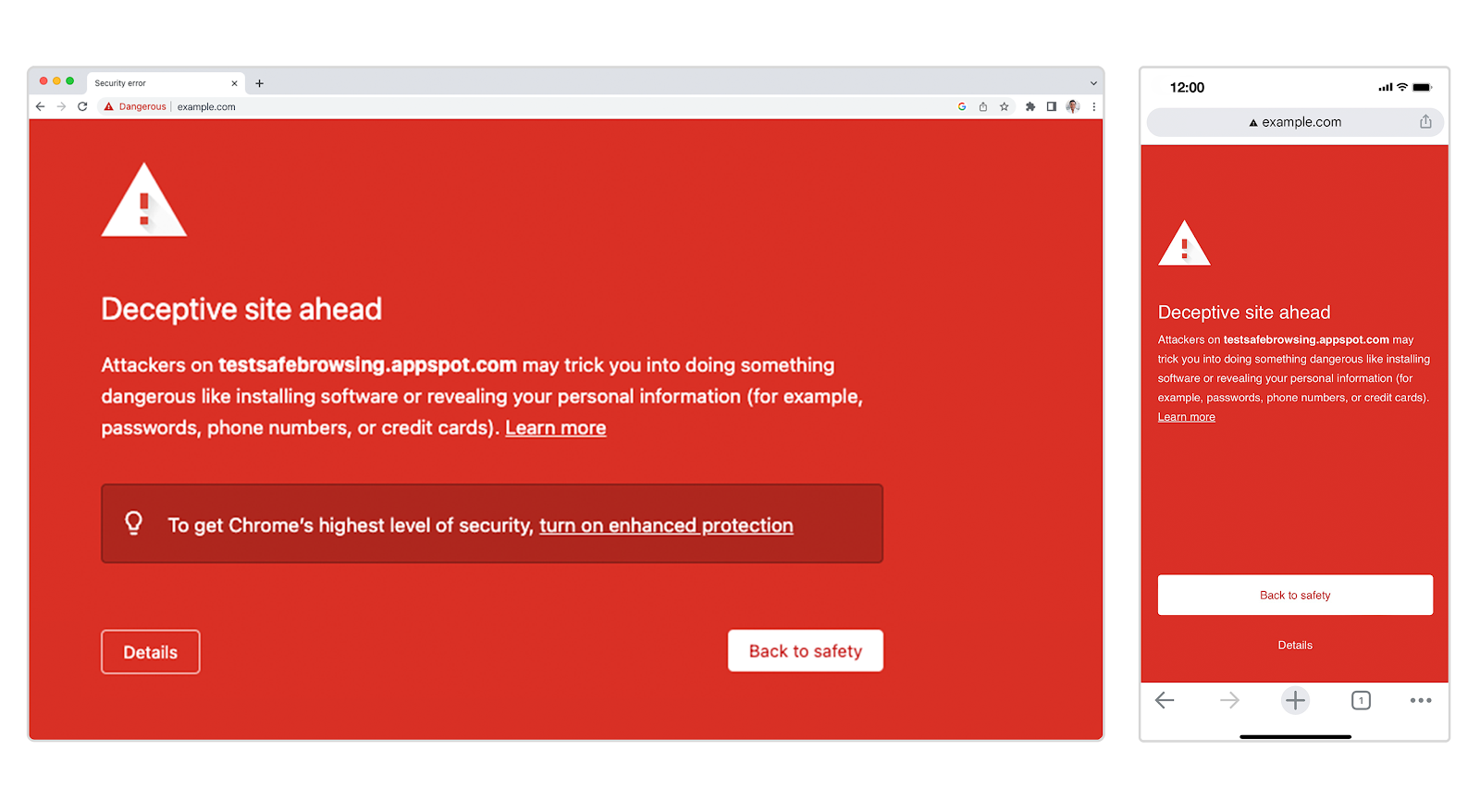
By default, Chrome users in the above populations who navigate to a website serving a certificate from Chunghwa Telecom or Netlock issued after July 31, 2025 will see a full page interstitial similar to this one.

Certificates issued by other CAs are not impacted by this action.

How can a website operator tell if their website is affected?

Website operators can determine if they are affected by this action by using the Chrome Certificate Viewer.

Use the Chrome Certificate Viewer

  • Navigate to a website (e.g., https://www.google.com)
  • Click the “Tune" icon
  • Click “Connection is Secure"
  • Click “Certificate is Valid" (the Chrome Certificate Viewer will open)
    • Website owner action is not required, if the “Organization (O)” field listed beneath the “Issued By" heading does not contain “Chunghwa Telecom" , “行政院” , “NETLOCK Ltd.”, or “NETLOCK Kft.”
    • Website owner action is required, if the “Organization (O)” field listed beneath the “Issued By" heading contains “Chunghwa Telecom" , “行政院” , “NETLOCK Ltd.”, or “NETLOCK Kft.”

What does an affected website operator do?

We recommend that affected website operators transition to a new publicly-trusted CA Owner as soon as reasonably possible. To avoid adverse website user impact, action must be completed before the existing certificate(s) expire if expiry is planned to take place after July 31, 2025.

While website operators could delay the impact of blocking action by choosing to collect and install a new TLS certificate issued from Chunghwa Telecom or Netlock before Chrome’s blocking action begins on August 1, 2025, website operators will inevitably need to collect and install a new TLS certificate from one of the many other CAs included in the Chrome Root Store.

Can I test these changes before they take effect?

Yes.

A command-line flag was added beginning in Chrome 128 that allows administrators and power users to simulate the effect of an SCTNotAfter distrust constraint as described in this blog post.

How to: Simulate an SCTNotAfter distrust

1. Close all open versions of Chrome

2. Start Chrome using the following command-line flag, substituting variables described below with actual values

--test-crs-constraints=$[Comma Separated List of Trust Anchor Certificate SHA256 Hashes]:sctnotafter=$[epoch_timestamp]

3. Evaluate the effects of the flag with test websites

Learn more about command-line flags here.

I use affected certificates for my internal enterprise network, do I need to do anything?

Beginning in Chrome 127, enterprises can override Chrome Root Store constraints like those described in this blog post by installing the corresponding root CA certificate as a locally-trusted root on the platform Chrome is running (e.g., installed in the Microsoft Certificate Store as a Trusted Root CA).

How do enterprises add a CA as locally-trusted?

Customer organizations should use this enterprise policy or defer to platform provider guidance for trusting root CA certificates.

What about other Google products?

Other Google product team updates may be made available in the future.

What’s New in Android Security and Privacy in 2025

Posted by Dave Kleidermacher, VP Engineering, Android Security and Privacy

Android’s intelligent protections keep you safe from everyday dangers. Our dedication to your security is validated by security experts, who consistently rank top Android devices highest in security, and score Android smartphones, led by the Pixel 9 Pro, as leaders in anti-fraud efficacy.

Android is always developing new protections to keep you, your device, and your data safe. Today, we’re announcing new features and enhancements that build on our industry-leading protections to help keep you safe from scams, fraud, and theft on Android.

Smarter protections against phone call scams

Our research shows that phone scammers often try to trick people into performing specific actions to initiate a scam, like changing default device security settings or granting elevated permissions to an app. These actions can result in spying, fraud, and other abuse by giving an attacker deeper access to your device and data. To combat phone scammers, we’re working to block specific actions and warn you of these sophisticated attempts. This happens completely on device and is applied only with conversations with non-contacts.

Android’s new in-call protections1 provide an additional layer of defense, preventing you from taking risky security actions during a call like:

  • Disabling Google Play Protect, Android’s built-in security protection, that is on by default and continuously scans for malicious app behavior, no matter the download source.
  • Sideloading an app for the first time from a web browser, messaging app or other source – which may not have been vetted for security and privacy by Google.
  • Granting accessibility permissions, which can give a newly downloaded malicious app access to gain control over the user's device and steal sensitive/private data, like banking information.

And if you’re screen sharing during a phone call, Android will now automatically prompt you to stop sharing at the end of a call. These protections help safeguard you against scammers that attempt to gain access to sensitive information to conduct fraud.

Piloting enhanced in-call protection for banking apps


Screen sharing scams are becoming quite common, with fraudsters often impersonating banks, government agencies, and other trusted institutions – using screen sharing to guide users to perform costly actions such as mobile banking transfers. To better protect you from these attacks, we’re piloting new in-call protections for banking apps, starting in the UK.

When you launch a participating banking app while screen sharing with an unknown contact, your Android device will warn you about the potential dangers and give you the option to end the call and to stop screen sharing with one tap.

This feature will be enabled automatically for participating banking apps whenever you're on a phone call with an unknown contact on Android 11+ devices. We are working with UK banks Monzo, NatWest and Revolut to pilot this feature for their customers in the coming weeks and will assess the results of the pilot ahead of a wider roll out.


Making real-time Scam Detection in Google Messages even more intelligent


We recently launched AI-powered Scam Detection in Google Messages and Phone by Google to protect you from conversational scams that might sound innocent at first, but turn malicious and can lead to financial loss or data theft. When Scam Detection discovers a suspicious conversation pattern, it warns you in real-time so you can react before falling victim to a costly scam.

AI-powered Scam Detection is always improving to help keep you safe while also keeping your privacy in mind. With Google’s advanced on-device AI, your conversations stay private to you. All message processing remains on-device and you’re always in control. You can turn off Spam Protection, which includes Scam Detection, in your Google Messages at any time.

Prior to targeting conversational scams, Scam Detection in Google Messages focused on analyzing and detecting package delivery and job seeking scams. We’ve now expanded our detections to help protect you from a wider variety of sophisticated scams including:

  • Toll road and other billing fee scams
  • Crypto scams
  • Financial impersonation scams
  • Gift card and prize scams
  • Technical support scams
  • And more
These enhancements apply to all Google Messages users.

Fighting fraud and impersonation with Key Verifier

To help protect you from scammers who try to impersonate someone you know, we’re launching a helpful tool called Key Verifier. The feature allows you and the person you’re messaging to verify the identity of the other party through public encryption keys, protecting your end-to-end encrypted messages in Google Messages. By verifying contact keys in your Google Contacts app (through a QR code scanning or number comparison), you can have an extra layer of assurance that the person on the other end is genuine and that your conversation is private with them.

Key Verifier provides a visual way for you and your contact to quickly confirm that your secret keys match, strengthening your confidence that you’re communicating with the intended recipient and not a scammer. For example, if an attacker gains access to a friend’s phone number and uses it on another device to send you a message – which can happen as a result of a SIM swap attack – their contact's verification status will be marked as no longer verified in the Google Contacts app, suggesting your friend’s account may be compromised or has been changed. Key Verifier will launch later this summer in Google Messages on Android 10+ devices.

Comprehensive mobile theft protection, now even stronger


Physical device theft can lead to financial fraud and data theft, with the value of your banking and payment information many times exceeding the value of your phone. This is one of the reasons why last year we launched the mobile industry’s most comprehensive suite of theft protection features to protect you before, during, and after a theft. Since launch, our theft protection features have helped protect data on hundreds of thousands of devices that may have fallen into the wrong hands. This includes devices that were locked by Remote Lock or Theft Detection Lock and remained locked for over 48 hours.

Most recently, we launched Identity Check for Pixel and Samsung One UI 7 devices, providing an extra layer of security even if your PIN or password is compromised. This protection will also now be available from more device manufacturers on supported devices that upgrade to Android 16.

Coming later this year, we’re further hardening Factory Reset protections, which will restrict all functionalities on devices that are reset without the owner’s authorization. You'll also gain more control over our Remote Lock feature with the addition of a security challenge question, helping to prevent unauthorized actions.

We’re also enhancing your security against thieves in Android 16 by providing more protection for one-time passwords that are received when your phone is locked. In higher risk scenarios2, Android will hide one-time passwords on your lock screen, ensuring that only you can see them after unlocking your device.

Advanced Protection: Google’s strongest security for mobile devices

Protecting users who need heightened security has been a long-standing commitment at Google, which is why we have our Advanced Protection Program that provides Google’s strongest protections against targeted attacks.

To enhance these existing device defenses, Android 16 extends Advanced Protection with a device-level security setting for Android users. Whether you’re an at-risk individual – such as a journalist, elected official, or public figure – or you just prioritize security, Advanced Protection gives you the ability to activate Google’s strongest security for mobile devices, providing greater peace of mind that you’re protected against the most sophisticated threats.

Advanced Protection is available on devices with Android 16. Learn more in our blog.

More intelligent defenses against bad apps with Google Play Protect

One way malicious developers try to trick people is by hiding or changing their app icon, making unsafe apps more difficult to find and remove. Now, Google Play Protect live threat detection will catch apps and alert you when we detect this deceptive behavior. This feature will be available to Google Pixel 6+ and a selection of new devices from other manufacturers in the coming months.

Google Play Protect always checks each app before it gets installed on your device, regardless of the install source. It conducts real-time scanning of an app, enhanced by on-device machine learning, when users try to install an app that has never been seen by Google Play Protect to help detect emerging threats.

We’ve made Google Play Protect’s on-device capabilities smarter to help us identify more malicious applications even faster to keep you safe. Google Play Protect now uses a new set of on-device rules to specifically look for text or binary patterns to quickly identify malware families. If an app shows these malicious patterns, we can alert you before you even install it. And to keep you safe from new and emerging malware and their variants, we will update these rules frequently for better classification over time.

This update to Google Play Protect is now available globally for all Android users with Google Play services.

Always advancing Android security


In addition to new features that come in numbered Android releases, we're constantly enhancing your protection on Android through seamless Google Play services updates and other improvements, ensuring you benefit from the latest security advancements continuously. This allows us to rapidly deploy critical defenses and keep you ahead of emerging threats, making your Android experience safer every day.

Through close collaboration with our partners across the Android ecosystem and the broader security community, we remain focused on bringing you security enhancements and innovative new features to help keep you safe.

Notes


  1. In-call protection for disabling Google Play Protect is available on Android 6+ devices. Protections for sideloading an app and turning on accessibility permissions are available on Android 16 devices. 

  2. When a user’s device is not connected to Wi-Fi and has not been recently unlocked 

Advanced Protection: Google’s Strongest Security for Mobile Devices

Posted by Il-Sung Lee, Group Product Manager, Android Security

Protecting users who need heightened security has been a long-standing commitment at Google, which is why we have our Advanced Protection Program that provides Google’s strongest protections against targeted attacks.

To enhance these existing device defenses, Android 16 extends Advanced Protection with a device-level security setting for Android users. Whether you’re an at-risk individual – such as a journalist, elected official, or public figure – or you just prioritize security, Advanced Protection gives you the ability to activate Google’s strongest security for mobile devices, providing greater peace of mind that you’re protected against the most sophisticated threats.

Simple to activate, powerful in protection

Advanced Protection ensures all of Android's highest security features are enabled and are seamlessly working together to safeguard you against online attacks, harmful apps, and data risks.

Advanced Protection activates a powerful array of security features, combining new capabilities with pre-existing ones that have earned top ratings in security comparisons, all designed to protect your device across several critical areas.

We're also introducing innovative, Android-specific features, such as Intrusion Logging. This industry-first feature securely backs up device logs in a privacy-preserving and tamper-resistant way, accessible only to the user. These logs enable a forensic analysis if a device compromise is ever suspected.

Advanced Protection gives users:

  • Best-in-class protection, minimal disruption: Advanced Protection gives users the option to equip their devices with Android’s most effective security features for proactive defense, with a user-friendly and low-friction experience.
  • Easy activation: Advanced Protection makes security easy and accessible. You don’t need to be a security expert to benefit from enhanced security.
  • Defense-in-depth: Once a user turns on Advanced Protection, the system prevents accidental or malicious disablement of the individual security features under the Advanced Protection umbrella. This reflects a "defense-in-depth" strategy, where multiple security layers work together.
  • Seamless security integration with apps: Advanced Protection acts as a single control point that enables important security settings across many of your favorite Google apps, including Chrome, Google Message, and Phone by Google. Advanced Protection will also incorporate third-party applications that choose to integrate in the future.

How your Android device becomes fortified with Advanced Protection

Advanced Protection manages the following existing and new security features for your device, ensuring they are activated and cannot be disabled across critical protection areas:

Continuously evolving Advanced Protection

With the release of Android 16, users who choose to activate Advanced Protection will gain immediate access to a core suite of enhanced security features. Additional Advanced Protection features like Intrusion Logging, USB protection, the option to disable auto-reconnect to insecure networks, and integration with Scam Detection for Phone by Google will become available later this year.

We are committed to continuously expanding the security and privacy capabilities within Advanced Protection, so users can benefit from the best of Android’s powerful security features.

New AI-Powered Scam Detection Features to Help Protect You on Android

Posted by Lyubov Farafonova, Product Manager, Phone by Google; Alberto Pastor Nieto, Sr. Product Manager Google Messages and RCS Spam and Abuse

Google has been at the forefront of protecting users from the ever-growing threat of scams and fraud with cutting-edge technologies and security expertise for years. In 2024, scammers used increasingly sophisticated tactics and generative AI-powered tools to steal more than $1 trillion from mobile consumers globally, according to the Global Anti-Scam Alliance. And with the majority of scams now delivered through phone calls and text messages, we’ve been focused on making Android’s safeguards even more intelligent with powerful Google AI to help keep your financial information and data safe.

Today, we’re launching two new industry-leading AI-powered scam detection features for calls and text messages, designed to protect users from increasingly complex and damaging scams. These features specifically target conversational scams, which can often appear initially harmless before evolving into harmful situations.

To enhance our detection capabilities, we partnered with financial institutions around the world to better understand the latest advanced and most common scams their customers are facing. For example, users are experiencing more conversational text scams that begin innocently, but gradually manipulate victims into sharing sensitive data, handing over funds, or switching to other messaging apps. And more phone calling scammers are using spoofing techniques to hide their real numbers and pretend to be trusted companies.

Traditional spam protections are focused on protecting users before the conversation starts, and are less effective against these latest tactics from scammers that turn dangerous mid-conversation and use social engineering techniques. To better protect users, we invested in new, intelligent AI models capable of detecting suspicious patterns and delivering real-time warnings over the course of a conversation, all while prioritizing user privacy.

Scam Detection for messages

We’re building on our enhancements to existing Spam Protection in Google Messages that strengthen defenses against job and delivery scams, which are continuing to roll out to users. We’re now introducing Scam Detection to detect a wider range of fraudulent activities.

Scam Detection in Google Messages uses powerful Google AI to proactively address conversational scams by providing real-time detection even after initial messages are received. When the on-device AI detects a suspicious pattern in SMS, MMS, and RCS messages, users will now get a message warning of a likely scam with an option to dismiss or report and block the sender.

As part of the Spam Protection setting, Scam Detection on Google Messages is on by default and only applies to conversations with non-contacts. Your privacy is protected with Scam Detection in Google Messages, with all message processing remaining on-device. Your conversations remain private to you; if you choose to report a conversation to help reduce widespread spam, only sender details and recent messages with that sender are shared with Google and carriers. You can turn off Spam Protection, which includes Scam Detection, in your Google Messages at any time.

Scam Detection in Google Messages is launching in English first in the U.S., U.K. and Canada and will expand to more countries soon.

Scam Detection for calls

More than half of Americans reported receiving at least one scam call per day in 2024. To combat the rise of sophisticated conversational scams that deceive victims over the course of a phone call, we introduced Scam Detection late last year to U.S.-based English-speaking Phone by Google public beta users on Pixel phones.

We use AI models processed on-device to analyze conversations in real-time and warn users of potential scams. If a caller, for example, tries to get you to provide payment via gift cards to complete a delivery, Scam Detection will alert you through audio and haptic notifications and display a warning on your phone that the call may be a scam.

During our limited beta, we analyzed calls with Gemini Nano, Google’s built-in, on-device foundation model, on Pixel 9 devices and used smaller, robust on-device machine-learning models for Pixel 6+ users. Our testing showed that Gemini Nano outperformed other models, so as a result, we're currently expanding the availability of the beta to bring the most capable Scam Detection to all English-speaking Pixel 9+ users in the U.S.

Similar to Scam Detection in messaging, we built this feature to protect your privacy by processing everything on-device. Call audio is processed ephemerally and no conversation audio or transcription is recorded, stored on the device, or sent to Google or third parties. Scam Detection in Phone by Google is off by default to give users control over this feature, as phone call audio is more ephemeral compared to messages, which are stored on devices. Scam Detection only applies to calls that could potentially be scams, and is never used during calls with your contacts. If enabled, Scam Detection will beep at the start and during the call to notify participants the feature is on. You can turn off Scam Detection at any time, during an individual call or for all future calls.

According to our research and a Scam Detection beta user survey, these types of alerts have already helped people be more cautious on the phone, detect suspicious activity, and avoid falling victim to conversational scams.

Keeping Android users safe with the power of Google AI


We're committed to keeping Android users safe, and that means constantly evolving our defenses against increasingly sophisticated scams and fraud. Our investment in intelligent protection is having real-world impact for billions of users. Leviathan Security Group, a cybersecurity firm, conducted a funded evaluation of fraud protection features on a number of smartphones and found that Android smartphones, led by the Pixel 9 Pro, scored highest for built-in security features and anti-fraud efficacy1.

With AI-powered innovations like Scam Detection in Messages and Phone by Google, we're giving you more tools to stay one step ahead of bad actors. We're constantly working with our partners across the Android ecosystem to help bring new security features to even more users. Together, we’re always working to keep you safe on Android.

Notes


  1. Based on third-party research funded by Google LLC in Feb 2025 comparing the Pixel 9 Pro, iPhone 16 Pro, Samsung S24+ and Xiaomi 14 Ultra. Evaluation based on no-cost smartphone features enabled by default. Some features may not be available in all countries. 

How we kept the Google Play & Android app ecosystems safe in 2024

Posted by Bethel Otuteye and Khawaja Shams (Android Security and Privacy Team), and Ron Aquino (Play Trust and Safety)

Android and Google Play comprise a vibrant ecosystem with billions of users around the globe and millions of helpful apps. Keeping this ecosystem safe for users and developers remains our top priority. However, like any flourishing ecosystem, it also attracts its share of bad actors. That’s why every year, we continue to invest in more ways to protect our community and fight bad actors, so users can trust the apps they download from Google Play and developers can build thriving businesses.

Last year, those investments included AI-powered threat detection, stronger privacy policies, supercharged developer tools, new industry-wide alliances, and more. As a result, we prevented 2.36 million policy-violating apps from being published on Google Play and banned more than 158,000 bad developer accounts that attempted to publish harmful apps.

But that was just the start. For more, take a look at our recent highlights from 2024:

Google’s advanced AI: helping make Google Play a safer place


To keep out bad actors, we have always used a combination of human security experts and the latest threat-detection technology. In 2024, we used Google’s advanced AI to improve our systems’ ability to proactively identify malware, enabling us to detect and block bad apps more effectively. It also helps us streamline review processes for developers with a proven track record of policy compliance. Today, over 92% of our human reviews for harmful apps are AI-assisted, allowing us to take quicker and more accurate action to help prevent harmful apps from becoming available on Google Play.

That’s enabled us to stop more bad apps than ever from reaching users through the Play Store, protecting users from harmful or malicious apps before they can cause any damage.

Working with developers to enhance security and privacy on Google Play

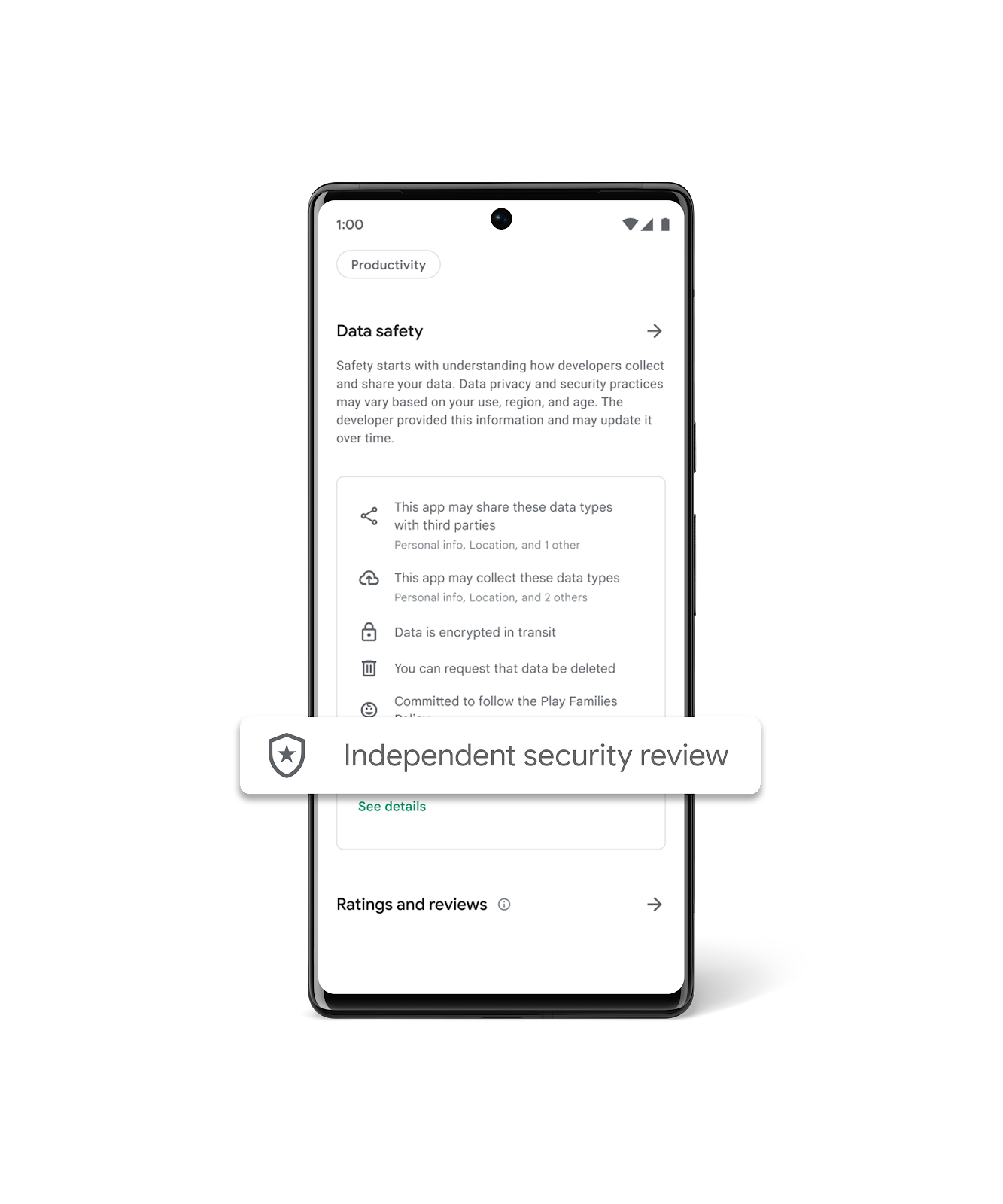
To protect user privacy, we’re working with developers to reduce unnecessary access to sensitive data. In 2024, we prevented 1.3 million apps from getting excessive or unnecessary access to sensitive user data. We also required apps to be more transparent about how they handle user information by launching new developer requirements and a new “Data deletion” option for apps that support user accounts and data collection. This helps users manage their app data and understand the app’s deletion practices, making it easier for Play users to delete data collected from third-party apps.

We also worked to ensure that apps use the strongest and most up-to-date privacy and security capabilities Android has to offer. Every new version of Android introduces new security and privacy features, and we encourage developers to embrace these advancements as soon as possible. As a result of partnering closely with developers, over 91% of app installs on the Google Play Store now use the latest protections of Android 13 or newer.

Safeguarding apps from scams and fraud is an ongoing battle for developers. The Play Integrity API allows developers to check if their apps have been tampered with or are running in potentially compromised environments, helping them to prevent abuse like fraud, bots, cheating, and data theft. Play Integrity API and Play’s automatic protection helps developers ensure that users are using the official Play version of their app with the latest security updates. Apps using Play integrity features are seeing 80% lower usage from unverified and untrusted sources on average.

We’re also constantly working to improve the safety of apps on Play at scale, such as with the Google Play SDK Index. This tool offers insights and data to help developers make more informed decisions about the safety of an SDK. Last year, in addition to adding 80 SDKs to the index, we also worked closely with SDK and app developers to address potential SDK security and privacy issues, helping to build safer and more secure apps for Google Play.

Google Play’s multi-layered protections against bad apps


To create a trusted experience for everyone on Google Play, we use our SAFE principles as a guide, incorporating multi-layered protections that are always evolving to help keep Google Play safe. These protections start with the developers themselves, who play a crucial role in building secure apps. We provide developers with best-in-class tools, best practices, and on-demand training resources for building safe, high-quality apps. Every app undergoes rigorous review and testing, with only approved apps allowed to appear in the Play Store. Before a user downloads an app from Play, users can explore its user reviews, ratings, and Data safety section on Google Play to help them make an informed decision. And once installed, Google Play Protect, Android’s built-in security protection, helps to shield their Android device by continuously scanning for malicious app behavior.

Enhancing Google Play Protect to help keep users safe on Android


While the Play Store offers best-in-class security, we know it’s not the only place users download Android apps – so it’s important that we also defend Android users from more generalized mobile threats. To do this in an open ecosystem, we’ve invested in sophisticated, real-time defenses that protect against scams, malware, and abusive apps. These intelligent security measures help to keep users, user data, and devices safe, even if apps are installed from various sources with varying levels of security.


Google Play Protect automatically scans every app on Android devices with Google Play Services, no matter the download source. This built-in protection, enabled by default, provides crucial security against malware and unwanted software. Google Play Protect scans more than 200 billion apps daily and performs real-time scanning at the code-level on novel apps to combat emerging and hidden threats, like polymorphic malware. In 2024, Google Play Protect’s real-time scanning identified more than 13 million new malicious apps from outside Google Play1.

Google Play Protect is always evolving to combat new threats and protect users from harmful apps that can lead to scams and fraud. Here are some of the new improvements that are now available globally on Android devices with Google Play Services:

  • Reminder notifications in Chrome on Android to re-enable Google Play Protect: According to our research, more than 95 percent of app installations from major malware families that exploit sensitive permissions highly correlated to financial fraud came from Internet-sideloading sources like web browsers, messaging apps, or file managers. To help users stay protected when browsing the web, Chrome will now display a reminder notification to re-enable Google Play Protect if it has been turned off.
  • Additional protection against social engineering attacks: Scammers may manipulate users into disabling Play Protect during calls to download malicious Internet-sideloaded apps. To prevent this, the Play Protect app scanning toggle is now temporarily disabled during phone or video calls. This safeguard is enabled by default during traditional phone calls as well as during voice and video calls in popular third-party apps.
  • Automatically revoking app permissions for potentially dangerous apps: Since Android 11, we’ve taken a proactive approach to data privacy by automatically resetting permissions for apps that users haven't used in a while. This ensures apps can only access the data they truly need, and users can always grant permissions back if necessary. To further enhance security, Play Protect now automatically revokes permissions for potentially harmful apps, limiting their access to sensitive data like storage, photos, and camera. Users can restore app permissions at any time, with a confirmation step for added security.

Google Play Protect’s enhanced fraud protection pilot analyzes and automatically blocks the installation of apps that may use sensitive permissions frequently abused for financial fraud when the user attempts to install the app from an Internet-sideloading source (web browsers, messaging apps, or file managers).

Building on the success of our initial pilot in partnership with the Cyber Security Agency of Singapore (CSA), additional enhanced fraud protection pilots are now active in nine regions – Brazil, Hong Kong, India, Kenya, Nigeria, Philippines, South Africa, Thailand, and Vietnam.

In 2024, Google Play Protect’s enhanced fraud protection pilots have shielded 10 million devices from over 36 million risky installation attempts, encompassing over 200,000 unique apps.

By piloting these new protections, we can proactively combat emerging threats and refine our solutions to thwart scammers and their increasingly sophisticated fraud attempts. We look forward to continuing to partner with governments, ecosystem partners, and other stakeholders to improve user protections.

App badging to help users find apps they can trust at a glance on Google Play

In 2024, we introduced a new badge for government developers to help users around the world identify official government apps. Government apps are often targets of impersonation due to the highly sensitive nature of the data users provide, giving bad actors the ability to steal identities and commit financial fraud. Badging verified government apps is an important step in helping connect people with safe, high-quality, useful, and relevant experiences. We partner closely with global governments and are already exploring ways to build on this work.

We also recently introduced a new badge to help Google Play users discover VPN apps that take extra steps to demonstrate their strong commitment to security. We allow developers who adhere to Play safety and security guidelines and have passed an additional independent Mobile Application Security Assessment (MASA) to display a dedicated badge in the Play Store to highlight their increased commitment to safety.

Collaborating to advance app security standards

In addition to our partnerships with governments, developers, and other stakeholders, we also worked with our industry peers to protect the entire app ecosystem for everyone. The App Defense Alliance, in partnership with fellow steering committee members Microsoft and Meta, recently launched the ADA Application Security Assessment (ASA) v1.0, a new standard to help developers build more secure mobile, web, and cloud applications. This standard provides clear guidance on protecting sensitive data, defending against cyberattacks, and ultimately, strengthening user trust. This marks a significant step forward in establishing industry-wide security best practices for application development.

All developers are encouraged to review and comply with the new mobile security standard. You’ll see this standard in action for all carrier apps pre-installed on future Pixel phone models.

Looking ahead


This year, we’ll continue to protect the Android and Google Play ecosystem, building on these tools and resources in response to user and developer feedback and the changing landscape. As always, we’ll keep empowering developers to build safer apps more easily, streamline their policy experience, and protect their businesses and users from bad actors.


1 Based on Google Play Protect 2024 internal data.

Android enhances theft protection with Identity Check and expanded features

Posted by Jianing Sandra Guo, Product Manager, Android, Nataliya Stanetsky, Staff Program Manager, Android

Today, people around the world rely on their mobile devices to help them stay connected with friends and family, manage finances, keep track of healthcare information and more – all from their fingertips. But a stolen device in the wrong hands can expose sensitive data, leaving you vulnerable to identity theft, financial fraud and privacy breaches.

This is why we recently launched Android theft protection, a comprehensive suite of features designed to protect you and your data at every stage – before, during, and after device theft. As part of our commitment to help you stay safe on Android, we’re expanding and enhancing these features to deliver even more robust protection to more users around the world.

Identity Check rolling out to Pixel and Samsung One UI 7 devices

We’re officially launching Identity Check, first on Pixel and Samsung Galaxy devices eligible for One UI 71, to provide better protection for your critical account and device settings. When you turn on Identity Check, your device will require explicit biometric authentication to access certain sensitive resources when you’re outside of trusted locations. Identity Check also enables enhanced protection for Google Accounts on all supported devices and additional security for Samsung Accounts on One UI 7 eligible Galaxy devices, making it much more difficult for an unauthorized attacker to take over accounts signed in on the device.

As part of enabling Identity Check, you can designate one or more trusted locations. When you’re outside of these trusted places, biometric authentication will be required to access critical account and device settings, like changing your device PIN or biometrics, disabling theft protection, or accessing Passkeys.

Identity Check gives you more peace of mind that your most sensitive device assets are protected against unauthorized access, even if a thief or bad actor manages to learn your device PIN.

Identity Check is rolling out now to Pixel devices with Android 15 and will be available on One UI 7 eligible Galaxy devices in the coming weeks. It will roll out to supported Android devices from other manufacturers later this year.

Theft Detection Lock: expanding AI-powered protection to more users

One of the top theft protection features introduced last year was Theft Detection Lock, which uses an on-device AI-powered algorithm to help detect when your phone may be forcibly taken from you. If the machine learning algorithm detects a potential theft attempt on your unlocked device, it locks your screen to keep thieves out.

Theft Detection Lock is now fully rolled out to Android 10+ phones2 around the world.

Protecting your Android device from theft

We're collaborating with the GSMA and industry experts to combat mobile device theft by sharing information, tools and prevention techniques. Stay tuned for an upcoming GSMA white paper, developed in partnership with the mobile industry, with more information on protecting yourself and your organization from device theft.

With the addition of Identity Check and the ongoing enhancements to our existing features, Android offers a robust and comprehensive set of tools to protect your devices and your data from theft. We’re dedicated to providing you with peace of mind, knowing your personal information is safe and secure.

You can turn on the new Android theft features by clicking here on a supported Android device. Learn more about our theft protection features by visiting our help center.

Notes


  1. Timing, availability and feature names may vary in One UI 7. 

  2. With the exclusion for Android Go smartphones 

Safer with Google: New intelligent, real-time protections on Android to keep you safe

Posted by Lyubov Farafonova, Product Manager and Steve Kafka, Group Product Manager, Android

User safety is at the heart of everything we do at Google. Our mission to make technology helpful for everyone means building features that protect you while keeping your privacy top of mind. From Gmail’s defenses that stop more than 99.9% of spam, phishing and malware, to Google Messages’ advanced security that protects users from 2 billion suspicious messages a month and beyond, we're constantly developing and expanding protection features that help keep you safe.

We're introducing two new real-time protection features that enhance your safety, all while safeguarding your privacy: Scam Detection in Phone by Google to protect you from scams and fraud, and Google Play Protect live threat detection with real-time alerts to protect you from malware and dangerous apps.

These new security features are available first on Pixel, and are coming soon to more Android devices.

More intelligent AI-powered protection against scams

Scammers steal over $1 trillion dollars a year from people, and phone calls are their favorite way to do it. Even more alarming, scam calls are evolving, becoming increasingly more sophisticated, damaging and harder to identify. That’s why we’re using the best of Google AI to identify and stop scams before they can do harm with Scam Detection.

Real-time protection, built with your privacy in mind.

  • Real-time defense, right on your device: Scam Detection uses powerful on-device AI to notify you of a potential scam call happening in real-time by detecting conversation patterns commonly associated with scams. For example, if a caller claims to be from your bank and asks you to urgently transfer funds due to an alleged account breach, Scam Detection will process the call to determine whether the call is likely spam and, if so, can provide an audio and haptic alert and visual warning that the call may be a scam.
  • Private by design, you’re always in control: We’ve built Scam Detection to protect your privacy and ensure you’re always in control of your data. Scam Detection is off by default, and you can decide whether you want to activate it for future calls. At any time, you can turn it off for all calls in the Phone app Settings, or during a particular call. The AI detection model and processing are fully on-device, which means that no conversation audio or transcription is stored on the device, sent to Google servers or anywhere else, or retrievable after the call.
  • Cutting-edge AI protection, now on more Pixel phones: Gemini Nano, our advanced on-device AI model, powers Scam Detection on Pixel 9 series devices. As part of our commitment to bring powerful AI features to even more devices, this AI-powered protection is available to Pixel 6+ users thanks to other robust Google on-device machine learning models.

We’re now rolling out Scam Detection to English-speaking Phone by Google public beta users in the U.S. with a Pixel 6 or newer device.

To provide feedback on your experience, please click on Phone by Google App -> Menu -> Help & Feedback -> Send Feedback. We look forward to learning from this beta and your feedback, and we’ll share more about Scam Detection in the months ahead.

More real-time alerts to protect you from bad apps

Google Play Protect works non-stop to protect you in real-time from malware and unsafe apps. Play Protect analyzes behavioral signals related to the use of sensitive permissions and interactions with other apps and services.

With live threat detection, if a harmful app is found, you'll now receive a real-time alert, allowing you to take immediate action to protect your device. By looking at actual activity patterns of apps, live threat detection can now find malicious apps that try extra hard to hide their behavior or lie dormant for a time before engaging in suspicious activity.

At launch, live threat detection will focus on stalkerware, code that may collect personal or sensitive data for monitoring purposes without user consent, and we will explore expanding its detection to other types of harmful apps in the future. All of this protection happens on your device in a privacy preserving way through Private Compute Core, which allows us to protect users without collecting data.

Live threat detection with real-time alerts in Google Play Protect are now available on Pixel 6+ devices and will be coming to additional phone makers in the coming months.

5 new protections on Google Messages to help keep you safe

Posted by Jan Jedrzejowicz, Director of Product, Android and Business Communications; Alberto Pastor Nieto, Sr. Product Manager Google Messages and RCS Spam and Abuse; Stephan Somogyi, Product Lead, User Protection; Branden Archer, Software Engineer

Every day, over a billion people use Google Messages to communicate. That’s why we’ve made security a top priority, building in powerful on-device, AI-powered filters and advanced security that protects users from 2 billion suspicious messages a month. With end-to-end encrypted1 RCS conversations, you can communicate privately with other Google Messages RCS users. And we’re not stopping there. We're committed to constantly developing new controls and features to make your conversations on Google Messages even more secure and private.

As part of cybersecurity awareness month, we're sharing five new protections to help keep you safe while using Google Messages on Android:

  1. Enhanced detection protects you from package delivery and job scams. Google Messages is adding new protections against scam texts that may seem harmless at first but can eventually lead to fraud. For Google Messages beta users2, we’re rolling out enhanced scam detection, with improved analysis of scammy texts, starting with a focus on package delivery and job seeking messages. When Google Messages suspects a potential scam text, it will automatically move the message into your spam folder or warn you. Google Messages uses on-device machine learning models to classify these scams, so your conversations stay private and the content is never sent to Google unless you report spam. We’re rolling this enhancement out now to Google Messages beta users who have spam protection enabled.
  2. Intelligent warnings alert you about potentially dangerous links. In the past year, we’ve been piloting more protections for Google Messages users when they receive text messages with potentially dangerous links. In India, Thailand, Malaysia and Singapore, Google Messages warns users when they get a link from unknown senders and blocks messages with links from suspicious senders. We’re in the process of expanding this feature globally later this year.
  3. Controls to turn off messages from unknown international senders. In some cases, scam text messages come from international numbers. Soon, you will be able to automatically hide messages from international senders who are not existing contacts so you don’t have to interact with them. If enabled, messages from international non-contacts will automatically be moved to the “Spam & blocked” folder. This feature will roll out first as a pilot in Singapore later this year before we look at expanding to more countries.
  4. Sensitive Content Warnings give you control over seeing and sending images that may contain nudity. At Google, we aim to provide users with a variety of ways to protect themselves against unwanted content, while keeping them in control of their data. This is why we’re introducing Sensitive Content Warnings for Google Messages.

    Sensitive Content Warnings is an optional feature that blurs images that may contain nudity before viewing, and then prompts with a “speed bump” that contains help-finding resources and options, including to view the content. When the feature is enabled, and an image that may contain nudity is about to be sent or forwarded, it also provides a speed bump to remind users of the risks of sending nude imagery and preventing accidental shares.

    All of this happens on-device to protect your privacy and keep end-to-end encrypted message content private to only sender and recipient. Sensitive Content Warnings doesn’t allow Google access to the contents of your images, nor does Google know that nudity may have been detected. This feature is opt-in for adults, managed via Android Settings, and is opt-out for users under 18 years of age. Sensitive Content Warnings will be rolling out to Android 9+ devices including Android Go devices3 with Google Messages in the coming months.
  5. More confirmation about who you’re messaging. To help you avoid sophisticated messaging threats where an attacker tries to impersonate one of your contacts, we’re working to add a contact verifying feature to Android. This new feature will allow you to verify your contacts' public keys so you can confirm you’re communicating with the person you intend to message. We’re creating a unified system for public key verification across different apps, which you can verify through QR code scanning or number comparison. This feature will be launching next year for Android 9+ devices, with support for messaging apps including Google Messages.

    These are just some of the new and upcoming features that you can use to better protect yourself when sending and receiving messages. Download Google Messages from the Google Play Store to enjoy these protections and controls and learn more about Google Messages here.

    Notes


    1. End-to-end encryption is currently available between Google Messages users. Availability of RCS varies by region and carrier. 

    2. Availability of features may vary by market and device. Sign up for beta testing and a data plan may be required.  

    3. Requires 2 GB of RAM. 

Supporting the Use of Rust in the Chromium Project

Posted by Dana Jansens (she/her), Chrome Security Team

We are pleased to announce that moving forward, the Chromium project is going to support the use of third-party Rust libraries from C++ in Chromium. To do so, we are now actively pursuing adding a production Rust toolchain to our build system. This will enable us to include Rust code in the Chrome binary within the next year. We’re starting slow and setting clear expectations on what libraries we will consider once we’re ready.

In this blog post, we will discuss how we arrived at the decision to support third-party Rust libraries at this time, and not broader usage of Rust in Chromium.

Why We Chose to Bring Rust into Chromium

Our goal in bringing Rust into Chromium is to provide a simpler (no IPC) and safer (less complex C++ overall, no memory safety bugs in a sandbox either) way to satisfy the rule of two, in order to speed up development (less code to write, less design docs, less security review) and improve the security (increasing the number of lines of code without memory safety bugs, decreasing the bug density of code) of Chrome. And we believe that we can use third-party Rust libraries to work toward this goal.

Rust was developed by Mozilla specifically for use in writing a browser, so it’s very fitting that Chromium would finally begin to rely on this technology too. Thank you Mozilla for your huge contribution to the systems software industry. Rust has been an incredible proof that we should be able to expect a language to provide safety while also being performant.

We know that C++ and Rust can play together nicely, through tools like cxx, autocxx bindgen, cbindgen, diplomat, and (experimental) crubit. However there are also limitations. We can expect that the shape of these limitations will change in time through new or improved tools, but the decisions and descriptions here are based on the current state of technology.

How Chromium Will Support the Use of Rust

The Chrome Security team has been investing time into researching how we should approach using Rust alongside our C++ code. Understanding the implications of incrementally moving to writing Rust instead of C++, even in the middle of our software stack. What the limits of safe, simple, and reliable interop might be.

Based on our research, we landed on two outcomes for Chromium.

  1. We will support interop in only a single direction, from C++ to Rust, for now. Chromium is written in C++, and the majority of stack frames are in C++ code, right from main() until exit(), which is why we chose this direction. By limiting interop to a single direction, we control the shape of the dependency tree. Rust can not depend on C++ so it cannot know about C++ types and functions, except through dependency injection. In this way, Rust can not land in arbitrary C++ code, only in functions passed through the API from C++.
  2. We will only support third-party libraries for now. Third-party libraries are written as standalone components, they don’t hold implicit knowledge about the implementation of Chromium. This means they have APIs that are simpler and focused on their single task. Or, put another way, they typically have a narrow interface, without complex pointer graphs and shared ownership. We will be reviewing libraries that we bring in for C++ use to ensure they fit this expectation.

The Interop Between Rust and C++ in Chromium

We have observed that most successful C/C++ and Rust interop stories to date have been built around interop through narrow APIs (e.g. libraries for QUIC or bluetooth, Linux drivers) or through clearly isolated components (e.g. IDLs, IPCs). Chrome is built on foundational but really wide C++ APIs, such as the //content/public layer. We examined what it would mean for us to build Rust components against these types of APIs. At a high level what we found was that because C++ and Rust play by different rules, things can go sideways very easily.

For example, Rust guarantees temporal memory safety with static analysis that relies on two inputs: lifetimes (inferred or explicitly written) and exclusive mutability. The latter is incompatible with how the majority of Chromium’s C++ is written. We hold redundant mutable pointers throughout the system, and pointers that provide multiple paths to reach mutable pointers. We have cyclical mutable data structures. This is especially true in our browser process, which contains a giant interconnected system of (mutable) pointers. If these C++ pointers were also used as Rust references in a complex or long-lived way, it would require our C++ authors to understand the aliasing rules of Rust and prevent the possibility of violating them, such as by:

  • Returning the same mutable pointer from a function twice, where the first may still be held.
  • Passing overlapping pointers where one is mutable into Rust, in a way that they may be held as references at the same time.
  • Mutating state that is visible to Rust through a shared or mutable reference.

Without interop tools providing support via the compiler and the type system, developers would need to understand all of the assumptions being made by Rust compiler, in order to not violate them from C++. In this framing, C++ is much like unsafe Rust. And while unsafe Rust is very costly to a project, its cost is managed by keeping it encapsulated and to the minimum possible. In the same way, the full complexity of C++ would need to be encapsulated from safe Rust. Narrow APIs designed for interop can provide similar encapsulation, and we hope that interop tools can provide encapsulation in other ways that allow wider APIs between the languages.

The high-level summary is that without additional interop tooling support:

  • Passing pointers/references across languages is risky.
  • Narrow interfaces between the languages is critical to make it feasible to write code correctly.

Any cross-language interop between arbitrary code introduces difficulties where concepts in one language are not found in the other. For Rust calling into C++, support for language features like templates or inheritance can be difficult for a binding generator to support. For C++ calling into Rust, proc macros, and traits are examples that provide similar challenges. At times, the impedance mismatch represents intentional design choices made for either language, however they also imply limits on FFI (interop) between the languages. We rely on interop tools to model the ideas of each language in a way that makes sense to the other, or to disallow them.

Accessing the Rust Ecosystem from Chromium

These challenges present an opportunity, both to make interop easier and more seamless, but also to get access to a wider range of libraries from either language. Google is investing in Crubit, an experiment in how to increase the fidelity of interop between C++ and Rust and express or encapsulate the requirements of each language to the other.

The Rust ecosystem is incredibly important, especially to a security-focused open source project like Chromium. The ecosystem is enormous (96k+ crates on crates.io) and growing, with investment from the systems development industry at large, including Google. Chrome relies heavily on third-party code, and we need to keep up with where that third-party investment is happening. It is critical that we build out support for including Rust into the Chromium project.

We will be following this strategy to establish norms, and to maintain a level of API review through the third-party process, while we look to the future of interop support pushing the boundaries of what is possible and reasonable to do between Rust and C++.


Some Other Related Content

Memory unsafety is an industry-wide problem, and making use of Rust is one part of a strategy to move the needle in this area. Recently, Android and Apple have each published a great blog post on the subject if you’re interested in learning more. With Chrome’s millions of lines of C++, we’re still working hard to improve the safety of our C++ too, through projects such as MiraclePtr.

Expanding the App Defense Alliance

Posted by Brooke Davis, Android Security and Privacy Team

The App Defense Alliance launched in 2019 with a mission to protect Android users from bad apps through shared intelligence and coordinated detection between alliance partners. Earlier this year, the App Defense Alliance expanded to include new initiatives outside of malware detection and is now the home for several industry-led collaborations including Malware Mitigation, MASA (Mobile App Security Assessment) & CASA (Cloud App Security Assessment). With a new dedicated landing page at appdefensealliance.dev, the ADA has an expanded mission to protect Android users by removing threats while improving app quality across the ecosystem. Let’s walk through some of the latest program updates from the past year, including the addition of new ADA members.

Malware Mitigation

Together, with the founding ADA members - Google, ESET, Lookout, and Zimperium, the alliance has been able to reduce the risk of app-based malware and better protect Android users. These partners have access to mobile apps as they are being submitted to the Google Play Store and scan thousands of apps daily, acting as another, vital set of eyes prior to an app going live on Play. Knowledge sharing and industry collaboration are important aspects in securing the world from attacks and that’s why we’re continuing to invest in the program.


New ADA Members

We’re excited to see the ADA expand with the additions of McAfee and Trend Micro. Both McAfee and Trend Micro are leaders in the antivirus space and we look forward to their contributions to the program.

Mobile App Security Assessment (MASA)

With consumers spending four to five hours per day in mobile apps, ensuring the safety of these services is more important than ever. According to Data.ai, the pandemic accelerated existing mobile habits - with app categories like finance growing 25% YoY and users spending over 100 billion hours in shopping apps.

That’s why the ADA introduced MASA (Mobile App Security Assessment), which allows developers to have their apps independently validated against the Mobile Application Security Verification Standard (MASVS standard) under the OWASP Mobile Application Security project. The project’s mission is to “Define the industry standard for mobile application security,” and has been used by both public and private sector organizations as a form of industry best practices when it comes to mobile application security. Developers can work directly with an ADA Authorized Lab to have their apps evaluated against a set of MASVS L1 requirements. Once successful, the app’s validation is listed in the recently launched App Validation Directory, which provides users a single place to view all app validations. The Directory also allows users to access more assessment details including validation date, test lab, and a report showing all test steps and requirements. The Directory will be updated over time with new features and search functionality to make it more user friendly.

The Google Play Store is the first commercial app store to recognize and display a badge for any app that has completed an independent security review through ADA MASA. The badge is displayed within an app’s respective Data Safety section.

This MASA program launched in beta earlier this year and is now available for all developers. We’ve seen strong early developer interest with leading apps across a diverse set of categories completing validation including Roblox, Uber, PayPal, Threema, Google Photos, YouTube and many more. On average, developers have completed validation within a month and resolved two outstanding issues identified by a security lab.

To learn more about the program and to help developers get started, there’s a Play Academy course dedicated to independent security review. Check out the interactive guidance on the Academy for App Success and get started today!

Cloud App Security Assessment (CASA)

As the industry continues to evolve and software connects more systems through complex cloud-to-cloud integrations, focusing on the security of cloud applications and their supporting infrastructure becomes increasingly critical. CASA (Cloud App Security Assessment) leverages the work set forth in OWASP’s Application Security Verification Standard ASVS to provide a consistent set of requirements to harden security for any application. The CASA framework provides multiple assurance levels in which low-risk cloud applications can be evaluated using either a self assessment or automated scan. For applications which present higher risk (such as a large user base, recent security breach, or processes highly sensitive data), an Authorized Lab may perform an assessment.

Further, the CASA accelerator provides developers with a workflow that minimizes the required checks depending on the developer's current valid certifications. The CASA checks have been mapped to 10 certifications and frameworks which eliminate redundant testing while lowering the cost of the assessment. Google is continuing to invest in this space with plans to use ASVS more proactively with the developer community next year.

It's been amazing to see the ADA grow this year and we are excited for the continued progress and expansion around the alliance’s mission.

Trust in transparency: Private Compute Core

Posted by Dave Kleidermacher, Dianne Hackborn, and Eugenio Marchiori

We care deeply about privacy. We also know that trust is built by transparency. This blog, and the technical paper reference within, is an example of that commitment: we describe an important new Android privacy infrastructure called Private Compute Core (PCC).

Some of our most exciting machine learning features use continuous sensing data — information from the microphone, camera, and screen. These features keep you safe, help you communicate, and facilitate stronger connections with people you care about. To unlock this new generation of innovative concepts, we built a specialized sandbox to privately process and protect this data.

Android Private Compute Core

PCC is a secure, isolated data processing environment inside of the Android operating system that gives you control of the data inside, such as deciding if, how, and when it is shared with others. This way, PCC can enable features like Live Translate without sharing continuous sensing data with service providers, including Google.

PCC is part of Protected Computing, a toolkit of technologies that transform how, when, and where data is processed to technically ensure its privacy and safety. For example, by employing cloud enclaves, edge processing, or end-to-end encryption we ensure sensitive data remains in exclusive control of the user.

How Private Compute Core works

PCC is designed to enable innovative features while keeping the data needed for them confidential from other subsystems. We do this by using techniques such as limiting Interprocess Communications (IPC) binds and using isolated processes. These are included as part of the Android Open Source Project and controlled by publicly available surfaces, such as Android framework APIs. For features that run inside PCC, continuous sensing data is processed safely and seamlessly while keeping it confidential.

To stay useful, any machine learning feature has to get better over time. To keep the models that power PCC features up to date, while still keeping the data private, we leverage federated learning and analytics. Network calls to improve the performance of these models can be monitored using Private Compute Services.

Let us show you our work

The publicly-verifiable architectures in PCC demonstrate how we strive to deliver confidentiality and control, and do it in a way that is verifiable and visible to users. In addition to this blog, we provide this transparency through public documentation and open-source code — we hope you'll have a look below.

To explain in even more detail, we’ve published a technical whitepaper for researchers and interested members of the community. In it, we describe data protections in-depth, the processes and mechanisms we’ve built, and include diagrams of the privacy structures for continuous sensing features.

Private Compute Services was recently open-sourced as well, and we invite our Android community to inspect the code that controls the data management and egress policies. We hope you'll examine and report back on PCC's implementation, so that our own documentation is not the only source of analysis.

Our commitment to transparency

Being transparent and engaged with users, developers, researchers, and technologists around the world is part of what makes Android special and, we think, more trustworthy. The paradigm of distributed trust, where credibility is built up from verification by multiple trusted sources, continues to extend this core value. Open sourcing the mechanisms for data protection and processes is one step towards making privacy verifiable. The next step is verification by the community — and we hope you'll join in.

We'll continue sharing our progress and look forward to hearing feedback from our users and community on the evolution of Private Compute Core and data privacy at Google.

Enhanced Protection - The strongest level of Safe Browsing protection Google Chrome has to offer

Posted by Benjamin Ackerman, Chrome Security and Jonathan Li, Safe Browsing

As a follow-up to a previous blog post about How Hash-Based Safe Browsing Works in Google Chrome, we wanted to provide more details about Safe Browsing’s Enhanced Protection mode in Chrome. Specifically, how it came about, the protections that are offered and what it means for your data.

Security and privacy have always been top of mind for Chrome. Our goal is to make security effortless for you while browsing the web, so that you can go about your day without having to worry about the links that you click on or the files that you download. This is why Safe Browsing’s phishing and malware protections have been a core part of Chrome since 2007. You may have seen these in action if you have ever come across one of our red warning pages.

We show these warnings whenever we believe a site that you are trying to visit or file that you are trying to download might put you at risk for an attack. To give you a better understanding of how the Enhanced Protection mode in Safe Browsing provides the strongest level of defense it’s useful to know what is offered in Standard Protection.

Standard Protection

Enabled by default in Chrome, Standard Protection was designed to be privacy preserving at its core by using hash-based checks. This has been effective at protecting users by warning millions of users about dangerous websites. However, hash-based checks are inherently limited as they rely on lookups to a list of known bad sites. We see malicious actors moving fast and constantly evolving their tactics to avoid detection using sophisticated techniques. To counter this, we created a stronger and more customized level of protection that we could offer to users. To this end, we launched Enhanced Protection in 2020, which builds upon the Standard Protection mode in Safe Browsing to keep you safer.

Enhanced Protection

This is the fastest and strongest level of protection against dangerous sites and downloads that Safe Browsing offers in Chrome. It enables more advanced detection techniques that adapt quickly as malicious activity evolves. As a result, Enhanced Protection users are phished 20-35% less than users on Standard Protection. A few of these features include:

  • Real time URL checks: By checking with Google Safe Browsing’s servers in real time before navigating to an uncommon site you’re visiting, Chrome provides the best protection against dangerous sites and uses advanced machine learning models to continuously stay up to date.
  • File checks before downloading: In addition to Chrome’s standard checks of downloaded files, Enhanced Protection users can choose to upload suspicious files to be scanned by Google Safe Browsing’s full suite of malware detection technology before opening the file. This helps catch brand new malware that Safe Browsing has not scanned before or dangerous files hosted on a brand new site.
  • More advanced vision-based phishing detection: To better detect phishing and dangerous sites for Enhanced Protection users, Chrome performs basic client-side checks on the web page to determine if it is suspicious. For pages deemed suspicious, Chrome sends a small set of visual features derived from the page to Google’s Safe Browsing servers for additional phishing classification using computer vision. This helps Chrome more accurately recognize dangerous sites, and can warn other users before they visit the site.

    User data privacy and security

    By opting into Enhanced Protection, you are sharing additional data with Safe Browsing systems that allow us to offer better and faster security both for you, and for all users online. Ensuring user privacy is of utmost importance for us and we go through great lengths to anonymize as much of the data as possible. This data is only used for security purposes and only retained for a short period of time. As threats evolve we will continuously add and improve our existing protections for Enhanced Protection users. These features go through extensive privacy reviews to ensure that your privacy continues to be prioritized while still providing you the highest level of security possible.

    How to enable

    Safe Browsing’s Enhanced Protection is currently available for all desktop platforms, Android devices and now iOS mobile devices. It can be enabled by navigating to the Privacy and Security option located in Chrome settings.

    For enterprise admins, you have the option of enabling Enhanced Safe Browsing on your managed devices using the SafeBrowsingProtectionLevel policy and in the Admin Console.

    For more details and updates about Safe Browsing and its Enhanced Protection mode, please visit our Google Safe Browsing website and follow the Google Security Blog for updates on new features.

Memory Safe Languages in Android 13

Posted by Jeffrey Vander Stoep

For more than a decade, memory safety vulnerabilities have consistently represented more than 65% of vulnerabilities across products, and across the industry. On Android, we’re now seeing something different - a significant drop in memory safety vulnerabilities and an associated drop in the severity of our vulnerabilities.

Looking at vulnerabilities reported in the Android security bulletin, which includes critical/high severity vulnerabilities reported through our vulnerability rewards program (VRP) and vulnerabilities reported internally, we see that the number of memory safety vulnerabilities have dropped considerably over the past few years/releases. From 2019 to 2022 the annual number of memory safety vulnerabilities dropped from 223 down to 85.

This drop coincides with a shift in programming language usage away from memory unsafe languages. Android 13 is the first Android release where a majority of new code added to the release is in a memory safe language.

As the amount of new memory-unsafe code entering Android has decreased, so too has the number of memory safety vulnerabilities. From 2019 to 2022 it has dropped from 76% down to 35% of Android’s total vulnerabilities. 2022 is the first year where memory safety vulnerabilities do not represent a majority of Android’s vulnerabilities.

While correlation doesn’t necessarily mean causation, it’s interesting to note that the percent of vulnerabilities caused by memory safety issues seems to correlate rather closely with the development language that’s used for new code. This matches the expectations published in our blog post 2 years ago about the age of memory safety vulnerabilities and why our focus should be on new code, not rewriting existing components. Of course there may be other contributing factors or alternative explanations. However, the shift is a major departure from industry-wide trends that have persisted for more than a decade (and likely longer) despite substantial investments in improvements to memory unsafe languages.

We continue to invest in tools to improve the safety of our C/C++. Over the past few releases we’ve introduced the Scudo hardened allocator, HWASAN, GWP-ASAN, and KFENCE on production Android devices. We’ve also increased our fuzzing coverage on our existing code base. Vulnerabilities found using these tools contributed both to prevention of vulnerabilities in new code as well as vulnerabilities found in old code that are included in the above evaluation. These are important tools, and critically important for our C/C++ code. However, these alone do not account for the large shift in vulnerabilities that we’re seeing, and other projects that have deployed these technologies have not seen a major shift in their vulnerability composition. We believe Android’s ongoing shift from memory-unsafe to memory-safe languages is a major factor.

Rust for Native Code

In Android 12 we announced support for the Rust programming language in the Android platform as a memory-safe alternative to C/C++. Since then we’ve been scaling up our Rust experience and usage within the Android Open Source Project (AOSP).

As we noted in the original announcement, our goal is not to convert existing C/C++ to Rust, but rather to shift development of new code to memory safe languages over time.

In Android 13, about 21% of all new native code (C/C++/Rust) is in Rust. There are approximately 1.5 million total lines of Rust code in AOSP across new functionality and components such as Keystore2, the new Ultra-wideband (UWB) stack, DNS-over-HTTP3, Android’s Virtualization framework (AVF), and various other components and their open source dependencies. These are low-level components that require a systems language which otherwise would have been implemented in C++.

Security impact

To date, there have been zero memory safety vulnerabilities discovered in Android’s Rust code.


We don’t expect that number to stay zero forever, but given the volume of new Rust code across two Android releases, and the security-sensitive components where it’s being used, it’s a significant result. It demonstrates that Rust is fulfilling its intended purpose of preventing Android’s most common source of vulnerabilities. Historical vulnerability density is greater than 1/kLOC (1 vulnerability per thousand lines of code) in many of Android’s C/C++ components (e.g. media, Bluetooth, NFC, etc). Based on this historical vulnerability density, it’s likely that using Rust has already prevented hundreds of vulnerabilities from reaching production.

What about unsafe Rust?

Operating system development requires accessing resources that the compiler cannot reason about. For memory-safe languages this means that an escape hatch is required to do systems programming. For Java, Android uses JNI to access low-level resources. When using JNI, care must be taken to avoid introducing unsafe behavior. Fortunately, it has proven significantly simpler to review small snippets of C/C++ for safety than entire programs. There are no pure Java processes in Android. It’s all built on top of JNI. Despite that, memory safety vulnerabilities are exceptionally rare in our Java code.

Rust likewise has the unsafe{} escape hatch which allows interacting with system resources and non-Rust code. Much like with Java + JNI, using this escape hatch comes with additional scrutiny. But like Java, our Rust code is proving to be significantly safer than pure C/C++ implementations. Let’s look at the new UWB stack as an example.

There are exactly two uses of unsafe in the UWB code: one to materialize a reference to a Rust object stored inside a Java object, and another for the teardown of the same. Unsafe was actively helpful in this situation because the extra attention on this code allowed us to discover a possible race condition and guard against it.

In general, use of unsafe in Android’s Rust appears to be working as intended. It’s used rarely, and when it is used, it’s encapsulating behavior that’s easier to reason about and review for safety.

Safety measures make memory-unsafe languages slow

Mobile devices have limited resources and we’re always trying to make better use of them to provide users with a better experience (for example, by optimizing performance, improving battery life, and reducing lag). Using memory unsafe code often means that we have to make tradeoffs between security and performance, such as adding additional sandboxing, sanitizers, runtime mitigations, and hardware protections. Unfortunately, these all negatively impact code size, memory, and performance.

Using Rust in Android allows us to optimize both security and system health with fewer compromises. For example, with the new UWB stack we were able to save several megabytes of memory and avoid some IPC latency by running it within an existing process. The new DNS-over-HTTP/3 implementation uses fewer threads to perform the same amount of work by using Rust’s async/await feature to process many tasks on a single thread in a safe manner.

What about non-memory-safety vulnerabilities?

The number of vulnerabilities reported in the bulletin has stayed somewhat steady over the past 4 years at around 20 per month, even as the number of memory safety vulnerabilities has gone down significantly. So, what gives? A few thoughts on that.

A drop in severity

Memory safety vulnerabilities disproportionately represent our most severe vulnerabilities. In 2022, despite only representing 36% of vulnerabilities in the security bulletin, memory-safety vulnerabilities accounted for 86% of our critical severity security vulnerabilities, our highest rating, and 89% of our remotely exploitable vulnerabilities. Over the past few years, memory safety vulnerabilities have accounted for 78% of confirmed exploited “in-the-wild” vulnerabilities on Android devices.

Many vulnerabilities have a well defined scope of impact. For example, a permissions bypass vulnerability generally grants access to a specific set of information or resources and is generally only reachable if code is already running on the device. Memory safety vulnerabilities tend to be much more versatile. Getting code execution in a process grants access not just to a specific resource, but everything that that process has access to, including attack surface to other processes. Memory safety vulnerabilities are often flexible enough to allow chaining multiple vulnerabilities together. The high versatility is perhaps one reason why the vast majority of exploit chains that we have seen use one or more memory safety vulnerabilities.

With the drop in memory safety vulnerabilities, we’re seeing a corresponding drop in vulnerability severity.


With the decrease in our most severe vulnerabilities, we’re seeing increased reports of less severe vulnerability types. For example, about 15% of vulnerabilities in 2022 are DoS vulnerabilities (requiring a factory reset of the device). This represents a drop in security risk.

Android appreciates our security research community and all contributions made to the Android VRP. We apply higher payouts for more severe vulnerabilities to ensure that incentives are aligned with vulnerability risk. As we make it harder to find and exploit memory safety vulnerabilities, security researchers are pivoting their focus towards other vulnerability types. Perhaps the total number of vulnerabilities found is primarily constrained by the total researcher time devoted to finding them. Or perhaps there’s another explanation that we have not considered. In any case, we hope that if our vulnerability researcher community is finding fewer of these powerful and versatile vulnerabilities, the same applies to adversaries.

Attack surface

Despite most of the existing code in Android being in C/C++, most of Android’s API surface is implemented in Java. This means that Java is disproportionately represented in the OS’s attack surface that is reachable by apps. This provides an important security property: most of the attack surface that’s reachable by apps isn’t susceptible to memory corruption bugs. It also means that we would expect Java to be over-represented when looking at non-memory safety vulnerabilities. It’s important to note however that types of vulnerabilities that we’re seeing in Java are largely logic bugs, and as mentioned above, generally lower in severity. Going forward, we will be exploring how Rust’s richer type system can help prevent common types of logic bugs as well.

Google’s ability to react

With the vulnerability types we’re seeing now, Google’s ability to detect and prevent misuse is considerably better. Apps are scanned to help detect misuse of APIs before being published on the Play store and Google Play Protect warns users if they have abusive apps installed.

What’s next?

Migrating away from C/C++ is challenging, but we’re making progress. Rust use is growing in the Android platform, but that’s not the end of the story. To meet the goals of improving security, stability, and quality Android-wide, we need to be able to use Rust anywhere in the codebase that native code is required. We’re implementing userspace HALs in Rust. We’re adding support for Rust in Trusted Applications. We’ve migrated VM firmware in the Android Virtualization Framework to Rust. With support for Rust landing in Linux 6.1 we’re excited to bring memory-safety to the kernel, starting with kernel drivers.

As Android migrates away from C/C++ to Java/Kotlin/Rust, we expect the number of memory safety vulnerabilities to continue to fall. Here’s to a future where memory corruption bugs on Android are rare!

Our Principles for IoT Security Labeling

Posted by Dave Kleidermacher, Eugene Liderman, and Android and Made by Google security teams

We believe that security and transparency are paramount pillars for electronic products connected to the Internet. Over the past year, we’ve been excited to see more focused activity across policymakers, industry partners, developers, and public interest advocates around raising the security and transparency bar for IoT products.

That said, the details of IoT product labeling - the definition of labeling, what labeling needs to convey in terms of security and privacy, where the label should reside, and how to achieve consumer acceptance, are still open for debate. Google has also been considering these core questions for a long time. As an operating system, IoT product provider, and the maintainer of multiple large ecosystems, we see firsthand how critical these details will be to the future of the IoT. In an effort to be a catalyst for collaboration and transparency, today we’re sharing our proposed list of principles around IoT security labeling.

Setting the Stage: Defining IoT Labeling

IoT labeling is a complex and nuanced topic, so as an industry, we should first align on a set of labeling definitions that could help reduce potential fragmentation and offer a harmonized approach that could drive a desired outcome:

  • Label: printed and/or digital representation of a digital product’s security and/or privacy status intended to inform consumers and/or other stakeholders. A label may include both printed and digital representations; for example, a printed label may include a logo and QR code that references a digital representation of the security claims being made.
  • Labeling scheme: a program that defines, manages, and monitors the use of labels, including but not limited to user experience, adherence to specific standards or security profiles, and lifecycle management of the label (e.g. decommissioning)
  • Evaluation scheme: a program that publishes, manages, and monitors the security claims of digital products against security requirements and related standards; labeling schemes may rely on evaluation schemes to produce the information referred to in or by their labels.

Proposed Principles for IoT Security Labeling Schemes

We believe in five core principles for IoT labeling schemes. These principles will help increase transparency against the full baseline of security criteria for IoT. These principles will also increase competition in security and push manufacturers to offer products with effective security protections, increase transparency, and help generate higher levels of assurance of protection over time.

1. A printed label must not imply trust

Unlike food labels, digital security labels must be “live” labels, where security/privacy status is conveyed on a central maintained website, which ideally would be the same site hosting the evaluation scheme. A physical label, either printed on a box or visible in an app, can be used if and only if it encourages users to visit the website (e.g. scan a QR code or click a link) to obtain the real-time status.

At any point in time, a digital product may become unsafe for use. For example, if a critical, in-the-wild, remote exploit of a product is discovered and cannot be mitigated (e.g. via a patch), then it may be necessary to change that product’s status from safe to unsafe.

Printed labels, if they convey trust implicitly such as, “certified to NNN standard” or, “3 stars”, run the danger of influencing consumers to make harmful decisions. A consumer may purchase a webcam with a “3-star” security label only to find when they return home the product has non-mitigatable vulnerabilities that make it unsafe. Or, a product may sit on a shelf long enough to become non-compliant or unsafe. Labeling programs should help consumers make better security decisions. The dangers around a printed “trust me” label will in some circumstances, mislead consumers.

2. Labels must reference strong international evaluation schemes

The challenge of utilizing a labeling scheme is not the physical manifestation of the label but rather ensuring that the label references a security/privacy status/posture that is maintained by a trustworthy security/privacy evaluation scheme, such as the ones being developed by the Connectivity Standards Alliance (CSA) and GSMA. Both of these organizations are actively developing IoT security/privacy evaluation schemes that reference well-regarded standards, including recent IoT baseline security guidance from NIST, ETSI, ISO, and OWASP. Some important requirements for evaluation schemes leveraged by a national labeling program include:

Strong governance: The NGO must have strong governance. For example, NGOs that house both a scheme and their own in-house evaluation lab introduce potential conflicts of interest that should be avoided.

Strong track record for managing evaluation schemes at scale: Managing a high quality, global scheme is hard. National authorities have struggled at this for many years, especially in the consumer realm. An NGO that has no prior track record of managing a scheme with significant global adoption is unlikely to be sufficiently trustworthy for a national labeling scheme to reference. CSA and GSMA have long track records of managing global schemes that have stood the test of time.

Choice with a high quality bar: The world needs a small set of high quality evaluation schemes that can act as the hub within a hub and spoke model for enabling national labeling schemes across the globe. Evaluation schemes will authorize a range of labs for lab-tested results, providing price competition for lab engagements. We need more than one scheme to encourage competition among evaluation schemes, as they too will levy fees for membership, certification, and monitoring. However, balance is key, as too many schemes could be challenging for governments to monitor and trust. Setting a high bar for governance and track record, as described above, will help curate global evaluation scheme choices.

International participation: National labeling schemes must recognize that many manufacturers sell products across the world. A national label that does not reference NGOs that serve the global community will force multiple inconsistent national labeling schemes that are prohibitively expensive for small and medium size product developers. Misaligned or non-harmonized national efforts may become a significant barrier to entry for smaller vendors and run counter to the intended goals of competition-enhancing policies in their respective markets.

Assurance maintenance: The NGO evaluation scheme must provide a mechanism for independent researchers to pressure test conformance claims made by manufacturers. Moment-in-time certifications have historically plagued security evaluation schemes, and for cost reasons, forced annual re-certifications are not the answer either. For the vast majority of consumer products, we should rely on crowdsourced research to identify weaknesses that may question a certification result. This approach has succeeded in helping to maintain the security of numerous global products and platforms and is especially needed to help monitor the results of self-attestation certifications that will be needed in any national scale labeling program. This is also an area where federal funding may be most needed; security bounty programs will add even more incentive for the security community to pressure test evaluation scheme results and hold the entire labeling program supply chain accountable. These reward programs are also a great way to recruit more people into the cybersecurity field.

3. A minimum security baseline must be coupled with flexibility above it

A minimum security baseline must be coupled with flexibility to define additional requirements and/or levels to accelerate ecosystem improvements. Security labeling is nascent, and most schemes are focused on common sense baseline requirement standards. These standards will set an important minimum bar for digital security, reducing the likelihood that consumers will be exposed to truly poor security practices. However, we should never say things like, “we need a labeling scheme to ensure that digital products are secure.” Security is not a binary state. Applying a minimum set of best practices will not magically make a product free of vulnerabilities. But it will discourage the most common security foibles. Furthermore, it is folly to expect that baseline security standards will protect against advanced persistent threat actors. Rather, they’ll hopefully provide broad protection against common opportunistic attackers. The Mirai botnet attack was so successful because so many digital products lack the most rudimentary security functionality: the ability to apply a security update in the field.

Over time we need to do better. Security evaluation schemes need to be sufficiently flexible to allow for additional security functional requirements to be measured and rated across products. For example, the current baseline security requirements do not cover things like the strength of a biometric authenticator (important for phones and a growing range of consumer digital products) nor do they provide a standardized method for comparing the relative strength of security update policies (e.g. a product that receives regular updates for five years should be valued more highly by consumers than one that receives updates for two years). Communities that focus on specific vertical markets of product families are motivated to create security functional requirement profiles (and labels) that go above and beyond the baseline and are more tailored for that product category. Labeling schemes must allow for this flexibility, as long as profile compliance is managed by high quality evaluation schemes.

Similarly, in addition to functionality such as biometrics and update frequency, labels need to allow for assurance levels, which answer the question, “how much confidence should we have in this product’s security functionality claims?” For example, emerging consumer evaluation schemes may permit a self-attestation of conformance or a lab test that validates basic security functionality. These kinds of attestations yield relatively low assurance, but still better than none. Today’s schemes do not allow for an assessment that emulates a high potential attacker trying to break the system’s security functionality. To date, due to cost and complexity, high potential attacker vulnerability assessments have been limited to a vanishingly small number of products, including secure elements and small hypervisors. Yet for a nation’s most critical systems, such as connected medical devices, cars, and applications that manage sensitive data for millions of consumers, a higher level of assurance will be needed, and any labeling scheme must not preclude future extensions that offer higher levels of assurance.

4. Broad-based transparency is just as important as the minimum bar

While it is desirable that labeling schemes provide consumers with simple guidance on safety, the desire for such a simple bar forces it to be the lowest common denominator for security capability so as not to preclude large portions of the market. It is equally important that labeling schemes increase transparency in security. So much of the discussion around labeling schemes has focused on selecting the best possible minimum bar rather than promoting transparency of security capability, regardless of what minimum bar a product may meet. This is short-sighted and fails to learn from many other consumer rating schemes (e.g. Consumer Reports) that have successfully provided transparency around a much wider range of product capabilities over time.

Again, while a common baseline is a good place to start, we must also encourage the use of more comprehensive requirement specifications developed by high-quality NGO standards bodies and/or schemes against which products can be assessed. The goal of this method is not to mandate every requirement above the baseline, but rather to mandate transparency of compliance against those requirements. Similar to many other consumer rating schemes, the transparency across a wide range of important capabilities (e.g. the biometrics example above) will enable easy side-by-side comparison during purchasing decisions, which will act as the tide to raise all boats, driving product developers to compete with each other in security. This already happens with speeds and feeds, battery life, energy consumption, and many other features that people care about. For example, the requirement for transparency could classify the strength of the biometric based on spoof / presentation attack detection rate, which we measure for Android. If we develop more comprehensive transparency in our labeling scheme, consumers will learn and care about a wider range of security capabilities that today remain below the veil; that awareness will drive demand for product developers to do better.

5. Labeling schemes are useless without adoption incentive

Transparency is the core concept that can raise demand and improve supply of better security across the IoT. However, what will cause products to be evaluated so that security capability data will be published and made easily consumable? After thirty years of the world wide web and connected digital technology, it is clear that simply expecting product developers to “do the right thing” for security is insufficient.

“Voluntary” regimes will attract the same developers that are already doing good security work and depend on doing so for their customers and brands. Security is, on average, poor across the IoT market because product developers optimize for profitability, and the economic impact of poor security is usually not sufficiently high to move the needle. Many avenues can lead to increased economic incentives for improved security. That means a mix of carrots and sticks will be necessary to incentivize developers to increase the security of their products.

National labeling schemes should focus on a few of the biggest market movers, in order of decreasing impact:

National mandate: Some national governments are moving towards legislation or executive orders that will require common baseline security requirements to be met, with corresponding labeling to differentiate compliant products from those not covered by the mandate. National mandates can drive improved behavior at scale. However, mandating a poor labeling scheme can do more harm than good. For example, if every nation creates a bespoke evaluation scheme, small and medium size developers would be priced out of the market due to the need to recertify and label their products across all these schemes. Not only will non-harmonized approaches harm industry financially, it will also inhibit innovation as developers create less inclusive products to avoid nations with painful labeling regimes.

National mandates and labeling schemes must reference broadly applicable, high quality, NGO standards and schemes (as described above) so that they can be reused across multiple national labeling schemes. Global normalization and cross-recognition is not a nice-to-have, national schemes will fail if they do not solve for this important economic reality upfront. Ideally, government officials who care about a successful national labeling scheme should be involved to nurture and guide the NGO schemes that are trying to solve this problem globally.

Retailers: Retailers of digital products could have a huge impact by preferencing baseline standards compliance for digital products. In its most impactful form, the retailer would mandate compliance for all products listed for sale. The larger the retailer, the more impact is possible. Less broad, but still extremely impactful, would be providing visual labeling and/or search and discovery preferences for products that meet the requirements specified in high quality security evaluation schemes.

Platform developers: Many digital products exist as part of platforms, such as devices built on the Android Open Source Project (AOSP) platform or apps published on the Google Play app store platform. In addition, interoperability standards such as Matter and Bluetooth act as platforms, certifying products that meet those interoperability standards. All of these platform developers may use security compliance within larger certification, compliance, and business incentive programs that can drive adoption at

scale. The impact depends on the size and scale of the platform and whether the carrots provided by platform providers are sufficiently attractive.

Continuing to Strive For Collaboration, Standardization, and Transparency

Our goal is to increase transparency against the full baseline of security criteria for the IoT over time. This will help drive “competition” in security and push manufacturers to offer products with more robust security protections. But we don’t want to stop at just increasing transparency. We will also strive to build realistic higher levels of assurance. As labeling efforts gain steam, we are hopeful that public sector and industry can work together to drive global harmonization to prevent fragmentation, and we hope to provide our expertise and act as a valued partner to governments as they develop policies to help their countries stay ahead of the latest threats in IoT. We look forward to our continued partnership with governments and industry to reduce complexity and increase innovation while improving global cybersecurity.

---------------------------------------------------------------------------------------------

See also: Google testimony on security labeling and evaluation schemes in UK Parliament
See also: Google participated in a White House strategic discussion on IoT Security Labeling

❌