Reading view

There are new articles available, click to refresh the page.

Bitcoin Treasury Company Is About To List on The New York Stock Exchange

On 3rd December, official filings and press releases announced Twenty One Capital’s upcoming debut on the New York Stock Exchange (NYSE), positioning the company as one of the largest Bitcoin treasury firms ever to enter public markets. The listing brings a dedicated Bitcoin balance sheet into Wall Street’s core ecosystem, signaling a structural shift in how institutional investors can gain long-term BTC exposure.

A Bitcoin Treasury Giant Steps Onto The NYSE Stage

Twenty One Capital’s NYSE entry is anchored by its business combination with Cantor Equity Partners (CEP), the SPAC serving as the public-market vehicle for the transaction. CEP shareholders have already approved the merger, and the deal is expected to close around December 8. Once completed, the combined entity will operate as Twenty One Capital, Inc. and begin trading on December 9 under the ticker XXI. 

The original announcement, released through official press channels and SEC-related filings, emphasized CEP’s central role in enabling the listing and establishing the company’s public-market structure. CEO Jack Mallers also highlighted the milestone on X, noting the company’s readiness for its debut.

According to this press announcement, Twenty One Capital will debut with an estimated 43,500 BTC, a reserve valued near $4 billion at recent market levels. This immediately places it among the top corporate Bitcoin treasuries globally. Unlike companies that hold Bitcoin as a secondary reserve, Twenty One is specifically engineered around a Bitcoin-native model. The firm intends to report “Bitcoin-per-share,” providing investors a transparent look at how much BTC each equity unit represents. It also pledges full, on-chain proof-of-reserves, positioning itself as a high-transparency asset custodian at launch.

This model effectively transforms Twenty One into a regulated balance-sheet wrapper for Bitcoin. It lowers operational friction for institutional allocators who want direct BTC exposure without the complexities of crypto custody, self-storage, or exchange-based acquisition. By listing on the NYSE rather than relying on ETFs or derivatives, Twenty One creates a regulated public equity vehicle that holds, safeguards, and transparently tracks Bitcoin for institutional and retail investors alike.

Wall Street’s New On-Ramp To Institutional BTC Exposure

The market impact of Twenty One’s listing reflects the accelerating integration of Bitcoin into mainstream financial architecture. The company’s backers—including Tether-linked entities, Bitfinex-aligned interests, SoftBank-connected capital, and Cantor’s public-markets network—provide a cross-sector foundation aimed at bridging crypto-native philosophies with institutional liquidity channels. 

Under this structure, Twenty One aims to become a long-term institutional treasury vessel—a regulated balance sheet that accumulates BTC and gives investors an equity-linked way to participate in Bitcoin’s upside without engaging directly with crypto custody or trading infrastructure.

As the NYSE debut approaches, Twenty One Capital embodies a pivot point where BTC’s role in capital markets shifts from speculative asset to institutional treasury instrument. If XXI attracts sustained flow, it could set a new blueprint for how corporate entities engage with Bitcoin—anchoring Wall Street’s next phase of digital-asset adoption.

Bitcoin price chart from Tradingview.com

Solana Vs. XRP: Clear Winner Emerges With ETF Net Flow Numbers

With the crypto market showing signs of recovery, both the XRP and Solana Exchange Traded Funds (ETFs) have attracted significant investor interest. The rivalry among major crypto ETFs has intensified, with XRP taking the spotlight amid its consistent surge in daily inflows and the Solana ETF recording significant outflows.

Solana ETFs See Largest Outflow Yet

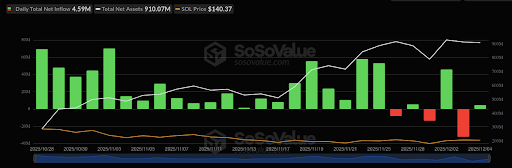
Solana has entered a surprising phase of turbulence as its recently launched US Spot ETF struggles to maintain momentum after weeks of inflows. The latest data from Sosovalue reveal a sizable setback with a fresh withdrawal of $32.19 million, marking the third and largest outflow recorded since the investment product debuted in late October 2025. 

The outflow, registered on December 3, came as a major surprise, especially given that the broader crypto market had been enjoying a slight reprieve from the bearishness weighing it down. Notably, Sosovalue’s data shows that the entire Solana ETF outflow originated from the 21Shares TSOL offering, which shed $41.79 million in a single session. Minor inflows into the remaining six Solana ETFs had softened the blow, reducing total outflow to $32.19. 

Solana XRP 1

Since the launch of Solana ETFs, TSOL has been responsible for all negative flows posted, including the $13.55 million pullback on December 1 and the $8.10 million decline in late November. Across all sessions, 21Shares Solana ETF has now seen total outflows reach $101.51 million. 

The weakness in TSOL stands in sharp contrast to Bitwise’s Solana ETF, BSOL. BSOL continues to outpace other investment products, with impressive cumulative inflows of $580.72 million, making it the most successful Solana ETF. Grayscale’s GSOL follows at a distant $89.01 million. Overall, the net cumulative inflows for the Solana ETF have reached $623.21 million. While this is impressive, it is still significantly behind the XRP ETF. 

XRP Overtakes Solana ETF As It Nears $1 Billion Inflows

The latest on-chain numbers show the XRP ETF pulling ahead of the Solana ETF with surprising speed and volume. Analyst Neil Tolbert highlighted the rise in XRP ETF inflow this week, noting that growing institutional interest indicates the trend is only getting started. With more XRP ETFs expected to debut soon, Tolbert anticipates a significant rise in demand and inflows as traditional finance finally wakes up. 

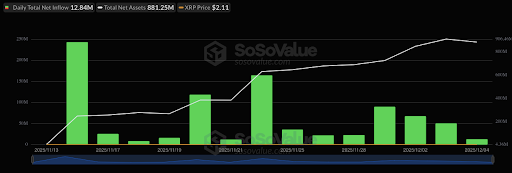
Five Spot XRP ETFs collectively hold more than $984 million in assets, with less than $16 million to reach the $1 billion inflow milestone. Canary Capital’s XRPC leads with $358.88 million, followed by Grayscale’s GXRP, Bitwise’s ETF, Franklin Templeton’s XRPZ, and finally REX-Osprey’s XRPR.  

Solana XRP 2

According to SosoValue, the total XRP ETFs, excluding that of REX-Osprey, have attracted approximately $887.12 million in net cumulative inflows. Since its launch in November, the XRP ETF has recorded 15 days of positive inflows, in stark contrast to Solana ETFs, which have seen multiple outflows. 

Despite Solana launching seven ETFs as early as October 2025 and XRP only introducing four last month, XRP ETFs have already surpassed Solana ETFs in total inflows by almost 30%. With fewer products and a later debut, XRP has emerged as the clear winner amongst the newest ETF entrants in 2025. 

XRP price chart from Tradingview.com

Trend Reversal Puts Dogecoin On A Path To $0.188

Dogecoin has quietly been trying to find its footing again. The price has started to firm up after a period of declines that dragged the meme coin to as low as $0.134 in early December, trading around $0.14 to $0.15 and showing signs that bearish pressure might be easing. 

In that backdrop, a recent chart analysis shared by crypto analyst BitGuru on X shows that Dogecoin could be forming a bullish base, and it offers a possible setup for a rebound towards $0.2.

A Recovery Attempt Begins To Take Shape

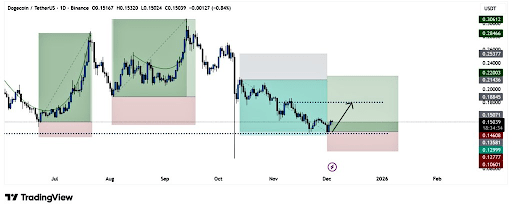
The daily candlestick price chart shows Dogecoin rebounding from the lower boundary of its demand zone after briefly dipping beneath it on December 1. That bounce is significant because it represents the willingness to defend the area that held price earlier in July and again during the October pullback. This playout means that Dogecoin has now created a higher low relative to the November breakdown, and this detail means that bullish movement might be moving in.

As it stands, Dogecoin’s price is now pushing back toward the middle of the broader range highlighted in green and teal on the chart below. Recent bullish candle closes on the daily timeframe show that the Dogecoin price is trying to push into that region once again, suggesting that buyers have begun testing the strength of mid-range resistance.

The chart reflects this pattern by displaying earlier price expansions in July and September, both of which unfolded after the Dogecoin price created a higher low.

Dogecoin prIce

Dogecoin Price Chart. Source: @bitgu_ru On X

Dogecoin On A Path To $0.188

Dogecoin’s higher-low structure is the signal BitGuru highlights as the earliest sign that momentum may be shifting. Now that the price is now climbing away from the demand zone, the first area to watch is the dotted mid-range line on the chart, which is at $0.188. 

A clean move above that level would mean that buyers have regained control of the market structure. This could open the door for a broader recovery and see Dogecoin returning above $0.20.

At its current price of $0.148, the targets at $0.188 and $0.20 represent gains of roughly 27% and 35%. These levels fall within a range of short-term price targets that Dogecoin could realistically reach before the end of the year if there’s even a little bullish momentum.

However, Dogecoin’s near-term outlook isn’t just about its own chart. Its fate is linked to the broader crypto market, especially Bitcoin. Therefore, Dogecoin’s price action might remain vulnerable to more declines and consolidations unless the wider crypto market turns bullish again. On the other hand, tentative signs of recovery, including rising trading volume, point to a bullish setup for Dogecoin.

Dogecoin price chart from Tradingview.com

The MicroStrategy Of Asia: Japanese Company Announces Plan For Bitcoin And XRP Treasury

Bitcoin and XRP have become central to a bold corporate shift in Japan, with AltPlus announcing that both digital assets will be formally incorporated into its long-term treasury strategy. The publicly listed company disclosed the move in its recent shareholder filing, outlining a multi-layered plan that positions cryptocurrencies as foundational components of its future financial and operational framework.

Bitcoin And XRP Lead Treasury

According to a post by “BankXRP” on X (formerly Twitter), AltPlus is expected to purchase and hold Bitcoin and XRP through a newly established cryptocurrency purchase and management division. The company frames this step as part of a long-horizon capital strategy supported by blockchain transparency, expanding global regulatory clarity, and the growing institutional acceptance of digital assets. In the filing, Bitcoin and XRP are highlighted for their scarcity, decentralization, predictability, and fast, low-cost transactional capabilities—attributes AltPlus expects will contribute to long-term value growth and broader financial-market utility.

Moreover, the treasury initiative is designed to strengthen the company’s financial base, diversify revenue streams, and establish a stable earnings engine through staking-based income. AltPlus presents the move as a structured method to enhance capital efficiency and reinforce corporate value over time. The company notes that holding both Bitcoin and XRP aligns its balance-sheet strategy with emerging global trends in digital-asset management and institutional-grade treasury practices.

AltPlus also outlines its risk-management system to address crypto-market volatility, liquidity risks, cybersecurity threats, regulatory changes, and speculative trading patterns. The company plans to implement investment-scale limits, a controlled holding-ratio strategy, and a proprietary internal asset-management system to govern acquisition, custody, tracking, and treasury integration. These measures are designed to maintain governance discipline, ensure compliance, and safeguard digital-asset operations as part of the broader corporate structure.

AltPlus’ Web3 And Digital-Asset Expansion

Beyond treasury allocation, AltPlus frames Bitcoin and XRP as key elements in a broader transition into digital-asset operations and Web3-enabled business development. The filing situates this shift within a global context, noting that major financial institutions and listed companies worldwide are increasingly incorporating crypto assets into holding, settlement, and capital-management functions.

Building on this trend, AltPlus plans to integrate blockchain infrastructure into its Entertainment and Solutions business. This includes exploring Web3 functionality, token-based engagement models, and digital-asset utilities across its gaming and IP ecosystem. These initiatives are intended to unlock new business models, enhance operational flexibility, and develop internal expertise for a digital-native market environment.

The company’s decision to include XRP directly in its treasury strategy is one of the standout elements of the announcement. AltPlus positions XRP as a long-term corporate asset alongside Bitcoin, marking a notable step forward for institutional crypto adoption in Japan. Through treasury transformation, staking-driven income generation, and Web3 ecosystem expansion, AltPlus is creating a strategic framework similar to the high-conviction treasury approach seen at MicroStrategy. At the same time, it is establishing a distinctly Japanese model focused on utility, diversification, and forward-looking corporate innovation.

Bitcoin price chart from Tradingview.com (XRP)

Expert Says An XRP Supply Shock Will Only Happen In These Conditions

A leading market expert argues that most investors misunderstand what would need to happen for an XRP supply shock to unfold. The analyst stressed that a true supply shock is driven by measurable XRP absorption, with early signs showing how quickly tokens are removed from circulation relative to how quickly they return. 

How A Real XRP Supply Shock Forms

Crypto analyst Pumpius took to X this Wednesday to outline the conditions he believes must align before XRP can experience an actual supply shock. The expert noted that many in the community often talk about an explosive squeeze that could drive XRP’s price higher, yet few understand the mechanics behind such a shock.

Pumpius argued that a real supply shock is not driven by speculation or hype, but by a measurable reduction in the amount of XRP available on the open market. In his view, such an event only occurs when tokens are absorbed faster than they can be replenished, creating an imbalance between circulating supply and future buyers. 

The analyst explained that the first big trigger for a supply shock would be the launch of Exchange-Traded Funds (ETFs). Once all ETFs go live, their issuers will need to buy real XRP rather than derivatives or IOUs, which could gradually drain the amount of available tokens on crypto exchanges. 

Pumpius added that institutional participation would amplify the supply impact of ETFs, since banks and large asset managers typically custody assets rather than actively trade them. He explained that XRP set aside for settlement purposes, treasury management, or long-term liquidity planning would be removed from day-to-day circulation, further contributing to a potential supply shock.   

Another point Pumpius mentioned in his post was that companies could start holding XRP in their corporate treasuries to support international payments and XRP Ledger (XRPL) based settlement corridors. If this occurs, the analyst suggests that these operational XRP balances would remain in working capital accounts rather than flowing back to exchanges.  

He added that Ripple’s management of its escrow further limits XRP’s supply. Currently, Ripple has little to no incentive to oversupply the market, and unused escrow releases are often returned, keeping the amount of net new XRP entering circulation tightly controlled.

On-Chain Utility And ZK Identity Drive Supply Crunch

In his post on X, Pumpius highlighted two other factors needed for XRP to experience a real supply shock. He stated that growing on-chain utility will further reduce the supply of XRP, ultimately contributing to a supply crunch. These include tokenized funds built on the XRPL, such as RLUSD, liquidity pools, identity layers, and payment rails—all of which rely on XRP as a core asset.

A Zero Knowledge identity infrastructure on the XRP Ledger could also lock away more tokens. Pumpius emphasized that these systems link XRP to identity-verified flows and validation processes, which naturally tighten supply. 

Together, these forces create the ideal conditions for a real XRP supply shock. Pumpius notes that as exchange balances drop and OTC desks hold less inventory, overall liquidity becomes thinner. Buyers are then forced to compete for the shrinking supply of tokens, potentially driving prices higher as demand outweighs supply.

XRP price chart from Tradingview.com

XRP Price Is Performing As Expected; Analyst Reveals What Comes Next

The XRP price has staged a strong rebound in recent days, rising from early-December weakness and climbing back above $2. The recovery comes just after crypto analyst CasiTrades published a detailed technical outlook on the social media platform X, where she outlined a scenario that anticipated both the initial decline and the current bounce.  Now that XRP has begun moving upward towards $2.2, the focus is on what the next phase of this pattern could bring next.

Subwave 3 Targets Hit As Structure Plays Out

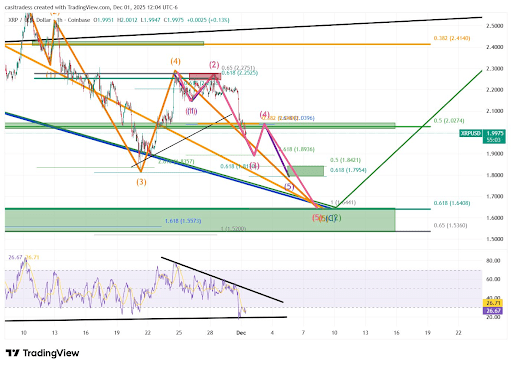
CasiTrades explained that XRP’s early-December drop was part of a subwave 2 setup that had been discussed during her previous livestream. When XRP fell to $2.03 in early December, it confirmed the transition into a subwave 3 extension, and the next projected target sat near $1.90. That level was important not only as a Fibonacci extension but also because it corresponded with Bitcoin reaching its macro 0.382 level around the $79,000 region.

The chart attached to her analysis illustrated this path clearly. A sequence of orange, pink, and black wave structures converged toward the same support region, all pointing toward $1.90 as the initial landing zone. As shown in the chart image below, there’s another green accumulation block between $1.80 and $1.64 as the deeper support level that could still come into play. 

XRP Price

XRP Chart Analysis. Source: @CasiTrades On X

At the time of her analysis, selling pressure was already slowing down, and momentum indicators like the RSI were building a bullish divergence. Since then, XRP’s price action has turned bullish, and this supports the idea that a reaction was always likely to occur in the $1.90 zone.

CasiTrades noted that once the price reached this level, she expected a bounce back toward $2.04 to retest resistance for a new Wave 4 formation. Over the past few days, XRP has done exactly that, rising from its lows and reclaiming momentum as buyers returned.

Two Final Scenarios Still In Play For XRP

According to CasiTrades, there are two possible outcomes for the XRP price against the backdrop of retesting $2.04. The first outcome is a double bottom forming around the $1.80 to $1.88 region, depending on the exchange. The chart she shared includes a mid-range support box that captures this possibility, with wave markings showing how price could rotate downward before a larger breakout.

The second potential outcome is a deeper sweep to $1.64, which is based on the macro 0.618 support. This zone forms the lower boundary of the green accumulation block on her chart, representing the final area where a full Wave 2 or Wave C completion could occur before XRP attempts a larger impulsive breakout.

XRP price chart from Tradingview.com

XRP ETFs Have Overtaken Bitcoin And Ethereum In Inflows – Here Are The Numbers

Since launching in mid-November 2025, institutional demand for XRP ETFs has climbed beyond the inflows recorded for the crypto market’s two largest assets, Bitcoin and Ethereum. The latest numbers show how quickly capital allocation has shifted, placing XRP at a defining advantage in an increasingly competitive market.

XRP ETFs Inflow Profile Establishes Category Leadership

The first wave of US spot XRP ETFs launched on November 13, led by Canary Capital’s XRPC, which opened with $243.05 million in first-day inflows and has since maintained consistent positive flows, frequently exceeding $100 million in single-day inflows. Across the four active issuers—Canary Capital (XRPC), Bitwise (XRP), Grayscale (GXRP), and Franklin Templeton (XRPZ)—cumulative net inflows have now surpassed $756 million, according to SoSoValue data. 

Daily performance across the broader market has followed the same strong pattern. XRP ETFs saw $243.05 million in inflows on November 14, $118.15 million on November 20, and $164.04 million on November 24. By December 1, it secured another $89.65 million, reinforcing the steadiness of demand throughout the launch phase.

Together, these numbers place XRP ahead of every other non-stablecoin asset in ETF inflows over the same period. Independent reports also show that the category gathered $587 million within its first ten trading days, surpassing early benchmarks set by previous altcoin ETF rollouts—including those tied to Bitcoin and Ethereum.

Institutional Capital Flows Favor XRP Over Bitcoin And Ethereum

XRP ETFs’ inflow performance becomes even more pronounced when compared with contemporaneous Bitcoin and Ethereum ETF inflows. On December 1, Bitcoin ETFs recorded $8.48 million in net inflows—roughly one-tenth of XRP’s same-day figure. By contrast, Ethereum ETFs reported more than $79 million in net outflows, continuing a multi-week trend of capital rotation away from ETH-linked products.

This divergence underscores a clear reallocation dynamic in the US market. While Bitcoin and Ethereum remain the dominant assets by AUM, inflow velocity has shifted decisively. XRP’s ability to attract more cumulative net inflows than the leading two crypto assets—despite launching later and holding a smaller market capitalization—marks a material development in ETF-driven capital flows.

The launch sequencing provides additional clarity. Franklin Templeton’s XRPZ and Grayscale’s GXRP both delivered standout debuts, recording $62.6 million and $67.4 million in first-day inflows, respectively, marking the strongest ETF launches of 2025 to date. This surge contributed to a broader inflow cycle that added roughly $300 million across the XRP ETF ecosystem, propelling XRP into the top tier of crypto ETFs by net new capital, despite the underlying asset remaining below key price resistance levels.

Data from multiple independent trackers shows that XRP ETFs have recently recorded higher net inflows than Bitcoin and Ethereum ETFs. Across the tracked XRP ETF issuers, inflows have been consistently strong, indicating a notable shift in investor capital allocation among newly launched digital-asset ETFs.

XRP price chart from Tradingview.com (XRP ETFs)

Are Dogecoin Whales Leaving The Meme Coin? Large Transactions Crash To 2-Month Lows

Dogecoin’s recent price action has taken an unexpected turn as on-chain data shows whale transactions collapsing to levels not seen in two months. This lack of activity from whale addresses has seen the meme coin falling to an important support area, and it raises the question about whether big players are stepping back from the meme coin.

Dogecoin Whale Activity Falls To Its Lowest Level In 60 Days

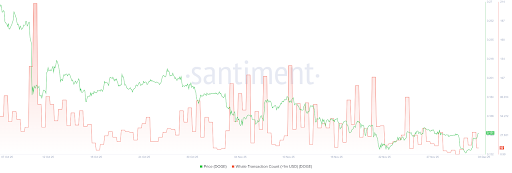
Data from on-chain analytics platform Santiment reveals that large transactions on the Dogecoin blockchain recently fell to as low as just 4 in a single day, marking a two-month low in whale participation. Santiment classifies whale transaction count as transactions with a value of $1 million or greater. This drop is notable, as it is a drastic change from the high levels of participation of whale traders in October and early November, which reached as high as 212 whale transactions on October 11. 

This drop is an extension of a steady Dogecoin cooldown that has persisted through the past few weeks. Large-holder activity can serve as a proxy for institutional or high-volume investors. Therefore, the current decline suggests that big players are either waiting for better entry conditions or scaling back exposure.

At the time of writing, Santiment data shows that there were 11 Dogecoin whale transactions in the past 24 hours. Although this is a rebound from the alarming four-transaction low, the current level is far below what is considered a healthy range for a cryptocurrency that relies heavily on sentiment bursts of activity. The reduction in transfers is especially notable at a time when Dogecoin’s price action in the past 24 hours is attempting to maintain an important level above $0.15.

Dogecoin whales 1

Dogecoin Whale Transaction Count. Source: Santiment

DOGE Holds Support, But Technical Momentum Weakens

Price action in the past few weeks has been mostly bearish price action, and technical analysis shows that the meme coin is now in its longest accumulation phase since its inception. 

Dogecoin whales 2

Dogecoin Price Accumulation. Source: @galaxyBTC On X

Notably, Dogecoin is going through a spark of strength over the past 24 hours as it bounced from $0.134 and climbed about 11%, but the recovery appears to be generated by retail traders rather than a meaningful return of whale activity. That estimation aligns with the weak inflows into Spot Dogecoin ETFs and the overall quietness from major holders.

It is difficult for the price to build a strong upward trend without whales participating on the buy side. It’s not just the presence of whales that matters, but  the nature of their activity. Earlier in the year, on October 11, whale transactions surged to 212, but most of those were sell orders. The result was immediate and painful, as the Dogecoin price dropped from $0.25 to $0.18 in a single day.

Dogecoin price chart from Tradingview.com

Here’s Why The Bitcoin Price Jumped Above $92,000, And Ethereum Price Reclaimed $3,000

The crypto market delivered a dramatic rebound this week, with the Bitcoin price vaulting above $92,000 and Ethereum climbing back over $3,000. The sharp recovery in both leading cryptocurrencies has caught the market’s attention, with analysts now sharing the major reason for the unexpected pump. 

Why The Ethereum And Bitcoin Price Are Rebounding

Bitcoin is currently trading above $93,000 after experiencing a period of accelerated selling and heavy long liquidations that had briefly pushed its price down over the past few weeks. Now that forced selling has eased, the cryptocurrency has recovered significantly, adding an astonishing $75 billion to its market capitalization within 10 hours. 

Ethereum has followed the same upward swing. Data from CoinMarketCap shows that ETH has gained more than 9% in the past 24 hours, with steady accumulation pushing its price above $3,050. 

Crypto market analyst Wimar.X has explained the reason behind the sudden surge in both Bitcoin and Ethereum prices. He framed the resurgence as a rapid wave of high-volume coordinated institutional buying. In his words, the market pumped because a massive round of accumulation occurred within a single hour. 

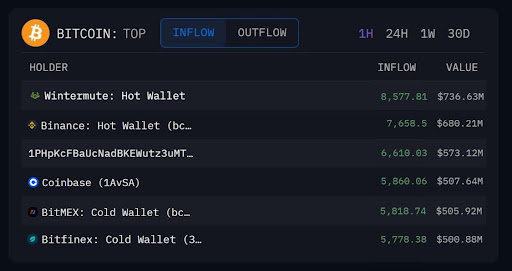
Data from Arkham Intelligence shows that Wintermute, a leading algorithmic trading firm, had bought 8,577 BTC ahead of the market surge. Binance, the world’s largest crypto exchange, also acquired 7,658 BTC, while a major whale wallet added 6,010 BTC to its portfolio. Finally, BitMEX, a crypto exchange co-founded by Arthur Hayes, reportedly accumulated 5,818 BTC, while Bitfinex absorbed 5,778 BTC. 

Bitcoin price 1

According to Wimar.X analysis, the sudden accumulation and its timing appear coordinated. He described the activity as manipulation, implying that it was intended to influence market perception and artificially sway prices. 

Analysts Share Outlook For Bitcoin And Ethereum Price After Pump

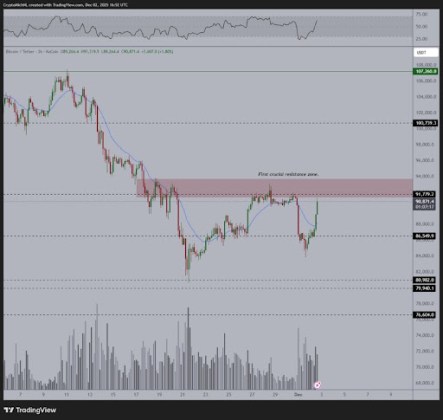
As the crypto market showed renewed strength and BTC recovered above $90,000, crypto expert Michael van de Poppe took to X to highlight the significance of the rebound. He noted that the recent dip in Bitcoin’s price at the start of the month appeared unusual but was followed by a strong bounce. According to the analyst, surpassing $92,000 will be critical for Bitcoin and could pave the way for a new all-time high and a potential test of $100,000. 

Bitcoin price 2

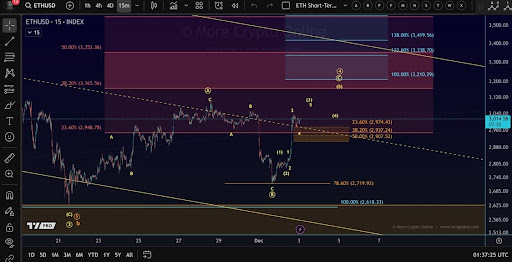
On the other hand, a market analyst identified as ‘More Crypto Online’ on X has stated that Ethereum is currently testing the micro support zone between $2,907 and $2,974. He noted that holding this support area is crucial for sustaining the upward momentum that began earlier this week.

Bitcoin Price 3

As a result, the analyst has predicted that Ethereum’s next upside window sits between $3,165 and $3,210. He cautioned that a breach below the lower support level could trigger a deeper corrective wave. However, current trends suggest that ETH is mainly aiming higher. 

Bitcoin price chart from Tradingview.com (Ethereum)

What Are The Odds Of Satoshi’s $130 Billion Bitcoin Fortune Being Hacked With Quantum Computing?

Concerns have emerged over whether Bitcoin creator Satoshi Nakamoto’s 1 million BTC fortune could be hacked. Crypto analyst Camol claims that advanced quantum computing could eventually crack Nakatomo’s wallet, draining it entirely. The analyst’s argument has sparked heated debate across the crypto community, with many critics dismissing the claims as unfounded and misleading. 

Will Quantum Computing Crack Nakamoto’s Bitcoin?

In an X post released on Monday, December 1, Camol predicted that Nakamoto’s BTC wallet will be drained within the next 10 years as quantum computing power advances exponentially. He called this rapid, annual double acceleration Neven’s Law, warning that the Bitcoin creator’s over $131 billion BTC stash could eventually be exposed to unprecedented risks and hacks. 

Camol’s argument focuses on Bitcoin’s secp256k1 elliptic curve and ECDSA signatures, which are used to secure wallets. He claims that these could eventually be reversed using Shor’s Algorithm, a quantum algorithm that, in theory, can break elliptic curve cryptography once sufficiently powerful quantum hardware exists. The analyst warns that if such a technology becomes viable, it could compromise the security of even the most well-protected Bitcoin holdings—in this case, Nakamoto’s. 

In his post, Camol also stated that Satoshi’s 1 million BTC fortune could face additional vulnerability because the wallet address is protected by a 160-bit hash that has never been exposed through spending activity. He claims that a powerful quantum attack could crack the hash and reveal the public key, eventually uncovering the private key through multiple attempts. The analyst also pointed out that sophisticated bad actors, such as state-sponsored groups and wealthy cybercriminals, could access Nakamoto’s BTC wallet. 

Experts And AI Dismiss BTC Quantum Hacking Claims

Crypto analyst @level941 on X sharply rebuked Camol’s claims, emphasizing that Satoshi’s BTC holdings are fundamentally more secure than most coins in circulation. He surmised that because Satoshi’s BTC is stored in early P2PKH addresses, the public keys will remain hidden and the wallet will stay locked unless the Bitcoin creator manually removes his coins. 

@level941 called Camol’s statements “false” and “incorrect,” noting that Quantum computers can only break RSA or ECC systems when the public key is known. This means that Satoshi’s BTC is protected by a 160-bit RIPED160 hash that quantum machines cannot brute force in any foreseeable timeline. 

The analyst also argued that if the Bitcoin network ever migrated to a quantum-safe signature scheme, Satoshi’s unmoved coins would become permanently locked rather than hacked or drained. Independent analysis from advanced AI systems further rejects Camol’s quantum-hacking narrative as scientifically unsupported. 

According to reports, present-day quantum computers have fewer than 1,000 noisy qubits, far short of the millions of error-corrected qubits required to break Bitcoin’s cryptography. AI systems also highlight that there is no evidence suggesting that a Bitcoin-breaking quantum machine will appear within ten years. It also revealed that Neven’s Law, which Camol referenced, is no longer considered a reliable predictor of long-term growth in quantum computing. In conclusion, the odds of Nakamoto’s BTC fortune being hacked are extremely low for at least the next few decades. 

Bitcoin price chart from Tradingview.com

Here’s What To Expect If The XRP Price Holds $2

The XRP price has spent the past several days in a fragile position after falling from $2.20 and retesting $2, which has now become the most closely watched level on its price chart. The weekly candle has managed to close slightly green for the first time in more than a month, yet the rebound has not erased the weakness created by the recent sell-off. 

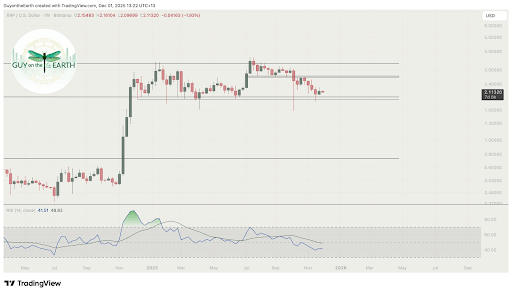
The latest technical analysis from Guy on the Earth focuses on this exact moment, noting that XRP’s entire structure now depends on whether this $2 zone can keep functioning as the pivot that stops further downside.

Holding $2 As The Important Bull Support

Guy on the Earth describes the $2 price level as the line separating resilience from a potentially long period of stagnation. His analysis shows XRP holding this level despite several weeks of bearish candles, a sign that sellers have not managed to gain full control even after the broader market’s pullback. 

The weekly chart he shared displays a cluster of past support zones roughly aligned between $2 and $1.95, making this area the foundation of the current trend. According to the analyst, losing the $2 price level could leave XRP drifting for months or even years with little upside movement, aside from isolated opportunities when temporary lows form. For now, the fact that XRP ended the past week in the green, even slightly, keeps the structure intact.

XRP’s reaction around $2 cannot be understood without watching Bitcoin. In his view, the best scenario for XRP is for Bitcoin to bounce back above $100,000, and a subsequent fall in BTC dominance. The chart’s declining RSI on the XRP weekly timeframe also hints at momentum changing, but its path will ultimately follow whatever direction Bitcoin chooses next.

XRP Price

XRP Price Chart. Source: @guyontheearth On X

Two Diverging Paths From Here

Guy on the Earth outlines two possible outcomes as the market enters a critical phase. The first is a recovery from current levels that allows altcoins to outperform again, opening the door for XRP to revisit the mid-range zone around $2.60 before making any attempt at its previous highs. 

The second is a deeper market drop that drags XRP below the $2 price level. This move would flip its most important support into resistance and set up a prolonged stretch of declining price action. Nothing inspiring will happen below there except well-timed buys when the lows appear to be in.

Both scenarios are realistic, and $2 is the dividing point that will determine which one unfolds. The analyst’s bias leans toward a move higher, but he warns that traders must be aware of the risks if Bitcoin does not stabilize soon.

At the time of writing, XRP is trading at $2.02 after a 1.2% fall in the past 24 hours and is at risk of losing this $2 support level.

XRP price chart from Tradingview.com

Ripple Marks Another Milestone In Bid To Dominate Global Payments With XRP

On December 1, 2025, Ripple announced a major regulatory upgrade in Singapore, reinforcing its ambition to make XRP a central instrument for global payments. The expanded license allows the company to streamline cross-border money transfers, expand its payments infrastructure, and provide faster, more transparent settlements to financial institutions worldwide.

Ripple Intensifies Its Global Payments Playbook

The Singapore regulatory upgrade extends the scope of Ripple’s Major Payment Institution (MPI) license, giving its subsidiary, Ripple Markets APAC Pte. Ltd., authority to operate a fully regulated, end-to-end payments platform. The license enables Ripple to handle fund collection, secure custody, token conversion, and final payouts within a single operational framework. XRP and Ripple’s stablecoin RLUSD are embedded into the system, consolidating complex cross-border processes into a fast, compliant, and transparent environment.

This upgrade positions Ripple as a turnkey solution for banks, corporates, and fintechs. By managing both regulatory compliance and the technology infrastructure, Ripple removes the fragmentation that slows legacy systems. These institutions now have a single point of contact, reducing complexity and making operations more efficient.

Ripple is also expanding its geographic reach through strategic partnerships. Its collaboration with Bahrain Fintech Bay allows the company to run pilot programs, real-world payment trials, and early deployment of token-driven services in the Gulf region. These initiatives help Ripple establish liquidity corridors, embed its infrastructure into local financial ecosystems, and build familiarity with regional regulators.

Financially, Ripple strengthened its position with a $500 million funding round in November 2025, which valued the company at roughly $40 billion. The capital is being directed toward scaling payment infrastructure, enhancing enterprise tools, and expanding its stablecoin program. With these resources, Ripple can roll out its technology faster, integrate with new partners more efficiently, and advance its dominance in the institutional payments market.

XRP’s Expanding Utility In Ripple’s Global Framework

XRP remains the settlement engine of Ripple’s infrastructure, providing instant liquidity, rapid transaction settlement, and multi-currency interoperability. This functionality allows Ripple to address high-friction payment corridors, such as those in Africa, where it works with regional providers to replace slow correspondent banking chains with XRP-enabled settlements. In the Asia-Pacific region, growing on-chain activity and rising institutional demand create favorable conditions for token-based cross-border payments. The Singapore MPI upgrade now offers a regulated launchpad to deliver XRP-powered rails across these high-growth regions.

Building on this foundation, Ripple is creating a vertically integrated ecosystem where fiat, stablecoins, and digital assets operate through a unified platform. Within this framework, XRP bridges currencies, provides deep liquidity, and executes transactions faster than traditional systems. Each regulatory approval, partnership, and infrastructure deployment further embeds XRP into the backbone of global financial infrastructure.

Together, these milestones illustrate Ripple’s multi-market strategy: expanding regulatory clarity, deploying robust infrastructure, and demonstrating real-world XRP utility. The Singapore upgrade is a decisive step in this progression, reinforcing Ripple’s steady movement toward making XRP a central tool for cross-border payment systems.

XRP price chart from Tradingview.com (Ripple)

Ripple Exec Sounds Warning: XRP Must Learn This From Solana Or Risk Damage

XRP and Solana share the opening line of a direct industry alert from a senior Ripple executive who argues that technical maturity alone will not guarantee XRP’s relevance in the next competitive cycle. He points to Solana’s execution style as a benchmark that XRP must study and internalize to stay competitive, drive innovation, and avoid strategic setbacks.

Solana’s Edge And The Core Lessons For Ripple

Luke Judges draws on his experience in the Solana ecosystem to highlight operational lessons for XRP. Before joining Ripple, he built two startups on Solana and ran a validator managing over $30 million in staked tokens. He personally navigated the network’s full market swings from its peak near $200 to a collapse below $10 and its eventual recovery—gaining insights into infrastructure demands, validator economics, and developer dynamics that go beyond theory.

According to Judges, Solana’s growth reflects a combination of speed, practical engineering decisions, and developer-friendly onboarding. He acknowledges Solana’s weaknesses, including a falling validator count that could raise decentralization concerns, but emphasizes that these do not negate the network’s operational strengths. High transaction throughput and pragmatic design choices, he notes, continue to attract builders and support adoption, demonstrating that efficiency and practical execution can drive results even when a system is imperfect.

Judges link these observations directly to XRP’s path forward. He suggests that overlooking the strengths of competing networks creates blind spots that hinder ecosystem development. Studying Solana’s approach can help the network refine its operations, accelerate development cycles, improve tooling for builders, and align technical decisions with real-world usage patterns. These, he indicates, are essential steps for XRP to maintain competitiveness in a fast-evolving layer-1 landscape.

XRP’s Strategic And Competitive Focus

Ripple’s internal roadmap already includes critical enhancements—smart contracts, native staking primitives, and the AlphaNet rollout for XRP Ledger Smart Contracts. However, Judges’ comments signal that technical capability without a sharpened go-to-market strategy is insufficient. He points to the Ethereum Foundation’s recent tightening of its GTM approach after losing market share to Solana as an example of the stakes involved.

To address these challenges, XRP’s competitive focus comes down to three main areas. First, the ecosystem must augment its programmability track with clearly packaged developer value propositions that demonstrate tangible differentiation. Second, validator economics require forward-looking structuring to avoid the attrition dynamics now visible in Solana’s network. Third, go-to-market alignment must accelerate, converting technology milestones into momentum-building enterprise and retail narratives.

Judges’ message ultimately operates as both caution and catalyst. He frames Solana’s strengths not as threats but as operational lessons, while its weaknesses provide a blueprint for pitfalls XRP should avoid. His message is clear: the blockchain space is shifting, and Ripple’s executive team signals that the window to capture the next market cycle demands adaptation, not insulation. The underlying mandate is to learn fast, move faster, and ensure XRP remains structurally relevant in the next phase of blockchain adoption.

XRP price chart from Tradingview.com

Dogecoin Opens The Floodgates: Here’s The Update On Shiba Inu And BONK ETFs

Dogecoin’s entry into the ETF market has changed the tone of the entire meme-coin sector, possibly opening the door for the likes of Shiba Inu and BONK. What began as a community hype token is now tied to a fully regulated product, and that achievement has pushed attention toward other popular meme coins. BONK and Shiba Inu are now the next names being discussed as institutions explore broader exposure to alternative cryptocurrencies.

BONK Moves Ahead With A Fully Listed ETP In Europe

Although the early inflows into Dogecoin’s ETF launch have been largely more underwhelming than what most expect, the establishment of an exchange-traded product for the king of meme coins opens up conversations about other meme coins. 

BONK is a standout example, taking a decisive step forward with the launch of an exchange-traded product tied to the meme coin on the SIX Swiss Exchange. The debut immediately led to an intraday rally as traders reacted to the token gaining a presence on one of Europe’s most established regulated markets. 

SIX is Switzerland’s largest and Europe’s third-largest stock exchange. Therefore, the ETP gives investors access to BONK without having to manage custody themselves, making it far easier for traditional market participants to gain exposure.

This development builds on BONK’s rising activity within the Solana ecosystem. Its trading volume and market capitalization have been climbing for weeks, and the ETP adds a form of legitimacy rarely given to meme coins. BONK now joins a very small group of community hype tokens that have crossed into regulated investment territory, giving it a stronger foundation as demand from new classes of investors grows.

The new BONK ETP was issued by Bitcoin Capital, a firm known for launching multiple cryptocurrency ETPs across major European markets. “With the Bonk ETP now listed on SIX Swiss Exchange, investing in Bonk has never been easier. Investors don’t need crypto expertise; they can trade Bonk just like any other stock. We’re making community-driven digital assets accessible to everyone, while meeting high security and regulatory standards,” added Marcel Niederberger, CEO of Bitcoin Capital 

Shiba Inu Attracting Institutional Interest

Shiba Inu has not yet secured an exchange-traded product of its own, but the token is steadily carving out its place in the wider fund landscape as major institutions begin weaving it into their early product designs. Even as Shibarium’s activity has cooled in recent weeks, SHIB is still part of broader conversations about regulated exposure.

One of the clearest examples comes from T. Rowe Price, a heavyweight in traditional finance with more than $1.7 trillion in assets under management. The firm recently submitted a filing for an actively managed crypto ETF that lists SHIB among its holdings.

Shiba Inu also appeared in Grayscale’s assessment of cryptocurrencies viewed as structurally viable for future spot-ETF models. These developments indicate that long-term positioning for Shiba Inu is becoming stronger as institutions evaluate which assets fit into their next generation of crypto funds.

Shiba Inu price chart from Tradingview.com (BONK Dogecoin)

Bitcoin Price Crash Below $50,000? Analyst Reveals Why 2026 Will Be The ‘Best Year’

A crypto analyst has issued one of the most dramatic market calls of the year, predicting that the Bitcoin price could crash below $50,000 by 2026. However, he claims that this drop could set the stage for a historic wealth transfer. He says 2026 could become the best year for investors who stay calm and prepare for a major market reset. His reasons are closely tied to the growing economic imbalances and to key US macroeconomic indicators, which continue to tilt deeper into negative territory. 

Analyst Predicts Bitcoin Price Crash And 2026 Market Reset 

A crypto market analyst who goes by the name ‘NoLimit’ on X has shared a dramatic forecast, claiming that 2026 may be the “best year” ever and could see the biggest wealth-transfer event in more than a decade. He anticipates significant volatility in digital assets during this period and predicts that the price of Bitcoin could slip below $50,000, representing a more than 42% decline from its present price above $86,000.

The analyst outlined several reasons why he believes that 2026 could become the most defining year for investors. As Bitcoin’s price declines to projected lows, NoLimit predicts the broader market will undergo a deep structural reset, which could drive declines across several economic indicators and financial assets. 

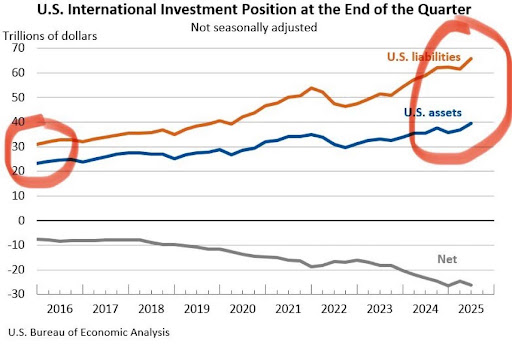
In his chart, the analyst referenced the widening gap between US assets and liabilities, arguing that the expanding spread is an early signal of structural weakness. That chart highlights a consistent rise in US liabilities from the roughly $30 trillion range in 2016 to above $60 trillion in 2025, while US assets climb more slowly. This gap pushes the net position further into negative territory, which the analyst indicates could trigger a broader correction in traditional markets

Bitcoin price

During the projected market reset in 2026, NoLimit anticipates a dramatic decline in US equities, warning that the S&P 500 could lose as much as 40% of its value. He believes that the correction will hit individual companies even harder. In the most extreme cases, he expects some stocks to fall by 50% to 98%, echoing the collapse of many technology firms during the dot-com crash in 2001

Gold Expected To Surge As Banks Collapse

NoLimit has indicated that his projected decline in Bitcoin’s price is expected to contribute to his proposed wealth-transfer event in 2026. While BTC drops below $50,000, the analyst forecasts that gold will skyrocket to $6,500, reflecting a more than 53.6% increase from its current price of around $4,233.

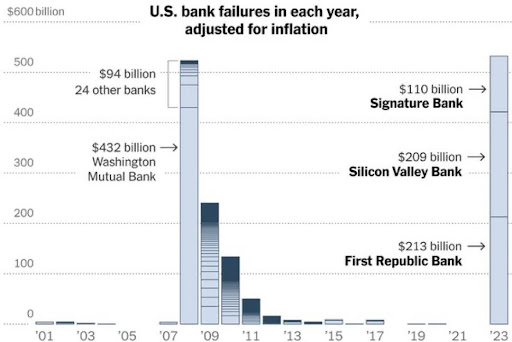
He also warns that several banks may collapse in 2026. He believes that the recessionary pressure building beneath the surface is far worse than most expect, pointing to sky-high debt, governments and corporations burdened by cheap loans, and the $1.2 trillion commercial real estate loans set to mature between 2025 and 2026.

Bitcoin price 2

NoLimit has indicated that these projected shifts in both economic indicators and investment assets will strain overextended investors and reward those who preserve liquidity and position themselves during the lowest point of the cycle. 

Bitcoin price chart from Tradingview.com

XRP Price Flashes Similarities To 2024 That Led To 600% Surge

The latest XRP price analysis shows a market posture remarkably similar to the technical setup that preceded its explosive 600% rally in late 2024. The analysis, released on November 27, highlights a repeatable pattern framework—historically signaling the transition from quiet consolidation to aggressive price expansion. With multiple indicators aligning, XRP is once again approaching a potential breakout window that traders remember well.

XRP Price Structure Echoes The 2024 Breakout Setup

The analysis shared by “guyonearth” on X argues that XRP is rebuilding the same technical foundation that preceded its major 2024 breakout. In that earlier cycle, the asset spent months tightening within a defined structure before unleashing a vertical rally. The analyst notes that the current configuration follows the same blueprint, with the cryptocurrency once again entering a compressed phase that often precedes high-momentum expansion.

The latest chart shows XRP trading inside a descending channel and recently rebounding from the lower boundary—an early signal that momentum may be shifting. The next critical objective is the channel’s upper boundary near $2.40, identified as the confirmation level for renewed upside. A move into this zone would indicate strengthening buyer control and open the door for broader trend acceleration.

Central to this setup is the $1.90–$2.00 support corridor, which continues to operate as XRP’s structural floor. The asset has repeatedly reversed from this band, reinforcing it as the market’s preferred pivot. Maintaining this range is essential for preserving the bullish setup, as losing it would disrupt the pattern and undermine continuation prospects.

Momentum indicators align with the broader narrative. The RSI is forming higher lows beneath a descending resistance line, suggesting that accumulation is quietly rebuilding. Viewed together, these elements form a unified narrative: XRP is recreating the combination of support integrity, structural tightening, and momentum rebuilding that historically led to a dramatic upward move. The analyst’s standpoint is that, if these components continue to hold, the altcoin may once again be positioning itself for a breakout that mirrors its 2024 trajectory.

Bitcoin Dominance Unlocks A Favorable Window

Broader market conditions add a supportive backdrop for XRP’s projected rally. The analyst notes that Bitcoin Dominance remains high and stable, as long as it stays above 57.5%. A drop below that level typically triggers stronger capital rotation into altcoins.

He expects dominance to eventually fall toward 43%, a shift that would mark a major redistribution of market share. That projected decline forms the window in which the altcoin could gain momentum, provided it continues to hold the $1.90–$2.00 support zone.

If Bitcoin dominance rolls over while XRP maintains structural strength, liquidity could tilt sharply toward altcoins. With a clear technical pattern and a short-term target near $2.40, the analyst positions XRP as well-placed to benefit from that rotation.

XRP price chart from Tradingview.com

Dogecoin Just Suffered An 80% Crash In This Major Metric

Dogecoin’s highly anticipated ETF debut has taken an unexpected slow turn. What began as a strong opening for the new GDOG fund quickly faded as inflows collapsed in dramatic fashion. The launch was expected to give Dogecoin a meaningful boost by opening the door for fresh institutional participation. Instead, the opposite has happened, and the Dogecoin ETF has seen its inflows collapse by 80%.

Spot Dogecoin ETF Just Suffered An 80% Crash In Inflows

The launch of Grayscale Investments’ first-ever spot Dogecoin ETF under the ticker GDOG was hailed as a monumental moment, the first time Dogecoin would be accessible to everyday investors through a traditional brokerage. On November 24, 2025, the product went live on the NYSE Arca, converting Grayscale’s existing DOGE trust into a publicly traded ETF.

However, just 48 hours after launch, the excitement appears to have cooled down. Although the first day reportedly pulled in roughly $1.8 million in inflows, the second day saw only about $365,420, a collapse of about 80% in early momentum. This has pushed the cumulative net inflows to around $2.16 million, but this is a modest figure for what many expected would be a major catalyst for Dogecoin.

Expectations for GDOG were high. Observers pointed to prior early inflow successes with crypto ETFs, notably those for Bitcoin, Ethereum, and more recently Solana, which collectively helped push capital inflows at a large scale.  To put this into comparison, Spot Solana ETFs, which first went live on October 18, raked in $117.39 million in inflows in the first two days of trading. The recently launched Spot XRP ETFs also saw inflows of $243.05 million on their first day of trading.

 According to data from SoSoValue, Dogecoin ETF trading volume for the first day was just $1.41 million, far below many projections. The momentum faded even faster on day two, with volume falling by roughly 78% to $397,620.

What It Means for DOGE And The Meme-Coin Space

The soft start of GDOG raises questions about whether meme coins like DOGE can truly thrive under traditional financial frameworks. On one hand, the ETF listing is a milestone: a token born as a joke is now trading alongside traditional assets on major exchanges. On the other, the weak capital flows hint at limits to demand among institutional investors. 

However, it is still too early to conclude. The long-term relevance of DOGE ETFs can only be judged once the market has had time to digest these new products. A successful DOGE ETF could open the door to other meme-coin funds (some suggest even an ETF for Shiba Inu may follow).

In addition to Grayscale, other asset managers have Spot Dogecoin ETFs lined up and ready to hit the market. Bitwise launched its Dogecoin ETF on Wednesday following Grayscale’s debut, but early inflow numbers are yet to come in. The asset manager noted they weren’t expecting to launch this product but are only doing so because the DOGE community requested it.

Dogecoin price chart from Tradingview.com

The Bitcoin Price Crash To $41,000: There’s A Shark In The Water

A crypto analyst has shared a technical analysis for the Bitcoin price, predicting a foreboding crash to $41,000. According to the analysis, Bitcoin has formed an unexpected harmonic “Shark” pattern that could extend its downtrend. While a drop to this low level could amplify the fear and uncertainty already plaguing the market, the analyst highlights that the appearance of this pattern is usually bullish. 

Shark Pattern Signals Bitcoin Price Crash To $41,000

Crypto analyst Tony Severino disclosed on X this Wednesday that Bitcoin is forming a rare bullish harmonic pattern on the weekly timeframe. Severino warns that rather than worrying about BTC whale activity, traders should not overlook this distinct pattern, describing it as a “Shark in the water.” 

In his accompanying chart, the analyst traced the Shark pattern, showing an ABCD harmonic structure. He set his primary target at “D,” which aligns with the $41,000 level. Based on the pattern’s projected trajectory, the analyst believes Bitcoin is likely to face more downside. He predicts that the cryptocurrency could still crash to around $41,000, eliminating more than 55% of its current price of over $91,000.  

Dogecoin price 1

Notably, Severino highlighted that harmonic patterns, such as the one observed in the BTC chart, often rely on specific Fibonacci ratios. As a result, the figures observed in the current setup are hard to ignore. While his initial projections are significantly bearish, the analyst highlights that a harmonic Shark pattern is traditionally considered a bullish reversal signal once the final leg completes. 

Bitcoin’s Next Move Stuck Between Bearish And Bullish

Another crypto analyst, Ted Pillows, has shared a technical analysis of the Bitcoin price outlook. However, his report outlines a bearish and bullish outcome depending on how BTC’s price moves in the coming days. 

Pillows’ forecast centers on the levels Bitcoin must reclaim to avoid a deeper price correction. Right now, the cryptocurrency is trading above $91,500 after falling by approximately 20% over the past month. Bitcoin has also faced significant negative sentiment despite its recent price recovery

In his post, Pillows noted that after breaking back above $89,000, Bitcoin is now moving higher, approaching a heavy resistance range between $93,000 and $94,000. The analyst has identified this region as a critical decision point that will determine the cryptocurrency’s next direction. 

Dogecoin price 2

His chart analysis outlines two potential outcomes. If Bitcoin reclaims and stays above the resistance zone, it could open the door for momentum to push its price above $100,000. Surpassing this threshold could also see the cryptocurrency climb toward $106,000 and $108,000.

On the other hand, if BTC rejects the $93,000-$94,000 range, Pillows expects a retreat toward $88,000. Should this level fail as well, he has set a lower support zone between $80,000 and $82,000. Further decline below this range could drag Bitcoin’s price down toward $78,600. 

Bitcoin price chart from Tradingview.com

❌