Reports have disclosed that central banks around the globe have stepped up purchases of gold this year, with one month standing out. In October 2025, officials bought 53 tons of gold, a level that analysts say is the highest monthly demand seen this year. These moves reflect growing concern about inflation, weaker currencies and rising geopolitical risk.
Central Bank Buying Surges
According to data cited by financial outlets, 2025 is on track to be the fourth-highest year this century for institutional gold accumulation when measured net year-to-date through October. Analysts at Deutsche Bank put gold’s share of central-bank reserves at about 24%, a level not seen since the 1990s. Those figures help explain why governments that once moved away from bullion are returning to it now.
Bitcoin Enters The Conversation
Some banks and market researchers are now asking whether Bitcoin could play a similar role for national treasuries. Based on reports from major financial firms, Deutsche Bank projects that Bitcoin could appear on central-bank balance sheets by 2030 as a complementary reserve asset.
Central banks are ramping up gold purchases:
Global central banks purchased +53 tonnes of gold in October, the most since November 2024.
This marks a +194% jump compared to July, and the 3rd-straight monthly acceleration.
Bitcoin’s market profile has changed: liquidity has risen, and price swings have been less extreme during recent months even though volatility remains higher than older reserve assets. Bitcoin also reached a record above $123,500 in recent trading, a price point that has captured wide attention.
A Few Banks Are Testing The Idea
A small number of central banks are now at least studying the idea more seriously. The Czech National Bank, for example, has discussed the possibility of a “test allocation” to learn how crypto might behave inside a reserve mix. Those conversations tend to focus on custody, accounting rules and how to report gains or losses, rather than immediate buying.
On Gold & Bitcoin: Why Officials Are Cautious
Risk is the main reason most central banks have not moved faster. Bitcoin still shows larger price swings than standard reserve assets, and global rules for how to hold and audit crypto are not uniform. Based on expert commentary, regulators and auditors would need clear guidance before many central banks felt comfortable adding crypto to official reserves.
What This Could Mean For Markets
If even a handful of national banks were to allocate a small share of reserves to Bitcoin, demand could rise sharply and change how markets view the asset. A modest sovereign allocation would not replace gold or the US dollar, but it could give Bitcoin a stronger role as a hedge for countries facing currency weakness or rising inflation. At the same time, such a move would push more work into custody and compliance services, which would have to scale up quickly.
Gold buying by central banks is already significant — 53 tons in one month and about 24% of reserves in gold for some — and that Bitcoin is being discussed as a possible next step for some policymakers. The path from discussion to adoption is uncertain, and many technical and legal questions remain. Still, the debate has moved from theory to test runs and official reports, making this one of the more closely watched trends in global finance this year.
Featured image from Unsplash, chart from TradingView
The Binance Blockchain Week event in Dubai became the center of a high-stakes showdown between traditional and digital innovation, with Bitcoin and gold going head-to-head. Investors, tech enthusiasts, and financial experts watched closely as Binance founder Changpeng Zhao expertly debated renowned Bitcoin critic Peter Schiff, making a compelling argument for why Bitcoin is better than gold.
Binance Founder Dominates Bitcoin And Gold Debate
During the Binance Blockchain Week in Dubai, Schiff and CZ faced off in a high-profile debate over the value of Bitcoin versus Gold. Schiff defended gold as a safe, stable, and tangible asset while the Binance founder made a compelling case for Bitcoin’s adoption, utility, value, and global reach.
Throughout the debate, which lasted over an hour, CZ consistently demonstrated the practical advantages of Bitcoin, leaving Schiff’s gold argument largely on the defensive. The Binance founder emphasized Bitcoin’s transparent and predictable supply and its role in the modern financial systems. He pointed to hundreds of millions of users who rely on Bitcoin for payments, savings, and transfers.
Schiff argued that Bitcoin lacks inherent value and is mainly driven by hype and faith that its price will rise. He stated that gold remains tangible, centuries old, scarce, and valuable in industry, making it superior to BTC. He further asserted that “nobody needs” Bitcoin and that the cryptocurrency is “backed by nothing.”
Practical demonstrations played a key role in the debate between Schiff and CZ. The Binance founder explained how Bitcoin and crypto payments already improve financial efficiency, especially in emerging markets. Schiff questioned whether these transactions truly count as money, since merchants ultimately receive traditional currency. CZ’s response highlighted the importance of adoption and network effects, noting that people who use BTC directly for payments give it real-world significance.
The debate also considered the preferences of younger generations. CZ asked Schiff whether millennials and Gen Z favoured Bitcoin or gold. The Bitcoin critic responded sharply, suggesting that they would choose gold. He pointed out that, with many young investors losing money on BTC, gold offers a safer, more appealing alternative. The Binance founder countered that younger people understand digital value more intuitively and prefer mobile, borderless, and censorship-resistant assets.
Digital Value And The Future Of Money
The debate between CZ and Schiff also highlighted the changing definition of money. Bitcoin functions as a decentralized network that enables instant settlement and transparent verification. Its adoption has also helped evolve the financial economy, facilitating faster and more seamless cross-border payments. Schiff argued that gold’s scarcity and industrial demand preserve its value and make it a reliable hedge against economic uncertainty.
Tokenization also became a point of agreement during the discussion, with Schiff emphasizing that gold can be digitized and tokenized for easier ownership and distribution without moving the physical metal. CZ contended that Bitcoin offers similar advantages while also enabling global financial inclusion. They also discussed the supply of both assets, with the Binance founder noting that Bitcoin has a visible supply, while gold doesn’t.
They also talked about the performance of both assets over the years. Schiff argued that gold had outperformed BTC over the past four years. CZ contended that Bitcoin has far outpaced gold over the last 8 years, and since its launch in 2009, it has skyrocketed from a few cents to an ATH above $126,000. He concluded his debate, predicting that Bitcoin’s growth will outpace gold over time.
Bitcoin has struggled to maintain a sustained correlation with Gold, recently only moving in unison during market downturns. However, examining Bitcoin’s price action through the lens of Gold rather than USD reveals a more complete picture of the current market cycle. By measuring Bitcoin’s true purchasing power against comparable assets, we can identify potential support levels and gauge where the bear market cycle may be approaching its conclusion.
Bitcoin Bear Market Officially Begins Below Key Support
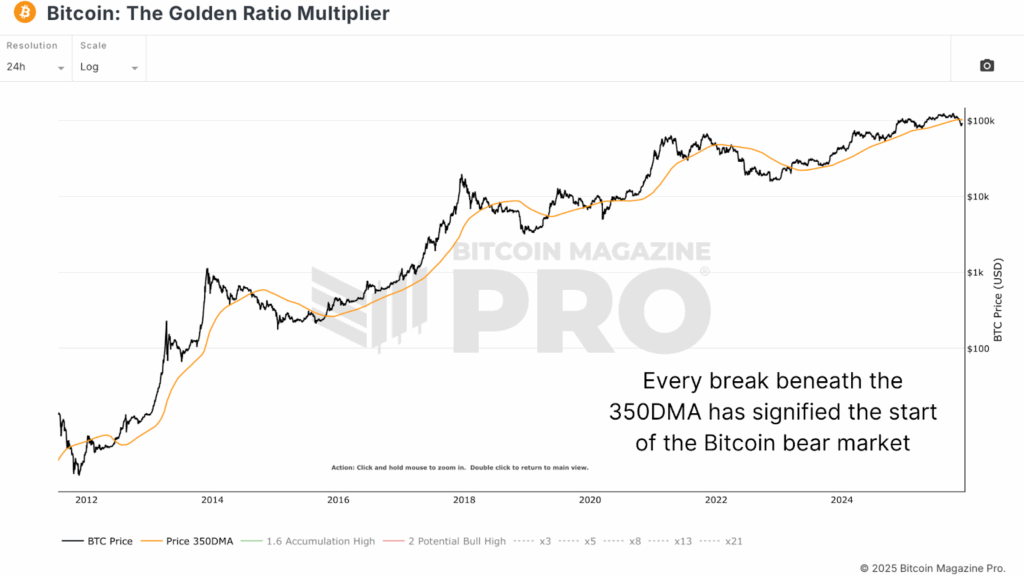
Breaking beneath the 350-day moving average at about $100,000 and the significant psychological 6-figure barrier marked the functional entry into bear market territory, with Bitcoin declining approximately 20% immediately thereafter. From a technical perspective, trading beneath The Golden Ratio Multiplier moving average has historically indicated Bitcoin entering a bear cycle, though the narrative becomes more interesting when measured against Gold rather than USD.
Figure 1: BTC breaking beneath the 350DMA has historically coincided with the start of bear markets.View Live Chart
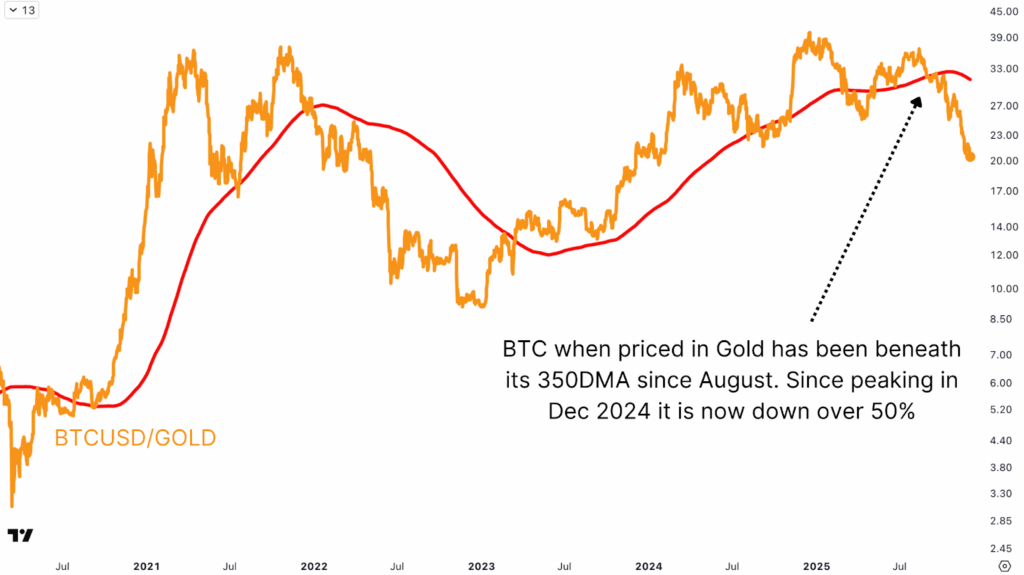
The Bitcoin versus Gold chart tells a notably different story than the USD chart. Bitcoin topped out in December 2024 and has since declined over 50% from that level, whereas the USD valuation peaked in October 2025, significantly beneath the highs set the prior year. This divergence suggests that Bitcoin may have been in a bear market for considerably longer than most observers realize. Looking at historical Bitcoin bear cycles when measured in Gold, we can see patterns that suggest the current pullback may already be approaching critical support zones.
Figure 2: When priced in Gold, BTC dropped beneath its 350DMA back in August.
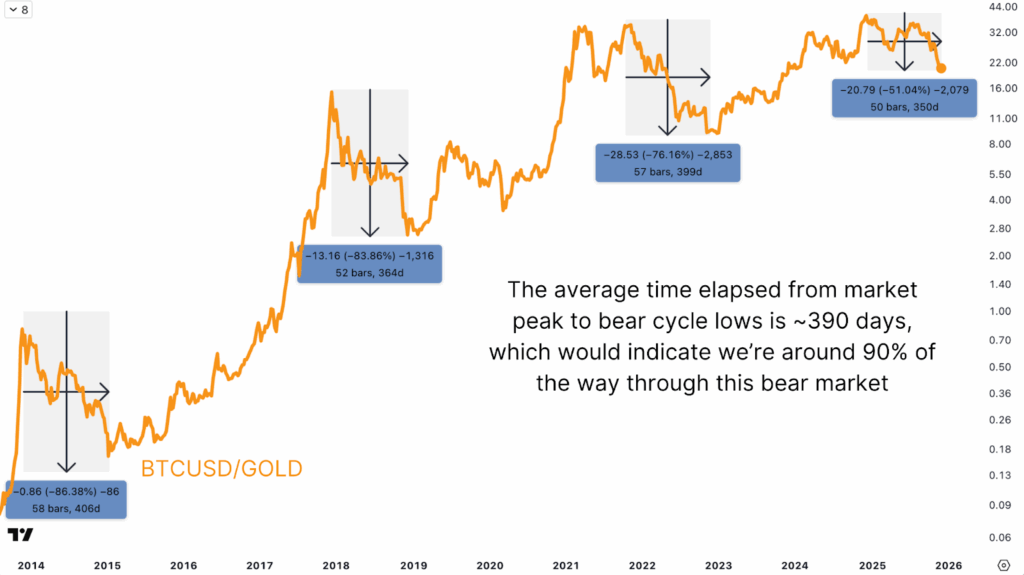
The 2015 bear cycle bottomed at an 86% retracement lasting 406 days. The 2017 cycle saw 364 days and an 84% decline. The previous bear cycle produced a 76% drawdown over 399 days. Currently, at the time of this analysis, Bitcoin is down 51% in 350 days when measured against Gold. While percentage drawdowns have been diminishing as Bitcoin’s market cap grows and more capital flows into the market, this trend reflects the rising tide of institutional adoption and lost Bitcoin supply rather than a fundamental change in cycle dynamics.
Figure 3: Plotting BTC’s value in Gold reveals a cycle pattern that suggests we could already be 90% of the way through this bear market.
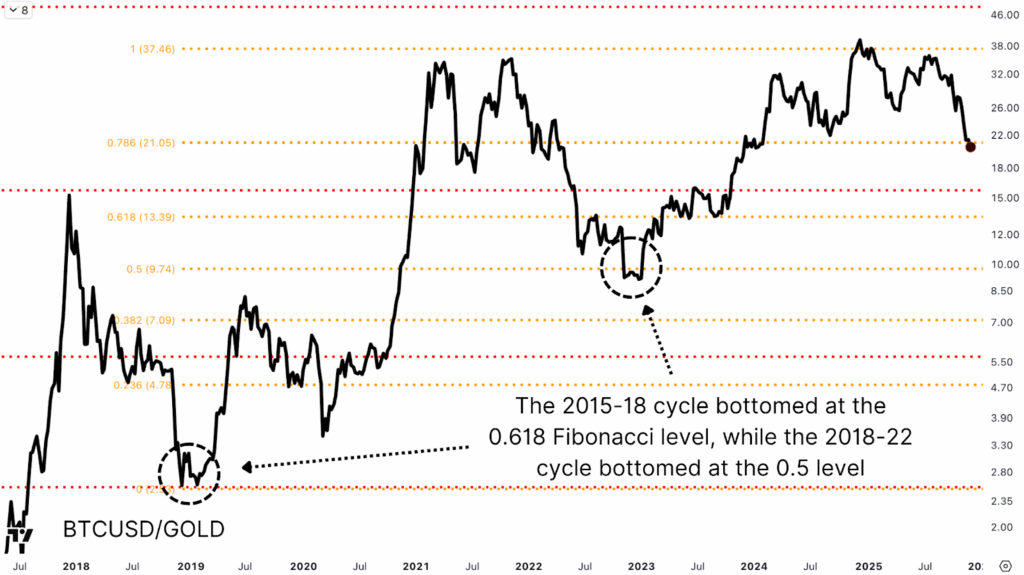
Rather than relying solely on percentage drawdowns and time elapsed, Fibonacci retracement levels mapped across multiple cycles provide greater precision. Using a Fibonacci retracement tool from bottom to top across historical cycles reveals striking levels of confluence.
Figure 4: In previous cycles, bear market bottoms have aligned with key Fibonacci retracement levels.
In the 2015-2018 cycle, the bear market bottom occurred at the 0.618 Fibonacci level, which corresponded to approximately 2.56 ounces of Gold per Bitcoin. The resulting price action marked the bottom with remarkable clarity, far cleaner than the equivalent USD chart. Moving forward to the 2018-2022 cycle, the bear market bottom aligned almost perfectly with the 0.5 level at approximately 9.74 ounces of Gold per Bitcoin. This level later acted as meaningful resistance-turned-support once Bitcoin reclaimed it during the subsequent bull market.
Translating Bitcoin Bear Market Gold Ratios Back to USD Price Targets
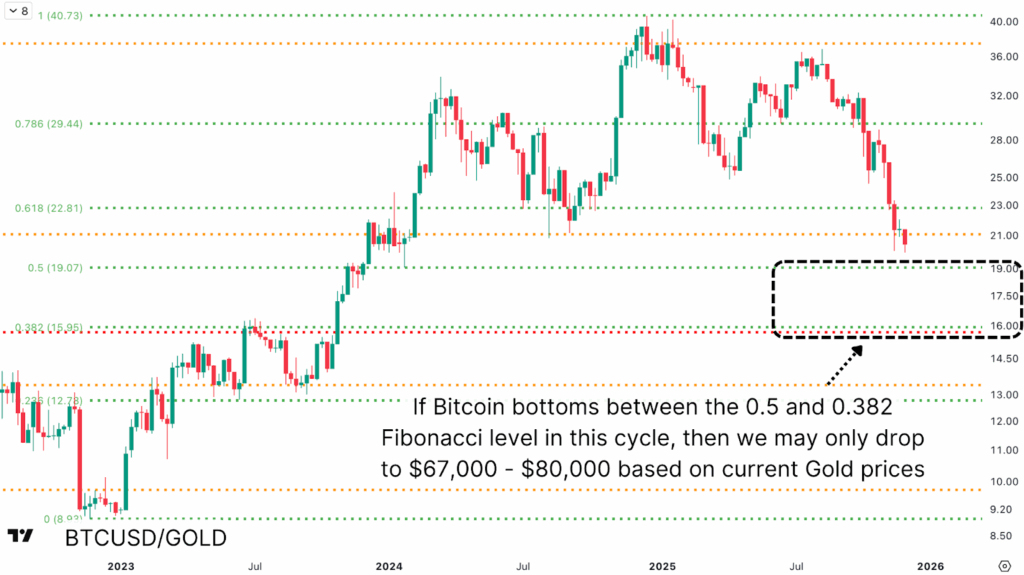
From the previous bear market low through the current bull cycle high, the 0.618 Fibonacci level sits at approximately 22.81 ounces of Gold per Bitcoin, while the 0.5 level rests at 19.07 ounces. Current price action is trading near the midpoint of these two levels, presenting what may be an attractive accumulation zone from a purchasing power perspective.
Figure 5: Applying Fibonacci levels to predict market lows for BTC versus Gold and subsequently pricing these back into USD, illustrates where Bitcoin’s price may bottom.
Multiple Fibonacci levels from different cycles create additional confluence. The 0.786 level from the current cycle translates to approximately 21.05 ounces of Gold, corresponding to a Bitcoin price around $89,160. The 0.618 level from the previous cycle aligns near $80,000 again. These convergence zones suggest that if Bitcoin were to decline further, the next meaningful technical target would be around $67,000, derived from the 0.382 Fibonacci retracement level at approximately 15.95 ounces of Gold per Bitcoin.
Conclusion: The Bitcoin Bear Market May Be 90% Complete Already
Bitcoin has likely been in a bear market for substantially longer than USD-only analysis suggests, with purchasing power already declining significantly since December 2024, when measured against Gold and other comparable assets. Historical Fibonacci retracement levels, when properly calibrated across multiple cycles and converted back into USD terms, point toward potential support confluence in the $67,000 to $80,000 range. While this analysis is inherently theoretical and unlikely to play out with perfect precision, the convergence of multiple data points across time horizons and valuation frameworks suggests the bear market may be approaching its conclusion sooner than many anticipate.
Disclaimer: This article is for informational purposes only and should not be considered financial advice. Always do your own research before making any investment decisions.
Arthur Hayes, the BitMEX co-founder, warned late last month that Tether’s shift into Bitcoin and gold could leave the stablecoin exposed if those assets tumble.
According to Hayes, a roughly 30% drop in Tether’s BTC and gold holdings could erase the company’s equity and leave USDT vulnerable.
His comments touched off fresh debate about how much of the company’s true financial strength is visible to the market.
The Tether folks are in the early innings of running a massive interest rate trade. How I read this audit is they think the Fed will cut rates which crushes their interest income. In response, they are buying gold and $BTC that should in theory moon as the price of money falls.… pic.twitter.com/ZGhQRP4SVF
Tether Is Far Stronger Than It Looks: Former Citi Analyst
A former Citi research lead, who goes by the name “Joseph”, pushed back on Hayes’s scenario. Based on reports, Joseph said public attestations only show the assets that directly back outstanding USDT and do not capture the full corporate balance sheet.
I spent 100’s of hours writing research on tether for @Citi. @CryptoHayes missed a few key points.
1) 𝐓𝐡𝐞𝐢𝐫 𝐝𝐢𝐬𝐜𝐥𝐨𝐬𝐞𝐝 𝐚𝐬𝐬𝐞𝐭𝐬 =/ 𝐚𝐥𝐥 𝐜𝐨𝐫𝐩𝐨𝐫𝐚𝐭𝐞 𝐚𝐬𝐬𝐞𝐭𝐬
When tether generates $ they have a separate equity balance sheet which they don’t… https://t.co/pHSRr245Up
He told reporters he spent hundreds of hours reviewing filings and market data and estimates Tether’s total equity could be in the $50–$100 billion range — a cushion much larger than what critics point to when they focus on attested reserves.
Reported Buffers
According to Joseph’s calculations, Tether holds about $120 billion in US Treasuries that are earning roughly 4%, which he says could generate about $10 billion a year in net income.
He also cited other corporate assets that are not part of public reserve snapshots — equity stakes, mining operations, and additional Bitcoin holdings — all of which, he argues, strengthen Tether’s overall capital position.
Paolo Ardoino, Tether’s CEO, has publicly cited roughly $30 billion in “group equity” as part of the firm’s buffer against shocks.
re: Tether FUD
From latest attestation announcement (Q3 2025):
“Tether will continue to maintain a multi-billion-dollar excess reserve buffer and an overall proprietary Group equity approaching $30 billion.”
Tether had (at end of Q3 2025) ~7B in excess equity (on top of the…
Hayes’s point, however, rests on a simple math worry: volatile assets can move fast, and marked declines would reduce the value of reserves.
He framed Tether’s move into Bitcoin and gold as a macro hedge against expected rate cuts, but said that hedge could backfire under a sharp sell-off.
Reports have noted that because attestations focus on backing for USDT supply, they may not reveal how much of the company’s other assets would be available in a crisis — a gap that keeps some investors uneasy.
What The Debate Means For Markets
The clash highlights two facts. One: there are sizable numbers involved — $120 billion in Treasuries, a roughly $30 billion equity figure cited by management, and the $50–$100 billion range estimated by Joseph.
Two: the core issue is disclosure. If Tether’s broader holdings can be marshalled quickly in a stress event, the company may handle big swings. If not, volatility could create trouble for short-term liquidity even if long-term equity is large.
Featured image from Pexels, chart from TradingView
A key long-term indicator comparing Bitcoin to gold has just triggered a signal not seen before in market history. Analysts say such extreme compression typically precedes violent directional moves, and the fact that it’s happening at the intersection of two global safe-haven assets makes the setup even more significant. With BTC outperforming gold for over a decade, this rare signal suggests that the next phase of the BTC vs Gold battle could rewrite long-term market expectations.
What Happens After A Historic Squeeze?
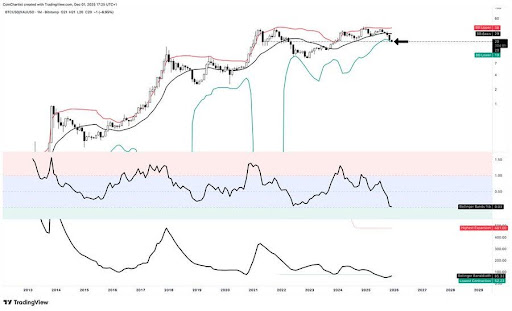
The Bitcoin versus Gold monthly Bollinger Bands are expanding from the tightest reading in history. A chartered market technician and Bitcoin trader, Tony “The Bull” Severino, revealed on X that the price is currently sitting at the lower Bollinger band, and a decisive close below will trigger a sell signal as the bands expand from a squeeze setup.
According to TonyTheBullCMT, this setup creates the potential for a significant trending-down move, which is the first major downtrend on the BTC against Gold chart. This might look the same against the USD, so don’t expect it to translate 1:1 there. However, it is becoming increasingly clear that Gold looks ready to overshadow BTC. If BTC is at % billion in the middle and falling into that lower greenish section, it won’t be a good sign for BTC in this ratio.
The weekly Bollinger Bands on this pair were the tightest ever in history, and since they began to expand, BTC dropped over 25% in a couple of weeks. Meanwhile, the monthly signal is at least 4x stronger.
Bitcoin has been in a brutal downtrend throughout the year. Crypto analyst Zynx has pointed out that BTC is now sitting almost 50% below its all-time high against Gold, and the ratio shows that the crypto king has effectively been in a bear market for an entire year of 2025.
Over the last 12 months, BTC has been down 45% against Gold. At this point, it would need to rally 99% to surpass its previous all-time high against Gold, which shows that BTC must hit around $170,000 before it can begin to claim a true bull market.
Bitcoin And Gold Ratio Hits A Statistical Low Rarely Reached
Bitcoin has reached one of its rarest valuation points relative to gold in more than a decade. An analyst and founder of GREEND0TS, Stacy Muur, highlighted that the BTC/Gold ratio has just dropped below the statistical lower boundary of a 15-year power-law model.
Interestingly, BTC has breached this level only once before in late 2017 and snapped back within weeks. Historically, when BTC gets this incredibly cheap compared to Gold, it doesn’t stay cheap against Gold for long. This is not a timing signal; rather, it is a rare statistical anomaly worth watching.
Precious metals are rallying again, with silver stealing the spotlight while gold regains its shine, and investors are starting to ask if cryptocurrencies could be next.
Key Takeaways:
Silver has doubled this year on rate-cut bets, a weaker dollar, and rising industrial demand.
Bitcoin is down over 30% from its peak as crypto markets suffer their sharpest pullback since 2022.
ETF outflows and on-chain losses show stress in crypto, even as metals draw fresh investor interest.
Gold climbed to its highest level in six weeks on Monday as investors increased bets on a US interest-rate cut, pushing spot prices above $4,240 an ounce.
Silver jumped even harder, touching a record near $57.86 before easing slightly, and is now up more than 100% this year.
Rate-Cut Bets and Weak Dollar Fuel Silver’s Record Run
The move comes as markets reprice expectations for looser monetary policy. Recent soft US data and dovish remarks from policymakers have fueled anticipation that the Federal Reserve could trim rates as soon as this month.
Futures markets now imply a high probability of a cut, and the dollar has slipped to a two-week low, making metals cheaper for overseas buyers.
Analysts also point to stronger industrial demand as a tailwind for silver, alongside its traditional role as a hedge when confidence in paper assets fades.
While metals surge, crypto is wrestling with a very different mood.
BREAKING: Silver hits new record high of $57.8 per ounce, is now up 100% this year. pic.twitter.com/td1UNjHTBh
Bitcoin has shed more than 30% from its October peak near $126,000 and now trades around $86,000, Linh Tran, Market Analyst at XS.com, said in a comment.
November alone delivered a double-digit slide, capping the worst late-year performance since the 2022 bear market.
In the past six weeks, the wider crypto market has lost about $1 trillion in value, with Bitcoin accounting for over $400 billion of that decline.
Institutional flows tell a similar story. US spot Bitcoin ETFs recorded roughly $3.5 billion in net outflows in November, the heaviest monthly withdrawal since approvals early last year.
Investors have used the vehicles as a quick exit as macro risk rises, reversing the pattern that once amplified upside during the rally.
Signs of stress also appear on-chain, where realized losses among short-term holders have spiked to levels last seen in late 2022, a signal of capitulation by late entrants and leveraged traders.
Bitcoin ETF Outflows Ease as Institutional Base Holds Firm
Still, there are hints that the bleeding may be slowing, Tran said. Late in November, ETFs registered a modest return to net inflows, adding about $70 million.
While small relative to earlier exits, the shift suggests selling pressure could be exhausting itself.
Cumulatively, ETFs still hold close to $120 billion in Bitcoin, around 6.5% of the network’s market value, indicating that the long-term institutional footprint remains intact.
So does silver’s breakout foreshadow a crypto rebound? Historically, easier money lifts all risk assets, but timing matters.
Metals often move first when rate expectations change. Digital assets tend to follow once liquidity actually turns.
For now, Bitcoin appears locked in a volatile range between $80,000 and $90,000, with the risk of a deeper test toward $70,000 if macro conditions sour again.
“In the medium and long term, if the Fed begins to signal clearer monetary easing, macro risks ease, and ETF flows shift from net outflows to neutral or net inflows, Bitcoin will have the runway to establish a new upward cycle,” Tran said.
Tether, the issuer of the world’s most widely used stablecoin, USDT, has evolved over the years into one of the most profitable and resilient firms within the crypto space.
Under the leadership of CEO Paolo Ardoino, Tether has broadened its focus beyond digital assets, becoming a significant player in the commodity market, particularly with substantial gold reserves.
Tether’s Gold Ambition
Recent reports from the Financial Times reveal that Tether has stirred the gold markets this year by becoming the largest holder of the precious metal outside of central banks.
According to Bryce Elder’s analysis, the crypto firm’s stockpile is comparable to that of smaller central banks, such as those in Korea, Hungary, and Greece. Last quarter, the company’s gold acquisitions accounted for nearly 2% of total gold demand, equating to almost 12% of central bank purchases.
Sources indicate that Tether’s investments in gold reflect the belief among its insiders that the commodity serves as “a superior store of value” and a “better hedge against inflation” compared to digital currencies.
Although Tether has significant holdings in Bitcoin, its investment in gold has surpassed its exposure to the leading cryptocurrency. Throughout the year, Tether purchased 26 tons of gold, bringing its total gold stockpile to over 116 tons.
However, Tether’s ambitions in the gold sector extend beyond mere accumulation; the firm is actively pursuing deals related to gold royalty companies, which finance mining operations in exchange for a percentage of future revenues.
Plans To Dominate The Gold Royalty Space
In June, Tether Investments—responsible for managing the company’s profits—acquired a minority stake in Toronto-listed Elemental Altus for $105 million. An additional $100 million was invested in September amid Elemental’s merger with rival EMX, resulting in Tether holding a controlling stake in the company.
Insiders suggest that the crypto giant has broader plans, aiming to consolidate small to mid-cap gold royalty firms to strengthen its position in the market. “Their goal is to keep consolidating the small to mid-cap gold royalty space,” said an insider familiar with Tether’s strategy.
However, while some view this approach as savvy, others are skeptical, with one commodity industry executive labeling Tether as “the weirdest company I have ever dealt with.”
Gold royalties offer the company a unique advantage over traditional bullion; they provide fixed exposure to gold, insulating the stablecoin issuer from fluctuations in gold prices. Yet, amid these ventures, Tether has faced scrutiny regarding its financials.
NewsBTC reported on Wednesday that S&P Global downgraded Tether’s assets to its lowest rating, “weak,” citing concerns over the firm’s rising exposure to high-risk reserve assets, which could undermine the collateral backing its stablecoin during a financial crisis.
According to a research note from S&P Global, this downgrade was part of a new assessment system introduced in 2023, which classifies stablecoins on a scale from 1 to 5 based on risk.
The firm’s USDT stablecoin received a rating of “5 (weak),” reflecting a decline from its previous score of “4 (constrained).” Analysts expressed concerns regarding Tether’s limited transparency concerning the creditworthiness of its custodians and counterparties.
In response to the downgrade, the firm’s CEO, Paolo Ardoino, took to social media platform X (formerly Twitter) to address the concerns, stating, “We wear your loathing with pride.”
He contended that traditional credit rating methodologies used by agencies like S&P stem from “outdated systems that have proven unreliable,” leading to renewed regulatory scrutiny of these legacy models.
Featured image from DALL-E, chart from TradingView.com
If you take a look around you, chances are pretty good that within a few seconds, your eyes will fall on some kind of electrical connector. In this day and age, it’s as likely as not to be a USB connector, given their ubiquity as the charger of choice for everything from phones to flashlights. But there are plenty of other connectors, from mains outlets in the wall to Ethernet connectors, and if you’re anything like us, you’ve got a bench full of DuPonts, banana plugs, BNCs, SMAs, and all the rest of the alphabet soup of connectors.
Given their propensity for failure and their general reputation as a necessary evil in electrical designs, it may seem controversial to say that all connectors are engineered to last. But it’s true; they’re engineered to last, but only for as long as necessary. Some are built for only a few cycles of mating, while others are built for the long haul. Either way, connectors are a great case study in engineering compromise, one that loops physics, chemistry, and materials science into the process.
A Tale of Two Connectors
While there’s a bewildering number of connectors available today, most have at least a few things in common. Generally, connectors consist of one or more electrically conductive elements held in position by an insulating body of some sort, one that can mechanically attach to another body containing more conductive elements. When the two connectors are attached, the conductive elements come into physical contact with each other, completing the circuit and providing a low-resistance path for current to flow. The bodies also have to be able to separate from each other when the connections need to be broken.
This Molex connector is only engineered for a few mating cycles over its useful life. By Barcex – Self-published work, CC BY-SA 2.5.
For as simple as that sounds, a lot of engineering goes into making connectors that are suitable for the job at hand. The intended use of a connector dictates a lot about how it’s designed, and in terms of connector durability, looking at the extremes can be instructive. On one end of the scale, we might have something like a Molex connector on a wiring harness in a dishwasher. Under ideal circumstances, a connector like that only needs to be used once, in the factory during assembly. If the future owner of the appliance is unlucky, that connector might go through one or two more mating cycles if the machine needs to be serviced at some point. Either way, the connector is only going to be subjected to low single-digit mating cycles, and should be designed accordingly
A USB-C connector, on the other hand, is designed for 10,000 mating cycles. By Tomato86 – Own work, CC BY-SA 4.0.
On the other end of the mating-cycle spectrum would be something like the USB-C connector on a cell phone. Assuming the user will charge the phone once a day, the connector might have to endure many thousands of mating cycles over the useful life of the phone. Such a connector has a completely different use case from a connector like that Molex, and very different design constraints. But the basic job — bringing two conductors into close contact to complete a low-resistance circuit, and allow the circuits to be broken only under the right circumstances — is the same for both.
But what exactly do we mean by “close contact”? It might seem obvious — conductors in each half of the connector have to touch each other. But keeping those conductors in contact is the real trick, especially in challenging environments such as under the hood of a car or inside a CNC machine, where vibration, dust, and liquid intrusion can all come together to force those contacts apart and break the circuit while it’s still in use.
Why Be Normal?
To keep contacts together, engineers rely on one of the simplest mechanisms of all: springs. In most connectors, the contacts themselves are the sprung elements, although there are connectors where force is applied to the contacts with separate springs. In either case, the force generated by the spring pushes the contacts together firmly enough to ensure that they stay connected. This is the normal force, called so because the force is exerted perpendicular to the plane of contact when the connector is mated.
Traditionally, normal force in connector engineering is expressed in grams, which seems like an affront to the SI system, where force is expressed in Newtons. But fear not — “grams” does not refer to the mass of a contact, but rather is shorthand for “gram-force,” the force applied by one gram of mass in a one g gravitational field. So, an “80 gram” contact is really exerting 0.784 N of normal force. But that’s a bit clunky, especially when most connectors have normal forces that are a fraction of a Newton. So it ends up being easier to refer to the grams part of the equation and just assume the acceleration component.
The amount of normal force exerted by the contacts is a critical factor in connector design, and has to be properly scaled for the job. If the force is too low, it may increase the resistance of the circuit or even result in intermittent open circuits. If the force is too high, the connector could be difficult to mate and unmate, or the contacts could wear out from excess friction.
Since the contacts themselves are usually the springs as well as the conductors, getting the normal force right, as well as ensuring the contacts are highly conductive, is largely an exercise in materials science. While pure copper is an excellent conductor, it is not elastic enough to provide the proper normal force. So, most connectors use one of two related copper alloys for their contacts: phosphor bronze, or beryllium copper. Both are excellent electrical and thermal conductors, and both are strong and springy, but there are significant differences between the two that make them suitable for different types of connectors.
As the name implies, phosphor bronze is an alloy of phosphorus and bronze, which itself is an alloy of copper and tin. To make phosphor bronze, about 0.03% phosphorus is added to pure molten copper. Any oxygen dissolved in the copper reacts with the phosphorus, making phosphorus pentoxide (P2O5), which can be easily removed during refining. About 2% tin is added along with about 10% zinc and 2% iron to make the final alloy, which is easily cast into sheets or coil stock.
While far superior to pure copper or non-phosphor bronze for use in contacts, phosphor bronze is, at best, a compromise material. It’s good enough in almost all categories — strength, elasticity, conductivity, wear resistance — but not really great in any of them. It’s the “Jack of all trades, master of none” of the electrical contact world, which, coupled with its easy workability and low cost, makes it the metal of choice for the contacts in commodity connectors. If a manufacturer is making a million copies of a connector, especially ones that are cheap enough that nobody will cry too much if they have to be replaced, chances are good that they’ll choose phosphor bronze. It’s also the alloy most likely to be used for connectors intended for low mating-cycle applications, like the aforementioned dishwasher Molex.
For more mission-critical contacts, a different alloy is generally called for: beryllium copper. Also known as spring copper, beryllium copper contains up to about 3% beryllium, but for electrical uses, it’s usually around 0.7% with a little cobalt and nickel added in. Beryllium copper is everything that phosphor bronze is, and more. It’s stronger and springier, it’s a far better electrical conductor, and it also has a better ability to withstand creep under load. Also known as stress relaxation, creep under load is the tendency for a spring to lose its strength over time, which reduces its normal force. Phosphor bronze has pretty good stress relaxation resistance, but when it heats up past around 125°C, it starts to lose spring force — not ideal for high-power applications. Beryllium copper is easily able to withstand 150°C or more, making it a better choice for power connectors.
Beryllium copper also has a higher elastic modulus than phosphor bronze, which makes it easier to create small contacts that still have enough normal force to maintain good contact. Smaller is better when it comes to modern high-density connectors, so you’ll often see beryllium copper used in fine-pitch connectors. It also has better fatigue life and tends to maintain normal force over repeated mating cycles, making it desirable for connectors that specify cycle lives in the thousands. But just because it’s desirable doesn’t make it a shoo-in — beryllium copper is at least three times more expensive than phosphor bronze. That means it’s usually reserved for connectors that can justify the added expense.
Noble Is Only Skin Deep
No matter what the base metal is for connector contacts, chances are good that the finished contact will have some sort of plated finish. Plating is important because it protects the base metal from oxidation, as well as increasing the wear resistance of contacts and improving their electrical conductivity. Plating metals fall into two broad categories: noble (principally gold, with silver used sometimes for high-power connectors, as well as palladium, but only very rarely) and non-noble platings.
Noble metal finishes are quite common in high-density connectors, RF applications, and high-speed digital circuits, as well as high-reliability applications and connectors that are expected to have high mating cycles. But at the risk of stating the obvious, gold is expensive, so it’s used only on connectors that really need it. And even then, it’s very rare that the entire contact is plated. While that would be incredibly expensive — gold is currently pushing $4,000 an ounce — the real reason is that gold isn’t particularly solderable. So generally, selective plating is used to deposit gold only on the mating surfaces of contacts, with the tail of the contact plated in a non-noble metal to improve solderability.
Among the non-noble finishes, tin and tin alloys are the first choice. Aside from its excellent solderability, tin alloys do a great job at protecting the base metal from corrosion. However, the tin plating itself begins to oxidize almost immediately after it’s applied. This would seem to be a problem, but it’s easily addressed by using more spring force in the contacts to break through the oxide layer to fresh tin. Tin-plated contacts typically specify normal forces of 100 grams or more, while noble metal contacts can get by with 30 grams or less. Also, tin contacts require much thicker plating than noble metal finishes. Tin is generally specified for commodity connectors and anywhere the number of mating cycles is likely to be low.
Don’t You Fret
Although corrosion is obviously something to be avoided, the real enemy when it comes to connector durability is metal-on-metal contact. The spring pressure between contacts unavoidably digs into the plating, and while that’s actually desirable in tin-plated contacts, too much of a good thing is bad. Digging past the plating into the base metal marks the end of the road for many connectors, as the base metal’s relatively lower conductivity increases the resistance of the connection, potentially leading to intermittent connections and even overheating. Again, noble metals perform better in this regard, at least in the long run, as their lower normal force reduces friction and results in a longer-lived contact.
There’s another metallurgical phenomenon that can wreak havoc on connectors: fretting. Fretting is caused by tiny movements of the contacts against each other, on the order of 10-7 meters, generally in response to low-g vibrations but also as a result of thermal expansion and contraction. Fretting damage occurs when the force of micromotions between contacts exceeds the normal force exerted between them. This leads to one contact sliding over the other by a tiny amount, digging a trench through the plating metal. In tin-plated contacts, this exposes fresh tin, which oxidizes instantly, forming an insulating surface. Further micromotions expose more fresh tin, which leads to more oxides. Eventually the connection fails due to high resistance. Fretting is insidious because it happens even without a lot of mating cycles; all it takes is a little vibration and some time. And those are the enemies of all connectors.
When it comes to gold trading (XAUUSD), most retail traders focus on the high-volatility London and New York sessions, overlooking the critical role of the Asian session. But here’s a secret the smart money knows: the Asian Range Theory is the foundation of institutional gold moves. During the Asian session (7:00 PM–3:00 AM EST), banks and hedge funds quietly set the stage for explosive breakouts, using low-volatility ranges and liquidity sweeps to trap retail traders before the real action begins.
In this 3,000-word guide, we’ll dive deep into the Asian Range Theory, revealing how institutions use the Tokyo session to engineer gold price movements. By leveraging The Institutional Code System™ for precise timing and The Goldmine Strategy for high-probability breakout setups, you’ll learn to decode institutional behavior, avoid common traps, and trade XAUUSD with confidence. Whether you’re a beginner or an experienced trader, this article will give you a blueprint to harness the Asian session’s hidden potential.
What Is the Asian Range Theory?
The Asian Range Theory posits that the low-volatility price action during the Asian session (7:00 PM–3:00 AM EST) is a deliberate setup by institutional traders to accumulate positions and create liquidity zones. These zones — often tight ranges or consolidation patterns — act as traps for retail traders and fuel for breakouts in the London or New York sessions.
Why the Asian Session Matters for Gold Trading
Gold (XAUUSD) is a safe-haven asset, sensitive to global economic events and institutional order flow. Unlike other forex pairs, its price action during the Asian session is shaped by:
Low Volatility: The Tokyo session typically sees smaller price movements (20–40 pips), as major players like US and European banks are less active.
Liquidity Sweeps: Institutions target retail stop-loss orders above or below key levels, creating false breakouts to trap impatient traders.
Pre-London Positioning: Banks adjust their books during the Asian session, setting up for major moves when liquidity surges at the London open.
The Institutional Fx Code System™ emphasizes the Asian session as the preparation phase for institutional trades, while The Goldmine Strategy uses these ranges to identify high-probability breakout and retest setups. By understanding the Asian Range Theory, you can align with smart money and avoid being trapped by their moves.
How Institutions Use the Asian Session to Engineer Gold Moves
To trade gold like an institution, you need to understand how banks and hedge funds operate during the Asian session. The Asian Range Theory highlights three key tactics:
1. Accumulation in Tight Ranges
During the Asian session, gold often trades in tight ranges (e.g., 20–30 pips), forming consolidation patterns like rectangles or triangles. Institutions use these ranges to accumulate large positions without attracting attention, setting the stage for breakouts in later sessions.
2. Liquidity Sweeps to Trap Retail Traders
Institutions deliberately push price above or below key levels (e.g., range highs/lows) to trigger retail stop-loss orders. These “sweeps” create false breakouts, trapping early retail entries before price reverses or breaks out in the opposite direction.
3. Pre-London Setup for Breakouts
The Asian session ends just before the London open (2:00 AM EST), a high-liquidity period. Institutions use the Asian range to mark key levels (e.g., order blocks or supply/demand zones) that will act as support or resistance during the breakout phase.
How to Trade the Asian Range Theory with The Institutional Code System™
The Institutional Code System™ provides a timing-based framework to decode the Asian session’s role in institutional gold moves. By focusing on the Asian killzone (7:00 PM–3:00 AM EST), you can identify setups that align with smart money. Here’s how to apply it:
1. Identify the Asian Range
On a 1-hour or 15-minute XAUUSD chart, mark the high and low of the Asian session (7:00 PM–3:00 AM EST). These levels are potential liquidity zones where institutions target retail stops.
Tool: Use TradingView’s rectangle tool to draw the range (e.g., $2,645–$2,650).
Filter: Confirm the range aligns with a higher-timeframe level (e.g., daily support/resistance or Fibonacci 61.8%).
2. Spot Liquidity Sweeps
Look for false breakouts above or below the range, often marked by a wick or engulfing candle. These sweeps indicate institutional stop-hunting before the real move.
3. Wait for the London Transition
The Asian session’s end (3:00 AM EST) overlaps with the London pre-open. Use The Institutional Code System™ to wait for price to retest a key level (e.g., range high/low or order block) before entering.
Executing Asian Range Setups with The Goldmine Strategy
The Goldmine Strategy complements The Institutional Code System™ by providing a clear execution framework for Asian range setups. It focuses on breakout and retest patterns, ensuring you enter trades with institutional confirmation. Here’s how to trade the Asian Range Theory:
Step 1: Map the Asian Range
During the Asian session, identify a consolidation range on a 15-minute or 1-hour XAUUSD chart. For example:
Range: $2,640–$2,650 from 9:00 PM to 2:00 AM EST.
Key Level: Confirm the range high ($2,650) aligns with a daily resistance or Fibonacci level.
Step 2: Watch for a Liquidity Sweep
Look for a false breakout above or below the range, often during the late Asian session (1:00 AM–3:00 AM EST). This sweep clears retail stops, setting up the real move.
Example: Price spikes above $2,650 to $2,653, then drops back to $2,645. This bullish sweep suggests a buy setup.
Step 3: Enter on the Retest
Using The Goldmine Strategy, wait for price to retest the range high/low or an order block as support/resistance during the London killzone (2:00 AM–5:00 AM EST).
Step 4: Manage Risk
Risk 1–2% of your account per trade.
Place stops below/above the retest level to avoid institutional sweeps.
Scale out profits during the London or New York killzone to lock in gains.
Retail traders often lose in the Asian session because they misinterpret its low volatility or fall into institutional traps. Here are common mistakes and how to avoid them:
Chasing False Breakouts: Retail traders enter on early breakouts (e.g., a spike above $2,650) without waiting for a retest, getting stopped out by sweeps.
Solution: Use The Goldmine Strategy to wait for confirmation.
Trading in Low Volatility: The Asian session’s tight ranges tempt traders to scalp, leading to choppy losses.
Solution: Use The Institutional Code System™ to focus on mapping ranges, not trading them.
Ignoring Higher Timeframes: Without daily/weekly context, traders misread Asian ranges as random noise.
Solution: Align setups with daily support/resistance or order blocks.
Lack of Patience: Retail traders act impulsively, missing the London transition where real moves begin.
Solution: Wait for the London killzone to execute Asian range setups.
Practical Tips for Mastering the Asian Range Theory
Create a Range Checklist: Download our free Asian Range Trading Guide (link to lead magnet) to track key levels and sweeps during the Asian session.
Use a Demo Account: Practice 20 Asian range setups using The Goldmine Strategy to build confidence.
Monitor Economic Events: Check Forex Factory for Asian session news (e.g., Bank of Japan announcements) that could affect gold.
Journal Your Trades: Record every Asian range trade, noting the range, sweep, and outcome to refine your strategy.
Unlock Institutional Gold Moves with the Asian Range Theory
The Asian Range Theory reveals the hidden mechanics of institutional gold trading. By understanding how banks use the Asian session to accumulate positions, sweep liquidity, and set up breakouts, you can trade XAUUSD with the precision of the smart money. The Institutional Code System™ provides the timing framework to identify these setups, while The Goldmine Strategy ensures you execute with discipline, turning ranges into profits.
Start by mapping one Asian range per day and practicing The Goldmine Strategy’s breakout-retest setups on a demo account. For more on institutional timing, read our article “The Three Killzones Every Gold Trader Should Master” or learn how to avoid traps with “The Gold Trap: How Liquidity Sweeps Build the Perfect Goldmine Setup”. Download our free Asian Range Trading Guide to get started today.
Share your Asian range trade on X with #AsianRange and tag us to join the conversation!
JPMorgan strategists say Bitcoin (BTC) now appears undervalued relative to gold following a steep October sell-off driven by leveraged liquidations and market turmoil.
Bitcoin fell more than 20% last month after hitting an all-time high of $126,000, a drop that JPMorgan’s Nikolaos Panigirtzoglou attributed to heavy deleveraging in futures markets and fallout from a $128 million hack of the DeFi platform Balancer.
He noted that the ratio of open interest in perpetual futures to Bitcoin’s market capitalization has since returned to average levels, suggesting that “excess leverage has largely been cleared.”
ETF outflows have been modest compared to prior inflows, Panigirtzoglou added, pointing to a more stable market backdrop.
“Most of the deleveraging activity is now behind us,” he said, adding that the futures open interest ratio remains a key indicator for short-term price direction.
On a volatility-adjusted basis, Bitcoin is now trading at a discount compared to gold. JPMorgan’s analysis found that as gold’s price surged above $4,000 per ounce—bringing higher volatility—Bitcoin’s own volatility subsided. To reach parity with gold’s $6.2 trillion in private-sector investment on a risk-adjusted basis, Bitcoin’s price would need to climb roughly two-thirds, to around $170,000.
“Having been $36,000 too high compared with gold at the end of last year, Bitcoin is now around $68,000 too low,” Panigirtzoglou wrote.
JUST IN: $3.4 trillion JPMorgan strategist says #Bitcoin has “significant upside for the next 6-12 months” over gold. pic.twitter.com/KJlmnfsKes
With leverage normalized and volatility easing, JPMorgan sees room for “significant upside” over the next six to twelve months if current conditions persist—an outlook that could strengthen Bitcoin’s appeal as a digital alternative to gold in investor portfolios.
Bitcoin price update
Bitcoin is currently trading at $101,977 after a tumultuous October. Bitcoin kicked off October with bull‑momentum, hitting a fresh all‑time high north of approximately $125,000–$126,000 around October 6.
But that euphoria proved short-lived. Soon after the peak, Bitcoin came under pressure: a massive liquidation of over $19 billion in perpetual futures contracts accelerated the unwind.
Macroeconomic jitters — trade tensions, central‑bank ambiguity and risk‑asset weakening — compounded the correction.
By month‑end, Bitcoin had recorded its first losing October since 2018, slipping around 4 %–5 % overall and suffering one of its worst October performances on record.
Despite the recent fall, the year‑to‐date picture remained positive — though less exuberant than some bulls expected.
Earlier in October, JPMorgan put out some research that suggests Bitcoin could be undervalued versus gold, with potential to rise to $165,000 based on volatility-adjusted comparisons and growing investor demand.
Recent bitcoin price action has left many investors frustrated. Despite setting new all-time highs above $120,000 earlier this year, the bitcoin price has struggled to keep pace with equities and Gold in recent months. The S&P 500 and precious metals have surged to new records, while Bitcoin has remained range-bound, giving the impression that it’s lagging behind. But when analyzing the market through a lens of capital rotation, this period of underperformance may not last much longer.
Relative Gains in the Bitcoin Price
While Bitcoin has appeared weak in dollar terms, it remains one of the strongest performers over the past year. BTC has still outperformed both Gold’s 46% and the S&P 500, yet even with that outperformance, the structure of the market makes it feel as though Bitcoin is still under-delivering. Measuring Bitcoin against other assets like equities and Gold rather than the dollar, which is itself depreciating, gives a more accurate view of its purchasing power and real market standing.
When charted against the S&P 500, Bitcoin’s performance shows an interesting divergence. The BTC to S&P ratio reveals that while Bitcoin set new USD highs in 2024, its relative value against equities is only just above the previous cycle’s peak. In other words, Bitcoin’s additional purchasing power has barely expanded. If Bitcoin were to reclaim the previous S&P 500 ratio high of ~19.6, it would equate to a bitcoin price of roughly $135,000, given current equity levels.
Bitcoin Price vs Gold
The Bitcoin to Gold ratio tells a similar story. Despite reaching new highs in dollar terms, BTC actually remains well below its previous cycle’s all-time high when priced in Gold. A full recovery to that ratio would place the bitcoin price near $150,000, and reclaiming the brief 2024 high would push it closer to $160,000. These comparisons help explain why sentiment feels more muted despite record prices. Measured against real-world stores of value, Bitcoin’s performance still trails prior peaks.
However, an interesting dynamic has repeated across multiple cycles. Each time Gold has experienced a sharp rally, Bitcoin has followed with a major bull phase shortly after. The pattern appeared in 2012, 2016, and again in 2020 — Gold rallied first, then Bitcoin followed with exponential gains. These Gold spikes seem to mark the early stages of capital rotation, as liquidity moves from defensive safe havens into more speculative, higher-beta assets like BTC.
Capital Rotation and the Bitcoin Price
That rotation may already be underway again. Gold recently set new highs before losing momentum, while equities have begun to strengthen. Historically, when Gold begins to underperform the S&P 500 after a major rally, it has signaled the start of risk-on conditions in broader markets — the kind that favor Bitcoin.
The same capital rotation that occurs within crypto markets, from stablecoins into Bitcoin, then into large-cap and smaller speculative altcoins, may also occur in traditional markets. Liquidity often flows from fiat and bonds into Gold and then equities, before eventually into risk assets like Bitcoin as investor confidence rises.
Conclusion: The Bitcoin Price May Soon Lead Again
Bitcoin remains tightly correlated with the S&P 500, meaning sustained equity strength is one of the most reliable precursors to bitcoin price outperformance. With Gold potentially topping and equities gaining traction, the next few months could mark the beginning of a new phase of risk appetite.
While Bitcoin has felt stagnant and underwhelming in recent weeks, the broader context suggests otherwise. Capital is in motion. The same rotation that has defined every past cycle appears to be setting up once again — and the bitcoin price may soon move from laggard to leader.
Disclaimer: This article is for informational purposes only and should not be considered financial advice. Always do your own research before making any investment decisions.
Changpeng “CZ” Zhao and Peter Schiff are supposedly taking their long-running argument to the stage.
The Binance founder has agreed to debate the outspoken economist and gold advocate after Schiff publicly challenged him to a “Bitcoin versus tokenized gold” discussion.
The exchange follows Schiff’s announcement that he’s launching his own blockchain-based gold product — and CZ’s sharp critique that such tokens are “not truly on-chain.”
“As much as you voice against Bitcoin, you are always professional and nonpersonal,” CZ told Schiff on X today. “I appreciate that. Can have a debate about it.”
Schiff replied later: “Absolutely. Several people have already reached out to me offering to moderate. Do you have a preference?”
All this debate talk arrives hours after President Donald Trump granted a full pardon to Changpeng Zhao. President Trump said CZ “wasn’t guilty” and was “persecuted by the Biden administration.”
JUST IN: Binance Founder CZ agrees to Bitcoin vs Gold debate with Peter Schiff. pic.twitter.com/oKtxii6YqH
Schiff recently said that he’s building a tokenized gold platform and neobank, with a blockchain token called Tgold at its core.
The product will reportedly allow users to purchase physical gold through a mobile app, store it in secure vaults, and transfer or redeem it digitally.
Schiff describes it as “real money for the digital age” — physical gold represented on-chain.
All this comes amid a multiyear gold rally, with prices hitting a record $4,380 per ounce earlier this month before settling near $4,128, at time of writing.
Schiff argues that tokenized gold could provide a stable, asset-backed alternative to Bitcoin’s volatility, serving as both a medium of exchange and store of value.
CZ pushes back: “It’s a ‘Trust Me Bro’ Token”
CZ wasted no time in firing back.
On X, he called tokenized gold “a ‘trust-me-bro’ token,” arguing that such assets rely on third-party custodians — precisely the kind of centralized trust structures Bitcoin was designed to eliminate.
“Tokenizing gold is NOT ‘on-chain’ gold,” CZ wrote. “It’s tokenizing that you trust some third party will give you gold at some later date — maybe decades later, during a war, after management changes, etc.”
His comments echo a common view among crypto purists: that true digital ownership requires self-custody and verifiable scarcity — traits Bitcoin has, but gold tokens do not.
As of writing, there is not an agreed-upon or specific time for Schiff and CZ to debate.
Bitcoin price retreated to around $108,300 today after briefly touching $114,000 on Tuesday, while traditional safe-haven assets continued to slide.
Spot gold fell to as low as $4,034 per ounce, extending its sharp losses from earlier in the week, and silver remained down nearly 8%.
The moves follow remarks from Federal Reserve Governor Christopher Waller, who announced plans for a “skinny master account” program that would allow eligible fintech and crypto firms limited access to the Fed’s payment system — a step seen as integrating digital assets more directly into traditional finance.
Those Fed comments were made at the Federal Reserve’s first-ever Payments Innovation Conference in Washington. Bitcoin initially jumped more than 5% to $114,000 during the event but has since retreated to around $108,000.
Market chatter on social media suggested that investors may be rotating out of precious metals and into bitcoin, echoing themes from Bitwise Asset Management’s latest Crypto Market Compass report.
Bitwise said a modest 3–4% shift of capital from gold into crypto could theoretically double Bitcoin’s price, given the relative size difference between the two markets.
Just today, Standard Chartered’s Geoff Kendrick wrote that he expects Bitcoin to briefly drop below $100,000 due to trade war concerns but said the decline may be short-lived, noting that recent gold weakness has historically sparked quick Bitcoin rebounds.
Bitcoin price prediction markets are flashing a signal
Bitcoin prediction markets like Polymarket and Kalshi are emerging as real-time sentiment indicators for traders betting on future bitcoin prices. These platforms aggregate odds based on where participants think bitcoin will end the year.
Earlier in October, traders were predicting a $144,000 year-end price, but that has since dropped to around $129,000 as volatility and fear increased.
When the spot price trades well below forecasts, it typically signals fear and potential undervaluation; when it trades near or above forecasts, it suggests market euphoria and possible local tops. Adjusted for prediction volatility, the data shows that wide gaps between the two often coincide with market lows.
So right now, it’s safe to say that prediction markets are flashing a contrarian “fear” signal.
While Polymarket claims 91% accuracy, removing outlier bets brings that figure closer to 71%. Interestingly, this ratio tends to move opposite the Fear and Greed Index — highlighting undervaluation during fear and overconfidence during greed.
Bitcoin price roared past $113,000 today, climbing from $108,000 earlier in the session, as traditional safe-haven assets took a hit.
Spot gold extended its losses to $4,085.39 per ounce, down more than 6%, while spot silver plunged as much as 8.7%, marking its steepest drop since 2021.
Bitcoin’s surge came after Federal Reserve Governor Christopher Waller signaled a major shift in U.S. crypto policy, announcing a “skinny master account” program. This initiative would give eligible fintechs and digital-asset firms limited, direct access to the Fed’s payment system, bypassing traditional banks.
Waller framed distributed ledgers, DeFi, and crypto assets as integral to mainstream finance. The Fed is actively exploring ways to integrate emerging financial technologies with legacy infrastructure.
The sell-off of precious metals has raised questions on social media about whether investors are rotating capital from gold and silver into bitcoin.
Bitwise: A small gold shift could spark Bitcoin price rally
Bitwise’s Crypto Market Compass Report from today suggested that bitcoin had been positioned for a potential rebound this quarter, with the possibility of a broader rally if even a small fraction of capital rotated from gold into crypto.
The firm emphasized that just a 3–4% shift from gold could have theoretically doubled bitcoin’s price, reflecting the stark difference in market capitalization between the two assets.
The analysis pointed to several supportive factors. Market sentiment, despite recent underperformance, indicated a significant degree of seller exhaustion.
Rising stress in U.S. regional banks had also amplified systemic financial risks. Bitcoin, as a counterparty risk-free asset, could have benefited as investors looked for alternatives outside traditional financial institutions.
At the same time, signals that the Federal Reserve might pause or even reverse Quantitative Tightening could have accelerated liquidity growth in the U.S. and globally. Gold historically responds strongly to easier monetary conditions, and bitcoin appears poised to follow suit, according to Bitwise.
Bitwise further noted that Bitcoin’s performance relative to gold tended to track shifts in risk appetite. During periods of renewed “risk-on” sentiment, Bitcoin has historically outperformed gold, meaning even a minor rotation of capital could produce outsized effects.
Overall, Bitwise framed the current market setup as highly favorable for Bitcoin. Even a small reallocation from gold money into Bitcoin could spark a meaningful rally.
Heather Morgan, known by her rap persona “Razzlekhan,” could land an 18-month prison sentence after pleading guilty to laundering cryptocurrency linked to the 2016 Bitfinex hack. Prosecutors described her role as pivotal in obscuring stolen bitcoin through complex schemes, despite not being part of the original theft. Her cooperation, and the influence of her husband, […]

 Login
Login



 (@paoloardoino)
  What The Debate Means For Markets















 Heather Morgan, known by her rap persona “Razzlekhan,” could land an 18-month prison sentence after pleading guilty to laundering cryptocurrency linked to the 2016 Bitfinex hack. Prosecutors described her role as pivotal in obscuring stolen bitcoin through complex schemes, despite not being part of the original theft. Her cooperation, and the influence of her husband, […]