❌

Reading view

There are new articles available, click to refresh the page.

Here’s Why Bitcoin Volatility Sparks Fresh Attention On MicroStrategy

The Bitcoin price volatility is once again drawing attention to MicroStrategy, the company whose strategy has become a major market reference point, with billions in accumulated BTC and a track record of aggressive buying during downturns. As traders search for stability in a shaky market, Strategy’s stance is being watched closely for what it might signal about the next phase of BTC’s trend.

Why MicroStrategy’s Next Move Could Redirect Market Momentum

Bitcoin’s recent volatility has put MicroStrategy (MSTR), the largest corporate holder of BTC, in the limelight. Walter Bloomberg has revealed on X that analysts are watching closely to see if the company could influence the cryptocurrency’s price if it sells some of its holdings.

According to JPMorgan, Strategy can avoid forced sales as long as its enterprise value-to-BTC holdings ratio stays above 1.0, which currently stands at 1.13 BTC. However, analysts continue to debunk these claims, accusing JPMorgan of spreading misinformation about market manipulation and the company.

Walter stated that if the ratio remains above this level, BTC markets may stabilize and ease recent market pressure. Due to the market pressure, the firm has slowed its BTC purchases, adding 9,062 BTC last month compared to 134,480 BTC a year ago, reflecting a more cautious accumulation approach amid a broader crypto downturn. Its stock has dropped roughly 42% over the past three months.

Additionally, challenges include the potential exclusion from MSCI indices, which could trigger $8.8 billion in passive fund outflows if index funds are forced to divest. However, MicroStrategy holds a $1.4 billion reserve for dividends and interest, helping it avoid selling its BTC even if the price falls further. In the meantime, there is no proof that MicroStrategy is in danger of liquidation.

How Institutional Behavior Builds A Higher Floor For Bitcoin

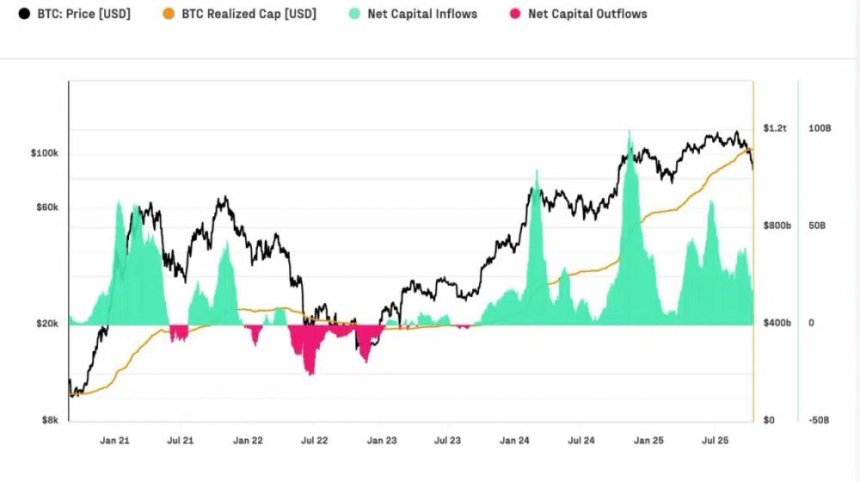
In a market speculation, Bitcoin is currently experiencing one of the most significant capital migrations in its history, fueled by institutional adoption. Analyst Matthew noted that the current BTC market cycle from 2022 to 2025 has already absorbed an unprecedented amount of new capital, surpassing all previous BTC cycles. This growth is a reflection of the market’s maturity and the ecosystem’s innovative approach to liquidity through regulated instruments.
Bitcoin

Furthermore, the network has incorporated more than $732 billion in fresh capital in the current cycle, surpassing the $388 billion that was injected during the 2018 to 2022 cycle. At that time, the surge helped push BTC market capitalization to an all-time high record of $1.1 trillion, a metric that indicates a much higher aggregate cost base for new institutional investors.

Related Reading: Why Bitcoin Traders Fear A Repeat Of July 2024’s Crash Next Week

Meanwhile, the total settlement volume in the decentralized BTC protocol was approximately $6.9 trillion in just 90 days. Despite this, the number of active on-chain entities dropped from 240,000 to 170,000 per day, which is a reflection of liquidity migration of capital flows into spot ETFs.


Bitcoin

Franklin Templeton Just Made A Major Dogecoin Move With Latest Filing

Franklin Templeton has taken a significant step that is already drawing attention across the crypto market. The asset-management giant has filed with the US Securities and Exchange Commission to broaden its Franklin Crypto Index ETF, confirming that Dogecoin will officially be added beginning December 1.Β 

The expansion shifts Franklin Templeton’s product from a Bitcoin- and Ethereum-focused offering into a more diversified crypto basket that gives investors access to a broader range of digital assets through a single instrument. This comes just a few days after Franklin Templeton launched its Spot XRP fund.

Franklin Templeton Expands Into A Wider Multi-Asset ETF

The success of Bitcoin and Ethereum ETFs has encouraged major institutions to look beyond the top two cryptocurrencies and build products that cover a wider range of well-known digital assets. Franklin Templeton’s latest move follows that trend by reshaping its Franklin Crypto Index ETF into a more expansive portfolio that includes several leading altcoins, Dogecoin among them.

The revised structure takes effect on December 1 and shifts the ETF to a design that reflects the broader market rather than a two-asset concentration. Franklin Templeton acknowledged this change through an announcement on X, presenting an updated token lineup that now spans everything from large market-cap cryptocurrencies like Cardano, Solana, and XRP.Β 

Even within that group, Dogecoin stands out, stepping further away from its reputation as a meme-based cryptocurrency and moving into a more institutionally recognized role.

Dogecoin Steps Into New Phase Of Institutional Exposure

Dogecoin’s inclusion in Franklin Templeton’s expanded ETF comes at a moment when the token is already experiencing increased attention from traditional finance. The first batch of Spot Dogecoin ETFs has only recently entered the market, and this is a milestone that would have been unthinkable a few years ago.Β 

Grayscale was the first major issuer out of the gate with its GDOG product, followed shortly after by Bitwise, which launched its own Dogecoin ETF at the request of its community.Β 

Early trading activity for these funds has been modest compared to the spectacular debuts once seen with Bitcoin and Ethereum ETFs, but it is still too early to tell, as the market might still be determining how much institutional interest exists for a meme-origin asset wrapped in a regulated structure.

Several other issuers have filings in progress and are preparing for their own Dogecoin products to go live. Some are positioning themselves carefully to see how the first batch of ETFs performs. According to Bloomberg Senior ETF analyst Eric Balchunas, there are likely about 100 crypto-based ETFs waiting to be launched in the next six months.

Dogecoin

Bitcoin Spot ETFs Break 4-Week Negative Streak With $70M Weekly Net Inflows

The US Bitcoin Spot ETFs have produced a positive turnaround following four prior weeks of consistent outflows. In line with Bitcoin’s price recovery, these investment funds also ended a bleeding month of losses on a moderately positive note.

Bitcoin Spot ETFs Begin Recovery From Red November

According to the ETF tracking site, SoSoValue, Bitcoin Spot ETFs registered a net inflow of $70.05 million in the last week of November, to provide relief to a rather draining month. Notably, this reported figure represents the first positive netflow in four weeks, stretching since the last week of October. In analyzing individual ETF performance, BlackRock’s IBIT, valued at $51.55 per share, was largely unaffected by Bitcoin’s recovery, resulting in net outflows of $137.01 million. However, its cumulative net inflow still stands at $62.57 billion, retaining its status as the undisputed market leader.Β 

Other ETFs that also remained under bearish influence include Bitwise’s BITB and VanEck’s HODL, with aggregate outflows of $18.10 million and $36.95 million, respectively. On the other hand, the majority of the positive momentum came from Fidelity’s FBTC, which registered net inflows valued at around $230.44 million. Meanwhile, Grayscale’s duo GBTC and BTC, alongside Ark Invest’s ARKB, recorded a combined $31.65 million in net deposits.

Other funds such as Invesco’s BTCO, Valkyrie’s BRRR, Franklin Templeton’s EZBC, WisdomTree’s BTCW, and Hashdex’s DEFI recorded no significant netflow. Following this recent modest recovery, the Bitcoin spot ETFs closed November with total net outflows of $3.48 billion. At the time of writing, the cumulative total net inflow for these investment funds stands at $57.71 billion, while total net assets are valued at $119.39 billion, representing 6.56% of the Bitcoin market cap.

Ethereum ETFs Not Excluded From Recovery PartyΒ 

According to SoSoValue, the Ethereum Spot ETFs also experienced a market rebound following three consecutive weeks of outflows. Over the last week, these products attracted net deposits of $312.62 million to bring the cumulative total net inflows to $12.94 billion.

BlackRock’s ETHA and Fidelity’s FETH accounted for the majority of this positive netflow with net deposits of $257.18 million and $45.3 million, respectively. The Ethereum Spot ETFs now boast of total net assets of $19.14 billion, representing 5.19% of ETH’s market cap. At press time, Ethereum continues to trade at $2,991 after a minor 1.64% decline in the past day. Meanwhile, Bitcoin remains in consolidation around $90,840.

Bitcoin Spot ETFs

❌