❌

Reading view

There are new articles available, click to refresh the page.

Crypto-To-Politics Donation Pipeline Under Threat As UK Mulls Ban

Britain is weighing a ban on crypto political donations as lawmakers raise alarm over traceability and foreign influence.

Reports have disclosed that ministers are discussing a move to bar parties and candidates from accepting gifts in cryptocurrency as part of changes tied to the upcoming Elections Bill.

Who Is Likely To Be Hit?

Reform UK, which has already opened a portal to take bitcoin and other digital tokens, would be directly affected if a ban goes ahead.

Reports show Reform became the first European party to accept crypto donations in late May 2025, and the move has drawn fresh attention to how digital coins can be used in politics.
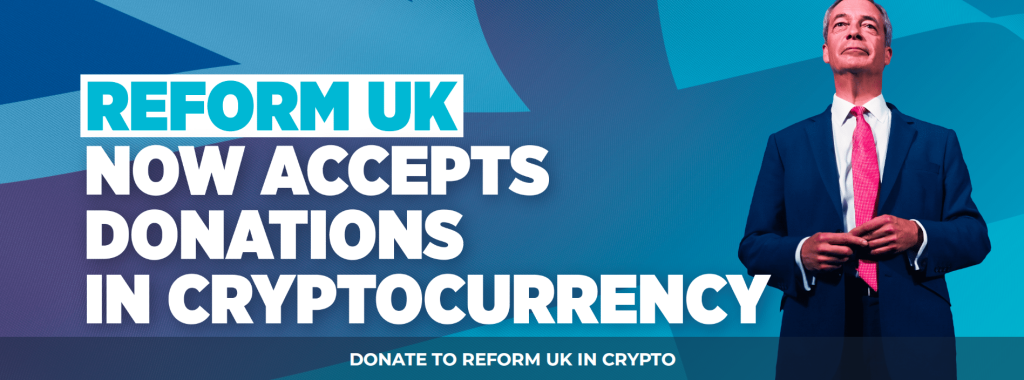
Campaign finance figures underline the stakes. In recent reporting, the Conservative Party raised Β£6.3 million in the first half of the year compared with Reform’s Β£2.1 million over the same period β€” numbers that help explain why any new fundraising channel is politically sensitive.

Why Officials Say They Are Worried

According to ministers and watchdogs, the problem is not the technology itself but the way tokens can hide who is really sending money.

Wallets on blockchains are pseudonymous, and tools exist that can mix or obscure transactions, making it hard to link a donation to a named donor. That raises the risk of foreign or illicit funds slipping into UK campaigns.

🚨UK Eyes #Crypto Political Donation Ban, Threatening Farage’s Reform War Chest

UK government considers banning #crypto political donations, treatening Nigel Farage’s Reform UK fundraising pic.twitter.com/cTIghUkbGn

β€” CryptOpus (@ImCryptOpus) December 2, 2025

Groups that track corruption have backed stronger rules. Spotlight on corruption and other campaigners have urged lawmakers to close loopholes and give regulators clearer powers to trace suspect funding.

They say more than guidance is needed; legal changes and extra resources for investigators will be necessary if the system is to be effective.

Crypto Donation Ban: How Enforcement Could Become Difficult

Even if Parliament were to require crypto donations to be converted into pounds within a set period or funneled only through regulated providers, enforcement would remain tricky.

Some officials believe new offences tied to illicit political funding and better police tools would be needed, while others warn that drafting workable rules will take time.

Full Or Partial Ban?

Lawmakers will debate whether to introduce a full ban, a partial ban, or tighter rules that force transparency and use of vetted intermediaries.

Reports indicate the idea is under active discussion, but it is unclear whether change can be written into law before the next election cycle.

Reform UK leaders have said they already accept crypto donations and view them as part of a wider pitch to voters; critics argue the timing and lack of clear oversight make that risky.

Featured image from Pexels, chart from TradingView

Office equipment from former Zulily HQ in Seattle donated to Goodwill for use across facilities

Office furniture from the former Zulily headquarters in Seattle. (Evergreen Goodwill Photo)

Zulily may no longer be a dominant player in Seattle’s tech scene, but physical pieces of the online retailer will live on in Evergreen Goodwill facilities across the region.

Hundreds of office chairs, desks, kitchen appliances, IT equipment, and more has been donated to Goodwill by Vanbarton Group, a commercial real estate investment firm that now owns the onetime Zulily building at 2601 Elliott Ave.

Vanbarton plans to convert the building, which occupies a full block near the waterfront, to 262 apartments, according to a Daily Journal of Commerce report from July.

A once-prominant online retailer, Zulily was a darling of Seattle’s growing tech scene when it was valued at $4 billionΒ following its IPOΒ in 2013. But after QVC parent Qurate paid $2.4 billion to buy the company in 2015, it was sold to Los Angeles investment firm Regent in May 2023 and eventually shut down.

In March, ZulilyΒ got a new owner for the third time in two years when Beyond, which emerged as a surprise buyer in 2024, announcedΒ plans to sell a majority stake in Zulily to Lyons Trading Company, the parent company of flash sales site Proozy.com.

Storage racks donated from the former Zulily headquarters in Seattle. (Evergreen Goodwill Photo)

Evergreen Goodwill said in a news release that the donation, facilitated by Vanbarton Group’s outreach, saved the nonprofit an estimated $100,000 in equipment costs and diverted valuable resources from landfills.

The office items are being repurposed in multiple locations, including Goodwill’s new Georgetown operations center, scheduled to open this fall, and job training and education centers that it operates in five counties.

Remaining items will be sold in Goodwill stores, with proceeds supporting free job training and education programs for people facing barriers to employment, according to Goodwill.

Previously:

Ukrainian Steals Bitcoin From Russian Darknet Market, Donates to Charity

Ukrainian Steals Bitcoin From Russian Darknet Market, Donates to Charity

A Ukrainian living in the U.S. has reportedly hacked a major drug market on the Russian dark web, diverting some of its crypto proceeds. The man says he donated the digital cash stolen from the illicit website to an organization delivering humanitarian aid across his war-torn homeland.

Wisconsin Resident With Ukrainian Roots Hacks Russian Dark Web Market Solaris

Ukrainian-born cyber intelligence expert Alex Holden, who left Kyiv as a teenager in the 1980s and now lives in Mequon, Wisconsin, claims he has hacked into Solaris, one of Russia’s largest online drug markets, Forbes informs in a report.

Supported by his team at Hold Security, he was able to get hold of some of the bitcoin sent to dealers and the darknet site’s owners. The cryptocurrency, worth over $25,000, was later transferred to Enjoying Life, a charitable foundation based in the Ukrainian capital.

Without revealing exactly how he did it, Holden explained he took control of much of the internet infrastructure behind Solaris, including some administrator accounts, obtained the website’s source code and a database of its users and drop off locations for drug deliveries.

For a while, the Ukrainian and his colleagues also gained access to the β€œmaster wallet” of the marketplace. It was used by buyers and dealers to deposit and withdraw funds and operated as the platform’s crypto exchange, the article details.

Given the rapid turnover, the wallet rarely had more than 3 BTC at a time. Holden managed to appropriate 1.6 BTC and send it to Enjoying Life. Hold Security donated another $8,000 to the charity, which provides assistance to people affected by the war in Ukraine.

Solaris Linked to β€˜Patriotic’ Russian Hacking Collective Killnet

The darknet market Solaris is suspected of having connections to the hacking crew Killnet, which after Moscow launched its invasion in late February became one of Russia’s β€œpatriotic” hacker groups vowing to target Ukrainians and their supporters.

Killnet has also conducted a number of attacks in the U.S., including on airport and state government websites as well as the National Geospatial-Intelligence Agency. It reportedly hit the Eurovision song contest, the Estonian government and Italy’s National Health Institute.

The group was also blamed for attacking Rutor, the main rival of Solaris, which became Russia’s leading underground drugs market after Hydra was shut down this past spring. According to U.S. cybersecurity firm Zerofox, Solaris was paying Killnet for DDoS services.

Besides the battlefield, Russia and Ukraine have also clashed in the online space, with the government in Kyiv recruiting experts for its own cyberforce. The special unit was tasked to identify and prevent Russian attacks but also hack back.

Hits such as those on Russia’s largest bank, Sber, and the Moscow Stock Exchange have been attributed to the Ukrainian IT army. Social media accounts associated with the hacktivist collective Anonymous took responsibility for many other attacks.

What do you think about Alex Holden’s attack on the Russian darknet market Solaris? Let us know in the comments section below.

❌