Reading view

There are new articles available, click to refresh the page.

Massive Bitcoin Awakening: 2 Physical Coins Unlock $179 Million After 13 Years

Two long-dormant Casascius coins, each loaded with 1,000 Bitcoin, were activated on Friday, unlocking more than $179 million that had sat untouched for over 13 years.

According to onchain data, one of the coins was minted in October 2012 when Bitcoin traded at $11.69. The other dates back to December 2011, when BTC was worth $3.88, giving that piece a theoretical gain near 2.3 million% since minting.

Historic Physical Coins Activated

Based on reports, Casascius coins (metal coins) were produced between 2011 and 2013 by Utah entrepreneur Mike Caldwell as physical representations of Bitcoin. Each coin or bar concealed a paper with a private key, and a tamper-resistant hologram covered that key.

🚨🚨🚨 Two Casascius coins, each containing 1,000 BTC, have just moved after being dormant for more than 13 years. pic.twitter.com/nlFUy39MkD

— Sani | TimechainIndex.com (@SaniExp) December 5, 2025
Records show only 16 of the 1,000 BTC bars and 6 of the 1,000 BTC coins were ever made, making these items both rare and historically important.

Caldwell shut down the operation after receiving a letter from FinCEN that raised questions about whether his business qualified as an unlicensed money transmitter.

How The Coins Worked

The mechanism was simple in practice but strict in outcome: whoever removed the hologram and revealed the private key could claim the full Bitcoin value stored beneath it.

Once that sticker was lifted and the private key used, the coin no longer carried any Bitcoin value. Based on reports, collectors treat that moment as irreversible. Some owners chose to move funds off the physical coins without cashing out.

Rarity And Returns

Numbers here show why collectors and investors watch these events closely. Two coins at 1,000 BTC each represent a huge hoard when prices are high. Even leaving aside the cost of minting, the December 2011 coin’s rise from $3.88 to current market valuations yields a headline-grabbing multiple.

But experts warn that turning the private key into spendable Bitcoin is only the first step; what happens next depends on the holder’s choices. Some will hold. Others may move funds into cold storage. Selling is not guaranteed.

Derivatives Market Shock

Meanwhile, the spot and derivatives markets are experiencing high volatility. Based on CoinGlass data, today’s derivatives activity showed an 11,588% liquidation imbalance that overwhelmingly wiped out long positions.

Bitcoin, at the time of writing, was trading below $90,000, and more than $20 million in BTC long liquidations occurred in minutes while short positions barely budged. That kind of one-sided pressure happens when many traders are crowded in the same direction and conditions change quickly.

Featured image from Unsplash, chart from TradingView
Pundit Predicts That XRP Is About To Make Investors Extremely Rich

A crypto analyst has made an unexpected declaration, predicting that XRP investors could become extremely rich in just a few months. This bold claim comes with a new technical analysis, suggesting that XRP is now entering a pivotal price area that previously triggered explosive rallies. Despite the cryptocurrency’s low price and recent downtrend, the analyst remains confident that XRP could mirror past trends and skyrocket to new highs.

XRP To Make Holders Wealthy In 3 Months?

In a recent X post, popular market analyst ‘Steph Is Crypto’ issued a dramatic warning to XRP holders, announcing that investors will become extremely rich within the next three months. The analyst’s bold prediction elicited mixed reactions from the XRP community, with some expressing optimism and others skepticism. 

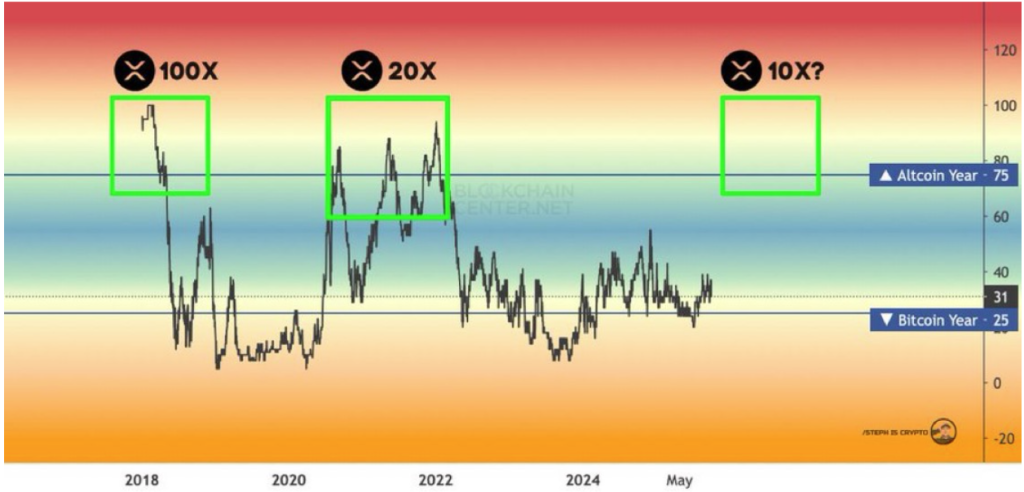
Steph Is Crypto shared a price chart with colored bands to support his ambitious claims, tracking XRP’s performance through multiple past bull cycles. The chart highlights a recurring pattern in which XRP enters a higher-colored zone during periods often associated with altcoin strength. In previous cycles, those moments were followed by unexpected, explosive upward price moves

During the bull cycle in 2018, XRP skyrocketed by 100x, pushing its price up towards its current all-time high of $3.84. A similar uptrend occurred again during the 2020 to 2022 cycle, with XRP entering a prolonged bull phase that saw its price rally by 20x. According to Steph Is Crypto, the current chart setup appears similar to these past bullish phases. 

His chart analysis suggests that XRP is once again approaching the same colored region that previously marked the start of strong price rallies. While the scale of the projected acceleration this time may differ from the peaks seen in the last two cycles, Steph Is Crypto remains confident that it will still be substantial enough to make holders significantly wealthy by March 2026.

XRP Maintains Bullish Monthly SuperTrend

Crypto market analyst ChartNerd has released a fresh technical analysis of XRP, suggesting that the cryptocurrency continues to show strong positive signals. According to him, XRP’s monthly SuperTrend remains firmly bullish. He emphasized that maintaining a price above the green SuperTrend line near $1.30 signals a long-term upward trajectory, with no red trends currently indicating the onset of a bear market. 

ChartNerd shared a chart with a SuperTrend overlay where green lines represent bullish conditions and red lines highlight previous bear markets. The current monthly candles for XRP remain well above the green zone, reinforcing the belief that broader market conditions favor an upside. The analyst interprets this as confirmation that XRP’s long-term price trend is still predominantly bullish. 

Historical data on the chart also indicate that past declines in XRP coincided with prolonged red SuperTrend phases. This happened before the big 2017 and 2020 breakout, with each recovery triggered once the price moved back above the green SuperTrend line. 

Featured image from Unsplash, chart from TradingView
SEC Chair Paul Atkins Advocates For Modernizing Crypto Regulations– Here’s How

In remarks made on December 4, US Securities and Exchange Commission (SEC) Chair Paul Atkins expressed an optimistic outlook for the cryptocurrency industry. Atkins emphasized the SEC’s intent to modernize its rules to facilitate an on-chain market environment, leveraging distributed ledger technology and the tokenization of financial assets.

SEC Chair Advocates For Crypto Tokenization

Atkins highlighted the transformative potential of these technologies for the capital markets. He stressed that enhancing these markets is essential for US firms and investors to maintain their leadership on a global scale. 

The chair underscored that the advancements in blockchain technology could streamline not only trading processes but also the entire issuer-investor relationship, which would enable a more efficient and transparent financial ecosystem.

Tokenization, according to Atkins, goes beyond merely changing the mechanics of trading. He pointed out that it can foster direct connections for various important functions such as proxy voting, dividend payments, and shareholder communications, all while reducing the reliance on multiple intermediaries. 

In his address, Atkins acknowledged several innovative models that deserve consideration. He noted that some companies are directly issuing equity on public distributed ledgers in the form of programmable assets. 

These assets can integrate compliance features, voting rights, and governance capabilities, allowing investors to hold securities in a digital format that promotes transparency and reduces the number of intermediaries involved.

Additionally, he mentioned that third parties are engaging in the tokenization of equities by generating on-chain security entitlements that represent ownership stakes in traditional equities. 

The emergence of synthetic exposures—tokenized products designed to reflect the performance of public equities—was also highlighted. While many of these offerings are currently being developed offshore, they showcase the international interest in US market exposure supported by distributed ledger technology.

Atkins Critiques Past SEC Strategies

However, Atkins cautioned that transitioning to on-chain capital markets entails more than just issuance. He stated that it is essential to address various stages of the securities transaction lifecycle effectively. 

For instance, if tokenized shares cannot be traded competitively in liquid on-chain environments, they risk becoming little more than conceptual assets without practical utility. 

The chair also criticized the previous SEC’s approach toward the crypto industry under the agency’s former chair Gary Gensler, which attempted to adapt to on-chain markets through an expansive redefinition of “exchange.” 

This earlier strategy enforced a broad regulatory framework that ultimately created uncertainty and stifled innovation, Atkins stated. He said that it is vital to avoid repeating such mistakes in order to stimulate innovation, investment, and job creation in the United States.

To foster a conducive environment for growth, Atkins called for compliant pathways that can enable market participants to capitalize on the unique benefits of new technologies like crypto. 

In light of this conviction, he has instructed SEC staff to explore recommendations for utilizing the agency’s exemptive authorities, permitting on-chain innovations while the Commission works toward developing long-term, effective crypto regulatory frameworks.

Crypto

Featured image from DALL-E, chart from TradingView.com

Russia Steps Deeper Into Crypto As State Bank Prepares Direct Trading

VTB, Russia’s second-largest bank, has told clients it plans to let them buy and sell real cryptocurrencies through its brokerage service, with a target rollout in 2026 pending regulator approval.

According to the bank, the move would go beyond the derivative products that most Russian banks have offered so far. It is a clear shift toward opening traditional finance to digital assets, at least for now among wealthy clients.

Client Eligibility And Timetable

Reports have disclosed that VTB intends to begin with high-net-worth customers only. The bank set thresholds for its initial offering: clients with assets above $1.3 million or annual income over $649,000 would be eligible at first.

Andrey Yatskov, who heads VTB’s brokerage arm, said there is “sharp demand” from clients for access to actual crypto, not just paper products tied to token prices. The bank has picked 2026 as the planned start year, but it made that clear the launch depends on regulators signing off.

Real Crypto, Not Just Contracts

Based on reports, the service would allow ownership of the underlying coins — not merely derivative contracts or token-linked notes. That is a significant distinction in Russia, where until recently banks were limited to offering exposure through derivative instruments.

Allowing customers to hold coins directly would require legal and compliance work, from custody arrangements to anti-money-laundering controls. Those steps are on the critical path before any retail expansion can happen.

Potential Market Signals

VTB has also given investors a sense of how it views crypto as an asset class. The bank recommended a 7% allocation to crypto for some investor profiles, and its internal forecasts have mentioned medium-term Bitcoin price targets in the $200,000–$250,000 range under favorable conditions.

If VTB moves forward, it could be the first major Russian bank to operate in this way — a signal that some parts of the financial sector see token ownership as something to be offered through mainstream channels.

Regulatory Hurdles And Geopolitics

The plan is not risk free. Russian regulation of crypto is still evolving, and any permit to offer direct trading will require approval from the relevant authorities. Sanctions and other geopolitical pressures could alter timelines or force changes to how the service is structured. Compliance teams will need to reconcile domestic rules with international restrictions that affect many big banks operating in or dealing with Russia.

For now, the rollout remains conditional. VTB’s timeline, client criteria, and product design all hinge on legal clarifications and regulator consent. Market participants and clients will likely follow announcements from the Bank of Russia and other agencies to judge how soon broader access might come.

Featured image from Pexels, chart from TradingView

Layoff Rumors And Metaverse Cuts Push Meta Shares Higher—Details

Meta Platforms Inc. shares climbed after reports that the company is weighing deep reductions to the budget behind its metaverse projects. Investors pushed the stock higher as traders reacted to the possibility that one of the company’s most costly bets could be scaled back.

Metaverse Budget Faces A Major Trim

Based on reports from Bloomberg and Reuters, Meta is considering cuts of up to 30% to the unit that builds its virtual reality and metaverse products, a move tied to planning for the company’s 2026 budget. The change would mainly affect Reality Labs, the division that makes Quest headsets and Horizon virtual spaces.

Reality Labs Has Been Losing Billions

Reality Labs has posted heavy losses since 2020. Reports put the total at more than $60 billion and, by some counts, closer to $70 billion in cumulative losses over recent years. Those sums have kept pressure on management to rethink where the company puts its money.

Investors Reward A Smaller Bet

The market response was swift. Meta’s share price jumped roughly 4%, and some outlets calculated that the move added about $69 billion to the company’s market value as traders reacted positively to a pullback from costly metaverse spending. That reaction signals investors prefer money steered toward projects with clearer near-term returns.

Layoffs Could Follow Early Next Year

Reports have warned that the cuts could bring staff reductions inside Reality Labs, with layoffs possibly starting as early as January 2026. Company leaders reportedly discussed budget scenarios during recent planning meetings. Any job cuts would mark a sharp change after years of heavy investment in virtual reality and related software.

A Bigger Push Toward AI And Wearables

At the same time, Meta has been moving money into artificial intelligence and related hardware. The company finalized a multibillion-dollar deal this year to take a large stake in Scale AI — a pact reported at roughly $14 billion for a near-half ownership — and then hired talent from that startup to help run a new AI effort. That tradeoff shows where Meta’s priorities now lie.

What This Means For Users And Competitors

For people who own or use Meta’s VR gear, this does not mean every project will end. But several initiatives could see slower progress and smaller teams. For rivals and suppliers in the AR/VR space, the cut may reshape who wins short-term device and platform business.

Analysts say the move narrows one major uncertainty for Meta while opening another: how well the company can compete in AI after so many dollars flowed into virtual worlds.

Featured image from Unsplash, chart from TradingView
A New Era Begins: CFTC Approves Spot Bitcoin On Regulated US Markets

Regulators in Washington on Thursday cleared a major step that lets Americans trade spot Bitcoin and other cryptocurrencies on federally registered exchanges for the first time.

According to the Commodity Futures Trading Commission, listed spot crypto products may now be offered on exchanges registered with the agency, a move announced on December 4, 2025.

Regulated Spot Trading Begins

The action comes from a CFTC press release labeled Release No. 9145-25 and that the change allows spot crypto contracts to be listed on futures exchanges that are registered with the CFTC.

The regulator said its rules now permit such listings to trade under the oversight and surveillance standards those exchanges already follow.

.@CFTCpham Announces First-Ever Listed Spot Crypto Trading on U.S. Regulated Exchanges: https://t.co/89Mx6f0ss4

— CFTC (@CFTC) December 4, 2025

Bitnomial Leads The Way

Bitnomial, a Chicago-based derivatives exchange, is set to be the first exchange to list such products, with plans to offer both leveraged and non-leveraged spot trading on its platform.

Market notices and statements show Bitnomial moved quickly to use the new framework, announcing a launch and filings that position it as the first US venue to trade listed spot crypto under CFTC rules.

What This Means For Investors

According to market commentators and reporting, the shift brings spot trades under long-standing market protections like clearing, surveillance and execution rules that apply to other listed products.

That can make some institutional players and big funds more willing to trade onshore. At the same time, regulators say this is meant to pull activity away from unregulated offshore venues and improve market oversight.

Acting Chairman Caroline Pham said the move is meant to strengthen the US position in the crypto market while giving traders access to safer and more transparent trading venues.

Risks Remain

Reports have disclosed that the change does not remove the underlying risks of crypto: prices can swing widely, and no regulatory move can stop market volatility.

Also, only exchanges that seek and obtain the proper CFTC registration will be able to use this route, so most offshore platforms remain outside US oversight for now.

Next Steps

Observers will be watching whether other US exchanges follow Bitnomial, how many retail investors gain access, and how the SEC responds on parallel issues such as token classification and custody rules.

The CFTC had flagged this pathway in August as part of a broader initiative to allow listed spot crypto trading, and agencies have since coordinated on guidance and public engagement.

The CFTC’s Acting Chairman said this brings spot crypto trading into a regulated setting Americans can trust, and that exchanges with the right protections can now list these products.

This development is part of a months-long policy push by the administration to create clearer rules for digital assets.

Featured image from Barron’s, chart from TradingView

It’s Official: UK Grants Bitcoin And Crypto Full Legal Asset Status

According to reports, the UK has put new law on the books that names cryptocurrencies as property under English law. The measure was approved and was given Royal Assent on December 2, 2025.

That move turns a long stretch of legal uncertainty into a clear rule about who owns what when it comes to Bitcoin, stablecoins and other tokenized assets.

UK Grants Property Status To Crypto

Based on reports, the bill — called the Property (Digital Assets etc.) Act 2025 — creates a new, third category of personal property for digital assets. The law covers England, Wales, and Northern Ireland.

It does not make crypto money that must be accepted in shops, and it does not itself set new rules for exchanges or taxes. What it does do is give owners a firmer legal claim they can use in court.

Courts Had Set The Stage Years Earlier

Even before the law, judges were already treating crypto as property in some cases. For example, a High Court action in 2019 allowed a proprietary remedy over Bitcoin used in a ransom claim.

Reports show another key ruling came in 2023 when a judge found that the stablecoin USDT could attract property rights under English law.

Legal groups such as the UK Jurisdiction Taskforce had argued for years that crypto meets basic tests for property: it can be defined, found, transferred and held for a period of time. The new act simply puts that view into statute.

Both takes miss it a bit. UK courts have already treated crypto as property for years; this just codifies and tightens the framework, especially for insolvency/estate stuff. It is “true” in the sense that the statute now spells it out, but it is not the revolution CryptoUK is…

— Crypto Reply Guy (@CryptoReplyGuy1) December 2, 2025

Stronger Rights For Holders And Courts

With property status written into law, people who hold crypto should find it easier to bring claims to recover stolen or lost assets. Creditors and insolvency practitioners will have clearer grounds to list digital assets in estates and bankruptcies.

Reports suggest the change will make freezing orders, seizure and restitution easier to obtain through UK courts than before. That matters for victims of hacks, customers of failed platforms, and anyone trying to settle an estate that includes crypto.

A Law, Not A Full Rulebook

The act is a legal recognition, not a full set of rules for how crypto is bought, sold or taxed. Regulators still control licensing, anti-money-laundering checks, and market conduct.

Tax authorities will keep defining how gains are assessed. Based on reports from legal commentators, the act acts as a foundation — it clarifies ownership first, and lawmakers or regulators can build more detailed rules on top of that later.

Featured image from Unsplash, chart from TradingView

Risk Runs Hot: Massive Crypto Liquidation Wave Slams Traders Overnight

A sharp rise in crypto liquidations is sending a louder message of how some traders are using more leverage in recent months.

Average daily wipeouts have jumped from roughly $28 million in long bets and $15 million in shorts during the last cycle to about $68 million long and $45 million short in the current cycle, according to a new Glassnode and Fasanara report. That shift has made single sell-offs much more violent.

Early Black Friday Shock

Reports have disclosed that Oct. 10 was the clearest sign of the change. On that day, more than $640 million per hour in long positions were liquidated as Bitcoin plunged from $121,000 to $102,000.

Open interest fell about 22% in less than 12 hours, sliding from close to $50 billion to $39 billion. Traders felt the move fast. Positions were closed out on a scale Glassnode called one of the sharpest deleveraging events in Bitcoin’s history.

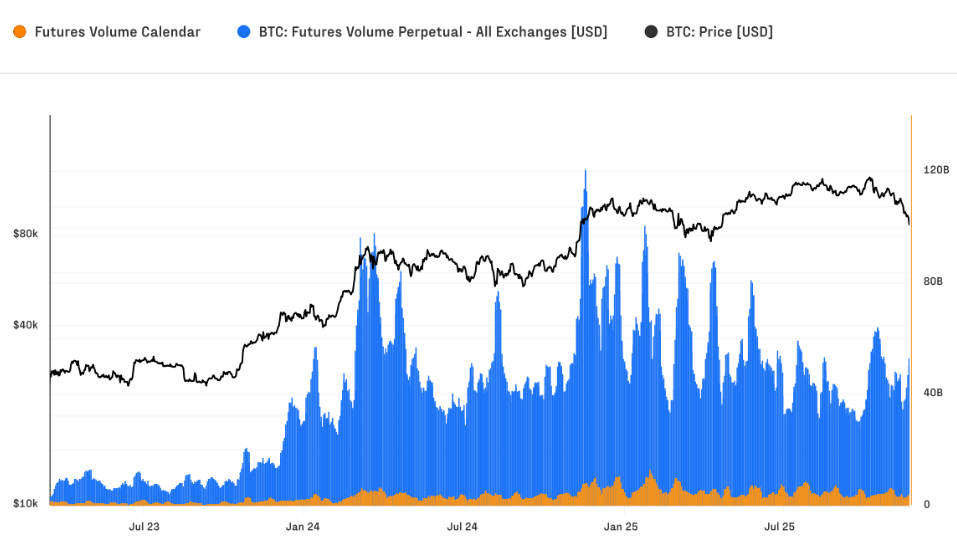
Futures Activity Hits Records

Futures markets have swelled. Open interest climbed to a record $68 billion and daily futures turnover topped $69 billion in mid-October.

Perpetual contracts now account for more than 90% of that activity, which concentrates risk in instruments that reset continuously.

Average daily futures wipeouts rising to $68 million long and $45 million short shows the costs when big swings occur.

Spot Trading Doubles

Based on reports, spot trading has also become more active. Bitcoin’s spot volume has climbed into an $8 billion to $22 billion daily range, roughly double what was seen in the prior cycle.

During the Oct. 10 crash, hourly spot volume spiked to $7.3 billion, with many traders stepping in to buy the dip rather than run for the exits. That flow has helped shift where price discovery happens.

Capital Flows And Market Share

Monthly inflows into Bitcoin have varied from $40 billion to $190 billion, pushing realized market capitalization to a record $1.1 trillion.

Roughly $730 billion has flowed into the network since the November 2022 low — more than all previous cycles combined.

As a result, Bitcoin’s share of overall crypto market cap rose from 38% in late 2022 to 58% today, based on the report’s figures.

Bitcoin As Settlement Rail

Meanwhile, there’s another striking stat: over the past 90 days the Bitcoin network processed nearly $7 trillion in transfers. That throughput exceeded what major card networks handled in the same window.

This has been cited as a reason some participants view Bitcoin not just as a store of value, but as an increasingly important settlement rail.

Bitcoin Price Action

At the time of writing, Bitcoin was trading at $93,165, up 6.5% and nearly 7% in the daily and weekly timeframes.

Featured image from Unsplash, chart from TradingView

Crypto-To-Politics Donation Pipeline Under Threat As UK Mulls Ban

Britain is weighing a ban on crypto political donations as lawmakers raise alarm over traceability and foreign influence.

Reports have disclosed that ministers are discussing a move to bar parties and candidates from accepting gifts in cryptocurrency as part of changes tied to the upcoming Elections Bill.

Who Is Likely To Be Hit?

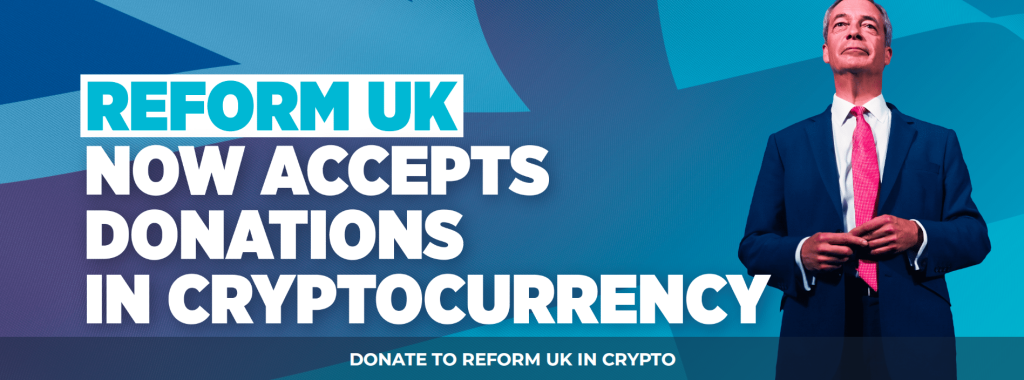
Reform UK, which has already opened a portal to take bitcoin and other digital tokens, would be directly affected if a ban goes ahead.

Reports show Reform became the first European party to accept crypto donations in late May 2025, and the move has drawn fresh attention to how digital coins can be used in politics.

Campaign finance figures underline the stakes. In recent reporting, the Conservative Party raised £6.3 million in the first half of the year compared with Reform’s £2.1 million over the same period — numbers that help explain why any new fundraising channel is politically sensitive.

Why Officials Say They Are Worried

According to ministers and watchdogs, the problem is not the technology itself but the way tokens can hide who is really sending money.

Wallets on blockchains are pseudonymous, and tools exist that can mix or obscure transactions, making it hard to link a donation to a named donor. That raises the risk of foreign or illicit funds slipping into UK campaigns.

🚨UK Eyes #Crypto Political Donation Ban, Threatening Farage’s Reform War Chest

UK government considers banning #crypto political donations, treatening Nigel Farage’s Reform UK fundraising pic.twitter.com/cTIghUkbGn

— CryptOpus (@ImCryptOpus) December 2, 2025

Groups that track corruption have backed stronger rules. Spotlight on corruption and other campaigners have urged lawmakers to close loopholes and give regulators clearer powers to trace suspect funding.

They say more than guidance is needed; legal changes and extra resources for investigators will be necessary if the system is to be effective.

Crypto Donation Ban: How Enforcement Could Become Difficult

Even if Parliament were to require crypto donations to be converted into pounds within a set period or funneled only through regulated providers, enforcement would remain tricky.

Some officials believe new offences tied to illicit political funding and better police tools would be needed, while others warn that drafting workable rules will take time.

Full Or Partial Ban?

Lawmakers will debate whether to introduce a full ban, a partial ban, or tighter rules that force transparency and use of vetted intermediaries.

Reports indicate the idea is under active discussion, but it is unclear whether change can be written into law before the next election cycle.

Reform UK leaders have said they already accept crypto donations and view them as part of a wider pitch to voters; critics argue the timing and lack of clear oversight make that risky.

Featured image from Pexels, chart from TradingView

Crypto Investors Brace As Japan Proposes 20% Tax By 2027

Japan’s government is backing a plan to tax cryptocurrency profits at a flat 20% rate, a major change from the current system that can push some traders into much higher brackets. Reports have disclosed the move aims to treat crypto gains more like stock trading, simplifying what many investors have called a confusing tax regime.

What The Change Means

Under the proposal, gains from crypto trades would be taxed separately from salaries and other miscellaneous income and instead be subject to the same 20% capital gains-style rate that applies to many investment products. Right now, crypto earnings in Japan are lumped in with other income and can be taxed at rates reaching as high as 55%.

Reports have also said regulators want to reclassify many cryptocurrencies as financial products. That would bring new rules, such as tighter disclosure and the potential application of insider trading laws to crypto markets. The Financial Services Agency is said to be leading the drafting of the proposal.

Industry Reaction And Regional Impact

Exchanges and brokers in Japan are studying what a uniform 20% rate would mean for fees, trading volumes, and client onboarding. Some market participants welcome the predictability; others worry about additional compliance burdens if exchanges must follow securities-style rules. Firms in other Asian hubs are watching closely because lower retail tax costs in Japan could shift where regional investors choose to trade.

Analysts note two effects are likely: clearer tax bills for individual traders and a possible uptick in institutional interest if banks and insurers can sell crypto through regulated channels. Still, some retail traders who benefited from earlier tax treatments may see little immediate gain.

Implementation Timeline And Next Steps

Based on reports, the measure is expected to be included in the fiscal 2026 tax reform package that ruling parties will compile soon, with legislation to be introduced in the next parliamentary session. That timetable means practical implementation could come in 2026 or take effect in 2027 depending on parliamentary approval and technical details.

Several important details remain unclear. Which assets will qualify, how past losses will be handled, and whether a list of approved tokens will be set are all open questions. Some coverage mentions a specific list of approved cryptocurrencies will be treated like equities, but final wording has not been released.

Featured image from Frank Lukasseck/Getty Images, chart from TradingView

Bitcoin Trail Ends: $29M Seized After European Authorities Shut Down Cryptomixer

Authorities in Europe have shut down a large crypto mixing service and seized a major amount of Bitcoin, according to law enforcement statements and media reports. The operation took down a key domain, seized servers, and captured $29 million in Bitcoin that investigators say was tied to illicit flows.

Europol And Swiss Authorities Act

Based on reports, a joint action by Europol, Swiss, and German authorities took place between November 24 and November 28, 2025. During the operation, three servers located in Switzerland were seized, the domain Cryptomixer.io was disabled, and investigators recovered about 12 terabytes of data.

According to officials, the service had been used since 2016 and is linked to roughly €1.3 billion in laundered Bitcoin over that time. The cash figure seized in the takedown was reported at close to $30 million in Bitcoin.

How The Service Worked

Reports have disclosed that the site operated as a hybrid mixer. That means it accepted funds on the regular web and used techniques to pool, jumble, and redistribute coins so the origin of funds became hard to trace.

Criminals allegedly used the service to hide proceeds from activities such as drug sales, ransomware attacks, and fraud, according to investigators. By randomizing amounts and delaying payouts, mixers like this make the usual tracking tools much less effective.

What The Seized Data Could Reveal

Law enforcement officers say the 12 terabytes of material may hold leads that point to other illegal transfers and the people behind them. The data is now being examined, and it could make it easier to trace how money moved through the service.

It is not yet clear whether arrests have been made. Experts warn that even with seized material, tracing every tainted coin will be difficult because of how mixing services scramble transaction records.

Wider Impact On Crypto Crime

Investigators argue the takedown is a major blow against online money laundering in Europe. Based on reports, crypto mixers of this size helped mask hundreds of millions, and in some cases billions, of dollars over years.

The removal of one large service may slow some criminal flows, but analysts caution that operators and users can migrate to other services or new tools. Criminals often adapt quickly, which means the broader problem may continue unless follow-up actions and legal steps are taken.

Featured image from Unsplash, chart from TradingView

$300 Million Crypto Bet: Kazakhstan’s Central Bank Gears Up

Kazakhstan’s central bank has signaled plans to place up to $300 million into crypto and crypto-linked assets, a move that would mark one of the clearest examples yet of a sovereign institution putting reserve money into this market. Based on reports, the funds would come from the country’s gold and foreign-exchange reserves rather than its social or oil wealth funds.

Central Bank Moves Cautiously

According to central bank briefings and market reporting, the investment will not be made all at once. Initial tranches could be modest — figures discussed publicly include amounts like $50 million and $100 million as possible early steps, with larger allocations of $250 million also on the table if conditions allow. The plan appears to be phased, with the bank watching price swings and market signals before committing major sums.

The assets under consideration may include direct holdings of crypto tokens or instruments linked to the crypto sector, such as exchange-traded products and equity stakes in companies that serve the industry. Based on reports, the central bank’s alternative investments arm, which already holds high-tech and financial assets, would manage the placement.

Investment Targets And Broader Plans

Reports have disclosed that this move sits alongside a wider push to create a national digital-asset reserve fund. Officials and informed sources have mentioned target sizes in the range of $500 million to $1 billion for that reserve. That proposed fund would focus more on ETFs and corporate equity than on simply holding tokens in wallets.

An existing state initiative, the Alem Crypto Fund, has already taken public steps into the market. In September 2025 the fund made an investment in the cryptocurrency BNB, signaling that parts of the state apparatus are experimenting with exposure to digital assets. That action is being watched closely by both domestic policymakers and foreign observers.

Risks And Safeguards

The central bank has stressed caution. Large price swings in major tokens have been noted as a reason to phase investments slowly. The proposed $300 million allocation, according to briefings, would be drawn from non-essential reserves — explicitly kept separate from Kazakhstan’s National Fund that pays for public programs — which is meant to protect social spending from market losses.

Some of the purchases, reports suggest, could be executed through regulated financial products rather than raw token buys, lowering custody and liquidity risks. The decision to structure the program in stages is intended to reduce the chance of a sudden, large loss if markets move against the holdings.

Featured image from kursiv.media, chart from TradingView

Dogecoin ETFs Flat At Launch, But TA Points To $1 If This Support Holds

The launch of spot exchange-traded funds (ETFs) tracking Dogecoin in the United States was met with muted enthusiasm. Inflows into Grayscale and Bitwise’s ETFs were limited in their first week of trading, despite the hype around the first-ever Dogecoin ETFs. But even as ETF inflows sputter, some technical analysts argue that DOGE might still undergo a strong price rally, possibly all the way to $1, if important support levels hold.

Spot DOGE ETFs Off To A Slow Start

When Grayscale rolled out its Spot DOGE fund (GDOG) on November 24, inflow volume clocked in at just about $1.8 million on the first day, far below the estimates some market participants had forecasted. For example, Eric Balchunas, senior ETF analyst at Bloomberg, predicted that the ETF will witness a $12 million volume on the first day of trading.

According to data from SoSoValue, net inflows across the DOGE ETFs by Grayscale and Bitwise added up to just over $2.16 million over the course of the initial trading week. This shows that institutional and retail investors are somewhat cautious when it comes to investing in the meme cryptocurrency. 

This is in contrast to the strong opening inflows seen by other altcoin ETFs, such as those for Solana (SOL) and XRP which were launched in the past few weeks. Furthermore, the lackluster uptake has raised doubts about whether the ETFs will ignite the kind of renewed interest in DOGE that some backers hoped for.

Technical Outlook Suggests Bullish Potential To $1

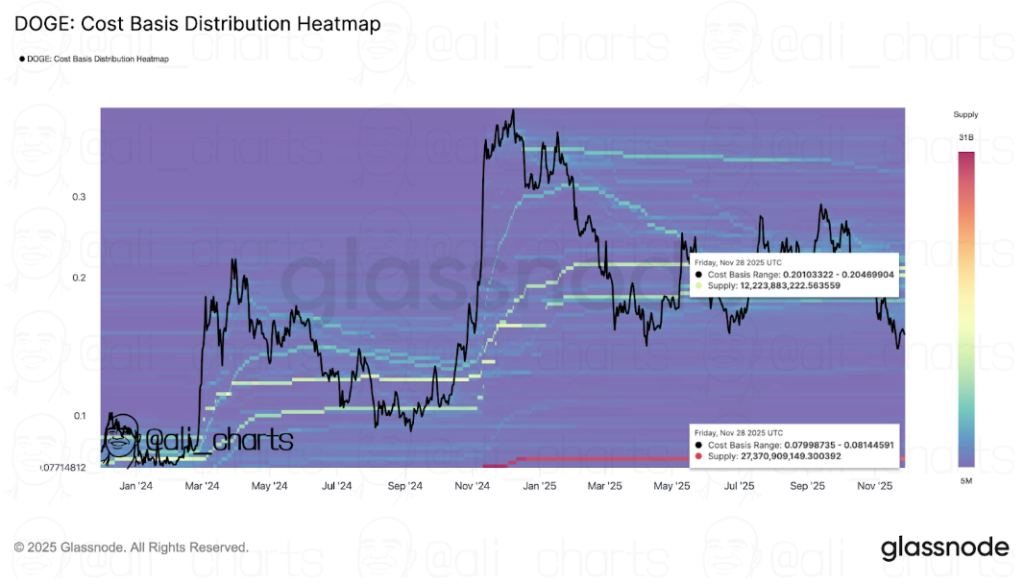
Even though ETF demand is currently tepid, multiple technical outlooks point to a potentially more optimistic outcome for Dogecoin. One technical outlook from crypto analyst Ali Martinez identifies key support at roughly $0.08, with resistance around $0.20. This support level harkens back to a time when DOGE dipped below $0.10, before launching into a multi-month rally to $0.50 after the US elections.

Dogecoin Key Price Levels. Source: @ali_charts On X

More bullishly, a multi-week technical breakdown done by crypto analyst XForceGlobal suggests that DOGE might be wrapping up a long-term corrective phase and positioning for a fifth wave, which is a powerful upward impulse according to the Elliott Wave Theory. That wave could push prices well beyond current levels, with intermediate targets potentially between $0.33 and $0.50, and a longer-term stretch to $1.

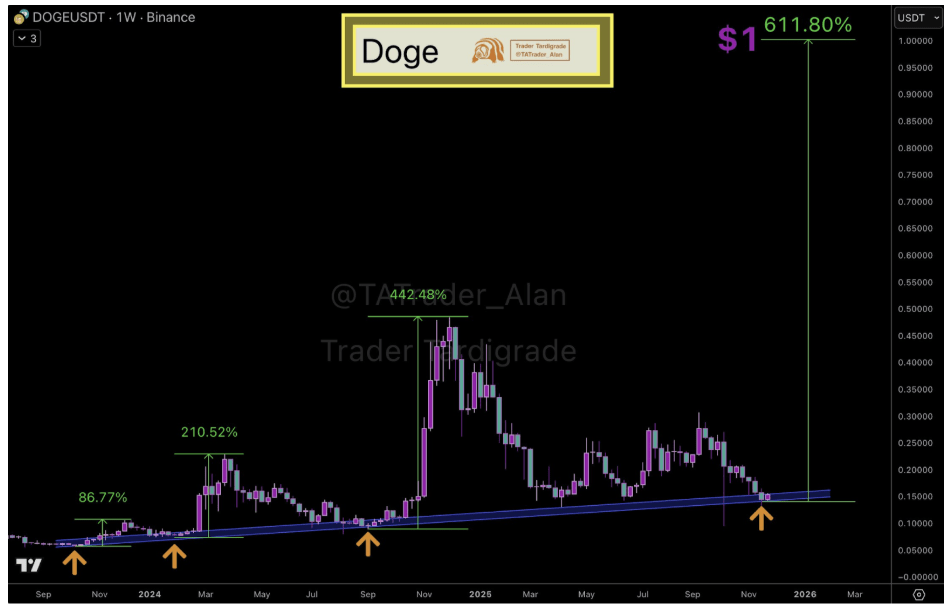
Similarly, crypto analyst Trader Tardigrade believes Dogecoin has dropped back onto the same long-term support zone that previously led to major rallies, calling it the launch pad for the next big move. His weekly chart highlights how Dogecoin’s price action has repeatedly bounced from this ascending trendline, producing gains of more than 80%, 210%, and even over 440% since October 2023. 

Dogecoin Technical Analysis. Source: @TATrader_Alan On X 

The analyst says the pattern is intact once again, and if the support at $0.15 holds, Dogecoin could follow the same structure into a larger expansion phase. Based on his projection, that continuation would give Dogecoin enough momentum to make a gradual 610% climb to $1 by 2026.

At the time of writing, Dogecoin is trading at $0.15 and is close to either rebounding or breaking below the support.

Featured image from Unsplash, chart from TradingView

XRP Price At A Critical Turning Point: Analyst Maps Out Simple Rules For Breakout

The monthly XRP chart has entered one of its most decisive phases in years, and one of the asset’s most vocal analysts is laying out a blunt roadmap. Egrag Crypto, known for his long-standing bullish stance on XRP, released a new technical update that breaks down the future outlook for the cryptocurrency into three straightforward outcomes. 

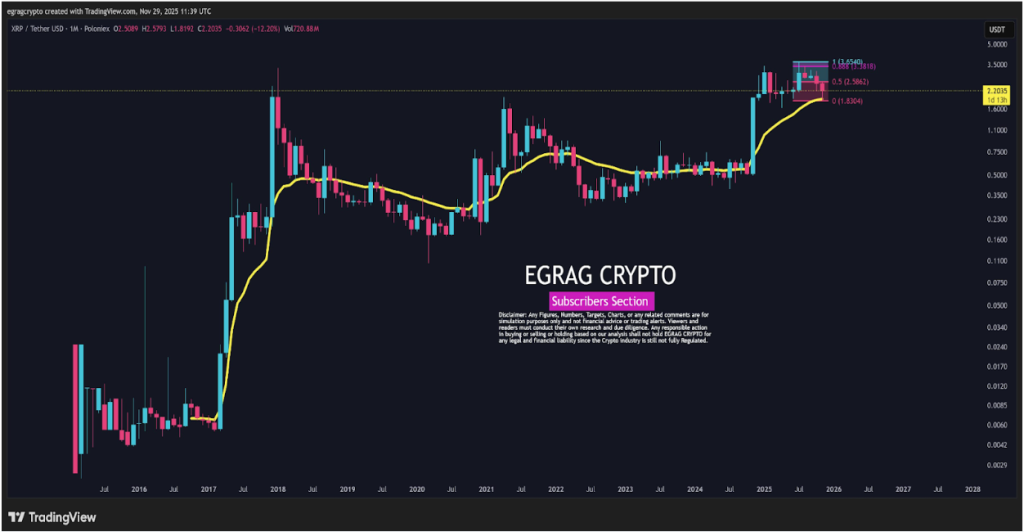
The chart accompanying his analysis shows XRP trading around the $2.20 region, sitting just above an important Fib support level but still wrestling with momentum, with the monthly candle about to close.

XRP Must Close Above $2.60 To Keep Bullish Momentum Intact

Egrag’s first decisive level is at $2.60, which matches with the 0.5 Fibonacci retracement level on the monthly chart. The analyst described a close above this region as bullish but the asset would not yet be fully clear of danger. The chart shows XRP repeatedly testing this price level in the first half of the year before breaking above it in July. However, the most recent breakdown in Q2 2025 has now put the price level in focus again.

The analysis becomes more aggressive once price action breaks above $3.40. EGRAG identified this as the 0.888 Fibonacci level, one of the final retracement zones.

According to him, a close above this level confirms a super-bullish macro breakout, which he summarized with the phrase “we are so back.” The chart reinforces this idea by showing a tight compression beneath this upper 0.888 Fib cluster, and that a decisive breakout could lead to a rapid move into new all-time high prices if there’s enough buying pressure.

XRP Price Chart. Source: @egragcrypto On X 

A Close Below 21 EMA Would Break Bullish Structure

The downside scenario in Egrag’s breakdown is equally straightforward. He warned that a close below the 21-month EMA would mean a severe failure of the bullish trend structure. His wording was intentionally harsh, noting that such a breakdown would mean “we are f**ked, no sugar-coating it.”

The chart shows the 21 EMA currently sitting around the $1.83-$1.90 price zone, forming the final major support on the monthly timeframe. Losing this level would drag XRP back into a deeper corrective zone and finally undo most of the price advancement made this year.

A significant development showed up towards the end of the week that aligns with the bullish continuation Egrag outlined. 21Shares confirmed that its US Spot XRP ETF, which is listed under the ticker TOXR, has received SEC approval and will officially launch on Monday.

The upcoming launch adds a perspective that institutional participation in XRP is only beginning. If inflows follow the early strength seen from other issuers, the ETFs could reinforce the bullish case Egrag mapped on the chart, especially if the XRP price is able to cross above $2.60 in December.

Featured image from Pixabay, chart from TradingView

Here’s What’s Driving The Bitcoin, Ethereum, And XRP Price Recovery

The Bitcoin, Ethereum, and XRP prices are showing signs of recovery as traders across regions take sharply different approaches to the latest price swings. Fresh market data reveals that buying and selling pressure is no longer evenly distributed throughout the day, with the United States emerging as the key source of support. At the same time, other regions struggle to regain a solid footing. 

US Traders Fuel Bitcoin, Ethereum, And XRP Price Recovery

Bitcoin’s market has moved once again as fresh on-chain data shows a clear divide in buying and seeking across global trading hours. A recent shift in US trading activity has had a noticeable impact on the broader crypto market. Ethereum and XRP, which experienced a sharp decline in previous weeks, have begun to stabilize and show mild recovery as Bitcoin strengthens during US hours. 

Currently, the price of BTC is above $90,000 after crashing below $87,000 earlier in the week. Ethereum has also reclaimed the $3,000 level and is now trading steadily above it. XRP has recorded the most weekly increase between the two, jumping approximately 14% according to CoinMarketCap, with its price presently around $2.18. While these cryptocurrencies have yet to regain all lost ground, renewed buying from US traders has helped ease the downward momentum that dominated in previous weeks. 

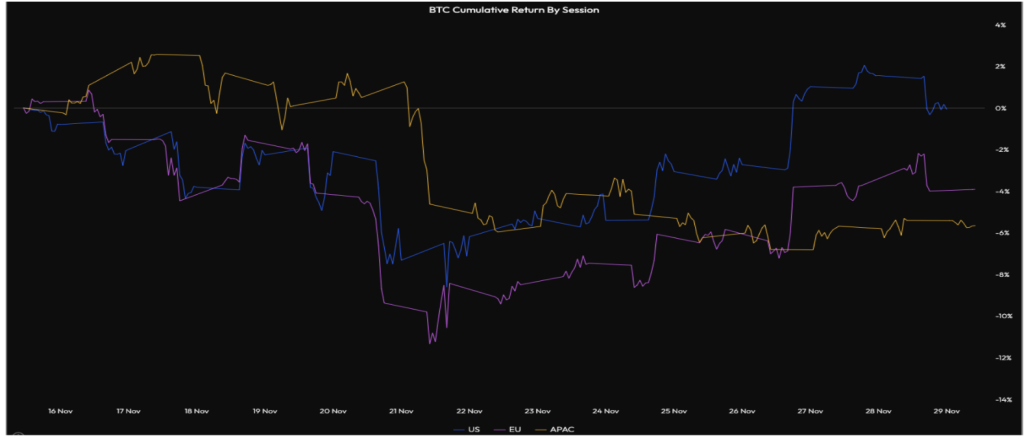
Sharing a new session-based chart from Velo, market analyst Ted Pillows disclosed that the US has reemerged as a net buyer of Bitcoin. At the same time, Asia remains the primary source of selling pressure throughout the year. This regional imbalance has reshaped the latest price movements of Ethereum and XRP, which tend to follow Bitcoin’s upward trajectory

The latest figures from Velo support this view. Velo’s Bitcoin session chart shows that US trading hours, which had been in negative territory earlier in the week, climbed steadily into positive territory from November 24 to date. The blue line representing US hours rose from just above 2% to 3.73% on November 24 before reaching 7.55% by November 26. This reflects a gain of more than 4% over the period, confirming a strong resurgence in demand from US traders. 

Europe Remains Uneven While Asia Leads Bitcoin Selling 

European trading hours, highlighted by the purple line, have been more uneven than those of the US. Europe rose to 1.67% on November 24 and briefly pushed higher to 3.31% later that day. This surge comes after the cumulative weekly return fell into negative territory from November 21, and while a slight recovery followed, it still ended the week below the flat line. This suggests that despite weak buying momentum, Europe may no longer be delivering the heavy selling pressure seen earlier. 

On the other hand, Asia continues to lag behind both regions. Velo’s chart shows that the APAC trading session, represented by the yellow line, started in slightly positive territory around November 20 but turned negative soon after. For most of the week, the regions remained between -5% and -7%. This persistent weakness signals a continuation of the year-long pattern in which Asian hours have been the leading driver of Bitcoin’s sell-side pressure.  

Featured image from Unsplash, chart from TradingView
What’s Going On Behind The Scenes With XRP? Expert Answers

Conversations around XRP have grown louder in recent weeks as the cryptocurrency continues to trade around the $2.2 region while new Spot XRP ETFs continue to attract inflows across multiple issuers. 

One voice in the community has attempted to explain why the market is unusually calm despite rising institutional demand. An XRP enthusiast known as Pumpius shared a detailed thread on X that breaks down the mechanics behind the new ETFs and why the real impact may still be ahead. His argument is that the current XRP price action does not yet reflect what is going on behind the scenes.

Why ETF Rules Create A Special Market Dynamic

Pumpius explained that the foundation of the entire setup is in one legal detail with fund managers. ETF fund managers are restricted from purchasing XRP directly from Ripple or from the escrow accounts that hold large reserves of the token. Every ETF must source XRP through open-market purchases, without private deals or wholesale arrangements.

The absence of direct acquisition forces institutional buyers into the same liquidity pool as retail and whales. With the new launch of XRP ETFs, and as demand continues to rise, the circulating supply is now the battleground, and this mechanical pressure is already visible in recent weeks as XRP trading volumes climbed while exchange supply began trending downward. 

According to market trackers, XRP supply on major exchanges has declined steadily since the approval of the first Spot XRP ETFs, showing that the stress on available liquidity is not theoretical but active. Particularly, data from CryptoQuant shows that Binance’s XRP reserves are now at their lowest point in months, having dropped to 2.7 billion tokens this week.

Incoming Supply Squeeze For XRP

Another part of the explanation focuses on Ripple’s behavior regarding escrow releases. Although one billion XRP is unlocked each month, Ripple has repeatedly returned about 700 million to 800 million of these unlocked  tokens back into escrow. 

Ripple releases only what it considers necessary to maintain healthy liquidity in the ecosystem, and the company has avoided significant selling pressure since the ETF approvals.

According to Pumpius, this means the ecosystem is operating in a controlled balance where ETF issuers are absorbing a growing share of the circulating float, while Ripple keeps escrow output extremely conservative. 

The result is a slow tightening of supply that’s happening behind the scenes and may not yet be visible in price action but can eventually cause what he called a structural supply shock. When this happens, XRP will not move slowly, but it will break price levels with impact.

Still speaking of what is happening behind the scenes, Ripple has been advancing several developments that could strengthen XRP’s long-term position. A recent example is Abu Dhabi’s financial regulator formally recognizing RLUSD as a fiat-referenced token.

Featured image from Unsplash, chart from TradingView

What The Latest Cardano Treasury Move Means For Investors

Cardano’s core ecosystem organizations have submitted a new proposal requesting 70 million ADA from the Treasury to fund a coordinated set of infrastructure upgrades. The proposal, which was made by the founding entities, the Midnight Foundation, and Intersect, targets important components that Cardano still lacks, and its approval could shape how the network grows heading into 2026. 

Why Cardano Is Making This Move Now

Despite Cardano’s reputation as a well-established Layer-1 blockchain, its ecosystem still lacks several must-have infrastructure pieces that underpin vibrant decentralized finance (DeFi), real-world asset (RWA) tokenization and institutional participation. However, the situation might improve soon with a collaborative effort, as revealed in the Cardano’s Critical Integrations Budget proposal for 2026.

The Critical Integrations Budget proposal brings together Input Output, Emurgo, the Cardano Foundation, Intersect, and the Midnight Foundation under a single plan. The coalition asserts that despite Cardano’s strong foundations, several essential ecosystem layers are either incomplete or absent. 

These include tier-one stablecoin infrastructure, institutional-grade custody solutions, cross-chain bridges, deeper analytics capabilities, and globally recognized oracles. These components are necessary for Cardano to support stable liquidity, attract DeFi builders, enable RWA tokenization, and allow institutions to participate securely. 

The proposal frames 2026 as the year Cardano should enter a more mature phase, and these upgrades form the groundwork for that transition. As such, the coalition is asking for 70 million ADA for its 2026 budget. Interestingly, Cardano founder Charles Hoskinson also noted the proposal in a post shared on the social media platform X.

Negotiations with major integration partners are already in place. The discussions have matured enough that the coalition believes it is time for the community to finance the final steps needed to onboard them. 

What This Means For ADA Holders

According to the announcement, the budget request is designed to guarantee that these integrations arrive in a coordinated, timely manner instead of being scattered across years. 

Stablecoin infrastructure and cross-chain connectivity have long been cited as the missing ingredients holding back liquidity and activity on Cardano. If these integrations go live, liquidity pathways widen, capital can move more easily onto the network, and developers gain the confidence to deploy advanced DeFi, RWA, and DePIN applications.

The Cardano Treasury is one of the healthiest community treasuries in the crypto industry. Public records indicate that the treasury currently holds about 1.7 billion ADA. This figure continues to grow through transaction fee allocations and a percentage of the ADA rewards distributed through the protocol’s inflation mechanism that are not allocated to staking pools.  

In that context, the 70 million ADA request is a limited fraction of available reserves. Voting for the proposal is expected to expire on December 30. Voting is carried out by Delegated Representatives (DReps) and final approval will be done by the network’s Constitutional Committee.

Featured image from Unsplash, chart from TradingView

Swiss Holdoff: Crypto Tax Reporting Won’t Start Until 2027

According to the Swiss Federal Council and government sources, Switzerland will postpone the automatic exchange of cryptocurrency account data with foreign tax authorities until at least January 2027.

That means the country will still pass new rules next year, but the cross-border sharing of crypto tax files will not start on schedule.

Delay Comes Despite Law Entering Into Force

Based on reports, the legal framework that brings crypto into the international tax reporting system is set to take effect on January 1, 2026.

Yet the step that actually lets Swiss authorities send data to other countries has been paused after a key parliamentary committee suspended its work on which partner states to include.

In practice, firms in Switzerland will face new domestic reporting duties in 2026, but the first round of international data swaps will wait until at least 2027.

Parliament Approved A List Of Partner States Earlier

Reports have disclosed that the Federal Council had previously prepared a list of 74 partner jurisdictions that would be eligible for automatic exchange under the OECD’s Crypto-Asset Reporting Framework (CARF).

That list was formalized in mid-2025, and it covers most EU member states plus the United Kingdom and other major economies that are ready to take part. But political talks and technical checks about reciprocity and rules have slowed the actual start of exchanges.

What Firms And Clients Will See

Crypto service providers in Switzerland will still need to register, carry out customer checks, and collect the information required by the CARF once the law is active.

Based on reports, that means exchanges and certain wallet providers must prepare files and be able to report holdings and transaction details when asked. For users, that makes holdings visible to tax authorities in partner countries once exchanges begin.

Major Countries Not Yet In The Initial Group

According to coverage of the issue, some big economies — for example the US, China and Saudi Arabia — are not included in the initial exchange group because they either have not aligned with CARF or do not have the necessary reciprocal agreements in place. That affects how broad the data sharing will be during the first year of exchanges.

Politics And Practical Checks Behind The Pause

Based on the Federal Council’s announcement and parliamentary notes, Swiss lawmakers and officials say they want to be sure the partner list meets legal and diplomatic standards before data leaves Swiss systems.

That has led the Economic Affairs and Taxation Committee to pause its deliberations while remaining issues are settled. The pause gives regulators time to double-check technical setups and the legal basis for exchanges.

Featured image from Unsplash, chart from TradingView
Crypto Regulation Heats Up: Senate Sets December Vote On Market Structure Bill

The US Senate is preparing for a possible vote on the crypto market structure bill, which would outline clear rules for how the country should deal with digital assets.

Lawmakers say the measure could finally settle the long-running dispute over whether tokens should be treated as commodities or securities, a decision that would determine which regulator takes charge.

Senate Targets December Markup

As proposed by the committee, the markup for the crypto market structure bill will be on December 8, 2025; this allows senators to debate and change parts of the text before moving it forward.

According to reports, the Senate Banking Committee and the Senate Agriculture Committee plan to move forward with their own drafts and then unify them into one text for the second phase. If both committees clear their drafts, the unified text would be forwarded for a vote by the full Senate.

🚨 BREAKING

U.S. SENATE TO VOTE ON CRYPTO MARKET STRUCTURE BILL IN DECEMBER.

TRUMP SAYS THE BILL IS CRUCIAL FOR MAKING U.S. “CRYPTO CAPITAL OF THE WORLD”

BULLISH FOR BITCOIN IF PASSES. pic.twitter.com/uBG17HyCCm

— 0xNobler (@CryptoNobler) November 26, 2025

Early Vote Still Not Certain

But there are some issues that may hamper the speed of the bill. There are reports that several sections on decentralized finance remain bracketed, indicating that senators have not settled on final language.

🚨NEW: Just had a call with an industry source who recently met with a group of Senate Dems working on market structure legislation. The source said one of the members noted that they are preparing for a possible markup of a bipartisan market structure bill the week of December…

— Eleanor Terrett (@EleanorTerrett) November 25, 2025

Senator Tim Scott, the chairman of the Senate Banking Committee, aims to achieve progress before the year is out. Other members warn that unresolved disagreements could delay a final vote until early 2026. How quickly the committees finish their reports and iron out remaining disputes will determine the schedule.

Two Committees, One Question

Banking and Agriculture have differed over the extent of regulators’ powers. Members on the banking side want greater protections for ordinary investors, including custody and trading protections.

Some more clarity here, pardon the pun: 😁

The CLARITY Act and the crypto market structure bill are the same thing. The CLARITY Act was passed by the House in July and the Senate has been working on its own version, which is what @SenatorTimScott was referring to below.

The… https://t.co/kFQyNbYlIk

— Eleanor Terrett (@EleanorTerrett) November 19, 2025

Agriculture members are preoccupied with market structure rules and commodity oversight. Both committees must agree on one system or talks could hit another dead end. The industry groups say they want clarity. Regulators have stayed cautious while waiting to see where Congress lands.

What’s At Stake For Markets

According to sources tracking the talks, a passed bill could give exchanges and crypto firms a set of clearer rules on how to register, list assets, and manage user funds. That might encourage more companies to operate in the US.

People trading crypto could also see better protections. Critics worry that strict rules might push startups abroad. The choices lawmakers make will influence how money flows into the sector.

Key Issues Around DeFi Oversight

According to sources, the most contentious disagreements over changes involve DeFi. Senators continue to disagree over how such protocols should be regulated and who is liable when something goes wrong.

While some lawmakers prefer narrow rules that won’t hurt small developers, others are pushing for broader authority over platforms that increasingly resemble traditional financial services. That debate has left large swaths of the text incomplete.

Featured image from Unsplash, chart from TradingView

Spain’s 47% Crypto Tax Sparks Outrage, Critics Predict Full Regulatory Chaos

Spain’s Sumar parliamentary group has submitted a proposal that would change how gains from cryptocurrencies are taxed, potentially pushing the top personal rate to 47%.

According to reports, the draft would move profits from crypto out of the current “savings” tax bracket — where gains are taxed up to around 30% — into the general income tax base, which carries higher top rates.

Sumar’s Proposal And Key Changes

Based on reports, the changes do more than tweak rates. They would treat gains from nonfinancial crypto assets as ordinary income, apply a 30% corporate tax rate to business crypto gains, and label all digital assets as attachable or seizable under certain conditions.

The plan also asks Spain’s securities regulator to design a “risk traffic light” that platforms must display to users, showing a simple risk indicator for various tokens.

Spain’s Sumar parliamentary group has proposed a legislative reform aimed at significantly increasing taxes on Bitcoin and other crypto assets. The proposal would shift taxation of crypto gains from the current “savings tax base” (capped at 30%) to the “general tax base,” where…

— Wu Blockchain (@WuBlockchain) November 26, 2025

Lawmakers filed the amendment recently. It targets at least three laws: the General Tax Law, the Income Tax Law and the Inheritance and Gift Tax Law.

Reports have made clear the package is broad and could change again as it moves through the legislature.

Industry Reaction And Legal Questions

The push has drawn sharp criticism from parts of the crypto community and some legal experts. Critics warn that treating crypto like regular income and declaring all tokens seizable could push investors and firms to move holdings abroad.

Others say seizing assets becomes tricky when tokens are self-custodied or held on platforms outside Spanish control.

Some lawyers argue the proposed seizure rules may be hard to apply in practice. They point to stablecoins and tokens that circulate across borders and systems, noting enforcement could be limited unless platforms or intermediaries cooperate.

🚨 El Grupo Parlamentario Sumar ha presentado tres enmiendas en el proyecto que transpone la Directiva de la UE sobre criptoactivos que van claramente contra Bitcoin, Ethereum y otras criptomonedas:

1⃣ Quieren que las ganancias por criptoactivos no considerados instrumentos…

— José Antonio Bravo Mateu (@jabravo) November 24, 2025

At the same time, supporters inside the Sumar group say stronger rules are needed to close tax loopholes and provide clearer rules for a market they view as risky for retail savers.

Market And Policy Risks

If enacted as written, the reform would raise the tax bill for many individual holders and traders. Retail investors who now pay up to 30% on gains could face rates near 47% on large profits.

Companies that keep crypto on their balance sheets would see a flat 30% corporate tax on gains. Analysts warn that these shifts could reduce trading activity and deter new crypto firms from setting up in Spain.

Featured image from Unsplash, chart from TradingView
❌