Reading view

There are new articles available, click to refresh the page.

Network Redundancy: The Safety Net When Everything Goes Wrong

[Update] Ironically, as soon as this blog went live, Cloudflare went down! So I will use this opportunity to say... I told you so! Keep reading to find out why.

Someone, at some point in time, (hopefully some kind of professional network engineer) designed your network. They drew a pretty picture with multicolored lines showing traffic flowing between a primary path and a secondary path. Oh, and this plan also had a budget and important management buy-in. Then they moved on to another company, country, or just a better job, and what you've been left with is a Frankenstein's monster of temporary-band-aid solutions to real problems that all became permanent circa 2015. Your so-called redundant paths? One goes down, and the other follows like some kind of tragic Romeo and Juliet situation - it's heartbreaking.

Build A Pocket-Sized Wi-Fi Analyzer

By: Lewin Day

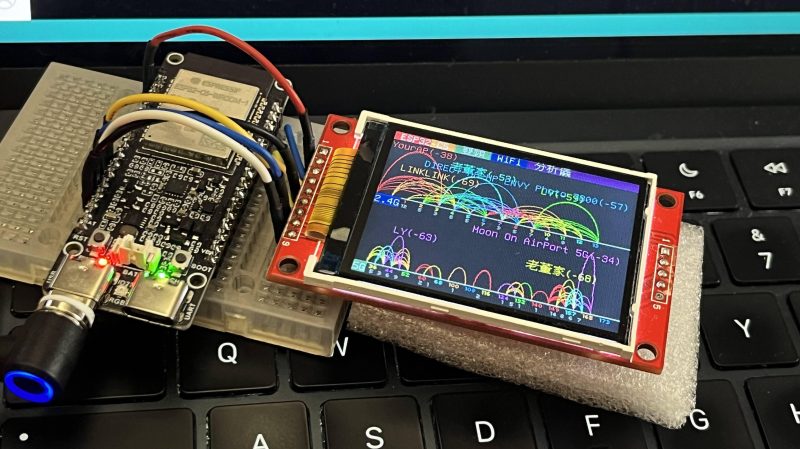
Wi-Fi! It’s everywhere, and yet you can’t really see it, by virtue of the technology relying on the transmission of electromagnetic waves outside the visual spectrum. Never mind, though, because you can always build yourself a Wi-Fi analyzer to get some insight into your radio surroundings, as demonstrated by [moononournation].

The core of the build is the ESP32-C5. The popular microcontroller is well-equipped for this task with its onboard dual-band Wi-Fi hardware, even if the stock antenna on most devboards is a little underwhelming. [moononournation] has paired this with a small rectangular LCD screen running the ILI9341 controller. The graphical interface is drawn with the aid of the Arduino_GFX library. It shows a graph of access points detected in the immediate area, as well as which channels they’re using and their apparent signal strength.

If you’re just trying to get a basic read on the Wi-Fi environment in a given locale, a tool like this can prove pretty useful. If your desires are more advanced, you might leap up to tinkering in the world of software defined radio. Video after the break.

China’s DeepSeek AI Predicts the Price of XRP, Cardano, Pi Coin by the End of 2025

By: Tim Hakki

China’s leading ChatGPT killer, DeepSeek AI, issues surprising December projections for XRP, Cardano, and Pi Network, cautioning traders that all three may experience heightened volatility throughout the month.

The wider cryptocurrency market has been in a pronounced downturn in recent weeks, with aggressive Bitcoin selling dragging nearly every top asset lower. BTC even touched an eight-month low near $82,000 last Friday, but today’s green candles helped the market to collectively add 5.7% in 24 hours, a possible sign of recovery.

Blockchain development continues at a rapid pace, and projects with established utility, including XRP, Cardano, and Pi, are widely viewed as resilient contenders positioned for eventual large-scale adoption.

Below is DeepSeek AI’s dual-scenario forecast highlighting the potential upside and downside risks for each throughout December.

XRP (XRP): DeepSeek AI Expects Either Total Collapse or XRP to $8

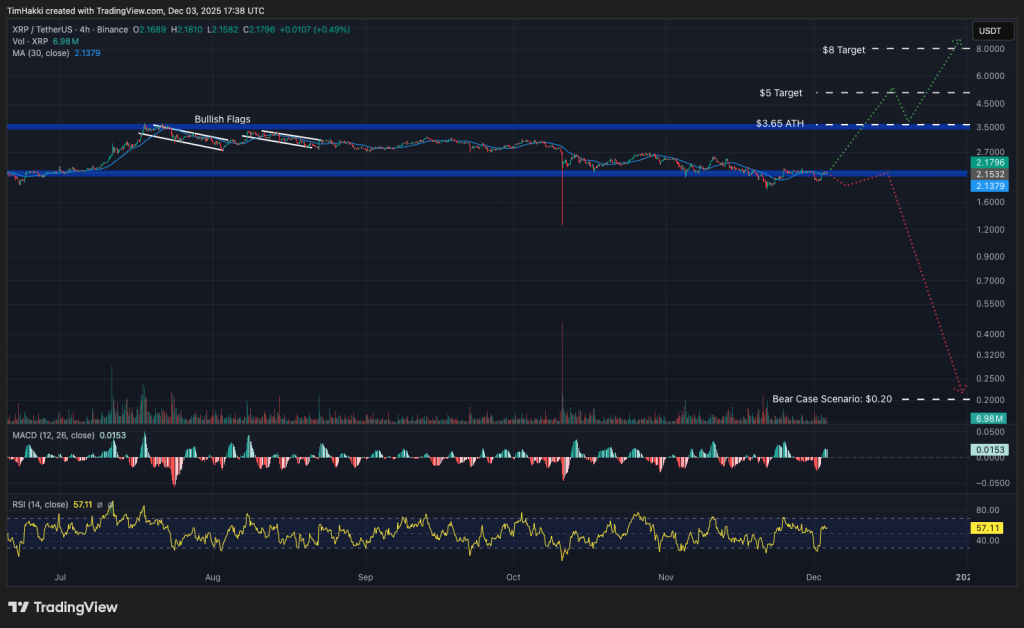
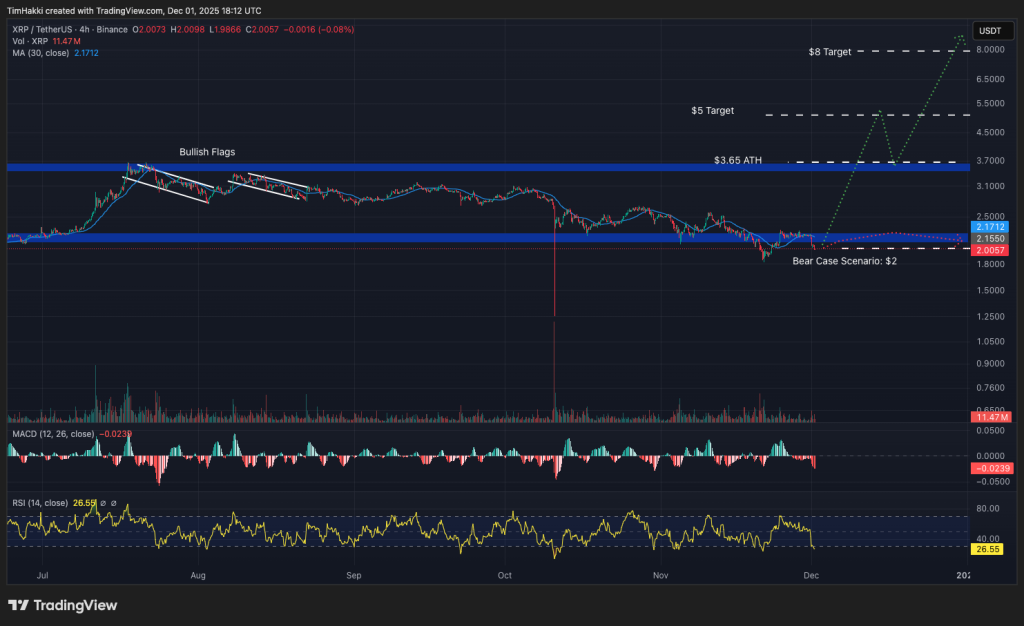
DeepSeek AI’s bearish projection suggests Ripple’s XRP ($XRP) could dramatically collapse by 91% from its current $2.18 level to around $0.20 in December if investor sentiment remains weak.

deepseek ai predicts xrp
Source: DeepSeek

Such a move would stand in stark contrast to XRP’s dramatic surge earlier this year, when the token rallied to a seven-year high of $3.65 in July following Ripple’s pivotal court victory over the U.S. Securities and Exchange Commission.

Throughout 2025, XRP has mainly oscillated between $2 and $3. Its RSI now sits at 57, rebounding from Monday’s oversold reading of 27 after XRP slid 9% within 24 hours, part of a broader pullback that wiped 5% from the total crypto market. Although today the market collectively rallied 6% and now capitalizes $3.24 trillion.

In a more bullish scenario, DeepSeek AI believes XRP could rise toward $8 in December.

The recent approval of nine U.S. spot XRP ETFs may attract fresh institutional capital during the holiday period, similar to the initial surge seen when spot Bitcoin and Ethereum ETFs debuted. Additional ETF approvals are likely to follow.

Cardano (ADA): DeepSeek Predicts a Possible 2,173% December Breakout

Cardano ($ADA) continues to distinguish itself as one of the most academically driven and methodically developed blockchains in the industry. Founded by Ethereum co-creator Charles Hoskinson, the network emphasizes security, formal research, scalability, and long-term viability.

With a market cap above $16 billion and $193 million in TVL on chain, Cardano remains a major force among layer-1 blockchains, supported by an active developer base and an expanding catalog of decentralized applications.

DeepSeek AI forecasts ADA could reach approximately $10 by early 2026, an extraordinary 2,173% jump from its current trading range around $0.44 and more than triple its all-time high of $3.09 set in 2021.

Analysts argue that Cardano’s steady upgrades and strong fundamentals make it a potential standout in the next DeFi-driven bull market.

However, DeepSeek’s downside scenario warns that ADA could fall to roughly $0.25 if market weakness intensifies, representing a drop of just over 43% for current holders.

Pi Network (PI): DeepSeek Predicts Pi will Either Moon or Go to Zero

Pi Network ($PI), known for its mobile-friendly mining system that rewards simple daily participation, continues to show resilience despite wider market turbulence. The token trades near $0.23, up 1.5% over the last 30 days, while Ethereum, XR,P and Bitcoin are all down more than 10% over the same period.

DeepSeek outlines two spectacular pathways: under bearish conditions, PI could run to $0. But in a bullish December, the token could surge to roughly $150, offering gains of up to 65,117% for current buyers.

Following a prolonged downward trend, November appears to be a stabilizing month for PI. The token held its value better than the big hitters recently after Pi Network announced a collaboration with AI company OpenMind, showcasing how Pi node operators can supply computational resources to external organizations, a tangible, scalable application of decentralized infrastructure.

The Pi testnet has also rolled out new features, including decentralized exchange support, automated market makers, liquidity tools, and an enhanced KYC framework, all of which significantly expand the ecosystem’s capabilities.

Maxi Doge (MAXI): A Rapidly Growing Meme Coin Absent From DeepSeek’s Forecasts

While DeepSeek AI anticipates uncertain times for multibillion-cap altcoins, presale tokens, by virtue of their newness, have more room for substantial growth. One standout newcomer is Maxi Doge ($MAXI), which has already secured $4.2 million in funding as investors bet on it becoming the next major Dogecoin challenger.

MAXI’s storyline follows the rise of “Maxi Doge,” a crypto bro who has spent years honing his trading skills and preparing to dethrone Dogecoin as the meme coin heavyweight. The project leans heavily into viral humor, community interaction, and strategic social media campaigns to accelerate adoption.

As an ERC-20 token, MAXI benefits from Ethereum’s improved scalability, strong security profile, energy-efficient consensus, and expansive developer ecosystem, all areas where Dogecoin’s older proof-of-work model falls short.

The team is currently advertising staking rewards of up to 72% APY, though returns decrease as more users join the pool.

MAXI is priced at $0.000271 in the ongoing presale round, with scheduled price increases in later phases. Purchases can be made through MetaMask or Best Wallet.

Dogecoin stands no chance!

Stay updated through Maxi Doge’s official X and Telegram pages.

Visit the Official Website Here

The post China’s DeepSeek AI Predicts the Price of XRP, Cardano, Pi Coin by the End of 2025 appeared first on Cryptonews.

Ethereum Fusaka Upgrade Goes Live Today: Experts Predict Potential Supply Crunch Ahead

The highly anticipated Fusaka Upgrade for Ethereum is on the verge of going live on Wednesday, heralding significant enhancements to the network’s overall functionality. 

Analysts contend that this pivotal development could usher in a considerable supply crunch for ETH, potentially boosting its price during a challenging period for the broader cryptocurrency market.

Layer 2 Solutions To Boost ETH Burn

According to analysts at Bull Theory, the Fusaka Upgrade integrates components from previous upgrades—Osaka, Fulu, and PeerDAS—but its most impactful feature is its resolution of one of Ethereum’s biggest challenges. 

Layers 2 (L2) solutions have long utilized Ethereum’s security while contributing minimal fees back to the network. Despite L2 solutions like Base, Arbitrum, Optimism, and zkSync generating millions in fees from users, the fees recorded on Ethereum tended to diminish to nearly zero when they posted their data. 

Consequently, this meant that significant L2 activity did not result in substantial ETH being burned, even though approximately 85% of Ethereum transactions now occur on these Layer 2 solutions.

The Fusaka Upgrade fundamentally changes this dynamic. A key enhancement is EIP-7918, which mandates that Layer 2 transactions pay real fees to Ethereum. 

This adjustment ensures that every L2 transaction will contribute directly to the burning of ETH—something that was not previously guaranteed. The analysts assert that this feature represents one of the most significant value shifts since the introduction of EIP-1559.

Post-Fusaka Projections

The upgrade is further expected to broaden the scope of ETH burn from being predominantly derived from Layer 1 (L1) transactions to encompassing all L2 activity. 

Historically, most ETH burn has originated from mainnet transactions; thus, the network saw slight inflation in 2024–2025 as Layer 2s made transactions cheaper, leading to a decrease in ETH burn while staking continued to issue new ETH. 

Post-Fusaka, every L2 blob will incur a minimum cost, which will be burned. As Layer 2 adoption increases, the rate at which ETH is burned will also rise, contributing to increased scarcity of ETH.

This enhancement positions Ethereum to shift back towards deflation for the first time in several years. Currently, ETH issues around 620,000 new tokens annually for stakers while burning approximately 350,000 tokens. This results in a net slight inflation. 

However, projections following the Fusaka Upgrade, even with conservative estimates, suggest that the additional burn from L2 activity could range from 200,000 to 400,000 ETH per year. 

Combined with existing burn rates, this could bring the total to over 600,000 ETH, leading to a net neutral or slightly deflationary state for ETH. 

More bullish models predict that if L2 adoption flourishes and demand for blobs rises, burn rates could soar to between 900,000 and 1.2 million ETH annually, resulting in a supply decrease of 200,000 to 300,000 ETH each year. 

Monetary Transformation For Ethereum?

Another notable aspect of the Fusaka upgrade is PeerDAS, which enhances Layer 2 growth by reducing bandwidth requirements by 85%. This efficiency allows L2 solutions to publish more blobs at lower costs, resulting in increased fees and, consequently, more ETH burned.

The upgrade also increases the block gas limit from 36 million to 60 million, allowing more transactions to fit within each block. This increase means that more transactions can occur, leading to higher fees collected and a corresponding rise in burning. 

Furthermore, lower fees for transactions—such as swaps, bridges, on-chain gaming, and social applications—will likely drive more usage, resulting in increased transactions and higher ETH burn.

Ultimately, the analysts believe that the Fusaka Upgrade represents a significant monetary transformation for Ethereum, indicating that the network is not only scaling but also beginning to monetize that scaling effectively.

Ethereum

Featured image from DALL-E, chart from TradingView.com

Analysts Turn Bullish on SUI as Token Extends Gains Amid Renewed Institutional Interest

Sui (SUI) is drawing renewed market attention after staging one of its strongest breakouts in months, rising sharply at a time when most large-cap altcoins remain range-bound.

The latest 31% surge was triggered by a series of developments that converged within days, most notably Coinbase’s approval to offer SUI trading to New York residents, a move that places the token inside one of the most heavily regulated crypto markets in the U.S.

The rally also arrived immediately after one of the largest token unlocks of the month, an event that would normally dampen prices but instead saw buyers step in with force.

SUI Network SUIUSD

New York Listing Boosts Liquidity and Institutional Demand

SUI surged between 25% and 32% over the past 24 hours after Coinbase confirmed that New York residents can now buy and trade the token across its web and mobile platforms.

The approval extends SUI’s reach into one of the most tightly regulated U.S. markets, strengthening its profile as a compliant layer-1 network and increasing accessibility for institutional investors.

The listing comes at a notable time. On December 1, SUI unlocked approximately $82–86 million worth of tokens, increasing circulating supply by more than 0.5%. Large unlocks typically pressure prices, but SUI moved higher instead, signaling strong demand absorption.

Trading volume has more than doubled, hitting roughly $1.5 billion, levels analysts say indicate genuine accumulation rather than short-lived speculation.

The launch of USDsui, a fiat-backed stablecoin designed for payments and DeFi use across the Sui ecosystem, also contributed to renewed interest. Combined with Coinbase’s expansion, these developments have strengthened confidence in Sui’s broader market positioning.

SUI Technical Indicators Point to Momentum Shift

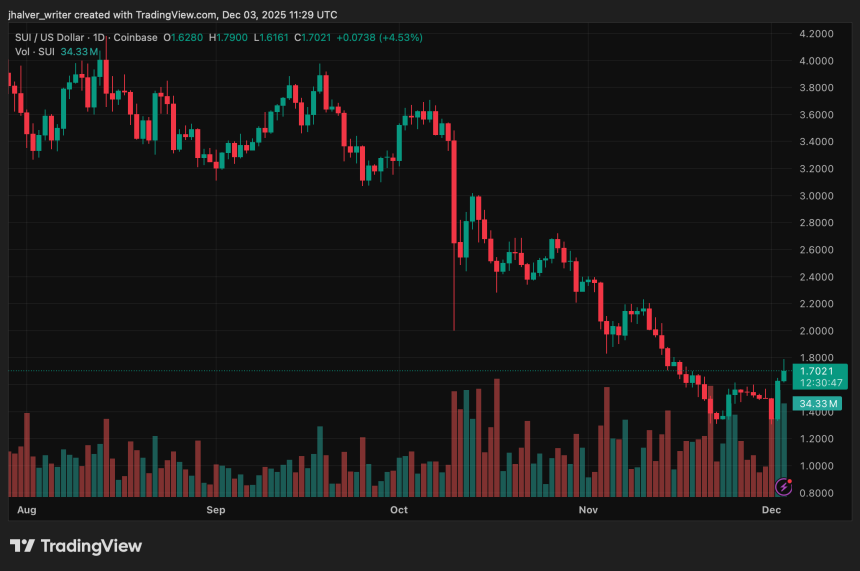
Price action shows that SUI recently rebounded from November’s lows near $1.12, climbing above the $1.60 support zone.

Indicators such as RSI and MACD now suggest easing selling pressure and a potential shift in short-term momentum. Analysts note that breaking above the mid-Bollinger Band near $1.90 would confirm a broader trend reversal.

SUI has also moved above the Keltner mid-band for the first time in weeks, with volume delta readings showing strong spot-market buying.

The next major resistance sits between $1.80 and $1.95, followed by a wider zone extending to $2.30. A decisive close above $1.92 is viewed as critical for invalidating November’s downtrend.

Rally Depends on Volume Holding

Market watchers say the current rally hinges on sustained demand. If daily volume remains above $1.5 billion and price holds the $1.60–$1.67 support zone, institutional participation could continue to push the token higher toward the $1.90 level.

However, weakening volume or a drop below $1.48 may signal that SUI has formed a local top. For now, sentiment remains constructive as the token benefits from increased U.S. accessibility, improving technical signals, and expanding ecosystem activity.

Cover image from ChatGPT, SUIUSD chart from Tradingview

Ethereum Network Fatigue? Monthly On-Chain Transactions Drops As Activity Slows Down

Over the past few weeks, the price of Ethereum has been on a downward trend due to a highly volatile market environment. ETH’s bearish action appears to have hampered on-chain activities, as evidenced by a decline in its total transactions carried out within a monthly period.

A Quiet Month For The Ethereum Network

Ethereum’s on-chain activity appears to have slowed down alongside the ongoing decline of ETH’s price. The blockchain, which is typically bustling with contract calls, exchanges, and transfers, now feels a little more roomy, suggesting a cooling pulse beneath the surface.

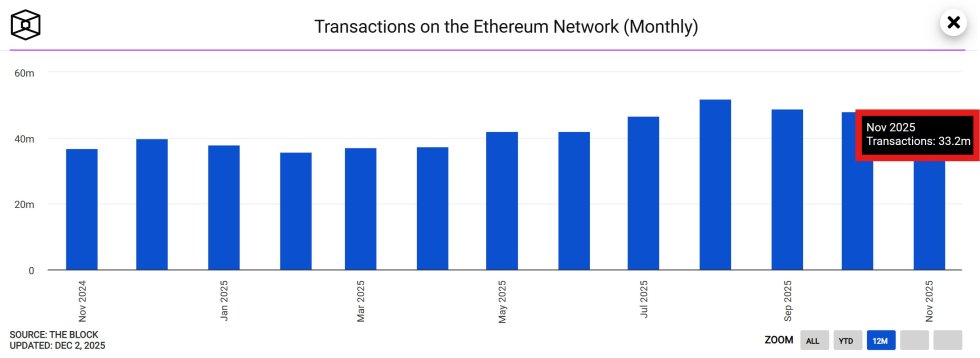
After examining the Transactions on the Ethereum Network metric in the monthly time frame, Everstake.eth, a market analyst and the head of the ETH segment at Everstake, revealed that the blockchain has recorded its worst month of the year. While price has declined, ETH’s total transactions executed in a month, particularly November, experienced a cool-off.

According to the data, the overall number of transactions carried out on the Ethereum network in November alone was approximately 32.2 million. Although this figure may seem large, it actually marks the lowest monthly count in the past 12 months.

Such a drop in transactions may suggest the renewed waning appetite for the network. In addition to suggesting a retreat, this delay reads more like a collective pause as users catch their breath, procedures recalibrating, and the market adjusting to its new rhythm. 

Ethereum

Everstake.eth highlighted that this kind of cooldown usually occurs when the market moves into a wait-and-see phase. During this phase, capital is observed sitting on the sidelines while developers continue to build on the blockchain. Despite this trend, the network still records more than 33 million transactions in a quiet month, which reflects its robust strength.

At a time like this, the expert noted that user behavior typically follows the market sentiment. As seen in the past, on-chain activity tends to cool down when volatility drops. However, Ethereum still retains the status as the most reliable network even during slow phases.

With the Fusaka Upgrade set to hit the market, Everstake.eth predicts that ETH transactions will see explosive growth. “If this is the worst month, imagine what the best will look like after Fusaka rolls out. It will be huge,” the expert stated.

ETH Active Transactions Pick Up

The monthly transactions may have slowed down, but the active addresses on the Ethereum network are heating up again. Leon Waidmann, the head of research at On-Chain Foundation, reported that active addresses throughout the entire ecosystem, Layer 1 and Layer 2s, bounced back above 9.5 million this week.

This surge points to a quiet resurgence of interest, utility, or a group readiness for the future. Waidmann highlighted that this marks the first meaningful reversal after several weeks of downside action.

ETH layer 2s such as Base, Arbitrum, Optimism, and World Chain have witnessed a strong rebound following a period of decline. Furthermore, multi-chain activity is starting to stabilize after the drop in Q3. These factors are painting a bullish picture for the network and its price prospects.

Ethereum

Life After End-of -Life

I've been battling with an operating system problem for the last few months. The problem? The operating system on some of my servers is screaming toward "end of life". That means they need to be updated.

Previously, I'd updated each server separately and taken notes as kind of an installation script. Of course, those scripts are great for notes but ended up not working well in practice. But at least I knew what needed to be installed.

This time I had the idea of actually scripting everything. This is particularly important since I'll be updating three servers, each with a handful of virtual machines -- and they all need to be updated. (Well, a few don't need to, but for consistency, I want to make them all the same.) The scripts should allow the migration to be more rapid and consistent, without depending on my memory or lots of manual steps.

There are a lot of steps to this process, but each step is pretty straightforward:
  1. Choose a new operating system. (I decided on Ubuntu 24.04 LTS for now.)

  2. Install the base operating system as a minimal server. Customize it to my liking. (E.g., I have some shell aliases and scripts that I use often and they need to be on every server. I also need to harden the basic OS and add in my custom server monitoring code.)

  3. Install a hypervisor. In virtual machine terminology, the hypervisor is "dom0" or the "host". It runs one or more virtual machines (VMs). Each VM is often called a "guest" or "domu". I have 3 production servers and a 4th "hot backup" in case of hardware failures or for staging migrations, so I'll be installing 4 dom0 systems and a bunch of domu on each dom0.

  4. Create a template virtual machine (template domu) and configure it with my defaults.

  5. I'll be updating the servers, one at a time. For each virtual machine (VM) on the old server:
    1. Copy the template on the staging server to a new VM.
    2. Transfer files from the old VM on the old server to the new VM on the staging server.
    3. Make sure it all works.

  6. When the staging server has everything running and the old server is no longer in use:
    1. Reinstall the old server using the installation scripts.
    2. Transfer each new VM from the staging server to the production server.
    3. Make sure it all works.

  7. When everything has been transferred and is running on the production server, remove it all from the staging server and then start the same process for the next old server.
It's a lot of steps, but it's really straightforward. My installation scripts have names like:
install-step00-base-os.sh
install-step01-user.sh
install-step02-harden.sh
install-step03-network.sh
install-step04-ufw.sh
install-step05-create-dom0.sh
install-step06-system-monitor.sh
install-step10-domu.sh
install-step11-domu-user.sh
install-step12-domu-harden.sh
install-step13-domu-network.sh
install-step14-domu-ufw.sh
install-step20-migration-prep.sh
install-step21-make-clone.sh
install-step22-copy-old2clone.sh
install-step23-validate.sh
install-step24-guest-move.sh
install-step25-guest-cleanup.sh
I expected this entire process to take about a month. In reality, I've been battling with every step of the process for nearly 3 months.

The first problems

I really thought choosing an operating system and a hypervisor was going to be the easiest choice. I had previously been using Xen. Unfortunately, Xen is not well-supported under Ubuntu 24.04. (Ubuntu with Xen refused to boot. I'm not the only person with this problem.)

Since Ubuntu 24.04 has been out for over a year, I'm not going to hold my breath for a quick fix. I decided to switch to KVM -- it's what the Debian and Ubuntu developers use. KVM has a lot of really nice features that Xen is missing, like an easy(?) way to move existing VMs between servers.

However, I absolutely could not get IPv6 working under KVM. My ISP doesn't sell fixed IPv6 ranges. Instead, everyone uses DHCPv6 with "sticky" addresses (you get an address once and then keep it).

I should have known that DHCPv6 would be a problem with Ubuntu 24.04: during the base Ubuntu OS install, it failed to acquire an IPv6 address from the installation screen. IPv4 works fine using DHCP, but IPv6 does not. Part of the problem seems to be with the OS installer.

However, I'm sure part of the problem is also with my ISP. You see, with IPv4, there's one way to get a dynamic address. However, IPv6 never solidified around a single method. For example:
  • DHCPv6 vs SLAAC: DHCPv6 provides stateful configurations, while SLAAC is for stateless. The ISP may even use a combination of them. For example, you may use DHCPv6 for the address, but SLAAC for the routes.

  • Addressing: There are options for acquiring a temporary address, prefix delegation, and more. (And if you request a prefix delegation but provide the wrong mask size, then it may not work.)

  • Routing: Even if you have the address assigned, you may not have a route until the ISP transmits an IPv6 router advertisement (RA). How often those appear depends on the ISP. My ISP transmits one RA every 10-20 minutes. So even if you think everything is working, you might need to wait 10-20 minutes to confirm that it works.
After a week of fighting with the IPv6 configuration, I managed to get DHCPv6 working with my ISP for a /128 on dom0, but I could never get the /56 or virtual servers to work.

While debugging the dom0 issues, I found a problem with KVM's internal bridging. I have a network interface (let's call it "wan"). All of the VMs access it over a bridge (called "br-wan").
  • Under Xen, each VM uses a dynamically allocated tap that interfaces with the bridge. The tap relays the VM's MAC address. As a result, the ISP's DHCPv6 server sees a request coming from the virtual system's MAC address and allocates an address associated with the MAC. This allowed IPv6 to work under Xen.

  • KVM also has a virtual tap that accesses the bridge, but the tap has a different MAC address than the VM. (This isn't a bug; it's just a different architectural decision that the KVM developers made.) As a result, the DHCPv6 server sees a request for an address coming from the tap's MAC, but the confirmation comes from the VM's MAC address. Since the address changed, the confirmation fails and the machine never gets an IPv6 address. (I could not find a workaround for this.)
I spent over a month battling with the IPv6 configuration. I am finally convinced that none of the KVM developers use IPv6 for their VMs, or they use an ISP with a less hardened DHCPv6 configuration. Since I'm up against a hard deadline, none of my new servers will have IPv6 enabled. (I'm still using CloudFlare for my front-end, and they support IPv6. But the connection from CloudFlare to me will be IPv4-only.)

How far did I get with IPv6?
  • dom0 can consistently get a /128 (that's ONE IPv6 address) if I clone the NIC's hardware address to the bridge.

  • With a modified configuration, the dhclient process on dom0 can request and receive a /56 from the ISP, but then the ISP refuses to confirm the allocation so dhclient never accepts it (because the MAC changes).

  • Switching from the default bridge to a macvtap makes no difference.

  • Flushing old leases, changing how the DUID is generated, creating my own post-dhcpv6 script to accept the allocation... these all fail.

  • While dom0 could partially work, my VM guest systems never worked. They were able to request and receive an allocation, but the confirmation was never accepted.
The lesson? If it doesn't work straight out of the box, then it doesn't work.

As one of my friends put it: "IPv6 is the way of the future, and it always will be." It's really no wonder that IPv6 hasn't had wider adoption over the last 30 years. It's just too complicated and there are too many incompatible configurations. (Given all of the problems I've encountered with virtual machines, I now understand why many cloud providers do not support IPv6.)

Cloning Templates

Once IPv6 was off the table, I turned my attention toward creating a reproducible VM template. Configuring a KVM domu/guest virtual server was relatively painless.

The idea is that I can clone the template and configure it for any new server. The cloning command seems relatively painless, unless you want to do something a little different.

For me, the template uses a QCOW2 file system. However, the running configured guest servers all use the Logical Volume Management (LVM) system. I allocate the logical volume (lvcreate) and then clone the template into the new LVM disk. (sudo qemu-img convert -p -f qcow2 -O raw "$SOURCE_QCOW2" "$LV_PATH")

The good news is that this works. The bad news is that the template is only a 25G disk, but the logical volume is allocated as 200G -- because the final server needs more disk space. If I boot the cloned system, then it only see a 25G hard drive. Expanding the cloned image to the full disk size is not documented anywhere that I could find, and it is definitely complicated. Here's the steps that I finally found that work:
# Create the new server's disk space
sudo lvcreate -L "$GuestVGsize" -n "$GuestName" "$GuestVG"
LV_PATH="/dev/$GuestVG/$GuestName"

# Find the template's disk. My template domu is called "template".
SOURCE_QCOW2=$(virsh dumpxml template | grep 'source file' | awk -F\' '{print $2}')

# Do the actual cloning (with -p to show progress)
sudo qemu-img convert -p -f qcow2 -O raw "$SOURCE_QCOW2" "$LV_PATH"

# LV_PATH is a single volume that contains multiple partitions.
# Partition 1 is the bootloader.
# Partition 2 is the file system.
# Get the file system's partition path
LV_CONTAINER_PARTITION_NAME=$(sudo kpartx -l "$LV_PATH" | tail -n 1 | awk '{print $1}')
LV_CONTAINER_PARTITION="/dev/mapper/${LV_CONTAINER_PARTITION_NAME}"

# Get the starting sector for resizing the 2nd (data) partition.
START_SECTOR=$(sudo gdisk -l "$LV_PATH" | grep '^ *2' | awk '{print $2}')
sudo kpartx -d "$LV_PATH"
sleep 2 # wait for it to finish

# Edit the partition table to expand the disk
sudo sgdisk "$LV_PATH" -d 2
sudo sgdisk "$LV_PATH" -n 2:"$START_SECTOR":0 -c 2:"Linux Filesystem" -t 2:8300
sudo sgdisk "$LV_PATH" -w
# Inform the operating system of this change
sudo partprobe "$LV_PATH"

# Extract links to the partitions for cleanup
sudo kpartx -a "$LV_PATH"
# Check the file system
sudo e2fsck -f "$LV_CONTAINER_PARTITION"
# Resize it
sudo resize2fs "$LV_CONTAINER_PARTITION"

# If you want: mount $LV_CONTAINER_PARTITION and edit it before the first boot.
# Be sure to umount it when you are done.

# Done! Remove the partition links
sudo kpartx -d "$LV_PATH"
This took me a few days to figure out, but now the cloned guest has the correct disk size. I can now easily clone the template and customize it for specific server configurations. (I skipped over the steps related to editing the KVM's xml for the new server or using virsh to activate the new cloned image -- because that would be an entire blog post all by itself.)

Copying Files

Okay, assume you have a working KVM server (dom0) and an allocated new server with the right disk size. Now I want to copy the files from the old server to the new server. This is mainly copying /home, /etc/postfix, /etc/nginx, and a few other directories. Copying the contents should be easy, right?

'rsync' would be a great option. However, I'm copying from a production server to the pre-deployment environment. Some of the files that need to be transferred are owned by other users, so the rsync would need to run as root on both the sender and recipient systems. However, my servers do not permit logins as root. This means that I can't rsync from one server to another.

'tar' is another great option. In theory, I could ssh into the remote system, tar up the files and transfer them to the new guest server. However, to get the files, tar needs to run as root on the production server. (We permit 'sudo', but not direct root logins.) An ideal solution would be like:
ssh prodserver "cd / ; sudo tar -cf - home" | (cd / ; sudo tar -xvf - )

Unfortunately, this approach has a few problems:
  • sudo requires a terminal to get the password. That means using "ssh -t" and not just "ssh".

  • The terminal receives a text prompt. That gets fed into the decoder's tar command. The decoder says "That's not a tar stream!" and aborts.
I finally worked out a solution using netcat:
On the receiving server:
cd / ; nc 12345 | tar -xvf - This waits for a connection on port 12345 and sends the data to tar to extract. netcat will terminate when the stream ends.

To get to the production server:
ssh -o LogLevel=error -t "$OldServer" "cd / ; sudo bash -c 'echo Running as sudo' ; sudo tar -cf - $GetPathsReal | nc newserver 12345

This is a little more complicated:
  • "-o LogLevel=error" My production ssh server displays a banner upon connection. I need to hide that banner so it doesn't confuse tar.

  • "-t" opens a terminal, so sudo will prompt for a password.

  • "sudo bash -c 'echo Running as sudo'" Get the sudo prompt out of the way. It must be done before the tar command. This way, the next sudo call won't prompt for a password.

  • "sudo tar -cf - $GetPathsReal | nc newserver 12345" This tars up the files that need to be transferred and sends them through a netcat tunnel.
The rsync solution would be simple and elegant. In contrast, using tar and netcat is a really ugly workaround -- but it works. Keep in mind, the netcat tunnel is not encrypted. However, I'm not worried about someone in my internal network sniffing the traffic. If you have that concern, then you need to establish an encrypted tunnel. The catch here is that ssh does not transfer the tar stream -- the tar stream comes over a parallel connection.

Current Status

These are far from all of the problems that I had to resolve. After nearly 3 months, I finally have the first three VMs from one dom0 migrated to the new OS. Moreover, my solution is 95% scripted. (The remaining 5% is a human entering prompts and validating the updated server.) Assuming no more big problems (HA!), it will probably take me one day per VM and a half-day per server.

The big lessons here?
  • With major OS migrations, expect things to break. Even common tasks or well-known processes are likely to change just enough to cause failures.

  • Automating this process is definitely worth it. By scripting every step, I ensure consistency and an ability create new services as needed. Moreover, some of the lessons (like battling with IPv6, fighting with file transfers, and working out how to deal with logical volumes) were needed anyway; those took months to figure out and the automated scripts document the process. Now I don't have to work it out each time as a special case.

  • After nearly 30 years, IPv6 is still much less standardized across real-world environments than people assume.

  • KVM, templates, and logical volumes require more knowledge than typical cloud workflows lead you to expect.
This process took far longer than I anticipated, but the scripting investment was worth it. I now have a reproducible, reliable, and mostly automated path for upgrading old systems and creating new ones.

Most of my running services will be moved over and nobody will notice. Downtimes will be measured in minutes. (Who cares if my mail server is offline for an hour? Mail will just queue up and be delivered when it comes back up.) Hintfo and RootAbout will probably be offline for about 5 minutes some evening. The big issue will be FotoForensics and Hacker Factor (this blog). Just the file transfers will probably take over an hour. I'm going to try to do this during the Christmas break (Dec 24-26) -- that's when there is historically very little traffic on these sites. Wish me luck!

Perplexity AI Predicts the Price of XRP, Pi Coin, Bitcoin by the End of 2025

By: Tim Hakki

One of ChatGPT’s strongest competitors, Perplexity AI, has issued a striking holiday outlook for XRP, Pi Network, and Bitcoin. The platform warns that all three assets could see heightened volatility in December, potentially soaring or plunging depending on broader economic trends and crypto-specific catalysts.

The crypto market has spent the past month in a deep correction triggered by a significant wave of Bitcoin selling, dragging most top assets down with it. BTC even touched an eight-month low near $82,000 last Friday.

Still, the long-term narrative remains generally positive. Innovation across the blockchain sector continues to accelerate, and projects with solid fundamentals, such as XRP, Pi Network, and Bitcoin, are likely to go the mile to adoption.

Below is Perplexity AI’s breakdown of both potential bullish and bearish scenarios for each coin in December.

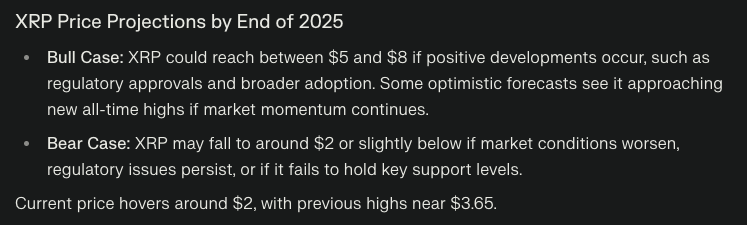
XRP (XRP): Perplexity AI Sees December Potential Ranging From Current Levels up to $8

Perplexity AI’s bearish projection indicates that Ripple’s XRP ($XRP) could keep its current level of $2 all the way to Christmas if risk appetite doesn’t pick back up.

perplexity ai predicts xrp
Source: Perplexity

Such a drop would sharply contrast with XRP’s impressive surge earlier this year, when the token climbed to a seven-year high of $3.65 in July following Ripple’s major court victory over the U.S. Securities and Exchange Commission.

XRP has spent most of 2025 trading between $2 and $3. The asset’s relative strength index (RSI) sits at an oversold 27, as XRP sank 9% in the last 24 hours, in line with a broader market selloff that took 5% off the now $3.02 trillion market.

In a favorable environment, Perplexity’s upside scenario places XRP as high as $8. The SEC’s recent approval of nine XRP spot ETFs may support institutional inflows over the Christmas holiday period, mirroring the trend seen when Bitcoin and Ethereum ETFs first launched. More ETF approvals could also be on the horizon.

Additional regulatory clarity or major partnerships could help push XRP into double-digit price territory by early 2026.

Pi Network (PI): Perplexity Forecasts Either a 120% Rally or Further Lows

Pi Network ($PI), known for its mobile-centric mining model that rewards basic daily engagement, continues to demonstrate notable resilience. Trading around $0.22, PI remains at the same price it was a fortnight ago, while Bitcoin and XRP both shed 10% over the period.

Perplexity outlines two opposing paths: in a bearish December, PI could slide further to roughly $0.18. Under bullish conditions, however, it could more than double up to $0.48, generating 120% returns for current holders.

After a prolonged decline, November appears to mark a turning point. Interest has picked up following Pi Network’s partnership with AI firm OpenMind, which showcased how Pi node operators can contribute computational power to external companies, a practical and scalable use of decentralized infrastructure.

The Pi testnet has also recently added support for decentralized exchanges, automated market makers, liquidity tools, and an improved KYC system, substantially increasing the project’s utility.

Bitcoin ($BTC): Perplexity AI Projects a Christmas Rise Toward $230,000 or an Epic Plunge Down to $75,000

Bitcoin ($BTC), the largest digital asset, recently set a new all-time high of $126,080 on October 6. Perplexity’s longer-term forecast suggests Bitcoin could push toward the $230,000 range by 2026.

Often described as digital gold, Bitcoin continues attracting significant institutional and retail capital as a perceived hedge during uncertain economic periods. BTC currently represents about $1.7 trillion of the total $3 trillion crypto market.

With inflation easing and investor sentiment improving ahead of the holidays, Bitcoin may soon retest earlier highs. The Federal Reserve’s latest interest-rate cut could also help stimulate demand and improve liquidity moving into December.

On the downside, further substantial selloffs could plunge BTC down toward $75,000. Should this happen, it will be a sign of a potentially long Bitcoin winter well into 2026.

However, Perplexity’s $230,000 projection remains achievable by early 2026, especially if the U.S. government follows through on commitments to deliver comprehensive crypto legislation.

Maxi Doge (MAXI): A Fast-Growing Meme Coin Missing From Perplexity’s Models

Although Perplexity AI sees potential pressure on major altcoins, presale tokens have continued to attract strong attention. One standout newcomer is Maxi Doge ($MAXI), which has already raised $4.2 million and promotes itself as the “next Dogecoin.”

MAXI’s storyline centers on the humorous character “Maxi Doge,” portrayed as plotting a lighthearted takeover after years of watching Dogecoin lead the meme-coin pack. The project relies on viral memes, community events, and an active social presence to fuel growth.

Built as an ERC-20 asset, MAXI benefits from Ethereum’s enhanced security, greater scalability, reduced environmental footprint, and larger developer ecosystem, advantages not present in Dogecoin’s older proof-of-work structure.

The project currently advertises staking yields up to 73% APY, though these rates will naturally decline as more users stake.

MAXI is priced at $0.000271 during its presale phase, with planned price increases in future rounds. Purchases are available via MetaMask or Best Wallet.

Dogecoin stands no chance!

Stay updated through Maxi Doge’s official X and Telegram pages.

Visit the Official Website Here

The post Perplexity AI Predicts the Price of XRP, Pi Coin, Bitcoin by the End of 2025 appeared first on Cryptonews.

Granular Access Control Policies for Post-Quantum AI Environments

Learn how to implement granular access control policies in post-quantum AI environments to protect against advanced threats. Discover strategies for securing Model Context Protocol deployments with quantum-resistant encryption and context-aware access management.

The post Granular Access Control Policies for Post-Quantum AI Environments appeared first on Security Boulevard.

Ethereum’s Core Chain Ignites With Mainnet Usage Soaring Past Prior Peaks

The leading Ethereum network is witnessing serious engagement even as its price struggles to undergo a major surge. After a massive wave of both new and old investors, the ETH mainnet utilization has increased drastically, reaching levels of adoption not seen since its inception.

Historic Lift-Off For Ethereum Mainnet Utilization

Ethereum is undergoing a shift in network adoption. In a significant landmark that cements its dominance, the Ethereum Maninnet usage has increased to the point where it feels more like a structural awakening than regular growth. 

Leon Waidmann, the founder of On-Chain Foundation and market expert, reported that the ETH mainnet’s utilization is currently at an all-time high. This kind of spike in network traffic may indicate the return of activity from the periphery to the center of the chain, new applications, or even a resurgence of trust in the network’s long-term prospects.

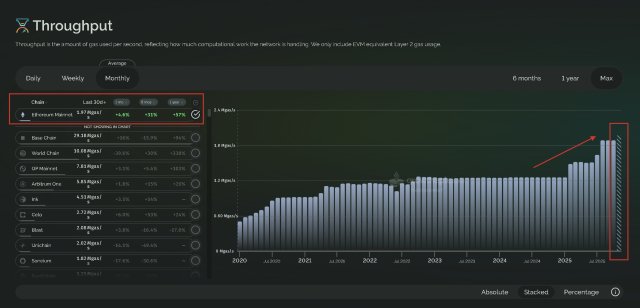
Data shared by the market expert shows the network’s usage in the past 30 days rose to 1.97mags/s, marking its highest level in history. The chart reveals that the rise to a new peak represents a more than 57% increase in Year-Over-Year (YoY), indicating that ETH is moving with intent once again.

Ethereum

While weak network effects and parasitic Layer 2s are being debated within the community, Waidmann highlighted that the Ethereum Mainnet continues to display strong growth and strength. This robust growth is evidenced by the increase in activity, spiking gas fees, and the surge in the number of ETH being burned.

By combining these key factors about the network, Waidmann claims that ETH could attract more economic load. As a result, the leading altcoin may gradually shed its old skin and take on a more rigid financial function.

Waidmann has declared that ETH could become harder money and a settlement collateral. As a result, ETH is starting to resemble the foundation of a future financial structure rather than just a utility token.

ETH Layer 2s Dominates Network’s Transactions

In the midst of surging network activity and adoption, Ethereum layer 2s are now dominating in terms of transactions at a speed that makes the base layer feel nearly slow in contrast. While the center might still hold, the edges are undeniably where users’ action currently resides.

Last week, Waidmann noted that the total Transaction Per Second (TPS) across the Ethereum network reached over 358.21. Meanwhile, a more significant portion of these transactions was carried out on layer 2 networks. According to the data shared by the on-chain Foundation founder, layer 2s controlled over 95.2% of the overall throughput. 

Such a development implies that execution has largely moved to the layer 2 chains. A major reason for this might be that users, liquidity, and developers are looking for quicker and less expensive channels to carry out transactions, transforming ETH’s scaling stack into the ecosystem’s actual heartbeat.

Ethereum

BlackRock Quietly Parks $4.3B On A Ghost Chain

By: Myxoplixx

Sei might be the most underrated chain in crypto right now. On paper, public dashboards show about $20,000,000 in total value locked across its DeFi ecosystem, a number that makes it look like yet another niche layer 1 fighting for scraps. Yet behind the scenes institutional capital flowing through tokenized funds tells a completely different story. When capital flows from giants like BlackRock and Hamilton Lane are tallied, Sei is already hosting about $4.3 billion in scoped or deployed assets. That creates a gap of more than 200 times between what most aggregators display and what is actually being built on chain.

The core of this discrepancy comes from how TVL trackers categorize “real world asset” tokenization and permissioned funds. BlackRock’s BUIDL fund, which started on Ethereum in 2024 and grew past $1 billion then toward nearly $3 billion in assets by mid 2025, has expanded across multiple chains through institutional platforms. In October 2025 BlackRock and Brevan Howard launched tokenized funds on Sei via the KAIO infrastructure, bringing BUIDL and a digital liquidity fund into production on the network. These positions can reach into the billions, but because the tokens are permissioned and often whitelisted, traditional DeFi dashboards undercount them or exclude them entirely from public TVL.

That is how you end up with BlackRock reportedly deploying about $2.3 billion worth of BUIDL capital on a chain whose native token trades at a market cap of around $1.8 billion. The world’s largest asset manager is effectively running more on chain value through Sei than the market currently assigns to the entire network itself. To make things spicier, this institutional footprint sits alongside only tens of millions in visible DeFi liquidity, which keeps Sei off most retail radar screens. Traders who screen by TVL alone see a small ecosystem and move on while the serious money is already experimenting with settlement, tokenization, and high performance execution.

Why Sei though? The answer is mostly about speed, cost, and reliability at institutional scale. Sei’s architecture focuses on ultra fast settlement, around 400 millisecond finality, and thousands of transactions per second, along with an on chain matching engine for trading. That kind of performance matters when you are tokenizing money market funds, bond like products, or liquidity vehicles that need to support constant institutional flows without clogging. Combined with integrations from tokenization specialists like Securitize and KAIO, Sei offers a kind of institutional grade sandbox where traditional finance can plug in without sacrificing compliance controls.

The 200 times gap between perceived TVL and actual institutional capital hints that the market might be mispricing the chain’s strategic position. If aggregators slowly adapt to count tokenized funds as part of TVL, or if even a fraction of that $4.3 billion becomes composable with open DeFi, Sei’s metrics could reprice in a hurry. More importantly, BlackRock’s choice to use Sei for real production capital acts as a massive signal to other asset managers who are still deciding where to deploy. For now it looks like the biggest player on Wall Street has quietly circled a lightly traded chain on the map and the rest of the market has not connected the dots yet.

Originally published at https://coinbasecorridor.blogspot.com on November 30, 2025.


BlackRock Quietly Parks $4.3B On A Ghost Chain was originally published in Coinmonks on Medium, where people are continuing the conversation by highlighting and responding to this story.

How to Look at Network Traffic: Essential Tools and Methods for Real-Time Analysis

Network traffic monitoring is one of the most crucial tasks for any IT professional or sysadmin. Whether you’re troubleshooting performance issues, hunting for security vulnerabilities, or optimizing bandwidth usage, understanding how to effectively monitor network traffic can be the difference between a healthy network infrastructure and costly outages.

My Journey From Zero to My First Profit — Launching Solana Memecoins in 2 Months

My Journey From Zero to My First Profit — Launching Solana Memecoins in 2 Months

How I Went From Total Beginner to Profitable Solana Memecoin Creator in Just 60 Days

When I started this journey, I was a total novice. No big capital. No insider network. Just curiosity — and a dream: to create a memecoin on Solana and actually make money from it.

Two months later? I made my first real profit. And I want to share exactly how I did it — not to brag, but to show that it’s possible — if you’re smart, disciplined, and willing to learn.

The Beginning: From Confusion to Clarity

Getting Started Was Chaos

  • I devoured YouTube tutorials, guides, and community threads. But most advice was either overly optimistic hype or full of scams.
  • My first launch on Pump.fun ended in disaster: only three bots bought, and they sold seconds after launch. I barely had time to react.
  • I learned a hard truth: if you don’t have at least $1,000 in capital, you’re fighting an uphill battle. Small dev buys (like 0.1–0.5 SOL) led to losses once trading and commission costs piled up.

The Secret Premium Memecoin Trading Strategy They Won’t Teach You: Unlocking 200x Results in 2025

Cracking the Code: How Profitable Devs Do It

Through trial and error, I discovered a few key insights that changed everything:

Multi-Wallet Strategy

  • Instead of launching from one wallet, I split my buys across many. This makes it look like different people are participating, not just “me.”
  • This trick is used not only by devs, but also by snipers and even trading bots.

Automation & Launch Tools

  • I experimented with “sniper bots” — Telegram bots that let you split one wallet into many, deploy your token, and buy bundles.
  • Then I graduated to automated launch systems — more expensive, but powerful. These tools gave me chart control, anti-sniping protection, MEV safety, and bundle strategies.
  • These tools don’t guarantee “100×”: they’re not magic. But when combined with a good launch plan, they give you a real shot.

Building a Real Community

  • I didn’t just launch a meme coin and disappear. I created a Twitter/X community, posted daily, and engaged.
  • With a small but active core group (50 people or so), I was already building momentum
  • I used AI tools (like ChatGPT) to help craft my token’s story, image, and description.

Launching the Token: The Strategy That Worked

This is how I actually did my first successful launch:

Define the Idea:

  • Pick a meme — but don’t overthink it.
  • Make it relatable and simple.

Set Up Using the Right Tools:

  • I used a bot or automated system depending on my budget.
  • For me, paying for an automated system made sense — it brought control.

Deploy & Control the Chart:

  • Use your wallets to buy bundles immediately after dev sells.
  • Use chart control features in your automation tool to “smooth out” the launch.
  • Buy on dips, sell on peaks. Don’t try to predict everything — use logic + tools.

Activate Your Community:

  • Tweet/ post about your project.
  • Share contract address + liquidity proof.
  • Keep your community updated in real time.

Monitor, Adjust, Take Profit:

  • Watch how traders react.
  • Use your multi-wallet strategy to keep your chart balanced.
  • When things are good, sell parts of your holdings. Reinvest or take profit; don’t go all-in.

AI-Powered Meme Coin Trading: The Hidden Advantage No One Is Talking About

The Result — What I Earned and Learned

  • In the first month, after experimenting with bots and automated systems, I earned ~30 SOL.
  • I wasn’t greedy — I focused on daily profit, not chasing 100x in a single trade.
  • It took discipline, patience, and a willingness to “fail small” many times.

Key Lessons I Wish I Knew Before I Started

  1. Start with capital — Trying to launch serious coins with less than 1,000 USD equivalent in SOL is very hard.
  2. Use real tools — Learning via free or cheating ways only takes you so far. Automation gives you an edge.
  3. Don’t underestimate community — A token with no people behind it is just code; a token with active users has potential.
  4. Chart control matters — If you can’t manage your supply / bundles, bots and early traders will run away with your launch.
  5. Take profit smartly — Use wallets, bots, and strategy to take money off the table and keep some to ride.

Why This Strategy Isn’t Just for Memecoin Gurus

  • You don’t need a huge team — just the right tools, a simple idea, and a little capital.
  • The automation systems are becoming more accessible.
  • If you’re disciplined and methodical, you can learn how to build and launch a token and profit in a reasonable timeframe.

How I Turned 2 SOL Into 15 SOL Trading Meme Coins — The Complete 2025 Guide to Sniping, Filtering…

Risks & Reality Check

  • Launching memecoins is risky — there are many scams, rug pulls, and failed launches.
  • Automation costs money — and paying a lot doesn’t guarantee success.
  • There’s no guarantee every coin you launch will moon. Sometimes you’ll just break even or lose.
  • Trading / launching memecoins involves on-chain risk (smart contract bugs, rug logic) and market risk (liquidity exit, price dump).

The System That Changed Everything — The Goldmine Memecoin Strategy

Before I found consistency, I was doing what everyone else does: guessing, hoping, and copying random Telegram calls.
That’s exactly why most people lose money in memecoins — there’s no structure, no timing, no strategy.

Everything changed when I built what I now call The Goldmine Memecoin Strategy.

This isn’t another “buy early and pray” method.
It’s a precision-engineered framework that breaks down memecoin trading and launching into clear, repeatable steps:

✅ How to identify tokens that can actually 10x–200x before the crowd even notices

Most traders are always late. Goldmine gives you the filters, timing windows, and behaviour patterns insiders use to spot winners before they become popular.

✅ How to avoid obvious rugs, smart-contract traps, and bot-manipulated charts

You get the exact red flags that instantly disqualify a token — saving you from 80% of losses.

✅ How to use Telegram sniper bots, multi-wallet tools, and filtering systems the way pros use them

Not just how to push buttons — but how to use them strategically to maximize entries and minimize losses.

✅ How to take profit like a professional (without draining the chart or getting stuck)

Most beginners blow their profits because they sell wrong. Goldmine shows you how to exit quietly, safely, and profitably.

✅ How to build consistent small daily gains that add up to massive wins

No hype. No luck. Just a disciplined system that helped me turn my first real profits in this space.

Why You Need This Strategy

If you’re serious about profiting from memecoins — launching or trading — you need more than vibes, hype, and hope.
You need a framework.

Goldmine gives you:

  • The exact tools I use
  • The exact timing windows I use
  • The exact filtering logic I use
  • The exact daily routine I use
  • And the exact playbook that moved me from confused beginner to consistent earner

Whether you’re launching your own token or sniping new ones, this strategy gives you the blueprint.

👉 Get the Goldmine Memecoin Strategy

If you enjoy this breakdown and want to level up your results, you can get the full strategy here:

Buy THE GOLDMINE MEME COIN STRATEGY — 200x Secrets Finally Revealed!
(Where 100x Gains Aren’t Luck — They’re Engineered)

Contact me directly on Telegram: t.me/fxmbrand
I also run a private community of 2,000+ pro traders who trade GOLD and forex pairs. (For FOREX TRADERS)

Buy THE GOLDMINE MEME COIN STRATEGY - 200x Secrets Finally Revealed! by Stephen Emeka on Selar

Final Thoughts: From Novice to Profitable Creator

Two months ago, I didn’t know how to deploy a token smartly, how bots worked, or how to build a community around a meme. Today, I’ve made real profit — not by luck, but by building, learning, and executing.

If you want to try creating your own memecoin on Solana:

  • Start with a clear idea
  • Use automated tools (even if it costs)
  • Build a real community
  • Deploy with control
  • Take smart profits

You might not make 1,000x your money. But if you follow this path, you can make your first SOL profit — and that’s how you learn, grow, and scale.


My Journey From Zero to My First Profit — Launching Solana Memecoins in 2 Months was originally published in Coinmonks on Medium, where people are continuing the conversation by highlighting and responding to this story.

Why prioritizing code quality is the fastest way to reduce security risks

The common perception is that a security vulnerability is a rare, complex attack pattern. In reality, the journey of most flaws begins much earlier and much more simply: as a code quality issue. For both developers and security practitioners, understanding this lifecycle is crucial to building secure, reliable, and maintainable software.

The post Why prioritizing code quality is the fastest way to reduce security risks appeared first on Security Boulevard.

❌