
❌

Reading view

There are new articles available, click to refresh the page.

Bitcoin Price Slides Below $90,000 – Is A Retest Of The November Lows Near?

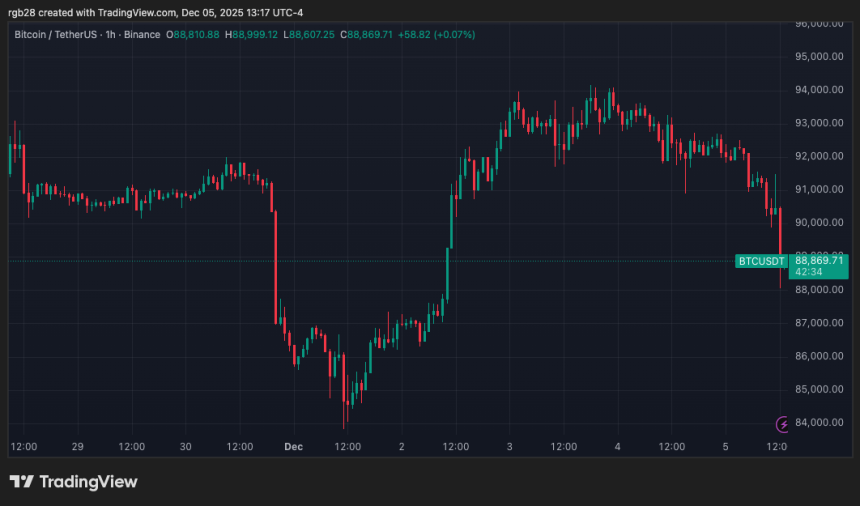
Bitcoin (BTC) is retesting a crucial support area after its price slid 5% from the recent highs and fell below the $90,000 barrier. Some analysts have suggested that the cryptocurrency’s structure remains intact, but warned that it must bounce quickly or risk retesting the November lows.

Bitcoin Retests $88,000 After Rejection

On Friday, Bitcoin lost the recently reclaimed $90,000 level, falling to a key support area before stabilizing. The flagship crypto has been attempting to recover from the November market correction, which sent its price to a seven-month low of $80,600.

Since reaching its local lows two weeks ago, the cryptocurrency has traded within a macro re-accumulation range, between $82,000 and $93,500, attempting to break out of this zone on Wednesday, when it reached a multi-week high of $94,150.

However, as the first week of December approaches its end, BTC has lost the upper area of its local range again, falling below its monthly open and tapping the $88,000 support.

Amid the drop, Analyst Ted Pillows noted that BTC has been struggling to reclaim the $94,000 resistance, adding that price β€œwants to go lower here before another breakout attempt.”  Therefore, he suggested that a bounce back from the $88,000-$89,000 support zone is likely.

Altcoin Sherpa affirmed that the ongoing retest would confirm whether the recent bounce was β€œjust lower highs and price is going lower or if we actually have any juice to bounce to like 100k or something.”

The analyst outlined two potential outcomes. In the first scenario, the flagship crypto would retrace to the $87,000-$89,000 area and bounce above the $93,000-$94,000 resistance levels.

In the second scenario, Bitcoin would continue to move sideways below the local resistance before eventually sliding to the November lows and potentially lower levels. Per the analysis, the leading cryptocurrency must bottom quickly, or it will risk the second outcome.

BTC Shows Shallowing Pullback Tendency

Analyst Rekt Capital also pointed out that Bitcoin continues to face rejection from the range high resistance. However, he considers that investors should not worry as long as the pullback isn’t as big as the previous ones.

If β€œthe rejection is shallower than the previous two, then this resistance will continue to weaken until eventually breached,” he explained, adding that β€œas long as this weakening continues, BTC should be able to finally breach this resistance over time & try to challenge the multi-week Downtrend above.”

Earlier this week, the analyst affirmed that BTC’s consolidation structure will remain intact as long as Bitcoin closes the week above the range lows. He also noted that its Macro Downtrend, which β€œhas been dictating resistance throughout this phase of the cycle,” remains the dominant structural barrier and the level to break.

As the price stabilized between the $88,500-$89,350 area, the analyst added that today’s retracement β€œcontinues to be a shallower pullback than the previous two,” which keeps the range β€œβ€˜retrace shallowing’ tendency” intact.

He noted that Bitcoin could technically drop into the ascending two-week support trendline, or tap the $86,000 level and still perform a shallower correction than the recent 10% drop.

As of this writing, Bitcoin is trading at $89,400, a 2.9% decline in the daily timeframe.
Bitcoin, btc, btcusdt

Bitcoin Liquidation Dominance Hits Multi-Year High: The Real Cause Behind BTC’s Breakdown

Bitcoin continues to trade below $90,000, struggling to recover after several days of heavy selling and aggressive long liquidations. Sellers keep pushing price lower, and bulls fail to reclaim momentum, creating a market environment filled with uncertainty and fear. Every attempt to bounce meets immediate resistance, showing how much control bears currently hold.

Data shared by Axel Adler shows a clear shift in derivatives pressure toward buyers. The liquidation dominance oscillator now sits at 32%, one of its highest readings in recent years. This level signals that leveraged bulls keep taking the majority of the damage, with long positions consistently wiped out as volatility rises. Instead of absorbing the drawdown, many traders continue to unwind or get forced out of their positions.

These repeated long liquidations fuel deeper downside moves and block any meaningful recovery attempts. The market now watches closely to see whether this wave of forced selling will continue dragging Bitcoin lower or if the pressure is finally reaching exhaustion.

Long Liquidations Dominate as Bitcoin Faces Renewed Downside Pressure

Adler explains that the liquidation dominance oscillator measures the ratio between long and short liquidations across the derivatives market. When the indicator prints positive values, shown as green bars, long positions take the bulk of the damage.

Negative values reflect a dominance of short liquidations. Bitcoin’s current reading of 32% stands out as one of the highest levels seen in the last three years, highlighting how aggressively bulls have been forced out during this correction.

November illustrates this perfectly. The market saw three separate waves of long liquidations, each exceeding $400 million. Every one of those spikes aligned with a sharp acceleration in Bitcoin’s price decline, reinforcing how leveraged buyers repeatedly amplified downside momentum. Rather than stabilizing the market, each flush created more selling pressure and triggered deeper unwinding across futures platforms.

Bitcoin Long Liquidations USD | Source: Axel Adler

The most recent liquidation wave reached $221 million, hitting the market right as Bitcoin attempted a short-term recovery. That flush immediately reversed the bounce and dragged BTC back down to the $86,000 region, erasing nearly all of last week’s gains. The persistent dominance of long liquidations shows that bulls remain under heavy stressβ€”and until this dynamic eases, Bitcoin will struggle to build sustainable upside.

Bitcoin Market Searches for a Higher Time-Frame Floor

Bitcoin’s weekly chart shows the market pressing into a critical support zone after weeks of heavy selling. The price has dropped from the $115,000 region to the $86,000–$88,000 range, where it now interacts directly with the 100 SMA. This moving average has served as a key structural support in previous cycles, and Bitcoin’s current test of it will likely determine whether the broader uptrend holds or breaks down further.

BTC Consolidates below $90K | Source: BTCUSDT chart on TradingView

The recent candles highlight intense volatility. Bitcoin briefly dipped to nearly $84,000 before buyers stepped in, forming a lower wick that shows early attempts to defend this level. However, the rebound remains shallow, and the 50 SMA continues to slope downward β€” a sign that short- and mid-term momentum still favors sellers. For bulls to regain control, BTC needs to reclaim $95,000 on a weekly closing basis.

Volume adds weight to the bearish pressure. Selling spikes dominate recent weeks, revealing a mix of forced liquidations and fear-driven exits rather than healthy profit-taking. As long as BTC trades below the 50 SMA, the market remains vulnerable to deeper retracements.

If the 100 SMA fails to hold, the next major liquidity zone sits near $70,000–$72,000, aligning with previous consolidation and the long-term 200 SMA. The next weekly close will be decisive.

Featured image from ChatGPT, chart from TradingView.com

❌