Reading view

There are new articles available, click to refresh the page.

MSCI Proposal Singles Out Bitcoin Treasury Companies and Undercuts Benchmark Neutrality

By: Nick Ward

Bitcoin Magazine

MSCI Proposal Singles Out Bitcoin Treasury Companies and Undercuts Benchmark Neutrality

MSCI is considering a new rule that would remove companies from its Global Investable Market Indexes if 50% or more of their assets are held in digital assets such as Bitcoin. The proposal appears simple, but the implications are far-reaching. It would affect companies like Michael Saylor’s Strategy (formerly MicroStrategy), Eric and Donald Trump Jr’s American Bitcoin Corp (ABTC), and dozens of others across global markets whose business models are fully legitimate, fully regulated, and fully aligned with long-standing corporate treasury practices.

The purpose of this document is to explain what MSCI is proposing, why the concerns raised around Bitcoin treasury companies are overstated, and why excluding these firms would undermine benchmark neutrality, reduce representativeness, and introduce more instability—not less—into the indexing system.

1. What MSCI Is Proposing

MSCI launched a consultation to determine whether companies whose primary activity involves Bitcoin or other digital-asset treasury management should be excluded from its flagship equity indices if their digital-asset holdings exceed 50% of total assets. The proposed implementation date is February 2026.

The proposal would sweep in a broad set of companies:

  • Strategy (formerly MicroStrategy), a major software and business-intelligence firm that holds Bitcoin as a treasury reserve.
  • American Bitcoin Corp (ABTC), a new public company created by Eric and Donald Trump with a Bitcoin-focused balance sheet.
  • Miners, infrastructure firms, and diversified operating companies that use Bitcoin as a long-term inflation hedge or capital reserve.

These companies are all publicly traded operating entities with audited financials, real products, real customers, and established governance. None are “Bitcoin ETFs.” Their only distinction is a treasury strategy that includes a liquid, globally traded asset.

2. The JPMorgan Warning — And the Reality Behind It

JPMorgan analysts recently warned that Strategy could face up to $2.8B in passive outflows if MSCI removes it from its indices, and up to $8.8B if other index providers follow.

Their analysis correctly identifies the mechanical nature of passive flows. But it misses the real context.

Strategy has traded more than $1 trillion in volume this year.
The “catastrophic” $2.8B scenario represents:

  • Less than one average trading day
  • ~12% of a typical week
  • ~3% of a typical month
  • 0.26% of year-to-date trading flow

In liquidity terms, this is immaterial. The narrative of a liquidity crisis does not match market structure reality. The larger issue is not the outflow itself—it is the precedent that index exclusion would set.

If benchmark providers begin removing companies because of the composition of their treasury assets, the definition of what qualifies as an “eligible company” becomes non-neutral.

MSCI $MSTR DE-LISTING FEAR MONGERING: THE $2.8 BILLION LIE

First: Strategy is at ZERO risk of being delisted from other indices. Second: J.P. Morgan says an MSCI delisting would trigger a $2.8 Billion forced sell off. They are banking on you not knowing the math.

I assessed… pic.twitter.com/NszHcnYt69

— Adrian (@_Adrian) November 25, 2025

3. A Contradiction on MSCI’s Own Balance Sheet

MSCI’s policy position also conflicts with the composition of MSCI’s own assets.

MSCI reports roughly $5.3B in total assets.
More than 70%—about $3.7B—is goodwill and intangible assets. These are non-liquid, non-marketable accounting entries that cannot be sold or marked to market. They are not verifiable in the same way that digital assets are.

Bitcoin, by contrast:

  • Trades globally 24/7
  • Has transparent price discovery
  • Is fully auditable and mark-to-market
  • Is more liquid than nearly any corporate treasury asset outside sovereign cash

The proposal would penalize companies for holding an asset that is far more liquid, transparent, and objectively priced than the intangibles that dominate MSCI’s own balance sheet.

MSCI is a New York based, pubco ( $MSCI) with ~$5.3B in assets on its balance sheet.

70% ($3.7B) of MSCI's assets are classified as “intangible” (goodwill and other intangible assets).​

At the same time, MSCI is proposing to exclude companies whose digital asset holdings… pic.twitter.com/dyVwRR2AhH

— Jeff Walton (@PunterJeff) November 25, 2025

4. How the Proposal Violates Benchmark Principles

MSCI is a global standard-setter. Its benchmarks are used by trillions of dollars in capital allocation. These indices are governed by widely accepted principles—neutrality, representativeness, and stability. The proposed digital-asset threshold contradicts all three.

Neutrality

Benchmarks must avoid arbitrary discrimination among lawful business strategies.
Companies are not removed for holding:

  • Large cash positions
  • Gold reserves
  • Foreign exchange reserves
  • Commodities
  • Real estate
  • Receivables that exceed 50% of assets

Digital assets are the only treasury asset singled out for exclusion. Bitcoin is legal, regulated, and widely held by institutions worldwide.

Representativeness

Indices are meant to reflect investable markets—not curate them.

Bitcoin treasury strategies are increasingly used by corporations of all sizes as a long-term capital-preservation tool. Removing these companies reduces the accuracy and completeness of MSCI’s indices, giving investors a distorted view of the corporate landscape.

Stability

The 50% threshold creates a binary cliff effect.
Bitcoin routinely moves 10–20% in normal trading. A company could fall in and out of index eligibility multiple times a year simply due to price action, forcing:

  • Unnecessary turnover
  • Additional tracking error
  • Higher fund implementation costs

Index providers typically avoid rules that amplify volatility. This rule would introduce it.

5. The Market Impact of Exclusion

Forced Selling

If MSCI proceeds, passive index funds would need to sell holdings in affected companies.
Yet the real-world impact is marginal because:

  • Strategy and ABTC are highly liquid
  • Flows represent a tiny fraction of normal trading volume
  • Active managers are free to continue holding or increasing exposure

Access to Capital

Analysts warn that exclusion could “signal” risk. But markets adapt quickly.
As long as a company is:

  • Liquid
  • Transparent
  • Able to raise capital
  • Able to communicate its treasury policy
    It remains investable. Index exclusion is an inconvenience—not a structural impairment.

Precedent Risk

If MSCI embeds asset-based exclusion rules, it sets a template for removing companies based on their savings decisions rather than their business fundamentals.

That is a path toward politicizing global benchmarks.

6. The Global Competitiveness Problem

Bitcoin treasury strategies are expanding internationally:

  • Japan (Metaplanet)
  • Germany (Aifinyo)
  • Europe (Capital B)
  • Latin America (multiple mining and infrastructure firms)
  • North America (Strategy, ABTC, miners, and energy-Bitcoin hybrids)

If MSCI excludes these companies disproportionately, U.S. and Western companies are placed at a competitive disadvantage relative to jurisdictions that embrace digital capital.

Indexes are meant to reflect markets—not pick national winners and losers.

7. MSCI Already Knows That Exclusion Creates Distortion

MSCI’s recent handling of Metaplanet’s public offering shows it understands the risks of “reverse turnover.” To avoid index churn, MSCI chose not to implement the event at the time of offering.

This acknowledgement underscores a broader truth: rigid rules can destabilize indices.
A digital-asset threshold creates similar fragility on a much larger scale.

8. Better Alternatives Exist

MSCI can achieve transparency and analytical clarity without excluding lawful operating companies.

A. Enhanced Disclosure

Require standardized reporting of digital-asset holdings in public filings.
This gives investors clarity without altering index composition.

B. Classification or Sub-Sector Label

Add a category such as “Digital Asset Treasury–Integrated” to help investors differentiate business models.

C. Liquidity or Governance Screens

If concerns are about liquidity, governance, or volatility, MSCI should use the criteria it already applies uniformly across sectors.

None require exclusion.

9. Why the Proposal Should Be Withdrawn

The proposal does not solve a real problem.
It creates several:

  • Reduces representativeness of global indices
  • Violates neutrality by discriminating against a specific treasury asset
  • Creates unnecessary turnover for passive funds
  • Damages global competitiveness
  • Sets a precedent for non-neutral index construction

Bitcoin is money. Companies should not be penalized for saving money—or for choosing a long-term treasury asset that is more liquid, more transparent, and more objectively priced than most corporate intangibles.

Indexes must reflect markets as they are—not as gatekeepers prefer them to be.

MSCI should withdraw the proposal and maintain the neutrality that has made its benchmarks trusted across global capital markets.

Disclaimer: This content was prepared on behalf of Bitcoin For Corporations for informational purposes only. It reflects the author’s own analysis and opinion and should not be relied upon as investment advice. Nothing in this article constitutes an offer, invitation, or solicitation to purchase, sell, or subscribe for any security or financial product.

This post MSCI Proposal Singles Out Bitcoin Treasury Companies and Undercuts Benchmark Neutrality first appeared on Bitcoin Magazine and is written by Nick Ward.

These New Shareholder Tools Make Bitcoin Activism Easy to Launch and Hard to Ignore

By: Nick Ward

Bitcoin Magazine

These New Shareholder Tools Make Bitcoin Activism Easy to Launch and Hard to Ignore

For most of my life, the limiting factor in bringing my ideas to life has been code. I’ve always had a clear vision for the tools I wanted to build, but the execution gap was real. The ideas stayed on whiteboards, in notebooks, or in half-finished PhotoShop mockups.

That barrier no longer exists.
AI has collapsed it.

In just 9 days, I built two fully functioning consumer applications designed to equip shareholders with the leverage they’ve never had: the ability to advocate—cleanly, credibly, and at scale, for Bitcoin on the corporate balance sheet.

These tools weren’t commissioned. No one told me to build them. They are not fancy, intricate, or technically complicated. They came from a simple observation: 1) corporations control the majority of global capital, and 2) shareholders deserve a frictionless way to push those corporations toward strategic, long-term Bitcoin adoption.

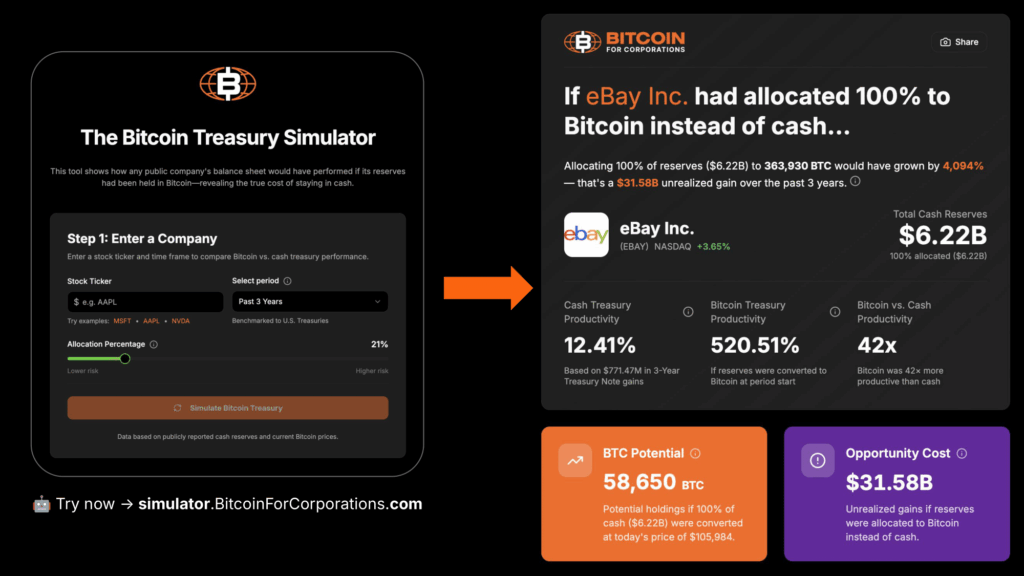
1. The Bitcoin Treasury Simulator

The Bitcoin Treasury Simulator answers a question that should be trivial but wasn’t:
How would a company have performed if it had allocated even a portion of its treasury to Bitcoin?

Retail investors can now enter a ticker, choose a time frame, and instantly see the opportunity cost of holding cash instead of Bitcoin—expressed in clear, defensible terms that anyone can understand.

For the first time, shareholders have a factual, data-driven tool they can bring to boards, IR teams, and fellow investors to show exactly what’s at stake.

🤖 Try the simulator: simulator.bitcoinforcorporations.com

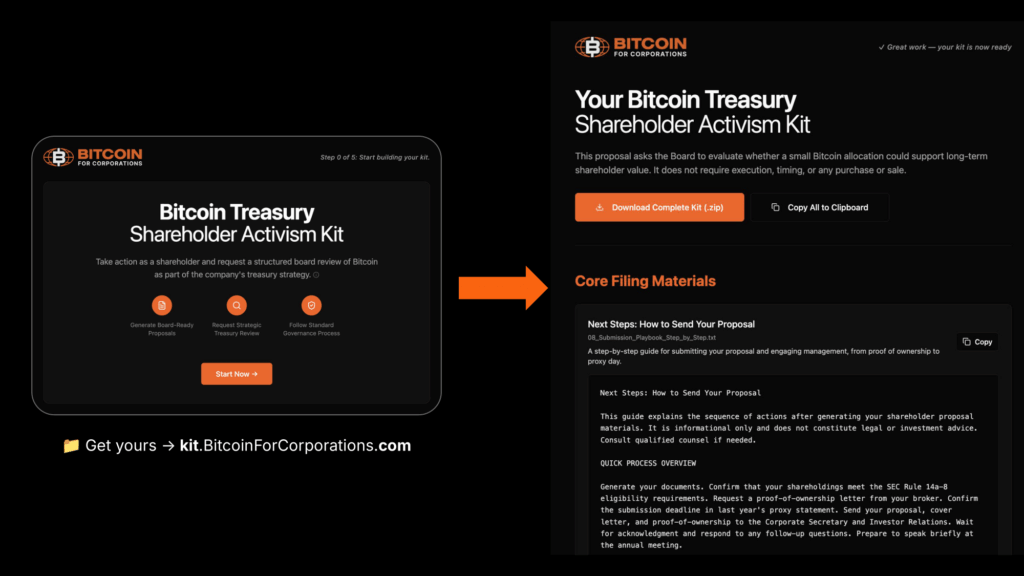
2. The Bitcoin Treasury Shareholder Activism Kit

Shareholder activism has always been powerful, but it’s been inaccessible to most investors. The rules are complex. The legalese is intimidating. The entire process feels like a wall you only get past if you’re a lawyer or a billion-dollar fund.

So I built a generator that removes all of that friction.

The Bitcoin Treasury Shareholder Activism Kit walks any verified shareholder—step by step—through generating a legitimate, SEC-compliant proposal asking a company to evaluate or adopt a Bitcoin treasury strategy. It produces the documentation, the language, the filing structure, and the instructions needed to get the proposal included in the company’s proxy.

Something that once felt like it required attorneys and institutional resources can now be completed in 2 minutes.

🤖 Create your kit: kit.bitcoinforcorporations.com

Why These Tools Exist

Corporate Bitcoin adoption does not happen by accident. It happens because someone—inside or outside the company—pushes for it with clarity, precision, and persistence.

These tools are built for the people willing to make that push.

They give shareholders:

  • Clear data.
  • A credible filing pathway.
  • A structured way to change corporate behavior.
  • And the confidence to take action without needing permission.

If you understand the value of compute, you should understand #Bitcoin.

Yet @Nvidia sits on ~$43B in cash.#Bitcoin outpaced cash reserves by ~41x over the last 3 years—That's nearly $216B in opportunity cost. pic.twitter.com/AftSN7LHpm

— Nick Ward (@nckbtc) November 11, 2025

What Comes Next

This is just the beginning. Both tools will evolve, expand, and integrate more deeply into the broader Bitcoin For Corporations ecosystem. But the important part is this: AI has made technical hurdles of these projects much easier to overcome.

And if enough people decide to build the future they want—one tool at a time—we accelerate corporate Bitcoin adoption far faster than anyone expects.

Disclaimer: This content was written on behalf of Bitcoin For CorporationsThis article is intended solely for informational purposes and should not be interpreted as an invitation or solicitation to acquire, purchase or subscribe for securities.

This post These New Shareholder Tools Make Bitcoin Activism Easy to Launch and Hard to Ignore first appeared on Bitcoin Magazine and is written by Nick Ward.

Strategy (MSTR) Earns S&P ‘B-’ Rating, Marking a Major Milestone for Bitcoin-Backed Credit

By: Nick Ward

Bitcoin Magazine

Strategy (MSTR) Earns S&P ‘B-’ Rating, Marking a Major Milestone for Bitcoin-Backed Credit

For the first time in financial history, a major credit rating agency has formally evaluated a company built on a bitcoin-backed credit model. In news covered by Bitcoin Magazine, the S&P Global Ratings has assigned Strategy Inc (MSTR) a ‘B-’ Issuer Credit Rating with a Stable outlook, recognizing not just the company, but the emergence of Bitcoin as collateral inside the credit system. This marks a watershed moment for corporate finance. Bitcoin-backed credit is no longer theoretical. It is now a rated financial reality.

Why This Moment Matters

Until now, Bitcoin had been accepted by equity markets, ETFs, and corporate treasury conversations — but credit markets remained untouched. Credit markets are where legitimacy is ultimately decided because they determine who can borrow, at what cost, and against which assets.

By rating Strategy Inc, S&P has implicitly acknowledged:

  • Bitcoin can underpin structured debt and preferred equity.
  • A bitcoin-backed credit strategy can be modeled, rated, and priced using traditional frameworks.
  • Bitcoin is shifting from speculative asset to recognized collateral within corporate capital structures.

This is not a marketing milestone — it is a structural one. Bitcoin has entered the language of risk-adjusted return, yield, and covenants.

How S&P Interpreted Strategy’s Bitcoin-Backed Capital Model

The rating is speculative grade, but the Stable outlook is critical. It signals S&P’s belief that Strategy can continue to service obligations and access capital markets without selling its Bitcoin reserves — a foundational principle of bitcoin-backed credit.

S&P’s analysis mentions several possible weaknesses:

  • High concentration of assets in Bitcoin
  • Low U.S. dollar liquidity and negative risk-adjusted capital under S&P’s methodology
  • Currency mismatch: long Bitcoin, short U.S. dollar debt obligations
  • Limited operating cash flow outside software revenue

However, they also credited Strategy with unique structural strengths:

  • No near-term debt maturities before 2027–2028
  • Proven access to capital markets — both equity and debt
  • A capital stack purpose-built to accumulate Bitcoin without diluting shareholders
  • Active liability management via convertible debt and preferred stock instruments

In short, S&P is signaling that bitcoin-backed credit can function — if managed with discipline.

Implications for the S&P 500 and Institutional Legitimacy

Strategy Inc met the S&P 500 inclusion criteria in profitability and market capitalization but was passed over in 2024, widely believed to be due to its Bitcoin-heavy balance sheet. That decision now appears less defensible.

With a formal credit rating, the company shifts from “unrated anomaly” to “rated issuer.” For institutional capital, that distinction matters.

  • Index committees can now reference a risk rating — not just a narrative.
  • Treasury teams and insurers can benchmark exposure to bitcoin-backed credit against traditional corporate debt.
  • This increases (not guarantees) the probability of future index inclusion and passive capital flows.

Bitcoin entering equity indices begins with Bitcoin entering the credit models behind them.

Bitcoin-Backed Credit: The Ideal State of Treasury Strategy

This rating does more than validate Strategy — it validates the architecture of bitcoin-backed credit as the superior evolution of corporate treasury management.

Phase 1 was equity-funded Bitcoin accumulation — high growth but shareholder dilution.
Phase 2 introduced convertible debt and preferred equity — allowing companies to acquire Bitcoin through capital markets rather than operating earnings.
Phase 3, now underway, is full institutional recognition of bitcoin-backed credit — rated, benchmarked, and capable of scaling.

This is the endgame:

  • Use capital markets to borrow in fiat
  • Use proceeds to acquire Bitcoin
  • Service liabilities without selling reserves
  • Increase Bitcoin-per-share over time, without issuing new common stock

With S&P formally rating Strategy’s issuer credit, this model moves from innovation to infrastructure.

Why Corporate Finance Leaders Need to Pay Attention

This rating does not compel companies to adopt Bitcoin. But it removes the claim that Bitcoin cannot be integrated into traditional credit systems.

From now on:

  • Bitcoin can be factored into risk-weighted capital models and treasury policy.
  • Credit and liquidity committees must understand how bitcoin-backed credit affects financing costs, refinancing risk, and balance sheet leverage.
  • Investors can now compare Bitcoin-based capital structures against other high-yield or hybrid debt strategies.
  • Boards can no longer dismiss Bitcoin as “unratable” or “unclassified.”

A New Chapter for Corporate Finance and Capital Markets

What makes this moment different isn’t that another institution “acknowledged” Bitcoin. That’s happened before with ETFs, GAAP accounting changes, and treasury allocations.

What’s different is where the recognition has now occurred: Not in equity markets. Not in payment networks. But in credit — the foundation of corporate finance and monetary systems.

When a credit rating agency like S&P evaluates a company built on Bitcoin, it does three things that have never happened before:

  • It forces Bitcoin into risk models normally reserved for banks, sovereigns, and investment-grade corporations.
  • It legitimizes bitcoin-backed credit as a structure that can be analyzed, refinanced, and scaled — not dismissed as speculative.
  • It signals to other corporates and lenders that they must now understand Bitcoin not as an investment, but as collateral.

This rating does not mean the model is risk-free. It means the model is real enough to underwrite, stress test, and lend against.

That is the real inflection point — not that S&P approved of Bitcoin, but that they were forced to measure it.

Disclaimer: This content was written on behalf of Bitcoin For CorporationsThis article is intended solely for informational purposes and should not be interpreted as an invitation or solicitation to acquire, purchase or subscribe for securities.

This post Strategy (MSTR) Earns S&P ‘B-’ Rating, Marking a Major Milestone for Bitcoin-Backed Credit first appeared on Bitcoin Magazine and is written by Nick Ward.

❌