Reading view

There are new articles available, click to refresh the page.

Off-Grid, Small-Scale Payment System

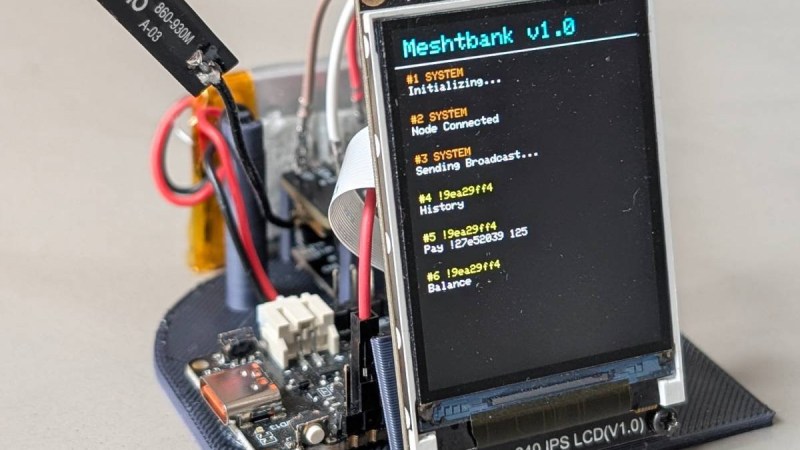
An effective currency needs to be widely accepted, easy to use, and stable in value. By now most of us have recognized that cryptocurrencies fail at all three things, despite lofty ideals revolving around decentralization, transparency, and trust. But that doesn’t mean that all digital currencies or payment systems are doomed to failure. [Roni] has been working on an off-grid digital payment node called Meshtbank, which works on a much smaller scale and could be a way to let a much smaller community set up a basic banking system.

The node uses Meshtastic as its backbone, letting the payment system use the same long-range low-power system that has gotten popular in recent years for enabling simple but reliable off-grid communications for a local area. With Meshtbank running on one of the nodes in the network, accounts can be created, balances reported, and digital currency exchanged using the Meshtastic messaging protocols. The ledger is also recorded, allowing transaction histories to be viewed as well.

A system like this could have great value anywhere barter-style systems exist, or could be used for community credits, festival credits, or any place that needs to track off-grid local transactions. As a thought experiment or proof of concept it shows that this is at least possible. It does have a few weaknesses though — Meshtastic isn’t as secure as modern banking might require, and the system also requires trust in an administrator. But it is one of the more unique uses we’ve seen for this communications protocol, right up there with a Meshtastic-enabled possum trap.

What I’m Thankful for in DevSecOps This Year: Living Through Interesting Times

devsecops, thanksgiving, thankful, security,

Alan reflects on a turbulent year in DevSecOps, highlighting the rise of AI-driven security, the maturing of hybrid work culture, the growing influence of platform engineering, and the incredible strength of the DevSecOps community — while calling out the talent crunch, tool sprawl and security theater the industry must still overcome.

The post What I’m Thankful for in DevSecOps This Year: Living Through Interesting Times appeared first on Security Boulevard.

AI Agent Does the Hacking: First Documented AI-Orchestrated Cyber Espionage

By: Tom Eston

In this episode, we discuss the first reported AI-driven cyber espionage campaign, as disclosed by Anthropic. In September 2025, a state-sponsored Chinese actor manipulated the Claude Code tool to target 30 global organizations. We explain how the attack was executed, why it matters, and its implications for cybersecurity. Join the conversation as we examine the […]

The post AI Agent Does the Hacking: First Documented AI-Orchestrated Cyber Espionage appeared first on Shared Security Podcast.

The post AI Agent Does the Hacking: First Documented AI-Orchestrated Cyber Espionage appeared first on Security Boulevard.

💾

The Downside to Mission Focus: Why the Intelligence Community Should Not Forget to Look Inward

OPINION — Not long ago, I was talking to an old friend and China analyst about the need for Intelligence Community (IC) analysts to spend significantly more time looking at themselves and their own agencies, processes, procedures, habits, biases, etc.—in other words, to be more introspective. I thought this an uncontroversial assertion as it has been well established in management literature that healthy organizations have robust introspective proclivities. But his response proved me wrong: “Do you have any idea what my read pile looks like? I have no time for navel-gazing.”

The above comment beautifully captures not only the IC’s aversion to introspection but also what is probably the main reason for that aversion—our “mission focus.” In fact, for most of us “mission, mission, mission” becomes a mantra from the day we take our oaths. But that admirable mission focus also comes with a very real downside: we tend to see introspection as a distraction from the mission rather than as a prerequisite to mission success. Add to that another compelling reason for our aversion—our historical and cultural wariness about looking at “blue” (U.S.-related) issues—and the roots of our introspective deficiencies quickly become evident.

That said, our aversion to introspection might well be disputed by some observers. After all, most of us take multiple personality assessments (e.g., Myers Briggs, DISC, etc.) during the course of our service. Additionally, we do have many of the trappings of an introspective community: organizations (e.g., National Intelligence University, Center for the Study of Intelligence, etc.), personnel (e.g., methodologists, tradecraft specialists, historians, etc.), and publications (e.g., NIU’s Research Notes, Shorts and Monographs; CIA’s Studies in Intelligence, etc.) that are specifically dedicated to thinking about the practice of intelligence. Why, then, do I posit that we are not sufficiently introspective?

Well, relative to the IC’s size, the aforementioned trappings are, by any measure, tiny. Moreover, although a sub-community of extraordinarily introspective officers exists, the majority of them are at their most introspective when—and because—they are not working on the line. As part of my research, I talk to many intelligence officers, especially line analysts. And in doing so I never fail to be amazed at how few seem to view routine introspective activities as vital to high performance. Sure, they see value in the occasional class, tradecraft-focused article, or ticking off the boxes on an Intelligence Community Directive 203 (Analytic Standards) checklist. But as a systematic, thorough, and routine activity? Not so much.

The Cipher Brief brings expert-level context to national and global security stories. It’s never been more important to understand what’s happening in the world. Upgrade your access to exclusive content by becoming a subscriber.

Given this, the IC needs to fundamentally reassess its whole conception of introspection. No longer can it be sufficient to expect introspective initiatives to be carried out mostly by non-line or support entities, although their foundational introspective efforts will remain vital supports to mission. Rather, on top of that foundational work, the IC must start building introspective activity into the regular routines of officers actively and directly working on the mission. Just as practicing doctors and lawyers are required (at least on paper) to engage in self-assessment—”reflective practice”—even as they confront ever-increasing numbers of patients and caseloads, intelligence practitioners too must consciously invest time and thought in regularly reflecting on how we conduct our work and ways in which we could better achieve our mission.

There is no set form this reflective practice must take. It could be conducted in a group, individual and/or hybrid format. The only aspects that are non-negotiable are that it be regular, resourced (particularly with regard to time), and required.

Ultimately, and as mentioned at the outset, healthy organizations have strong introspective tendencies. It is crucial then, that the IC reconceives and incentivizes introspection as a fundamental prerequisite to mission success and not the distraction or “navel gazing” it too often is deemed to be.

The Cipher Brief is committed to publishing a range of perspectives on national security issues submitted by deeply experienced national security professionals.

Opinions expressed are those of the author and do not represent the views or opinions of The Cipher Brief.

Have a perspective to share based on your experience in the national security field? Send it to Editor@thecipherbrief.com for publication consideration.

Read more expert-driven national security insights, perspective and analysis in The Cipher Brief

The Vault Expands Beyond the Head Shop with a New CBD Store Launch


CBD SHOP Live


🌿 The Vault Levels Up: We’re Going Full CBD, Baby! 🌿


As if The Vault wasn’t already the high point of your week (pun absolutely intended), we’ve just taken things to a whole new level of chill. That’s right — The Vault Cannabis Seeds Store has cracked open a brand-new treasure trove: our very own CBD shop! 💚


We know you’ve loved our CBD Gummies (and who wouldn’t, they’re the sweetest way to stay mellow), but now we’ve gone full-spectrum — literally. We’ve added the complete range of Aztec CBD Pods and Aztec CBD Pod Refills, giving you 15 delicious flavours to puff, sip, and savour your way to serenity.


So whether you’re into Mango Kush Mondays, Blueberry Bliss Thursdays, or that classic OG Kush comfort, there’s a pod for every mood. It’s like Pokémon for adults — gotta try ‘em all.


This is only the beginning folks as we will be launching many more products over the coming weeks so make sure and sign up for our newsletter to stay informed about new product launches!


🌀 The Aztec Experience: Chill, Refilled, Repeated


These Aztec CBD Pods are as smooth as your best one-liner after a few gummies. Designed for the sleek Aztec CBD Pod Device, they deliver the perfect hit of calm — minus the high, but with all the vibes.


Each pod is crafted with love, care, and a pinch of magic (okay, mostly premium CBD, but we like to think there’s magic in there too). And when you’re done, simply pop in a refill and keep your zen flowing. It’s the circle of life — Vault edition.


💸 Celebration Time: Discount Alert!


You know us — we couldn’t launch something this exciting without throwing a little party. So, to celebrate our CBD store launch, we’re giving you 10% off EVERYTHING.


That’s right — everything. Seeds? ✅
CBD goodies? ✅
Head shop items that make your mates say “Where’d you get that?” ✅


Just use the code CBD10 at checkout and bask in the sweet glow of savings.


🌈 Why You’ll Love It


15 flavours of Aztec CBD Pods and refills (because choice is everything)

Top-quality CBD from a trusted name

Discounts on literally everything (we can’t stress that enough)

And, of course, the same cheeky Vault charm you know and love 💚


Drop a comment below and let us know what you think of our first 3 CBD products and which ones you would like us to stock next?


So what are you waiting for? Whether you’re mellowing out, topping up, or just looking to refill your chill, head over to The Vault’s CBD Store


Newsletter Sign Up


Make sure you never miss another Vault Giveaway or Promo – sign up for our newsletter!


Legal Disclaimer: The competition winners will have their prizes sent to them via recorded delivery. Please, double-check you’re giving us your full address correctly. If you win the competition but don’t receive your prize, we cannot resend competition prizes, so you’ll have to raise this with your local delivery service (In the UK, for example, this would be Royal Mail).


Remember: It is illegal to germinate cannabis seeds in many countries including the UK. It is our duty to inform you of this fact and to urge you to obey all of your local laws to the letter. The Vault only ever sells or sends out seeds for souvenir, collection or novelty purposes.

The post The Vault Expands Beyond the Head Shop with a New CBD Store Launch first appeared on Cannabis Seeds News.

The Future of U.S. Intelligence: Leaner, Smarter, and Tech-Focused

EXPERT OPINION — It is time to reimagine the US intelligence community (IC). The 1947 National Security Act established the CIA which arguably had the biggest impact on the modern age of U.S. intelligence. Subsequent changes to the National Security Act and the Intelligence Community (IC) were mere tweaks in comparison:
  • In 2003, the Department of Defense established the Under Secretary for Intelligence (amended in 2020 to the Under Secretary for Intelligence and Security); the office acts as a chapeau for Defense Intelligence. Its role in oversight of the Military Intelligence Program arguably could give it influence over the defense intelligence agencies and services, if the office leaned into its leadership role.
  • In 2004, Congress amended the 1947 National Security Act and created the Director of National Intelligence (DNI), taking the role of manager for community intelligence from the Director of the CIA. This move did not reengineer how the IC is organized.

For nearly eighty years, we have been tinkering and adding to the IC but we have not fundamentally redrawn or refocused it. Now is the time to do that. Three critical junctures make it imperative that we rethink how the IC is organized and functions. Important technological advancements need to be the heart beat of how the IC does its work. Global conditions are emphasizing the need for gray zone work/cognitive warfare which currently is a side hustle of the IC and needs to become a focus. Finally, the IC has become too unwieldy and dispersed to have the impact it should.

Congress is proposing changes to the DNI, legislating procurement, and legislating definitions of covert warfare versus irregular warfare, but that remains piecemeal and not far reaching enough. As a whole, the IC has been directed to downsize. This is sorely needed as the overlap and bloated bureaucracies help to develop the go it alone mindset. A leaner IC will force integration.

Now is the time to go back to the drawing board and reimagine what our intelligence community should look like:

  • Technology forward.
  • More emphasis on publicly available information.
  • More integrated and driven by USG foreign policy strategies that have clear goals.
  • Closer ties between the Department of Defense and the rest of the intelligence community.
  • Focus on irregular warfare, cognitive warfare, and gray zone activities.

A Technology-Driven IC

The heart of the new IC should be embodied in two new organizations that are retooled from existing structures: one that is an Open Source Center that curates all Open-source data; and one that is a technology hub that oversees and develops technology for the entire IC—a one stop shop.

The Open Source Center would be the heart of analysis for the new IC. It would be loosely modeled after the old Foreign Broadcasting Information Service (FBIS) that procured important open source articles and books and provided translations for the entire government during the Cold War era. Individuals working in this new agency would range from those without clearance to those with high clearance levels but the data would be all unclassified—until merged into a comprehensive story board. The data and tools would be accessible to the entire IC. The center would include the latest AI technology to help highlight anomalies. It would include data analysts from government, tech companies, and companies that are already working commercial data open source analysis.

The Open Source Center currently housed at the CIA and DIA’s Open Source organization would be the nucleus of the personnel for this work. Analysts and technology specialists would work together to gather the latest trends to feed the rest of the government. The center would work with partners and allies to bring in their data and share patterns. Eventually, the patterns and anomalies procured in this center would be merged with U.S. exquisite intelligence, but more routinely, this publicly available or procured unclassified data would be used to provide warning at the strategic, operational, and tactical levels across government agencies, to partners, and when appropriate, to the American people. This data would feed the U.S. IC and military watch centers across the world as a first notice of concerning anomalies.

In order to speed up technology procurement and ensure that leading-edge technology is being used by the IC, we need an IC technology center or hub. Much like the parts and pieces of IARPA, DARPA, and IN-Q-TEL that compete, this unit should bring in all the technology experiments and investments so that the successes can be shared across the IC more quickly. This would allow government and industry to focus on the IC’s technology priorities, make pricing of new technologies more competitive, and cut down on boutique answers to requirements that cannot be scaled IC wide. It would also speed up technology acquisition by bringing in some of the authorities for quick procurement that the above agencies have. This Center would support both Defense and civilian intelligence organizations and be manned by personnel from across the entire IC.

Sign up for the Cyber Initiatives Group Sunday newsletter, delivering expert-level insights on the cyber and tech stories of the day – directly to your inbox. Sign up for the CIG newsletter today.

DNI for All

Turn the DNI into the organization that it was made to be—the leader focused on oversight, guidance, and integration of the entire IC. This does not need to happen with a lot of bureaucracy. The right leaders and experts can do this work.

The DNI has never been given the powers that it needs to fulfill its mandate. To do this, the DNI must have say over the entire National Intelligence Program budgeting. Currently, the DNI’s oversight is watered down by having little budget decision making authority. If they do not like the direction that the DNI is providing, the other intelligence agency Directors go directly to Congress who will earmark specific funds and the DNI, who answers directly to the President, is thwarted. This needs to change.

Defense intelligence makes up the largest part of the intelligence community with each service having its own intelligence unit, each COCOM having its own, and the collection support agencies technically being under the Secretary of Defense. To oversee this enterprise, the Office of the Secretary of Defense created the Undersecretary for Intelligence and Security (OUSDI&S) in 2003. This office continues to struggle to find its footing in the IC. As stated previously, it has some power that the DNI does not in that it has sway over the Military Intelligence Program (MIP) budget. However, the CSA Directors have their own avenues of communication to the Secretary of Defense, the DNI, and Congress. To fix this issue, the I&S Under Secretary simultaneously should act as the DNI Deputy. The Director for Military Affairs at the DNI should be the Department’s and I&S’ in-house consultant on a day-to-day basis and act as conduit between DNI and OUSDI&S. This arrangement would streamline the multiple meetings that CSA Directors are invited to attend separately with I&S and DNI—they could be held at the same time. It would also make it clear that OUSD I&S brings the rest of the defense intelligence agencies to the table and sets joint IC priorities.

A key issue in the IC is that there is no comprehensive strategy for countering our adversaries. While the NSC sometimes tries to play the role of the strategy developer, most NSC Directors do not thoroughly understand the capabilities of each of the intelligence agencies and IC agencies are not compelled to follow the direction of such strategies, especially when the NSC provides competing priorities. Either the IC is left out or there are multiple IC entities who compete with each other to try to develop the strategy. It makes most sense to have the DNI embrace its integration role and represent the entire IC to the NSC to develop the IC portion of strategic competition strategies. The DNI, with its National Intelligence Managers, would lead IC strategic competition teams so that these teams could be prioritized by resources and personnel.

By retasking and focusing the DNI workforce, the above work can be accomplished without growing the workforce and with more streamlined personnel numbers. The IC also needs to entice the best and brightest to work at the DNI. The IC needs those individuals who truly are experts both in their functional area and as intelligence professionals. Agency directors must recognize the importance of interagency work and reward that work. Over time, the real IC experts and leaders no longer go to DNI on rotation because they have seen their home agencies shut them out upon return.

All Source Agencies Should Double Down on Core Competencies

CIA and DIA have spread into each other’s lanes so that there is now a duplication of analysis and, in some cases, collection. CIA should focus on nonmilitary issues such as political stability and economics, and DIA should focus its workforce on military and military technology issues. Of course, there will be a gray area but that should be worked out between the Directors of the two agencies. Some would say that we should have only one all-source analytical organization. The issue with that is that the needs of the Department of Defense for niche military analysis would overwhelm the economic, medical, and political stability issues that CIA focuses on. Both need to be done and both have their customers.

During my time as a young analyst at CIA, my focus was on political stability and when I had to brief or write on a specific military issue that required anything more than basic knowledge, I would call my DIA counterpart to provide his/her expertise. That individual would be able to discuss all aspects of a weapon system, military personalities, and readiness, etc. When DIA analysts were asked to discuss stability issues, they would bring me with them and together we could paint a holistic story.

Single Source Agencies

The National Geospatial Agency and the National Security Agency are both U.S. treasures. We need to keep them focused on their core competencies by feeding them commercially available data—do not make them go out and develop analytics, buy data sets, etc. We also need to keep them focused on their genre. They should not be doing all source analytics.

The Cipher Brief brings expert-level context to national and global security stories. It’s never been more important to understand what’s happening in the world. Upgrade your access to exclusive content by becoming a subscriber.

Emphasizing Irregular and Cognitive Warfare

Irregular warfare must be a focus of U.S. national security policy going forward. This concept needs to include cognitive warfare as a regular tool for national security leaders. Instead of the steel-eyed focus on dominating an opponent’s military, with the covert and clandestine arts as a small subset of our national security, we must focus on positively influencing governments and populations as much as we focus on overcoming an adversary’s weapon system. We must excel at denial and deception and information operations that give our adversaries pause during peacetime and make them think hard about any offensive engagement with the U.S.

We also must use all the gray zone tactics to be prepared in case the worst happens and we are in a kinetic fight. This gets accomplished through the use of irregular warfare and well thought out strategic campaigns. This requires a "whole-of-government" approach. No single government entity can win an irregular war on its own. With a DNI that is truly leading the IC and partnering with the Department of Defense, the DNI’s, National Intelligence Managers would work with COCOMs to help develop these irregular warfare or competition strategies and bring in intelligence units from all the agencies to include state, treasury, energy, military services, etc.

To further support a whole of government effort in this area, we need to develop an OSS-like agency that has oversight of CIA HUMINT and covert capabilities with DoD HUMINT and clandestine capabilities. This small but mighty organization would focus on deconfliction and training. It would respond to gaps and requirements using the best athletes from the appropriate agency or department. The current office of Community HUMINT could be the nucleus for this new entity but it must move from CIA to DNI so that DNI can play its leadership/integrator role.

Defense Intelligence

DIA began as an all-source agency to support the warfighter. It has developed into a large bureaucracy. DIA headquarters needs to be refocused and slimmed down to a staff that provides support to the Pentagon (OSD and Joint Staff) and to the COCOMs. Headquarters should only provide those supporting functions such as training, resources, personnel, infrastructure, and data. They should also deconflict and integrate the work of the individuals in the field and at the COCOMs. COCOMs, OSD, and Joint Staff should be plussed up with analysts and collectors currently at DIA headquarters. They would work on the issues that the operators and military decisionmakers need to be worked on.

Conclusion

This new IC would have a clear leader and be refocused on technology, publicly available information, and developing strategies for gray zone competition. The other proposed changes clean up ongoing issues that add to some dysfunction and distraction in the IC. This focus on technology and publicly available information leaves the most sensitive activities that any global power must perform to a smaller, more focused group of individuals who would be experts in the field of covert and clandestine activities. The plan also stops some of the redundancies across the three important areas of analysis, technology, and sensitive activities. It clarifies leadership roles and allows enough overlap to encourage some internal IC competition while providing for better oversight.

Who’s Reading this? More than 500K of the most influential national security experts in the world. Need full access to what the Experts are reading?

Read more expert-driven national security insights, perspective and analysis in The Cipher Brief because National Security is Everyone’s Business.

Intelligence Reform Should Include an Updated Probability Yardstick

OPINION — The US Intelligence Community (IC) is experiencing tumult and facing critique, and all things point to significant reform, creating an opening for the analytic community to rethink how it articulates probability in a way that is useful for customers and usable for analysts. DNI Gabbard has begun reducing her office’s budget and staff, and recently announced revocation of security clearances for a number of current and former intelligence officers. The Heritage Foundation, which initiated Project 2025, has called for analytic reform. Even British intelligence experts are noting an opening to reconsider our intelligence practices.

The current calls for change are looking for a grand strategy. My focus here is admittedly small and more practical – we need a simple-to-apply and understand gauge for weighing and communicating probability. Intelligence professionals, and analysts in particular, have long been focused on their own self-reflection and analytic biases; this moment of change presents an opportunity for our analytic community to refine their measurement of, and language around, probability. Rest assured (and I am now just giving an educated guess as a former analyst who knows our culture of self-critique), officers across the IC have scrutinized their analysis of the many misses that Senator Cotton highlighted.

Sign up for the Cyber Initiatives Group Sunday newsletter, delivering expert-level insights on the cyber and tech stories of the day – directly to your inbox. Sign up for the CIG newsletter today.

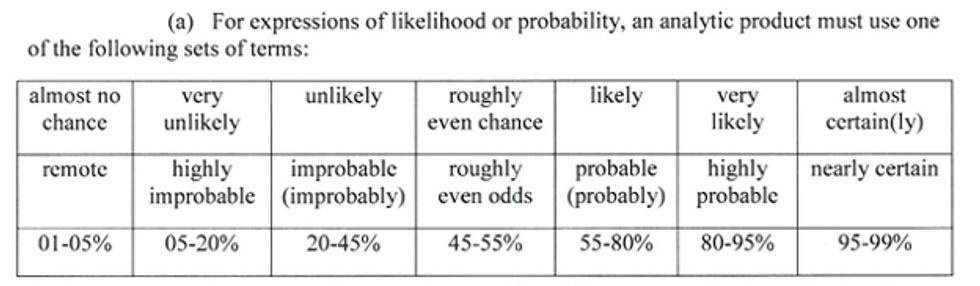
Part of the challenge is that what analysts get right or wrong is not so binary. It’s based on a spectrum of probabilistic language that they use, often not so rigidly as presented below, but still quite similar. The specturm, as I highlight below, is prone to miscalculation, misunderstanding, and analyst apathy. I think we can do better. The old standard is ready for a refresh that analysts use to the benefit of US national security.

  • Current Standards – From ICD 203 section 2, a, noted above:

  • My Proposed Standards:

Author created using AI prompt.

I will not claim here that my proposed approach perfect, and I can hear my former colleagues now, pulling and picking it apart, as they should! I purposely shared this draft with no current or former analysts (which is the opposite of the norm) because I wanted to present a starting point for change. I contend that this new standard would be more usable, more often used, and yes, more accurate.

  • More Usable – It may come across as flippant, but weighing four categories of probability is just more doable than weighing seven. This assertion becomes less flippant once you look more closely and realize that analysts are being asked to consider probability within 5-percentage point increments. Can any human (or any AI LLM) forecast the likelihood of human behavior to the 55th percentile? No. Are we equipped to give a general range? Yes. The current gauge is asking analysts to split hairs when, instead, we should be bundling those hairs to give a more realistic assessment of whether events will occur.
  • More Often Used – Altogether, I have written and edited thousands of analytic assessments; overall, a tiny percentage used the ICD 203 framework. The truth is that analysts frequently use words such as “likely” and “unlikely” because that’s more effective than placing specific percentages in their written work. And so, they are quite unlikely (yes, less than 30 percent of the time) to pull out and use the ICD 203 standards. Congressional Oversight might say this is the problem. I would say we have given analysts a tool that is restrictive and cumbersome. Often, the best intelligence work is the analytic email or phone call to the customer sharing insights on the spot; that’s rarely, if ever, conducive to a seven-point probability gauge. And, when you do have time, the tool should work; I have sat in a few debates about whether something was likely or very likely. If the customer simply knew it was likely, and more than probable, it would have done the job.
  • More Accurate – Analysis is both an art and a science, and it is becoming more of a science with advanced technologies that allow the analysts to focus more on the why and “so what” than they do on the what, when, and where. But when you require exactness (like asking for gauging probability to a five percentage points), your result is likely to be less accurate. I once worked for a senior manager who compelled us to make a call but to avoid “hammer judgments” such as “leader x will win the election” or “leader y will not fall from power.” Such judgments are a sort of overconfidence bias, which is sometimes rooted in overprecision. The job of the intelligence analyst is to forecast, not predict. If you give the analysts a tool with broader probability ranges that they are more likely to use, they will be more likely to make a call, and the call is more likely to benefit from the nuance that surrounds it.

Give AI a Chance

Analysts have an opportunity to use AI in their search for probability. The IC is wrestling with how to adopt AI and whether its adoption is existential. It can be helpful without being overwhelming. Examining the probability of an issue is one good example. If an LLM has access to all the same reporting as an analyst, an easy and productive exercise would be to ask the AI platform the likelihood of X happening, and then analyze that result in comparison to the analysts’ original findings. I asked Chat GPT, based on my proposed probability standards, the likelihood of Russia and Ukraine reaching a peace deal; the response was that it was Possible (30–50%). That’s good fodder for an analytic debate to hone your own findings.

The Cipher Brief is committed to publishing a range of perspectives on national security issues submitted by deeply experienced national security professionals.

Opinions expressed are those of the author and do not represent the views or opinions of The Cipher Brief.

Have a perspective to share based on your experience in the national security field? Send it to Editor@thecipherbrief.com for publication consideration.

Read more expert-driven national security insights, perspective and analysis in The Cipher Brief

How Medical Cannabis in the UK Is Helping Seniors Live Healthier, Happier Lives

cannabis seeds for medical use


For seniors, aging often comes with its fair share of challenges – chronic pain, sleepless nights, and the need for safer treatment options. While the US cannabis market is thriving with innovative products and accessibility, the UK offers a different, patient-focused approach that’s reshaping care for older adults.


With over 12.5 million people aged 65 and older, seniors in the UK are turning to cannabis for pain and carefully tailored UK cannabis strains to find relief from conditions like arthritis and sleep disorders.


By focusing on safety and regulation, the UK provides an example of how medical cannabis can meet the needs of aging populations – a lesson the US may find valuable as the industry continues to grow.


Why do seniors struggle with traditional treatments?


Chronic pain is a reality for many older adults, often caused by conditions like arthritis, back injuries, and fibromyalgia. Conventional treatments (opioids, NSAIDs, or sleep aids) come with significant drawbacks. Side effects like dependency, gastrointestinal issues, and diminished effectiveness over time make these options less than ideal, especially for vulnerable aging bodies.


Are older patients more open to cannabis now?


The short answer? Yes. As education and destigmatization efforts continue, more seniors are exploring cannabis as a natural alternative. In the UK, 1.4 million people already use cannabis recreationally for medical purposes, with chronic pain as one of the leading drivers.


This trend reflects a growing openness to plant-based solutions that can address both pain and sleep issues safely.


How is medical cannabis transforming senior care in the UK?


For older adults who have exhausted traditional treatments, medical cannabis has been nothing short of life-changing. Arthritis patients report regaining mobility, while those with chronic pain find relief without the side effects of opioids.


What does a patient-first approach look like?


Unlike the US, where cannabis is widely accessible but unevenly regulated, the UK ensures every prescription is tailored to individual needs. Products undergo rigorous testing, guaranteeing both safety and efficacy. A study from the UK Medical Cannabis Registry revealed that 45.4% of chronic pain patients also experience sleep impairments—issues that medical cannabis uniquely addresses by tackling pain and improving rest simultaneously.


Clinics like Releaf are at the forefront of this shift. Known for their high standards and patient-first ethos, they represent what’s possible when regulation meets innovation. While the UK’s system is smaller and slower to grow compared to the US, it prioritizes trust and long-term care over commercial gains.


How does the US approach chronic pain differently?


The US cannabis market is an undeniable world-leading powerhouse, offering products and services that reflect the creativity of the industry. From THC-infused beverages to same-day delivery, dispensaries on almost every corner in certain cities, and some of the very best bud known to man, patients have a level of accessibility that the UK can’t match.


But this abundance comes with its challenges. Over-commercialization has led to quality inconsistencies, and with regulations varying by state, patients are often left wondering if their cannabis is as safe as it should be.


What can the US learn from the UK?


By adopting some of the UK’s emphasis on safety and regulation, the US could create a more balanced system. Incorporating medical oversight into cannabis care wouldn’t stifle innovation—it would enhance trust and ensure the industry meets the needs of its most vulnerable patients, including seniors.


What does the future hold for seniors and cannabis in the UK?


As wellness trends evolve, the demand for medical cannabis among seniors is set to rise. Chronic pain and sleep disorders will likely remain top priorities, but education and outreach could open the door for even more conditions to be treated.


Could cannabis become a standard part of senior care?


With clinics like Releaf leading the way in the UK, it’s easy to see how cannabis could integrate into senior care as a routine treatment. As research grows and collaboration between countries like the UK and US increases, cannabis could become a cornerstone of holistic health for aging populations.


Final thoughts


For older adults seeking relief from pain and sleep problems, medical cannabis offers hope where traditional medicine often fails. The UK’s careful, patient-first approach highlights what’s possible when safety and care take precedence a perspective that could benefit the growing US cannabis market as well.


To learn more about how cannabis is transforming lives, revisit the links up top in this article on cannabis for pain and UK cannabis strains to learn a little more on how these approaches are shaping a brighter future for senior wellness.


Make sure you never miss another Vault promo and sign up for our newsletter at https://www.cannabis-seeds-store.co.uk/the-vault-newsletter


Remember: It’s illegal to germinate cannabis seeds in many countries including the UK.  It is our duty to inform you of this important fact and to urge you to obey all of your local laws.

The post How Medical Cannabis in the UK Is Helping Seniors Live Healthier, Happier Lives first appeared on Cannabis Seeds News.

Synology NAS tips

By: hoek

You may or may not remember my article Mount Synology NAS in Linux. Being the lucky owner of a Synology DS720+, I sometimes do some interesting things on it besides the standard stuff. And since this site is also my online notebook, I have collected all the things I have configured on my NAS in this article.

Hacker forums

By: hoek

There is lot of low tier hacker forums and communities. It’s hard to find a place where you can find all the good quality information about hacking. It is such a large field and the knowledge in it is so extensive and specific that there is no forum where you can find everything. There is also no place on the web where you can find guides from

❌