❌

Reading view

There are new articles available, click to refresh the page.

Magic Magikarp Makes Moves

By: Ian Bos
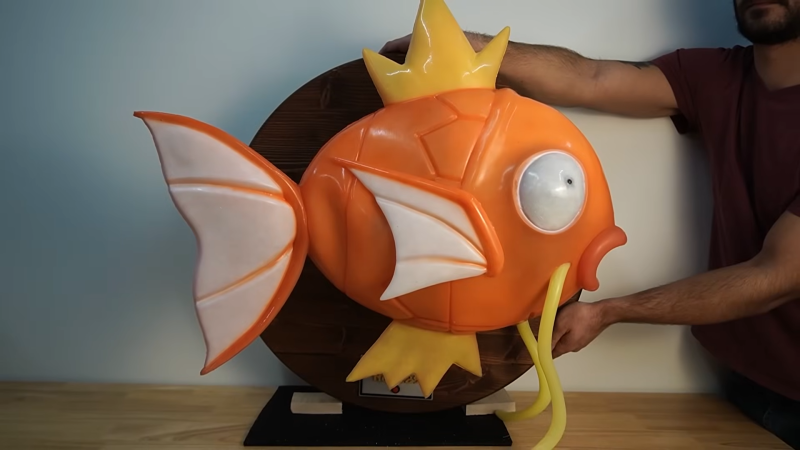
A picture of a life sized magikarp from pokemon

One of the most influential inventions of the 20th century was Big Mouth Billy Bass. A celebrity bigger than the biggest politicians or richest movie stars, there’s almost nothing that could beat Billy. That is, until [Kiara] from Kiara’s Workshop built a Magikarp version of Big Mouth Billy Bass.

Sizing in at over 2 entire feet, the orange k-carp is able to dance, it is able to sing, and it is able to stun the crowd. Magikarp functions the same way as its predecessor; a small button underneath allows the show to commence. Of course, this did not come without its challenges.

Starting the project was easy, just a model found online and some Blender fun to create a basic mold. Dissecting Big Mouth Billy Bass gave direct inspiration for how to construct the new idol in terms of servos and joints. Programming wasn’t even all that much with the use of Bottango for animations. Filling the mold with the silicone filling proved to be a bit more of a challenge.

After multiple attempts with some minor variations in procedure, [Kirara] got the fish star’s skin just right. All it took was a paint job and some foam filling to get the final touches. While this wasn’t the most mechanically challenging animatronic project, we have seen our fair share of more advanced mechanics. For example, check out this animatronic that sees through its own eyes!
Wiring Up The Railway, All The Live-Long Day

For those of you who haven’t spent time in North America around this time of year, you may be unaware of two things: one, the obligatory non-stop loop of β€œAll I Want For Christmas Is You” retail workers are subjected to starting November first, and two: there is a strong cultural association between Christmastime and model railroading that may not exist elsewhere. That may down to childhood memories of when we got our first trainsets, or an excellent postwar marketing campaign by Lionel. Either way, now that Mariah Carey is blaring, we’re thinking about our holiday track layouts. Which makes this long presentation on Wiring for Small Layouts by [Chicago Crossing Model Railroad] quite timely.

There are actually three videos in this little course; the first focuses mostly on the tools and hardware used for DCC wiring (that’s Digital Command Control), which will be of less interest to our readers– most of you are well aware how to perform a lineman’s splice, crimp connectors onto a wire, and use terminal blocks.

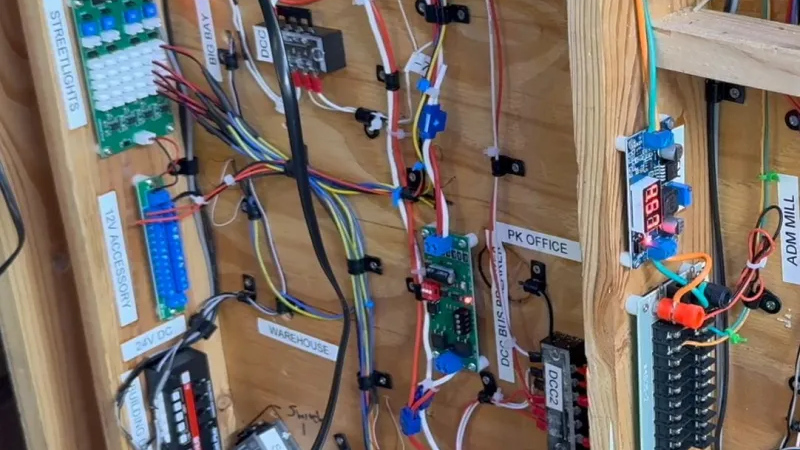
The second two videos are actually about wiring, in the sense of routing all the wires needed for a modern layout– which is a lot more than β€œplug the rheostat into the tracks in one spot” that our first Lionel boxed set needed. No, for the different accessories there are multiple busses at 5V, 12V and 24V along with DCC that need to be considered. Unsurprisingly enough given those voltages, he starts with an ATX power supply and breaks out from there.

Even if you’re not into model railroading, you might learn something from these videos if you haven’t done many projects with multiple busses and wire runs before. It’s far, far too easy to end up with a rats nest of wires, be they DCC, I2C or otherwise. A little planning can save some big headaches down the line, and if this is a new skill for you [Chicago Crossing Model Railroad] provides a good starting point for that planning. Just skip ahead a couple minutes for him to actually start talking if you don’t want the musical cliff notes montage at the start of the videos.

If you don’t have any model trains, don’t worry, you can 3D print them.Β  Lack of room isn’t really an excuse.

Building a Drivable, Life-Size 3D-Printed LEGO Technic Buggy

The 8845 LEGO Technic Dune Buggy original. (Credit: Matt Denton)

It’s part of the great circle of life that toys and scale models that provide a reflection of macro-sized objects like vehicles and buildings will eventually be scaled up again to life-sized proportions. Case in point the LEGO Technic dune buggy that [Matt Denton] recently printed at effectively human scale, while also making it actually drivable.

The basis for this project is the 8845 Dune Buggy which was released in 1981. Unlike the modern 42101 version, it’s more straightforward and also seems more amenable to actually sitting in despite featuring more pieces for a total of 174 pieces.Β  Naturally, [Matt] didn’t simply go for a naΓ―ve build of the 8845 buggy, but made a few changes. First is the scale that’s 10.42 times larger than the LEGO original, based around the use of 50 mm bearings. The model was also modified to be a single-seater, with the steering wheel placed in the center.

With some structural and ergonomic tweaks in place, the resulting CAD model was printed out mostly in PLA with a 1 mm nozzle and 10% infill using a belt FDM printer to help with the sheer size of the parts. After that it was mostly a LEGO kit assembly on a ludicrous scale that resembles a cross between building a LEGO kit and assembling Ikea flatpack furniture.

At merely the cost of most of his sanity, [Matt] finally got the whole kit together, still leaving a few suspension issues to resolve, as it turns out that so much plastic actually weighs a lot, at 102 kg. With that and other issues resolved, the final touch was to add an electric motor to the whole kit using a belt-driven system on the rear axle and bringing every LEGO minifig’s dreams to life.

After a few test drives, some issues did pop up, including durability concerns and not a lot of performance, but overall it performs much better than you’d expect from a kid’s toy.

❌