Reading view

There are new articles available, click to refresh the page.

NASA, SpaceX Launch US-European Satellite to Monitor Earth’s Oceans
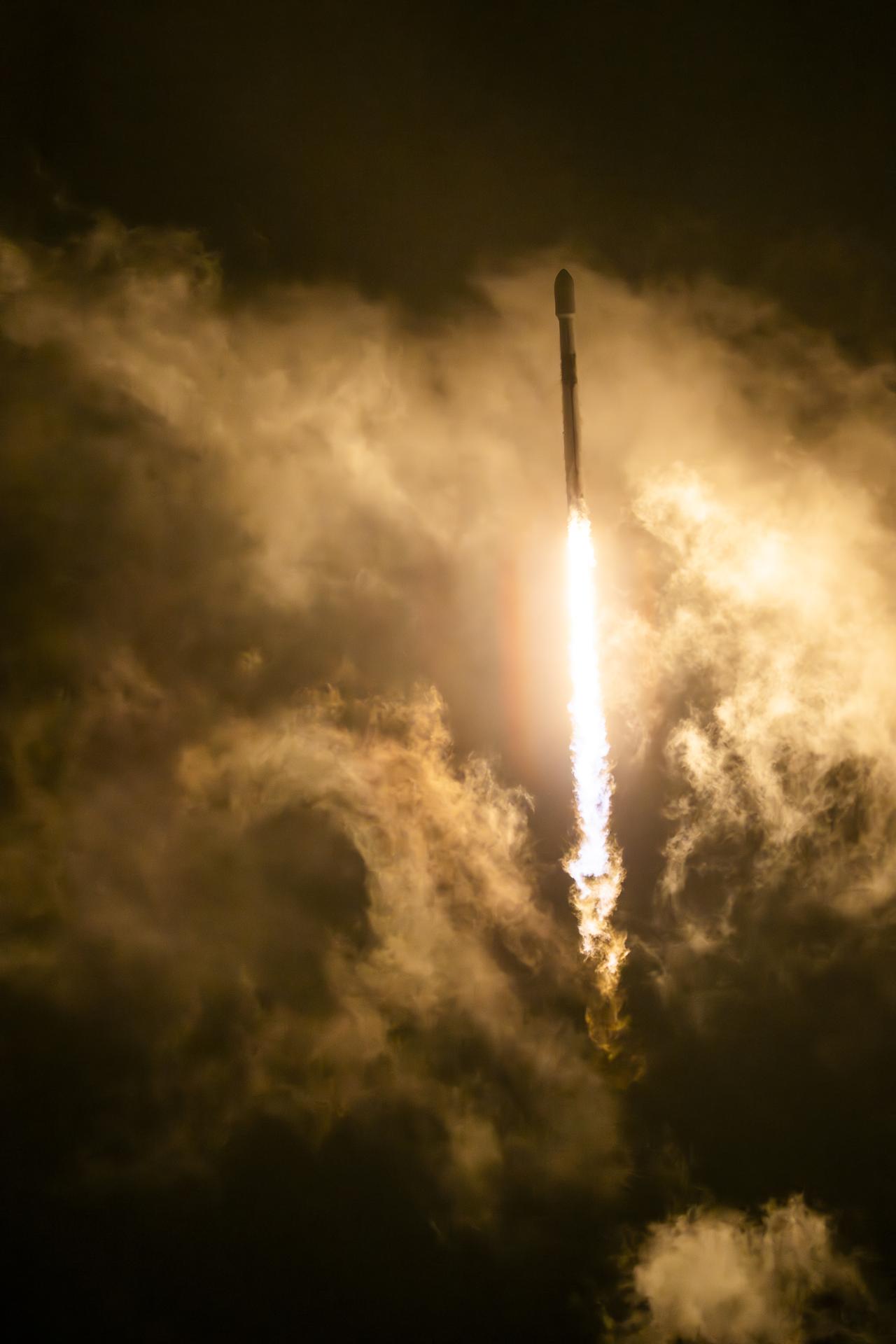
The Sentinel-6B satellite lifted off aboard a SpaceX Falcon 9 rocket from Launch Complex 4 East at Vandenberg Space Force Base in central California at 9:21 p.m. PST on Nov. 16.
Credit: NASA/Carla Thomas

About the size of a full-size pickup truck, a newly launched satellite by NASA and its partners will provide ocean and atmospheric information to improve hurricane forecasts, help protect infrastructure, and benefit commercial activities, such as shipping.

The Sentinel-6B satellite lifted off aboard a SpaceX Falcon 9 rocket from Launch Complex 4 East at Vandenberg Space Force Base in central California at 9:21 p.m. PST on Nov. 16. Contact between the satellite and a ground station in northern Canada occurred about 1 hour and 30 minutes later at 10:54 p.m. All systems are functioning normally.

“Understanding tidal patterns down to the inch is critical in protecting how we use our oceans every day on Earth,” said Nicky Fox, associate administrator, Science Mission Directorate at NASA Headquarters in Washington. “Sentinel-6B will build upon the legacy of Sentinel-6 Michael Freilich by making sea level measurements that improve forecasts used by communities, businesses, and operations across the country. It also will support a safer reentry for our astronauts returning home, including crew from Artemis Moon missions.”

Sea levels vary from place to place, and the satellite will provide accurate measurements at both local and global scales — all from hundreds of miles above in low Earth orbit. Those observations form the basis for U.S. flood predictions, which are crucial for safeguarding coastal infrastructure, real estate, energy storage sites, and other coastal assets. Sentinel-6B will take over for Sentinel-6 Michael Freilich, which launched in 2020 and later became the official reference satellite for global sea level measurements, providing sea surface height measurements against which those from other satellites are compared for accuracy.

The satellite comes from a collaboration between multiple partners, including NASA, ESA (European Space Agency), EUMETSAT (European Organisation for the Exploitation of Meteorological Satellites), and the National Oceanic and Atmospheric Administration (NOAA). It also is part of the European Union’s family of Copernicus missions.

“Collaboration between partners is key to a mission such as Sentinel-6, and my thanks go to everyone involved in developing, launching, and operating this exceptional satellite, which follows in the footsteps of the first Sentinel-6, Michael Freilich,” said Simonetta Cheli, director, ESA’s Earth Observation Programmes. “This achievement demonstrates what can be accomplished when international agencies and industries work together toward a shared goal. Sentinel-6B will ensure we continue to collect the high-precision data needed to understand our changing climate, safeguard our oceans and support decisions that protect coastal communities around the world.”

The two satellites make up the Copernicus Sentinel-6/Jason-CS (Continuity of Service) mission, the latest in a series of ocean-observing radar altimetry missions that have monitored Earth’s changing seas since the early 1990s.

As with its predecessor, Sentinel-6B satellite also will provide key information about wind speeds, wave heights, atmospheric temperature, and humidity. Moreover, because water expands as its temperature increases, researchers can tell which parts of the ocean are warmer than others based on where the sea surface height is greater.

Combined with data from other instruments, that knowledge can help in forecasting marine weather, including the development of hurricanes, which intensify with warmer water. Also, because large currents are taller than surrounding waters due to their higher temperatures, sea surface measurements can shed light on interactions between the Gulf Stream, for example, and nearby waves. Where they meet, seas can become rougher, presenting a hazard to even the largest ships.

“Sentinel-6B is a testament to the value of NASA’s partnership missions to put actionable satellite information and science into the hands of decision-makers on the ground,” said Karen St. Germain, director, NASA Earth Science Division at the agency’s headquarters. “Sentinel-6B will collect ocean surface observations that will inform decisions critical to coastal communities, commercial shipping and fishing, national defense, and emergency preparedness and response. This is what NASA does — puts advanced technology and science into action for the benefit of the nation.”   

When Sentinel-6B reaches its operating elevation, the satellite will fly about 30 seconds behind Sentinel-6 Michael Freilich, which carries identical science instruments. Once the mission finishes cross-calibrating the data collected by the two, Sentinel-6 Michael Freilich will move into a different orbit, and Sentinel-6B will take over the role of official reference satellite, orbiting Earth about 13 times a day at 830 miles (1,336 kilometers) above the surface.

“Sentinel-6B demonstrates the versatile Earth science applications made possible by expertly engineered, space-based technology. The satellite’s powerful suite of instruments will measure about 90% of Earth’s oceans down to fractions of an inch — continuing to add to a vital dataset that America and a growing global community depend on,” said Dave Gallagher, director, NASA’s Jet Propulsion Laboratory (JPL) in Southern California.

More about Sentinel-6B

Copernicus Sentinel-6/Jason-CS is a collaboration between ESA, the European Union, EUMETSAT, NASA, and NOAA. French space agency CNES (Centre National d’Études Spatiales) contributed technical support. Copernicus, which includes the Sentinel missions, is the European Union’s Earth observation program led by the European Commission. 

A division of Caltech in Pasadena, JPL contributed three science instruments for each Sentinel-6 satellite: the Advanced Microwave Radiometer, the Global Navigation Satellite System – Radio Occultation, and the laser retroreflector array. NASA also is contributing launch services, ground systems supporting operation of the NASA science instruments, the science data processors for two of these instruments, and support for the U.S. members of the international Ocean Surface Topography Science Team, and Sentinel-6 science teams.

To learn more about Sentinel-6B, visit:

https://science.nasa.gov/mission/sentinel-6B/

-end-

Elizabeth Vlock
Headquarters, Washington
202-358-1600
elizabeth.a.vlock@nasa.gov

Andrew Wang / Andrew Good
Jet Propulsion Laboratory, Pasadena, Calif.
626-379-6874 / 626-840-4291
andrew.wang@jpl.nasa.gov / andrew.c.good@jpl.nasa.gov
Share

Details

Last Updated
Nov 17, 2025
Editor
Jessica Taveau

NASA, European Partners Set to Launch Sentinel-6B Earth Satellite

By: scarney1

5 min read

Preparations for Next Moonwalk Simulations Underway (and Underwater)

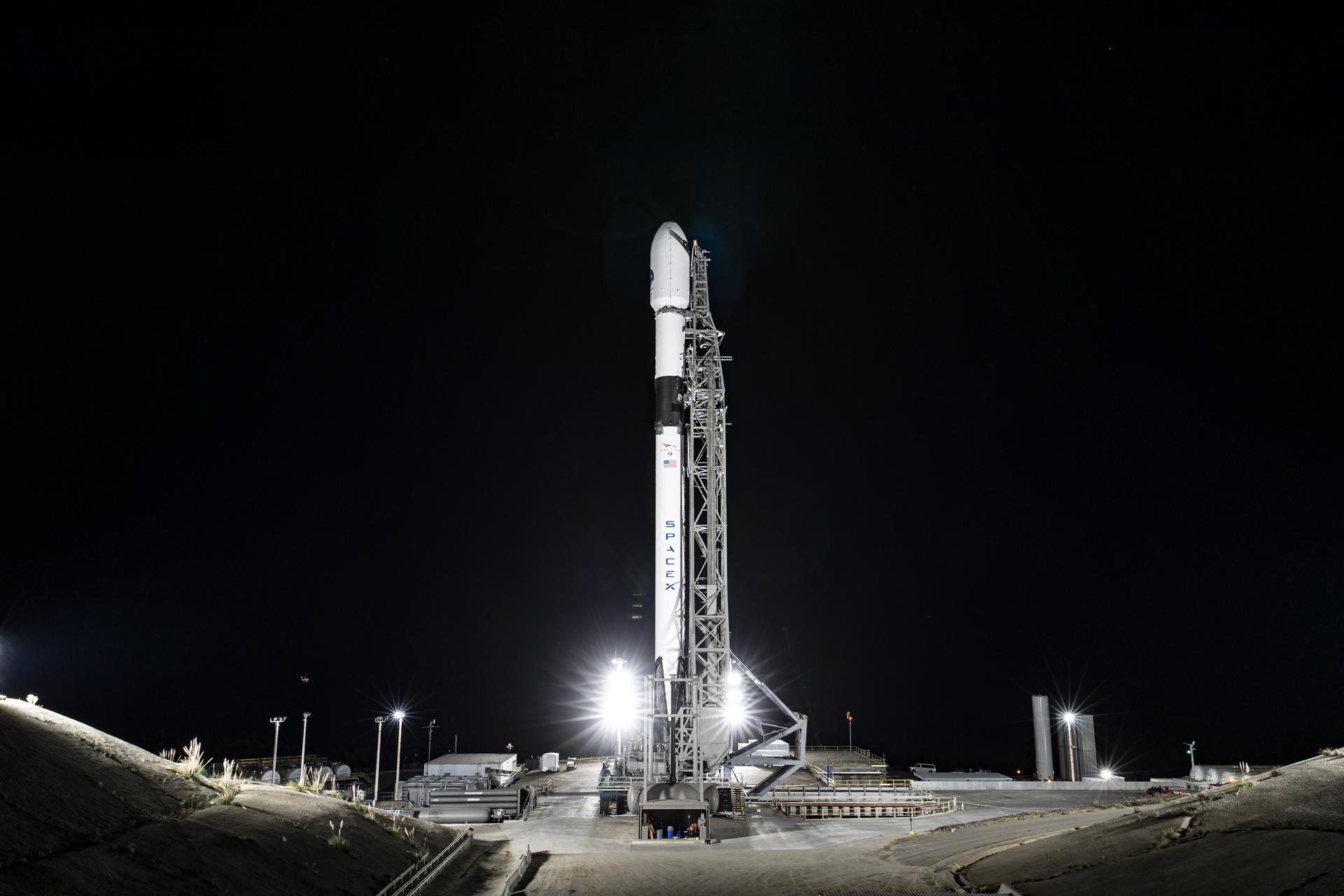
A wide-angle, distant photo of a white rocket on the launch pad, brightly lit, with a black night sky behind it.
Set to launch no earlier than Nov. 16, Sentinel-6B will continue the data record now being collected by its twin satellite Sentinel-6 Michael Freilich, which lifted off from Vandenberg Space Force Base in November 2020 aboard the SpaceX Falcon 9 rocket shown here.
SpaceX

Set to track sea levels across more than 90% of Earth’s ocean, the mission must first get into orbit. Here’s what to expect.  

Sentinel-6B, an ocean-tracking satellite jointly developed by NASA and ESA (European Space Agency), is ready to roll out to the launch pad, packed into the payload fairing of a SpaceX Falcon 9 rocket.   

Launch is targeted at 12:21 a.m. EST, Monday, Nov. 17 (9:21 p.m. PST, Sunday, Nov. 16). Once it lifts off from Vandenberg Space Force Base in California, the satellite will ride out a 57-minute sequence of events ending in spacecraft separation, when the satellite detaches from the rocket.  

Then Sentinel-6B’s real work begins. Orbiting Earth every 112 minutes at 4.5 miles (7.2 kilometers) per second, the satellite will eventually take over for its twin, Sentinel-6 Michael Freilich, launched five years ago, to continue a multidecade dataset for sea level measurements from space. Those measurements, along with atmospheric data the mission gathers, will help improve public safety and city planning while protecting coastal infrastructure, including power plants and defense interests. NASA will also use the data to refine atmospheric models that support the safe re-entry of Artemis astronauts.  

Here’s a closer look at what lies ahead for the satellite in the coming days.

Launch timeline 

Measuring 19.1 feet (5.82 meters) long and 7.74 feet (2.36 meters) high (including the communications antennas), the satellite weighs in at around 2,600 pounds (1,200 kilograms) when loaded with propellant at launch. 

The satellite will lift off from Space Launch Complex 4 East at Vandenberg. If needed, backup launch opportunities are available on subsequent days, with the 20-second launch window occurring about 12 to 13 minutes earlier each day.  

A little more than two minutes after the Falcon 9 rocket lifts off, the main engine cuts off. Shortly after, the rocket’s first and second stages separate, followed by second-stage engine start. The reusable Falcon 9 first stage then begins its automated boost-back burn to the launch site for a powered landing. About three minutes after launch, the two halves of the payload fairing, which protected the satellite as it traveled through the atmosphere, separate and fall safely back to Earth.  

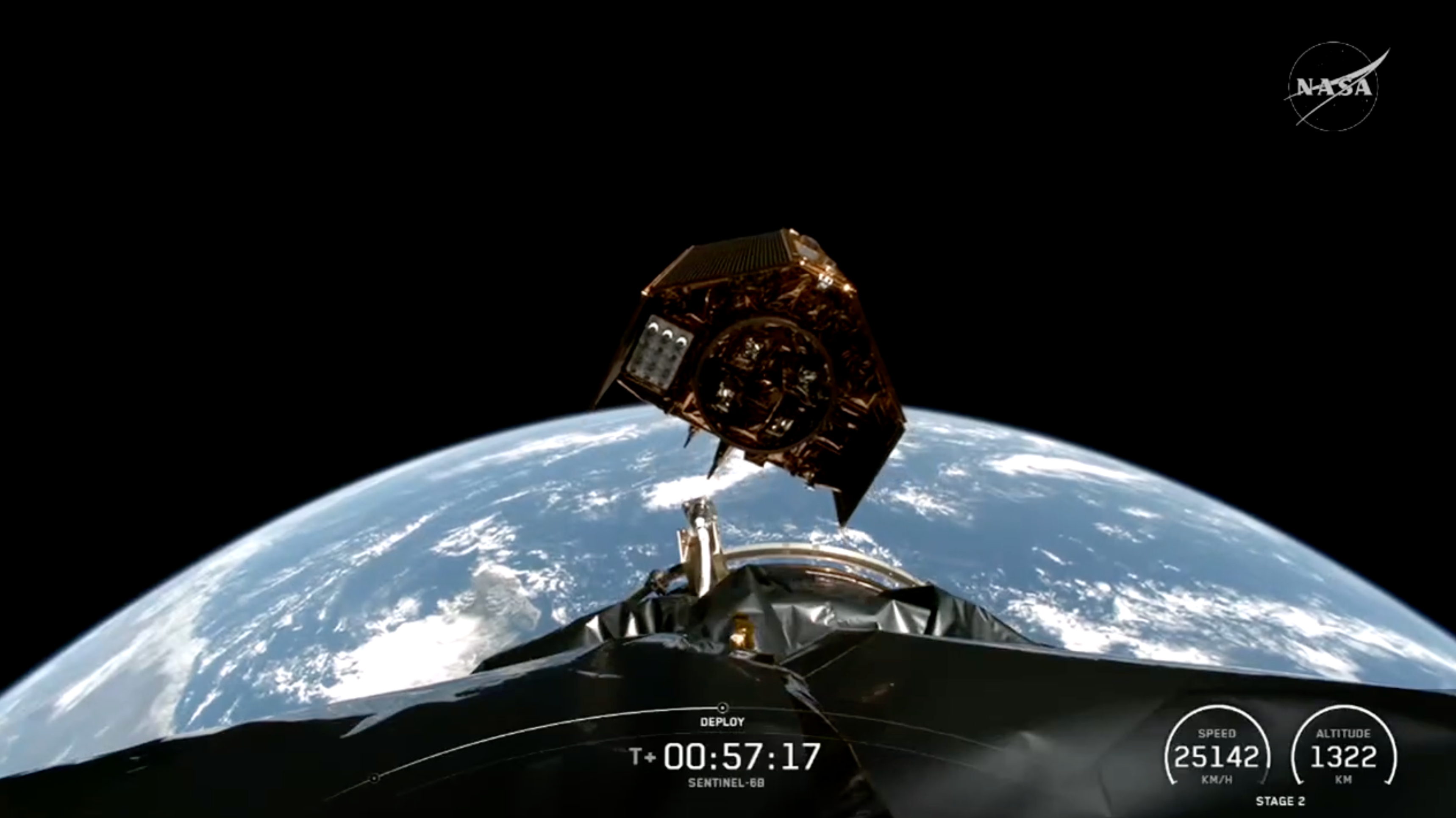
The first cutoff of the second stage engine takes place approximately eight minutes after liftoff, at which point the launch vehicle and the spacecraft will be in a temporary “parking” orbit. The second stage engine fires a second time about 44 minutes later, and about 57 minutes after liftoff, the rocket and the spacecraft separate. Roughly seven minutes after that, the satellite’s solar panels deploy. Sentinel-6B is expected to make first contact with ground controllers about 35 minutes after separation (roughly an hour and a half after liftoff) — a major milestone indicating that the spacecraft is healthy. 

Science mission 

Following launch operations, the team will focus on its next challenge: getting the spacecraft ready for science operations. Once in orbit, Sentinel-6B will fly about 30 seconds behind its twin, the Sentinel-6 Michael Freilich satellite. When scientists and engineers have completed cross-calibrating the data collected by the two spacecraft, Sentinel-6B will take over the role of providing primary sea level measurements while Sentinel-6 Michael Freilich will move into a different orbit. From there, researchers plan to use measurements from Sentinel-6 Michael Freilich for different purposes, including helping to map seafloor features (variations in sea surface height can reveal variations in ocean floor features, such as seamounts). 

Sentinel-6B is part of a U.S.-European mission that will continue 30-year-plus record of sea-level measurements. Its observations will help build an accurate picture of local and global sea surface heights to support storm forecasting, secure coastal infrastructure, and help optimize commercial activities, such as shipping.
NASA/JPL-Caltech

Where to find launch coverage 

Launch day coverage of the mission will be available on the agency’s website, including links to live streaming and blog updates beginning no earlier than 11 p.m. EST, Nov. 16, as the countdown milestones occur. Streaming video and photos of the launch will be accessible on demand shortly after liftoff. Follow countdown coverage on NASA’s Sentinel-6B blog.  

For more information about NASA’s live programming schedule, visit 
plus.nasa.gov/scheduled-events

More about Sentinel-6B

The Copernicus Sentinel-6/Jason-CS (Continuity of Service) mission is a collaboration between NASA, ESA, EUMETSAT (European Organisation for the Exploitation of Meteorological Satellites), and the National Oceanic and Atmospheric Administration (NOAA). The European Commission contributed funding support while France’s space agency CNES (Centre National d’Études Spatiales) provided technical expertise. The mission also marks the first international involvement in Copernicus, the European Union’s Earth Observation Programme.  

A division of Caltech in Pasadena, JPL built three science instruments for each Sentinel-6 satellite: the Advanced Microwave Radiometer, the Global Navigation Satellite System – Radio Occultation, and the Laser Retroreflector Array. NASA is also contributing launch services, ground systems supporting operation of the NASA science instruments, the science data processors for two of these instruments, and support for the U.S. members of the international Ocean Surface Topography and Sentinel-6 science teams. The launch service is managed by NASA’s Launch Services Program, based at the agency’s Kennedy Space Center in Florida.

News Media Contacts

Elizabeth Vlock
NASA Headquarters, Washington
202-358-1600
elizabeth.a.vlock@nasa.gov

Andrew Wang / Andrew Good
Jet Propulsion Laboratory, Pasadena, Calif.
626-379-6874 / 626-840-4291
andrew.wang@jpl.nasa.gov / andrew.c.good@jpl.nasa.gov
2025-125

💾

NASA and its U.S. and international partners have teamed up to launch a new Earth-observing satellite called Sentinel-6B that will measure sea surface height...

6 Things to Know From NASA About New US, European Sea Satellite

By: scarney1

6 min read

Preparations for Next Moonwalk Simulations Underway (and Underwater)

Set to launch no earlier than Nov. 16, Sentinel-6B will continue a decades-long data record of sea level measurement that will help decision-makers manage coastal flooding, support hurricane intensity forecasts, and assist in the return of astronauts from space.
NASA

Data from Sentinel-6B will continue a decades-long record of sea surface height, helping to improve coastal planning, protect critical infrastructure, and advance weather forecasts.

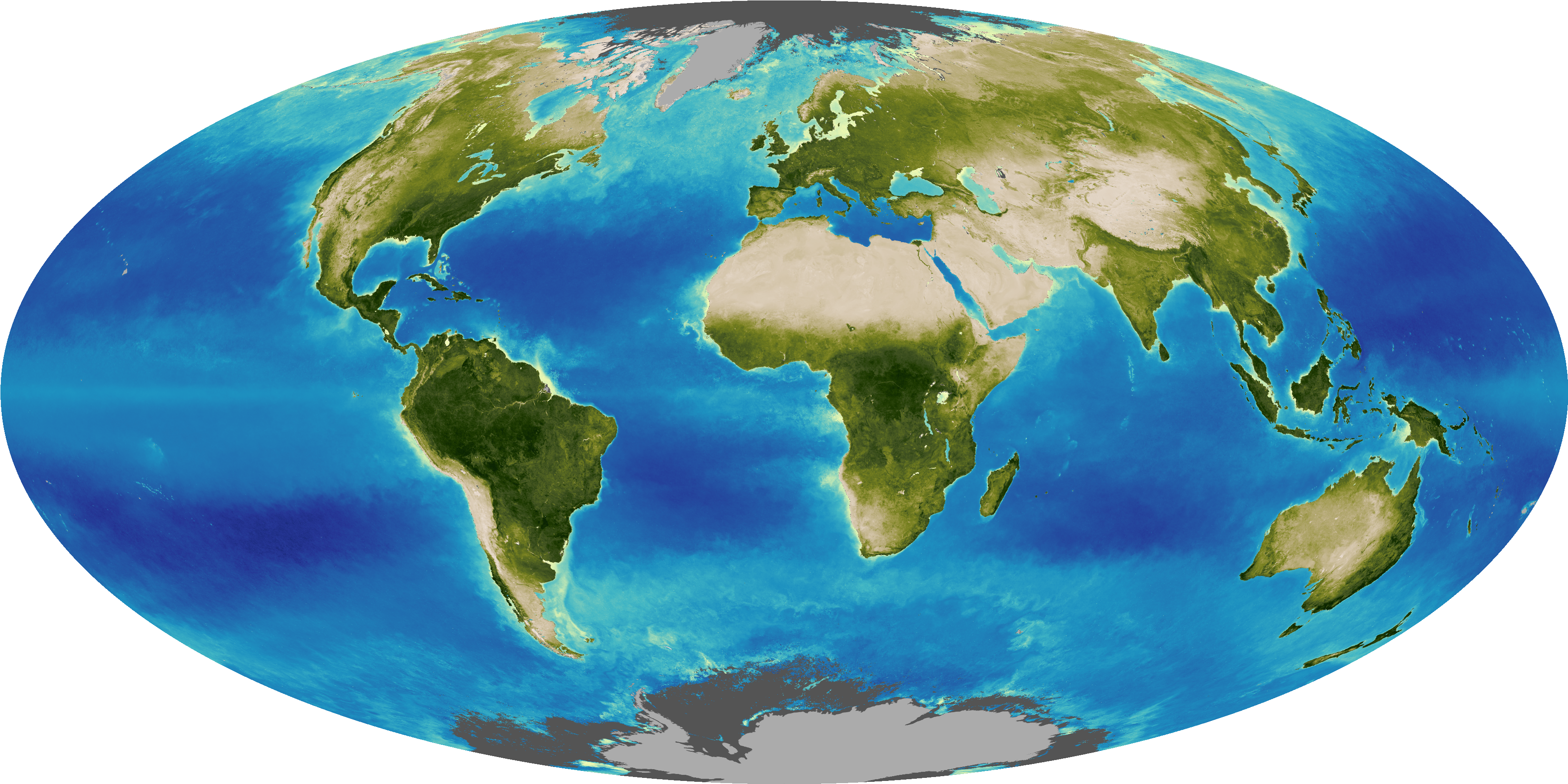
With launch set for no earlier than 12:21 a.m. EST Monday, Nov. 17, Sentinel-6B is the latest satellite in a series of spacecraft NASA and its partners have used to measure sea levels since 1992. Their data has helped meteorologists improve hurricane forecasts, managers protect infrastructure, and coastal communities plan. 

After launch, Sentinel-6B will begin the process of data cross-calibration with its predecessor, Sentinel-6 Michael Freilich, to provide essential information about Earth’s ocean. 

Sentinel-6B is the second of two satellites that constitute the Sentinel-6/Jason-CS (Continuity of Service) mission, a collaboration between NASA, ESA (European Space Agency), EUMETSAT (European Organisation for the Exploitation of Meteorological Satellites), and the National Oceanic and Atmospheric Administration (NOAA). The European Commission contributed funding support while France’s space agency CNES (Centre National d’Études Spatiales) provided technical expertise.

Here are six things to know about Sentinel-6B and the broader Copernicus Sentinel-6/Jason-CS mission: 

1. Sentinel-6B will deliver data on about 90% of Earth’s ocean, providing direct benefits to humanity.

Sentinel-6B will contribute to a multidecade dataset for sea level measurements from space. This data is key to helping improve public safety, city planning, and protecting commercial and defense interests. 

Pioneered by NASA and its partners, the dataset enables users in government, industry, and the research community to better understand how sea levels change over time. Combined with information from other NASA satellites, data from Copernicus Sentinel-6/Jason-CS is vital for tracking how heat and energy move through Earth’s seas and atmosphere, as well as for monitoring ocean features such as currents and eddies. The measurements come courtesy of a radar altimeter that measures sea levels for nearly all of Earth’s ocean, providing information on large-scale currents that can aid in commercial and naval navigation, search and rescue, and the tracking of debris and pollutants from disasters at sea.

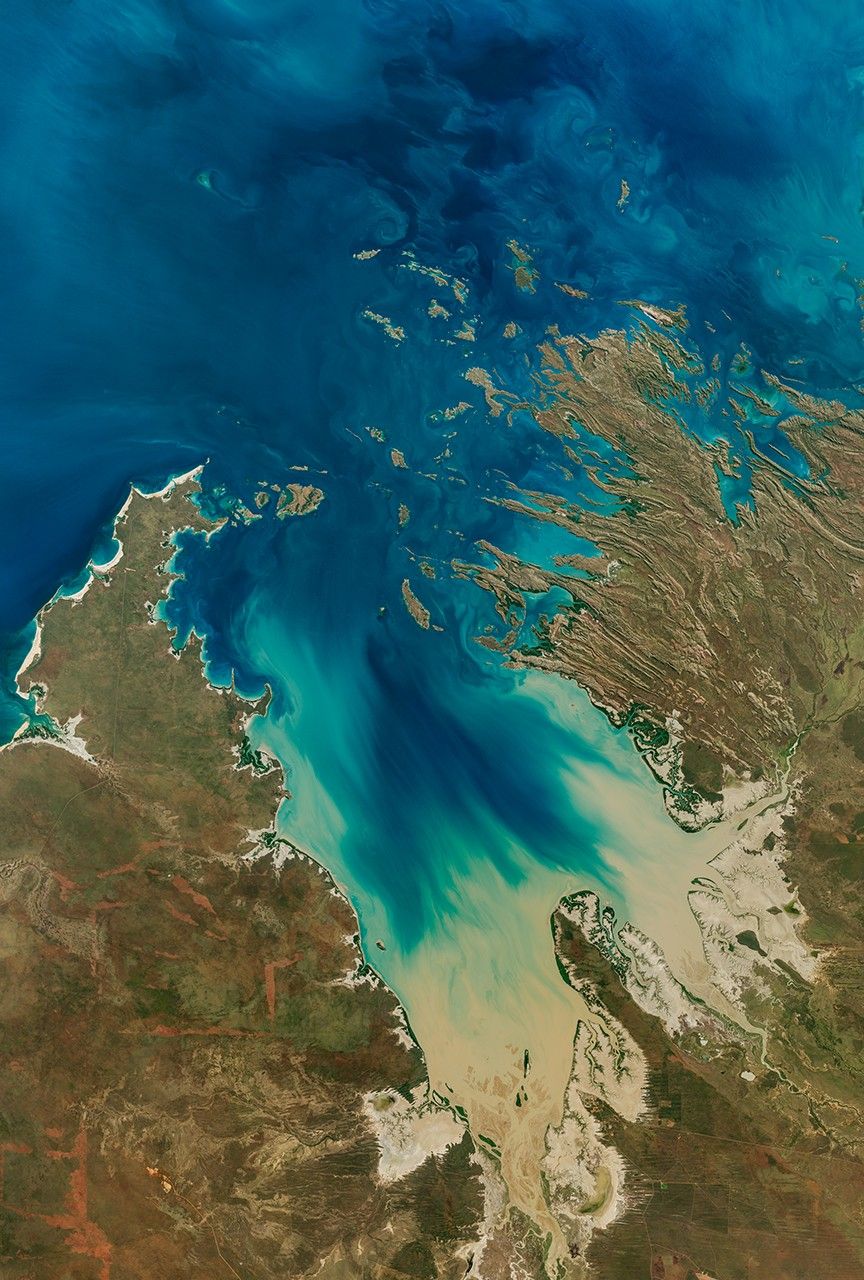
Sentinel-6B is part of a U.S.-European mission that will continue 30-year-plus record of sea-level measurements. Its observations will help build an accurate picture of local and global sea surface heights to support storm forecasting, secure coastal infrastructure, and help optimize commercial activities, such as shipping.
Credit: NASA/JPL-Caltech

2. Data from the Copernicus Sentinel-6/Jason-CS mission helps NASA prepare for the next phase of space exploration.

The better we understand Earth, the better NASA can carry out its mission to explore the universe. Data from the Copernicus Sentinel-6/Jason-CS mission is used to refine the Goddard Earth Observing System atmospheric forecast models, which the NASA Engineering Safety Center uses to plan safer reentry of astronauts returning from Artemis missions.

Additionally, changes to Earth’s ocean, observed by satellites, can have measurable effects beyond our planet. For instance, while the Moon influences ocean tides on Earth, changes in those tides can also exert a small influence on the Moon. Data from Copernicus Sentinel-6/Jason-CS can help improve understanding of this relationship, knowledge that can contribute to future lunar exploration missions.

3. The Copernicus Sentinel-6/Jason-CS mission helps the U.S. respond to challenges by putting actionable information into the hands of decision-makers.

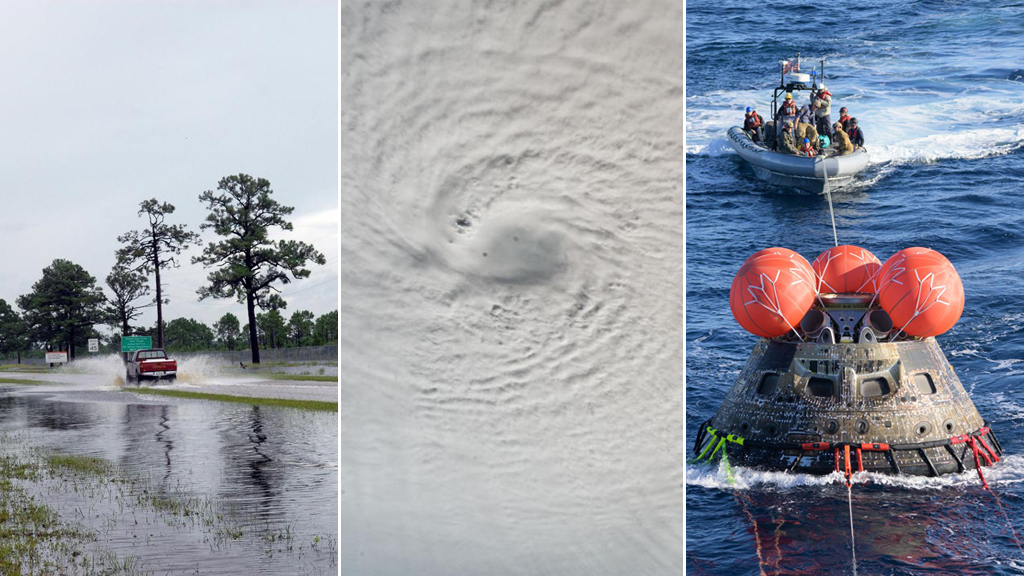
Data collected by the mission helps city planners, as well as local and state governments, to make informed decisions on protecting coastal infrastructure, real estate, and energy facilities. The mission’s sea level data also improves meteorologists’ weather predictions, which are critical to commercial and recreational navigation. By enhancing weather prediction models, data provided by Copernicus Sentinel-6/Jason-CS improves forecasts of hurricane development, including the likelihood of storm intensification, which can aid disaster preparedness and response.

4. Data from Sentinel-6B will support national security efforts.

The ocean and atmosphere measurements from Sentinel-6B will enable decision-makers to better protect coastal military installations from such events as nuisance flooding while aiding national defense efforts by providing crucial information about weather and ocean conditions. The satellite will do so by feeding near-real time data on Earth’s atmosphere and seas to forward-looking weather and ocean models. Since the measurements are part of a long-term dataset, they also can add historical context that puts the new data in perspective.

5. The Copernicus Sentinel-6/Jason-CS mission’s direct observation of sea levels delivers information critical to protecting coastlines, where nearly half of the world’s population lives.

Sea level rise varies from one area to another, meaning that some coastlines are more vulnerable than others to flooding, erosion, and saltwater contamination of underground freshwater supplies, the latter of which threatens farmland and drinking water. Sea level measurements from Sentinel-6 Michael Freilich, and soon, Sentinel-6B, form the basis of U.S. flood predictions for coastal infrastructure, real estate, energy storage sites, and other coastal assets. Knowing which regions are more vulnerable to these risks will enable U.S. industries and emergency managers to make better-informed decisions about transportation and commercial infrastructure, land-use planning, water management, and adaptation strategies.

6. The international collaboration behind the mission enables the pooling of capabilities, resources, and expertise.

The multidecadal dataset that this mission supports is the result of years of close work between NASA and several collaborators, including NASA, ESA, EUMETSAT, CNES, and NOAA. By pooling expertise and resources, this partnership has delivered cost-effective solutions that have made precise, high-impact data available to industry and government agencies alike.

More about Sentinel-6B

Copernicus Sentinel-6/Jason-CS was jointly developed by ESA, EUMETSAT, NASA, and NOAA, with funding support from the European Commission and technical support from CNES. The mission also marks the first international involvement in Copernicus, the European Union’s Earth Observation Programme. 

Managed for NASA by Caltech in Pasadena, JPL contributed three science instruments for each Sentinel-6 satellite: the Advanced Microwave Radiometer, the Global Navigation Satellite System – Radio Occultation, and the laser retroreflector array. NASA is also contributing launch services, ground systems supporting operation of the NASA science instruments, the science data processors for two of these instruments, and support for the international ocean surface topography community. 

For more about Sentinel-6B, visit:

https://science.nasa.gov/mission/sentinel-6B

News Media Contacts

Elizabeth Vlock
NASA Headquarters, Washington
202-358-1600
elizabeth.a.vlock@nasa.gov

Andrew Wang / Andrew Good
Jet Propulsion Laboratory, Pasadena, Calif.
626-379-6874 / 626-840-4291
andrew.wang@jpl.nasa.gov / andrew.c.good@jpl.nasa.gov

2025-124

💾

NASA and its U.S. and international partners have teamed up to launch a new Earth-observing satellite called Sentinel-6B that will measure sea surface height...

NASA Sets Launch Coverage for International Ocean Tracking Mission

In this artist’s concept, the ocean-observing satellite Sentinel-6B orbits Earth with its deployable solar panels extended.
Credit: NASA/JPL-Caltech

NASA will provide live coverage of prelaunch and launch activities for Sentinel-6B, an international mission delivering critical sea level and ocean data to protect coastal infrastructure, improve weather forecasting, and support commercial activities at sea.

Launch is targeted at 12:21 a.m. EST, Monday, Nov. 17 (9:21 p.m. PST, Sunday, Nov. 16) aboard a SpaceX Falcon 9 rocket from Space Launch Complex 4 East at Vandenberg Space Force Base in California.

Watch coverage beginning at 11:30 p.m. EST (8:30 p.m. PST) on NASA+, Amazon Prime, and more. Learn how to watch NASA content through a variety of platforms, including social media.

The Sentinel-6B mission continues a decades-long effort to monitor global sea level and ocean conditions using precise radar measurements from space. Since the early 1990s, satellites launched by NASA and domestic and international partners have collected precise sea level data. The launch of Sentinel-6B will extend this dataset out to nearly four decades.

NASA’s mission coverage is as follows (all times Eastern and subject to change based on real-time operations):

Saturday, Nov. 15

4 p.m. – NASA Prelaunch Teleconference on International Ocean Tracking Mission

  • Karen St. Germain, director, Earth Science Division, NASA Headquarters in Washington
  • Pierrik Veuilleumier, Sentinel-6B project manager, ESA (European Space Agency)
  • Parag Vaze, Sentinel-6B project manager, NASA’s Jet Propulsion Laboratory in Pasadena, California
  • Tim Dunn, senior launch director, Launch Services Program, NASA’s Kennedy Space Center in Florida
  • Julianna Scheiman, director, NASA Science Missions, SpaceX
  • 1st Lt. William Harbin, launch weather officer, U.S. Air Force

Audio of the teleconference will stream on the NASA Video YouTube channel.  

Media interested in participating by phone must RSVP no later than two hours prior to the start of the call at: ksc-newsroom@mail.nasa.gov. A copy of NASA’s media accreditation policy is online.

Sunday Nov. 16

11:30 p.m. – Launch coverage begins on NASA+, Amazon Prime, and more.

Audio-only coverage

Audio-only of the launch coverage will be carried on the NASA “V” circuits, which may be accessed by dialing 321-867-1220 or -1240. On launch day, “mission audio” countdown activities without NASA+ launch commentary will be carried at 321-867-7135.

NASA website launch coverage

Launch day coverage of the mission will be available on the agency’s website. Coverage will include links to live streaming and blog updates beginning no earlier than 11 p.m. EST, Nov. 16, as the countdown milestones occur. Streaming video and photos of the launch will be accessible on demand shortly after liftoff. Follow countdown coverage on NASA’s Sentinel-6/Jason-CS blog.

For questions about countdown coverage, contact the NASA Kennedy newsroom at: 321-867-2468.

Attend launch virtually

Members of the public can register to attend this launch virtually. NASA’s virtual guest program for this mission includes curated launch resources, notifications about related opportunities or changes, and a stamp for the NASA virtual guest passport following launch.

Watch, engage on social media

Let people know you’re watching the mission on X, Facebook, and Instagram by following and tagging these accounts:

X: @NASA, @NASAKennedy, @NASAJPL, @NASAEarth

Facebook: NASA, NASA Kennedy, NASA JPL, NASA Earth

Instagram: @NASA, @NASAKennedy, @NASAJPL, @NASAEarth

Sentinel-6B is the second of twin satellites in the Copernicus Sentinel-6/Jason-CS (Continuity of Service) mission, a collaboration among NASA, ESA, EUMETSAT (European Organisation for the Exploitation of Meteorological Satellites), and the National Oceanic and Atmospheric Administration (NOAA). The first satellite in the mission, Sentinel-6 Michael Freilich, launched in November 2020. The European Commission contributed funding support, while France’s space agency CNES (Centre National d’Études Spatiales) provided technical expertise. The mission also marks the first international involvement in Copernicus, the European Union’s Earth Observation Programme.

For more information about these missions, visit:

https://science.nasa.gov/mission/sentinel-6b/

-end-

Elizabeth Vlock
NASA Headquarters, Washington
202-358-1600
elizabeth.a.vlock@nasa.gov

Leejay Lockhart
Kennedy Space Center, Fla.
321-747-8310
leejay.lockhart@nasa.gov

Andrew Wang / Andrew Good
Jet Propulsion Laboratory, Pasadena, Calif.
626-379-6874 / 818-393-2433
andrew.wang@jpl.nasa.gov / andrew.c.good@jpl.nasa.gov

❌