Meta Platforms Inc. shares climbed after reports that the company is weighing deep reductions to the budget behind its metaverse projects. Investors pushed the stock higher as traders reacted to the possibility that one of the company’s most costly bets could be scaled back.
Metaverse Budget Faces A Major Trim
Based on reports from Bloomberg and Reuters, Meta is considering cuts of up to 30% to the unit that builds its virtual reality and metaverse products, a move tied to planning for the company’s 2026 budget. The change would mainly affect Reality Labs, the division that makes Quest headsets and Horizon virtual spaces.
Reality Labs Has Been Losing Billions
Reality Labs has posted heavy losses since 2020. Reports put the total at more than $60 billion and, by some counts, closer to $70 billion in cumulative losses over recent years. Those sums have kept pressure on management to rethink where the company puts its money.
Investors Reward A Smaller Bet
The market response was swift. Meta’s share price jumped roughly 4%, and some outlets calculated that the move added about $69 billion to the company’s market value as traders reacted positively to a pullback from costly metaverse spending. That reaction signals investors prefer money steered toward projects with clearer near-term returns.
Layoffs Could Follow Early Next Year
Reports have warned that the cuts could bring staff reductions inside Reality Labs, with layoffs possibly starting as early as January 2026. Company leaders reportedly discussed budget scenarios during recent planning meetings. Any job cuts would mark a sharp change after years of heavy investment in virtual reality and related software.
A Bigger Push Toward AI And Wearables
At the same time, Meta has been moving money into artificial intelligence and related hardware. The company finalized a multibillion-dollar deal this year to take a large stake in Scale AI — a pact reported at roughly $14 billion for a near-half ownership — and then hired talent from that startup to help run a new AI effort. That tradeoff shows where Meta’s priorities now lie.
What This Means For Users And Competitors
For people who own or use Meta’s VR gear, this does not mean every project will end. But several initiatives could see slower progress and smaller teams. For rivals and suppliers in the AR/VR space, the cut may reshape who wins short-term device and platform business.
Analysts say the move narrows one major uncertainty for Meta while opening another: how well the company can compete in AI after so many dollars flowed into virtual worlds.
Featured image from Unsplash, chart from TradingView
Maximum Physical Privacy and Security as a Crypto Whale: OpSec Strategies Against Physical Threats & Scams
In recent years, physical attacks on cryptocurrency holders have surged dramatically. According to data tracked by Bitcoin security expert Jameson Lopp, reported physical attacks on Bitcoin and crypto holders increased by 169% in just six months in 2025, with dozens of violent incidents including kidnappings, home invasions, and armed robberies.
Lopp maintains a comprehensive list of over 200 known physical attacks since 2014, ranging from $5 wrench attacks (where attackers use physical coercion to force transfers) to organized kidnappings involving torture.
As a crypto whale — someone holding significant digital assets — you are a high-value target. Criminals know crypto transfers are irreversible, making you more attractive than traditional wealthy individuals. Beyond digital hacks, threats now include real-world violence and sophisticated scams like pig butchering that can lead to doxxing, luring, or physical meetings.
This article focuses on physical OpSec (operational security) to maximize privacy and safety in everyday life, drawing from best practices recommended by experts like Lopp and security firms.
Adopt a Low-Profile Lifestyle: The Foundation of Physical Privacy
The best defense is not being targeted in the first place.
Never discuss your crypto holdings publicly, at parties, or even with close friends unless absolutely necessary. Loose lips lead to targeting.
Avoid all visible signals of wealth or crypto involvement: No Bitcoin bumper stickers, conference lanyards, luxury watches/cars that stand out, or social media posts showing opulent lifestyles.
Dress modestly, drive common vehicles, and live in unassuming neighborhoods. Blend in completely.
Remove online traces: Scrub old posts, use pseudonyms, avoid linking real identity to wallets or addresses.
Fortify Your Home and Personal Environment
Your residence is the most likely attack vector.
Install layered physical barriers: Reinforced doors with deadbolts, shatter-resistant window film, motion-activated floodlights, visible security cameras, and alarm systems monitored 24/7.
Create natural deterrents: Thorny bushes under windows, fenced property with locked gates, no easy climbing points.
Build a safe room (panic room) with a solid-core door, independent communication (satellite phone or hardline), supplies, and a weapon if legal/trained.
Store seed phrases and hardware wallets in bolted safes or bank safety deposit boxes — never all in one place.
Consider professional security assessments or guarded communities if your holdings justify it.
Design Your Wallet Setup to Defensively Against the $5 Wrench Attack
The classic $5 wrench attack — where an attacker threatens violence until you hand over keys — cannot be fully prevented, but it can be made impractical.
Use multisignature (multisig) wallets requiring multiple keys from geographically separated locations (e.g., different cities or countries). Even under duress, you physically cannot comply quickly, forcing attackers to keep you hostage longer and increasing their risk.
Distribute keys/backups across trusted family, institutions, or secure vaults in multiple jurisdictions.
Avoid “duress PINs” or decoy wallets — attackers may test them or continue violence if they suspect more funds.
Consider collaborative custody services (e.g., Casa, AnchorWatch) that add institutional keys and emergency lockdowns.
Daily Movement and Travel OpSec
Vary routines: Routes to work, gym times, etc. Predictability enables ambushes.
Maintain situational awareness: Head on swivel, avoid phone distraction in public, note tailing vehicles/people.
Travel low-key: Use rideshares or rentals instead of personal luxury vehicles; fly commercial in economy if possible; never post travel plans in real-time.
For high-risk areas (e.g., certain countries with known crypto kidnappings), hire executive protection or avoid altogether.
Carry minimal identifying info; use burner phones for sensitive communications.
OpSec often comes into play in public settings. For example, if members of your team are discussing work-related matters at a nearby lunch spot, during a conference, or over a beer, odds are that someone could overhear. As they say, loose lips can sink ships, so make sure you don’t discuss any sensitive company information while out in public.
A lot of OpSec missteps can be avoided by being more aware of your surroundings and the context in which you are speaking: what you’re saying, where you are, who you’re speaking to, and who might overhear. It’s a good idea to go over the “no-no’s” for your specific company during onboarding and to remind employees of them periodically.
Counter Social Engineering, Phone Scams, and Pig Butchering Schemes
Many physical attacks begin with doxxing via scams.
Phone scams / SIM swapping: Use authentication app 2FA (not SMS), put PINs/passwords on mobile accounts, screen unknown calls ruthlessly, never give out verification codes.
To lock down your SIM, contact your mobile phone carrier. That is a standard that has been tested by telecommunications operators in the US, the UK, Poland, and China — also check out this tweet and this article. You just need to insist on it or visit the head office, and I’m sure that the support manager on the phone mayn’t know about it! Ask them to NEVER make changes to your phone number/SIM unless you physically show up to a specific store with at minimum two forms of identification. This (should) prevent hackers from calling up AT&T or T-Mobile or Vodafone, claiming to be you, and asking them to port your phone number to a new phone.
Get countermeasures in place. The last step of operational security is to create and implement a plan to eliminate threats and mitigate risks. This could include updating your hardware, creating new policies regarding sensitive data, or training employees on sound security practices and company policies. Countermeasures should be straightforward and simple.
Pig Butchering Schemes
These long-con scams build fake romantic or friendship relationships online, then push “lucrative” crypto investments on fake platforms.
Red flags: Unsolicited contact on dating/social apps, rapid affection, steering conversation to crypto, pushing specific (fake) platforms.
Rule: Never invest with or send crypto to anyone you met online. Period. If someone disappears when you refuse to invest, it confirms the scam.
General rule: Any unsolicited investment “opportunity,” recovery scam, or urgency play is fraud.
Additional Physical OpSec Tips for Crypto Whales (Updated for Late 2025 Threats)
We’re talking home invasions with intruders posing as delivery drivers (San Francisco $11M robbery on Nov 22), street kidnappings (Bangkok, Bali, Ukraine), carjackings forcing on-the-spot transfers (Oxford), and straight-up torture/murder when victims can’t or won’t pay (Dubai double murder, multiple Russian cases). The pattern is clear: organized crews are now routinely use delivery disguises, follow targets from public places, grab people off the street, or hit homes with overwhelming force and torture.
The threat model has upgraded from opportunistic thugs to professional kidnapping rings.
Delivery & Package Paranoia
2025’s #1 new vector is criminals posing as FedEx/Uber Eats/Amazon drivers.
Never accept unsolicited deliveries. Route all hardware wallets, seed backup plates, anything valuable to PO Boxes, private mailboxes (e.g., UPS Store), or secure coworking spaces, or lawyer/accountant offices.
Install a package locker or secure drop box outside your perimeter that doesn’t require you to open the door.
Use doorbell cams + intercom. If a delivery person shows up you didn’t order, do not open the door — ever. Tell them to leave it outside the gate or return later.
Bonus: Have mail forwarded through re-mailing services (e.g., Traveling Mailbox or Earth Class Mail) so your real address never appears on anything.
Thief posing as a delivery man steals $11mn in crypto from a man in San Francisco, after tying him up and pulling a gun.
Data Broker Scrubbing + Digital Footprint Eradication
Most victims who got hit hard were doxxed through basic OSINT.
Pay for professional deletion services (DeleteMe, Kanary, OneRep, or 360 Privacy) — do it quarterly. The average whale appears on 70–120 data broker sites with home address, phone, relatives, property records.
Remove your home from Google Street View (request blur) and Zillow, Redfin, etc.
If you’re really paranoid (you should be), buy your next house through an anonymous land trust or Wyoming/LLC structure so your name isn’t on public property records.
Duress Planning That Actually Works
Decoy wallets are good, but pros now expect them and will keep torturing. Real solution:
Have a very believable “main” hot wallet with $50k–$250k (enough to satisfy most crews).
Real stack in geo-distributed multisig that literally cannot be moved without keys in 2–3 different countries and a 7–30 day timelock on large amounts.
Practice your duress story: “That’s everything, I promise — the rest is in a multisig with my ex-wife in Canada and my lawyer in Switzerland. It takes weeks to move.”
Safe room with ballistic blanket/door, satellite phone or VOIP line independent of home power, and a weapon if you’re trained.
Family & Staff OpSec (The Weakest Link 90% of the Time)
Most tortured victims in 2025 were attacked together with spouses/kids/parents because the attackers knew the whole family would be home.
Your spouse and adult children must be fully understand OpSec — no bragging, no crypto stickers, no “my husband is loaded in Bitcoin” comments at school events.
Domestic staff (cleaners, nannies, gardeners) are the #1 leak vector. Vet them like you’re hiring a CIA asset — background checks, NDAs, never let them go if they ever ask about crypto.
Give family pre-agreed code words for phone calls (AI voice cloning + fake kidnapping calls are now common).
Conference & Travel Hardening (You’re Being Watched)
Bitcoin 2025 in Vegas and every major conference now has professional spotters.
Book flights/hotels under alias or corporate name.
Never post that you’re going until you’re already home.
Use cash or privacy.com virtual cards for everything on-site.
Travel with a “burner” phone and laptop that have zero access to real keys.
If you’re a known whale, hire close protection for the duration — it’s $2–4k/day and worth every penny.
The Nuclear Options (For 9-Figure+ Holders)
Relocate to a truly safe jurisdiction (UAE, Singapore, Switzerland, or certain gated compounds in Puerto Rico/Cayman).
Full-time executive protection team + armored vehicle with driver.
Collaborative custody with institutions that have armed response protocols (e.g., AnchorWatch + private security integration).
During and After an Incident
Life > Bitcoin. If attacked, comply as needed but use multisig delays to your advantage (“I need my partner in another country”).
Have emergency lockdown features enabled on wallets/apps.
Report incidents to authorities and communities (e.g., contribute to Lopp’s list) to help others.
Have inheritance/dead-man-switch planning so funds aren’t lost if the worst happens.
Final Thoughts
Bottom line for end of 2025: The game has permanently changed. The crews doing these hits are no longer random junkies — they’re transnational gangs who research targets for months, use fake delivery uniforms bought on Telegram, and are willing to waterboard you while your kids watch if they think you have more. Silence, geographic distribution of keys, and making yourself an annoyingly hard target are now non-negotiable if you want to keep both your bitcoin and your fingernails.
Maximum physical privacy as a crypto whale requires treating yourself like a high-net-worth individual in witness protection — constant vigilance, multiple defense layers, and acceptance that perfect security doesn’t exist, only making attacks too costly or difficult. The combination of strict OpSec, physical fortifications, geographically distributed multisig, and scam paranoia has kept many whales safe despite rising threats.
Implement these gradually, starting with the basics: shut up about your stack, secure your home, and your home, and distribute your keys. Your wealth is freedom — don’t let poor OpSec turn it into a liability. Stay safe!
If you want to support my work, please, consider donating me:
0x1191b7d163bde5f51d4d2c1ac969d514fb4f4c62 or officercia.eth — all supported EVM chains;
17Ydx9m7vrhnx4XjZPuGPMqrhw3sDviNTU or bc1q75zgp5jurtm96nltt9c9kzjnrt33uylr8uvdds — Bitcoin;
If you enjoy my content and want to help keep it ad-free, please consider supporting my work through donations. Your contributions will allow me to dedicate more time to crafting in-depth articles and sharing even more valuable insights.
Former leaders of the shuttered crypto-friendly Signature Bank have returned with a new venture built around always-on settlement.
Key Takeaways:
N3XT is a Wyoming-chartered, fully reserved blockchain bank built for institutional clients.
The bank uses a private blockchain with programmable smart-contract payments and will not offer lending.
N3XT has secured backing from major crypto investors including Winklevoss Capital, Paradigm and HACK VC.
Their new institution, N3XT, is a state-chartered, blockchain-based bank designed to move money at any hour, with near-instant finality.
N3XT Unveils 24/7 Payments Platform Built on Private Blockchain
Announced on Thursday, N3XT says it will operate on a private blockchain that allows transactions to clear around the clock.
The platform supports programmable payments through smart contracts and is built to work alongside stablecoins, utility tokens and other digital assets.
The institution will run under Wyoming’s Special Purpose Depository Institution framework, a charter that allows fully reserved, non-lending banks designed to custody digital assets.
The effort is led by Signature Bank founder Scott Shay, whose former institution was one of three crypto-linked banks that collapsed during the 2023 banking turmoil.
Signature, alongside Silicon Valley Bank and Silvergate, fell after deposit outflows accelerated and market confidence evaporated.
The Federal Deposit Insurance Corporation seized Signature in March 2023, citing liquidity pressure, concentration risks and a rapid run by large uninsured depositors.
N3XT’s leadership includes another Signature veteran, Jeffrey Wallis, previously the bank’s director of digital asset and Web3 strategy. Wallis will serve as CEO and president. He said the new institution is built around the idea that financial transfers should be as frictionless as sending digital information.
“We’re applying crypto innovations to banking to deliver instant, programmable payments for institutional clients,” Wallis said.
To avoid the vulnerabilities that contributed to Signature’s downfall, N3XT will not offer lending. The bank says all deposits will be backed one-to-one by cash or short-term U.S. Treasurys, with daily disclosures of reserve holdings.
It’s been a long time coming. Today, I am extremely excited to announce the launch of N3XT.
As CEO, I could not be prouder of the team that brought this vision to life. Together, we've built a safer, faster, more modern foundation for how businesses move money. https://t.co/TrDpVJYIo5
That structure mirrors elements of stablecoin issuers, while keeping the institution within the contours of a regulated bank charter.
The firm is currently onboarding businesses from several industries, including crypto, foreign exchange, shipping, logistics and other sectors that depend on continuous settlement.
N3XT has drawn notable support from the venture community. The company completed three funding rounds with backing from Winklevoss Capital, Paradigm, and HACK VC.
HACK co-founder Alexander Pack wrote on X that the firm is backing N3XT as it emerges from stealth, praising its founders for returning to the industry after Signature’s closure.
European Banking Giants Unite to Launch Euro Stablecoin
As reported, ten of Europe’s largest banks have formed a consortium to issue a euro-backed stablecoin by mid-2026, marking the region’s strongest attempt yet to push back against U.S. dollar dominance in digital finance.
The group, which includes BNP Paribas, ING, UniCredit, CaixaBank, Danske Bank and others, has created an Amsterdam-based entity, Qivalis, to develop a MiCA-compliant digital payment instrument.
Euro-denominated stablecoins remain negligible today, representing just $649 million compared to a market almost entirely controlled by dollar-pegged tokens.
Qivalis has put together a heavyweight leadership team as it moves through regulatory approvals. Former Coinbase Germany chief Jan-Oliver Sell will serve as CEO, with ING veteran Floris Lugt as CFO.
The group has already applied for an electronic money institution license with the Dutch Central Bank, and says more European lenders may still join the initiative.
According to reports, the UK has put new law on the books that names cryptocurrencies as property under English law. The measure was approved and was given Royal Assent on December 2, 2025.
That move turns a long stretch of legal uncertainty into a clear rule about who owns what when it comes to Bitcoin, stablecoins and other tokenized assets.
UK Grants Property Status To Crypto
Based on reports, the bill — called the Property (Digital Assets etc.) Act 2025 — creates a new, third category of personal property for digital assets. The law covers England, Wales, and Northern Ireland.
It does not make crypto money that must be accepted in shops, and it does not itself set new rules for exchanges or taxes. What it does do is give owners a firmer legal claim they can use in court.
Courts Had Set The Stage Years Earlier
Even before the law, judges were already treating crypto as property in some cases. For example, a High Court action in 2019 allowed a proprietary remedy over Bitcoin used in a ransom claim.
Reports show another key ruling came in 2023 when a judge found that the stablecoin USDT could attract property rights under English law.
Legal groups such as the UK Jurisdiction Taskforce had argued for years that crypto meets basic tests for property: it can be defined, found, transferred and held for a period of time. The new act simply puts that view into statute.
Both takes miss it a bit. UK courts have already treated crypto as property for years; this just codifies and tightens the framework, especially for insolvency/estate stuff. It is “true” in the sense that the statute now spells it out, but it is not the revolution CryptoUK is…
With property status written into law, people who hold crypto should find it easier to bring claims to recover stolen or lost assets. Creditors and insolvency practitioners will have clearer grounds to list digital assets in estates and bankruptcies.
Reports suggest the change will make freezing orders, seizure and restitution easier to obtain through UK courts than before. That matters for victims of hacks, customers of failed platforms, and anyone trying to settle an estate that includes crypto.
A Law, Not A Full Rulebook
The act is a legal recognition, not a full set of rules for how crypto is bought, sold or taxed. Regulators still control licensing, anti-money-laundering checks, and market conduct.
Tax authorities will keep defining how gains are assessed. Based on reports from legal commentators, the act acts as a foundation — it clarifies ownership first, and lawmakers or regulators can build more detailed rules on top of that later.
Featured image from Unsplash, chart from TradingView
AI agents are now capable of exploiting smart contracts on Ethereum and other blockchains, raising urgent questions about the economic risks of autonomous cyber capabilities.
RedotPay has announced a new partnership with Ripple to improve its stablecoin payout infrastructure and broaden access to lower-cost cross-border transactions.
@RedotPay is proud to partner with @Ripple and integrate Ripple Payments to launch “Send Crypto, Receive NGN,” enabling users to send XRP or #stablecoins and receive NGN in minutes, not days. pic.twitter.com/Ndtj9TPQVE
The fintech is launching its “Send Crypto, Receive NGN” feature, which allows users to convert digital assets into Nigerian naira (NGN) through Ripple Payments, Ripple’s licensed cross-border payment solution.
Crypto-to-NGN Transfers
The new NGN payout feature allows verified users with local bank accounts to convert supported digital assets directly into NGN, with settlement typically taking place within minutes.
According to RedotPay, the integration is intended to simplify the user experience and provide a more cost-effective alternative to traditional remittance channels.
Michael Gao, CEO and Co-Founder of RedotPay, said near-instant NGN payouts mark milestone for the platform. He notes that the company’s goal is to make stablecoin-based payments “as easy to use as local currency,” allowing users to send XRP or other supported assets and receive NGN securely and quickly.
Gao adds that the partnership with Ripple will extend RedotPay’s global reach while improving the reliability and accessibility of its services.
Targeting Long-Standing Remittance Inefficiencies
Global remittances continue to face structural challenges. Traditional transfers often involve high fees—averaging 6.49% globally—and settlement times ranging from one to five business days.
These inefficiencies have helped accelerate adoption of digital alternatives, with Chainalysis identifying Asia Pacific as the fastest-growing region for on-chain stablecoin usage, particularly for trading and remittances.
RedotPay said it aims to address these issues by leveraging Ripple Payments’ underlying blockchain infrastructure to deliver transparent pricing and accelerated settlement.
The NGN payout feature currently supports a wide range of cryptocurrencies including USDC, USDT, BTC, ETH, SOL, TON, S, TRX, XRP, and BNB, with Ripple’s RLUSD slated for future integration. Once a user sends a supported asset through RedotPay, the designated bank account receives NGN directly.
Jack Cullinane, Head of Commercial for Asia Pacific at Ripple, said the partnership highlights the real-world utility of Ripple Payments in reducing friction in cross-border transactions and improving accessibility for both consumers and businesses.
“Send Crypto, Receive NGN” expands on RedotPay’s existing multi-market offerings, which include BRL and MXN payouts. The service targets globally mobile users such as digital nomads, freelancers, and entrepreneurs, as well as individuals working abroad who require efficient ways to send funds back home. By extending its stablecoin-powered payout channels, RedotPay aims to broaden access to emerging markets where traditional remittance services remain slow and expensive.
Stablecoins for Wider Global Use
RedotPay said with the Ripple partnership strengthening its settlement infrastructure, the company plans to further scale its regional offerings and bring faster, more affordable crypto-enabled remittances to underserved markets.
Distributed Lab researchers have published a breakthrough protocol demonstrating how Ethereum can implement privacy-preserving games while maintaining participant confidentiality and correctness.
The ZK Secret Santa (ZKSS) system uses zero-knowledge proofs to establish gift sender-receiver relationships without revealing identities, addressing fundamental challenges in executing private transactions on public blockchains.
The timing proves significant as Ethereum accelerates institutional privacy infrastructure following warnings from co-founder Vitalik Buterin that, without robust protections, the network risks becoming “the backbone of global surveillance rather than global freedom.”
The Secret Santa protocol illustrates practical applications of privacy technology that Ethereum desperately needs to unlock enterprise adoption.
Research Tackles Blockchain’s Transparency Problem
The ZKSS protocol solves three critical challenges preventing private on-chain activities.
Ethereum’s transparent ledger prevents concealing participant addresses, forcing researchers to deploy transaction relayers alongside zero-knowledge proofs to protect identities.
The blockchain’s lack of true randomness requires outsourcing gift pair selection to participants with ZKP verification, preventing self-assignment.
The “double voting” problem is resolved through nullifier-based mechanisms that verify participation without compromising confidentiality.
Head of Solidity at Distributed Lab, Artem Chystiakov, proposed a three-step, non-peer-to-peer process that requires the involvement of all participants.
Is it possible to play Secret Santa on-chain? Well, yes!
Here is a formal specification of the ZK Secret Santa protocol that can be implemented in Solidity. It preserves the full privacy of gift senders while maintaining the game's trustlessness and correctness.
The algorithm leverages cryptographic primitives, including hash functions, ECDSA signature recovery, and Merkle proofs, to ensure the correctness of execution.
Players register addresses in a Sparse Merkle Tree during setup, commit signature hashes, and then anonymously submit randomness values that serve as RSA public keys for encrypted delivery address transmission.
The protocol draws parallels to physical Secret Santa mechanics, where participants secretly place random notes into a hat before drawing assignments.
“Each participant securely places a piece of paper containing their randomness into a hat,” the research states, with transport mechanisms corresponding to relayers ensuring no one observes which note belongs to whom.
The ZKP “magic” guarantees participants cannot retrieve their own notes during the drawing phase.
Privacy Technology Transforms Ethereum Into Surveillance-Free Network
Ethereum’s privacy upgrade fundamentally changes how transactions work by hiding sender and receiver information while still proving transactions are valid.
Think of it like sending a sealed envelope through the postal system, where everyone can verify it was delivered correctly without knowing who sent it or what’s inside.
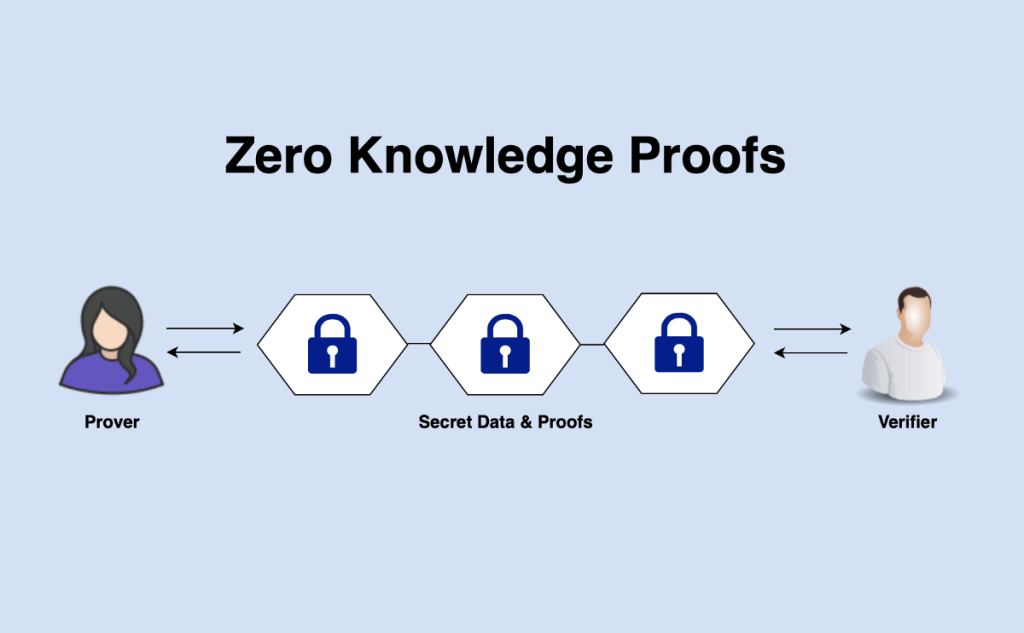
Zero-knowledge proofs make this possible by proving something is true without revealing the underlying data.
The technology addresses Ethereum’s core vulnerability, where every transaction becomes permanently visible to anyone with internet access.
Current blockchain transparency enables competitors to track business deals, governments to monitor spending patterns, and hackers to identify wealthy targets by monitoring wallet balances.
Companies handling millions in transactions face particular exposure since their entire supply chain and financial operations become public records.
Privacy-preserving smart contracts now enable businesses to conduct confidential transactions while maintaining audit trails for compliance.
Projects like RAILGUN and Aztec Network allow users to shield wallet balances and transaction details from public view while still settling on Ethereum’s secure base layer.
Users can create “shielded balances” that function like private bank accounts, with transaction history visible only to the account holder.
The Ethereum Foundation launched a 47-member Privacy Cluster in October, under the coordination of Blockscout founder Igor Barinov, to accelerate development across five key areas, including private transactions, portable verification, and selective identity disclosure.
Regulatory Pressure Intensifies Privacy Development
The Financial Stability Board warned in October that strict privacy laws hinder global crypto oversight, as confidentiality rules prevent data sharing across jurisdictions.
“Secrecy or data privacy laws may pose significant barriers to cooperation,” the FSB wrote, noting delays in addressing cooperation requests that discourage participation in oversight arrangements altogether.
Given the growing concern, the EU introduced sweeping crypto data-sharing rules in November under Implementing Regulation 2025/2263, requiring exchanges and wallet providers to report customer holdings in standardized formats from January 2026.
EU’s new crypto data-sharing rules will force exchanges and service providers to share user data and transaction records.#EU#CryptoPrivacyhttps://t.co/YoIDXmgNvm
The framework extends the Transfer of Funds Regulation’s “travel rule” to crypto, mandating sender-recipient identification for all transfers, including self-hosted wallet interactions above €1,000.
Most recently, Vitalik Buterin donated nearly $390,000 to the Session encrypted messaging app in November, highlighting that strong metadata privacy “requires decentralization.”
Session Technology Foundation President Alex Linton explained that permissionless account creation prevents censorship by generating cryptographically secure Account IDs rather than requiring phone numbers or email addresses that introduce surveillance risks.
Swiss and German police shut down Cryptomixer, seizing servers, domains and 28M dollars in Bitcoin during an Europol backed action targeting crypto laundering.
The flow of capital into spot Bitcoin and Ethereum ETFs has started to adjust again after weeks of steady redemptions. New data shows that both asset classes have recorded their first net-positive inflow week since October, and this might be an early sign that institutional appetite may be stabilizing after a difficult month for the leading cryptocurrencies and their ETF products.
On the other hand, inflow data shows that the recently launched Solana and XRP ETF products continue to attract steady institutional capital.
Bitcoin And Ethereum ETFs Break Their Outflow Streak
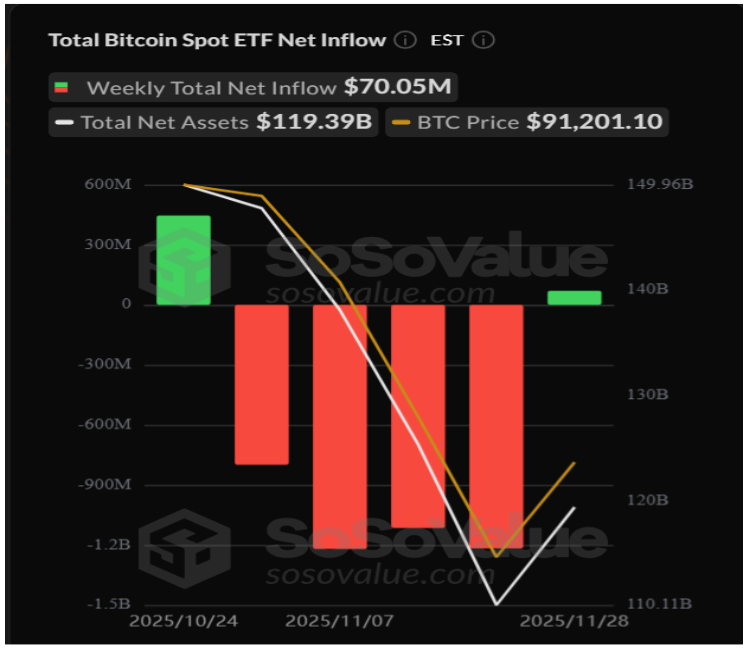
Spot Bitcoin ETFs quietly reversed their month-long downturn with roughly $70 million in net inflows during the final week of November. According to data from SoSoValue, this is the first positive inflow week since late October, putting an end to a four-week streak of redemptions that had removed about $4.35 billion worth of outflows from those funds.
Notably, most days of the just-concluded week were defined by low activity in Bitcoin ETFs, but the $71.37 million inflows on November 28 were enough to make the week a positive close.
The return of net-positive flows, even on a moderate scale, indicates that some institutional desks may be rebuilding exposure to Bitcoin.
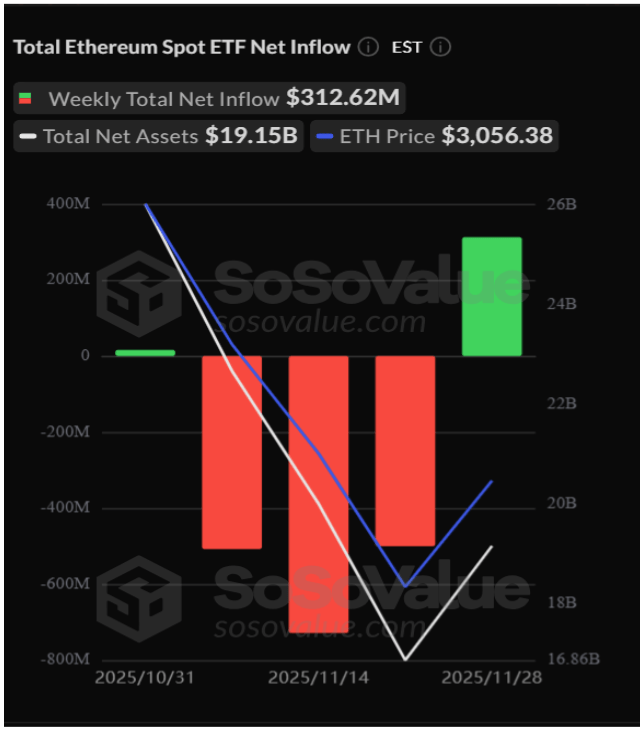
Ethereum saw an even more notable change in flow numbers. Net inflows into Spot Ethereum ETFs climbed to about $312.62 million in the just-concluded week, ending a three-week stretch of redemptions that had drained more than $1.74 billion from issuers.
The size of Ethereum’s rebound stands out because the price of the leading altcoin had been under more intense pressure than Bitcoin throughout most of November. The fresh inflows point to a noticeable change in sentiment, especially among institutions that had previously paused ETH accumulation.
Even as Bitcoin and Ethereum struggled through weeks of outflows, the newly introduced Solana and XRP ETFs never lost momentum. Spot Solana ETFs are now on a five-week inflow streak, with a further $108.34 million inflow last week.
Interestingly, Spot Solana ETFs experienced $8.1 million in outflows on Wednesday to end a 21-day inflow streak, but this was insufficient to cause a net outflow week.
Spot XRP ETFs, though launched more recently, have followed a similar trajectory. They are now on a three-week run of consistent inflows, with another $243.95 million added last week, its highest weekly inflow so far.
Another Spot XRP ETF is set to go live soon, as 21Shares recently confirmed that its US Spot XRP ETF has secured SEC approval and will begin trading on Monday, December 1. This builds upon the increasing appetite from investors looking for more crypto exposure outside of Bitcoin and Ethereum.
Featured image from Unsplash, chart from TradingView
The Bitcoin, Ethereum, and XRP prices are showing signs of recovery as traders across regions take sharply different approaches to the latest price swings. Fresh market data reveals that buying and selling pressure is no longer evenly distributed throughout the day, with the United States emerging as the key source of support. At the same time, other regions struggle to regain a solid footing.
US Traders Fuel Bitcoin, Ethereum, And XRP Price Recovery
Bitcoin’s market has moved once again as fresh on-chain data shows a clear divide in buying and seeking across global trading hours. A recent shift in US trading activity has had a noticeable impact on the broader crypto market. Ethereum and XRP, which experienced a sharp decline in previous weeks, have begun to stabilize and show mild recovery as Bitcoin strengthens during US hours.
Currently, the price of BTC is above $90,000 after crashing below $87,000 earlier in the week. Ethereum has also reclaimed the $3,000 level and is now trading steadily above it. XRP has recorded the most weekly increase between the two, jumping approximately 14% according to CoinMarketCap, with its price presently around $2.18. While these cryptocurrencies have yet to regain all lost ground, renewed buying from US traders has helped ease the downward momentum that dominated in previous weeks.
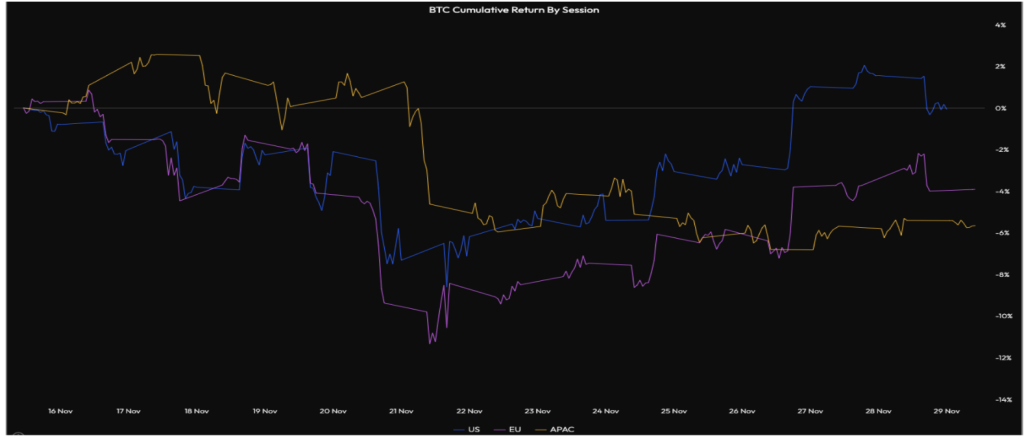
Sharing a new session-based chart from Velo, market analyst Ted Pillows disclosed that the US has reemerged as a net buyer of Bitcoin. At the same time, Asia remains the primary source of selling pressure throughout the year. This regional imbalance has reshaped the latest price movements of Ethereum and XRP, which tend to follow Bitcoin’s upward trajectory.
The latest figures from Velo support this view. Velo’s Bitcoin session chart shows that US trading hours, which had been in negative territory earlier in the week, climbed steadily into positive territory from November 24 to date. The blue line representing US hours rose from just above 2% to 3.73% on November 24 before reaching 7.55% by November 26. This reflects a gain of more than 4% over the period, confirming a strong resurgence in demand from US traders.
Europe Remains Uneven While Asia Leads Bitcoin Selling
European trading hours, highlighted by the purple line, have been more uneven than those of the US. Europe rose to 1.67% on November 24 and briefly pushed higher to 3.31% later that day. This surge comes after the cumulative weekly return fell into negative territory from November 21, and while a slight recovery followed, it still ended the week below the flat line. This suggests that despite weak buying momentum, Europe may no longer be delivering the heavy selling pressure seen earlier.
On the other hand, Asia continues to lag behind both regions. Velo’s chart shows that the APAC trading session, represented by the yellow line, started in slightly positive territory around November 20 but turned negative soon after. For most of the week, the regions remained between -5% and -7%. This persistent weakness signals a continuation of the year-long pattern in which Asian hours have been the leading driver of Bitcoin’s sell-side pressure.
Featured image from Unsplash, chart from TradingView

 Login
Login














 EU’s new crypto data-sharing rules will force exchanges and service providers to share user data and transaction records.