โŒ

Reading view

There are new articles available, click to refresh the page.

Strategy CEO Says $1.44B Cash Reserve Aims to Calm Bitcoin-Slump Fears

By: Amin Ayan

Strategy CEO Phong Le says the companyโ€™s newly built $1.44 billion cash reserve is designed to quiet investor anxiety over its ability to withstand a sharp downturn in Bitcoin.

Key Takeaways:

  • Strategy built a $1.44B cash reserve to ease investor fears about its ability to meet dividend and debt obligations.
  • The firm raised the funds in just eight and a half days, aiming to show it can still attract capital without selling any Bitcoin.
  • Strategy says it will only consider selling BTC if its stock falls below NAV.

Speaking on CNBCโ€™s Power Lunch, Le said the move followed weeks of speculation about whether the firm could continue meeting its dividend and debt commitments if market conditions worsened.

โ€œWeโ€™re very much a part of the crypto ecosystem and Bitcoin ecosystem,โ€ Le said. โ€œWhich is why we decided a couple of weeks ago to start raising capital and putting US dollars on our balance sheet to get rid of this FUD.โ€

Strategy Builds Cash Buffer to Avoid Selling Bitcoin in Market Slump

The reserve, announced Monday and funded via a stock sale, is intended to secure at least 12 months of dividend payments, with plans to stretch that buffer to 24 months.

The company emphasized that the stock-funded buildup gives Strategy breathing room without having to sell any Bitcoin during a turbulent period for the market.

Concerns over Strategyโ€™s dividend stability had grown louder in recent weeks as Bitcoin retreated from its highs.

Le acknowledged the market chatter but dismissed it as exaggerated. โ€œWe werenโ€™t going to have an issue paying dividends, and we werenโ€™t likely going to have to tap into selling our Bitcoin,โ€ he said.

โ€œBut there was FUD that was put out there that we wouldnโ€™t be able to meet our dividend obligations, which causes people to pile into a short Bitcoin bet.โ€

This afternoon, Phong Le, CEO of @Strategy, joined @CNBC @PowerLunch to discuss how $MSTR moves with bitcoin, how our USD reserve addresses recent FUD, the shifting Overton Window, key volatility drivers, and why bitcoinโ€™s long-term outlook remains strong. pic.twitter.com/1t5hsfov0m

โ€” Strategy (@Strategy) December 5, 2025

The CEO said raising $1.44 billion in just eight and a half days was intended as a direct response, showing the firm can still attract capital even in a downcycle.

โ€œWe did it to address the FUD, and to show people weโ€™re still able to raise money when Bitcoin is under pressure.โ€

Last week, Le said Strategy would only consider selling Bitcoin if the stock dropped below net asset value and the company lost the ability to raise additional funds.

Strategy has also introduced a new โ€œBTC Creditโ€ dashboard, which it says shows the company holds enough assets to service dividends for more than 70 years.

Strategy Adopts Dual-Reserve Model as BTC Buying Slows

As reported, Strategy has shifted from its long-standing โ€œbuy Bitcoin at all costsโ€ approach to a dual-reserve treasury model that pairs long-term BTC holdings with a growing dollar buffer.

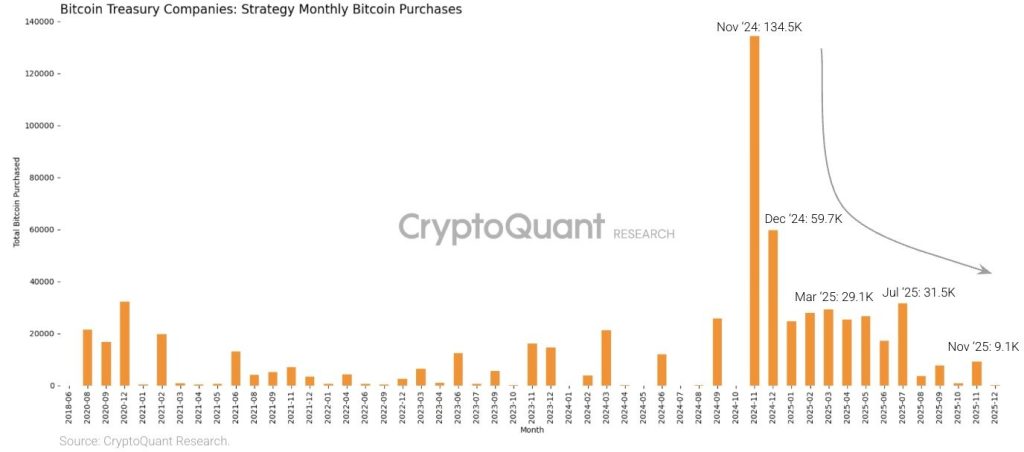
The move follows a dramatic slowdown in the firmโ€™s accumulation pace, from 134,000 BTC per month at its 2024 peak to just 9,100 BTC in November, signaling preparation for a potentially prolonged bear market.

Despite the slowdown, the company remains one of the worldโ€™s largest Bitcoin holders, with roughly 650,000 BTC on its balance sheet.

The post Strategy CEO Says $1.44B Cash Reserve Aims to Calm Bitcoin-Slump Fears appeared first on Cryptonews.

Strive Urges MSCI to Scrap Proposal Excluding Major BTC Holders

By: Amin Ayan

Strive, a Nasdaq-listed firm and the 14th-largest public holder of Bitcoin, is pushing back against MSCIโ€™s plan to remove companies with significant digital-asset exposure from its global indexes.

Key Takeaways:

  • Strive says MSCIโ€™s plan to exclude crypto-heavy firms would shut investors out of key growth sectors.
  • JPMorgan warns Strategy could face up to $2.8B in losses under the proposal.
  • Strive argues BTC-focused firms are vital to AI infrastructure and structured finance, making the cutoff unfair.

In a letter addressed to MSCI chairman and CEO Henry Fernandez, the company warned that the proposal, which would exclude firms whose crypto holdings exceed 50% of total assets, risks shutting passive investors out of fast-growing corners of the market.

JPMorgan Warns Strategy Could Lose $2.8B Under MSCI Proposal

JPMorgan analysts recently cautioned that Strategy, a prominent Bitcoin treasury company included in the MSCI World Index, could face as much as $2.8 billion in losses if the exclusion moves forward.

Strategyโ€™s chair, Michael Saylor, has confirmed that discussions with MSCI are ongoing as the company attempts to head off the decision.

Strive CEO Matt Cole argued that the proposal misunderstands the role large Bitcoin-focused firms play in emerging industries, particularly artificial intelligence.

He noted that miners such as MARA Holdings, Riot Platforms, and Hut 8, all potential exclusion targets, are rapidly expanding into AI infrastructure by retooling data centers for high-intensity compute workloads.

โ€œMany analysts argue that the AI race is increasingly limited by access to power, not semiconductors,โ€ Cole wrote, adding that miners are uniquely positioned to meet those needs.

https://t.co/5gdKWpFATh

โ€” Matt Cole (@ColeMacro) December 5, 2025

Even as AI revenue increases, he said, companies will continue holding sizable Bitcoin reserves, meaning MSCIโ€™s exclusion would permanently wall off a sector positioned at the intersection of digital assets and next-generation computing.

Cole also pointed to the rising demand for Bitcoin-linked financial products. Firms such as Strategy and Metaplanet function similarly to banks offering structured BTC notes, providing equity-based access to Bitcoin performance without requiring investors to hold the asset directly.

Excluding these treasury companies, he argued, would give traditional financial institutions, including JPMorgan, Morgan Stanley, and Goldman Sachs, an uneven playing field, as index-linked capital would become biased against firms whose business models center on Bitcoin exposure.

Strive Says MSCIโ€™s 50% Rule Would Cause Index โ€œWhiplashโ€

Strive further challenged the practicality of MSCIโ€™s 50% threshold, noting that tying index eligibility to a volatile asset would cause companies to drift in and out of benchmarks, increasing tracking errors for funds that follow them.

Cole highlighted Trump Media & Technology Group as an example. Despite holding one of the largest public Bitcoin treasuries, it narrowly avoided MSCIโ€™s preliminary exclusion list because its BTC exposure currently sits just under the cutoff.

Instead of a blanket rule, Strive proposed a parallel โ€œex-digital asset treasuryโ€ version of MSCIโ€™s indexes.

This would allow asset managers who wish to avoid crypto-heavy companies to do so, while others could maintain exposure to the full investable universe.

MSCI has not yet indicated whether it will revise its proposal, but industry pressure is mounting as treasury-heavy firms await a final decision.

The post Strive Urges MSCI to Scrap Proposal Excluding Major BTC Holders appeared first on Cryptonews.

Vivek Ramaswamyโ€™s Strive Urges MSCI to Rethink Bitcoin Index Exclusion

Bitcoin Magazine

Vivek Ramaswamyโ€™s Strive Urges MSCI to Rethink Bitcoin Index Exclusion

Strive Asset Management is pushing back against MSCIโ€™s latest proposal. The index provider suggested removing companies with bitcoin holdings over 50% of total assets from major equity benchmarks.

In a letter to MSCI CEO Henry Fernandez, Strive warned the plan could create uneven results worldwide. Companies report bitcoin differently under U.S. GAAP and IFRS accounting standards. Strive said this could lead to inconsistent outcomes for firms with similar exposure.

The Nasdaq-listed firm urged MSCI to rely on optional โ€œex-digital-asset treasuryโ€ index variants instead of redefining eligibility for broad benchmarks. These custom indexes already exist for sectors like energy and tobacco.

Strive is the 14th-largest public corporate bitcoin holder, with more than 7,500 BTC on its balance sheet. Its executives argued that the proposal would โ€œdepart from index neutralityโ€ and asked MSCI to โ€œlet the market decideโ€ how bitcoin-heavy firms are treated.

Co-founded by Vivek Ramaswamy and Anson Frericks in 2022, Strive has a mission to โ€œdepoliticize corporate America.โ€

MSCIโ€™s ruling affect on companies like Strive and Strategy

The rule change could affect major players like Strategy, which holds 650,000 BTC. JPMorgan estimates MSCIโ€™s exclusion could trigger $2.8 billion in passive outflows from Strategy alone. If other index providers follow suit, the total could rise to $8.8 billion.

Striveโ€™s letter criticized the 50% threshold as โ€œunjustified, overbroad and unworkable.โ€ Many bitcoin treasury companies operate real businesses.ย 

These include AI data centers, structured finance, and cloud infrastructure. Miners such as MARA, Riot, Hut 8, and CleanSpark are pivoting into renting excess power and compute capacity.

The firm drew comparisons to other industries. Indexes do not exclude energy companies with large oil reserves or gold miners whose value depends on metals. Applying a bitcoin-specific rule, Strive argued, imposes an investment judgment on benchmarks meant to remain neutral.

Executives also highlighted market volatility and accounting differences. Bitcoinโ€™s price swings could push companies in and out of eligibility from quarter to quarter. Derivatives or structured products further complicate exposure calculations.

Strive warned that strict rules could push innovation abroad. U.S. markets may face penalties, while international companies benefit from IFRS treatment. The firm believes the proposal may stifle new bitcoin-backed financial products.

MSCI plans to announce its decision on January 15, 2026, before the February index review. Strive is among several firms lobbying against the proposal. Its argument centers on fairness, neutrality, and market choice rather than restricting investor access.

Last week, Strategyโ€™s Michael Saylor disputed MSCI index disputes and clarified that Strategy is a publicly traded operating company with a $500 million software business and a treasury strategy using Bitcoin, not a fund, trust, or holding company.ย 

This post Vivek Ramaswamyโ€™s Strive Urges MSCI to Rethink Bitcoin Index Exclusion first appeared on Bitcoin Magazine and is written by Micah Zimmerman.

Hereโ€™s Why Bitcoin Volatility Sparks Fresh Attention On MicroStrategy

The Bitcoin price volatility is once again drawing attention to MicroStrategy, the company whose strategy has become a major market reference point, with billions in accumulated BTC and a track record of aggressive buying during downturns. As traders search for stability in a shaky market, Strategyโ€™s stance is being watched closely for what it might signal about the next phase of BTCโ€™s trend.

Why MicroStrategyโ€™s Next Move Could Redirect Market Momentum

Bitcoinโ€™s recent volatility has put MicroStrategy (MSTR), the largest corporate holder of BTC, in the limelight. Walter Bloomberg has revealed on X that analysts are watching closely to see if the company could influence the cryptocurrencyโ€™s price if it sells some of its holdings.

According to JPMorgan, Strategy can avoid forced sales as long as its enterprise value-to-BTC holdings ratio stays above 1.0, which currently stands at 1.13 BTC. However, analysts continue to debunk these claims, accusing JPMorgan of spreading misinformation about market manipulation and the company.

Walter stated that if the ratio remains above this level, BTC markets may stabilize and ease recent market pressure. Due to the market pressure, the firm has slowed its BTC purchases, adding 9,062 BTC last month compared to 134,480 BTC a year ago, reflecting a more cautious accumulation approach amid a broader crypto downturn. Its stock has dropped roughly 42% over the past three months.

Additionally, challenges include the potential exclusion from MSCI indices, which could trigger $8.8 billion in passive fund outflows if index funds are forced to divest. However, MicroStrategy holds a $1.4 billion reserve for dividends and interest, helping it avoid selling its BTC even if the price falls further. In the meantime, there is no proof that MicroStrategy is in danger of liquidation.

How Institutional Behavior Builds A Higher Floor For Bitcoin

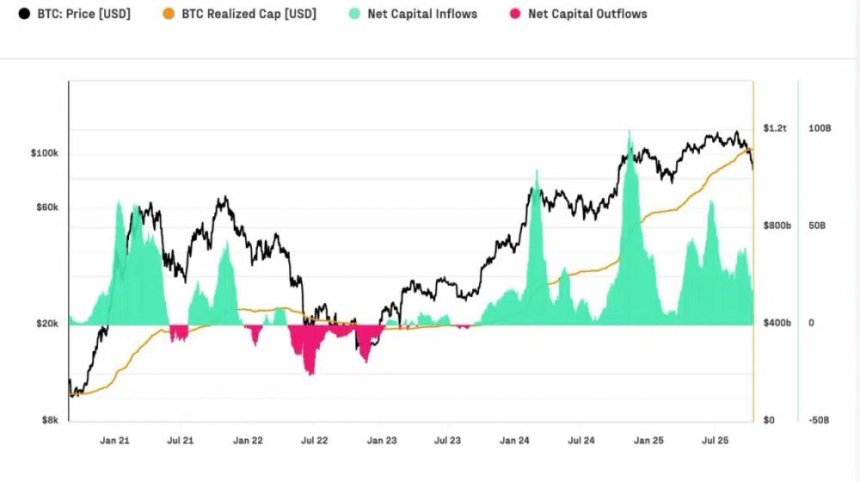
In a market speculation, Bitcoin is currently experiencing one of the most significant capital migrations in its history, fueled by institutional adoption. Analyst Matthew noted that the current BTC market cycle from 2022 to 2025 has already absorbed an unprecedented amount of new capital, surpassing all previous BTC cycles. This growth is a reflection of the marketโ€™s maturity and the ecosystemโ€™s innovative approach to liquidity through regulated instruments.

Bitcoin

Furthermore, the network has incorporated more than $732 billion in fresh capital in the current cycle, surpassing the $388 billion that was injected during the 2018 to 2022 cycle. At that time, the surge helped push BTC market capitalization to an all-time high record of $1.1 trillion, a metric that indicates a much higher aggregate cost base for new institutional investors.

Related Reading: Why Bitcoin Traders Fear A Repeat Of July 2024โ€™s Crash Next Week

Meanwhile, the total settlement volume in the decentralized BTC protocol was approximately $6.9 trillion in just 90 days. Despite this, the number of active on-chain entities dropped from 240,000 to 170,000 per day, which is a reflection of liquidity migration of capital flows into spot ETFs.

Bitcoin

Strategyโ€™s Bitcoin Appetite Dries Up In 2025 โ€” What Happened?

Strategy, the Michael Saylor-led corporate Bitcoin buyer long watched by investors, has sharply cut back purchases this year, according to CryptoQuant. Once a steady force of demand, its monthly buys have fallen dramatically, changing the way market watchers view institutional support for Bitcoin.

Sharp Drop In Monthly Purchases

Based on reports, Strategyโ€™s monthly accumulation peaked around 134,000 BTC in late 2024. By November 2025 that figure had dropped to roughly 9,100 BTC. That move amounts to about a 93% decline from the high-water mark. Buying this month was almost nil, with only 135 BTC recorded early in December. Those numbers show how quickly a major buyer can thin out.

Strategyโ€™s Bitcoin buying has collapsed through 2025.

Monthly purchases fell from 134K BTC at the 2024 peak to just 9.1K BTC in November 2025, only 135 BTC so far this month.

A 24-month buffer makes one thing clear: theyโ€™re bracing for the bear market. pic.twitter.com/qEwXR3JQ82

โ€” CryptoQuant.com (@cryptoquant_com) December 3, 2025

A Big Buy Amid The Pullback

Reports have disclosed that on November 17, 2025, Strategy made a sizeable purchase of roughly 8,178 BTC, a buy worth near $835 million at the time. The purchase was the largest for the firm since July and pushed its total holdings to about 649,870 BTC. But while that single entry was large, it did not reverse the broader trend: overall monthly activity is far lower than it was a year earlier.

Big Holdings But More Cash On Hand?

According to CryptoQuant, Strategy has also piled up cash โ€” about $1.4 billion has been set aside. That reserve is being held to cover dividend payments, debt servicing and other company needs. Observers say this signals a shift toward preserving liquidity rather than steady accumulation of Bitcoin. In other words, the company appears to be prioritizing cash stability over more buys for now.

What CryptoQuant And Others Are Watching

Market analysts are taking the slowdown as a warning sign that corporate appetite for Bitcoin treasuries may be cooling. If other big holders act the same, the structural demand that helped support prices could weaken.

Some traders will read the figures as a move to brace for a possible bear market. Others point out that Strategyโ€™s enormous stash โ€” nearly 650,000 BTC โ€” still gives it room to ride out a downturn without having to sell immediately.

Key signals to monitor include the monthly purchase totals going forward and any change in Strategyโ€™s cash holdings. Observers will be watching to see if the company returns to regular Bitcoin purchases or if the reduced buying becomes the standard.

Itโ€™s also important to monitor other corporate treasuries, because if several slowdowns occur together, the market for newly issued and available Bitcoin could tighten significantly.

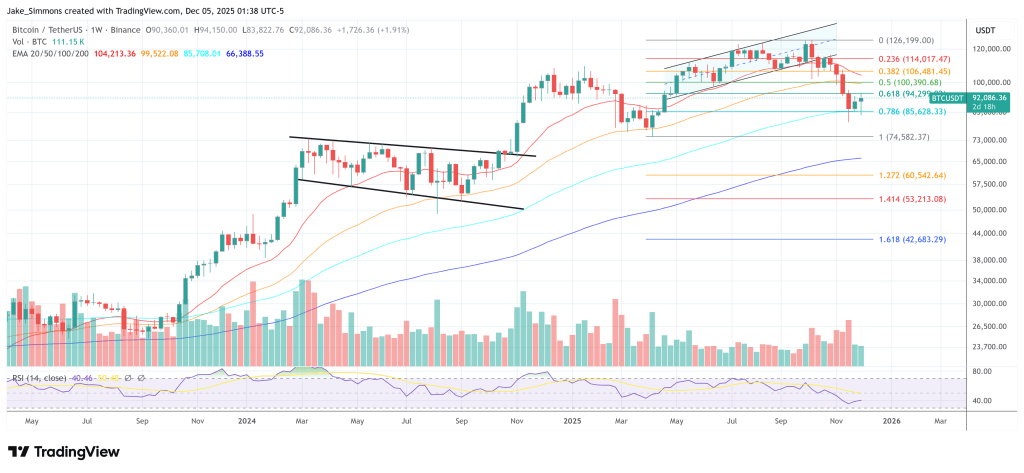
Featured image from JRU, chart from TradingView

Could Strategy Be Forced To Sell Its Bitcoin? Bitwise CIO Says No

Bitwise Chief Investment Officer Matt Hougan is pushing back against one of the loudest bearish narratives around bitcoin treasury company Strategy (MSTR, formerly MicroStrategy): that it could be forced into a liquidation of its roughly $60 billion bitcoin stack. In his latest CIO memo, Hougan writes bluntly that โ€œMichael Saylor and Strategy selling bitcoin is not one ofโ€ the real risks in crypto.

Will Strategy Sell Its Bitcoin?

The immediate trigger for market anxiety is MSCIโ€™s consultation on whether to remove so-called digital asset treasury companies (DATs) like Strategy from its investable indexes. Nearly $17 trillion in assets tracks those benchmarks, and JPMorgan estimates index funds might have to sell up to $2.8 billion of MSTR if it is excluded.

MSCIโ€™s rationale is structural: it views many DATs as closer to holding companies or funds than operating companies, and its investable universes already exclude holding structures such as REITs.

Hougan, a self-described โ€œdeep index geekโ€ who previously spent a decade editing the Journal of Indexes, says he can โ€œsee this going either way.โ€ Michael Saylor and others are arguing that Strategy remains very much an operating software company with โ€œcomplex financial engineering around bitcoin,โ€ and Hougan agrees that this is a reasonable characterization. But he notes that DATs are divisive, MSCI is currently leaning toward excluding them, and he โ€œwould guess there is at least a 75% chance Strategy gets bootedโ€ when MSCI announces its decision on January 15.

He argues, however, that even a removal is unlikely to be catastrophic for the stock. Large, mechanical index flows are often anticipated and โ€œpriced in well ahead of time.โ€ Hougan points out that when MSTR was added to the Nasdaq-100 last December, funds tracking the index had to buy about $2.1 billion of stock, yet โ€œits price barely moved.โ€

He believes some of the downside in MSTR since October 10 already reflects investors discounting a probable MSCI removal, and that โ€œat this point, I donโ€™t think youโ€™ll see substantial swings either way.โ€ Over the long term, he insists, โ€œthe value of MSTR is based on how well it executes its strategy, not on whether index funds are forced to own it.โ€

The more dramatic claim is the so-called MSTR โ€œdoom loopโ€: MSCI exclusion leads to heavy selling, the stock trades far below NAV, and Strategy is somehow forced to sell its bitcoin. Here Hougan is unequivocal: โ€œThe argument feels logical. Unfortunately for the bears, itโ€™s just flat wrong. There is nothing about MSTRโ€™s price dropping below NAV that will force it to sell.โ€

He breaks the problem down to actual balance sheet constraints. Strategy, he says, has two key obligations: about $800 million per year in interest payments and the need to refinance or redeem specific debt instruments as they mature.

Smaller DATs Are The Bigger Problem

On interest, the company currently has approximately $1.4 billion in cash, enough to โ€œmake its dividend payments easily for a year and a halfโ€ without touching its bitcoin or needing heroic capital markets access. On principal, the first major maturity does not arrive until February 2027, and that tranche is โ€œonly about $1 billionโ€”chump changeโ€ compared with the roughly $60 billion in bitcoin the company holds.

Governance further reduces the likelihood of forced selling. Michael Saylor controls around 42% of Strategyโ€™s voting shares and is, in Houganโ€™s words, a person with extraordinary โ€œconviction on bitcoinโ€™s long-term value.โ€ He notes that Saylor โ€œdidnโ€™t sell the last time MSTR stock traded at a discount, in 2022.โ€

Hougan concedes that a forced liquidation would be structurally significant for bitcoin, roughly equivalent to two years of spot ETF inflows dumped back into the market. He simply does not see a credible path from MSCI index mechanics and equity volatility to that outcome โ€œwith no debt due until 2027 and enough cash to cover interest payments for the foreseeable future.โ€ At the time of writing, he notes, bitcoin trades around $92,000, about 27% below its highs but still 24% above Strategyโ€™s average acquisition price of $74,436 per coin. โ€œSo much for the doom.โ€

Hougan ends by stressing that there are real issues to worry about in cryptoโ€”slow-moving market structure legislation, fragile and โ€œpoorly runโ€ smaller DATs, and a likely slowdown in DAT bitcoin purchases in 2026. But on Strategy specifically, his conclusion is direct: he โ€œwouldnโ€™t worry about the impact of MSCIโ€™s decision on the stock priceโ€ and sees โ€œno plausible near-term mechanism that would force it to sell its bitcoin. Itโ€™s not going to happen.โ€

At press time, BTC traded at $92,086.

Bitcoin price

Agents-as-a-service are poised to rewire the software industry and corporate structures

This was the year of AI agents. Chatbots that simply answered questions are now evolving into autonomous agents that can carry out tasks on a userโ€™s behalf, so enterprises continue to invest in agentic platforms as transformation evolves. Software vendors are investing in it as fast as they can, too.

According to a National Research Group survey of more than 3,000 senior leaders, more than half of executives say their organization is already using AI agents. Of the companies that spend no less than half their AI budget on AI agents, 88% say theyโ€™re already seeing ROI on at least one use case, with top areas being customer service and experience, marketing, cybersecurity, and software development.

On the software provider side, Gartner predicts 40% of enterprise software applications in 2026 will include agentic AI, up from less than 5% today. And agentic AI could drive approximately 30% of enterprise application software revenue by 2035, surpassing $450 billion, up from 2% in 2025. In fact, business users might not have to interact directly with the business applications at all since AI agent ecosystems will carry out user instructions across multiple applications and business functions. At that point, a third of user experiences will shift from native applications to agentic front ends, Gartner predicts.

Itโ€™s already starting. Most enterprise applications will have embedded assistants, a precursor to agentic AI, by the end of this year, adds Gartner.

IDC has similar predictions. By 2028, 45% of IT product and service interactions will use agents as the primary interface, the firm says. Thatโ€™ll change not just how companies work, but how CIOs work as well.

Agents as employees

At financial services provider OneDigital, chief product officer Vinay Gidwaney is already working with AI agents, almost as if they were people.

โ€œWe decided to call them AI coworkers, and we set up an AI staffing team co-owned between my technology team and our chief people officer and her HR team,โ€ he says. โ€œThat team is responsible for hiring AI coworkers and bringing them into the organization.โ€ You heard that right: โ€œhiring.โ€

The first step is to sit down with the business leader and write a job description, which is fed to the AI agent, and then it becomes known as an intern.

โ€œWe have a lot of interns weโ€™re testing at the company,โ€ says Gidwaney. โ€œIf they pass, they get promoted to apprentices and we give them our best practices, guardrails, a personality, and human supervisors responsible for training them, auditing what they do, and writing improvement plans.โ€

The next promotion is to a full-time coworker, and it becomes available to be used by anyone at the company.

โ€œAnyone at our company can go on the corporate intranet, read the skill sets, and get ice breakers if they donโ€™t know how to start,โ€ he says. โ€œYou can pick a coworker off the shelf and start chatting with them.โ€

For example, thereโ€™s Ben, a benefits expert whoโ€™s trained on everything having to do with employee benefits.

โ€œWe have our employee benefits consultants sitting with clients every day,โ€ Gidwaney says. โ€œBen will take all the information and help the consultants strategize how to lower costs, and how to negotiate with carriers. Heโ€™s the consultantsโ€™ thought partner.โ€

There are similar AI coworkers working on retirement planning, and on property and casualty as well. These were built in-house because theyโ€™re core to the companyโ€™s business. But there are also external AI agents who can provide additional functionality in specialized yet less core areas, like legal or marketing content creation. In software development, OneDigital uses third-party AI agents as coding assistants.

When choosing whether to sign up for these agents, Gidwaney says he doesnโ€™t think of it the way he thinks about licensing software, but more to hiring a human consultant or contractor. For example, will the agent be a good cultural fit?

But in some cases, itโ€™s worse than hiring humans since a bad human hire who turns out to be toxic will only interact with a small number of other employees. But an AI agent might interact with thousands of them.

โ€œYou have to apply the same level of scrutiny as how you hire real humans,โ€ he says.

A vendor who looks like a technology company might also, in effect, be a staffing firm. โ€œThey look and feel like humans, and you have to treat them like that,โ€ he adds.

Another way that AI agents are similar to human consultants is when they leave the company, they take their expertise with them, including what they gained along the way. Data can be downloaded, Gidwaney says, but not necessarily the fine-tuning or other improvements the agent received. Realistically, there might not be any practical way to extract that from a third-party agent, and that could lead to AI vendor lock-in.

Edward Tull, VP of technology and operations at JBGoodwin Realtors, says he, too, sees AI agents as something akin to people. โ€œI see it more as a teammate,โ€ he says. โ€œAs we implement more across departments, I can see these teammates talking to each other. It becomes almost like a person.โ€

Today, JBGoodwin uses two main platforms for its AI agents. Zapier lets the company build its own and HubSpot has its own AaaS, and theyโ€™re already pre-built. โ€œThere are lead enrichment agents and workflow agents,โ€ says Tull.

And the company is open to using more. โ€œIn accounting, if someone builds an agent to work with this particular type of accounting software, we might hire that agent,โ€ he says. โ€œOr a marketing coordinator that we could hire thatโ€™s built and ready to go and connected to systems we already use.โ€

With agents, his job is becoming less about technology and more about management, he adds. โ€œItโ€™s less day-to-day building and more governance, and trying to position the company to be competitive in the world of AI,โ€ he says.

Heโ€™s not the only one thinking of AI agents as more akin to human workers than to software.

โ€œWith agents, because the technology is evolving so far, itโ€™s almost like youโ€™re hiring employees,โ€ says Sheldon Monteiro, chief product officer at Publicis Sapient. โ€œYou have to determine whom to hire, how to train them, make sure all the business units are getting value out of them, and figure when to fire them. Itโ€™s a continuous process, and this is very different from the past, where I make a commitment to a platform and stick with it because the solution works for the business.โ€

This changes how the technology solutions are managed, he adds. What companies will need now is a CHRO, but for agentic employees.

Managing outcomes, not persons

Vituity is one of the largest national, privately-held medical groups, with 600 hospitals, 13,800 employees, and nearly 14 million patients. The company is building its own AI agents, but is also using off-the-shelf ones, as AaaS. And AI agents arenโ€™t people, says CIO Amith Nair. โ€œThe agent has no feelings,โ€ he says. โ€œAGI isnโ€™t here yet.โ€

Instead, it all comes down to outcomes, he says. โ€œIf you define an outcome for a task, thatโ€™s the outcome youโ€™re holding that agent to.โ€ And that part isnโ€™t different to holding employees accountable to an outcome. โ€œBut you donโ€™t need to manage the agent,โ€ he adds. โ€œTheyโ€™re not people.โ€

Instead, the agent is orchestrated and you can plug and play them. โ€œIt needs to understand our business model and our business context, so you ground the agent to get the job done,โ€ he says.

For mission-critical functions, especially ones related to sensitive healthcare data, Vituity is building its own agents inside a HIPAA-certified LLM environment using the Workato agent development platform and the Microsoft agentic platform.

For other functions, especially ones having to do with public data, Vituity uses off-the-shelf agents, such as ones from Salesforce and Snowflake. The company is also using Claude with GitHub Copilot for coding. Nair can already see that agentic systems will change the way enterprise software works.

โ€œMost of the enterprise applications should get up to speed with MCP, the integration layer for standardization,โ€ he says. โ€œIf they donโ€™t get to it, itโ€™s going to become a challenge for them to keep selling their product.โ€

A company needs to be able to access its own data via an MCP connector, he says. โ€œAI needs data, and if they donโ€™t give you an MCP, you just start moving it all to a data warehouse,โ€ he adds.

Sharp learning curve

In addition to providing a way to store and organize your data, enterprise software vendors also offer logic and functionality, and AI will soon be able to handle that as well.

โ€œAll you need is a good workflow engine where you can develop new business processes on the fly, so it can orchestrate with other agents,โ€ Nair says. โ€œI donโ€™t think weโ€™re too far away, but weโ€™re not there yet. Until then, SaaS vendors are still relevant. The question is, can they charge that much money anymore.โ€

The costs of SaaS will eventually have to come down to the cost of inference, storage, and other infrastructure, but they canโ€™t survive the way theyโ€™re charging now he says. So SaaS vendors are building agents to augment or replace their current interfaces. But that approach itself has its limits. Say, for example, instead of using Salesforceโ€™s agent, a company can use its own agents to interact with the Salesforce environment.

โ€œItโ€™s already happening,โ€ Nair adds. โ€œMy SOC agent is pulling in all the log files from Salesforce. Theyโ€™re not providing me anything other than the security layer they need to protect the data that exists there.โ€

AI agents are set to change the dynamic between enterprises and software vendors in other ways, too. One major difference between software and agents is software is well-defined, operates in a particular way, and changes slowly, says Jinsook Han, chief of strategy, corporate development, and global agentic AI at Genpact.

โ€œBut we expect when the agent comes in, itโ€™s going to get smarter every day,โ€ she says. โ€œThe world will change dramatically because agents are continuously changing. And the expectations from the enterprises are also being reshaped.โ€

Another difference is agents can more easily work with data and systems where they are. Take for example a sales agent meeting with customers, says Anand Rao, AI professor at Carnegie Mellon University. Each salesperson has a calendar where all their meetings are scheduled, and they have emails, messages, and meeting recordings. An agent can simply access those emails when needed.

โ€œWhy put them all into Salesforce?โ€ Rao asks. โ€œIf the idea is to do and monitor the sale, it doesnโ€™t have to go into Salesforce, and the agents can go grab it.โ€

When Rao was a consultant having a conversation with a client, heโ€™d log it into Salesforce with a note, for instance, saying the client needs a white paper from the partner in charge of quantum.

With an agent taking notes during the meeting, it can immediately identify the action items and follow up to get the white paper.

โ€œRight now weโ€™re blindly automating the existing workflow,โ€ Rao says. โ€œBut why do we need to do that? Thereโ€™ll be a fundamental shift of how we see value chains and systems. Weโ€™ll get rid of all the intermediate steps. Thatโ€™s the biggest worry for the SAPs, Salesforces, and Workdays of the world.โ€

Another aspect of the agentic economy is instead of a human employee talking to a vendorโ€™s AI agent, a company agent can handle the conversation on the employeeโ€™s behalf. And if a company wants to switch vendors, the experience will be seamless for employees, since they never had to deal directly with the vendor anyway.

โ€œI think thatโ€™s something thatโ€™ll happen,โ€ says Ricardo Baeza-Yates, co-chair of theย  US technology policy committee at the Association for Computing Machinery. โ€œAnd it makes the market more competitive, and makes integrating things much easier.โ€

In the short term, however, it might make more sense for companies to use the vendorsโ€™ agents instead of creating their own.

โ€œI recommend people donโ€™t overbuild because everything is moving,โ€ says Bret Greenstein, CAIO at West Monroe Partners, a management consulting firm. โ€œIf you build a highly complicated system, youโ€™re going to be building yourself some tech debt. If an agent exists in your application and itโ€™s localized to the data in that application, use it.โ€

But over time, an agent thatโ€™s independent of the application can be more effective, he says, and thereโ€™s a lot of lock-in that goes into applications. โ€œItโ€™s going to be easier every day to build the agent you want without having to buy a giant license. โ€œThe effort to get effective agents is dropping rapidly, and the justification for getting expensive agents from your enterprise software vendors is getting less,โ€ he says.

The future of software

According to IDC, pure seat-based pricing will be obsolete by 2028, forcing 70% of vendors to figure out new business models.

With technology evolving as quickly as it is, JBGoodwin Realtors has already started to change its approach to buying tech, says Tull. It used to prefer long-term contracts, for example but thatโ€™s not the case anymore โ€œYou save more if you go longer, but Iโ€™ll ask for an option to re-sign with a cap,โ€ he says.

That doesnโ€™t mean SaaS will die overnight. Companies have made significant investments in their current technology infrastructure, says Patrycja Sobera, SVP of digital workplace solutions at Unisys.

โ€œTheyโ€™re not scrapping their strategies around cloud and SaaS,โ€ she says. โ€œTheyโ€™re not saying, โ€˜Letโ€™s abandon this and go straight to agentic.โ€™ Iโ€™m not seeing that at all.โ€

Ultimately, people are slow to change, and institutions are even slower. Many organizations are still running legacy systems. For example, the FAA has just come out with a bold plan to update its systems by getting rid of floppy disks and upgrading from Windows 95. They expect this to take four years.

But the center of gravity will move toward agents and, as it does, so will funding, innovation, green-field deployments, and the economics of the software industry.

โ€œThere are so many organizations and leaders who need to cross the chasm,โ€ says Sobera. โ€œYouโ€™re going to have organizations at different levels of maturity, and some will be stuck in SaaS mentality, but feeling more in control while some of our progressive clients will embrace the move. Weโ€™re also seeing those clients outperform their peers in revenue, innovation, and satisfaction.โ€

CIOs take note: talent will walk without real training and leadership

Tech talent, especially with advanced and specialized skills, remains elusive. Findings from a recent IT global HR trends report by Gi Group show a 47% enterprise average struggles with sourcing and retaining talent. As a consequence, turnover remains high.

Another international study by Cegos highlights that 53% of 200 directors or managers of information systems in Italy alone say the difficulty of attracting and retaining IT talent is something they face daily.ย Cybersecurityย is the most relevant IT problem but a majority, albeit slight, feels confident of tackling it. Conversely, however, only 8% think theyโ€™ll be able to solve the IT talent problem. IT team skills development and talent retention are the next biggest issues facing CIOs in Italy, and only 24% and 9%, respectively, think they can successfully address it.

โ€œTalents arenโ€™t rare,โ€ says Cecilia Colasanti, CIO of Istat, the National Institute of Statistics. โ€œTheyโ€™re there but theyโ€™re not valued. Thatโ€™s why, more often, they prefer to go abroad. For me, talent is the right person in the right place. Managers, including CIOs, must have the ability to recognize talents, make them understand theyโ€™ve been identified, and enhance them with the right opportunities.โ€

The CIO as protagonist of talent management

Colasanti has very clear ideas on how to manage her talents to create a cohesive and motivated group. โ€œThe goal I set myself as CIO was to release increasingly high-quality products for statistical users, both internal and external,โ€ she says. โ€œI want to be concrete and close the projects weโ€™ve opened, to ensure the institution continues to improve with the contribution of IT, which is a driver of statistical production. I have the task of improving the IT function, the quality of the products released, the relevance of the management, and the well-being of people.โ€

Istatโ€™s IT department currently has 195 people, and represents about 10% of the instituteโ€™s entire staff. Colasantiโ€™s first step after her CIO appointment in October 2023 was to personally meet with all the resources assigned to management for an interview.

โ€œIโ€™ve been working at Istat since 2001 and almost everyone knows each other,โ€ she says. โ€œIโ€™ve held various roles in the IT department, and in my latest role as CIO, I want to listen to everyone to gather every possible viewpoint. Because how well we know each other, I feel my colleagues have a high expectation of our work together. Thatโ€™s why I try to establish a frank dialogue and avoid ambiguity. But I make it clear that listening doesnโ€™t mean delegating responsibility. I accept some proposals, reject others, and try to justify choices.โ€

Another move was to reinstate the two problems, two solutions initiative launched in Istat many years ago. Colasanti asked staff, on a voluntary basis, to identify two problems and propose two solutions. She then processed the material and shared the results in face-to-face meetings, commenting on the proposals, and evaluating those to be followed up.

โ€œIโ€™ve been very vocal about this initiative,โ€ she says, โ€œBut I also believe itโ€™s been an effective way to cement the relationship of trust with my colleagues.โ€

Some of the inquiries related to career opportunities and technical issues, but the most frequent pain points that emerged were internal communication and staff shortages. Colasanti spoke with everyone, clarifying which points she could or couldnโ€™t act on. Career paths and hiring in the public sector, for example, follow precise procedures where little could be influenced.

โ€œI tried to address all the issues from a proactive perspective,โ€ she says. โ€œWhere I perceived a generic resistance to change rather than a specific problem, I tried to focus on intrinsic motivation and peopleโ€™s commitment. Itโ€™s important to explain the strategies of the institution and the role of each person to achieve objectives. After all, people need and have the right to know the context in which they operate, and be aware of how their work affects the bigger picture.โ€

Engagement must be built day by day, so Colasanti regularly meets with staff including heads of department and service managers.

Small enterprise, big concerns

The case of Istat stands out for the size of its IT department, but in SMEs, IT functions can be just a handful of people, including the CIO, and much of the work is done by external consultants and suppliers. Itโ€™s a structure that has to be worked with, dividing themselves between coordinating various resources across different projects, and the actual IT work. Outsourcing to the cloud is an additional support but CIOs would generally like to have more in-house expertise rather than depend on partners to control supplier products.

โ€œAttracting and retaining talent is a problem, so things are outsourced,โ€ says the CIO of a small healthcare company with an IT team of three. โ€œYou offload the responsibility and free up internal resources at the risk of losing know-how in the company. But at the moment, we have no other choice. We canโ€™t offer the salaries of a large private group, and IT talent changes jobs every two years, so keeping people motivated is difficult. We hire a candidate, go through the training, and see them grow only to see them leave. But our sector is highly specialized and the necessary skills are rare.โ€

The sirens of the market are tempting for those with the skills to command premium positioning, and the private sector is able to attract talent more easily than public due to its hiring flexibility and career paths.

โ€œThe public sector offers the opportunity to research, explore and deepen issues that private companies often donโ€™t invest in because they donโ€™t see the profit,โ€ says Colasanti. โ€œThe public has the good of the community as its mission and can afford long-term investments.โ€

Training builds resource retention

To meet demand, CIOs are prioritizing hiring new IT profiles and training their teams, according to the Cegos international barometer. Offering reskilling and upskilling are effective ways to overcome the pitfalls of talent acquisition and retention.

โ€œThe market is competitive, so retaining talent requires barriers to exit,โ€ says Emanuela Pignataro, head of business transformation and execution at Cegos Italia. โ€œIf an employer creates a stimulating and rewarding environment with sufficient benefits, people are less likely to seek other opportunities or get caught up in the competition. Many feel theyโ€™re burdened with too many tasks they canโ€™t cope with on their own, and these are people with the most valuable skills, but who often work without much support. So if the company spends on training or onboarding new people who support these people, they create reassurance, which generates loyalty.โ€

In fact, Colasanti is a staunch supporter of life-long learning, and the experience that brings balance and management skills. But she doesnโ€™t have a large budget for IT training, yet solutions in response to certain requests are within reach.

โ€œIn these cases, I want serious commitment,โ€ she says. โ€œThe institution invests and the course must give a result. A higher budget would be useful, of course, especially for an ever-evolving subject like cybersecurity.โ€

The need for leadership

CIOs also recognize the importance of following people closely, empowering them, and giving them a precise and relevant role that enhances motivation. Itโ€™s also essential to collaborate with the HR function to develop tools for welfare and well-being.

According to the Gi Group study, the factors that IT candidates in Italy consider a priority when choosing an employer are, in descending order, salary, a hybrid job offer, work-life balance, the possibility of covering roles that donโ€™t involve high stress levels, and opportunities for career advancement and professional growth.

But thereโ€™s another aspect that helps solve the age-old issue of talent management. CIOs need to recognize more of the role of their leadership. At the moment, Italian IT directors place it at the bottom of their key qualities. In the Cegos study, technical expertise, strategic vision, and ability to innovate come first, while leadership came a distant second. But the leadership of the CIO is a founding basis, even when thereโ€™s disagreement with choices.

โ€œI believe in physical presence in the workplace,โ€ says Colasanti. โ€œIstat has a long tradition of applying teleworking and implementing smart working, which everyone can access if they wish. Personally, I prefer to be in the office, but I respect the need to reconcile private life and work, and I have no objection to agile working. Iโ€™m on site every day, though. My colleagues know Iโ€™m here.โ€

๋ ˆ๊ฑฐ์‹œ ์œ ์ง€๋ณด์ˆ˜์— ๋ฐœ๋ชฉ ์žกํžŒ IT, ์„œ๋“œํŒŒํ‹ฐ๋กœ ๋ŒํŒŒ๊ตฌ ๋ชจ์ƒ‰

๊ธฐ์ˆ  ๋ถ€์ฑ„๊ฐ€ IT ์กฐ์ง์„ ๋งˆ๋น„์‹œํ‚ฌ ์œ„ํ˜‘ ์š”์ธ์œผ๋กœ ๋– ์˜ค๋ฅด์ž ์ƒ๋‹น์ˆ˜ CIO๊ฐ€ ๋ ˆ๊ฑฐ์‹œ ์†Œํ”„ํŠธ์›จ์–ด์™€ ์‹œ์Šคํ…œ ์œ ์ง€๋ณด์ˆ˜ยท์—…๊ทธ๋ ˆ์ด๋“œ๋ฅผ ์œ„ํ•ด ์„œ๋“œํŒŒํ‹ฐ ์„œ๋น„์Šค ์—…์ฒด์— ๋ˆˆ์„ ๋Œ๋ฆฌ๊ณ  ์žˆ๋‹ค. ๋งค๋‹ˆ์ง€๋“œ ์„œ๋น„์Šค ์—…์ฒด ์—”์†Œ๋…ธ(Ensono)๊ฐ€ ์‹ค์‹œํ•œ ์„ค๋ฌธ์กฐ์‚ฌ ๊ฒฐ๊ณผ, IT ๋ฆฌ๋” 100๋ช… ๊ฐ€์šด๋ฐ 95๋ช…์ด ๋ ˆ๊ฑฐ์‹œ IT๋ฅผ ํ˜„๋Œ€ํ™”ํ•˜๊ณ  ๊ธฐ์ˆ  ๋ถ€์ฑ„๋ฅผ ์ค„์ด๊ธฐ ์œ„ํ•ด ์™ธ๋ถ€ ์„œ๋น„์Šค ์—…์ฒด๋ฅผ ํ™œ์šฉํ•˜๊ณ  ์žˆ๋Š” ๊ฒƒ์œผ๋กœ ๋‚˜ํƒ€๋‚ฌ๋‹ค.

์ด ๊ฐ™์€ ์›€์ง์ž„์€ ๋ถ€๋ถ„์ ์œผ๋กœ ๋ ˆ๊ฑฐ์‹œ IT ๋น„์šฉ ์ฆ๊ฐ€์—์„œ ๋น„๋กฏ๋๋‹ค. ์‘๋‹ต์ž ๊ฐ€์šด๋ฐ ๊ฑฐ์˜ ์ ˆ๋ฐ˜์€ ์ง€๋‚œํ•ด ๋…ธํ›„ IT ์‹œ์Šคํ…œ ์œ ์ง€๋ณด์ˆ˜์— ์˜ˆ์‚ฐ๋ณด๋‹ค ๋” ๋งŽ์€ ๋น„์šฉ์„ ์ง€์ถœํ–ˆ๋‹ค๊ณ  ๋‹ตํ–ˆ๋‹ค. ๋” ํฐ ๋ฌธ์ œ๋Š” ๋ ˆ๊ฑฐ์‹œ ์• ํ”Œ๋ฆฌ์ผ€์ด์…˜๊ณผ ์ธํ”„๋ผ๊ฐ€ IT ์กฐ์ง์˜ ๋ฐœ๋ชฉ์„ ์žก๊ณ  ์žˆ๋‹ค๋Š” ์ ์ด๋‹ค. IT ๋ฆฌ๋” 10๋ช… ๊ฐ€์šด๋ฐ 9๋ช…์€ ๋ ˆ๊ฑฐ์‹œ ์œ ์ง€๋ณด์ˆ˜๊ฐ€ AI ํ˜„๋Œ€ํ™” ๊ณ„ํš์— ๊ฑธ๋ฆผ๋Œ์ด ๋˜๊ณ  ์žˆ๋‹ค๊ณ  ์ง€์ ํ–ˆ๋‹ค.

์—”์†Œ๋…ธ์˜ CTO ํŒ€ ๋ฒ ์–ด๋จผ์€ โ€œ๋ ˆ๊ฑฐ์‹œ ์‹œ์Šคํ…œ ์œ ์ง€๋ณด์ˆ˜๊ฐ€ ํ˜„๋Œ€ํ™” ๋…ธ๋ ฅ์— ํฐ ๋ฐฉํ•ด๊ฐ€ ๋˜๊ณ  ์žˆ๋‹คโ€๋ผ๋ฉฐ, โ€œ์ „ํ˜•์ ์ธ ํ˜์‹ ๊ฐ€์˜ ๋”œ๋ ˆ๋งˆ๋‹ค. ํ˜์‹ ๋ณด๋‹ค๋Š” ๋…ธํ›„ ์‹œ์Šคํ…œ๊ณผ ๊ทธ ํ•ด๊ฒฐ ๋ฐฉ์•ˆ์—๋งŒ ์ง‘์ค‘ํ•˜๊ณ  ์žˆ๋‹คโ€๋ผ๊ณ  ์ง€์ ํ–ˆ๋‹ค.

์ผ๋ถ€ CIO๋Š” ๋ ˆ๊ฑฐ์‹œ ์‹œ์Šคํ…œ ์šด์˜์„ ์„œ๋น„์Šค ์—…์ฒด์— ๋งก๊ธฐ๊ฑฐ๋‚˜ ์™ธ๋ถ€ ITํŒ€์„ ํ™œ์šฉํ•ด ๊ธฐ์ˆ  ๋ถ€์ฑ„๋ฅผ ์ •๋ฆฌํ•˜๊ณ  ์†Œํ”„ํŠธ์›จ์–ด์™€ ์‹œ์Šคํ…œ์„ ํ˜„๋Œ€ํ™”ํ•˜๊ณ  ์žˆ๋‹ค. ๋ฒ ์–ด๋จผ์€ ๋ ˆ๊ฑฐ์‹œ ์‹œ์Šคํ…œ์„ ์™ธ๋ถ€์— ๋งก๊ธฐ๋Š” ๊ธฐ์—…์ด ์ฆ๊ฐ€ํ•˜๋Š” ๋ฐฐ๊ฒฝ์œผ๋กœ ๊ณ ๋ นํ™”๋œ ์ธ๋ ฅ์„ ๊ผฝ์•˜๋‹ค. ๊ธฐ์—… ๋‚ด๋ถ€์˜ ๋ ˆ๊ฑฐ์‹œ ์‹œ์Šคํ…œ ์ „๋ฌธ๊ฐ€๊ฐ€ ์€ํ‡ดํ•˜๋ฉด์„œ ์ถ•์ ๋œ ์ง€์‹๋„ ํ•จ๊ป˜ ๋น ์ ธ๋‚˜๊ฐ€๊ณ  ์žˆ๋‹ค๋Š” ์˜๋ฏธ๋‹ค.

๋ฒ ์–ด๋จผ์€ โ€œ์ด ์ผ์„ ๋‚ด๋ถ€์—์„œ ์ง์ ‘ ์ฒ˜๋ฆฌํ•  ์ˆ˜ ์žˆ๋Š” ์ธ๋ ฅ์ด ๋งŽ์ง€ ์•Š๋‹ค. ์กฐ์ง ๋‚ด ์ธ๋ ฅ์ด ๊ณ ๋ นํ™”๋˜๊ณ  ํ‡ด์ง์ž๊ฐ€ ๋Š˜์–ด๋‚˜๋Š” ์ƒํ™ฉ์—์„œ, ํ•„์š”ํ•œ ์ธ์žฌ๋ฅผ ์ฑ„์šฉํ•˜๊ธฐ ์–ด๋ ค์šด ์˜์—ญ์—์„œ๋Š” ์™ธ๋ถ€์—์„œ ์ „๋ฌธ ์ธ๋ ฅ์„ ์ฐพ์•„์•ผ ํ•œ๋‹คโ€๋ผ๊ณ  ์„ค๋ช…ํ–ˆ๋‹ค. ๋˜, โ€œMSP ๋ชจ๋ธ ์ž์ฒด๋Š” ์ˆ˜์‹ญ ๋…„ ์ „๋ถ€ํ„ฐ ์กด์žฌํ–ˆ์ง€๋งŒ, ์ตœ๊ทผ์—๋Š” ์˜ˆ์‚ฐ์„ ํ™•๋ณดํ•˜๊ณ  AI๋ฅผ ๋„์ž…ํ•  ์‹œ๊ฐ„์„ ๋งŒ๋“ค๊ธฐ ์œ„ํ•ด MSP๋ฅผ ๊ธฐ์ˆ  ๋ถ€์ฑ„ ๊ด€๋ฆฌ ์ˆ˜๋‹จ์œผ๋กœ ํ™œ์šฉํ•˜๋Š” ํ๋ฆ„์ด ์ปค์ง€๊ณ  ์žˆ๋‹คโ€๋ผ๊ณ  ๋ถ„์„ํ–ˆ๋‹ค.

AI์ฒ˜๋Ÿผ ์ƒˆ๋กœ์šด ๊ธฐ์ˆ ์ด ๋น ๋ฅด๊ฒŒ ํ™•์‚ฐ๋˜๋Š” ๊ฒƒ๋„ ์ด๋Ÿฐ ํ๋ฆ„์— ์ผ์กฐํ•˜๊ณ  ์žˆ๋‹ค. ๋ฒ ์–ด๋จผ์€ โ€œํ•œ์ชฝ์—๋Š” ๊ด€๋ฆฌยท์œ ์ง€ํ•ด์•ผ ํ•˜๋Š” ๋ ˆ๊ฑฐ์‹œ ๋ฌธ์ œ๊ฐ€ ์žˆ๊ณ , ๋‹ค๋ฅธ ํ•œ์ชฝ์—๋Š” ์ˆ˜๋…„ ๋™์•ˆ ๊ฒฝํ—˜ํ•˜์ง€ ๋ชปํ•œ ์†๋„๋กœ ๋ฐœ์ „ํ•˜๋Š” ์ตœ์‹  ๊ธฐ์ˆ ์ด ์žˆ์–ด ์–‘์ชฝ์„ ๋™์‹œ์— ๋”ฐ๋ผ๊ฐ€๊ธฐ ์–ด๋ ต๋‹คโ€๋ผ๊ณ  ๋ง๋ถ™์˜€๋‹ค.

์œ„ํ—˜์˜ ์•„์›ƒ์†Œ์‹ฑ

์‚ฌ์ด๋ฒ„ ๋ณด์•ˆ ์„œ๋น„์Šค ์—…์ฒด ๋‰ด๋น…(Neuvik)์˜ CEO ๋ผ์ด์–ธ ๋ ˆ์ด๋ฅด๋น…์€ ๋ ˆ๊ฑฐ์‹œ IT ๊ด€๋ฆฌ๋ฅผ ์„œ๋น„์Šค ์—…์ฒด์— ๋งก๊ธฐ๋Š” ํ๋ฆ„์ด ํ™•๋Œ€๋˜๊ณ  ์žˆ๋‹ค๋Š” ์ ์— ๋™์˜ํ–ˆ๋‹ค. ๋ ˆ์ด๋ฅด๋น…์€ ๋ ˆ๊ฑฐ์‹œ ์‹œ์Šคํ…œ์— ์ ํ•ฉํ•œ ์ „๋ฌธ๊ฐ€๋ฅผ ๋งค์นญํ•˜๋Š” ๋“ฑ ์—ฌ๋Ÿฌ ์žฅ์ ์„ ์–ธ๊ธ‰ํ•˜๋ฉด์„œ๋„, CIO๊ฐ€ ์œ„ํ—˜ ๊ด€๋ฆฌ๋ฅผ ์œ„ํ•ด MSP๋ฅผ ํ™œ์šฉํ•˜๋Š” ๊ฒฝํ–ฅ๋„ ์žˆ๋‹ค๊ณ  ์ง€์ ํ–ˆ๋‹ค.

๋ ˆ์ด๋ฅด๋น…์€ โ€œ๋งŽ์€ ์žฅ์  ๊ฐ€์šด๋ฐ ์ž์ฃผ ์–ธ๊ธ‰๋˜์ง€ ์•Š๋Š” ํ•ต์‹ฌ์€ ์ทจ์•ฝ์  ์•…์šฉ์ด๋‚˜ ์„œ๋น„์Šค ์ค‘๋‹จ ์œ„ํ—˜์„ ์„œ๋น„์Šค ์—…์ฒด์— ๋งก๊ธธ ์ˆ˜ ์žˆ๋‹ค๋Š” ์ โ€์ด๋ผ๋ฉฐ, โ€œ์ทจ์•ฝ์  ๋ฐœ๊ฒฌ๊ณผ ํŒจ์น˜, ์ „๋ฐ˜์ ์ธ ์œ ์ง€๋ณด์ˆ˜์— ์ง€์†์ ์œผ๋กœ ๋งŽ์€ ๋น„์šฉ์ด ๋“œ๋Š” ํ™˜๊ฒฝ์—์„œ๋Š” ์ž˜๋ชป ๋Œ€์‘ํ–ˆ์„ ๋•Œ ๋ฐœ์ƒํ•˜๋Š” ์œ„ํ—˜์„ ์„œ๋น„์Šค ์—…์ฒด๊ฐ€ ๋– ์•ˆ๊ฒŒ ๋˜๋Š” ๊ฒฝ์šฐ๊ฐ€ ๋งŽ๋‹คโ€๋ผ๊ณ  ์„ค๋ช…ํ–ˆ๋‹ค.

๋ฏธ ๊ตญ๋ฐฉ๋ถ€(US Department of Defense)์—์„œ ๋น„์„œ์‹ค์žฅ ๊ฒธ ์‚ฌ์ด๋ฒ„ ๋ถ€๋ฌธ ๋ถ€๊ตญ์žฅ์„ ์ง€๋‚ธ ๋ ˆ์ด๋ฅด๋น…์€ ๋ ˆ๊ฑฐ์‹œ IT ์œ ์ง€๋ณด์ˆ˜ ์˜ˆ์‚ฐ์„ ์ดˆ๊ณผ ์ง‘ํ–‰ํ•œ IT ์ฑ…์ž„์ž๊ฐ€ ๋งŽ๋‹ค๋Š” ๊ฒƒ์ด ๋†€๋ž„ ์ผ์€ ์•„๋‹ˆ๋ผ๊ณ  ๋งํ•œ๋‹ค. ๋งŽ์€ ์กฐ์ง์ด ํ˜„์žฌ ๋ณด์œ ํ•œ IT ์ธํ”„๋ผ์™€ ์•ž์œผ๋กœ ์ „ํ™˜ํ•ด์•ผ ํ•  ์ธํ”„๋ผ ์‚ฌ์ด์—์„œ ํ•„์š”ํ•œ ์ธ์žฌ ์—ญ๋Ÿ‰์ด ๋งž์ง€ ์•Š๋Š” ์ƒํ™ฉ์— ๋†“์—ฌ ์žˆ๋‹ค๊ณ  ์ง€์ ํ•˜๋ฉฐ, ๋ ˆ๊ฑฐ์‹œ ์†Œํ”„ํŠธ์›จ์–ด์™€ ์‹œ์Šคํ…œ์˜ ์ง€์†์ ์ธ ์œ ์ง€๋ณด์ˆ˜ ๋น„์šฉ์ด ์˜ˆ์ƒ๋ณด๋‹ค ๋” ๋งŽ์ด ๋“œ๋Š” ๊ฒฝ์šฐ๋„ ์žฆ๋‹ค๊ณ  ๋งํ–ˆ๋‹ค.

๋ ˆ์ด๋ฅด๋น…์€ โ€œ์ดˆ๊ธฐ ๋„์ž… ๋น„์šฉ์ด 1์ด๋ผ๋ฉด, ์œ ์ง€๋ณด์ˆ˜ ๋น„์šฉ์€ 1X์ด๊ธฐ ๋•Œ๋ฌธ์— ์˜ˆ์ƒํ•˜์ง€ ๋ชปํ•œ ๊ฑฐ๋Œ€ํ•œ ์œ ์ง€๋ณด์ˆ˜ ๊ผฌ๋ฆฌ๊ฐ€ ์ƒ๊ธด๋‹คโ€๋ผ๊ณ  ๋ง๋ถ™์˜€๋‹ค.

๋ ˆ๊ฑฐ์‹œ ์œ ์ง€๋ณด์ˆ˜์˜ ๋ซ์—์„œ ๋ฒ—์–ด๋‚˜๋ ค๋ฉด ์ ์ ˆํ•œ ์„œ๋“œํŒŒํ‹ฐ ์—…์ฒด๋ฅผ ๊ณ ๋ฅด๋Š” ์„ ๊ฒฌ์ง€๋ช…๊ณผ ์„ ํƒ ๊ธฐ์ค€์ด ํ•„์š”ํ•˜๋‹ค. ๋ ˆ์ด๋ฅด๋น…์€ โ€œ์žฅ๊ธฐ์ ์ธ ๊ด€์ ์—์„œ ํ•ด๋‹น ์—…์ฒด์™€ ํ–ฅํ›„ 5๋…„ ๊ณ„ํš์ด ๋งž๋ฌผ๋ฆฌ๋Š”์ง€ ๋ฐ˜๋“œ์‹œ ํ™•์ธํ•ด์•ผ ํ•œ๋‹ค. ๋˜ ์กฐ์ง์˜ ๋ชฉํ‘œ์™€ ์—…์ฒด๊ฐ€ ์ œ๊ณตํ•˜๋ ค๋Š” ์ง€์› ๋ฐฉํ–ฅ์ด ์ผ์น˜ํ•˜๋Š”์ง€๋„ ์ ๊ฒ€ํ•ด์•ผ ํ•œ๋‹คโ€๋ผ๊ณ  ์กฐ์–ธํ–ˆ๋‹ค.

๋‘ ๋ฒˆ ์ง€๋ถˆํ•˜๋Š” ๋น„์šฉ

์ผ๋ถ€ IT ๋ฆฌ๋”๊ฐ€ ๋ ˆ๊ฑฐ์‹œ ์‹œ์Šคํ…œ ํ˜„๋Œ€ํ™”๋ฅผ ์„œ๋“œํŒŒํ‹ฐ ์—…์ฒด์— ๋งก๊ธฐ๊ณ  ์žˆ์ง€๋งŒ, IT ์„œ๋น„์Šค ๊ด€๋ฆฌ ๋ฐ ๊ณ ๊ฐ ์„œ๋น„์Šค ์†Œํ”„ํŠธ์›จ์–ด ์—…์ฒด ํ”„๋ ˆ์‹œ์›์Šค(Freshworks)๊ฐ€ ์ตœ๊ทผ ๊ณต๊ฐœํ•œ ๋ณด๊ณ ์„œ๋Š” ์ด๋Ÿฐ ํ˜„๋Œ€ํ™” ๋…ธ๋ ฅ์ด ๊ณผ์—ฐ ํšจ์œจ์ ์ธ์ง€์— ์˜๋ฌธ์„ ์ œ๊ธฐํ–ˆ๋‹ค.

ํ”„๋ ˆ์‹œ์›์Šค์˜ ์กฐ์‚ฌ์—์„œ ์‘๋‹ต์ž์˜ 3/4 ์ด์ƒ์€ ์†Œํ”„ํŠธ์›จ์–ด ๋„์ž…์— ์˜ˆ์ƒ๋ณด๋‹ค ๋” ๋งŽ์€ ์‹œ๊ฐ„์ด ๊ฑธ๋ฆฐ๋‹ค๊ณ  ๋‹ตํ–ˆ๊ณ , ํ”„๋กœ์ ํŠธ ๊ฐ€์šด๋ฐ 2/3์€ ์˜ˆ์‚ฐ์„ ์ดˆ๊ณผํ–ˆ๋‹ค๊ณ  ์‘๋‹ตํ–ˆ๋‹ค. ํ”„๋ ˆ์‹œ์›์Šค์˜ CIO ์•„์Šˆ์œˆ ๋ฐœ๋ž„์€ ์„œ๋“œํŒŒํ‹ฐ ์„œ๋น„์Šค ์—…์ฒด๊ฐ€ ์ด ๋ฌธ์ œ๋ฅผ ํ•ด๊ฒฐํ•ด ์ฃผ์ง€ ๋ชปํ•  ์ˆ˜๋„ ์žˆ๋‹ค๊ณ  ๊ฒฝ๊ณ ํ–ˆ๋‹ค.

๋ฐœ๋ž„์€ โ€œ๋ ˆ๊ฑฐ์‹œ ์‹œ์Šคํ…œ์ด ๋„ˆ๋ฌด ๋ณต์žกํ•ด์ง€๋ฉด์„œ ๊ธฐ์—…์ด ๋„์›€์„ ๊ตฌํ•˜๋ ค๊ณ  ์„œ๋“œํŒŒํ‹ฐ ์—…์ฒด์™€ ์ปจ์„คํ„ดํŠธ์— ์ ์  ๋” ์˜์กดํ•˜๊ณ  ์žˆ์ง€๋งŒ, ์‹ค์ œ๋กœ๋Š” ์ˆ˜์ค€ ์ดํ•˜์˜ ๋ ˆ๊ฑฐ์‹œ ์‹œ์Šคํ…œ์„ ๋‹ค๋ฅธ ์ˆ˜์ค€ ์ดํ•˜ ๋ ˆ๊ฑฐ์‹œ ์‹œ์Šคํ…œ์œผ๋กœ ๋ฐ”๊พธ๋Š” ๊ฒฐ๊ณผ์— ๊ทธ์น˜๋Š” ๊ฒฝ์šฐ๊ฐ€ ๋งŽ๋‹คโ€๋ผ๋ฉฐ, โ€œ์„œ๋“œํŒŒํ‹ฐ ์—…์ฒด์™€ ์ปจ์„คํ„ดํŠธ๋ฅผ ์ถ”๊ฐ€ํ•˜๋ฉด ๊ธฐ์กด ๋ฌธ์ œ๋ฅผ ํ•ด๊ฒฐํ•˜๊ธฐ๋ณด๋‹ค๋Š” ์ƒˆ๋กœ์šด ๋ณต์žก์„ฑ๋งŒ ๋”ํ•ด ๋ฌธ์ œ๋ฅผ ์•…ํ™”์‹œํ‚ค๋Š” ์‚ฌ๋ก€๋„ ์ ์ง€ ์•Š๋‹คโ€๋ผ๊ณ  ์ง€์ ํ–ˆ๋‹ค.

ํ•ด๋ฒ•์€ ์„œ๋“œํŒŒํ‹ฐ ์—…์ฒด๋ฅผ ๋Š˜๋ฆฌ๋Š” ๊ฒƒ์ด ์•„๋‹ˆ๋ผ ๋ณ„๋„์˜ ๋ณต์žกํ•œ ์ž‘์—… ์—†์ด ๋ฐ”๋กœ ์“ธ ์ˆ˜ ์žˆ๋Š” ์ƒˆ๋กœ์šด ๊ธฐ์ˆ ์„ ๋„์ž…ํ•˜๋Š” ๋ฐ ์žˆ๋‹ค. ๋ฐœ๋ž„์€ โ€œ์ด๋ก ์ ์œผ๋กœ ์„œ๋“œํŒŒํ‹ฐ ์—…์ฒด๋Š” ์ „๋ฌธ์„ฑ๊ณผ ์†๋„๋ฅผ ์ œ๊ณตํ•œ๋‹ค. ํ•˜์ง€๋งŒ ํ˜„์‹ค์—์„œ๋Š” ๋ณต์žกํ•œ ๊ธฐ์ˆ ์„ ๋„์ž…ํ•˜๋Š” ๋ฐ ํ•œ ๋ฒˆ, ํ•ด๋‹น ๊ธฐ์ˆ ์ด ์ œ๋Œ€๋กœ ์ž‘๋™ํ•˜๋„๋ก ์ปจ์„คํ„ดํŠธ๋ฅผ ํˆฌ์ž…ํ•˜๋Š” ๋ฐ ๋˜ ํ•œ ๋ฒˆ ๋“ฑ ๋‘ ๋ฒˆ ๋น„์šฉ์„ ์ง€๋ถˆํ•˜๋Š” ๊ฒฝ์šฐ๊ฐ€ ๋งŽ๋‹คโ€๋ผ๊ณ  ๊ผฌ์ง‘์—ˆ๋‹ค.

ํ”ผํ•˜๊ธฐ ์–ด๋ ค์šด ์„œ๋“œํŒŒํ‹ฐ ์—…์ฒด ํ™œ์šฉ

์‚ฌ์ด๋ฒ„ ๋ณด์•ˆ ์†”๋ฃจ์…˜ ์—…์ฒด ์›Œ์น˜๊ฐ€๋“œ ํ…Œํฌ๋†€๋กœ์ง€์Šค(WatchGuard Technologies)์˜ ํ•„๋“œ CTO ๊ฒธ CISO ์• ๋ค ์œˆ์Šคํ„ด์€ ์ƒ๋‹น์ˆ˜ IT ๋ฆฌ๋”๊ฐ€ ์ผ์ • ์ˆ˜์ค€์˜ ์„œ๋“œํŒŒํ‹ฐ ์ง€์›์„ ์‚ฌ์‹ค์ƒ ํ”ผํ•  ์ˆ˜ ์—†๋Š” ์„ ํƒ์œผ๋กœ ๋ณด๊ณ  ์žˆ๋‹ค. ์œˆ์Šคํ„ด์€ ์˜ค๋ž˜๋œ ์ฝ”๋“œ๋ฅผ ์—…๋ฐ์ดํŠธํ•˜๊ฑฐ๋‚˜ ์›Œํฌ๋กœ๋“œ๋ฅผ ํด๋ผ์šฐ๋“œ๋กœ ์ด์ „ํ•˜๊ณ  SaaS ๋„๊ตฌ๋ฅผ ๋„์ž…ํ•˜๊ณ , ์‚ฌ์ด๋ฒ„๋ณด์•ˆ์„ ๊ฐ•ํ™”ํ•˜๋Š” ๋“ฑ ๋Œ€๋ถ€๋ถ„์˜ ๊ณผ์ œ์—์„œ ์ด์ œ ์™ธ๋ถ€ ์ง€์›์ด ํ•„์š”ํ•˜๋‹ค๊ณ  ๋งํ–ˆ๋‹ค.

์œˆ์Šคํ„ด์€ ๋…ธํ›„ ์›๊ฒฉ์ ‘์† ๋„๊ตฌ์™€ VPN์„ ํฌํ•จํ•œ ๋ ˆ๊ฑฐ์‹œ ์‹œ์Šคํ…œ์ด ์Œ“์ด๋ฉด ๊ธฐ์ˆ  ๋ถ€์ฑ„๊ฐ€ ๋ˆˆ๋ฉ์ด์ฒ˜๋Ÿผ ๋ถˆ์–ด๋‚˜ ์กฐ์ง์„ ์ง“๋ˆ„๋ฅผ ์ˆ˜ ์žˆ๋‹ค๊ณ  ๊ฒฝ๊ณ ํ–ˆ๋‹ค. ๋˜, ์•„์ง ๋งŽ์€ ์กฐ์ง์ด ํด๋ผ์šฐ๋“œ๋‚˜ SaaS ๋„๊ตฌ๋กœ ์™„์ „ํžˆ ํ˜„๋Œ€ํ™”ํ•˜์ง€ ๋ชปํ•œ ์ƒํƒœ์ด๋ฉฐ, ์ „ํ™˜ ์‹œ์ ์ด ์˜ค๋ฉด ์™ธ๋ถ€ ์—…์ฒด์— ๋„์›€์„ ์š”์ฒญํ•  ์ˆ˜๋ฐ–์— ์—†์„ ๊ฒƒ์ด๋ผ๊ณ  ๋‚ด๋‹ค๋ดค๋‹ค.

์œˆ์Šคํ„ด์€ โ€œ๋Œ€๋ถ€๋ถ„ ๊ธฐ์—…์€ ์ž์ฒด ์• ํ”Œ๋ฆฌ์ผ€์ด์…˜์„ ์„ค๊ณ„ยท๊ฐœ๋ฐœยท์šด์˜ํ•˜์ง€ ์•Š๊ณ , ๊ทธ๋Ÿฐ ์˜์—ญ์— ๊ธฐ์ˆ  ๋ถ€์ฑ„๊ฐ€ ์Œ“์—ฌ ์žˆ๋Š” ์ƒํ™ฉ์—์„œ ํ•˜์ด๋ธŒ๋ฆฌ๋“œ IT ๊ตฌ์กฐ๋ฅผ ์œ ์ง€ํ•˜๊ณ  ์žˆ๋‹คโ€๋ผ๋ฉฐ, โ€œ์—ฌ์ „ํžˆ ์ฝ”๋กœ์ผ€์ด์…˜๊ณผ ์˜จํ”„๋ ˆ๋ฏธ์Šค ์ค‘์‹ฌ์ด๋˜ ์‹œ์ ˆ์˜ ํ™˜๊ฒฝ์„ ์œ ์ง€ํ•˜๋Š” ๊ธฐ์—…๋„ ๋งŽ๊ณ , ์ด๋Ÿฐ ํ™˜๊ฒฝ์—๋Š” ๊ฑฐ์˜ ์˜ˆ์™ธ ์—†์ด ๋ ˆ๊ฑฐ์‹œ ์„œ๋ฒ„์™€ ๋ ˆ๊ฑฐ์‹œ ๋„คํŠธ์›Œํฌ, ํ˜„๋Œ€์ ์ธ ์„ค๊ณ„๋‚˜ ์•„ํ‚คํ…์ฒ˜๋ฅผ ๋”ฐ๋ฅด์ง€ ์•Š๋Š” ๋ ˆ๊ฑฐ์‹œ ์‹œ์Šคํ…œ์ด ํฌํ•จ๋ผ ์žˆ๋‹คโ€๋ผ๊ณ  ์„ค๋ช…ํ–ˆ๋‹ค.

์ด๋Ÿฐ ๊ธฐ์—…์˜ IT ๋ฆฌ๋”๋Š” ๋…ธํ›„ ๊ธฐ์ˆ ์„ ๋‹จ๊ณ„์ ์œผ๋กœ ํ‡ด์—ญ์‹œํ‚ค๋Š” ๊ณ„ํš์„ ์„ธ์šฐ๊ณ , IT ํˆฌ์ž๊ฐ€ ๊ฐ€๋Šฅํ•œ ํ•œ ์ตœ์‹  ์ƒํƒœ๋ฅผ ์œ ์ง€ํ•˜๋„๋ก ์†”๋ฃจ์…˜ ์—…์ฒด์˜ ์ฑ…์ž„์„ ๋ช…ํ™•ํžˆ ํ•˜๋Š” ์„œ๋น„์Šค ๊ณ„์•ฝ์„ ์ฒด๊ฒฐํ•ด์•ผ ํ•œ๋‹ค. ์œˆ์Šคํ„ด์€ ๋งŽ์€ ์†”๋ฃจ์…˜ ์—…์ฒด๊ฐ€ ์‹ ์ œํ’ˆ์„ ๋‚ด๋†“์œผ๋ฉด์„œ ๊ธฐ์กด ์ œํ’ˆ ์ง€์›์„ ๋„ˆ๋ฌด ์‰ฝ๊ฒŒ ์ค‘๋‹จํ•œ๋‹ค๊ณ  ์ง€์ ํ–ˆ๋‹ค.

์œˆ์Šคํ„ด์€ โ€œ์—…๊ทธ๋ ˆ์ด๋“œ๋ฅผ ํ•˜์ง€ ์•Š์„ ๊ณ„ํš์ด๋ผ๋ฉด ๋ ˆ๊ฑฐ์‹œ ์ง€์› ๋น„์šฉ์„ ๋ฉด๋ฐ€ํžˆ ๋”ฐ์ ธ ๋ณด๊ณ , ์—…๊ทธ๋ ˆ์ด๋“œํ•  ์ˆ˜ ์—†๋‹ค๋ฉด ์–ด๋–ป๊ฒŒ ๊ฒฉ๋ฆฌํ•  ๊ฒƒ์ธ์ง€์— ๋Œ€ํ•œ ๋‹ต์„ ์ค€๋น„ํ•ด์•ผ ํ•œ๋‹คโ€๋ผ๋ฉฐ, โ€œ์—…๊ทธ๋ ˆ์ด๋“œ๊ฐ€ ๋ถˆ๊ฐ€๋Šฅํ•  ๊ฒฝ์šฐ ์œ„ํ—˜์„ ์˜ฎ๊ธฐ๊ธฐ ์œ„ํ•œ ์ด๋ฅธ๋ฐ” โ€˜๋ฌด๋ค ๊ฒฉ๋ฆฌ ์ „๋žต(graveyard segmentation strategy)โ€™์„ ์–ด๋–ป๊ฒŒ ์„ค๊ณ„ํ• ์ง€๋„ ๊ณ ๋ฏผํ•ด์•ผ ํ•œ๋‹คโ€๋ผ๊ณ  ๊ฐ•์กฐํ–ˆ๋‹ค. ๋˜ โ€œ์†”๋ฃจ์…˜ ์—…์ฒด ์‹ค์‚ฌ ๊ณผ์ •์—์„œ ์ด๋Ÿฐ ๋…ผ์˜๊ฐ€ ๋น ์ง€๋Š” ๊ฒฝ์šฐ๊ฐ€ ๋งŽ๊ณ , ๊ทธ๋Ÿฌ๋‹ค ๋ฌธ์ œ๊ฐ€ ํ„ฐ์ง€๋ฉด ์กฐ์ง์ด ๋’ค๋Šฆ๊ฒŒ ๋†€๋ผ๊ฒŒ ๋œ๋‹คโ€๋ผ๊ณ  ๋ง๋ถ™์˜€๋‹ค.

๊ทธ๋ ‡๋‹ค๊ณ  CIO๊ฐ€ ๋ ˆ๊ฑฐ์‹œ IT ์ „๋ฌธ์„ฑ์„ ์Œ“๋Š” ๋ฐฉํ–ฅ์œผ๋กœ ์ปค๋ฆฌ์–ด๋ฅผ ์„ค๊ณ„ํ•˜๋Š” ๊ฒƒ์€ ํ”ผํ•ด์•ผ ํ•œ๋‹ค. ์œˆ์Šคํ„ด์€ โ€œ์†Œํ”„ํŠธ์›จ์–ด๋‚˜ ๊ตฌ์ถ• ๋น„์šฉ์„ ์ถฉ๋ถ„ํžˆ ์ƒ๊ฐํ•˜์ง€ ๋ชปํ–ˆ๋‹ค๋ฉด, ์•ž์œผ๋กœ ๋„์ž…ํ•˜๋Š” ๋ชจ๋“  ์‹ ๊ทœ ์• ํ”Œ๋ฆฌ์ผ€์ด์…˜์—๋Š” ์ตœ์‹  ์ปดํฌ๋„ŒํŠธ๋ฅผ ์‚ฌ์šฉํ•˜๊ฒ ๋‹ค๊ณ  ์Šค์Šค๋กœ ๋‹ค์งํ•ด์•ผ ํ•œ๋‹คโ€๋ผ๊ณ  ๊ฐ•์กฐํ–ˆ๋‹ค.
dl-ciokorea@foundryco.com

Making History With Bitcoin: Whatโ€™s Going On With MicroStrategy And Wall Street?

Market expert Shanaka recently explained how a historical event is unfolding with MicroStrategy and its Bitcoin strategy. This comes as the company faces a negative valuation from Wall Street while MSCI considers whether to remove MSTR from its indices.ย 

MicroStrategyโ€™s Market Cap Drops Below the Value Of Bitcoin Holdings

In an X post, Shanaka noted that MicroStrategy, which is the worldโ€™s largest corporate Bitcoin holder, is now worth less than its BTC holdings. The company currently holds 650,000 BTC, valued at around $60 billion, while the MSTR stock has a market cap of $55 billion. The expert noted that Wall Street is valuing the company at a negative based on this.ย 

He further remarked that this is the sustained NAV inversion since MicroStrategy began the Bitcoin model in 2020. Shanaka noted that the company has created a $1.44 billion emergency reserve to pay dividends. This came after the CEO Phong Le admitted that they might have to sell BTC to fund dividend payments if the mNAV drops below 1.ย 

MicroStrategyโ€™s woes could deepen as MSCI will decide by January whether to expel the company from global stock indices. MSCI is considering whether companies that hold Bitcoin should be regarded as funds or trusts rather than as companies. JPMorgan estimates the company could see $8.8 billion in outflows if other index providers make a similar move.

Shanaka described the math as โ€œmerciless,โ€ noting that MicroStrategy has $8.2 billion in debt, $7.8 billion in preferred stock, and $16 billion in total obligations against a $45.7 billion shell. Meanwhile, the company currently holds its BTC at an average cost of $74,436, which the expert noted is 15% above breakeven. As such, he remarked that one sustained drop erases every gain since 2020.ย 

Shanaka stated that MicroStrategyโ€™s current situation is not just about one company but about whether corporations can hold sound money without being destroyed by the very system they sought to escape. He added that the largest experiment in corporate Bitcoin adoption is breaking in real time.ย 

Saylor Confirms Talks With MSCI Over Potential Exclusion

According to a Reuters report, Michael Saylor confirmed that MicroStrategy is in talks with MSCI over a potential exclusion from their indices. MSCI is expected to decide by January 15 whether to remove digital-asset treasury companies that buy Bitcoin and other crypto assets, amid concerns that they are classified as investment funds.ย ย 

Saylor opined that MicroStrategyโ€™s potential exclusion from MSCI indices wonโ€™t make any difference. He explained that his company is currently leveraged by a multiple of 1.11 and could survive a 95% Bitcoin crash. Meanwhile, it is worth noting that Phong Le has stated that it is unlikely they will sell any BTC over the next three years following the creation of the USD reserves, which should be sufficient for dividend payments during this period.

Bitcoin

Why CIOs must reimagine ERP as the enterpriseโ€™s composable backbone

In my experience leading ERP modernization projects and collaborating with IT and business executives, Iโ€™ve learned that technology alone rarely determines success, but mindset and architecture do. Gartner reports, โ€œBy 2027, more than 70% of recently implemented ERP initiatives will fail to fully meet their original business case goals.โ€ ERP success now requires a fundamentally different architecture.

For decades, ERP systems have been the core of enterprise operations: managing finance, supply chain, manufacturing, HR and more. The same systems that once promised control and integration are now stifling flexibility, slowing innovation and piling up technical debt.

From what Iโ€™ve observed across multiple ERP programs, the problem isnโ€™t ERP itself, but rather, itโ€™s how weโ€™ve come to think about it. Many organizations still treat ERP purely as a system of record, missing the broader opportunity in front of them.

The next era of business agility will be defined by ERP as a composable platform: modular, data-centric, cloud-native and powered by AI. In many of the organizations Iโ€™ve worked with, technology leaders arenโ€™t debating whether to modernize the core. Instead, theyโ€™re focused on how to do it without stalling the business.

Forbes captures the shift succinctly: โ€œit is anticipated thatโ€ฏ75% of global businesses will begin replacing traditional monolithic ERP systems with modular solutions โ€” driven by the need for enhanced flexibility and scalability in business operations.โ€ This highlights ERPโ€™s evolution from monolithic legacy suites to an adaptive, innovation-driven platform.

Those who embrace this shift will make ERP an enabler of innovation. Those who donโ€™t will watch their core systems become their biggest bottleneck and stay held back.

From monoliths to modular backbones

In the 1990s and 2000s, ERP meant one vendor, one codebase and one massive implementation project touching every corner of the business. Companies spent millions customizing software to fit every process nuance.

I saw the next chapter unfold with the cloud era. Companies such as SAP, Oracle, Microsoft and Infor transitioned their portfolios to SaaS, while a wave of startups emerged with modular, industry-focused ERP platforms. APIs and services finally promised a system that could evolve with the business.

In one transformation I supported, our biggest turning point came when we stopped treating ERP as a single implementation. We began decomposing capabilities into modules that business teams could own and evolve independently.

But for many enterprises, that promise never fully materialized. The issue isnโ€™t the technology anymore, but the mindset. In many organizations, ERP is still viewed as a finished installation rather than a living platform meant to grow and adapt.

The cost of the old mindset

Legacy ERP thinking simply canโ€™t keep up with todayโ€™s pace of change. The result is slower innovation, fragmented data and IT teams locked in perpetual catch-up mode. Organizations need architectures that change as fast as the business does.

LeanIX, citing Gartner research, highlights the advantage: โ€œOrganizations that have adopted a composable approach to IT are 80% faster in new-feature implementation, particularly when using what Gartner defines as composable ERP platforms,โ€ demonstrating the performance gap between modular ERP and traditional monolithic systems.

Iโ€™ve seen legacy ERP thinking carry a high price tag in real projects:

  • Inflexibility: Business models evolve faster than software cycles. Traditional ERP canโ€™t keep up.
  • Over-customization: Years of bespoke code make upgrades risky and expensive.
  • Data fragmentation: Multiple ERP instances and disconnected modules create inconsistent data and unreliable analytics.
  • User frustration: Outdated interfaces drive workarounds and disengagement.
  • High total cost of ownership: Maintenance and upgrades consume budgets that should fund innovation.

Enter the composable ERP

The emerging composable ERP model breaks this monolith apart. Gartner defines it as an architecture where enterprise applications are assembled from modular building blocks, connected through APIs and unified by a data fabric.

As LeanIX explains, โ€œComposable ERP, built on modular and interoperable components, allows organizations to respond faster to change by assembling capabilities as needed rather than relying on a rigid, monolithic suite,โ€ illustrating the transition from static ERP systems to a dynamic, adaptable business platform.

Having worked on both sides โ€” custom development and packaged ERP โ€” Iโ€™ve learned that the real power of composability lies in how easily teams can assemble, not just integrate, capabilities. Rather than seeing ERP as a single suite, think of it as the system that enables how an enterprise operates. The core processes โ€” finance, supply chain, manufacturing, HR โ€” are what make up the base. Modular features such as AI forecasting, customer analytics and sustainability tracking can plug in dynamically as the business evolves.

This approach enables organizations to:

  • Mix and match modules from different vendors or in-house teams.
  • Integrate best-of-breed cloud apps through standard APIs instead of brittle custom code.
  • Leverage AI for automation, insights and predictive decisions.
  • Deliver persona-based experiences tailored to each userโ€™s role.

Personas: The human face of composable ERP

Traditional ERP treated every user the same, in which there would be one interface, hundreds of menus, endless forms. Composable ERP flips that script with persona-based design, built around what each role needs to accomplish.

  • CFOs see real-time financial health across entities with AI-driven scenario modeling.
  • Supply chain leaders monitor live demand signals, supplier performance and sustainability metrics.
  • Plant managers track IoT-enabled equipment, predictive maintenance and production KPIs.
  • Sales and service teams access operational data seamlessly without switching systems.

From my experience, when ERP is designed around real personas rather than generic transactions, adoption rises and decisions happen faster.

Challenges and pitfalls

These are not theoretical issues; theyโ€™re the practical challenges I see IT and business teams grappling with every day.

  • Data governance: Without a unified data strategy, modularity turns to chaos.
  • Integration complexity: APIs require discipline for versioning, authentication, semantic alignment.
  • Vendor lock-in: Even open platforms can create subtle dependencies.
  • Change management: Employees need support and training to unlearn old habits.
  • Security: A more connected system means a larger attack surface. Zero-trust security is essential.

True success demands leadership that balances technical depth with organizational empathy.

The CIOโ€™s new playbook

Through years of ERP work and collaboration between business and IT teams, Iโ€™ve realized that the biggest hurdle to ERP success is the belief that ERP is a fixed system instead of a constantly evolving platform for innovation.

This shift isnโ€™t about tools, but rather itโ€™s about redefining the ERPโ€™s role in the business. McKinsey reinforces this reality, stating, โ€œModernizing the ERP core is not just a technology upgrade โ€” it is a business transformation that enables new capabilities across the enterprise.โ€ Itโ€™s a shift that calls for a fundamentally different playbook, especially for CIOs leading modernization efforts.

  1. Start with the business architecture, not the software. Define how you want your enterprise to operate, then design ERP capabilities to fit.
  2. Build a unified data fabric. A composable ERP lives or dies by consistent, high-quality data.
  3. Adopt modular thinking incrementally. Start small by piloting a few modules, prove the value, then scale.
  4. Empower fusion teams. Blend IT, operations and business experts into agile squads that compose solutions quickly.
  5. Measure success by outcomes, not go-lives. The goal is agility and resilience and not a single launch date.
  6. Push vendors for openness. Demand published APIs and true interoperability, not proprietary cloud labels.

Oracle reinforces this imperative: โ€œCompanies need to move toward a portfolio that is more adaptable to business change, with composable applications that can be assembled, reassembled and extended,โ€ highlighting flexibility as a core selection criterion.

Reframe ERP as an innovation platform. Encourage experimentation with low-code workflows, analytics and AI copilots.

Looking ahead: When ERP becomes invisible

In a few years, we might not even use the term ERP. Like CRMโ€™s evolution into customer experience platforms, ERP will fade into the background, becoming the invisible digital backbone of the enterprise.

Iโ€™ve watched ERP evolve from on-premises to cloud to AI-driven platforms. AI will soon handle transactions and workflows behind the scenes, while employees interact through conversational interfaces and embedded analytics. Instead of logging into systems, theyโ€™ll simply request outcomes โ€” and the composable ERP fabric will dynamically orchestrate everything required to deliver them.

That future belongs to organizations rethinking ERP today. This isnโ€™t just another upgrade cycle โ€” itโ€™s a redefinition of how enterprises operate.

From record-keeping to value creation

ERP was once about efficiency โ€” tracking inventory, closing books, enforcing process discipline. Today, itโ€™s about resilience and innovation. From my own journey across multiple ERP programs, Iโ€™ve seen that the CIOโ€™s challenge isnโ€™t just keeping systems running, but also architecting agility into how the enterprise operates.

Composable ERP, which is built on cloud, AI and human-centered design, is the blueprint. It turns ERP from a system of record into a system of innovation that evolves as fast as the market around it.

The opportunity is clear: Lead the transformation or risk maintaining yesterdayโ€™s architecture while others design tomorrowโ€™s enterprise.

This article is published as part of the Foundry Expert Contributor Network.
Want to join?

Strategy Sets $1.44B Buffer for Bitcoin Bear Market Risk: CryptoQuant

Strategy, the worldโ€™s largest corporate holder of Bitcoin, has set aside a $1.44 billion U.S. dollar reserve as a liquidity buffer against a prolonged market downturn, a move that analysts at CryptoQuant say signals preparation for a potential bear market phase.

The company, the worldโ€™s largest corporate holder of Bitcoin, raised the funds through ongoing at-the-market equity sales.

Strategyโ€™s Bitcoin buying has collapsed through 2025.

Monthly purchases fell from 134K BTC at the 2024 peak to just 9.1K BTC in November 2025, only 135 BTC so far this month.

A 24-month buffer makes one thing clear: theyโ€™re bracing for the bear market. pic.twitter.com/qEwXR3JQ82

โ€” CryptoQuant.com (@cryptoquant_com) December 3, 2025

The reserve is designed to cover dividend payments on preferred stock and service interest obligations for at least 12 months, with the stated goal of extending coverage to 24 months or more.

Strategy also disclosed that it may sell Bitcoin or Bitcoin derivatives as part of its risk-management toolkit if market conditions deteriorate.

Strategy Pivots to Dual-Reserve Treasury as Bitcoin Buying Slows

CryptoQuant described the move as a structural change from Strategyโ€™s long-standing playbook of issuing equity and convertibles primarily to buy more Bitcoin.

Instead, the company is now operating a dual-reserve treasury model that pairs long-term Bitcoin exposure with short-term dollar liquidity aimed at reducing the risk of forced BTC sales during market stress.

The shift comes as Strategyโ€™s pace of Bitcoin accumulation has slowed sharply through 2025. Monthly purchases fell from 134,000 BTC at the 2024 peak to 9,100 BTC in November 2025, with just 135 BTC added so far this month, according to CryptoQuant.

Source: CryptoQuant

The analytics firm said the scale and timing of the dollar buffer signal preparation for a sustained bear market.

Despite the slowdown, Strategy remains deeply exposed to Bitcoin. On Nov. 17, the firm bought 8,178 BTC for roughly $835.5 million in its largest purchase since July, bringing total holdings to about 650,000 BTC.

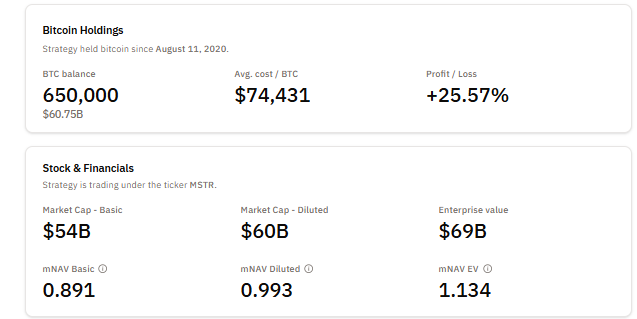
Strategyโ€™s stock trades under the ticker MSTR, with a basic market capitalization of about $54 billion and an enterprise value near $69 billion.

Source: BitcoinTreasuries.NET

Market net asset value metrics show the stock trading close to the value of its Bitcoin holdings. Basic mNAV stands at 0.892, diluted mNAV at 0.994, and enterprise-value mNAV at 1.136, reflecting the effect of debt and preferred obligations.

Falling Shares Put Strategyโ€™s Bitcoin Treasury Model Under the Microscope

CEO Phong Le has said the company would only consider selling Bitcoin if its shares fall below net asset value and access to new financing dries up.

He described such sales as a last resort to protect what he calls โ€œBitcoin yield per share,โ€ stressing that selling would occur only if issuing new equity became more dilutive than reducing holdings.

Strategyโ€™s annual fixed obligations tied to preferred shares are estimated at $750 million to $800 million. Le said the new dollar reserve currently covers about 21 months of dividends.

Founder and Executive Chairman Michael Saylor described the reserve as the next stage in Strategyโ€™s evolution as a Bitcoin-focused treasury company, positioning it to navigate market volatility while maintaining its long-term digital-asset strategy.

To reassure investors, the company recently launched a โ€œBTC Creditโ€ dashboard, stating that it has sufficient dividend coverage even if Bitcoin prices remain flat for extended periods.

Strategy also said its debt remains well-covered if Bitcoin falls to its average cost of roughly $74,000 and remains manageable even at $25,000.

The reserve strategy has drawn mixed reactions from the market. Bitcoin critic Peter Schiff argued that the shift shows the company is being forced to sell stock to buy dollars rather than Bitcoin in order to meet its obligations.

Today is the beginning of the end of $MSTR. Saylor was forced to sell stock not to buy Bitcoin, but to buy U.S. dollars merely to fund MSTR's interest and dividend obligations. The stock is broken. The business model is a fraud, and @Saylor is the biggest con man on Wall Street.

โ€” Peter Schiff (@PeterSchiff) December 1, 2025

Strategyโ€™s share price has fallen more than 60% from recent highs even as Bitcoin has traded between $95,000 and $110,000 in late 2025, adding to investor scrutiny of the model.

Strategyโ€™s stance is also being watched by index providers. MSCI is currently reviewing how companies with large digital-asset treasuries should be treated in major equity indexes.

Any change in classification could force benchmark-tracking funds to rebalance, adding another layer of volatility to a stock that already trades with a high Bitcoin beta.

The post Strategy Sets $1.44B Buffer for Bitcoin Bear Market Risk: CryptoQuant appeared first on Cryptonews.

IT leaders turn to third-party providers to manage tech debt

As tech debt threatens to cripple many IT organizations, a huge number of CIOs have turned to third-party service providers to maintain or upgrade legacy software and systems, according to a new survey.

A full 95% of IT leaders are now using outside service providers to modernize legacy IT and reduce tech debt, according to a survey by MSP Ensono.

The push is in part due to the cost of legacy IT, with nearly half of those surveyed saying they paid more in the past year to maintain older IT systems than they had budgeted. More importantly, dealing with legacy applications and infrastructure is holding IT organizations back, as nearly nine in 10 IT leaders say legacy maintenance has hampered their AI modernization plans.

โ€œMaintaining legacy systems is really slowing down modernization efforts,โ€ says Tim Beerman, Ensonoโ€™s CTO. โ€œItโ€™s the typical innovatorโ€™s dilemma โ€” theyโ€™re focusing on outdated systems and how to address them.โ€

In some cases, CIOs have turned to service providers to manage legacy systems, but in other cases, they have looked to outside IT teams to retire tech debt and modernize software and systems, Beerman says. One reason theyโ€™re turning to outside service providers is an aging employee base, with internal experts in legacy systems retiring and taking their knowledge with them, he adds.

โ€œNot very many people are able to do it themselves,โ€ Beerman says. โ€œYou have maturing workforces and people moving out of the workforce, and you need to go find expertise in areas where you canโ€™t hire that talent.โ€

While the MSP model has been around for decades, the move to using it to manage tech debt appears to be a growing trend as organizations look to clear up budget and find time to deploy AI, he adds.

โ€œIf you look at the advent of lot of new technology, especially AI, thatโ€™s moving much faster, and clients are looking for help,โ€ Beerman says. โ€œOn one side, you have this legacy problem that they need to manage and maintain, and then you have technology moving at a pace that it hasnโ€™t moved in years.โ€

Outsourcing risk

Ryan Leirvik, CEO at cybersecurity services firm Neuvik, also sees a trend toward using service providers to manage legacy IT. He sees several advantages, including matching the right experts to legacy systems, but CIOs may also use MSPs to manage their risk, he says.

โ€œOf the many advantages, one primary advantage oftenย not mentioned is shifting the exploitation or service interruption risk to the vendor,โ€ he adds. โ€œIn an environment where vulnerability discovery, patching, and overall maintenance is an ongoing and expensive effort, the risk of getting it wrong typically sits with the vendor in charge.โ€

The number of IT leaders in the survey who overspent their legacy IT maintenance budgets also doesnโ€™t surprise Leirvik, a former chief of staff and associate director of cyber at the US Department of Defense.

Many organizations have a talent mismatch between the IT infrastructure they have and the one they need to move to, he says. In addition, the ongoing maintenance of legacy software and systems often costs more than anticipated, he adds.

โ€œThereโ€™s this huge maintenance tail that we werenโ€™t expecting because the initial price point was one cost and the maintenance is 1X,โ€ Leirvik says.

To get out of the legacy maintenance trap, IT leaders need foresight and discipline to choose the right third-party provider, he adds. โ€œTake the long-term view โ€” make sure the five-year plan lines up with this particular vendor,โ€ he says. โ€œDo your goals as an organization match up with where theyโ€™re going to help you out?โ€

Paying twice

While some IT leaders have turned to third-party vendors to update legacy systems, a recently released report from ITSM and customer-service software vendor Freshworks raises questions about the efficiency of modernization efforts.

More than three-quarters of those surveyed by Freshworks say software implementations take longer than expected, with two-thirds of those projects exceeding expected budgets.

Third-party providers may not solve the problems, says Ashwin Ballal, Freshworksโ€™ CIO.

โ€œLegacy systems have become so complex that companies are increasingly turning to third-party vendors and consultants for help, but the problem is that, more often than not, organizations are trading one subpar legacy system for another,โ€ he says. โ€œAdding vendors and consultants often compounds the problem, bringing in new layers of complexity rather than resolving the old ones.โ€

The solution isnโ€™t adding more vendors, but new technology that works out of the box, Ballal adds.

โ€œIn theory, third-party providers bring expertise and speed,โ€ he says. โ€œIn practice, organizations often find themselves paying for things twice โ€” once for complex technology, and then again for consultants to make it work.โ€

Third-party vendors unavoidable

Other IT leaders see some third-party support as nearly inevitable. Whether itโ€™s updating old code, moving workloads to the cloud, adopting SaaS tools, or improving cybersecurity, most organizations now need outside assistance, says Adam Winston, field CTO and CISO at cybersecurity vendor WatchGuard Technologies.

A buildup of legacy systems, including outdated remote-access tools and VPNs, can crush organizations with tech debt, he adds. Many organizations havenโ€™t yet fully modernized to the cloud or to SaaS tools, and they will turn to outside providers when the time comes, he says.

โ€œMost companies donโ€™t build and design and manage their own apps, and thatโ€™s where all that tech debt basically is sitting, and they are in some hybrid IT design,โ€ he says. โ€œThey may be still sitting in an era dating back to co-location and on-premise, and that almost always includes legacy servers, legacy networks, legacy systems that arenโ€™t really following a modern design or architecture.โ€

Winston advises IT leaders to create plans to retire outdated technology and to negotiate service contracts that lean on vendors to keep IT purchases as up to date as possible. Too many vendors are quick to drop support for older products when new ones come out, he suggests.

โ€œIf youโ€™re not going to upgrade, do the math on that legacy support and say, โ€˜If we canโ€™t upgrade that, how are we going to isolate it?โ€™โ€ he says. โ€œโ€˜What is our graveyard segmentation strategy to move the risk in the event that this canโ€™t be upgraded?โ€™ The vendor due diligence leaves a lot of this stuff on the table, and then people seem to get surprised.โ€

CIOs should avoid specializing in legacy IT, he adds. โ€œIf you canโ€™t amortize the cost of the software or the build, promise yourself that every new application thatโ€™s coming into the system is going to use the latest component,โ€ Winston says.

From oversight to intelligence: AIโ€™s impact on project management and business transformation

For CIOs, the conversation around AI has moved from innovation to orchestration, and project management, long a domain of human coordination and control, is rapidly becoming the proving ground for how intelligent systems can reshape enterprise delivery and accelerate transformation.

In boardrooms across industries, CIOs face the same challenge of how to quantify AIโ€™s promise in operational terms: shorter delivery cycles, reduced overhead, and greater portfolio transparency. A 2025 Georgia Institute of Technology-sponsored study of 217 project management professionals and C-level tech leaders revealed that 73% of organizations have adopted AI in some form of project management.

Yet amid the excitement, the question of how AI will redefine the role of the project manager (PM) remains, as does how will the future framework for the business transformation program be defined.

A shift in the PMโ€™s role, not relevance

Across industries, project professionals are already seeing change. Early adopters in the study report project efficiency gains of up to 30%, but success depends less on tech and more on how leadership governs its use. The overwhelming majority found it highly effective in improving efficiency, predictive planning, and decision-making. But what does that mean for the associates running these projects?

Roughly one-third of respondents believed AI would allow PMs to focus more on strategic oversight, shifting from day-to-day coordination to guiding long-term outcomes. Another third predicted enhanced collaboration roles, where managers act as facilitators who interpret and integrate AI insights across teams. The rest envisioned PMs evolving into supervisors of AI systems themselves, ensuring that algorithms are ethical, accurate, and aligned with business goals.

These perspectives converge on a single point: AI will not replace PMs, but it will redefine their value. The PM of the next decade wonโ€™t simply manage tasks, theyโ€™ll manage intelligence and translate AI-driven insights into business outcomes.

Why PMOs canโ€™t wait

For project management offices (PMOs), the challenge is no longer whether to adopt AI but how. AI adoption is accelerating, with most large enterprises experimenting with predictive scheduling, automated risk reporting, and gen AI for documentation. But the integration is uneven.

Many PMOs still treat AI as an add-on, a set of tools rather than its strategic capability. This misses the point since AI is about augmenting judgment and automation. The organizations gaining a real competitive advantage are those embedding AI into their project methodologies, governance frameworks, and performance metrics with this five-point approach in mind.

1. Begin with pilot projects

Think small, scale fast. The most successful AI integrations begin with targeted use cases that automate project status reports, predict schedule slippage, or identify resource bottlenecks. These pilot projects create proof points, generate enthusiasm, and expose integration challenges early.

2. Measure value, not just activity

One common pitfall is adopting AI without clear performance metrics. PMOs should set tangible KPIs such as reduction in manual reporting time, improved accuracy in risk forecasts, shorter project cycle times, and higher stakeholder satisfaction. Communicating these outcomes across the organization is just as important as achieving them. Success stories build momentum, foster buy-in, and demystify AI for skeptical teams.

3. Upskill PMs

AI will only be as valuable as the people who use it. Nearly half of the surveyed professionals cited lack of a skilled workforce as a barrier to AI integration. Project managers donโ€™t need to become data scientists, but they must understand AI fundamentals, how algorithms work, where biases emerge, and what data quality means. In this evolving landscape, the most effective PMs will combine data literacy with human-centered leadership, including critical thinking, emotional intelligence, and communication.

4. Strengthen governance and ethics

Increasing AI raises pressing ethical questions, especially when algorithms influence project decisions. PMOs must take the lead in establishing AI governance frameworks that emphasize transparency, fairness, and human oversight. Embedding these principles into the PMOโ€™s charter doesnโ€™t just mitigate risk, it builds trust.

5. Evolve from PMO to BTO

The traditional PMO focuses on execution through scope, schedule, and cost. But AI-driven organizations are shifting toward business transformation offices (BTOs), which align projects directly with strategic value creation through process improvement in parallel. A PMO ensures projects are done right. A BTO ensures the right projects are done. A crucial element of this framework is the transition from a Waterfall to an Agile mindset. The evolution of project management has shifted from rigid plans to iterative, customer-centric, and collaborative methods, with hybrid methodologies becoming increasingly common. This Agile approach is vital for adapting to the rapid changes brought by AI and digital disruption.

The new PM career path

By 2030, AI could manage most routine project tasks, such as status updates, scheduling, and risk flagging, while human leaders focus on vision, collaboration, and ethics. This shift mirrors past revolutions in project management from the rise of Agile to digital transformation, but at an even faster pace. But as organizations adopt AI, the risk of losing the human element persists. Project management has always been about people and aligning interests, resolving conflicts, and inspiring teams. However, while AI can predict a delay, it canโ€™t motivate a team to overcome it. The PMโ€™s human ability to interpret nuance, build trust, and foster collaboration remains irreplaceable.

A call to action

AI represents the next frontier in enterprise project delivery, and the next decade will test how well PMOs, executives, and policymakers can navigate the evolution of transformation. To thrive, organizations must invest in people as much as in platforms, adopt ethical, transparent governance, foster continuous learning and experimentation, and measure success by outcomes rather than hype.

For CIOs, the mandate is clear: lead with vision, govern with integrity, and empower teams with intelligent tools. AI, after all, isnโ€™t a threat to the project management profession. Itโ€™s a catalyst for its reinvention, and when executed responsibly, AI-driven project management will not only deliver operational gains but also build more adaptive, human-centered organizations ready for the challenges ahead. By embracing it thoughtfully, PMs can elevate their roles from administrators to architects of change.

Strategyโ€™s Michael Saylor Engages With MSCI Over Possible Index Exclusion By January 15

Concerns regarding the potential exclusion of Strategy (MSTR) from the MSCI index emerged last week, with estimates from JPMorgan analysts indicating that such a move could result in approximately $2 billion to $8 billion in outflows.

Amid mounting concerns within the crypto community, Michael Saylor confirmed that the company is in discussions with MSCI regarding its potential exclusion from the providerโ€™s indices.ย 

Michael Saylor Weighs In On Exclusion Concerns

MSCI has stated that by January 15, it will decide whether to remove companies whose business models focus on purchasing cryptocurrencies, amid concerns that these firms resemble investment funds, which are currently ineligible for index inclusion.

Reuters reported that Saylor acknowledged the discussions with MSCI but expressed skepticism regarding JPMorganโ€™s projections of potential outflows. He commented, โ€œIt wonโ€™t make any difference, in my opinion,โ€ regarding the implications of a possible exclusion.ย 

Saylor noted that the equity associated with Strategy is inherently volatile due to its significant reliance on Bitcoinโ€™s (BTC) price. He cautioned, โ€œIf Bitcoin falls 30% or 40%, then the equity is going to fall more, because the equity is built to fall.โ€ย 

Currently, Strategy operates with a leverage ratio of 1.11, and Saylor indicated that the company could withstand a steep decline of 95% in Bitcoin prices.

Reports from NewsBTC indicated that Saylor Strategyโ€™s position emphasizing that it is not merely a passive Bitcoin holding entity. Instead, he highlighted that the company functions as a software firm with a proactive financial strategy, countering the narrative surrounding MSCIโ€™s concerns.

Strategy Establishes New USD Reserveย 

The recent fluctuations in Bitcoin prices have reignited fears of a potential bear market, raising questions about whether Strategy would consider selling some of its substantial Bitcoin reserves, currently exceeding 650,000 coins.ย 

This speculation intensified after Strategy CEO Phong Le addressed the possibility of selling some holdings during an interview on the โ€œWhat Bitcoin Didโ€ podcast.ย 

Le stated that if the companyโ€™s stock trades below the value of its Bitcoin holdings and it is unable to raise additional capital for preferred dividends, a sale might become unavoidable.ย 

โ€œIf the stock trades below the value of our Bitcoin, then mathematically we would have to sell some Bitcoin. It would be the last resort,โ€ he explained.

To support this vision, the Virginia-based company recently announced the establishment of a $1.44 billion reserve fund allocated for dividend payments on preferred stock and to meet its debt obligations.

The newly created reserve is funded through proceeds from its at-the-market stock offering. The company aims to maintain a balance sufficient to cover at least 12 months of dividends, with ambitions to extend this coverage to 24 months or more in the future.ย 

Saylor remarked, โ€œEstablishing a USD Reserve to complement our BTC Reserve marks the next step in our evolution. We believe it will better position us to navigate short-term market volatility while delivering on our vision of being the worldโ€™s leading issuer of Digital Credit.โ€

Strategy

At the time of writing, Bitcoin was trading just above $93,000, marking a 4.5% increase over the past 24 hours. MSTR, the stock of the investment firm Strategy, traded up 2% in the premarket.ย 

Featured image from Bloomberg, chart from TradingView.comย 

โŒ