
❌

Reading view

There are new articles available, click to refresh the page.

NASA Sets Coverage for Astronaut Jonny Kim, Crewmates Return
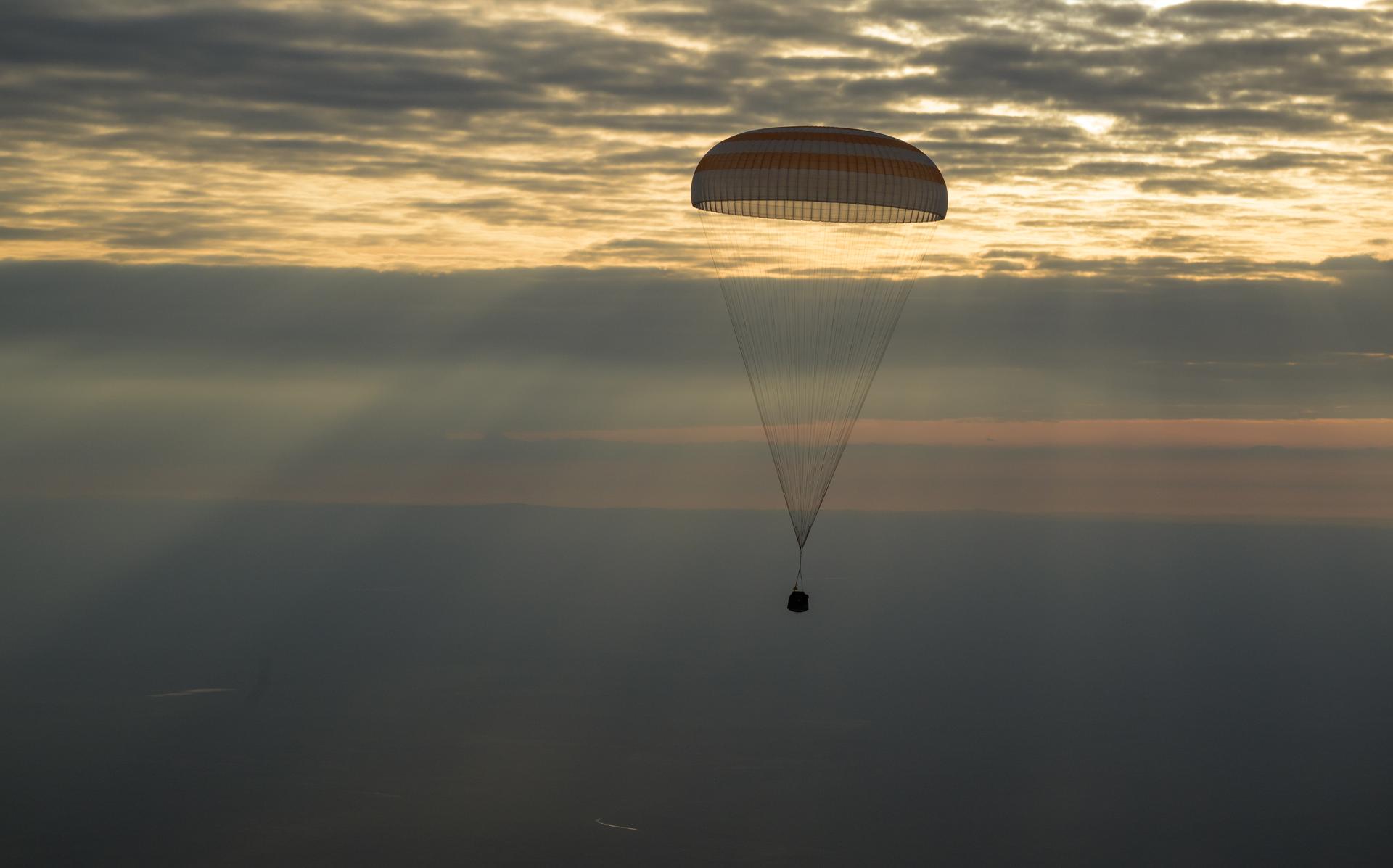
The photo features a dim horizon with the Soyuz MS-26 spacecraft as it lands by parachute.
The Soyuz MS-26 spacecraft is seen as it lands on April 20, 2025 (April 19 Eastern time) in a remote area near the town of Zhezkazgan, Kazakhstan, with the Expedition 71/72 crew aboard.
NASA/Bill Ingalls

NASA astronaut Jonny Kim, accompanied by Roscosmos cosmonauts Sergey Ryzhikov and Alexey Zubritsky, is preparing to depart the International Space Station aboard the Soyuz MS-27 spacecraft and return to Earth.

Kim, Ryzhikov, and Zubritsky will undock from the station’s Prichal module at 8:41 p.m. EST on Monday, Dec. 8, headed for a parachute-assisted landing at 12:04 a.m. on Tuesday, Dec. 9 (10:04 a.m. local time in Kazakhstan), on the steppe of Kazakhstan, southeast of the city of Dzhezkazgan.

Watch NASA’s live coverage of the crew’s return on NASA+, Amazon Prime, and the agency’s YouTube channel. Learn how to stream NASA content through a variety of online platforms, including social media.

The space station change of command ceremony will begin at 10:30 a.m. Sunday, Dec. 7, on NASA+ and the agency’s YouTube channel. Rzyhikov will hand over station command to NASA astronaut Mike Fincke for Expedition 74, which begins at the time of Soyuz MS-27 undocking.

Kim and his crewmates are completing a 245-day mission aboard the station. At the conclusion of their mission, they will have orbited Earth 3,920 times and traveled nearly 104 million miles. This was the first flight for Kim and Zubritsky to the orbiting laboratory, while Ryzhikov is ending his third trip to space.

After landing, the three crew members will fly by helicopter to Karaganda, Kazakhstan, where recovery teams are based. Kim will board a NASA aircraft and return to Houston, while Ryzhikov and Zubritsky will depart for their training base in Star City, Russia.

NASA’s coverage is as follows (all times Eastern and subject to change based on real-time operations):

Sunday, Dec. 7:

10:30 a.m. – Expedition 73/74 change of command ceremony begins on NASA+ Amazon Prime, and YouTube.

Monday, Dec. 8:

4:45 p.m. – Farewells and hatch closing coverage begins on NASA+, Amazon Prime, and YouTube.

5:10 p.m. – Hatch closing

8:15 p.m. – Undocking coverage beings on NASA+, Amazon Prime, and YouTube.

8:41 p.m. – Undocking

10:30 p.m. – Deorbit and landing coverage begins on NASA+, Amazon Prime, and YouTube.

11:10 p.m. – Deorbit burn

Tuesday, Dec. 9:

12:04 a.m. – Landing

For more than 25 years, people have lived and worked continuously aboard the International Space Station, advancing scientific knowledge and making research breakthroughs that are not possible on Earth. The station is a critical testbed for NASA to understand and overcome the challenges of long-duration spaceflight and to expand commercial opportunities in low Earth orbit. As commercial companies concentrate on providing human space transportation services and destinations as part of a robust low Earth orbit economy, NASA is focusing its resources on deep space missions to the Moon as part of the Artemis campaign in preparation for future human missions to Mars.

Learn more about International Space Station research and operations at:

https://www.nasa.gov/station

-end-

Josh Finch / Jimi Russell
Headquarters, Washington
202-358-1100
joshua.a.finch@nasa.gov / james.j.russell@nasa.gov

Sandra Jones / Joseph Zakrzewski
Johnson Space Center, Houston
281-483-5111
sandra.p.jones@nasa.gov / joseph.a.zakrzewski@nasa.gov
Share

Details

Last Updated
Dec 04, 2025
Editor
Elizabeth Shaw

NASA Celebrates Five Years of Artemis Accords, Welcomes 3 New Nations

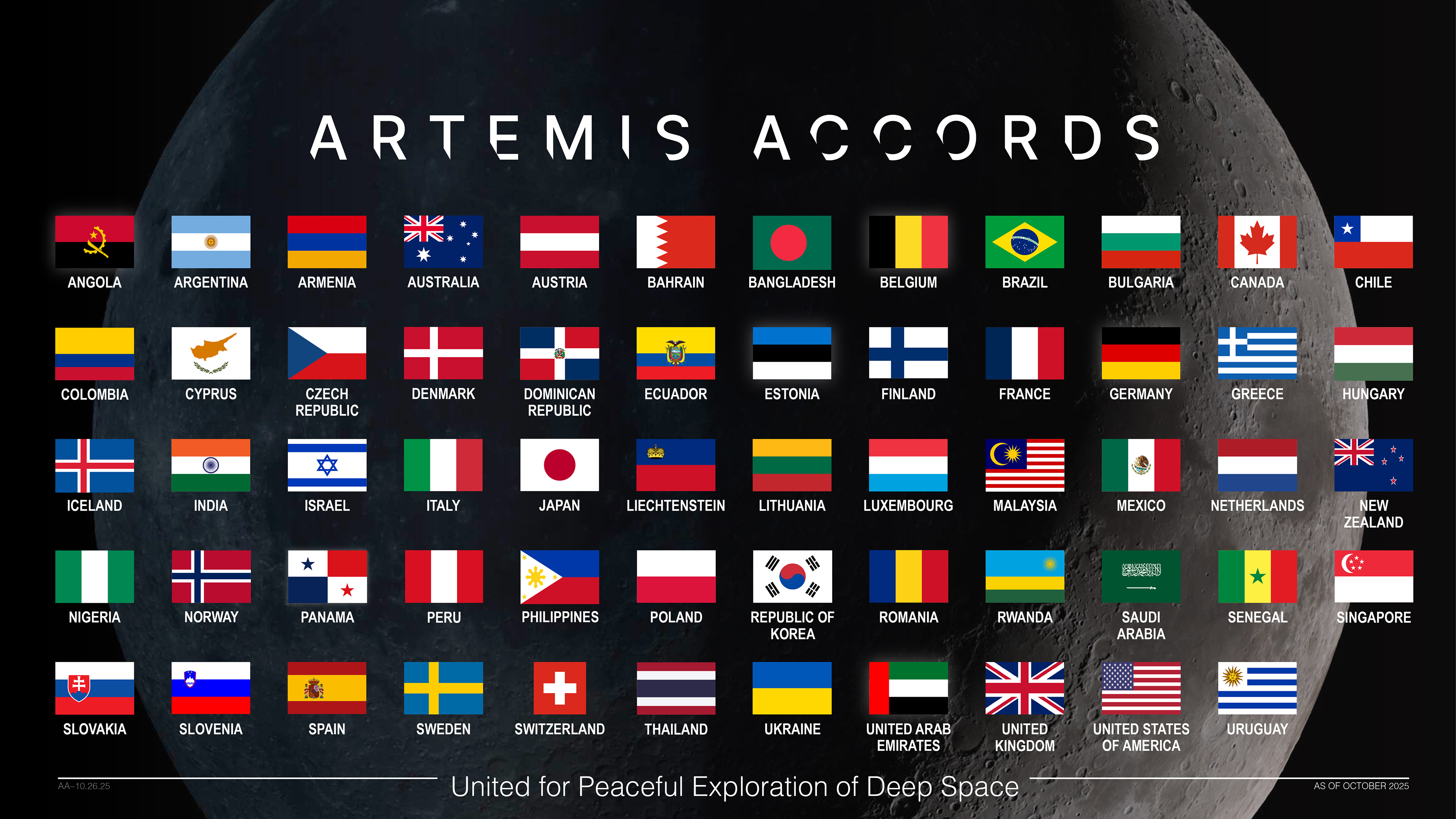
National flags of Artemis Accords signatories.
NASA

October marked the fifth anniversary of NASA and the original founders signing the Artemis Accords, as well as the recognition of Hungary, Malaysia and the Philippines joining the expanding coalition dedicated to the peaceful exploration of space. The number of countries involved now totals 59.

β€œNASA welcomes the newest signatories, whose participation strengthens the global commitment to responsible exploration,” said acting NASA Administrator Sean Duffy. β€œTheir decision to sign the Artemis Accords affirms a shared commitment to safe, transparent, and peaceful exploration β€” at a time when others seek to weaponize the final frontier. Together we are building the foundation for the Golden Age of space exploration.”

Both Malaysia and the Philippines signed the Artemis Accords as part of President Trump’s visit to Kuala Lumpur for the annual Association of Southeast Asian Nations Summit. The separate signings were announced by the White House on Oct. 26.

Foreign Minister PΓ©ter SzijjΓ‘rtΓ³ of Hungary signed the Artemis Accords on Oct. 22 while in Washington during an official visit, in the lead up to President Trump’s meeting with Prime Minister Viktor OrbΓ‘n.

Hungary’s signing came three months after Hungarian to Orbit (HUNOR) astronaut Tibor Kapu launched to space in a mission aboard a SpaceX Dragon spacecraft to the International Space Station. The private astronauts, part of the NASA-supported Axiom Mission 4 crew, spent about two weeks conducting science, outreach, and commercial activities, alongside NASA astronauts. Β 

Five years of progress

On Oct. 13, 2020, during the first Trump Administration, the United States, led by NASA and the U.S. Department of State, joined with seven other founding nations to establish the Artemis Accords, responding to the growing interest in lunar activities by both governments and private companies.

Since then, the Artemis Accords have grown into an international coalition. What began with a handful of founding nations has multiplied with seven countries signing in 2025 alone. The surge in participation highlights an increased global commitment to shaping a safe, peaceful, and prosperous future in space.

In September, NASA co-chaired the Artemis Accords Principals’ Meeting in Sydney alongside the space agencies of Australia and the United Arab Emirates. The gathering brought together dozens of signatory nations to deepen dialogue and strengthen shared commitments to the sustainable and responsible use of space. Global space leaders discussed the following topics:

  • Non-interference in each other’s space activities, including transparency on expected launch dates, general nature of activities, and landing location
  • Orbital debris mitigation
  • Interoperability of systems for safer and more efficient operations
  • Release of scientific data

At the meeting, NASA committed to hosting an Artemis Accords workshop in 2026 for signatories focused on transparency and the sharing of data. The agency has taken additional steps since the accords were established to release more information about lunar missions, promoting openness and preventing harmful interference.

The progress made by signatories, and their continued commitment to implementing the accords’ principles, is essential to advancing sustainable exploration of the Moon under the Artemis campaign, Mars, and beyond. Following a call to Artemis Accords signatories, four CubeSats from South Korea, Saudi Arabia, Argentina, and Germany, will fly on Artemis II.

More nations are expected to sign the accords in the months and years ahead, as NASA and its partners continue to advance the principles of the accords.

Learn more about the Artemis Accords at:

https://www.nasa.gov/artemis-accords

❌