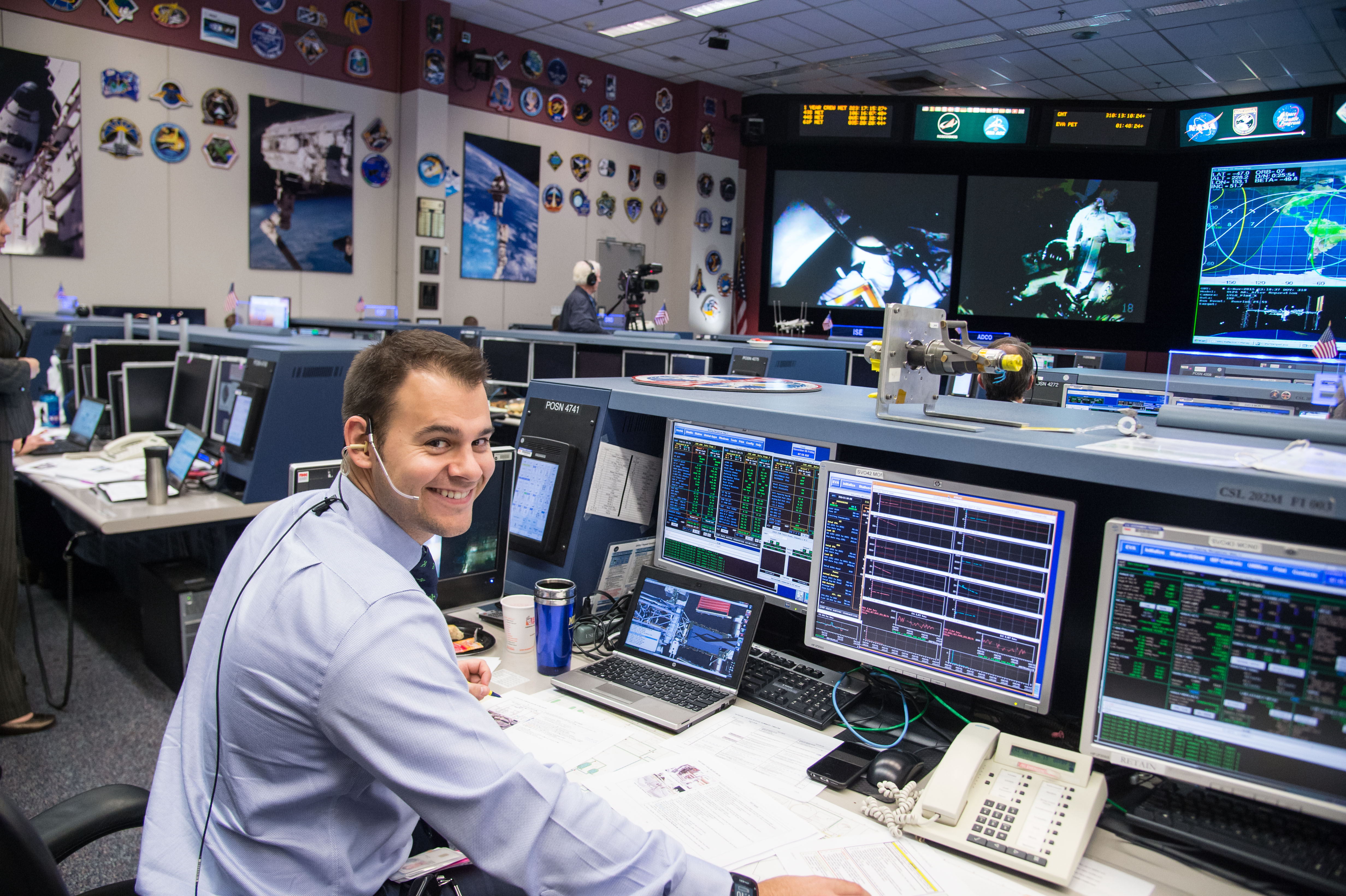
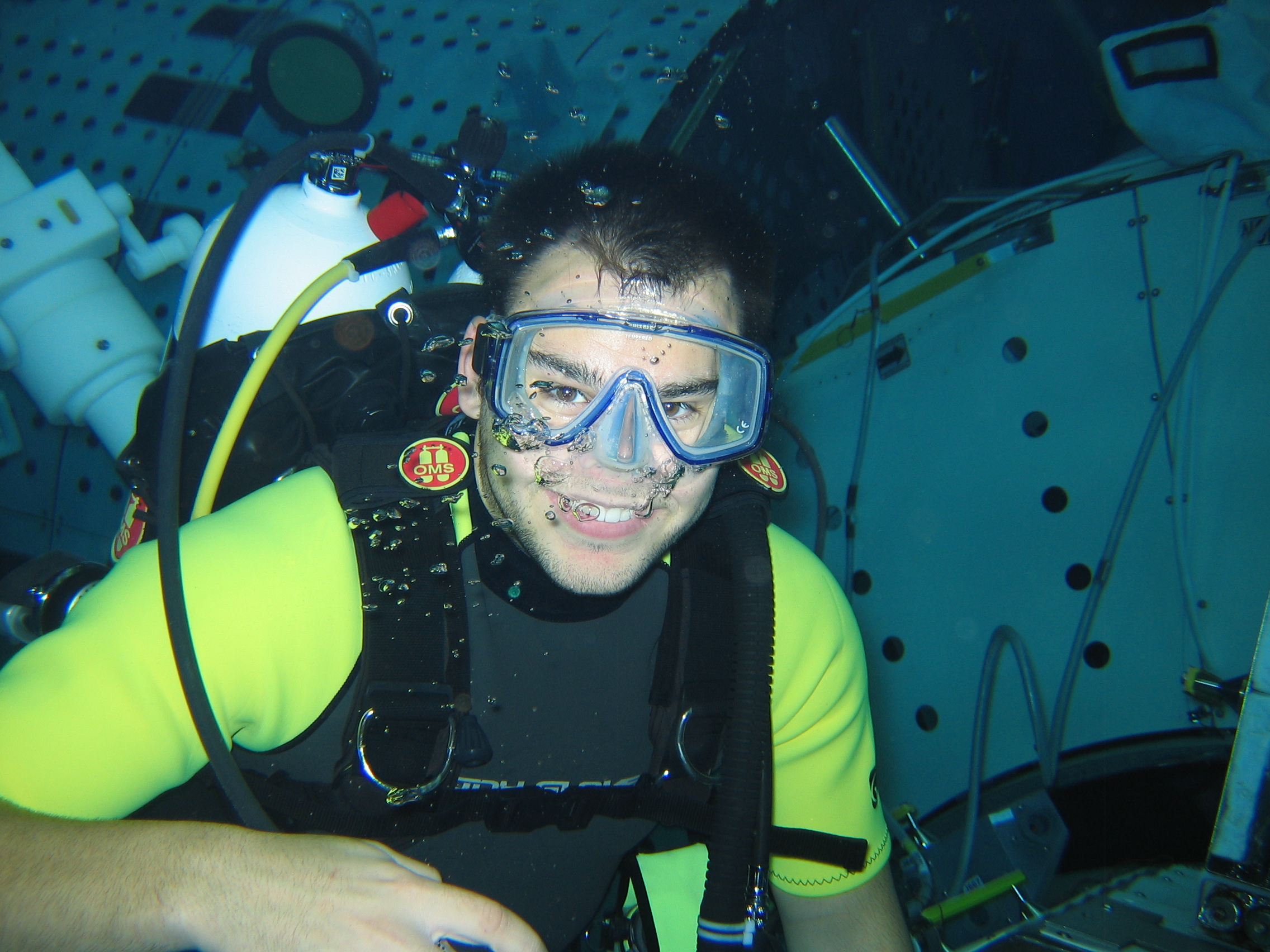
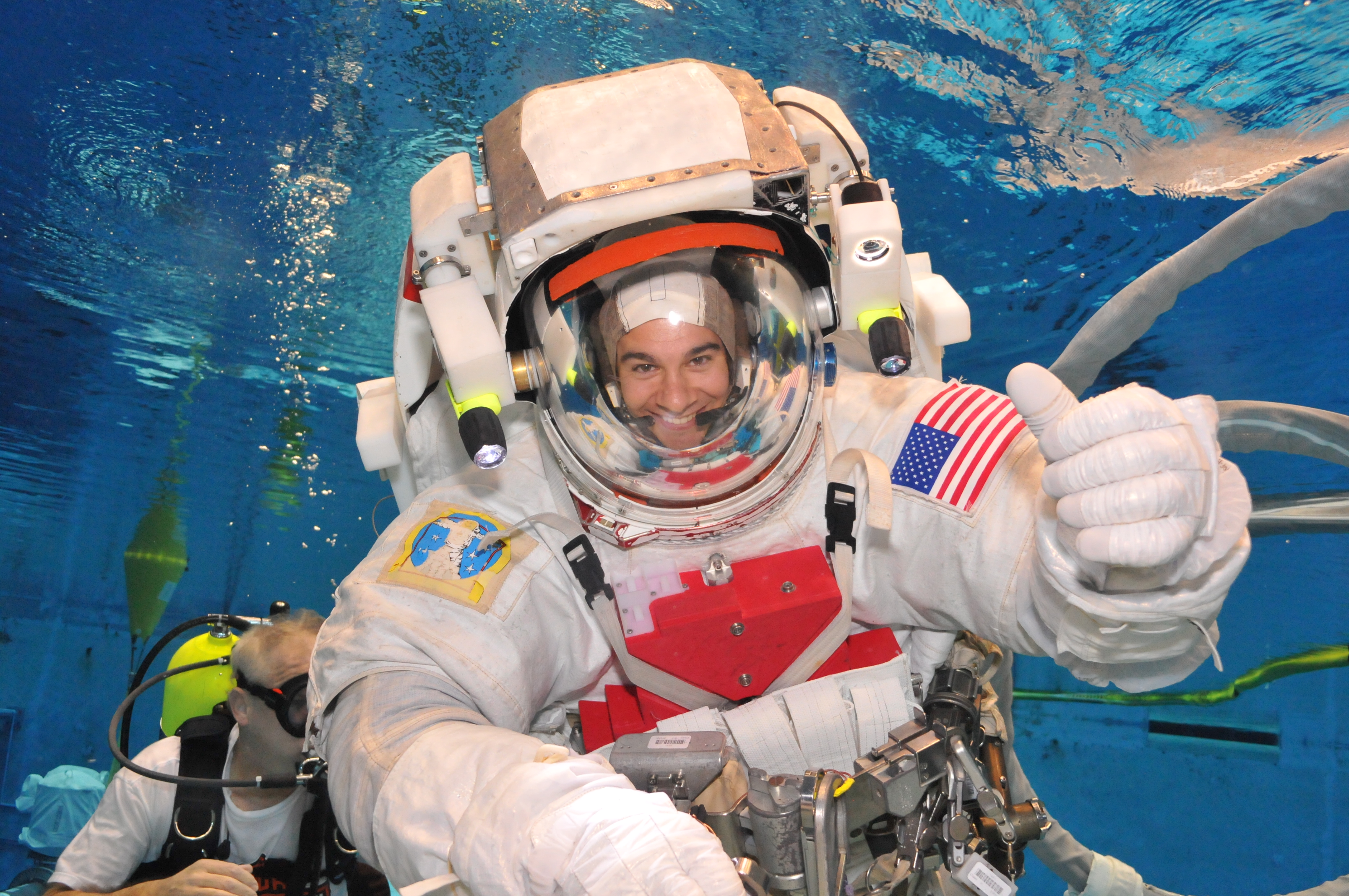
Preparations for Next Moonwalk Simulations Underway (and Underwater)
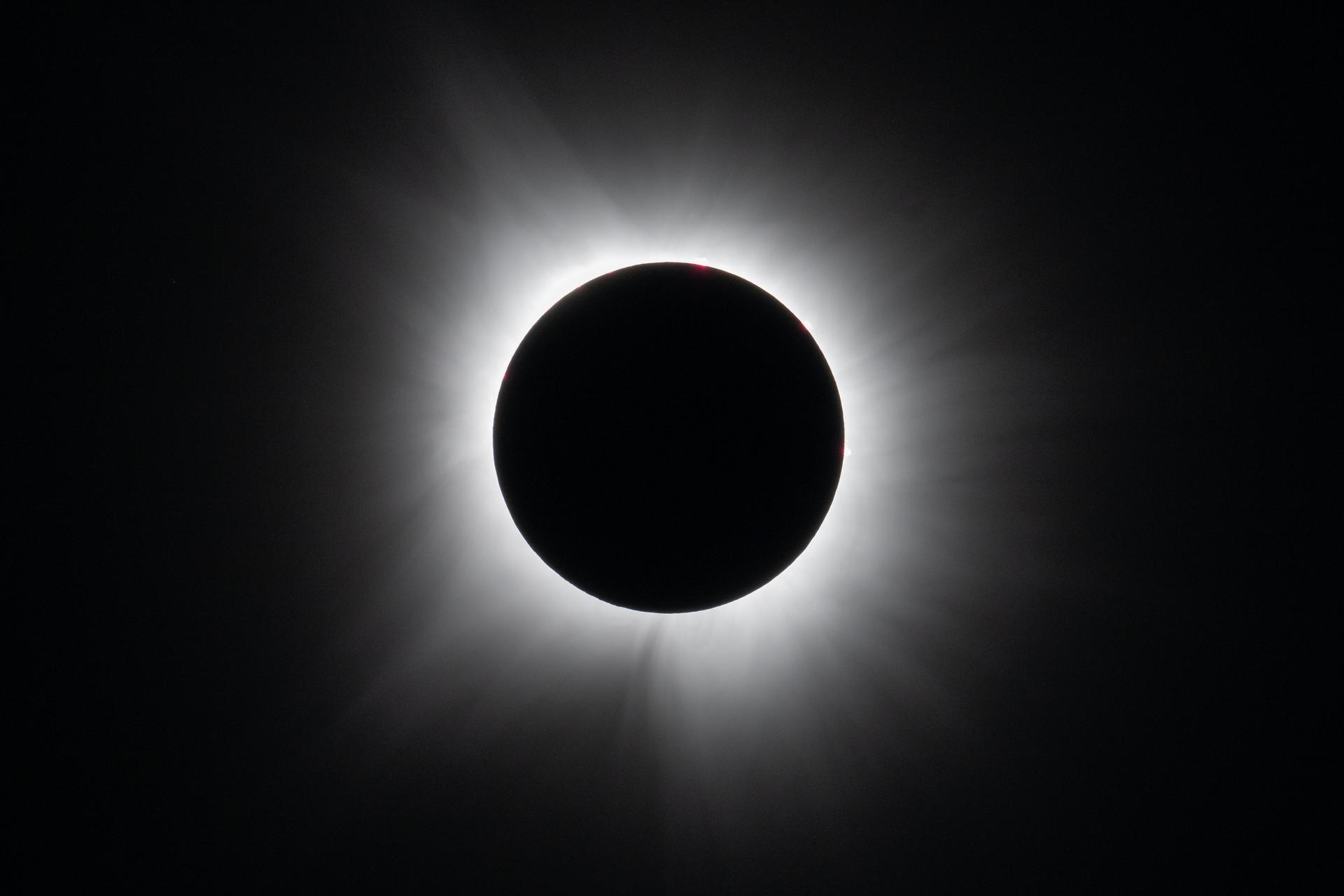
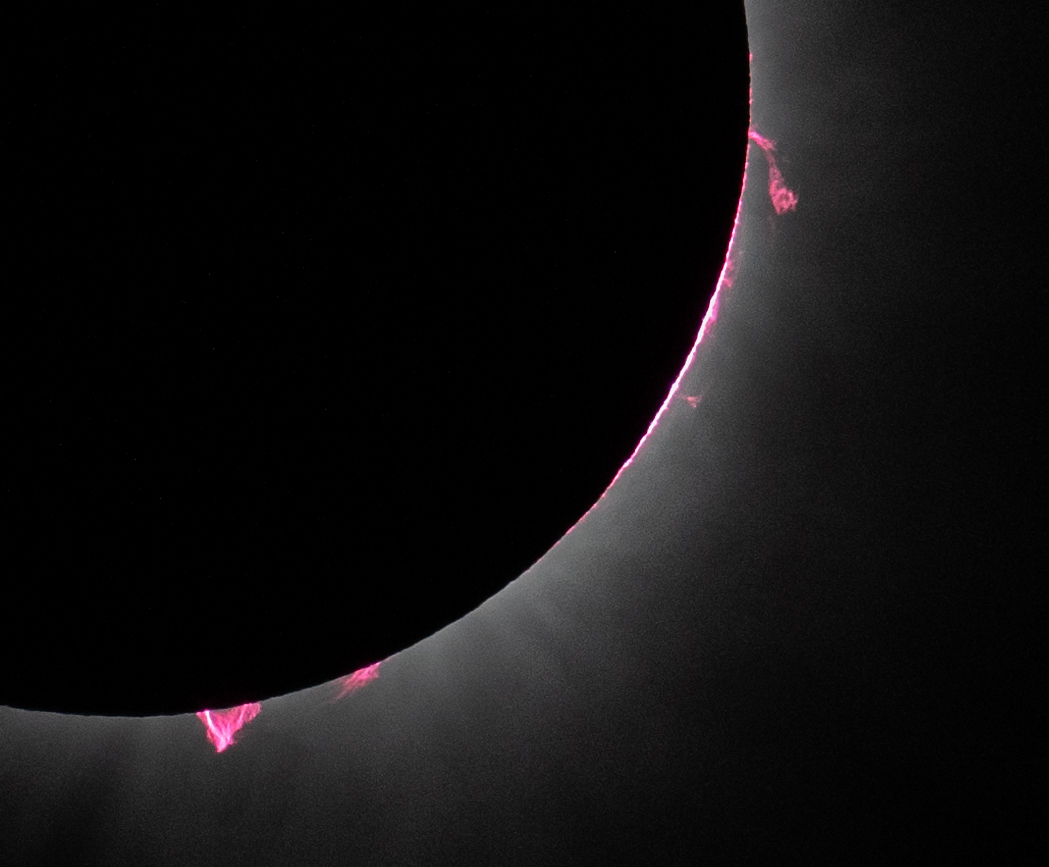
NASA’s broadcast of the April 8, 2024, total solar eclipse has won an Emmy Award for Excellence in Production Technology.
At the 76th Technology & Engineering Emmy Awards on Dec. 4, in New York City, the Academy of Television Arts & Sciences announced the win. Walt Lindblom and Sami Aziz accepted the award on behalf of the agency. For the broadcast, Lindblom served as the coordinating producer and Aziz served as the executive producer.
“By broadcasting the total solar eclipse, this team brought joy and wonder for our Sun, Moon, and Earth to viewers across America and the world,” said Will Boyington, associate administrator for the Office of Communications at NASA Headquarters in Washington. “Congratulations to the production team, whose efforts demonstrate the hard work and dedication to the sharing the marvel that makes our solar system something we strive to understand.”
NASA’s live broadcast coverage of the 2024 total solar eclipse was the most complex live project ever produced by the agency. In total, NASA’s eclipse broadcasts garnered almost 40 million live and replay views across its own distribution channels, including on NASA+, the agency’s free streaming service. Externally, the agency’s main broadcast was picked up in 2,208 hits on 568 channels in 25 countries.
“Our unique place in the solar system allows us on Earth to witness one of the most spectacular science shows nature has to offer. NASA’s production team captured the action every step of the way across the path of totality, including the rare glimpse of the Sun’s corona,” said Nicky Fox, associate administrator for science at NASA Headquarters. “Congratulations to the NASA team for successfully showing the 2024 total solar eclipse through the eyes of NASA for the whole world to experience together.”
The broadcast spanned three hours, showcasing the eclipse across seven American states and two countries. From cities, parks, and stadiums, 11 hosts and correspondents provided on air commentary, interviews, and live coverage. Viewers tuned in from all over the world, including at watch parties in nine locations, from the Austin Public Library to New York’s Times Square. An interactive “Eclipse Board” provided real time data analysis as the Moon’s shadow crossed North America.
Live feeds from astronauts aboard the International Space Station and NASA’s WB-57 high-altitude research aircraft were brought in to provide rare and unique perspectives of the solar event. To make this possible, NASA deployed and enabled 67 cameras, 6 NASA Wide Area Network control rooms, 38 encoders, and 35 decoders. The team coordinated 20 live telescope feeds which represented 12 locations across the path of totality.
NASA’s eclipse broadcast won another Emmy award earlier this year at the 46th Annual News & Documentary Emmy Awards for Outstanding Live News Special. Additionally, the show received an Emmy nomination for Outstanding Show Open or Title Sequence – News. NASA’s eclipse communication and broadcast efforts also won two Webby Awards and two Webby People’s Voice Awards.
On April 8, 2024, North America's last total solar eclipse until 2045 moved across the continent. It made landfall in Mexico, crossed the United States from ...
Preparations for Next Moonwalk Simulations Underway (and Underwater)
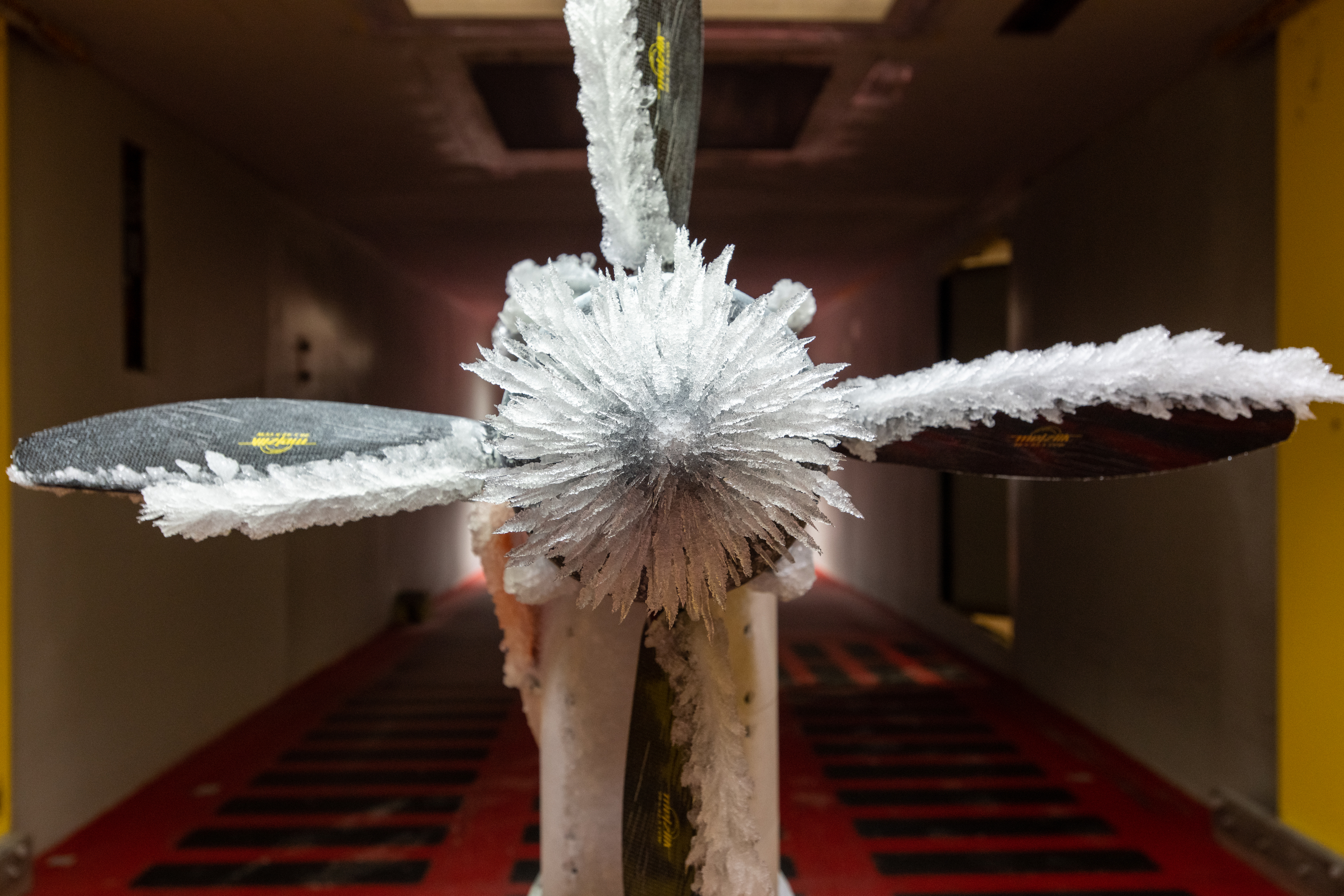
Researchers at NASA’s Glenn Research Center in Cleveland used the Glenn Icing Computational Environment (GlennICE) software to create 3D computational models of this advanced air mobility rotor and study propeller icing issues. The physical model of this rotor was installed and tested in the Icing Research Tunnel in 2023 as part of an icing evaluation study, which also sought to validate the computational models.
Credit: NASA/Jordan Cochran
When flying in certain weather conditions, tiny freezing water droplets floating in the air can pose a risk to aircraft. If not taken into consideration, these water droplets can accumulate on an aircraft as ice and pose a safety risk.
But NASA software tools such as Glenn Icing Computational Environment (GlennICE) are working to keep passengers and pilots safe.
NASA developed GlennICE, a new NASA software code, to transform the way we explore, understand, and prevent ice buildup on aircraft wings and engines, as well as control surfaces like rudders and elevators.
Owing to decades of world-class NASA research, engineers nationwide can now use GlennICE to design aircraft in such a way that ice buildup will either occur rarely or pose very little risk.
Named for NASA’s Glenn Research Center in Cleveland, GlennICE is part of NASA’s work to provide the aviation industry with computational tools, including design software, to improve aircraft safety and enable innovation. For icing research and modeling, NASA computer codes have become the industry standard over the past several decades. And GlennICE builds on this work, performing highly advanced digital modeling of water and ice particles in just about any atmospheric condition you can imagine.
With updated capabilities and a streamlined user experience, GlennICE will enable users to advance the state of the art – particularly researchers working on complex, unusual future aircraft designs.
“The legacy codes are well formulated to handle simulations of traditional tube-and-wing shaped aircraft,” said Christopher Porter, lead for GlennICE’s development. “But now, we have new vehicles with new designs that present icing research challenges. This requires a more advanced tool, and that’s where GlennICE comes in.”
So far, dozens of industry partners as well as other government agencies have started using GlennICE, which is available on NASA’s software catalog.
Timelapse video of an ice accretion on the 65% common research model.
Credit: NASA/Jordan Cochran
Ice buildup: not cool
Though based on legacy NASA codes such as LEWICE 3D, GlennICE is a whole different ballgame. The new toolkit can be tailored to unique situations and is compatible with other software tools. In other words, it is more configurable, and much less time consuming for researchers to set up and use.
This streamlined process, along with its more-advanced ability to model icing, allows GlennICE to easily tackle 21st-century concepts such as supersonic planes, advanced air mobility drones and other aircraft, unconventionally shaped wings, open-rotor turbofan designs, or new configurations for conventional aircraft such as radar domes.
But how does this simulation process work?
“Imagine an aircraft flying through a cloud,” Porter said. “Some of those water and ice droplets hit the aircraft and some of them don’t. GlennICE simulates these droplets and exactly where they will end up, both on the aircraft and not.”
When these water droplets hit the aircraft, they attach, freeze, and start to gather even more droplets that do the same. The software simulates exactly where this will occur, and what shape the ice will take over time.
“We’re not just dealing with the airplane, but the physics of the air and water as well,” Porter said.
Because it’s designed for simulating droplets, researchers have expressed interest in using GlennICE to simulate other conditions involving sand and ash. These substances, when ingested by aircraft engines, can pose separate risks that aeronautical engineers work to prevent.
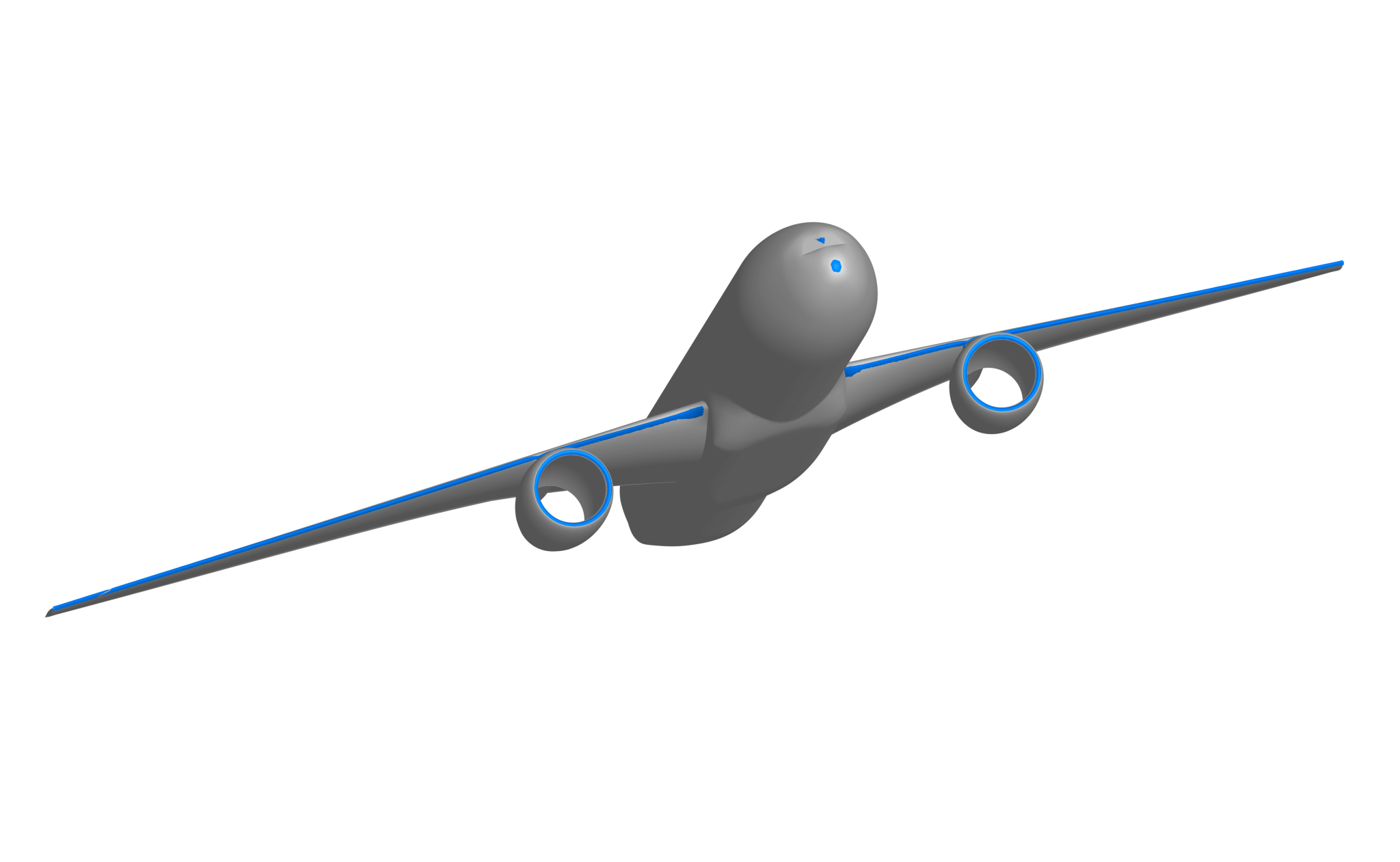
Glenn Icing Computational Environment (GlennICE) simulated ice accretions (blue) on the High Lift Common Research Model (gray).
Credit: NASA/Thomas Ozoroski
World-class research
Icing research is fundamental to aviation safety, and NASA fulfils a key role in ensuring pilots and passengers fly more safely and ice-free. The agency’s wind tunnels, for instance, have world-class icing research capabilities not commonly found in aeronautics research.
Paired with wind tunnel testing, GlennICE offers a holistic set of capabilities to researchers. While wind tunnels can verify and validate data with real-world models and conditions, tools like GlennICE can fill gaps in research not easily achieved with wind tunnels.
“Some environments we need to test in are impractical with wind tunnels because of the tunnel size required and complex physics involved,” Porter said. “But with GlennICE, we can do these tests digitally. For example, we can model all the icing conditions noted in new regulations.”
The GlennICE development falls under NASA’s Transformative Aeronautics Concept and Advanced Air Vehicles programs. Those programs supported GlennICE to further NASA’s work on computational tool development for aerospace design. More about the history of icing research at NASA is available on the agency’s website.
The clock is ticking, but great gifts are still within reach. This year’s Last-Minute Gift Guide rounds up smart tools, flavor essentials, Steven’s newest gear picks, and even the ultimate experience gift: Barbecue University. If you need something useful, memorable, and ready to go, you’ll find it here.
Oscarware’s Porcelain-Coated and Disposable Grill Toppers are a must-have for every outdoor cook on your list. Whether they’re searing veggies, grilling seafood, or whipping up breakfast at the campsite, these toppers make it easier, cleaner, and more delicious.
Proudly made in the USA by a women-owned business, Oscarware’s grill toppers are built for performance and convenience. The porcelain-coated models offer long-lasting durability, while the disposable versions are perfect for grilling on-the-go.
From backyard BBQs to tailgate feasts, it’s the practical, thoughtful gift that keeps the flavor coming all year long.
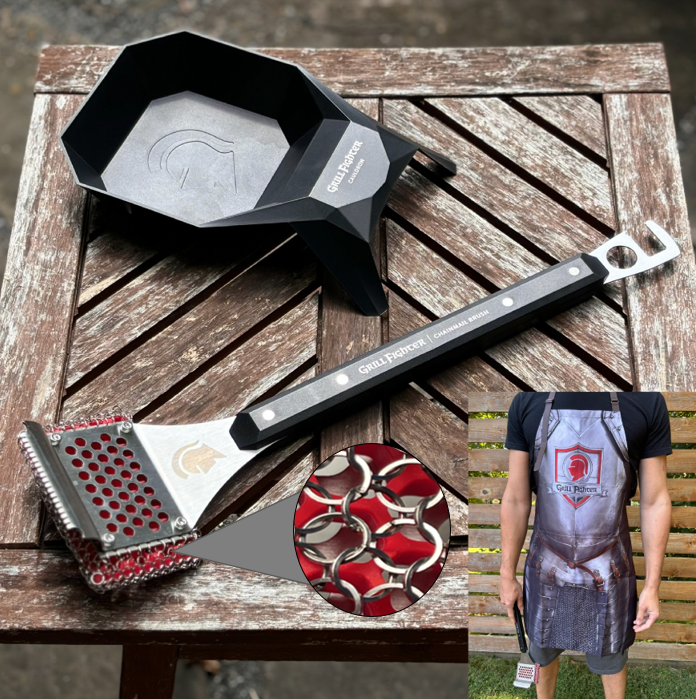
Grill smarter, not harder with the all-in-one GrillFighter Chainmail Brush; the perfect Gift for your Favorite Grillmaster!
Featuring four powerful methods: welded, square-edged chainmail backed by a non-absorbing silicone sponge for contour cleaning, steam cleaning with the included Grill Cauldron, a serrated scraper plow for lifting off tough grime and the Grill Pincer for clearing gunk from the bottom of the grill bars. Extremely durable, nothing to replace. Cleans up in the dishwasher. The Combo also includes the realistic Apron of Armor for mess-free BBQing.
Give the gift of effortless perfection this holiday season. The INKBIRD INT-14-BW lets grill lovers and home cooks master the feast with four separate true wireless probes to monitor multiple dishes at once. With dual WiFi and Bluetooth connection, as well as app control, you can track the turkey, ham, and even a side dish all from your phone – no more running in and out of the kitchen. It features ultra-precise sensors, various preset menus, dishwasher-safe probes, and a 25-hour battery – making holiday cooking a certainty, not a challenge.
Snag up to $100 off with code 14BWT for a limited time.
No coal in your stocking this year. But smoking wood chunks and chips are a definite must for your favorite griller. Try Steven’s cherrywood chunks with chicken; applewood with ribs, and mesquite for adding extra flavor to steaks.
LiquidZERO makes zero-sugar cocktail mixes that taste like the real thing—no bitterness, no artificial aftertaste. Created by writer and chef Michael Hiller and refined by master sommeliers, each shaker jar comes with dried fruit garnish and enough mix for eight cocktails. Great for parties, tailgates, and grill-side gatherings, it’s an easy way to serve pro-quality drinks (or mocktails) in under 30 seconds.
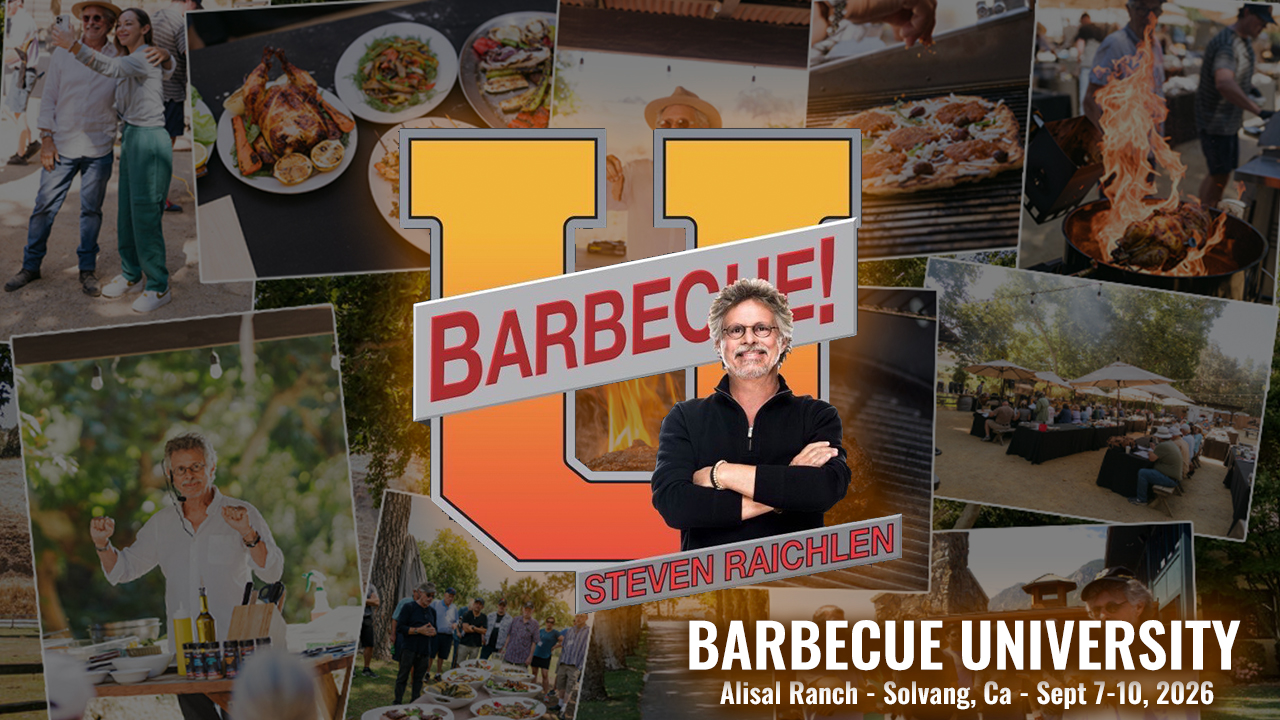
And the ultimate gift for that special griller? How about the gift that keeps on giving: Barbecue University® by Steven Raichlen. That’s right, the school that Forbes.com called an “awesome experience for food lovers” just announced the dates for its next session: September 7-10, 2026. Classes take place at the luxurious Alisal Ranch in Solvang, California. Your instructor is grilling legend, Steven Raichlen. You’ve watched him on Public Television. You’ve read his amazing books, like The Barbecue Bible and Project Smoke. Now take your grilling to the next level with the man who launched the modern barbecue revolution. Students learn not just by watching, but by cooking on the school’s more than 30 grills, smokers, and wood-burning ovens, with plenty of leisure time for horseback riding, hiking and wine tasting. Barbecue University®. Where the only marks you get are grill marks! For more information and to sign up, please write: reservations@alisal.com
The American Barbecue Map is the first ever visual representation of the entirety of American barbecue culture. The Map took two years and 375 hours of painting to complete and is available as a high quality 24×36” print. It features 184 of the top American BBQ restaurants, a signature dish of each region, an illustrated timeline of barbecue history, 25 individual barbecue kings and queens, and the top BBQ sides and desserts. Try to look at it without getting hungry! A portion of the proceeds will be donated to Southern Foodways Alliance.
New this year from Steven Raichlen: an essential guide to griddles, including delicious recipes and the dos and don’ts of grilling. Named one of Amazon’s Best Cookbooks of the Year.
Prized for their accessibility and versatility—and because they’re so much fun to use—griddles (also known as planchas and flat-tops) are soaring in popularity. Project Griddle features the trademark Raichlen approach, with plenty of practical cooking techniques and nearly 80 hunger-inducing recipes. It traces the history and geography of griddling, from the teppan of Japan to the plancha of Spain to champa grilling in South America. A gear chapter showcases the various types of stand-up and portable flattops and planchas, plus the requisite accessories, how to season and maintain a griddle, how to oil and cook on it, with chefs’ shortcuts, and some pitfalls to watch out for.
And then there are the recipes—each one as outrageously delicious and foolproof as the last, for classics like the crispiest smash burgers and tapas bar shrimp to an entire suite of heretofore un-grillable foods—egg-and-bacon breakfast feasts, potato latkes, crepes, French toast, and smoky fried rice. It’s Project Smoke for griddles—and don’t think of buying one without its guidance.
The best way to spread holiday cheer is..? You guessed it, sharp knives! The Tormek T-1 Kitchen Knife Sharpener is easy to use and provides professional results at home. Family parties this holiday no longer has to be a drag because of dull knives! In a matter of minutes, you will be able to transform your knives from not usable, to your favorite knife. This Swedish made knife sharpener with its adjustable angle guide, fine-grained diamond wheel and composite honing wheel makes it easy to get a razor-sharp edge.
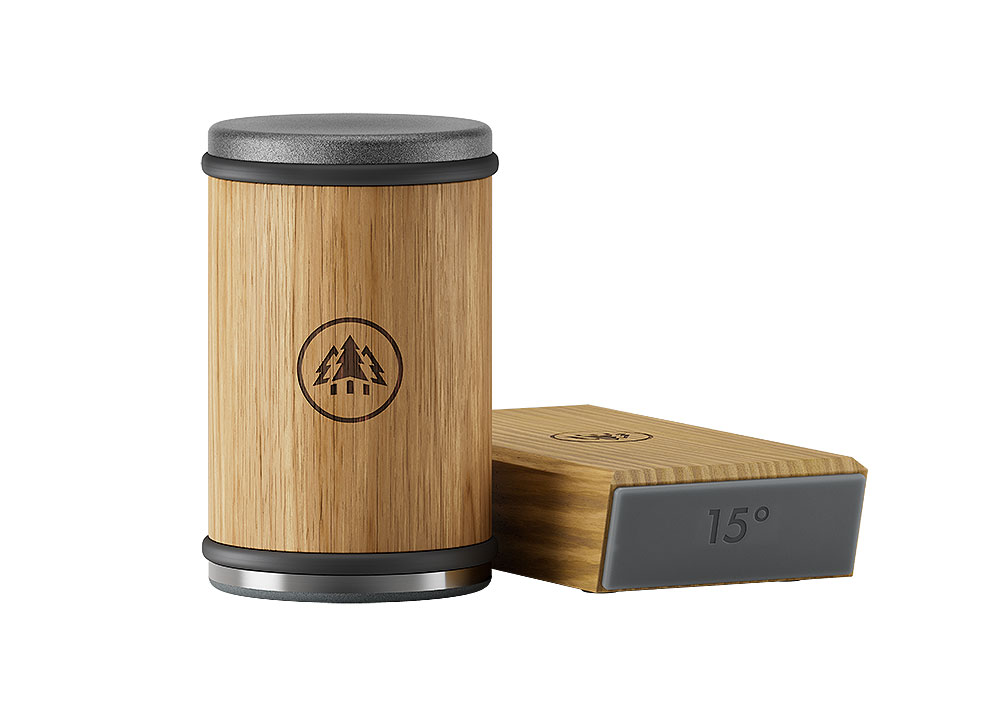
For the dedicated home cook, a truly sharp knife isn’t a luxury—it’s an essential. Experience the HORL3: Engineered in the Black Forest, Germany, this Rolling Knife Sharpener blends exquisite design with functional authority. Its unique system uses a magnetic guide to lock in the desired angle (15° or 20°), ensuring consistent, gentle sharpening with a durable diamond and refining ceramic disc. This holiday season, consider a gift that promises lifelong quality and effortless performance.
The Perfect Stocking Stuffer for Grillers and Foodies!
Kinzie Foods 5-Pack BBQ Mini Gift Set includes Sweet, Fiery, Pickle, Ghost, and Espresso — five unique, clean-ingredient sauces with memorable flavor. Each bottle is made to amplify smoke, heat, and char without covering them up. With roots in Texas and a home in South Dakota, Kinzie Foods was founded by Walter Kinzie, a live event producer who traded backstage passes for adventurous and unforgettable bites. It’s the perfect stocking stuffer for grillers, foodies, or anyone who refuses to settle for bland.
Need a gift for the guy who has everything and loves to cook outdoors? Treat him this holiday season with a bottle of Spritz King! Spritz King is an innovative culinary basting spray designed to create a deep char and better exterior bark on meats cooked on BBQ’s and smoker grills! Specially formulated with all natural ingredients and the perfect ratios of sugars and acidity, Spritz King seals in moisture, enhances flavor and builds a wonderfully crips exterior. Save up to 20% at Spritz King from November 28th thru December 31st. Get your Spritz on today!
Drip EZ’s signature Prep Tubs are a kitchen and grilling gamechanger. First use it as a vessel to marinate your favorite meats, then collapse it down to reveal the built in cutting board, and finally, use it to stash leftovers with the included locking lid. This all-in-one kitchen solution is the key to organized meal prep. The Prep Tubs are also great for organizing fresh produce and serving up sides with ease. When not in use, they collapse completely flat for convenient storage in your cabinets.
Top Chefs and Pitmasters Say It’s Simply The Best Beef In America!
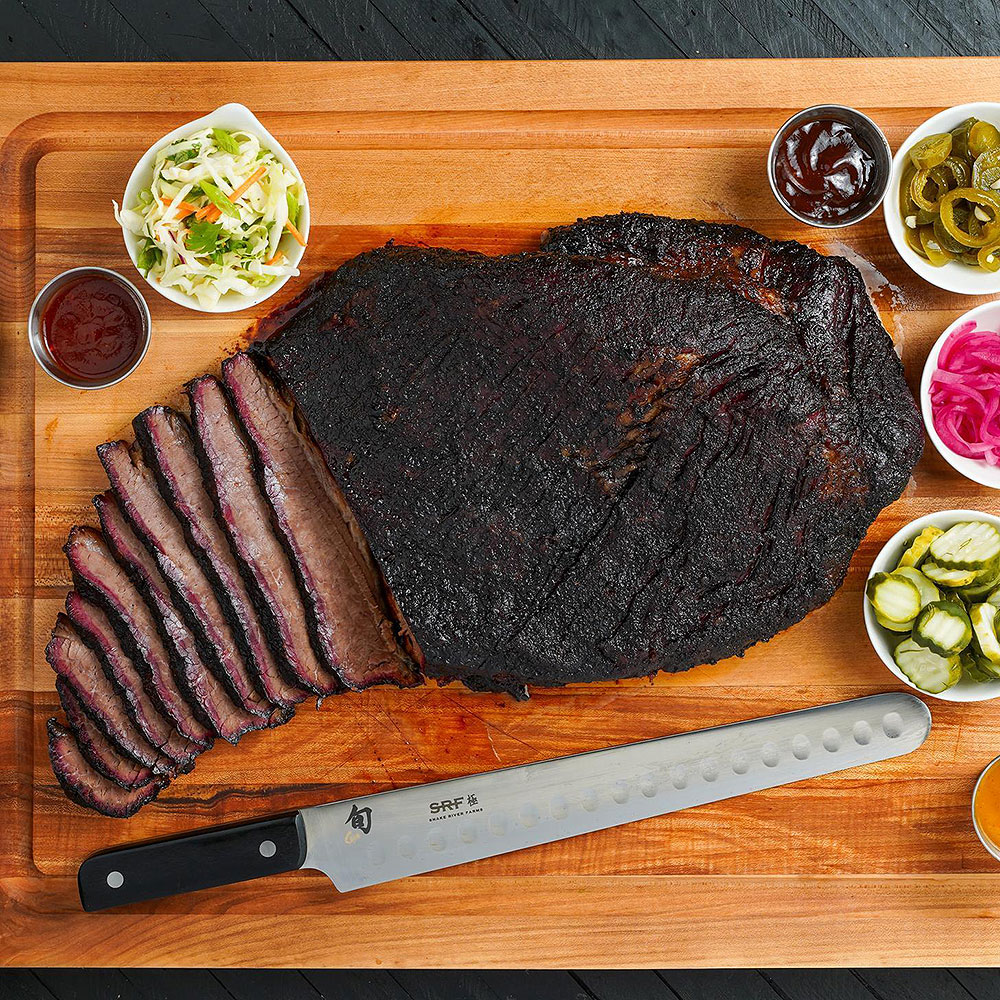
Snake River Farms is the best beef you’re ever going to eat. Period. From steakhouse classics like ribeye and filet mignon to rare butcher’s cuts, each bite delivers rich flavor and unrivaled tenderness. Snake River Farms briskets are the secret weapon for most professional pitmasters. But even humble burgers and hot dogs become gourmet experiences with Snake River Farms’ American Wagyu. SRF wagyu is so exceptionally marbled that every cut grades well above USDA Prime. Discover why top chefs and pitmasters call it simply the best beef in America.
A Unique, Flavor-Enhancing Gift: Wagyu Beef Tallow
South Chicago Packing Wagyu Beef Tallow is the perfect gift for the Foodie, Grill Master, or Home Chef on your list this year! This 100% pure, traditional cooking fat elevates every dish, whether you’re grilling, frying, roasting, or sautéing. Wagyu Beef Tallow adds deep, rich flavor and helps you achieve that perfect, mouthwatering sear. Available in a convenient spray, 11.5oz glass jar, or 42oz tub, Wagyu Beef Tallow is the perfect gift for anyone looking to level up their cooking.
The thinnest probe on the market slips into tight spots, leaving an unnoticeable hole in your perfect steak or protein. It lasts 40 hours on a charge—and, as a game-changer, we pioneered integrating a full temp controller into a wireless thermometer. Set alarms and control remotely via Bluetooth/WiFi with unlimited range. Hits 1000°F for searing without melting. Built weatherproof for rain or shine. Users rave: “Accuracy and range blew others away—truly wireless freedom.” It’s not just a probe; it’s your pit boss in your pocket.
If you’re down to the wire, we hope this list makes things a little easier. Pick something useful, wrap it up, and enjoy the best part of the season: good food with good people.
Preparations for Next Moonwalk Simulations Underway (and Underwater)
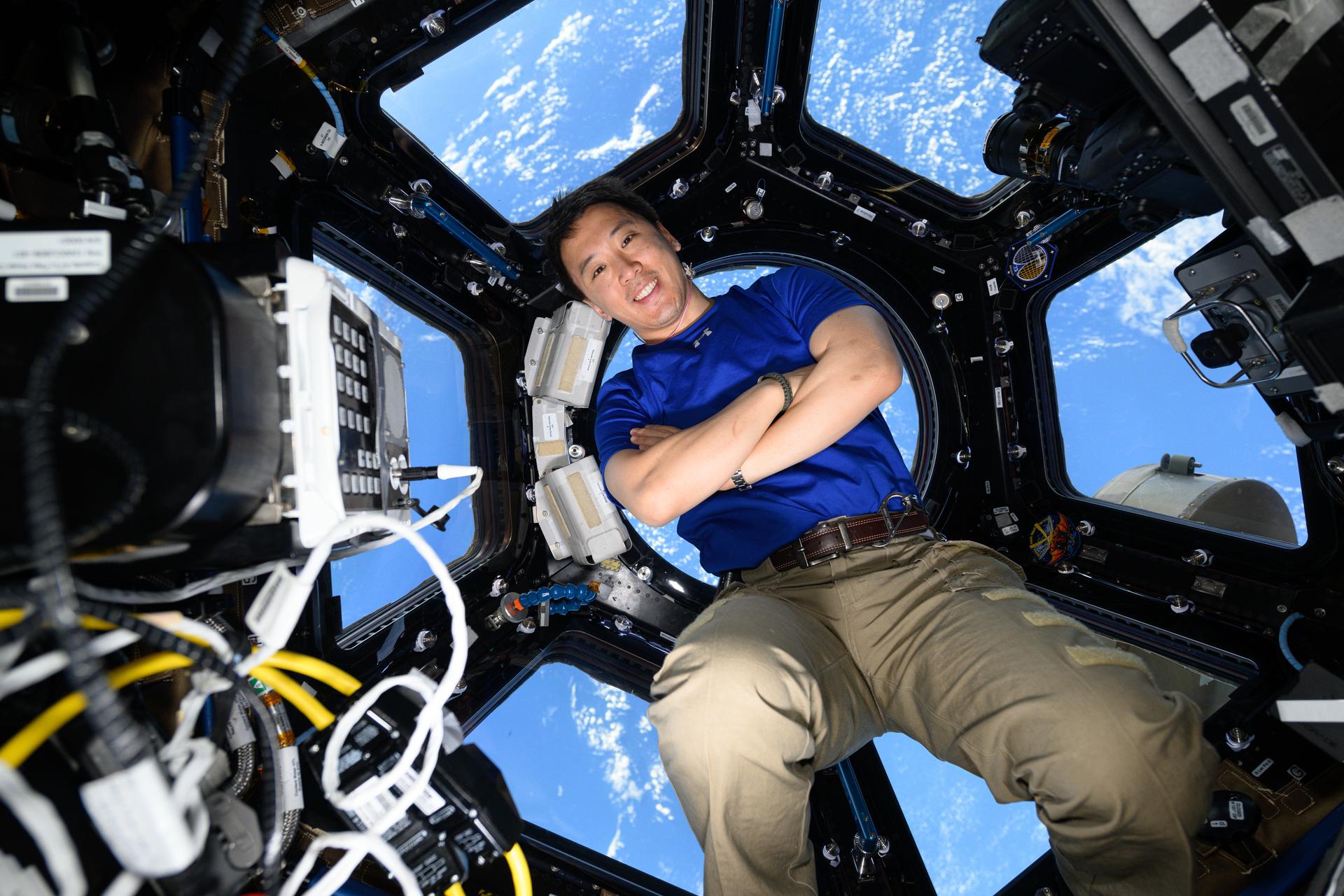
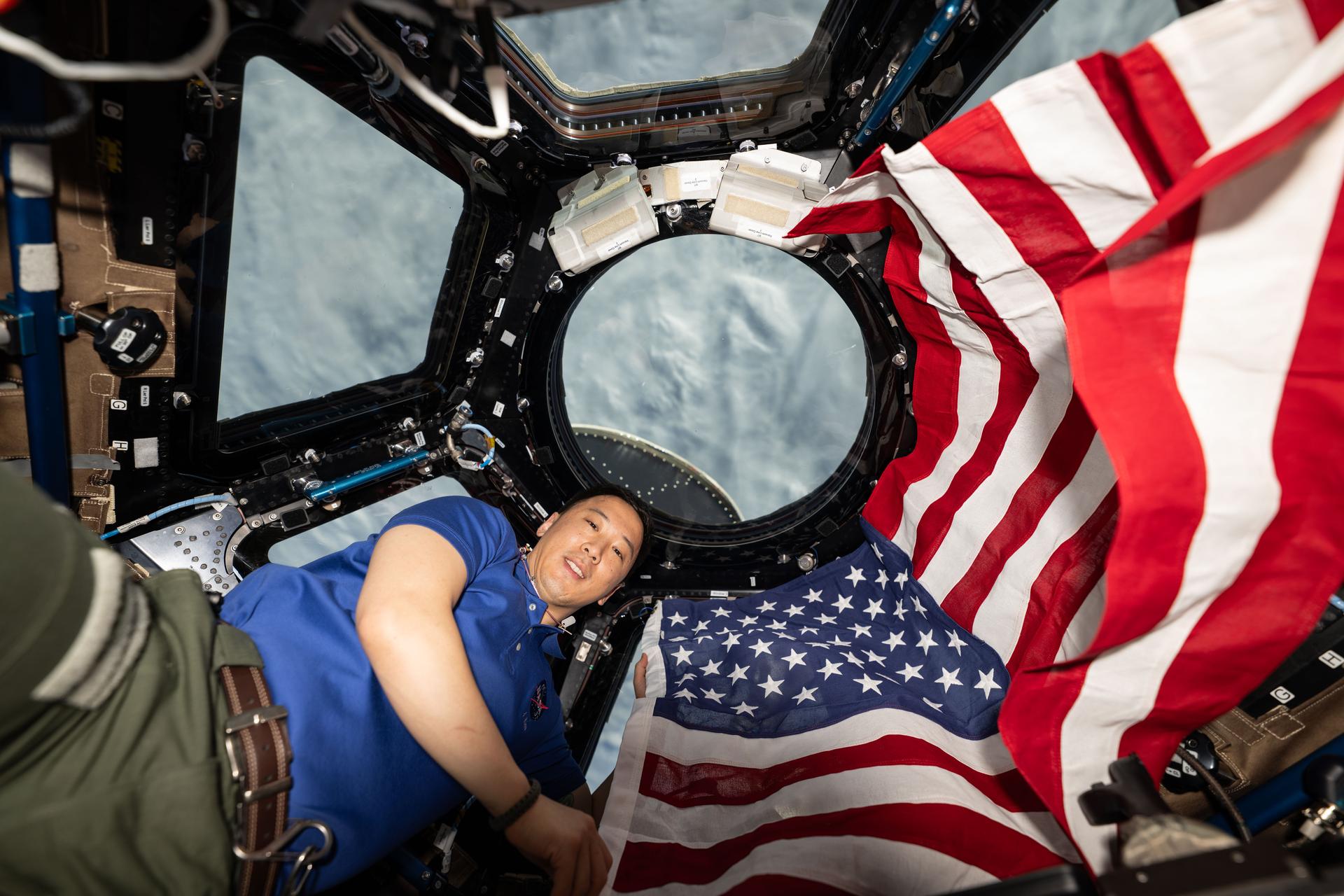
NASA astronaut Jonny Kim floats inside the Cupola of the International Space Station.
NASA
NASA astronaut Jonny Kim is wrapping up his first mission aboard the International Space Station in early December. During his stay, Kim conducted scientific experiments and technology demonstrations to benefit humanity on Earth and advance NASA’s Artemis campaign in preparation for future human missions to Mars.
Here is a look at some of the science Kim completed during his mission:
Medical check-ups in microgravity
NASA
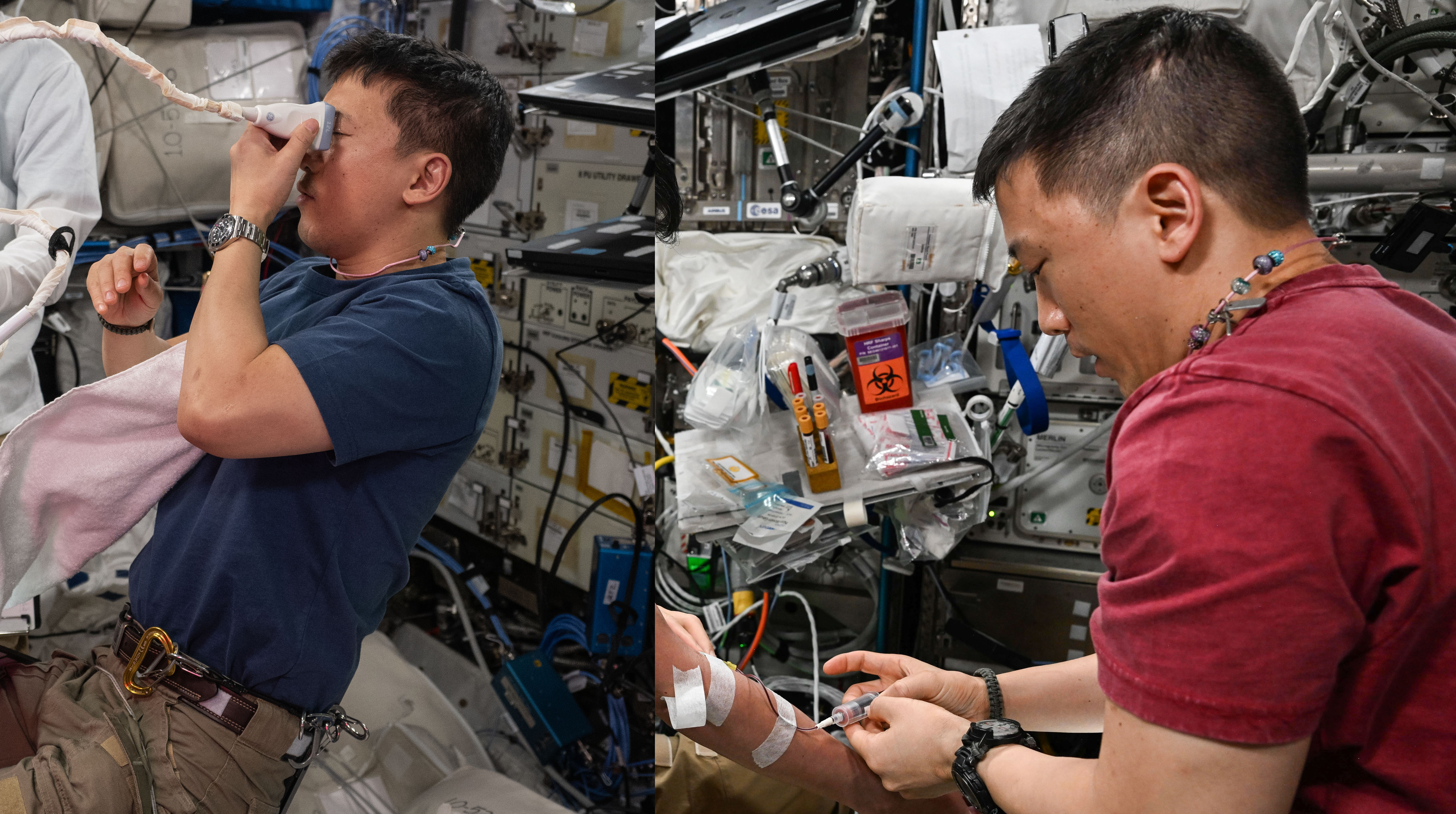
NASA astronaut Jonny Kim, a medical doctor, completed several routine medical exams while aboard the International Space Station. NASA flight surgeons and researchers monitor crew health using a variety of tools, including blood tests, eye exams, and ultrasounds.
Kim conducts an ultrasound of his eye in the left image. Eye exams are essential as long-duration spaceflight may cause changes to the eye’s structure and affect vision, a condition known as spaceflight associated neuro-ocular syndrome, or SANS. In the right image, Kim draws blood from a fellow crew member. These blood sample collections provide important insights into crew cartilage and bone health, cardiovascular function, inflammation, stress, immune function, and nutritional status.
NASA astronauts complete regular medical exams before, during, and after spaceflight to monitor astronaut health and develop better tools and measures for future human exploration missions to the Moon and Mars.
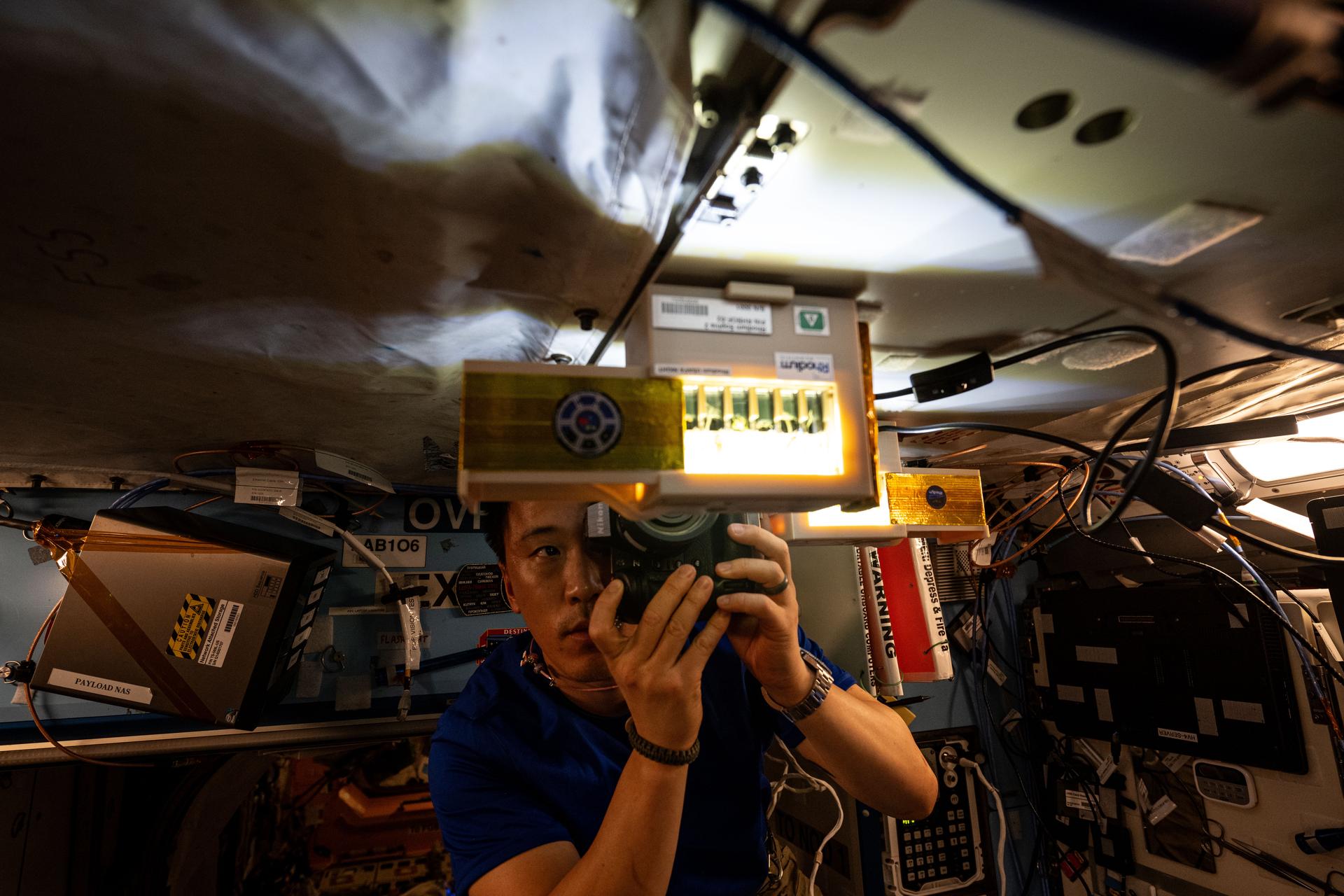
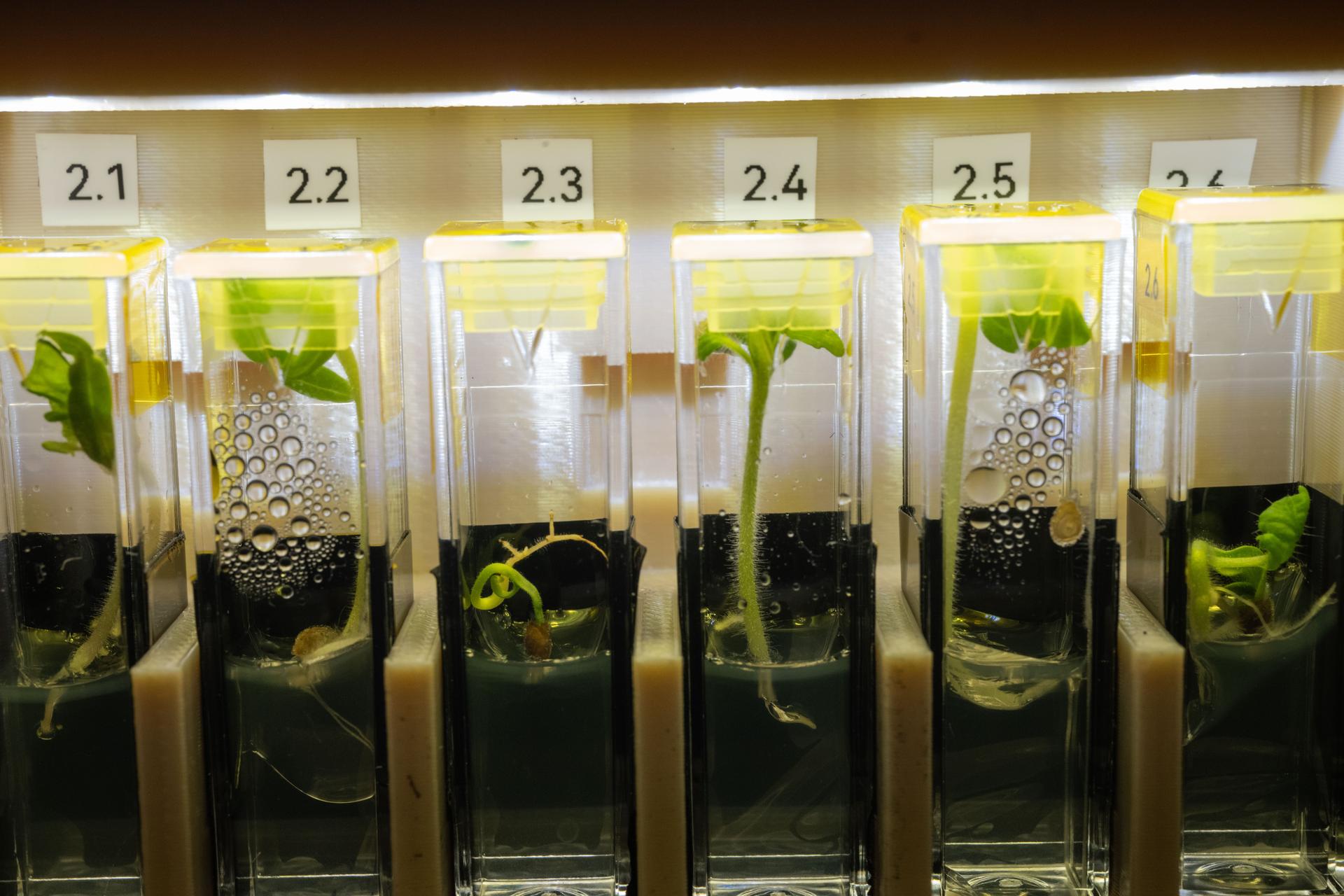
NASA astronaut Jonny Kim photographs dwarf tomato sprouts grown using a nutrient supplement instead of photosynthesis as part of a study on plant development and gene expression. The plants are given an acetate supplement as a secondary nutrition source, which could increase growth and result in better yields, all while using less power and fewer resources aboard the space station and future spacecraft.
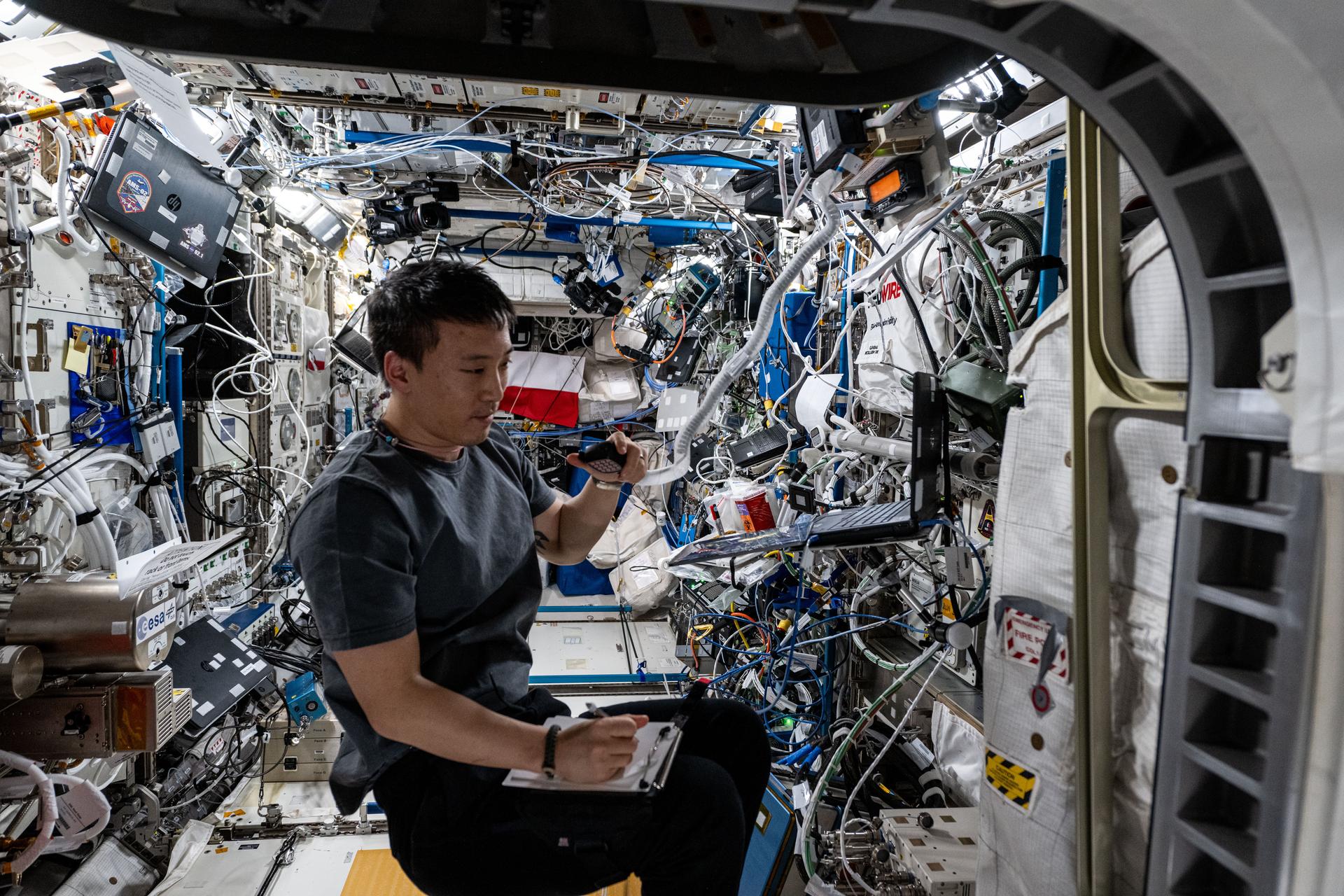
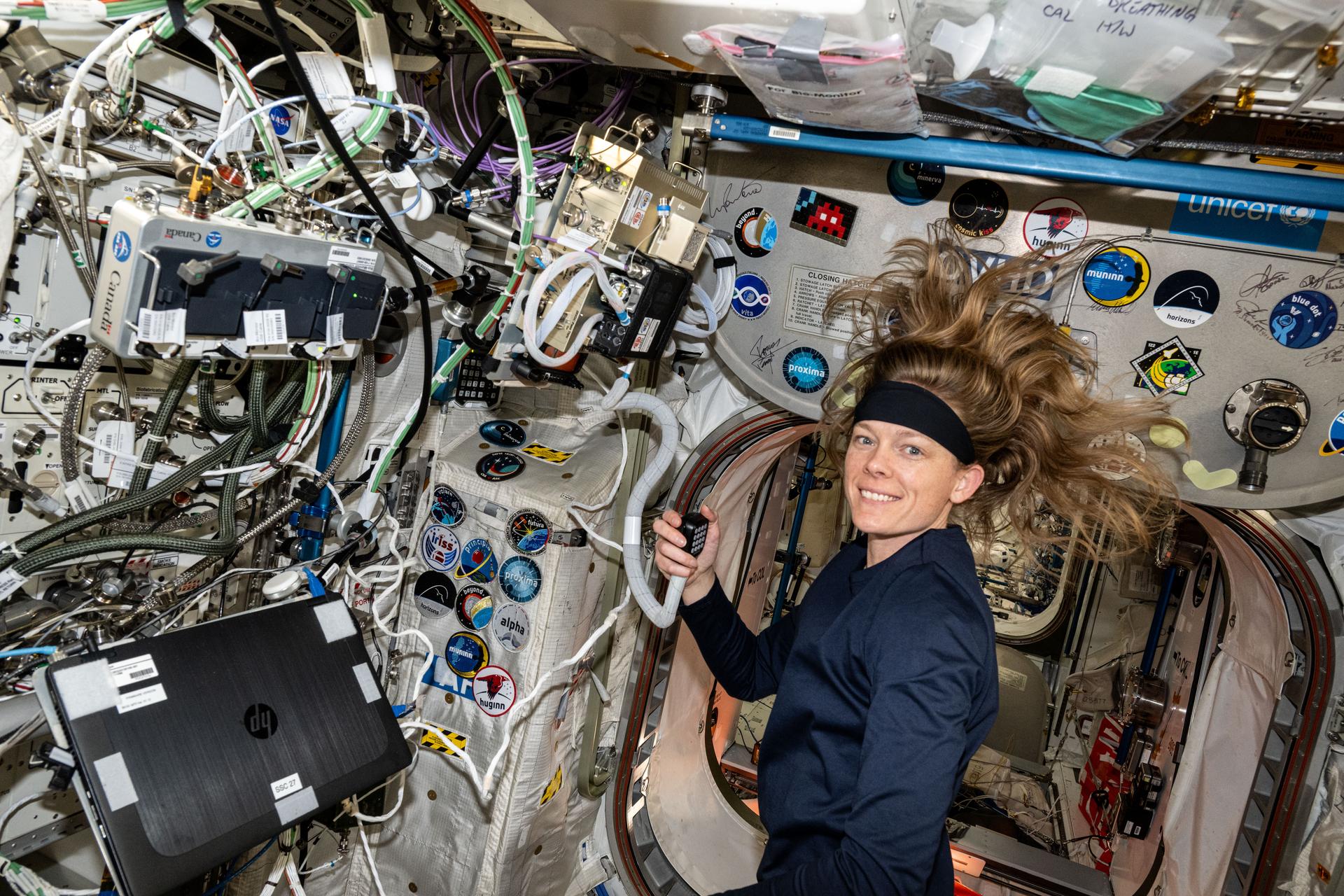
NASA astronaut Jonny Kim uses a ham radio to speak with students on Earth via an educational program connecting students worldwide with astronauts aboard the International Space Station. Students can ask about life aboard the orbiting laboratory and the many experiments conducted in microgravity. This program encourages an interest in STEM (science, technology, engineering, and mathematics) and inspires the next generation of space explorers.
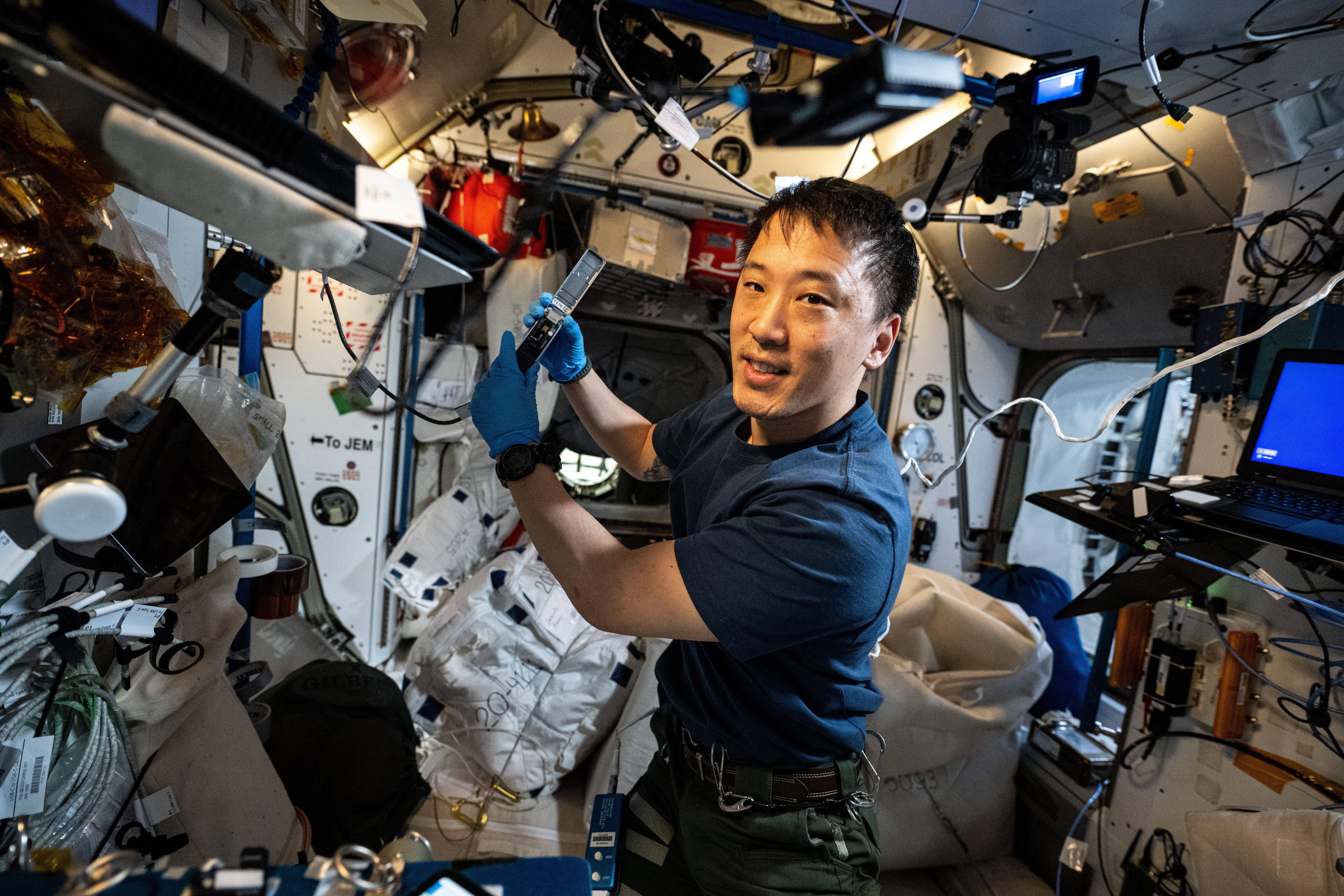
Secure and reliable data storage and transmission are essential to maintain the protection, accuracy, and accessibility of information. In this photo, NASA astronaut Jonny Kim displays research hardware that tests the viability of encoding, transmitting, and decoding encrypted information via DNA sequences. As part of this experiment, DNA with encrypted information is sequenced aboard the space station to determine the impact of the space environment on its stability. Using DNA to store and transmit data could reduce the weight and energy requirements compared to traditional methods used for long-duration space missions and Earth-based industries.
Future deep space exploration could rely on robotics remotely operated by humans. NASA astronaut Jonny Kim tests a technology demonstration that allows astronauts to remotely control robots on Earth from the International Space Station. Findings from this investigation could help fine-tune user-robot operating dynamics during future missions to the Moon, Mars, and beyond.
NASA astronaut Jonny Kim conducts an investigation to assess the effects of microgravity on bone marrow stem cells, including their ability to secrete proteins that form and dissolve bone. Bone loss, an age-related factor on Earth, is aggravated by weightlessness and is a health concern for astronauts. Researchers are evaluating whether blocking signals that cause loss could protect astronauts during long-duration spaceflights. The findings could also lead to preventative measures and treatments for bone loss caused by aging or disease on Earth.
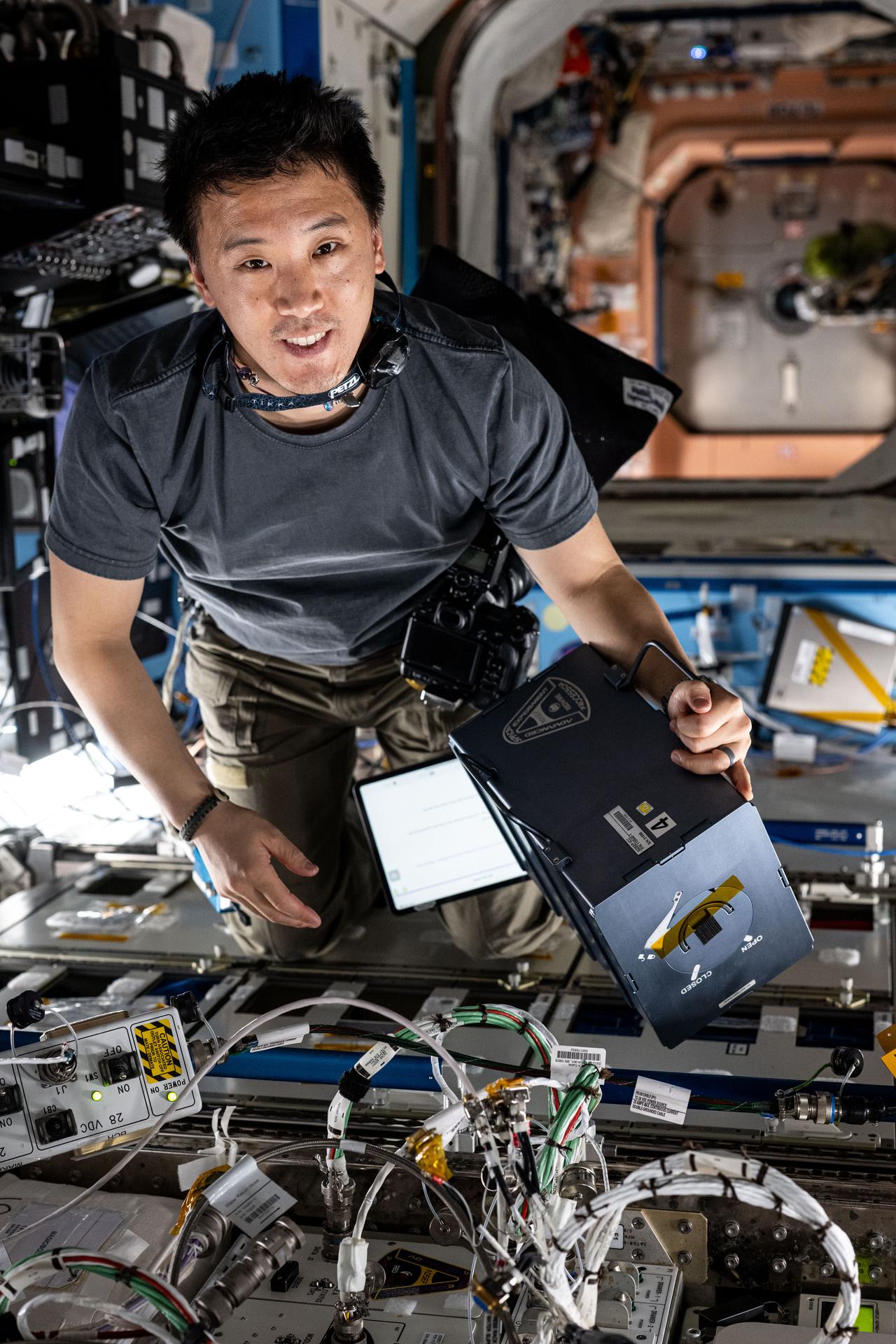
NASA astronaut Jonny Kim tests new hardware installed to an existing crystallization facility that enables increased production of crystals and other commercially relevant materials, like golden nanospheres. These tiny, spherical gold particles have optical and electronic applications, and are biocompatible, making them useful for medication delivery and diagnostics. As part of this experiment aboard the space station, Kim attempted to process larger, more uniform golden nanospheres than those produced on the ground.
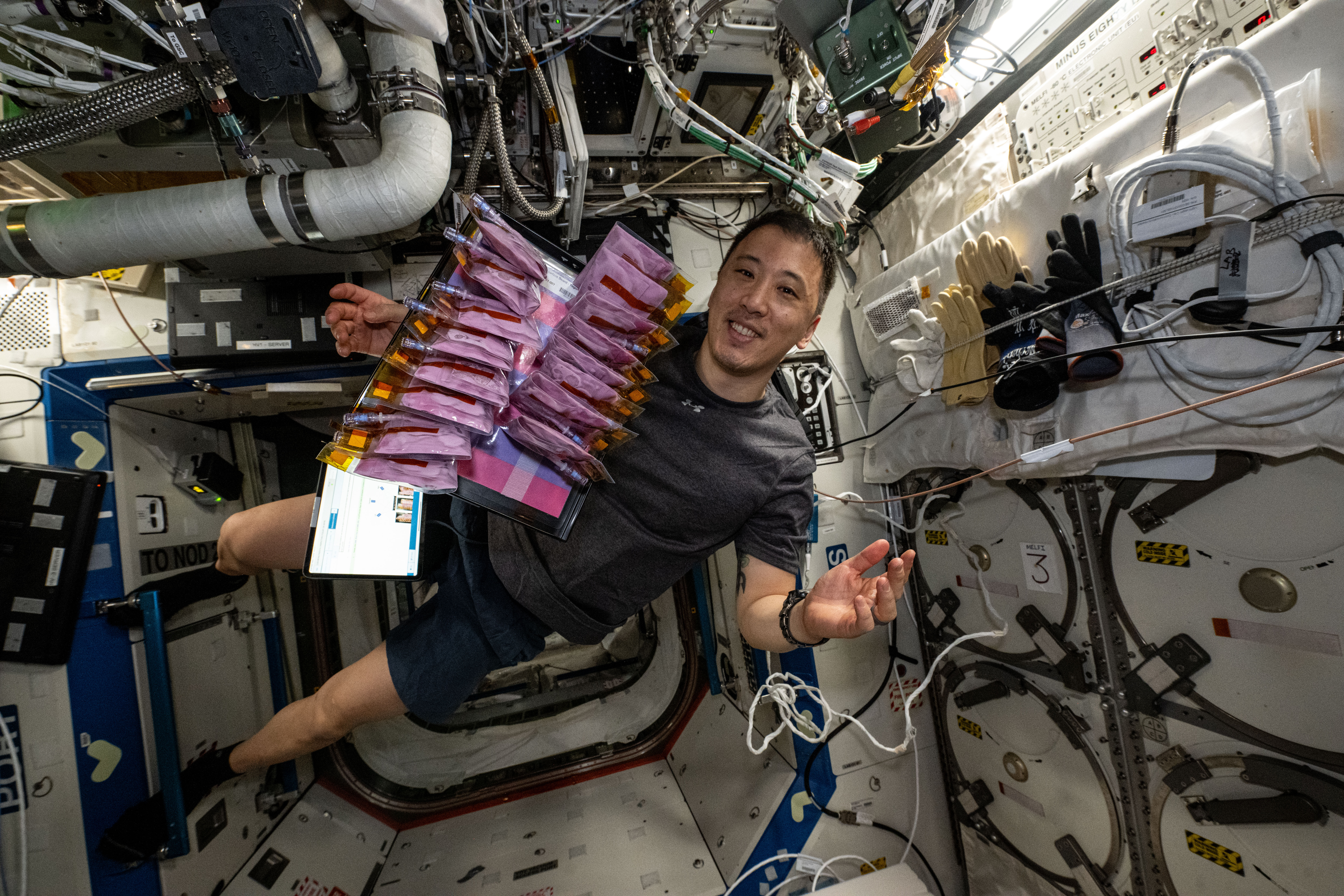
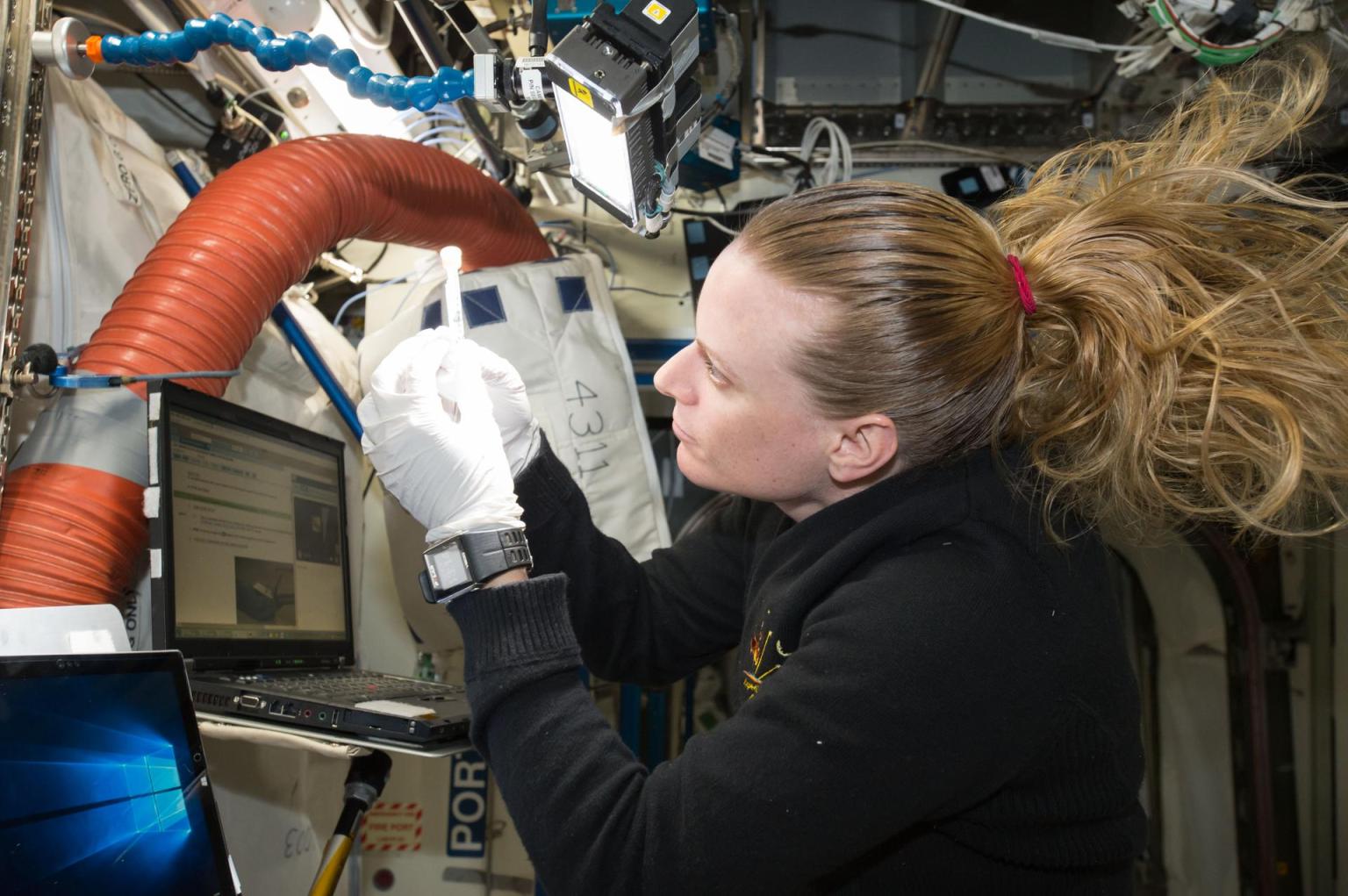
Some vitamins and nutrients in foods and supplements lose their potency during long-term storage, and insufficient intake of even a single nutrient can lead to diseases and other health issues. NASA astronaut Jonny Kim displays purple-pink production bags for an investigation aimed at producing nutrient-rich yogurt and kefir using bioengineered yeasts and probiotics. The unique color comes from a food-grade pH indicator that allows astronauts to visually monitor the fermentation process.
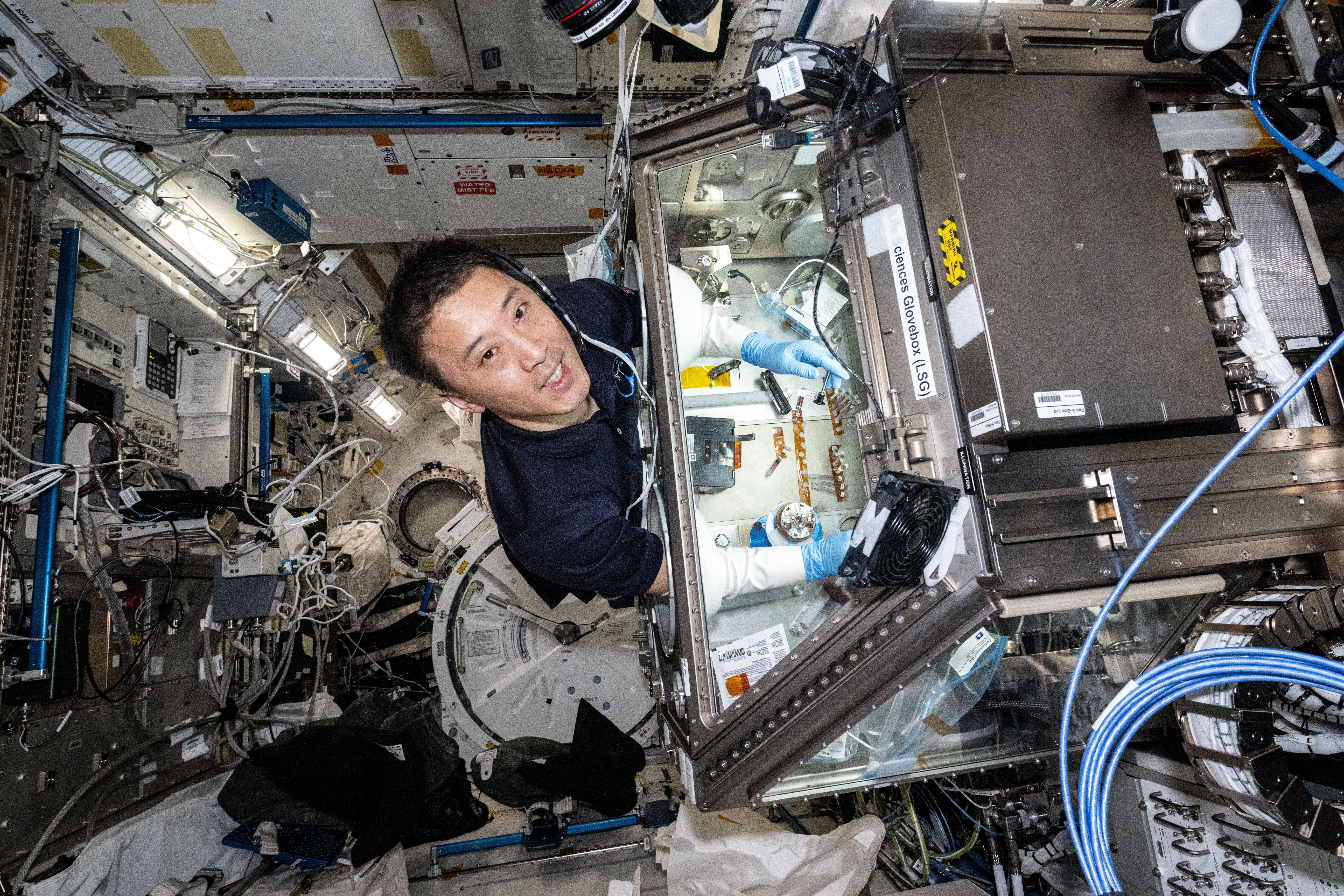
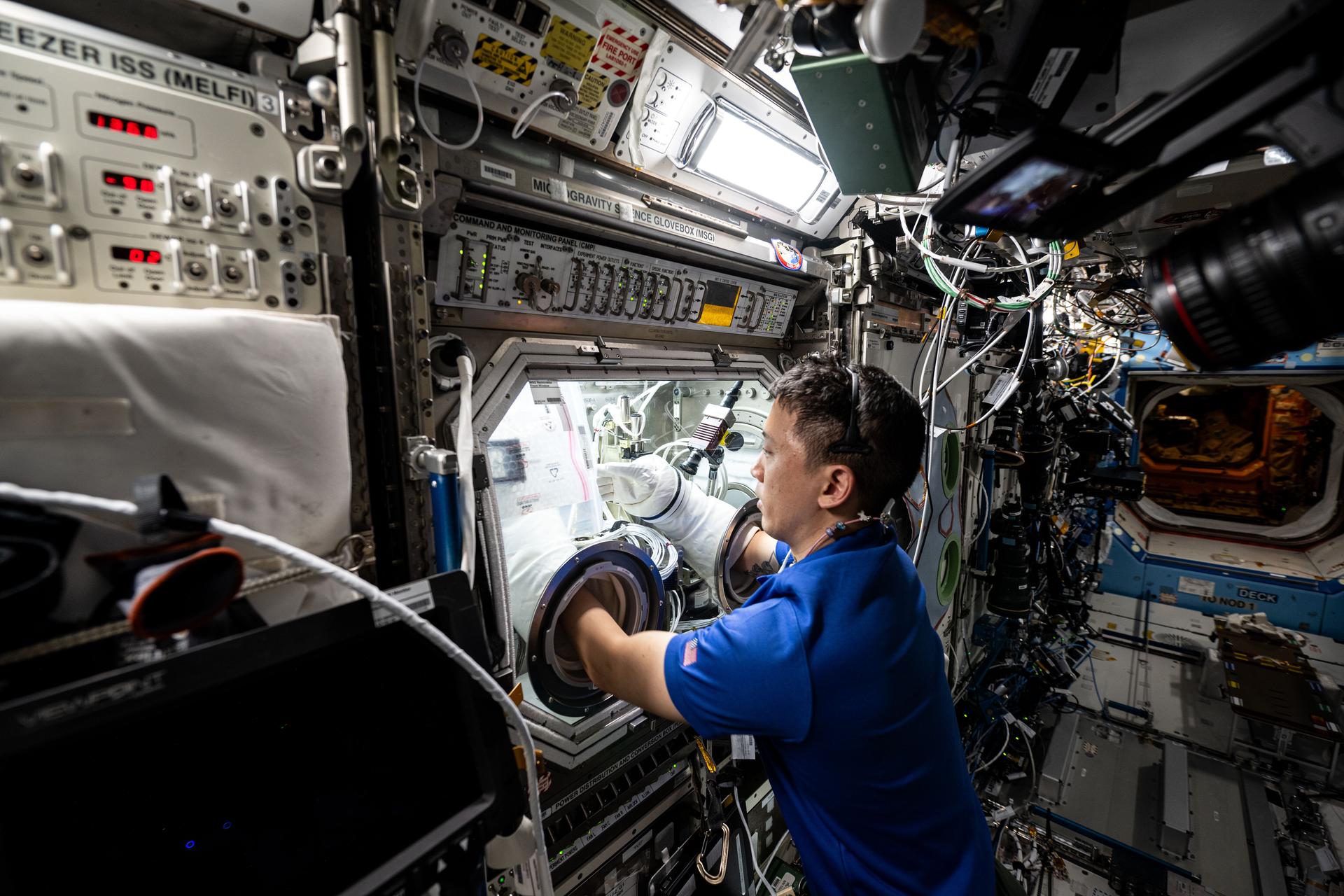
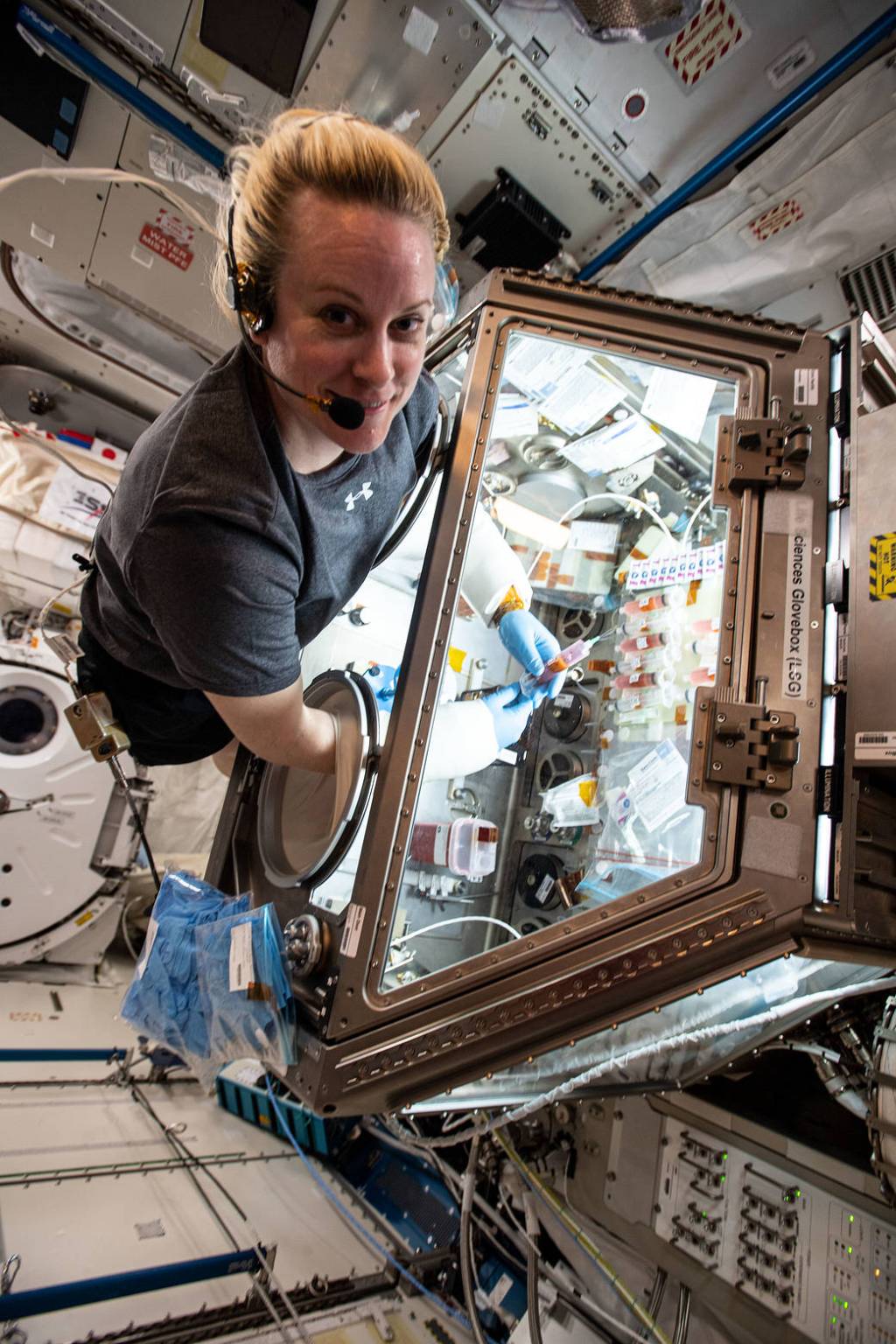
NASA astronaut Jonny Kim uses the Microgravity Science Glovebox to study how high-concentration protein fluids behave in microgravity. This study helps researchers develop more accurate models to predict the behavior of these complex fluids in various scenarios, which advances manufacturing processes in space and on Earth. It also can enable the development of next-generation medicines for treating cancers and other diseases.
On Sept. 28, 2025, NASA astronaut Jonny Kim photographed Hurricane Humberto from the International Space Station. Located at 250 miles above Earth, the orbiting laboratory’s unique orbit allows crew members to photograph the planet’s surface including hurricanes, dust storms, and fires. These images are used to document disasters and support first responders on the ground.
The asteroid Bennu continues to provide new clues to scientists’ biggest questions about the formation of the early solar system and the origins of life. As part of the ongoing study of pristine samples delivered to Earth by NASA’s OSIRIS-REx (Origins, Spectral Interpretation, Resource Identification, and Security-Regolith Explorer) spacecraft, three new papers published Tuesday by the journals Nature Geosciences and Nature Astronomy present remarkable discoveries: sugars essential for biology, a gum-like substance not seen before in astromaterials, and an unexpectedly high abundance of dust produced by supernova explosions.
Sugars essential to life
Scientists led by Yoshihiro Furukawa of Tohoku University in Japan found sugars essential for biology on Earth in the Bennu samples, detailing their findings in the journal Nature Geoscience. The five-carbon sugar ribose and, for the first time in an extraterrestrial sample, six-carbon glucose were found. Although these sugars are not evidence of life, their detection, along with previous detections of amino acids, nucleobases, and carboxylic acids in Bennu samples, show building blocks of biological molecules were widespread throughout the solar system.
For life on Earth, the sugars deoxyribose and ribose are key building blocks of DNA and RNA, respectively. DNA is the primary carrier of genetic information in cells. RNA performs numerous functions, and life as we know it could not exist without it. Ribose in RNA is used in the molecule’s sugar-phosphate “backbone” that connects a string of information-carrying nucleobases.
“All five nucleobases used to construct both DNA and RNA, along with phosphates, have already been found in the Bennu samples brought to Earth by OSIRIS-REx,” said Furukawa. “The new discovery of ribose means that all of the components to form the molecule RNA are present in Bennu.”
The discovery of ribose in asteroid samples is not a complete surprise. Ribose has previously been found in two meteorites recovered on Earth. What is important about the Bennu samples is that researchers did not find deoxyribose. If Bennu is any indication, this means ribose may have been more common than deoxyribose in environments of the early solar system.
Researchers think the presence of ribose and lack of deoxyribose supports the “RNA world” hypothesis, where the first forms of life relied on RNA as the primary molecule to store information and to drive chemical reactions necessary for survival.
A team of Japanese and US scientists have discovered the bio-essential sugars ribose and glucose in samples of asteroid Bennu that were collected by NASA’s OSIRIS-REx mission. This finding builds on the earlier discovery of nucleobases (the genetic components of DNA and RNA), phosphate, and amino acids (the building blocks of proteins) in the Bennu samples, showing that the molecular ingredients of life could have been delivered to early Earth by meteorites. Download this graphic from NASA’s Scientific Visualization Studio website: https://svs.gsfc.nasa.gov/14932
NASA/Goddard/University of Arizona/Dan Gallagher
“Present day life is based on a complex system organized primarily by three types of functional biopolymers: DNA, RNA, and proteins,” explains Furukawa. “However, early life may have been simpler. RNA is the leading candidate for the first functional biopolymer because it can store genetic information and catalyze many biological reactions.”
The Bennu samples also contained one of the most common forms of “food” (or energy) used by life on Earth, the sugar glucose, which is the first evidence that an important energy source for life as we know it was also present in the early solar system.
Mysterious, ancient ‘gum’
A second paper, in the journal Nature Astronomy led by Scott Sandford at NASA’s Ames Research Center in California’s Silicon Valley and Zack Gainsforth of the University of California, Berkeley, reveals a gum-like material in the Bennu samples never seen before in space rocks – something that could have helped set the stage on Earth for the ingredients of life to emerge. The surprising substance was likely formed in the early days of the solar system, as Bennu’s young parent asteroid warmed.
Once soft and flexible, but since hardened, this ancient “space gum” consists of polymer-like materials extremely rich in nitrogen and oxygen. Such complex molecules could have provided some of the chemical precursors that helped trigger life on Earth, and finding them in the pristine samples from Bennu is important for scientists studying how life began and whether it exists beyond our planet.
On this primitive asteroid that formed in the early days of the solar system, we’re looking at events near the beginning of the beginning.
Scott SandFord
Astrophysicist, NASA's Ames Research Center
Bennu’s ancestral asteroid formed from materials in the solar nebula – the rotating cloud of gas and dust that gave rise to the solar system – and contained a variety of minerals and ices. As the asteroid began to warm, due to natural radiation, a compound called carbamate formed through a process involving ammonia and carbon dioxide. Carbamate is water soluble, but it survived long enough to polymerize, reacting with itself and other molecules to form larger and more complex chains impervious to water. This suggests that it formed before the parent body warmed enough to become a watery environment.
“With this strange substance, we’re looking at, quite possibly, one of the earliest alterations of materials that occurred in this rock,” said Sandford. “On this primitive asteroid that formed in the early days of the solar system, we’re looking at events near the beginning of the beginning.”
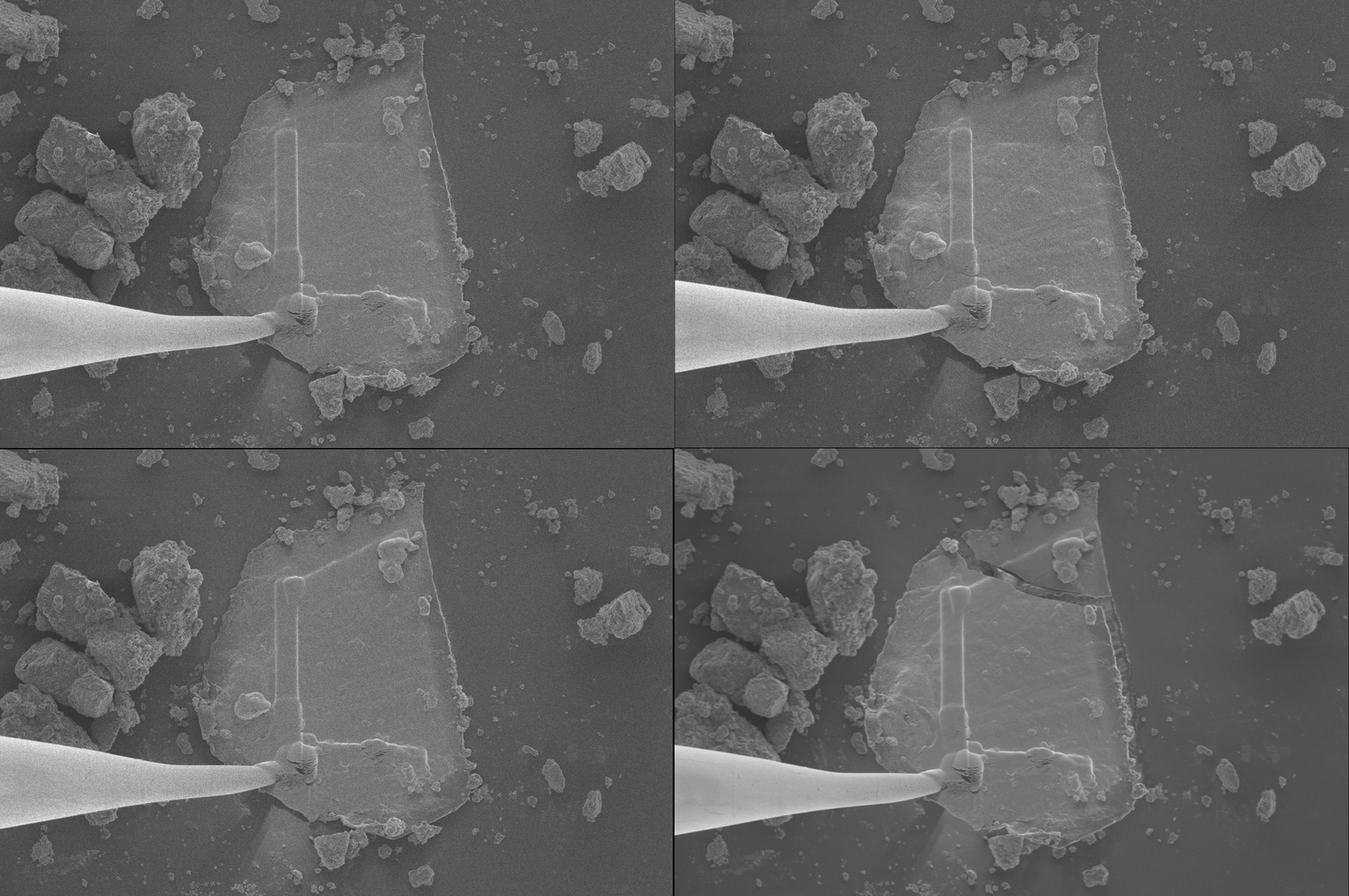
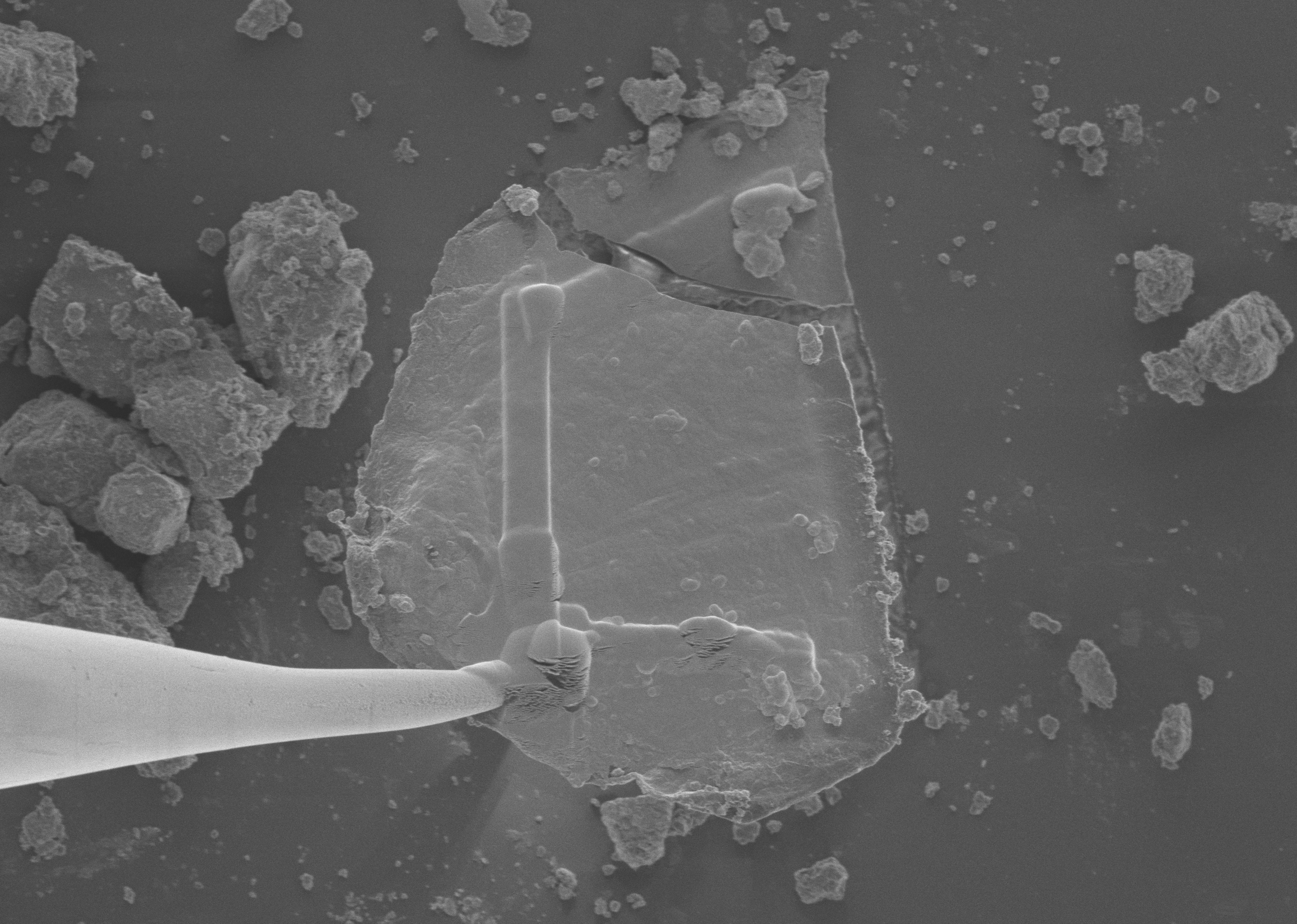
Using an infrared microscope, Sandford’s team selected unusual, carbon-rich grains containing abundant nitrogen and oxygen. They then began what Sandford calls “blacksmithing at the molecular level,” using the Molecular Foundry at Lawrence Berkeley National Laboratory (Berkeley Lab) in Berkeley, California. Applying ultra-thin layers of platinum, they reinforced a particle, welded on a tungsten needle to lift the tiny grain, and shaved the fragment down using a focused beam of charged particles.
A microscopic particle of asteroid Bennu, brought to Earth by NASA’s OSIRIS-REx mission, is manipulated under a transmission electron microscope. In order to move the fragment for further analysis, researchers first reinforced it with thin strips of platinum (the “L” shape on the particle’s surface) then welded a tungsten microneedle to it. The asteroid fragment measures 30 micrometers (about one-one thousandth of an inch) across.
NASA/University of California, Berkeley
When the particle was a thousand times thinner than a human hair, they analyzed its composition via electron microscopy at the Molecular Foundry and X-ray spectroscopy at Berkeley Lab’s Advanced Light Source. The ALS’s high spatial resolution and sensitive X-ray beams enabled unprecedented chemical analysis.
“We knew we had something remarkable the instant the images started to appear on the monitor,” said Gainsforth. “It was like nothing we had ever seen, and for months we were consumed by data and theories as we attempted to understand just what it was and how it could have come into existence.”
The team conducted a slew of experiments to examine the material’s characteristics. As the details emerged, the evidence suggested the strange substance had been deposited in layers on grains of ice and minerals present in the asteroid.
It was also flexible – a pliable material, similar to used gum or even a soft plastic. Indeed, during their work with the samples, researchers noticed the strange material was bendy and dimpled when pressure was applied. The stuff was translucent, and exposure to radiation made it brittle, like a lawn chair left too many seasons in the sun.
“Looking at its chemical makeup, we see the same kinds of chemical groups that occur in polyurethane on Earth,” said Sandford, “making this material from Bennu something akin to a ‘space plastic.’”
The ancient asteroid stuff isn’t simply polyurethane, though, which is an orderly polymer. This one has more “random, hodgepodge connections and a composition of elements that differs from particle to particle,” said Sandford. But the comparison underscores the surprising nature of the organic material discovered in NASA’s asteroid samples, and the research team aims to study more of it.
By pursuing clues about what went on long ago, deep inside an asteroid, scientists can better understand the young solar system – revealing the precursors to and ingredients of life it already contained, and how far those raw materials may have been scattered, thanks to asteroids much like Bennu.
Abundant supernova dust
Another paper in the journal Nature Astronomy, led by Ann Nguyen of NASA’s Johnson Space Center in Houston, analyzed presolar grains – dust from stars predating our solar system – found in two different rock types in the Bennu samples to learn more about where its parent body formed and how it was altered by geologic processes. It is believed that presolar dust was generally well-mixed as our solar system formed. The samples had six-times the amount of supernova dust than any other studied astromaterial, suggesting the asteroid’s parent body formed in a region of the protoplanetary disk enriched in the dust of dying stars.
The study also reveals that, while Bennu’s parent asteroid experienced extensive alteration by fluids, there are still pockets of less-altered materials within the samples that offer insights into its origin.
An artistic visualization of the OSIRIS-REx spacecraft descending towards asteroid Bennu to collect a sample.
NASA/Goddard/University of Arizona
“These fragments retain a higher abundance of organic matter and presolar silicate grains, which are known to be easily destroyed by aqueous alteration in asteroids,” said Nguyen. “Their preservation in the Bennu samples was a surprise and illustrates that some material escaped alteration in the parent body. Our study reveals the diversity of presolar materials that the parent accreted as it was forming.”
NASA’s Goddard Space Flight Center provided overall mission management, systems engineering, and the safety and mission assurance for OSIRIS-REx. Dante Lauretta of the University of Arizona, Tucson, is the principal investigator. The university leads the science team and the mission’s science observation planning and data processing. Lockheed Martin Space in Littleton, Colorado, built the spacecraft and provided flight operations. Goddard and KinetX Aerospace were responsible for navigating the OSIRIS-REx spacecraft. Curation for OSIRIS-REx takes place at NASA’s Johnson Space Center in Houston. International partnerships on this mission include the OSIRIS-REx Laser Altimeter instrument from CSA (Canadian Space Agency) and asteroid sample science collaboration with JAXA’s (Japan Aerospace Exploration Agency’s) Hayabusa2 mission. OSIRIS-REx is the third mission in NASA’s New Frontiers Program, managed by NASA’s Marshall Space Flight Center in Huntsville, Alabama, for the agency’s Science Mission Directorate in Washington.
For more information on the OSIRIS-REx mission, visit:
How did the molecular building blocks of life arrive at early Earth? To find out, NASA sent a spacecraft called OSIRIS-REx to collect samples from the carbon...
Jared Serbu Mr. McDaniel, let’s talk a little bit about some of the underlying factors and reasons why you organized this letter in the first place. What has changed that concerns you enough to take this step in recent days, weeks, months?
Dustin McDaniel Well, we’ve seen a significant increase in threats on the judiciary both at the state and federal level for the last several years. We pointed out that threats have increased significantly as per the numbers from the U.S. Marshal Service, and that doesn’t even count state judicial officials. And honestly, we were aware of it, but earlier this year, a group of incumbent actively serving federal judges reached out to me and my co-chair of SAGE, the Society of AGs Emeritus in Nebraska, John Brunning, and they asked specifically for former attorneys general to use their voices as lawyers and as former chief law enforcement officials in our states to encourage Congress to focus on the issue. And that was a very unusual thing. We’ve never had federal judges ask us, honestly, for anything. And so it drew our attention to the fact that they must genuinely be afraid for themselves, their families, and the integrity of the judicial system. So that was the first thing that sparked it. I will also tell you that back in September, I was in New Jersey for a meeting of attorneys general and Federal Judge Esther Salas spoke to the group and she had the most tragic story which she has been telling across the nation. But as a federal judge, she was targeted for assassination. And the man came to her home and her son and husband made it to the front door before she did. And her husband was shot several times and survived, but her son was murdered. And she was the intended target. And since that time, she has been an evangelist around the country trying to raise awareness that these threats are not just against individual members of the judiciary, but against our judicial system as a whole, undermining the rights and liberties of every single American. So between the call this summer and hearing Judge Salas speak so personally about her own experience, we felt moved to try to do what we could.
Jared Serbu And judges generally don’t go out and hold a press conference every time they receive one of these threats and they probably don’t get the media or public attention that they probably otherwise would if they were to do something like that. I mean, what’s your sense of how commonplace these sorts of things are becoming that just sort of escape public attention, because the U.S. Marshal Service, the statistics keeping agency, is really the only one tracking it?
Dustin McDaniel Well, I know that when I was attorney general, we had a political assassination in Arkansas of a high ranking official, and that prompted me to do internal security reviews in our own office. And I had no idea how many threats that I as the AG was getting on a a rather frequent basis. And so we have seen attorneys general, at that time security for AGs was kind of the exception. Today it’s the norm. And you talk to attorneys general who never thought they would want or need to have part-time or even full-time security detail, and it’s because of the credibility and frequency of the threats against them and their families that they simply have no choice. We are hearing that at the same level in the judiciary. After Judge Salas’ son Daniel’s tragic and senseless murder, we have seen a significant increase in threats on judges in the form of pizza deliveries. Federal judges at their home will receive late at night an unordered pizza delivery, and the name on the pizza will be Daniel, which is Judge Salas’ dead son’s name. That only signal to a federal judge is, we know who you are, we know where you are, and that we are sending you a message, whoever they are. Even if that never results in violence, that clearly is intimidating and upsetting and undermining the independence and security of our judicial system, which again is about more than just the judges. It’s about the people.
Jared Serbu Have you seen any indications, and this is impossible to quantify, I realize, that this change in the threat environment is influencing either the ways or the actual content of judicial decisions? Do we have any indication that it’s playing a role in how the judiciary operates?
Dustin McDaniel Well, we have always known that jurors who are judicial officials, even though they’re ordinary citizens, when they are serving as a member of a jury, they are judicial officials critical. And we know that intimidation and bribery of jurors has long been a concern. And we do have specific cases of that. I don’t have any specific cases that I can cite where a federal judge folded under threat or pressure and ruled in a way that he or she would not have ruled otherwise, but they’re human beings. And of course they’re going to have to take some of that into consideration. And it certainly makes it harder. The federal judges that I talk to, most of whom, they’re all underpaid. Our federal judges are underpaid. They certainly could make more money in private practice if they didn’t commit themselves to a lifetime of service to the nation. And the ones I talk to do it because they believe it’s their duty, and their patriotic duty to the country to serve in that capacity. So what I’m seeing from judges is a strong resilience and a commitment that they’re not going to be intimidated and they are going to do their jobs despite these threats, which makes them all the more important for us to protect them. And certainly their families didn’t sign up for that that risk and duty. And so the fact that they continue to go to work and make tough decisions every day is, they’re used to it when they are sentencing mob bosses. They’re not used to it when just their ordinary daily duties lead to the crazy people in their community targeting them for violence, often for political reasons.
Jared Serbu And so part of the ask in the letter is increased funding, and more security kind of throughout the Article III World. What would that actually look like in practice? And are there obvious gaps that you see right now that’s kind of low-hanging fruit that needs to be taken care of right away?
Dustin McDaniel Well, we got forty, the former attorneys general of forty states and the District of Columbia and I think three territories to sign on to this letter because we recognize that the problem has to be addressed. That being said, we stopped short of trying to tell Congress how to do their job. The Congress can appropriate money, and I think everybody trusts the U.S. Marshal Service to know their jobs and know how to fill the gaps once they get adequate funding and resources. I know from my own experience that they have proactive means to where they are looking for threats, even those that have not made themselves known, and then they have a reactive function to react once a threat comes in or someone says or does something that gets on their radar. I trust the U.S. Marshal Service to do their job well as long as they’re given adequate resources and time and personnel to do it. And make no mistake, this is only at the federal level. It was not practical for us to send a similar letter to every state legislature in the country. However, this is a pressing issue in every state in America.
Jared Serbu What’s behind all that? Because that fact, the fact that this is happening both in federal cases that may receive a lot of media attention or are politically charged in some way, that it’s not isolated to those and that it’s also extending to state courts, kind of points to some sort of broader, I almost want to say cultural problem. I don’t know what it is. What’s your take on what’s behind all this? And, to the extent we can point to those things, are there things that can be done, again to take your point on proactive versus reactive, to tamp down those threats instead of just responding to them?
Dustin McDaniel Well, it’s a way bigger issue than any one person can really address, and my opinion on how it’s come to be is just like anyone else’s, but we’ve certainly seen in the last thirty years a rise in school shootings, mass casualty events, online hostility, people venting their tempers in ways that would have not been anticipated, much less considered acceptable, not that long ago. There are angry people in our society. Why they’re angry, everyone’s got their opinion on that. How they manifest their frustrations, regardless of whether they’re with the economy or their elected officials or the judicial system or things that are much more personal, there are outlets, but one outlet that is simply not acceptable and that we cannot tolerate is threatening those people that we as a society entrust to hold folks accountable, to enforce our rights, to keep us safe in our own homes. We can’t expect any of that of the judiciary if they themselves are under daily threat.
FILE - This photo from Tuesday May 3, 2011, shows the Thurgood Marshall U.S. Courthouse where the Second Circuit Court of Appeals is located in New York's lower Manhattan. (AP Photo/Mary Altaffer, File)
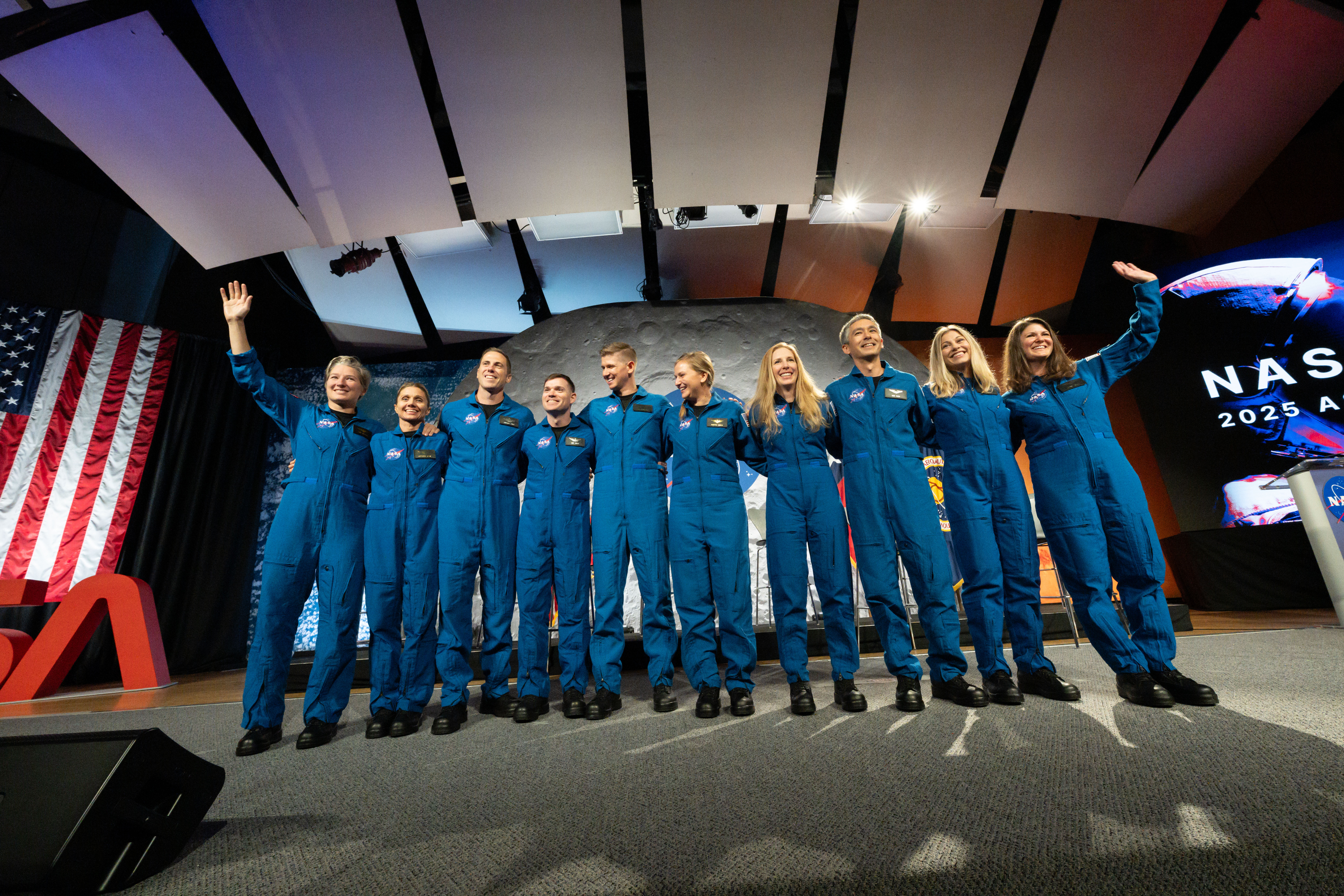
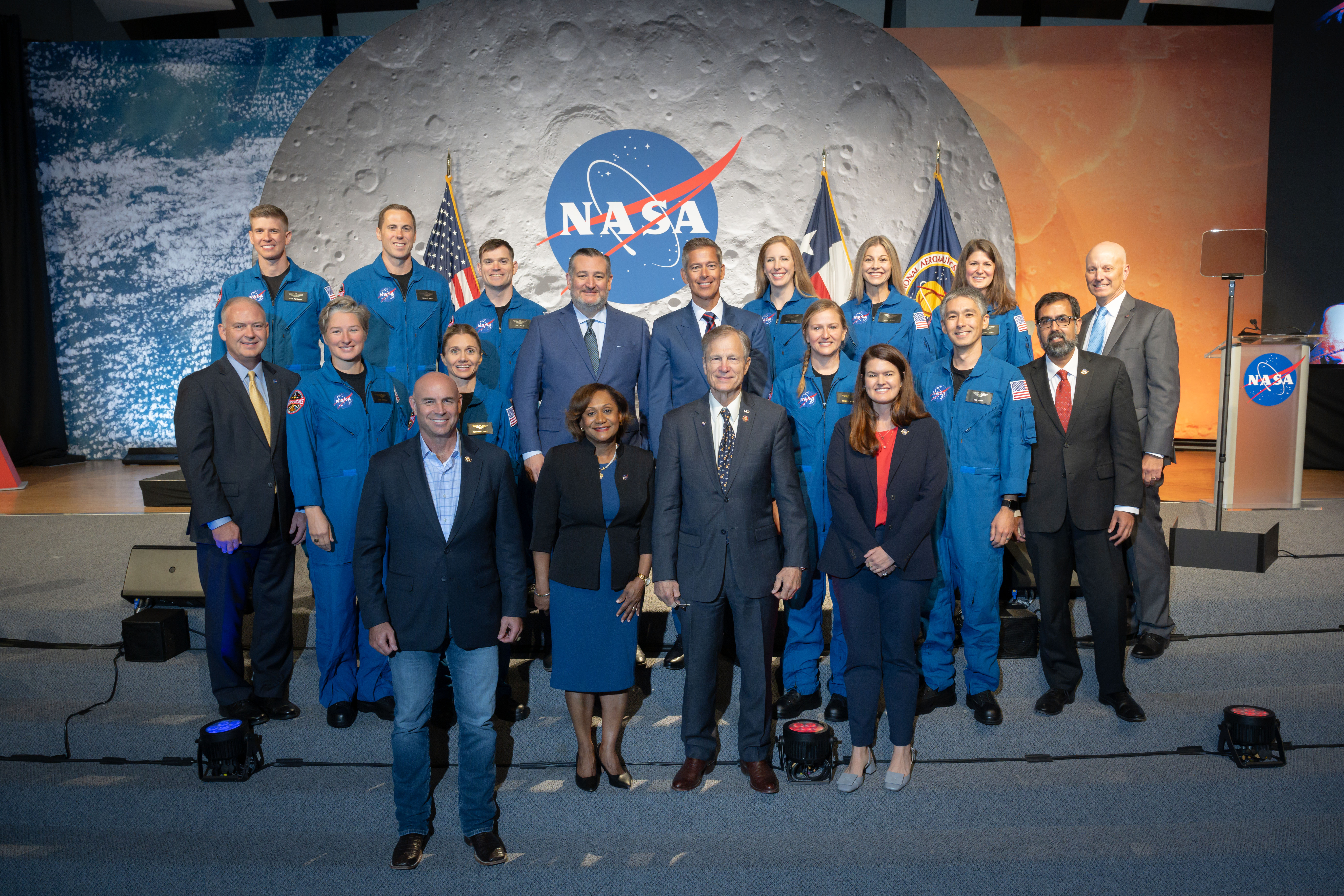
NASA’s Johnson Space Center Director Vanessa Wyche introduces the agency’s 24th astronaut class on Sept. 22, 2025.
Credits: NASA/James Blair
When NASA’s 2025 astronaut candidates arrived at the agency’s Johnson Space Center in Houston this fall, they stepped into history, sharing a common mission to master the skills and teamwork that define NASA’s next era of exploration.
Selected from a pool of more than 8,000 applicants, the new class represents a range of backgrounds — military test pilots, engineers, a physician, and a scientist — but all were inspired by moments in their lives that set them on a path to space.
They will spend nearly two years in training before becoming eligible for missions to low Earth orbit, the Moon, and eventually, Mars. When they graduate, they will join NASA’s active astronaut corps, advancing science aboard the International Space Station and supporting Artemis missions that will carry human exploration farther than ever before.
During the class announcement at Johnson on Sept. 22, 2025, Center Director Vanessa Wyche celebrated the moment as a milestone for exploration.
“Today is an exciting day for our nation and for all of humanity as we introduce NASA’s 2025 astronaut candidates — the next generation who will help us explore the Moon, Mars, and beyond,” Wyche said. “Each one of these candidates brings unique experiences and perspectives that reflect the diversity of America and the spirit of exploration that defines NASA.”
Behind their new blue flight suits are years of preparation and stories as multifaceted as the missions they will one day support.
Different Roads to the Same Horizon
NASA’s new astronaut candidates greet the crowd for the first time at Johnson Space Center in Houston.
NASA/James Blair
Some of the candidates built their careers in the air, where precision, communication, and teamwork were part of every mission. Former U.S. Navy pilot and test pilot Rebecca Lawler says that is exactly what drew her to NASA.
“All of these people are coming from different disciplines and levels of expertise, and you’re all working together to get science to fly,” she said. “That’s what excites me most — bringing those experiences together as a team.”
Imelda Muller, an anesthesiologist and former U.S. Navy undersea medical officer, said her experience supporting experimental diving teams taught her how people from different backgrounds can come together under one mission, something she sees echoed at NASA.
Muller remembers looking up at the night sky as a kid, able to see almost every star on a clear night. Her grandfather worked on the Apollo program and used to share stories with her, and she says the mix of stargazing and imagining those missions inspired her dream of becoming an astronaut.
Anna Menon, a biomedical engineer and former flight controller, has seen the human side of spaceflight from the ground and from space. She supported astronaut health aboard the space station from the Mission Control Center in Houston and served as a mission specialist and medical officer aboard SpaceX’s Polaris Dawn mission.
As more people venture into space, we have this incredible opportunity to learn how the human body changes in microgravity. That knowledge will help keep crews healthy as we go farther than ever before.
Anna Menon
NASA Astronaut Candidate
A Houston native, she discovered her passion for exploration in the fourth grade during a field trip to Johnson. “That experience lit a fire in me to want to be part of the space industry,” she said.
The Language of Human Spaceflight
NASA astronaut candidate Erin Overcash speaks during the class announcement ceremony at Johnson Space Center.
NASA/James Blair
For the test pilots — including Adam Fuhrmann, Cameron Jones, Ben Bailey, and Erin Overcash — flight testing taught adaptability, composure, and the discipline to make quick decisions when it matters most. As Fuhrmann put it, it is about knowing when to lead and when to listen.
In flight test, nothing happens alone. We work with incredible engineers and professionals to plan and execute complex missions. That teamwork translates perfectly to human spaceflight.
Adam Fuhrmann
NASA Astronaut Candidate
Every astronaut candidate will spend nearly two years learning spacecraft systems, practicing spacewalks in the Neutral Buoyancy Laboratory, flying T-38 jets, and studying geology, robotics, and survival training.
As U.S. Army Chief Warrant Officer and helicopter test pilot Ben Bailey said, it is not one skill that matters most — it is the combination.
“Each one is exciting on its own — flying, language training, spacewalks — but getting to do them all together, as a crew, that’s the best part,” Bailey said.
During the event, current astronauts welcomed the new class and shared advice drawn from their own journeys in human spaceflight. “Thankfully, you will have some of the most talented, passionate instructors and an incredibly dedicated team here at NASA,” said NASA astronaut Chris Williams. “Some of the most special moments will come as you find how much you get to learn from each other.”
From the International Space Station, NASA astronaut Zena Cardman encouraged the candidates to “learn everything you can, get to know each other, and enjoy the ride.”
NASA astronaut Jonny Kim followed with a reminder every explorer carries forward: “The people sitting beside you now will become lifelong friends.”
Explorers of the Golden Age
The 2025 astronaut candidates with NASA leadership during their class announcement.
NASA/James Blair
From geologist Lauren Edgar, who worked on the Curiosity Mars Rover and the Artemis III science team, to engineers like Yuri Kubo, who completed seven NASA internships, and Katherine Spies, who designed and tested flight systems that make exploration possible, each brings a layer of expertise to the agency’s future on the Moon and beyond.
I’ve always loved figuring out how things work and finding ways to make them better. That’s what drew me to engineering, and it’s what keeps me excited about exploration.
Yuri Kubo
NASA Astronaut Candidate
A New Era Begins
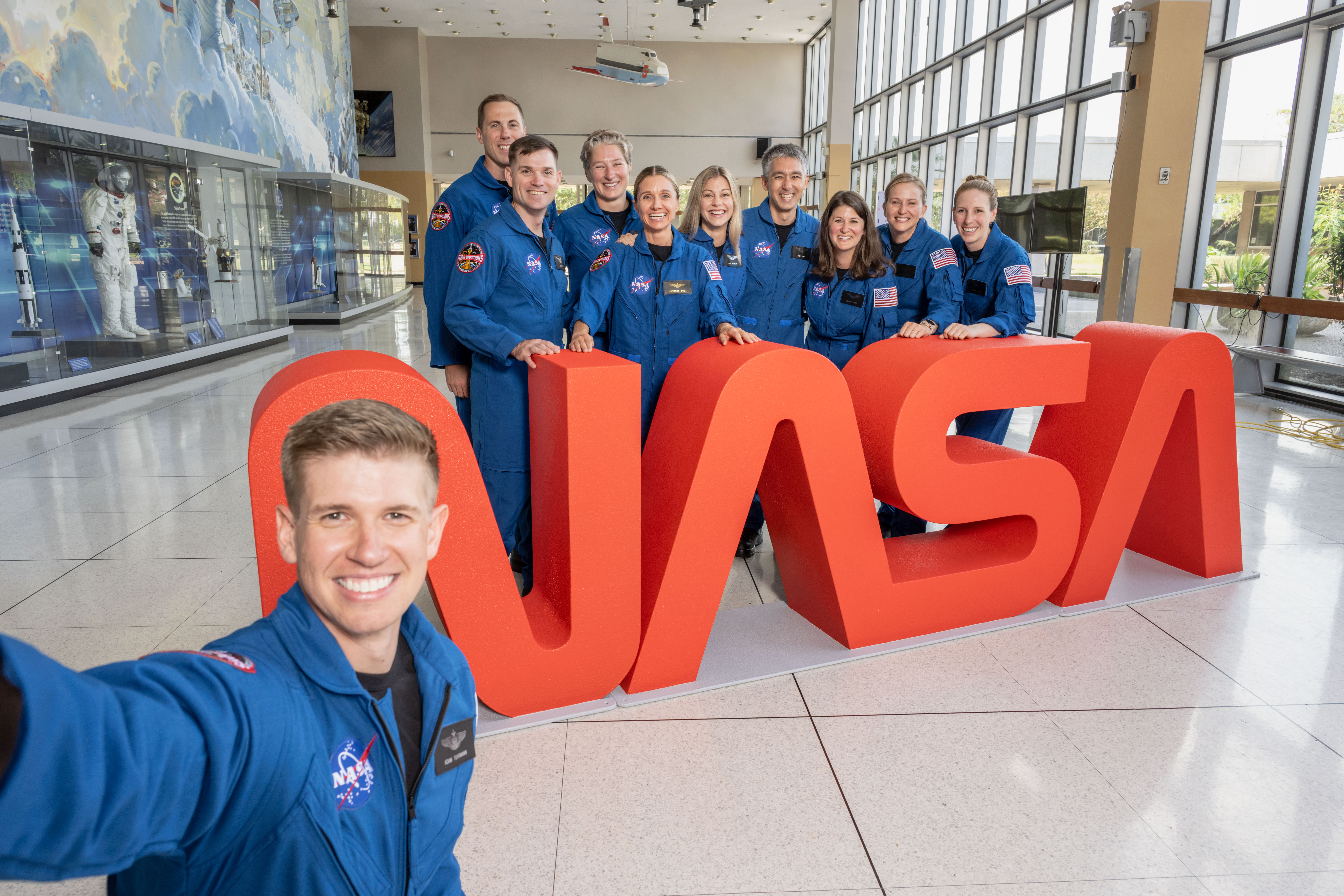
NASA’s astronaut candidate class pose for a selfie during their first week at Johnson Space Center.
NASA
At the announcement ceremony, NASA Flight Operations Director Norm Knight said, “Every lesson learned aboard station has paved the way for where we’re headed next – to the Moon, this time to stay, and on to Mars. We have a group of individuals who are not only exceptional, but who will be inspirational for the United States of America and for our planet.”
Together, the astronaut candidates reflect the spirit of Artemis — curiosity, courage, and continuous learning as humanity prepares for its next giant leap.
25 Years of Scientific Discovery Aboard the International Space Station
November marks 25 years of human presence aboard the International Space Station, a testament to international collaboration and human ingenuity. Since the first crew arrived on Nov. 2, 2000, NASA and its partners have conducted thousands of research investigations and technology demonstrations to advance exploration of the Moon and Mars and benefit life on Earth.
Researchers have taken advantage of the unique microgravity environment to conduct experiments impossible to replicate on Earth, transforming research across disciplines. More than 4,000 experiments have pushed the boundaries of science, sparked discoveries, and driven scientific breakthroughs.
“25 years ago, Expedition 1 became the first crew to call the International Space Station home, beginning a period of continuous human presence in space that still continues to this day,” said NASA acting administrator Sean Duffy. “This historic milestone would not have been possible without NASA and its partners, as well as every astronaut and engineer who works to keep the lights on in low Earth orbit.”
To celebrate a quarter century of innovation in microgravity, NASA is highlighting 25 scientific breakthroughs that exemplify the station’s enduring impact on science, technology, and exploration.
Building the road to the Moon and Mars
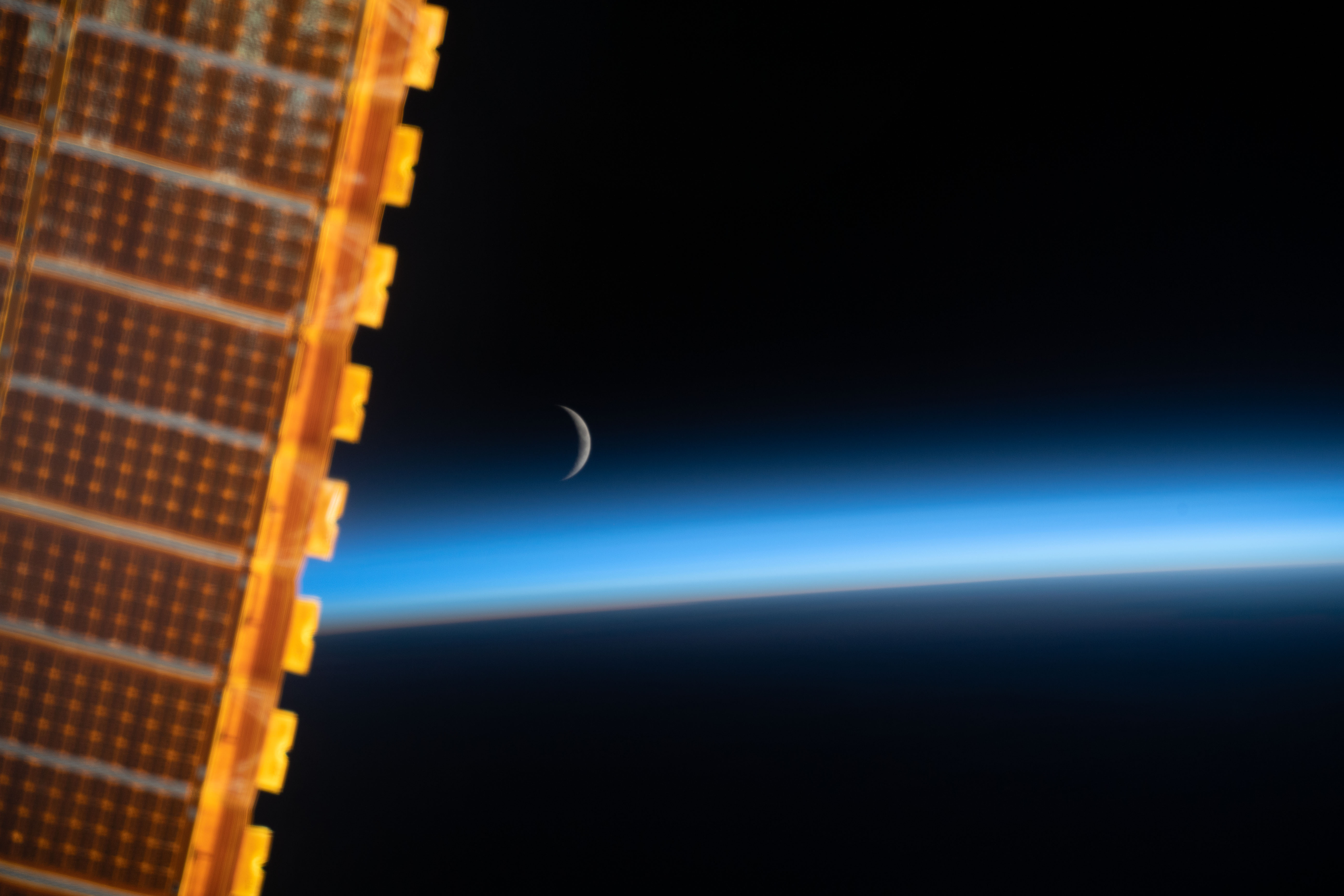
The waxing crescent moon appears just above the Earth’s atmosphere as the International Space Station orbits the Earth.
Navigation, communication, and radiation shielding technologies proven aboard the space station are being integrated into spacecraft and missions to reach the Moon and Mars.
Robotic systems, for example a robotic surgeon and autonomous assistants, will expand available medical procedures and allow astronauts to dedicate time to more crucial tasks during missions far from Earth.
Astronauts have used recycled plastic and stainless steel to 3D print tools and parts. The ability to 3D print in space lays the groundwork for on-demand repair and fabrication during future deep space missions where resupply isn’t readily available.
Humanity’s push to the Moon and Mars begins with discoveries in low Earth orbit. From demonstrating how astronauts can live, work, and repair equipment off Earth to testing life-support systems and advanced materials, every innovation aboard the station helps to advance NASA’s Artemis and other exploration initiatives and brings humanity closer to thriving beyond our planet.
Sustaining life beyond Earth
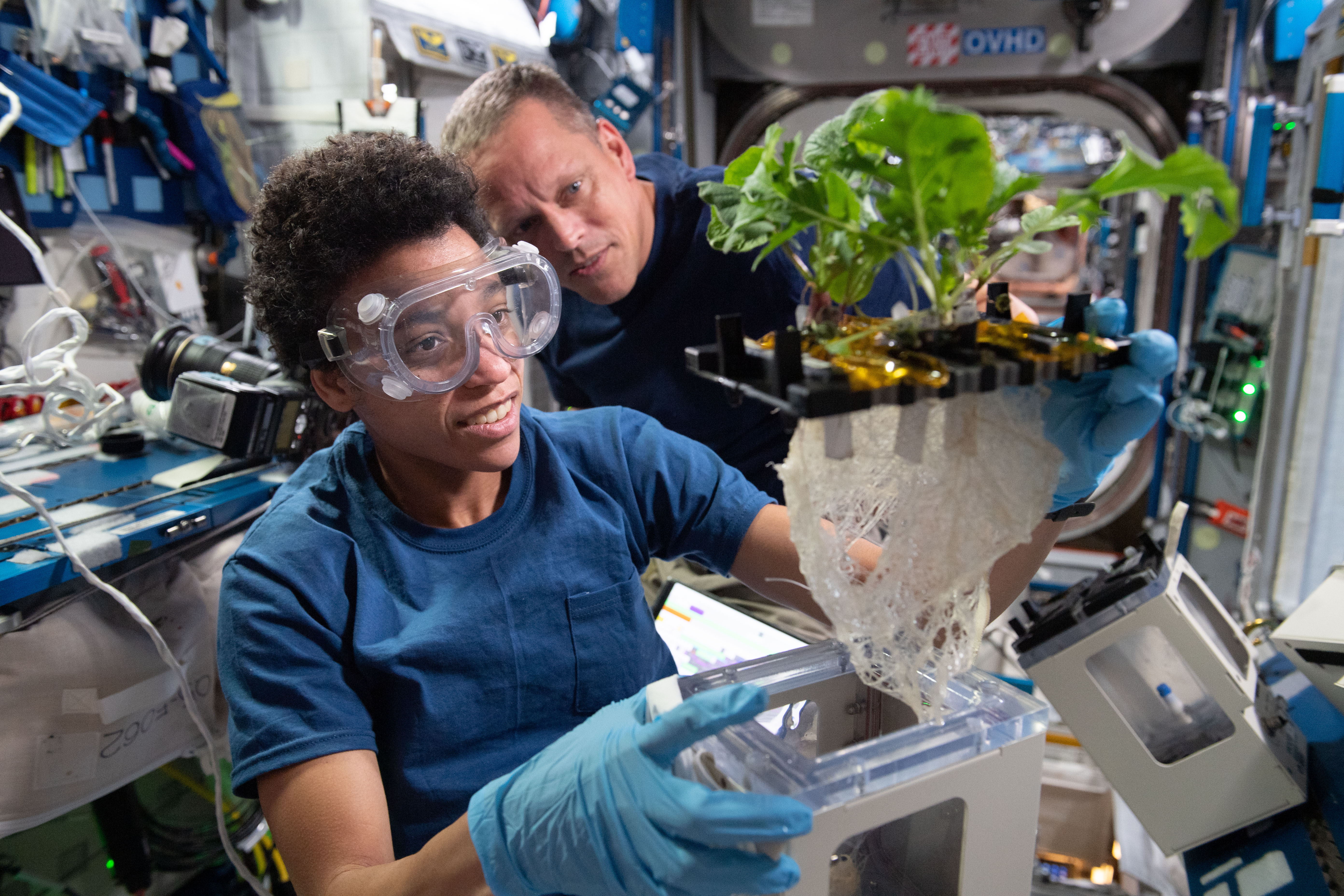
NASA astronauts Jessica Watkins, front, and Bob Hines, back, work on XROOTS aboard the International Space Station. This experiment used the station’s Veggie facility to test soilless hydroponic and aeroponic plant growth.
NASA
As NASA prepares to return humans to the Moon through the Artemis program and push onward to Mars, sustaining life beyond Earth is more critical than ever.
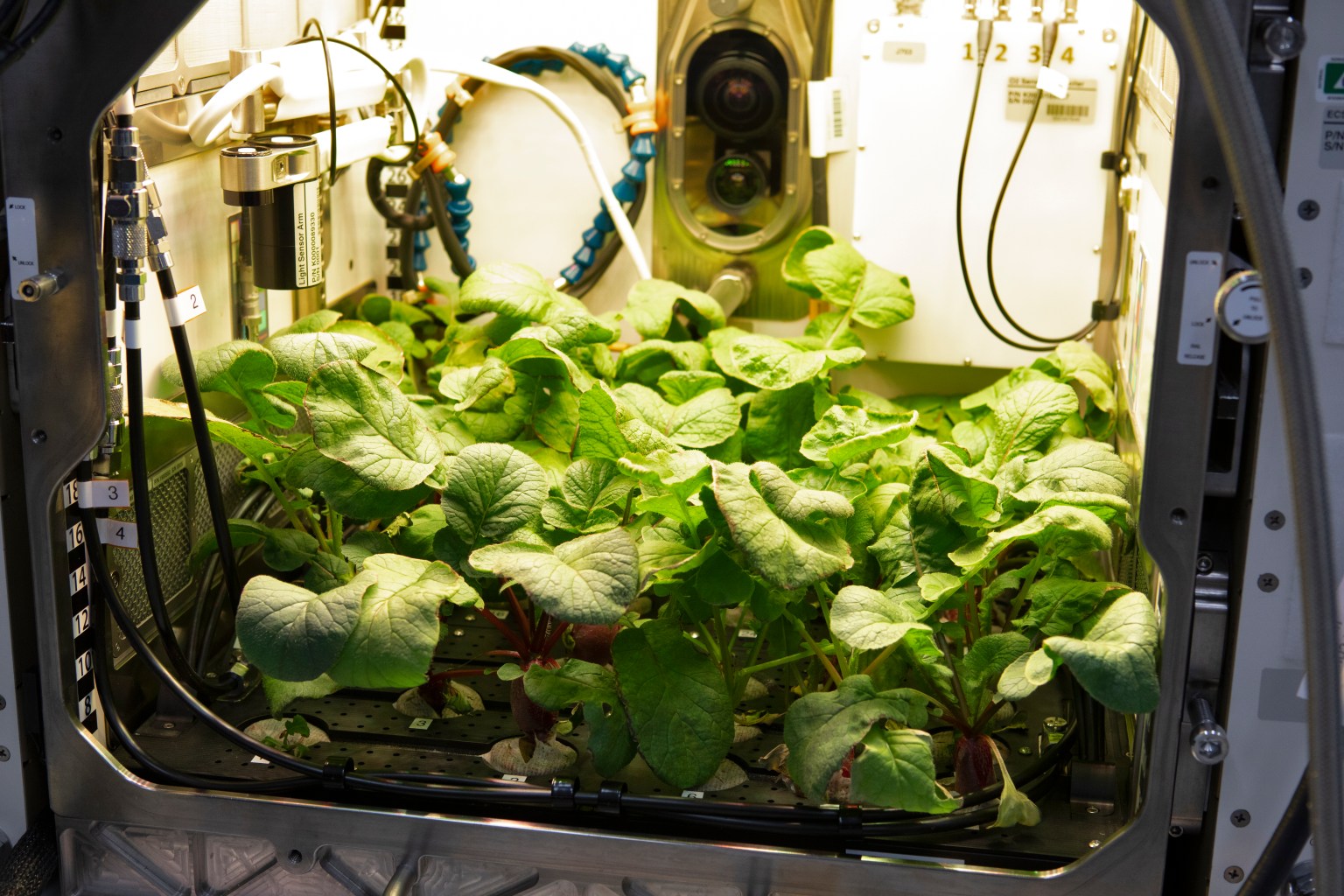
Astronauts have grown more than 50 species of plants in space, including tomatoes, bok choi, romaine lettuce, and chili peppers.
Advanced life support systems are capable of recycling up to 98% of water in the U.S. segment aboard the space station, the ideal level needed for exploration missions.
Researchers have sequenced DNA in orbit and are advancing techniques to enable real-time assessment of microbial life in space, which is essential to maintaining astronaut health.
Why this matters:
By growing food, recycling water, and improving medical care in space, NASA is paving the way for future long-duration missions to the Moon and Mars while revolutionizing agriculture and medicine back home.
Helping humanity on Earth
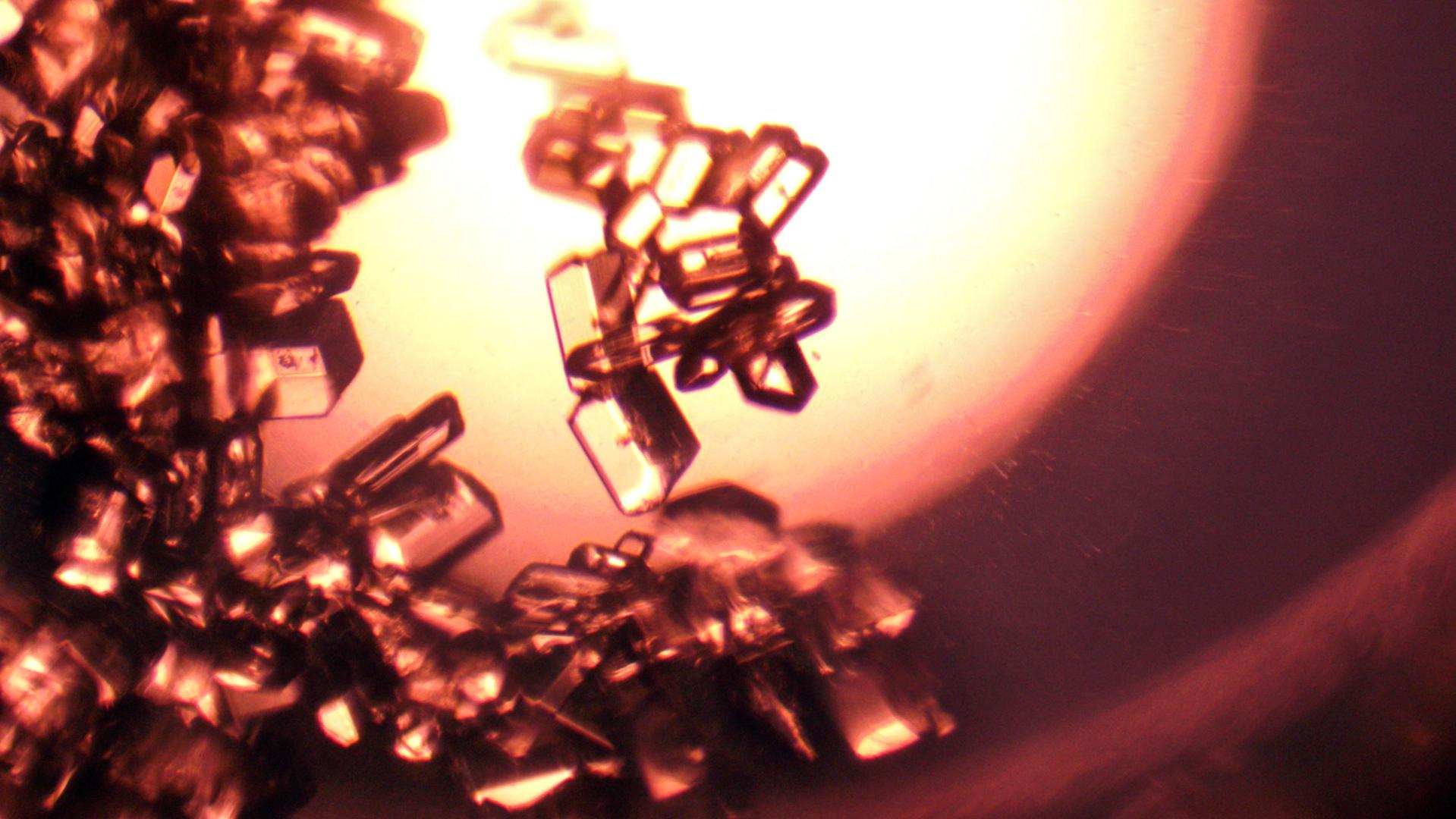
Pharmaceutical crystals grown aboard the International Space Station are shown after returning to Earth.
Redwire
Research aboard the orbiting laboratory not only pushes humanity farther into the cosmos but can help address complex human health issues on the ground. By providing a platform for long-term microgravity research, the space station fosters breakthroughs that yield direct benefits to people on Earth.
Research aboard the space station provides new insights to develop treatments for diseases like cancer, Alzheimer’s, Parkinson’s, and heart disease by revealing how microgravity alters cellular functions.
New developments in medicine for cancer, muscular dystrophy, and neurodegenerative diseases have come from growing protein crystals in microgravity with larger, more organized structures.
High quality stem cells can be grown in greater quantities in space, helping to develop new regenerative therapies for neurological, cardiovascular, and immunological conditions.
Pioneering efforts in 3D bioprinting, which uses cells, proteins, and nutrients as source material, have produced human tissue structures such as a knee meniscus and heart tissue, a major step toward manufacturing organs in space for transplant patients on Earth.
Researchers are using miniaturized tissue models to observe how space affects tissues and organ systems, offering new ways to develop and test medicines to protect astronauts on future missions and improve treatments on Earth.
Photos taken by astronauts have supported emergency response to natural disasters, such as hurricanes, with targeted views from space.
Instruments mounted on the space station protect critical space infrastructure and provide data on the planet’s natural patterns by measuring Earth’s resources and space weather.
Why this matters:
Microgravity research is moving us closer to manufacturing human organs in space for transplant and revealing new ways to fight cancer, heart disease, osteoporosis, neurodegenerative disease, and other serious illnesses that affect millions of people worldwide. The station also serves as an observation platform to monitor natural disasters, weather patterns, and Earth’s resources.
Understanding our universe
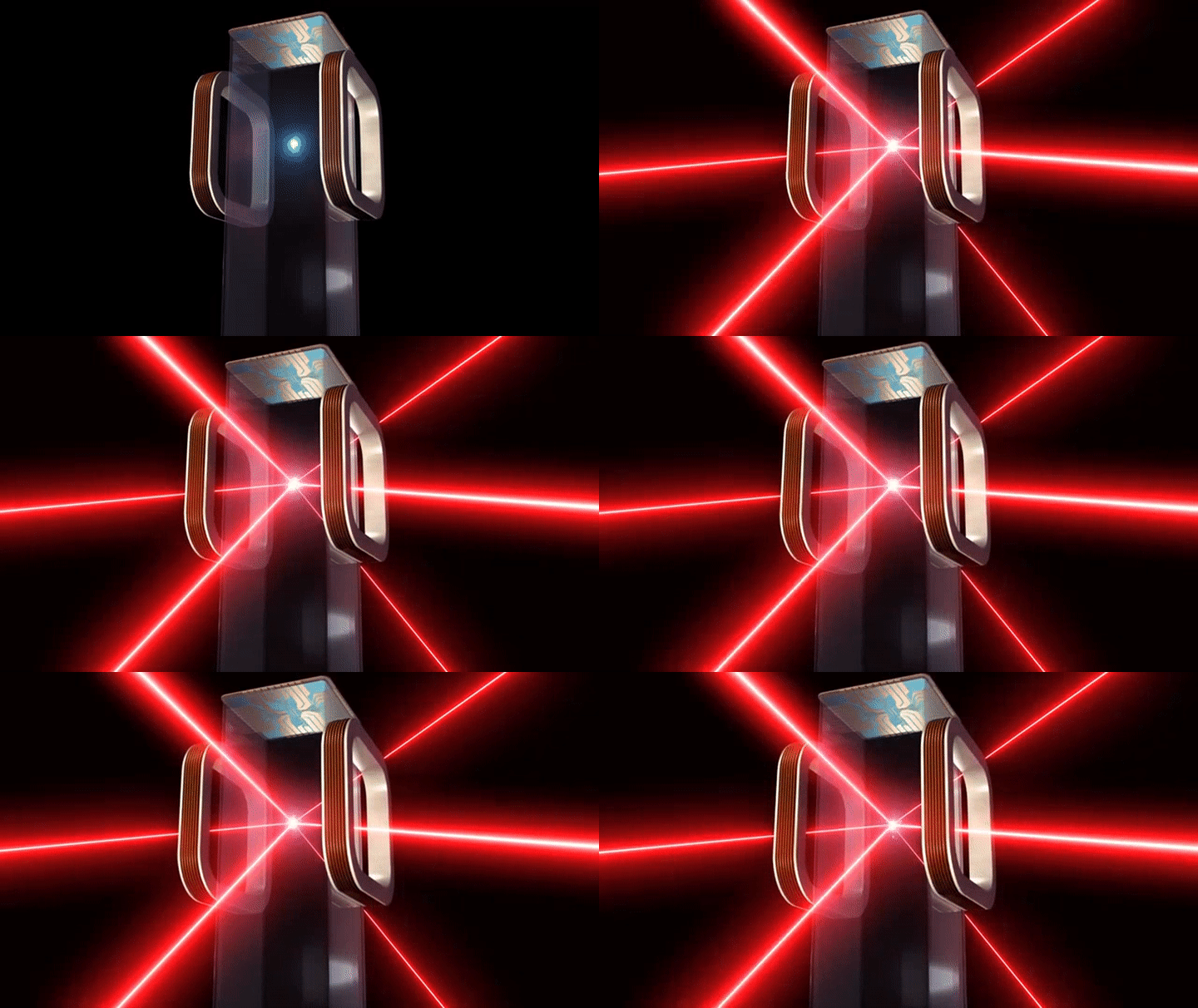
Artist concept of operations inside NASA’s Cold Atom Laboratory aboard the International Space Station.
NASA
The space station offers scientists an unparalleled vantage point to learn about the fundamental behavior of the universe. By studying cosmic phenomena typically blocked or absorbed by Earth’s atmosphere and observing physics at an atomic level, researchers can probe mysteries impossible to study from Earth.
Researchers have recorded billions of cosmic events, helping scientists search for antimatter and dark matter signatures in space.
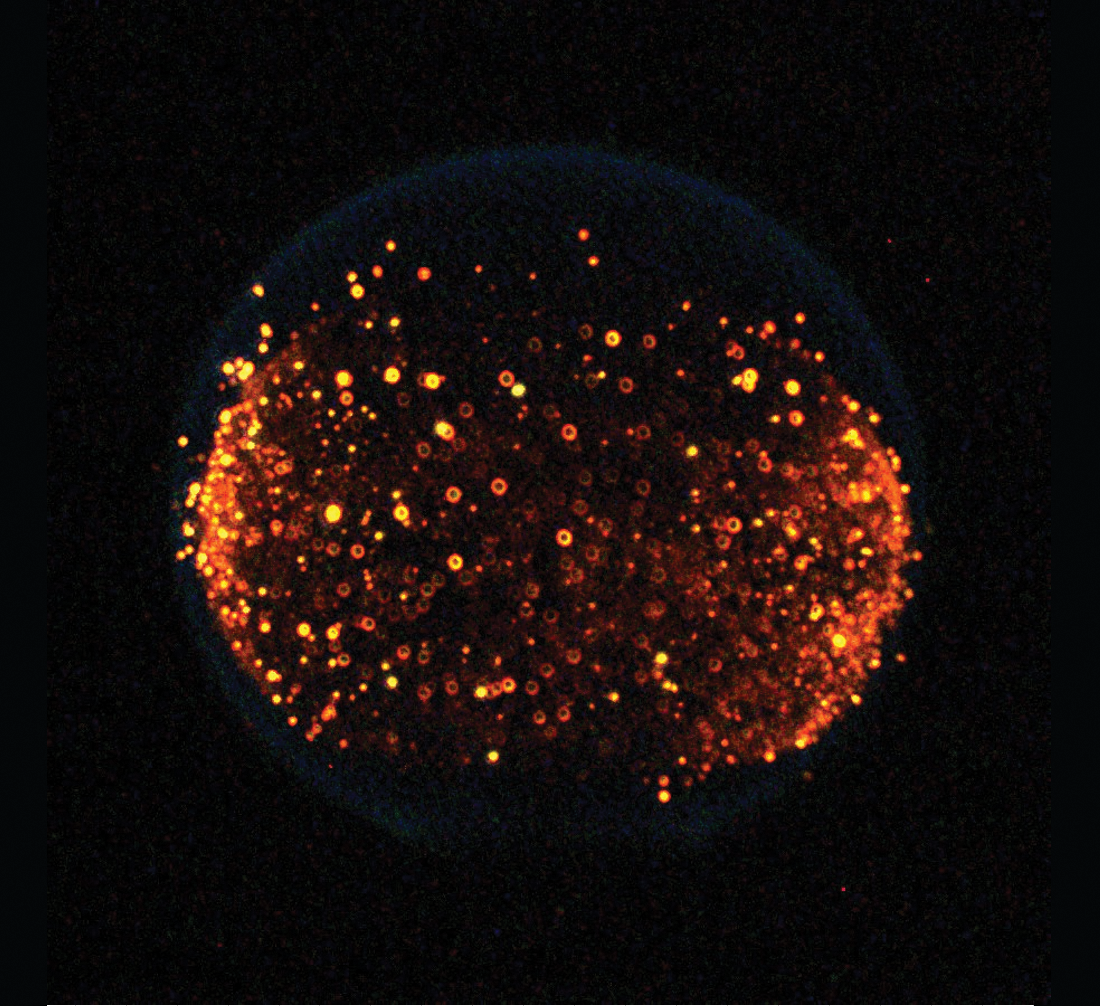
Scientists have created and studied the fifth state of matter on the space station, allowing researchers to use quantum science to advance technology like space navigation, satellite operations, and GPS systems on Earth.
Why this matters:
Research aboard the space station is helping us unravel the deepest mysteries of our universe, from the smallest quantum particles to the most powerful cosmic explosions. Observations of collapsing stars and black holes could inspire new navigation tools using cosmic signals and expand our grasp of space-time. Studies of antimatter and dark matter bring us closer to understanding the 95% of the universe invisible to the human eye. Creating the fifth state of matter in space unlocks new quantum pathways that could transform technology on Earth and in space.
Learning new physics
This image shows a flame ignited as part of the Flame Design investigation on the International Space Station.
NASA
Physical processes behave differently in microgravity, offering scientists a new lens for discovery.
Engineers can design more efficient fuel and life support systems for future spacecraft thanks to studies of fluid boiling, containment, and flow.
Analyzing gels and liquids mixed with tiny particles in space helps researchers fine-tune material compositions and has led to new patents for consumer products.
Breakthroughs in fundamental physics aboard the space station drive innovation on Earth and advance spacecraft fuel, thermal control, plant watering, and water purification systems. Research in soft materials is improving products in medicine, household products, and renewable energy, while cool flames studies may lead to cleaner, more efficient engines.
Enabling global access to space
NASA astronaut Nichole Ayers talks on a ham radio with students from Lakeside Junior High School in Springdale, Arkansas. Ayers answered questions from the students about her experience living and working aboard the International Space Station.
NASA
Since 2000, the space station has opened doors for private companies, researchers, students, and astronauts around the world to participate in exploration and help propel humanity forward to the Moon and Mars.
The space station is a launchpad for the commercial space economy, enabling private astronaut missions and hosting hundreds of experiments from commercial companies, giving them the chance to strengthen their technologies through in-orbit research, manufacturing demonstrations, and innovation.
CubeSats deployed from the space station enable students and innovators around the world to test radio antennas, small telescopes, and other scientific demonstrations in space.
More than one million students have engaged with astronauts via ham radio events, inspiring the next generation to participate in science, technology, engineering, and mathematics.
The space station has enabled the space economy, where commercial research, manufacturing, and technology demonstrations are shaping a new global marketplace. NASA and its international partners have established a leadership position in low Earth orbit, creating new opportunities for industry and paving the way for exploration missions to the Moon, Mars, and beyond.
Learn more about the research aboard the International Space Station at:
Recently, we joined Amazon Web Services (AWS) to talk about one of the fastest-moving transformations in the cloud industry: how Internal Developer Platforms (IDPs) are streamlining modern software delivery. Andy Suderman joined me and Eli Peveto, AWS Partner Solutions Architect to walk through a strategic framework for building an IDP on Amazon Elastic Kubernetes Service (EKS).
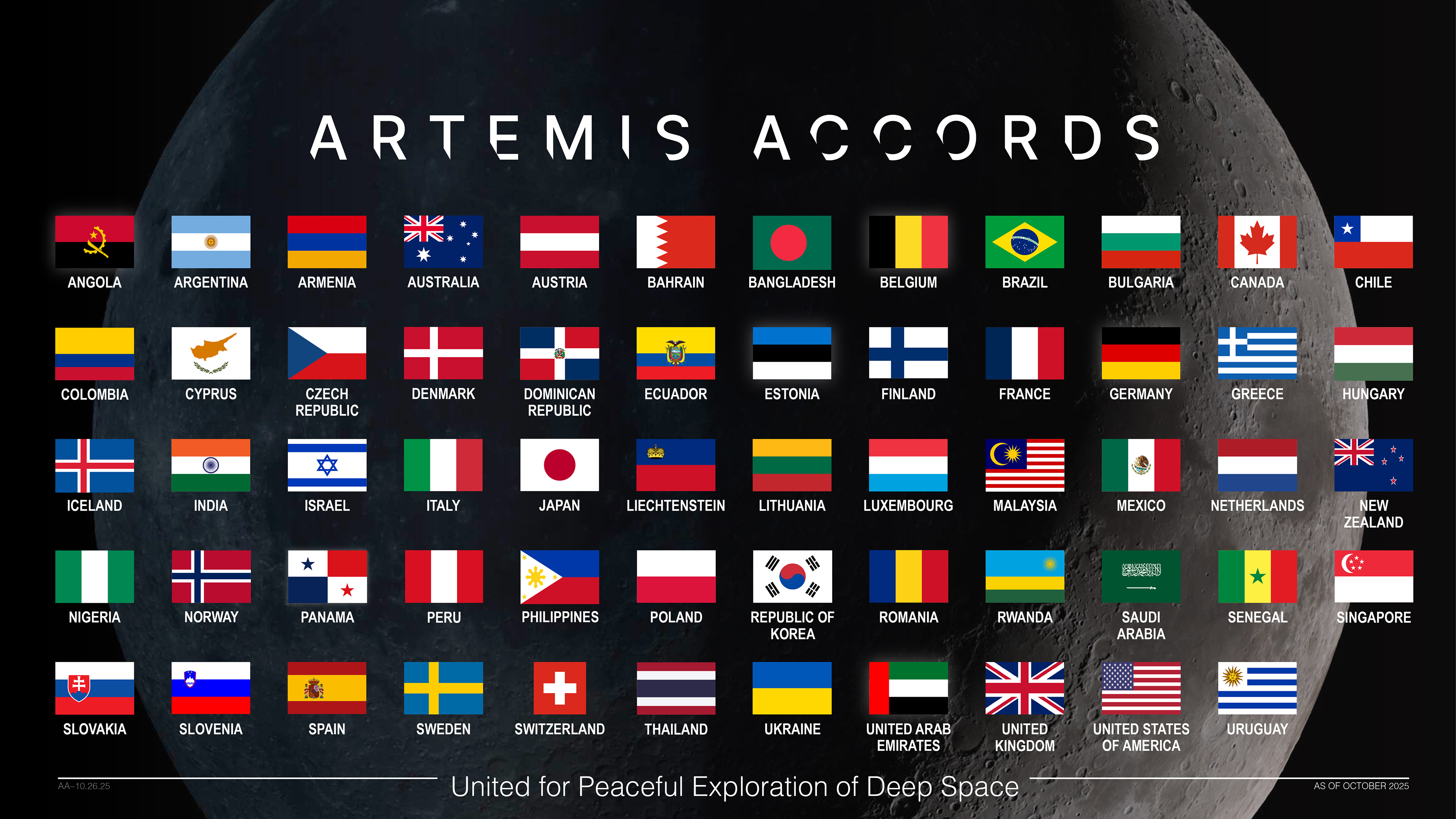
October marked the fifth anniversary of NASA and the original founders signing the Artemis Accords, as well as the recognition of Hungary, Malaysia and the Philippines joining the expanding coalition dedicated to the peaceful exploration of space. The number of countries involved now totals 59.
“NASA welcomes the newest signatories, whose participation strengthens the global commitment to responsible exploration,” said acting NASA Administrator Sean Duffy. “Their decision to sign the Artemis Accords affirms a shared commitment to safe, transparent, and peaceful exploration — at a time when others seek to weaponize the final frontier. Together we are building the foundation for the Golden Age of space exploration.”
Both Malaysia and the Philippines signed the Artemis Accords as part of President Trump’s visit to Kuala Lumpur for the annual Association of Southeast Asian Nations Summit. The separate signings were announced by the White House on Oct. 26.
Foreign Minister Péter Szijjártó of Hungary signed the Artemis Accords on Oct. 22 while in Washington during an official visit, in the lead up to President Trump’s meeting with Prime Minister Viktor Orbán.
Hungary’s signing came three months after Hungarian to Orbit (HUNOR) astronaut Tibor Kapu launched to space in a mission aboard a SpaceX Dragon spacecraft to the International Space Station. The private astronauts, part of the NASA-supported Axiom Mission 4 crew, spent about two weeks conducting science, outreach, and commercial activities, alongside NASA astronauts.
Five years of progress
On Oct. 13, 2020, during the first Trump Administration, the United States, led by NASA and the U.S. Department of State, joined with seven other founding nations to establish the Artemis Accords, responding to the growing interest in lunar activities by both governments and private companies.
Since then, the Artemis Accords have grown into an international coalition. What began with a handful of founding nations has multiplied with seven countries signing in 2025 alone. The surge in participation highlights an increased global commitment to shaping a safe, peaceful, and prosperous future in space.
In September, NASA co-chaired the Artemis Accords Principals’ Meeting in Sydney alongside the space agencies of Australia and the United Arab Emirates. The gathering brought together dozens of signatory nations to deepen dialogue and strengthen shared commitments to the sustainable and responsible use of space. Global space leaders discussed the following topics:
Non-interference in each other’s space activities, including transparency on expected launch dates, general nature of activities, and landing location
Orbital debris mitigation
Interoperability of systems for safer and more efficient operations
Release of scientific data
At the meeting, NASA committed to hosting an Artemis Accords workshop in 2026 for signatories focused on transparency and the sharing of data. The agency has taken additional steps since the accords were established to release more information about lunar missions, promoting openness and preventing harmful interference.
The progress made by signatories, and their continued commitment to implementing the accords’ principles, is essential to advancing sustainable exploration of the Moon under the Artemis campaign, Mars, and beyond. Following a call to Artemis Accords signatories, four CubeSats from South Korea, Saudi Arabia, Argentina, and Germany, will fly on Artemis II.
More nations are expected to sign the accords in the months and years ahead, as NASA and its partners continue to advance the principles of the accords.
Preparations for Next Moonwalk Simulations Underway (and Underwater)
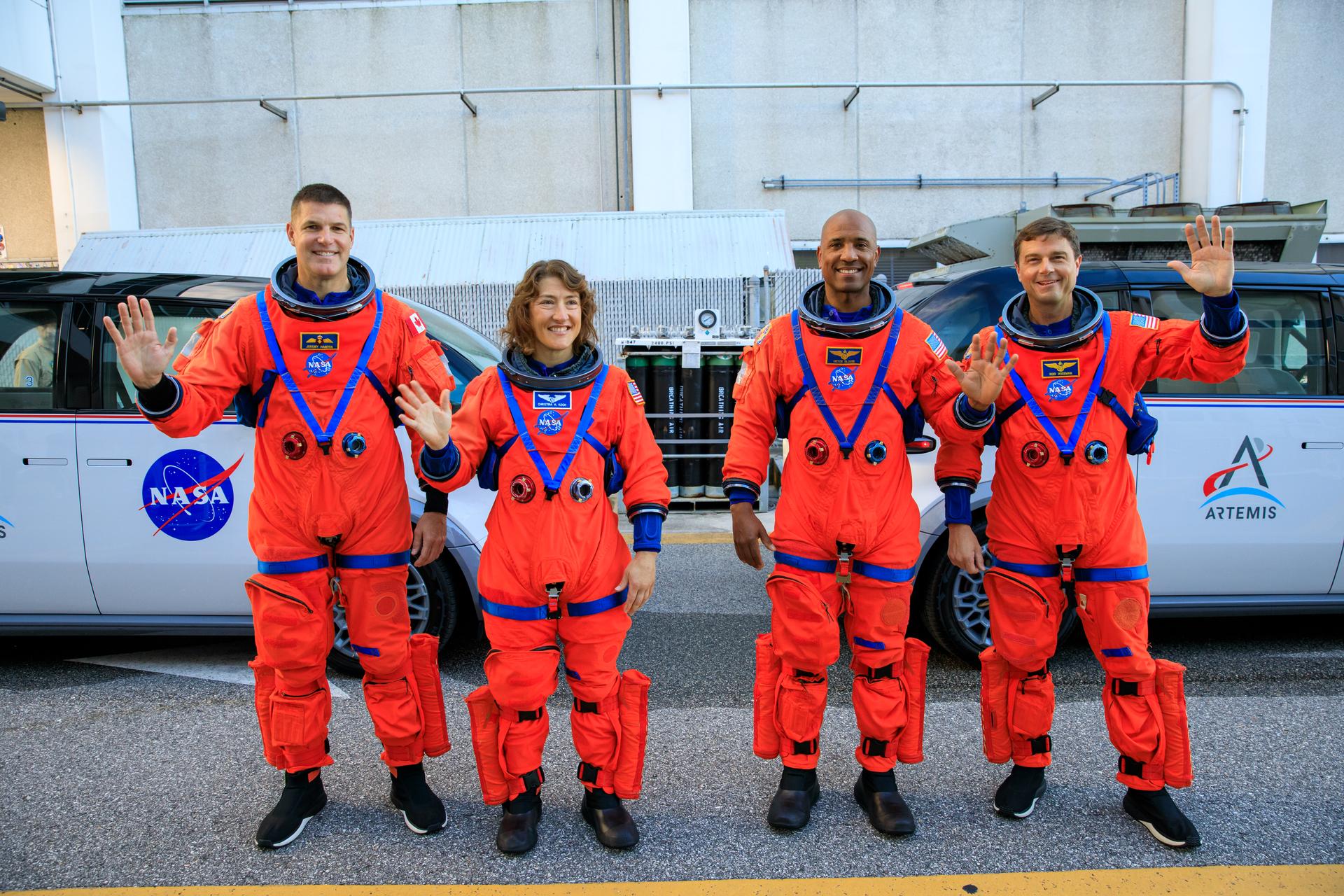
Los miembros de la tripulación de Artemis II (de izquierda a derecha: el astronauta de la CSA o Agencia Espacial Canadiense Jeremy Hansen, y los astronautas de la NASA Christina Koch, Victor Glover y Reid Wiseman) salen de las instalaciones de alojamiento de astronautas en el Edificio de Operaciones y Verificación Neil Armstrong, dirigiéndose hacia los vehículos de transporte de la tripulación Artemis para ir a la Plataforma de Lanzamiento 39B como parte de una prueba integrada de sistemas terrestres en el Centro Espacial Kennedy en Florida el miércoles 20 de septiembre, para poner a prueba el horario de la tripulación para el día del lanzamiento.
NASA/Kim Shiflett
Los creadores digitales y usuarios de redes sociales están invitados a inscribirse para asistir al lanzamiento de la misión Artemis II de la NASA. El cohete Sistema de Lanzamiento Espacial (SLS, por sus siglas en inglés) de la agencia lanzará al espacio la nave espacial Orion desde el complejo de lanzamientos 39B en el Centro Espacial Kennedy de la NASA en Florida. Cuatro astronautas a bordo de la nave volarán alrededor de la Luna y regresarán a la Tierra tras permanecer unos 10 días en el espacio.
¿Eres un apasionado de las redes sociales y las comunicaciones? ¿Te entusiasma crear contenido para su público? ¿Eres fanático de experiencias nuevas y únicas? Si la respuesta a todo es sí, ¡este evento de NASA Social es para ti! Esta es tu oportunidad de tener un asiento de primera fila para presenciar esta misión histórica de Artemis que sentará la bases para futuros aterrizajes en la Luna y futuras misiones tripuladas a Marte.
Este evento de NASA Social tendrá lugar durante dos días, incluyendo el día del lanzamiento. Está previsto que la misión Artemis II sea lanzada a más tardar en abril de 2026, con posibles oportunidades desde febrero. Un máximo de 50 creadores digitales serán seleccionados para asistir a este evento de dos días, y tendrán un acceso similar al de los medios de comunicación.
Los participantes de este NASA Social tendrán la oportunidad de:
Recorrer el Centro Espacial Kennedy de la NASA
Aprender directamente de nuestros expertos
Conocer a otros creadores digitales y usuarios de redes sociales
Compartir con las personas que integran el equipo de redes sociales de la NASA
Ver el lanzamiento de la misión Artemis II
El plazo de inscripción a este evento de NASA Social para el lanzamiento de Artemis II comienza en esta página el miércoles 19 de noviembre y la fecha límite para presentar la solicitud es el lunes 24 de noviembre a las 5 p.m., hora del este. Todas las solicitudes serán consideradas individualmente.
¿Necesito tener una cuenta de redes sociales para inscribirme? Sí. Este evento está diseñado para personas que:
Utilizan activamente diferentes plataformas y herramientas de redes sociales para difundir información a una audiencia determinada.
Producen con regularidad nuevos contenidos que contienen elementos multimedia.
Tienen el potencial de alcanzar un gran número de personas utilizando las plataformas digitales.
Conectan con una audiencia específica, independiente y diferente de la de los medios de comunicación tradicionales o la de la NASA.
Tienen un historial acreditado de publicación de contenido en plataformas de redes sociales.
Tienen publicaciones anteriores que han logrado una gran visibilidad y que son respetadas y ampliamente reconocidas.
Se anima a los usuarios a seguir @NASAArtemis para las actualizaciones de la campaña Artemis en X, Facebook e Instagram (en inglés), así como las cuentas de la NASA en español en X,Facebook e Instagram. Las actualizaciones y la información sobre el evento se compartirán (en inglés) en X a través de la cuenta @NASA_Events.
¿Cómo me inscribo? El plazo de inscripción para este evento comienza el 19 de noviembre y termina el 24 de noviembre a las 5 p. m., hora del este de Estados Unidos. La inscripción es solo para una persona (tú) y no es transferible. Cada persona que desee asistir debe inscribirse por separado. Cada solicitud será considerada individualmente.
¿Puedo inscribirme si no tengo ciudadanía estadounidense? Sí, este evento está abierto para todos los que lo soliciten.
¿Cuándo sabré si he sido seleccionado? Después de que se hayan recibido y procesado las inscripciones, se enviará a la gente seleccionada un correo electrónico con información de confirmación e instrucciones adicionales. Esperamos enviar las primeras notificaciones el lunes 8 de diciembre, y las notificaciones de lista de espera el lunes 15 de diciembre.
¿Cuáles son las credenciales de NASA Social? Todas las solicitudes para el evento de NASA Social serán consideradas individualmente. Aquellas personas elegidas deben demostrar a través del proceso de inscripción que cumplen con los criterios específicos de participación.
Aún si no consigues participar en este evento de NASA Social, puedes observar el lanzamiento fuera de las instalaciones de la NASA y participar en la conversación en línea. Descubre las formas en que puedes presenciar un despegue visitando el sitio web (en inglés) http://www.nasa.gov/centers/kennedy/launchingrockets/viewing.html.
¿Cuáles son los requisitos para la inscripción? La inscripción debe indicar tu intención de viajar al Centro Espacial Kennedy de la NASA en Florida y de asistir en persona a este evento de dos días de duración. Tú serás responsable de tus propios gastos de viaje, alojamiento, comida y otros servicios.
La programación de los eventos y la participación de invitados especiales están sujetas a cambios sin previo aviso. La NASA no se hace responsable de las pérdidas o daños ocasionados como resultado de tu visita. Además, la NASA no se hace responsable de las pérdidas o daños ocasionados si el evento es cancelado con una anticipación limitada o sin previo aviso. Por favor, planifica tu asistencia como corresponda.
El centro Kennedy es una instalación del gobierno. Aquellas personas seleccionadas podrían tener que completar algunos pasos de inscripción adicionales para recibir autorización para ingresar a áreas de acceso protegido.
IMPORTANTE: No se admitirá a personas sin la debida identificación.
Para ciudadanos estadounidenses:
Se te pedirá que presentes la identificación de REAL ID o un pasaporte válido de Estados Unidos MÁS uno de los siguientes documentos:
Documentos aceptables para acompañar la identificación federal o estatal:
Pasaporte estadounidense
Tarjeta de autorización de empleo no vencida (formulario I-688A)
Documento de autorización de empleo no vencido emitido por el Departamento de Seguridad Nacional (DHS) que contenga una fotografía (formulario I-688B)
Licencia de conducir o tarjeta de identificación expedida por un estado o territorio de Estados Unidos, siempre que contenga una fotografía o información como nombre, fecha de nacimiento, sexo, estatura, color de ojos y dirección
Tarjeta de identificación expedida por organismos o entidades gubernamentales federales, estatales o locales, siempre que contenga una fotografía o información como nombre, fecha de nacimiento, sexo, estatura, color de ojos y dirección
Tarjeta de identificación académica con fotografía
Tarjeta de registro electoral
Tarjeta de identificación como dependiente de militar
Tarjeta militar o registro de reclutamiento de Estados Unidos
Tarjeta de miembro de la Marina Mercante de la Guardia Costera de Estados Unidos
Documento tribal de identificación de nativo estadounidense
Tarjeta del Seguro Social de Estados Unidos emitida por la Administración del Seguro Social (que no sea una tarjeta que indique que no es válida para el empleo)
Original o copia certificada de la partida de nacimiento expedida por un estado, condado, autoridad municipal o territorio de Estados Unidos que contenga un sello oficial
Tarjeta de identificación de ciudadanía estadounidense (formulario I-197)
Tarjeta de identificación para uso de ciudadanos residentes en Estados Unidos (formulario I-179)
Documento de autorización de empleo no vencido emitido por el DHS que contenga una fotografía (que sea diferente de los documentos indicados anteriormente)
Para ciudadanos extranjeros:
Se permiten los mismos documentos indicados para los ciudadanos estadounidenses (la tarjeta del seguro social, SSN, solo será solicitada cuando corresponda)
Pasaporte extranjero no vencido, con sello I-551 o formulario I-94 adjunto que indique autorización de empleo no vencida
Número de pasaporte y fecha de registro
Documento de ciudadanía
Licencia de conducir emitida por una autoridad gubernamental canadiense
Para extranjeros con residencia legal en Estados Unidos:
Se permiten los mismos documentos indicados para los ciudadanos estadounidenses y:
Tarjeta de residencia permanente o tarjeta de recibo de registro de extranjero con fotografía (formulario I-551)
Tarjeta de residente temporal no vencida (formulario I-688)
Certificado de nacimiento en el extranjero expedido por el Departamento de Estado (formulario FS-545 o formulario DS-1350)
La Ley de REAL ID fue aprobada por el Congreso en 2005 para establecer estándares mínimos de seguridad para las licencias de conducir y tarjetas de identificación emitidas por los estados. Todas las personas inscritas deben tener al menos 18 años de edad.
¿Qué sucede si cambia la fecha de lanzamiento? Cientos de factores diferentes pueden hacer que una fecha de lanzamiento programada cambie varias veces. La fecha de lanzamiento no será oficial hasta después de la revisión de aptitud para el vuelo. Si la fecha de lanzamiento cambia antes de esta revisión, la NASA puede ajustar la fecha del evento de NASA Social en consecuencia para que coincida con la nueva fecha de lanzamiento objetiva, y notificará a las personas inscritas por correo electrónico acerca de cualquier cambio que tenga lugar.
Si el lanzamiento se pospone, se invitará a las personas seleccionadas a asistir a una fecha de lanzamiento posterior. Si el lanzamiento se pospone por más de 72 horas, el evento de NASA Social podría ser cancelado. Los asistentes al evento de NASA Social son responsables de todos los gastos adicionales ocasionados en relación con cualquier retraso en el lanzamiento. Recomendamos encarecidamente a los participantes que hagan reservas de viaje reembolsables y/o flexibles.
¿Qué sucede si no puedo acudir al Centro Espacial Kennedy? Si no puedes venir al Centro Espacial Kennedy y asistir en persona, no debes inscribirte en el evento de NASA Social. Únete a la conversación siguiendo las cuentas de @NASAArtemis (en inglés) en X, Facebook e Instagram, o las cuantas de la NASA en español en X,Facebook e Instagram y mira el lanzamiento en nasa.gov/live (ofreceremos retransmisiones en inglés y en español). La NASA proporcionará actualizaciones periódicas sobre el lanzamiento y la misión en sus cuentas @NASA y @NASAArtemis y @NASA_ES.
Si no puedes asistir a este evento de NASA Social, no te preocupes: ¡la NASA está planeando muchos otros eventos de NASA Social en el futuro cercano que se llevarán a cabo en diferentes lugares! Sigue nuestras noticias en las redes sociales de la NASA, o en nuestro boletín semanal en español: https://www.nasa.gov/suscribete.
Artemis II crew members (from left) CSA (Canadian Space Agency) astronaut Jeremy Hansen, and NASA astronauts Christina Koch, Victor Glover, and Reid Wiseman walk out of Astronaut Crew Quarters inside the Neil Armstrong Operations and Checkout Building to the Artemis crew transportation vehicles prior to traveling to Launch Pad 39B as part of an integrated ground systems test at Kennedy Space Center in Florida on Wednesday, Sept. 20, to test the crew timeline for launch day.
Digital creators and social media users are invited to register to attend the launch of the NASA’s Artemis II mission. The agency’s SLS (Space Launch System) rocket will launch the Orion spacecraft from Launch Complex 39B at NASA’s Kennedy Space Center in Florida. Four astronauts aboard will fly around the Moon and return to Earth after about 10 days in space.
Are you passionate about social media and communications? Do you love to create content for an audience? Are you a fan of new, unique experiences? If you said yes, this NASA Social event is for you! This is your opportunity to be on the front lines of this historic Artemis mission that will lay the groundwork for future Moon landings and crewed missions to Mars.
The NASA Social event will take place over two days, including the day of launch. Artemis II is targeted to launch no later than April 2026, with potential opportunities as soon as February. A maximum of 50 digital creators will be selected to attend this two-day event and will be given access similar to news media.
NASA Social participants will have the opportunity to:
Tour NASA’s Kennedy Space Center
Learn directly from subject matter experts
Meet fellow digital creators and social media users
Spend time with members of NASA’s social media team
View the launch of the Artemis II mission
NASA Social registration for the Artemis II launch opens on this page on Wednesday, Nov. 19 and the deadline to apply is 5 p.m. EST on Monday, Nov. 24. All applications will be considered on a case-by-case basis.
Do I need to have a social media account to register?
Yes. This event is designed for people who:
Actively use multiple social networking platforms and tools to disseminate information to a unique audience.
Regularly produce new content that features multimedia elements.
Have the potential to reach a large number of people using digital platforms.
Reach a unique audience, separate and distinctive from traditional news media and/or NASA audiences.
Must have an established history of posting content on social media platforms.
Have previous postings that are highly visible, respected, and widely recognized.
Users are encouraged to follow @NASAArtemis for Artemis updates on X, Facebook, and Instagram. Updates and information about the event will be shared on X via @NASA_Events.
How do I register?
Registration for this event opens Nov. 19 and closes at 5 p.m. EST on Nov. 24. Registration is for one person only (you) and is non-transferable. Each individual wishing to attend must register separately. Each application will be considered on a case-by-case basis.
Can I register if I am not a U.S. citizen?
Yes, this event is open for all to apply.
When will I know if I am selected?
After registrations have been received and processed, an email with confirmation information and additional instructions will be sent to those selected. We expect to send the first notifications on Monday, Dec. 8, and waitlist notifications on Monday, Dec. 15.
What are NASA Social credentials?
All NASA social applications will be considered on a case-by-case basis. Those chosen must prove through the registration process they meet specific engagement criteria.
If you do not make the registration list for this NASA Social, you still can attend the launch off site and participate in the conversation online. Find out about ways to experience a launch at http://www.nasa.gov/centers/kennedy/launchingrockets/viewing.html.
What are the registration requirements?
Registration indicates your intent to travel to NASA Kennedy and attend the two-day event in person. You are responsible for your own expenses for travel, accommodation, food, and other amenities.
The schedule of events and special guest appearances are subject to change without notice. NASA is not responsible for loss or damage incurred as a result of attending. NASA, moreover, is not responsible for loss or damage incurred if the event is canceled with limited or no notice. Please plan accordingly.
Kennedy is a government facility. Those who are selected may need to complete additional steps to receive clearance to enter the secure areas.
Kennedy is a government facility. Those who are selected may need to complete additional steps to receive clearance to enter the secure areas.
IMPORTANT: Those without proper identification cannot be admitted.
For United States Citizens:
You will be required to present a REAL ID compliant identification or valid U.S. passport PLUS one of the following:
Acceptable documents to accompany federal or state identification:
Unexpired Employment Authorization Document issued by DHS that contains a photograph (Form I-688B)
Driver’s license or ID card issued by a state or outlying possession of the United States provided it contains a photograph or information such as name, date of birth, gender, height, eye color, and address
ID card issued by federal, state or local government agencies or entities, provided it contains a photograph or information such as name, date of birth, gender, height, eye color and address
School ID card with a photograph
Voter’s Registration Card
Military Dependent’s ID Card
U.S. Military card or draft record
U.S. Coast Guard Merchant Mariner Card
Native American Tribal Document
U.S. Social Security Card issued by the Social Security Administration (other than a card stating it is not valid for employment)
Original or Certified copy of birth certificate issued by a state, county, municipal authority or outlying possessions of the United States bearing an official seal
U.S. Citizen ID Card (Form I-197)
ID Card for use of Resident Citizens of the United States (Form I-179)
Unexpired employment authorization document issued by DHS (other than those listed previously)
For Foreign Nationals:
Same items required of U.S. Citizens (SSN only when applicable)
Unexpired foreign passport, with I-551 stamp or attached Form I-94 indicating unexpired employment authorization
Passport number and registration date
Citizenship
Driver’s license issued by a Canadian Government authority
For Legal Resident Aliens:
Same items required of U. S. Citizens, and:
Permanent Resident Card or Alien Registration Receipt Card with photograph (Form I-551)
Unexpired Temporary Resident Card (Form I-688)
Certification of Birth Abroad issued by the Department of State (Form FS-545 or Form DS-1350)
The REAL ID Act was passed by Congress in 2005 to establish minimum security standards for state-issued driver’s licenses and identification cards.
All registrants must be at least 18 years old.
What if the launch date changes?
Hundreds of different factors can cause a scheduled launch date to change multiple times. The launch date will not be official until after the Flight Readiness Review. If the launch date changes prior to the review, NASA may adjust the date of the NASA Social accordingly to coincide with the new target launch date, and will notify registrants of any changes via email.
If the launch is postponed, attendees will be invited to attend a later launch date. If the launch is postponed beyond 72 hours, the NASA Social event may be canceled.
NASA Social attendees are responsible for any additional costs they incur related to any launch delay. We strongly encourage participants to make travel arrangements that are refundable and/or flexible.
What if I cannot come to the Kennedy Space Center?
If you cannot come to the NASA Kennedy and attend in person, you should not register for the NASA Social. Join the conversation by following @NASAArtemis on X, Facebook, and Instagram, and watch the launch at nasa.gov/live. NASA will provide regular launch and mission updates on @NASA and @NASAArtemis.
If you cannot make this NASA Social, don’t worry; NASA is planning many other NASA Social events in the near future at various locations! Check for updates on NASA Socials.
Brian Alpert’s path was always destined for the aerospace industry, but his journey turned toward NASA’s Johnson Space Center during his sophomore year in college. That was when Tricia Mack, who works in NASA’s Transportation Integration Office within the International Space Station Program, spoke to his aerospace seminar about planning spacewalks, training crews, and supporting operations from the Mission Control Center in Houston.
Alpert was inspired to join the agency and later earned a spot as an engineering co-op student at Johnson. “My first stop after new employee orientation was Tricia’s office,” he said.
Brian Alpert supports a spacewalk outside of the International Space Station from the Mission Control Center at Johnson Space Center in 2015.
NASA/Bill Stafford
Eighteen years later, Alpert is the cross-program integration deputy for NASA’s human landing system (HLS) – the mode of transportation that will take astronauts to the lunar surface as part of the Artemis campaign. In his role, Alpert is responsible for coordinating with other Artemis programs, like the Orion Program, on issue resolution, joint agreements, data exchanges, hardware integration, and reviews. He also co-leads the Exploration Atmospheres Issue Resolution Team, assessing risks to and impacts on space vehicle atmosphere, spacesuit pressure, and operational timelines for Artemis missions.
Alpert has enjoyed the opportunity to participate in several proposal reviews for Artemis program contracts as well. “NASA’s model of embracing public-private partnerships to achieve its strategic goals and objectives is exciting and will continue to expand opportunities in space,” he said.
He applies lessons learned and skills gained from his previous roles as a spacewalk crew instructor, flight controller, and systems engineer to his current work on HLS. “I hope to pass on to the next generation that skills and lessons you learn as a student or a young employee can and will help you in your future work,” he said.
Brian Alpert routes cables in the Johnson Space Center’s Neutral Buoyancy Laboratory in preparation for a crew training run in 2011.
Image courtesy of Brian Alpert
Alpert’s prior NASA roles involved memorable experiences like working to address spacesuit and vehicle failures that occurred during a spacewalk on International Space Station Expedition 32. He was serving as the lead spacewalk systems flight controller in the Mission Control Center at the time and played a key role in getting NASA astronaut Suni Williams and JAXA (Japan Aerospace Exploration Agency) astronaut Aki Hoshide safely back aboard the space station. Since Williams and Hoshide did not complete the spacewalk’s primary objective – replacing a Main Bus Switching Unit – a backup spacewalk was scheduled several days later. Alpert was on console for that spacewalk, too.
“One important lesson that I have learned through my career to date is how exceptionally talented, passionate, and hard-working everyone is here at NASA,” he said. “Whenever work gets stressful or problems get hard, there are teams of people that have your back, are willing to problem-solve with you, and can bring another perspective to finding a solution that you may not have considered.” He added that his colleagues are the best part of his job. “As much as I love what we do at NASA, what really gets me excited to come to work is all the outstanding people I get to work with every day.”
Brian Alpert completes a dive in NASA Johnson Space Center’s Neutral Buoyancy Laboratory for a spacesuit familiarization exercise in 2009.
Image courtesy of Brian Alpert
Learning how to navigate change has been an important lesson for Alpert, as well. “NASA has been through a lot of change since I became a full-time employee in 2009,” he said. “Making sure that I have clear goals for myself, my work, and my team helps us all stay focused on the mission and the work at hand and helps us prioritize projects and tasks as questions or challenges inevitably arise.”
One challenge Alpert especially enjoys? Johnson’s annual Chili Cookoff. He has participated in many cookoffs as part of the Cosmic Chili team, noting that he often dons a Wolverine costume as part of the festive fun. He also welcomes a space trivia challenge – and a chance to add to his collection of trivia trophies.
NASA announced its newest class of astronaut candidates on Sept. 22, 2025, at the agency’s Johnson Space Center in Houston. After the welcome ceremony, the 10 highly qualified individuals rolled up their sleeves and prepared for the next step in their journey to the stars: nearly two years of training to become flight-eligible for missions to low Earth orbit, the Moon, and ultimately, Mars.
NASA astronaut Chris Williams participates in a spacewalk safety system training in the virtual reality lab at NASA’s Johnson Space Center.
NASA/Riley McClenaghan
The training astronaut candidates complete is comprehensive and rigorous. They learn about NASA’s history and vision, and how astronauts advance the agency’s mission. They take classes on space health – gaining an understanding of radiation exposure, microgravity’s effects on the human body, space food and nutrition, and how to use the exercise equipment aboard the International Space Station. They also study first aid and practice providing medical care for crewmates. Each candidate will receive flight training, learning to pilot or improving their current piloting skills through the T-38 supersonic jet and other aviation platforms.
NASA astronauts Andre Douglas, Christina Birch, and Deniz Burnham during life support systems training in a mockup of an International Space Station airlock at Johnson Space Center.
NASA/James Blair
With NASA’s plans for the future of exploration, this class of astronauts may have opportunities to fly to low Earth orbit, or even beyond. Some may contribute to research and technology investigations taking place aboard the space station – which is about to celebrate 25 years of continuous human presence in space. Others may venture to the Moon to prepare for future Mars missions.
NASA astronaut Marcos Berríos studies a rock sample during Earth and planetary sciences field training in northern Arizona.
NASA/Riley McClenaghan
To be ready for any destination, this class will complete both space station training and advanced preparation for deep space. These exercises allow astronaut candidates to work through problems and build relationships with their classmates while preparing them for space flights.
“Training was such an intense period that we got to know each other really well,” said NASA astronaut Anil Menon, who joined the agency as part of the 2021 class – astronaut group 23. “Now when we come together, there are these moments – like we might be handing off a capcom shift, or we might be flying a jet together – and in those moments, I feel like I know them so well that we know how to navigate all sorts of challenges together and just be our best selves as a team.”
NASA astronaut Luke Delaney prepares for a training flight in a T-38 jet.
NASA/Robert Markowitz
Astronaut candidate training also teaches foundational skills that can be applied to any destination in space. The group will complete several dives in the Neutral Buoyancy Laboratory, simulating spacewalks in different environments and learning how to do maintenance tasks in microgravity with a full-scale underwater mockup of the International Space Station as their worksite. They will also train inside other mockups of space vehicles, learning emergency procedures, maintenance, and repair of spacecraft, along with how to contribute to future developmental programs.
NASA astronaut Anil Menon suits up before completing a training dive in the Neutral Buoyancy Laboratory at Johnson Space Center.
NASA/Josh Valcarcel
Robotics training will prepare them to use the station’s Canadarm2 robotic arm. They will trek through the wilderness as part of their land and water survival training, and they will study geology in the classroom and in the field. The group will practice tasks in a variety of simulations, leveraging Johnson’s world-class facilities, virtual reality, and immersive technologies. Additionally, the class will work shifts in the Mission Control Center in Houston to experience a day in the life of the people who keep watch over the astronauts and vehicles.
Astronaut candidates who successfully complete the training program celebrate their achievement in a graduation ceremony, after which they are officially flight-eligible members of NASA’s astronaut corps. They will also receive office and ground support roles at Johnson while they await future flight assignments.
NASA astronauts Anil Menon, Nichole Ayers, and Andre Douglas work to build a shelter during wilderness survival training at Ft. Rucker, Alabama.
NASA/Robert Markowitz
“I’ve been exposed to a lot of different parts of what we do at Johnson Space Center, working both with the current increment of supporting operations aboard the International Space Station, as well as supporting some development of the Orion spacecraft and Artemis II preparations,” said NASA astronaut Chris Birch, another member of astronaut group 23.
Many members of NASA’s active astronaut corps emphasize that the learning does not stop when astronaut candidate training ends. “You have the foundational training and you continue to build off of that,” said Deniz Burnham, adding that the hardest days can be the most educational. “You get to learn, you get to improve, and then you’re still getting the opportunity. It’s such a positively unique experience and environment, and you can’t help but be grateful.”
As NASA astronaut Frank Rubio, class mentor, told the group, “You’ll become part of a legacy of those who trained before you, continuing the adventure they started, and looking ahead to future human exploration.”
Preparations for Next Moonwalk Simulations Underway (and Underwater)
Recent airborne science flights to Greenland are improving NASA’s understanding of space weather by measuring radiation exposure to air travelers and validating global radiation maps used in flight path planning. This unique data also has value beyond the Earth as a celestial roadmap for using the same instrumentation to monitor radiation levels for travelers entering Mars’ atmosphere and for upcoming lunar exploration.
NASA’s Space Weather Aviation Radiation (SWXRAD) aircraft flight campaign took place August 25-28 and conducted two five-hour flights in Nuuk, Greenland. Based out of NASA’s Langley Research Center in Hampton, Virginia, the mission gathered dosimetry measurements, or the radiation dose level, to air travelers from cosmic radiation. Cosmic radiation is caused by high-energy particles from outer space that originate from our Sun during eruptive events like solar flares and from events farther away, like supernovae in our Milky Way galaxy and beyond.
Science team partners from Honeywell reviewing dosimeter data on board NASA’s B200 King Air during a flight over Nuuk, Greenland.
NASA/Guillaume Gronoff
“With NASA spacecraft and astronauts exploring the Moon, Mars, and beyond, we support critical research to understand – and ultimately predict – the impacts of space weather across the solar system,” said Jamie Favors, director of NASA’s Space Weather Program at NASA Headquarters in Washington. “Though this project is focused on aviation applications on Earth, NAIRAS could be part of the next generation of tools supporting Artemis missions to the Moon and eventually human missions to Mars.”
Jamie Favors, NASA Space Weather Program director, and Chris Mertens, SWXRAD principal investigator, discussing a dosimeter at NASA’s Langley Research Center as specialized instruments are integrated onto NASA’s B200 King Air aircraft before deploying to Greenland.
NASA/Mark Knopp
NASA’s Nowcast of Aerospace Ionizing Radiation System, or NAIRAS, is the modeling system being enhanced by the SWXRAD airborne science flights. The model features real-time global maps of the hazardous radiation in the atmosphere and creates exposure predictions for aircraft and spacecraft.
NASA’s B200 King Air on the runway in Goose Bay, Canada, a stop during the flight to Nuuk, Greenland.
NASA/Guillaume Gronoff
“The radiation exposure is maximum at the poles and minimum at the equator because of the effect of Earth’s magnetic field. In the polar regions, the magnetic field lines are directed into or out of the Earth, so there’s no deflection or shielding by the fields of the radiation environment that you see everywhere else.” explained Chris Mertens, principal investigator of SWXRAD at NASA Langley. “Greenland is a region where the shielding of cosmic radiation by Earth’s magnetic field is zero.”
That means flight crews and travelers on polar flights from the U.S. to Asia or from the U.S. to Europe are exposed to higher levels of radiation.
Frozen and rocky terrain in the Polar region observed from above Nuuk, Greenland during NASA’s SWXRAD science flights.
NASA/Guillaume Gronoff
The data gathered in Greenland will be compared to the NAIRAS modeling, which bases its computation on sources around the globe that include neutron monitors and instruments that measure solar wind parameters and the magnetic field along with spaceborne data from instruments like the NOAA GOES series of satellites.
“If the new data doesn’t agree, we have to go back and look at why that is,” said Mertens. “In the radiation environment, one of the biggest uncertainties is the effect of Earth’s magnetic field. So, this mission eliminates that variable in the model and enables us to concentrate on other areas, like characterizing the particles that are coming in from space into the atmosphere, and then the transport and interactions with the atmosphere.”
An aerial view of Nuuk, Greenland.
NASA/Guillaume Gronoff
The SWXRAD science team flew aboard NASA’s B200 King Air with five researchers and crew members. In the coming months, the team will focus on measurement data quality checks, quantitative modeling comparisons, and a validation study between current NAIRAS data and the new aircraft dosimeter measurements.
All of this information is endeavoring to protect pilots and passengers on Earth from the health risks associated with radiation exposure while using NASA’s existing science capabilities to safely bring astronauts to the Moon and Mars.
Northern Lights, or auroras, seen over the city of Nuuk, Greenland. Auroras are considered space weather and are easily visible effects of activity from the Sun interacting with the magnetosphere and Earth’s atmosphere.
NASA/Guillaume Gronoff
“Once you get to Mars and even the transit out to Mars, there would be times where we don’t have any data sets to really understand what the environment is out there,” said Favors. “So we’re starting to think about not only how do we get ready for those humans on Mars, but also what data do we need to bring with them? So we’re feeding this data into models exactly like NAIRAS. This model is thinking about Mars in the same way it’s thinking about Earth.”
The SWXRAD flight mission is funded through NASA’s Science Mission Directorate Heliophysics Division. NASA’s Space Weather Program Office is hosted at NASA Langley and facilitates researchers in the creation of new tools to predict space weather and to understand space weather effects on Earth’s infrastructure, technology, and society.
For more information on NASA Heliophysics and NAIRAS modeling visit:
Please fill out the form below to request registration for the 2026 Moon to Mars Architecture workshops. A request to register does not guarantee participation in the event.
The workshop for industry and academia will be held in Washington, DC, on January 21 and 22, 2026, in collaboration with the National Academy of Sciences. The workshop for international partners will be held in Rome, Italy, on February 24 and 25, 2026, in collaboration with the Italian Space Agency.
2026 Moon to Mars Architecture Workshops | Registration Request
Your Information
Registration Information
This field is for validation purposes and should be left unchanged.
Tungsten Automation, a provider of workplace automation software was the victim of a cyber attack that resulted in the theft of data on more than 5,000 current and former employees, the company disclosed on Friday.
The Organization for Security and Co-operation in Europe (OSCE) has set out to teach law enforcement officers in Uzbekistan how to conduct crypto and dark web investigations. The regional body recently organized a training course for employees of the country’s security agencies in Tashkent.
Uzbekistan Police and Security Agents Attend OSCE Course on Cryptocurrencies
Representatives of Uzbekistan’s Prosecutor General’s Office, the Ministry of Internal Affairs, and the State Security Service have taken a training course on cryptocurrency and dark web investigations held by the OSCE between Oct. 17 and 21 in the capital Tashkent.
The course was organized by the OSCE Transnational Threats Department in co-operation with the OSCE Project Co-ordinator in Uzbekistan and the Academy of the Prosecutor General’s Office, the intergovernmental security body said on its website.
“Participants learned about the main concepts and key trends in the areas of internetworking, anonymity and encryption, cryptocurrencies, obfuscation techniques, dark web, and Tor networks,” the announcement detailed.
They also practiced various approaches and methods for seizure of crypto assets, blockchain analysis, and darknet searching. The course was based on materials provided by the European Cybercrime Training and Education Group (ECTEG).
A new computer classroom donated by the OSCE to the Prosecutor General’s Academy was inaugurated before the course by Deputy Prosecutor General of Uzbekistan Erkin Yuldashev and Acting OSCE Project Co-ordinator in Uzbekistan Hans-Ulrich Ihm.
Crypto Training in Region to Continue Throughout Next Year
Digital technologies have been transforming the criminal landscape, noted Evgeniy Kolenko who heads the Prosecutor General’s Academy. He insisted that educating law enforcement in this field needs a long-term and systematic approach.
“Cybercrime education requires adequate equipment – both hardware and software,” added Gayrat Musaev, Head of the Academy’s Department for Implementation of Information and Communication Technologies and Information Security. Musaev also praised the new dark web lab.
The OSCE course is the first of this kind in Uzbekistan within the second phase of the “Capacity Building on Combating Cybercrime in Central Asia” project funded by the U.S., Germany, and South Korea. Similar training activities will continue across the region throughout 2022 and 2023.
This year, the government in Tashkent has been taking steps to more comprehensively regulate Uzbekistan’s crypto sector. In the spring, President Shavkat Mirziyoyev issued a decree providing definitions for terms like crypto assets and exchange. New registration rules for crypto miners were presented in June and earlier in October, Uzbekistan introduced monthly fees for crypto companies.
Do you think law enforcement authorities in Central Asia will continue to increase focus on the crypto space? Share your thoughts on the subject in the comments section below.

 Login
Login