 Login
LoginChatGPT’s user growth has slowed, report finds
ChatGPT's global monthly active users only grew by around 5% from August to November, while Gemini's users grew by about 30%.

I was surprised the best chatbot for job searches wasn't the one I thought it would be.
The post I tested job searches using Gemini, ChatGPT, and Grok, and there’s a clear standout appeared first on Digital Trends.

There's a smarter way to save important nuggets of information, and the iPhone already offers the fundamental stack to do it with some AI assistance.
The post I turned the Notes app on my iPhone into a ChatGPT-powered memory bank appeared first on Digital Trends.

ChatGPT allegedly validated the worst impulses of a wannabe influencer accused of stalking more than 10 women at boutique gyms, where the chatbot supposedly claimed he’d meet the “wife type.”
In a press release on Tuesday, the Department of Justice confirmed that 31-year-old Brett Michael Dadig currently remains in custody after being charged with cyberstalking, interstate stalking, and making interstate threats. He now faces a maximum sentence of up to 70 years in prison that could be coupled with “a fine of up to $3.5 million,” the DOJ said.
The podcaster—who primarily posted about “his desire to find a wife and his interactions with women”—allegedly harassed and sometimes even doxxed his victims through his videos on platforms including Instagram, Spotify, and TikTok. Over time, his videos and podcasts documented his intense desire to start a family, which was frustrated by his “anger towards women,” whom he claimed were “all the same from fucking 18 to fucking 40 to fucking 90” and “trash.”


© Yurii Karvatskyi | iStock / Getty Images Plus
As more AI (artificial intelligence) technologies emerge, competition among them will intensify, and rankings of the best to worst may shift. Currently, the most significant AI models are Google Gemini, Microsoft CoPilot, OpenAI ChatGPT, and Apple Intelligence.

Hidden code in ChatGPT’s iOS app hints that a Health-app connector is incoming, giving AI-powered chat a full view of your activity, sleep, and fitness stats.
The post You could soon ask ChatGPT how healthy your week really was appeared first on Digital Trends.


When I was a kid, I was interested in a number of professions that are now either outdated, or have changed completely. One of those dreams involved checking out books and things to patrons, and it was focused primarily on pulling out the little card and adding a date-due stamp.
Of course, if you’ve been to a library in the last 20 years, you know that most of them don’t work that way anymore. Either the librarian scans special barcodes, or you check materials out yourself simply by placing them just so, one at a time. Either way, you end up with a printed receipt with all the materials listed, or an email. I ask you, what’s the fun in that? At least with the old way, you’d usually get a bookmark for each book by way of the due date card.
As I got older and spent the better part of two decades in a job that I didn’t exactly vibe with, I seriously considered becoming a programmer. I took Java, Android, and UNIX classes at the local junior college, met my now-husband, and eventually decided I didn’t have the guts to actually solve problems with computers. And, unlike my husband, I have very little imagination when it comes to making them do things.
Fast forward to last weekend, the one before Thanksgiving here in the US. I had tossed around the idea of making a personal library system just for funsies a day or so before, and I brought it up again. My husband was like, do you want to make it tonight using ChatGPT? And I was like, sure — not knowing what I was getting into except for the driver’s seat, excited for the destination.
I want to make a book storage system. Can you please write a Python script that uses SQL Alchemy to make a book model that stores these fields: title, author, year of publication, genre, and barcode number?
So basically, I envisioned scanning a book’s barcode, pulling it up in the system, and then clicking a button to check it out or check it back in. I knew going in that some of my books don’t have barcodes at all, and some are obliterated or covered up with college bookstore stickers and what have you. More on that later.
First, I was told to pip install sqlalchemy, which I did not have. I was given a python script called books_db.py to get started. Then I asked for code that looks up all the books and prints them, which I was told to add to the script.
Then things were getting serious. I asked it to write a Flask server and a basic HTML front end for managing the books in the system. I was given the Flask server as app.py, and then some templates: base.html to be used by all pages, and index.html to view all the books, and add_book.html to, you know, add a new book. At that point, I got to see what it had created for the first time, and I thought it was lovely for a black and white table. But it needed color.
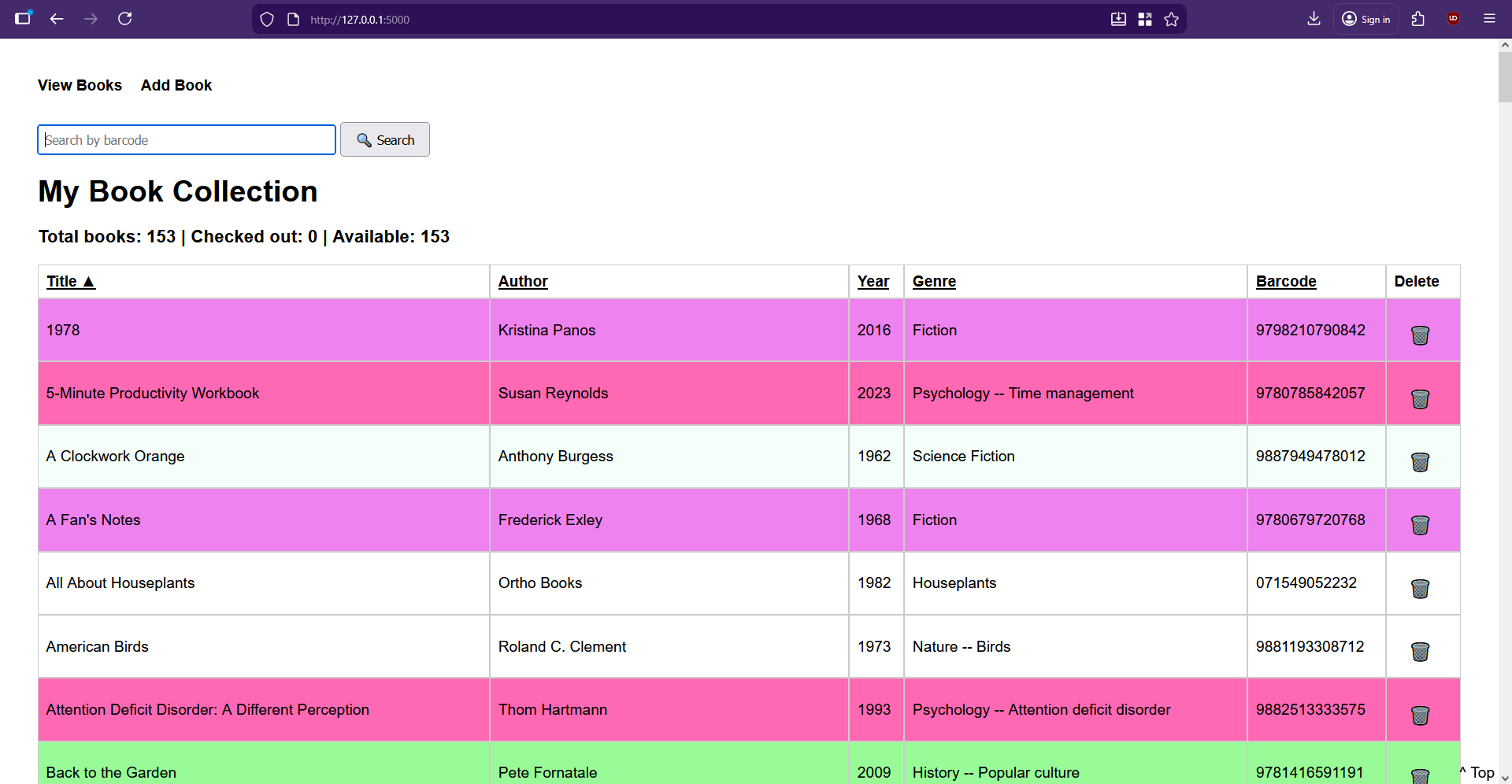
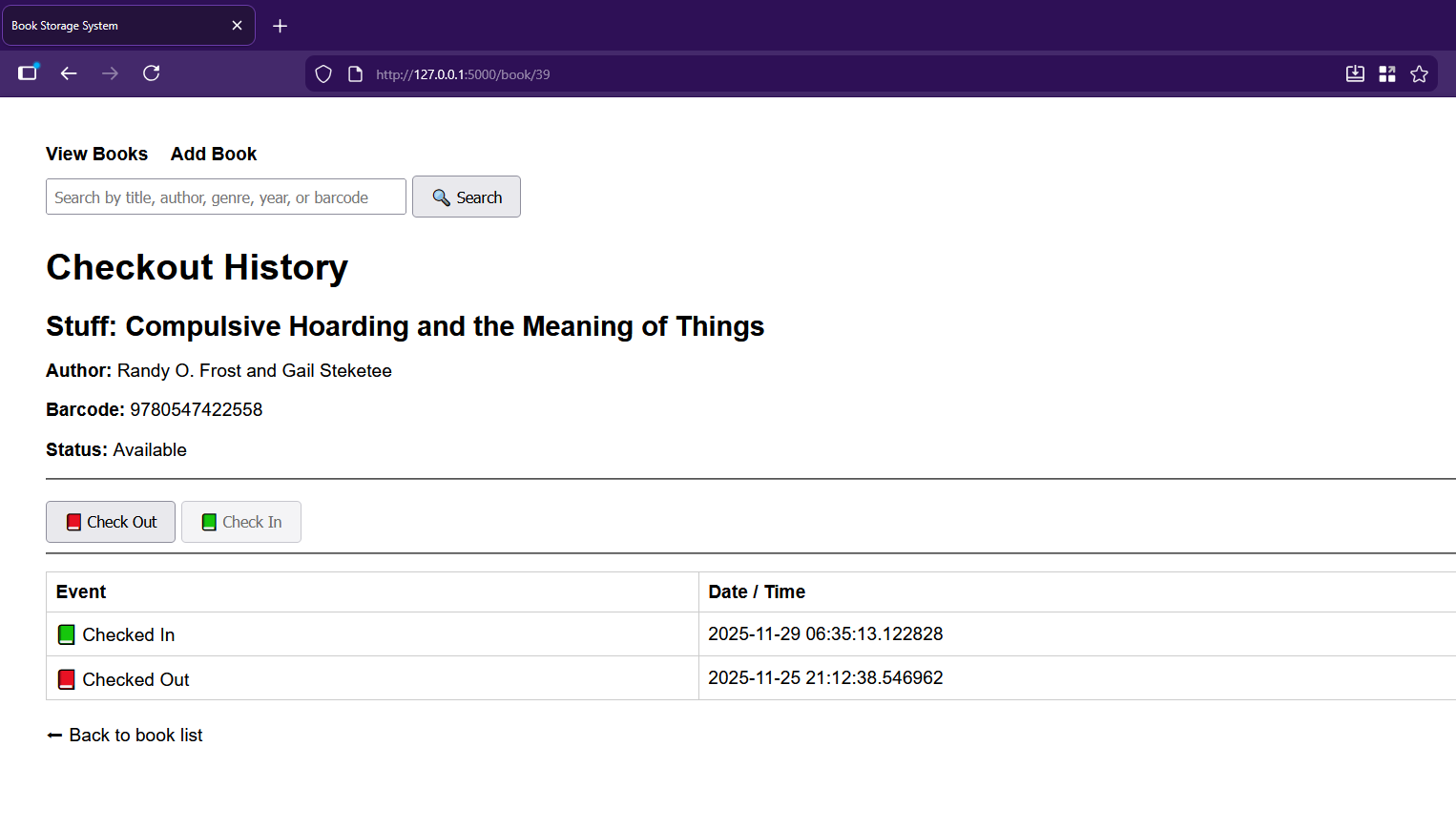
I asked the chat-thing for features and implemented them piecemeal, as you do if you’re not a masochist. First up was a cute little trash-can delete-button for every entry. Then it was time to set up the CheckoutEvent. Each of these events records which book it belongs to, whether it’s a check-out or check-in event, and the timestamp of said event. Of course, then it was time to get the checkout history wired to the front-end and accessible by clicking a book’s title.
All I really had to do was add a history route to app.py, update index.html to make the titles clickable, and create the book_history.html it spat out. Then I had it add the buttons for checking in and out on the new checkout history page, which involved adding routes to app.py as well as a helper to compute the current status.
Then it had me modify the history route and update book_history.html with the actual buttons. And they’re super cute, too — there’s a little red book on the checkout button, and a green book on the check-in.
On the index.html page, can you add a barcode number-based search box? And when the user searches, redirect them to the book page for that barcode?
Now it was time to get the barcode scanning situation up and running. I was sure at some point that ChatGPT would time me out for the night since I use the free model, but it just kept helping me do whatever I wanted, and even suggesting new features.
I wanted the barcode handling to be twofold: one, it should definitely pull the checkout page if the book exists in the system, and it should also definitely go to the book-entering page if not.
Yes — that’s a great workflow feature.We’ll add a barcode search box to your index page, and when someone submits a barcode, the app will:
Look up the book by barcode
Redirect straight to that book’s checkout history page
Show a nice error if the barcode doesn’t exist
I did what it told me, adding a barcode search route in app.py and updating the index() route to use it. I then added its barcode search form to index.html. It was at this point that I had to figure out a way to generate barcodes so I could make little stickers for the books that lack them entirely, or have otherwise obliterated ones.
I have a pretty basic 1D barcode scanning gun, and it won’t scan everything. As I soon found out, it prefers fake EAN barcodes to UPCs altogether. I finally found an online barcode generator and got to work, starting with a list of randomly-generated numbers I made with Excel. I decided I wanted all the fake barcodes to start with 988, which is close enough to the ISBN 978 lead-in, and happens to use my favorite number twice.
We took a brief detour as I asked the chat-thing to make the table to have ascending/descending sorting by clicking the headers. The approach it chose was to keep things server-side, and use little arrows to indicate direction. I added sorting logic to app.py and updated index.html to produce the clickable headers, and also decided that the entries should be color-coded based on genre, and implemented that part without help from GPT. Then I got tired and went to bed.
I’m of a certain age and now sleep in two parts pretty much every night. In fact, I’m writing this part now at 1:22 AM, blasting Rush (2112) and generally having a good time. But I can tell you that I was not having a good time when I got out of bed to continue working on this library system a couple of hours later.
There I was, entering books (BEEP!), when I decided I’d had enough of that and needed to try adding more features. I cracked my knuckles and asked the chat-thing if it could make it so the search works across all fields — title, author, year, genre, or barcode. It said, cool, we can do that with a simple SQLAlchemy or_ query. I was like, whatever, boss; let’s get crazy.
Can you make it so the search works across all fields?
It had me import or_ and update the search route in app.py to replace the existing barcode search route with a generalized search using POST. Then I was to update index.html to rename the input to a general query. Cool.
But no. I messed it up some how and got an error about a missing {% endblock %}. In my GPT history it says, I’m confused about step 2. Where do I add it? And maybe I was just tired. I swear I just threw the code up there at the top like it told me to. But it said:
Ah! I see exactly why it’s confusing — your current index.html starts with the <h1> and then goes straight into the table. The search form should go right under the <h1> and before the table.
Then I was really confused. Didn’t I already have a search box that only handled barcodes? I sure did, over in base.html. So the new search code ended up there. Maybe that’s wrong. I don’t remember the details, but I searched the broader internet about my two-layer error and got the thing back to a working state many agonizing minutes later. Boy, was I proud, and relieved that I didn’t have to ask my husband to fix my mistake(s) in the morning. I threw my arms in the air and looked around for the cats to tell them the good news, but of course, I was the only one awake.
I wasn’t satisfied. I wanted more. I asked it to add a current count of books in the database and display it toward the top. After that, it offered to add a count of currently-checked-out vs. available books, to which I said yes please. Then I wanted an author page that accepts an author’s name and shows all books by that author. I asked for a new page that shows all the books that are checked out. Most recently, I made it so the search box and the column headers persist on scroll.
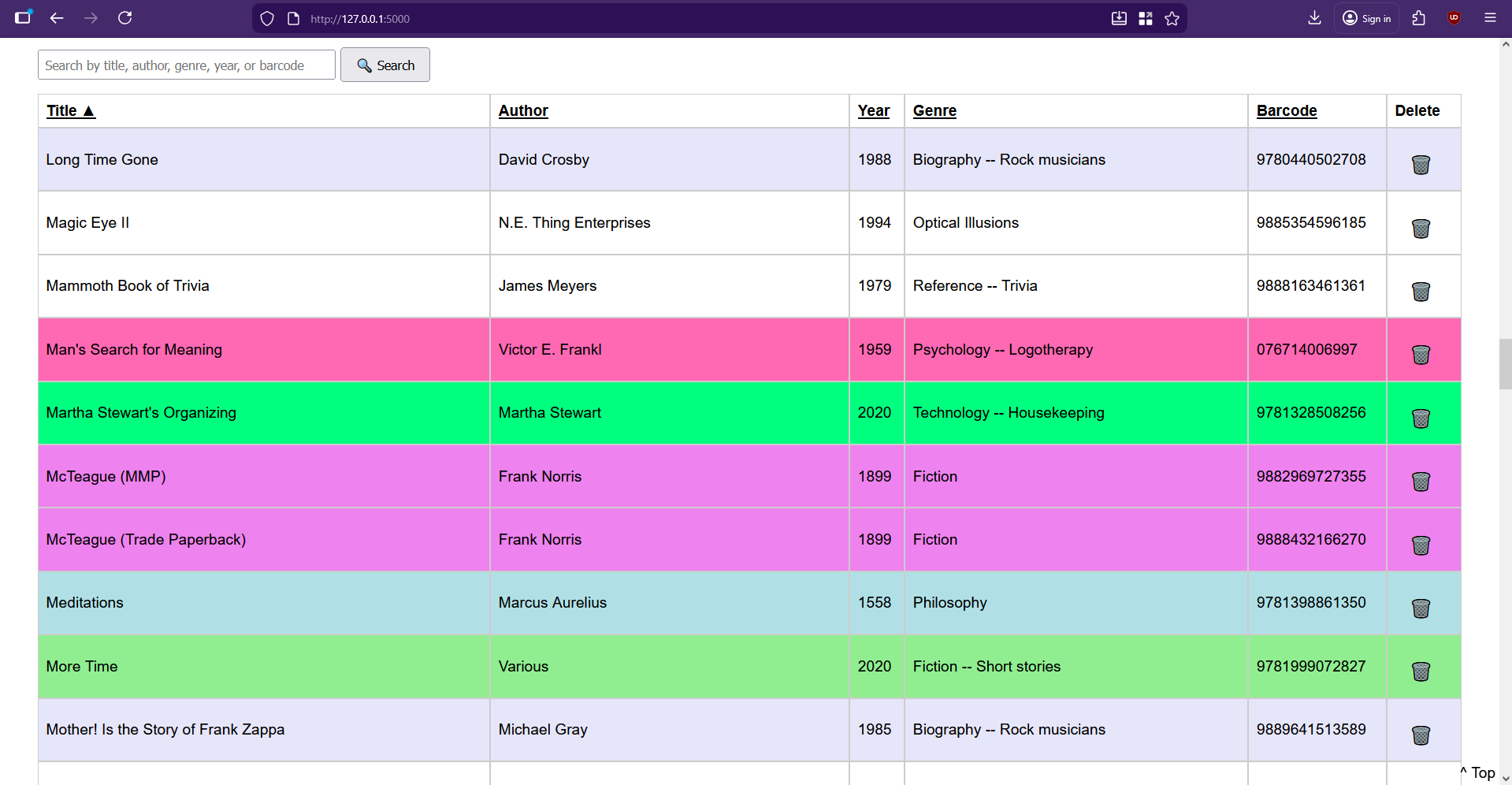
I’m still trying to think of features, but for now I’m busy entering books, typing up check-out cards on my IBM Wheelwriter 5, and applying library pockets to the inside back covers of all my books. If you want to make your own personal library system, I put everything on GitHub.
I couldn’t have done any of this without my husband’s prompts and guidance, his ability to call shenanigans on GPT’s code whenever warranted, and ChatGPT itself. Although I have programmed in the past, it’s been a good long time since I even printed “Hello, World” in any language, though I did find myself recalling a good deal about this and that syntax.
If you want to make a similar type of niche system for your eyes only, I’d say this could be one way to do it. Wait, that’s pretty non-committal. I’d say just go for it. You have yourself and the broader Internet to check mistakes along the way, and you just might like some of the choices it makes on your behalf.
The shoe is most certainly on the other foot. On Monday, OpenAI CEO Sam Altman reportedly declared a “code red” at the company to improve ChatGPT, delaying advertising plans and other products in the process, The Information reported based on a leaked internal memo. The move follows Google’s release of its Gemini 3 model last month, which has outperformed ChatGPT on some industry benchmark tests and sparked high-profile praise on social media.
In the memo, Altman wrote, “We are at a critical time for ChatGPT.” The company will push back work on advertising integration, AI agents for health and shopping, and a personal assistant feature called Pulse. Altman encouraged temporary team transfers and established daily calls for employees responsible for enhancing the chatbot.
The directive creates an odd symmetry with events from December 2022, when Google management declared its own “code red” internal emergency after ChatGPT launched and rapidly gained in popularity. At the time, Google CEO Sundar Pichai reassigned teams across the company to develop AI prototypes and products to compete with OpenAI’s chatbot. Now, three years later, the AI industry is in a very different place.


© Anadolu via Getty Images
OpenAI may soon be forced to explain why it deleted a pair of controversial datasets composed of pirated books, and the stakes could not be higher.
At the heart of a class-action lawsuit from authors alleging that ChatGPT was illegally trained on their works, OpenAI’s decision to delete the datasets could end up being a deciding factor that gives the authors the win.
It’s undisputed that OpenAI deleted the datasets, known as “Books 1” and “Books 2,” prior to ChatGPT’s release in 2022. Created by former OpenAI employees in 2021, the datasets were built by scraping the open web and seizing the bulk of its data from a shadow library called Library Genesis (LibGen).


© wenmei Zhou | DigitalVision Vectors
ChatGPT may not stay ad-free forever. New leaked code hints ads could show up for certain query types, adding marketing into what was once a clean space. This could help OpenAI fund the free tier but change how natural your chats feel.
The post Your ChatGPT conversations may not stay ad-free for long appeared first on Digital Trends.

You can do far, far more than draft an email to your boss. From meal planning and interior redesign, there’s a whole world of untapped AI potential that awaits…
The post 9 unexpected things I was able to do with ChatGPT (and a few you must try) appeared first on Digital Trends.


Facing five lawsuits alleging wrongful deaths, OpenAI lobbed its first defense Tuesday, denying in a court filing that ChatGPT caused a teen’s suicide and instead arguing the teen violated terms that prohibit discussing suicide or self-harm with the chatbot.
The earliest look at OpenAI’s strategy to overcome the string of lawsuits came in a case where parents of 16-year-old Adam Raine accused OpenAI of relaxing safety guardrails that allowed ChatGPT to become the teen’s “suicide coach.” OpenAI deliberately designed the version their son used, ChatGPT 4o, to encourage and validate his suicidal ideation in its quest to build the world’s most engaging chatbot, parents argued.
But in a blog, OpenAI claimed that parents selectively chose disturbing chat logs while supposedly ignoring “the full picture” revealed by the teen’s chat history. Digging through the logs, OpenAI claimed the teen told ChatGPT that he’d begun experiencing suicidal ideation at age 11, long before he used the chatbot.


© via Edelson PC
