Choosing the right tool for multiple jobs can be tough. There are countless brands to choose from, and each one offers hundreds of tools with various models that often look identical. Earlier this year, I finally bought a Ryobi High-Torque Impact Wrench, and not only is it the tool upgrade I needed, but it's something everyone should own.
ShadyPanda spent seven years uploading trusted Chrome and Edge extensions, later weaponizing them for tracking, hijacking, and remote code execution. Learn how the campaign unfolded.
Security researchers have released a specialized scanning tool to identify vulnerable React Server Component (RSC) endpoints in modern web applications, addressing a critical gap in the detection of CVE-2025-55182. New Detection Approach Challenges Existing Security Assumptions A newly available Python-based scanner is transforming how organizations assess their exposure to CVE-2025-55182 by introducing a sophisticated surface […]
Brevo, a customer relationship management company headquartered in Paris, is now a unicorn. The U.S. currently represents 15% of Brevo’s revenue — one of its three largest markets along with France and Germany.
The snowy cold weather is here, and that means it's time to get out your winter tools and start preparing and battling the snow. And if you don't have any winter power tools, we have you covered. Here are a few cordless tools you should consider purchasing, like an electric snowblower.
AWS CEO Matt Garman unveils the crowd-pleasing Database Savings Plans with just two seconds remaining on the “lightning round” shot clock at the end of his re:Invent keynote Tuesday morning. (GeekWire Photo / Todd Bishop)
LAS VEGAS — After spending nearly two hours trying to impress the crowd with new LLMs, advanced AI chips, and autonomous agents, Amazon Web Services CEO Matt Garman showed that the quickest way to a developer’s heart isn’t a neural network. It’s a discount.
One of the loudest cheers at the AWS re:Invent keynote Tuesday was for Database Savings Plans, a mundane but much-needed update that promises to cut bills by up to 35% across database services like Aurora, RDS, and DynamoDB in exchange for a one-year commitment.
The reaction illustrated a familiar tension for cloud customers: Even as tech giants introduce increasingly sophisticated AI tools, many companies and developers are still wrestling with the basic challenge of managing costs for core services.
The new savings plans address the issue by offering flexibility that didn’t exist before, letting developers switch database engines or move regions without losing their discount.
“AWS Database Savings Plans: Six Years of Complaining Finally Pays Off,” is the headline from the charmingly sardonic and reliably snarky Corey Quinn of Last Week in AWS, who specializes in reducing AWS bills as the chief cloud economist at Duckbill.
Quinn called the new “better than it has any right to be” because it covers a wider range of services than expected, but he pointed out several key drawbacks: the plans are limited to one-year terms (meaning you can’t lock in bigger savings for three years), they exclude older instance generations, and they do not apply to storage or backup costs.
He also cited the lack of EC2 (Elastic Cloud Compute) coverage, calling the inability to move spending between computing and databases a missed opportunity for flexibility.
But the database pricing wasn’t the only basic upgrade to get a big reaction. For example, the crowd also cheered loudly for Lambda durable functions, a feature that lets serverless code pause and wait for long-running background tasks without failing.
Garman made these announcements as part of a new re:Invent gimmick: a 10-minute sprint through 25 non-AI product launches, complete with an on-stage shot clock. The bit was a nod to the breadth of AWS, and to the fact that not everyone in the audience came for AI news.
He announced the Database Savings Plans in the final seconds, as the clock ticked down to zero. And based on the way he set it up, Garman knew it was going to be a hit — describing it as “one last thing that I think all of you are going to love.”
While Black Friday is one of the biggest shopping days of the year, Home Depot isn't slowing down and still has epic tool deals for Cyber Monday and beyond. While there are several available, if you're looking to stock up on Milwaukee battery packs, one deal in particular caught my attention.
Are you an aspiring mechanic or someone who prefers to fix things yourself? If so, having the right tools can make all the difference. In fact, having the wrong tool or not having what you need can be the difference between a quick job and spending hours fighting nuts and bolts. So, here are a few must-have Ryobi tools for at-home auto repairs.
Sometimes you need to know what temperature something is, but you don’t quite want to touch it. At times like these, you might want a temp gun on hand to get a good reading, like the one [Arnov Sharma] built.
The build is a relatively simple one, and is based around an Waveshare ESP32 C6 development module that comes with a small LCD screen out of the box. The microcontroller is set up to read an MLX90614 infrared temperature sensor. This device picks up the infrared energy that is emitted by objects relative to their temperature. The sensor has a great range—from -70 C to 380 C. The readouts from this sensor are then displayed on the screen. Battery power is from a small 600 mAh LiPo cell, which is managed by a IP5306 charge module.
It’s worth noting that these infrared temperature sensors aren’t infallible devices. The temperature they perceive is based on certain assumptions about factors like an objects emissivity. Thus, they don’t always give accurate readings on metallic or shiny objects, for example. It’s also important to understand the sensor’s field of view. Despite many commercial versions featuring a laser pointer for aiming, many of these infrared temperature sensors tend to average their reading over a small spot that gets larger the farther away they are from the object being measured.
Learn how to choose the right virtual data room for your startup with pricing models, key features, cost factors, and tips to secure the best VDR deal.
AI-generated code is reshaping software development and introducing new security risks. Organizations must strengthen governance, expand testing and train developers to ensure AI-assisted coding remains secure and compliant.
마이크로소프트(MS)가 로컬 기기만으로 복잡한 작업을 자동화할 수 있는 소형 컴퓨터 사용 에이전트(CUA) 모델 ‘파라-7B’를 공개하며, 에이전틱 AI 기술을 개별 PC의 영역으로 확장하고 있다.
이번 공개는 사용자 피드백을 수집하기 위한 실험 목적이며, 기업이 민감한 워크플로를 클라우드로 전송하지 않고도 처리할 수 있는 AI 에이전트의 방향성을 미리 제시한다. MS는 실제 UI 네비게이션 작업에서 GPT-4o 같은 대형 모델과 견주거나 그 이상을 보여주는 성능도 확인할 수 있다는 점을 강조했다.
MS는 블로그 게시물에서 “텍스트 기반 응답을 생성하는 기존 대화형 모델과 달리, 파라-7B와 같은 컴퓨터 사용 에이전트(CUA)는 마우스와 키보드 등 실제 컴퓨터 인터페이스를 활용해 사용자를 대신해 작업을 수행한다”라며 “70억 파라미터 규모임에도 동급 모델군에서 최고 수준의 성능을 보여주며, 여러 대규모 모델을 조합해 동작하는 고비용 에이전트 시스템과 비교해도 충분히 경쟁력이 있다”라고 설명했다.
파라-7B는 스크린샷을 분석해 화면 요소를 픽셀 수준에서 해석하며, 코드 구조가 복잡하거나 접근할 수 없는 환경에서도 화면 기반으로 인터페이스를 탐색할 수 있다.
MS에 의하면 Fara-7B는 내부 벤치마크 웹보이저(WebVoyager) 테스트에서 73.5%의 성공률을 기록해, 동일한 컴퓨터 사용 에이전트 환경에서 평가된 GPT-4o를 앞섰다. MS는 이 모델이 기존 7B급 시스템보다 훨씬 적은 단계로 작업을 완료하는 경향이 있어 데스크톱 환경에서 더 빠르고 예측 가능한 자동화를 구현할 수 있다고 설명했다.
또한 MS는 이메일 발송이나 금융 거래 수행처럼 되돌릴 수 없는 행동을 진행하기 전, 에이전트가 반드시 멈춰 사용자 승인을 요청하도록 하는 ‘크리티컬 포인트(Critical Points)’ 안전 장치를 모델에 적용했다.
로컬 모델로의 전환
분석가들은 파라-7B처럼 소형 로컬 모델로 이동하는 흐름이 엔터프라이즈 AI 아키텍처 전반의 광범위한 변화와 맞닿아 있다고 봤다.
오늘날 대규모 추론이나 조직 차원의 검색은 여전히 클라우드 기반 시스템이 주도하고 있다. 그러나 실제 기업에서 이뤄지는 일상적 워크플로우는 노트북 내에서 데이터를 이동하는 작업처럼, 정보가 기기 밖으로 나갈 수 없는 방식이 상당수다.
파리크 컨설팅 CEO인 파리크 자인은 “엣지 기반 모델은 클라우드 AI의 3가지 주요 문제, 즉 연산 비용, 기기 외부로의 데이터 전송 문제, 지연 시간을 해결한다. 대부분의 기업 업무는 노트북 내부 애플리케이션에서 이뤄지기 때문에 로컬 에이전트가 훨씬 적합하다”라고 말했다.
포레스터 부사장이자 수석 애널리스트인 찰리 다이는 조직이 에이전트 기반 AI 도입을 가속화할수록, 파라-7B와 같이 경량화된 온디바이스 에이전트의 중요성이 더욱 커질 것이라고 진단했다.
다이는 “기업 입장에서 이는 AI 워크로드가 점차 분산되는 흐름을 의미한다. 초대규모 인프라 의존도가 낮아지는 만큼 엣지 거버넌스와 모델 수명주기 관리를 위한 새로운 전략이 요구된다”라고 설명했다.
카덴스 인터내셔널 수석 부사장 툴리카 실은 이런 흐름이 하이브리드 AI 아키텍처의 확대로 이어지고 있다고 분석했다. 이는 로컬 에이전트가 프라이버시 민감 업무를 처리하고, 클라우드가 확장성을 맡는 구조를 의미한다. 특히 소규모 온디바이스 에이전트는 외부 시스템에 정보를 노출하지 않으면서 민감하거나 반복적인 데스크톱 작업을 자동화할 수 있는 현실적인 방안이 될 수 있다.
실용성과 거버넌스 과제
픽셀 단위로 화면을 해석하는 에이전트는 별도의 통합 작업 없이 다양한 애플리케이션에서 동작할 수 있어 높은 호환성을 보장하지만, 동시에 운영상 위험도 수반한다. 자인은 이를 AI 기능이 강화된 로보틱 프로세스 자동화(RPA)에 가깝다고 설명했는데, 에이전트가 마우스와 키보드 입력을 모방해 시스템 간 데이터를 이동시키기 때문이다. dl-ciokorea@foundryco.com
Alan reflects on a turbulent year in DevSecOps, highlighting the rise of AI-driven security, the maturing of hybrid work culture, the growing influence of platform engineering, and the incredible strength of the DevSecOps community — while calling out the talent crunch, tool sprawl and security theater the industry must still overcome.
While AI bubble talk fills the air these days, with fears of overinvestment that could pop at any time, something of a contradiction is brewing on the ground: Companies like Google and OpenAI can barely build infrastructure fast enough to fill their AI needs.
During an all-hands meeting earlier this month, Google’s AI infrastructure head Amin Vahdat told employees that the company must double its serving capacity every six months to meet demand for artificial intelligence services, reports CNBC. The comments show a rare look at what Google executives are telling its own employees internally. Vahdat, a vice president at Google Cloud, presented slides to its employees showing the company needs to scale “the next 1000x in 4-5 years.”
While a thousandfold increase in compute capacity sounds ambitious by itself, Vahdat noted some key constraints: Google needs to be able to deliver this increase in capability, compute, and storage networking “for essentially the same cost and increasingly, the same power, the same energy level,” he told employees during the meeting. “It won’t be easy but through collaboration and co-design, we’re going to get there.”
As you know, there are plenty of automation tools out there, but most of them are closed-source, cloud-only services that charge you per operation and keep your data on their servers. For those of us who value privacy and transparency, these solutions simply won’t do. That’s where n8n comes into the picture – a free, private workflow automation platform that you can self-host on your own infrastructure while maintaining complete control over your data.
In this article, we explore n8n, set it up on a Raspberry Pi, and create a workflow for monitoring security news and sending it to Matrix. Let’s get rolling!
What is n8n?
n8n is a workflow automation platform that combines AI capabilities with business process automation, giving technical teams the flexibility of code with the speed of no-code. The platform uses a visual node-based interface where each node represents a specific action, for example, reading an RSS feed, sending a message, querying a database, or calling an API. When you connect these nodes, you create a workflow that executes automatically based on triggers you define.
With over 400 integrations, native AI capabilities, and a fair-code license, n8n lets you build powerful automation while maintaining full control over your data and deployments.
The Scenario: RSS Feed Monitoring with Matrix Notifications
For this tutorial, we’re going to build a practical workflow that many security professionals and tech enthusiasts need: automatically monitoring RSS feeds from security news sites and threat intelligence sources, then sending new articles directly to a Matrix chat room. Matrix is an open-source, decentralized communication protocol—essentially a privacy-focused alternative to Slack or Discord that you can self-host.
Step #1: Installing n8n on Raspberry Pi
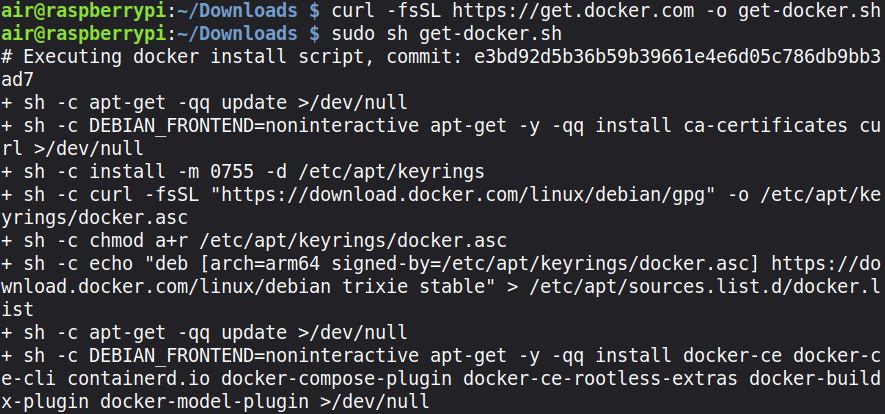
Let’s get started by setting up n8n on your Raspberry Pi. First, we need to install Docker, which is the easiest way to run n8n on a Raspberry Pi. SSH into your Pi and run these commands:
pi> curl -fsSL https://get.docker.com -o get-docker.sh pi> sudo sh get-docker.sh pi> sudo usermod -aG docker pi
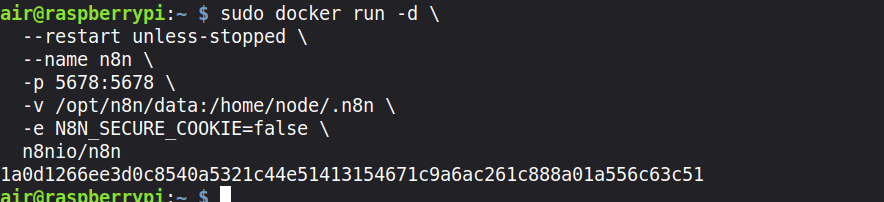
Log out and back in for the group changes to take effect. Now we can run n8n with Docker in a dedicated directory:
This command runs n8n as a background service that automatically restarts if it crashes or when your Pi reboots. It maps port 5678 so you can access the n8n interface, and it creates a persistent volume at /opt/n8n/data to store your workflows and credentials so they survive container restarts. Also, the service doesn’t require an HTTPS connection; HTTP is enough.
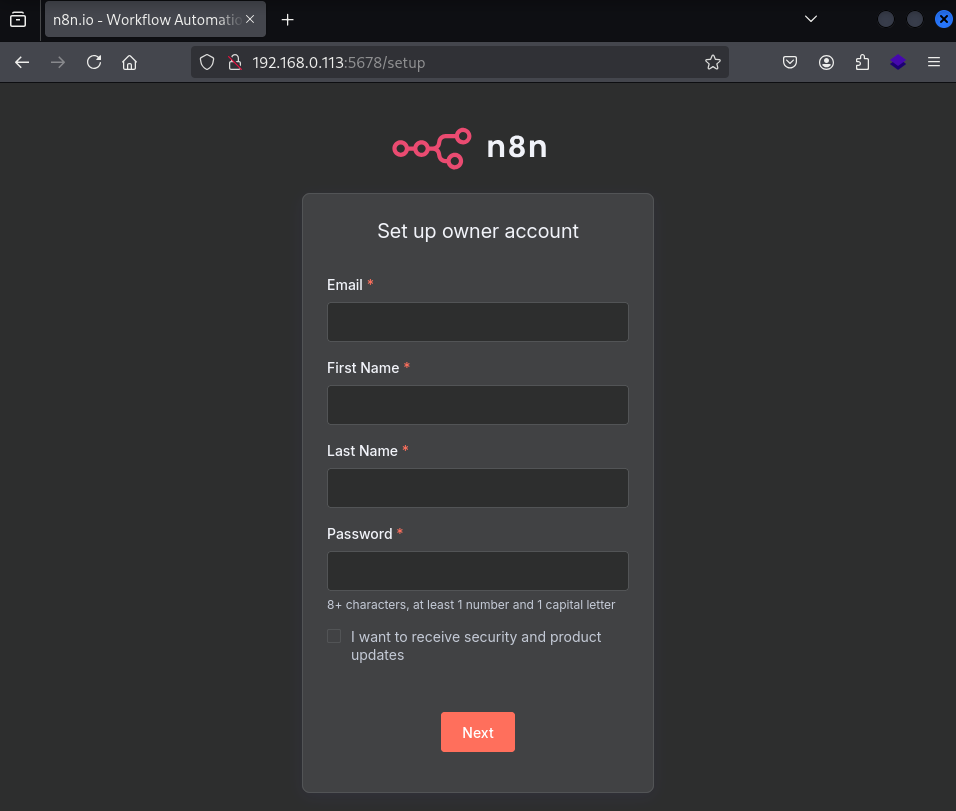
Give it a minute to download and start, then open your web browser and navigate to http://your-raspberry-pi-ip:5678. You should see the n8n welcome screen asking you to create your first account.
Step #2: Understanding the n8n Interface
Once you’re logged in and have created your first workflow, you’ll see the n8n canvas—a blank workspace where you’ll build your workflows. The interface is intuitive, but let me walk you through the key elements.
On the right side, you’ll see a list of available nodes organized by category (Tab key). These are the building blocks of your workflows. There are trigger nodes that start your workflow (like RSS Feed Trigger, Webhook, or Schedule), action nodes that perform specific tasks (like HTTP Request or Function), and logic nodes that control flow (like IF conditions and Switch statements).
The main canvas in the center is where you’ll drag and drop nodes and connect them. Each connection represents data flowing from one node to the next. When a workflow executes, data passes through each node in sequence, getting transformed and processed along the way.
Step #3: Creating Your First Workflow – RSS to Matrix
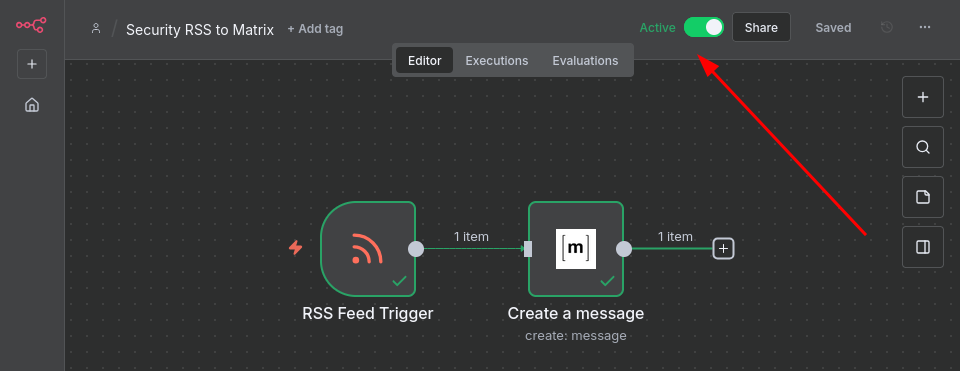
Now let’s build our RSS monitoring workflow. Click the “Add workflow” button to create a new workflow. Give it a meaningful name like “Security RSS to Matrix”.
We’ll start by adding our trigger node. Click the plus icon on the canvas and search for “RSS Feed Trigger”. Select it and you’ll see the node configuration panel open on the right side.
In the RSS Feed Trigger node configuration, you need to specify the RSS feed URL you want to monitor. For this example, let’s use the Hackers-Arise feed.
The RSS Feed Trigger has several important settings. The Poll Times setting determines how often n8n checks the feed for new items. You can set it to check every hour, every day, or on a custom schedule. For a security news feed, checking every hour makes sense, so you get timely notifications without overwhelming your Matrix room.
Click “Execute Node” to test it. You should see the latest articles from the feed appear in the output panel. Each article contains data like title, link, publication date, and sometimes the author. This data will flow to the next nodes in your workflow.
Step #4: Configuring Matrix Integration
Now we need to add the Matrix node to send these articles to your Matrix room. Click the plus icon to add a new node and search for “Matrix”. Select the Matrix node and “Create a message” as the action.
Before we can use the Matrix node, we need to set up credentials. Click on “Credential to connect with” and select “Create New”. You’ll need to provide your Matrix homeserver URL, your Matrix username, and password or access token.
Now comes the interesting part—composing the message. n8n uses expressions to pull data from previous nodes. In the message field, you can reference data from the RSS Feed Trigger using expressions like {{ $json.title }} and {{ $json.link }}.
Here’s a good message template that formats the RSS articles nicely:
Click the “Execute Workflow” button at the top. You should see the workflow execute, data flow through the nodes, and if everything is configured correctly, a message will appear in your Matrix room with the latest RSS article.
Once you’ve confirmed the workflow works correctly, activate it by clicking the toggle switch at the top of the workflow editor.
The workflow is now running automatically! The RSS Feed Trigger will check for new articles according to the schedule you configured, and each new article will be sent to your Matrix room.
Summary
The workflow we built today, monitoring RSS feeds and sending security news to Matrix, demonstrates n8n’s practical value. Whether you’re aggregating threat intelligence, monitoring your infrastructure, managing your home lab, or just staying on top of technology news, n8n can eliminate the tedious manual work that consumes so much of our time.

 Login
Login