Welcome to Edition 8.21 of the Rocket Report! We’re back after the Thanksgiving holiday with more launch news. Most of the big stories over the last couple of weeks came from abroad. Russian rockets and launch pads didn’t fare so well. China’s launch industry celebrated several key missions. SpaceX was busy, too, with seven launches over the last two weeks, six of them carrying more Starlink Internet satellites into orbit. We expect between 15 and 20 more orbital launch attempts worldwide before the end of the year.
As always, we welcome reader submissions. If you don’t want to miss an issue, please subscribe using the box below (the form will not appear on AMP-enabled versions of the site). Each report will include information on small-, medium-, and heavy-lift rockets, as well as a quick look ahead at the next three launches on the calendar.
Another Sarmat failure. A Russian intercontinental ballistic missile (ICBM) fired from an underground silo on the country’s southern steppe on November 28 on a scheduled test to deliver a dummy warhead to a remote impact zone nearly 4,000 miles away. The missile didn’t even make it 4,000 feet, Ars reports. Russia’s military has been silent on the accident, but the missile’s crash was seen and heard for miles around the Dombarovsky air base in Orenburg Oblast near the Russian-Kazakh border. A video posted by the Russian blog site MilitaryRussia.ru on Telegram and widely shared on other social media platforms showed the missile veering off course immediately after launch before cartwheeling upside down, losing power, and then crashing a short distance from the launch site.
ChatGPT allegedly validated the worst impulses of a wannabe influencer accused of stalking more than 10 women at boutique gyms, where the chatbot supposedly claimed he’d meet the “wife type.”
In a press release on Tuesday, the Department of Justice confirmed that 31-year-old Brett Michael Dadig currently remains in custody after being charged with cyberstalking, interstate stalking, and making interstate threats. He now faces a maximum sentence of up to 70 years in prison that could be coupled with “a fine of up to $3.5 million,” the DOJ said.
The podcaster—who primarily posted about “his desire to find a wife and his interactions with women”—allegedly harassed and sometimes even doxxed his victims through his videos on platforms including Instagram, Spotify, and TikTok. Over time, his videos and podcasts documented his intense desire to start a family, which was frustrated by his “anger towards women,” whom he claimed were “all the same from fucking 18 to fucking 40 to fucking 90” and “trash.”
Stoke Space’s Zenith booster engine blazes during a hot-fire test in 2024. (Stoke Space Photo)
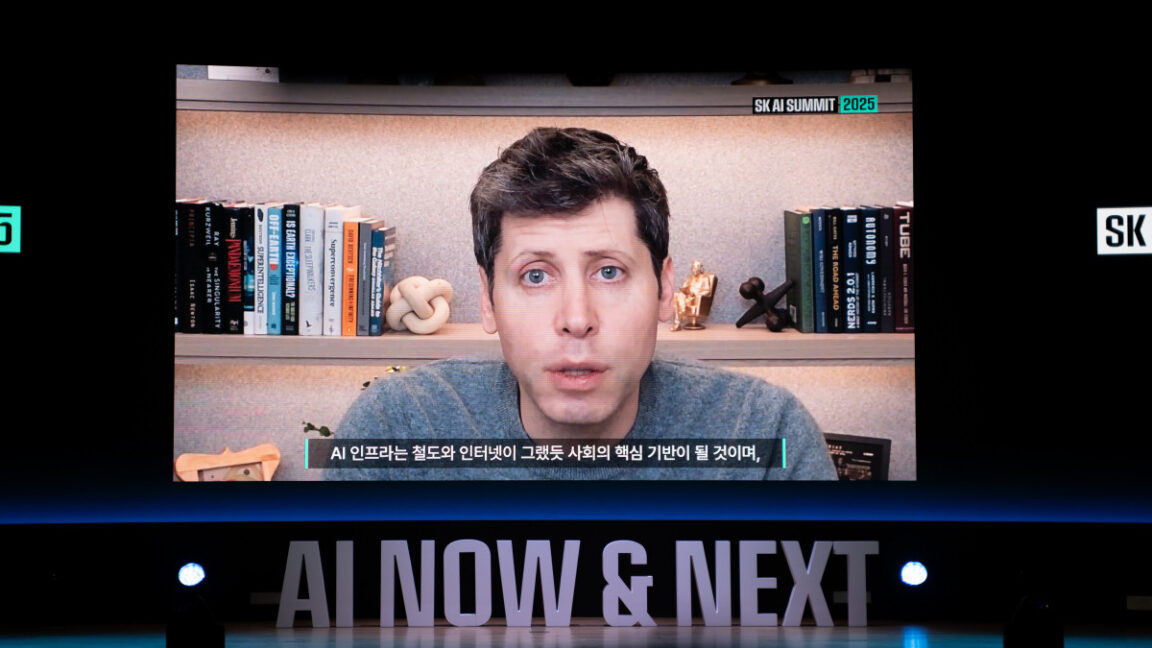
OpenAI CEO Sam Altman is thinking about expanding into the final frontier for data centers, and his efforts to follow through on that thought reportedly turned into talks with Stoke Space, a rocket startup headquartered just south of Seattle.
Altman looked into putting together the funding to invest in Stoke Space, with an eye toward either forging a partnership or ending up with a controlling stake in the company, according to an account published by The Wall Street Journal. The discussions reportedly began this summer and picked up in the fall, but are said to be no longer active.
Such a move would open up a new front in Altman’s competition with SpaceX founder Elon Musk, who has talked about scaling up Starlink V3 satellites to serve as data centers for AI applications. “SpaceX will be doing this,” Musk wrote in a post to his X social-media platform.
The tech world’s appetite for data processing and storage is being driven by the rapidly growing resource requirements of artificial intelligence applications. Altman addressed the subject on Theo Von’s “This Past Weekend” podcast in July.
“I do guess that a lot of the world gets covered in data centers over time,” Altman said. “But I don’t know, because maybe we put them in space. Like, maybe we build a big Dyson sphere on the solar system and say, ‘Hey, it actually makes no sense to put these on Earth.'”
Citing unidentified sources, the Journal said Altman has been exploring the idea of investing in space ventures to follow through on that thought. Kent, Wash.-based Stoke Space, which is working on a fully reusable rocket called Nova, reportedly became a focus of Altman’s interest.
Much has changed on the AI frontier in recent weeks. OpenAI is facing a strong challenge from Google and its Gemini chatbot — and this week, Altman ordered OpenAI to refocus urgently on upgrading ChatGPT, its flagship AI platform. Such down-to-earth market concerns may have been one of the factors putting Altman’s space aspirations on hold.
A spokesperson for Stoke Space said the company would not comment on the Journal’s report.
There’s another Seattle-area space venture that may well offer the kind of play that Altman is looking for: Redmond, Wash.-based Starcloud is developing its own platform for AI data centers in space. Like Stoke Space, Starcloud went through the startup accelerator program at Y Combinator, which Altman ran for a time before he became OpenAI’s CEO.
The shoe is most certainly on the other foot. On Monday, OpenAI CEO Sam Altman reportedly declared a “code red” at the company to improve ChatGPT, delaying advertising plans and other products in the process, The Information reported based on a leaked internal memo. The move follows Google’s release of its Gemini 3 model last month, which has outperformed ChatGPT on some industry benchmark tests and sparked high-profile praise on social media.
In the memo, Altman wrote, “We are at a critical time for ChatGPT.” The company will push back work on advertising integration, AI agents for health and shopping, and a personal assistant feature called Pulse. Altman encouraged temporary team transfers and established daily calls for employees responsible for enhancing the chatbot.
The directive creates an odd symmetry with events from December 2022, when Google management declared its own “code red” internal emergency after ChatGPT launched and rapidly gained in popularity. At the time, Google CEO Sundar Pichai reassigned teams across the company to develop AI prototypes and products to compete with OpenAI’s chatbot. Now, three years later, the AI industry is in a very different place.
OpenAI clarified that the app suggestion was not an advertisement, but instead a poor attempt to integrate an app discovery feature within conversations.
Researchers from MIT, Northeastern University, and Meta recently released a paper suggesting that large language models (LLMs) similar to those that power ChatGPT may sometimes prioritize sentence structure over meaning when answering questions. The findings reveal a weakness in how these models process instructions that may shed light on why some prompt injection or jailbreaking approaches work, though the researchers caution their analysis of some production models remains speculative since training data details of prominent commercial AI models are not publicly available.
The team, led by Chantal Shaib and Vinith M. Suriyakumar, tested this by asking models questions with preserved grammatical patterns but nonsensical words. For example, when prompted with “Quickly sit Paris clouded?” (mimicking the structure of “Where is Paris located?”), models still answered “France.”
This suggests models absorb both meaning and syntactic patterns, but can overrely on structural shortcuts when they strongly correlate with specific domains in training data, which sometimes allows patterns to override semantic understanding in edge cases. The team plans to present these findings at NeurIPS later this month.
OpenAI may soon be forced to explain why it deleted a pair of controversial datasets composed of pirated books, and the stakes could not be higher.
At the heart of a class-action lawsuit from authors alleging that ChatGPT was illegally trained on their works, OpenAI’s decision to delete the datasets could end up being a deciding factor that gives the authors the win.
It’s undisputed that OpenAI deleted the datasets, known as “Books 1” and “Books 2,” prior to ChatGPT’s release in 2022. Created by former OpenAI employees in 2021, the datasets were built by scraping the open web and seizing the bulk of its data from a shadow library called Library Genesis (LibGen).
Analysts will be watching to see if Thrive-owned firms actually succeed in building long-term profitable businesses using OpenAI’s tech, or if the result is really just pumped up valuations based on speculative market potential.
ChatGPT may not stay ad-free forever. New leaked code hints ads could show up for certain query types, adding marketing into what was once a clean space. This could help OpenAI fund the free tier but change how natural your chats feel.
You can do far, far more than draft an email to your boss. From meal planning and interior redesign, there’s a whole world of untapped AI potential that awaits…

 Login
Login