
❌

Reading view

There are new articles available, click to refresh the page.

PowerShell for Hackers: Evading Detection

Hello aspiring cyberwarriors!Β 

In modern intrusion scenarios, being inside the system is often not the hardest part. The real challenge begins once you need to stay there without being noticed. Blue teams in well-defended environments rely on continuous monitoring, heavy logging, and SIEM tools such as Splunk or Elastic to track activity. They know what normal user behavior looks like, and they build alerts around suspicious deviations. A compromised workstation that suddenly starts running recon commands immediately raises red flags. At that point, the defender does not need to guess. The investigation begins, and you risk being locked out before making any progress.

For this reason, hackers must rely on obfuscation. Although it does not make commands invisible, it helps you make them much harder to recognize. By transforming payloads and commands into strange, broken-looking forms, you can slip through detection systems that depend on simple pattern matching. In this article we will look at three tools that bring obfuscation to PowerShell: psobf, a Golang-based obfuscator; Argfuscator, which focuses on disguising Windows command arguments; and PowerShell Script Obfuscator by I-Am-Jakoby, which relies on encoding and multi-layered transformations. Together, these tools give you flexible ways to conceal actions and extend dwell time in hostile environments.

Psobf

Repo:

https://github.com/TaurusOmar/psobf

Psobf, short for PowerShell Obfuscator, is a Golang-based project released in the summer of 2024 and under active development. The tool requires Go 1.25.0 or newer on Linux. Once installed, it makes obfuscating PowerShell payloads fast and customizable.

Installing Go

bash$ > wget https://go.dev/dl/go1.25.0.linux-amd64.tar.gzΒ Β 

bash$ > rm -rf /usr/local/go && tar -C /usr/local -xzf go1.25.0.linux-amd64.tar.gzΒ Β 

bash$ > echo "export PATH=$PATH:/usr/local/go/bin" >> /etc/profileΒ Β 

bash$ >Β  source /etc/profileΒ Β 

Installing psobf

Now we are ready to install the tool. Based on their GitHub page, the installation is plain and simple:

bash$ > go install github.com/TaurusOmar/psobf/cmd/psobf@latest

showing the installation manual of psobf from github

Then append this line to /etc/profile:

export PATH=$PATH:/root/go/bin

adding go directory to the path on linux

Obfuscating a Reverse Shell

With psobf installed, we can generate and obfuscate a reverse shell, for instance one taken from revshells.com. Obfuscation is as simple as choosing an input script, an output file, and a level of transformation:

bash$ > psobf -i revshell.ps1 -o obf.ps1 -level 5

obfuscating a script with psobf

Once moved to the target and executed, the obfuscated shell works as expected, giving us a stealthier connection while hiding the command’s real nature.

executing the obfuscated script
using netcat to receive the connection

Argfuscator

Argfuscator is designed to help evade static filters that defenders apply to common commands. Security teams often set alerts around specific keywords and arguments. For example, they may detect whoami, net user, or netstat -ano. Running such commands directly can immediately give you away.

Argfuscator transforms these commands into broken-looking but still functional versions. The tool uses a mix of random case changes, quotation tricks, regex replacements, shorthand expansions, and other substitutions. Out of the box, it supports obfuscation of 68 Windows commands, which is sufficient for most basic recon and persistence tasks.

showing available commands to obfuscate with argfuscator

The resulting output may look unreadable, but that is the point.

obfuscating a command with argfuscator
obfuscating whoami with argfuscator
executing argfuscated whoami
executing argfuscated certutil

SIEM filters are less effective, and the commands execute successfully despite their appearance. Argfuscator is especially useful for day-to-day stealth during a long intrusion.

PowerShell Script Obfuscator

The PowerShell Script Obfuscator by I-Am-Jakoby provides a broader set of transformations. Rather than focusing on arguments, it targets entire scripts. The tool can obfuscate PowerShell code through Base64, Hex, ASCII encoding, URL encoding, binary representations, or even string reversal. By layering these methods, scripts become unreadable to humans and resistant to simple inspection by defenders.

showing powershell script obfuscator by I-Am-Jakoby

For example, a reverse shell can be wrapped in Base64 and executed with the -e flag:

PS > powershell -e "..."

encoding a reverse shell with base64
executing an encoded base64 shell

With Netcat listening, the obfuscated payload delivers the connection as expected.

The real advantage comes from stacking methods. A script that passes through binary encoding, then string reversal, and finally Base64 will look entirely random until decoded step by step. Even if defenders capture the obfuscated script, the time required to peel back multiple layers creates breathing room for the hacker. This extra time can mean the difference between completing objectives and being cut off mid-operation.

Summary

Evading detection is tricky. In tightly watched environments, blunt actions like running plain recon commands, dropping unaltered scripts are immediate invitations for investigation. The point of obfuscation is about making your activity harder to recognize at a glance, forcing automated systems to miss patterns and making human analysts spend time untangling noise. This gives you time to complete tasks before defenders have a clear picture.

We covered tools that give you different ways to add that friction without changing the underlying behavior of your code. One hides the shape of PowerShell payloads, another mangles command arguments so simple keyword rules fail, and a third layers encodings so a script looks meaningless until decoded. Used together, they don’t guarantee success, but they raise the bar for both detection systems and the people who must investigate what they find.

The post PowerShell for Hackers: Evading Detection first appeared on Hackers Arise.
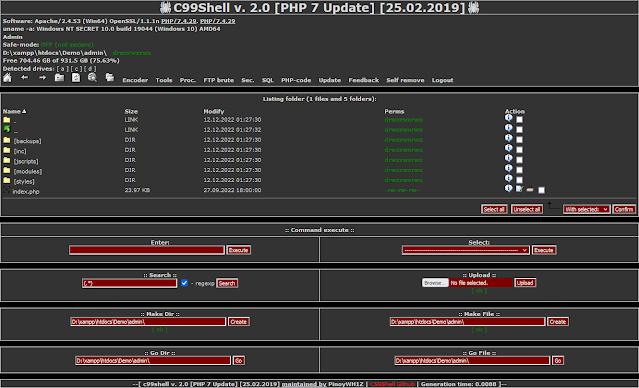
C99Shell-PHP7 - PHP 7 And Safe-Build Update Of The Popular C99 Variant Of PHP Shell

By: Unknown


C99Shell-PHP7

PHP 7 and safe-build Update of the popular C99 variant of PHP Shell.

c99shell.php v.2.0 (PHP 7) (25.02.2019) Updated by: PinoyWH1Z for PHP 7

About C99Shell

An excellent example of a web shell is the c99 variant, which is a PHP shell (most of them calls it malware) often uploaded to a vulnerable web application to give hackers an interface. The c99 shell lets the attacker take control of the processes of the Internet server, allowing him or her give commands on the server as the account under which the threat is operating. It lets the hacker upload, browse the file system, edit and view files, in addition, to deleting, moving them and changing permissions. Finding a c99 shell is an excellent way to identify a compromise on a system. The c99 shell is about 1500 lines long if packed and 4900+ if properly displayed, and some of its traits include showing security measures the web server may use, a file viewer that has permissions, a place w here the attacker can operate custom PHP code (PHP malware c99 shell).

There are different variants of the c99 shell that are being used today. This github release is an example of a relatively recent one. It has many signatures that can be utilized to write protective countermeasures.


About this release:

I've been using php shells as part of my Ethical Hacking activities. And I have noticed that most of the php shells that are downloadable online are encrypted with malicious codes and without you knowing, others also insert trackers so they can see where you placed your php shell at.

I've came up with an idea such as "what if I get the stable version of c99shell and reverse the encrypted codes, remove the malicious codes and release it to public for good." And yeah, I decided to do it, but I noticed that most of the servers now have upgraded their apache service to PHP 7, sadly, the codes that I have is for PHP 5.3 and below.

The good thing is.. only few lines of syntax are needed to be altered, so I did it.

Here you go mates, a clean and safe-build version of the most stable c99shell that I can see.

If ever you see more bugs, please create an issue or just fork it, update it and do a pull request so I can check it and update the codes for stabilization.

PS:

This is a widely used php shell by hackers, so don't freak out if your anti-virus/anti-malware detects this php file as malicious or treated as backdoor. Since you can see the codes in my re-released project, you can read all throughout the codes and inspect or even debug as much as you like.

Disclaimer:

I will NOT be held responsible for any unethical use of this hacking tool.

Official Release:

c99shell_v2.0.zip (Zip Password: PinoyWH1Z)


C99Shell-PHP7 - PHP 7 And Safe-Build Update Of The Popular C99 Variant Of PHP Shell

By: Unknown


C99Shell-PHP7

PHP 7 and safe-build Update of the popular C99 variant of PHP Shell.

c99shell.php v.2.0 (PHP 7) (25.02.2019) Updated by: PinoyWH1Z for PHP 7

About C99Shell

An excellent example of a web shell is the c99 variant, which is a PHP shell (most of them calls it malware) often uploaded to a vulnerable web application to give hackers an interface. The c99 shell lets the attacker take control of the processes of the Internet server, allowing him or her give commands on the server as the account under which the threat is operating. It lets the hacker upload, browse the file system, edit and view files, in addition, to deleting, moving them and changing permissions. Finding a c99 shell is an excellent way to identify a compromise on a system. The c99 shell is about 1500 lines long if packed and 4900+ if properly displayed, and some of its traits include showing security measures the web server may use, a file viewer that has permissions, a place w here the attacker can operate custom PHP code (PHP malware c99 shell).

There are different variants of the c99 shell that are being used today. This github release is an example of a relatively recent one. It has many signatures that can be utilized to write protective countermeasures.


About this release:

I've been using php shells as part of my Ethical Hacking activities. And I have noticed that most of the php shells that are downloadable online are encrypted with malicious codes and without you knowing, others also insert trackers so they can see where you placed your php shell at.

I've came up with an idea such as "what if I get the stable version of c99shell and reverse the encrypted codes, remove the malicious codes and release it to public for good." And yeah, I decided to do it, but I noticed that most of the servers now have upgraded their apache service to PHP 7, sadly, the codes that I have is for PHP 5.3 and below.

The good thing is.. only few lines of syntax are needed to be altered, so I did it.

Here you go mates, a clean and safe-build version of the most stable c99shell that I can see.

If ever you see more bugs, please create an issue or just fork it, update it and do a pull request so I can check it and update the codes for stabilization.

PS:

This is a widely used php shell by hackers, so don't freak out if your anti-virus/anti-malware detects this php file as malicious or treated as backdoor. Since you can see the codes in my re-released project, you can read all throughout the codes and inspect or even debug as much as you like.

Disclaimer:

I will NOT be held responsible for any unethical use of this hacking tool.

Official Release:

c99shell_v2.0.zip (Zip Password: PinoyWH1Z)


❌