❌

Reading view

There are new articles available, click to refresh the page.

Turkmenistan To Open Doors To Crypto Operations In 2026

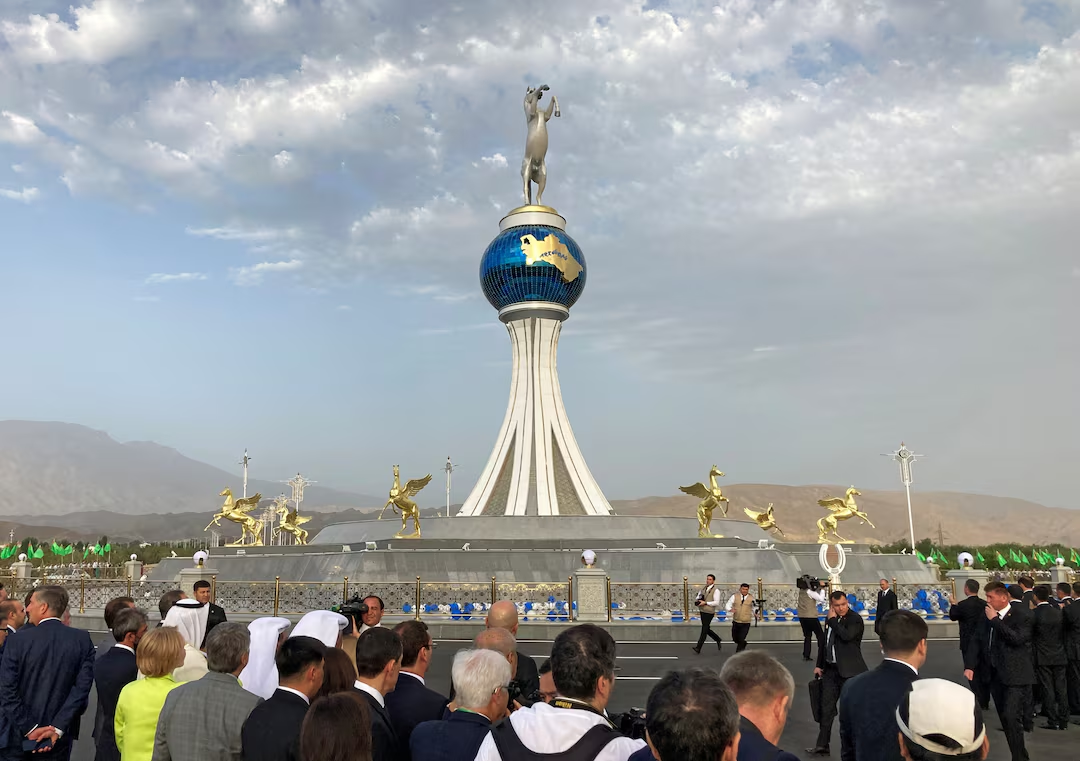
Digital asset adoption continues to grow after Turkmenistan announced plans to legally accommodate cryptocurrency operations from 2026. Following this move, the Central Asian nation joins the expanding list of countries opting for regulation in the crypto industry against an outright ban.

Turkmenistan Explores Crypto Amid Economy DiversificationΒ 

On Friday, Reuters reported that President Serdar Berdymukhamedov of Turkmenistan signed a new law that will permit registration of crypto exchanges and crypto mining companies from January 1, 2026.Β 

Notably, this development appears to represent part of the state government’s recent efforts to diversify its economy beyond gas exports, following Turkmenistan’s status as the nation with fourth fourth-largest gas reserves. Reuters also confirmed the government’s motive behind its new regulation, stating an intent to drive investment and speed up digitalization.Β 

While there are no official data on the level of crypto ownership in Turkmenistan, citizens’ ability to purchase digital assets using credit/debit cards, as well as the existence of Bitcoin ATMs, indicate significant traction requiring legalization. In particular, local Kyrgyzstan media states the new regulations signed by President Berdymukhamedov assert the legal status of cryptocurrencies as civil assets but with no economic power to serve as currency or means of payment.Β 

Furthermore, all licensed crypto exchanges are mandated to ensure the protection of users’ data and deposits. Meanwhile, mining operations can be performed by both individuals and local businesses following approval and registration with the recognized state authority.Β Other aspects of Turkmenistan’s crypto regime cover specific definitions of terms, and operations center around offering, transfer, issuance, and storage.

Crypto Adoption Surges In Central Asia

Beyond Turkmenistan, other nations in Central Asia, including Kazakhstan and Uzbekistan, are also ramping up crypto regulatory efforts to create an enabling environment for digital assets adoption. Notably, Uzbekistan has completed legal preparations to formally adopt stablecoins for payments in 2026, while also permitting the trading of tokenized stocks on licensed exchanges.Β 

Meanwhile, Bitcoinist reported that Kazakhstan has recently allocated $500 million – $1 billion for a national reserve fund with a potential launch slated for 2026. In addition, the former soviet state also introduced a national stablecoin, KZTx, in collaboration with the world’s biggest exchange, Binance.Β 

Taken together, these crypto-friendly moves show that Central Asian nations are doubling down on blockchain and digital assets as an emerging pillar of the global financial sector.Β 

According to data from CoinMarketCap, the total crypto market cap is now valued at $3.05 trillion following a modest rebound in the last week after an extended correction that began in early October.Β 

Turkmenistan

Russians Offered Ready-made Crypto Exchange Accounts Amid Restrictions

Russians Offered Ready-made Crypto Exchange Accounts Amid Restrictions

Russian crypto traders have been looking to obtain unrestricted accounts for global exchanges as their access to such platforms is limited. Over the past year, the offering of such accounts on the dark web has increased significantly, cybersecurity experts told the Russian press.

Supply of Crypto Exchange Accounts for Russian Users Doubles in a Year of Sanctions

More and more ready-to-use accounts for cryptocurrency exchanges are being sold to Russian residents. While this is not a new phenomenon β€” such accounts are often employed by fraudsters and money launderers β€” the current growth in supply has been attributed to the restrictions imposed by the trading platforms on customers from Russia, as a result of compliance with sanctions over the war in Ukraine.

Russian residents have been buying these accounts despite the dangers, including the risk that whoever created them could maintain access after the sale, the Kommersant reported. But they are inexpensive and offers on darknet markets have doubled since early 2022, Nikolay Chursin from the Positive Technologies information security threat analysis group told the business daily.

According to Peter Mareichev, an analyst at Kaspersky Digital Footprint Intelligence, the number of new ads for ready-made and verified wallets on various exchanges reached 400 in December. Proposals to prepare fake documents for passing know-your-customer procedures also rose, the newspaper revealed in an earlier article last month.

Simple login data, username and password, is typically priced at around $50, Chursin added. And for a fully set up account, including the documents with which it was registered, a buyer would have to pay an average of $300. Dmitry Bogachev from digital threat analysis firm Jet Infosystems explained that the price depends on factors such as the country and date of registration as well as the activity history. Older accounts are more expensive.

Sergey Mendeleev, CEO of defi banking platform Indefibank, pointed out that there are two categories of buyers β€” Russians that have no other choice as they need an account for everyday work and those who use these accounts for criminal purposes. Igor Sergienko, director of development at cybersecurity services provider RTK-Solar, is convinced that demand is largely due to crypto exchanges blocking Russian accounts or withdrawals to Russian bank cards in recent months.

Major crypto service providers, including leading digital asset exchanges, have complied with financial restrictions introduced by the West in response to Russia’s invasion of Ukraine. Last year, the world’s largest crypto trading platform, Binance, indicated that, while restricting sanctioned individuals and entities, it was not banning all Russians.

However, since the end of 2022, a number of Russian users of Binance have complained about having their accounts blocked without explanation, as reported by Forklog. Many experienced problems for weeks, including suspended withdrawals amid prolonged checks, affected customers said. The company told the crypto news outlet that the blocking of users from Eastern Europe and the Commonwealth of Independent States was related to the case with the seized crypto exchange Bitzlato.

Do you think the restrictions will push more Russians towards buying ready-made accounts for cryptocurrency exchanges? Share your thoughts on the subject in the comments section below.

❌