Reading view

There are new articles available, click to refresh the page.

$62,000 Ethereum? Tom Lee Revives Bullish Call For 2026

Tom Lee has reiterated one of the most aggressive Ethereum targets in the market, telling attendees at Binance Blockchain Week on 4 December that ETH could eventually trade at $62,000 as it becomes the core infrastructure for tokenized finance.

“Okay, so let me explain to you why Ethereum, now that we’ve talked about crypto, […] is the future of finance,” Lee said on stage. He framed 2025 as Ethereum’s “1971 moment,” drawing a direct analogy to when the US dollar left the gold standard and triggered a wave of financial innovation.

Lee’s Thesis For Ethereum

“In 1971, the dollar went off the gold standard. And in 1971, it galvanized Wall Street to create financial products to make sure the dollar would be the reserve currency,” Lee argued. “Well, in 2025, we’re tokenizing everything. So it’s not just the dollar that’s getting tokenized, but it’s stocks, bonds, real estate.”

In his view, this shift positions ETH as the primary settlement and execution layer for tokenized assets. “Wall Street is, again, going to take advantage of that and create products onto a smart contract platform. And where they’re building this is on Ethereum,” he said. Lee pointed to current real-world asset experiments as early evidence, noting that “the majority of this, the vast majority, is being built on Ethereum,” and adding that “Ethereum has won the smart contract war.”

Lee also stressed that ETH’s market behavior has not yet reflected that structural role. “As you know, ETH has been range bound for five years, as I’ve shaded here. But it’s begun to break out,” he told the audience, explaining why he “got very involved with Ethereum by turning Bitmine into an ETH treasury company, because we saw this breakout coming.”

The core of his valuation case is expressed through the ETH/BTC ratio. Lee expects Bitcoin to move sharply higher in the near term: “I think Bitcoin is going to get to $250,000 within a few months.” From there, he derives two key ETH scenarios.

First, if the ETH/BTC price relationship simply reverts to its historical mean, he sees substantial upside. “If ETH price ratio to Bitcoin gets back to its eight year average, that’s $12,000 for Ethereum,” he said. Second, in a more aggressive case where ETH appreciates to a quarter of Bitcoin’s price, his long-standing $62,000 target emerges: “If it gets to 0.25 relative to Bitcoin, that’s $62,000.”

🔥 TOM LEE CALLS FOR $62,000 $ETH

“I think Ethereum’s going to become the future of finance, the payment rails of the future and if it gets to .25 relative to Bitcoin that’s $62,000. Ethereum at $3,000 is grossly undervalued.” pic.twitter.com/VydvLou9IE

— CryptosRus (@CryptosR_Us) December 4, 2025

Lee links these ratios directly to the tokenization narrative. “If 2026 is about tokenization, that means Ether’s utility value should be rising. Therefore, you should watch this ratio,” he told the crowd, arguing that valuation should track growing demand for ETH blockspace and its role as “the payment rails of the future.”

He concluded with a pointed assessment of current levels: “I think Ethereum at $3,000, of course, is grossly undervalued.”

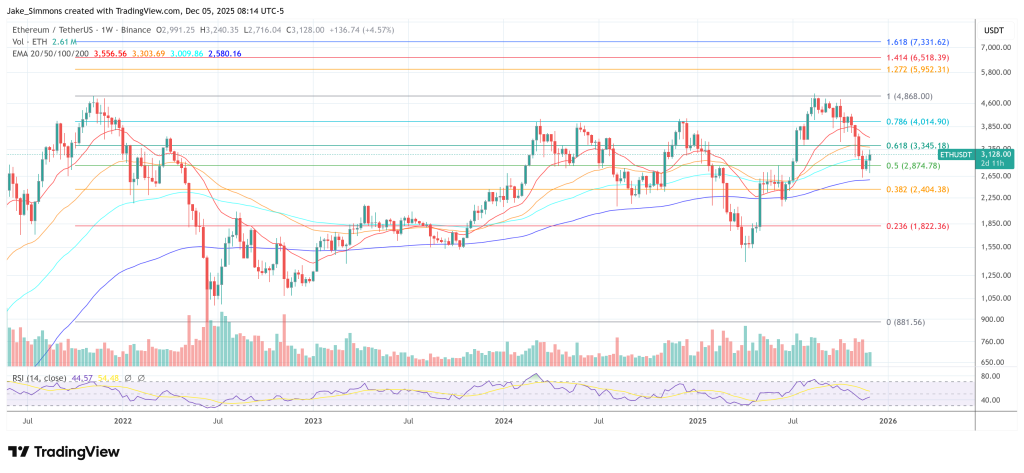
At press time, ETH traded at $3,128.
Ethereum price

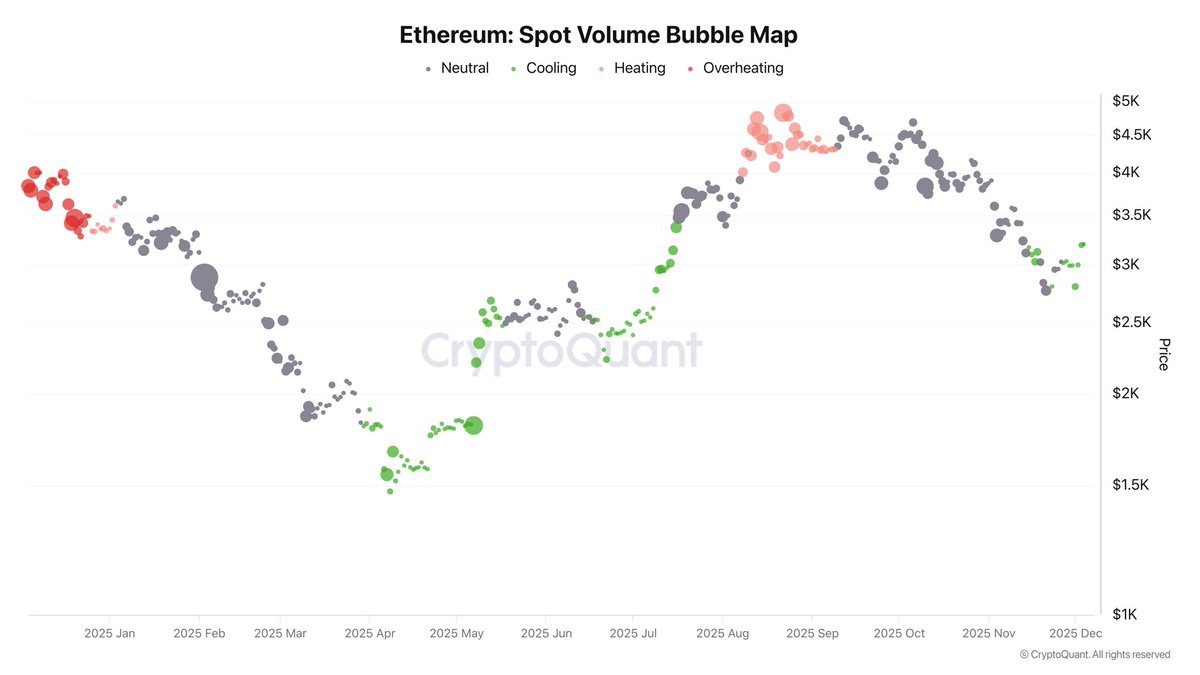
Ethereum Spot Volume Weakens As Futures Take Control Of Price Direction

Ethereum has retraced from the $3,240 level and is now testing the $3,150 zone as support, a key area that traders are closely watching. Bulls are attempting to defend this level after a modest rebound, but uncertainty remains high as the market tries to establish direction following weeks of volatility and aggressive selling pressure. While some analysts view this consolidation as the early stages of a recovery, others warn that ETH may still be vulnerable to deeper pullbacks if momentum fails to strengthen.

According to top analyst Darkfost, Ethereum’s recent price action is being shaped by a notable shift in market structure. Over the past few days, spot volumes have continued to decline, even as the price attempted a small recovery. This weakening in spot activity reduces the impact of actual buying and selling on the underlying asset, making futures markets increasingly influential in dictating short-term price direction.

As Darkfost explains, when spot volume thins out, futures often become the dominant driver of volatility. This dynamic can accelerate both upside and downside moves, depending on traders’ positioning. With Ethereum now sitting at a critical support level, the market awaits clearer signals to determine whether this rebound can evolve into a sustained recovery or merely represents a temporary pause in the downtrend.

Futures-Driven Momentum Raises the Stakes for Ethereum

Darkfost expands on this dynamic by noting that when spot volumes weaken to the extent seen over the past few days, the risk of heightened volatility increases sharply. Thin spot liquidity means fewer buy and sell orders are available to absorb sudden moves, allowing futures-driven momentum to exert an outsized influence on price. This environment often produces sharper swings and rapid directional shifts, as leveraged traders and algorithmic strategies dominate short-term market behavior.

Ethereum Spot Volume Bubble Map | Source: CryptoQuant

For now, the futures market is tilting upward, providing a constructive force that is helping Ethereum hold above the $3,150 support zone. Darkfost emphasizes that this upward pressure from futures could work in the bulls’ favor, as volatility—if it expands to the upside—may push the spot market to follow the same trajectory.

In other words, a sustained futures-led rebound could act as the spark needed for a broader recovery, especially if spot buyers gain confidence and begin re-entering the market.

However, this setup cuts both ways. Without stronger spot participation, any reversal in futures positioning could quickly translate into accelerated downside pressure. For now, Ethereum sits in a delicate phase where volatility is both a potential catalyst and a potential threat, making the next few sessions crucial for determining the market’s short-term direction.

ETH Weekly Structure Holds Key Support

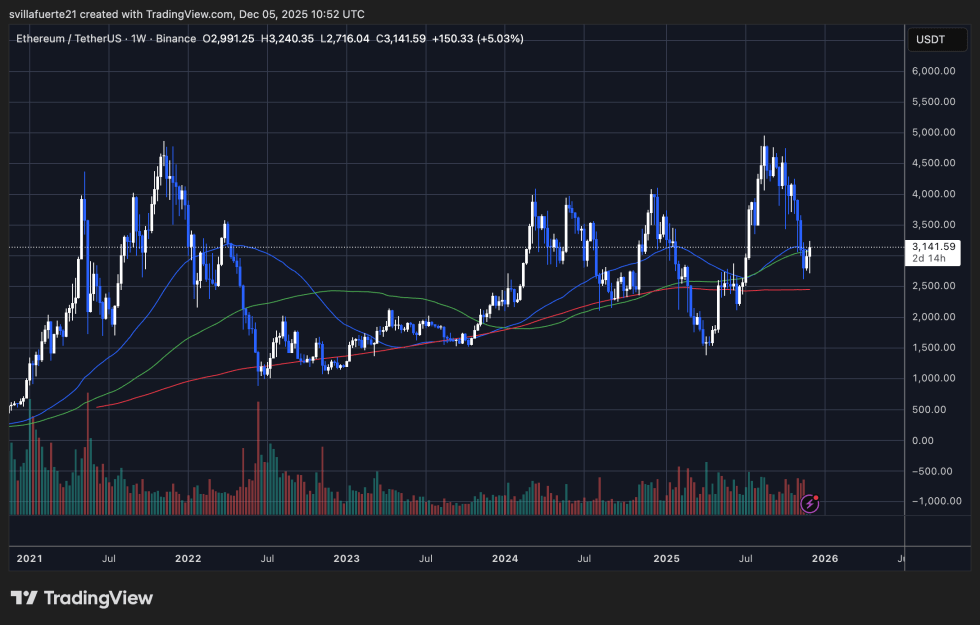
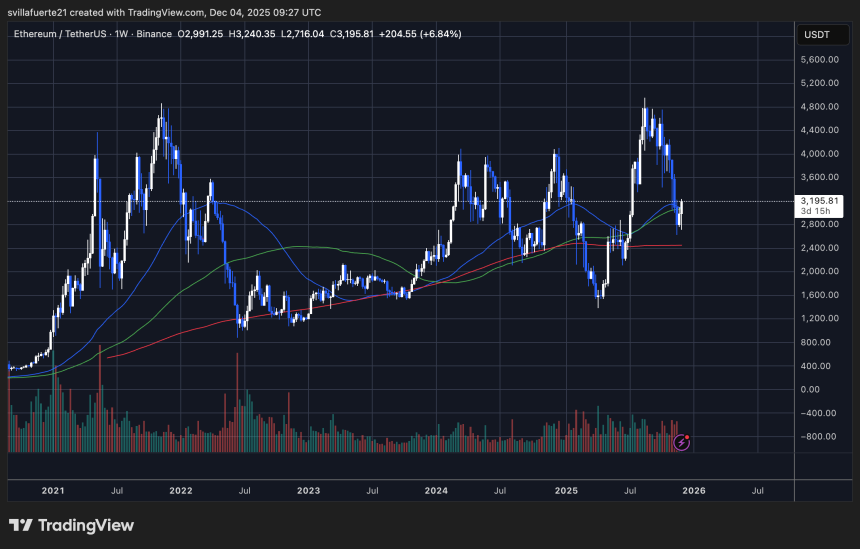
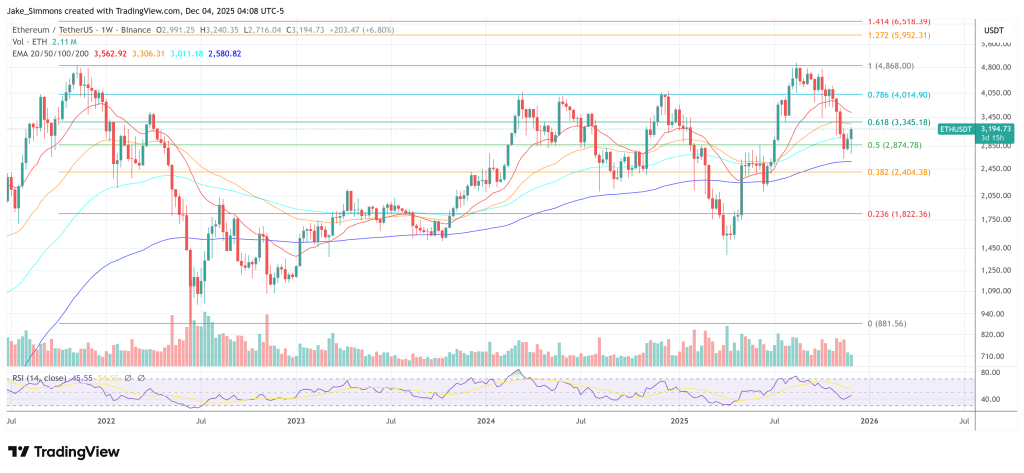
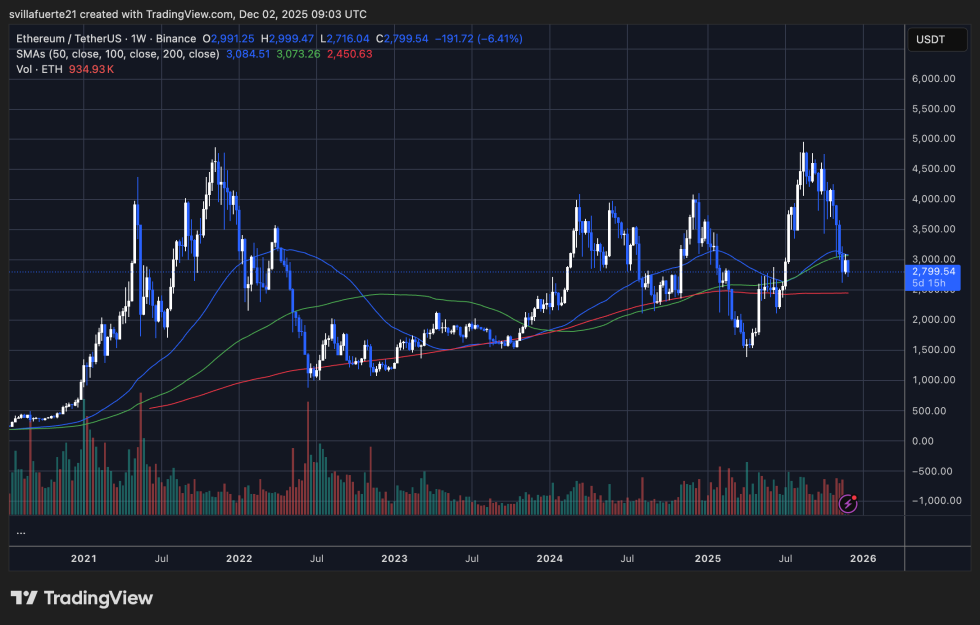
Ethereum’s weekly chart shows a market attempting to stabilize after a steep downturn from the $4,500 region. ETH has rebounded toward $3,140, reclaiming its 100-week moving average (green line) — a historically important support level that often defines the boundary between mid-term bullish and bearish phases. This bounce signals renewed demand at a critical zone, especially after the strong wick rejection seen near $2,700, where buyers stepped in aggressively.

ETH consolidates around key level | Source: ETHUSDT chart on TradingView

However, Ethereum still faces meaningful resistance overhead. The 50-week moving average (blue line), now hovering near $3,400–$3,500, has flipped into resistance and remains the next major hurdle for bulls. A successful reclaim of this zone would materially improve ETH’s technical structure and open the door to a challenge of higher levels. Until then, the weekly trend remains neutral to slightly bearish.

Volume offers an encouraging signal: the recent rebound occurred with a noticeable uptick in buying activity compared to prior weeks, suggesting strengthened interest at these lower levels. Yet the broader structure shows a pattern of lower highs since August, meaning ETH must demonstrate follow-through to avoid slipping back into deeper consolidation.

Featured image from ChatGPT, chart from TradingView.com

Ethereum Shows Signs Of Accumulation As CVD Strengthens And Correlation Stays Elevated

Ethereum is holding firmly above the $3,150 level as the market shifts into a more bullish phase after enduring weeks of heavy selling pressure and fear-driven liquidation. The recovery has sparked debate among analysts: some view the bounce as nothing more than a relief rally within a broader bearish trend, while others believe Ethereum may be building the foundation for a more sustained rebound.

A new CryptoQuant report offers one of the clearest insights. According to Ethereum data on Binance, the past several weeks have shown heightened volatility in the Cumulative Volume Delta (CVD) — a metric that tracks real-time buying and selling pressure. This volatility reflects sharp, rapid shifts in trader behavior as the market attempts to stabilize.

Although Ethereum remains in a downtrend from its August peak, recent CVD spikes point to the return of notable buying activity. However, the report emphasizes that these bursts of demand are sporadic and lack the sustained strength needed to confirm a full bullish reversal.

CVD Volatility Highlights Ongoing Battle Between Buyers and Sellers

According to the Arab Chain report, Ethereum’s CVD recently turned positive, coinciding with the price’s attempt to stabilize above the $3,100 level. This shift indicates fresh liquidity entering the market through short-term buy orders, suggesting that some traders are stepping in to accumulate during dips.

However, the sudden spikes and rapid pullbacks within the CVD reveal that the market remains locked in a strong tug-of-war between buyers and sellers. This volatility underscores the fact that Ethereum has not yet reached either temporal stability or a clear structural trend.

Binance Ethereum CVD Momentum & Price Correlation | Source: CryptoQuant

The report also highlights the importance of the 30-day correlation between price and CVD, which has held steady at around 0.6 despite lower price levels. This relatively high reading shows that liquidity flows continue to influence Ethereum’s price direction in a meaningful and consistent way. Even though buying pressure appears irregular, its recurring impact on price suggests that traders are still actively responding to market conditions.

Overall, this pattern reflects investors attempting to capitalize on volatility, especially as anticipation grows around potential liquidity inflows tied to upcoming network upgrades. Yet, Arab Chain stresses that without a more sustained accumulation phase and reduced short-term selling, Ethereum may struggle to generate a decisive upward movement.

Ethereum Attempts a Recovery but Faces Key Resistance

Ethereum’s latest price action shows a cautious recovery as ETH climbs back above the $3,150 level, but the chart reveals that the broader structure remains fragile. After a steep decline from the October highs near $4,500, ETH found support slightly above $2,700, where buyers stepped back in with increased volume—visible in the recent surge of green candles at the bottom of the chart. This reaction suggests renewed interest at lower levels, but not yet a decisive shift in trend.

ETH testing key resistance | Source: ETHUSDT chart on TradingView

The price is now pressing against the 100-day SMA (red line), a level that previously acted as support and has now flipped into resistance. Reclaiming this line would be an important step toward restoring bullish momentum. Above it, ETH faces another barrier at the 50-day SMA (blue line), which continues to slope downward, reflecting ongoing medium-term selling pressure.

Despite the rebound, volume remains inconsistent, indicating hesitation among market participants. ETH will need stronger follow-through buying to challenge the next resistance zone around $3,300–$3,350, a region aligned with previous breakdown levels.

Featured image from ChatGPT, chart from TradingView.com

Ethereum Bug Nearly Triggers Network Crisis After Fusaka Upgrade

Ethereum’s Fusaka upgrade executed flawlessly on December 4, 2025, marking a historic milestone as the network achieved zero downtime while implementing its most significant expansion of data availability since EIP-4844.

However, within hours of activation, a critical bug in the Prysm consensus client threatened network stability, causing validation issues that slowed block finalization before client diversity safeguards prevented a potential crisis.

The incident unfolded as Prysm nodes experienced denial-of-service-like conditions triggered by excessive historical state generation.

Prysm core developer Terence Tsao explained that “historical state generation is compute and memory heavy, and a node can be dos’ed by a large number heavy, and a node can be dos’ed by a large number of state replays happening in parallel.

To shine more light on this, historical state generation is compute and memory heavy, and a node can be dos'ed by a large number of state replays happening in parallel. over the past two hours we’ve seen a spike in stale attestations targeting checkpoint roots from off slots… https://t.co/lnNtD05Tuc

— terence (@terencechain) December 4, 2025

Over two hours, a spike in stale attestations targeting checkpoint roots from off-slots forced affected nodes to reconstruct historical states, pushing systems into compromised operating conditions.

The Ethereum Foundation quickly issued emergency guidance, while ten other consensus clients maintained network operations, preventing any service disruption.

Client Diversity Proves Its Value During Crisis

While Prysm operators scrambled to implement the emergency workaround flag –disable-last-epoch-targets, alternative clients, including Lighthouse, Teku, Nimbus, and Lodestar, continued validating blocks without interruption.

The network maintained consensus throughout the incident, with finalization continuing despite affected validators experiencing participation issues.

Lido Finance reported minimal impact compared to other staking solutions, attributing its resilience to distributed validator operations where Prysm powers approximately 15% of node operators.

Following yesterday’s successful Fusaka hardfork, a Prysm Consensus Layer client bug caused network-wide participation issues.

The Lido protocol continues to operate normally and there is no cause for concern for stakers.

Lido was less affected by this incident than other…

— Lido (@LidoFinance) December 4, 2025

The protocol’s Q3 2025 metrics demonstrate balanced client usage as a deliberate strategy to mitigate single-client failure risks.

Most Lido-operated Prysm setups recovered within hours after applying the recommended configuration changes or temporarily switching to alternative clients.

The incident reinforced long-standing arguments for client diversity as Ethereum’s primary defense against consensus failures.

Developer Kydo captured the significance, noting that the upgrade simultaneously reinforced four critical narratives:

  • Zero-downtime operations
  • Layer-2 scaling capability through PeerDAS activation
  • Client diversity protection
  • Revenue-generating potential.

Ethereum briefly hit $3.2 billion annual run rate during the incident as blob fee mechanisms adjusted to new pricing parameters.

PeerDAS and Blob Scaling Transform Data Availability

Beyond the Prysm incident, Fusaka delivered transformative upgrades to Ethereum’s data layer through the PeerDAS implementation and the Blob Parameter Only (BPO) fork mechanism.

PeerDAS introduced data availability sampling, enabling nodes to store only 1/8 of the blob data while maintaining security guarantees.

This architectural shift enables throughput increases up to 8x current capacity while keeping hardware requirements manageable for independent operators.

Vitalik Buterin emphasized the upgrade’s historical significance, stating, “PeerDAS in Fusaka is significant because it literally is sharding.

He celebrated the achievement as a dream dating back to 2015, noting “Ethereum is coming to consensus on blocks without requiring any single node to see more than a tiny fraction of the data.

PeerDAS in Fusaka is significant because it literally is sharding.

Ethereum is coming to consensus on blocks without requiring any single node to see more than a tiny fraction of the data. And this is robust to 51% attacks – it's client-side probabilistic verification, not… pic.twitter.com/OK81xBteER

— vitalik.eth (@VitalikButerin) December 3, 2025

The implementation represents a breakthrough first proposed in 2017, though Buterin acknowledged remaining challenges, including distributed block building and sharded mempool development.

The BPO mechanism enables Ethereum to increase blob capacity between major upgrades rather than waiting for coordinated hard forks.

Fusaka maintains the current 6-blob target initially, but scheduled adjustments will raise limits to 10/15 on December 9, 2025, and 14/21 on January 7, 2026.

This addresses mounting pressure as layer-2 demand pushed Ethereum’s blob capacity toward saturation throughout 2024.

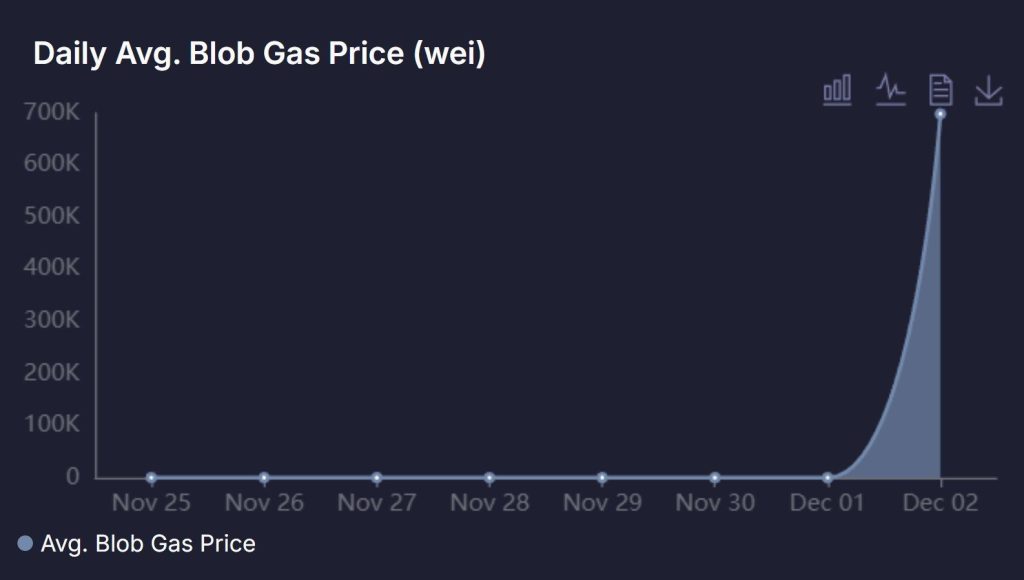
EIP-7918 ties blob base fees to execution costs, preventing market collapse. Blob fees jumped 1,500x immediately after activation, rising from 1 wei to 1,500 wei.

Daily Average Blob Gas Price after Ethereum Bug Fusaka Upgrade
Source: X/@jarrodwatts

Developer Kydo explained this increase “restores a functioning fee market for blobs, so the protocol can actually use price to steer blob demand instead of being stuck at 1 wei.

The change ensures that layer-2 operators pay meaningful costs for the computational resources their operations impose on network nodes.

Notably, Matt Hougan, CIO at Bitwise, also praised the momentum, noting, “Ethereum delivering two major upgrades in one year is impressive. The giant is awake and doing the right things.

Ethereum delivering two major upgrades in one year is impressive. The giant is awake and doing the right things:

* Shipping fast
* Improving throughput
* Improving UX
* Improving value capture

— Matt Hougan (@Matt_Hougan) December 4, 2025

Among major L2s, according to information shared with Cryptonews, Optimism has announced plans to adopt Fusaka features into the OP Stack in early 2026, with Base, Soneium, and other layer-2 teams contributing to testing throughout development.

The post Ethereum Bug Nearly Triggers Network Crisis After Fusaka Upgrade appeared first on Cryptonews.

Ethereum Coils For A Breakout As IH&S + Heavy Accumulation Emerges

Ethereum is approaching a critical moment as multiple bullish signals begin to align. A clear Inverse Head & Shoulders formation, combined with rising accumulation and weakening trend rejection, suggests that the market may be gearing up for a powerful upside move. With momentum tightening and key levels coming into focus, ETH now stands on the verge of a breakout that could set the stage for its next major rally.

Inverse Head And Shoulders Signals Brewing Momentum

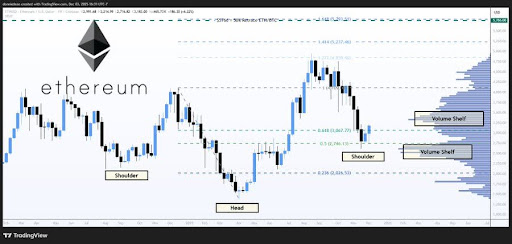
According to a recent update shared by crypto analyst Donald Dean, Ethereum may be gearing up for a significant move. He highlighted the development of a potential inverse head and shoulders pattern, a classic bullish reversal formation that often precedes strong upward momentum. This emerging structure suggests that ETH could soon shift into a more aggressive bullish phase if confirmed.

Dean also pointed out that the weekly chart is showing solid support near the 50% Fibonacci retracement level, positioned around $2,750. Adding to the bullish signals, a hammer candle has appeared on the weekly timeframe, hinting at buying pressure stepping back in after recent downside movement.

Ethereum

If the pattern plays out, Dean noted that Ethereum’s first major target lies at $4,109, a level that would allow ETH to challenge previous resistance/support zones. Reclaiming this region would mark a meaningful shift in momentum and strengthen the bullish outlook for the asset.

Beyond that, the next upside target sits near $5,766, which aligns closely with the 1.618 Golden Ratio extension calculated at approximately $5,793.51. Dean described this confluence as particularly noteworthy, suggesting that if Ethereum breaks above its nearer targets, a larger rally toward this golden-ratio level becomes a realistic possibility.

Growing Accumulation Suggests Bulls Are Preparing For Action

In an earlier analysis, LSTRADER reminded followers of the impressive move from $1,600 to $4,800, noting that this surge had been identified in advance through both the ETH chart and the ETH/BTC setup. The analysis captured the momentum shift that preceded the rally, reinforcing the value of tracking key structural signals.

In the current market structure, LSTRADER noted that the chart clearly shows multiple instances where the trend faced rejection. Despite these rejections, the trend is steadily losing strength while accumulation continues to build, a combination that typically reflects growing bullish interest and the potential for an upward breakout.

However, LSTRADER stressed that no major move should be assumed until the trendline itself is broken, and confirmation is still required. For now, patience is key as traders continue monitoring the structure and waiting for a decisive shift in trend direction.

Ethereum

Ethereum NUPL Holds Steady, Signaling Market Balance Amid Volatility

Ethereum is demonstrating notable relative strength after reclaiming the $3,150 level and attempting to push higher, offering a refreshing shift in sentiment following weeks of intense selling pressure, fear, and market-wide uncertainty. As the broader crypto landscape begins to stabilize, ETH stands out as one of the assets showing early signs of recovery, drawing renewed attention from traders and long-term investors alike.

A key factor supporting this shift is the Net Unrealized Profit/Loss (NUPL) reading for Ethereum on Binance, which is currently sitting around 0.22 while price trades near $3,100.

This level reflects a delicate equilibrium between fear and optimism, indicating that a significant portion of ETH holders remain in moderate profit. Importantly, NUPL has not yet moved into the “greed” zone typically seen in the late stages of a bullish cycle, suggesting that the market is far from overheated.

Instead, Ethereum appears to be transitioning into a more neutral, constructive phase where investors are cautiously optimistic but not excessively euphoric. This balance often forms the foundation for a healthier recovery, especially after a deep correction. If momentum continues building and NUPL remains stable or trends higher, ETH could be positioning itself for a stronger upside move in the coming weeks.

NUPL Signals a Transitional Market Phase

Arab Chain notes that Ethereum’s NUPL index experienced a significant rise between June and August, reaching levels far higher than today and reflecting strong profitability across the network during mid-2025. At that time, investor sentiment leaned toward optimism, supported by rising prices and improving macro conditions.

Ethereum Net Unrealized Profit and Loss | Source: CryptoQuant

However, as Ethereum’s price began to decline steadily from October onward, unrealized profits started to shrink. This pushed NUPL down toward more neutral territory, signaling a shift in sentiment from elevated optimism to a more grounded, cautious outlook.

Crucially, NUPL has not fallen into negative territory, meaning the average ETH holder has not transitioned into unrealized losses. This is an important sign of underlying market strength. When investors remain in profit, they tend to be less motivated to sell aggressively at lower prices, reducing the risk of panic-driven capitulation and helping stabilize price action during corrections.

Taken together, these signals indicate that Ethereum is currently in a transitional phase. The market is neither euphoric nor fearful—rather, it is waiting for a decisive catalyst to define the next trend. As long as NUPL stays above 0.20, Ethereum retains a meaningful level of investor confidence, increasing the likelihood of a rebound if liquidity strengthens or positive fundamental developments emerge.

ETH Rebounds Strongly on the Weekly Chart

Ethereum’s weekly chart shows a powerful rebound as price surges back above the $3,150–$3,200 region, reclaiming a critical support band that had turned into resistance during the November sell-off. The long lower wick from last week’s candle confirms strong buy-side interest around the $2,700–$2,800 zone, an area that has historically acted as a major demand region during multi-month corrections.

ETH consolidates above key level | Source: ETHUSDT Chart on TradingView

ETH has now reclaimed the 100-week SMA, a key trend indicator currently positioned near $2,900, signaling renewed structural stability. The 200-week SMA, sitting comfortably lower, continues to reinforce the long-term uptrend. However, the 50-week SMA, which has flattened and now looms around the $3,350–$3,400 level, represents the next significant resistance level. ETH will need a decisive weekly close above this moving average to confirm a true shift back into bullish momentum.

Volume on the rebound is notably stronger than in previous consolidation phases, suggesting increased participation and growing confidence among market participants. However, ETH is not yet in the clear. The series of lower highs since the September peak forms a descending structure that must be broken for a sustained uptrend to resume.

Featured image from ChatGPT, chart from TradingView.com

Ethereum Whale Redistribution Continues: Moves 5,000 ETH As Price Reclaims $3K Level

Ethereum is showing notable relative strength as it reclaims the $3,150 level and attempts to push higher, signaling early signs of recovery after weeks dominated by heavy selling pressure, fear, and uncertainty. The broader market rebound has helped restore confidence, but ETH’s ability to outperform key altcoins highlights growing demand and improved sentiment around the asset.

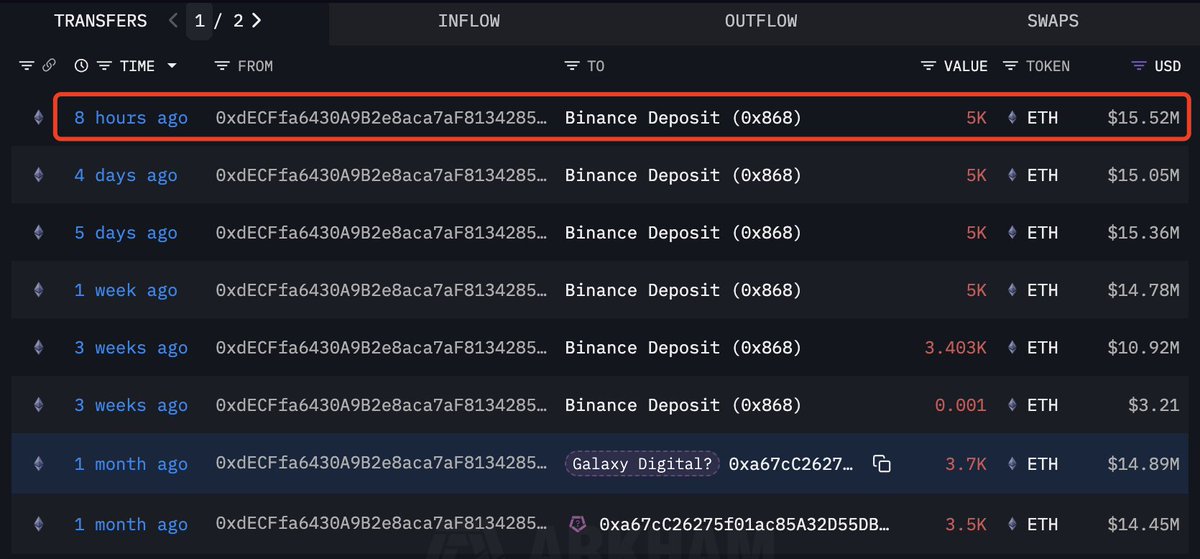
Adding to the renewed optimism, fresh on-chain data from Lookonchain reveals a significant move from one of the market’s most recognized whales. During the rebound, whale 0xdECF deposited another 5,000 ETH—worth approximately $15.52 million—into Binance.

This wallet has become well-known for sending large batches of ETH to exchanges throughout the recent downturn, often coinciding with moments of heightened volatility and capitulation.

Its latest deposit suggests that the whale remains highly active and responsive to market conditions. While such movements can sometimes introduce uncertainty, they also highlight increasing liquidity and engagement from major holders. With price reclaiming key levels and whales repositioning, Ethereum enters a critical phase where sustained strength could confirm a broader shift in market structure.

Ethereum Whale Distribution Highlights Market Caution

According to Lookonchain, whale 0xdECF has sold 25,603 ETH—valued at approximately $85.44 million—across Binance and Galaxy Digital since October 28. Despite this substantial distribution, the wallet still holds 5,000 ETH (around $15.52 million), suggesting that the whale has not fully exited its position but has significantly reduced exposure during the recent market decline.
Ethereum Whale Transfers | Source: Lookonchain

This pattern of behavior provides important insight into sentiment among large holders: while they are not abandoning Ethereum entirely, they are actively managing risk and responding to volatility more aggressively than usual.

Such persistent selling pressure from a large wallet often acts as a drag on price during periods of weakness, especially when market liquidity is thin. However, the fact that the whale continues to retain a meaningful position indicates an expectation of potential recovery—or at least a desire to remain strategically exposed to future upside.

Ethereum now finds itself in a critical phase. The asset has reclaimed key levels, but its mid-term structure remains highly sensitive to macro conditions and whale behavior. If selling from major holders slows and accumulation begins to outpace distribution, the recent rebound could solidify into a sustained trend. Otherwise, renewed sell flows could place Ethereum at risk of revisiting lower support zones.

ETH Reclaims Short-Term Momentum but Faces Heavy Resistance

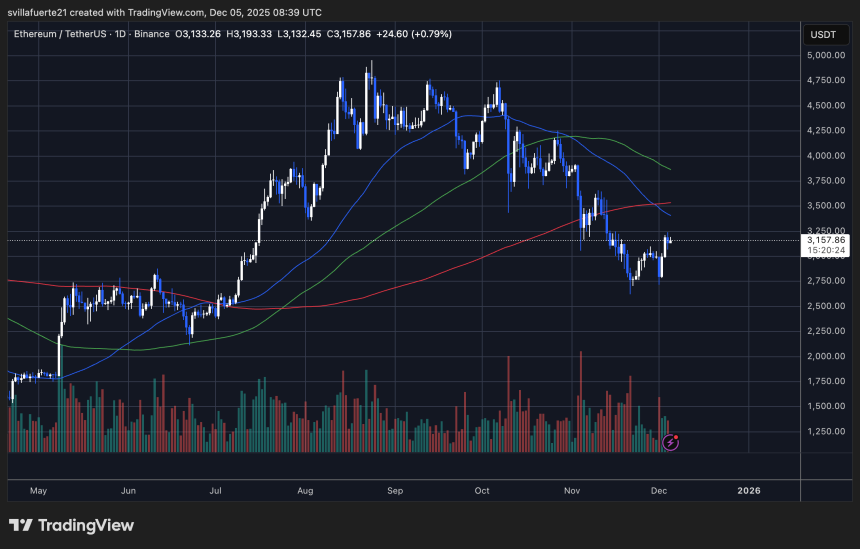
Ethereum’s daily chart shows a clear improvement in momentum after reclaiming the $3,150–$3,200 region, but the broader structure remains fragile. The bounce from the $2,750–$2,850 support zone marked a decisive shift in buyer behavior, with strong lower wicks indicating aggressive demand. This rebound has pushed ETH back above key short-term levels, yet the asset still faces a challenging path forward.

ETH testing critical supply level | Source: ETHUSDT chart on TradingView

Price is now approaching the 50-day SMA, currently sloping downward just above $3,250, which now acts as immediate resistance. This moving average has capped every rally since late October and remains the first major barrier for bulls to reclaim. Beyond it, the 100-day SMA around $3,450 and the 200-day SMA near $3,600 form a tight cluster of overhead resistance that defines the medium-term downtrend.

Volume on the recent bounce is stronger than previous attempts, signaling that buyers are showing more conviction compared to the mid-November attempts to recover. However, the overall trend still leans bearish until ETH can break above the 50-day SMA and begin closing daily candles over $3,300.

Ethereum sits in a critical inflection zone: holding above $3,100 strengthens the case for continued recovery, while rejection from the $3,250–$3,300 band could trigger another retest of the $2,800 region. The next few sessions will determine whether this rebound evolves into a deeper trend reversal.

Featured image from ChatGPT, chart from TradingView.com

Ethereum Fusaka Is Live: Buterin Explains Why It Is ‘Significant’

Ethereum’s Fusaka upgrade is now live on mainnet, marking a major structural change in how the network handles data and scaling. The upgrade was activated at epoch 411392 at 21:49:11 UTC, with the official Ethereum account first signalling “upgrade in progress . . . activating Fusaka @ epoch 411392 // 21:49:11 UTC” and then confirming that “Fusaka is live on Ethereum mainnet!”

In its announcement, the account highlighted three core elements of Fusaka. PeerDAS “now unlocks 8x data throughput for rollups,” substantially expanding the amount of data that rollup-based layer 2 networks can publish to the network. The upgrade also introduces “UX improvements via the R1 curve & pre-confirmations,” and is described as explicit “prep for scaling the L1 with gas limit increase & more.” The project added that community members and core developers will “continue to monitor for issues over the next 24 hrs.”

Why Fusaka Is ‘Significant’ For Ethereum

Vitalik Buterin framed the core of the upgrade in unusually direct terms. “PeerDAS in Fusaka is significant because it literally is sharding,” he wrote. “Ethereum is coming to consensus on blocks without requiring any single node to see more than a tiny fraction of the data. And this is robust to 51% attacks – it’s client-side probabilistic verification, not validator voting.” In other words, the network can now agree on blocks even though no node has to download all of the associated data, relying instead on probabilistic verification on the client side.

Buterin tied this to a long-running research line, noting that “sharding has been a dream for Ethereum since 2015, and data availability sampling since 2017,” and linking back to early research work on data availability and erasure coding. With Fusaka, that architecture is no longer just a roadmap concept but a live mechanism securing Ethereum’s data layer.

At the same time, Buterin was clear that Fusaka does not complete the sharding roadmap. He stressed that “there are three ways that the sharding in Fusaka is incomplete.” First, he argued that “we can process O(c^2) transactions (where c is the per-node compute) on L2s, but not on the ethereum L1,” adding that “if we want to scaling to benefit the ethereum L1 as well, beyond what we can get by constant-factor upgrades like BAL and ePBS, we need mature ZK-EVMs.”

Second, he pointed to the “proposer/builder bottleneck,” where “the builder needs to have the whole data and build the whole block,” and said “it would be amazing to have distributed block building.” Third, he noted bluntly: “We don’t have a sharded mempool. We still need that.”

Despite those caveats, Buterin called Fusaka “a fundamental step forward in blockchain design.” He argued that “the next two years will give us time to refine the PeerDAS mechanism, carefully increase its scale while we continue to ensure its stability, use it to scale L2s, and then when ZK-EVMs are mature, turn it inwards to scale ethereum L1 gas as well.”

He closed by sending “big congrats to the Ethereum researchers and core devs who worked hard for years to make this happen,” underscoring that for the Ethereum community, Fusaka is not a routine protocol update but the arrival of a long-promised sharding era on mainnet.

At press time, ETH traded at $3,194.

Ethereum price

BitMine Adds $150M in Ether to Treasury in Fresh Accumulation Push

By: Amin Ayan

BitMine, the Ethereum-focused treasury firm led by Tom Lee, has added another $150 million worth of Ether to its balance sheet, according to on-chain data shared Wednesday by Arkham.

Key Takeaways:

  • Tom Lee–led BitMine reportedly added $150 million in ETH.
  • The company now holds over 3% of Ethereum’s supply and is openly targeting a 5% stake.
  • Tom Lee says ETH is entering a “supercycle,” citing network upgrades and a potential pivot by the Federal Reserve as catalysts.

The data shows the company received 18,345 ETH via BitGo and a further 30,278 ETH through Kraken, pointing to one of the largest single inflows into a corporate Ethereum treasury this year.

BitMine has not yet issued a formal confirmation of the transfers, though the wallet movements align with its recent buying pattern.

BitMine Builds 3% Stake in Ethereum as It Targets 5% Supply

The firm has steadily built its Ether position throughout 2025, even during November’s market pullback.

In the final week of last month alone, BitMine snapped up 96,798 ETH, lifting its holdings to more than 3% of Ethereum’s circulating supply.

Management has previously said it aims to ultimately control around 5% of all ETH, framing Ether not just as a store of value but as core infrastructure for financial markets.

TOM LEE JUST BOUGHT $150M ETH

Two fresh wallets just withdrew $92M of ETH from Kraken, and $58M from Bitgo, matching prior Bitmine purchase patterns.

Tom Lee is DCAing ETH. pic.twitter.com/uZxEnhVvzi

— Arkham (@arkham) December 3, 2025

The aggressive strategy stands out at a time when other digital asset treasuries are easing off.

Figures from Bitwise show companies bought about 370,000 ETH in November, an 81% drop from August’s peak of 1.97 million ETH.

Lee said in a Dec. 1 disclosure that several near-term developments are shaping his outlook, including Ethereum’s Fusaka upgrade and expectations that the Federal Reserve will bring its balance-sheet reduction program to an end.

Last month, Lee said Ether may be entering the early stages of the type of explosive growth cycle that propelled Bitcoin to a 100x rally since 2017.

Lee said the current Ether market resembles Bitcoin’s setup eight years ago, a period marked by deep volatility that ultimately preceded one of the strongest bull cycles in crypto history.

Lee noted that his firm first recommended Bitcoin to Fundstrat clients in 2017 when BTC traded near $1,000.

Since then, Bitcoin suffered several drawdowns of up to 75%, yet still surged more than 100-fold from that initial call.

“We believe ETH is embarking on that same Supercycle,” he wrote, arguing that Ether’s recent weakness reflects doubt, not deterioration.

BitMine Names New CEO Amid Leadership Shakeup

BitMine has also appointed a new chief executive as the company continues to build one of the largest Ether treasuries among publicly traded firms.

Last month, the company said Chi Tsang will replace Jonathan Bates as CEO, with the transition taking effect immediately.

“With its substantial Ethereum holdings and credibility with both Wall Street and the Ethereum ecosystem, BitMine is positioned to become a leading financial institution,” he said.

Alongside the leadership change, BitMine appointed three new independent board members.

The post BitMine Adds $150M in Ether to Treasury in Fresh Accumulation Push appeared first on Cryptonews.

Bitget and Chorus One expand Monad staking access in emerging markets

  • The collaboration follows the launch of the Monad mainnet in November 2025.
  • Chorus One secures more than $3.5 billion across 30 blockchains.
  • More than $6 million was staked during the first week of the programme.

Chorus One has partnered with cryptocurrency exchange Bitget to expand access to Monad staking at a global scale.

The collaboration focuses on simplifying how users interact with the Monad network, which launched its mainnet in November 2025.

The move places emphasis on infrastructure growth, user access, and the broader shift toward staking services.

Both companies confirmed that Bitget’s more than 120 million users will be able to access staking tools through Chorus One’s platform, creating new pathways for participation in the growing staking economy.

Validator expansion

The Monad network is a layer one blockchain that emphasises high throughput.

It supports Ethereum contracts without requiring any code changes, according to its technical documentation.

The focus of the integration between Bitget and Chorus One is to support a validator environment that can grow with decentralisation, geographic diversity, and long-term stability.

Chorus One already secures assets across more than 30 blockchains and reports securing over $3.5 billion in staked assets.

The platform also holds ISO 27001 certification, which is a standard used to assess security practices.

This places the partnership inside a broader trend where staking providers with stronger compliance frameworks are becoming central to blockchain infrastructure.

User access

Monad allows users to unstake assets in around 5.5 hours. Chorus One’s staking model supports flexible terms, which means both institutional and retail users on Bitget can stake or restake Monad tokens based on their preferences.

The partnership creates a direct path for Bitget users to enter the Monad ecosystem.

Within the first week of the staking programme launch, Chorus One released figures showing that more than $6 million worth of assets had been staked on the network.

The rapid participation signals interest in Monad’s performance-focused design and the integration with a major exchange ecosystem, reflecting a wider demand for accessible staking opportunities worldwide.

Market expansion

Bitget operates in several regions, including the Asia Pacific and African markets.

The platform’s presence in these regions gives the new staking programme a wider reach, especially in places where digital asset demand is growing.

Chorus One has already worked with the Avalanche Foundation to expand validator infrastructure across Africa, which positions the company to contribute to similar regional development for the Monad network.

The companies stated that the partnership aims to support cryptocurrency adoption in emerging markets by providing tools that reduce entry barriers and increase access to blockchain-based services.

With the expansion of new networks such as Monad, staking options are becoming a way for users in developing regions to take part in blockchain activity without needing a complex technical setup or advanced hardware.

The post Bitget and Chorus One expand Monad staking access in emerging markets appeared first on CoinJournal.

Ethereum Fusaka Upgrade Goes Live Today: Experts Predict Potential Supply Crunch Ahead

The highly anticipated Fusaka Upgrade for Ethereum is on the verge of going live on Wednesday, heralding significant enhancements to the network’s overall functionality. 

Analysts contend that this pivotal development could usher in a considerable supply crunch for ETH, potentially boosting its price during a challenging period for the broader cryptocurrency market.

Layer 2 Solutions To Boost ETH Burn

According to analysts at Bull Theory, the Fusaka Upgrade integrates components from previous upgrades—Osaka, Fulu, and PeerDAS—but its most impactful feature is its resolution of one of Ethereum’s biggest challenges. 

Layers 2 (L2) solutions have long utilized Ethereum’s security while contributing minimal fees back to the network. Despite L2 solutions like Base, Arbitrum, Optimism, and zkSync generating millions in fees from users, the fees recorded on Ethereum tended to diminish to nearly zero when they posted their data. 

Consequently, this meant that significant L2 activity did not result in substantial ETH being burned, even though approximately 85% of Ethereum transactions now occur on these Layer 2 solutions.

The Fusaka Upgrade fundamentally changes this dynamic. A key enhancement is EIP-7918, which mandates that Layer 2 transactions pay real fees to Ethereum. 

This adjustment ensures that every L2 transaction will contribute directly to the burning of ETH—something that was not previously guaranteed. The analysts assert that this feature represents one of the most significant value shifts since the introduction of EIP-1559.

Post-Fusaka Projections

The upgrade is further expected to broaden the scope of ETH burn from being predominantly derived from Layer 1 (L1) transactions to encompassing all L2 activity. 

Historically, most ETH burn has originated from mainnet transactions; thus, the network saw slight inflation in 2024–2025 as Layer 2s made transactions cheaper, leading to a decrease in ETH burn while staking continued to issue new ETH. 

Post-Fusaka, every L2 blob will incur a minimum cost, which will be burned. As Layer 2 adoption increases, the rate at which ETH is burned will also rise, contributing to increased scarcity of ETH.

This enhancement positions Ethereum to shift back towards deflation for the first time in several years. Currently, ETH issues around 620,000 new tokens annually for stakers while burning approximately 350,000 tokens. This results in a net slight inflation. 

However, projections following the Fusaka Upgrade, even with conservative estimates, suggest that the additional burn from L2 activity could range from 200,000 to 400,000 ETH per year. 

Combined with existing burn rates, this could bring the total to over 600,000 ETH, leading to a net neutral or slightly deflationary state for ETH. 

More bullish models predict that if L2 adoption flourishes and demand for blobs rises, burn rates could soar to between 900,000 and 1.2 million ETH annually, resulting in a supply decrease of 200,000 to 300,000 ETH each year. 

Monetary Transformation For Ethereum?

Another notable aspect of the Fusaka upgrade is PeerDAS, which enhances Layer 2 growth by reducing bandwidth requirements by 85%. This efficiency allows L2 solutions to publish more blobs at lower costs, resulting in increased fees and, consequently, more ETH burned.

The upgrade also increases the block gas limit from 36 million to 60 million, allowing more transactions to fit within each block. This increase means that more transactions can occur, leading to higher fees collected and a corresponding rise in burning. 

Furthermore, lower fees for transactions—such as swaps, bridges, on-chain gaming, and social applications—will likely drive more usage, resulting in increased transactions and higher ETH burn.

Ultimately, the analysts believe that the Fusaka Upgrade represents a significant monetary transformation for Ethereum, indicating that the network is not only scaling but also beginning to monetize that scaling effectively.

Ethereum

Featured image from DALL-E, chart from TradingView.com

Ethereum Network Fatigue? Monthly On-Chain Transactions Drops As Activity Slows Down

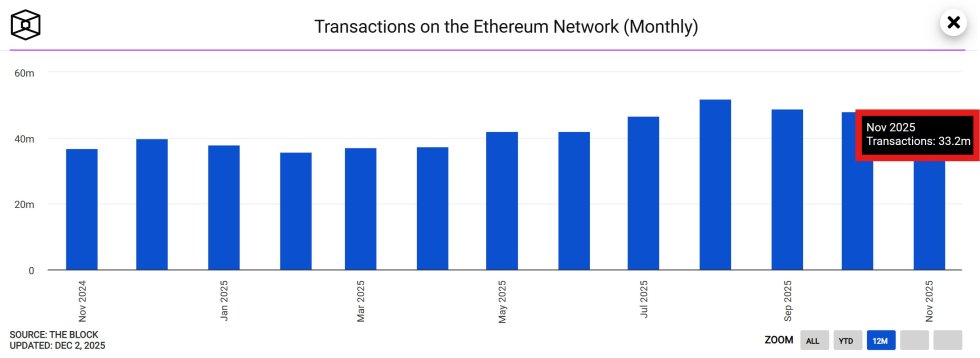
Over the past few weeks, the price of Ethereum has been on a downward trend due to a highly volatile market environment. ETH’s bearish action appears to have hampered on-chain activities, as evidenced by a decline in its total transactions carried out within a monthly period.

A Quiet Month For The Ethereum Network

Ethereum’s on-chain activity appears to have slowed down alongside the ongoing decline of ETH’s price. The blockchain, which is typically bustling with contract calls, exchanges, and transfers, now feels a little more roomy, suggesting a cooling pulse beneath the surface.

After examining the Transactions on the Ethereum Network metric in the monthly time frame, Everstake.eth, a market analyst and the head of the ETH segment at Everstake, revealed that the blockchain has recorded its worst month of the year. While price has declined, ETH’s total transactions executed in a month, particularly November, experienced a cool-off.

According to the data, the overall number of transactions carried out on the Ethereum network in November alone was approximately 32.2 million. Although this figure may seem large, it actually marks the lowest monthly count in the past 12 months.

Such a drop in transactions may suggest the renewed waning appetite for the network. In addition to suggesting a retreat, this delay reads more like a collective pause as users catch their breath, procedures recalibrating, and the market adjusting to its new rhythm. 

Ethereum

Everstake.eth highlighted that this kind of cooldown usually occurs when the market moves into a wait-and-see phase. During this phase, capital is observed sitting on the sidelines while developers continue to build on the blockchain. Despite this trend, the network still records more than 33 million transactions in a quiet month, which reflects its robust strength.

At a time like this, the expert noted that user behavior typically follows the market sentiment. As seen in the past, on-chain activity tends to cool down when volatility drops. However, Ethereum still retains the status as the most reliable network even during slow phases.

With the Fusaka Upgrade set to hit the market, Everstake.eth predicts that ETH transactions will see explosive growth. “If this is the worst month, imagine what the best will look like after Fusaka rolls out. It will be huge,” the expert stated.

ETH Active Transactions Pick Up

The monthly transactions may have slowed down, but the active addresses on the Ethereum network are heating up again. Leon Waidmann, the head of research at On-Chain Foundation, reported that active addresses throughout the entire ecosystem, Layer 1 and Layer 2s, bounced back above 9.5 million this week.

This surge points to a quiet resurgence of interest, utility, or a group readiness for the future. Waidmann highlighted that this marks the first meaningful reversal after several weeks of downside action.

ETH layer 2s such as Base, Arbitrum, Optimism, and World Chain have witnessed a strong rebound following a period of decline. Furthermore, multi-chain activity is starting to stabilize after the drop in Q3. These factors are painting a bullish picture for the network and its price prospects.

Ethereum

Bitmine Buys Another 18,345 Ethereum ($54.94M) In Fresh Accumulation Push – Details

Ethereum has reclaimed the $3,000 level after a strong market reaction to improving macro conditions, offering investors a much-needed shift in momentum. The move comes just days after the Federal Reserve officially ended Quantitative Tightening (QT), a policy shift that immediately boosted liquidity expectations across all risk assets. With markets now pricing in an imminent interest rate cut, confidence has begun to return, and ETH is one of the first major assets to respond.

This rebound reflects more than just macro relief. According to data from Arkham, shared by Lookonchain, Bitmine continues to accumulate Ethereum at current prices, reinforcing bullish sentiment at a moment when many traders remain cautious. Bitmine’s persistent buying throughout the correction has become one of the most influential signals for on-chain analysts, suggesting that large players see long-term value even as the market wrestles with volatility.

Reclaiming $3,000 places Ethereum back above a key psychological level, and the combination of supportive macro policy and whale accumulation provides a stronger foundation than the market had just weeks ago.

Bitmine and Linked Wallets Expand Ethereum Holdings

According to data from Arkham reported by Lookonchain, Bitmine has purchased another 18,345 ETH, worth approximately $54.94 million, just a few hours ago. This marks yet another large buy in a growing series of aggressive accumulation moves that Bitmine has made throughout the correction. Their continued willingness to buy at current levels signals strong confidence in Ethereum’s long-term value, even as the market navigates heightened volatility.

Bitmine-Linked Wallet Transfers | Source: Arkham

Shortly after this report, Lookonchain highlighted activity from a newly created wallet, 0x52B7, which withdrew 30,278 ETH—valued at $91.16 million—from Kraken. The size and timing of the withdrawal have led analysts to speculate that this wallet may be linked to Bitmine or part of a broader accumulation strategy.

Large withdrawals from exchanges typically indicate that the owner intends to hold the assets off-exchange, often for long-term storage or staking, rather than preparing to sell.

Bitmine-Linked Wallet Transfers

If the wallet is indeed connected to Bitmine, this would bring their latest combined accumulation to nearly 50,000 ETH in a single day. Such behavior suggests strategic positioning ahead of potential macro-driven upside or internal confidence in Ethereum’s recovery.

This kind of synchronized whale activity often precedes significant price shifts, reinforcing the idea that large players are preparing for a stronger market phase.

ETH Reclaims $3,000 But Still Faces Key Resistance

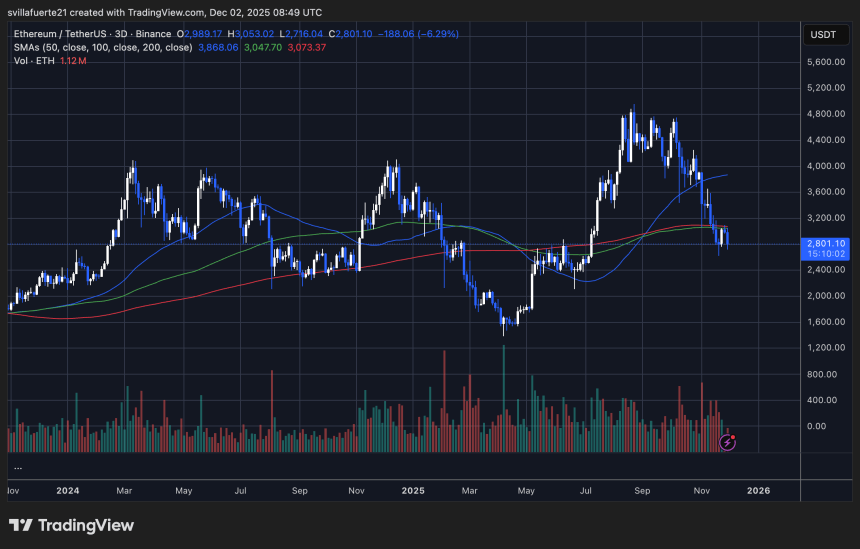
Ethereum’s 3-day chart shows a notable improvement after reclaiming the $3,000 level, but the broader trend still carries signs of fragility. The recent bounce followed a deep corrective move that sent ETH from the $4,500 region down to the $2,700–$2,800 support zone, where buyers finally stepped in with conviction. The strong lower wicks around this area confirm that demand remains active, but Ethereum has yet to fully recover its bullish structure.

ETH consolidates around key level | Source: ETHUSDT chart on TradingView

Price now trades just below the 50 SMA, which sits near the $3,100–$3,150 zone—an important short-term resistance level. A clean break above this moving average would signal renewed momentum and increase the chances of retesting the $3,400–$3,600 range. Meanwhile, the 100 SMA and 200 SMA remain slightly above price, reflecting the broader downtrend that has dominated since September.

Volume has picked up slightly during the recovery, but it remains muted compared to the selling spikes seen during the drawdown. This indicates cautious buying rather than aggressive accumulation at these levels. To confirm a trend reversal, ETH must close above the 50 SMA and then challenge the cluster of resistance around $3,200–$3,300.

Featured image from ChatGPT, chart from TradingView.com

Here’s Why The Bitcoin Price Jumped Above $92,000, And Ethereum Price Reclaimed $3,000

The crypto market delivered a dramatic rebound this week, with the Bitcoin price vaulting above $92,000 and Ethereum climbing back over $3,000. The sharp recovery in both leading cryptocurrencies has caught the market’s attention, with analysts now sharing the major reason for the unexpected pump. 

Why The Ethereum And Bitcoin Price Are Rebounding

Bitcoin is currently trading above $93,000 after experiencing a period of accelerated selling and heavy long liquidations that had briefly pushed its price down over the past few weeks. Now that forced selling has eased, the cryptocurrency has recovered significantly, adding an astonishing $75 billion to its market capitalization within 10 hours. 

Ethereum has followed the same upward swing. Data from CoinMarketCap shows that ETH has gained more than 9% in the past 24 hours, with steady accumulation pushing its price above $3,050. 

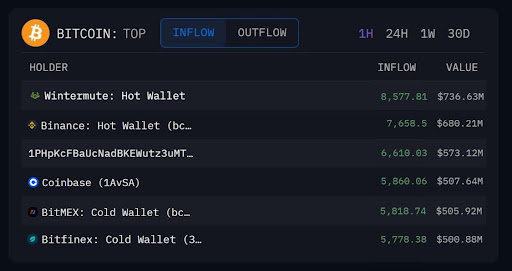
Crypto market analyst Wimar.X has explained the reason behind the sudden surge in both Bitcoin and Ethereum prices. He framed the resurgence as a rapid wave of high-volume coordinated institutional buying. In his words, the market pumped because a massive round of accumulation occurred within a single hour. 

Data from Arkham Intelligence shows that Wintermute, a leading algorithmic trading firm, had bought 8,577 BTC ahead of the market surge. Binance, the world’s largest crypto exchange, also acquired 7,658 BTC, while a major whale wallet added 6,010 BTC to its portfolio. Finally, BitMEX, a crypto exchange co-founded by Arthur Hayes, reportedly accumulated 5,818 BTC, while Bitfinex absorbed 5,778 BTC. 

Bitcoin price 1

According to Wimar.X analysis, the sudden accumulation and its timing appear coordinated. He described the activity as manipulation, implying that it was intended to influence market perception and artificially sway prices. 

Analysts Share Outlook For Bitcoin And Ethereum Price After Pump

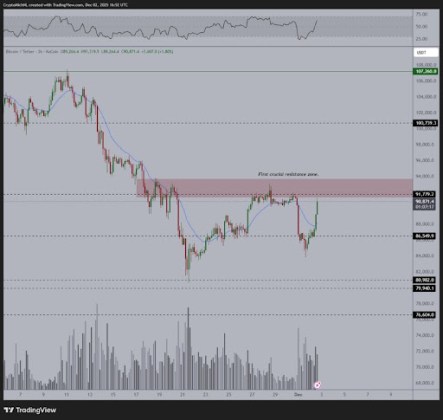
As the crypto market showed renewed strength and BTC recovered above $90,000, crypto expert Michael van de Poppe took to X to highlight the significance of the rebound. He noted that the recent dip in Bitcoin’s price at the start of the month appeared unusual but was followed by a strong bounce. According to the analyst, surpassing $92,000 will be critical for Bitcoin and could pave the way for a new all-time high and a potential test of $100,000. 

Bitcoin price 2

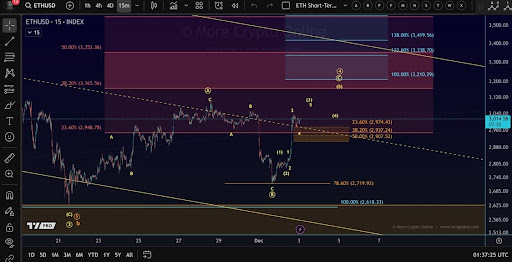
On the other hand, a market analyst identified as ‘More Crypto Online’ on X has stated that Ethereum is currently testing the micro support zone between $2,907 and $2,974. He noted that holding this support area is crucial for sustaining the upward momentum that began earlier this week.

Bitcoin Price 3

As a result, the analyst has predicted that Ethereum’s next upside window sits between $3,165 and $3,210. He cautioned that a breach below the lower support level could trigger a deeper corrective wave. However, current trends suggest that ETH is mainly aiming higher. 

Bitcoin price chart from Tradingview.com (Ethereum)

Ethereum Open Interest Cut In Half As $6.4B In Positions Vanish: Market Reset Accelerates

Ethereum has fallen below the $2,800 mark after a sharp and sudden decline, deepening panic across the market and reinforcing the sense that bulls have lost control. The recent drop has pushed investors into defensive mode, with some analysts now openly discussing the possibility of a broader bear market emerging. Selling pressure has intensified across spot and derivatives markets, and volatility continues to rise as traders struggle to identify a reliable support zone.

A new CryptoQuant report by Darkfost highlights one of the most alarming developments: Ethereum’s open interest on Binance has been steadily collapsing for more than three months. After reaching an all-time high of $12.6 billion on August 22, open interest has now been cut in half. Nearly $6.4 billion in derivative positions have evaporated, bringing ETH’s open interest down to $6.2 billion, a steep 51% decline.

While this appears to be an extraordinary contraction, Darkfost notes that open interest has only just slipped below the previous all-time high of $7.7 billion. This underscores how speculative and overstretched the 2025 derivatives market had become — and suggests that Ethereum may be undergoing a much deeper structural reset than most expected.

Speculation Unwinds Across Exchanges as Ethereum Enters Deep Reset Phase

Darkfost emphasizes that 2025 has been the most speculative phase in Ethereum’s history, fueled by aggressive leverage, rapid inflows, and a market structure that proved far less solid — and far less sustainable — than it appeared during the rally. The collapse in open interest on Binance is only part of the story.

The same pattern is unfolding across major derivatives platforms, revealing a broader structural unwind rather than an exchange-specific phenomenon.

On Gate.io, ETH open interest has fallen from $5.2 billion to $3.5 billion. On Bybit, the drop is even more severe, plunging from $6.1 billion to $2.3 billion. This synchronized contraction shows how aggressively speculative positions have been flushed out. Meanwhile, the ongoing correction has dragged Ethereum’s price from $4,830 to $2,800, marking a steep 43% decline from the highs.

Ethereum Open Interest By Exchange | Source: CryptoQuant

This widespread reduction in leverage suggests the market is undergoing a deeper reset than typical corrections. Investors are not rushing to re-enter positions, especially as liquidations continue to stack up across exchanges.

While shrinking open interest weighs on short-term momentum and sentiment, Darkfost notes that such aggressive deleveraging may ultimately help rebuild a healthier market foundation — one capable of supporting a durable bottom for ETH.

ETH Loses Key Trend Support as 3-Day Structure Turns Fully Bearish

Ethereum’s 3-day chart shows a decisive breakdown in structure, with price now firmly below the 50 SMA, 100 SMA, and 200 SMA for the first time since late 2024. The rejection from the $3,600–$3,800 region triggered a strong impulse to the downside, sending ETH directly through all major moving averages and confirming a shift toward a higher-timeframe downtrend. The current trading zone around $2,800 reflects a critical test of former support, but momentum remains weak.

ETH testing critical liquidity level | Source: ETHUSDT chart on TradingView

The 50 SMA has now crossed below the 100 SMA, while both are beginning to converge downward toward the 200 SMA — a configuration that typically precedes sustained corrections. Volume has increased on red candles, showing that sellers remain dominant, and there is little evidence of aggressive dip-buying. The most recent candle wick toward $2,700 highlights vulnerability rather than strength, suggesting buyers are hesitant to defend this level with conviction.

ETH is also forming a series of lower highs and lower lows, further confirming bearish market structure. If $2,750 breaks cleanly, the next significant liquidity zones sit near $2,550 and $2,300, where prior consolidations developed earlier in the cycle.

Featured image from ChatGPT, chart from TradingView.com

When Will Bitcoin, Ethereum, And Dogecoin Go Into A Bear Market?

The prices of Ethereum and Dogecoin have followed a similar trajectory to the Bitcoin price crash as the pioneer digital asset continues to lead the crypto market lower. The muted action from Bitcoin has led to speculations that the market is finally headed into another bear trend after rising over the last few years. In this same vein, a crypto analyst has predicted when they believe that the bear market will really start, and that the current trend could still lead to an eventual pump in the market.

Why The Bitcoin, Ethereum, And Dogecoin Prices Could Still Pump

Crypto analyst ChainShinobi explained what is going on in the market, predicting that the trend could end up going against what investors are expecting at this time. According to the X post, while everyone is currently calling for lower prices, it could lead to another pump that culminates in the final top for the crypto market

ChainShinobi predicts what they refer to as “a face-melter”, the type of rally that no one sees coming and takes the likes of Bitcoin, Dogecoin, and Ethereum to possibly new all-time highs. However, instead of using this time to call for higher prices, the analyst believes that it is the best time for investors to actually get out of the market. This pump, which the analyst refers to as an exit window, could provide investors one final chance to actually get out of the market before another price crash.

This is “The moment to lock in massive profit while everyone else is busy blinding themselves with hopium and pushing their targets higher and higher… the same way they dragged their targets lower and lower right now,” the crypto analyst said.

The Same Wave Every Cycle

As for when the Dogecoin, Ethereum, and Dogecoin prices could move into the next bear market, the crypto analyst tells investors not to expect it until next year. More precisely, ChainShinobi believes that the bear market will fully begin by the end of the first quarter of 2025.

When the pump comes, the analyst warns that there could be an influx of bullish sentiment, with bullish news flooding the market. But it is during this time that the market is expected to turn. Essentially, the bear market is expected to begin when investors least expect it. “It’s pretty easy to see what’s coming. You don’t need to overdo TA or PA right now to see the path laid out,” the post read.

Bitcoin price chart from Tradingview.com (Ethereum, Dogecoin)

Bitmine Continues Ethereum Buying Spree With Fresh 7,080 ETH Purchase

Ethereum has fallen below the $2,800 mark after a sharp and sudden decline, deepening market anxiety and raising fresh questions about whether a broader bearish phase may be emerging. The drop has undermined bullish momentum, with buyers struggling to defend key support levels as selling pressure accelerates across both spot and derivatives markets.

Sentiment has deteriorated quickly, and several analysts are beginning to openly discuss the possibility of a sustained bear market if ETH fails to stabilize soon.

Yet amid the growing panic, a notable counter-signal continues to attract attention: Bitmine’s ongoing accumulation. Despite ETH’s decline, the firm has repeatedly added to its holdings, purchasing thousands of ETH over the past several weeks. Bitmine’s persistent buying behavior suggests that at least some large players still view the current correction as an opportunity rather than a risk.

For investors searching for signs of resilience, Bitmine’s actions have become a point of cautious optimism. While the macro structure remains fragile and the downtrend intact, steady accumulation from an institutional buyer provides a potential anchor of support — and raises the possibility that a rebound could form once selling pressure exhausts.

Bitmine Expands Its Massive Ethereum Position

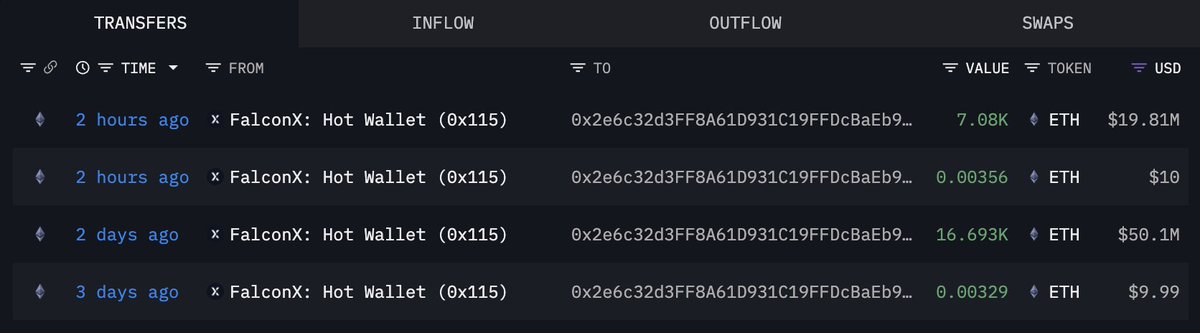
According to on-chain data from Arkham, shared by Lookonchain, Bitmine has continued its aggressive accumulation strategy, purchasing an additional 7,080 ETH—worth approximately $19.8 million—just a few hours ago.

Bitmine-Linked Wallet Transfers | Source: Arkham

This latest buy adds to a series of repeated inflows over the past several weeks, reinforcing the firm’s conviction even as Ethereum trades near multi-month lows. Bitmine’s willingness to keep adding during periods of heightened volatility has become one of the most notable accumulation trends in the market.

With this purchase, Bitmine’s total Ethereum holdings have climbed to roughly 3.43 million ETH, now valued at around $9.6 billion at current prices. This positions the firm as one of the largest known institutional holders of ETH, and its continued accumulation stands in sharp contrast to the broader atmosphere of fear and defensive positioning. While many traders are reducing exposure amid Ethereum’s sharp decline, Bitmine appears to be doubling down.

Such behavior from a major entity often signals longer-term confidence in Ethereum’s fundamentals, regardless of short-term price action. For investors, Bitmine’s expanding position has created a counter-narrative to prevailing bearish sentiment, suggesting that deeper-pocketed players may be preparing for a recovery once the market finishes resetting.

ETH Tests Weekly Support as Trend Weakens

Ethereum’s weekly chart shows a significant loss of momentum, with price breaking below the 50 SMA and now sitting directly on top of the 100 SMA near the $2,750–$2,800 region. This zone has historically served as an important structural support during prior corrections, making the current interaction a critical moment for the broader trend. The sharp rejection from the $4,500 level marks one of ETH’s steepest weekly declines since 2022, highlighting the intensity of the current sell-off.

ETH consolidates around key level | Source: ETHUSDT chart on TradingView

The 50 SMA has begun to curl downward, signaling early signs of medium-term trend weakness. Meanwhile, the 100 SMA is flattening, acting as the last dynamic support before the 200 SMA at $2,450, which represents the true long-term floor. A clean weekly close below the 100 SMA would open the door to a deeper retracement toward that level.

Volume has increased during the recent decline, reflecting forced selling and derivatives-driven liquidations rather than orderly profit-taking. Despite this, the long lower wicks forming near $2,700 suggest buyers are still attempting to defend the area.

Featured image from ChatGPT, chart from TradingView.com

Fusaka Upgrade Could Reshape How Ethereum Captures Layer-2 Value, Says Nansen

Ethereum’s upcoming Fusaka upgrade is emerging as a major development that could reshape how value flows from Layer-2 networks back to ETH.

The Fusaka upgrade is almost here.

PeerDAS (EIP-7594) is one of the key features helping Ethereum securely scale.

It unlocks up to 8x data throughput. For rollups, this means cheaper blob fees and more space to grow. pic.twitter.com/0AUv3e7QP5

— Ethereum (@ethereum) December 2, 2025

Today, the majority of economic activity generated by rollups—including MEV extraction, sequencing revenue, and transaction ordering—remains siloed at the L2 level, accruing to independent operators rather than to Ethereum itself. New analysis from on-chain intelligence firm Nansen suggests that Fusaka may shift this balance.

A New Foundation for Based Rollups

Fusaka introduces the technical infrastructure required for “based rollups,” a model where Ethereum validators take over the responsibility of sequencing transactions for L2s. Instead of relying on external or proprietary sequencers, L2s could integrate directly with Ethereum’s validator set, aligning their incentives more tightly with the base layer.

“Fusaka itself does not guarantee value accrual to ETH, but it enables it,” said Nicolai Søndergaard, Research Analyst at Nansen. “The upgrade introduces the base infrastructure for based rollups, where Ethereum validators take over L2 sequencing.”

Søndergaard explained that if rollups adopt this structure, L2 MEV would begin flowing to ETH stakers, fee burn would increase due to higher blob demand, validator rewards would rise through pre-confirmation revenue, and Ethereum would start capturing a greater share of the economic activity that currently accumulates at the L2 level.

He explains, however, that none of this is automatic. The long-term impact depends entirely on whether L2 teams choose to abandon their existing sequencing models.

Capital Markets Anticipate Structural Improvements

The potential benefits of Fusaka extend beyond validator economics. According to Edwin Mata, CEO and co-founder of enterprise tokenization platform Brickken, the upgrade represents a material improvement to Ethereum’s settlement architecture.

With reduced data loads for rollups and validators, the network becomes more predictable in both performance and cost, a key requirement for regulated institutions assessing whether a public blockchain can support issuance and post-trade processes at scale.

Mata notes that this predictability is essential for capital-market participants who need reliable settlement environments. By strengthening Ethereum’s consistency, Fusaka enhances its appeal as a venue for institutional-grade financial activity.

A More Efficient Environment for Tokenized Assets

For the growing real-world asset sector, Fusaka could streamline key operational mechanics. Lower fees and increased throughput on L2s create a more efficient sector for the lifecycle of tokenized instruments, allowing for smoother transfers, faster reconciliations, and greater dependability during distribution events.

Mata also pointed out the upgrade’s impact on network resilience. Fusaka lowers the operational threshold for node participation, which broadens the validator base and reduces concentration risk. For financial markets that depend on systems with no single point of failure, greater decentralization is a fundamental advantage.

As the Ethereum ecosystem prepares for Fusaka, analysts and industry leaders will be watching whether L2s embrace the base-rollup model. If they do, the upgrade could mark a turning point in how Ethereum captures value from the ecosystem it anchors.

The post Fusaka Upgrade Could Reshape How Ethereum Captures Layer-2 Value, Says Nansen appeared first on Cryptonews.

Vanguard reverses course, opens door to Bitcoin, Ethereum, XRP, and Solana ETFs

  • Vanguard now allows clients to trade Bitcoin, Ethereum, XRP, and Solana ETFs.
  • XRP ETFs have seen $756M inflows in 11 days, with no outflows recorded.
  • Goldman and other firms are boosting crypto exposure alongside Vanguard.

In a dramatic shift that signals growing acceptance of digital assets by mainstream finance, Vanguard has opened its brokerage platform to regulated crypto ETFs.

Starting this week, US investors can access exchange-traded funds tied to Bitcoin, Ethereum, XRP, and Solana, marking a major reversal from the firm’s long-held resistance to cryptocurrency.

🚨 Just found this on Vanguard’s official website 👀

Multiple XRP ETFs (Franklin, Canary, REX-Osprey, ProShares…) are now showing under « Non-Vanguard Funds » in the Digital Assets category.

Looks like access is finally opening up for crypto ETFs pic.twitter.com/Y08IgtAybg

— Arthur (@XrpArthur) December 2, 2025

Notably, the move comes amid surging client demand and increasing institutional interest in digital assets, reshaping Vanguard’s traditional investment philosophy.

Vanguard finally embraces crypto

For years, Vanguard maintained a cautious stance toward cryptocurrencies, with former CEO Tim Buckley publicly dismissing BTC and other digital assets as too speculative and unsuitable for long-term portfolios.

The firm consistently refused to offer crypto ETFs, emphasising stability and low-risk investments for retirement-focused clients.

However, leadership changes paved the way for a rethink.

Salim Ramji, formerly the global head of ETFs at BlackRock, assumed the CEO role and gradually steered Vanguard toward regulated crypto offerings.

While the firm still will not create its own crypto ETFs or mutual funds, it now supports third-party products that meet regulatory standards, providing clients with access to digital assets while maintaining compliance.

The platform expansion enables more than 50 million US brokerage clients to trade crypto ETFs alongside other non-core assets like gold.

This could significantly increase market participation, with some predicting near-term price boosts in Bitcoin (BTC) and Ethereum (ETH).

Vanguard’s inclusion of XRP ETFs

Among the new offerings, XRP-based ETFs have generated particular excitement.

In just 11 trading days, spot XRP ETFs have recorded net inflows exceeding $756 million, with total assets under management reaching $723 million.

Remarkably, there have been no outflows, and major inflow events include $243 million during Canary Capital’s launch, $164 million tied to Grayscale and Franklin Templeton ETFs, and $89.65 million in the most recent session.

This rapid accumulation is reducing the liquid XRP supply on exchanges, potentially creating a supply shock that could influence pricing.

Mainstream finance accelerates crypto adoption

Vanguard’s pivot reflects a broader trend among traditional financial institutions embracing crypto.

Goldman Sachs, for example, is deepening its exposure through a $2 billion acquisition of Innovator Capital Management, which issues defined-outcome ETFs, including Bitcoin-linked structured funds.

The bank has rapidly increased its holdings in Bitcoin and Ethereum ETFs, totalling billions in assets, while also developing infrastructure for tokenised financial products.

Industry observers view these moves as part of a gradual yet significant integration of digital assets into mainstream portfolios, indicating that regulated, institutionally backed crypto investment is shifting from a niche to a standard.

The implications of Vanguard’s decision extend beyond immediate market activity.

By allowing access to regulated crypto ETFs, the firm is providing a channel for both retail and institutional investors to participate in digital asset markets within a familiar, compliant framework.

This could draw additional inflows, potentially reshaping liquidity dynamics and market sentiment across Bitcoin, Ethereum, XRP, and Solana.

For Vanguard, the shift represents not only a strategic response to client demand but also an acknowledgement that digital assets have become a permanent fixture in the global financial landscape.

The post Vanguard reverses course, opens door to Bitcoin, Ethereum, XRP, and Solana ETFs appeared first on CoinJournal.

Ethereum’s Privacy Upgrade Hides Transaction Details Like a Secret Santa Game

Distributed Lab researchers have published a breakthrough protocol demonstrating how Ethereum can implement privacy-preserving games while maintaining participant confidentiality and correctness.

The ZK Secret Santa (ZKSS) system uses zero-knowledge proofs to establish gift sender-receiver relationships without revealing identities, addressing fundamental challenges in executing private transactions on public blockchains.

The timing proves significant as Ethereum accelerates institutional privacy infrastructure following warnings from co-founder Vitalik Buterin that, without robust protections, the network risks becoming “the backbone of global surveillance rather than global freedom.

The Secret Santa protocol illustrates practical applications of privacy technology that Ethereum desperately needs to unlock enterprise adoption.

Research Tackles Blockchain’s Transparency Problem

The ZKSS protocol solves three critical challenges preventing private on-chain activities.

Ethereum’s transparent ledger prevents concealing participant addresses, forcing researchers to deploy transaction relayers alongside zero-knowledge proofs to protect identities.

The blockchain’s lack of true randomness requires outsourcing gift pair selection to participants with ZKP verification, preventing self-assignment.

The “double voting” problem is resolved through nullifier-based mechanisms that verify participation without compromising confidentiality.

Head of Solidity at Distributed Lab, Artem Chystiakov, proposed a three-step, non-peer-to-peer process that requires the involvement of all participants.

Is it possible to play Secret Santa on-chain? Well, yes!

Here is a formal specification of the ZK Secret Santa protocol that can be implemented in Solidity. It preserves the full privacy of gift senders while maintaining the game's trustlessness and correctness.

Happy winter! pic.twitter.com/T3NC6eoty2

— Artem Chystiakov (@Arvolear) December 1, 2025

The algorithm leverages cryptographic primitives, including hash functions, ECDSA signature recovery, and Merkle proofs, to ensure the correctness of execution.

Players register addresses in a Sparse Merkle Tree during setup, commit signature hashes, and then anonymously submit randomness values that serve as RSA public keys for encrypted delivery address transmission.

The protocol draws parallels to physical Secret Santa mechanics, where participants secretly place random notes into a hat before drawing assignments.

Each participant securely places a piece of paper containing their randomness into a hat,” the research states, with transport mechanisms corresponding to relayers ensuring no one observes which note belongs to whom.

The ZKP “magic” guarantees participants cannot retrieve their own notes during the drawing phase.

Privacy Technology Transforms Ethereum Into Surveillance-Free Network

Ethereum’s privacy upgrade fundamentally changes how transactions work by hiding sender and receiver information while still proving transactions are valid.

Think of it like sending a sealed envelope through the postal system, where everyone can verify it was delivered correctly without knowing who sent it or what’s inside.

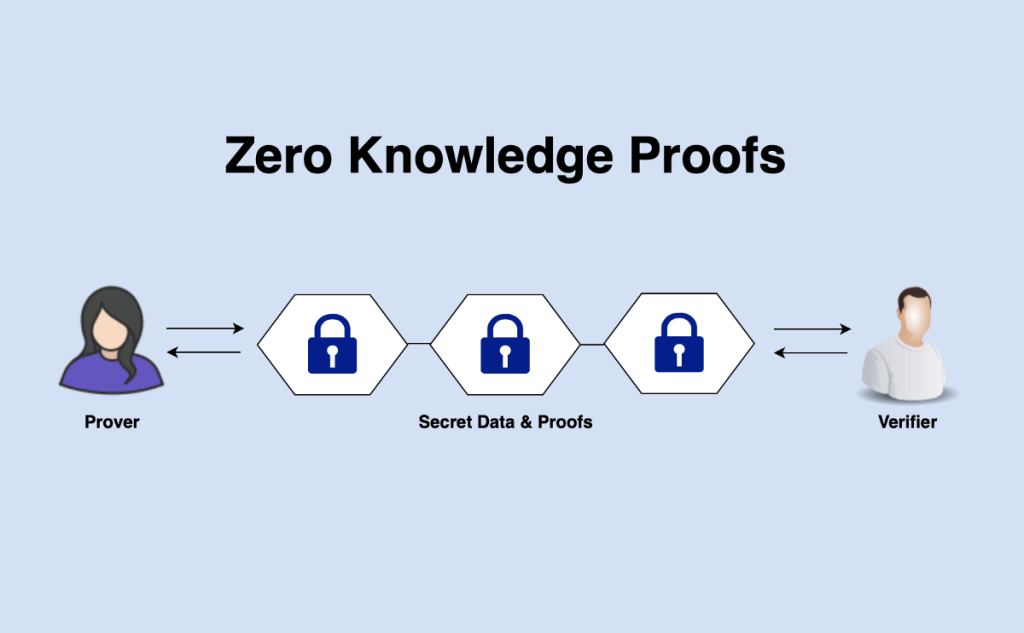
Zero-knowledge proofs make this possible by proving something is true without revealing the underlying data.

Source: Medium

The technology addresses Ethereum’s core vulnerability, where every transaction becomes permanently visible to anyone with internet access.

Current blockchain transparency enables competitors to track business deals, governments to monitor spending patterns, and hackers to identify wealthy targets by monitoring wallet balances.

Companies handling millions in transactions face particular exposure since their entire supply chain and financial operations become public records.

Privacy-preserving smart contracts now enable businesses to conduct confidential transactions while maintaining audit trails for compliance.

Projects like RAILGUN and Aztec Network allow users to shield wallet balances and transaction details from public view while still settling on Ethereum’s secure base layer.

Users can create “shielded balances” that function like private bank accounts, with transaction history visible only to the account holder.

The Ethereum Foundation launched a 47-member Privacy Cluster in October, under the coordination of Blockscout founder Igor Barinov, to accelerate development across five key areas, including private transactions, portable verification, and selective identity disclosure.

Regulatory Pressure Intensifies Privacy Development

The Financial Stability Board warned in October that strict privacy laws hinder global crypto oversight, as confidentiality rules prevent data sharing across jurisdictions.

Secrecy or data privacy laws may pose significant barriers to cooperation,” the FSB wrote, noting delays in addressing cooperation requests that discourage participation in oversight arrangements altogether.

Given the growing concern, the EU introduced sweeping crypto data-sharing rules in November under Implementing Regulation 2025/2263, requiring exchanges and wallet providers to report customer holdings in standardized formats from January 2026.

🇪🇺 EU’s new crypto data-sharing rules will force exchanges and service providers to share user data and transaction records.#EU #CryptoPrivacyhttps://t.co/YoIDXmgNvm

— Cryptonews.com (@cryptonews) November 27, 2025

The framework extends the Transfer of Funds Regulation’s “travel rule” to crypto, mandating sender-recipient identification for all transfers, including self-hosted wallet interactions above €1,000.

Most recently, Vitalik Buterin donated nearly $390,000 to the Session encrypted messaging app in November, highlighting that strong metadata privacy “requires decentralization.

Session Technology Foundation President Alex Linton explained that permissionless account creation prevents censorship by generating cryptographically secure Account IDs rather than requiring phone numbers or email addresses that introduce surveillance risks.

The post Ethereum’s Privacy Upgrade Hides Transaction Details Like a Secret Santa Game appeared first on Cryptonews.

❌