Reading view

There are new articles available, click to refresh the page.

Solana Mobile Announces 2026 Token Launch Despite Security Concerns Around Seeker Chip

Solana Mobile’s push into decentralized mobile technology is approaching a new chapter, with the company confirming that its SKR token will launch in January 2026. The token is meant to anchor the Solana Seeker ecosystem, supporting governance, staking, rewards, and developer incentives.

Related Reading: Crypto Gets Legal Recognition: UK Enacts Property Act 2025 For Digital Assets

But this milestone comes at a complicated moment: a newly disclosed hardware vulnerability in the Seeker’s core chip has raised questions about device security just as Solana prepares for broader adoption.

The timing highlights the tension between Solana Mobile’s rapid ecosystem expansion and the security challenges tied to hardware beyond its control.
Solana SOL SOLUSD_2025-12-04_12-51-03

SKR Set to Power Governance and Rewards Across Solana’s Mobile Ecosystem

The SKR token, with a total supply of 10 billion, will serve as the governance and coordination asset for Solana’s mobile platform. Solana Mobile confirmed that 30% of the supply will go toward airdrops and early unlocks for Seeker users and active dApp participants.

Additional allocations include 25% for ecosystem growth and partnerships, 10% for liquidity, 10% for a community treasury, 15% for Solana Mobile, and 10% for Solana Labs.

SKR is designed to integrate deeply with Solana’s mobile ecosystem. Holders will be able to stake the token with designated “guardians,” including Solana Mobile at launch, and later partners such as Helius, DoubleZero, Jito, Anza, and Triton One.

These guardians will verify device authenticity, moderate apps on the Solana dApp Store, and uphold community standards.

Solana Mobile says SKR will act as the engine behind incentives and ownership across the platform, moving beyond the reward-focused design associated with the earlier Saga model.

Security Flaw in Seeker Chip Raises Concerns

The excitement around SKR’s launch has been met with concern following a report from Ledger security researchers revealing an unfixable vulnerability in the MediaTek Dimensity 7300 chip used in the Seeker smartphone.

According to the researchers, electromagnetic fault injection during the chip’s boot process can bypass memory protections and give attackers full device control, including access to private keys.

The flaw cannot be addressed through software patches because it is physically embedded in the chip’s silicon. While the likelihood of success per attempt is low, between 0.1% and 1%, the attack can be repeated once per second, potentially allowing a breach within minutes.

MediaTek acknowledged the vulnerability but noted that the chip was not designed to defend against such high-level physical attacks.

Rollout Plans Continue as Security Questions Emerge

Despite the concerns, interest in Solana’s mobile efforts remains strong. The Seeker has reportedly surpassed 150,000 pre-orders, and Solana Mobile plans to reveal full SKR tokenomics and ecosystem updates at the Solana Breakpoint Conference in Abu Dhabi from December 11–13.

As Solana prepares for SKR’s rollout, the company faces a delicate balancing act. This includes advancing its mobile-first Web3 vision while addressing security limitations tied to third-party hardware.

Related Reading: Taiwan Eyes First Stablecoin Debut In 2026 As Regulatory Framework Advances

The coming months will reveal whether the SKR token can accelerate ecosystem growth or if the unresolved chip vulnerability will overshadow the momentum Solana Mobile has built.

Cover image from ChatGPT, SOLUSD chart from Tradingview

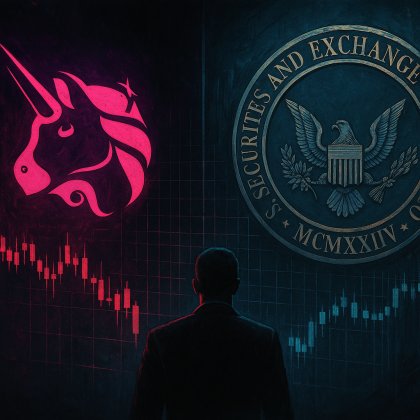
Debate Erupts as Uniswap’s Adams Accuses Citadel of Driving Aggressive SEC Oversight on DeFi

The tension between decentralized finance and traditional Wall Street players resurfaced this week after Uniswap founder Hayden Adams publicly accused Citadel Securities of influencing U.S. regulators to impose stricter rules on the DeFi sector.

Adams’ comments, shared across social media, sparked a wide-ranging debate over who should be considered a financial intermediary in blockchain-based markets, and whether the rules of traditional finance should apply to open-source developers.

Adams claimed that Citadel, led by CEO Ken Griffin, has been lobbying the U.S. Securities and Exchange Commission (SEC) to classify DeFi developers, validators, liquidity providers and even front-end operators as broker-dealers.

Uniswap UNI UNIUSD_2025-12-04_12-08-55

Citadel’s Filing Raises Concerns Over Tokenized Markets

At the center of the dispute is Citadel’s December 2 filing to the SEC. The document argues that many blockchain-based systems effectively bring together buyers and sellers in ways that resemble traditional exchanges.

As such, Citadel says they should be regulated under the same standards, even if those systems operate through smart contracts rather than centralized infrastructure.

Citadel warned that tokenized U.S. equities trading on DeFi platforms could create a “shadow equity market” outside the national market system, reducing regulatory oversight and fragmenting liquidity.

The firm’s letter also rejects the idea that technology differences justify regulatory exemptions, insisting that “the same activity should face the same rules” regardless of whether it is powered by algorithms or legacy systems.

DeFi advocates counter that this perspective ignores the design of decentralized protocols, which can function without centralized control and often rely on open-source contributions rather than corporate governance.

Adams Pushes Back Against “Fair Access” Claims

Adams criticized Citadel’s assertion that DeFi systems cannot provide “fair access,” calling the argument inconsistent with how traditional market makers operate. He argued that open-source protocols can lower barriers to participation, unlike centralized trading venues where access is limited by intermediaries.

Developers and community members echoed this point, noting that the DeFi ecosystem encompasses a broad range of models, from fully permissionless exchanges to platforms that rely on more centralized components.

Some community voices added that regulatory conversations often lack clarity because “DeFi” itself encompasses many different structures.

Regulatory Pressure Builds as SEC Signals Broader Scrutiny

The exchange comes at a time when the SEC has repeatedly taken enforcement action against DeFi teams. The agency has emphasized that it assesses economic realities rather than decentralization labels, citing past cases such as the Rari Capital settlement in 2024.

If regulators adopt Citadel’s framing, entities involved in developing or maintaining DeFi protocols could face registration requirements designed for traditional broker-dealers.

Industry participants warn that such a shift could make open-source projects difficult to operate, raising questions about the future of permissionless finance in the United States.

As the debate continues, the clash highlights a deeper divide between emerging decentralized systems and established financial institutions, one that is increasingly shaping regulatory policy discussions in Washington.

Cover image from ChatGPT, UNIUSD chart from Tradingview

Fusaka Upgrade Reignites Confidence in Ethereum, Analysts Eye $3,500 Target

Ethereum (ETH) is topping talks once again as its Fusaka upgrade goes live and the ETH price returns firmly above the $3,200 mark. After weeks of choppy trading and lingering fear across the broader crypto market, the combination of a major technical overhaul and rising on-chain activity is giving traders a fresh narrative to follow.

Related Reading: Eric Trump Says Bitcoin Could Hit $500,000, Stands By ABTC Strategy

In the last 24 hours, ETH has climbed around 4–5%, outperforming most large-cap cryptos and reclaiming a key psychological zone near $3,200. Market data shows rising volumes and a noticeable pickup in accumulation from larger holders, even as sentiment indicators still sit in “Fear” territory.

Ethereum ETH ETHUSD ETH price

Fusaka Upgrade Shifts Focus Back to Ethereum’s Scaling Roadmap

The Fusaka upgrade, Ethereum’s second major network update of 2025, activated at block height 18,200,000. At its core is PeerDAS, a data availability sampling system that lets nodes store only slices of blob data instead of entire payloads.

This change is estimated to expand blob throughput by roughly eight times, easing congestion and helping layer-2 networks push more transactions through Ethereum’s base layer.

Developers describe Fusaka as another step in Ethereum’s long-term scaling roadmap, aligning the main chain with growing layer-2 activity.

Beyond PeerDAS, the upgrade bundles a series of Ethereum Improvement Proposals that tweak gas limits, transaction sizes, cryptographic support, and block configuration, aiming to improve efficiency while keeping validator requirements manageable.

Whales, ETFs and Technical Signals Cluster Around $3,500

On-chain data shows “shark” wallets holding between 1,000 and 10,000 ETH have ramped up accumulation in recent weeks, buying aggressively on dips around $2,700–$3,000.

Institutional interest also appears to be rising. BitMine has reportedly added more than 18,000 ETH to its treasury ahead of Fusaka, while U.S. spot Ethereum ETFs have recorded notable net inflows.

Technically, ETH is trading around $3,200 with analysts watching resistance between $3,300 and $3,500. Short-term models project a move toward roughly $3,537 within days, implying upside of about 10% if the current trend holds.

However, indicators remain mixed. The broader setup is still labelled “bearish,” and any pullback could see ETH retesting support around $3,100, $3,000, or even the $2,850 zone.

Related Reading: XRP Price Is Performing As Expected; Analyst Reveals What Comes Next

For now, the Fusaka upgrade has shifted the conversation back to fundamentals, with Ethereum’s price action testing whether renewed confidence is enough to carry it through the $3,500 barrier.

Cover image from ChatGPT, ETHUSD chart from Tradingview

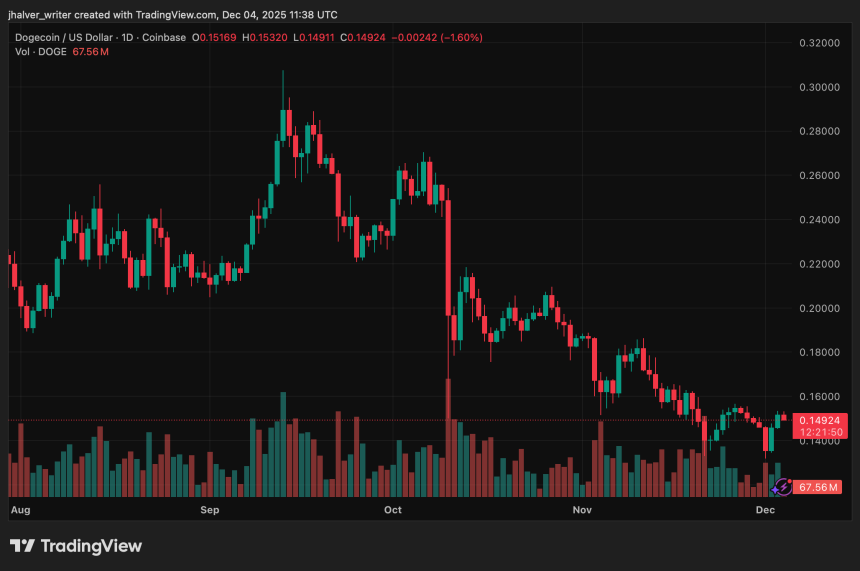
Bullish Setup Emerges for Dogecoin as Price Action Tightens and Market Signals Turn Positive

The Dogecoin (DOGE) price movement is entering a phase that traders often watch closely, a stretch of tightening action that usually precedes a decisive move.

After several days of elevated activity, shifting ETF flows, and a rare alignment of technical indicators, the memecoin is now sitting at a point where sentiment and structure appear to be converging.

The conversation around Dogecoin is beginning to shift from short-term speculation to whether the asset is preparing for a larger breakout as the year closes.

Recent trading sessions have highlighted a steady rise in activity, driven initially by an 8% price jump that pushed DOGE to the $0.15 region. The move came alongside a 242% surge in volume, reflecting strong participation from retail investors.

Dogecoin DOGE DOGEUSD_2025-12-04_12-38-10

DOGE ETF Momentum Builds as Market Structure Tightens

A major catalyst behind recent volatility has been the rollout of multiple DOGE-related exchange-traded products.

Grayscale’s GDOG and Bitwise’s BWOW have recorded early but steady inflows, now totaling nearly $2.9 million since launch. Although the numbers remain modest, analysts view these products as important steps toward bringing Dogecoin into mainstream financial products.

At the same time, technical structure on the charts has narrowed into a symmetrical triangle, a pattern that forms when lower highs and higher lows converge. Current support sits in the $0.145–$0.150 range, with the upper boundary near $0.165. A breakout above this ceiling could open the door to targets between $0.18 and $0.20.

Indicators such as RSI, MACD, and the TD Sequential tool show early signs of shifting momentum, though signals remain mixed and require confirmation through stronger volume.

Retail Traders Lead as Analysts Reassess

Despite rising optimism, institutional traders have taken a more cautious stance. Futures open interest and derivatives volume have cooled, pointing to a market waiting for a clearer direction.

Still, retail participation has continued to rise, and analysts note that Dogecoin’s ascending channel remains intact as long as price holds above the $0.1470 level.

Across higher timeframes, DOGE has also reclaimed a series of higher lows, reinforcing the possibility that the meme token is attempting to build a more sustainable bullish structure.

Some analysts project a potential move toward $0.42 over the coming months if current patterns persist, while more aggressive models leave room for a retest of psychological levels in the $1 range, though such targets remain highly speculative.

Traders are closely watching $0.1470 and $0.1500, as losing these levels could invite a deeper pullback toward $0.138. For now, the market remains compressed, with both sides preparing for the next decisive break.

Cover image from ChatGPT, DOGEUSD chart on Tradingview

Bitcoin Rally Strengthens With Renewed $100K Targets Following Key Institutional Policy Change

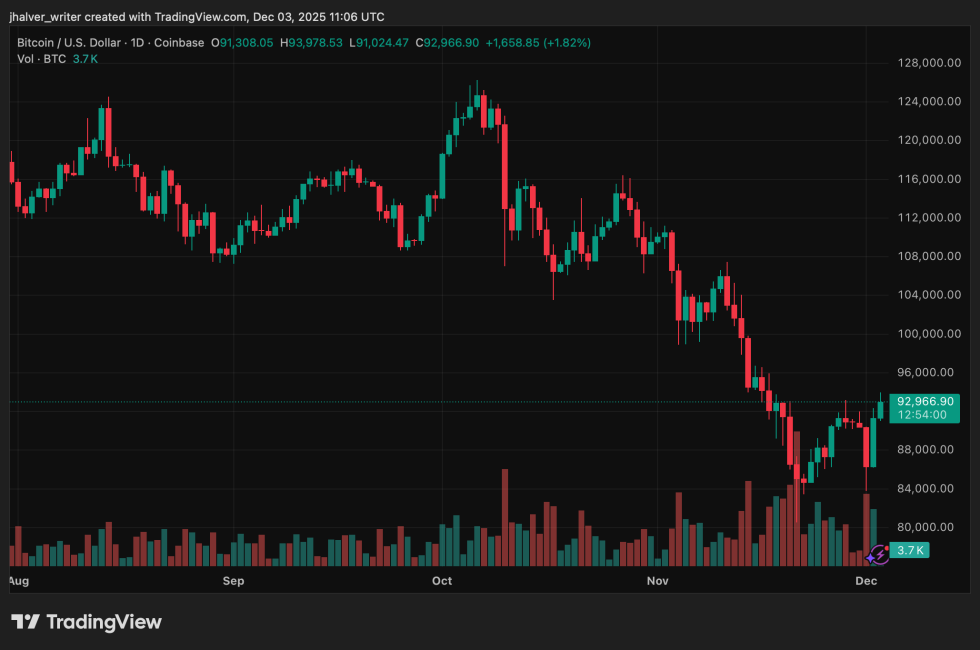
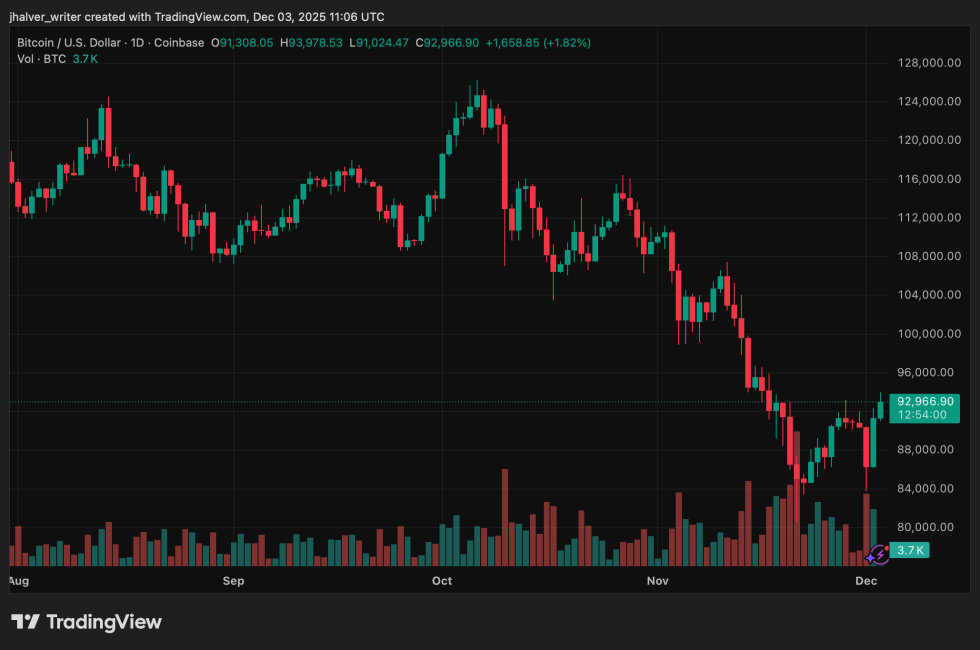
Bitcoin (BTC) climbed back above the $93,000 level this week as improving liquidity conditions and a major shift in institutional policy helped stabilize market sentiment following sharp volatility.

Related Reading: Crypto Investors Brace As Japan Proposes 20% Tax By 2027

The move follows a month-long slide that erased nearly 20% from recent highs and raised questions about whether the broader uptrend was losing strength. Consequently, about $250 million in BTC short positions have been liquidated.

Bitcoin BTC BTCUSD BTCUSD_2025-12-03_12-06-00_e6a7e5

Institutional Access Expands as Vanguard Lifts ETF Ban

The most notable catalyst for the rebound came from Vanguard, which reversed its long-standing ban on Bitcoin ETFs. The decision immediately opened access to tens of millions of retail accounts and allowed products such as BlackRock’s IBIT to trade on the platform, generating more than $1 billion in volume on day one.

The policy shift triggered a rapid surge in demand and helped fuel more than $400 million in short liquidations as Bitcoin jumped from the mid-$88,000 area to above $93,000 within hours.

Analysts note that several major firms, including Robinhood and Fidelity, added significant BTC exposure during the session. Combined with stablecoin issuers expanding supply in recent weeks, liquidity across the crypto market has broadened.

Macro Shifts and Technical Levels Support the Recovery

The rebound coincided with the U.S. Federal Reserve ending its quantitative tightening programme and injecting fresh funds into short-term markets. Repo facility usage also increased, improving liquidity for risk assets. Traders now assign high probability to a rate cut at the Fed’s December meeting.

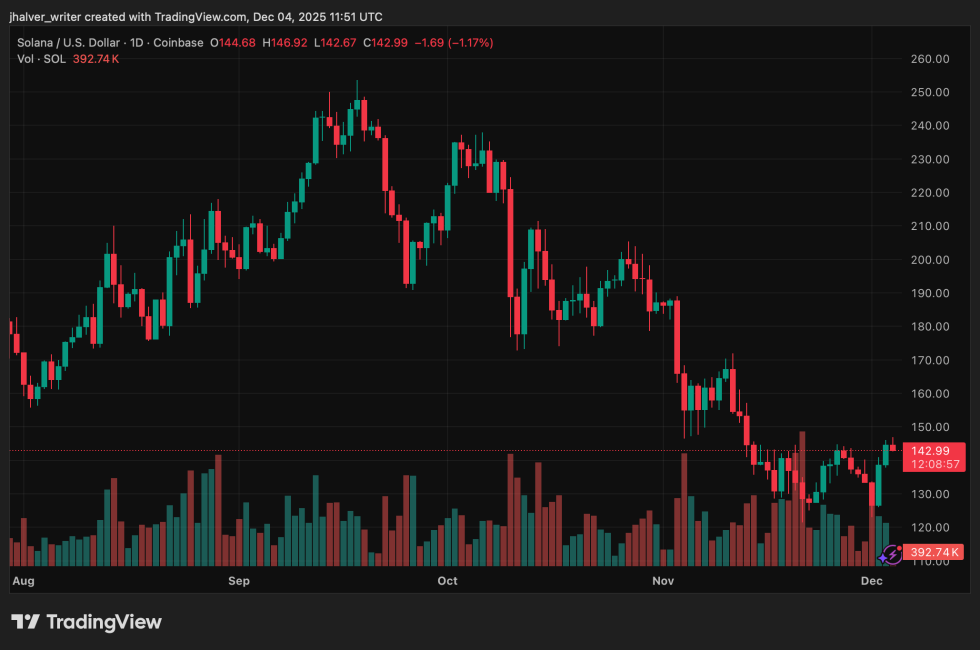
Across the market, major assets followed Bitcoin higher. Ethereum traded near $3,000, Solana reached $142, and XRP climbed back above $2.18. Market indexes tracking large-cap cryptocurrencies rose around 7%, while the Crypto Fear & Greed Index moved off extreme fear levels.

Technical indicators are showing early signs of stabilisation. Analysts highlight the $86,000–$88,000 range as a key support zone that has held through repeated tests in recent months. Bitcoin is also pressing against resistance between $92,500 and $94,000, forming an ascending triangle pattern.

Renewed $100K Bitcoin Targets, but Debate Over Trend Strength Remains

Despite the strong bounce, analysts remain divided on whether Bitcoin is entering a renewed expansion phase or simply retracing after a sharp correction.

Some warn that deeper downtrends historically unfold over longer periods. Others argue that rising institutional participation and on-chain activity resemble previous mid-cycle resets rather than the start of a prolonged decline.

Related Reading: Bank Of America Opens Up To Bitcoin, Recommends Up To 4% Crypto Allocation

For now, BTC’s ability to maintain levels above $92,000 is viewed as critical. A sustained move higher would keep $100,000 firmly in focus, while failure to break resistance could send the market back into the high-$80,000 range.

Cover image from ChatGPT, BTCUSD chart from Tradingview

Crypto Gains Strong Legal Protection in the UK as Lawmakers Finalize Digital Asset Property Rules

The UK has reached a defining moment for its digital economy, introducing legal clarity that crypto users and businesses have long sought. For a long time, cryptocurrencies, stablecoins, and other digital tokens existed in a grey legal zone, recognised by courts in practice but not formally defined in statute.

That uncertainty shaped how disputes were settled, how assets were recovered, and how companies approached innovation. Now, with Parliament passing the Property (Digital Assets, etc.) Act and securing royal assent, the UK has made a deliberate shift toward a more structured digital asset framework.

The new rules are designed to do more than refine legal language. It is believed that they will help how English law categorises emerging technologies, laying the groundwork for clearer ownership rights, smoother dispute resolution, and broader institutional participation.

Crypto Bitcoin UK BTCUSD_2025-12-03_12-06-00

UK Issues Digital Assets Firm Legal Ownership Status

The legislation confirms that digital or electronic “things” qualify as personal property, placing cryptocurrencies on the same legal footing as traditional assets.

Previously, courts treated crypto as property through case-by-case rulings, relying on common law. Parliament’s decision now writes this position into statute, following a 2024 recommendation from the Law Commission.

Digital assets had long challenged existing classifications. UK law traditionally recognised two forms of personal property: physical items (“things in possession”) and enforceable rights (“things in action”).

Crypto fits neither category neatly. The new law resolves this by creating space for a distinct type of property that reflects how digital tokens behave and are used in modern markets.

Industry groups welcomed the change, stating that it will help courts deal with theft, fraud, insolvency, and inheritance cases involving crypto with greater consistency. Users now have a clearer pathway for proving ownership and recovering lost or stolen digital funds.

Stronger Protections as Adoption Rises

The shift arrives as crypto participation continues to grow in the UK. According to financial regulators, around 12% of adults now hold some form of crypto, up from 10% in earlier findings. Policymakers have argued that this rising adoption makes legal certainty essential for both consumer protection and market stability.

The new statute also aligns with the government’s broader plan for a regulated crypto regime that would bring exchanges and service providers under rules similar to those applied to traditional financial firms. Lawmakers aim to support innovation while introducing clear standards for accountability.

Cover image from ChatGPT, BTCUSD chart from Tradingview

Chainlink Approaches Key Breakout Levels as ETF Launch Triggers Market-Wide Buzz

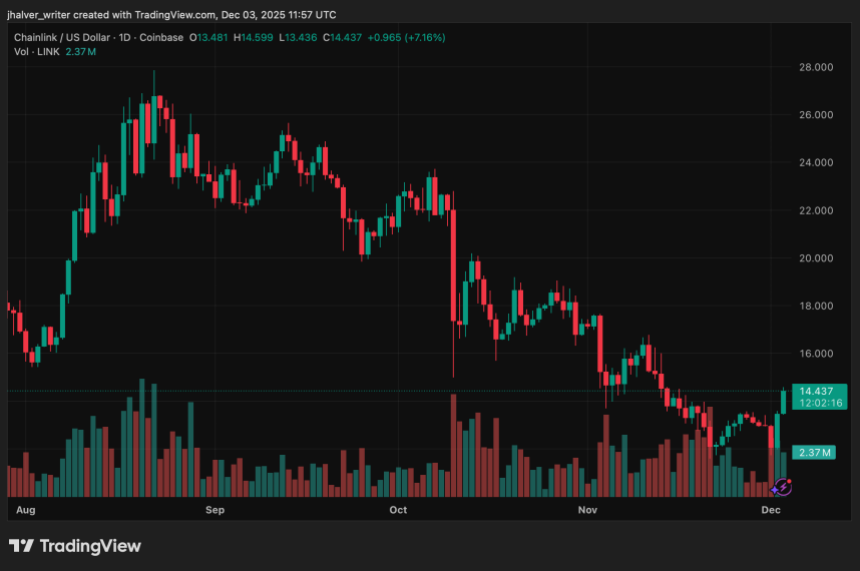
Chainlink (LINK) is once again in the spotlight across the cryptosphere after the launch of the first U.S. Chainlink-focused ETF sparked a sharp price rebound and renewed institutional interest. LINK surged more than 20% in 24 hours, trading around $14.4 as volumes and market participation accelerated.

Chainlink ETF Launch Sparks Strong Market Reaction

Grayscale launched the GLNK ETF on December 2, converting its previous private Chainlink trust into a publicly traded product on NYSE Arca.

The ETF opened with zero fees and recorded more than 1.17 million shares traded on its first day, far above historical averages. Trading volume reached roughly $13.8 million, while early inflows were reported near $43 million, reflecting strong initial demand.

The ETF gives institutions regulated exposure to LINK without requiring direct token custody. With access through major platforms such as Fidelity and Robinhood, Chainlink is receiving increased visibility among traditional investors.

Grayscale currently holds about 1.3 million LINK tokens through the product. Derivatives data also shows rising interest, with LINK futures open interest climbing more than 20% and funding rates turning positive as traders add long positions.

Chainlink LINK LINKUSD LINKUSD_2025-12-03_12-57-44

Technical Signals Point Toward Breakout Potential

Beyond ETF-driven momentum, the LINK chart is drawing attention from technical analysts.

Several analysts have emphasized a rare four-year descending wedge pattern, typically associated with long-term compression before a breakout. LINK recently bounced from the $12.50 support level, forming higher lows and regaining key Fibonacci levels.

Momentum indicators are turning positive as well. The daily RSI has recovered to around 53, while MACD signals improving strength. LINK is now approaching the $14.96 Supertrend level and remains below the 50-day and 200-day EMAs, both key levels the market is watching for confirmation of a trend shift.

If the token holds above $13, analysts expect a possible move toward the $18–$20 resistance range. A break above these zones could open the path toward the higher targets mentioned by long-term analysts.

Year-End Targets Strengthen as Market Sentiment Improves

Crypto analyst Ali Martinez notes that LINK is currently sitting on an important long-term support trendline, which could act as a foundation for a move toward $26 and potentially $47 if momentum continues.

Rising institutional inflows, accelerating derivatives activity, and a new spot ETF creating a steady channel for capital have strengthened market expectations.

For now, traders are watching the $12–$13 support area for signs that LINK can sustain its recovery. A decisive move above $14.50–$15 would mark the next major step toward a full bullish breakout.

Cover image from ChatGPT, LINKUSD chart from Tradingview

Analysts Turn Bullish on SUI as Token Extends Gains Amid Renewed Institutional Interest

Sui (SUI) is drawing renewed market attention after staging one of its strongest breakouts in months, rising sharply at a time when most large-cap altcoins remain range-bound.

The latest 31% surge was triggered by a series of developments that converged within days, most notably Coinbase’s approval to offer SUI trading to New York residents, a move that places the token inside one of the most heavily regulated crypto markets in the U.S.

The rally also arrived immediately after one of the largest token unlocks of the month, an event that would normally dampen prices but instead saw buyers step in with force.

SUI Network SUIUSD

New York Listing Boosts Liquidity and Institutional Demand

SUI surged between 25% and 32% over the past 24 hours after Coinbase confirmed that New York residents can now buy and trade the token across its web and mobile platforms.

The approval extends SUI’s reach into one of the most tightly regulated U.S. markets, strengthening its profile as a compliant layer-1 network and increasing accessibility for institutional investors.

The listing comes at a notable time. On December 1, SUI unlocked approximately $82–86 million worth of tokens, increasing circulating supply by more than 0.5%. Large unlocks typically pressure prices, but SUI moved higher instead, signaling strong demand absorption.

Trading volume has more than doubled, hitting roughly $1.5 billion, levels analysts say indicate genuine accumulation rather than short-lived speculation.

The launch of USDsui, a fiat-backed stablecoin designed for payments and DeFi use across the Sui ecosystem, also contributed to renewed interest. Combined with Coinbase’s expansion, these developments have strengthened confidence in Sui’s broader market positioning.

SUI Technical Indicators Point to Momentum Shift

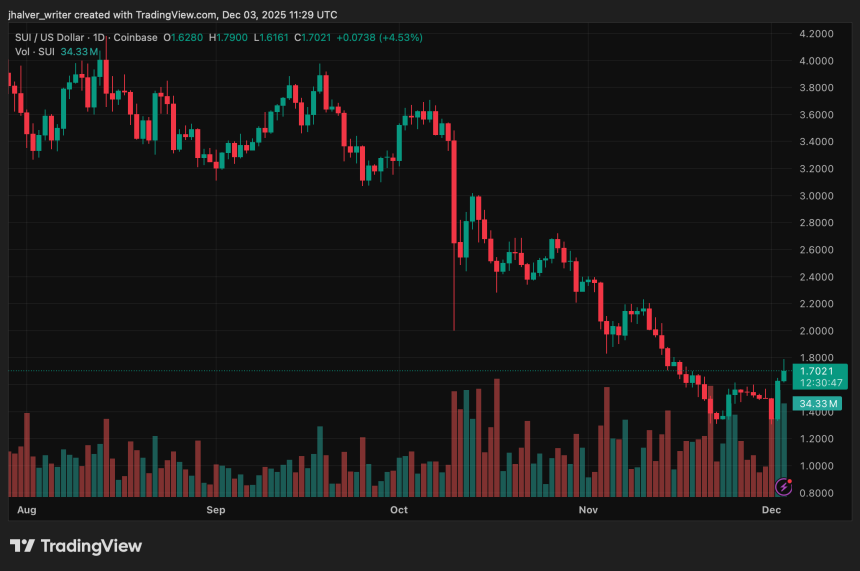
Price action shows that SUI recently rebounded from November’s lows near $1.12, climbing above the $1.60 support zone.

Indicators such as RSI and MACD now suggest easing selling pressure and a potential shift in short-term momentum. Analysts note that breaking above the mid-Bollinger Band near $1.90 would confirm a broader trend reversal.

SUI has also moved above the Keltner mid-band for the first time in weeks, with volume delta readings showing strong spot-market buying.

The next major resistance sits between $1.80 and $1.95, followed by a wider zone extending to $2.30. A decisive close above $1.92 is viewed as critical for invalidating November’s downtrend.

Rally Depends on Volume Holding

Market watchers say the current rally hinges on sustained demand. If daily volume remains above $1.5 billion and price holds the $1.60–$1.67 support zone, institutional participation could continue to push the token higher toward the $1.90 level.

However, weakening volume or a drop below $1.48 may signal that SUI has formed a local top. For now, sentiment remains constructive as the token benefits from increased U.S. accessibility, improving technical signals, and expanding ecosystem activity.

Cover image from ChatGPT, SUIUSD chart from Tradingview

Can the Fusaka Upgrade Renew Ethereum’s Momentum After Recent Price Hit?

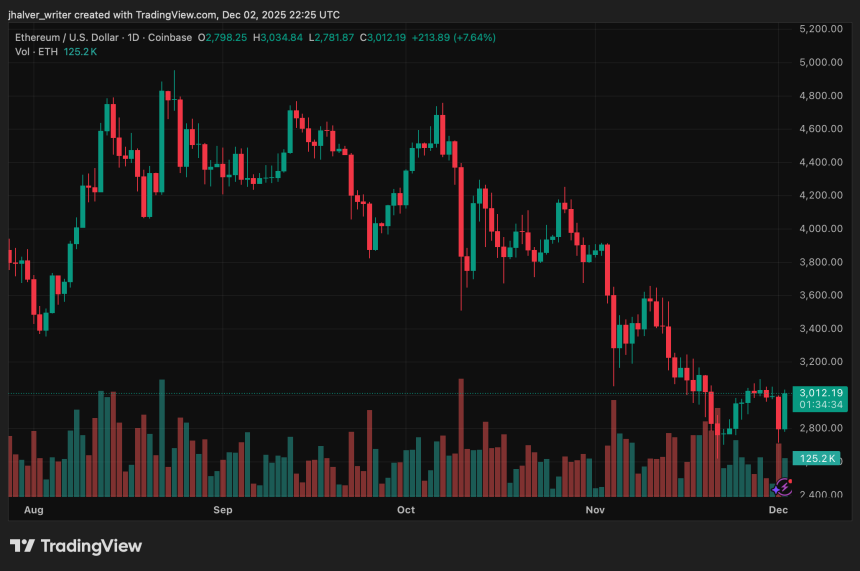
Ethereum fell more than 2% within 24 hours, sliding below $3,000 after losing its $2,900 support level. The drop triggered widespread liquidations, with around $500 million in long positions wiped out. Data shows that $79 million of the $106 million in ETH-focused contracts liquidated were long bets.

Trading activity spiked sharply during the decline, with daily volume rising 200% to $33.2 billion. The broader crypto market also contracted, falling nearly 1.2% and erasing an estimated $1100 billion in value within hours. Bitcoin, SOL, XRP, and DOGE followed similar downward moves.

Despite the volatility, some firms accumulated ETH during the downturn. BitMine Immersion Technologies increased its holdings by 96,798 ETH, diverging from the trend of companies reducing risk exposure.

Ethereum ETH ETHUSD ETH price

Fusaka Upgrade Goes Live, Aiming to Boost Scalability

On December 3, Ethereum is set to activate its Fusaka upgrade, the network’s second major 2025 update. The upgrade aligns execution- and consensus-layer changes, introducing features that aim to improve Layer 2 and reduce costs.

A key component is PeerDAS, a data-sampling mechanism designed to reduce the bandwidth validators need to verify Layer 2 data. This system aims to cut validator bandwidth requirements by up to 85% and expand blob data capacity, potentially lowering Layer 2 transaction fees by 40–60%.

Fusaka also raises Ethereum’s block gas limit to 60 million, enabling more transactions per block, and introduces updates to the Ethereum Virtual Machine that streamline smart contract execution. These combined changes are expected to enhance the network’s transaction capacity.

Industry interest had been rising ahead of the upgrade. Major financial players, including Amundi and Fidelity, recently announced moves into tokenized products built on Ethereum, reflecting broader institutional activity across the network.

Can Ethereum (ETH) Recover From Oversold Levels?

Ethereum (ETH) last traded at around $2,807, with technical indicators indicating continued bearish momentum. The MACD remains in negative territory, while the Relative Strength Index sits at 32, signaling oversold conditions.

Key support levels are at $2,700 and $2,500. A failure to hold these zones may deepen the downtrend, while a rebound could push ETH back toward $2,900–$3,000. Open Interest rose 4.3% after the decline, suggesting traders are reopening positions and preparing for higher volatility.

Whether the Fusaka upgrade can shift market sentiment remains uncertain, but its long-term scaling impact may play a role in Ethereum’s broader recovery.

Cover image from ChatGPT, ETHUSD chart from Tradingview

Cardano’s December Slide Intensifies: What’s Driving the Decline and What Comes Next?

Cardano (ADA) has opened December under pressure, dropping more than 7% in the past week as broader market sentiment weakens and macroeconomic uncertainty rises.

ADA is now trading near $0.38–$0.4, testing key support levels and extending a month-long downtrend that has erased recent gains.

Cardano ADA ADAUSD ADAUSD_2025-12-02_23-18-41

Macroeconomic Pressure and Market Sentiment Weigh on ADA

The latest decline comes amid renewed concerns over global interest rate policy. Comments from Bank of Japan Governor Kazuo Ueda signaled the possibility of a rate hike, a shift that could unwind leveraged positions funded through low-interest yen borrowing.

Cardano’s drop aligns with losses seen across the crypto market, with Bitcoin, Ethereum, and other major altcoins also trading lower. High trading volumes, over $1 billion in the past 24 hours, reflect elevated volatility and growing caution among investors.

On-chain indicators show dormant ADA wallets from as far back as 2017 moving coins to exchanges, a sign that long-term holders may be preparing to exit positions.

Short interest in ADA futures has also increased, with open interest rising 12% over the past week. Traders are betting on a further slide below $0.35 unless ADA can reclaim the $0.40 resistance level.

Ecosystem Developments Offer Some Long-Term Support

Despite the market downturn, several developments within the Cardano ecosystem continue to generate attention. A $30 million liquidity initiative designed to strengthen Cardano’s DeFi sector is scheduled for rollout in early 2026.

The fund aims to boost total value locked by supporting lending, staking, and decentralized exchange activity, areas where Cardano has historically lagged behind competitors.

Another upcoming milestone is the launch of the Midnight sidechain on December 8. The privacy-focused network introduces new capabilities around data protection and secure enterprise applications.

Some analysts believe the launch could increase Cardano’s adoption and improve sentiment, particularly if it leads to more activity in decentralized finance.

Cardano’s long-term technical outlook also remains a topic of debate. Analysts note that ADA is once again touching the support line of a multi-year uptrend. Historically, similar tests have preceded recoveries, with some projecting a possible rebound toward the $0.50–$0.75 range if the market stabilizes.

What Comes Next for Cardano (ADA)?

The near-term outlook for Cardano remains uncertain. A break below $0.38 could expose the token to further declines toward the $0.30 area, especially if broader market weakness continues. However, strong staking participation, around 70% of circulating supply, may help cushion deeper drawdowns.

Longer-term forecasts vary widely, ranging from modest recoveries to highly optimistic projections tied to expected ecosystem upgrades in 2026.

For now, ADA’s trajectory will depend on whether macroeconomic pressures ease and whether Cardano can translate its upcoming developments into sustained network growth and investor confidence.

Cover image from ChatGPT, ADAUSD chart on Tradingview

New U.S. Stablecoin Regulations Imminent as FDIC Finalizes GENIUS Act Guidelines

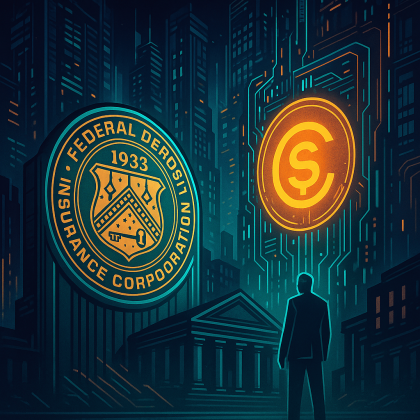
The U.S. Federal Deposit Insurance Corporation (FDIC) is preparing to publish its first formal proposal outlining how stablecoin issuers will operate under the GENIUS Act, according to acting chairman Travis Hill.

The rulemaking package is expected to be submitted to the House Financial Services Committee before the end of December, marking a major step toward implementing the country’s new federal stablecoin framework.

Bitcoin BTC BTCUSD BTCUSD_2025-12-02_12-41-27

FDIC Nears First Draft of GENIUS Act Stablecoin Rules

The Guiding and Establishing National Innovation for U.S. Stablecoins Act (GENIUS Act), signed into law in July, created a multi-agency oversight system for payment stablecoins.

Under the law, only licensed issuers are allowed to offer stablecoins to U.S. users, with oversight divided between the FDIC, Federal Reserve, Treasury, and other regulators.

Hill said the FDIC has been developing application procedures and prudential standards that will apply to stablecoin-issuing subsidiaries of FDIC-supervised institutions.

These standards include capital requirements, liquidity expectations, and reserve asset diversification rules designed to ensure issuers can meet redemptions during periods of stress.

The agency also expects to release a separate proposal early next year detailing the financial and operational requirements stablecoin issuers must meet once approved.

Regulators Outline Broader Digital-Asset Responsibilities

Hill noted that the FDIC has taken a cautious but constructive approach toward banks exploring digital-asset services, ensuring activities remain “safe and sound.” Part of the agency’s ongoing work includes responding to recommendations from the President’s Working Group on Digital Asset Markets.

One area receiving particular attention is tokenized deposits, digital representations of bank deposits issued on blockchain networks. Hill confirmed that new guidance is being drafted to clarify how these instruments fit within existing banking rules, reflecting growing industry interest in tokenization for payments and settlement.

Other regulators are advancing their own responsibilities under the GENIUS Act. Federal Reserve Vice Chair for Supervision Michelle Bowman stated that the central bank is collaborating with banking agencies to establish capital, liquidity, and diversification standards for stablecoin issuers.

Treasury Continues Public Consultation Process

The U.S. Department of the Treasury has also played a central role in implementing the GENIUS Act.

In September, it released an Advance Notice of Proposed Rulemaking (ANPRM) seeking public feedback on its stablecoin oversight approach. The comment period, which ran through early November, invited input from industry participants, academics, and consumer groups.

The Treasury stated that the consultation aims to strike a balance between innovation and financial stability concerns. Public submissions will help build the final proposals, which will govern non-bank stablecoin issuers and related digital asset activities.

Related Reading: Crypto Crackdown: House GOP Discovers 30 Firms Debanked In Operation Chokepoint 2.0

With the FDIC’s first proposal now nearing completion, federal agencies are entering the next phase of what is expected to be a multi-month rulemaking process. Once draft rules are released, they will undergo public review before final guidelines are adopted and phased in across the stablecoin market.

Cover image from ChatGPT, BTCUSD chart from Tradingview

Solana Integration Boosts Kalshi’s Push Into Tokenized Event Contracts and Crypto Liquidity

Kalshi has taken a major step in restructuring how prediction markets operate by moving its event contracts onto the Solana blockchain.

The transition brings U.S.-regulated prediction markets directly into decentralized finance, positioning the platform to compete more closely with its on-chain rival, Polymarket, while targeting deeper liquidity and broader user access.

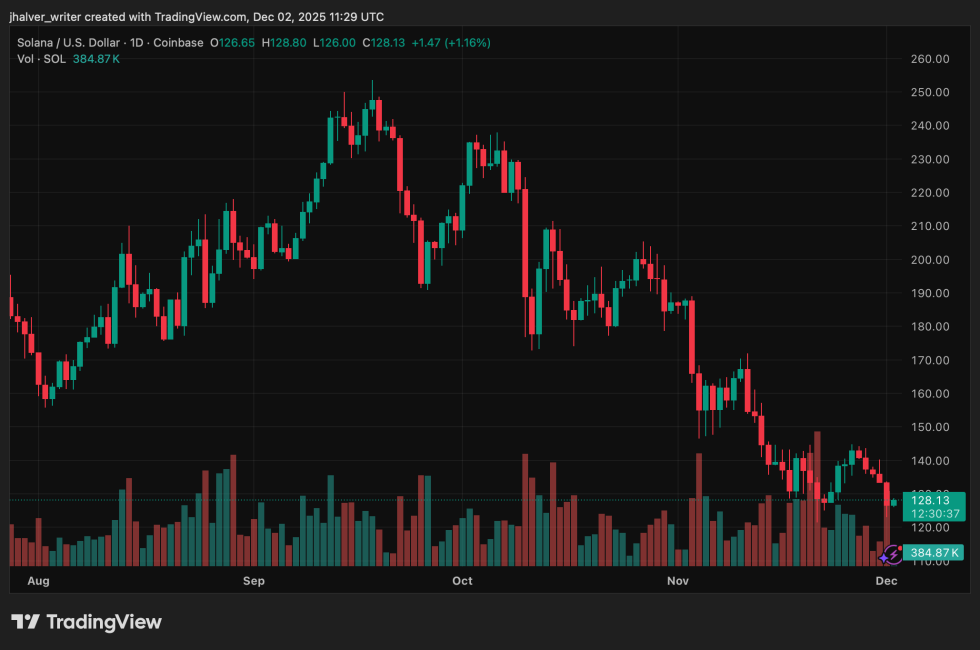
Solana SOL SOLUSD

Prediction Contracts Move On-Chain

Kalshi’s event markets now operate as Solana-based SPL tokens rather than entries on a centralized exchange. Through an integration with Solana protocols DFlow and Jupiter, users can trade “yes” and “no” positions via crypto wallets, tap automated liquidity, and settle outcomes through on-chain logic.

The shift enables contracts to be traded, borrowed, lent, or used as collateral within DeFi systems. Kalshi is supporting developer participation with a $2 million grants program and a new Builder Codes system that rewards teams for driving trading volume through custom applications.

Executives describe tokenization as the platform’s long-term strategy, arguing that on-chain access offers speed, transparency, and programmability while preserving Kalshi’s CFTC-regulated framework. The hybrid model links decentralized liquidity with an off-chain matching engine.

Will the Move Capture Liquidity and Challenge Polymarket?

Prediction-market activity has surged in 2025, with sector-wide volume nearing $28 billion by late October. November saw Kalshi record $5.8 billion in trading, while Polymarket handled $3.7 billion following rulings that reopened U.S. access.

Liqudity has become the core competitive factor. By issuing markets as standard Solana tokens, Kalshi expects automated market makers, trading bots, and cross-protocol liquidity systems to tighten spreads and improve pricing accuracy.

Enhanced privacy is another draw, with tokenized markets offering wallet-based trading rather than identity-verified accounts. Industry analysts note that the move puts Kalshi in direct competition with Polymarket’s fully on-chain model.

Solana Expands Multi-Chain Prediction Economy

Kalshi believes Solana is the first step toward a broader on-chain architecture. The company plans to add EVM-compatible networks and deeper integrations with DeFi protocols to build a multi-chain forecasting ecosystem.

Additional partnerships, including earlier collaborations with Zero Hash and stablecoin custody support from Coinbase, reflect an effort to streamline global accessibility.

With its valuation recently rising to $11 billion after a major funding round, the company is signaling confidence that tokenized prediction markets will become a standard format for forecasting and derivatives tied to real-world events.

As prediction markets evolve toward decentralized models, Kalshi’s Solana rollout marks a turning point in how regulated platforms interact with crypto liquidity and sets the stage for intensified competition across the sector.

Cover image from ChatGPT, SOLUSD chart from Tradingview

KuCoin Secures MiCA License Expanding Its Position Across the EU Market

KuCoin has secured a Markets in Crypto-Assets (MiCA) license in Austria, a move that expands its regulated presence across the European Union.

Related Reading: Ripple Scores Major Win As MAS Supercharges Its Singapore License

The approval, granted to its local entity KuCoin EU Exchange GmbH, allows the platform to offer digital asset services in 29 European Economic Area (EEA) countries under the EU’s unified crypto regulatory framework.

KuCoin btc btcusd crypto exchange

A Major Step Under the MiCA Regulatory Framework

The MiCA framework, which took full effect in December 2024, establishes uniform requirements for crypto service providers across the European Union.

With its Austrian authorization, KuCoin EU Exchange GmbH is now permitted to offer trading, custody, and other digital asset services across 29 EEA countries through MiCA’s passporting mechanism.

To meet MiCA obligations, exchanges must comply with capital adequacy standards, segregate customer assets, adhere to transparency rules, and obtain approval from national regulators.

KuCoin reports that it has implemented several security and compliance measures to meet these requirements, including SOC 2 Type II, ISO 27001:2022, ISO 27701, and CCSS certifications, alongside third-party proof-of-reserves audits.

CEO BC Wong said the authorization aligns with the company’s long-term compliance plans and reflects the regulatory expectations set under MiCA.

KuCoin’s Expanded Access Under EU Passporting Rules

Under MiCA’s passporting mechanism, KuCoin can now operate its digital asset services across 29 EEA countries, once it is licensed in Austria. This places the exchange among other major platforms, such as Coinbase, Kraken, and Bitstamp, that secured authorization ahead of the regulation’s full rollout.

The license is designed to expand KuCoin’s ability to serve users within a unified regulatory framework that applies consistent standards across member states.

This development also aligns with the company’s broader “$2 Billion Trust Project,” which includes efforts to enhance compliance systems and follows its AUSTRAC registration in Australia in November.

As part of the transition, EEA users except those in Malta will gain access to KuCoin EU’s upcoming MiCA-compliant platform, while new registrations on KuCoin Global will no longer be available within the region.

Industry Implications and Outlook

KuCoin’s MiCA approval reinforces a broader shift in the crypto sector as exchanges adapt to tighter regulatory expectations. For investors, MiCA brings more clarity around standards for disclosure, asset protection, and operational oversight. For exchanges, it creates a consistent framework that simplifies cross-border operations.

Related Reading: Domino-Effect Sell-Off: Analysts Reveal The Spark Behind Bitcoin’s Flash Crash

As the European market continues to formalize its digital asset rules, KuCoin’s alignment with MiCA positions it to compete more effectively with other regulated exchanges. The company says it will continue scaling its compliance programs as it expands across additional jurisdictions.

Cover image from ChatGPT, BTCUSD chart from Tradingview
Bitcoin Faces Heavy Selling Pressure as Liquidations Trigger Steeper Decline

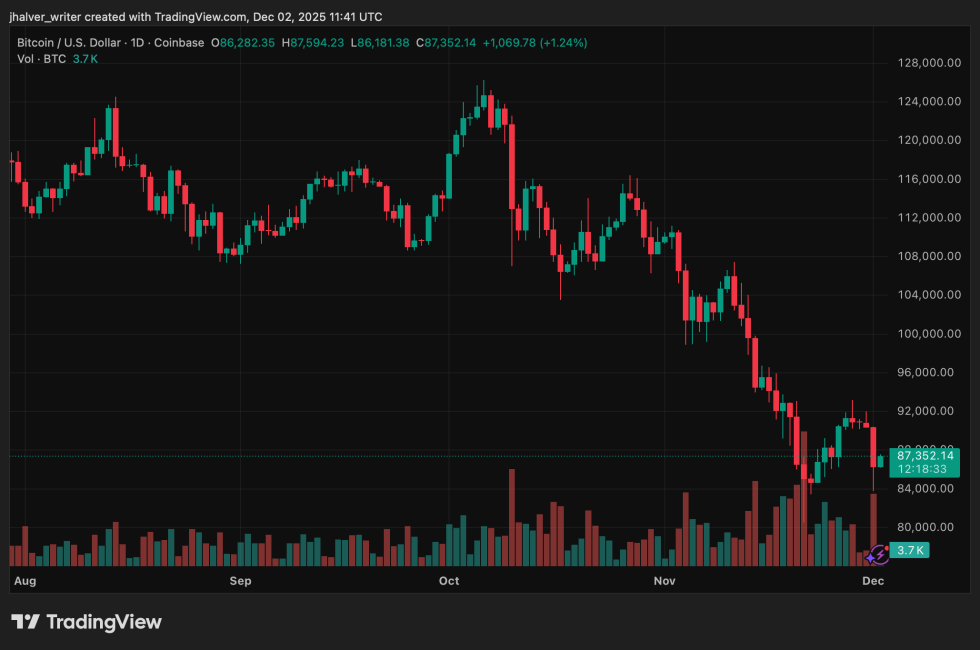
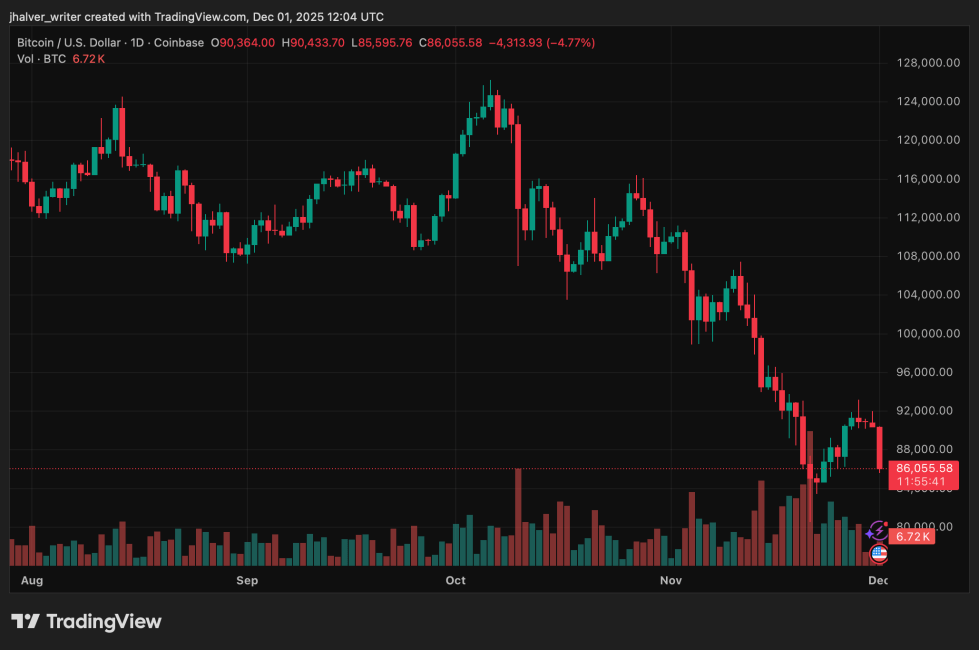
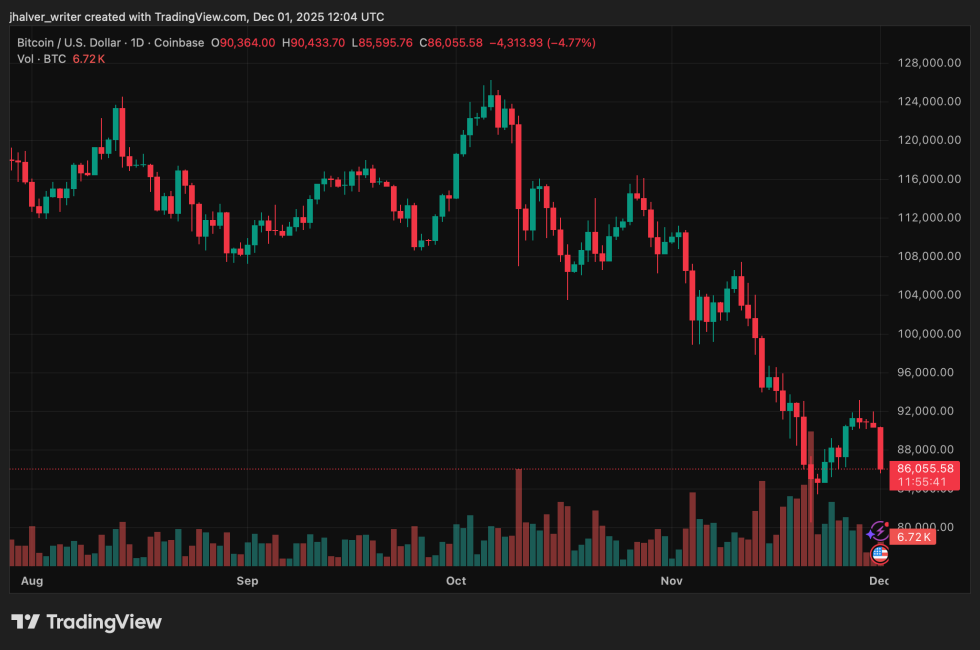
Bitcoin (BTC) faced renewed selling pressure on Monday, dropping to around $86,000 after a series of liquidation events erased hundreds of millions of dollars in leveraged positions.

The decline deepened over the weekend, pushing BTC briefly under $85,500 amid broader risk-off sentiment and growing macroeconomic uncertainty.

Bitcoin BTC BTCUSD

Liquidation Wave Accelerates Downtrend

Data from multiple exchanges shows that more than $640 million worth of leveraged positions were wiped out within 24 hours, triggering a sharp breakdown below Bitcoin’s recent trading channel.

The pullback followed a breach of a major liquidation cluster under the $90,000 level, which rapidly thinned liquidity and intensified the move toward the mid-$80,000 region.

On the charts, Bitcoin lost short-term structural support after falling below the lower boundary of its ascending channel. Indicators such as the Chaikin Money Flow (CMF) and the monthly MACD have weakened, with the latter printing a bearish crossover historically associated with extended downturns.

Analysts say support now lies around $84,500–$84,800, with deeper levels near $82,000 and $80,500 if selling pressure continues.

Altcoins reflected the volatility, with Ethereum dropping to around $2,800 while Solana, XRP, Binance Coin, and Dogecoin recorded losses between 5% and 7%. The total crypto market cap declined by nearly 5% to $2.95 trillion.

Bitcoin ETF Outflows and Macro Signals Add Pressure

The correction comes as Bitcoin spot ETFs recorded significant outflows through November. The month saw about $3.5 billion leave Bitcoin ETF products, with major issuers facing sizeable withdrawals.

Analysts attribute the trend to portfolio rebalancing and profit-taking, rather than a broad exit from digital assets; however, the timing has added pressure to an already fragile market.

Global macro developments have also shaped sentiment. The Bank of Japan is signaling a possible rate hike in December, contributing to volatility across risk assets.

In the US, traders are awaiting new guidance from the Federal Reserve after the end of Quantitative Tightening. A shift toward easier policy could help stabilize liquidity conditions, but uncertainty remains ahead of upcoming FOMC communications.

Market Awaits Fed Direction as Key Levels Hold

Despite the downside momentum, some analysts argue that the broader cycle remains intact, calling the current pullback a shakeout rather than the start of a prolonged bear phase.

For now, BTC’s ability to hold the $86,000–$87,000 zone will be closely watched. A recovery above $89,000 could ease immediate pressure, while a break below support may open the path toward the low-$80,000 range.

Cover image from ChatGPT, BTCUSD chart from Tradingview

Market Downturn Hits Dogecoin Hard: Is a Larger Correction on the Horizon?

Similar to major assets in the cryptosphere, Dogecoin (DOGE) is facing renewed selling pressure as broader crypto market weakness intensifies, pushing the memecoin below several key technical levels.

Related Reading: $300 Million Crypto Bet: Kazakhstan’s Central Bank Gears Up

The decline occurs amid outflows, a weakening market structure, and fading speculative interest, raising questions about whether a deeper correction may be underway.

Dogecoin DOGE DOGEUSD

Dogecoin Breaks Key Supports as Selling Pressure Mounts

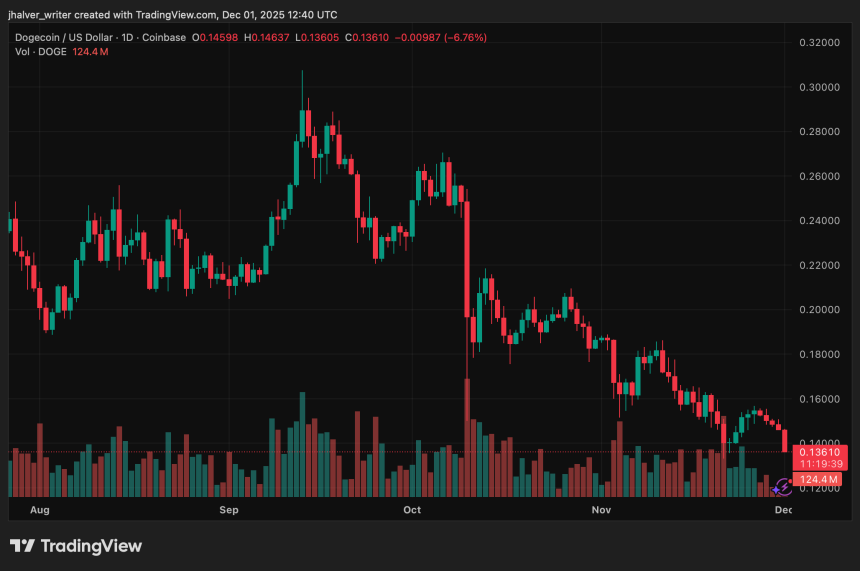
Dogecoin slipped below important support areas after breaking a bullish trend line on the hourly chart, continuing a multi-day downtrend. The price now trades below the 100-hour simple moving average, near $0.13, with MACD momentum strengthening in the bearish zone and the RSI remaining below 50.

The coin declined more than 8% in 24 hours, falling through multiple Fibonacci retracement zones and failing to regain footing above the 23.6% level of the latest swing move.

Analysts note that immediate resistance lies near the 50% retracement of the recent decline. A close above that threshold is needed to ease short-term downside pressure.

Failure to break above these resistance areas has kept momentum tilted toward sellers, with a retest of recent lows likely if the market does not stabilize.

Weak Flows and Derivatives Contraction Deepen Market Strain

Spot market flows show persistent distribution. Recent data revealed a $5.7 million outflow, extending the multi-month trend of reduced accumulation from large holders. Earlier inflows that supported rallies toward $0.30 have given way to steady red prints, reflecting waning confidence among major players.

Derivatives markets reinforce the weakening structure. Open interest has dropped more than 9% as traders unwind positions rather than add exposure during declines.

Long-short ratios show a mild long bias, but price action has repeatedly invalidated those positions, triggering waves of long-side liquidations whenever DOGE attempts to rise above short-term moving averages.

These repeated failed rallies have kept Dogecoin locked beneath declining EMAs between $0.154 and $0.202, a structure analysts say remains firmly bearish.

DOGE ETF Disappointment and Market Rotation Add Further Pressure

Dogecoin’s recently launched ETFs have not provided support. Combined inflows from major issuers barely surpassed $2 million, far below expectations and significantly weaker than the debut flows seen in Bitcoin or Ethereum funds.

The soft demand has signaled limited institutional appetite for the memecoin, contributing to negative sentiment.

Related Reading: XRP Hit By Violent 59% Leverage Flush As Speculators Slam The Brakes

Meanwhile, market rotation is moving toward utility-focused assets and payment-driven networks. Declining volume and low whale activity suggest traders may be shifting away from meme assets in favor of projects showing faster adoption and real-world use cases.

Cover image from ChatGPT, DOGEUSD chart from Tradingview
XRP Shows Unusual Market Behavior as Traders Weigh Fresh Bullish Signals for December

XRP is entering December with a mix of unusual market signals, steady price action, and renewed bullish expectations from analysts and prediction platforms.

Despite the general instability and uncertainty in the crypto market, traders continue to monitor XRP’s behavior above the $2.0 range as new data points shape sentiment.

XRP XRPUSD XRPUSD_2025-12-01_13-31-45

One-Sided Liquidations Highlight Market Imbalance

Liquidation data from CoinGlass recorded an unusual reading this week after XRP posted $0 in short liquidations during a one-hour window. All losses came from long positions, totaling about $128,000. Such a clean one-sided liquidation profile is rare in active derivatives markets and immediately stood out across the crypto sector.

Other major assets, such as Bitcoin and Ethereum showed typical liquidation activity on both sides. For XRP, the imbalance suggested that leveraged traders were heavily positioned for upside, leaving long holders exposed even to small price movements.

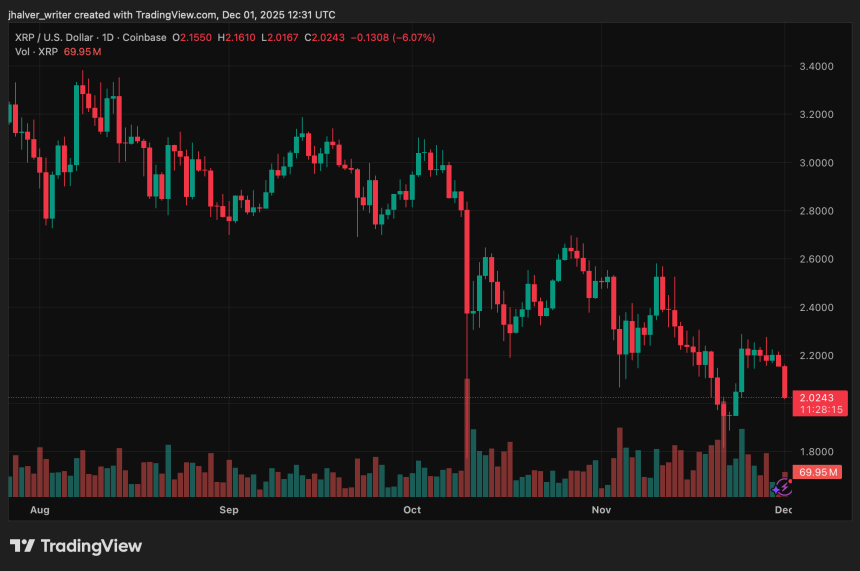
Despite this, XRP’s price has not been immune to the broader market downturn, which saw the total crypto market cap drop by more than 5%. XRP slipped toward the $2.04 area, but analysts note that the $2.00 zone remains a key support level. On the upside, $2.20 continues to act as the immediate resistance level to watch.

Technical Outlook Points to a Potential December Breakout

XRP ended November down more than 17%, mirroring a broad market decline that has seen Bitcoin fall to $86,700 and several altcoins record double-digit losses. This drop came despite positive developments, including strong early inflows into newly approved crypto ETFs and the growth of Ripple USD (RLUSD).

On the charts, XRP continues to trade around the Murrey Math Lines pivot. Analysts highlight a bullish flag pattern forming on the eight-hour timeframe, which is typically a continuation structure that may trigger a breakout. A successful move higher could send the token toward $2.73, the next major resistance.

Mixed Prediction Market Signals but Strong Community Confidence

Prediction markets are split on XRP’s near-term prospects. Kalshi data shows a 69% probability that XRP will end the year with a positive return, reflecting strengthened sentiment after weeks of consolidation. In contrast, Polymarket assigns a 99% chance to XRP reclaiming the ATH by 2026.

Despite the divergence, the community outlook remains firm. Traders point to XRP’s steady range, rising ETF interest, and resilience during volatility as indicators of potential upside. As December unfolds, XRP’s narrow trading band and unusual liquidation patterns are setting the stage for this decisive month.

Cover image from ChatGPT, XRPUSD chart from Tradingview

Bitcoin Recovery Gains Momentum Past $90K, Yet Analysts Warn the Upside Could Be Fragile

Bitcoin has climbed back above the $90,000 mark, recovering sharply after last week’s slump to near-$80,000. The world’s largest crypto surged as much as 4% in 24 hours, briefly touching $91,200, boosted by renewed market optimism, improving liquidity, and growing expectations of a Federal Reserve rate cut in December.

Related Reading: The 250% Price Surge That Will Send Bitcoin To $300,000

However, despite the rebound, analysts warn that the latest upswing may remain structurally fragile.

Bitcoin BTC BTCUSD

Risk Appetite Returns as BTC Leads Market Rebound

After weeks of volatility, Bitcoin’s latest rise mirrors a broader recovery across the crypto market. A wave of buying pushed Ethereum back above $3,000, while major altcoins, including XRP, BNB, Solana, Cardano, Tron, and Dogecoin, logged gains of over 4%.

Market analysts attribute the rally largely to improving macro sentiment. Traders are now pricing in an 85% chance of a Fed rate cut, up from just 44% a week earlier. Lower interest rates typically boost demand for risk assets, including crypto.

Additionally, a massive 1.8 million BTC withdrawal from exchanges overnight sparked speculation of increased institutional accumulation.

Regardless, caution lingers. The crypto Fear & Greed Index sits deep in “Extreme Fear,” and despite rising prices, market conviction remains thin. As CoinSwitch noted, BTC’s jump was fueled partly by a short squeeze, not purely organic demand.

Analysts Warn of Resistance Ahead

Even with the recent improvement, several analysts believe Bitcoin’s upside remains limited in the near term. Resistance between $92,000 and $95,000 is expected to be a key test for bulls.

Ed Engel of Compass Point notes that BTC’s rebound from the $82,000 Real Market Average suggests early signs of capitulation but not a confirmed bottom.

Whale wallets holding 10–10,000 BTC have continued reducing their holdings for six straight weeks, an ongoing bearish indicator. Meanwhile, institutional desks are reportedly trimming exposure into year-end, adding more supply to the market.

Some traders expect Bitcoin to retest $82,000 or even dip below $80,000 if momentum fades. Others believe a strong break above $95,000, supported by retail demand, could renew bullish structure and open the path toward fresh highs.

A Market at a Crossroads

Despite improved liquidity and rebounding prices, Bitcoin’s recovery remains fragile. Sentiment is mixed, leveraged positions are still unwinding, and macro data continues to send conflicting signals. For now, BTC appears stuck between growing optimism and persistent skepticism.

Related Reading: Crypto Asset Reporting Framework Advances: US Treasury Aims For Global Compliance By 2027

The next major catalyst, whether from the Federal Reserve, institutional flows, or renewed retail appetite, will likely determine whether Bitcoin’s climb is the start of a sustainable uptrend or just another relief rally.

Cover image from ChatGPT, BTCUSD on Tradingview
Australia Signals Big Crypto Ambitions With $24B Framework and Tighter Custody Standards

Australia is accelerating its push into digital finance with the introduction of the Corporations Amendment (Digital Assets Framework) Bill 2025, a comprehensive regulatory overhaul designed to strengthen crypto custody standards, improve investor protection, and unlock an estimated $24 billion in annual economic value.

The bill establishes the country’s first comprehensive framework for digital asset platforms and crypto custodians, positioning Australia as one of the most proactive jurisdictions in the global race for crypto regulation.

crypto bitcoin btc btcusd

A New Licensing Regime to Protect Consumers

The cornerstone of the legislation is a requirement for crypto exchanges and custody providers to obtain an Australian Financial Services License (AFSL).

This brings them under the supervision of the Australian Securities and Investments Commission (ASIC), a major structural shift for an industry that previously operated in a fragmented regulatory space.

Assistant Treasurer Daniel Mulino emphasized that Australia must “keep pace” with financial innovation. The bill specifically targets firms holding customer crypto, rather than blockchain technology itself, addressing a widespread concern that companies can currently store unlimited digital assets for clients without adequate safeguards.

To close this gap, the bill introduces two new regulated categories:

  • Digital asset platforms
  • Tokenized custody platforms

Both will be subject to strict standards for transactions, settlements, asset storage, and mandatory disclosure of risks and fees.

Balancing Innovation With Oversight

While the legislation imposes tough standards, it also aims to support responsible growth in the digital asset sector. Companies handling less than A$10 million in annual transactions or participating in crypto only as an incidental activity will be exempt from licensing.

Industry response has been broadly positive, with firms like Crypto.com and DECA calling the bill a long-awaited step that provides regulatory clarity without stifling innovation. A phased rollout, a 12-month preparation period followed by a six-month transition window, gives platforms time to meet the new requirements.

ASIC’s recent crackdown on scams underscores the urgency. Since mid-2023, the regulator has removed over 14,000 phishing and scam sites, approximately 20% of which were related to cryptocurrency.

A Transformational Step for Australia’s Digital Finance Future

Treasurer Jim Chalmers noted that digital assets, from cryptocurrencies to tokenized real-world assets, represent a significant economic opportunity. Research cited by the government suggests that the reforms could help unlock up to $24 billion annually in productivity and efficiencies across the financial sector.

However, industry experts warn that coordination across ASIC, AUSTRAC, and the ATO will be essential. The bill’s success will depend on whether the final regulatory framework is both enforceable and flexible enough to adapt to rapid innovation in tokenization and blockchain services.

As the bill moves through Parliament, with easy passage expected in the House, the key question is whether crossbench support in the Senate will solidify Australia’s position as a global leader in secure, innovation-friendly crypto regulation.

Cover image from ChatGPT, BTCUSD on Tradingview

❌