Uber will begin selling customer data to marketers, according to a report by Business Insider. The company's ad division just launched a new insights platform called Uber Intelligence that's tasked with hoovering up and selling trip and delivery data.
The data will technically be anonymous, via the use of a platform called LiveRamp. This will "let advertisers securely combine their customer data with Uber's to help surface insights about their audiences, based on what they eat and where they travel."
Basically, it'll provide a broad view of local consumer trends based on collected data. Uber gives an example of a hotel brand using the technology to identify which restaurants or venues to partner with according to rideshare information.
The company also says it's planning on using this tech to directly advertise to consumers, saying it could be used to identify customers who are "heavy business travelers" and then plague them with ads in the app or in vehicles during their next trip to the airport. Fun times.
"That seamlessness is why we're so excited," Edwin Wong, global head of measurement at Uber Advertising, told Business Insider. Uber has stated that its ad business is already on track to generate $1.5 billion in revenue this year, and that's before implementing these changes.
This article originally appeared on Engadget at https://www.engadget.com/big-tech/uber-will-start-selling-trip-and-takeout-data-to-marketers-171011769.html?src=rss
Netflix has already committed to reviving Star Searchfor its streaming service, and now the company is turning its attention to a different type of live show: HQ Trivia. Netflix's Best Guess Live is an attempt to revive the late 2010s app-based show with what the company is calling its first "weekday mobile game show."
Best Guess Live will be hosted by Howie Mandel (Deal or No Deal, America's Got Talent) and Hunter March (Sugar Rush) and will broadcast Monday through Friday at 8PM ET / 5PM PT. The game seems like it will lean on multiple choice questions much like HQ Trivia did, and will reward players who answer the fastest and play multiple times per week. Netflix's announcement doesn't have any specifics as to how much money will be up for grabs, but the company does promise to give away "thousands of dollars in prize money."
HQ Trivia, started by Vine co-founders Rus Yusupov and Colin Kroll, was a surprise hit when it debuted in 2017, thanks in part to its host Scott Rogowsky and the appointment-viewing nature of a daily game show you could watch on your phone. The later slow collapse of HQ was rocky enough to warrant a CNN documentary, but clearly the concept of the app fits nicely with Netflix's growing interest in live shows and casual games.
Netflix has experimented with a growing number of live shows, including talk shows and sports programming. The company has also recently abandoned its aspirations to develop AAA games and ambitious indie titles to focus on casual experiences and games based on Netflix IP. Best Guess Live seems like a nice fusion of casual interactive experience and lightweight live content. Many people already open the Netflix app daily to find something to watch. It makes sense they'd be willing to do it for money, too.
This article originally appeared on Engadget at https://www.engadget.com/entertainment/streaming/best-guess-live-is-netflixs-take-on-hq-trivia-170000030.html?src=rss
The makers of ICEBlock, the community-based reporting app for ICE sightings and activity, are suing the federal government, alleging "unlawful threats" made by Trump administration officials led to the app's removal from app stores. The suit centers on free speech violations and accuses the administration of coercing Apple into taking down the app in October. Google began taking down similar apps around the same time.
Josh Aaron developed ICEBlock in response to the Trump administration's crackdown on illegal immigration. The app allowed users to pin ICE agent locations on a map as well as add notes such as what agents were wearing or the kind of vehicle they were driving. The app would then alert users within a five-mile radius of the sighting. The White House called the app "an incitement of further violence against… ICE officers" and sought its removal.
“A lesson we should all take from this is when we see our government is doing something wrong, it is our duty to stand up,” Aaron told the New York Times.
This isn't the first time Apple has faced controversy for an app takedown. In 2019, the company removed an app that protesters in Hong Kong were using to track police after facing pressure from the Chinese government.
Apple, for its part, said it took the app down in response to "information we've received from law enforcement about the safety risks associated with ICEBlock." Federal officials said the gunman who attacked an ICE facility in Dallas had used tracking apps, including ICEBlock.
"Fundamentally, ICEBlock neither enables nor encourages confrontation — it simply delivers time-limited location information to help users stay aware of their surroundings in a responsible and nonviolent way," Aaron's suit reads.
Engadget has reached out to Apple for comment and will update if we hear back.
This article originally appeared on Engadget at https://www.engadget.com/general/the-developer-behind-iceblock-is-suing-the-federal-government-165111674.html?src=rss
BROADVIEW, ILLINOIS, UNITED STATES - SEPTEMBER 19: ICE officers clash with demonstrators outside an Immigration and Customs Enforcement (ICE) facility using smoke gas and plastic bullets to disperse crowds protesting against deportations in Broadview, Illinois, United States on September 19, 2025. Several hundred protesters had gathered near the Broadview ICE center, chanting against immigration enforcement policies. (Photo by Jacek Boczarski/Anadolu via Getty Images)
Paramount has been none too pleased about Netflix striking an $82.7 billion deal to buy much of Warner Bros. Discovery (WBD). Now, Paramount is making a hostile takeover bid for WBD. It's making its pitch directly to WBD shareholders with an all-cash offer of $30 per share that expires on January 8.
Late last week, the WBD board unanimously accepted Netflix's offer of $27.75 per share. That breaks down to $23.25 per share in cash and another $4.50 per share in Netflix stock. Netflix's overall bid is valued at $82.7 billion, while Paramount's totals $108.4 billion.
There's a key difference when it comes to the Paramount offer, as it’s for all of WBD. The latter is scheduled to split into two companies next year. Netflix only wants the Streaming and Studios side of WBD's business, which includes HBO Max and the Warner Bros. film, TV and game studios.
Paramount is after the whole shebang, including WBD's cable channels (Global Networks). "WBD's Board of Directors recommendation of the Netflix transaction over Paramount's offer is based on an illusory prospective valuation of Global Networks that is unsupported by the business fundamentals and encumbered by high levels of financial leverage assigned to the entity," Paramount said in a press release on Monday.
As of the end of September, WBD was carrying $34.5 billion of gross debt. It planned to saddle the Global Networks company (aka Discovery Global) with most of that. The Paramount offer includes $40.7 billion in financing from the family of Paramount CEO David Ellison — his father is Oracle co-founder Larry Ellison — and RedBird Capital, but it would be taking on more debt to secure a deal for WBD. The bid includes "$54 billion of debt commitments from Bank of America, Citi and Apollo." (Apollo owns a majority stake in Yahoo, Engadget's parent company).
According to an SEC filing [PDF], other entities are backing the Paramount bid, including Jared Kushner’s investment firm Affinity Partners and the sovereign wealth funds of Saudi Arabia (the Public Investment Fund), Qatar and Abu Dhabi. Tencent was a financing partner in a previous Paramount offer, but it’s not involved with the hostile takeover attempt.
In a letter sent to WBD CEO David Zazlav before the company accepted Netflix's offer, Paramount questioned the "fairness and adequacy" of the sale process. It asked whether WBD was acting in the best interest of shareholders after the management team allegedly appeared to favor the Netflix offer.
"Despite Paramount submitting six proposals over the course of 12 weeks, WBD never engaged meaningfully with these proposals which we believe deliver the best outcome for WBD shareholders," Paramount said. "Paramount has now taken its offer directly to WBD shareholders and its Board of Directors to ensure they have the opportunity to pursue this clearly superior alternative."
Paramount — which Skydance bought for $8 billion this year — also claims that its offer is likely to face less regulatory scrutiny than the Netflix offer, which wouldn't close until sometime after WBD splits in two later in 2026. According to CNBC, Paramount executives believe that the company's smaller size and cozy relationship with the Trump administration will help streamline the regulatory process. Over the weekend, President Donald Trump said that Netflix's bid for WBD has "got to go through a process, and we’ll see what happens. But it is a big market share. It could be a problem."
Update December 8, 2025, 11:14AM ET: Added details about the involvement of sovereign wealth funds and Affinity Partners.
This article originally appeared on Engadget at https://www.engadget.com/big-tech/paramount-makes-a-108-billion-hostile-takeover-bid-for-warner-bros-discovery-152248473.html?src=rss
It’s 2025, so chances are you have at least one person who works remotely on your gift list. While the work-from-home life has its perks — nobody likes a long commute — it certainly comes with its own set of challenges, from missing out on pro-level equipment to dealing with annoyances around the house. If you’re looking to buy a gift for someone who spends much of their time in their home office, we’ve rounded up a few techy ideas that should make their days a little more delightful — or at least easier to manage.
This article originally appeared on Engadget at https://www.engadget.com/computing/accessories/the-22-best-gift-ideas-for-the-remote-worker-in-your-life-140037336.html?src=rss
Amazon's budget Blink smart home brand is adding AI-generated video descriptions as a new benefit for subscribers. Blink Video Descriptions are text descriptions of the motion doorbells and cameras capture, and they’ll be available in beta starting December 8.
Not unlike Ring Video Descriptions, a feature offered on Amazon's other smart home brand, Blink's AI-generated descriptions are supposed to be a concise way to check out what's happening in and around your home. Any kind of motion can produce a video clip and a notification in the Blink app, but video descriptions should help weed out which ones are worth watching and worrying about.
Blink says Video Descriptions will be supported on all existing Blink doorbells and cameras, provided you're paying to be a Blink subscriber for at least $4 a month or $40 a year. That means if you've scooped up one of the new Blink 2K+, Blink Outdoor 2K+ or Blink Arc cameras, you'll be able to take advantage of the feature.
Blink Video Descriptions start rolling out to subscribers today in beta, though not in Illinois, possibly due to the state's Biometric Information Privacy Act.
Correction, Dec 8, 2025, 12:03pm ET: This story originally misstated the availability date for the beta as mid November.
This article originally appeared on Engadget at https://www.engadget.com/home/smart-home/blink-budget-security-cameras-will-support-ai-powered-video-descriptions-143000725.html?src=rss
Cyber Monday has come and gone, but you can still get a great deal on a smartwatch with the Google Pixel Watch 4 marked down to $300 from $350. At almost 15 percent off, this is the lowest we've ever seen it.
The Pixel Watch 4 was just released in October and is our smartwatch of choice for users with Pixel phones. In our hands-on review we scored it 86 out of 100, taking note of its fast recharge time, health and fitness tracking, repairable design and gorgeous display.
The curved display sits under a domed glass cover and sports an impressive 3,000 nits of peak brightness, well beyond the 2,000 nits max of the Apple Watch Series 11. This makes the Pixel Watch 4 about 50 percent brighter than the previous generation, and thanks to smaller bezels the display is about 10 percent bigger.
The new generation also adds dual-frequency GPS, updated processors and a custom haptic engine. It also boasts a more repairable design thanks to a case that can be easily unscrewed to replace the display or battery. We did find the gesture based raise-to-talk Gemini feature a little gimmicky, and users should note that the watch must be connected to the internet for Gemini to work.
Thanks to all this, we named the Pixel Watch 4 the best smartwatch for Android users. It's as good a workout companion as a daily watch and offers peace of mind with emergency SOS via satellite. If you're an Android user in the market for a smartwatch, this is one of the best deals available now.
This article originally appeared on Engadget at https://www.engadget.com/wearables/the-google-pixel-watch-4-is-cheaper-than-ever-right-now-141715083.html?src=rss
Sure, Black Friday and Cyber Monday have come and gone, but you can still find a last-minute deal on the best tech gifts. Take the Apple Watch Series 11, which has dropped to an all-time low of $299, from $399. The 25 percent discount is an even better deal than we saw on either of those sale holidays.
We gave the Apple Watch Series 11 a score of 90 when it came out in September. That's thanks, in part, to an upgraded 24 hours of battery life — which lasted closer to a day and a half — compared to the 18 hours promised by the Series 10. It also features a thin, light design and a wrist flick gesture for everything from dismissing a notification to ending calls. Plus, it has Apple's new hypertension tracker and comprehensive health monitoring.
This deal is available for the Apple Watch Series 11 with a 42mm case and a small to medium band. It also comes with just GPS capabilities and in three colorways: Jet Black aluminum case with Black sport band, Space Gray aluminum cause with Black sport band and Rose Gold aluminum case with Light Blush sport band.
Check out our coverage of the best Apple deals for more discounts, and follow @EngadgetDeals on X for the latest tech deals and buying advice.
This article originally appeared on Engadget at https://www.engadget.com/deals/apple-watch-series-11-drops-100-to-an-all-time-low-price-130006591.html?src=rss
After Netflix announced that it was acquiring Warner Bros. Discovery last week, observers immediatley wondered when or if the deal could obtain regulatory approval. Now, President Trump has made comments indicating that said approval is likely to take awhile if it happens at all, Bloomberg reported.
\n
"Well, that’s got to go through a process, and we’ll see what happens," Trump told reporters in a recent Q&A scrum. "But it is a big market share. It could be a problem." The President added that he will be personally involved in the approval process.
\n
As we pointed out last week, Netflix and HBO Max combined would account for around 33 percent of the US streaming video market, ahead of Prime Video's 21 percent share and likely enough to attract the antitrust division of the US Justice Department. For its part, Netflix has said that it will "maintain Warner Bros. current businesses," which includes HBO Max and HBO, theatrical releases for films as well as movie and TV studio operations.
\n
Headwinds were likely with any deal, so in November Netflix's co-CEO Ted Sarandos reportedly met with Trump at the White House, arguing that the acquisition wouldn't create a monopoly. Trump said that Warner Bros. Discovery should sell to the highest bidder, and Sarandos left the meeting feeling that Netflix wouldn't face White House opposition in the short term.
\n
Even before regulators address the acquisition, more drama may ensue. Paramount, which first expressed interested in buying WBD when it wasn't even for sale, may launch a hostile bid. And Hollywood's unions and guilds are up in arms over fears that Netflix may significantly reduce Warner Bros.' theatrical distribution, along with its back end profits and production jobs.
This article originally appeared on Engadget at https://www.engadget.com/entertainment/streaming/trump-says-if-netflix-buys-warner-bros-its-market-share-could-be-a-problem-123004774.html?src=rss
It's been over one year since Intuit shut down the popular budgeting app Mint. I was a Mint user for many years; millions of other users like me enjoyed how easily Mint allowed us to track all accounts in one place and monitor credit scores. I also used it regularly to help me track spending, set goals like pay my mortgage down faster and with general money management.
Ahead of Mint’s demise, I gave Credit Karma, Intuit’s other financial app, a try but found it to be a poor Mint alternative. So I set out to find a true replacement in another budgeting app. The following guide lays out my experience testing some of the most popular Mint replacement apps available today. Our pick for best Mint alternative remains Quicken Simplifi, even this long after Mint being shut down, thanks to its easy to use app, good income and bill detection and its affordable price. But there are plenty of other solid options out there for those with different needs. If you’re also on the hunt for a budgeting app to replace Mint, we hope these details can empower you to choose which of the best budgeting apps out there will be right for you.
No pun intended, but what I like about Quicken Simplifi is its simplicity. Whereas other budgeting apps try to distinguish themselves with dark themes and customizable emoji, Simplifi has a clean user interface, with a landing page that you just keep scrolling through to get a detailed overview of all your stats. These include your top-line balances; net worth; recent spending; upcoming recurring payments; a snapshot of your spending plan; top spending categories; achievements; and any watchlists you’ve set up.
Another one of the key features I appreciate is the ability to set up savings goals elsewhere in the app. I also appreciate how it offers neat, almost playful visualizations without ever looking cluttered. I felt at home in the mobile and web dashboards after a day or so, which is faster than I adapted to some competing services (I’m looking at you, YNAB and Monarch).
Getting set up with Simplifi was mostly painless. I was particularly impressed at how easily it connected to Fidelity; not all budget trackers do, for whatever reason. This is also one of the only services I tested that gives you the option of inviting a spouse or financial advisor to co-manage your account. One thing I would add to my initial assessment of the app, having used it for a few months now: I wish Simplifi offered Zillow integration for easily tracking your home value (or at least a rough estimate of it). Various competitors including Monarch Money and Copilot Money work with Zillow, so clearly there's a Zillow API available for use. As it stands, Simplifi users must add real estate manually like any other asset.
Dana Wollman / Engadget
In practice, Simplifi miscategorized some of my expenses, but nothing out of the ordinary compared to any of these budget trackers. As you’re reviewing transactions, you can also mark if you’re expecting a refund, which is a unique feature among the services I tested. Simplifi also estimated my regular income better than some other apps I tested. Most of all, I appreciated the option of being able to categorize some, but not all, purchases from a merchant as recurring. For instance, I can add my two Amazon subscribe-and-saves as recurring payments, without having to create a broad-strokes rule for every Amazon purchase.
The budgeting feature is also self-explanatory and can likely accommodate your preferred budgeting method. Just check that your regular income is accurate and be sure to set up recurring payments, making note of which are bills and which are subscriptions. This is important because Simplifi shows you your total take-home income as well as an “income after bills” figure. That number includes, well, bills but not discretionary subscriptions. From there, you can add spending targets by category in the “planned spending” bucket. Planned spending can also include one-time expenditures, not just monthly budgets. When you create a budget, Simplifi will suggest a number based on a six-month average.
Not dealbreakers, but two things to keep in mind as you get started: Simplifi is notable in that you can’t set up an account through Apple or Google. There is also no option for a free trial, though Quicken promises a “30-day money back guarantee.”
Monarch Money grew on me. My first impression of the budgeting app, which was founded by a former Mint product manager, was that it's more difficult to use than others on this list, including Simplifi, NerdWallet and Copilot. And it is. Editing expense categories, adding recurring transactions and creating rules, for example, is a little more complicated than it needs to be, especially in the mobile app. (My advice: Use the web app for fine-tuning details.) Monarch also didn’t get my income right; I had to edit it.
Once you’re set up, though, Monarch offers an impressive level of granularity. In the budgets section, you can see a bona fide balance sheet showing budgets and actuals for each category. You'll also find a forecast, for the year or by month. And recurring expenses can be set not just by merchant, but other parameters as well. For instance, while most Amazon purchases might be marked as “shopping,” those for the amounts of $54.18 or $34.18 are definitely baby supplies, and can be automatically marked as such each time, not to mention programmed as recurring payments. Weirdly, though, there’s no way to mark certain recurring payments as bills, specifically.
Dana Wollman / Engadget
Not long after I first published this story in December 2023, Monarch introduced a detailed reporting section where you can create on-demand graphs based on things like accounts, categories and tags. That feature is available just on the web version of the app for now. As part of this same update, Monarch added support for an aggregator that makes it possible to automatically update the value of your car. This, combined with the existing Zillow integration for tracking your home value, makes it easy to quickly add a non-liquid asset like a vehicle or real estate, and have it show up in your net worth graph.
The mobile app is mostly self-explanatory. The main dashboard shows your net worth; your four most recent transactions; a month-over-month spending comparison; income month-to-date; upcoming bills; an investments snapshot; a list of any goals you’ve set; and, finally, a link to your month-in-review. That month-in-review is more detailed than most, delving into cash flow; top income and expense categories; cash flow trends; changes to your net worth, assets and liabilities; plus asset and liability breakdowns. In February 2024, Monarch expanded on the net worth graph, so that if you click on the Accounts tab you can see how your net worth changed over different periods of time, including one month, three months, six months, a year or all time.
On the main screen, you’ll also find tabs for savings and checking accounts (and all others as well), transactions, cash flow, budget and recurring. Like many of the other apps featured here, Monarch can auto-detect recurring expenses and income, even if it gets the category wrong. (They all do to an extent.) Expense categories are marked by emoji, which you can customize if you’re so inclined.
Monarch Money uses a combination of networks to connect with banks, including Plaid, MX and Finicity, a competing network owned by Mastercard. (I have a quick explainer on Plaid, the industry standard in this space, toward the end of this guide.) As part of an update in late December, Monarch has also made it easier to connect through those other two networks, if for some reason Plaid fails. Similar to NerdWallet, I found myself completing two-factor authentication every time I wanted to get past the Plaid screen to add another account. Notably, Monarch is the only other app I tested that allows you to grant access to someone else in your family — likely a spouse or financial advisor. Monarch also has a Chrome extension for importing from Mint, though really this is just a shortcut for downloading a CSV file, which you’ll have to do regardless of where you choose to take your Mint data.
Additionally, Monarch just added the ability to track Apple Card, Apple Cash, and Savings accounts, thanks to new functionality brought with the iOS 17.4 update. It's not the only one either; currently, Copilot and YNAB have also added similar functionality that will be available to anyone with the latest versions of their respective apps on a device running iOS 17.4. Instead of manually uploading statements, the new functionality allows apps like Monarch's to automatically pull in transactions and balance history. That should make it easier to account for spending on Apple cards and accounts throughout the month.
Monarch also recently launched investment transactions in beta. It also says bill tracking and an overhauled goals system are coming soon. Monarch hasn't provided a timeline for that last one, except to say that the improved goals feature is coming soon.
Copilot Money might be the best-looking budgeting app I tested. It also has the distinction of being exclusive to iOS and Macs — at least for now. Andres Ugarte, the company’s CEO, has publicly promised that Android and web apps are coming soon. But until it follows through, I can’t recommend Copilot for most people with so many good competitors out there.
Copilot Money for Web and Android!
Thanks to the support from our users, and the overwhelming positive reception we're seeing from folks migrating from Mint, we can now say that we'll be building @copilotmoney for Web and Android with a goal to launch in 2024.
There are other features that Copilot is missing, which I’ll get into. But it is promising, and one to keep an eye on. It’s just a fast, efficient, well designed app, and Android users will be in for a treat when they’ll finally be able to download it. It makes good use of colors, emoji and graphs to help you understand at a glance how you’re doing on everything from your budgets to your investment performance to your credit card debt over time. In particular, Copilot does a better job than almost any other app of visualizing your recurring monthly expenses.
Behind those punchy colors and cutesy emoji, though, is some sophisticated performance. Copilot’s AI-powered “Intelligence” gets smarter as you go at categorizing your expenses. (You can also add your own categories, complete with your choice of emoji.) It’s not perfect. Copilot miscategorized some purchases (they all do), but it makes it easier to edit than most. On top of that, the internal search feature is very fast; it starts whittling down results in your transaction history as soon as you begin typing.
Dana Wollman / Engadget
Copilot is also unique in offering Amazon and Venmo integrations, allowing you to see transaction details. With Amazon, this requires just signing into your Amazon account via an in-app browser. For Venmo, you have to set up fwd@copilot.money as a forwarding address and then create a filter, wherein emails from venmo@venmo.com are automatically forwarded to fwd@copilot.money. Like Monarch Money, you can also add any property you own and track its value through Zillow, which is integrated with the app.
While the app is heavily automated, I still appreciate that Copilot marks new transactions for review. It’s a good way to both weed out fraudulent charges, and also be somewhat intentional about your spending habits.
Like Monarch Money, Copilot updated its app to make it easier to connect to banks through networks other than Plaid. As part of the same update, Copilot said it has improved its connections to both American Express and Fidelity which, again, can be a bugbear for some budget tracking apps. In an even more recent update, Copilot added a Mint import option, which other budgeting apps have begun to offer as well.
Because the app is relatively new (it launched in early 2020), the company is still catching up to the competition on some table-stakes features. Ugarte told me that his team is almost done building out a detailed cash flow section as well. On its website, Copilot also promises a raft of AI-powered features that build on its current “Intelligence” platform, the one that powers its smart expense categorization. These include “smart financial goals,” natural language search, a chat interface, forecasting and benchmarking. That benchmarking, Ugarte tells me, is meant to give people a sense of how they’re doing compared to other Copilot users, on both spending and investment performance. Most of these features should arrive in the new year.
Copilot does a couple interesting things for new customers that distinguish it from the competition. There’s a “demo mode” that feels like a game simulator; no need to add your own accounts. The company is also offering two free months with RIPMINT — a more generous introductory offer than most. When it finally does come time to pony up, the $7.92 monthly plan is cheaper than some competing apps, although the $95-a-year-option is in the same ballpark.
You may know NerdWallet as a site that offers a mix of personal finance news, explainers and guides. I see it often when I google a financial term I don’t know and sure enough, it’s one of the sites I’m most likely to click on. As it happens, NerdWallet also has the distinction of offering one of the only free budgeting apps I tested. In fact, there is no paid version; nothing is locked behind a paywall. The main catch: There are ads everywhere. To be fair, the free version of Mint was like this, too.
Even with the inescapable credit card offers, NerdWallet has a clean, easy-to-understand user interface, which includes both a web and a mobile app. The key metrics that it highlights most prominently are your cash flow, net worth and credit score. (Of note, although Mint itself offered credit score monitoring, most of its rivals do not.) I particularly enjoyed the weekly insights, which delve into things like where you spent the most money or how much you paid in fees — and how that compares to the previous month. Because this is NerdWallet, an encyclopedia of financial info, you get some particularly specific category options when setting up your accounts (think: a Roth or non-Roth IRA).
Dana Wollman / Engadget
As a budgeting app, NerdWallet is more than serviceable, if a bit basic. Like other apps I tested, you can set up recurring bills. Importantly, it follows the popular 50/30/20 budgeting rule, which has you putting 50% of your budget toward things you need, 30% toward things you want, and the remaining 20% into savings or debt repayments. If this works for you, great — just know that you can’t customize your budget to the same degree as some competing apps. You can’t currently create custom spending categories, though a note inside the dashboard section of the app says “you’ll be able to customize them in the future.” You also can’t move items from the wants column to “needs” or vice versa but “In the future, you'll be able to move specific transactions to actively manage what falls into each group.” A NerdWallet spokesperson declined to provide an ETA, though.
Lastly, it’s worth noting that NerdWallet had one of the most onerous setup processes of any app I tested. I don’t think this is a dealbreaker, as you’ll only have to do it once and, hopefully, you aren’t setting up six or seven apps in tandem as I was. What made NerdWallet’s onboarding especially tedious is that every time I wanted to add an account, I had to go through a two-factor authentication process to even get past the Plaid splash screen, and that’s not including the 2FA I had set up at each of my banks. This is a security policy on NerdWallet’s end, not Plaid’s, a Plaid spokesperson says.
Precisely because NerdWallet is one of the only budget trackers to offer credit score monitoring, it also needs more of your personal info during setup, including your birthday, address, phone number and the last four digits of your social security number. It’s the same with Credit Karma, which also does credit score monitoring.
Related to the setup process, I found that NerdWallet was less adept than other apps at automatically detecting my regular income. In my case, it counted a large one-time wire transfer as income, at which point my only other option was to enter my income manually (which is slightly annoying because I would have needed my pay stub handy to double-check my take-home pay).
YNAB is, by its own admission, “different from anything you’ve tried before.” The app, whose name is short for You Need a Budget, promotes a so-called zero-based budgeting system, which forces you to assign a purpose for every dollar you earn. A frequently used analogy is to put each dollar in an envelope; you can always move money from one envelope to another in a pinch. These envelopes can include rent and utilities, along with unforeseen expenses like holiday gifts and the inevitable car repair. The idea is that if you budget a certain amount for the unknowns each month, they won’t feel like they’re sneaking up on you.
Importantly, YNAB is only concerned with the money you have in your accounts now. The app does not ask you to provide your take-home income or set up recurring income payments (although there is a way to do this). The money you will make later in the month through your salaried job is not relevant, because YNAB does not engage in forecasting.
The app is harder to learn than any other here, and it requires more ongoing effort from the user. And YNAB knows that. Inside both the mobile and web apps are links to videos and other tutorials. Although I never quite got comfortable with the user interface, I did come to appreciate YNAB’s insistence on intentionality. Forcing users to draft a new budget each month and to review each transaction is not necessarily a bad thing. As YNAB says on its website, “Sure, you’ve got pie charts showing that you spent an obscene amount of money in restaurants — but you’ve still spent an obscene amount of money in restaurants.” I can see this approach being useful for people who don’t tend to have a lot of cash in reserve at a given time, or who have spending habits they want to correct (to riff off of YNAB’s own example, ordering Seamless four times a week).
My colleague Valentina Palladino, knowing I was working on this guide, penned a respectful rebuttal, explaining why she’s been using YNAB for years. Perhaps, like her, you have major savings goals you want to achieve, whether it’s paying for a wedding or buying a house. I suggest you give her column a read. For me, though, YNAB’s approach feels like overkill.
Other Mint alternatives we tested
PocketGuard
PocketGuard used to be a solid free budget tracker, but the company has since limited its “free” version to just a free seven-day trial. Now, you’ll have to choose between two plans once the trial is over: a $13 monthly plan or a $75 annual plan. When I first tested it, I found it to be more restricted than NerdWallet, but still a decent option. The main overview screen shows you your net worth, total assets and debts; net income and total spending for the month; upcoming bills; a handy reminder of when your next paycheck lands; any debt payoff plan you have; and any goals. Like some other apps, including Quicken Simplifi, PocketGuard promotes an “after bills” approach, where you enter all of your recurring bills, and then PocketGuard shows you what’s left, and that’s what you’re supposed to be budgeting: your disposable income.
Although PocketGuard’s UI is easy enough to understand, it lacks polish. The “accounts” tab is a little busy, and doesn’t show totals for categories like cash or investments. Seemingly small details like weirdly phrased or punctuated copy occasionally make the app feel janky. More than once, it prompted me to update the app when no updates were available. The web version, meanwhile, feels like the mobile app blown up to a larger format and doesn’t take advantage of the extra screen real estate. Ultimately, now that the free tier is gone, it just doesn’t present the same value proposition as it once did.
What is Plaid and how does it work?
Each of the apps I tested uses the same underlying network, called Plaid, to pull in financial data, so it’s worth explaining in its own section what it is and how it works. Plaid was founded as a fintech startup in 2013 and is today the industry standard in connecting banks with third-party apps. Plaid works with over 12,000 financial institutions across the US, Canada and Europe. Additionally, more than 8,000 third-party apps and services rely on Plaid, the company claims.
To be clear, you don’t need a dedicated Plaid app to use it; the technology is baked into a wide array of apps, including the budget trackers I tested for this guide. Once you find the “add an account” option in whichever one you’re using, you’ll see a menu of commonly used banks. There’s also a search field you can use to look yours up directly. Once you find yours, you’ll be prompted to enter your login credentials. If you have two-factor authentication set up, you’ll need to enter a one-time passcode as well.
As the middleman, Plaid is a passthrough for information that may include your account balances, transaction history, account type and routing or account number. Plaid uses encryption, and says it has a policy of not selling or renting customer data to other companies. However, I would not be doing my job if I didn’t note that in 2022 Plaid was forced to pay $58 million to consumers in a class action suit for collecting “more financial data than was needed.” As part of the settlement, Plaid was compelled to change some of its business practices.
In a statement provided to Engadget, a Plaid spokesperson said the company continues to deny the allegations underpinning the lawsuit and that “the crux of the non-financial terms in the settlement are focused on us accelerating workstreams already underway related to giving people more transparency into Plaid’s role in connecting their accounts, and ensuring that our workstreams around data minimization remain on track.”
How to import your financial data from the Mint app
Mint users should consider getting their data ready to migrate to their new budgeting app of choice soon. Unfortunately, importing data from Mint is not as easy as entering your credentials from inside your new app and hitting “import.” In fact, any app that advertises the ability to port over your stats from Mint is just going to have you upload a CSV file of transactions and other data.
To download a CSV file from Mint, do the following:
Sign into Mint.com and hit Transactions in the menu on the left side of the screen.
Select an account, or all accounts.
Scroll down and look for “export [number] transactions” in smaller print.
Your CSV file should begin downloading.
Note: Downloading on a per-account basis might seem more annoying, but could help you get set up on the other side, if the app you’re using has you importing transactions one-for-one into their corresponding accounts.
How we tested Mint alternatives
Before I dove into the world of budgeting apps, I had to do some research. To find a list of apps to test, I consulted trusty ol’ Google (and even trustier Reddit); read reviews of popular apps on the App Store; and also asked friends and colleagues what budget tracking apps they might be using. Some of the apps I found were free, just like Mint. These, of course, show loads of ads (excuse me, “offers”) to stay in business. But most of the available apps require paid subscriptions, with prices typically topping out around $100 a year, or $15 a month. (Spoiler: My top pick is cheaper than that.)
Since this guide is meant to help Mint users find a permanent replacement, any services I chose to test needed to do several things: import all of your account data into one place; offer budgeting tools; and track your spending, net worth and credit score. Except where noted, all of these apps are available for iOS, Android and on the web.
Once I had my shortlist of six apps, I got to work setting them up. For the sake of thoroughly testing these apps (and remember, I really was looking for a Mint alternative myself), I made a point of adding every account to every budgeting app, no matter how small or immaterial the balance. What ensued was a veritable Groundhog Day of two-factor authentication. Just hours of entering passwords and one-time passcodes, for the same banks half a dozen times over. Hopefully, you only have to do this once.
What about Rocket Money?
Rocket Money is another free financial app that tracks spending and supports things like balance alerts and account linking. If you pay for the premium tier, the service can also help you cancel unwanted subscriptions. We did not test it for this guide, but we'll consider it in future updates.
This article originally appeared on Engadget at https://www.engadget.com/apps/the-best-budgeting-apps-to-replace-mint-143047346.html?src=rss
If you haven't yet upgraded to Apple's AirPods Pro 3, you can pick up the company's latest model at a discount through a deal on Amazon right now. The AirPods Pro 3, which came out in September, are currently down from $249 to $220 — their Cyber Monday all-time low price. With the new AirPods Pro, Apple made some big improvements, including better battery life and sound quality, and introduced useful new features, such as Live Translation.
The AirPods Pro 3 are the best AirPods available today, with Apple's H2 chip, and earned a score of 90 out of 100 in Engadget's review this fall. Active noise cancellation (ANC) is one of the biggest selling points of the AirPods Pro, and Apple has made the experience even better with the AirPods Pro 3. They sport new foam-infused ear tips that create a better seal to improve passive noise isolation, and as Engadget's Billy Steele wrote in his review, "Ultra-low-noise microphones combine with advanced computational audio to silence even more background noise." In testing, they had no problem blocking out the chatter of people nearby or otherwise noisy environments.
With the AirPods Pro 3, Apple introduced heart-rate sensing, so you'll be able to see your heart rate data from the earbuds in the Fitness app and other workout apps. The AirPods Pro 3 also boast Live Translation, which you can activate via controls on the earbuds themselves. As long as you have an Apple Intelligence-capable device, you'll be able to translate in-person conversations in English, French, German, Italian, Japanese, Korean, Portuguese, Spanish and Chinese (Mandarin).
This article originally appeared on Engadget at https://www.engadget.com/deals/apples-airpods-pro-3-are-back-to-an-all-time-low-price-222806220.html?src=rss
One does not simply spend more than 11 hours watching The Lord of the Rings trilogy in a single weekend at home when the opportunity to do so in theaters arises. As The Lord of the Rings: The Fellowship of the Ring turns 25, Fathom Entertainment and Warner Bros. announced theatrical screenings of the Peter Jackson trilogy in their extended editions, according to an exclusive report from Variety.
The re-releases will be available in DBOX presentations from January 16 to 19, complete with movements and vibrations to make you feel like you're making the journey to Mordor with Frodo and his entourage. If you prefer a traditional experience, the trilogy will be available in standard format from January 23 to 25.
Fathom Entertainment
Fathom Entertainment
For the collectors out there, the screenings will also feature limited-edition themed concession items. Fans can purchase popcorn buckets that showcase maps of Middle-earth at AMC locations, while Regal venues and other local cinemas will have buckets with designs of the One Ring. Tickets are already on sale at Fathom's website.
This article originally appeared on Engadget at https://www.engadget.com/entertainment/tv-movies/the-lord-of-the-rings-trilogy-returns-to-theaters-in-january-for-25th-anniversary-202433217.html?src=rss
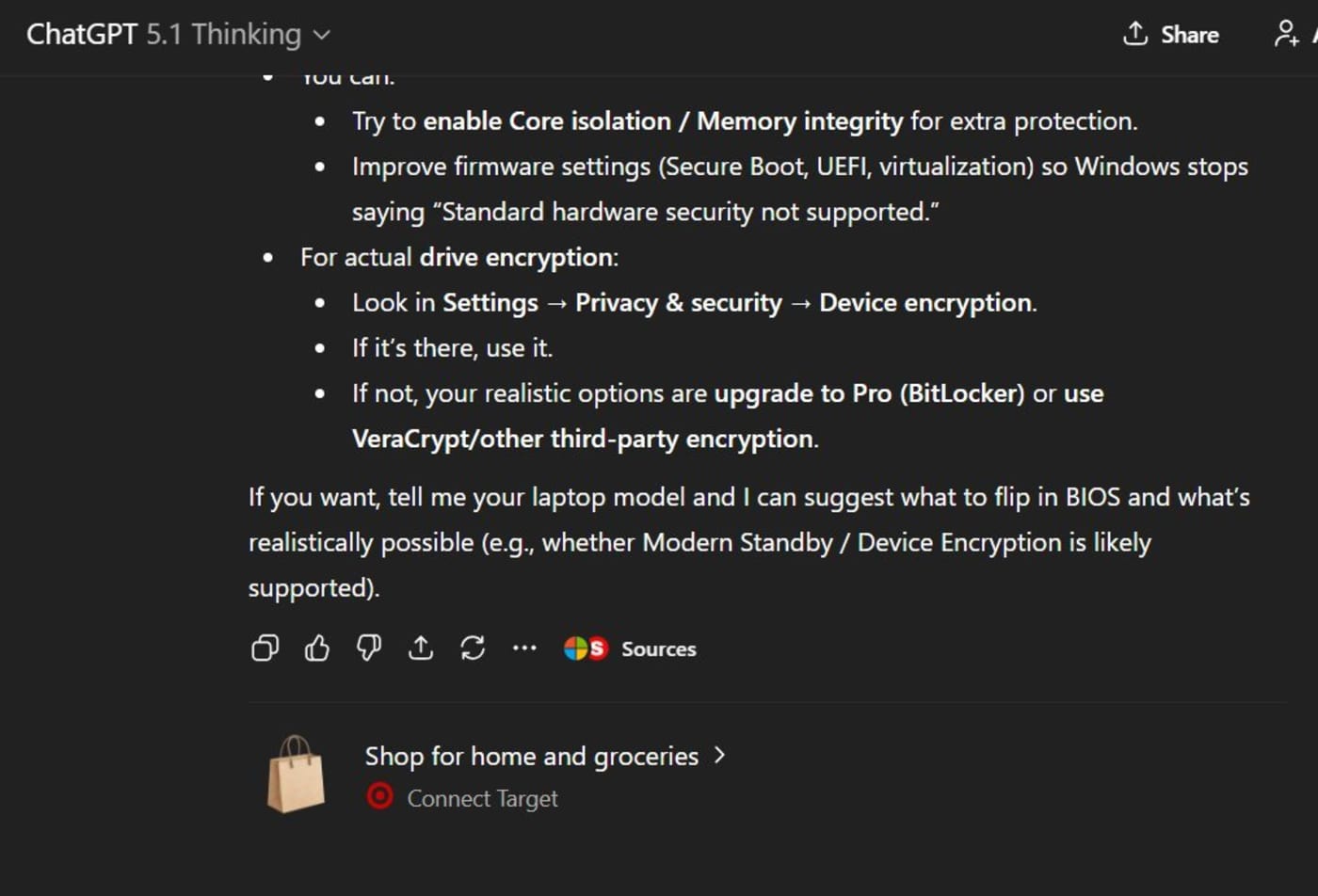
Those might not exactly be ads you're seeing on ChatGPT, at least according to OpenAI. Nick Turley, OpenAI's head of ChatGPT, clarified the confusion around potential ads appearing with the AI chatbot. In a post on X, Turley said "there are no live tests for ads" and that "any screenshots you've seen are either not real or not ads." The OpenAI exec's explanation comes after another post from former xAI employee Benjamin De Kraker on X that has gained traction, which featured a screenshot showing an option to shop at Target within a ChatGPT conversation.
OpenAI's Daniel McAuley responded to the post, arguing that it's not an ad but rather an example of app integration that the company announced in October. However, the company's chief research officer, Mark Chen, also replied on X that they "fell short" in this case, adding that "anything that feels like an ad needs to be handled with care."
"We’ve turned off this kind of suggestion while we improve the model’s precision," Chen wrote on X. "We’re also looking at better controls so you can dial this down or off if you don’t find it helpful."
There's still a lot of uncertainty about whether OpenAI will introduce ads to ChatGPT, but in November, someone discovered code in a beta version of the ChatGPT app on Android that made several mentions of ads. Even in Turley's post debunking the inclusion of live ads, the OpenAI exec added that "if we do pursue ads, we’ll take a thoughtful approach." Turley also posted that "people trust ChatGPT and anything we do will be designed to respect that."
This article originally appeared on Engadget at https://www.engadget.com/ai/openais-head-of-chatgpt-says-posts-appearing-to-show-in-app-ads-are-not-real-or-not-ads-190454584.html?src=rss
Just a day after receiving a roughly $140 million fine, X has terminated the ad account of the European Commission. Nikita Bier, X's head of product, accused the European Commission of using an exploit to artificially boost the reach of its post announcing the major fine.
In the post, Bier said that the commission "logged into [their] dormant ad account to take advantage of an exploit in our Ad Composer" and posted "a link that deceives users into thinking it’s a video and to artificially increase its reach." Bier explained in a separate post that the exploit has "never been abused like this" and "is now patched." However, X still revoked the European Commission's ability to buy and track ads on its platform.
While X decided to remove the European Commission's ad account, it still needs to submit specific measures and an action plan to address the concerns associated with the $140 million fine. The European Commission's spokesperson for Tech Sovereignty, Defence, Space and Research, Thomas Regnier, said that this is the first-ever fine under the Digital Services Act. The European legislative body claimed that X has a deceptive system when it comes to verified accounts, lacks transparency with its advertising repository and doesn't provide effective data for researchers. In response, X's owner, Elon Musk, replied to the European Commission's post, calling it "bullshit."
This article originally appeared on Engadget at https://www.engadget.com/social-media/x-shuts-down-the-european-commissions-ad-account-the-day-after-major-fine-173553267.html?src=rss
A federal judge has expanded on the remedies decided for the Department of Justice's antitrust case against Google, ruling in favor of putting a one-year limit on the contracts that make Google's search and AI services the default on devices, Bloomberg reports. Judge Amit Mehta's ruling on Friday means Google will have to renegotiate these contacts every year, which would create a fairer playing field for its competitors. The new details come after Mehta ruled in September that Google would not have to sell off Chrome, as the DOJ proposed at the end of 2024.
This all follows the ruling last fall that Google illegally maintained an internet search monopoly through actions including paying companies such as Apple to make its search engine the default on their devices and making exclusive deals around the distribution of services such as Search, Chrome and Gemini. Mehta's September ruling put an end to these exclusive agreements and stipulates that Google will have to share some of its search data with rivals to "narrow the scale gap" its actions have created.
This article originally appeared on Engadget at https://www.engadget.com/big-tech/judge-puts-a-one-year-limit-on-googles-contracts-for-default-search-placement-215549614.html?src=rss
Apple's Johny Srouji may be the latest company executive to seek greener pastures, according to a report from Bloomberg. The report said that Srouji, Apple's senior vice president of hardware technologies, told Tim Cook that he is "seriously considering leaving in the near future."
While the report didn't mention if Srouji has another job lined up, Bloomberg's sources claimed that he wants to join another company if he leaves Apple. Srouji joined the company in 2008 to develop Apple's first in-house system-on-a-chip and eventually led the transition to Apple silicon.
If Srouji leaves Apple, he would be the latest in a string of departures of longtime execs. At the start of the month, Apple announced that John Giannandrea, the company's senior vice president for machine learning and AI strategy, would be retiring from his role in spring 2026. A couple of days later, Bloomberg reported that the company's head of interface design, Alan Dye, would be leaving for a role at Meta. Adding to those exits, Apple also revealed that Kate Adams, who has been Apple's general counsel since 2017, and Lisa Jackson, vice president for Environment, Policy, and Social Initiatives, will both be leaving in early 2026.
The shakeup at the executive level comes after Bloomberg's Mark Gurman previously reported that Cook may not be preparing for his own departure as CEO next year. Gurman's prediction counters a report from the Financial Times that claimed that Apple was accelerating succession plans for Cook with an expected stepping down sometime next year.
This article originally appeared on Engadget at https://www.engadget.com/big-tech/apples-johny-srouji-could-continue-the-companys-executive-exodus-according-to-report-200750252.html?src=rss
Johny Srouji (R), senior vice president of hardware technologies at Apple, and an Apple engineer view testing data on Apple's new C1 cellular modem in a shield room that blocks interference from cellular networks at Apple's wireless labs, in Sunnyvale, California, U.S., February 18, 2025. REUTERS/Stephen Nellis
To prevent its robotaxi fleet from passing stopped school buses, Waymo is issuing another software recall in 2025. While it's not a traditional recall that pulls vehicles from the road, Waymo is voluntarily updating software for its autonomous fleet in response to an investigation from the National Highway Traffic Safety Administration. According to Waymo, the recall will be filed with the federal agency early next week.
Mauricio Peña, Waymo's chief safety officer, said in a statement that Waymo sees far fewer crashes involving pedestrians than human drivers, but that the company knows when "our behavior should be better."
"As a result, we have made the decision to file a voluntary software recall with NHTSA related to appropriately slowing and stopping in these scenarios," Peña said in a statement to multiple news outlets. "We will continue analyzing our vehicles’ performance and making necessary fixes as part of our commitment to continuous improvement."
According to the NHTSA investigation, some Waymo autonomous vehicles were seen failing to stop for school buses that had their stop signs and flashing lights deployed. The federal agency said in the report that there were instances of Waymo cars driving past stopped school buses in Atlanta and Austin, Texas.
Earlier this year, Waymo issued another software recall after some of its robotaxi fleet were seen hitting gates, chains, and similar objects. Last year, Waymo also filed two other software recalls, one of which addressed a fleet vehicle crashing into a telephone pole and another correcting how two separate robotaxis hit the same exact pickup truck that was being towed.
This article originally appeared on Engadget at https://www.engadget.com/transportation/waymos-robotaxi-fleet-is-being-recalled-again-this-time-for-failing-to-stop-for-school-buses-190222243.html?src=rss
The big reveal for Meta's next mixed reality glasses is being postponed until the first half of 2027, according to a report from Business Insider. Based on an internal memo from Maher Saba, the vice president of Meta's Reality Labs Foundation, the report said that the company's project, which is codenamed "Phoenix," will no longer be scheduled for a 2026 debut.
In a separate memo, Meta execs explained that the delay would help deliver a more "polished and reliable experience." According to BI, a memo from Meta's Gabriel Aul and Ryan Cairns said this new release window is "going to give us a lot more breathing room to get this right." Meta hasn't publicly revealed many details about its Phoenix project, but The Information previously reported that it would feature a goggle-like form factor with an external power source, similar to how the Apple Vision Pro is attached to a battery pack.
In the memo from Saba, BI reported that Meta is also working on a "limited edition" wearable with the codename "Malibu 2." Yesterday, Meta announced its acquisition of Limitless, a startup that recently developed an AI wearable called Pendant. Even though Meta's current product portfolio is dominated by smart glasses and VR headsets, the Limitless acquisition and Malibu 2 project could hint at the company's plans to expand its offerings.
This article originally appeared on Engadget at https://www.engadget.com/ar-vr/meta-plans-to-push-back-the-debut-of-its-next-mixed-reality-glasses-to-2027-172437374.html?src=rss
We’ve slept off our collective turkey coma and returned to the review lab here at Engadget. Our team may also be in full CES prep mode, but we’ve got a few more devices to get off or our desks before 2025 is over. Catch up on all of the reviews you might have missed over the last few weeks — a perfect activity for a lazy December weekend.
Dell 16 Premium
There’s no denying the design of the Dell 16 Premium makes the laptop live up to its name. Unfortunately, all of that polish leads to some issues: a high price and hampered usability. “The more I looked at the Dell 16 Premium's beautiful facade, the more I wanted something... more,” senior reporter Devindra Hardawar wrote. “It needs more usable ports, like HDMI and a full-sized SD card reader. It needs more useful function keys that are visible in bright light — and also stay in one place — so I can touch type more easily. And for the love of god, just give up on the invisible trackpad.”
DJI Osmo Action 6
DJI’s drone business in the US faces an uncertain future, and the company’s action cams could be swept up in the ordeal as well. Thankfully, our contributing reporter Steve Dent resides in the EU where he observed first hand the Osmo Action 6’s superior low light performance and battery life. “With a bigger sensor and larger aperture than the competition, DJI’s Action 6 is now the best action cam on the market for night shooting, delivering clean, sharp video with better stabilization than rivals,” he said. “It’s also ideal for users who output to both YouTube and TikTok.”
Nikon ZR
In keeping with the video theme, Steve also spent time testing the Nikon ZR. While this is primarily a model for shooting video, it benefits from the addition of RED RAW, excellent autofocus and more. “With the ZR, Nikon has shown that it’s finally catching up to and even surpassing its rivals for content creation,” he explained. “Whether you’re doing social media, YouTube, documentaries or even film production, this camera is versatile and powerful with few compromises.”
Ooni Volt 2
The Ooni Volt brought the company’s popular brand of pizza making indoors for the first time, but that model wasn’t without it faults. Now Ooni is back with the Volt 2, and the completely overhauled design is a big upgrade over the original. “It’s easier to use for all skill levels thanks to its clearer controls and large display,” I explained. “Presets work well, but they can also serve as a starting point for further recipe refinement for experienced users. And the pizza — my goodness, the pizza is consistently restaurant quality (or better) across a range of styles.”
Antigravity A1
Insta360’s spin-off Antigravity is now shipping its first drone and our UK bureau chief Mat Smith has already flown it. The A1 comes with a controller and FPV headset to assist with the piloting, but the mix of unique features and crisp video (in good conditions) is also laudable. “The intuitive controls and ability to look all around you make it unlike anything else currently available,” he said. “It’s a delightful introduction to drones, FPV or otherwise, but a shame that software issues marred my tests.”
This article originally appeared on Engadget at https://www.engadget.com/engadget-review-recap-dell-16-premium-nikon-zr-ooni-volt-2-and-more-130000527.html?src=rss
Welcome to our latest roundup of what's going on in the indie game space. A bunch of titles that are arriving very late to make it into game of the year conversations debuted this week, and we learned some new details about upcoming projects, such as a release date for a rad-looking arena shooter called Don't Stop, Girlypop.
It's an enjoyable enough game, largely thanks to the variety of characters and how differently they play. Captain America is one of my favorites. Each character has a secondary move (often a ranged attack) to go with their basic melee strikes, and Cap's one has no ammo or cooldown. I never grew tired of spamming his shield projectile attack and knocking enemies off the screen.
I really enjoyed playing as She-Hulk too. Her secondary move involves grabbing an enemy and throwing them around. She-Hulk can also toss them into the air then leap with McTominay-esque athleticism to deliver a kick and send the baddie crashing into its cohorts. The character swap system (each player chooses two and can switch between them any time) evokes tag fighting games and the co-op features work well too.
Routine offers up a slice of liminal space terror with a dash of retro-futurism. Lunar Software based the aesthetic on "how people from the 1980s might envision a believable moon base" with analogue technology.
Your mission is to explore the base and try to determine how it got to this state. Lunar wanted Routine to feel as immersive as possible, so there are no waypoint markers and you won't see a heads-up display. Instead, you have a personal data assistant that connects to wireless access points throughout the base and provides you with information about your current goals.
Here's another horror title we've been looking forward to for several years. Sleep Awake deals with things that go bump in the night. It's a first-person psychedelic horror game in which a force called The HUSH makes anyone who falls asleep vanish. So, our hero Katja and other residents of the last-known city on Earth try various ways to stay awake, but they’ll inevitably have to deal with the effects of sleep derivation.
Sleep Awake is from Eyes Out — a studio formed by Spec Ops: The Line director Cory Davis and Nine Inch Nails guitarist Robin Finck — and publisher Blumhouse Games. It's out now on Steam, PlayStation 5 and Xbox Series X/S for $30.
How about another horror game? It's the last one we have this week, I promise. Tingus Goose has been on my radar for a while because it just looks so deeply strange. This is billed as "a cozy body horror idle game" in which you "plant seeds in patients, bounce babies for profit and ascend through surreal worlds toward riches."
I'm glad for that description from the game's PR team, because I don't fully know what to make of the trailer. A goose emerges from a human being's torso and grows a giant neck and human fingers stick out of it and… it's all just so strange. But I kinda dig it?
Tingus Goose is from SweatyChair and co-publishers Playsaurus and UltraPlayers. It's on Steam for $5.94 until December 8, and it will cost $7 after that.
I haven't seen anything that looks quite like Effulgence RPG before. It's a party-based RPG with a 3D ASCII art style. Here, you'll need to take out enemies to acquire better gear.
Andrei Fomin released Effulgence RPG in early access on Steam this week for $10. The solo developer is aiming to release the full version of the game in June and to add more content and quality-of-life updates in the meantime. It's not usually the kind of game that I'd normally be drawn toward, but that art style alone is cool enough to make me want to try it.
Looking for something a little more relaxing? Log Away is a cozy cabin builder from The-Mark Entertainment. There are several environments to choose from and a variety of decorations at your disposal depending on your interests. You can have a pet too, so that qualifies Log Away as this week's dog game.
I've played it a bit and found it to be quite relaxing, a soothing counter punch to the non-stop action of Cosmic Invasion. It's out now on Steam for $10, but if you buy it by December 11 you'll save a dollar and get a Christmas-themed DLC at no extra cost.
I adore Sayonara Wild Hearts with every fiber of my being and I appreciated what Simogo did with Lorelai and the Laser Eyes, even if I never stuck with it for long. I haven't played any of the studio's earlier games, though. That's something I'm planning to fix very soon now that the Simogo Legacy Collectionis here.
The studio reworked all of its first seven mobile games — including Year Walk and Device 6 — and combined them into a collection that's available on Steam, Nintendo Switch and Switch 2. It costs $15 though there's a 15 percent discount until December 12. I'm very much looking forward to digging into this over the holidays.
Upcoming
I've been very much looking forward to Don’t Stop, Girlypop! for a while. It's a movement-focused arena shooter with a Y2K aesthetic. Think of it as an anti-capitalist, hyperpop riff on games like Doom Eternal.
The demo is a lot of fun and I'm glad there's finally a release date for this game from Funny Fintan Softworks and publisher Kwalee. It's coming to Steam on January 29.
Limbot seems like it could be a fun party game. You can play it by yourself, but having three friends join you seems like the optimal way to go. In that case, each of you will take control of one of a cardboard robot's limbs. So you'll have to coordinate to move around this papercraft world effectively and complete precision-based objectives. It sounds like a recipe for an Overcooked-style tiff between friends.
This physics-based game from Ionized Studios is coming to Steam, Xbox One and Xbox Series X/S. It's slated to arrive between April and June next year.
Polyperfect's Zlin City: Arch Moderna is a diorama city builder inspired by historical events of the 1930s and '40s and the architecture of Zlin, a town in Czechia (Czech Republic). The developers used 3D printing, photogrammetry and 3D scanning to capture the objects that are used in the game. The result is something that — at least at first glance — looks beautifully textured.
There's no confirmed release window for Zlin City: Arch Moderna as yet. It'll be available on Steam.
This article originally appeared on Engadget at https://www.engadget.com/gaming/a-marvel-beat-em-up-long-awaited-survival-horror-and-other-new-indie-games-worth-checking-out-120000228.html?src=rss

 Login
Login