Reading view

There are new articles available, click to refresh the page.

NASA just lost contact with a Mars orbiter, and will soon lose another one

NASA has lost contact with one its three spacecraft orbiting Mars, the agency announced Tuesday. Meanwhile, a second Mars orbiter is perilously close to running out of fuel, and the third mission is running well past its warranty.

Ground teams last heard from the Mars Atmosphere and Volatile Evolution, or MAVEN, spacecraft on Saturday, December 6. “Telemetry from MAVEN had showed all subsystems working normally before it orbited behind the red planet,” NASA said in a short statement. “After the spacecraft emerged from behind Mars, NASA’s Deep Space Network did not observe a signal.”

NASA said mission controllers are “investigating the anomaly to address the situation. More information will be shared once it becomes available.”


Read full article

Comments

© NASA/Goddard Space Flight Center

After years of resisting it, SpaceX now plans to go public. Why?

SpaceX is planning to raise tens of billions of dollars through an initial public offering next year, multiple outlets have reported, and Ars can confirm. This represents a major change in thinking from the world’s leading space company and its founder, Elon Musk.

The Wall Street Journal and The Information first reported about a possible IPO last Friday, and Bloomberg followed that up on Tuesday evening with a report suggesting the company would target a $1.5 trillion valuation. This would allow SpaceX to raise in excess of $30 billion.

This is an enormous amount of funding. The largest IPO in history occurred in 2019, when the state-owned Saudi Arabian oil company began public trading as Aramco and raised $29 billion. In terms of revenue, Aramco is a top-five company in the world.

Read full article

Comments

© JIM WATSON/AFP via Getty Images

After NPR and PBS defunding, FCC receives call to take away station licenses

A conservative group yesterday urged the Federal Communications Commission to take licenses away from NPR and PBS stations and let other entities use the spectrum. The request came from the Center for American Rights (CAR), a nonprofit law firm that has played a prominent role in the news-distortion investigations spearheaded by FCC Chairman Brendan Carr.

“In the wake of the wind-down of the Corporation for Public Broadcasting and the end of federal funding for NPR and PBS, the Center respectfully suggests that the Commission open an inquiry that looks at the future of ‘public’ broadcasting in that new environment,” a Center for American Rights filing said.


The CPB is set to shut down after Congress approved President Trump’s request to rescind its funding. The Center for American Rights said the CPB shutdown should be used as an opportunity to reassign spectrum used by NPR and PBS stations to other entities.
Read full article

Comments

© Getty Images | tarabird

A new open-weights AI coding model is closing in on proprietary options

On Tuesday, French AI startup Mistral AI released Devstral 2, a 123 billion parameter open-weights coding model designed to work as part of an autonomous software engineering agent. The model achieves a 72.2 percent score on SWE-bench Verified, a benchmark that attempts to test whether AI systems can solve real GitHub issues, putting it among the top-performing open-weights models.


Perhaps more notably, Mistral didn’t just release an AI model, it released a new development app called Mistral Vibe. It’s a command line interface (CLI) similar to Claude Code, OpenAI Codex, and Gemini CLI that lets developers interact with the Devstral models directly in their terminal. The tool can scan file structures and Git status to maintain context across an entire project, make changes across multiple files, and execute shell commands autonomously. Mistral released the CLI under the Apache 2.0 license.

It’s always wise to take AI benchmarks with a large grain of salt, but we’ve heard from employees of the big AI companies that they pay very close attention to how well models do on SWE-bench Verified, which presents AI models with 500 real software engineering problems pulled from GitHub issues in popular Python repositories. The AI must read the issue description, navigate the codebase, and generate a working patch that passes unit tests. While some AI researchers have noted that around 90 percent of the tasks in the benchmark test relatively simple bug fixes that experienced engineers could complete in under an hour, it’s one of the few standardized ways to compare coding models.

Read full article

Comments

© Mistral / Benj Edwards

Cable channel subscribers grew for the first time in 8 years last quarter

In a surprising, and likely temporary, turn of events, the number of people paying to watch cable channels has grown.

On Monday, research analyst MoffettNathanson released its “Cord-Cutting Monitor Q3 2025: Signs of Life?” report. It found that the pay TV operators, including cable companies, satellite companies, and virtual multichannel video programming distributors (vMVPDs) like YouTube TV and Fubo, added 303,000 net subscribers in Q3 2025.

According to the report, “There are more linear video subscribers now than there were three months ago. That’s the first time we’ve been able to say that since 2017.”

Read full article

Comments

© Getty

Kindle Scribe Colorsoft brings color e-ink to Amazon’s 11-inch e-reader

Amazon has been updating the large-screened Kindle Scribe tablet more frequently and regularly than it updates its standard e-readers, and today the company is announcing the tablet’s third hardware update in four years. The regular Scribe is also being joined by a lower-end Scribe with less storage and no front light and an upgraded Kindle Scribe Colorsoft model with a color e-ink screen. This makes it only the second Kindle to include a color screen, after last year’s Kindle Colorsoft.

Both the regular Kindle Scribe and the Kindle Scribe Colorsoft are available to order starting today for $500 and $630, respectively. Both of those devices include a Premium Pen accessory and 32GB of internal storage; 64GB of storage is available for an extra $50 for both devices. The cheaper front light-less Scribe is coming sometime next year and will run $430 for a model with a more modest 16GB of storage. (These are all much more expensive than the original Scribe’s $340 launch price, but inflation, tariffs, and shortages are wreaking havoc with all kinds of tech prices for the past few years.)

The Scribe and Scribe Colorsoft both come with an updated front light “with miniaturized LEDs that fit tightly against the display,” narrowing the bezel and improving the uniformity of the lighting. Amazon has also tweaked the friction level of the paper-like texture on the glass display, shrunk the gap between the glass and the actual display panel to make writing on the tablet feel more like writing on paper, and added a quad-core processor and more RAM to speed the tablet up.

Read full article

Comments

© Amazon

US taking 25% cut of Nvidia chip sales “makes no sense,” experts say

Donald Trump’s decision to allow Nvidia to export an advanced artificial intelligence chip, the H200, to China may give China exactly what it needs to win the AI race, experts and lawmakers have warned.

The H200 is about 10 times less powerful than Nvidia’s Blackwell chip, which is the tech giant’s currently most advanced chip that cannot be exported to China. But the H200 is six times more powerful than the H20, the most advanced chip available in China today. Meanwhile China’s leading AI chip maker, Huawei, is estimated to be about two years behind Nvidia’s technology. By approving the sales, Trump may unwittingly be helping Chinese chip makers “catch up” to Nvidia, Jake Sullivan told The New York Times.

Sullivan, a former Biden-era national security advisor who helped design AI chip export curbs on China, told the NYT that Trump’s move was “nuts” because “China’s main problem” in the AI race “is they don’t have enough advanced computing capability.”

Read full article

Comments

© Andrew Harnik / Staff | Getty Images News

After key Russian launch site is damaged, NASA accelerates Dragon supply missions

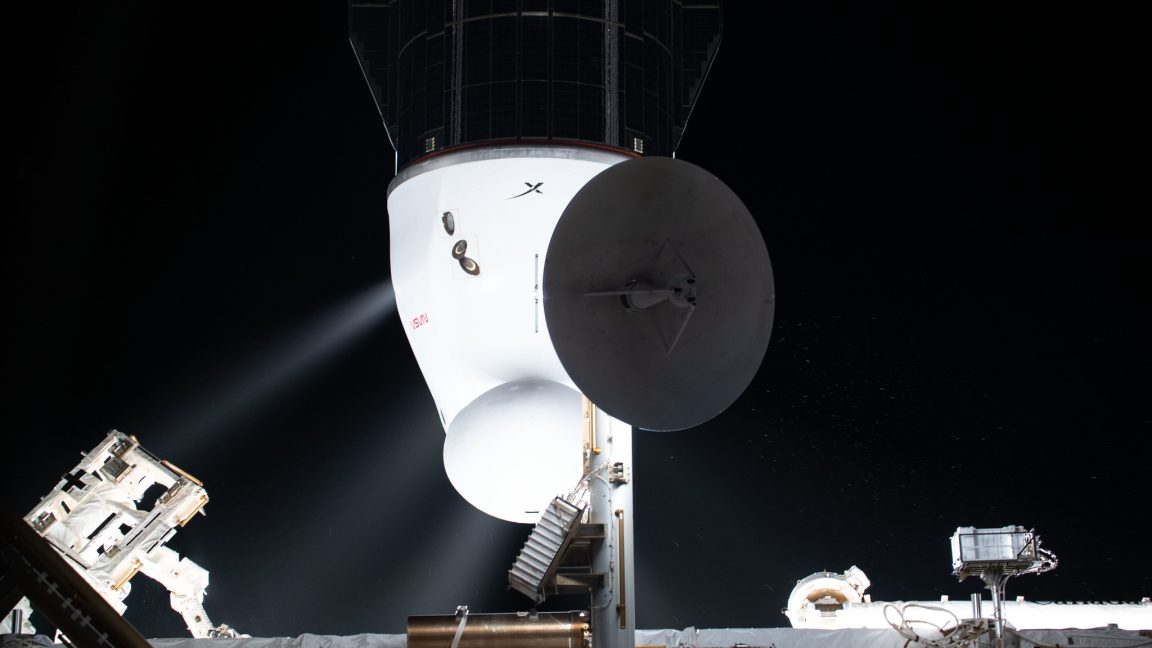
With a key Russian launch pad out of service, NASA is accelerating the launch of two Cargo Dragon spaceships in order to ensure that astronauts on board the International Space Station have all the supplies they need next year.

According to the space agency’s internal schedule, the next Dragon supply mission, CRS-34, is moving forward one month from June 2026 to May. And the next Dragon supply mission after this, CRS-35, has been advanced three months from November to August.

A source indicated that the changing schedules are a “direct result” of a launch pad incident on Thanksgiving Day at the Russian spaceport in Baikonur, Kazakhstan.

Read full article

Comments

© NASA

Ugly infotainment mars the 2025 Subaru Forester Hybrid experience

Although many of us associate it with rally-derived machinery from the late 1990s and early 2000s, these days, Subaru has mostly abandoned its performance cars to concentrate on its true calling—rugged, all-wheel-drive vehicles that are high on practicality, powered by horizontally opposed “boxer” engines. One area where the brand has never particularly excelled has been fuel efficiency, which is where today’s test car, the Subaru Forester Hybrid, comes in.

The last time Ars reviewed a Subaru Forester, it left us impressed. How about one with 40 percent better economy, in that case? Now, the 2.5 L flat-four engine operates on the Atkinson/Miller cycle, which generates 162 hp (121 kW) and 154 lb-ft (208 Nm). There’s an electric motor-generator starter and an electric traction motor with 118 hp (88 kW) and 199 lb-ft (270 Nm) that work together to send a combined 194 hp (145 kW) to all four wheels via a symmetrical all-wheel drive system and a planetary continuously variable transmission.

Subaru Forester Hybrid in profile
The Forester Hybrid is 183.3 inches (4,656 mm) long, 70.2 inches (1,783 mm) wide, and 68.1 inches (1,729 mm) tall, with a 105.1-inch (2,670 mm) wheelbase. Credit: Jonathan Gitlin
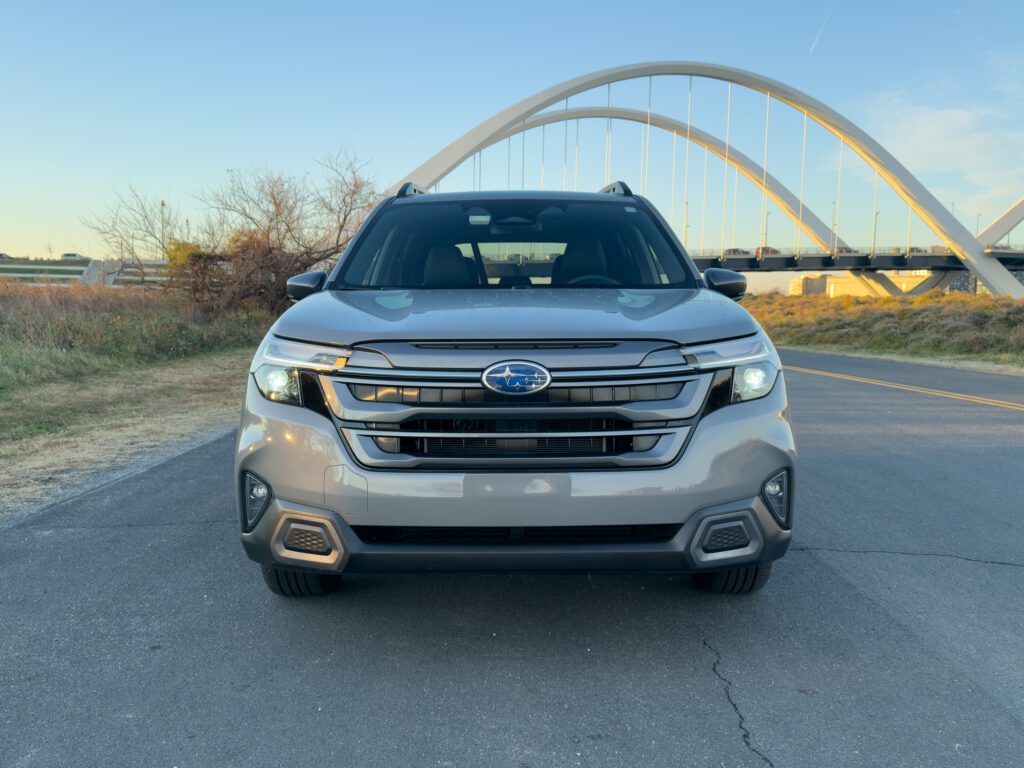
Subaru Forester Hybrid seen head-on
Spot the two EyeSight cameras at the top of the windscreen. Credit: Jonathan Gitlin
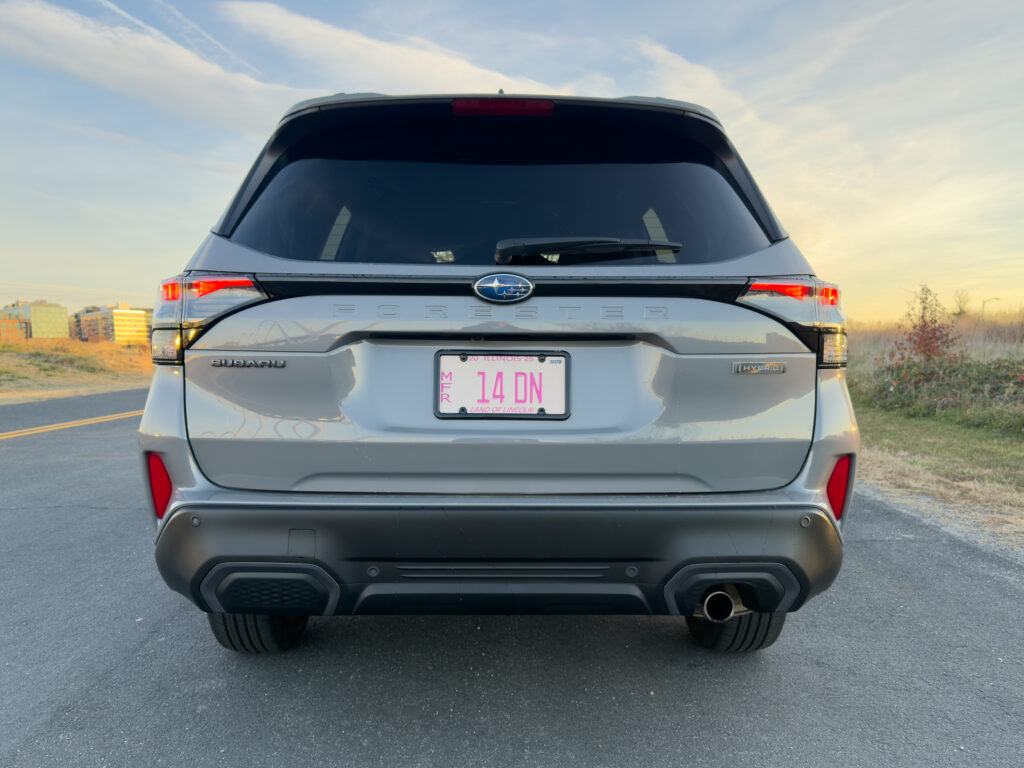
Subaru Forester Hybrid seen from behind
Hatching plots. Credit: Jonathan Gitlin

If that sounds vaguely familiar, that’s because it’s the same powertrain that Subaru has also fitted to the smaller Crosstrek Hybrid that we drove in September.

Read full article

Comments

© Jonathan Gitlin

This is the oldest evidence of people starting fires

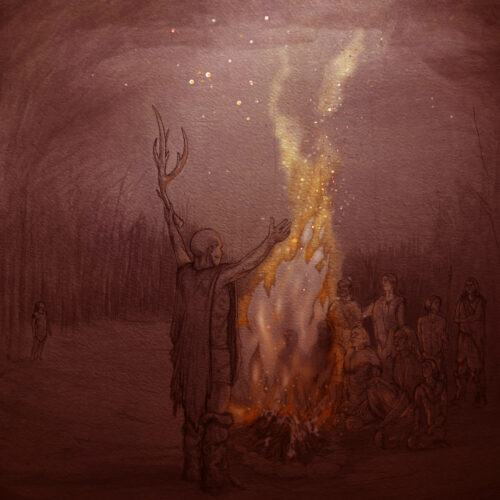
Heat-reddened clay, fire-cracked stone, and fragments of pyrite mark where Neanderthals gathered around a campfire 400,000 years ago in what’s now Suffolk, England.

Based on chemical analysis of the sediment at the site, along with the telltale presence of pyrite, a mineral not naturally found nearby but very handy for striking sparks with flint, British Museum archaeologist Rob Davis and his colleagues say the Neanderthals probably started the fire themselves. That makes the abandoned English clay pit at Barnham the oldest evidence in the world that people (Neanderthal people, in this case) had learned to not only use fire, but also create it and control it.

A cozy Neanderthal campfire

Today, the Barnham site is part of an abandoned clay pit where workers first discovered stone tools in the early 1900s. But 400,000 years ago, it would have been a picturesque little spot at the edge of a stream-fed pond, surrounded by a mix of forest and grassland. There are no hominin fossils here, but archaeologists unearthed a Neanderthal skull about 100 kilometers to the south, so the hominins at Barnham were probably also Neanderthals. The place would have have offered a group of Neanderthals a relatively quiet, sheltered place to set up camp, according to Davis and his colleagues.

Read full article

Comments

© Craig Williams, The Trustees of the British Museum

Sperm donor with rare cancer mutation fathered nearly 200 children in Europe

By: Beth Mole

A single sperm donor who carries a rare cancer-causing genetic mutation has fathered at least 197 children across 14 countries in Europe, according to a collaborative investigation by 14 European news groups.

According to their investigative report, some of the children have already died, and many others are expected to develop deadly cancers.

The man—Donor 7069, alias “Kjeld”—carries a rare mutation in the TP53 gene, which codes for a critical tumor suppressor called protein 53 or p53. This protein (which is a transcription factor) keeps cells from dividing uncontrollably, can activate DNA repair processes amid damage, and can trigger cell death when a cell is beyond repair. Many cancers are linked to mutations in p53.

Read full article

Comments

© Getty | Sciepro

Impeachment articles filed against RFK Jr., claiming abuse of power

By: Beth Mole

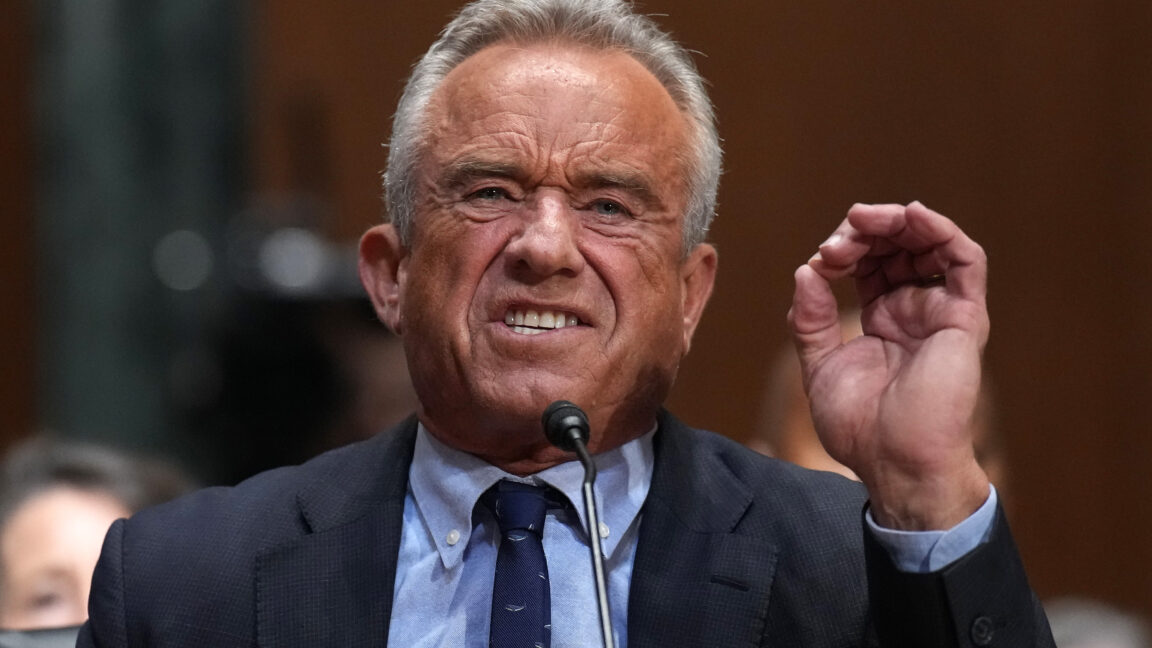
Rep. Haley Stevens (D-Mich.) filed articles of impeachment against Health Secretary Robert F. Kennedy Jr. Wednesday, accusing him of abusing the powers of his office and undermining public health, putting Americans’ lives at risk.

He “has got to go,” Stevens said in a video announcing the impeachment articles. In an accompanying press statement, she said Kennedy, who rose to prominence as an ardent anti-vaccine activist, “has turned his back on science, on public health, and on the American people—spreading conspiracies and lies, driving up costs, and putting lives at risk.”  She called him the “biggest self-created threat to our health and safety.”

It is very unlikely that an impeachment push will gain traction in the Republican-controlled Congress. No other Democratic lawmakers are backing the articles.

Read full article

Comments

© Getty | Andrew Harnik

Dr. Oz tells his federal employees to eat less during the holidays

Dr. Mehmet Oz, the administrator for the Centers for Medicare and Medicaid Services (CMS) and former daytime talk show star, has recently been emailing all federal workers in his agency weekly tips on “Crushing Cubicle Cravings” and how to avoid snacking in the office.

“We all love a fun cookie swap and potluck this time of year. With several teams across CMS hosting holiday gatherings this month, I am sharing some strategies to help you make healthier choices—while still indulging in festive treats,” Oz wrote in his latest missive, which appears as a recurring section in his weekly bulletin titled “From the Administrator’s Desk,” according to emails viewed by WIRED.

“Set your intentions,” writes Oz. “Decide in advance how many treats you’ll allow yourself to enjoy and try to stick to that number. You don’t have to try every cookie on the cookie table.”

Read full article

Comments

© Premyuda Yospim

AMD’s next-gen “FSR Redstone” brings big gains, as long as you’re using a new GPU

Nvidia, AMD, and Intel have all made high-quality image upscaling a cornerstone feature of their new GPUs this decade. Upscaling technologies like Nvidia’s Deep Learning Super Sampling (DLSS), AMD’s FidelityFX Super Resolution (FSR), and Intel’s Xe Super Sampling (XeSS) are all ways to transform a lower-resolution source image into a higher-resolution image, delivering better-looking games without requiring as much graphics hardware as you’d need to render the higher-resolution image natively. Later additions have focused on improving ray-tracing performance and “frame generation” technologies that boost frame rates by creating new AI-generated frames to insert between natively rendered frames.

Generally speaking, Nvidia’s DLSS technologies have provided better image quality than AMD’s FSR, but they have only been available on newer Nvidia hardware—the GeForce RTX 20-series or newer for most features, with frame-generation features locked to the RTX 40- and 50-series. FSR’s results don’t look as good, but they have benefited from running on just about anything, including older GPUs, Nvidia GPUs, and even integrated Intel and AMD GPUs.

Today, AMD is trying to shift that dynamic with something called “FSR Redstone,” a collection of ray-tracing and frame-generation features all intended to boost AMD’s image quality while being relatively easy to implement for game developers who are already using FSR 3.1 or FSR 4.

Read full article

Comments

© AMD

Operation Bluebird wants to relaunch “Twitter,” says Musk abandoned the name and logo

A Virginia startup calling itself “Operation Bluebird” announced this week that it has filed a formal petition with the US Patent and Trademark Office, asking the federal agency to cancel X Corporation’s trademarks of the words “Twitter” and “tweet” since X has allegedly abandoned them.

“The TWITTER and TWEET brands have been eradicated from X Corp.’s products, services, and marketing, effectively abandoning the storied brand, with no intention to resume use of the mark,” the petition states. “The TWITTER bird was grounded.”

If successful, two leaders of the group tell Ars, Operation Bluebird would launch a social network under the name Twitter.new, possibly as early as late next year. (Twitter.new has created a working prototype and is already inviting users to reserve handles.)

Read full article

Comments

© Getty Images | Anadolu Agency

Win hardware, collectibles, and more in the 2025 Ars Technica Charity Drive

It’s once again that special time of year when we give you a chance to do well by doing good. That’s right—it’s the 2025 edition of our annual Charity Drive!

Every year since 2007, we’ve encouraged readers to give to Penny Arcade’s Child’s Play charity, which provides toys and games to kids being treated in hospitals around the world. In recent years, we’ve added the Electronic Frontier Foundation to our charity push, aiding in their efforts to defend Internet freedom. This year, as always, we’re providing some extra incentive for those donations by offering donors a chance to win pieces of our big pile of vendor-provided swag. We can’t keep it, and we don’t want it clogging up our offices, so it’s now yours to win.

This year’s swag pile is full of high-value geek goodies. We have over a dozen prizes valued at nearly $5,000 total, including gaming hardware and collectibles, apparel, and more. In 2023, Ars readers raised nearly $40,000 for charity, contributing to a total haul of more than $542,000 since 2007. We want to raise even more this year, and we can do it if readers dig deep.

Read full article

Comments

© Kyle Orland

Over 250 people quarantined in South Carolina as measles outbreak rages

By: Beth Mole

A measles outbreak that began in South Carolina at the start of October is showing no signs of slowing as officials on Tuesday reported 27 new cases since Friday. Those cases bring the outbreak total to 111.

The southern state’s outbreak now rivals outbreaks ongoing in Utah and Arizona, which have tallied 115 and 176 cases, respectively. The outbreaks are threatening to cost the country its measles elimination status, which was earned in 2000 after vaccination efforts stopped the virus from spreading continuously. If the current transmission of the virus isn’t halted by January, the virus will have circulated for 12 consecutive months, marking it once again as an endemic disease in the US.

In an update on Tuesday, South Carolina’s health department suggested the spread is far from over. Of the state’s 27 new cases, 16 were linked to exposure at a church, the Way of Truth Church in Inman. And amid the new cases, new exposures were identified at Inman Intermediate School. That’s on top of exposures announced Friday at four other schools in the region, which led to well over 100 students being quarantined.

Read full article

Comments

© Getty | Natalya Maisheva

Big Tech joins forces with Linux Foundation to standardize AI agents

Big Tech has spent the past year telling us we’re living in the era of AI agents, but most of what we’ve been promised is still theoretical. As companies race to turn fantasy into reality, they’ve developed a collection of tools to guide the development of generative AI. A cadre of major players in the AI race, including Anthropic, Block, and OpenAI, has come together to promote interoperability with the newly formed Agentic AI Foundation (AAIF). This move elevates a handful of popular technologies and could make them a de facto standard for AI development going forward.

The development path for agentic AI models is cloudy to say the least, but companies have invested so heavily in creating these systems that some tools have percolated to the surface. The AAIF, which is part of the nonprofit Linux Foundation, has been launched to govern the development of three key AI technologies: Model Context Protocol (MCP), goose, and AGENTS.md.

MCP is probably the most well-known of the trio, having been open-sourced by Anthropic a year ago. The goal of MCP is to link AI agents to data sources in a standardized way—Anthropic (and now the AAIF) is fond of calling MCP a “USB-C port for AI.” Rather than creating custom integrations for every different database or cloud storage platform, MCP allows developers to quickly and easily connect to any MCP-compliant server.

Read full article

Comments

© Getty Images

Supreme Court appears likely to approve Trump’s firing of FTC Democrat

The Supreme Court’s conservative justices appear ready to overturn a 90-year-old precedent that said the president cannot fire a Federal Trade Commission member without cause. A ruling for Trump would give him more power over the FTC and potentially other independent agencies such as the Federal Communications Commission.

Former FTC Commissioner Rebecca Kelly Slaughter, a Democrat, sued Trump after he fired both Democrats from the commission in March. Slaughter’s case rests largely on the 1935 ruling in Humphrey’s Executor v. United States, in which the Supreme Court unanimously held that the president can only remove FTC commissioners for inefficiency, neglect of duty, or malfeasance in office.

Chief Justice John Roberts said during yesterday’s oral arguments that Humphrey’s Executor is a “dried husk” despite being the “primary authority” that Slaughter’s legal team is relying on. Roberts said the court’s 2020 ruling in Seila Law made it “pretty clear… that Humphrey’s Executor is just a dried husk of whatever people used to think it was because, in the opinion itself, it described the powers of the agency it was talking about, and they’re vanishingly insignificant, have nothing to do with what the FTC looks like today.”

Read full article

Comments

© Getty Images | Douglas Rissing

NASA astronauts will have their own droid when they go back to the Moon

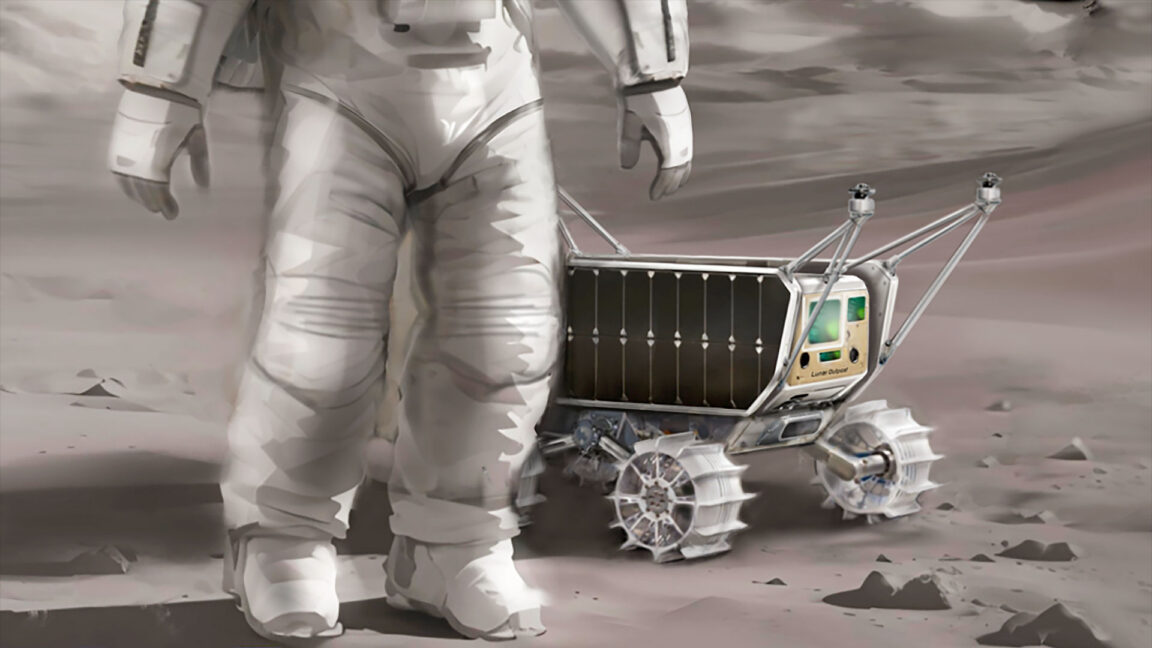
B-9 had Will Robinson. Twiki had Buck Rogers. And, of course, C-3PO and R2-D2 had Luke Skywalker. Now, in a scenario straight out of science fiction, MAPP will have whoever NASA names to the crew of the second Artemis mission to land on the moon.

The space agency has selected Lunar Outpost’s Mobile Autonomous Prospecting Platform, or MAPP, to become the first robotic rover to operate on the moon alongside astronauts. Although its tasks will be far simpler than those of the robots seen on TV and in the movies, the autonomous four-wheeled MAPP will help scientists learn more about the crew’s surroundings. Science instruments on the rover will characterize the surface plasma and behavior of the dust in the lunar environment.

“The Apollo era taught us that the further humanity is from Earth, the more dependent we are on science to protect and sustain human life on other planets,” said Nicky Fox, NASA’s associate administrator for science, in a statement. “By deploying these… science instruments on the lunar surface, our proving ground, NASA is leading the world in the creation of humanity’s interplanetary survival guide to ensure the health and safety of our spacecraft and human explorers as we begin our epic journey back to the Moon.”

Read full article

Comments

© Lunar Outpost/collectSPACE.com

❌