
Reading view

There are new articles available, click to refresh the page.

Why an Unmanned Mission May be Most Effective in Venezuela

OPINION — Wars are increasingly fought by unconventional means. A recent example is Ukrainian insertion of unmanned aerial systems (UAS) to attack Russian airfields, launched from civilian outfitted trucks. The Israeli pager attacks are another example of leveraging unconventional means to achieve an outsized effect. Both examples demonstrate that unconventional methods can not only disrupt enemy forces and destroy key objectives, but also achieve tremendous psychological effects and by saturating the airspace, limit an adversaries ability to mount offensive operations.

While the U.S. continues a conventional military buildup off the coast of Venezuela, the lessons from the Ukrainian and Israeli conflicts may be prescient: the US can achieve most of our policy objectives with limited or no ground forces deployment into Venezuela. The authors assume the current U.S. administration’s objectives are centered on regime change without conventional warfare.

Venezuelan forces may be well-prepared for guerilla warfare. Reports are circulating that Russian “advisors” have been dispatched to Venezuela, and it is likely that the Venezuelan army is incorporating Russia’s lessons from Ukraine into their preparation. American forces meeting a small, well-prepared drone force could lead to unacceptable casualties, a prolonged conflict, unnecessary escalation, and international embarrassment.

We suggest, therefore, that if intervention in Venezuela is forthcoming, the U.S. should adopt a strategy centered on unmanned systems. Modern combat in Ukraine and Israel provide a viable model.

Our proposed strategy suggests leveraging a combination of UAS and unmanned ground vehicles (UGV) to weaken the Maduro government’s internal support, and hasten favorable conditions for peace - again, assuming “regime change” or negotiated peace are the desired endstates.

How the U.S. Military Thinks of War

The U.S. Military uses a six-phase planning model to describe the progression of an operation or campaign. This continuum begins with Phase 0: Shape, which involves continuous peacetime activities to influence the operational environment and prepare for contingencies. As an operation develops, the force moves to Phase I: Deter, demonstrating capability and resolve to dissuade, followed by Phase II: Seize Initiative once hostilities begin, gaining access and advantage. The core combat phase is Phase III: Dominate, which involves applying overwhelming combat power to defeat the enemy force. The final stages, often requiring significant force commitment for irregular warfare, are Phase IV: Stabilize, focusing on securing the operating area and providing security, and Phase V: Enable Civil Authority, which transitions security and control back to legitimate local governance to establish a lasting peace. Technologies are used in every phase as a strategic force multiplier.

Proposed Unmanned Systems Strategy

Phase 0 should begin immediately. This phase would be centered on information collection around the capital, Caracas, and the economic epicenters, Venezuela, Maracaibo, Valencia, and Barquisimeto, as well as oil refineries, given their central importance to the Venezuelan economy. Significant real-time intelligence collection could be achieved by leveraging High Altitude Long Endurance (HALE) aircraft coupled with pervasive small, ground-based sensors. UGVs would provide long-term, ground-based multi-disciplined intelligence collection capabilities, leveraging commercial off-the-shelf technologies (proven effective in Ukraine) to reduce risk of exposing sensitive or proprietary technologies.

The assessed trigger for escalation would be a breakdown of negotiations over a change of government. Subsequent operations would focus on precision degradation and infrastructure interdiction, designed to be quick, minimize political fallout, and avoid direct engagement with Venezuelan forces. Generally, operations would seek to scale between Phase 1 - Deter, and Phase 3 - Dominate, to apply and then relieve pressure on the Venezuelan government and population as needed to degrade political will and popular support. Operations should be carefully crafted, and targets thoughtfully selected, not just for military effect, but for their psychological and political impact.

Aerial and Electronic Warfare Dominance

The first actions would be entirely aerial, focused on blinding the Venezuelan government and shaping persistent intelligence, all while demonstrating the ability to dominate without causing significant destruction. The U.S. could suppress air defenses using high-altitude, stealth drones, and specialized EW drones to undermine government influence and degrade command and control. Targets would include Venezuela's air defense systems, mostly Russian S-300VM and Buk-M2E missile batteries, and radar networks. Key locations would be targeted with precision-guided munitions or overwhelmed and jammed by EW drones before kinetic strikes to establish air superiority for subsequent UAS waves.

What national security news are you missing today? Get full access to your own national security daily brief by upgrading to Subscriber+Member status.

Targeting Command and Control

The U.S. could leverage loitering munitions and specialized communications relay and jammer UAVs to target key military and government communication nodes, high-frequency transmission sites, and satellite ground stations. Small, inexpensive UAS could be coupled with highly mobile UGVs to extend range, and to achieve precise sequencing, impressing urgency and conveying the message that the Maduro government is inept. By severing communication links between the military high command and field units, the U.S. could cause decentralized chaos, which would degrade the will to fight. Unmanned surface vehicles (USVs) and unmanned underwater vehicles (UUVs) could contain Venezuelan forces, targeting the fleet to deny freedom of movement.

Given instability in Venezuela and the Maduro Government’s demonstrated willingness to enter into discussions, well-sequenced escalation and deescalation may provide the necessary impetus to achieve the desired effect. Minimizing destruction up to this juncture reduces the subsequent burden of rebuilding, which would increase popular support for a replacement government. Minimizing damage would also reduce the likelihood of causing unintended regional instability through large-scale human displacement.

With their extended battery life and ability to recharge with onboard solar panels or from civilian power sources, UGVs provide an ideal baseline for extended operations, providing prolonged ground-based intelligence and surveillance. Information from onboard sensors, long-term intelligence collection, could provide timely battle damage assessments, and would shape planning for subsequent operations.

Well-Timed Precision Strikes

Small UAS loaded with precision explosive and cyber and EW payloads could be loaded onto UGV and transported deep within the country, where they would be staged for well-timed, precision operations to set conditions for negotiations. Disabling power to cause temporary service blackouts, or disrupting and corrupting government information campaigns would allow the U.S. to control the narrative. These precision operations should be choreographed and limited to eliminate harm to civilians.

Precision strikes launched from UGVs could damage government buildings and political headquarters, timed for maximum media coverage, to demonstrate penetration and weakness. Cellular towers could be struck with small munitions to inconvenience and frustrate the population. These limited actions could continue near indefinitely, and would reinforce the narrative that Maduro is weak and incapable, increasing the likelihood of a timely resignation.

UGVs with an explosive payload could be covertly controlled over cellular networks over extended distances, to strike key locations such as bridges, military installations or troop concentrations deep within Venezuela. In the event of a troop deployment, UGV could also be outfitted with weapon platforms such as machine guns or grenade launchers, for force protection.

Subscriber+Members get exclusive access to expert-driven briefings on the top national security issues we face today. Gain access to save your virtual seat now.

Conclusion

With warships off the coast and the airspace over Venezuela “closed”, all signs indicate that the U.S. administration intends to leverage the military to achieve a political objective. There are two options should we choose to proceed. The first is a conventional war, with high financial cost, significant political risk and moderate risk of casualties. The second option is to leverage our growing unmanned systems arsenal, where financial costs will be relatively low, and the risk of casualties will be minimal.

The lessons from modern conflicts in Ukraine and Israel overwhelmingly provide a model for moving towards an agile, unmanned systems-centric strategy. This agile approach, moving from pervasive intelligence collection to targeted electronic warfare and precision kinetic strikes, if choreographed with other effects, would exert maximum political and psychological pressure. It also minimizes collateral damage by avoiding direct military engagement with Venezuelan forces.

This strategy has several advantages: it drastically reduces the risk of unacceptable casualties for American forces, and it minimizes the destructive aftermath that traditionally prolongs conflict and burdens post-conflict reconstruction. An unmanned systems strategy also enables the U.S. to move fluidly between deterring and dominating to maximize effects, and serves as a strong deterrent against countries who might doubt America’s ability to fight and win in modern combat.

Ultimately, the choice to intervene will always be a political one. However, if such action is deemed necessary, adopting a nearly exclusive unmanned strategy offers a path to achieving a political end-state quickly and cleanly. It is a recognition that the future of modern warfare is defined not by the size of a conventional buildup, but by the strategic, ethical, and precise application of unmanned systems to effect change.

The Cipher Brief is committed to publishing a range of perspectives on national security issues submitted by deeply experienced national security professionals.

Opinions expressed are those of the author and do not represent the views or opinions of The Cipher Brief.

Have a perspective to share based on your experience in the national security field? Send it to Editor@thecipherbrief.com for publication consideration.

Read more expert-driven national security insights, perspective and analysis in The Cipher Brief
America’s Antibiotic Weakness Is a National Security Blindspot

OPINION – Offshoring and outsourcing antibiotic production to China and India is putting America’s access to lifesaving medicines at risk. It’s time to implement antibiotic security measures before a supply crisis occurs. The first step is rebuilding onshore fermentation manufacturing capacity.

Antibiotics have significantly improved life expectancy and overall public health for over 80 years. Penicillin alone has saved approximately 200 million lives. Its discovery paved the way for further advancements in antibiotics that have saved hundreds of millions more.

From the 1940s to the late 1980s, the United States led global antibiotic manufacturing. The volume of fermentation capacity required to produce antibiotics in the U.S. was a key measure of this. However, over time, pharmaceutical companies steadily outsourced and shifted antibiotic manufacturing to other countries, largely driven by opportunities to reduce costs and avoid capital investment.

Today, the production of antibiotic active pharmaceutical ingredients (APIs) is concentrated in a handful of countries; nearly 70% of the manufacturing sites for a representative shortlist of 40 antibiotic APIs are in India and China (with the majority in China). More concerning, the United States no longer has any significant fermentation manufacturing capabilities to produce antibiotic APIs onshore (see Table 1).

Fermentation capacity for manufacture of antibiotics in USA

Year

Fermentation Capacity (Liters)

1944

400,000

1984

18,000,000

2024

Less than 400,000

This reality creates risks to health security and equitable access to key medicines, especially since antibiotics are such an essential tool for combating infections. In 2024, there were 256 million prescriptions for antibiotics distributed in the U.S. alone. Yet, the amount of antibiotics manufactured in the United States has dwindled to a concerningly low level; 92% of the 111 most-prescribed antibiotics have no U.S. source as of 2021. Worse, antibiotics are 42% more likely to be in short supply than other drug products.

Save your virtual seat now for The Cyber Initiatives Group Winter Summit on December 10 from 12p – 3p ET for more conversations on cyber, AI and the future of national security.

During the COVID-19 pandemic, India limited exports of two common antibiotics, tinidazole and erythromycin (among other drugs), due to dwindling supply of APIs resulting from the temporary closure of Chinese manufacturing facilities. And, in 2017, there was a global shortage of two other antibiotics, piperacillin-tazobactam and benzathine penicillin, because a single factory in China shut down. Just three API manufacturers for these products remain, all in China.

Other countries are already steps ahead of the U.S. in securing their own antibiotic supply. India’s Production Linked Incentive (PLI) scheme, for example, enhances antibiotic security by promoting domestic manufacturing of APIs, key starting materials (KSMs), and drug intermediates. This reduces India’s reliance on imports, and plays a crucial role in protecting Indian public health.

For its national security, the United States must bring antibiotics manufacturing back home. Key is maintaining a level of fermentation manufacturing capacity. This would enhance domestic ability to respond to public health emergencies and minimize the impacts of global supply chain disruptions and geopolitical tensions. Beyond improving antibiotic security, increasing capacity in the U.S. would create net new jobs and enable the implementation of improved and lower cost technologies.

Collaboration between the government and the private sector, particularly via government funding, is crucial to catalyze change in the production landscape. It would also drive innovation in manufacturing processes. To bring fermentation capacity back onshore, something the U.S. has already done to ensure access to other key products, there will have to be incentives.

The CHIPS and Science Act, for example, reduces U.S. dependence on foreign semiconductor manufacturing, particularly from geopolitical rivals like China. The Act provides $52.7 billion in funding to boost domestic semiconductor production, research, and workforce development, ensuring that the United States maintains a secure and resilient supply of critical microchips used in defense, infrastructure, and consumer technology. Antibiotics should receive the same treatment.

Given that higher costs to produce antibiotics onshore drove antibiotic production overseas in the first place, further economic incentives, such as tax credits and subsidies, are also needed. These could motivate pharmaceutical companies to invest in manufacturing capacity domestically. Contract manufacturing organizations (CMOs) and generic drug suppliers should also be targets of these incentives since generics represent over 80% of antibiotic market share by revenue.

Finally, guaranteed purchasing agreements from the government or public entities can provide financial stability for antibiotic manufacturers and make investing in fermentation or manufacturing capabilities a more attractive, lower risk opportunity.

Need a daily dose of reality on national and global security issues? Subscriber to The Cipher Brief’s Nightcap newsletter, delivering expert insights on today’s events – right to your inbox. Sign up for free today.

These opportunities are not without challenges. Pharmaceutical companies have historically prioritized more profitable, chronic disease treatments; antibiotics are prescribed for short durations and generate significantly less revenue compared to other drugs. Any new economic incentives need to be meaningful enough to bridge this gap significantly.

In the meantime, the government should continue stockpiling antibiotics to insure against future shortages. Currently, the U.S. maintains an undisclosed amount of antibiotics through the Center for the Strategic National Stockpile (SNS), but a longer term manufacturing strategy is required to improve safety and reduce risk of shortage.

Access to antibiotics is too critical to simply let cost dictate where production occurs. At the end of the day, this is about protecting our ability to combat infection.

The Cipher Brief is committed to publishing a range of perspectives on national security issues submitted by deeply experienced national security professionals. Opinions expressed are those of the author and do not represent the views or opinions of The Cipher Brief.

Have a perspective to share based on your experience in the national security field? Send it to Editor@thecipherbrief.com for publication consideration.

Read more expert-driven national security insights, perspective and analysis in The Cipher Brief because National Security is Everyone’s Business.

Can Europe Survive the New Multipolar World?

EXPERT PERSPECTIVE — For more than three decades after the Cold War, Europe lived under the illusion that history had settled in its favor. Liberal democracy seemed ascendant, global markets expanded without friction, and American military primacy insulated the continent from hard-power competition. Under those conditions, the European Union could focus on enlargement, regulation, and internal integration rather than geopolitics.

That era is finished.

A new multipolar world, shaped primarily by the United States, China and Russia has taken hold, and Europe’s place within it is increasingly uncertain. The EU now faces a destabilizing combination of external pressures and internal constraints that call into question its long-term strategic relevance. The next decade will determine whether Europe becomes a genuine pole of power or resigns itself to being a geopolitical appendage.

The End of Post-Cold War Certainties

The post-1991 Western order rested on three assumptions: U.S. military dominance, deepening globalization, and the notion that political liberalization would eventually spread worldwide. Each of these pillars has eroded.

U.S. primacy is no longer guaranteed. Washington is now stretched between deterring China in the Indo-Pacific, supporting Ukraine, and managing crises in the Middle East. American policymakers—across both parties—increasingly resent Europe’s reliance on U.S. defense guarantees and expect the EU to realign its China policy with America’s priorities. Europe’s security depends on a partner whose long-term predictability it cannot ensure.

Globalization is fragmenting. The pandemic, geopolitical rivalries, and technological decoupling between Washington and Beijing have shattered faith in frictionless global supply chains. Europe, whose prosperity hinges on exports, advanced manufacturing, and access to global markets, feels the squeeze.

Authoritarian resilience has replaced Western convergence. China’s techno-authoritarian model and Russia’s militarized nationalism offer alternatives to liberal democracy. Across Africa, the Middle East, and South Asia, states increasingly hedge rather than take sides, reducing the EU’s ability to shape norms or export its model. The world is no longer moving toward Europe. It is moving away from it.

The New Power Triangle: Washington, Beijing, Moscow

1. The United States: indispensable, but increasingly impatient

The U.S. remains the only actor capable of deterring Russia on Europe’s behalf, and without American intelligence, logistics, and weaponry, Ukraine’s position would be far more precarious. Yet Washington’s strategic focus is shifting eastward. In every administration, the question recurs: Why should America subsidize European security indefinitely?

Growing U.S. skepticism combined with the possibility of future political shifts exposes Europe’s most dangerous vulnerability: dependence on an ally whose priorities are changing faster than Europe can adapt.

2. China: Europe’s vital economic partner turned systemic rival

China is indispensable to European industries from electric vehicles to renewable energy to pharmaceuticals. Yet Beijing’s industrial subsidies, strategic investments, and political influence operations challenge the EU’s economic model and internal cohesion. As Washington accelerates decoupling, Europe is pressured to follow suit at high cost to its own industry.

China is no longer just a market; it is a shaping force in a global system that Europe struggles to influence.

3. Russia: the security threat that will not disappear

Russia’s invasion of Ukraine shattered Europe’s illusions of a “post-historic” continent. Even after the initial shock, Moscow’s ongoing militarization signals a long-term confrontation. Europe’s sanctions, energy diversification, and support for Kyiv have been substantial but the EU still lacks the military and industrial backbone to sustain a prolonged, high-intensity conflict without the United States.

Russia is not a temporary crisis. It is a structural challenge.

Europe’s Structural Weakness: Power Without Agency

Europe has economic weight, technological capability, and regulatory influence but struggles to convert them into geopolitical power.

1. Fragmented decision-making. EU foreign policy requires unanimity, making coherent action nearly impossible. France pushes for “strategic autonomy,” Germany for economic stability, Poland for deterrence, Italy for flexibility. Diverging priorities fracture the bloc at every major juncture, from China policy to Middle East diplomacy.

2. Military insufficiency. Despite increases in defense spending, Europe remains dependent on the U.S. for intelligence, logistics, command-and-control, missile defense, and advanced weapons. The continent’s defense industry is fragmented into dozens of incompatible national systems that a luxury Europe can no longer afford.

3. Economic vulnerabilities. From semiconductors to critical minerals, Europe relies on external suppliers. In a world defined by technological blocs and industrial rivalry, the EU risks being squeezed between U.S. security demands and Chinese economic dominance.

4. Demographic decline. Aging societies and shrinking workforces reduce the EU’s long-term competitiveness and its ability to project power.

These vulnerabilities do not make Europe irrelevant—but they do make it reactive.

Three Possible Futures

Scenario 1: Strategic Autonomy Becomes Real

Europe could choose to become a coherent geopolitical actor—pooling defense procurement, adopting majority voting on foreign policy, investing heavily in its defense industry, and crafting a unified China strategy. This would give the EU real agency.

But achieving this requires political courage that Europe has rarely demonstrated.

Scenario 2: Renewed Atlantic Dependence

The EU may double down on the U.S. alliance, accepting a secondary role in global geopolitics while focusing on economic and regulatory power. This is the easiest path both politically and financially but it leaves Europe dangerously exposed to America’s domestic turmoil.

Scenario 3: Fragmentation and Decline

If member states continue to pursue conflicting national policies and U.S. attention continues shifting to Asia Europe risks strategic irrelevance. In this scenario, global powers shape Europe’s environment, while Europe merely adapts.

This path is unlikely to be dramatic. Decline rarely is. It is slow, quiet, and comfortable until suddenly it is not.

Europe Must Choose Power Over Comfort

The multipolar world will not wait for Europe to get its act together. The question is no longer whether the EU wishes to become a global actor; it is whether it can afford not to.

Europe’s future is binary:

A genuine geopolitical pole, capable of defending its interests. A subordinate ally, protected but strategically constrained. Or a divided continent, overshadowed by the ambitions of others. For three decades, Europe believed it had escaped history. Now history has returned with force. Whether Europe survives the new multipolar world depends on whether it chooses power over comfort, strategy over complacency, and unity over drift.

The Cipher Brief is committed to publishing a range of perspectives on national security issues submitted by deeply experienced national security professionals.

Opinions expressed are those of the author and do not represent the views or opinions of The Cipher Brief.

Have a perspective to share based on your experience in the national security field? Send it to Editor@thecipherbrief.com for publication consideration.

Read more expert-driven national security insights, perspective and analysis in The Cipher Brief

Inside the Pentagon IG’s Findings on Signalgate

OPINION — “The [Defense] Secretary [Pete Hegseth] sent nonpublic DoD information [on March 15 at 11:44 EDT] identifying the quantity and strike times of manned U.S. aircraft over hostile [Houthi] territory [in Yemen] over an unapproved, unsecure network [Signal] approximately 2 to 4 hours before the execution of those [U.S. aircraft] strikes. Using a personal cell phone to conduct official business and send nonpublic DoD information through Signal risks potential compromise of sensitive DoD information, which could cause harm to DoD personnel and mission objectives.”

That was one finding from the December 2, Defense Department Inspector General (DoD IG)] report entitled Evaluation of the Secretary of Defense’s Reported Use of a Commercially Available Messaging Application for Official Business that was released last Wednesday.

Another finding was “We [Office of the DoD IG] concluded that the [Defense] Secretary [Hegseth] sent sensitive nonpublic, DoD operational information that he determined did not require classification over Signal on his personal cell phone. Although EO 13526 [Executive Order on Classified National Security Information] grants the [Defense] Secretary the authority to determine the proper level of classification of DoD information, we concluded that the Secretary’s actions did not comply with DoDI 8170.01 [DoD Policy for social media accounts] which prohibits using a personal device for official business and sending nonpublic information over a non-approved commercially available messaging application.”

So in that first finding the DoD IG found Hegseth’s message potentially endangered U.S. military members and their mission, and in the second finding the DoD IG said the Defense Secretary had violated DoD policy.

On Wednesday evening, after public release of the DoD IG report, Hegseth on X messaged, “No classified information. Total exoneration. Case closed. Houthis bombed into submission. Thank you for your attention to this IG report.” At roughly the same time, Pentagon spokesman Sean Parnell in a statement said: “Total exoneration of Secretary Hegseth and proves what we all knew – no classified information was shared. The matter is resolved and the case is closed.”

Of course the DoD IG report is the opposite of “total exoneration,” and by no means should the case be closed. In fact, this entire matter should have been an illustration to the Trump administration that it cannot get away with lying about serious matters, but nonetheless they have continued to try.

The history of this DoD IG report shows that Hegseth and others in the Trump administration even failed to cooperate in the IG’s investigation.

For example, the DoD IG report said frankly, “The Secretary declined to be interviewed for this evaluation.” Hegseth did, after four months, supply to the IG Office a July 25, one-page, five paragraph statement. In it, Hegseth used two paragraphs to defend the questioned details in his March 15, Signal chat message, arguing at one point the information was “either not classified, or that I could safely declassify [it].”

Meanwhile, there were other times of non-cooperation. The DOD IG report said, “We requested a copy of the Secretary’s communications on Signal on or about March 15. According to a senior official in the Office of the Secretary of Defense (OSD), the Secretary declined to provide us direct access to his personal cell phone.”

At another point, when the DoD IG was trying to get a full transcript of the March 15, Signal chat, it found that OSD had a consolidated version it received from the White House Counsel’s Office, but the request for a copy was declined “because it was not a DoD-created record.”

The DOD IG report, itself, originated from a request back on March 26, by Sens, Roger Wicker (R-Miss.) and Jack Reed (D-R.I.), the Chairman and Ranking Member of the Senate Armed Services Committee.

The two Senators were reacting to two articles dated March 24, and March 26, on The Atlantic website written by Editor Jeffrey Goldberg, who had described that somehow then-National Security Advisor Mike Waltz had made Goldberg part of a Signal chat group of senior Trump administration officials named the Houthi PC small group. The chat group included Vice President JD Vance, Secretary of State Marco Rubio, Secretary Hegseth, Director of the Central Intelligence Agency John Ratcliffe, and Director of National Intelligence Tulsi Gabbard.

What national security news are you missing today? Get full access to your own national security daily brief by upgrading toSubscriber+Member status.

Goldberg’s March 24, Atlantic article alleged that on March 15, the Signal chat group received from Hegseth sensitive war plans about the U.S. air strikes before they took place on Yemen that day. The Atlantic initially chose not to print those war plan details because potentially they contained classified information. Although the White House initially said the story seemed authentic, Hegseth initially said, “Nobody was texting war plans, and that’s all I have to say about that."

By the next day, the Trump administration had settled on their response. Appearing on March 25 before the Senate Select Committee on Intelligence, CIA Director Ratcliffe said, “The Secretary of Defense is the original classification authority, and my understanding is that his comments are that any information that he shared was not classified.” DNI Gabbard, appearing with Ratcliffe, echoed him saying, “There were no classified or intelligence equities that were included in that chat group at any time.”

After the denials, The Atlantic on March 26, then published Goldberg’s subsequent article which contained Hegseth’s pre-strike details. They gave the scheduled March 15 time of the first F-18 launch package; the time the first strike F-18s should reach “Target Terrorist;” the time of launch of MQ-9 strike drones; the time launch of second F-18 package; the time “when first bombs will definitely drop,” and the time when F-18 2nd package strike begins; and the time when the first sea-based Tomahawk missiles launched.

Although Hegseth claimed, “there were no details that would endanger our troops or the mission,” anyone who knew where the F-18s were based, their time of departure and the expected time bombs were to be dropped in Yemen might have been be able to determine the targets.

The DoD IG report concluded, “If this information had fallen into the hands of U.S. adversaries, Houthi forces might have been able to counter U.S. forces or reposition personnel and assets to avoid planned U.S. strikes. Even though these events did not ultimately occur, the Secretary’s actions created a risk to operational security that could have resulted in failed U.S. mission objectives and potential harm to U.S. pilots.”

Nominations for outstanding leaders in national security and intelligence are now open for the 2026 Cipher Brief Honors Dinner. Find out more here.

Another issue raised by the DOD IG report is that Hegseth was involved in other Signal chat groups into which he could have put additional classified information.

For example, the DOD IG reported, “One of the officials we spoke with stated that the Secretary posted the same sensitive operational information concerning the March 15, Houthi attack plans on the ‘Defense Team Huddle’ group chat.” That was a chat group Hegseth established from his personal and professional inner circle in January 2025, before his confirmation as defense secretary, and included Hegseth’s wife, Jennifer, who is a former Fox News producer.

The New York Times reported the Defense Team Huddle chat group also included Hegseth’s younger brother, Phil Hegseth, who has since become a senior adviser to the Defense Secretary and a DoD liaison officer to the Department of Homeland Security (DHS).

Other OSD officials told DoD IG investigators there are “multiple additional Signal group chats in which the Secretary allegedly participated to conduct official DoD business and transmit nonpublic DoD information,” according to the IG report. “Two officials stated that they were part of several group chats, and one of them stated that the Secretary and others used the chats to coordinate meetings, respond to media inquiries, or alert staff to check their official email accounts.”

That was another reason, the report said, “why we [DoD IG] requested copies of messages from these other Signal group chats, as well as access to the Secretary’s personal cell phone,” which so far have been unsuccessful.

I must conclude this article by saying that much credit goes to the DoD IG office, and Acting DoD IG Steven A. Stebbins. They did an admirable job on this inquiry given the lack of cooperation from their top bosses to this inquiry. They showed the professionalism looked for and needed in federal government employees.

The Cipher Brief is committed to publishing a range of perspectives on national security issues submitted by deeply experienced national security professionals.

Opinions expressed are those of the author and do not represent the views or opinions of The Cipher Brief.

Have a perspective to share based on your experience in the national security field? Send it to Editor@thecipherbrief.com for publication consideration.

Read more expert-driven national security insights, perspective and analysis in The Cipher Brief

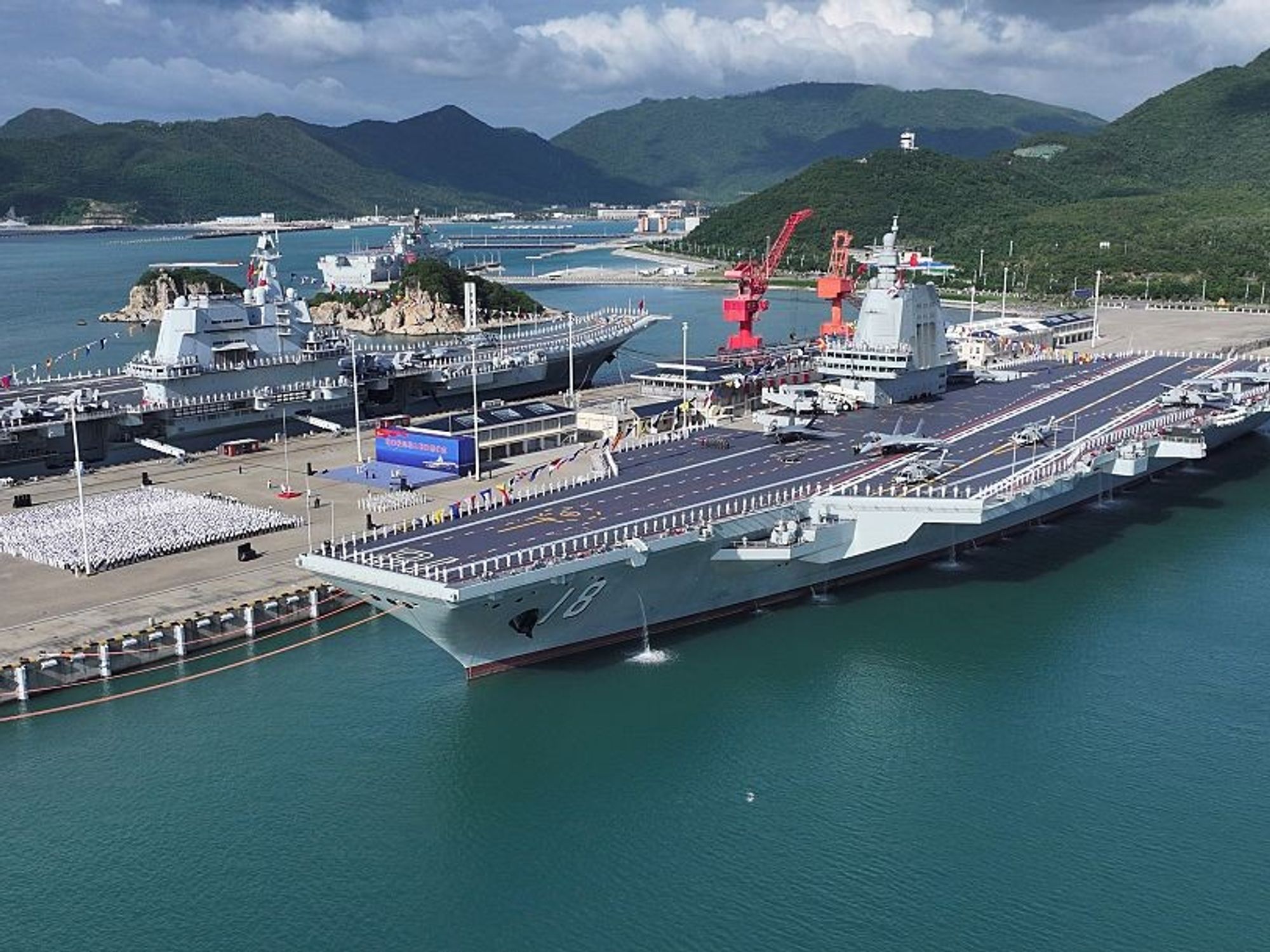
What China’s ‘World-Class Navy’ Means for the U.S. and Asia


DEEP DIVE — On a Wednesday in November, with Chinese President Xi Jinping looking on, the People’s Liberation Army Navy (PLAN) commissioned the 80,000-ton Fujian, the country’s third aircraft carrier and largest to date, in a ceremony that also featured its latest Navy stealth fighters, helicopters and command aircraft. A week later, China’s Ministry of Defense announced that the Sichuan, one of the world’s largest amphibious assault ships, had completed initial sea trials and would be ready for deployment next year. And last week, Shanghai is hosted “Marintec China,” the largest maritime conference in the world.

These are all signs of China’s continued rise as a maritime power and challenger to U.S. supremacy on the seas. And they have happened at a lightning-fast pace.

China now has “a world-class Navy,” retired Rear Admiral Mike Studeman, a former Commander of the Office of Naval Intelligence, told The Cipher Brief. “It's not, ‘Hey, we're going to achieve this in 2049.’ And it's just not in the numbers, it's in the quality. These ships are modern by any standard.”

The recently commissioned Fujian is the first Chinese carrier (and only the second in the world, after the U.S. Gerald R. Ford) to be equipped with electromagnetic catapults for launching aircraft. As for the new amphibious vessel, the Sichuan, experts have been impressed both by its sophistication and the fact that it was built in just over two years.

Top U.S. Navy officials are taking note. On an Asia-Pacific tour last month, Admiral Daryl Caudle, the U.S. Chief of Naval Operations, acknowledged the new carrier and assault ship and the overall “impressive” growth of China’s Navy.

“How they utilize those aircraft carriers globally is, of course, a concern of mine,” Adm. Caudle said in Japan. As for the Sichuan assault vessel, Adm. Caudle said, “We’ll watch that very closely and see what they’re going to do there. That’s a large ship, very capable.”

Experts say the recent milestones are the latest evidence of gains that have seen China’s Navy surpass the U.S. fleet in overall numbers while boosting the quality of its vessels as well.

“It's impressive,” former Rear Admiral, Mark Montgomery, told The Cipher Brief. “They're building a hundred merchant ships for every one we build, and two warships for every one we build. And they have quantitatively exceeded the size of our U.S. naval ship numbers.”

Montgomery was quick to add that China’s advances “don’t mean they have a more capable Navy” than the U.S. In terms of the quality of submarines and destroyers and carriers – “your choice, ship class after ship class,” as he put it – the U.S. remains without peer. But Montgomery and others say that China has rapidly narrowed the quality gap, and already changed the strategic equation for any potential conflict over the South China Sea or Taiwan.

China is “building a lot of ships, but the technological sophistication of those vessels has also significantly increased,” said Matthew Funaiole, Senior Fellow at the China Power Project at the Center for Strategic and International Studies (CSIS). “They're really trying to compete with other countries – and they obviously have their sights set on the U.S. in terms of maritime dominance in the region.”

The Trump Administration issued an executive order in April to jumpstart the U.S. shipbuilding industry and restore “American maritime dominance,” but experts say the U.S. has work to do to match the urgency of the Chinese buildup.

“The shipbuilding capacity in China now dwarfs that of the United States,” Emmanouil Karatarakis wrote in a recent analysis for The Cipher Brief. Citing estimates that China's overall shipbuilding capability (armed and unarmed) is now hundreds of times larger than the U.S.'s, he added, “This imbalance has far-reaching implications for long-term strategy and wartime readiness.”

Subscriber+Members are invited to join in an exclusive virtual conversation on Monday, December 8 at 2:30p ET on Russia’s Gray Zone Operations in Europe with former leaders from the Department of Defense, CIA, NATO and the British Foreign Office. Members receive links to register via email.

Not a Subscriber+Member? Let’s fix that.

China’s maritime rise

As with many elements of China’s rise as a global power, this one began in the early 1990s. At the time, China’s Navy was deployed primarily to guard its coastline – and while precise figures are hard to come by, estimates of its 1990 force range from 350-400 vessels, most of which were small patrol craft. Back then, the PLAN had no modern destroyers or submarines, and when China first put a carrier to water – in 2012 – it was a retrofitted Soviet vessel (the ship had actually been built in the 1980s, in the then-Soviet republic of Ukraine).

Today, China’s Navy boasts more than 1,000 vessels, including roughly 370 warships and submarines in what the Pentagon calls China’s “battle force” capability. The bulk of this rags-to-riches rise in maritime assets has come during the tenure of Xi Jinping.

“Xi Jinping has always been clear-eyed about the fact that a great power is a maritime power,” RADM Studeman said. “He personally understands that China, in order to be the leading power in the world, needs to have a maritime capability bar none. And that's the course they're on.”

Beijing has taken advantage of a booming commercial shipbuilding industry and the fact that – unlike in the U.S. – the civilian and military sectors in China are intertwined. Shipbuilding was included in the 10 core technologies in Beijing’s “Made in China 2025” industrial strategy, a blueprint for competing with global leaders in key industrial sectors.

A CSIS report offered staggering evidence of China’s maritime rise: the country’s share of global shipbuilding has jumped from 5% in 1999 to roughly 50%, while the U.S. now builds fewer than 1% of commercial ships globally. China’s largest state-owned shipbuilder built more commercial vessels by tonnage in 2024 than the entire U.S. shipbuilding industry had built since the end of World War II.

As for warships, China is now on track to have a 425-ship fleet by 2030, while the U.S. Navy currently has fewer than 300 deployable battle-force vessels – a total which experts worry may drop as aging ships are retired faster than new ones are put to water. “The growing size and sophistication of China’s Navy, combined with Beijing’s increasing assertiveness,” the CSIS report said, “poses major challenges to U.S. and allied military readiness and deterrence in the Indo-Pacific.”

Strategic implications

Experts say there are two basic strategic aims behind China’s maritime growth: preparing for potential conflict in the region, and adding a critical element for the country’s projection of global power and influence.

For the latter goal, the Fujian adds a major “chess piece,” as RADM Studeman put it, helping the PLAN expand its growing “blue-water” capabilities and extend its reach well beyond China’s Southeast Asian neighbors.

“They have been going up into the Bering Sea and parts of the Arctic and Antarctic,” Studeman said. “And they've been able to expand their footprint and develop their capabilities in an evolutionary way, which has been remarkable to see.”

The new carrier group might also be used in a maritime blockade of Taiwan, global humanitarian missions, and show-of-force deployments far from China’s shores.

“China wants to have the ability to operate globally,” Funaiole told The Cipher Brief. “I don’t think they want to do the same things the U.S. does, which is to have forward-positioned fleets all over the world. But they do want the ability to operate in different regions that are further and further away from the Chinese mainland, and you need to have a blue-water Navy in order to do that. It's the key to power projection.”

As far as a potential Taiwan conflict is concerned, the Sichuan – the newly-minted amphibious vessel, would be the more important “chess piece.” It’s an assault ship built to provide launch platforms for large combat drones, helicopters, and amphibious equipment, according to China’s Ministry of Defense.

“The carriers are less important for a Taiwan contingency than a lot of the other assets,” Funaiole said. “The amphibious ships are critical for that being successful.”

RADM Montgomery echoed the point, calling the new carrier group “a muscle flex and power projection,” while noting that the Sichuan and other assets would bring more concrete benefits in a regional conflict.

“The rest of their Navy [beyond the carrier group] isn't a muscle flex,” he said. “This is actually building a capability and capacity to push the United States farther and farther away from the area of crisis and contingency, whether in the East China Sea around the Senkaku [Islands] with Japan, in Taiwan, or in the South China Sea. The idea is to keep our Navy as far away as possible with a mix of missiles, aircraft, submarines, surface ships, all of that.” Those elements have been developed “at close to breakneck speed,” Montgomery said. “They've done a fantastic job of identifying, developing, resourcing and fielding a Navy air and missile force that places the US Navy and US Air Force at risk.”

U.S. Navy commanders have also warned that in the event of a Pacific war, China would be better equipped to replace lost ships – by virtue of geography and its more efficient shipbuilding. Taiwan war scenarios have shown that China would be able to absorb far heavier warship losses than the U.S.

Save your virtual seat now atThe Cyber Initiatives Group Winter Summit on December 10 from 1p – 4p ET for expert-led conversations on cyber, AI and the future of national security.

Can the U.S. turn the tide?

The White House’s April order, issued under the heading “Restoring America’s Maritime Dominance,” marked a recognition of China’s rise and a high-profile effort to reverse the erosion of U.S. shipbuilding. As The Cipher Brief has reported, the order mandates a whole-of-government push to jump-start the domestic shipbuilding industry.

The order called for the creation of an “Office of Shipbuilding” within the National Security Council, and said that within 210 days, the Assistant to the President for National Security Affairs “shall submit a Maritime Action Plan (MAP) to the President…to achieve the policy set forth in this order.”

That 210-day deadline has passed (November 5 was the 210th day), and there has been no public announcement of such a plan. The White House did not respond to requests for comment.

RADM Studeman acknowledged that even in the best-case scenario, these goals would take years to achieve, but added that he was disappointed by a slow pace of progress since the order was signed.

I expected to see more frankly,” he said. “I think that they're incredibly good ideas that were in that directive, and unless it's going on very quietly, I haven't seen enough progress in each of the areas.”

RADM Montgomery agreed.

“I know it's expectation management, but I'm disappointed,” he said, adding that he worries that future U.S. budgets may not provide the funds he believes are needed to kickstart the warship-building industry.

“China has modernized shipyards, as have Japan and Korea, who equally outpace us,” Montgomery said. “We do not have modernized shipyards for a number of reasons. We have not properly invested in that. Our labor costs are significantly higher, and that's particularly true in shipbuilding and defense manufacturing.”

He and others hold out hope that investments and expertise from Korea and Japan will help boost the U.S. output. The authors of the CSIS report urged a blend of punitive measures against China and long-term investments in U.S. and allied shipbuilding capacity. “U.S. Navy leaders have begun intensive outreach to allies like Japan and South Korea to support U.S. shipbuilding efforts,” the report stated, “an effort that President Trump has indicated he supports. However, much work remains to be done.”

“You need basically startup VC capital to get things going on it,” Funaiole said. “And it's not just the technical part or the physical infrastructure. We also have a lack of expertise and shipbuilding in this country. And so there also needs to be personnel training investments and exchange programs with other countries as well and specialization into new areas.”

Experts agree on this much: failure to address these issues risk damage to U.S. national security.

“As tensions rise,” the CSIS report said, “leaders in Beijing may calculate that China’s superior shipbuilding capacity would be a material benefit to outlasting adversaries in a protracted military conflict.”

Read more expert-driven national security insights, perspective and analysis in The Cipher Brief because National Security is Everyone’s Business.


Putin Sees “Useful Meetings”, the U.S. Should See a Trap Set for Inexperienced Negotiators

EXPERT OPINION / PERSPECTIVE -- Reports from Moscow suggest that U.S. representatives Jared Kushner and Steve Witkoff are “optimistic” about the prospect of results from their discussion with Kremlin officials this week. But after months of fruitless negotiations, if they are optimistic about achieving a negotiated solution to Russia’s invasion of Ukraine, they have little reason for it, given comments from Russian officials on the Moscow discussions.

If, as has been recently suggested to me, a central priority behind Kusher and Witkoff’s participation in negotiations (instead of relying on more experienced U.S. diplomats with a record of dealing with autocrats like Vladimir Putin) is to secure business deals in Russia following the conclusion of hostilities, then both the negotiations over Ukraine’s future and future business deals in Russia will prove to be fool’s errands, the former first and the latter over time. President Trump should know better and should have selected better representation for U.S. interests.

Kremlin spokesman Dmitriy Peskov described the meeting between Putin and the U.S. representatives as “very useful, constructive, and highly substantive.” At the same time, he said no compromise on a peace plan was reached. He went on to note that Russia wants peace, but only if its objectives are met and reiterated that Moscow insists on achieving the goals of its “special operation.”

Peskov’s remarks are not surprising as they are completely consistent with the narrative that Putin has pushed before and during his ill-fated invasion of Ukraine. As if to emphasize the Kremlin’s rejection of the Kushner-Witkoff mission, Putin launched one of the largest drone and missile attacks on Ukraine, probably while the U.S. representatives were still in the air flying home.

Russia’s position in this “negotiation” is absolutely clear and has been for some time: The complete elimination of Ukraine as an independent nation; the breakup of the transatlantic alliance which has been the bedrock of European security since 1945; the creation and exacerbation of political division in the United States to weaken it as a strategic opponent and create the conditions for the establishment of a multi-polar world order with Moscow and Beijing leading the autocratic anti-democratic poles and a weakened U.S. and Europe, the other pole. Success in Ukraine is key to Putin and Chinese President Xi Jingping’s strategy.

As part of the red orchestra Putin is directing to set the stage for the achievement of his objectives, he is pushing two critical narratives. The first is that Russia can achieve through military conquest the subjugation of Ukraine - the narrative that Kyiv is losing and will inevitably lose the war. Secondly, he is pushing the argument in Washington and elsewhere that Europe is undermining the Trump Administration’s efforts to achieve a negotiated solution to the conflict (however feckless and unrealistic the 28 point peace plan was/is). Putin is also using a combination of “gray zone” clandestine kinetic and lethal operations across Europe to undermine public confidence in their security at home and undermine resolve to support Ukraine and resist Putin’s ambitions. The Russian leader has executed a number of these efforts in recent years with varying degrees of plausible deniability and certainly without any retribution or consequence paid.

Subscriber+Members are invited to join in an exclusive virtual conversation on Monday, December 8 at 2:30p ET on Russia’s Gray Zone Operations in Europe with former leaders from the Department of Defense, CIA, NATO and the British Foreign Office. Members receive links to register via email.

Not a Subscriber+Member? Let’s fix that.


At Putin’s age and at this stage of his regime, he cannot back off his maximalist objectives in Ukraine, at least not until the pain from the war is felt by Russian elites and the Russian public to the point where his house of cards starts to tumble.

Ukraine’s ability to extract maximum casualties from Russia’s marginal territorial advances in Ukraine plus the cost being paid by Ukraine’s long-range strikes against energy infrastructure and military targets in the Russian Federation start to undermine support in those constituencies for Putin’s continued governance. The plan led by Kushner and Witkoff and endorsed by Trump works against undermining support in Russia for Putin’s aggression.

So, where does that leave Kushner and Witkoff with regard to a rumored undisclosed agenda of using the negotiations as cover for post-conflict business arrangements with Moscow? Dealing with business confidence in a kleptocracy is an oxymoron. If Kushner and Witkoff have never heard of Bill Browder, they should look him up.

Browder has consistently and accurately described the risks of doing business in Putin’s Russia. He again recently pointed out these risks in the specific context of warning Trump and his representatives of the risk they are taking on. Browder’s cogent observations and the wreckage of the hundreds of U.S. and western businesses that poured into Russia after the collapse of the Soviet Union show that you can put money in but getting it out is another matter entirely.

Who’s Reading this? More than 500K of the most influential national security experts in the world. Need full access to what the Experts are reading?

Trump and his representatives seem to think they will be the exception to the Russian kleptocratic paradigm. They will not be.

One can be sure Putin and Dmitriev will be whispering all the promises into the ears of their U.S. interlocutors. Kushner and Witkoff will dutifully carry these messages back to the White House and share their pipe dream fantasies of the untold riches of being on Putin’s good side.

The only thing Putin asks Kushner and Witkoff to relay is that Trump stop aiding and supporting the two remaining obstacles to a negotiated settlement, Zelensky and the European members of NATO. End military, intelligence, and economic aid to Ukraine, Putin certainly will have said, and Ukrainian resistance will collapse speedily, and the war will brought more rapidly to its inevitable conclusion. And the U.S. certainly should be able to put enough pressure on its NATO puppets to end their futile support for Ukraine and there will be peace in our time.

The President should engage some sound and experienced counsel to provide more realistic and experienced guidance on Russian realities. The first bit of that counsel would be to remove any illusion that Putin is a man who can be trusted. Putin’s public and private comments as well as his actions over the twenty plus years he has been running the Russian Federation leave no doubt as to where he stands with regard to the West in general and the U.S. in particular.

He believes democracy and capitalism are outmoded and morally exhausted political and economic philosophies doomed to collapse. As President of the country to which Putin refers as the “glavniy protivnik” or main enemy, President Trump should realize in Putin’s mind, HE is the main enemy.

Any promises of business deals that will follow the conclusion of the Ukraine conflict will inevitably be broken by Putin and his representatives. President Trump should understand Putin wants to steal his money the most. What greater victory for Putin than to have the U.S. hand him victory in Ukraine and in the process set up the biggest theft of money from a U.S. entity in history.

A second bit of counsel President Trump might seek to provide his representatives is that it is very difficult to keep secret deals secret when you are represented by someone as manifestly incompetent and compromised as Steve Witkoff. No additional evidence needs to be provided than the leaked transcript of the call with Kirill Dmitriev in which Witkoff provides advice on how to persuade President Trump to accept the Russian proposals for the end of the conflict in Ukraine.

In addition to the naiveté of having such a conversation in the first place, Witkoff should also be advised that undertaking such actions looks a lot like he is acting as an agent of influence for the Russian Federation.

Lastly, President Trump should be reminded of former British Prime Minister Winston Churchill’s famous remarks to Neville Chamberlain after Munich, “You were given the choice between dishonor and war. You chose dishonor and you will have war.” In the context of the current negotiations Churchill might have added that a fool and his money are soon parted.

All statements of fact, opinion, or analysis expressed are those of the author and do not reflect the official positions or views of the U.S. Government. Nothing in the contents should be construed as asserting or implying U.S. Government authentication of information or endorsement of the author's views.

The Cipher Brief is committed to publishing a range of perspectives on national security issues submitted by deeply experienced national security professionals.

Opinions expressed are those of the author and do not represent the views or opinions of The Cipher Brief.

Have a perspective to share based on your experience in the national security field? Send it to Editor@thecipherbrief.com for publication consideration.

Read more expert-driven national security insights, perspective and analysis in The Cipher Brief
The Strategic Failure on North Korea’s Nuclear Rise

EXPERT OPINION — South Korea’s Korea Institute for Defense Analysis recently publicly stated that we underestimated North Korea’s nuclear weapons program. According to their analysis, North Korea has between 127 and 150 nuclear weapons (not 50 to 60 nuclear weapons), and by 2030 they will have 200 nuclear weapons, reaching 400 nuclear weapons by 2040.

At the eighth Central Committee of the Workers’ Congress in late 2022, North Korean leader Kim Jong Un ordered the exponential expansion of North Korea's nuclear arsenal and the development of a more powerful intercontinental ballistic missile. Mr. Kim reportedly said: “They are now keen on isolating and stifling North Korea…and the prevailing situation calls for redoubled efforts to overwhelmingly beef up our military muscle.”

During this six-day meeting of the Central Committee, Mr. Kim not only called for an “exponential increase in North Korea’s nuclear arsenal”, but he also called for the mass production of battlefield tactical nuclear weapons targeting South Korea, and a new ICBM with a “quick nuclear counterstrike capability; a weapon that could strike the mainland U.S.”

North Korean leaders usually say what they plan to do. Indeed, this is the case with Mr. Kim. Not only has he apparently done this with his arsenal of nuclear weapons, but in October 2025, at the parade celebrating the 80th anniversary of the Korean Workers’ Party, the Hwasong-20, a solid fuel, mobile three stage ICBM capable of targeting the whole of the U.S., was introduced to the international community. The Hwasong-20 possibly could also be capable of launching multiple nuclear warheads at different targets, a capability that would challenge any missile defense system. So, the arsenal of ICBMs that could strike the U.S. – Hwasong-18 and 19 – has also grown exponentially with the Hwasong-20, as Mr. Kim said in 2022.

North Korea has also been working on its submarine program, to include a nuclear-powered submarine. This is in addition to its extensive work on hypersonic and cruise missiles, all representing a challenge to any missile defense system.

North Korea is also developing a second-strike capability, with programs to ensure the survivability of some of North Korea’s nuclear weapons and the progress North Korea has made with solid-fuel mobile ICBMs and nuclear-armed submarines, providing a mobile launch platform. Moreover, North Korea’s doctrine for the use of nuclear weapons has changed to a preemptive, first use of nuclear weapons if a nuclear attack against the leadership or command and control systems is imminent or perceived to be imminent.

The Cipher Brief brings expert-level context to national and global security stories. It’s never been more important to understand what’s happening in the world. Upgrade your access to exclusive content by becoming a subscriber.

Russian President Vladimir visited Pyongyang in June 2024, when he and Mr. Kim signed a mutual defense treaty, part of a “Strategic Comprehensive Partnership” between Russia and North Korea, ratified in November 2024. Article 4 of the treaty states that should either nation “put in a state of war by an armed invasion, the other will provide military and other assistance with all means in its possession without delay”

In October 2024, NATO claimed North Korean soldiers arrived in Russian Kursk Oblast to join Russian forces in its war of aggression with Ukraine. Additionally, North Korea was providing Russia with artillery shells and ballistic missiles. That assistance to Russia continues.

In return, it’s likely that in addition to energy and food assistance, Russia is providing North Korea with assistance with its satellite and ballistic missile programs and, also, with its nuclear program. Indeed, Russia could help with North Korea’s nuclear-powered submarine program, especially with the design, materials and components for such a technically challenging program.

North Korea’s mutual defense treaty with Russia, and its participation in the war with Ukraine, was a major failing of the U.S. and South Korea. We should have seen movement in this direction and did more to prevent it from happening. Of course, there is irony in Russia now saying North Korea should have nuclear weapons when in the Six Party Talks with North Korea, Russia, with China, Japan, South Korea and the U.S., was in sync arguing that North Korea should not have nuclear weapons.

North Korea’s nuclear and ballistic missile programs are an existential threat to the U.S. and its allies. Our past policy to “contain and deter” North Korea and to be “strategically patient” with North Korea didn’t work. They failed, as evidenced by North Korea’s robust nuclear and ballistic missile programs and their allied relationship with Russia – and China. Indeed, efforts should be made by the leadership in the U.S. and South Korea to get Mr. Kim to reengage, especially with President Donald Trump.

As South Korean President Lee Jae Myung said, North and South Korea are in a “very dangerous situation” where an accidental clash is possible at any time.

This column by Cipher Brief Expert Ambassador Joseph DeTrani was first published in The Washington Times

Read more expert-driven national security insights, perspective and analysis in The Cipher Brief because National Security is Everyone’s Business.

Second Strike, No Survivors: The Legal and Political Questions Around Trump’s Narco-Boat Killings

OPINION — “As we’ve said from the beginning, and in every statement, these highly effective strikes are specifically intended to be ‘lethal, kinetic strikes.’ The declared intent is to stop lethal drugs, destroy narco-boats, and kill the narco-terrorists who are poisoning the American people. Every trafficker we kill is affiliated with a Designated Terrorist Organization.”

That was part of a message from Defense Secretary Pete Hegseth last Friday evening on the social platform X, commenting on an earlier Washington Post story that alleged Hegseth had verbally ordered defense officials to “kill everybody” traveling on a narco-trafficking boat September 2. That was the first of 21 boats struck and sunk since then by U.S. military units – actions which have killed 83 people.

According to last week’s Post story, that first September 2, missile strike hit a so-called narco-trafficking boat carrying 11 passengers, but left two survivors clinging to the wreckage. The Post story then reported for the first time that a second strike was ordered by Adm. Frank "Mitch" Bradley, who was at the time, head of Special Operations Command and was the commander in charge of the operation.

In his Friday message, apparently referring to The Post article, Hegseth wrote, “As usual, the fake news is delivering more fabricated, inflammatory, and derogatory reporting to discredit our incredible warriors fighting to protect the homeland.”

Hegseth went on to write that the attacks have been “lawful under both U.S. and international law, with all actions in compliance with the law of armed conflict,” positions already being criticized and questioned before last week’s Post story.

On Sunday, President Trump on Air Force One said, “He [Hegseth] said he did not say that [the order “kill everybody”], and I believe him, 100 percent.”

Yesterday, White House Press Secretary Karoline Leavitt, said “Secretary Hegseth authorized Adm. Bradley to conduct these kinetic strikes,” and that “Adm. Bradley worked well within his authority and the law to ensure the boat was destroyed and the threat to the United States of America was eliminated.”

A good question is who was in the room when Adm. Bradley gave that order?

What national security news are you missing today? Get full access to your own national security daily brief by upgrading to Subscriber+Member status.

The second strike issue has also put a spotlight on President Trump’s threat policy toward Venezuela and its leader, Nicolas Maduro.

I describe it as a threat policy because Trump’s been unclear whether he just wants Maduro out, or plans for the U.S. to take over Venezuela and install a new government in Caracas.

Since August, a possible U.S. invasion force has been built up in the Caribbean, and over the past weeks Marine, Navy and Air Force elements have carried out well-publicized military exercises. Trump last week threatened to attack Venezuelan land-based drug facilities, and he disclosed on Sunday, that he had spoken to Maduro.

Press reports claim Trump offered free passage if Maduro left Venezuela, but indications are that the latter did not accept the offer. A Trump-led White House meeting on Venezuela was scheduled for 5 p.m. yesterday with the President’s top national security aides.

Let’s pause for a moment.

President Trump has not yet explained his strategy, or the specific purpose or plan, for the built-up U.S. Caribbean military forces. He has talked about stopping drugs from entering the U.S., often claiming – with no proof – that each narco-boat destroyed saves 25,000 American lives.

It’s no real war on drugs in the U.S. since it has no domestic element, and even the foreign side is flawed as illustrated by Trump’s surprise pardon offer last Friday to former-Honduran President Juan Orlando Hernández.

Based ironically on an investigation begun during Trump’s first administration, Hernandez was convicted and sentenced last year to 45 years in prison. Prosecutors described him as a “violent, multi-ton drug trafficker” who allegedly abused his political connections for personal and political gain and at least twice “helped arrange murders of drug trafficking rivals.”

Nominations for outstanding leaders in national security and intelligence are now open for the 2026 Cipher Brief Honors Dinner. Find out more here.

Meanwhile, up to now Congress has yet to hold a public hearing focused on the Caribbean buildup or the Venezuelan situation. However, this second-strike killing of the two September 2 survivors has brought new attention and concern to the legal questioning of the Trump administration’s killing of narco-traffickers.

Harvard Law School Professor Jack Goldsmith last Friday pointed out in his Executive Functions platform that the Defense Department’s own Law of War Manual says, “it is also prohibited to conduct hostilities on the basis that there shall be no survivors, or to threaten the adversary with the denial of quarter. This rule is based on both humanitarian and military considerations. This rule also applies during non-international armed conflict.”

Last Friday, Sens. Roger Wicker (R-Miss.) and Jack Reed (D-R.I.), chairman and ranking Democrat on the Senate Armed Services Committee, released a joint statement saying their committee “is aware of recent news reports and the Department of Defense’s initial response regarding follow-on strikes on suspected narcotics vessels in the SOUTHCOM area of responsibility.”

As a result, the two Senators said, “The Committee has directed inquiries to the Department and we will be conducting vigorous oversight to determine the facts related to these circumstances.”

Their notice comes on top of a letter sent November 24, to Attorney General Pam Bondi and Hegseth by Democratic Senators on the Armed Services Committee, seeking “expeditious declassification and public release of the Department of Justice Office of Legal Counsel’s [OLC] written opinion, dated September 5, 2025, concerning the domestic and international legal basis for recent military strikes of certain vessels near South America and the Caribbean, with appropriate redactions necessary to protect military personnel and sensitive intelligence matters.”

The 13 Senators pointed out, “Few decisions are more consequential for a democracy than the use of lethal force,” and noted as precedent that “after the United States carried out military strikes in Libya in 2011, and in Syria in 2018, the Department of Justice released the applicable OLC opinion justifying each operation.”

On Saturday, the House Armed Services Chairman and ranking Democrat. Reps. Mike Rogers (R-Ala.) and Adam Smith (D-Wash.), issued their own statement saying their committee is “committed to providing rigorous oversight of the Department of Defense’s military operations in the Caribbean,” and “we take seriously the reports of follow-on strikes on boats alleged to be ferrying narcotics in the SOUTHCOM region and are taking bipartisan action to gather a full accounting of the operation in question.”

With both Republican-chaired committees on record opening inquiries into the narco-boat attacks, and President Trump threatening new land attacks on Venezuela, it is not clear what happens next.

Are you Subscribed to The Cipher Brief’s Digital Channel on YouTube? There is no better place to get clear perspectives from deeply experienced national security experts.

What Trump has done is put out statements on Truth Social such as the one last Saturday, “To all Airlines, Pilots, Drug Dealers, and Human Traffickers.” They are to “please consider THE AIRSPACE ABOVE AND SURROUNDING VENEZUELA TO BE CLOSED IN ITS ENTIRETY.” Most international commercial flights had been cancelled more than 10 days ago after the November 21, U.S. Federal Aviation Administration warning of the risks of flying over Venezuelan airspace,

What is all this Trump messaging supposed to mean? And is this a way a serious U.S. President should be conducting foreign policy?

As I and others have pointed out, there has been unease indicated within the Defense Department since these unprovoked killings began. In mid-October, SOUTHCOM Commander Adm. Alvin Holsey announced his early retirement on December 12 – little more than a year after he assumed the position. Holsey has yet to disclose his reasoning, but the New York Times reported that he had raised internal concerns about the attacks on the boats.

In November, NBC reported that a senior SOUTHCOM Judge Advocate General in August, before the strikes began, had raised whether they would be legal, and that he was later sidelined.

We also have had President Trump’s social media outbursts beginning November 20, against Sen. Mark Kelly (D-Ariz.) and five other Members of Congress, each of whom had served in the military or CIA, for their video reminding military personnel that they “can refuse illegal orders.” Trump at various times called what they had done “Seditious Behavior” that was “punishable by death.”

Hegseth, last Tuesday in a memo to the Navy Secretary John Phelan, described Kelly’s participation in the video as “Potentially Unlawful Conduct,” and asked for it to be reviewed for “consideration and disposition as you deem appropriate.” As a retired Navy officer, Kelly could be ordered back on active duty and face a court martial trial. But Hegseth, having apparently left it up to Phelan and the Navy to carry out, made it highly unlikely that anything more than an inquiry will ever take place.

While all these activities are taking place today, I want to also record a bit of history surrounding Operation Southern Spear, which Secretary Hegseth announced November 13, “as a new, formal military and surveillance campaign,” with a goal “to remove ‘narco-terrorists’ from the Western Hemisphere and secure the U.S. homeland from illicit drugs.”

In fact, Operation Southern Spear had its roots in the Biden administration and was officially announced by the U.S. Navy 4th Fleet on January 28, 2025, as “a heterogeneous mix of Robotic and Autonomous Systems to support the detection and monitoring of illicit trafficking while learning lessons for other theaters.” In a press release, the 4th Fleet said the operation was an evolution of the Navy’s previous operation dubbed Windward Stack, begun in 2023. It added, the results of Operation Southern Spear “will help determine combinations of unmanned vehicles and manned forces needed to provide coordinated maritime domain awareness and conduct counternarcotics operations.”

In a July 2, 2025, announcement, the Navy said SOUTHCOM and 4th Fleet have launched Operation Southern Spear which “will involve un-crewed surface vessels that can stay at sea for extended periods, small robotic interceptor boats, and vertical take-off and landing un-crewed air systems. These will combine with manned forces to help provide coordinated maritime domain awareness and conduct counternarcotics operations.”

I doubt that the originators of Operation Southern Spear foresaw it as a human killing program.

The Cipher Brief is committed to publishing a range of perspectives on national security issues submitted by deeply experienced national security professionals.

Opinions expressed are those of the author and do not represent the views or opinions of The Cipher Brief.

Have a perspective to share based on your experience in the national security field? Send it to Editor@thecipherbrief.com for publication consideration.

Read more expert-driven national security insights, perspective and analysis in The Cipher Brief

The Kremlin's Kill List: Inside a Culture of State-Sponsored Murder


EXPERT OPINION / PERSPECTIVE — The 2024 spy swap between Russia and the West exposed a brutal truth: Moscow still treats innocent civilians as bargaining chips, and killers as heroes. In the deal, Russia forced multiple governments to trade convicted Russian intelligence officers, including an SVR “illegal” couple arrested in Slovenia, in exchange for Western citizens that the Kremlin had deliberately entrapped. But the real prize for Russian President Vladimir Putin was Vadim Krasikov, the FSB assassin who was convicted by a German court for murdering Chechen exile Zelimkhan Khangoshvili in Berlin in 2019. Through years of negotiations, including those aimed at freeing Wall Street Journal reporter Evan Gershkovich, Krasikov’s release remained a non-negotiable demand from Russia.

When the swap finally happened, Putin greeted Krasikov on the tarmac with a public embrace, an extraordinary display of presidential affection for a convicted murderer. Days later, the Kremlin confirmed his FSB status, praised his “service,” and even highlighted his past role as a presidential bodyguard. Putin’s message to his security services—and to the world—could not have been clearer: if you kill for Putin’s regime, the regime will protect you. Killing for the regime has always been a mission for Russia’s intelligence services (RIS).

State-directed murder was long embedded in the mission and culture of the RIS and their predecessors. The practice predates the Soviet Union, reaching back to the Czarist Okhrana, which routinely hunted down dissidents when exile to Siberia failed to silence them. After the 1905 revolution, Czar Nicholas II unleashed a wave of retributive assassinations that set a precedent for the violence institutionalized by the Cheka and later the KGB. He became known as “Bloody Nicholas.” The state security “organs” (as they are still known in Russia) elevated assassination into a professional craft, giving rise to the notorious phrase in Russian: vishaya mera nakazaniya — the highest measure of punishment. The term still carries its original meaning and dreaded connotation: death at the order of the state, whether by trial or extrajudicial killing.

There were many examples both at home and abroad for Soviet citizens to be afraid. Stalin’s plot to kill his arch-rival and fellow revolutionary, Leon Trotsky, was decades in the making and ended with an ice pick to Trotsky’s head while he was in Mexico City. His assassin, Ramon Mercader, was awarded the title Hero of the Soviet Union when he was released from prison and arrived back in the USSR.

Secret institutes like the infamous “Poison Factory,” known in the KGB as Laboratory 1 or “kamera” (for “the cell”), were set up during the early years of the Cold War to study chemical and biological agents that could be used to murder quietly. Laboratory 1 specialized in refining special toxins, like the ricin pellet the KGB provided to their Bulgarian allies, and used in the infamous assassination of Bulgarian dissident Georgi Markov on a London bridge in 1978.

Today is no different. Some assassinations are believed to be directly ordered by Putin in what the Russians call “direct action” (pryamoye deistviye, also known colloquially as mokroe delo, or wet work), while others are believed to be carried out with his implied approval. Poison factories continue to function inside of Russia. Today, the FSB uses a modern “kamera” which helped refine the nerve agent Novichok for use against the defector Sergei Skripal in the 2018 Salisbury UK attack. It was the same agent used against Russian Opposition leaders Alexei Navalny in a failed assassination attempt, prior to his death in a remote Russian prison, also likely wet work at the hands of the FSB.

Why does Putin let his Chekist assassins use such a well-known, state-only produced chemical weapon like Novichok to kill defectors or dissidents? The answer: because he wants the world to know the RIS were behind the attacks and that the tradition of the “highest measure” continues. Otherwise, he could certainly have his hitmen use a gun, ice pick, or other more deniable method. There is a track record now for decades, going back to the FSB defector Alexander Litvinenko and his death from polonium in the UK. The RIS will not hesitate to murder any intelligence or military defectors that the RIS can find and reach in the West. The lack of a formidable response from the UK and the U.S. to the Litvinenko poisoning only emboldened Putin and his henchmen (one of the assassins, Lugavoy, was praised so highly within Russia that he was eventually elected to the Russian duma).

Save your virtual seat now atThe Cyber Initiatives Group Winter Summit on December 10 from 1p – 4p ET for expert-led conversations on cyber, AI and the future of national security.

The Russian Record of Killing their Own: Disincentivizing Dissent

Putin and his RIS siloviki want all of their officers to know that the price for treason is death, and they don’t care what government may be offended or what international laws are broken. Otherwise, the incentive for those officers to betray Russia’s corrupt services and look to a better life for themselves and their families is too high. It matters not whether the execution is ordered by a secret court, or carried out on the street, the RIS consider it within their purview to decide how and when.

Two historical points illustrate this as practice within the RIS. For decades of the Cold War, and after, the rumor proliferated within the KGB and GRU that one or both of the first GRU spies to work for the United States, Pyotr Popov and Oleg Penkovskiy, were executed by being thrown into a furnace alive. Popov was uncovered and executed in 1960. Penkovskiy was arrested and executed in May 1963 after the vital role he played in providing intelligence to the United States during the Cuban Missile Crisis.

The practice during that time period, carried over from Stalin’s purges, was more likely a bullet to the back of the head up against a wall at the infamous Lubyanka prison. But the rumor, which was spread to the West by GRU defector Viktor Suvorov, was effective and garnered a lot of attention within the services; it still does. It was purposely spread, and taught, and continues to be, at the KGB Andropov Academy through the 1980s, now known as the modern SVR Foreign Service Academy (what they call the AVR). The same rumor is taught to officers at the GRU Military Diplomatic Academy. Defectors have confirmed for years that this rumor is whispered among classes at the academies, and as a warning against dissents—“you want to be thrown into a furnace alive, shut-up you idiot!” The very idea of being burned alive in a furnace is hard for young officers to forget.

There is another example from Cold War history that illustrates the same point. In 1985, the so-called “year of the spy,” while crypto-spy John Walker and his family ring were uncovered and arrested, CIA officer Ed Howard defected to Moscow, and many other espionage incidents took place. CIA traitor Rick Ames gave his “big dump” of classified holdings to the Soviets. Ames offered up roughly a dozen different U.S. cases to the Soviet services, including many penetrations of the KGB and GRU. Most of those assets were executed in short order, sending up a giant “CI flag” of counterintelligence warning to CIA/FBI and the entire U.S. intelligence community that something was amiss. A major mole hunt, which unfortunately took nine years, eventually led to Ames’ arrest. Ames himself commented after his arrest that he was astounded that the KGB/GRU had killed so many assets: why not keep them running as controlled cases, at least for a time, in order to protect him? It was an unprecedented, even reckless reaction.

Why did they do it?

The answer, as some senior Russian officers including former Line KR (kontrarazvedka or CI) Chief Viktor Cherkashin would later confirm (he wrote a book that was translated in the West) was that the Soviet services had no choice. The KGB and GRU had to take drastic steps to stop the flood of espionage and leaks in the Soviet services—too many traitors! An example had to be set.

Cherkashin would know since he ran both Ames and FBI spy Robert Hanssen when he served in the Washington D.C. Residency (station) of the KGB. Reportedly, the issue went to the highest ranks of the KGB/GRU and then on to the Central Committee of the Communist Party. For all their feared security prowess in the Soviet Union, the vaunted KGB had no idea that the CIA was running so many cases under their noses, literally, in Moscow and around the world. Since their own counterintelligence, the 2nd Chief Directorate of the KGB, had failed so miserably, the decision was made to execute them all (or nearly all, a previous few escaped death in the Gulag). There had to be a hard line drawn for the tens of thousands of other Soviet intelligence officers not to betray the regime - the highest measure would be the warning.

Need a daily dose of reality on national and global security issues? Subscriber to The Cipher Brief’s Nightcap newsletter, delivering expert insights on today’s events – right to your inbox. Sign up for free today.

Murder by Order or Murder to Impress the Boss?

The FSB is no less of a counterintelligence failure than their KGB predecessors. They cannot turn the tide against the U.S., our intelligence services, and those of our allies. Instead they arrest innocent civilians like those used to barter for the 2024 swap. That is why Putin likely continues to order death to all intelligence defectors. That is why he will greet a killer like Krasikov at the airport in Moscow in front of the cameras. But Putin’s RIS don’t just kill defectors and Chechen separatists. The RIS were almost certainly behind many political hits in Russia like Navalny, Boris Nemtsov and many others “falling out of windows” from Putin’s own government in recent years. Here it is important to recall that under President Yeltsin, Russia abolished the death penalty. So what were once judicial executions, ordered by the state, have become extra-judicial killings in the Putin era. But for the RIS, there is no distinction.

There have been many assaults and killings of journalists like Anna Politkovskaya. The question often arises—does Putin know about and order all of these murders? Perhaps, but there may be something else at play as well, an effort to impress “the boss.” This could also explain some of the more reckless acts of sabotage playing out in Europe at the hands of the RIS. Mafia families work in the same way - they surprise the boss with new income streams or take out a threat to the family with a hit, to earn one’s “button” and become a “made man.”

Indeed, the RIS function within mob-like cultures, fostered by patronage relationships, and corruption at every level. Officers are encouraged to pay bribes up the chain of command, and frauds of all kinds at every level infect their services. Putin has no doubt told aspiring leaders in the SVR, GRU and especially the FSB, his favorite service, to surprise him with new and inventive operations meant to hit back against the West, particularly regarding Ukraine. This has led to a cascading series of actions by the RIS, including sabotage, exploding parcels, and, yet again, like earlier in their history, attempted assassinations. The most brazen plot uncovered so far was the GRU plot that was unraveled in Germany in 2024 to assassinate the CEO of Rheinmetall, a leading provider of arms to Ukraine. GRU unit 29155 is likely behind that plot, just as they were behind the Skripal attack, and others.

The RIS attack dogs in Putin’s services are simply continuing a tradition of state-directed violence. Yet in the West, we often hesitate to assign blame, waiting for courtroom-quality evidence. But the evidence is already written across decades of Russian intelligence tradecraft, and reinforced by independent investigations.

Open-source teams like Bellingcat have repeatedly identified the GRU and FSB officers behind some of Moscow’s most feral operations - from the Skripal poisoning in Salisbury to the attempted assassination of Alexei Navalny. Still, conclusive proof of Kremlin authorization often appears only when an insider defects with hard intelligence. Those who contemplate such a step know they will be protected and given a new life in the West. They also know the stakes, however, if caught.

The absence of courtroom proof in every case of murder, poisoning, or a fall from a window should not silence the West. Putin’s record speaks for itself. His regime has presided over the killings of journalists, opposition figures, exiles abroad, and tens of thousands of Ukrainian civilians. He operates as a modern bloody czar, no different in impulse from Nicholas II—ordering assassinations, reprisals, and revenge killings with impunity. And the pattern is escalating. It is only a matter of time before Russian intelligence pushes further, testing its reach against U.S. and allied targets. The warning signs are unmistakable. The question is no longer whether the threat exists, but what the West intends to do about it.

All statements of fact, opinion, or analysis expressed are those of the author and do not reflect the official positions or views of the US Government. Nothing in the contents should be construed as asserting or implying US Government authentication of information or endorsement of the author’s views.

The Cipher Brief is committed to publishing a range of perspectives on national security issues submitted by deeply experienced national security professionals. Opinions expressed are those of the author and do not represent the views or opinions of The Cipher Brief.

Have a perspective to share based on your experience in the national security field? Send it to Editor@thecipherbrief.com for publication consideration.

Read more expert-driven national security insights, perspective and analysis in The Cipher Brief because National Security is Everyone’s Business.

‘Mind-Blowing’ Pentagon Overhaul Will Reshape Acquisition


FEATURED INTERVIEW — As the Pentagon undertakes its most ambitious overhaul yet of how it acquires new warfighting capabilities, Silicon Valley entrepreneurs are weighing in on whether the modernization effort can happen quickly enough to bring the U.S. up to speed with China in a time of rapid technological development.

When the overhaul was announced earlier this month, Secretary of War Pete Hegseth said the reforms aims to dramatically accelerate how the Department buys and fields new capabilities and that the changes are specifically aimed at cutting bureaucracy, rewarding rapid development, and pushing defense primes to invest more of their capital in new capabilities.

In the weeks since the announcement, the U.S. Army has shared details on how it will reform its service-level acquisition process. Part of the change involves consolidating the service’s program executive offices (PEOs), which are responsible for buying new weapons, into six new offices called “portfolio acquisition executives” (PAEs). Plans also include the creation of a new office to rapidly field and scale emerging technologies. Similar initiatives are in the works at the other services.

Measures like these have been championed by the private sector, which has traditionally on the cutting edge of innovative capabilities for decades. Cipher Brief COO & Executive Editor Brad Christian caught up with Entrepreneur and Stanford Professor Steve Blank, who recently published a Department of War Program Executive Office directory to help entrepreneurs better navigate the current complicated system for selling to government. Their conversation has been lightly edited for length and clarity.

Steve Blank

Steve Blank is an adjunct professor at Stanford and co-founder of the Gordian Knot Center for National Security Innovation. His book, The Four Steps to the Epiphany is credited with launching the Lean Startup movement. He created the curriculum for the National Science Foundation Innovation Corps. At Stanford, he co-created the Department of Defense Hacking for Defense and Department of State Hacking for Diplomacy curriculums. He is co-author of The Startup Owner's Manual.

THE INTERVIEW

Christian: Describe your initial reaction to the Pentagon's somewhat surprise announcement that it was overhauling its acquisition process.

Blank: It was mind blowing. It was mind blowing not because anything the Secretary said was new; these are things that people who are interested in acquisition reform have been asking for the last 10 years. But it was put in a single package and was clearly done by the infusion of people who have actually run large businesses and were used to all the language of organizations that already know how to deliver with speed and urgency.

The part that didn't get said, is essentially that the Department of War wants to adopt startup innovation techniques of lean iteration, pivots, incremental releases, good enough delivery, and that gets you what the Secretary asked for, which was speed of delivery. But all those are things that we've lived with in Silicon Valley for the last 50 years. And it wasn't until we had people who worked outside of buildings with no windows inside the Pentagon to understand that those techniques could actually be applied. And it required blowing up the existing system. And they did that spectacularly well. There are very few holes in these proposals.

Save your virtual seat now for The Cyber Initiatives Group Winter Summit on December 10 from 12p – 3p ET for more conversations on cyber, AI and the future of national security.

Christian: Obviously the Pentagon procurement system is a product of decades of bureaucracy and rules. Are you hopeful that you're going to be able to see the kind of change in the rapid timeline that they've laid forth here?

Blank: Number one, this is a pretty extensive reorganization. Right now, the Department of War is siloed between requirements and system centers for testing and prototyping and acquisition, which was the acquisition with a small A with the PEOs and program managers, and then it went to contracts and then it went to sustainment, et cetera.

Those were silos. Now we're putting it all underneath a single portfolio acquisition executive. So, instead of making their offices 10,000 people, it's actually a matrix organization, much like a combatant command is. Most of those people will stay in their existing organizations but now be tasked to work on specific portfolios. And the portfolios will no longer be arranged by weapons system. They're going to be arranged, for example, by war fighting concepts or technology concepts, et cetera.

That said, boy are they trying moving an elephant and make it dance. And at the same time, they recognized - this was one of the genius parts - that people won't just get a memo and know what to do. Historically, they've depended on the Defense Acquisition University, which taught contracting officers and the rest, how to work with the 5,000 pages of the DFAR and FAR, Federal Acquisition, Defense Acquisition Regulations. One of the unnoticed things was that they basically told the Defense Acquisition University, to stop teaching what they're teaching today, recognizing that they need to teach people this new methodology. That's not going to happen by telepathy.

First of all, we need to train the trainers, then we need to train all the people who've grown up in their career following the paperwork. I predict six months or a year of chaos and confusion. And there are always saboteurs in a large-scale reorganization who are angry that their cheese has been moved or worse, their authority has been diminished or their head count went somewhere else. This is going to be no different except maybe at a bigger scale.

In the end, if we pull this off (and I'll explain the only possible reason not to do this) the country will be much better for it.

The other obstacle will be if you're on the board of directors and the executive staff of a prime, you're going to go through the 12 stages of denial and grief and whatever because I don't know how many times both Deputy Secretary of Defense Steve Feinberg and Secretary Hegseth made it clear that the primes weren't delivering and they weren't investing in the things the country needed and they got used to the system and we were kind of mutually dependent on a broken system - and that's over. Well, you're not going to let your stockholders say you just went home and packed up. Obviously, it's pretty clear that appealing to the Pentagon isn't going to work, but Congress is “coin operated”. This is now going to be a race of lobbying cash from the primes versus lobbying cash for the first time from private equity and venture capital. So it's going to be, who has the biggest pile of cash to influence Congress and the executive branch to keep these rules in place or modify them?

Remember what a disaster this is if you're an existing large company selling to the DoD. It says number one, we're going to buy commercial off the shelf. Number two, we're going to buy commercial off the shelf and then modify it. If and only if either one and two work, we will do some bespoke contracting with the existing organization. It's never happened before. Pretty clear, pretty direct. So, the easy thing would be for primes to change their business model. But my prediction is they're going to double and triple down on the amount of lobbying and dollars spent.

Christian: In addition to the lobbying are we going to see consolidation? A major prime, like you said, isn't going to just pack up their bags and go home. Are they just going to start scooping up all of the small commercial providers?

Blank: In the space segment, they were already doing that. And in fact, were told to kind of stand down and that these things needed to flourish. You have to remember that primes and corporations are companies. Their number one priority, at least in their heads, is no longer national interests, it's the shareholders and returns and revenues and profits. That's the nature of capitalism. The problem here is that the Department of War said, 'Well, that's nice, but we're not getting what we need out of that. Send a note to your shareholders that life's about to change'. That's going to create a lot of conflict - with a lot of money involved - in trying to bend the rules back.

And just as an aside, the primes aren't useless. You don't want them to go out of business. No startup is building an aircraft carrier or a joint strike fighter. We can make the argument of whether we should anymore, but that's secondary. That level of complexity and skill set is just not built yet. Maybe the Andurils and others will get there in another five years, but they're not there yet. And so, waving a wand and making the primes go away completely is equally inane as saying we could depend on startups for everything that the Department of War needs.

But the balance of power, at least as the secretary and deputy believe, is that we need to be building things faster and delivering them faster and on time. And we're going to look for alternate sources. That's just a mind blower. So, as I said, I see six months to a year of confusion as this reorganization happens and people come and go as they establish who's in charge, what the rules are, et cetera.

The only good thing about making this happen is in a normal administration, the administration would wait for Congress's approval. I've not seen that happen in many of these cases with this administration. And in this case, it might actually be good for the country. Time will tell.

Are you Subscribed to The Cipher Brief’s Digital Channel on YouTube? There is no better place to get clear perspectives from deeply experienced national security experts.

Christian: You referenced decades of Silicon Valley's experience with iterating and moving quickly. One of the threats and one of the actual challenges that a country like China poses to America is they have a top-down autocratic government that doesn't change every four years. That presents a unique challenge to the Pentagon that Silicon Valley doesn't know, or the private sector doesn't necessarily have. How much of a risk is there for the next administration to come in and potentially change everything? And then, if you're one of those big primes, are you baking that into your long-term planning that this might shift in a measurable way in the future? Or do you think these changes are going to be something that is so overwhelmingly positive that future administrations have to stick with it?

Blank: Well, if you were asking me this three years ago, I would have said you should get all this done now because it's going to be flipped back in three years. What's different now though, is the amount of capital available for startups, scale-ups, and private equity firms that can match or overpower the lobbying efforts of the primes. So as I said, both the executive branch and Congress are coin operated, even more so now than ever. And for the first time ever, the insurgents have as much or more coin than the incumbents. That's what's going to change this game.

So yes, a Democratic administration or another Republican one might have a different opinion. But in this case, we're talking about piles of money flooding the streets of Washington D.C. to try to change the game. Think about who is now sitting in the cabinet and in other places where we're seeing people with commercial experience for the first time ever at scale, inside the executive branch for sure and inside the Department of War which changes the nature of the conversation and as we're seeing - the types of things they're recommending. It wasn't that people didn't recognize this before. It was kind of hard to explain this to people who had never run a business or who have been career successful. I've said for years, we had world class organizations, world class people for a world that no longer existed.

Finally, we have people who understand what that world should be like because they've been operating in it. Secretary Feinberg has been writing checks for tens of billions of dollars- buying aircraft carriers, okay, he’s written those kinds of checks before. Tell me who else has ever been in that position.

Again, it's not that the DOW should run like a corporation or a startup, but having that experience sets a bar for what you know is possible for doing extraordinary things. It's what this country knew how to do in World War II and during the Cold War, and we just kind of lost it when Robert McNamara, ex-chief financial officer of Ford, put in the first version of the Planning, Programming, Budgeting and Execution System (PPBE) in 1962. We've been operating on that system for 63 years, or some variance of it.

Basically, he imposed a chief financial officer's strategy on budgeting and planning, which made sense at the time. It stopped making sense about 15 years ago, but no one inside the building knew what to do differently. That's changed.

There was also one set of announcements that kind of flew under the radar, and that was that the policy organization in the DOW lost three organizations to acquisition and sustainment (A&S). I think Elbridge Colby runs that group and it went to A&S. So all the foreign military sales and all the policy stuff kind of disappeared overnight. I don't know what the talking points will be, but the optics aren't great for policy. That's number one.

The second thing that got buried in the memo and I'm not sure it was in the speech, but this new Economic Defense Unit (EDU) I think has taken over the office of strategic capital. And I think that's good given what the agenda is, which is that we're essentially using the whole of nation approach to decouple from China and not only invest in critical minerals but in the other parts of the ecosystem that we need as well, everything from batteries to drone motors to whatever. So we can operate independently. Scaling that unit up was strategically as important.

This was an acquisition announcement, but watching all these other moves are really smart chess pieces at scale, not just nibbling around the edges, but at scale. And I think paying attention to the other moves that are being made inside the DOW, you'll at least understand the master chess game that they're at least trying to implement. It's pretty smart.

Christian: You've done incredible work recently with helping people understand and navigate his environment in ways that perhaps were difficult for people to understand before. What are you going to be looking for next and what are you potentially going to be working on as a result of these changes?

Blank: I think you're referring to the PEO directory that I wrote, which is about 300 pages long. It’s the first phone book for the Department of War with a 30 page preamble of go-to-market strategies. I literally have started rewriting it and it's now going to be called the Portfolio Acquisition Executive Handbook and now it's going to explain how PAEs work and what the silos looked like before and how each service is reorganizing.

For example, the Army likely will condense 12 PEOs into six portfolios and make major shifts, this month or certainly by the end of the year. And the other services will follow. I think the Army is a little ahead of everybody else. But having a phone book to actually explain who's who and what they're supposed to be doing.

As I said, it will be six months to a year of chaos and I think having some kind of handbook that at least shows you where things are heading and who are the new people to call on would be helpful. So that's what the Stanford Gordian Knot Center for National Security Innovation is doing.

Read more expert-driven national security insights, perspective and analysis in The Cipher Brief because National Security is Everyone’s Business.
A Real Life Example of Russian Information Operations

EXPERT PERSPECTIVE — In January of 2018, I was involved in organizing and supporting the visit of General Aleksandr Bortnikov, and Sergey Naryshkin, the heads of the Russian Federal Security Service (FSB) and Foreign Intelligence Service (SVR), respectively, to Washington D.C. to discuss counterterrorism cooperation.

Interestingly, Bortnikov and Naryshkin did not travel at the same time, indicating to me that there was no love lost between the two. The SVR delegation arrived first, spent one day meeting with the leadership teams of the Central Intelligence Agency (CIA) and the Director of National Intelligence (ODNI), then departed the next day before Bortnikov and his delegation arrived. Contrary to the wild claims made by some U.S. politicians and journalists after the visit, the head of the Russian Main Directorate of Intelligence (GRU) of the Ministry of Defense (MoD) did not travel to the U.S. in January of 2018, and the SVR and FSB delegations did not have any other official or unofficial meetings with U.S. officials. Also, the visits were fully coordinated within the U.S. Government’s Interagency.

Because these visits were part of the U.S. Administration’s “Intelligence Diplomacy” efforts, the U.S. and Russian sides both agreed that there would be no public or official statements about the meetings, nor would there be any organized media coverage of the visits.

After meetings with the DNI and CIA, Naryshkin had dinner plans with the then-Russian Ambassador to the U.S., Anatoly Antonov. And on the day of his departure from the U.S., Naryshkin advised a representative of the U.S. side supporting the visit that he and Antonov chose to have dinner at a quiet restaurant in Georgetown and that while dining together, a Russian journalist “happened” to be in the same restaurant at the same time, saw Naryshkin, and would “probably write a story” about his visit.

In delivering this news, Naryshkin claimed that he had no control over what the journalist would say or write and, sure enough, soon after his plane departed, there were media reports circulating in the U.S. about Naryshkin’s visit. The initial story came from a source in the Russian media, and was picked up by multiple U.S. and International media outlets. But the reporting included false claims, like “Naryshkin and Bortnikov were joined in the U.S. by the head of the GRU General Igor Korobov." Some reporting implied that the visits were not coordinated within the U.S. Government and suggested that it was possible that the Russians had also met with officials from the White House and the National Security Council (NSC) — all insinuations that were meant to undermine the U.S. President at the time.

The Cipher Brief brings expert-level context to national and global security stories. It’s never been more important to understand what’s happening in the world. Upgrade your access to member-exclusive content by becoming a subscriber.

Of course, the SVR was aware of the deep political sensitivities in the U.S. related to all-things Russia at the time and they knew that Trump himself was still dealing with the fallout of the “Russia Collusion” narrative that had been created and promoted by political opponents during the 2016 Presidential election. Naryshkin used the opportunity presented by his visit to “leak” information about the visit itself and to exploit existing domestic problems in the U.S., knowing that would further inflame suspicions about the U.S. President and undermine both the President and confidence in the U.S. system. There is no doubt that Naryshkin’s boss, Russian President Vladimir Putin was aware of this information operation in advance and authorized it.

I refer to this action by the Kremlin as an “information operation” because to my knowledge, the SVR did not disseminate any false or distorted information directly when Naryshkin leaked news of his visit. However, it is very possible that this was part of what the Russians called an “operational combination” in which additional aspects of SVR operations could have involved seeding false information using clandestine sources in the U.S. media space - to amplify the narrative.

For example, it is possible that the Russians would used their sources to pass information to U.S. or Western journalists that led to a lot of the false claims about the GRU Director’s presence in the U.S. at the time and allegations of a "secret meeting" between the U.S. President and Russian Intelligence officials. Of course, it is also possible that the Russians did not have to seed this type of information and instead, simply benefited from the fact that Trump’s opponents were looking to seize on any tidbit of information to attack the President and were not beyond distorting facts or promoting falsehoods to advance their own political agendas.

Information Operations are designed to play on the emotions, fears, prejudices and pre-existing beliefs of their target audiences. They are much more successful when target audiences do not apply critical thinking skills and approach receiving information with a level of objective discipline.


Disinformation is used by U.S. adversaries to fuel divides between Americans. Find out how to spot it in this public service message from The Cipher Brief

In the case cited above, the Russians most likely assessed that “leaking” news of the visit of their Intelligence officials to the U.S. would play to the fears and political biases of certain portions of the U.S. audience and result in an emotional or politically charged response.

Unfortunately, the Russians likely got a great deal of benefit from a small investment of effort because elements of their target audience overreacted, giving the operation greater impact than it would have had if some targets of the effort had simply responded objectively, asked good questions about the news and purpose of the visit and taken the time to understand that the visit had been pre-cleared and coordinated within the U.S. Government “Interagency” system and was not unlike other visits by Russian Intelligence and Security officials to the U.S. during previous presidencies.

All statements of fact, opinion, or analysis expressed are those of the author and do not reflect the official positions or views of the US Government. Nothing in the contents should be construed as asserting or implying US Government authentication of information or endorsement of the author's views.

Read more expert-driven national security insights, perspective and analysis in The Cipher Brief because National Security is Everyone’s Business.
The U.S. Needs to Restore Deterrence Credibility Against Putin

OPINION — President Donald Trump’s 28-point peace plan is a humanitarian attempt to halt the killing and destruction in Ukraine, although Russia’s President Vladimir Putin may view the peace plan as an attempt to appease Russia. Since Russia’s invasion of Georgia in August 2008, the U.S. and its NATO allies have not been able to deter an aggressive Russian Federation.

When Russia invaded Georgia in 2008, this was a clear signal, especially to NATO, that Russia was prepared to use force in the “near abroad” when their interests weren’t respected. The response from the U.S. and NATO was weak: no military support to Georgia or strong punitive actions against Russia

In 2014, Russia seized Crimea, with minimal consequences. The muted response in 2008 to Russia’s invasion of Georgia no doubt convinced the Kremlin that the U.S. and NATO would not risk a military confrontation with Russia. Although Russia was suspended from the G8 and the United Nations General Assembly adopted a resolution condemning Russia’s annexation of Crimea, NATO’s military response – suspending all cooperation with Russia -- was weak:

The U.S. withdrawal from Afghanistan in August 2021reinforced the Russian view that U.S. and NATO “red lines” were either not clear or not credible. Indeed, Russia viewed the withdrawal as a weakening of U.S. deterrence credibility.

On February 4, 2022, just weeks before Russia’s invasion of Ukraine on February 24, 2022, Mr. Putin met with Chinese President Xi Jinping at the Beijing Winter Olympics. The joint statement from their discussion was clear in stating a “no-limits” partnership and “no forbidden areas of cooperation” between Russia and China.

And prior to Russia’s February 2022 invasion of Ukraine, the U.S. publicly stated that they had credible intelligence of Russia’s plan to invade Ukraine. Unfortunately, however, even with this insight, the U.S. could not convince Mr. Putin an invasion of Ukraine would cross a red line and result in sanctions and other consequences for Russia. We failed to deter Russia from this bloody four-year war, with over 400,000 Ukrainian casualties and over one million Russian casualties.

The 28-point peace plan is being reviewed by the leadership in Ukraine and NATO and it’s possible the peace plan will be amended, to secure greater support from Ukraine and NATO.

What’s clear from Russia’s actions in Georgia, Crimea and Ukraine is that U.S. and NATO deterrence failed. A credible deterrence strategy would have made it clear to Russia that their aggressive military behavior would have resulted in significant consequences, to include biting sanctions, pariah status and a likely military response.

The Cipher Brief brings expert-level context to national and global security stories. It’s never been more important to understand what’s happening in the world. Upgrade your access to exclusive content by becoming a subscriber.

China, North Korea and Iran, allies of Russia, are watching closely how the war in Ukraine ends. Indeed, their interest in what’s included in the peace plan and the consequences for Russia, given their invasion of a Ukraine that had security assurances from Russia – and the U.S. and United Kingdom – in the 1994 Budapest Memorandum on Security Assurances, which pledged to respect Ukraine’s independence, sovereignty, and existing borders.

Hopefully, none of Russia’s allies will view the Ukraine peace plan as license to foment trouble in their region. Clearly, China understands U.S. policy: A peaceful resolution of issues between China and Taiwan, in accord with the Taiwan Relations Act of 1979. North Korea knows that the U.S. has extended deterrence commitments to our ally in South Korea and Iran should appreciate – - especially since the June 2025 bombing of their Fordow nuclear facility -- that Israel is a close ally of the U.S, with strong security commitments.

Deterrence credibility is important. That’s why the U.S. is providing Taiwan with about $387 million in defensive arms sales in 2024. And that’s why we have a Washington Declaration with South Korea, enhancing the nuclear deterrence alliance. Iran saw clearly, with the bombing of Fordow, how close our allied relationship is with Israel.

These allies of Russia would be making a grievous error if they try to exploit any peace agreement with Russia to end the war in Ukraine. And Mr. Putin would be advised to comply with any peace accord to end the Ukraine war and to refrain from any future attempt to violate the sovereignty of any of the 32 NATO members.

This column by Cipher Brief Expert Ambassador Joseph DeTrani was first published in The Washington Times

Read more expert-driven national security insights, perspective and analysis in The Cipher Brief because National Security is Everyone’s Business.

The Delhi Blast and Pakistan’s Proxy War: Why Another Clash Looks Likely

OPINION — South Asia has once again returned to the global spotlight after a suicide bombing struck the heart of India’s capital on November 10. The bomber detonated explosives in a car near Delhi’s historic Red Fort, killing 13 and injuring 25 others. This attack—the first major attack in the Indian capital in over a decade—points to the threat of Pakistan-based terrorism beyond the border regions.

According to Indian authorities, the Delhi bombing was part of a broader plot that security agencies disrupted in the days leading up to the attack. The suicide bomber, allegedly recruited by the Pakistan-based group Jaish-e-Mohammad (JeM), reveals how Pakistan-backed outfits are upgrading their recruitment methods and fundraising tactics following Indian airstrikes in May that destroyed several of their operational centers. These developments highlight the fragility of regional security as both India and Pakistan edge closer to another military confrontation. With this backdrop, the United States must reassess its growing ties with Pakistan’s military establishment, which remains the epicenter of South Asia’s instability.

The Rise of a “White-Collar” Terror Network

Prior to the Delhi attack, Indian authorities uncovered a terror network across three provinces in India, including Jammu and Kashmir. Authorities seized nearly 2,900 kilograms of explosive materials near Delhi, including 360 kilograms of ammonium nitrate, confiscated assault rifles, and arrested at least ten doctors linked to the operation.

The scope of the seizure suggests that the “white collar” terrorist cell planned multiple coordinated attacks capable of mass casualties far exceeding the Delhi bombing. A hypothesis remains that the Delhi suicide bomber, Dr. Umar Nabi, acted independently after authorities preempted the larger plot and detained his associates. Nabi and another doctor from Kashmir were allegedly connected with JeM recruiters via Telegram and met their handlers in Turkey. It can be assessed with high confidence that the duo’s alleged meeting with their handlers overseas likely facilitated access to explosives, funding, and logistical support.

The revelation of the white-collar terrorist network in India marks a shift in Pakistan-based terrorist groups’ recruitment strategies—from radicalizing uneducated youth to mobilizing educated professionals with specialized skills. At the same time, JeM and other groups have shifted their financing from traditional banking channels to fintech platforms, mobile wallets, and decentralized digital payment systems. Together, these trends illustrate a strategic recalibration: a move toward more sophisticated, less detectable forms of proxy warfare aimed at destabilizing India’s internal security and social cohesion.

What national security news are you missing today? Get full access to your own national security daily brief by upgrading to Subscriber+Member status.

The Pakistan Angle

A day after the Delhi bombing, another suicide attack outside Islamabad’s District Court killed 12 people. Pakistan’s Prime Minister Shehbaz Sharif and Defense Minister Khawaja Asif immediately blamed India, claiming the attacks were “orchestrated from Afghanistan at India’s behest.” However, the Pakistani Taliban (TTP) offshoot Jamaat ul Ahrar (JuA) claimed responsibility, contradicting the government’s narrative. Although no direct link has been established between the Delhi and Islamabad attacks, the latter exposes Pakistan’s deteriorating counterterrorism capacity and its flawed internal security policies. Official data from October indicates more than 4,700 terrorist incidents occurred in Pakistan this year alone, killing over 1,000 people despite 62,000 reported counterterrorism operations carried out by security forces. This paradox points to a chronic failure of strategy rather than a lack of effort.

Instead of reinforcing counterinsurgency grids in its northwest, Pakistan has relied on punitive airstrikes and heavy-handed tactics—often targeting civilian areas in Afghanistan. In early October, Pakistani jets carried out an airstrike in Kabul intended to kill TTP leader Noor Wali Mehsud. The botched operation, however, damaged civilian infrastructure and provoked international condemnation. Mehsud later released a video clip confirming he remains active within Pakistan, further embarrassing Islamabad. Additional airstrikes in Afghanistan’s Paktia Province killed three athletes, inflaming tensions along the Afghanistan-Pakistan border and triggering sporadic cross-border shelling. These misdirected operations have played directly into the TTP’s hands, enabling its expansion and emboldening more radical offshoots like JuA, which has increasingly targeted civilians in major Pakistani cities.

Pakistan’s motivations appear less about counterterrorism and more about geopolitical signaling. Its October 9 airstrike in Kabul coincided with Taliban Foreign Minister Amir Khan Muttaqi’s visit to India—the first such diplomatic outreach since the Taliban takeover of Kabul. The timing suggests Pakistan’s strikes were designed to warn Kabul against strengthening ties with New Delhi. Yet, Afghanistan has refused to yield and continues to deepen cooperation with India in healthcare and infrastructure development.

Nominations for outstanding leaders in national security and intelligence are now open for the 2026 Cipher Brief Honors Dinner. Find out more here.

Another Conflict Remains Imminent

As domestic terrorism surges, Pakistan’s civil-military leadership has diverted its focus to countering India’s strategic positioning in the region by inflicting punitive strikes on Afghanistan and increasing military cooperation with the interim government of Bangladesh, which is hostile to New Delhi. Simultaneously, Field Marshal Asim Munir, Pakistan’s Chief of Army Staff, recently consolidated power after parliament passed the 27th constitutional amendment, granting him sweeping authority and lifetime immunity from prosecution. This move has sparked widespread criticism within Pakistan. Three senior judges have resigned in protest, and prominent civil society figures warn that the country has entered a new phase of authoritarian rule. Munir’s expanding authority mirrors the military’s long-standing playbook: when legitimacy wanes, external crises—particularly with India—serve as instruments of political survival.

The conditions for another India-Pakistan confrontation are steadily aligning. Pakistan’s military, under domestic pressure, could once again resort to conflict with India to restore its standing. Meanwhile, Indian Army Chief General Upendra Dwivedi has warned that any future operation would be far more severe than Operation Sindoor—the codename for India’s May 2025 strikes on Pakistani terrorist and military infrastructure. General Dwivedi’s statement that territory remains the “currency of victory” signals India’s willingness to pursue limited territorial gains in Pakistan-occupied areas of Jammu and Kashmir in the event of renewed hostilities.

The May India-Pakistan conflict has set a precedent that Pakistan will use nuclear saber-rattling to secure a ceasefire with India. Yet, Indian strategists increasingly regard Pakistan’s nuclear threats as coercive posturing designed to provoke U.S. intervention rather than as credible deterrence. If another conflict erupts, India may not be deterred by Pakistan’s nuclear signaling. The Indian calculus appears to favor limited conventional offensives aimed at degrading Pakistan’s militant infrastructure and securing limited territorial gains while testing Islamabad’s actual nuclear resolve. Such a confrontation would dramatically alter South Asia’s deterrence dynamics and expose the fragility of Pakistan’s “bleeding India with a thousand cuts” doctrine.

Conclusion

For the United States, these developments present a dilemma. As I warned in The Cipher Brief in September, America’s national security priorities cannot align with Pakistan’s objectives in the region. Washington’s growing diplomatic and economic engagement with Pakistan risks undermining long-term regional stability if it fails to address Islamabad’s dual game—presenting itself as a counterterror ally while nurturing militant proxies.

Washington must reexamine the foundations of its Pakistan strategy. The United States should leverage its political influence and aid frameworks to condition engagement on measurable counterterror reforms: dismantling militant networks, enforcing digital financial oversight, and halting cross-border militant activity. Without such conditionality, the United States risks legitimizing a regime that fuels the very instability it claims to combat.

The Cipher Brief is committed to publishing a range of perspectives on national security issues submitted by deeply experienced national security professionals.

Opinions expressed are those of the author and do not represent the views or opinions of The Cipher Brief.

Have a perspective to share based on your experience in the national security field? Send it to Editor@thecipherbrief.com for publication consideration.

Read more expert-driven national security insights, perspective and analysis in The Cipher Brief

Destroying Boats, Killing Crews, Escalating Risks: The Venezuela Gambit

OPINION — “Does the Coast Guard have legal authority to destroy a boat or to kill the crew with lethal force if there has not been a provocation?”

That was Sen. Andy Kim (D-N.J.), last Wednesday, questioning Adm. Kevin E. Lunday during the latter’s confirmation hearing to be the Commandant of the United States Coast Guard last Wednesday before the Senate Armed Services Committee.

Lunday answered, “Well, Senator, we're operating out there under our Coast Guard law enforcement authority as a law enforcement agency, a maritime law enforcement agency. And so that's not within our authority as a law enforcement agency during our Coast Guard operations under the Department of Homeland Security's authority.”

I begin with that exchange because to me, the heart of Lunday’s response – “that’s not within our authority as a law enforcement agency” – showed a senior military officer respecting the law under which he operates.

It also raises directly the question of under what law, or still-secret Justice Department interpretation of the law, is the Trump administration carrying out its destruction of alleged narco-trafficking boats and killing of crews – so far 21 boats and 83 dead crew members?

Before discussing, again, the legal issues surrounding the Trump administration’s military activity in the Caribbean, I want to lay out concerns about what the U.S. military is doing – beyond blowing up speed boats -- and how those actions, along with Venezuela’s reactions, could lead to a war no one wants.

On November 16, with the arrival of the USS Gerald R. Ford Carrier Strike Group, more than 15 percent of all deployed U.S. Navy warships are now positioned in the Caribbean Sea, a force greater than existed during the 1960s Cuban missile crisis. Remember, the earlier buildup included the USS Iwo Jima and its amphibious ready group with the 22nd Marine Expeditionary Unit (MEU) that has more than 2,200 Marines, MV-22 Ospreys, CH-53E helicopters, and landing craft.

Although U.S. Southern Command has said these forces are focused on counternarcotics efforts with regional partners, it has not commented or disclosed details on any other specific operations,

However, the New York Times reported Friday that “the U.S. Navy has routinely been positioning warships near Venezuela’s coast in locations far from the Caribbean’s main drug-smuggling routes, suggesting that the buildup is focused more on a pressure campaign against Venezuela than on the counternarcotics operation the Trump administration says it’s waging.”

At the same time, Air & Space Forces Magazine reported “multiple B-52H Stratofortress bombers [from Minot Air Force Base, N.D.] flew off the northern coast of South America on November 20,” on a “lengthy, nearly daylong flight, which a U.S. official said was a ‘presence patrol.’” At the same time that the B-52s were operating in the region, the U.S. also dispatched Navy F/A-18 Super Hornets from the Gerald R. Ford who then joined with a U.S. Air Force RC-135 Rivet Joint signals intelligence aircraft, the magazine reported.

“All the aircraft, including the fighters, switched on their transponders for parts of the mission, making them visible [to Venezuelan radar] on flight tracking data,” according to the magazine.

What national security news are you missing today? Get full access to your own national security daily brief by upgrading to Subscriber+Member status.

From November 16 through November 21, elements of the Marine Corps 22nd MEU along with Trinidad and Tobago Defense Forces held joint training exercises in both urban and rural environments across Trinidad and Tobago, which is just seven miles away from the Venezuelan shoreline. Operations took place during daytime and after dark, and some incorporated 22nd MEU helicopters.

Last Saturday, Trinidad and Tobago Acting Foreign Affairs Minister Barry Padarath said that joint military training with Washington will continue. “We have said, very clearly, that part of our mandate from the nation has been to restore peace and security,” Padarath said, “and therefore we are partnering with the United States and continuing these joint efforts.”

All these past activities, plus President Trump’s threats, have caused Venezuelan President Nicolas Maduro to mobilize some 200,000 soldiers. With the announcement that the Gerald R. Ford was deploying to the Caribbean, Venezuelan Defense Minister Vladimir Padrino López raised the military alert levels in the country, according to El Pais newspaper. That meant, the newspaper wrote, “placing the entire country’s military arsenal on full operational readiness, as well as the massive deployment of land, air, naval, riverine, and missile assets; weapons systems; military units; the Bolivarian Militia; Citizen Security Organs; and the Comprehensive Defense Commands.”

Last week, Secretary of State Marco Rubio announced Monday’s U.S. State Department designation of Cartel de Los Soles, the Venezuelan criminal group Trump claims Maduro controls, as a “foreign terrorist organization (FTO).” Secretary of Defense Pete Hegseth said, “It gives more tools to our department to give options to the President,” and “nothing is off the table, but nothing is automatically on the table either.”

Sen. Rand Paul (R-Ky.), a member of the Senate Foreign Relations Committee and opponent of the attacks on alleged narco-trafficking boats, told Sunday’s CBS’ Face the Nation, “I think by doing this [naming Venezuela an FTO] they're pretending as if we are at war. They're pretending as if they've gotten some imprimatur to do what they want. When you have war, the rules of engagement are lessened.”

Looking at the political implications, Sen. Paul added, “I think once there's an invasion of Venezuela, or if they decide to re-up the subsidies and the gifts to Ukraine, I think you'll see a splintering and a fracturing of the movement that has supported the President, because I think a lot of people, including myself, were attracted to the President because of his reticence to get us involved in foreign wars.”

A CBS poll released Sunday showed just one in five Americans had heard a lot about the U.S. Caribbean military buildup, but of that knowledgeable group, 70 percent opposed going to war with Venezuela in the first place. In addition, 75 percent said Trump needed Congress’ approval before taking action in Venezuela, including just over half of Republicans.

Nominations for outstanding leaders in national security and intelligence are now open for the 2026 Cipher Brief Honors Dinner. Find out more here.

As for the legal side, Sen. Paul said, attacking boats “is really going against the rule of law in the way in which we interact with people on the high seas, and it has no precedent.”

At Wednesday’s hearing, Adm. Lunday gave the following explanation of how the Coast Guard legally carries out its non-lethal interdiction operations under maritime and U.S. laws.

“In the Eastern Pacific or the Caribbean or other locations, but principally in those areas,” Adm. Lunday explained, “we normally receive information. It could be from a surveillance aircraft or other means that there is a suspected drug smuggling boat that is headed north and then we will interdict that boat. We use an armed helicopter to disable the boat [by firing at their outboard engines] and then we will go aboard, seize the boat, and typically take a representative or take the samples, the cocaine that's on the boat if we can recover it. We'll destroy the boat as a hazard to navigation. Then we'll take the detainees who were operating the boat and we'll process them and…then arrest and then seek to prosecute.”

Lunday made clear “the helicopter interdiction tactical squadron which are…very specialized crews that do this work and they are trained and they're effective at disabling the engines. The time they would use lethal force was if they were fired upon from the drug smuggling boat under our mode of operating as a law enforcement agency.”

Near the end of last Wednesday’s hearing, Sen. Ben Ray Lujan (D-N.M.) asked Lunday, “Admiral, yes or no. Does the US Coast Guard have a role in these military strikes on vessels in the Caribbean or Pacific?”

Lunday responded, “Senator, thank you for the question. So, under our Coast Guard Maritime Law Enforcement Authority, we're not involved in the Department of War’s operations that you're describing. That's under the Department of War.”

Asked by Sen. Lujan if he had been to meetings about the strikes on vessels, Lunday replied he had “not been involved in meetings regarding those military activities specifically,” and later added, “I have not had a conversation with Secretary Hegseth about these strikes. No, Senator.”

Sen. Lujan closed by saying to the non-present Pete Hegseth: “Mr. Secretary, if you're out there, if you're listening to this…If you've ignored the Admiral, give him a holler, pull him in, have a good conversation, and learn from this wise person.”

That’s not a bad idea.

The Cipher Brief is committed to publishing a range of perspectives on national security issues submitted by deeply experienced national security professionals.

Opinions expressed are those of the author and do not represent the views or opinions of The Cipher Brief.

Have a perspective to share based on your experience in the national security field? Send it to Editor@thecipherbrief.com for publication consideration.

Read more expert-driven national security insights, perspective and analysis in The Cipher Brief

Do Oil Sanctions Still Work?


DEEP DIVE — On October 22, 2025, in his boldest move yet to force Vladimir Putin back to the negotiating table, President Trump unleashed sweeping U.S. blocking sanctions on Russia’s energy giants — state-controlled Rosneft and privately held Lukoil, the two companies that pump nearly half of Moscow’s crude exports and bankroll the Kremlin’s war in Ukraine.

These aren’t slap-on-the-wrist measures. The designations freeze every asset these firms have in the U.S., ban American companies and citizens from any dealings with them, and put the world’s banks, refiners, and traders on notice: keep helping Rosneft or Lukoil, and you could be next under secondary sanctions.

Putin fired back quickly, branding the move an “unfriendly act” and vowing Russia “won’t bend,” but even he admitted “some losses are expected” as the Kremlin scrambles to shield its oil cash cow.

Markets didn’t wait for the dust to settle: Brent crude rocketed nearly 6 percent in a single day, hitting around $66 a barrel, as traders priced in the chaos. All eyes instantly shifted to the mega-buyers, India and China: would they defy Washington and keep discounted Russian oil flowing?

A month later, the squeeze is tightening: Russian Urals crude now trades at a painful $20 discount to Brent, Indian and some Chinese buyers have hit pause, and Moscow is desperately rerouting through shadowy intermediaries. With the U.S. wind-down window slamming shut on November 21, the big question looms larger than ever.

The sanctions hammer has landed hard — but will it finally cripple Putin’s war machine, or force Russia to get sneakier? And under what conditions do these measures actually bite?

“If you really work on sanctions and make them effective and implement them with rigor and offer a path out, they can be pretty effective. See Iran, South Africa, Libya,” Richard Nephew, a Senior Research Scholar at Columbia University’s Center on Global Energy Policy and a former U.S. sanctions official who served as the lead sanctions expert in the Obama administration’s Iran nuclear negotiations, tells The Cipher Brief. “If you do them as a way of just getting the press or activists to leave you alone, then they don’t work.”

The Theory of Oil Sanctions: Coercion via Crude

At its core, the rationale for oil sanctions is compelling and straightforward: many authoritarian regimes depend heavily on oil exports for a large share of their state revenue. By targeting the oil sector — blocking key companies, choking off trade, and denying access to Western finance — the goal is to slash those export earnings, intensify economic pain, erode the regime’s ability to fund wars or strategic ambitions, and ultimately force a behavioral change.

This logic has long been a cornerstone of U.S. foreign policy toward oil-rich adversaries like Iran, Venezuela, and now Russia, precisely because petroleum is both a strategic lifeline and a uniquely vulnerable pressure point. Over the past two decades, the overall use of economic sanctions has exploded, with energy sanctions standing out for their rare ability to deliver simultaneous economic and military leverage.

Yet experts caution that Washington often conflates pain with success.

“The U.S. often thinks about sanctions effectiveness the wrong way,” Rosemary Kelanic, Director of the Middle East Program at Defense Priorities, tells The Cipher Brief. “Effectiveness should be measured in terms of whether sanctions could achieve the desired policy outcomes, not just whether they impose costs.”

For Moscow, she stresses, the stakes are existential.

“Historically speaking, sanctions sometimes convince countries to give in on issues of minor importance, but they practically never compel countries to abandon vital national interests,” Kelanic continued. “For Russia, Ukraine is important enough to fight a long, slogging war over.”

In theory, when tightly enforced and backed by genuine international coordination, these measures can severely restrict foreign-exchange inflows, impose steep costs on rerouting exports, strain domestic budgets, curb military spending, and shift a regime’s calculus. In practice, however, the historical record reveals that outright success is elusive — evasion, adaptation, and incomplete coalitions often blunt the blow.

Need a daily dose of reality on national and global security issues? Subscriber to The Cipher Brief’s Nightcap newsletter, delivering expert insights on today’s events – right to your inbox. Sign up for free today.

Why the Record Is Mixed

Even the toughest oil sanctions can falter without ironclad enforcement. Announcing penalties is easy; making them bite requires global banks, refiners, shippers, and buyers to comply. If Rosneft or Lukoil can still sell through opaque brokers, shadow tankers, or non-dollar deals, much of the intended pain evaporates. Treasury recognized this by explicitly threatening secondary sanctions against any foreign entity that continues to deal with the two giants.

Nephew says that the early signs of real pressure will be visible on shipping patterns.

“The biggest macro indicator will be whether we see prices going up, the semi-glut of oil being tapped, and oil coming off of the water,” he observed. “On a more micro level, if we see that there are additional sanctions being imposed on Russian cut-outs, if we’re seeing ports continuing to deny ships with oil, if we’re seeing indications of pipelines no longer carrying this oil into China. Those are the sorts of things that will be indicative of exports drying up.”

Russia, for one, has proven adept at evasion. After earlier measures, it built a vast “shadow fleet” of aging, untraceable tankers and rerouted most exports to Asia. A recent European Council on Foreign Relations report warns that unless Europe fully aligns — closing asset-divestment loopholes and mirroring U.S. measures — the squeeze will remain partial.

Global oil markets themselves have grown more resilient. The dollar’s once-dominant role has eroded; China, India, and others now buy discounted crude and settle in yuan or rupees. Iran’s exports collapsed under “maximum pressure,” then recovered to over 1.5 million b/d through similar workarounds. Russia has followed the same playbook, shifting nearly all seaborne volumes eastward since 2022.

Nephew points out that none of this is new.

“Smuggling has been a feature of sanctions forever,” he said, highlighting that alternative payment networks may look innovative. Still, countries have long relied on hawala-style systems to dodge banking restrictions. “What makes a difference is the commitment of governments to enforce sanctions and to pay costs to do so.”

Sanctions can also backfire. Disrupting supply often spikes global prices, partially offsetting the loss of volumes for the sanctioned producer. Brent jumped 5 to 6 percent the day Rosneft and Lukoil were hit, temporarily boosting Russia’s per-barrel revenue even as discounts widened.

Finally, pain tolerance matters. Oil and gas still fund roughly 25 to 30 percent of Russia’s federal budget, a heavy blow but not a fatal one. With once-huge reserves still significant, domestic repression to shift burdens to citizens, and eager buyers in Asia, Moscow can endure far longer than many Western policymakers expect. History shows that oil sanctions rarely force rapid capitulation; they inflict damage slowly and decisively only when the target is already economically fragile and internationally isolated. Russia, so far, is neither.

Are you Subscribed to The Cipher Brief’s Digital Channel on YouTube? There is no better place to get clear perspectives from deeply experienced national security experts.

Making Oil Sanctions Work

Experts emphasize that oil sanctions can be far more effective if the U.S. and its allies act as a unified bloc rather than going it alone. The recent sanctions on Rosneft and Lukoil explicitly call on Europe and others to join by banning imports, seizing Russian companies’ assets, and closing loopholes that still allow some countries to buy discounted oil. Without this coordination, Russia reroutes its crude to willing buyers. Experts warn that half-measures create safe havens and sharply reduce the pain—true pressure demands everyone play by the same rules.

A second big fix is plugging the leaks in global shipping and finance. The new U.S. measures take a tougher line by directly threatening secondary sanctions against any bank, refiner, or broker that continues to deal with Rosneft or Lukoil. Better satellite tracking of ships and aggressive follow-through on those threats could choke off the underground routes that have kept Russian oil flowing despite years of sanctions.

Nephew argues that enforcement, not the sanctions themselves, was what made the Iran campaign effective. The BNP Paribas case, which carried massive penalties, showed banks that Washington meant business.

“We imposed really stringent sanctions that threatened a lot of people with ruin if they moved Iranian money,” Nephew recalled. “So long as the U.S. has an important economy, we’ll have some measure of economic power that can be used for sanctions power. We just won’t have as much ability to dictate terms; we’ll have to think about who to target and how. But, as for energy sanctions in general, so long as the world needs energy, denying it is going to carry weight.”

Kelanic also pointed out that the global oil system is more shock-absorbent than many assume.

“There’s plenty of oil that can cushion the market if any supply disruptions occur,” she explained.

That flexibility allows it to sustain pressure for longer without triggering global price spikes.

Third, sanctions work best when the goals are realistic and the timing is right. Asking Moscow to end the war overnight is unlikely to succeed; more achievable aims — like making new weapons harder to buy or keeping revenues low long-term — have a better shot, especially when paired with incentives, such as easing some restrictions for good behavior, and help for ordinary people caught in the crossfire. The global oil market has also changed dramatically: trades now happen in yuan or rupees through non-Western networks, so sanctions must constantly evolve to target those new pathways.

Oil Sanctions in Action: Three Big Examples Compared

The impact of oil sanctions depends heavily on the target’s strength, isolation, and resilience. Three recent cases show how different those outcomes can be.

Iran (2012–today): U.S.-led sanctions crushed Iran’s oil exports from 2.5 million barrels a day down to under 500,000 at their peak. It was excruciating and forced Tehran to the negotiating table for the 2016 nuclear deal. Yet once the pressure eased a bit, Iran bounced back; today it quietly ships 1.5 to 2 million barrels a day, mainly to China, using ghost tankers and creative payment tricks. Analysts underscore that sanctions can deliver massive short-term pain, but determined countries learn to live with them.

Venezuela (2019–today): Sanctions hammered the state oil company, PDVSA, and slashed exports, but Venezuela was already falling apart due to corruption, mismanagement, and hyperinflation. The regime lost a lot of cash yet made almost no real concessions — it just tightened its grip and kept surviving. Experts point out that if a country is already in free fall, additional pressure from sanctions doesn’t force significant political change.

Russia (2022–now, sharpened October 2025): Russia is different. It started with substantial cash reserves, a modern economy, and eager customers in China and India. The new direct sanctions on giants Rosneft and Lukoil are the toughest yet. Still, Russia has spent years building shadow tankers and Asian trade routes. Oil prices are down, and the discount on Russian crude is painful, but Moscow keeps exporting almost as much as before. Thus, when the target is big, rich, and has willing buyers outside the West, sanctions hurt but don’t quickly break the Kremlin.

A Tool Under Strain but Not Broken

Oil sanctions can hurt but they rarely force quick political surrender. Iran showed that sustained pressure can shift behavior, yet Russia and Venezuela demonstrate how resilient or already-collapsing regimes can absorb the pain and adapt. The new U.S. measures against Rosneft and Lukoil are the most challenging test yet of whether this tool can still bite in a more multipolar world.

Their impact ultimately hinges on strict enforcement, coordinated allies, closed loopholes, and whether the target is structurally vulnerable. Yet, if buyers keep finding workarounds and Russia keeps rerouting crude through shadow networks, the sanctions may sting without delivering major strategic change. The coming months will indicate whether oil sanctions remain a credible tool or drift into symbolism.

As Nephew puts it, “No tool works if it is applied halfheartedly, mildly or inconsistently.”

Read more expert-driven national security insights, perspective and analysis in The Cipher Brief because National Security is Everyone’s Business.

The Human Algorithm: Why Disinformation Outruns Truth and What It Means for Our Future

EXPERT PERSPECTIVE — In recent years, the national conversation about disinformation has often focused on bot networks, foreign operatives, and algorithmic manipulation at industrial scale. Those concerns are valid, and I spent years inside CIA studying them with a level of urgency that matched the stakes. But an equally important story is playing out at the human level. It’s a story that requires us to look more closely at how our own instincts, emotions, and digital habits shape the spread of information.

This story reveals something both sobering and empowering: falsehood moves faster than truth not merely because of the technologies that transmit it, but because of the psychology that receives it. That insight is no longer just the intuition of intelligence officers or behavioral scientists. It is backed by hard data.

In 2018, MIT researchers Soroush Vosoughi, Deb Roy, and Sinan Aral published a groundbreaking study in Science titled The Spread of True and False News Online. It remains one of the most comprehensive analyses ever conducted on how information travels across social platforms.

The team examined more than 126,000 stories shared by 3 million people over a ten-year period. Their findings were striking. False news traveled farther, faster, and more deeply than true news. In many cases, falsehood reached its first 1,500 viewers six times faster than factual reporting. The most viral false stories routinely reached between 1,000 and 100,000 people, whereas true stories rarely exceeded a thousand.

One of the most important revelations was that humans, not bots, drove the difference. People were more likely to share false news because the content felt fresh, surprising, emotionally charged, or identity-affirming in ways that factual news often does not. That human tendency is becoming a national security concern.

For years, psychologists have studied how novelty, emotion, and identity shape what we pay attention to and what we choose to share. The MIT researchers echoed this in their work, but a broader body of research across behavioral science reinforces the point.

People gravitate toward what feels unexpected. Novel information captures our attention more effectively than familiar facts, which means sensational or fabricated claims often win the first click.

Emotion adds a powerful accelerant. A 2017 study published in the Proceedings of the National Academy of Sciences showed that messages evoking strong moral outrage travel through social networks more rapidly than neutral content. Fear, disgust, anger, and shock create a sense of urgency and a feeling that something must be shared quickly.

And identity plays a subtle, but significant role. Sharing something provocative can signal that we are well informed, particularly vigilant, or aligned with our community’s worldview. This makes falsehoods that flatter identity or affirm preexisting fears particularly powerful.

Taken together, these forces form what some have called the “human algorithm,” meaning a set of cognitive patterns that adversaries have learned to exploit with increasing sophistication.

Save your virtual seat now for The Cyber Initiatives Group Winter Summit on December 10 from 12p – 3p ET for more conversations on cyber, AI and the future of national security.

During my years leading digital innovation at CIA, we saw adversaries expand their strategy beyond penetrating networks to manipulating the people on those networks. They studied our attention patterns as closely as they once studied our perimeter defenses.

Foreign intelligence services and digital influence operators learned to seed narratives that evoke outrage, stoke division, or create the perception of insider knowledge. They understood that emotion could outpace verification, and that speed alone could make a falsehood feel believable through sheer familiarity.

In the current landscape, AI makes all of this easier and faster. Deepfake video, synthetic personas, and automated content generation allow small teams to produce large volumes of emotionally charged material at unprecedented scale. Recent assessments from Microsoft’s 2025 Digital Defense Report document how adversarial state actors (including China, Russia, and Iran) now rely heavily on AI-assisted influence operations designed to deepen polarization, erode trust, and destabilize public confidence in the U.S.

This tactic does not require the audience to believe a false story. Often, it simply aims to leave them unsure of what truth looks like. And that uncertainty itself is a strategic vulnerability.

If misguided emotions can accelerate falsehood, then a thoughtful and well-organized response can help ensure factual information arrives with greater clarity and speed.

One approach involves increasing what communication researchers sometimes call truth velocity, the act of getting accurate information into public circulation quickly, through trusted voices, and with language that resonates rather than lectures. This does not mean replicating the manipulative emotional triggers that fuel disinformation. It means delivering truth in ways that feel human, timely, and relevant.

Another approach involves small, practical interventions that reduce the impulse to share dubious content without thinking. Research by Gordon Pennycook and David Rand has shown that brief accuracy prompts (small moments that ask users to consider whether a headline seems true) meaningfully reduce the spread of false content. Similarly, cognitive scientist Stephan Lewandowsky has demonstrated the value of clear context, careful labeling, and straightforward corrections to counter the powerful pull of emotionally charged misinformation.

Sign up for the Cyber Initiatives Group Sunday newsletter, delivering expert-level insights on the cyber and tech stories of the day – directly to your inbox. Sign up for the CIG newsletter today.

Organizations can also help their teams understand how cognitive blind spots influence their perceptions. When people know how novelty, emotion, and identity shape their reactions, they become less susceptible to stories crafted to exploit those instincts. And when leaders encourage a culture of thoughtful engagement where colleagues pause before sharing, investigate the source, and notice when a story seems designed to provoke, it creates a ripple effect of more sound judgment.

In an environment where information moves at speed, even a brief moment of reflection can slow the spread of a damaging narrative.

A core part of this challenge involves reclaiming the mental space where discernment happens, what I refer to as Mind Sovereignty™. This concept is rooted in a simple practice: notice when a piece of information is trying to provoke an emotional reaction, and give yourself a moment to evaluate it instead.

Mind Sovereignty™ is not about retreating from the world or becoming disengaged. It is about navigating a noisy information ecosystem with clarity and steadiness, even when that ecosystem is designed to pull us off balance. It is about protecting our ability to think clearly before emotion rushes ahead of evidence.

This inner steadiness, in some ways, becomes a public good. It strengthens not just individuals, but the communities, organizations, and democratic systems they inhabit.

In the intelligence world, I always thought that truth was resilient, but it cannot defend itself. It relies on leaders, communicators, technologists, and more broadly, all of us, who choose to treat information with care and intention. Falsehood may enjoy the advantage of speed, but truth gains power through the quality of the minds that carry it.

As we develop new technologies and confront new threats, one question matters more than ever: how do we strengthen the human algorithm so that truth has a fighting chance?

All statements of fact, opinion, or analysis expressed are those of the author and do not reflect the official positions or views of the U.S. Government. Nothing in the contents should be construed as asserting or implying U.S. Government authentication of information or endorsement of the author's views.

Read more expert-driven national security insights, perspective and analysis in The Cipher Brief, because National Security is Everyone's Business.

Snatching Defeat from the Jaws of Victory

EXPERT OPINION – The recently leaked 28-point peace plan to end the war in Ukraine is nothing short of an appeasement that satisfies the maximalist demands of the aggressor in the conflict, Russian President Vladimir Putin. This is nothing short of the side on the verge of victory (eg, the free world) conceding to the side on the verge of defeat (Putin, the leader of the anti-west coalition). Sadly, it comes at a time when the situation on the battlefield is more or less a draw, both sides are effectively attacking energy infrastructure, and Russia’s economy is moving toward recession.

According to Russian data, third Quarter GDP growth in Russia was 0.6%. The expectation is that Q4 data will show the beginning of a recession. Sberbank has just decided to let 20% of their workforce go. Russia has for the first time, begun to sell gold reserves, presumably to make up for lost revenue from the recently imposed sanctions on Rosneft and Lukoil. Russia’s wartime transition to a command economy is not sustainable with a declining workforce sapped by the loss of young men sacrificed in Ukraine and those who have voted with their feet by leaving Putin’s kleptocracy.

The key points of the 28-point plan amount to nothing less than surrender by Ukraine and make in vain the sacrifices made by their valiant soldiers and citizens in their three plus years of war of full-scale war since Russia’s deadly invasion.

The agreement will be remembered in history with the same ignominy of the Munich Agreement of 1938 and will have the same consequence of setting the stage for a larger war to come.

Perhaps most egregious in the terms of the draft agreement is the re-establishment of the Russian Orthodox Church in Ukraine and the establishment of Russian as the official language. This indignity on top of the kidnapping of hundreds - if not thousands - of Ukrainian children to Russia and the forced conscription into the Russian army of men from Russian occupied territory. Then, of course, there is the massacre of innocent citizens by Russian soldiers in places like Bucha, all of which will go unaccounted for under the draft agreement. No judgement at Nuremberg for Russian war criminals.

What national security news are you missing today? Get full access to your own national security daily brief by upgrading to Subscriber+Member status.

The plan U.S. officials have negotiated is nothing more than cultural genocide against the people of Ukraine. That the U.S. would be part of an agreement that almost certainly would result in the arrest, deportation and incarceration of a generation of brave Ukrainians who have bravely resisted Putin’s aggression is simply unthinkable.

Mr. Trump, every member of your national security team should be required to watch episode nine of the brilliant HBO series Band of Brothers. The episode’s title is “Why We Fight” and the reasons for standing up to autocracy and evil portrayed in that episode are perfectly applicable to the situation today with the free world standing strong against the aggression of a malevolent dictator.

The Trump Administration’s desire to end the violence in Ukraine is commendable, but not at the price of setting the stage for the next war by giving victory to the aggressor. The men who reportedly negotiated the key points of the agreement have no experience dealing with Russia or Russians of the KGB ilk. The promises of “peace” offered by the Russian side are a chimera at best. Putin and the gang of thieves in his government know perfectly well how to manipulate representatives of the character of Steve Witkoff, President Trump’s real estate specialist now in charge of negotiating with Russia over Ukraine. Perhaps those negotiators are working with the idea of “Commander’s intent” that the President believes an agreement can be reached and counted upon with a counter-party like Putin. This is a serious misjudgment with serious consequences.

Those who have studied Putin for decades, understand clearly that he wants nothing but the destruction of the United States, our system of government and the set of ideals for which we stand. This is core to his beliefs. Putin and his security services will do everything they can to undermine the United States. One should not be surprised if the Russian services do not use every opportunity in the context of the Epstein revelations to attack every angle of the political spectrum in the U.S. that they can, including President Trump.

President Trump is now facing the most significant foreign and national security moment of his presidency. It appears the representatives he has chosen to negotiate with the Russian side have left him in a position to be remembered forever in history as the Chamberlain of the 21st century. Mr. Trump would do well to recognize that history does not remember Neville Chamberlain for any achievements in his political career in economic or domestic policy in Great Britain. He is remembered solely for Munich and "peace in our time". Mr. Trump is setting himself up to be remembered by history similarly. Sadly, it could also be the legacy of the country that was once the pillar of strength of the free world.


The Cipher Brief is committed to publishing a range of perspectives on national security issues submitted by deeply experienced national security professionals.

Opinions expressed are those of the author and do not represent the views or opinions of The Cipher Brief.

Have a perspective to share based on your experience in the national security field? Send it to Editor@thecipherbrief.com for publication consideration.

Read more expert-driven national security insights, perspective and analysis in The Cipher Brief

I Was Cheney's CIA Briefer: This is the Dick Cheney I Knew

EXPERT PERSPECTIVE — About a week before being interviewed by Richard Bruce Cheney about whether I would be the right person to serve as his national security briefer, I broke a bone in my left foot. While bounding down the stairs at home in a rush not to be late to a meeting at the National Security Council, I missed a step. So, rather than spending the morning at The White House, I spent it at a doctor’s office getting a big, goofy, purple cast on my left leg. Fantastic. How better to exude to the Vice President of the United States that I would be competent as his President’s Daily Brief (PDB) briefer, than hobbling into the interview with a cast? Somehow, I got the job.

During the presidency of George W. Bush, the President and Vice President’s PDB briefers met and traveled with them six days a week, sometimes seven. We would awaken every morning around 1:00am to prepare what is known as the “Book” and accompanying material. The Book was the President’s Daily Brief itself, a brutally concise, relatively short collection of intelligence analyses produced at that time, by just the CIA; it went to a short list of designated policymakers. All who received it also got morning briefers to accompany and expand on the content as needed and to take taskings, but only those for the President and Vice President routinely traveled with them. In addition to the PDB, there was “behind-the-tab” material for all recipients except the President. In Cheney’s case, I decided—with zero supervision or coordination—what he also needed to see, per my judgement. Raw intel, press pieces, book summaries, graphics, and anything else that I thought could be useful.

I generally briefed the then-Vice President at the Naval Observatory, the official residence for U.S. vice presidents. But just a week into the job, I accompanied him on Marine Two to Camp David, where he would attend some meetings. Thus began a rapid, daily learning curve into who this man was - starting with how he treated others.

“Others” fell generally into two categories with little gray area between—those he respected and those he did not. People in both categories usually knew where they stood, and Cheney didn’t manifest different orientations toward people based on their societal stations in life. This was a man whose default setting was to show courtesy and respect toward others unless they convinced him otherwise. Every one of his ushers, central members of the residence staff, told me individually - with zero nudging from me - that they liked the Cheneys much more than they liked their predecessors. Why, I asked. Because the Cheneys always showed respect to them, their time demands, they told me. As for those in the other category? Many of us recall Cheney telling Senator Patrick Leahy to “go f*** yourself” on the Senate floor in 2004. He also bluntly expressed his opinions on a wide range of actors and even nations to me during our time together. Few if any fell into gray area.

Nominations for outstanding leaders in national security and intelligence are now open for the 2026 Cipher Brief Honors Dinner. Find out more here.

Cheney consistently hosted the longest of the PDB sessions across all PDB recipients of that Administration, a reflection of his intellectual curiosity, the endless stacks of books and other things he read, his many years of navigating the U.S. Government and geopolitics, and the fact that on most mornings, he went from his briefings with me to attending PDB sessions with his boss. I always had at least 30 minutes with him, and on mornings when events or travel altered the President’s schedule, my sessions could stretch beyond 90 minutes.

Something that was reflected in his time commitment to those PDB sessions was that, among being many things, Dick Cheney was an overachiever of the world-class order. Whatever task, duty, mission, strategic pursuit that might be in his cross hairs, he would be utterly prepared. This part of him of course helped land his stint as the youngest White House Chief of Staff in history, under President Gerald Ford.

Much has been written about Cheney’s role and actions in the immediate wake of 9-11; I came after, during the run up to and consequences following America’s second invasion of Iraq. Because of when I briefed him and the job I took immediately afterward in July 2003 - Chief of CIA’s Iraq enterprise covering military, political, leadership, and economic analysis - I draw from a unique combination of perspectives to offer context on the Iraq, Dick Cheney story. Some will be surprised by what I saw including during NSC meetings chaired by President Bush and attended by Cheney when I sat in as the 'plus-one' for the CIA Director or for the Director of National Intelligence.

On March 16, 2002, Dick Cheney said on NBC’s Meet the Press, “I think things have gotten so bad inside Iraq, from the standpoint of the Iraqi people, my belief is we will, in fact, be greeted as liberators . . . I think it [the invasion] will go relatively quickly . . . weeks rather than months.” As we now know, he - and other seniors in the Bush Administration - could not have been more wrong.

Not long after we invaded Iraq in March of 2003, violence there began to swell up, and soon thereafter the CIA enterprise I headed gave President Bush and Cheney - their first and highly unwelcome dose of the “I” word: insurgency. Early on, Bush and other Administration seniors explained the sources of the violence as “criminals, regime dead-enders, or trouble-makers” pushed into the country by Iraq and Syria as operatives. But in the summer of 2003, we put a PDB into the Oval Office arguing that an organized and indigenous insurgency was quickly developing. Feedback from Bush’s PDB briefer that morning was “The President was so angry he came off his chair. He wants a memo tomorrow morning recounting when we warned him this was coming.” A lot people worked overnight to produce that 4.5-page piece, which delivered what was asked.

At some point between that initial shock and late summer, fall of 2003, Cheney - whom we had briefed in more detail on the insurgency, told us “The President needs to hear this.” Consider that one of the Administration’s most vocal and influential advocates of invading Iraq, who had been on record saying the effort would be easy and short, had now turned to persuading Bush and his entire NSC that we faced an insurgency in Iraq. Cheney knew that this information, once it entered the public arena, would likely get himself as well as President Bush eviscerated by the media and by critics. But that seemed to matter little to him; the United States was underestimating what it was now facing in Iraq, and Cheney’s focus became aligning policy with reality.

The Cipher Brief brings expert-level context to national and global security stories. It’s never been more important to understand what’s happening in the world. Upgrade your access to exclusive content by becoming a subscriber.

A few days before Veterans Day in 2003, someone in the CIA Director’s office told me there would be a briefing that day for Bush’s NSC on Iraq that I would lead. Cheney had facilitated this. I also was told I could take one analyst of my choice, but I knew some on the NSC would push back hard and would expect "in the weeds" details of our analysis, so I subbed myself out and sent two senior analysts who knew the weeds - a superlative military expert and a political-analyst counterpart.

It was a PhD and former Marine CIA military analyst in my Iraq enterprise who forced then Secretary of Defense Don Rumsfeld and others to accept that an insurgency was emerging in Iraq. The analyst’s most persuasive moment came when Rumsfeld argued forcefully that there were several and differing definitions of insurgency, making use of the word confusing at best and inaccurate at worst. That military analyst calmly but firmly summarized the two most widely accepted definitions and illustrated that the CIA’s conclusion was based on the one observed by Rumsfeld’s Department of Defense. The analyst also laid out premises needed to justify that definition, all of which all in the room were seeing. Bush declared acceptance, noted that NSC members had to be square with this reality among themselves, and requested all to avoid the word insurgency in public.

Let me close with an insight that sheds light on Cheney’s near obsession with going into Iraq to find WMD and then showing a level of comfort with enhanced interrogation techniques that many find appalling.

One morning after a PDB briefing with me, Cheney sat back and recounted some history following the Gulf War, during which he was Secretary of Defense. He reminded me with some energy that during interrogations of Saddam Hussein’s son-in-law Hussein Kamel, who defected temporarily, we learned that Iraq’s nuclear-weapons program was further along than we had assessed. Rather than a form of scolding for off-the-mark CIA analysis back then, this perspective he was sharing signaled an acknowledgement that I knew the weight of his role in persuading Bush ’43 to invade Iraq—and in his mind, he had good reason. If we were underestimating Saddam’s WMD program again and Osama bin Laden gained access to any part of it, the consequences for Americans would be catastrophic.

The Economist Magazine recently summarized the unwavering sense of duty to nation felt by Cheney. In the closing words of its obituary in reference to criticism about his posture toward countering terrorism, and on being wrong about WMD in Iraq, The Economist wrote: “He was unmoved . . . He was, as always, just doing his job. Trying to protect America.”

All statements of fact, opinion, or analysis expressed are those of the author and do not reflect the official positions or views of the US Government. Nothing in the contents should be construed as asserting or implying US Government authentication of information or endorsement of the author’s views.

Read more expert-driven national security insights, perspective and analysis in The Cipher Brief because National Security is Everyone’s Business.

How Myanmar’s Generals Crushed Democracy — And What Comes Next

OPINION — After decades of military rule in Myanmar, free and fair general elections were permitted in 2015 and the National League for Democracy and its leader, Aung San Suu Kyi, won by a landslide. In February 2021, a military coup d’etat installed General Min Aung Hlaing as the acting president, and imprisoned Aung San Suu Kyi, the de facto head of state and recipient of a Nobel Peace Prize in 1991 for her non-violent struggle for democracy and human rights in Myanmar.

The military coup has brought death and suffering to the people of Myanmar. Recent figures from the United Nations estimate that over 6,000 civilians have been killed by the military, including over 1,000 women and 695 children. According to the United Nations, over 62% of verified civilian deaths result from airstrikes and artillery barrages by the military. And more than 3.5 million people have been displaced within Myanmar since the military coup, with hundreds of thousands more seeking refuge in neighboring countries.

Anti-coup resistance forces are active in Myanmar, to include the People’s Defense Forces and ethnic armed organizations. The National Unity Government, an exiled government of elected politicians who were ousted in the coup, provides leadership, funding and support to the various resistance groups that often coordinate activities to fight the military junta, to restore democracy to Myanmar.

According to the United Nations, since the February 2021 coup, the military junta has imported over $1 billion in weapons, raw materials, and dual-use goods from several countries, with Russia and China topping the list of suppliers. Russia’s state arms exporter, Rosoboronexorrt, was instrumental in providing the military junta with over $400 million of weaponry: attack helicopters, fighter jets, missiles, drones, and radar systems. And for the world to see, there were joint naval exercises between Russia and Myanmar’s military junta.

China has resumed normal relations with the military junta and its various ministries, in addition to providing Chinese Y-8 transport planes. China is quite open about its political engagement with the military junta and, working with Russia, resists United Nations efforts to condemn the junta.

The Cipher Brief brings expert-level context to national and global security stories. It’s never been more important to understand what’s happening in the world. Upgrade your access to exclusive content by becoming a subscriber.

What has been disappointing is the inability of the Association of Southeast Asian Nations (ASEAN) to influence Myanmar’s military junta and restore democracy to Myanmar. Indeed, in April 2021 ASEAN adopted a “Five-Point Consensus” to stop the violence, initiate a dialogue and appoint a special envoy to oversee progress in restoring democracy in Myanmar. The military junta has basically ignored ASEAN and the five-point consensus, despite ASEAN’s engagement with the military junta, thus providing legitimacy with a regime committing grave abuses.

Malaysia, as the 2025 ASEAN Chair, has been proactive in pushing for a ceasefire and meaningful dialogue with resistance forces. Indonesia has been supportive and hopefully other ASEAN members will be equally supportive of a cease fire and dialogue with multiple ethnic armed organizations, to include the National Unity Government and the People’s Defense Forces.

The military junta announced phased elections in December 2025 through January 2026. There is understandable concern that this will be a sham election, designed to legitimize the military junta and its leader, General Min Aung Hlaing.

The United Nations, ASEAN and the U.S. should demand that they be permitted to send election monitors to Myanmar to certify that the election was fair and open to all the people.

This column by Cipher Brief Expert Ambassador Joseph DeTrani was first published in The Washington Times

Read more expert-driven national security insights, perspective and analysis in The Cipher Brief because National Security is Everyone’s Business.
❌