Reading view

There are new articles available, click to refresh the page.

The Unbanked Billion: Why AGI Will Choose Bitcoin Over Dollars

Software agents now plan travel, shop online, and negotiate subscriptions; the next step extends that autonomy from clicks to settlement, since a wallet can be created in code and funded without manual steps.

That shift recasts payments as an API call, and it places public chains and stablecoins in the centre of a new transaction layer that never sleeps.

The idea is not science fiction for distant horizons; it follows directly from how agents already fetch data, route tasks, and make bounded choices, which means a wallet simply gives those choices a way to clear. Once an agent can hold value, it can pay for compute, storage, and data, and it can accept income for work completed, such as labeling, scraping, modelling, or orchestration.

The practical consequence lands in market microstructure rather than marketing slogans, because autonomous clients transact in small bursts at high frequency, and that behaviour rewards always-on rails with low fees, programmable controls, and finality that does not depend on banking hours.

AI Agents and On-Chain Wallets

An agent that operates through a browser or a scripted environment can generate an address, set spending rules, and move funds under policy constraints defined by its owner, and that capability removes the need for a traditional account in many machine contexts.

Bitcoin and major stablecoins already settle value at any hour, and they provide deterministic outcomes that agents can reason about, which reduces operational risk for machine workflows.

In this setting, the wallet becomes a permissions system as much as a purse, since owners can impose daily limits, permitted counterparties, and audit trails, while services can demand proof of funds, time-locked payments, or escrow before fulfilling requests.

Machine wallets then pay other machines for access to GPUs, curated datasets, retrieval bandwidth, or specialised tools, with pricing expressed in tokens that settle quickly and atomically.

A parallel economy can emerge from these loops, because agents often trade with other agents rather than with people, which creates a constant order flow that ties token liquidity to the cost of compute and the value of data.

🚀 Nansen launches @Nansen_AI a mobile agent bringing onchain data, portfolio insights & soon trading—AI-driven markets. #Crypto #AIhttps://t.co/IEk2JBvVUV

— Cryptonews.com (@cryptonews) September 25, 2025

Policy, KYC, and the Fiat-Crypto Bridge

Rules will decide the shape of this market as surely as code will, since financial regulators must map identity, liability, and records to transactions that no banker keys in by hand.

A workable pattern places a verified human or company at the perimeter, delegates spend authority to an agent, and binds the wallet to controls that can be inspected, suspended, or revoked when thresholds or alerts trigger.

Consumer protection fits into that model through disclosures and limits that mirror card frameworks, while anti-abuse controls track flows without forcing every low-value machine payment through manual review.

Payment companies can bridge fiat and crypto by linking fiat balances to on-chain rails for settlement, and by allowing agents to draw against prefunded sources that are tied to known principals.

The result is a system where Bitcoin and major stablecoins clear routine tasks and periodic invoices, banks remain central for fiat entry and exit, and auditability improves because policies live in code rather than policy binders.

The post The Unbanked Billion: Why AGI Will Choose Bitcoin Over Dollars appeared first on Cryptonews.


Crypto Market Consolidates as Funds Rotate to BTC and ETH After $2B Liquidations: Wintermute

After two months dominated by uncertainty, global markets are showing greater tolerance toward negative macro inputs, according to research commentary from Wintermute.

https://t.co/GcIe5KH1NC

— Wintermute (@wintermute_t) December 9, 2025

Concerns surrounding central bank policy pivots, uneven macroeconomic data, and questions around the sustainability of AI-driven capex remain, but they are no longer triggering the same reflexive risk-off reaction seen earlier in the quarter.

The result is a consolidation phase marked by choppy but more resilient trading patterns as price action settles into a range-bound structure. Wintermute notes that the market has shifted from reactive liquidation to a more measured environment of digestion and recalibration.

Crypto Sees Rotation Into Majors as Fragility Meets Resilience

In crypto, the shift has been one of consolidation rather than breakout. Bitcoin has recovered toward $92,000, while overall crypto market capitalization has rebounded to $3.25 trillion.

Last Friday’s sharp $4,000 intraday drawdown, triggered by cascading liquidations totaling $2 billion in just over an hour, showed the lingering fragility of the recovery.

However, the key takeaway for Wintermute was that the market absorbed the shock without follow-through selling, indicating growing resilience.

Fading momentum in the Nasdaq is pushing investors toward more selective risk-taking. Wintermute’s desk notes a rotation into majors, with rare simultaneous inflows into BTC and ETH from both retail and institutional participants.

Yet despite increased spot flows, the compressed basis reflects low conviction in leveraged positioning, as participants await clarity on the macro front.

Focus Turns to the Fed and BOJ as Altcoin Appetite Stalls

A packed central bank calendar is now driving positioning. Market attention is fixed on the Federal Reserve decision this Wednesday, followed by the Bank of Japan next week.

With CME basis compressed, interest has shifted toward delta-neutral strategies in lower-cap assets, where carry opportunities remain attractive, reports Wintermute.

This trend shows a lack of appetite for directional altcoin risk, with the market prioritizing yield capture and capital efficiency over speculative exposure—a posture consistent with consolidation rather than breakout.

Outlook: Consolidation Remains the Base Case

Wintermute’s research concludes that the market is consolidating without conviction, and major macro events are likely to dictate the next directional move. Activity has narrowed around the most liquid assets, while subdued funding and muted leverage reflect caution.

Absent a decisive macro surprise, crypto is expected to remain range-bound, with volatility driven more by liquidity and structural positioning than fundamentals. Rising interest in delta-neutral and carry strategies reinforces consolidation as the prevailing regime into year-end.

The post Crypto Market Consolidates as Funds Rotate to BTC and ETH After $2B Liquidations: Wintermute appeared first on Cryptonews.

Tassat Secures U.S. Patent for ‘Yield-in-Transit’ On-chain Settlement Technology

Tassat Group, Inc. announced on Tuesday that it has secured a U.S. patent for its on-chain Yield-in-Transit (YIT) technology, marking an advancement in programmable interest-bearing settlement infrastructure.

Proud to share that Tassat has been granted a U.S. patent for Yield-in-Transit, enabling continuous on-chain interest accrual across settlement, collateral, and treasury operations. It’s live on Lynq, with 50+ institutions onboarding. https://t.co/6BK3DUve4f

— Tassat Group (@tassatgroup) December 9, 2025

The patent is part of Tassat’s mission to modernize financial transaction systems for regulated institutions and supports the company’s role in allowing Lynq to deliver end-to-end integrated interest-bearing settlement at scale.

Developed in collaboration with Arca Labs and tZERO Group and launched in July 2025 with the backing of U.S. Bank, Avalanche, B2C2, Crypto.com, Fireblocks, Galaxy, FalconX, and Wintermute, Lynq allows digital asset institutions to accrue and receive on-chain interest continuously throughout settlement, collateral, and reserve processes.

Yield-in-Transit: Intraday Interest Without Friction

Tassat’s patented YIT technology covers the intraday accrual and distribution of on-chain interest, addressing a longstanding challenge in high-velocity settlement environments.

By allowing interest distribution proportionate to the time assets are held, the YIT model removes the ambiguity, manual reconciliation, and economic inefficiency typically associated with 24/7, cross-platform settlement.

“The award of this key patent validates Tassat’s continued innovation in tokenization and real-time programmable settlement platforms,” said Glen Sussman, Chief Executive Officer of Tassat.

“Yield-in-Transit has the potential to transform how digital asset institutions such as market makers, exchanges, custodians, and stablecoin issuers think about on-chain capital efficiency,” Sussman added.

Driving Capital Productivity in a 24/7 Financial Landscape

YIT will make sure that liquidity is never idle. The technology keeps capital productive throughout the settlement process—positioning on-chain assets to continuously generate returns in ways traditional systems cannot without batch-based cycles, cutoffs, or multi-day delays.

“This IP embodies our commitment to building next-generation blockchain solutions that meet the real-time needs of leading digital asset firms,” added Andre Frank, Chief Operating Officer of Tassat. “It opens the door to YIT-enabled features, including collateral pledging, delivery vs. payment, and stablecoin reserve management.”

Real-World Deployment Through Lynq

The real-time impact of Yield-in-Transit is already being demonstrated within Lynq’s institutional network.

“Through the incorporation of Yield-in-Transit into Lynq, our users are able to accrue on-chain intraday interest and receive distributions the same day,” said Jerald David, Chief Executive Officer at Lynq. “Tassat and Lynq are redefining how institutions optimize settlement, collateral, and liquidity operations.”

The post Tassat Secures U.S. Patent for ‘Yield-in-Transit’ On-chain Settlement Technology appeared first on Cryptonews.

Malaysia’s Crown Prince Launches $121M Crypto Treasury – Despite Bubble Fears

Malaysia’s Crown Prince has formally stepped into the digital-asset sector with a new state-backed stablecoin initiative and a large crypto-treasury plan, even as concerns grow over whether the global digital-asset treasury boom has already entered a fragile phase.

Bullish Aim Sdn. Bhd., chaired and owned by His Royal Highness Tunku Ismail Ibni Sultan Ibrahim, the Regent of Johor, announced the launch of RMJDT, a ringgit-backed stablecoin issued on Zetrix, the Layer-1 blockchain that powers Malaysia’s national Malaysia Blockchain Infrastructure.

The rollout took place under the supervision of the country’s regulated sandbox, which is overseen by both the Securities Commission and Bank Negara Malaysia, to test financial innovations ranging from stablecoins to programmable payment systems.

🇲🇾 Malaysia's central bank will explore asset tokenization and digital assets, collaborating with the private sector on potential use cases for tokenized deposits and CBDCs.#BankNegaraMalaysia #CBDChttps://t.co/FAnsrg2yY6
— Cryptonews.com (@cryptonews) March 24, 2025

Crown Prince Drives RMJDT Rollout With $121M Digital Asset Reserve

RMJDT is intended to strengthen the ringgit’s profile in cross-border settlements and attract foreign direct investment, echoing Malaysia’s broader push into tokenization and digital-asset modernization.

The Crown Prince said the initiative is part of Johor’s effort to align with the country’s Digital Asset National Policy, which encourages real-world asset tokenization and experiments in supply-chain finance.

Alongside the stablecoin launch, Bullish Aim confirmed plans to establish a Digital Asset Treasury Company with an initial allocation of 500 million ringgit, roughly $121 million, in Zetrix tokens.

The firm intends to expand the treasury to one billion ringgit over time. The treasury will be used to stabilize gas fees for RMJDT transactions and to support up to 10% of validator nodes within the national blockchain infrastructure.

The move draws inspiration from high-profile corporate treasury strategies such as those employed by Strategy, which has accumulated more than 660,000 Bitcoin since 2020.

Additionally, Ismail’s reported $2.7 billion bid for a land deal in Singapore back in August shows how some well-capitalized players are still willing to take major swings, even as worries grow about others mimicking the same strategies.

The Regent of Johor said the Zetrix reserve was necessary to ensure predictable operations and tighter alignment with the national blockchain.

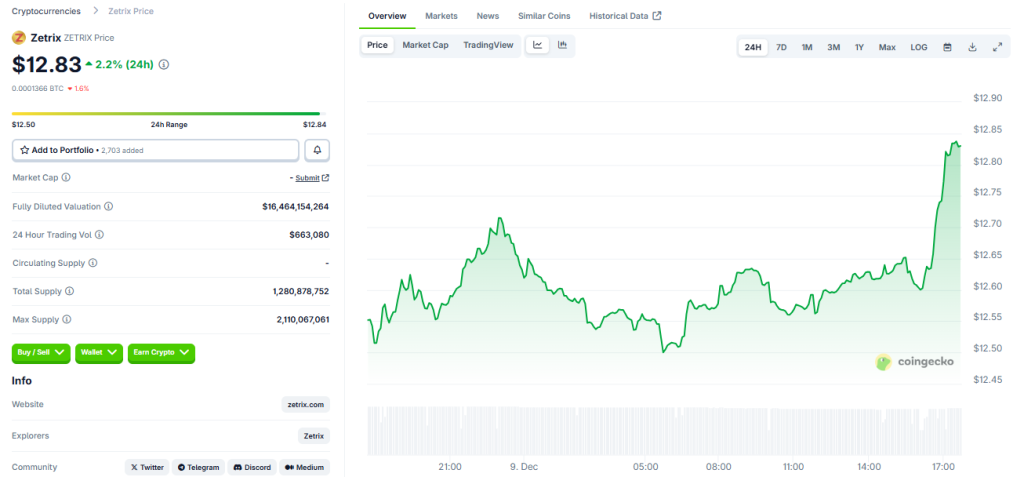
Source: CoinGecko

The launch comes at a time when Zetrix trades around $12.60, well below its peak above $20 recorded roughly a year earlier, according to CoinGecko data.

Malaysia Ramps Up Crypto Treasuries Even as Global Inflows Slow

The timing also places Johor’s initiative inside a broader regional shift. In recent months, Malaysia has seen a series of digital-asset treasury announcements.

On November 12, VCI Global said it would acquire $100 million worth of OOB tokens in a deal that will make Tether the company’s largest shareholder.

🛒 VCI Global has announced plans to acquire $100 million worth of OOB tokens, the native asset of Tether-backed crypto payments company Oobit.#Malaysia #Cryptohttps://t.co/OLLT57dQ9T

— Cryptonews.com (@cryptonews) November 12, 2025

VCI Global plans to fold the token into its AI and fintech platforms and establish its own digital treasury division.

The firm had already purchased $50 million worth of tokens through a restricted share issuance and intends to buy another $50 million on the secondary market after Oobit completes its migration from Ethereum to Solana.

These developments are unfolding as Malaysia’s regulators accelerate reforms to support a more active digital-asset ecosystem.

🔍 @SecComMalaysia proposes regulatory enhancements to the digital asset exchange framework by accelerating token listings. #DigitalAssets #Malaysiahttps://t.co/EV3L8ir6m1

— Cryptonews.com (@cryptonews) July 1, 2025

The Securities Commission has proposed an overhaul of exchange rules after trading volumes more than doubled in 2024 to nearly 14 billion ringgit.

The new framework would allow certain tokens to be listed without prior approval, provided they meet strict criteria, while requiring operators to adopt tighter governance and risk controls.

Source: DefiLlama

But the broader digital-asset treasury sector is showing signs of fatigue. Data from DefiLlama shows corporate crypto treasuries recorded their slowest month of the year in November, with inflows dropping to $1.32 billion, down sharply from September’s peak.

Galaxy Research described the market as entering a “Darwinian phase,” with leverage unraveling and several treasury-backed stocks trading at deep discounts.

Even major players like Strategy, despite adding nearly $1 billion in Bitcoin last week, have seen their equity fall more than 35% over the past month.

The post Malaysia’s Crown Prince Launches $121M Crypto Treasury – Despite Bubble Fears appeared first on Cryptonews.

Bitcoin Price Prediction: BlackRock Doubles Down on Crypto with New ETF Filing – Is a Full-Scale Wall Street Invasion About to Begin?

The world’s largest asset manager, BlackRock, has submitted an S-1 application to launch a staked Ethereum ETF, and analysts believe this Wall Street expansion could permanently alter the Bitcoin price prediction landscape.

BlackRock’s new SEC filing proposes a staking-enabled Ethereum trust that differs from its existing iShares Ethereum Trust (ETHA).

While institutional interest in crypto continues to grow, all eyes are now on where BTC is heading next.

BlackRock Shifts Toward Yield-Bearing Crypto Products

While ETHA tracks spot price movements, the proposed fund would capture both price appreciation and staking yields generated from the trust’s ETH holdings.

The official prospectus filing for ishares Staked Ethereum ETF, their fourth crypto filing. Spot btc, eth, btc income and now this. pic.twitter.com/M6vRxiGm78

— Eric Balchunas (@EricBalchunas) December 8, 2025

This filing represents a significant evolution in institutional crypto strategy.

Investors are increasingly demanding exposure beyond simple price tracking, seeking tokenized financial instruments that generate returns.

If regulators approve the application, it could establish important precedents for how staking rewards are classified.

BlackRock’s dominance in crypto ETFs is undeniable.

Its iShares Bitcoin Trust (IBIT) has become the largest crypto ETF globally and the most successful ETF launch in history, commanding approximately $70 billion in assets.

BlackRock CEO Larry Fink recently revealed that multiple sovereign wealth funds are quietly accumulating BTC “incrementally” despite the recent 30%+ correction.

Bitcoin Price Prediction: BTC Holds $90K as Bulls Eye Return to All-Time Highs

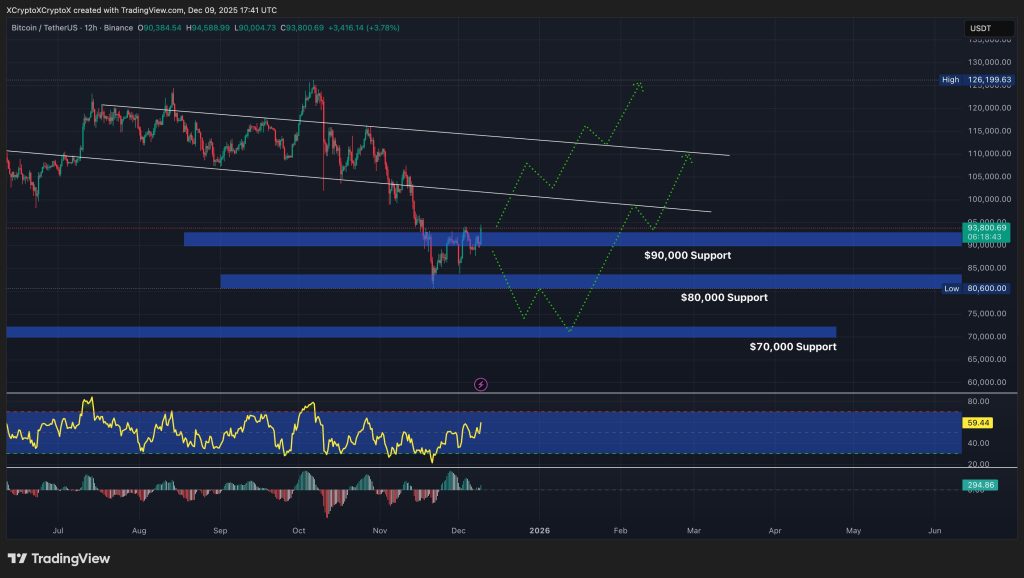
Bitcoin has bounced strongly from the $90,000 zone and is now pushing into key resistance inside a long-term descending channel.

The latest move marks a potential shift in momentum, especially with price reclaiming the $93,000 level and targeting a breakout from this downward structure.

Source: TradingView

Buyers are currently defending the $90,000 support with confidence, and if BTC holds this zone, the chart shows two possible bullish scenarios.

In the short term, Bitcoin could sweep down to retest $80,000 or even $70,000 liquidity before making a sharp reversal to the upside.

Alternatively, a clean breakout above the channel could send BTC surging directly toward $112,000, with a longer-term path toward $126,000 if momentum holds.

RSI continues to trend upward, showing early strength, and MACD histogram bars have flipped green, suggesting short-term bullish pressure.

As the week begins, price action favors the bulls, but traders will want to watch for a strong daily close above $94,500 to confirm upside continuation.

Maxi Doge Presale Builds Momentum as Market Eyes Next Breakout

With Bitcoin on the verge of a breakout, investor attention is quickly shifting toward early-stage opportunities with even bigger potential.

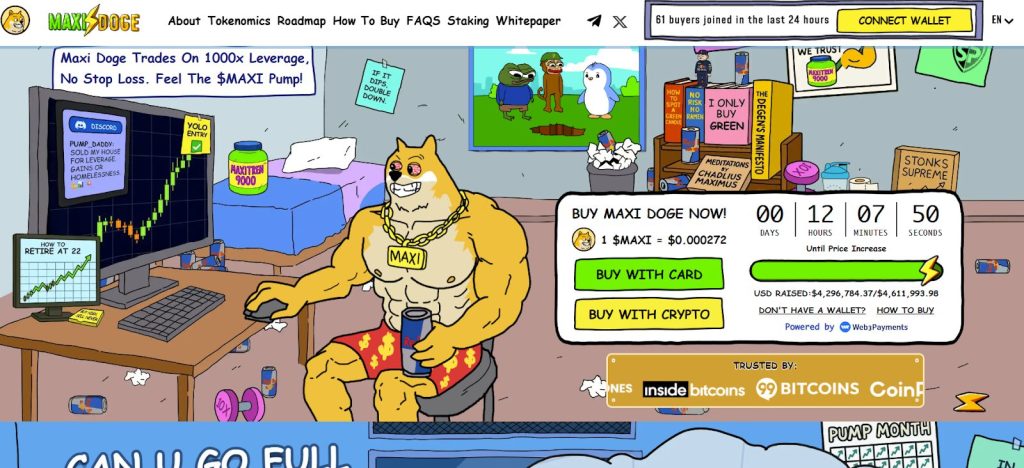
Maxi Doge ($MAXI) has emerged as a top contender.

Built around the high-energy ethos of gym culture and trader discipline, $MAXI is more than just a meme coin.

MAXI is creating a hub where early adopters can share trading setups, alpha leaks, and early opportunities in a fast-moving market.

Bitcoin Price Prediction - Maxi doge banner

Tapping into the same speculative momentum that drove Dogecoin’s historic 1,000x rally, the Maxi Doge presale has already surpassed $4.3 million in funding.

With daily price increases and 72% APY staking rewards for early holders, the window to secure a strong position is quickly narrowing.

To purchase MAXI at the current price, visit the official Maxi Doge presale website and connect an Ethereum-compatible wallet, such as Best Wallet.

You can pay using existing crypto or a bank card in seconds.

Visit the Official Maxi Doge Website Here

The post Bitcoin Price Prediction: BlackRock Doubles Down on Crypto with New ETF Filing – Is a Full-Scale Wall Street Invasion About to Begin? appeared first on Cryptonews.

Crypto Traders Turn Cautious, Favor Bitcoin Over Risky Altcoin Bets

Bitcoin has rebounded to around $92,000 after last week’s $2 billion liquidation event, but traders are adopting cautious positioning amid high volatility and looming central bank decisions.

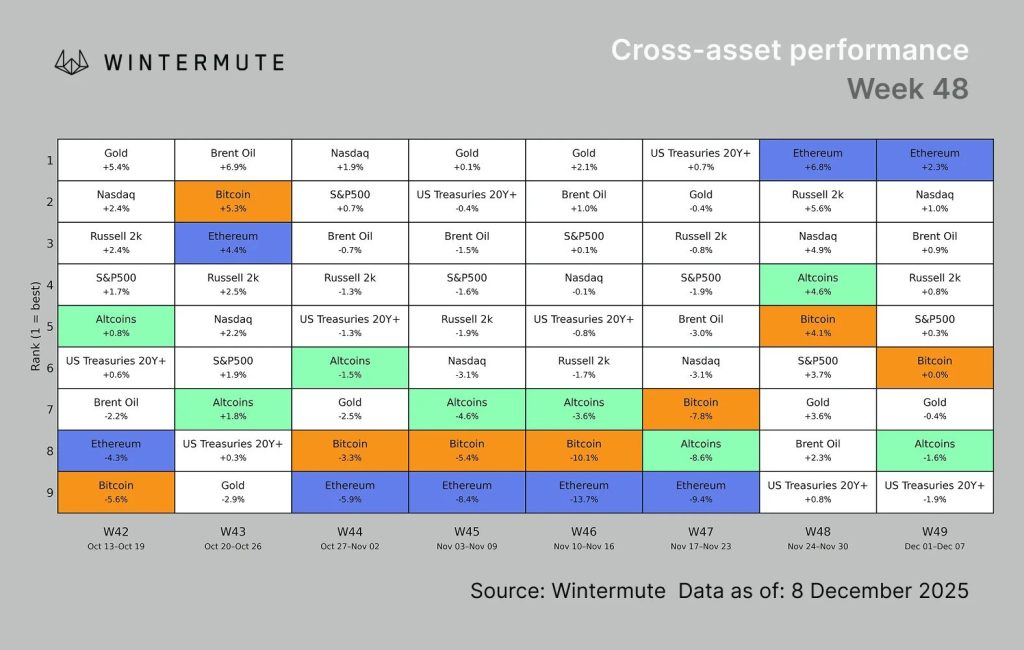
According to market maker Wintermute, market activity has narrowed sharply into Bitcoin and Ethereum, with investors favoring delta-neutral and carry strategies over directional altcoin exposure while awaiting clarity from the Federal Reserve and macro indicators.

The consolidation follows two months of macro uncertainty that triggered strong market turbulence. Total crypto market capitalization has recovered to approximately $3.25 trillion.

Yet, compressed basis rates and subdued funding levels indicate limited appetite for leveraged positions ahead of this week’s Fed decision and next week’s Bank of Japan rate announcement.

Bitcoin Over Altcoin - Wintermute Cross-asset performance
Source: Wintermute

Market Absorbs Shock Without Follow-Through Selling

Friday’s sharp drawdown was a major blow to Bitcoin’s recovery, with cascading liquidations erasing roughly $4,000 in just over an hour.

The liquidation event eliminated approximately $2 billion in leveraged positions, briefly pushing Bitcoin below $88,000 before buyers stepped in at lower levels.

Despite the violent intraday move, the market absorbed the shock without triggering sustained selling pressure.

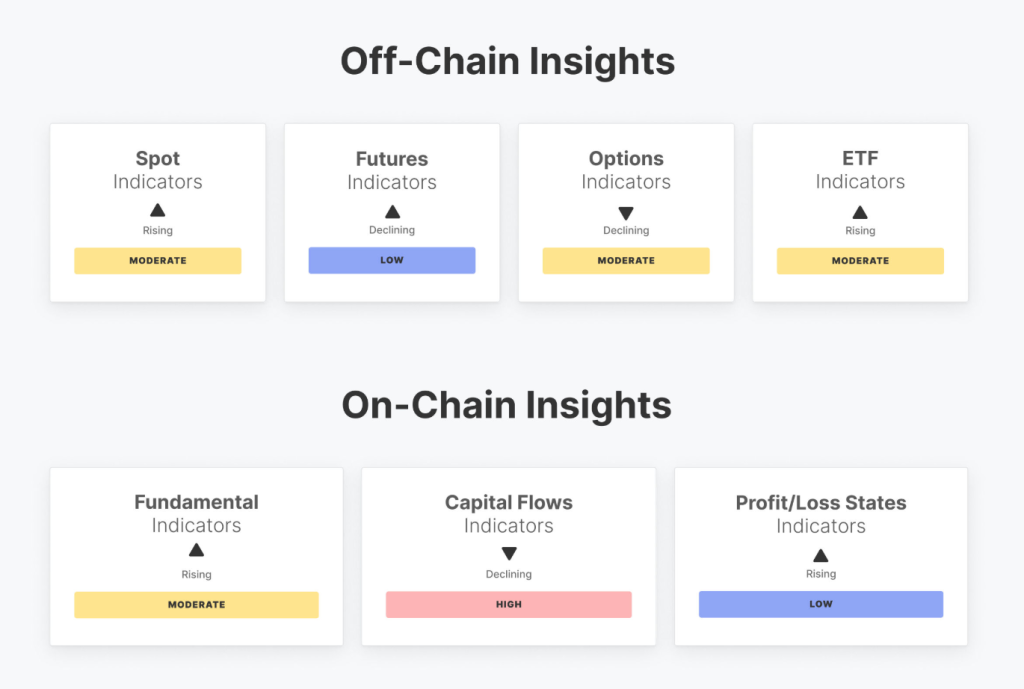
Glassnode data shows Bitcoin’s 14-day RSI climbing from 38.6 to 58.2, while spot volume increased 13.2% to $11.1 billion.

This suggests buyers remained active at the lows even as broader conviction remains uneven across on-chain, derivatives, and ETF metrics.

Bitcoin Over Altcoin - Glassnode off-chain and on-chain insights
Source: Glassnode Report

Year-end implied volatility remains elevated, with traders positioning for either $85,000 or $100,000 by December 26.

Options data reveals heightened caution, with the 25-delta skew reaching 12.88% and volatility spread turning sharply negative at -14.6%, indicating strong demand for downside protection despite the recent bounce.

Institutional Flows Turn Negative Amid Growing Caution

ETF flows have emerged as a major headwind, flipping from a $134.2 million inflow to a $707.3 million outflow.

The reversal indicates profit-taking or weakening institutional interest following Bitcoin’s recent volatility, which is adding pressure to near-term price action.

While ETF trade volume rose 21.33% to $22.6 billion and ETF MVRV increased to 1.67, the substantial outflows suggest some investors are taking advantage of elevated prices to reduce exposure.

Speaking with Cryptonews, Arthur Azizov, founder and investor at B2 Ventures, noted the impact of persistent withdrawals.

More than $2.7 billion has left BTC products over the past five weeks, and another $194 million left just in a single day,” he said.

When such a row of withdrawals persists, the whole market becomes quieter and gets less support.

However, MicroStrategy continues its aggressive accumulation strategy, recently purchasing 10,624 BTC for approximately $962.7 million at an average price of $90,615 per bitcoin.

Strategy has acquired 10,624 BTC for ~$962.7 million at ~$90,615 per bitcoin and has achieved BTC Yield of 24.7% YTD 2025. As of 12/7/2025, we hodl 660,624 $BTC acquired for ~$49.35 billion at ~$74,696 per bitcoin. $MSTR $STRC $STRK $STRF $STRD $STRE https://t.co/oyLwSuW7nW

— Michael Saylor (@saylor) December 8, 2025

The company now holds 660,624 BTC acquired for roughly $49.35 billion at an average cost of $74,696, with 2025 additions totaling $21.48 billion, just $500 million short of its entire 2024 accumulation.

Traders Prioritize Yield Capture Over Directional Bets

Futures open interest has declined to $30.6 billion, while perpetual funding rates have turned more supportive, with long-side payments rising to $522,700.

However, the compressed CME basis has driven growing interest in delta-neutral strategies in lower-cap assets, where carry opportunities remain attractive, confirming limited appetite for directional altcoin risk.

On-chain metrics show modest stabilization, with active addresses rising slightly to 693,035 and entity-adjusted transfer volume increasing 17.1% to $8.9 billion.

However, Realised Cap Change fell to just 0.7%, well below its low band, indicating softer capital inflows, while the STH-to-LTH ratio climbed to 18.5%, indicating continued dominance by short-term holders.

While speaking with Cryptonews, Ignacio Aguirre, CMO at Bitget, also warned of additional pressure from international monetary policy.

A stronger yen raises the risk of unwinding yen carry trades, which is a move that can temporarily weigh on crypto valuations as leveraged positions reset across global markets,” he said.

Azizov emphasized key resistance levels ahead. “Only a strong move above $100,000 could flip the script, restore confidence, and open the way toward $120,000+ level,” he said.

If that fails, a deeper pullback to the broad $82,000–$88,000 zone may be needed.

The post Crypto Traders Turn Cautious, Favor Bitcoin Over Risky Altcoin Bets appeared first on Cryptonews.

Crypto Rally Stalls Near $94K Bitcoin as Bond Turmoil Spurs Risk-Off Ahead of Fed

The crypto market entered December with strong upward momentum, with Bitcoin climbing towards $94,000 and Ethereum nearing $3,250 by late last week, according to a research note from Laser Digital.

The rally was fuelled by two key catalysts: Strategy’s purchase of roughly $960 million worth of BTC and anticipation around the Fusaka upgrade scheduled for December 3.

However, as those factors passed, bullish sentiment evaporated. Prices quickly reversed during Friday’s U.S. trading session, leading to aggressive selling. A small rebound emerged over the weekend, but sentiment failed to sustain into Monday—a pattern that Laser Digital notes has been “typical behavior of the crypto market for the past few months.”

Bond Yields Hit Multi-Decade Highs as Policy Expectations Shift

Macro conditions added pressure across risk assets. Bond markets sold off across major economies, driven initially by Japan. The JGB 10-year yield breached 1.90%, a record level over the past 30 years.

Laser Digital says that the move followed growing odds of a December rate hike by the Bank of Japan, coupled with concerns around increased issuance stemming from a larger-than-expected FY25 supplementary budget and the expected FY26 budget.

Meanwhile, in the U.S., the 10-year Treasury climbed above 4.10%, with markets positioning ahead of the Federal Reserve’s policy meeting. Expectations for a “hawkish cut” this week—a reduction accompanied by firm forward guidance—weighed on rate sentiment and risk appetite broadly.

Market Split Between Equities and Crypto

Gracy Chen, CEO at the universal exchange Bitget, said investors are behaving as if the Fed’s rate decision has already been decided. “According to CME Group’s FedWatch, Fed funds futures bet on almost a 90% chance of a 25 bp cut, which makes sense, especially given inflation cooling and soft macro data. Interestingly, just a couple of weeks ago, the chance was below 40%.”

She notes a divergence in risk sentiment: “The S&P 500 is up almost 17% this year and trades only about 4% below its October peak. Yet U.S. equity funds had $3.5 billion in outflows last week, while global funds added $7.9 billion… Crypto, sadly, is much weaker… A rate cut could make BTC rise back toward $94,000–$96,000. By contrast, a cautious move could send it into the $80K range again.”

Volatility Builds Ahead of Central Bank-Heavy Week

Laser Digital notes that options markets are pricing extra volatility ahead of the FOMC decision. The trading desk expects “price action to be choppy this week and next,” citing a dense calendar that includes the Fed on December 10, the BOJ on December 19, and two major labor reports in between.

Market focus is centred on the Fed’s updated Summary of Economic Projections (SEP) dot plot and the potential revision to the terminal rate path, both of which could reshape positioning into year-end.

Volume Cools, but Event Risk Premium Remains

Crypto volatility has eased back from recent peaks, though markets continue to price event risk meaningfully. BTC volumes are trading around the 45-vol handle and ETH around 70-vol, with 11th December event volatility marked at 56v for BTC and 75v for ETH.

Laser Digital notes that spot-vol correlation remains negative—a trend that has continued to materialize. With macro forces dominating and catalysts fading, markets appear braced for turbulence as central banks take centre stage.

https://t.co/nW0weLdqlv

— Laser Digital (@LaserDigital_) December 9, 2025

The post Crypto Rally Stalls Near $94K Bitcoin as Bond Turmoil Spurs Risk-Off Ahead of Fed appeared first on Cryptonews.

Bitcoin Stalls Near $90K as Select Altcoins Rally, Leaving ‘Altcoin Season’ on Hold

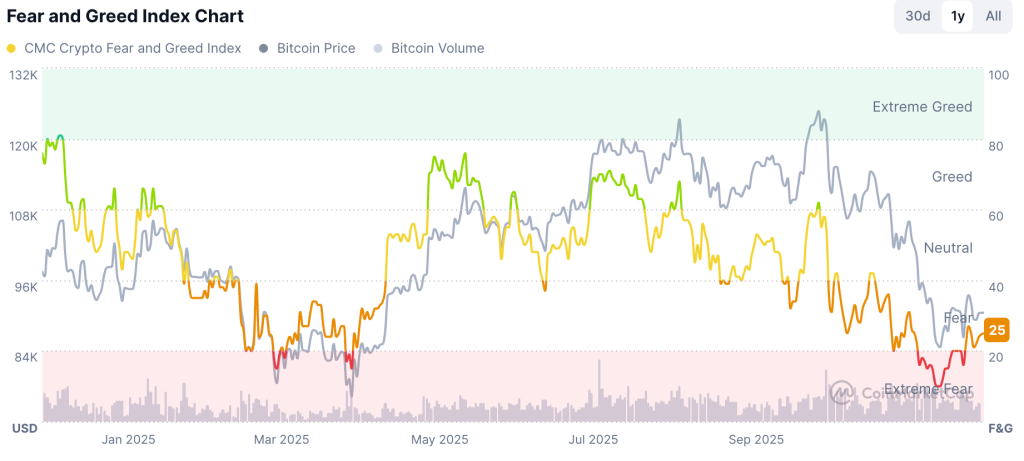
Fear continues to shape the market even though the sharp panic of late November has eased. The Fear and Greed Index now prints 25, placing sentiment inside the fear band without dipping back into extreme readings.

Bitcoin is trading a little above $90,000 with a small recovery from earlier lows, and the market continues to behave as though it is still sorting through recent losses rather than preparing for a broad turn in risk appetite.

Within that restrained environment, only a few altcoins are showing clear strength. Zcash, MemeCore, and Cardano are moving higher while the majority of large caps remain muted. Their performance offers a narrow window into how traders position themselves when the wider market hesitates but does not fully retreat.

Fear and Greed Index (Source: CoinMarketCap)

Zcash Shows Its First Meaningful Bounce After Heavy Losses

Zcash (ZEC) is now trading around $426, up by about 10% in 24 hours, and its rise stands out because the token fell sharply from a peak near $700 in November before losing close to 30% across the month.

Trading data today shows firmer depth and a pickup in spot volume across several venues, which indicates that market participants are revisiting liquid privacy names now that the steepest part of the decline has passed.

The rebound still leaves ZEC far from last month’s high, yet the current structure looks steadier than earlier attempts at recovery. Activity is spread across several markets rather than concentrated in narrow windows, which suggests a more stable footing for the token as sentiment steadies around the mid-twenty fear readings.

MemeCore Advances On Continued Community Activity

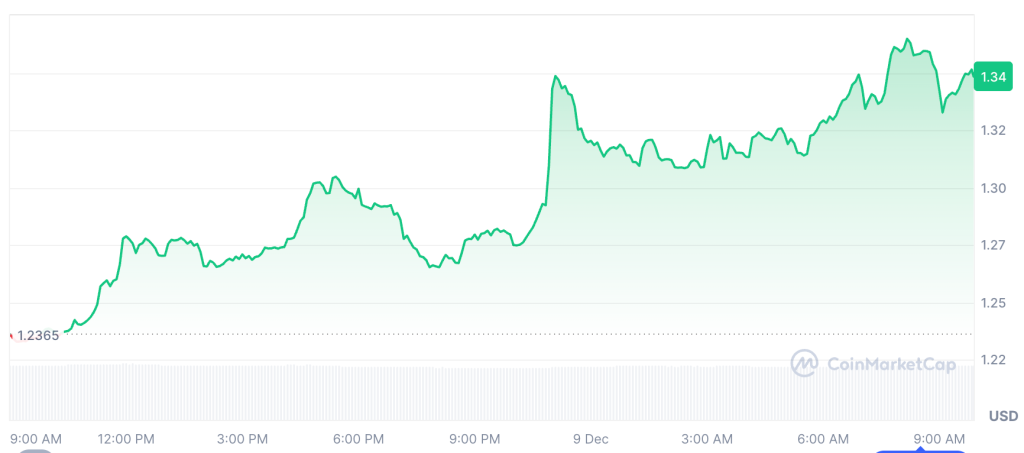
MemeCore (M) is trading near $1.34, up by about 9% in 24 hours. The move follows a period where engagement inside its community continued even during last week’s extreme fear conditions.

MemeCore Price (Source: CoinMarketCap)

Trading screens show stable liquidity on its active pairs, and on-chain usage linked to staking and social features remains visible enough to support small bursts of momentum whenever market pressure slows.

The rise today appears tied to that ongoing participation instead of a single driver. MemeCore has tended to perform best when traders look for tokens supported by active user bases rather than one-off events.

Cardano Edges Higher With Large Cap Rotation

Cardano (ADA) is trading near $0.45, up by about 3% in 24 hours. The growth is modest but aligns with behavior seen across other large caps in recent sessions, where liquidity remains firm and flows turn balanced once Bitcoin stabilizes.

Help shape the next generation of DeFi and RWA startups building on Cardano.

We are seeking Service Providers to deliver sessions and workshops for the Cardano Accelerator Program on startup relevant disciplines.

Interested? Apply by 4 January: https://t.co/5mkP8cv1TJ

— Cardano Foundation (@Cardano_CF) December 8, 2025

Trading volumes today show measured participation rather than strong accumulation, yet ADA continues to benefit from being one of the more established networks during risk-averse periods.

Cardano’s move does not alter its longer trend, but it illustrates how stable large caps often move first when markets pause after declines.

Altcoin Season Still Out Of Reach Despite Small Pockets Of Strength

The overall picture still leans toward caution. A fear reading of 25, Bitcoin holding just above $90,000, and limited rotation across major assets all point to a market that has not regained the breadth usually associated with altcoin season.

The advances in Zcash, MemeCore, and Cardano show that selective interest persists, but the gains remain narrowly concentrated and depend heavily on liquidity and existing user activity rather than broad enthusiasm.

For now, altcoin season sits at a distance, with only small pockets of momentum taking shape while sentiment remains anchored in the lower bands of the fear index.

The post Bitcoin Stalls Near $90K as Select Altcoins Rally, Leaving ‘Altcoin Season’ on Hold appeared first on Cryptonews.

OKX and Deltix Boost US Institutional Trading

Major crypto exchange OKX has joined hands with Deltix to expand institutional trading capabilities for clients across the U.S. Per the announcement, the companies in this country will be able to access, for the first time, regulated digital-asset liquidity via the same infrastructure they use for equities and FX.

Deltix is a division of EPAM Systems, which provides digital development, software engineering, and product design services among others.

Moreover, this particular division offers institutional-grade trading and quantitative research platforms to funds, brokers, and trading firms across markets.

According to Ilya Gorelik, CEO of Deltix, the integration provides clients with a unified trading experience across traditional and digital markets.

Also, per the OKX press release, the partnership connects the worlds of traditional and digital asset markets. The former brings “mature infrastructure, sophisticated risk management, and regulatory guardrails,” while the latter boasts “innovation, transparency, and opportunity.”

Moreover, “several” quant funds and algorithmic trading firms already use the integration to extend digital-asset exposure within their quantitative and execution frameworks, the companies note.

One of them is Windy Financial. Its Head of Digital Strategies, Brian Petersen, commented that the partnership provides “a seamless, institutional-grade solution that lets us execute digital strategies […] without venturing into offshore or unregulated markets. It’s a powerful step forward for quantitative and institutional firms seeking high-performance, compliant market access.”

Digital and Traditional Markets on the Same Infrastructure

Institutions increasingly look to participate in digital-asset markets, the partners say. They expect the same level of governance, reliability, and performance as in TradFi.

“This partnership brings digital assets directly into the same infrastructure that professional traders and funds already rely on every day,” says Roshan Robert, OKX US CEO. It gives U.S. institutional clients regulated, onshore access to digital-asset markets.

Download OKX in the US. Make them proud. pic.twitter.com/17oWCOR8AC

— OKX (@okx) December 9, 2025

At the same time, these institutions gain access to the liquidity and execution quality through OKX’s global shared order book.

U.S. institutional clients can now access OKX’s spot markets available via Deltix. They can integrate digital asset trading into existing quant and execution workflows.

Moreover, they can execute against OKX’s global shared order book. This way, they gain liquidity and performance necessary for institutional-grade trading, OKX says. They can test, trade, and deploy quantitative strategies for digital assets alongside their TradFi workflows.

Then, the clients can leverage the exchange’s APIs for execution and market-data connectivity.

Additionally, clients route activity through OKX’s licensed U.S. entity, which provides them with full regulatory compliance.

Finally, they can manage risk, analytics, and reporting within their native infrastructure.

“The partnership fills a critical gap in end-to-end infrastructure for quantitative, fund, and proprietary-trading firms seeking efficient digital-asset execution, research, and analytics,” the announcement concludes.

The post OKX and Deltix Boost US Institutional Trading appeared first on Cryptonews.

Hong Kong Targets Crypto Tax Evasion with 2028 Data Sharing Plan

Hong Kong launched a public consultation on implementing the OECD’s Crypto-Asset Reporting Framework (CARF) and amended Common Reporting Standard (CRS), aiming to begin automatic exchange of crypto tax information with partner jurisdictions by 2028.

The government plans to complete legislative amendments in 2026, strengthening the city’s commitment to international tax cooperation while maintaining its reputation as a global financial hub amid evolving digital asset regulations.

Financial Services Secretary Christopher Hui announced “Hong Kong will make amendments to the Inland Revenue Ordinance (Cap. 112) (the Ordinance) for implementing CARF and the newly amended CRS” and demonstrated a commitment to combating cross-border tax evasion.

The automatic exchange will operate on a reciprocal basis with partners meeting data confidentiality and security standards, with the newly amended CRS implementation scheduled for 2029.

Hong Kong Crypto Tax and Data Sharing - Image of Christopher Hui
Secretary for Financial Services and the Treasury Christopher Hui. | Source: The Standard

Framework Responds to Rapid Digital Asset Growth

The OECD published CARF in 2023 following the rapid expansion of the digital asset market in recent years, providing automatic exchange of crypto transaction tax information similar to Hong Kong’s existing CRS framework, operational since 2018.

The new framework incorporated digital financial products and enhanced reporting requirements, addressing gaps in traditional financial account information exchange.

Hong Kong has been exchanging financial account information automatically with partner jurisdictions annually since 2018 under the CRS, enabling tax authorities to use the information for assessments and to detect tax evasion.

The CARF extension builds upon this established infrastructure, applying similar transparency standards to crypto assets that process billions in trading volume across the city’s licensed exchanges.

The government proposes mandatory registration for financial institutions to enhance identification, alongside increased penalties and enhanced enforcement mechanisms.

These measures respond to the OECD’s second-round peer review of Hong Kong’s CRS administrative framework effectiveness, which began in 2024 and examines the city’s commitment to global tax transparency standards.

Balancing Innovation and Compliance Pressures

The consultation arrives as Hong Kong navigates competing pressures between fostering digital asset innovation and satisfying international regulatory standards.

The city has pursued aggressive fintech expansion through its new “Fintech 2030” strategy launched by the Hong Kong Monetary Authority, focusing on data, artificial intelligence, resilience, and tokenization under the DART framework.

Hong Kong has courted crypto activity through licensing regimes and spot crypto exchange-traded funds, seeking regulated venues for demand.

Securities and Futures Commission Chief Executive Julia Leung recently announced licensed crypto exchanges will soon connect with global order books, ending the city’s isolated trading model and enabling local platforms to tap broader liquidity.

✅ Hong Kong will allow licensed crypto exchanges to connect with global order books, ending its current isolated trading model.#HongKong #Cryptohttps://t.co/f8Lj9NKxoR

— Cryptonews.com (@cryptonews) November 3, 2025

Despite regulatory openness, authorities have drawn bright lines between market infrastructure and listed issuers relying on speculative token holdings.

The stock exchange questioned at least five companies seeking to pivot to crypto treasury models, while the SFC warned retail investors about risks tied to digital asset treasury strategies after observing substantial premiums above asset holdings.

Amidst all these, HashKey Holdings advanced toward becoming Hong Kong’s first listed crypto exchange, clearing the stock exchange’s listing hearing and preparing to raise at least $200 million through an initial public offering scheduled before year-end.

The company accounts for more than 75% of Hong Kong’s onshore digital asset trading volume and has recorded HK$1.3 trillion in cumulative spot-market transactions.

Mainland Tensions Shape Regional Strategy

The consultation also unfolds against mainland China’s renewed crypto crackdown, with the People’s Bank of China reasserting strict prohibitions on virtual asset trading in late November following signs of renewed speculation.

Beijing specifically flagged stablecoins as posing money laundering and fraud risks, convening a high-level meeting with 13 government agencies to coordinate enforcement.

🇨🇳 China reinforces crypto ban with renewed enforcement targeting stablecoins as Hong Kong stocks with digital asset exposure drop sharply following central bank warning.#China #Cryptohttps://t.co/XDtoyarpNo

— Cryptonews.com (@cryptonews) December 1, 2025

Hong Kong-listed crypto companies saw sharp losses following Beijing’s announcement, with Yunfeng Financial Group dropping over 10% and OSL Group losing more than 5%.

The mainland stance has complicated Hong Kong’s ambitions, particularly after Chinese regulators instructed major tech firms, including Ant Group and JD.com, to pause stablecoin issuance plans.

For now, regarding the consultation paper, public feedback is welcome through February 6, 2026, with submissions accepted by post or email to the Financial Services and Treasury Bureau.

The post Hong Kong Targets Crypto Tax Evasion with 2028 Data Sharing Plan appeared first on Cryptonews.

ASIC Unveils Major Stablecoin Relief and Omnibus Rights — But There’s a Catch

Australia’s securities regulator has introduced a sweeping set of exemptions aimed at easing the path for digital asset businesses while making clear that the reprieve is temporary and tied to a broader overhaul of the country’s crypto framework.

The Australian Securities and Investments Commission (ASIC) on Tuesday finalized class relief for intermediaries handling the secondary distribution of certain stablecoins and wrapped tokens.

The decision allows exchanges and other service providers to operate without holding separate Australian financial services, market, or clearing and settlement licenses when dealing with eligible products.

ASIC said the move is intended to support innovation as the government works on a permanent regime for digital asset platforms and payment systems.

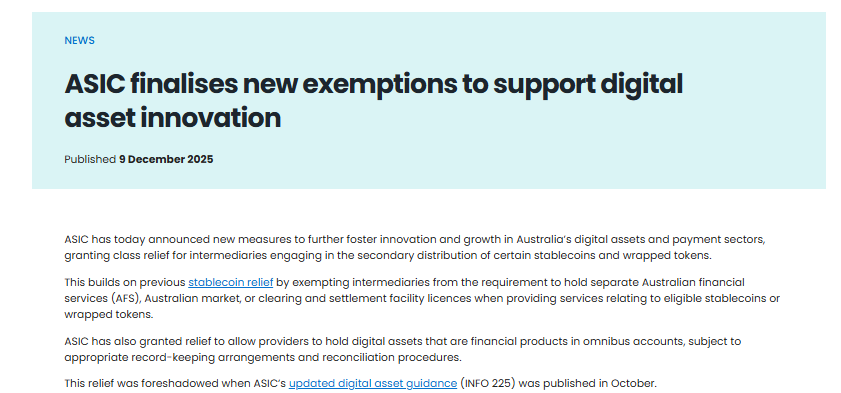
Source: ASIC

ASIC Confirms Omnibus Custody Relief After Industry Feedback

The relief also extends to custody, as providers will be permitted to hold tokenized financial products in omnibus accounts, a structure commonly used in traditional markets but long restricted in crypto.

ASIC said the exemption will only apply if firms maintain proper records and reconciliation procedures. The regulator initially signaled this shift in October when it published the latest update to its key digital-asset guidance, INFO 225.

Tuesday’s announcement marks the end point of a consultation that began on 29 October, when ASIC released Simple Consultation 32 outlining proposed exemptions for stablecoins and wrapped assets.

🇦🇺 Australia requires stablecoin and digital asset providers to obtain financial services licenses under new ASIC guidance effective June 2026.#Australia #Stablecoinhttps://t.co/OECNhNHLUz

— Cryptonews.com (@cryptonews) October 29, 2025

The regulator received five non-confidential submissions, with industry groups largely supporting the plan but requesting clearer definitions and wider eligibility.

ASIC responded by expanding the scope to include tokens issued by entities that have applied for licenses.

The changes sit on top of a broader framework that ASIC has been assembling throughout the year.

The regulator’s updated INFO 225 guidance, published in late October, confirmed its long-held view that many stablecoins, wrapped tokens, tokenized securities, and even digital asset wallets fall under existing financial product rules.

Stablecoin Issuers Get Temporary Breather Under ASIC’s Transition Plan

That interpretation requires most service providers to hold AFS licenses and comply with investor-protection laws already in force.

To ease the transition, ASIC has adopted a sector-wide no-action stance until June 30, 2026.

Companies will have time to review the new guidance, lodge license applications, or adjust their operations.

🇦🇺 Australia's ASIC grants stablecoin intermediary relief from licensing requirements until 2028, with Catena Digital as the first qualified issuer.#Australia #Stablecoinhttps://t.co/vi2mBPwPbb

— Cryptonews.com (@cryptonews) September 18, 2025

The temporary relief is expected to remain in place until mid-2028, by which time the government aims to replace it with legislation covering tokenized payments and custody structures.

ASIC has indicated it may add more issuers after several firms said existing licensing hurdles threatened the commercial viability of launching Australian-regulated stablecoins.

Intermediaries must still provide retail investors with Product Disclosure Statements, a condition ASIC argues balances flexibility with consumer safeguards.

Regulators Tighten Grip as Australia Races to Catch Up in Digital Assets

The exemptions land at a moment when policymakers say Australia risks slipping behind global competitors.

ASIC Chair Joe Longo warned last month that tokenization is reshaping capital markets and urged the country to modernize quickly or face what he called a “missed opportunity.”

Government proposals released in September would require exchanges to obtain AFS licenses and impose penalties of up to 10% of annual turnover for rule breaches. Smaller platforms meeting low-threshold criteria would be exempt.

💸 Australia is set to slap crypto platforms with fines as steep as 10% of turnover under tough new draft rules, the Treasury said Thursday.#Australia #CryptoRegulation https://t.co/eVdrLlJgnd

— Cryptonews.com (@cryptonews) September 25, 2025

The push for tighter supervision has not stopped enforcement actions. In October, ASIC obtained a temporary travel ban against Blockchain Global director Ryan Xu as it investigates the collapse of the ACX Exchange, which left creditors owed more than A$58 million.

The case remains before the Federal Court.

Australia’s digital-asset sector has grown rapidly, with adoption climbing to 31% in 2025. Self-managed superannuation funds have increased their crypto exposure sevenfold since 2021, reaching A$1.7 billion.

🇦🇺 Australia's crypto adoption hits 31% outpacing other developed nations as stablecoins power $46T in transactions and crypto market cap crosses $4T globally.#Australia #Crypto #Adoptionhttps://t.co/ujNdEiEQDn

— Cryptonews.com (@cryptonews) October 24, 2025

Large exchanges have begun targeting this market, with Coinbase preparing a dedicated service for retirement accounts.

The post ASIC Unveils Major Stablecoin Relief and Omnibus Rights — But There’s a Catch appeared first on Cryptonews.

[LIVE] Bitcoin Price Alert: September and October JOLTS Data Drops Today — Will Job Openings Shift Fed Rate Decision?

The Bureau of Labor Statistics releases both September and October JOLTS job openings data at 10:00 AM ET today, the final major employment report before the Federal Reserve’s rate decision tomorrow.

Bitcoin is trading around $92,000 as markets brace for the delayed data; both reports were postponed due to the government shutdown and are dropping simultaneously just hours before the Fed enters its December 9-10 FOMC meeting.

The last JOLTS report covered August and showed job openings holding steady, but traders are watching closely for any signs of a cooling labor market that could justify the Fed’s anticipated 25 basis-point rate cut.

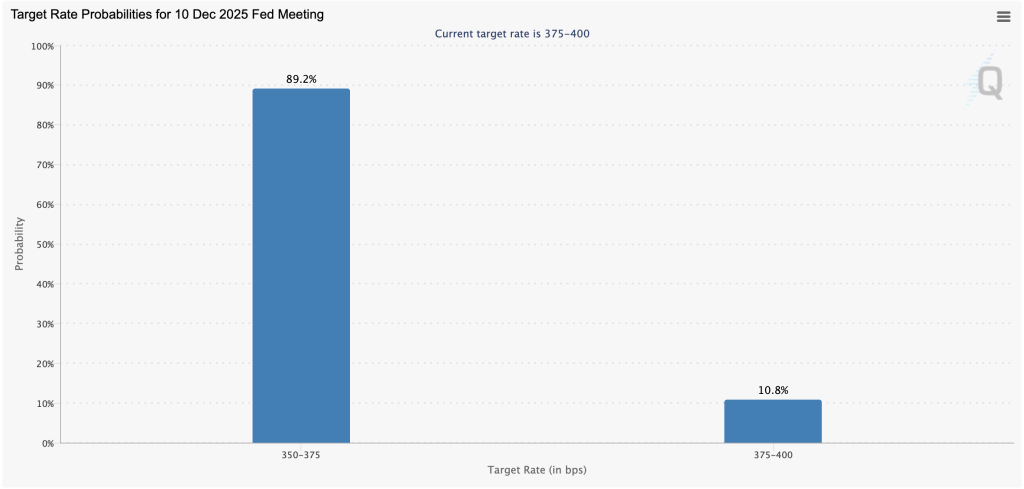
Current market odds sit at 89% for a December cut, but today’s double data dump could shift those probabilities if openings show unexpected weakness or strength.

September and October JOLTS Data - Fed Rate Cut Odds
Source: CME FedWatch Tool

Job openings are a critical leading indicator for the Fed because they signal labor demand before it shows up in hiring or unemployment data.

After last Thursday’s shockingly strong jobless claims print (191K vs 219K expected—lowest since 2022), Fed Chair Powell faces conflicting signals. Robust initial claims suggest no labor market distress, but if JOLTS openings have declined sharply over September and October, it would support the case for preemptive easing.

The Fed has already ended quantitative tightening as of December 1, and September PCE data showed core inflation improving to 2.8% from 2.9%, creating a dovish backdrop despite recent employment strength.

Markets are essentially getting two months of data in one release, which could produce volatility if the trend shows clear acceleration or deceleration.

Bitcoin needs to hold support at $90,000-$92,000 heading into tomorrow’s 2:00 PM ET Fed decision and Powell’s 2:30 PM press conference. Resistance remains at $90,000, and the descending trendline that’s capped rallies since mid-November.

If JOLTS data shows job openings collapsing, it strengthens the rate cut case and could provide the catalyst Bitcoin needs to break above $98K.

Conversely, if openings remain elevated, it reinforces the “no landing” scenario where the economy stays strong, and the Fed pauses easing, potentially sending Bitcoin back toward the $88,000-$90,000 support zone that marked November’s low.

Double JOLTS Report: Final Employment Signal Before Fed Decision

The post [LIVE] Bitcoin Price Alert: September and October JOLTS Data Drops Today — Will Job Openings Shift Fed Rate Decision? appeared first on Cryptonews.

Fed Cut Already Priced In, Powell’s Tone and 2026 Shift Bullish for Crypto: Nansen

By: Amin Ayan

Crypto analysts are watching today’s Federal Reserve meeting closely, but according to Nansen’s Principal Research Analyst Aurelie Barthere, the rate cut itself is no longer the main story.

Key Takeaways:

  • Markets have already priced in today’s 25bps rate cut, making Powell’s tone and forward guidance the key drivers for crypto.
  • Nansen’s Aurelie Barthere says the 2026 leadership shift toward Kevin Hassett could be bullish for digital assets.
  • Bitcoin faces major resistance near $91,000, with Barthere expecting it to hover around this level after the FOMC meeting.

In a note shared with Cryptonews.com, Barthere said markets have already priced Fed rate cut in, adding that what matters now is Fed Chair Jerome Powell’s tone and the upcoming leadership transition in early 2026.

Fed to Stick to ‘Wait-and-See’ Approach

Barthere expects the Fed to deliver the widely anticipated 25-basis-point cut, noting that policymakers are likely to stress a data-dependent approach given the two-month lag in labor-market figures.

“The Fed is likely to maintain a wait-and-see stance,” she said, adding that she expects the terminal rate projection to remain near 3.0%, reflecting a divided committee.

Beyond today’s decision, Barthere pointed to the delayed announcement of Kevin Hassett as the next Fed Chair, now expected in early 2026, as a potentially bullish development for crypto markets.

A leadership shift toward a more growth-friendly stance could strengthen expectations for further easing next year.

On the technical front, Barthere said Bitcoin faces a critical test at the $91,000 level, where the 20-day EMA converges with a downtrend dating back to October.

BREAKING: There is now a 94% chance that the Fed will cut interest rates on Wednesday, per Polymarket.

The 3rd rate cut of 2025 is coming. pic.twitter.com/d7a7coKSDY

— The Kobeissi Letter (@KobeissiLetter) December 8, 2025

She expects BTC to trade around this zone after the FOMC meeting, rather than making a decisive breakout.

The Fed meeting arrives at the end of a turbulent year for the US economy, marked by weakening labor conditions, rising layoffs, and renewed inflation pressure tied to President Donald Trump’s tariff policies.

The central bank is also operating with limited fresh data due to the U.S. government shutdown, which delayed November hiring and inflation releases.

Despite mixed signals, economists overwhelmingly expect another quarter-point cut. The CME FedWatch tool places the odds of a 25-bps move at 89.4%, which would mark the third consecutive reduction and push the federal funds rate into the 3.75%–4% range.

Fed Liquidity Boost Could Send Bitcoin “Sharply Higher,” Analysts Say

As reported, Bitcoin’s climb above $92,000 has stirred fresh optimism among market watchers who now believe this week’s Federal Reserve meeting could set off a far bigger rally.

Analysts at the London Crypto Club say a liquidity boost from the Fed on Wednesday may act as a powerful catalyst, potentially driving the world’s largest cryptocurrency “sharply higher.”

In their latest note, David Brickell and Chris Mills argue that the central bank is poised to deliver a “dovish surprise,” forecasting that policymakers will inject liquidity through a creative bond-buying mechanism rather than explicit quantitative easing.

“We’re moving into a continued rate-cutting cycle accompanied by balance sheet expansion as the Fed effectively turns on the money printers to monetise the deficit,” they wrote.

Meanwhile, a key on-chain indicator known as “liveliness” is climbing again, even as Bitcoin’s price action remains subdued.

Analysts say the divergence suggests renewed underlying demand, with dormant coins moving at levels not seen in years, a sign that long-term holders may be re-entering the market.

Last week, Bitfinex said the market is showing “seller exhaustion” following a period of heavy deleveraging and panic-driven exits by short-term holders.

The post Fed Cut Already Priced In, Powell’s Tone and 2026 Shift Bullish for Crypto: Nansen appeared first on Cryptonews.

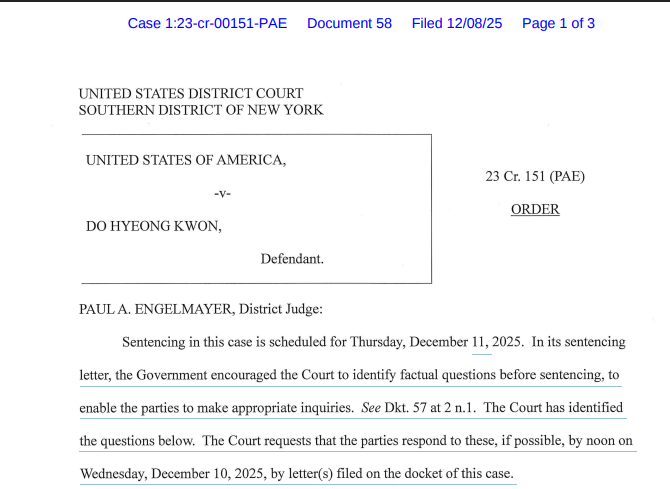
Do Kwon Sentencing: Judge Demands Clarity on Looming 40-Year South Korea Prison Term

US District Judge Paul Engelmayer has asked prosecutors and defense lawyers for detailed clarification on a series of unresolved issues ahead of Terraform Labs co-founder Do Kwon’s sentencing.

This includes the possibility of the crypto entrepreneur facing an additional 40-year prison term in South Korea after serving time in the United States.

The judge issued the order on December 8, laying out multiple questions that he wants answered before the December 11 hearing.

Source: Court Document

The filing shows that the court is weighing how Kwon’s foreign legal exposure, previous detention, and the mechanics of international prisoner transfer programs may affect the punishment imposed in New York.

Court Seeks Clarity on Kwon’s Potential 40-Year Korean Prison Term

The judge’s first set of questions focuses on South Korea’s ongoing criminal case against Kwon.

He asked both parties whether they have any reliable information about the likely outcome of the charges he faces there, whether any agreements have been made with Korean authorities, and what sentencing ranges apply if he is convicted.

South Korean prosecutors previously said they would seek up to 40 years in prison for the same conduct that forms the basis of the US case.

The court also asked whether a Korean sentence could run concurrently or consecutively with a US sentence, a detail that could influence the final terms.

The order also seeks clarification on how to treat the nearly two years Kwon spent in custody in Montenegro. He was arrested in March 2023 while traveling under a false passport and remained detained until extradition.

The judge wants to know whether the Bureau of Prisons will credit any portion of that 21-month period toward his US term and whether the government’s recommendation of a 12-year sentence was based on the assumption that none of that time will count.

Federal prosecutors have already urged the court to impose the full 12 years permitted under Kwon’s plea agreement.

US prosecutors demand 12-year sentence for Do Kwon after Terra's $40B collapse that destabilized crypto markets and aided FTX implosion.#FTX #DoKwon #TerraFormhttps://t.co/LfzwEWH4XG

— Cryptonews.com (@cryptonews) December 6, 2025

Defense Pushes Back as Prosecutors Call TerraUSD Collapse “Colossal”

They described the TerraUSD collapse as “colossal in scope,” citing the broader market chain reaction that contributed to the downfall of major firms, including Sam Bankman-Fried’s FTX.

Kwon pleaded guilty in August to conspiracy and wire fraud, admitting that he made false statements about TerraUSD’s stability mechanisms and concealed Jump Trading’s role in supporting the stablecoin during a 2021 depeg event.

⚖ US agrees to recommend a 12-year prison sentence and a $19m fine for Do Kwon after he has pleaded guilty to wire fraud and conspiracy#DoKwon #TerraUSD https://t.co/ktCCrKzob4

— Cryptonews.com (@cryptonews) August 12, 2025

Kwon’s lawyers have asked for a five-year term instead, arguing that the time he spent in Montenegro was served in “brutal conditions” and should weigh heavily in the court’s decision.

They also point to the likelihood that he will be extradited to South Korea after completing his US sentence, where he faces a much longer potential punishment.

The defense says that imposing the full recommended term would result in an excessively long combined period of imprisonment.

Judge Seeks DOJ Clarification on Victim Compensation and Asset Forfeiture

The judge’s order shows he is taking that possibility seriously. He asked both sides to explain whether supervised release would even matter if Kwon is likely to be removed from the United States.

He also questioned what guarantees the U.S. would have that another country would enforce the rest of Kwon’s sentence if he is transferred overseas.

Prosecutors have already said they will support a transfer request once Kwon serves half of his sentence.

But the judge noted that these transfers usually require detailed recommendations to the Bureau of Prisons before they can move forward.

The filing also points to several administrative problems tied to forfeiture and victim payments.

The judge asked the Justice Department to clarify how its remission process would decide which victims qualify for compensation from the seized assets.

This question is especially important because the losses span multiple countries, and no restitution order was requested in the case.

The post Do Kwon Sentencing: Judge Demands Clarity on Looming 40-Year South Korea Prison Term appeared first on Cryptonews.

Sen. Moreno Warns “No Deal is Better Than a Bad Deal” as Crypto Bill Talks Stall

Talks on the United States’ long-awaited crypto market structure bill have entered another tense stretch, with Sen. Bernie Moreno saying negotiations have become “decently frustrating” as lawmakers struggle to align on the next major step for digital-asset regulation.

Speaking Monday at the Blockchain Association Policy Summit in Washington, D.C., Moreno said he does not want Congress to advance a weak bill simply to show progress, adding that “no deal is better than a bad deal.”

He is scheduled to meet with Democrats on Tuesday to determine whether the two sides can break the recent deadlock.

Progress Slows on Crypto Oversight Bill Despite Earlier Bipartisan Momentum

Earlier this year, Lawmakers to pass a stablecoin law marking a rare moment of bipartisan agreement.

However, the broader market structure bill, intended to decide which federal agency has jurisdiction over different types of crypto assets and how consumer protections should be applied, has been difficult to finalize.

Both the House and Senate have their own versions, and lawmakers will need to resolve these differences before the bill can move toward.

The House passed its version, the Digital Asset Market Clarity Act, in July. The bill gives the Commodity Futures Trading Commission primary authority over digital commodities and preserves the Securities and Exchange Commission’s power over fundraising and token issuances.

🇺🇸 GENIUS Act, Anti-CBDC Act, and CLARITY Act pass crucial procedural vote 215-211 in Congress after Trump's decisive Oval Office intervention rescues stalled crypto agenda.#GeniusAct #Trumphttps://t.co/Lm2tCBbimp

— Cryptonews.com (@cryptonews) July 16, 2025

The Senate Banking Committee, where Moreno sits, has its own draft that introduces the term “ancillary assets” in an effort to define which tokens should not be treated as securities.

That committee must also coordinate with the Senate Agriculture Committee, which released a separate draft last month expanding CFTC authority. Both proposals would still require markup hearings, revisions, and a formal vote before advancing.

There was brief optimism last week when Senate Banking Committee Chair Tim Scott told attendees at a “Crypto Christmas” event that there was a realistic path to hold a markup hearing on December 17 or 18.

But other members are less confident. Sen. Mark Warner said on Monday that completing a markup before the holidays would be difficult, in part because lawmakers are still waiting for the White House’s language on quorum and ethics provisions.

Industry lawyers have also raised concerns about unresolved issues in the bill, including how stablecoin yield products should be treated and how decentralized finance should be regulated.

Congress Faces Tightening Window as Political Friction Slows U.S. Crypto Rulemaking Efforts

Political complications continue to cloud the process. Several Democrats have voiced concerns about President Donald Trump’s financial ties to crypto ventures, which Bloomberg estimated at $620 million in July.

📜 Democratic lawmakers have launched a new probe into former President Donald Trump’s growing involvement in the crypto industry.#Crypto #Regulationhttps://t.co/Wli5QqlNdu

— Cryptonews.com (@cryptonews) May 15, 2025

His family’s involvement in a stablecoin project and a mining firm has fueled questions about potential conflicts of interest. The debate has added another layer of tension as Congress attempts to write rules that would shape the industry for years.

The negotiations are unfolding at a time when the U.S. is trying to put a more permanent structure around the digital-asset market.

Earlier this year, the GENIUS Act became law, marking the country’s first attempt at a federal framework for stablecoins. The law requires stablecoin issuers to hold full reserves, undergo monthly audits, and follow strict anti-money-laundering rules.

A key point in the legislation is the clarification that stablecoins are not to be treated as securities. With that clarification in place, agencies now have until July 2026 to finish writing the rules that will put the law into practice.

🇺🇸 @RepBryanSteil presses regulators to speed up GENIUS Act rulemaking before the July 2026 deadline amid concerns over potential delays#GENIUSAct #CryptoRegulationhttps://t.co/KF4aPx4der

— Cryptonews.com (@cryptonews) December 3, 2025

Officials from the FDIC, OCC, Federal Reserve, and NCUA told members of Congress last week that they have already begun the work and expect to roll out the new rules in two phases starting next year.

Even with that, lawmakers say time is running short. Sen. Thom Tillis warned that Congress has only a small window to move forward. He said that if discussions continue into February, the election season could bring everything to a stop.

The post Sen. Moreno Warns “No Deal is Better Than a Bad Deal” as Crypto Bill Talks Stall appeared first on Cryptonews.

Why Is Crypto Down Today? – December 9, 2025

After starting the week with an increase, the crypto market is down today, with the cryptocurrency market capitalisation falling by 1.2%. It currently stands at $3.17 trillion. 86 of the top 100 coins have gone down over the past 24 hours. At the same time, the total crypto trading volume is at $116 billion.

TLDR:
  • Crypto market cap decreased by 1.2% on Tuesday morning (UTC);
  • 86 of the top 100 coins and all top 10 coins have gone down today;
  • BTC decreased by 1.1% to $90,480, and ETH is down by 0.3% to $3,122;
  • The US Federal Reserve is expected to cut interest rate on Wednesday;
  • ‘All eyes are on Bitcoin’s $91,000 resistance level’;
  • Official announcement of Kevin Hassett as the next Fed Chair should be bullish for crypto in 2026;
  • The US CFTC launched a pilot where crypto serves as collateral in derivatives markets;
  • US BTC spot ETFs saw inflows of $54.79 million on Friday, and ETH spot ETFs recorded $75.21 million in outflows;
  • Michael Saylor’s company Strategy purchased additional 10,624 BTC;
  • Crypto market sentiment remains largely the same within the fear category.
  • Crypto Winners & Losers

    At the time of writing, all top 10 coins per market capitalization have seen their prices decrease over the past 24 hours.

    Bitcoin (BTC) is down by 1.1% since this time yesterday, currently trading at $90,480.

    btc logo
    Bitcoin (BTC)
    24h7d30d1yAll time

    Ethereum (ETH) is down by 0.3%, meaning that it’s practically unchanged, now changing hands at $3,122. This is the category’s smallest drop.

    The highest fall among the ten is 2.1% by Tron (TRX), currently trading at $0.2811.

    Solana (SOL)’s 1.9% is behind it, now standing at $133.

    Looking at the top 100 coins, 86 have dropped over the past day.

    At the red top we find Hyperliquid (HYPE), which fell 6.1% to the price of $28.2.

    It’s followed by Internet Computer (ICP)’s 4.7% to $3.37.

    The two best performers yesterday are also the two best performers today.

    Zcash (ZEC) saw a 12.8% increase to the price of $419.

    Canton (CC) is up 9.8%, now changing hands at $0.07446.

    Traders are focused on the US Federal Reserve and the speed at which it will cut rates following the expected announcement, set for this week. That said, many argue that the cut is priced in.

    Meanwhile, the US Commodity Futures Trading Commission (CFTC) has launched a pilot that lets Bitcoin, Ether, and USDC serve as collateral in derivatives markets.

    .@CFTCpham Announces Launch of Digital Assets Pilot Program for Tokenized Collateral in Derivatives Markets: https://t.co/okRaxM9aQ9

    — CFTC (@CFTC) December 8, 2025

    $91,000 Resistance Level

    Aurelie Barthere, Principal Research Analyst at Nansen, commented that “all eyes are on Bitcoin’s $91,000 resistance level.” This is where the 20-day EMA meets the downward trend from last October.

    “Following the FOMC+ meeting, I expect BTC to hover around this level without a decisive break,” the analyst says.

    Nansen expects a rate cut, which is already priced into markets, and guidance from the Federal Reserve Chair Jerome Powell emphasizing a data-dependent path forward.

    “With a two-month lag in labor-market data, the Fed is likely to maintain a wait-and-see stance,” Barthere says. “In the Summary of Economic Projections, I’m expecting the terminal rate to hold near 3.0%, reflecting a Committee still divided between hawks and doves.”

    Barthere concludes that “looking ahead to early 2026, the official announcement of Kevin Hassett as the next Fed Chair should be bullish for crypto, and it’s notable that this decision, originally expected this year, has been delayed.”

    Levels & Events to Watch Next

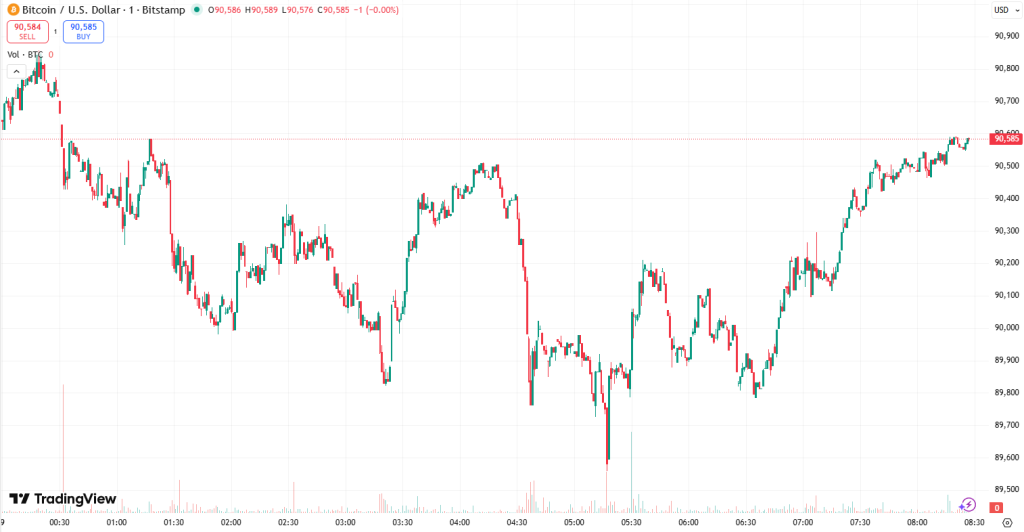
    At the time of writing on Tuesday morning, BTC stood at $90,480. There was a notable plunge earlier in the day from the intraday high of $92,203 to the low of $89,735. It then recorded another smaller peak at $91,353 before pulling back to the current price.

    BTC is still green in the 7-day time frame, having appreciated 4.1% and moving between $86,418 and $93,855.

    A drop below $85,000 could lead to the $78,000 which would open doors for further decreases. However, if BTC recovers above $95,000 and then $102,000, it could proceed to the $108,000 level.

    Bitcoin Price Chart. Source: TradingView

    Ethereum is currently changing hands at $3,122. It saw a lot choppier trading day than BTC. It decreased from the day’s high of $3,171 to the low of $3,093, the level it hit twice today.

    Over the past week, ETH has outperformed BTC again, having increased by 11.3%. It traded in the $2,796–$3,222 range.

    If it continues falling, the price could retreat below $3,000 and towards $2,850. On the other hand, if it reclaims the $3,300 level, it may keep rising to $3,450 and $3,560.

    Ethereum (ETH)
    24h7d30d1yAll time

    Meanwhile, the crypto market saw a minor increase on Tuesday morning, staying within the fear territory. The crypto fear and greed index rose to 25 today compared to 24 yesterday.

    That said, it’s been moving in a tight range over the past 30 days, occasionally dropping into the extreme fear zone.

    This highlights notable caution and indecisiveness, much in line with the market conditions overall.

    ETFs Post Another Mixed Day, Strategy Buys More BTC

    The ETF week has begun in the red. On Monday, the US BTC spot exchange-traded funds (ETFs) recorded $60.48 million in outflows. With this, the total net inflow pulled back to $57.65 billion.

    Of the twelve BTC ETFs, one recorded inflows, and three saw outflows. BlackRock accounts for the entirety of the positive flows, adding $28.76 million.

    At the same time, Grayscale saw the highest outflows of $44.03 million, followed by Fidelity’s $39.44 million and VanEck’s $5.76 million.

    Moreover, the US ETH ETFs posted positive flows on 8 December, breaking a brief red streak with $35.49 million in outflows. The total net inflow now stands at $12.91 billion.

    Of the nine funds, two recorded inflows, and none saw outflows. BlackRock took in $23.66 million, and Grayscale took in $11.83 million.

    Meanwhile, Michael Saylor’s company Strategy has purchased additional 10,624 BTC for approximately $962.7 million at an average price of $90,615 per coin. The move has many wonder if the company is expecting a notable rally.

    This latest acquisition brings Strategy’s total holdings to 660,624 BTC, bought for $49.35 billion at an average price of $74,696.

    Strategy has acquired 10,624 BTC for ~$962.7 million at ~$90,615 per bitcoin and has achieved BTC Yield of 24.7% YTD 2025. As of 12/7/2025, we hodl 660,624 $BTC acquired for ~$49.35 billion at ~$74,696 per bitcoin. $MSTR $STRC $STRK $STRF $STRD $STRE https://t.co/oyLwSuW7nW

    — Michael Saylor (@saylor) December 8, 2025

    Quick FAQ

    1. Why did crypto move with stocks today?

    The crypto market recorded a decrease over the past 24 hours, and the US stock market closed its previous session lower. By the closing time on Monday, 8 December, the S&P 500 was down by 0.35%, the Nasdaq-100 decreased by 0.25%, and the Dow Jones Industrial Average fell by 0.45%. All eyes are on the Federal Reserve, with investors across the board awaiting its decision on the interest rate cut this week.

    1. Is this drop sustainable?

    This is an expected drop following an increase in the market, albeit a smaller one. The market continues trading in a tight range.

    The post Why Is Crypto Down Today? – December 9, 2025 appeared first on Cryptonews.

    Privacy Coin Zcash Exposed – Half of All Transactions Now Tracked

    Blockchain intelligence firm Arkham announced on Tuesday that it has labeled over 53% of Zcash transactions, linking approximately $420 billion in volume to identifiable individuals and institutions, despite Zcash’s reputation as a privacy-focused cryptocurrency.

    The platform’s new tracking capability covers both shielded and transparent transactions, with 48% of transaction inputs and outputs and 37% of total balances, roughly $2.5 billion, now attributed to specific entities.

    ZCASH IS LIVE ON ARKHAM

    Arkham has now labeled more than half of the privacy chain Zcash’s shielded and unshielded transactions. This accounts for $420B of volume tagged to known individuals and institutions.

    Track $ZEC transactions, entities and balances on Arkham. Here’s what… pic.twitter.com/TOVJtr7kbl

    — Arkham (@arkham) December 8, 2025

    The disclosure sparked immediate controversy within the crypto community, with critics accusing Arkham of making misleading claims about its ability to track truly private transactions.

    Zcash founder Zooko Wilcox clarified that the firm “didn’t actually deanonymize any ZEC that was held at rest in the shielded pool,” noting such tracking would be “impossible because the information just isn’t there.

    Tracking Claims Draws Sharp Industry Backlash

    Blockchain developers quickly challenged Arkham’s announcement, pointing out fundamental limitations in tracking shielded Zcash transactions.

    Multiple industry figures noted that Arkham can only trace transparent-to-transparent, shielded-to-transparent, and transparent-to-shielded movements.

    At the same time, fully shielded transactions remain cryptographically protected through zero-knowledge proofs that make deanonymization technically impossible.

    Mert from Helius Labs called the announcement a “scummy clickbait title,” arguing Arkham deliberately included references to shielded transactions “for a few clicks” despite being unable to track them.

    He added that “for a data org, that’s as scammy as it gets” and suggested the move prioritized “clicks over truth,” potentially damaging the firm’s credibility in blockchain analytics.

    Saad El Kouari from AWB noted that the platform failed to identify major holders, including Grayscale, Electric Coin Company, and Shielded Labs, suggesting that its tracking capabilities remain limited to transparent wallet activity.

    He emphasized that Arkham “can’t identify a single whale” and “0 individuals, not even very clear targets” like Wilcox himself, demonstrating the significant gaps in the firm’s surveillance reach.

    Dynamic Fee Proposal Addresses Network Congestion

    Beyond the privacy debate, Zcash developers advanced a separate initiative to overhaul the network’s fee structure.

    Shielded Labs released a detailed blueprint Monday proposing a shift from static fees, originally 10,000 zatoshi, later reduced to 1,000, to a dynamic model based on median transaction activity across 50-block periods.

    The proposal addresses recurring “sandblasting” spam episodes that previously clogged wallets and congested the chain under fixed-fee structures.

    An earlier ZIP-317 proposal introduced action-based accounting, treating every transaction component as a uniform “action,” fixing abuse vectors while maintaining predictable, low fees that don’t adjust to network usage.

    Developers emphasized that with ZEC’s recent price surge and increasing institutional interest, the current system has become unsustainable.

    Some users have reported edge cases where shielding small transactions costs double-digit ZEC amounts.

    The dynamic fee mechanism introduces a stateless design using “comparables” to establish standard fees while maintaining privacy protections.

    Under network stress, a temporary priority lane at 10× the standard fee would allow users to compete for block space without requiring protocol redesign or risking the complexity of EIP-1559-style mechanisms that could compromise Zcash’s privacy constraints.

    Institutional Adoption Drives Token Performance

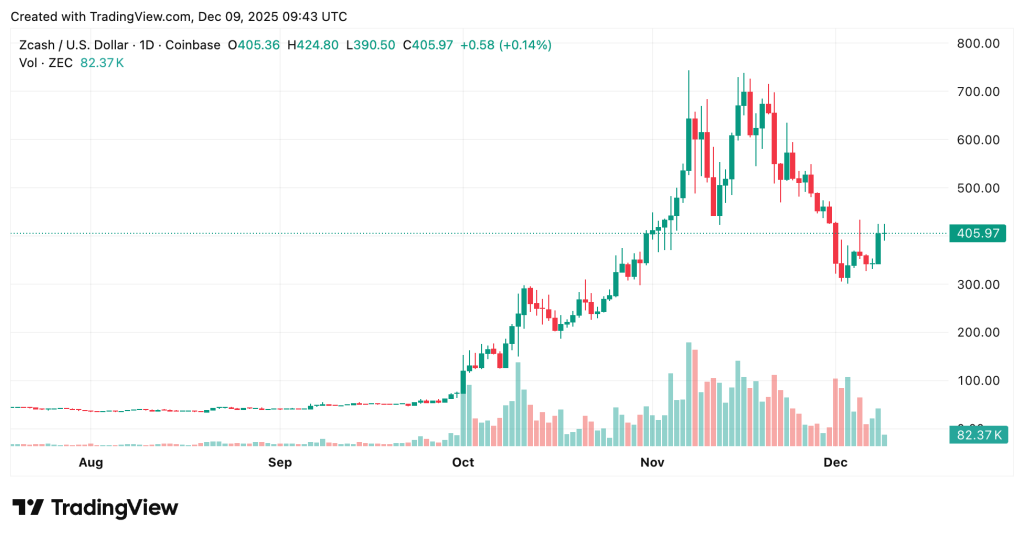
    ZEC surged nearly 5% today, trading above $400 and vastly outperforming the broader market.

    Privacy Coin Zcash - Zcash Price Chart
    Source: TradingView

    Last month, Zcash received significant institutional validation. The Winklevoss twins’ treasury vehicle has acquired 200,000 ZEC since November, worth over $80 million, targeting eventual ownership of roughly 5% of the circulating supply.

    Similarly, Reliance Global recently liquidated all other digital asset positions to focus exclusively on Zcash.

    Grayscale also filed with regulators to convert its existing Zcash Trust into a spot ETF tracking the CoinDesk Price Index, potentially opening new access channels for institutional investors.

    So far, the token’s share of supply held in shielded addresses has climbed to approximately 30% from an average of 10% in 2024, according to Grayscale Research.

    Looking forward, as Carter Feldman, Founder and CEO of Psy Protocol, told Cryptonews, we are seeing a surge in demand for onchain privacy, and “not just at the base layer, but also with the emergence of next-generation blockchains designed for privacy-preserving smart contracts, like Psy, Miden, and Aztec.

    The post Privacy Coin Zcash Exposed – Half of All Transactions Now Tracked appeared first on Cryptonews.

    Standard Chartered-Backed Libeara Launches Tokenized Gold Fund in Singapore

    By: Amin Ayan

    Libeara, the blockchain infrastructure platform backed by Standard Chartered’s venture arm SC Ventures, has rolled out a new tokenized gold investment fund in Singapore, bringing one of the world’s oldest safe-haven assets onto digital rails.

    Key Takeaways:

    • Libeara and FundBridge launched a tokenized gold fund that tracks gold’s spot price.
    • The structure removes vaulting costs while keeping regulated, gold-linked exposure.
    • The move expands Standard Chartered’s push into real-world asset tokenization.

    The fund, launched in partnership with FundBridge Capital, allows professional investors to gain exposure to gold through blockchain-based tokens issued on Libeara’s ledger.

    Each token is designed to correlate to the spot price of gold, offering a digitized alternative to holding the physical metal.

    FundBridge Says Tokenized Gold Cuts Costs While Preserving Price Exposure

    FundBridge said the structure removes the traditional costs of vaulting and logistics while keeping the price exposure intact.

    “FundBridge’s priority is to bridge traditional fund governance with emerging digital infrastructure,” CEO Sue Lynn Lim reportedly told Nikkie.

    “We’ve worked closely with our partners to ensure the framework meets the standards of a regulated fund environment while advancing the use of real-world assets on-chain.”

    The fund, named MG 999, is available exclusively to institutional and accredited participants. Unlike traditional gold funds, MG 999 does not hold physical bullion.

    Instead, the tokens are engineered to mirror gold’s market performance, offering a synthetic exposure mechanism that FundBridge says targets efficiency without compromising regulatory safeguards.

    𝐔𝐒$𝟏 𝐁𝐢𝐥𝐥𝐢𝐨𝐧 in regulated assets, powered by Libeara !

    We’re proud to announce that the total amount of tokenised assets powered by Libeara has officially surpassed US$1 Billion in AUM on https://t.co/ppI25aKcvhhttps://t.co/G1b99JjJZC pic.twitter.com/Z1eLYXbkjZ

    — Libeara (@libeara_) November 26, 2025

    The move extends a broader push by established financial institutions to tokenize real-world assets, bonds, funds, treasuries and now precious metals, as blockchain technology gains ground well beyond the volatile world of cryptocurrencies.

    SC Ventures has been steadily expanding its digital-assets footprint in Asia. Alongside Libeara, the bank holds majority stakes in Zodia Custody and Zodia Markets, both focused on institutional digital-asset services.

    The latest initiative underscores how traditional finance players are leveraging their reputation to enter a sector that has struggled with trust following multiple industry blowups.

    Gold Demand Surges as Institutions Seek Alternatives

    The launch also comes during a renewed surge in global gold demand. Central banks have been increasing their bullion reserves this year amid ongoing concerns about the long-term dominance of the US dollar and geopolitical uncertainty.

    President Donald Trump’s tariff policies have further stoked demand for safer assets.

    Last month, Standard Chartered joined other financial institutions in launching a physically backed gold fund in Singapore, with the bank acting as custodian for bullion stored at the high-security Le Freeport vault near Changi Airport.

    That product targets investors seeking exposure to allocated metal rather than tokenized units.

    MG 999 also contains a lending component aimed at Singapore’s jewelry sector. Mustafa Gold, a major retailer in the city-state, has been named the fund’s first borrower.

    The structure allows Mustafa to secure credit against its gold jewelry inventory while keeping the pieces on display.

    “Gold-linked tokens are quite unique and complex,” said Mustafa founder Mustaq Ahmad. “MG 999 lets retailers tap digital innovation and better manage working-capital needs.”

    The post Standard Chartered-Backed Libeara Launches Tokenized Gold Fund in Singapore appeared first on Cryptonews.

    Polymarket Accused of Double-Counting its Trading Volume

    Paradigm co-founder Matt Huang has amplified research alleging that prediction market Polymarket may be inflating its reported trading volumes through a data aggregation error that causes double-counting across most third-party analytics platforms.

    The findings, detailed by Paradigm research partner Storm Slivkoff, suggest the issue affects public datasets and dashboards that rely on Polymarket’s disclosed figures, potentially overstating the platform’s actual activity by approximately 100%.

    The controversy emerged as Huang reshared Slivkoff’s analysis on X, sparking immediate pushback from Polymarket’s data team and criticism that Paradigm, an investor in rival platform Kalshi, was attempting to discredit a competitor through technical semantics.

    Polymarket data bug: volumes are double-counted in most public data

    Interesting find in diligence from @notnotstorm https://t.co/xuQ41JUVHf

    — Matt Huang (@matthuang) December 8, 2025

    Technical Root of Volume Dispute

    Slivkoff’s investigation reveals that Polymarket’s smart contracts emit separate OrderFilled events for the maker and taker sides of each trade, resulting in redundant representations of identical transactions.

    Most analytics dashboards compute volume by summing these events, effectively counting the same trade twice.

    A simple transaction involving YES tokens sold for $4.13 generates two OrderFilled events for that amount, causing dashboards to report $8.26 in volume rather than the actual $4.13 traded.

    The complexity stems from Polymarket’s unique market structure, which supports eight distinct trade types, including conventional swaps and split-merge operations in which participants exchange USDC for opposing YES-NO positions.

    While no individual event contains incorrect information, aggregating all OrderFilled events without distinguishing between maker and taker representations results in systematic double-counting of notional volume and cash flow metrics.

    The issue extends across both Polymarket’s CTF Exchange and NegRisk exchange contracts, which share identical event emission patterns.

    Slivkoff’s analysis, which included building a transaction simulator and auditing contract code, demonstrates that proper measurement requires using one-sided metrics, either taker-side or maker-side volume, rather than summing redundant event streams.

    Polymarket Double-Counting Trading Volume - Polymarket USDC Volume Metrics Chart
    Source: Paradigm

    When calculated correctly, Polymarket’s actual monthly volumes for October and November 2024 were approximately $1.25 billion each, roughly half the $2.5 billion figures displayed on most public dashboards before corrections.

    Industry Response and Competitive Tensions

    Polymarket’s Primo Data quickly disputed the characterization, insisting that the platform’s official site displays notional taker volume without double-counting, in line with industry standards used by Kalshi.

    This post isn’t about Polymarket’s website, it’s about the common dashboards that people use for tracking Polymarket volume,” Slivkoff clarified, emphasizing the issue affects third-party analytics rather than Polymarket’s internal reporting.

    This is not how prediction markets report volume, including your portfolio company Kalshi.

    To be clear:

    1. Our site does not double count volume. We show notional taker volume (same as Kalshi).

    2. The primary dashboards that show both Polymarket & Kalshi show notional volume… pic.twitter.com/9Bu0zm0DS0

    — Primo Data (@primo_data) December 8, 2025

    Major data providers, including DefiLlama, Allium Labs, and Blockworks, confirmed they are updating their Polymarket dashboards to eliminate double-counting after validating Slivkoff’s findings.

    Meanwhile, some analysts defended existing practices, with Dragonfly data head Hildobby claiming sophisticated dashboards accounted for the distinction since 2024, though acknowledging the methodology remained undocumented until now.

    The timing drew scrutiny, given Paradigm’s investment in Kalshi, Polymarket’s primary US competitor.

    Will Sheehan of Parsec Finance criticized the research as reading “a bit like a hit piece when it’s just data being hard and Polymarket’s contracts being open/onchain,” while others questioned whether the disclosure of Paradigm’s competitive interest adequately addressed potential bias.

    Storm defended the work as identifying honest mistakes resulting from data complexity rather than assigning blame, noting Polymarket itself bears no responsibility for how third parties interpret its event streams.

    Beyond the immediate volume dispute, Nick Preszler of Melee Markets argued the controversy highlights broader measurement challenges in prediction markets, where low-priced contracts can generate disproportionate notional volume compared to actual capital at risk.

    If a user buys $10 worth of contracts at .1c each, they are risking $10, but get credited for $10,000 of volume,” Preszler noted, advocating for alternative metrics like open interest and fee revenue to provide more accurate industry comparisons.

    ‼ Polymarket is building an internal trading desk to bet against customers as it relaunches in U.S. markets following CFTC regulatory clearance.#Polymarket #CFTChttps://t.co/mTAUebkNsV

    — Cryptonews.com (@cryptonews) December 5, 2025

    The debate comes as Polymarket prepares its full US relaunch following CFTC regulatory clearance and pursues a valuation of $12 billion to $15 billion.

    Simultaneously, the company is facing criticism over plans to establish an internal market-making operation that would trade against customers, mirroring controversial practices already employed by Kalshi.

    The post Polymarket Accused of Double-Counting its Trading Volume appeared first on Cryptonews.

    US Spot BTC ETFs Bleed $60.4M as Altcoin Capital Flows Increase

    The US spot Bitcoin exchange-traded funds (ETFs) saw a net outflow of $60.48 million on Monday, despite BlackRock’s IBIT fund contributing to a single-day inflow of $28.76 million.

    Per SoSoValue data, Grayscale’s GBTC saw the maximum outflows of $44.03 million, followed by Fidelity’s FBTC fund, which recorded a $39.44 million in outflows.

    Meanwhile, the spot Ethereum ETFs logged in a net inflow of $35.5 million yesterday, led by BackRock’s ETHA, which saw $23.7 million inflows.

    Altcoin ETFs ‘Boom’ – XRP Leads With $935M Inflow Since Debut

    Ripple XRP spot ETFs have attracted more than $900 million in cumulative institutional capital since their launch last month. The move signals capital rotation amid Bitcoin’s turbulence and arbitrage unwind.

    Particularly, XRP has the most significant altcoin ETF debut to date, with $38.04 million in a single day inflow from four funds on Monday.

    Source: SoSoValue

    Besides, spot Solana ETFs posted $1.18M net inflows in a single day, solely from Fidelity’s FSOL fund. The altcoin witnessed a cumulative net inflow of $640.06 million, since its debut on October 28.

    Per CoinMarketCap data, XRP showed a significant surge at the start of December, reaching a peak of $2.20. However, the altcoin has dropped 1.54% to $2.05 over the past 24 hours, signalling bearish momentum. XRP is trading at $2.06 at the time of writing.

    Meanwhile, Solana has risen to nearly 5% in the past week, trading at $133.16 at press time.

    ETF Trajectory for Next Year

    Bitwise Asset Management executive Katherine Dowling told DL News that the crypto ETF sector will continue to boom.

    “It is a good starter kit for many investors to gain exposure,” said Dowling, adding that altcoin funds such as Solana and XRP “have promising fundamentals,” pushing the prices to go further.

    Additionally, Bitfinex analysts view this as a healthy, tactical rebalancing. They told Cryptonews, “the spot ETF channel remains intact.”

    Speaking about Bitcoin’s long-term outlook, they said that the structural thesis remains firm.

    “As more large allocators use ETF wrappers as entry points, Bitcoin’s path towards a regulated store-of-value role continues, meaning that future inflows can become deeper and more stable.”

    The post US Spot BTC ETFs Bleed $60.4M as Altcoin Capital Flows Increase appeared first on Cryptonews.

    ❌