Reading view

There are new articles available, click to refresh the page.

South Korea Misses Stablecoin Bill Deadline — Banks vs. Innovation Battle Heats Up

South Korea’s effort to legalize won-pegged stablecoins has hit another setback after the country’s top financial regulator missed a government-imposed deadline, exposing a deepening power struggle between financial authorities over who should control the next phase of digital finance.

Earlier this month, the ruling Democratic Party asked the Financial Services Commission to submit a draft stablecoin bill by December 10, fulfilling President Lee’s campaign pledge to create a legal framework for digital assets.

🇰🇷 South Korea pushes for draft stablecoin bill by Dec. 10 deadline as lawmakers threaten independent action if FSC misses target. #SouthKorea #Stablecoinhttps://t.co/dLzvS4qax1

— Cryptonews.com (@cryptonews) December 1, 2025

That deadline passed without a submission.

Stablecoin Disagreement Holds Up South Korea’s Crypto Bill

The South Korean media outlet Newsis reported that FSC later confirmed it was unable to deliver the proposal on time, saying it needed additional coordination with other agencies.

A spokesperson said the regulator would instead release the government’s position publicly alongside its formal submission to the National Assembly, citing the public’s right to understand the framework being proposed.

The FSC said it is preparing a draft tentatively titled the Basic Digital Asset Act, also described as Phase Two of South Korea’s virtual asset legislation.

Officials expect the proposal to be released later this month or early next month, ahead of a consolidated bill the ruling party has pledged to introduce in January 2026 under President Lee Jae-myung’s election commitments.

Behind the delay is an unresolved dispute between the FSC and the Bank of Korea over who should lead stablecoin issuance.

The central bank has argued that stablecoins function similarly to currency and deposit-like instruments and should therefore remain under bank control.

It has pushed for a rule requiring domestic banks to hold at least a 51% stake in any stablecoin-issuing entity, along with inspection powers and veto authority over approvals.

The FSC has resisted that approach, pointing to overseas models, noting that most issuers under the European Union’s MiCA framework are non-bank digital asset firms and that Japan’s first yen-linked stablecoin was issued by a fintech company.

FSC officials have said bank-led issuance lacks global precedent and could limit participation by technology firms that already operate digital payment infrastructure.

Negotiations between the FSC and the BOK remain ongoing. Officials familiar with the talks say a compromise may involve flexible ownership thresholds based on business scope, though no agreement has been confirmed.

The disagreement has stalled coordination long enough for lawmakers to begin reviewing multiple competing drafts at the National Assembly’s Political Affairs Committee.

Delays in Stablecoin Rules Raise Fears South Korea Is Falling Behind

Industry groups have warned that continued delays risk leaving South Korea behind jurisdictions such as the United States, the European Union, and Japan, all of which have already established stablecoin rules.

Domestic stablecoin issuance remain illegal in South Korea, even as companies prepare infrastructure behind the scenes.

Naver Financial has developed a blockchain wallet for Busan’s local currency program, while KakaoBank has begun work on a KRW-denominated digital token. Major banks have also explored a joint stablecoin project targeting late 2025 or early 2026.

🚀 Naver Financial, the fintech arm of South Korean internet giant Naver, is preparing to roll out a stablecoin wallet in Busan.#SouthKorea #Cryptohttps://t.co/40QBNaXJ9C

— Cryptonews.com (@cryptonews) November 25, 2025

Regulatory urgency has been heightened by recent enforcement challenges. In December, Korean authorities disclosed that Binance froze only a small portion of funds stolen during last month’s Upbit hack, despite urgent requests from police and the exchange.

🇰🇷 Korean authorities say @Binance froze only a small portion of the crypto stolen during last month’s @Official_Upbit hack.#SouthKorea #Binancehttps://t.co/o5VVQN9tYp

— Cryptonews.com (@cryptonews) December 12, 2025

Investigators said hackers rapidly laundered assets across chains and wallets, highlighting the difficulty of coordinating responses without clearer oversight frameworks.

Experts said the incident shows the need for faster, more structured controls as digital-asset activity expands.

South Korea’s stablecoin debate is also unfolding against a backdrop of delayed crypto policy more broadly. The country’s virtual asset tax regime, approved in 2020, has been postponed several times and is now scheduled for 2027.

The post South Korea Misses Stablecoin Bill Deadline — Banks vs. Innovation Battle Heats Up appeared first on Cryptonews.

Bitcoin Price Prediction: Japan’s Next Rate Hike Could Flip the Global Risk Trade – Is Bitcoin the Big Winner?

Japan’s central bank is scheduled to hold its Monetary Policy Meeting (MPM) on December 18–19, 2025, with markets anticipating a possible rate hike to 0.75% from 0.5%, a move that could flip the global risk trade and significantly impact the Bitcoin price prediction outlook.

Japan’s Rate Hike Is Risky For Bitcoin

Analysts view the potential rate hike as ending the “Carry Trade” era.

Higher rates make yen assets more appealing, prompting investors to pull capital from overseas holdings like crypto.

This strengthens the yen, raises borrowing costs worldwide, and dampens Bitcoin speculation, historically causing 20-30% price drops.

🚨 HOW WILL BITCOIN REACT TO JAPAN's RATE HIKE?

🏦The Bank of Japan is expected to raise rates to 0.75%, a level not seen since 1995, and #Bitcoin is already not liking it.

WHY?🤷

Because history isn’t kind to Bitcoin here…

🗓During the last 3 BOJ rate hikes, BTC drops 20%+… pic.twitter.com/KaEsxZyHc8
— Coin Bureau (@coinbureau) December 15, 2025

Macro investor Afsheen Jafry explained that while markets focus on Powell and the Fed, the BOJ actually controls something more fundamental: global liquidity flows.

“When the BOJ tightens, capital floods back to Japan. When they ease, it floods out, and crypto is always first in line to catch that overflow,” she noted.

She cited July 2024 when the BOJ’s rate increase triggered a massive selloff, crushing Bitcoin from $73,000 to $53,000.

“That wasn’t random. That was carry trade unwinding on a massive scale.”

The BOJ also holds roughly ¥83 trillion ($534 billion) in ETFs accumulated since 2010, representing 7-8% of Japan’s ETF market.

Reports indicate officials plan gradual sales of these ETFs starting in January 2026.

These sales would reverse years of liquidity injections, potentially pressuring Japanese stocks and reducing global risk appetite.

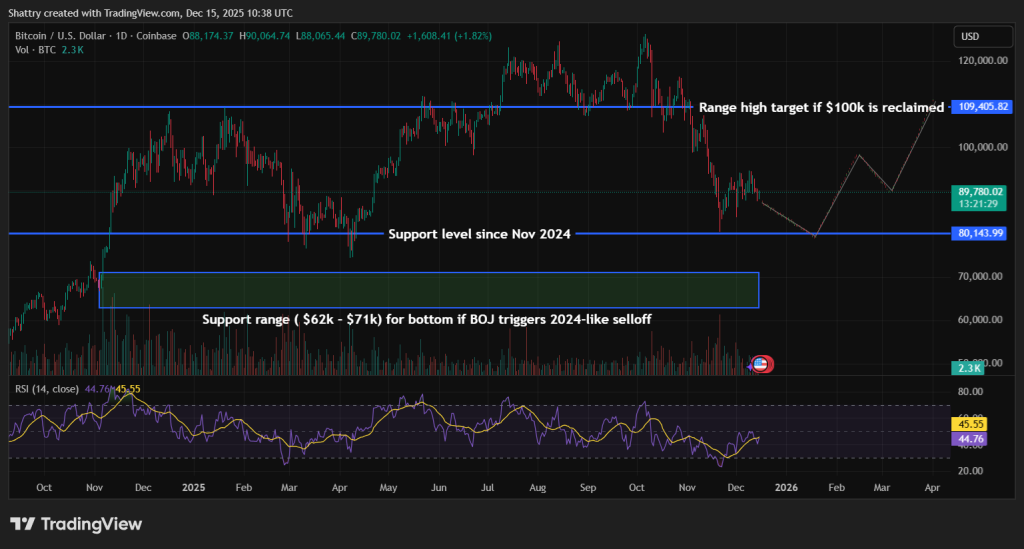
Bitcoin Price Prediction: Defending $80K Support Critical for Price Recovery

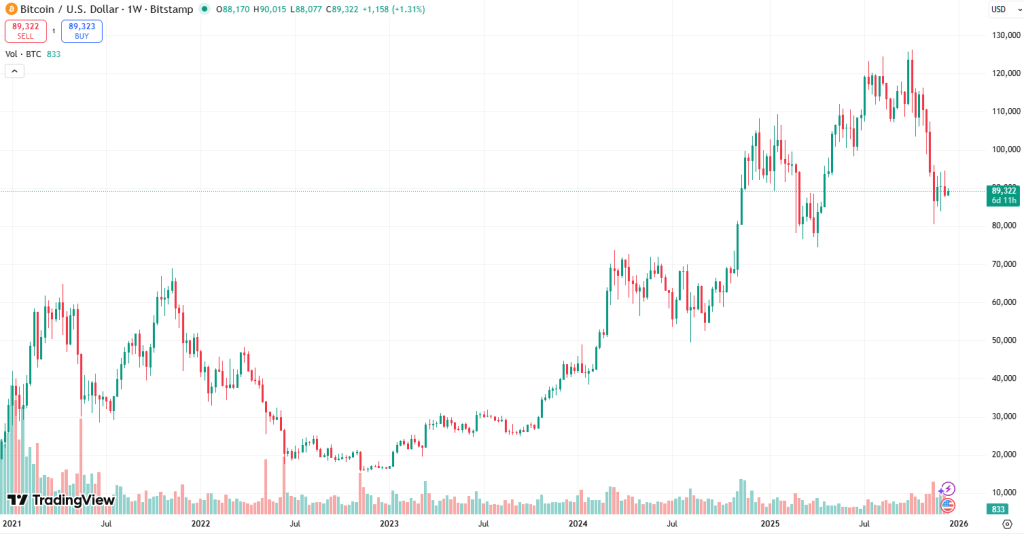
Bitcoin is holding firm above the $80,000 level after November’s sharp drop, showing buyers are defending this key support that has held since late 2024.

The recent push toward the upper $80,000s hints at early signs of recovery, but BTC remains trapped below the critical $100,000 to $109,000 resistance zone.

Breaking through this range could flip momentum and confirm a true reversal. Otherwise, this bounce may fade.

Bitcoin Price Prediction - Bitcoin Price Chart
Source: TradingView

RSI has climbed from oversold levels into the mid-40s, signaling that selling pressure is cooling, though upside momentum is not yet convincing.

If Bitcoin keeps holding $80,000, a retest of $100,000 is likely, with $109,000 as the next target. On the flip side, a breakdown could send BTC sliding toward the $62,000 to $71,000 demand zone.

As Bitcoin prepares for its next move, traders are pouring millions of dollars into presales, investing in meme coins before they list on exchanges.

Don’t Miss Out on One of the Hottest Meme Presales Right Now

Maxi Doge ($MAXI) has quickly become one of the most talked‑about presales in crypto, gathering millions in early support and standing out in a crowded meme coin market.

This is not just another token, it’s a high‑energy community‑driven play built for traders who want early exposure before listings hit major exchanges.

The MAXI presale has established an alpha channel where traders exchange tips, early trade ideas, and hidden opportunities to capitalize on the upcoming bull run.

Bitcoin Price Prediction - Maxidoge banner

Traders are already comparing $MAXI’s momentum to Dogecoin’s early days, with strong social engagement and visibility rising fast.

To get involved before the next price increase:

Visit the Official Maxi Doge Website Here

The post Bitcoin Price Prediction: Japan’s Next Rate Hike Could Flip the Global Risk Trade – Is Bitcoin the Big Winner? appeared first on Cryptonews.

A Storm Is Coming and Bear May Follow, Expert Says

Bitcoin is in an uptrend, the bull is still running, but a bear confirmed entry, and an explosive storm may be on its way, according to Tony Severino, market analyst at fintech platform YouHodler. Ethereum is weak compared to Bitcoin, but this is about to change. At the same time, 2026 will be a massive year, perhaps BTC’s “most decisive” yet.

According to Severino, Bitcoin is, by definition, still in an uptrend.

Yet, overhead resistance is stacked. Bitcoin could try to reclaim the 50-week moving average, which sits at some $102,000.

Then, $100,000 will act as a key psychological barrier, and this makes it “an ideal zone for a bull trap.” A move above $100,000 “could embolden bulls with a ‘we’re so back’ mentality.” But this could “blind them to a potential reversal back down to new lows,” Severino says.

He argues that,

“If bulls are able to reclaim $100,000 and hold the support line for weeks to months, any chance of a bear market will likely be cancelled.”

A bearish high timeframe signal just confirmed in Bitcoin

The last time it confirmed, Bitcoin fell 75% over the next 365 days before it reached a bottom

The signal has never missed a bull market or bear market, and it has no false signals

You can see the signal, TA, and my… pic.twitter.com/iBXmm39AZW

— Tony "The Bull" Severino, CMT (@TonyTheBullCMT) December 8, 2025

A Bear Is Here

Importantly, Q1 2026 will be critical. Per the analyst, it will “show us the way for the rest of the year.”

Given the high timeframe momentum and four-year-cycle timing and dynamics, he argues, “there is a higher probability that Bitcoin is entering a bear market.”

Therefore, it’s likely that BTC will fail to reclaim $100,000. This would indicate “that the bull market is indeed over.”

To confirm a downtrend and change into a bear market, the coin would need to confirm “a lower low.” Therefore, $74,000 becomes a critical support zone that bulls must defend to keep BTC bullish.

Falling below this zone would confirm the bear market. The next downside target would then sit around $53,000.

“At that point, higher timeframe technical indicators would reach levels oversold enough to begin to consider a true bear market bottom is in,” he says.

At the same time, Severino discussed the key technical indicators he’s paying attention to. Per his email, these are all related to momentum. And momentum persists, he says. “Even when a car hits its brakes to avoid an accident, strong enough momentum could push the vehicle towards a crash. It will take time for bearish momentum to turn bullish.”

As an example, the analysts provided the six-week LMACD (Logarithmic Moving Average Convergence Divergence). This technical indicator confirmed a bearish crossover, he says. It takes 200-365 on average between the signal and a bottom, as well as up to 860 days between a bearish and a bullish crossover.

“I’d have to begin to see the monthly LMACD lines converge and close in on a bullish crossover before I’d consider a bear market thesis invalidated,” Severino says.

When a bear market drags on and destroys everything weak, the market needs time to stabilize and reassemble itself

But the very destruction becomes fuel

The deepest contractions produce the most explosive expansions

Human growth works the same way — forged in adversity,…

— Tony "The Bull" Severino, CMT (@TonyTheBullCMT) December 11, 2025

Four-Year-Cycle Under Microscope

“Make no mistake, 2026 will be Bitcoin’s most decisive year yet,” Severino says. “2025 was characterized by confusion” due to macro backdrop uncertainty and Donald Trump’s “tariff tantrums.”

Moreover, Bitcoin’s 2025 yearly candlestick will close as a Doji. This is typically a pause in a trend. Therefore, either a reversal or strong continuation will follow it.

“Simply put, Bitcoin will prove the four-year-cycle remains with a bear market, or break the cyclical pattern with a renewed bull run.”

Source: Tradingview

At the same time, “a storm is coming.”

Volatility is stirring on the lowest timeframes. Yet, higher timeframes show an “unusually calm” market. “A spark is waiting to ignite this compression into an explosion,” the analyst argues.

Ethereum Could Be The Decision Maker

Ethereum remains relatively weak compared to Bitcoin, Severino says. However, the analyst says, “this is about to change dramatically.”

The ETHBTC pair shows a reversal: ETH could be outperforming BTC in the longer term.

However, Severino cautious that if the cryptocurrency market enters a downtrend and bear market, this outperformance could be associated with ETHUSD holding better than BTCUSD, rather than ETHUSD growing faster than BTCUSD.

Yet, this BTC-ETH “mismatch” should present many favourable trading opportunities even in the bear market.

Source: Tradingview

Finally, the ETH/BTC ratio may show a potential capital rotation into Ethereum.

Several events could dampen BTC and raise ETH. These include a BTC-related catalyst pushing sentiment down, or ETH being far more oversold than BTC. The latter may see Bitcoin reset while Ethereum continues the foundation building phase.

Therefore, “if Ethereum can revitalize crypto market sentiment, it may finally create the perfect storm situation for an unexpected altcoin season,” Severino concludes. “If Ethereum’s strength fails to ignite interest in altcoins, we may be witnessing the market purging projects without true potential.”

The post A Storm Is Coming and Bear May Follow, Expert Says appeared first on Cryptonews.

Visa Launches Stablecoins Advisory as Market Tops $300B — Banks Rush In?

Visa has launched a new “Stablecoins Advisory Practice” as the stablecoin market climbs above $300 billion just as banks and financial institutions accelerate their engagement with digital dollars.

Visa has launched a Stablecoins Advisory Practice to help banks, fintechs and enterprises design and implement stablecoin strategies. The service will support use cases such as cross-border and B2B payments, as Visa deepens its push into stablecoins. https://t.co/Mnn4CKwVUd

— Wu Blockchain (@WuBlockchain) December 15, 2025

The move comes as traditional financial institutions accelerate their engagement with stablecoins following clearer regulatory signals in the United States.

Visa Works With Early Clients on Stablecoin Strategies

Carl Rutstein, global head of Visa Consulting and Analytics, said the practice is designed to meet growing client demand rather than push adoption indiscriminately.

He said Visa is working with dozens of early clients, including Navy Federal Credit Union, VyStar Credit Union, and Pathward, and expects the number to expand into the hundreds.

The advisory work spans strategy development, technical architecture, operational readiness, and implementation support, with some clients ultimately deciding whether stablecoins align with actual customer needs.

Stablecoins are cryptocurrencies designed to maintain a fixed value, typically pegged to the U.S. dollar through reserves.

Once largely confined to crypto trading, they are increasingly being used for payments, cross-border transfers, and business-to-business settlement, particularly in regions with currency volatility or limited access to traditional banking rails.

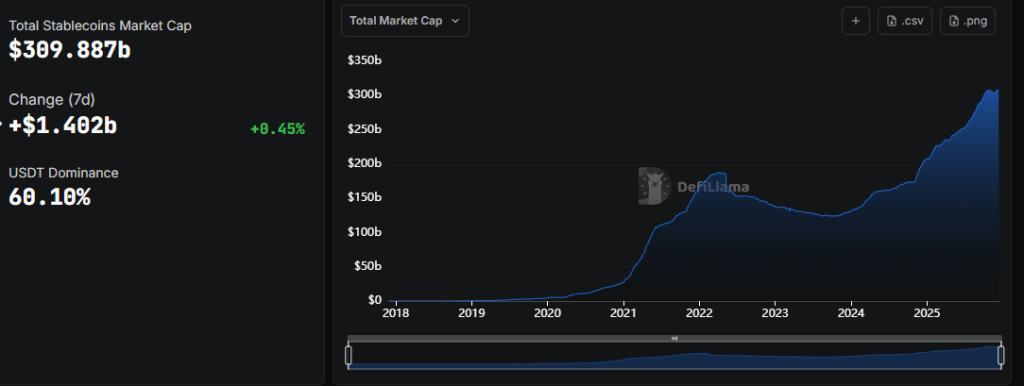
According to DefiLlama data, the global stablecoin market capitalization now stands at $309.85 billion. Tether’s USDT remains dominant with a 60.10% market share and a market cap of $186.23 billion, followed by Circle’s USDC at $78.31 billion.

Source: DefiLlama

Other stablecoins, including Ethena’s USDe, Sky Dollar, Dai, and PayPal USD, make up smaller but growing portions of the market, collectively reflecting broader issuer diversity.

Visa Pushes Stablecoins Deeper Into Global Payments

Visa’s latest move follows a series of stablecoin initiatives by the company over the past several years. In 2023, Visa piloted USDC settlement on blockchain networks and now supports more than 130 stablecoin-linked card programs across 40 countries.

Visa recently began testing a system that allows businesses to fund cross-border payments using stablecoins instead of pre-depositing cash into local accounts.

🌍 Credit card giant @Visa has begun testing stablecoin-powered cross-border payments, marking a major step in digital tokens gaining acceptance among global finance players.#Visa #Stablecoins https://t.co/bJwqFJe5tc

— Cryptonews.com (@cryptonews) September 30, 2025

Visa has said the program will expand in 2026 and targets banks, remittance firms, and financial institutions that currently rely on costly correspondent banking networks.

The push has been reinforced by regulatory clarity in the United States following President Donald Trump’s signing of the GENIUS Act in July, which established formal rules for stablecoin issuance.

Since then, several financial and payments firms have accelerated their stablecoin strategies.

PayPal and Mastercard have expanded their digital dollar capabilities, while institutions such as Citigroup, JPMorgan, and Standard Chartered continue to explore tokenized settlement and on-chain liquidity tools.

Stablecoin Adoption Spreads Globally as Banks and Card Networks Step In

Visa’s advisory launch also arrives as stablecoin adoption spreads beyond the U.S. In Africa, Visa has partnered with Yellow Card Financial to support stablecoin payments across 20 countries, while Circle has worked with Onafriq to connect stablecoins to hundreds of wallets and bank accounts.

@visa and @yellowcard_app have partnered to expand stablecoin-powered payments across Africa.#stablecoin #Visahttps://t.co/nB85xKKAXa

— Cryptonews.com (@cryptonews) June 19, 2025

Mastercard recently partnered with Chainlink to let cardholders make on-chain crypto purchases. Meanwhile, Sony Bank plans to launch a regulated dollar-pegged stablecoin for payments within its digital entertainment ecosystem.

🔗 @chainlink announces historic @Mastercard partnership enabling 3 billion+ cardholders to buy cryptocurrency onchain through seamless fiat-to-crypto conversion eliminating complex barriers.#Chainlink #Mastercard #Cryptohttps://t.co/SSrILSQ5Tf

— Cryptonews.com (@cryptonews) June 24, 2025

Institutions such as Goldman Sachs, Wells Fargo, McKinsey, Anchorage Digital, and GFT Technologies already offer advisory, research, or infrastructure services tied to stablecoins.

Visa executives have consistently framed stablecoins not as a threat to existing payment systems, but as an extension of them.

Speaking earlier this year, Visa’s head of crypto, Cuy Sheffield said the future of payments would combine traditional rails with on-chain settlement, rather than replacing one with the other.

The post Visa Launches Stablecoins Advisory as Market Tops $300B — Banks Rush In? appeared first on Cryptonews.

Base Co-Founder Draws Fire After Backing Soulja Boy’s Token Despite Repeated Scam Claims

Base co-founder Jesse Pollak is facing mounting criticism after publicly engaging with and backing activity linked to a meme token associated with rapper Soulja Boy.

The case revives long-running concerns about celebrity-driven crypto promotions and the responsibility of senior ecosystem figures.

The controversy unfolded over a sequence of posts on X in mid-December.

On December 13, Soulja Boy shared a comparison of creator payout schedules across major platforms, arguing that newer applications offered faster access to earnings than traditional social networks.

Twitch pays you once a month. TikTok pays you once a week. Favorited pays you once a day. Choose your poison wisely.

— Soulja Boy (Draco) (@souljaboy) December 13, 2025

On-Chain Research Rekindles Concerns Over Celebrity Crypto Promotions

Pollak amplified the discussion while framing Base, Coinbase’s Ethereum Layer-2 network, as an alternative monetization layer for creators.

In a direct reply to Soulja Boy, Pollak said he had just backed the rapper on Base and had “instantly earned,” describing the interaction as an example of “new internet” behavior enabled by on-chain tools.

. @baseapp pays you instantly https://t.co/0XurhOsj1H

— jesse.base.eth (@jessepollak) December 13, 2025

Although Pollak did not name or explicitly promote a specific token, many users interpreted the exchange as an endorsement of a Soulja Boy-linked meme token that had just launched on Base.

@souljaboy just backed you on @base and you instantly earned.

new internet shithttps://t.co/CQ5NCvBwXj pic.twitter.com/fmdkt8UsZy

— jesse.base.eth (@jessepollak) December 13, 2025

Developers, traders, and researchers questioned why a senior figure at a Coinbase-backed network would publicly engage with a celebrity whose crypto history has drawn repeated scrutiny.

The criticism quickly shifted from the token itself to broader concerns about trust, reputation, and showing within the Base ecosystem, which has positioned itself as a compliant, mainstream-friendly Layer-2 network.

The debate intensified after on-chain investigator ZachXBT publicly challenged Pollak’s decision to interact with Soulja Boy.

Why give SouljaBoy the platform to scam new people? https://t.co/PDxnk0Z0Za

— ZachXBT (@zachxbt) December 14, 2025

He pointed to research he published in April 2023 documenting what he described as a long pattern of exploitative crypto promotions tied to the rapper.

ZachXBT Details Pattern of Abandoned Crypto Projects Linked to Soulja Boy

According to that research, Soulja Boy was involved in at least 73 token promotions and 16 NFT launches, many of which later collapsed or were abandoned.

Why give SouljaBoy the platform to scam new people? https://t.co/PDxnk0Z0Za

— ZachXBT (@zachxbt) December 14, 2025

ZachXBT outlined several examples from past market cycles, including meme tokens such as RapDoge, which was promoted in July 2021 before quickly rug-pulling, and projects like Orion and The Life Token, which used charitable narratives before collapsing.

Beyond tokens, the investigator said Soulja Boy launched multiple NFT collections, some of which advertised future utility that never materialized.

He also referenced prior regulatory and legal issues, including SEC charges related to Tron promotions and a lawsuit connected to SafeMoon.

Growing Scrutiny Follows Base’s Rapid Rise in the Layer-2 Market

Against that backdrop, critics argued that visibility from prominent builders functions as implicit validation, particularly for new users who may not be familiar with a promoter’s history.

Supporters of open, permissionless networks countered that public blockchains do not restrict who can deploy tokens or participate, and that engagement does not necessarily equate to endorsement.

The episode arrives at a sensitive moment for Base.

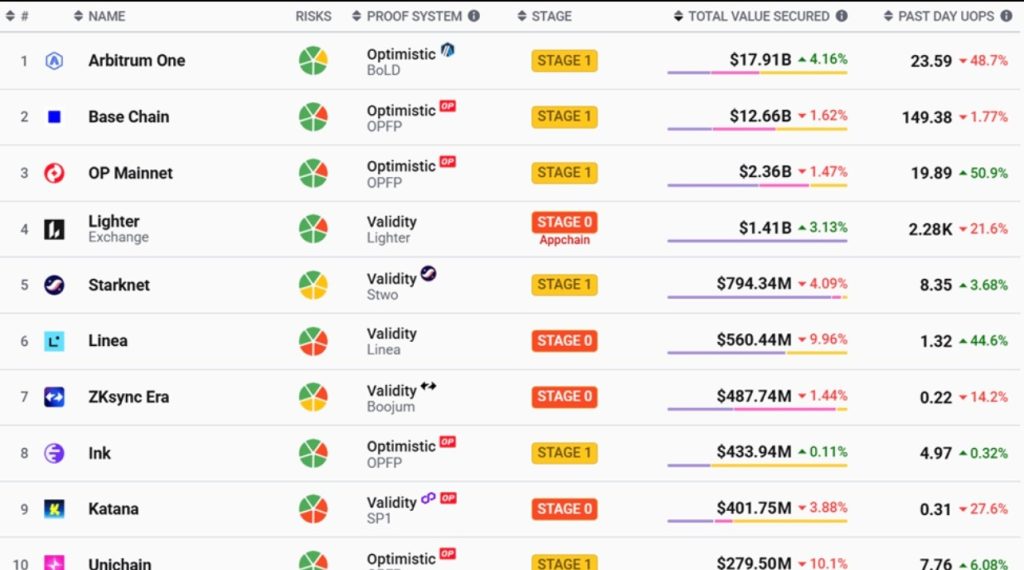
According to L2beat data, Base is currently the second-largest Layer-2 network by total value locked, with approximately $12.66 billion, trailing only Arbitrum.

Source: L2Beat

Its rapid growth has positioned it as one of the most visible scaling layers in the Ethereum ecosystem, increasing scrutiny around how senior figures communicate publicly.

The backlash also reflects a broader pattern in crypto discourse.

In recent months, ZachXBT has repeatedly surfaced in high-profile cases involving alleged misconduct, including claims tied to celebrity NFT launches, suspected large-scale hacks, and the exposure of organized fraud networks.

These episodes have fueled recurring debates about due diligence, accountability, and the role of influence in shaping on-chain behavior.

The post Base Co-Founder Draws Fire After Backing Soulja Boy’s Token Despite Repeated Scam Claims appeared first on Cryptonews.

BitMine Immersion’s ETH Holdings Surge to 3.97M Tokens – Over 3.2% of Total Supply

BitMine Immersion Technologies said it now holds more than 3.2% of the total Ethereum token supply, placing the company roughly two-thirds of the way toward its stated goal of acquiring 5% of all ETH in circulation.

As of December 14, the company reports it held 3,967,210 ETH, following the addition of more than 102,000 tokens over the past week. Based on market prices at the time, BitMine’s ETH position alone represented a multibillion-dollar allocation.

🧵
BitMine provided its latest holdings update for Dec 15th, 2025:

$13.2 billion in total crypto + "moonshots":
-3,967,210 ETH at $3,074 per ETH (@coinbase)
– 193 Bitcoin (BTC)
– $38 million stake in Eightco Holdings (NASDAQ: ORBS) (“moonshots”) and
– total cash of $1.0…

— Bitmine (NYSE-BMNR) $ETH (@BitMNR) December 15, 2025

Crypto, Cash and “Moonshots” Reach $13.3B

BitMine reports that its combined crypto holdings, cash reserves and strategic investments totaled approximately $13.3 billion. Alongside its Ethereum position, the company holds 193 bitcoin, $1.0 billion in cash and a $38 million stake in Eightco Holdings, which it categorizes as a “moonshot” investment.

The company said the scale and composition of its balance sheet reflect a deliberate strategy to combine liquidity with long-duration exposure to digital assets.

Management has also stressed that maintaining a cash buffer allows BitMine to continue accumulating crypto during periods of market volatility while preserving operational flexibility.

Institutional Backing and Market Liquidity

BitMine said it continues to be supported by a group of prominent institutional and strategic investors, including Cathie Wood’s ARK Invest, Founders Fund, Pantera Capital, Galaxy Digital, Digital Currency Group, Kraken and Bill Miller III, as well as individual investor Tom Lee.

The company views this backing as critical to its ambition of reaching the 5% ETH ownership threshold, which it refers to internally as the “Alchemy of 5%.” In the equity markets, BitMine’s stock has emerged as one of the most actively traded in the United States.

According to Fundstrat data, BMNR has averaged roughly $1.9 billion in daily trading volume over the past five days, ranking it as the 41st most traded U.S. stock.

Staking Plans and Shareholder Meeting Ahead

BitMine said it is also developing a staking initiative known as the Made in America Validator Network, or MAVAN, which is expected to be deployed in early 2026. The company has described the project as a secure, institutional-grade staking solution designed to generate yield on its Ethereum holdings.

BitMine will hold its annual shareholders meeting at the Wynn Las Vegas on January 15, 2026. The event is expected to provide further updates on its treasury strategy, staking rollout and progress toward its long-term Ethereum ownership target.

The post BitMine Immersion’s ETH Holdings Surge to 3.97M Tokens – Over 3.2% of Total Supply appeared first on Cryptonews.

Billionaire Michael Saylor Announces New $1 Billion Bitcoin Purchase – Does He Know Something is Coming?

By: Amin Ayan

Bitcoin bull Michael Saylor’s Strategy has doubled down on its long-standing conviction, announcing another massive Bitcoin buy worth nearly $1 billion.

Key Takeaways:

  • Strategy bought $980 million in Bitcoin, increasing its holdings to 671,268 BTC.
  • The purchase was funded through stock sales
  • The purchase comes after Strategy created a $1.44 billion cash reserve to avoid selling Bitcoin, ensuring dividend and debt payments during market volatility.

In a Form 8-K filing dated December 15, Strategy disclosed that it acquired 10,645 BTC between December 8 and December 14, spending $980.3 million at an average price of $92,098 per coin.

The purchase was funded through proceeds raised under the firm’s at-the-market (ATM) equity and preferred stock offerings, including sales of common shares and multiple preferred stock classes.

Strategy Becomes World’s Largest Corporate Bitcoin Holder With 671,268 BTC

Following the latest acquisition, Strategy’s total Bitcoin holdings climbed to 671,268 BTC, with an aggregate purchase cost of $50.33 billion and an average price of $74,972 per Bitcoin.

The move further cements the company’s position as the largest corporate holder of Bitcoin globally, far ahead of other public firms.

Last week, Strategy also purchased 10,624 BTC for roughly $962.7 million, paying an average price of $90,615 per coin.

Strategy has acquired 10,645 BTC for ~$980.3 million at ~$92,098 per bitcoin and has achieved BTC Yield of 24.9% YTD 2025. As of 12/14/2025, we hodl 671,268 $BTC acquired for ~$50.33 billion at ~$74,972 per bitcoin. $MSTR $STRC $STRK $STRF $STRD $STRE https://t.co/VdAz7pqce1

— Michael Saylor (@saylor) December 15, 2025

The new purchases come as Strategy has built a $1.44 billion reserve to cover dividend and debt interest payments in cash, avoiding the need to sell any of its extensive Bitcoin holdings during periods of high market volatility.

CEO Phong Le has said the company’s newly built cash reserve is designed to quiet investor anxiety over its ability to withstand a sharp downturn in Bitcoin.

Le said the move followed weeks of speculation about whether the firm could continue meeting its dividend and debt commitments if market conditions worsened.

“We’re very much a part of the crypto ecosystem and Bitcoin ecosystem,” Le said. “Which is why we decided a couple of weeks ago to start raising capital and putting US dollars on our balance sheet to get rid of this FUD.”

The reserve, funded via a stock sale, is intended to secure at least 12 months of dividend payments, with plans to stretch that buffer to 24 months.

Concerns over Strategy’s dividend stability had grown louder in recent weeks as Bitcoin retreated from its highs.

Bitcoin Drops Under $90,000 as Investors Turn Defensive

Bitcoin slipped below the $90,000 mark this week, reinforcing a cautious short-term outlook as investors pull back from risk assets, according to Lin Tran, senior market analyst at XS.com.

In a note shared with Cryptonews, Tran said Bitcoin continues to trade in line with broader risk sentiment, remaining closely tied to US technology stocks and shifting expectations around monetary policy.

The analyst noted that Bitcoin’s rejection near $100,000 and its struggle to hold above the psychological $90,000 level point to growing risk aversion, particularly as markets head into year-end.

Investors appear focused on protecting gains after the strong rally earlier in the cycle.

Tran highlighted US Federal Reserve policy as the key macro driver.

While interest rates have been cut, the Fed’s cautious guidance and still-elevated real rates have limited the return of global liquidity, capping Bitcoin’s upside.

The post Billionaire Michael Saylor Announces New $1 Billion Bitcoin Purchase – Does He Know Something is Coming? appeared first on Cryptonews.

Digital Asset ETP Inflows Hit $716M as Bitcoin, Ethereum and XRP Lead Weekly Gains: CoinShares

Digital asset investment products recorded another week of inflows as improving sentiment around major cryptocurrencies continues to draw capital back into the market, according to the latest data from CoinShares.

Weekly inflows into digital asset exchange-traded products (ETPs) reached $716 million, pushing total assets under management (AuM) to $180 billion.

While still well below the $264 billion all-time high the steady inflows suggest investor confidence is gradually rebuilding after a volatile period for crypto markets.

Learn more in our full report: https://t.co/xTpsANOdqw

— CoinShares (@CoinSharesCo) December 15, 2025

Investor Confidence Gradually Improves

CoinShares noted that digital asset funds have now posted their third consecutive week of modest inflows showibg what it described as a “cautious yet increasingly optimistic” investor base.

This comes despite mixed price performance following the US Federal Reserve’s recent interest rate cut, with post-decision trading marked by uneven flows and divergent sentiment across assets.

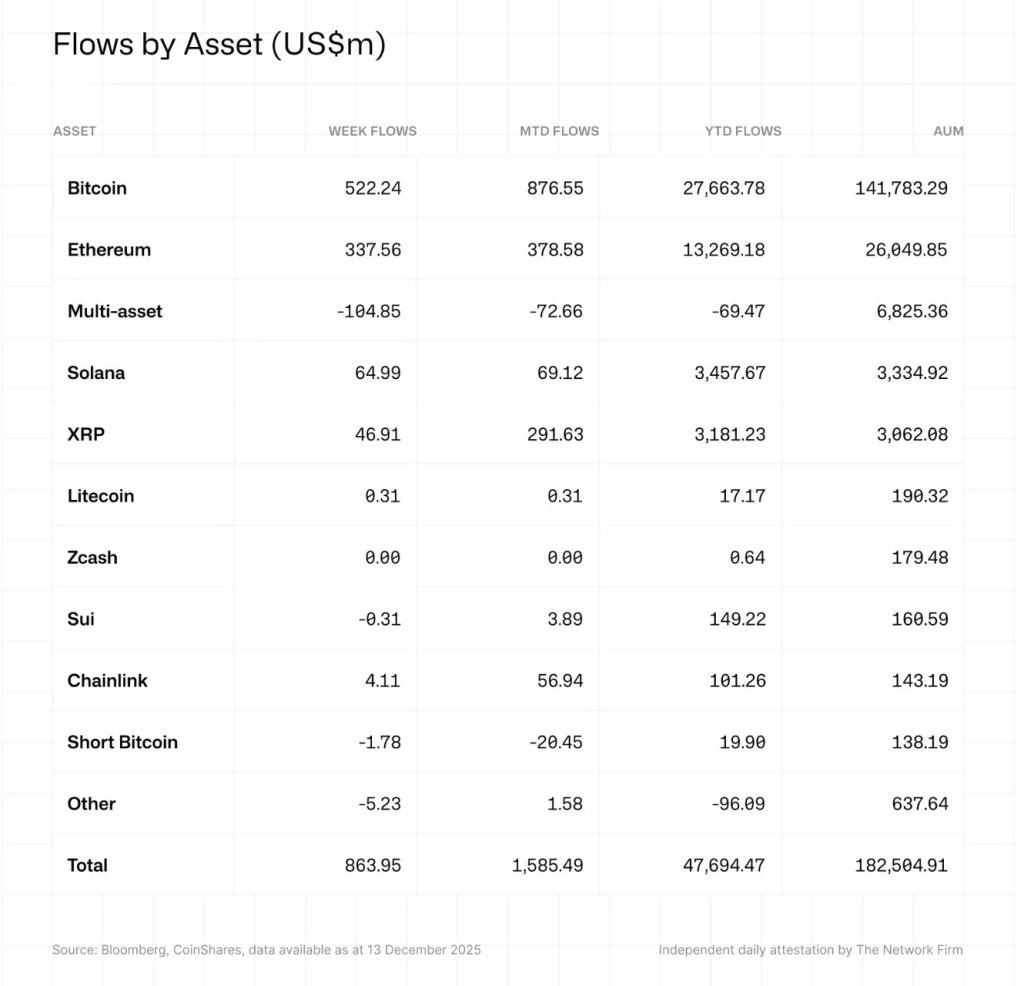
Total inflows across digital asset investment products reached $864 million over the broader reporting period, underscoring continued demand even as macro uncertainty persists. CoinShares said the data also suggests investors are increasing exposure rather than making broad risk-on bets.

US Dominates Regional Inflows

Inflows were broad-based geographically but heavily concentrated in a handful of markets. The US led by a wide margin accounting for $483 million of weekly inflows followed by Germany with $96.9 million and Canada with $80.7 million.

Looking at a longer timeframe, the US also continues to dominate sentiment posting $796 million of inflows last week alone. Germany and Canada also remained net positive, with inflows of $68.6 million and $26.8 million respectively. CoinShares said these three countries have driven the bulk of demand in 2025.

Bitcoin, Ethereum and XRP Lead Demand

Bitcoin remained the largest beneficiary in absolute terms, attracting $352 million in weekly inflows. Notably, short-Bitcoin investment products recorded outflows of $1.8 million, signalling a further easing of negative sentiment toward the asset.

Despite thje renewed interest CoinShares highlights that Bitcoin has been a relative laggard this year, with year-to-date inflows of $27.7 billion compared to $41 billion over the same period in 2024.

Ethereum continues to close the gap recording $338 million in weekly inflows and lifting year-to-date inflows to $13.3 billion. That figure is a 148% increase compared to 2024 also reflecting growing institutional engagement with Ethereum-based products.

XRP also stood out – drawing $245 million in inflows while Chainlink posted a record $52.8 million weekly inflow — equivalent to 54% of its total AuM.

Altcoins Show Selective Strength

Beyond the major cryptos Solana’s year-to-date inflows reached $3.5 billion, a tenfold increase compared to 2024, even though recent weekly flows were more muted.

Aave and Chainlink recorded smaller weekly inflows of $5.9 million and $4.1 million respectively.

Not all assets benefited – Hyperliquid saw weekly outflows of $14.1 million, highlighting that investor appetite remains selective rather than indiscriminate.

Overall CoinShares said the data points to a market that is stabilising, with capital gravitating toward large-cap and established digital assets as confidence slowly returns.

The post Digital Asset ETP Inflows Hit $716M as Bitcoin, Ethereum and XRP Lead Weekly Gains: CoinShares appeared first on Cryptonews.

JPMorgan to Launch Tokenized Money-Market Fund on Ethereum Seeding $100M in Capital: WSJ

JPMorgan Chase’s $4 trillion asset-management division is launching its first tokenized money-market fund on the Ethereum blockchain, according to a Wall Street Journal report.

The bank will initially seed the vehicle with $100 million of its own capital before opening it to external investors from Tuesday.

Exclusive: JPMorgan Chase is joining the list of traditional financial firms seeking to bring blockchain technology to an investing staple: the money-market fund.

— The Wall Street Journal (@WSJ) December 15, 2025

JPMorgan Brings Money Markets Onchain

According to the WSJ report the private fund, called the My OnChain Net Yield Fund — or “MONY” — is built on JPMorgan’s in-house tokenization platform, Kinexys Digital Assets.

It will be available to qualified investors, defined as individuals with at least $5 million in investable assets and institutions with a minimum of $25 million. The minimum investment size is set at $1 million.

Tokenization Gains Momentum After GENIUS Act

The launch comes during a rise in momentum for tokenized financial products following the passage of the GENIUS Act earlier this year. The legislation established a US regulatory framework for dollar-backed stablecoins, helping to remove uncertainty around onchain settlement and digital representations of traditional assets.

Since then, Wall Street firms have accelerated efforts to tokenize everything from equities and bonds to real-world assets, viewing blockchain as a way to improve operational efficiency, reduce settlement times and expand investor access.

“There is a massive amount of interest from clients around tokenization,” said John Donohue, head of global liquidity at J.P. Morgan Asset Management told the WSJ.

“And we expect to be a leader in this space and work with clients to make sure that we have a product lineup that allows them to have the choices that we have in traditional money-market funds on blockchain,” adds Donohue.

How the MONY Fund Works

Investors can subscribe to the MONY fund through JPMorgan’s Morgan Money portal, the bank’s digital money-market investing platform. In return, investors receive digital tokens representing their fund shares, which are held in their crypto wallets.

Like traditional money-market funds, MONY invests in baskets of short-term, high-quality debt instruments. The fund accrues dividends daily and pays interest designed to track prevailing money-market yields, which have remained attractive amid a higher interest rate environment.

Stablecoins and Institutional Adoption

Subscriptions and redemptions can be made using either cash or USDC, the dollar-pegged stablecoin issued by Circle Internet Group. Allowing USDC settlement highlights how regulated financial products are increasingly incorporating crypto-native payment rails.

JPMorgan’s move builds on its broader blockchain strategy, which includes tokenized deposits, onchain settlement and wholesale payment infrastructure. While MONY is limited to institutional and high-net-worth investors, it shows a broader shift toward integrating blockchain into core financial products once considered far removed from crypto.

The post JPMorgan to Launch Tokenized Money-Market Fund on Ethereum Seeding $100M in Capital: WSJ appeared first on Cryptonews.

Doha Bank Completes $150M Instantly Settled Digital Bond Led by Standard Chartered

By: Amin Ayan

Doha Bank has completed its first digitally native US dollar bond, issuing $150 million in floating-rate notes that settled instantly using distributed ledger technology.

Key Takeaways:

  • Doha Bank completed a $150 million digital bond with instant T+0 settlement.
  • Standard Chartered led the deal using Euroclear’s regulated DLT platform.
  • The issuance highlights growing adoption of digital bonds in the Gulf.

The notes were listed on the London Stock Exchange’s International Securities Market and achieved same-day, or T+0, settlement through Euroclear’s Digital Financial Market Infrastructure (D-FMI), according to a Monday announcement.

The transaction marks one of Qatar’s earliest digitally native US dollar bond issuances and reflects a growing push across the Gulf region to modernize capital markets infrastructure.

Standard Chartered Leads Doha Bank’s Digital Bond Issuance

Standard Chartered acted as sole global coordinator and sole arranger, overseeing the structuring, execution, and distribution of the bond.

Unlike traditional securities, which typically settle one or two days after trading, Doha Bank’s digital notes were issued, allocated, and settled in real time.

Euroclear’s D-FMI platform, a permissioned distributed ledger operated by a central securities depository, handled issuance and settlement while remaining fully integrated with existing market standards and post-trade systems. Citi served as issuing and paying agent on the transaction.

Doha Bank said the issuance supports its broader funding strategy by diversifying sources of capital and expanding its investor base.

Sheikh Abdulrahman Bin Fahad Al-Thani, the bank’s group chief executive, said the transaction demonstrates how digital infrastructure can improve efficiency and market access while reinforcing Qatar’s position as a regional financial hub.

He added that the deal aligns with Qatar Central Bank initiatives aimed at strengthening the resilience and competitiveness of the country’s capital markets.

Doha Bank completes a $150 million digital bond issuance using Euroclear’s DLT platform.

The bond settled instantly (T+0) on a permissioned distributed ledger signaling the region’s growing preference for regulated, institution-grade digital bond infrastructure.

— Moon Republic (@MoonRepublic_io) December 15, 2025

Standard Chartered said the bond highlights rising institutional demand for digital issuance that delivers measurable operational gains.

Salman Ansari, the bank’s global head of capital markets, said the deal shows how regulated digital infrastructure is moving beyond pilot projects and into live market activity.

The issuance also reflects a broader industry trend favoring permissioned distributed ledger systems over public blockchains for tokenized debt.

Regulated platforms such as Euroclear’s D-FMI allow issuers to benefit from features like instant settlement and automated recordkeeping while preserving legal finality, controlled access, and compatibility with custody and clearing frameworks used by institutional investors.

Same-Day Settlement Works Within Existing Market Structures

Euroclear said the transaction demonstrates that same-day settlement can be achieved without disrupting existing market structures.

“Equally important, integration with traditional secondary-market services and trading venues ensures that investors retain access to liquidity,” Sebastien Danloy, Chief Business Officer at Euroclear, said.

As reported, Mastercard is in late-stage talks to acquire crypto infrastructure firm Zerohash for between $1.5 billion and $2 billion, a deal that would deepen the payments giant’s push into stablecoins and on-chain settlement.

If completed, the acquisition would give Mastercard greater control over how fiat and digital assets settle across its network as payments firms move toward always-on, 24/7 money.

The talks come amid intensifying competition, with Stripe’s recent purchase of stablecoin firm Bridge and Coinbase’s reported interest in BVNK highlighting a broader race among payment providers to secure the infrastructure needed as stablecoins shift from trading platforms into everyday payments.

The post Doha Bank Completes $150M Instantly Settled Digital Bond Led by Standard Chartered appeared first on Cryptonews.

Agnelli Family Rejects Tether’s $1 Billion Bid for Juventus Stake

The Agnelli family has unanimously rejected Tether’s binding all-cash proposal to acquire majority control of Juventus Football Club, dismissing the stablecoin issuer’s €1 billion ($1.17 billion) investment pledge just one day after the offer became public.

According to Dow Jones Newswires, Exor, the family’s holding company, said Saturday it has no intention of selling its 65.4% stake to the El Salvador-based crypto firm or any third party, ending what would have been one of European football’s most audacious takeover attempts this year.

Tether submitted its formal proposal on Friday, seeking to purchase Exor’s controlling position and subsequently launch a public tender for all remaining shares at an undisclosed price.

As per Reuters, Juventus shares surged more than 12% Monday morning, reaching their highest level since November 25, after the rejection implied a 21% premium to Friday’s close despite the family’s refusal to negotiate.

@Tether_to has launched an all-cash bid to acquire Italy’s @juventusfcen, an offer that was reportedly swiftly turned down.#Tether #Cryptohttps://t.co/4iTBXWjo5V

— Cryptonews.com (@cryptonews) December 13, 2025

Century-Old Legacy Defends Against Crypto Ambition

Exor’s board emphasized that Juventus represents more than a commercial asset for the Agnelli dynasty, which has maintained ownership for over a century.

Juventus is a storied and successful club, of which Exor and the Agnelli family are the stable and proud shareholders for over a century, and they remain fully committed to the club,” the holding company stated, closing the door on further discussions.

Tether CEO Paolo Ardoino positioned the rejected offer as a long-term commitment rooted in his personal connection to the Turin-based Serie A club.

As a boy, I learned what commitment, resilience, and responsibility meant by watching Juventus face success and adversity with dignity,” Ardoino said, adding that Tether was prepared to support the club with stable capital across a lengthy investment horizon.

The stablecoin issuer framed its proposal as a strategic move to help Juventus navigate a rapidly changing global sports and media landscape.

Despite the rebuff, Tether maintains significant influence within Juventus after quietly purchasing an initial stake in February and expanding holdings beyond 10% by April.

The company successfully placed deputy investment chief Zachary Lyons and Francesco Garino on Juventus’s board in October, with shareholders approving Garino’s appointment last month.

Private Equity Reshapes European Football Landscape

Tether’s rejected bid arrives amid accelerating private-equity interest in European football clubs, as they seek to capitalize on lucrative media rights and player transfer markets.

According to Newswires, Apollo Global Management agreed last month to acquire majority control of Spanish club Atletico de Madrid, while RedBird Capital purchased AC Milan for $1.2 billion in 2022 and Oaktree Capital seized FC Inter Milan last year.

Financial groups have rushed into European football as clubs generate increasing revenue from international broadcasting deals and player transactions.

Juventus, valued at roughly €944 million, represents a particularly attractive target given its status as Italy’s most successful club with a global fanbase and established commercial infrastructure.

However, crypto partnerships have drawn sharp criticism when clubs partner with questionable firms.

FC Barcelona faced backlash in November after signing a three-year sponsorship deal with Zero-Knowledge Proof, a blockchain startup registered in Samoa with minimal social media presence.

⚽ FC Barcelona draws backlash over sponsorship with obscure crypto firm ZKP amid concerns about transparency and financial desperation.#Barcelona #Cryptohttps://t.co/kvkBEK0a5j

— Cryptonews.com (@cryptonews) November 28, 2025

The club later distanced itself from ZKP’s FCB token, clarifying it had “no connection whatsoever” to the digital asset.

Sports crypto adoption is growing. Paris Saint-Germain became the first sports entity to adopt a Bitcoin treasury strategy in May, while football accounted for 43% of crypto and digital asset sponsorships during the 2024/25 season, up 64% year-over-year.

Tether’s Aggressive Expansion Across Multiple Sectors

Tether’s broader expansion push has accelerated dramatically across multiple sectors, with the company on track to generate approximately $15 billion this year from its $183.8 billion USDT market capitalization.

Recent reports also suggest Tether may seek $20 billion in new capital for a 3% ownership stake, establishing a valuation near $500 billion that would approach Mastercard while eclipsing Netflix and Samsung.

The firm has simultaneously deployed approximately $1.5 billion in commodity trade lending across oil, cotton, and agricultural markets while expanding its gold reserves beyond $12 billion to support this aggressive diversification strategy beyond its core stablecoin operations.

The post Agnelli Family Rejects Tether’s $1 Billion Bid for Juventus Stake appeared first on Cryptonews.

Why Is Crypto Down Today? – December 15, 2025

As a new week begins, the crypto market is down today, with the cryptocurrency market capitalisation decreasing by 0.5%. It now stands at $3.15 trillion. About 80 of the top 100 coins have gone down over the past 24 hours. At the same time, the total crypto trading volume is at $94.3 billion, notably lower than what we’ve been seeing over the past month.

TLDR:
  • Crypto market cap decreased by 0.5% on Monday morning (UTC);
  • 80 of the top 100 coins and 5 of the top 10 coins have gone down today;
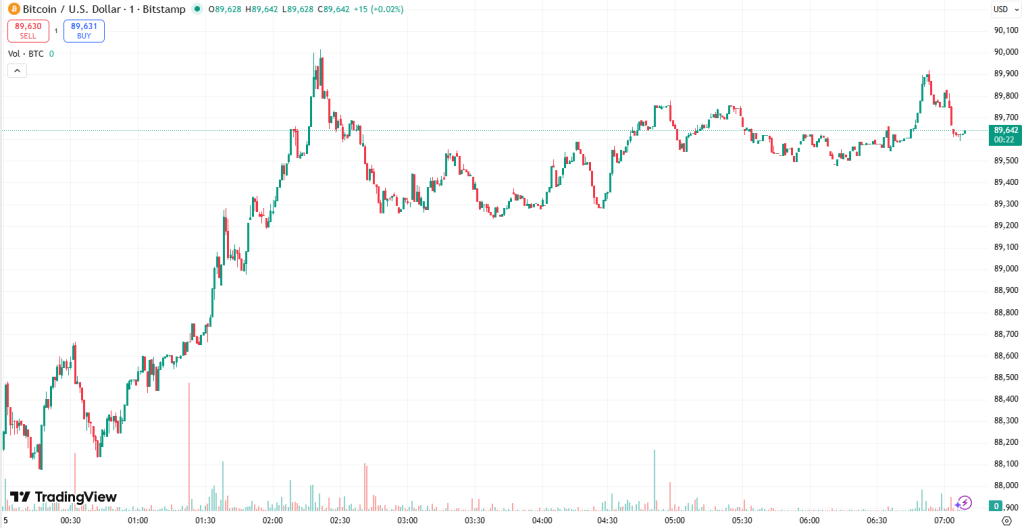
  • BTC decreased by 0.5% to $89,627, and ETH is up by 0.6% to $3,128;
  • The Bank of Japan prepares for a rate increase on 19 December;
  • We’re not in a bear market yet;
  • $74,000 is a critical support zone that bulls must defend;
  • Bitcoin will prove the four-year-cycle remains with a bear market or break it with a bull run;
  • A spark is waiting to ignite volatility compression into an explosion;
  • US BTC spot ETFs saw inflows of $49.16 million, while ETH spot ETFs recorded $19.41 million on Friday;
  • The US SEC issued new crypto custody guidance for retail investors;
  • Crypto market sentiment barely moved.
  • Crypto Winners & Losers

    At the time of writing, 5 of the top 10 coins per market capitalisation have seen their prices decrease over the past 24 hours, and three are up (not taking the two stablecoins into account).

    Bitcoin (BTC) is down by 0.5% since this time yesterday, currently trading at $89,627. This is the smallest decrease in this category.

    btc logo
    Bitcoin (BTC)
    24h7d30d1yAll time

    Ethereum (ETH) is up by 0.6%, now changing hands at $3,128.

    The highest decrease on the list is Dogecoin (DOGE)’s 1.5% to $0.1362.

    It’s followed by XRP’s 1.2%. The coin now stands at $1.99.

    On the other hand, Tron (TRX) is the category’s best performer, having appreciated 2.5%, currently trading at $0.2816.

    Looking at the top 100 coins, we find that 80 have dropped over the past day.

    MemeCore (M) fell the most in this category: 6.1% to the price of $1.7.

    It’s followed by Midnight (NIGHT), which is down 5.1% to $0.06792.

    On the green side, two coins saw double-digit increases. Rain (RAIN) appreciated 11.6% to the current $0.007968.

    Provenance Blockchain (HASH) follows with a rise of 11% to the current $0.03013.

    The rest of this list is up by 2.4% and less per coin.

    The market is still consolidating. Lower holiday liquidity and institutional momentum keep BTC range-bound, while traders await new catalysts.

    Moreover, all eyes are on the Bank of Japan now, as it prepares to implement a 25-basis-point rate increase on 19 December.

    Ignacio Aguirre, CMO at Bitget, told Cryptonews that a stronger yen “raises the risk of unwinding yen carry trades which is a move that can temporarily weigh on crypto valuations as leveraged positions reset across global markets.”

    Not a Bear Market (Yet)

    Tony Severino, Market Analyst at YouHodler, argues that “Bitcoin, by definition, is in an uptrend.”

    For BTC to shift into a bear market, a downtrend needs to be confirmed with a lower low. This makes $74,000 a critical support zone that bulls must defend to keep BTC bullish, the analyst says.

    The coin could try to reclaim the 50-week Moving Average, located at around $102,000. Therefore, $100,000 will act as a key psychological barrier for price.

    “The psychology around $100,000 per BTC makes it an ideal zone for a bull trap. Above $100,000 could embolden bulls with a “we’re so back” mentality, which blinds them to a potential reversal back down to new lows. If bulls are able to reclaim $100,000 and hold the support line for weeks to months, any chance of a bear market will likely be cancelled.”

    Meanwhile, a storm is coming, Severino says. While volatility stirs on the lowest timeframes, the market is still unusually calm at higher timeframes, he says. “A spark is waiting to ignite this compression into an explosion.”

    Moreover, sentiment remains at fearful extremes. “While this can be a catalyst for a sustained bounce in a bull market, fear and panic measures stay elevated throughout the duration of a bear market.”

    Severino concludes that Bitcoin will either prove the four-year-cycle remains with a bear market, or break the cyclical pattern with a renewed bull run.

    Levels & Events to Watch Next

    At the time of writing on Monday morning, BTC stood at $89,627. The coin began the day with the intraday high of $90,265, gradually falling to the low of $87,892. It then jumped to $89,898 before moving to the current price.

    Over the past week, BTC moved between $88,230 and $94,267. It’s down 2.2% in this period. It’s also down 6.9% in a month and 28.8% from the all-time high of $126,080.

    Should the market go downwards, BTC could see the sub-$80,000 level. It may fall to $76,300, followed by $70,000. Conversely, a push upwards could help it regain the $100,000 territory.

    Bitcoin Price Chart. Source: TradingView

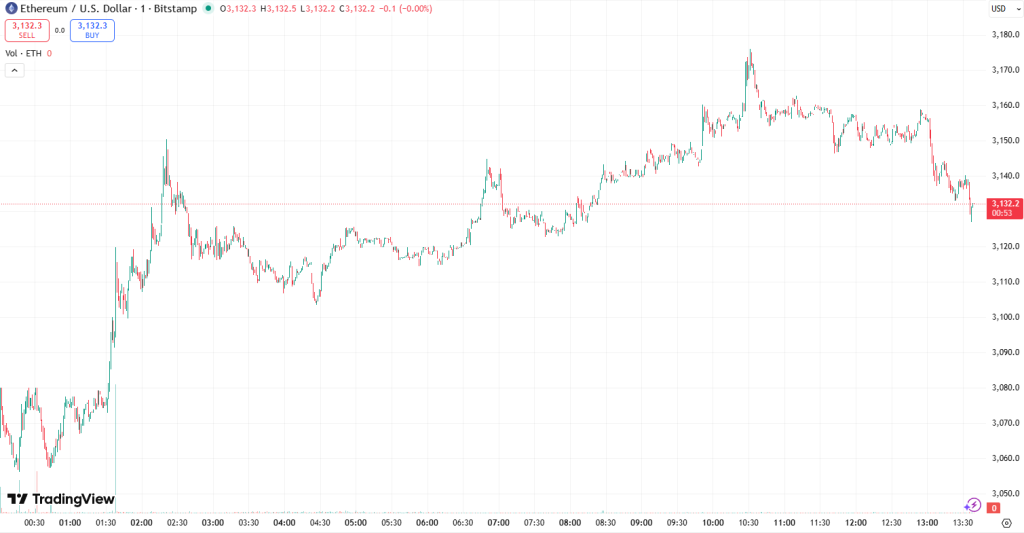
    Ethereum is currently changing hands at $3,128. Unlike BTC, ETH started the day at $3,119, gradually trading lower to the intraday low of $3,052. It then surged to the intraday high of $3,141.

    Moreover, ETH is unchanged in a week, trading in the $3,065–$3,390 range. At the same time, it’s down 1.4% in a month and 36.6% from the ATH of $4,946.

    Ethereum could see its price reclaim the $3,200 level, after which it could seek to regain the $3,290-$3,370 levels as well. However, another drop could return it to the $2,900 zone and below.

    Ethereum (ETH)
    24h7d30d1yAll time

    Meanwhile, the crypto market continues moving in a very tight range, much like the market itself. The crypto fear and greed index stands at 27 today, the same as yesterday.

    This further highlights the market’s indecisiveness and the participants’ caution as everybody await a macroeconomic signal strong enough to give the prices a push in either direction.

    ETFs Saw a Mixed Friday

    Following a single red day, the US BTC spot exchange-traded funds (ETFs) recorded $49.16 million in inflows on Friday. The total net inflow increased slightly to $57.9 billion.

    Of the twelve BTC ETFs, one recorded inflows and one saw outflows. BlackRock added $51.13 million.

    At the same time, Fidelity posted $1.96 million in outflows.

    Moreover, the US ETH ETFs recorded negative flows for a second day in a row, with $19.41 million in outflows on 12 December. The total net inflow pulled back very slightly compared to Thursday, standing at $13.09 billion.

    Of the nine funds, one recorded inflows, and three saw outflows. BlackRock accounted for all the inflows for the day with $23.25 million.

    Grayscale let go of $36.52 million, while Fidelity saw $6.14 million in outflows.

    Meanwhile, the US Securities and Exchange Commission (SEC) issued new crypto custody guidance for retail investors. It urged them to understand the risks and options before storing digital assets.

    The SEC’s Office of Investor Education and Assistance outlined the technicalities of crypto asset custody, and it defined self-managed wallets and third-party custodians.

    Curious about crypto wallets and how to store and access crypto assets? Check out our Crypto Asset Custody Basics Investor Bulletin.https://t.co/x4HMYMHLAe pic.twitter.com/bSbP25nzOc

    — U.S. Securities and Exchange Commission (@SECGov) December 13, 2025

    Quick FAQ

    1. Why did crypto move with stocks today?

    The crypto market saw a decrease over the past 24 hours, and the US stock market posted a drop during its previous session. By the closing time on Friday, 12 December, the S&P 500 was down by 1.07%, the Nasdaq-100 decreased by 1.91%, and the Dow Jones Industrial Average fell by 0.51%. Tech shares continued experiencing significant pressure as AI bubble concerns grew.

    1. Is this drop sustainable?

    Some fresh catalysts, such as the Bank of Japan’s rate increase, could impact the crypto market in the short term and push it out of the consolidation range. Barring such significant catalysts, the prices are likely to continue trading sideways and lower for a while longer.

    The post Why Is Crypto Down Today? – December 15, 2025 appeared first on Cryptonews.

    Do Kwon Could Face Second Trial in Korea After 15-Year US Sentence

    Terraform Labs co-founder Do Kwon faces the possibility of an additional trial and lengthy prison term in South Korea following his 15-year sentence from a Manhattan federal court for orchestrating the $40 billion TerraUSD collapse.

    According to The Korea Times, the 34-year-old Korean national could apply to be transferred to his home country after serving half his US term, where prosecutors are seeking a sentence exceeding 30 years for violations of capital markets laws.

    US District Judge Paul Engelmayer delivered the sentence last week, rejecting both the prosecution’s 12-year recommendation and the defense’s five-year request.

    In the history of federal prosecutions, there are few frauds that have caused as much harm as you have,” Engelmayer told Kwon directly.

    Do Kwon Korea Sentence - Do Kwon Arrest Picture
    Source: The Korea Times

    Korean Authorities Prepare Separate Prosecution

    South Korean prosecutors obtained an arrest warrant for Kwon in September 2022 through the Seoul Southern District Prosecutors’ Office joint financial crimes unit.

    A senior prosecutor told the local report that prosecuting Kwon domestically would serve local victims most effectively, as approximately 200,000 Korean investors have suffered losses totaling roughly 300 billion won ($204 million).

    Ten alleged accomplices have faced trial in Korea for nearly three years while authorities awaited Kwon’s potential return.

    The separate Korean charges center on violations of the Capital Markets Act stemming from the same conduct underlying his US conviction.

    However, Korean prosecutors maintain they can pursue independent punishment regardless of the American proceedings.

    Kwon initially sought extradition to Korea rather than to the United States after his March 2023 arrest in Montenegro on charges of possessing forged documents.

    He spent nearly two years detained there before transfer to America in December 2024, with his defense team describing the conditions as “brutal.”

    ⚖ US prosecutors demand 12-year sentence for Do Kwon after Terra's $40B collapse that destabilized crypto markets and aided FTX implosion.#FTX #DoKwon #TerraFormhttps://t.co/LfzwEWH4XG

    — Cryptonews.com (@cryptonews) December 6, 2025

    Terra Collapse Mechanics and Fraudulent Claims

    Between 2018 and 2022, Kwon admitted to knowingly participating in schemes to defraud Terraform Labs’ crypto purchasers.

    The Singapore-based firm issued the TerraUSD stablecoin and its sister token, Luna, claiming that Terra maintained a one-to-one dollar peg through its protocol design.

    When Terra fell below $1 in May 2021, Kwon publicly stated the protocol had restored its value autonomously.

    US prosecutors later discovered that an investment firm contracted by Terraform Labs had secretly purchased Terra to artificially prop up its price, with Jump Trading’s role deliberately concealed from investors.

    Both tokens plunged again in May 2022, wiping out tens of billions in investor value and triggering cascading failures across cryptocurrency markets.

    Federal prosecutors specifically cited the collapse’s contribution to Sam Bankman-Fried’s FTX implosion as evidence of broader systemic damage beyond Terra’s immediate losses.

    Kwon was convicted on nine counts, including fraud and money laundering, and Judge Engelmayer ordered the forfeiture of $19 million in illicit gains.

    The initial potential sentence under US guidelines was 130 years, but the August plea agreement capped prosecutorial recommendations at 12 years.

    Sentencing Disparities and Transfer Mechanics

    Judge Engelmayer called the 12-year recommendation “unreasonable” while dismissing the five-year request as “implausible,” ultimately imposing 15 years as “the least I can impose.”

    The defense argued that dual prosecution should be factored into sentencing calculations, particularly given the overlap in allegations across jurisdictions.

    The court rejected this reasoning, with Engelmayer stating that one court cannot base rulings on speculation about another court’s decisions.

    US prosecutors indicated they would not oppose a transfer request under the International Prisoner Transfer Program after Kwon serves half his sentence, leaving the pathway to Korean prosecution open.

    🏦 US District Judge Paul A. Engelmayer handed down a 15-year prison sentence to Terraform Labs co-founder Do Kwon for Terra's $40 billion crash.#DoKwon #TerraUSD #CryptoFraudhttps://t.co/7N3WlnQrTB

    — Cryptonews.com (@cryptonews) December 12, 2025

    The contrasting treatment compared to Bankman-Fried’s 25-year sentence has raised questions about consistency, as Kwon’s guilty plea significantly reduced exposure despite Terra’s larger loss.

    Legal experts note that federal guidelines for fraud at Terra’s scale typically suggest advisory ranges approaching life imprisonment before statutory caps.

    Kwon will receive credit for time served in US custody, though questions remain about whether his 21-month detention in Montenegro will count toward his American term.

    The sentencing comes amid escalating crypto-related criminal activity worldwide.

    Spanish and Danish authorities recently arrested nine suspects in a violent kidnapping and murder targeting a victim’s crypto holdings.

    Just last month, South Australia Police also filed 800 charges against 55 individuals in a massive crypto-linked crime ring.

    The post Do Kwon Could Face Second Trial in Korea After 15-Year US Sentence appeared first on Cryptonews.

    Major JavaScript Library Breach Puts All Crypto Websites at Risk

    A critical security flaw in React Server Components has prompted urgent warnings across the crypto industry, as threat actors are rapidly exploiting it to drain wallets and deploy malware.

    Security Alliance announced that crypto-drainers are actively weaponizing CVE-2025-55182, urging all websites to review their front-end code immediately for suspicious assets.

    The vulnerability affects not only Web3 protocols but all websites using React, with attackers targeting permit signatures across platforms.

    Users face immediate risk when signing any transaction, as malicious code intercepts wallet communications and redirects funds to attacker-controlled addresses.

    Crypto Drainers using React CVE-2025-55182

    We are observing a big uptick in drainers uploaded to legitimate (crypto) websites through exploitation of the recent React CVE.

    All websites should review front-end code for any suspicious assets NOW.

    — Security Alliance (@_SEAL_Org) December 13, 2025

    Critical Flaw Enables Remote Code Execution

    React’s official team disclosed CVE-2025-55182 on December 3, rating it CVSS 10.0 following Lachlan Davidson’s November 29 report through Meta Bug Bounty.

    The unauthenticated remote code execution vulnerability exploits how React decodes payloads sent to Server Function endpoints, allowing attackers to craft malicious HTTP requests that execute arbitrary code on servers.

    The flaw impacts React versions 19.0, 19.1.0, 19.1.1, and 19.2.0 across react-server-dom-webpack, react-server-dom-parcel, and react-server-dom-turbopack packages.

    Major frameworks, including Next.js, React Router, Waku, and Expo, require immediate updates. Patches arrived in versions 19.0.1, 19.1.2, and 19.2.1, with Next.js users needing upgrades across multiple release lines from 14.2.35 through 16.0.10.

    Unfortunately, the researchers have again detected two major new flaws.

    Researchers have found two new vulnerabilities in React Server Components while attempting to exploit the patches last week.

    These are new issues, separate from the critical CVE last week. The patch for React2Shell remains effective for the Remote Code Execution exploit.

    — React (@reactjs) December 11, 2025

    Vercel deployed Web Application Firewall rules to automatically protect projects on its platform, though the company emphasized that WAF protection alone remains insufficient.

    Immediate upgrades to a patched version are required,” Vercel stated in its December 3 security bulletin, adding that the vulnerability affects applications that process untrusted input in ways that permit remote code execution.

    Multiple Threat Groups Launch Coordinated Attacks

    Google Threat Intelligence Group documented widespread attacks beginning on December 3, tracking criminal groups ranging from opportunistic hackers to government-backed operations.

    Chinese hacking groups installed various malware types on compromised systems, primarily targeting cloud servers on Amazon Web Services and Alibaba Cloud.

    These attackers employed sophisticated techniques to maintain long-term access to victim systems.

    Some groups installed software creating secret tunnels for remote control, while others deployed programs that continuously download additional malicious tools disguised as legitimate files. The malware hides in system folders and automatically restarts to avoid detection.

    Several groups disguised malicious software as common programs or used legitimate cloud services, such as Cloudflare Pages and GitLab, to hide their communications.

    New details on multiple state and criminal actors now exploiting React2Shell. https://t.co/4M21rqLndT

    — John Hultquist (@JohnHultquist) December 13, 2025

    Financially motivated criminals joined the attack wave starting on December 5, installing crypto-mining software that secretly uses victims’ computing power to generate Monero.

    These miners run constantly in the background, driving up electricity costs while generating profits for attackers. Underground hacking forums quickly filled with discussions sharing attack tools and exploitation experiences.

    Historic Supply Chain Attack Pattern Continues

    The React vulnerability follows a September 8 attack in which hackers compromised Josh Goldberg’s npm account and published malicious updates to 18 widely used packages, including chalk, debug, and strip-ansi.

    These utilities collectively account for over 2.6 billion weekly downloads, and researchers have discovered crypto-clipper malware that intercepts browser functions to swap legitimate wallet addresses with attacker-controlled ones.

    Ledger CTO Charles Guillemet described that incident as a “large-scale supply chain attack,” advising users without hardware wallets to avoid on-chain transactions.

    The attackers gained access through phishing campaigns impersonating npm support, claiming accounts would be locked unless two-factor authentication credentials were updated by September 10.

    🚨 Hackers are stealing more crypto and moving it faster. One laundering process took only 2 minutes 57 seconds. Can the industry cope?#CryptoSecurity #Web3 #Blockchain #DeFihttps://t.co/lGwutYsT6Q

    — Cryptonews.com (@cryptonews) August 12, 2025

    Global Ledger data shows hackers stole over $3 billion across 119 incidents in the first half of 2025, with 70% of breaches involving funds being moved before they became public.

    Only 4.2% of stolen assets were recovered, as laundering now takes seconds rather than hours.

    For now, organizations using React or Next.js are advised to patch immediately to versions 19.0.1, 19.1.2, or 19.2.1, deploy WAF rules, audit all dependencies, monitor network traffic for wget or cURL commands initiated by web server processes, and hunt for unauthorized hidden directories or malicious shell configuration injections.

    The post Major JavaScript Library Breach Puts All Crypto Websites at Risk appeared first on Cryptonews.

    Hex Trust’s High-Stakes Wrapped XRP Gambit: $100M Liquidity Infusion Fuels Bridge Exploit Fears

    Institutional custodian Hex Trust announced the launch of Wrapped XRP (wXRP) on Thursday, deploying the token across Ethereum, Solana, Optimism, and HyperEVM with $100 million in initial liquidity.

    The move aims to anchor Ripple’s RLUSD stablecoin pairs on EVM chains. XRP remained flat on the news, while RLUSD supply held steady at 1.3 billion.

    The Signal: XRP Liquidity vs. Security

    Hex Trust’s wXRP enters a crowded market already fragmented by Coinbase’s cbXRP and Axelar’s eXRP. The $100 million seed capital is intended to support trading pairs immediately, thereby eliminating the “cold start” problem that typically accompanies new wrapped assets.

    The structure is a standard 1:1 custodial model: Hex Trust holds the native XRP; users get the IOU. While this enables DeFi composability, it reintroduces the single point of failure—the custodian—that the XRP Ledger was built to eliminate.

    The Risk Vector

    The timing is precarious. Bridge and custodian exploits were the culprit behind over 50% of all crypto losses in the first half of 2025. By moving XRP off its native ledger, holders swap protocol security for smart contract risk.

    Hex Trust attempts to mitigate this via LayerZero’s Omnichain Fungible Token (OFT) standard, which theoretically reduces attack surfaces compared to traditional “lock-and-mint” bridges. Yet, the big prize for hackers remains: $100 million sitting in a single custodial wallet.

    The Institutional Take: Can XRP Really go to Zero?

    While the headline is the $100M liquidity, the real story is the fragmentation of XRP liquidity. We now have three major synthetic XRP variants (cbXRP, eXRP, wXRP) competing for the same DeFi flows.

    For desks, this creates arbitrage opportunities but fractures deep liquidity. Expect spreads to widen across these variants until a clear winner emerges. The real risk isn’t the wrapper—it’s the bridge. If the Hex Trust multisig is compromised, wXRP goes to zero, regardless of the underlying asset’s health.

    The post Hex Trust’s High-Stakes Wrapped XRP Gambit: $100M Liquidity Infusion Fuels Bridge Exploit Fears appeared first on Cryptonews.

    North Korean Actors Use ‘Fake Zoom’ to Drain Crypto Wallets, $300M Stolen Already

    North Korean cybercriminals are using ‘fake Zoom’ tactics to install malware, stealing victims’ sensitive data, including passwords and private keys. Cybersecurity firm Security Alliance (SEAL) warned that it has been tracking “multiple daily” such attempts.

    SEAL is tracking multiple DAILY attempts by North Korean actors utilizing “Fake Zoom” tactics for spreading malware as well as escalating their access to new victims.

    Social engineering is at the root of the attack. Read the thread below for pointers on how to stay secure. https://t.co/2SQGdtPKGx

    — Security Alliance (@_SEAL_Org) December 13, 2025

    The warning comes after MetaMask security researcher Taylor Monahan first outlined the sophisticated trap orchestrated by the DPRK threat actors.

    “They’ve stolen over $300m via this method already,” Monahan wrote on X. “DPRK threat actors are still rekting way too many of you via their fake Zoom / fake Teams meets.”

    Fake Zoom Modus Operandi – “They’re Taking Over Your Telegrams”

    According to Monahan, the scam typically begins with a message from a Telegram account, appears to belong to someone the victim knows.

    “They message everyone with prior conversation history,” he said.

    The hacker, disguised as the “known person,” then guides the victim to a Zoom link via Calendly. Once the meeting starts, the victim sees a live video feed of their contact and other team members, which is a recorded video in reality, rather than deepfakes.

    The hacker then complains about the lack of audio clarity, sending a “patch” file via chat and asking the victim to restore the clarity by updating a software development kit, or SDK. The file shared contains the malware payload.

    The malware, often a Remote Access Trojan (RAT), if installed, will exfiltrate sensitive data, including internal security protocols, passwords, and drain crypto wallets completely.

    North Korean Hackers’ Strategic Pivot in Social Engineering Campaigns

    North Korean hackers, including the infamous Lazarus Group, have been previously linked to high-profile crypto thefts aimed at generating millions in revenue.

    For instance, recently sophisticated North Korean hackers infiltrated crypto companies through elaborate job application schemes and fake interview processes.

    Last month, the Lazarus Group orchestrated a major cryptocurrency breach that drained roughly $30.6 million from South Korea’s largest exchange, Upbit.

    In the latest ‘fake Zoom’ call tactic, experts have warned users to immediately disconnect from WiFi and power off the device to halt malware activity.

    ⚠ If you clicked…

    – DISCONNECT WIFI

    – TURN COMPUTER OFF

    – DO NOT USE COMPUTER.

    – ONLY USE PHONE/IPAD.

    – Move funds out of your wallets to new/secure hardware or CEX accounts. Change all your passwords, AWS keys, etc.

    – Wipe the computer completely before using it again. pic.twitter.com/C5NTGu4bsR

    — Tay 💖 (@tayvano_) December 13, 2025

    The latest attack comes at a time when global crypto thefts have reached $2.17 billion in stolen assets by mid-2025.

    The post North Korean Actors Use ‘Fake Zoom’ to Drain Crypto Wallets, $300M Stolen Already appeared first on Cryptonews.

    Binance Rejects Claims of Delayed Response in Upbit Hack Case

    By: Amin Ayan

    Binance has pushed back against claims that it failed to act swiftly in freezing funds linked to last month’s Upbit hack, rejecting reports that it only partially complied with requests from South Korean authorities.

    Key Takeaways:

    • Binance denies claims that it delayed or partially complied with requests to freeze Upbit hack funds.
    • The exchange says it acted immediately and continues to work with law enforcement on the case.
    • South Korean authorities allege only a fraction of the stolen assets were frozen as hackers rapidly laundered the funds.

    In a statement shared with Cryptonews, a Binance spokesperson said suggestions of a delayed or limited response were inaccurate.

    “Binance’s security and investigations teams identified the incident and immediately took action to assist in freezing related transfers and mitigating further movements,” the spokesperson said.

    Binance Says It Acted Promptly and Worked With Law Enforcement

    The exchange added that it has been working closely with law enforcement and other relevant parties since the incident.

    “We continue to monitor the situation closely and provide support as needed,” the spokesperson said, stressing that any claims suggesting Binance did not take prompt or effective action are “unsubstantiated and inaccurate.”

    The response follows a report published last week citing South Korean investigators, who claimed Binance froze only a small portion of the funds stolen during the Upbit breach.

    According to local media, authorities said roughly 17% of the assets flagged for freezing were ultimately locked down.

    Investigators allege that the hackers behind the attack moved quickly, dispersing stolen funds across more than a thousand wallets within hours of the breach on Nov. 27.

    🇰🇷 Korean authorities say @Binance froze only a small portion of the crypto stolen during last month’s @Official_Upbit hack.#SouthKorea #Binancehttps://t.co/o5VVQN9tYp

    — Cryptonews.com (@cryptonews) December 12, 2025

    Security analysts said the group used a combination of chain hopping, token swaps, and bridges to obscure transaction trails, a tactic that complicated recovery efforts.

    Authorities said that a significant share of the laundered assets eventually reached service wallets on Binance.

    Upbit and police reportedly requested an immediate freeze on around 470 million won (approximately $370,000) worth of Solana tokens believed to have entered the exchange.

    Of that amount, about 80 million won (roughly $75,000) was frozen, with Binance citing the need for additional verification before taking broader action, per previous claims by Korean authorities.

    Upbit Moves 99% of Customer Assets to Cold Storage After $30M Hack

    As reported, Upbit is shifting nearly all customer assets into cold storage after hackers stole 44.5 billion won (about $30 million) from its Solana hot wallet, marking one of the strongest security responses yet by a major exchange.

    Operator Dunamu said the platform will raise its cold wallet ratio to 99% and reduce hot wallet exposure to effectively zero, far above South Korea’s legal requirement that 80% of user funds be stored offline.

    The exchange already held 98.33% of assets in cold storage at the end of October, the highest among domestic platforms, but accelerated its overhaul following the breach.

    Meanwhile, South Korean authorities have launched an investigation, and local reports have cited early intelligence assessments that allegedly connect the intrusion to North Korea’s Lazarus Group.

    The post Binance Rejects Claims of Delayed Response in Upbit Hack Case appeared first on Cryptonews.

    Curve Founder Proposes $6.6M CRV Grant for Ecosystem Development

    By: Amin Ayan

    Curve Finance founder Michael Egorov has put forward a proposal seeking approval for a 17.45 million CRV token grant aimed at supporting the long-term development of the Curve ecosystem.

    Key Takeaways:

    • Curve founder Michael Egorov has proposed a $6.6 million CRV grant to fund ecosystem growth.
    • The funding would support Swiss Stake AG’s 2026 roadmap, including Llamalend upgrades.
    • Swiss Stake AG remains reliant on DAO funding despite building early revenue streams.

    At current market prices, the grant is valued at roughly $6.6 million and would be allocated to Swiss Stake AG, the core development company behind Curve.

    Curve Founder Seeks Fresh Grant to Fund Development and Security

    The proposal, published on the Curve DAO governance forum on Sunday, follows a similar grant approved in late 2024.

    Egorov said the funding is intended to cover research, software development, infrastructure, and security work for Curve’s lending protocol, while also sustaining the firm’s contributor base.

    “This grant will fund software research and development, infrastructure, security, and ecosystem support, ensuring that the 25-member team at Swiss Stake AG can continue its ongoing contributions to Curve,” Egorov wrote in the proposal.

    According to the document, Swiss Stake AG has outlined a broad roadmap for 2026. Planned initiatives include launching and scaling a new version of Curve’s lending product, Llamalend, developing an onchain foreign exchange swap system, and improving the protocol’s user interface.

    The proposal also references ongoing work around integrations, crosschain functionality, and governance tooling.

    A proposal to grant 17.45M CRV to Swiss Stake AG for further development of technologies for Curve.

    Please vote at: https://t.co/Mhg1knf2Yu

    And read the proposal at: https://t.co/hhiZtzR696 pic.twitter.com/NvwAE6ma3o

    — Curve Finance (@CurveFinance) December 14, 2025

    Egorov added that any intellectual property produced using the grant would be released under an open-source license compatible with Curve’s existing software repositories, aligning with the protocol’s open development model.

    If the proposal is approved, Swiss Stake AG would be allowed to stake a portion of the CRV received to generate additional yield, though only within the boundaries set out in the proposal.

    The firm also committed to publishing biannual reports detailing how the grant funds are spent.

    The proposal highlights Swiss Stake AG’s ongoing push toward financial self-sufficiency.

    While the firm has developed several revenue streams, including Curve Lite deployments on other networks and fees earned through staking veCRV via protocols such as Convex, StakeDAO, and Yearn, Egorov said these revenues remain insufficient to fully sustain operations.

    “All such revenues have been used strictly in line with the purposes outlined in the grant,” Egorov said, adding that the company is still reliant on community support at its current stage.

    Vitalik Buterin Says DeFi Is Ready to Compete With Banks

    As reported, Ethereum co-founder Vitalik Buterin says decentralized finance has reached a stage where on-chain savings are no longer experimental and are beginning to rival traditional banking.

    Speaking at a Dromos Labs event, Buterin said he is encouraged by DeFi’s progress in security, usability, and maturity, adding that more users and institutions could soon treat DeFi as a primary banking alternative.

    Buterin argued the sector has shifted away from its early reputation for risky yield farming and frequent exploits.

    While acknowledging recent incidents such as the Balancer hack, he said the gap between today’s DeFi ecosystem and the early 2020 era is “night and day,” citing stronger smart contract security and what he called the “walkaway test,” which ensures users can always independently recover their funds.

    The post Curve Founder Proposes $6.6M CRV Grant for Ecosystem Development appeared first on Cryptonews.

    Spanish Police Arrest Five in Cross-Border Crypto Kidnapping Case

    By: Amin Ayan

    Spanish police have arrested five people and charged four others in Denmark over the kidnapping and killing of a man who was targeted for his cryptocurrency holdings, authorities said Thursday.

    Key Takeaways:

    • Police arrested suspects in Spain and Denmark over a violent, crypto-linked kidnapping and killing.
    • The case involved physical coercion to access victims’ cryptocurrency wallets.
    • It highlights growing security risks for individual crypto holders.

    The arrests follow a joint investigation that uncovered what police described as a cross-border criminal group focused on stealing digital assets through violent means.

    Spanish and Danish authorities coordinated the operation, which involved multiple raids and the seizure of weapons and electronic devices.

    Masked Gunmen Abduct Couple in Málaga Crypto Case

    The case came to light in April, when a woman reported to police in Málaga that she and her partner had been abducted in the nearby town of Mijas.

    According to investigators, the couple was ambushed by three or four masked men dressed in black and armed with handguns.

    Police said the man was shot in the leg as he attempted to flee. Both victims were then forced into a vehicle and taken to a house, where they were held for several hours.

    During the captivity, the attackers attempted to gain access to the couple’s cryptocurrency wallets.

    The woman was released around midnight. Her partner did not survive. His body was later discovered in a wooded area, showing signs of violence in addition to the gunshot wound, authorities said.

    Spanish police have arrested 5 people for the kidnapping & murder of a man targeted for his cryptocurrency holdings, while another four suspects have been charged in Denmark in connection with the same plot. The attack occurred in April in southern Spain.https://t.co/hEnOk3GgZp

    — Jameson Lopp (@lopp) December 11, 2025

    As part of the investigation, police carried out six raids at properties in Madrid and Málaga. Officers seized two handguns, one real and one imitation, along with a baton, blood-stained clothing, mobile phones, and documents believed to be linked to the crime. Biological evidence connected to the scene was also recovered.

    In Denmark, police charged four suspects in connection with the case. Two of them were already serving prison sentences for similar offenses, according to authorities.

    The incident highlights a growing concern within the crypto industry: physical attacks aimed at forcing victims to surrender access to digital wallets.

    Often referred to as “wrench attacks,” these crimes have drawn increased attention in recent months, prompting renewed calls for better personal security practices among crypto holders.

    Violent ‘Wrench Attacks’ on Crypto Holders Surge

    Violent attacks targeting cryptocurrency holders are on track to reach record levels in 2025, according to a report from blockchain analytics firm Chainalysis.

    As of July, 35 so-called “wrench attacks” have already been recorded worldwide, putting the year on pace to surpass the previous peak seen during the 2021 bull market.

    Chainalysis said crypto-related crime is increasingly shifting from online exploits to real-world violence. More than $2.17 billion has been stolen from crypto services so far this year, already exceeding the total for all of 2024, with nearly a quarter of losses now coming from personal wallet attacks.

    Bitcoin holders are facing higher average losses, as criminals focus on large-value wallets, particularly in regions with growing retail adoption.

    The Asia-Pacific region has emerged as one of the hardest hit, ranking second globally for Bitcoin stolen and third for Ether theft.

    Countries including Japan, Indonesia, South Korea, and the Philippines have reported a rise in incidents, some with severe outcomes.

    The post Spanish Police Arrest Five in Cross-Border Crypto Kidnapping Case appeared first on Cryptonews.

    Bitcoin Stalls Near $90K as Holiday Lull Mutes Market

    Bitcoin continues to trade in a narrow range just below the $90,000 level, reflecting a broader pause in market momentum as the year draws to a close. The world’s largest cryptocurrency was last hovering around $89,700, down roughly 1.2% over the past 24 hours, with price action largely subdued.

    The lack of volatility reflects a wider consolidation phase, as institutional trading desks scale back activity ahead of the holidays. With liquidity thinning and risk appetite muted, market participants appear reluctant to take fresh directional bets.

    Post-October Correction Sets a Defensive Tone

    The current sideways movement follows a sharp correction from Bitcoin’s October highs. On October 10, BTC was trading above $113,000 before a steep sell-off reset market expectations. That drawdown has since fostered a more cautious tone, particularly as the market enters a traditionally low-liquidity period.

    On-chain and derivatives data suggest participation has steadily weakened through the final quarter. A recent Glassnode report shows trading activity declining from November into December, alongside expectations that implied volatility will continue to compress toward year-end.

    “The contraction in volume reflects a more defensive overall market positioning, with less liquidity-driven capital flow available to absorb volatility or sustain directional moves,” Glassnode noted.

    Institutional Fatigue and a Wait-and-See Market

    That assessment aligns with commentary from market analysts, including Markus Thielen of 10x Research, who has pointed to signs of “institutional fatigue.” Despite substantial spot Bitcoin ETF inflows earlier in the year, those allocations have yet to translate into sustained upside, prompting funds to de-risk and close books into year-end.

    10x Weekly Crypto Kickoff – Why Year-End Risk Skews to the Downside

    The report covers derivatives positioning, volatility trends, and funding dynamics across Bitcoin and Ethereum, along with sentiment, technical signals, ETF and stablecoin flows, option activity, expected… pic.twitter.com/4Pp3VyBX3h

    — 10x Research (@10x_Research) December 14, 2025

    With retail participation also subdued, analysts broadly agree that the conditions for a meaningful breakout are lacking. Even the Federal Reserve’s recent neutral stance on interest rates has failed to act as a catalyst for renewed institutional positioning.

    For now, Bitcoin appears content to remain range-bound, with traders and investors alike waiting for clearer signals, and deeper liquidity, likely not until the New Year.

    The post Bitcoin Stalls Near $90K as Holiday Lull Mutes Market appeared first on Cryptonews.

    ❌