Reading view

There are new articles available, click to refresh the page.

Fed Liquidity Move Could Send Bitcoin “Sharply Higher,” Analysts Say

By: Amin Ayan

Bitcoin’s climb above $92,000 has stirred fresh optimism among market watchers who now believe this week’s Federal Reserve meeting could set off a far bigger rally.

Key Takeaways:

  • Analysts say a Fed-driven liquidity boost could send Bitcoin sharply higher after breaking above $92,000.
  • London Crypto Club expects a “dovish surprise” with rate cuts and balance sheet expansion acting as major catalysts.
  • Markets widely anticipate a 25bps cut, with lower rates historically fueling stronger demand for risk assets like Bitcoin.

Analysts at the London Crypto Club say a liquidity boost from the Fed on Wednesday may act as a powerful catalyst, potentially driving the world’s largest cryptocurrency “sharply higher.”

Fed Poised for “Dovish Surprise” as Analysts Warn Liquidity Wave Is Coming

In their latest note, David Brickell and Chris Mills argue that the central bank is poised to deliver a “dovish surprise,” forecasting that policymakers will inject liquidity through a creative bond-buying mechanism rather than explicit quantitative easing.

“We’re moving into a continued rate-cutting cycle accompanied by balance sheet expansion as the Fed effectively turns on the money printers to monetise the deficit,” they wrote.

“That’s a powerful, structural tide to be swimming against in the new year.”

The outlook comes at a tense moment for crypto traders. Bitcoin’s recent break above $92,000 follows two months of turbulence that erased almost all of the year’s gains, leaving investors eager for a clear macro signal that could reset market direction.

Interest rate cuts aren’t coming. And if I’m right, the biggest hike since 2022 arrives in 2026.

All year, people have been fed the same story:
“Just wait for the cuts… and everything booms.”

I don’t think that’s the regime we’re heading into.

Last week, I locked my interest… pic.twitter.com/tSDBM3QOiQ

— ASX Trader (David Bird), CFTe (@ASX__Trader) December 7, 2025

The Federal Open Market Committee’s decision dominates this week’s macro calendar.

“Policymakers are expected almost universally to cut rates 25bps for a third time this year,” said Ed Yardeni of Yardeni Research, echoing broad market expectations.

The CME FedWatch tool shows an 86% probability of a quarter-point cut, while prediction market Polymarket places the odds even higher at 94%.

Historically, lower interest rates have benefited risk assets like Bitcoin by reducing the appeal of bonds and increasing the flow of capital into higher-yielding or speculative markets.

Bitcoin Tests Key Fibonacci Support

As reported, Bitcoin is trading at a pivotal level that analysts say could determine whether the market holds its broader uptrend or slips back toward spring lows.

Crypto trader Daan Crypto Trades said the 0.382 Fibonacci retracement zone is the line bulls must defend, warning that a breakdown could send BTC back to April levels near $76,000.

“It’s also pretty much the last major support before testing the April lows again, which would break this high time frame market structure,” he said.

Meanwhile, a key on-chain indicator known as “liveliness” is climbing again, even as Bitcoin’s price action remains subdued.

Analysts say the divergence suggests renewed underlying demand, with dormant coins moving at levels not seen in years, a sign that long-term holders may be re-entering the market.

Last week, Bitfinex said the market is showing “seller exhaustion” following a period of heavy deleveraging and panic-driven exits by short-term holders.

The post Fed Liquidity Move Could Send Bitcoin “Sharply Higher,” Analysts Say appeared first on Cryptonews.

Canada’s $72M Crypto Tax Crackdown Targets 2,500 Dapper Labs Users — But No Charges Yet

Canada’s tax authority has widened its crypto enforcement net, targeting 2,500 users of Vancouver-based NFT firm Dapper Labs in a probe tied to an estimated C$72 million ($54 million) in suspected unpaid taxes.

The probe sits within a larger Canada Revenue Agency (CRA) campaign that has already generated more than C$100 million in recovered taxes through crypto audits over the past three years, according to a report by The Canadian Press

Yet despite the growing sums involved, authorities confirm that no criminal charges have been laid in any crypto tax case since 2020, showing the gap between civil enforcement and criminal prosecution in Canada’s digital asset sector.

CRA Secures Rare ‘Unnamed Persons’ Order in Dapper Labs Tax Probe

The report stated that the CRA sought and received approval in September to compel Dapper Labs to disclose information tied to thousands of users under what is known as an “unnamed persons requirement.”

The legal tool allows tax authorities to obtain records on an identifiable group of taxpayers without accusing the company itself of wrongdoing.

Dapper, which operates one of the most prominent non-fungible token platforms and runs its own blockchain and digital wallets, did not oppose the application.

The report shows the CRA initially sought information on roughly 18,000 Dapper users, but following negotiations, the scope was narrowed to 2,500 accounts.

It marks only the second time Canadian courts have granted such an order against a domestic crypto firm, the first being issued against Coinsquare in 2020.

In an affidavit supporting the application, CRA project lead Predrag Mizdrak said crypto markets are deeply embedded in the underground economy and present “significant non-compliance” risks.

Internal agency figures show that about 15% of Canadian crypto users fail to file taxes on time or at all, while 30% of those who do file are classified as high risk for non-compliance.

The agency estimates that up to 40% of taxpayers using crypto platforms fall into non-filing or high-risk categories.

The CRA currently employs 35 dedicated cryptoasset auditors working across more than 230 files.

Since 2020, five criminal investigations involving digital assets have been launched, with four still ongoing as of March.

The agency says the cases are complex and often hinge on cross-border evidence and cooperation, contributing to long timelines and the absence of charges to date.

Canada Prepares New Crypto Reporting Rules as Federal Crackdown Widens

The crackdown on Dapper users comes as Canada tightens its wider crypto oversight. Under long-standing CRA policy, cryptocurrencies are treated as commodities rather than currencies.

Casual investors generally face capital gains tax, with only 50% of profits taxable at marginal rates, while frequent traders, miners, and crypto businesses are taxed on full business income.

Most crypto transactions, including sales, swaps, and crypto-based purchases, are treated as taxable dispositions under existing rules.

New reporting rules are also on the way as Canada is preparing to implement the OECD-backed Crypto-Asset Reporting Framework starting in 2026. The framework will require exchanges, brokers, and crypto ATM operators to report transaction data and customer information directly to the CRA.

Crypto firms in Canada will soon face increased disclosure obligations, per regulations introduced in Tuesday's 2024 federal budget.#Canada #crypto #CanadaBudgethttps://t.co/pkdV878DXM

— Cryptonews.com (@cryptonews) April 17, 2024

The 2024 federal budget set aside more than C$50 million over five years to support that effort.

At the same time, Ottawa plans to establish a national financial crimes agency by 2026 to focus on sophisticated money laundering and online financial fraud.

Finance officials describe it as the country’s first unit focused exclusively on sophisticated financial crime.

Beyond taxes, enforcement has intensified on the anti-money-laundering front. FINTRAC recently issued a record C$19.6 million fine against KuCoin for failing to register and report large transactions.

👨🏻‍⚖️ Canada’s financial intelligence agency @FINTRAC_Canada

has fined the operator of @kucoincom C$19.6 million (US$14.09 million).#KuCoin #Canadahttps://t.co/O2k1Fskkgd

— Cryptonews.com (@cryptonews) September 26, 2025

Meanwhile, another firm, Xeltox Enterprises, was hit with penalties totaling nearly C$177 million.

In September, the Royal Canadian Mounted Police shut down TradeOgre and seized more than C$56 million in assets, marking Canada’s first full crypto exchange takedown.

The post Canada’s $72M Crypto Tax Crackdown Targets 2,500 Dapper Labs Users — But No Charges Yet appeared first on Cryptonews.

Digital Asset ETPs Record $716M Weekly Inflows as AuM Reaches $180B: CoinShares

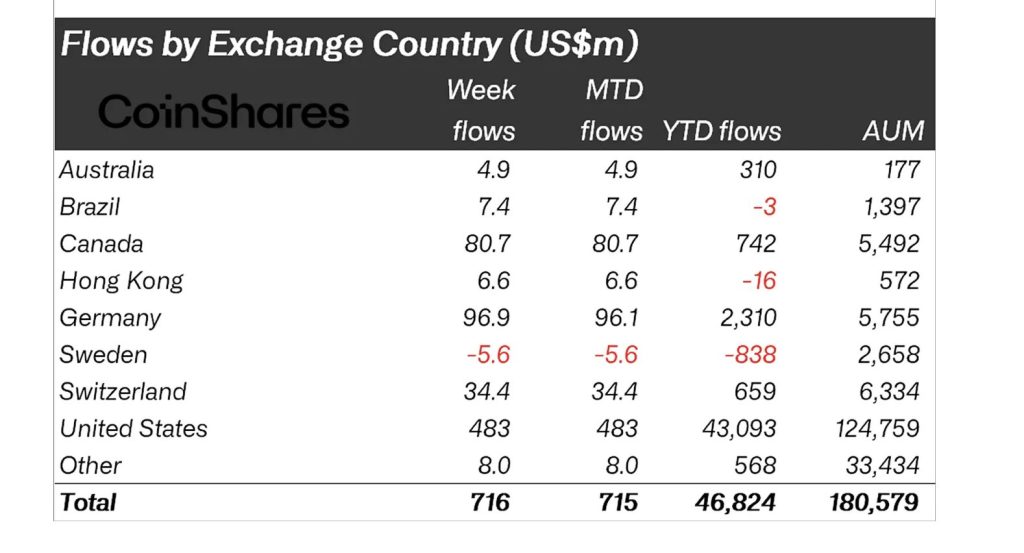
Digital asset investment products recorded a second consecutive week of inflows, totalling $716M, showing improving sentiment across institutional and retail investors after a volatile period in crypto markets, according to the latest report from CoinShares.

CoinShares reports total assets under management rose 7.9% from their November lows to $180B, though this figure remains below the all-time high of $264B. Daily flow data indicated minor outflows toward the end of the week, which analysts believe reflected macroeconomic uncertainty and market reactions to U.S. inflation-related data.

Despite those short-term jitters, the week’s net performance highlights renewed confidence in digital asset exposure through exchange-traded products.

A notable trend was the geographic spread of inflows, suggesting renewed interest globally rather than activity concentrated in a single region. The United States led with $483M in inflows, followed by Germany at $96.9M and Canada at $80.7M, demonstrating that institutional re-engagement with crypto markets is widening across regulated investment platforms.

Bitcoin Leads Inflows While Short Products Reverse

Bitcoin remained the primary focus for investors, recording $352M in inflows last week, contributing to year-to-date (YTD) inflows of $27.1B. This remains below the record $41.6B seen in 2024; however, continued inflows suggest persistent appetite for exposure despite reduced volatility and slower price momentum compared to previous cycles.

In contrast, short-Bitcoin investment products saw outflows of $18.7M — the largest since March 2025. Analysts note that the previous occurrence coincided with price lows and later recovery, hinting that current negative sentiment may have exhausted itself, with investors positioning for a more favourable outlook.

The reversal in short-Bitcoin demand could be interpreted as a tactical shift, where investors are less confident in prolonged downside risk and increasingly reassessing the potential for stabilization or upside in digital asset markets.

XRP Sees Strong Momentum as Institutional Interest Accelerates

XRP continued to draw attention, with $245M flowing into ETPs last week, bringing YTD inflows to $3.1B — a dramatic increase compared to $608M in 2024. The surge reflects heightened institutional engagement following greater clarity around its legal and regulatory landscape, which has broadened access and improved sentiment.

The continued rise in XRP ETP demand marks one of the strongest comparative growth stories in the digital asset space this year, suggesting that investors may now be reassessing exposure beyond Bitcoin and Ethereum as the market diversifies.

Chainlink Records Largest Inflows on Record

Chainlink registered $52.8M in weekly inflows, representing over 54% of its total assets under management — the largest on record for the token. The surge highlights growing institutional and developer interest in the tokenized asset and oracle infrastructure ecosystem that Chainlink underpins.

As tokenization of real-world assets expands and demand for reliable data connectivity increases across blockchains, Chainlink’s growth may indicate a long-term thematic trend rather than short-term speculation.

Digital asset ETPs saw US$716m in weekly inflows, lifting total AuM to US$180bn, though still well below the US$264bn all-time high. Bitcoin attracted US$352m while XRP (US$245m) and Chainlink (US$52.8m) also saw strong demand. Short-Bitcoin products saw outflows of US$18.7m, the…

— Wu Blockchain (@WuBlockchain) December 8, 2025

The post Digital Asset ETPs Record $716M Weekly Inflows as AuM Reaches $180B: CoinShares appeared first on Cryptonews.

Why Is Crypto Up Today? – December 8, 2025

The week begins green, as the crypto market is up today, with the cryptocurrency market capitalisation rising by 2.2%. It stands at $3.2 trillion. 90 of the top 100 coins have gone up over the past 24 hours. At the same time, the total crypto trading volume is at $111 billion.

TLDR:
  • Crypto market cap increased by 2.2% on Monday morning (UTC);
  • 90 of the top 100 coins and all top 10 coins have gone up today;
  • BTC increased by 2.4% to $91,532, and ETH is up by 3.3% to $3,133;
  • The correction may take months to complete;
  • The market could trade in a $71,000 to $105,000 range for the next 4-6 months;
  • If we have a 2-day close above $108,000, the correction is over;
  • Vitalik Buterin suggests a trustless, onchain futures market to lock in Ethereum fees;
  • Binance secured three new licences in Abu Dhabi, and Coinbase reopened registration in India;
  • US BTC spot ETFs saw inflows of $54.79 million on Friday, and ETH spot ETFs recorded $75.21 million in outflows;
  • More than 100 publicly traded companies saw their crypto purchase strategies backfire;
  • Crypto market sentiment remains largely the same within the fear category.
  • Crypto Winners & Losers

    At the time of writing, all top 10 coins per market capitalization have seen their prices rise over the past 24 hours.

    Bitcoin (BTC) is up by 2.4% since this time yesterday, currently trading at $91,532.

    btc logo
    Bitcoin (BTC)
    24h7d30d1yAll time

    Ethereum (ETH) is up by 3.3%, now changing hands at $3,133. This is the highest increase among the ten.

    The second-highest rise is Solana (SOL)’s 2.8% to $135.

    The smallest increase in the category is 0.4% by Tron (TRX), currently trading at $0.2869.

    When it comes to the top 100 coins, 90 have appreciated over the past day.

    At the top we find Zcash (ZEC), with a 9.2% increase to the price of $370.

    It’s followed by Canton (CC)’s 8%, now changing hands at $0.06749.

    On the other hand, Monero (XMR) and MemeCore (M) fell the most among the ten that have gone red over the past day. The former is down 2.8% to $375, while the latter fell 2% to $1.23.

    These are also the only two coins with decreases above 1%.

    Meanwhile, several notable developments occurred globally. Philippines’ GoTyme Bank has launched crypto trading for its 6.5 million customers through a partnership with US fintech firm Alpaca.

    Robinhood Markets announced two key acquisitions, marking its official entry into the Indonesian market, Binance secured three new licences in Abu Dhabi, and Coinbase reopened registration in India after a two-year operational hiatus.

    🇮🇳 Coinbase returns to India after two-year absence, with plans to introduce rupee deposits and fiat trading by 2026.#Coinbase #Indiahttps://t.co/xTgnD4Ux9I
    — Cryptonews.com (@cryptonews) December 8, 2025

    Correction May Take Months To Complete

    John Glover, Chief Investment Officer of Ledn, commented how a number of headlines are indicating that BTC’s bounce off of the $81,500 level over this past week “signals that we are on our way to new highs by year end.”

    “I disagree,” he says.

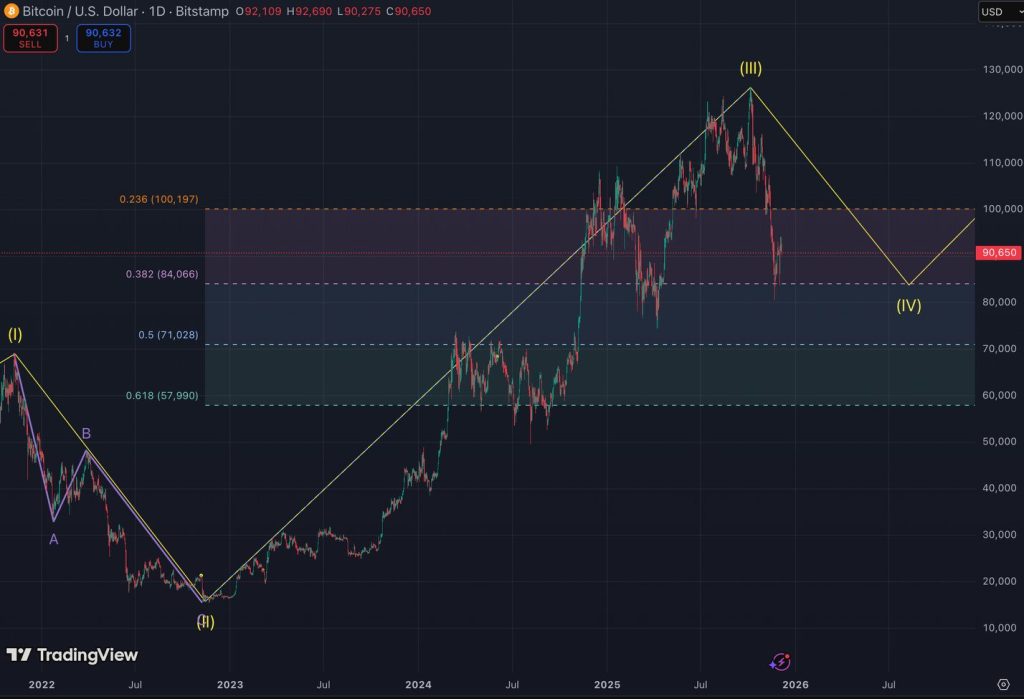
    He argues that the Rule of Alternation suggests that if Wave II is fairly simple in its A-B-C formation, then Wave IV is likely to be complex.

    “To me what we’ve seen since the Wave III high thus far is only the A wave of the Wave IV A-B-C correction, and will take months to complete.”

    “I continue to look for the market to trade in a $71,000 to $105,000 range for the next 4-6 months, and intend to accumulate BTC in the $72,000 to $84,000 range as the opportunity presents itself,” Glover says.

    “If we have a 2 day close above $108,000 I’ll make the call that the correction is over and ensure that I have my full long position in place at that time,” he concludes.

    Source: Ledn

    Levels & Events to Watch Next

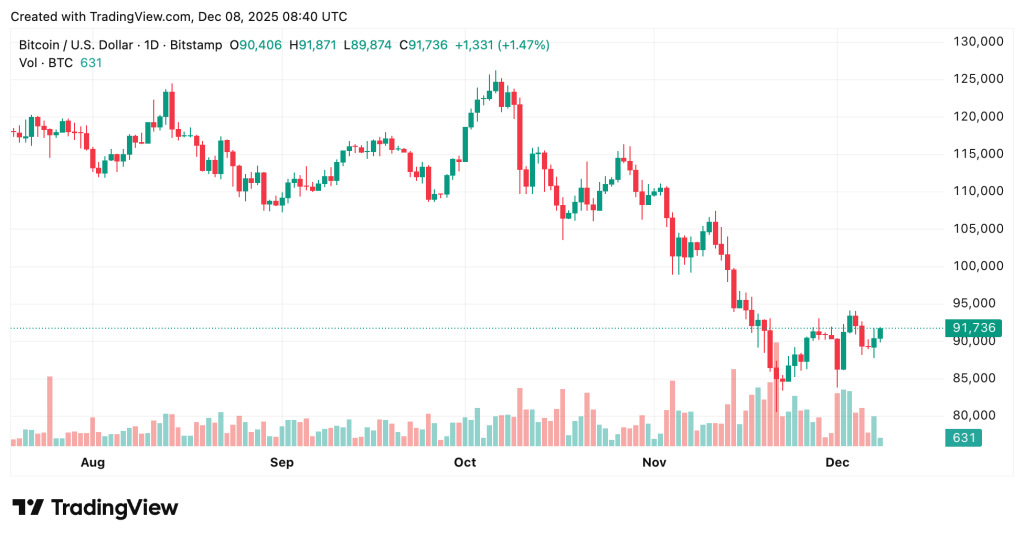
    At the time of writing on Monday morning, BTC stood at $91,532. After a brief dip to the intraday low of $87,887, the price jumped to the day’s high (so far) of $91,786.

    Moreover, BTC is up 6.3% over the past 7 days, trading in the $84,553–$93,855 range. It’s down 10.3% in a month and 27.3% from its all-time high of $126,080.

    Clearing and holding the $94,600 level could confirm bullish continuation. In this case, BTC could move towards $100,000. Conversely, the price could drop to the $76,000 level.

    Ethereum is currently changing hands at $3,133. Like BTC, ETH saw a brief dip earlier in the day, dropping to the intraday low of $2,941 before jumping to the intraday high of $3,145.

    It also appreciated just below 11% in a week, trading between the low of $2,736 and the high of $3,222.

    Meanwhile, ETH is down 9% in a month and 36.7% from its ATH of $4,946.

    If the bulls continue running, we could see ETH move above $3,230, followed by the $3,300 and $3,380 levels. But a fall below $2,800 may lead to the $2,550 level.

    Ethereum (ETH)
    24h7d30d1yAll time

    Meanwhile, the crypto market sentiment dropped further over the weekend within the fear territory but then increased slightly on Monday. The crypto fear and greed index moved between 20 and 21 in the previous two days, before increasing to 24 today.

    This index has largely moved between 10 and 25 over the past month, indicating market participants’ caution and reflecting the market’s own moves within a tight range.

    ETFs See Mixed Performance

    On Friday, 5 December, after two days of outflows, the US BTC spot exchange-traded funds (ETFs) saw a $54.79 million in positive flows. The total net inflow is now at $54.79 billion.

    Of the twelve BTC ETFs, five recorded inflows, and one saw outflows. BlackRock accounts for the entirety of the negative flows, letting go of $32.49 million.

    On the other hand, Ark&21Shares added $42.79 million, followed by Fidelity’s $27.29 million.

    The US ETH ETFs posted negative flows on Friday for a second day in a raw, with $75.21 million in outflows. The total net inflow pulled back to $12.88 billion.

    BlackRock is responsible for this entire amount. Of the nine funds, none recorded inflows.

    Notably, more than 100 publicly traded companies transformed into crypto-holding vehicles in the first half of 2025, borrowing billions to buy digital tokens, copying Michael Saylor’s Bitcoin strategy.

    However, they have seen median stock prices fall 43% year-to-date despite broader market gains, resulting from the way they fund crypto purchases.

    Meanwhile, Vitalik Buterin has suggested a trustless, onchain futures market that would let users lock in future Ethereum transaction fees.

    We need a good trustless onchain gas futures market.

    (Like, a prediction market on the BASEFEE)

    I've heard people ask: "today fees are low, but what about in 2 years? You say they'll stay low because of increasing gaslimit from BAL + ePBS + later ZK-EVM, but do I believe you?"…

    — vitalik.eth (@VitalikButerin) December 6, 2025

    Quick FAQ

    1. Why did crypto move with stocks today?

    The crypto market recorded an increase over the past 24 hours, as did the US stock market during the last session last week. By the closing time on Friday, 5 December, the S&P 500 was up by 0.19%, the Nasdaq-100 increased by 0.43%, and the Dow Jones Industrial Average rose by 0.22%. This followed a US inflation report that boosted expectations that the Federal Reserve will cut interest rates next week.

    1. Is this rally sustainable?

    We are likely to see prices rise at least moderately higher in the coming days and, potentially, weeks. Nonetheless, expect the typical short-tem decreases.

    The post Why Is Crypto Up Today? – December 8, 2025 appeared first on Cryptonews.

    Harvard Bets Big on Bitcoin With $443M Stake, Outpacing Gold 2-to-1

    Harvard University expanded its Bitcoin ETF holdings by 257% in the third quarter, making the iShares Bitcoin Trust its largest disclosed position with $442.8 million as of September 30.

    According to Matt Hougan, Bitwise CIO, Harvard simultaneously increased its gold ETF holdings by 99% to $235 million, allocating to Bitcoin at a 2-to-1 ratio relative to gold.

    Harvard ramped its bitcoin investment in Q3 from $117m ot $443m. It also boosted its gold ETF allocation from $102m to $235m.

    Think about that for a second: Harvard decided to put on a debasement trade and it allocated to bitcoin 2-to-1 over gold.

    — Matt Hougan (@Matt_Hougan) December 8, 2025

    The $443 million position represents approximately 0.75% of Harvard’s $57 billion endowment, ranking the institution among the top 20 largest holders of the BlackRock-managed fund.

    Timing Proves Problematic as Bitcoin Tumbles

    Harvard’s aggressive Bitcoin accumulation came right before a sharp market correction that has erased substantial value from its cryptocurrency holdings.

    Bitcoin has dropped more than 20% since the third quarter ended, falling from $114,000 to around $92,000.

    Harvard Bitcoin - Bitcoin Chart
    Source: TradingView

    The timing suggests Harvard could face a 14% loss on its third-quarter purchases in the best-case scenario, assuming shares were bought at July’s low point, which represents an $89 million paper loss on the recent position alone.

    While the losses remain a fraction of Harvard’s massive endowment, the university’s annualized returns have lagged behind some Ivy League peers over the past decade, according to WSJ.

    Harvard posted an 8.2% return ranking ninth out of 10 elite schools in a Markov Processes International comparison. For the year ending June 30, Harvard reported an 11.9% gain but trailed MIT’s 14.8% and Stanford’s 14.3%.

    Stanford finance professor Joshua Rauh explained in an interview with The Harvard Crimson that “investors often seem to view both bitcoin and gold as hedges against a collapse of the international monetary system in general, and against a loss of the US dollar in particular.

    However, he cautioned that “the extent to which either actually protects investors from these forces is uncertain and scenario-dependent.

    Academic Skepticism Meets Institutional Validation

    Harvard’s substantial Bitcoin allocation stands in stark contrast to earlier predictions from its own economics faculty.

    Kenneth Rogoff, a Harvard professor and former IMF chief economist, stated in 2018 that Bitcoin would more likely trade at $100 than $100,000 within a decade.

    I think bitcoin will be worth a tiny fraction of what it is now if we’re headed out 10 years from now,” Rogoff told CNBC, arguing that removing money laundering and tax evasion would leave Bitcoin with “very small” transaction uses.

    Rogoff recently acknowledged his misjudgment in his new bookOur Dollar, Your Problem,” writing, “I was far too optimistic about the US coming to its senses about sensible cryptocurrency regulation.”

    👨‍🏫 Harvard economist @krogoff admits his $100 Bitcoin crash prediction was wrong as $BTC trades above $115,000.#Bitcoin #Harvardhttps://t.co/AX8l7Aitxz

    — Cryptonews.com (@cryptonews) August 20, 2025

    He added that he “did not anticipate a situation where regulators, and especially the regulator in chief, would be able to brazenly hold hundreds of millions (if not billions) of dollars in cryptocurrencies seemingly without consequence given the blatant conflict of interest.

    Despite growing institutional adoption, criticism of Harvard’s Bitcoin investment has intensified.

    MarketWatch columnist Brett Arends called the investment an “environmental catastrophe,” noting that Bitcoin’s global computing network uses more energy than Thailand or Poland annually.

    Meanwhile, Stanford professor Darrell Duffie also expressed surprise at the investment, stating, “Bitcoin does not pay dividends and has limited uses as a payment instrument.

    Bitcoin’s Path Forward Remains Uncertain

    Bitcoin is struggling to find direction amid ETF outflows and weakening market sentiment, creating uncertainty about whether it can reclaim the $100,000 threshold.

    More than $2.7 billion has left Bitcoin ETF products over the past five weeks.

    Speaking with Cryptonews, Arthur Azizov, Founder and Investor at B2 Ventures, described the current situation as “a market that has lost its anchor at the exact moment it needed stability.

    He noted a disconnect with traditional markets, pointing out that “the S&P 500 is up more than 16% this year, while Bitcoin is down about 3%.

    Azizov identified key resistance levels ahead, explaining that “a large share of Bitcoin is currently held at a loss, so each move toward $96,000–$100,000 meets selling from holders who want to exit at break-even.

    He added that approximately $3.35 billion in Bitcoin options expire around a $91,000 area of interest, making traders cautious.

    Only a strong move above $100,000 could flip the script, restore confidence, and open the way toward $120,000+ level,” Azizov stated.

    If that fails, a deeper pullback to the broad $82,000–$88,000 zone may be needed to attempt to break the $100k ceiling once again.

    The post Harvard Bets Big on Bitcoin With $443M Stake, Outpacing Gold 2-to-1 appeared first on Cryptonews.

    British Columbia Seizes $1M in Cash and Gold Linked to QuadrigaCX Co-Founder

    By: Amin Ayan

    British Columbia has secured a landmark victory under its unexplained wealth order (UWO) regime, after the province successfully seized more than $1 million in cash, gold and luxury items tied to QuadrigaCX co-founder Michael Patryn.

    Key Takeaways:

    • B.C. seized over $1M in cash, gold and luxury items tied to QuadrigaCX co-founder Michael Patryn.
    • Police found 45 gold bars, high-end watches and a loaded pistol in Patryn’s safety deposit box.
    • Authorities allege the assets came from misappropriated QuadrigaCX customer funds.

    The Supreme Court of British Columbia granted the forfeiture after Patryn chose not to contest the action, clearing the way for authorities to liquidate 45 gold bars, multiple high-end watches and roughly $250,000 in cash originally seized during an RCMP investigation.

    The order marks one of the most significant applications of the province’s new anti–money laundering tools.

    Gold Bars, Rolexes and a .45 Pistol Found in Patryn’s Safety Deposit Box

    Court filings show the seized items were discovered in a CIBC safety deposit box in Vancouver in 2021, including three one-kilogram gold bars and 42 smaller bars.

    Officers also recovered Rolex and Chanel watches, rings, jewelry, identification documents, and even a Ruger 1911 .45-caliber pistol with loaded magazines.

    At current prices, the gold alone is valued at more than $800,000.

    The civil forfeiture office alleged the assets were purchased using QuadrigaCX customer funds, money that investigators say was misappropriated during the years leading up to the exchange’s infamous collapse.

    QUADRIGACX CO-FOUNDER FACES UNEXPLAINED WEALTH COURT ORDER

    Michael Patryn, co-founder of QuadrigaCX and known as "Sifu" in the DeFi community, is facing a new court order in British Columbia which requires him to explain how he acquired his assets.

    QuadrigaCX collapsed in… pic.twitter.com/3N6mEkYfjp

    — Crypto Town Hall (@Crypto_TownHall) March 28, 2024

    The unexplained wealth order required Patryn to demonstrate legitimate sources for the assets, but while he initially challenged the investigation on constitutional grounds, he ultimately withdrew his response and did not appear when the province sought judgment.

    QuadrigaCX, once Canada’s largest cryptocurrency exchange, imploded in 2019 after CEO Gerald Cotten died in India and it emerged that more than $169 million in customer assets were missing.

    Regulators later concluded that the platform had effectively become a Ponzi scheme by 2016, with new deposits used to fulfill withdrawal requests while Cotten allegedly siphoned funds to finance personal expenses.

    Patryn’s Criminal Past Resurfaces in QuadrigaCX Forfeiture Case

    Investigators have long alleged that Patryn, also known by several aliases including Omar Dhanani, played a central role in the exchange’s operations and benefited from client funds.

    His criminal history was cited in the forfeiture filings. In 2005, under the name Omar Dhanani, he was convicted in the US for operating an online identity-theft and money-laundering service and later deported to Canada.

    The province’s win now triggers a separate review to determine whether any of the recovered assets can be directed to compensate QuadrigaCX creditors.

    Claimants received just 13 cents on the dollar when bankruptcy proceedings concluded in May 2023.

    Patryn’s current whereabouts remain uncertain, though the civil forfeiture suit lists his last known location as Thailand.

    In 2023, QuadrigaCX announced plans to start the “interim distribution” of funds to creditors, despite only a fraction of the missing funds being recovered.

    The post British Columbia Seizes $1M in Cash and Gold Linked to QuadrigaCX Co-Founder appeared first on Cryptonews.

    Argentina Weighs Allowing Traditional Banks To Trade Cryptocurrencies

    Argentina’s central bank is reportedly weighing a move that could redraw the country’s crypto landscape, drafting rules that would let traditional banks offer trading and custody services for digital assets after years of leaving that business to exchanges and fintech platforms.

    Local outlet La Nacion reported Friday that the officials are working on a regulation that would open the door for lenders to handle cryptocurrencies directly, although they have not committed to a timetable or disclosed key details.

    One exchange operating in the country believes the measure could win approval around April 2026, signalling a relatively near-term shift if the process stays on track.

    The idea has circulated quietly for months among exchanges, people close to regulators and a handful of bankers. It fits with a broader push inside government circles to ease restrictions on crypto use and bring part of the activity that already happens at scale into the formal financial system.

    Crypto Demand Surges As Argentines Seek Stability Amid Inflation

    For Argentina, the stakes are higher than in most markets. Years of inflation and currency controls have pushed savers toward dollars and digital assets, and crypto has become a parallel store of value for many households.

    By one estimate, Argentines are now six times more likely to use crypto on a daily basis than residents of the average Latin American country.

    Allowing banks to trade and hold crypto on behalf of clients could give that demand a new channel. Analysts say regulated lenders can offer familiar on-ramps, clearer disclosures and more robust compliance checks, which together may make digital assets feel less like a grey market product and more like a standard investment option.

    The real impact, they caution, will depend on how the central bank draws the lines on issues such as custody standards, capital treatment and which tokens qualify.

    Libra Scandal Casts A Long Shadow Over Argentina’s Crypto Debate

    The debate is unfolding in the long shadow of the Libra meme coin scandal, a blow that shook confidence in Argentina’s crypto scene and raised uncomfortable questions about political promotion of speculative tokens.

    That episode erupted in Feb. 2025 when President Javier Milei, known for his libertarian economic agenda and enthusiasm for digital assets, posted on X endorsing the Solana-based Libra token as a tool for “market-driven innovation” and economic liberation from the peso.

    The coin’s price raced from fractions of a cent to more than $4.50 within hours of his post, lifting its fully diluted valuation to around $4.6b before collapsing more than 96% in what investigators described as a classic rug pull by its creators at Kelsier Ventures.

    Thousands of investors, many of them everyday Argentines who took the president’s message as a green light, were left holding the bag, with losses estimated between $100m and $251m.

    Argentina’s central bank has swung between tolerance and crackdowns in the past, at one point barring unregulated crypto services in the banking system, and any turn toward openness would mark a significant change in stance.

    For now, officials appear to be testing whether they can bring a fast growing market into the tent without importing too much of its volatility into the traditional financial system.

    The post Argentina Weighs Allowing Traditional Banks To Trade Cryptocurrencies appeared first on Cryptonews.

    Ethereum’s First ZK-Rollup ZKsync Lite to Shut Down in 2026

    ZKsync has announced plans to deprecate ZKsync Lite, Ethereum’s first zero-knowledge rollup, in 2026 as the protocol shifts its focus entirely toward the ZKsync network and ZK Stack-powered chains.

    The original Layer 2 solution, which launched in December 2020 as a groundbreaking proof-of-concept, will undergo an orderly sunset after serving its purpose of validating critical ideas for production ZK systems.

    No immediate action is required from users, as ZKsync Lite continues to operate normally, with funds remaining secure and withdrawals to Ethereum’s Layer 1 functioning throughout the deprecation process.

    The ZKsync Association will share detailed migration guidance, specific dates, and a comprehensive deprecation plan in the coming year.

    📌In 2026, we plan to deprecate ZKsync Lite (aka ZKsync 1.0), the original ZK-rollup we launched on Ethereum.
    This is a planned, orderly sunset for a system that has served its purpose and does not affect any other ZKsync systems.

    — ZKsync (@zksync) December 7, 2025

    From Pioneer to Legacy System

    ZKsync Lite emerged as the first zero-knowledge rollup on Ethereum, pioneering technology that would later evolve into ZKsync Era and the Elastic Network.

    The protocol addressed Ethereum’s fundamental challenges of high transaction fees and slow transaction processing by executing transactions off-chain and submitting cryptographic proofs of validity back to Layer 1.

    The project gained significant momentum in November 2025 when Ethereum co-founder Vitalik Buterin publicly endorsed ZKsync following its Atlas upgrade, describing the work as “underrated and valuable.

    ZKsync has been doing a lot of underrated and valuable work in the ethereum ecosystem. Excited to see this come from them! https://t.co/coZKCfsb8h

    — vitalik.eth (@VitalikButerin) November 1, 2025

    His backing catalyzed institutional adoption, triggering a 50% surge in ZK token prices while positioning ZKsync as central to Ethereum’s “Lean Ethereum” scaling strategy.

    ZKsync evolved from its initial Lite version to ZKsync Era in March 2023, becoming the first publicly available zkEVM.

    The June 2024 ZKsync 3.0 upgrade transformed the ecosystem from a single Layer 2 into the Elastic Network, an interconnected system of autonomous ZK chains sharing liquidity and security through cryptographic proofs rather than traditional bridges.

    Institutional Traction Validates ZK Technology

    While ZKsync Lite phases out, the broader ZKsync ecosystem has attracted major institutional interest.

    Deutsche Bank is developing an Ethereum Layer 2 blockchain using ZKsync technology as part of Project Dama 2, which involves 24 financial institutions testing the blockchain for asset tokenization under Singapore’s regulatory sandbox.

    UBS also conducted a proof-of-concept for its Key4 Gold product using ZKsync Validium, testing the platform’s ability to support tokenized gold investments with privacy and scalability.

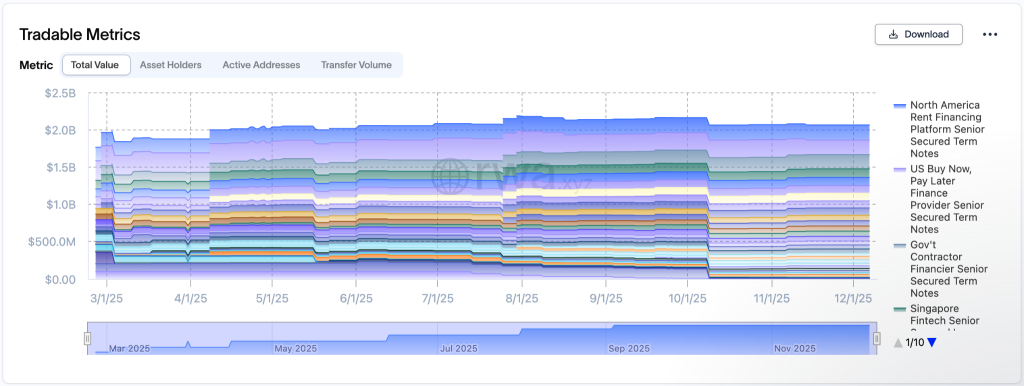
    Tradable has also tokenized $2.1 billion in institutional-grade private credit on ZKsync, accounting for nearly 90% of the network’s market share for real-world asset protocols.

    ZKsync Lite to Shut Down - Tradable Metrics Chart
    Source: RWA[dot]xyz

    The Ethereum Foundation launched “Ethereum for Institutions” in October 2024, providing enterprises with structured pathways to blockchain adoption using zero-knowledge proofs, fully homomorphic encryption, and trusted execution environments.

    Projects like Chainlink, RAILGUN, and Aztec Network pioneer privacy-preserving smart contracts that secure counterparty information while maintaining transparency.

    Security Incidents Test Platform Resilience

    The deprecation announcement follows two significant security breaches in 2025 involving ZKsync’s protocols.

    In April, an attacker exploited admin access to the airdrop distribution contract, minting 111 million unclaimed ZK tokens worth approximately $5 million during the protocol’s token distribution to ecosystem participants.

    The hacker agreed to return 90% of the stolen assets in exchange for a 10% bounty, transferring nearly $5.7 million back to the ZKsync Security Council within the designated 72-hour safe harbor window.

    The recovered amount exceeded the original stolen value due to token price increases, with ZK gaining 16.6% and ETH rising 8.8% following the incident.

    🤝 The @TheZKNation has recovered $5 million worth of stolen tokens following a security breach on April 15.#ZKsync #Hackhttps://t.co/sb7iC0RqoR

    — Cryptonews.com (@cryptonews) April 24, 2025

    Just one month later, hackers compromised the official X accounts of ZKsync and Matter Labs, spreading false regulatory warnings claiming SEC investigations and Treasury Department sanctions.

    The attackers also published phishing links promoting a fake ZK token airdrop designed to drain users’ wallets, causing the token price to drop approximately 5% despite a prior 38.5% weekly rally.

    The breach occurred through compromised delegated accounts with limited posting privileges, which have since been disconnected.

    These back-to-back incidents contributed to broader industry concerns, as crypto hacks resulted in $1.6 billion in losses during the first quarter of 2025 alone. The quarter was among the worst for crypto security breaches in history.

    The post Ethereum’s First ZK-Rollup ZKsync Lite to Shut Down in 2026 appeared first on Cryptonews.

    Bitcoin Tests Key Fibonacci Support as Analysts Warn of Drop to $76K

    By: Amin Ayan

    Bitcoin is trading at a pivotal level that analysts say could determine whether the market holds its broader uptrend or slips back toward spring lows.

    Key Takeaways:

    • Bitcoin is sitting on a crucial Fibonacci support level, with a breakdown risking a drop toward the April lows near $76,000.
    • A weekend leverage flush pushed BTC below $88,000 before a sharp rebound.
    • Traders now await the Fed meeting and key US economic data.

    In a recent post on X, crypto trader Daan Crypto Trades said the 0.382 Fibonacci retracement zone is the line bulls must defend, warning that a breakdown could send BTC back to April levels near $76,000.

    “It’s also pretty much the last major support before testing the April lows again, which would break this high time frame market structure,” he said.

    Bitcoin Dips Below $88K in Weekend Leverage Flush, Analyst Says

    Over the weekend, Bitcoin briefly dipped below $88,000 during another round of leverage washouts before rebounding above $91,500.

    Analyst “Bull Theory” described the move as typical low-liquidity weekend manipulation aimed at flushing both longs and shorts.

    The market now turns its attention to this week’s Federal Open Market Committee meeting, where a 0.25% rate cut is widely expected.

    BREAKING: Bitcoin dumped $2,000 from $89.7k to $87.7k and liquidated $171 million worth of longs.

    But then it pumped $3,500 from $87.7k to $91.2k and liquidated $75 million worth of shorts.

    All this happened in the last 4 hours.

    This is another example of manipulation on the… pic.twitter.com/1JxZ3rSWmu

    — Bull Theory (@BullTheoryio) December 7, 2025

    Still, crypto markets have cooled since the October cut, as Fed Chair Jerome Powell emphasized a data-dependent path rather than a predictable easing cycle.

    Markus Thielen of 10x Research noted that traders expect a similar tone this week, cautious and potentially hawkish, keeping pressure on risk assets.

    With ETF inflows softening and trading volumes thinning into December, Thielen said upside participation remains limited, while volatility compression leaves BTC more vulnerable to downside moves in the near term.

    “Bulls will point to the Treasury General Account rebuild, the end of Quantitative Tightening, and looming rate cuts as a liquidity windfall for Bitcoin,” Thielen wrote.

    He added that hypothetical macro tailwinds are “irrelevant if the underlying message lacks conviction and the market structure fails to support a sustained move.”

    Nick Ruck of LVRG Research said upcoming U.S. jobs data and inflation figures may prove just as influential.

    If they reinforce expectations for continued easing, he believes renewed liquidity inflows could fuel a broader recovery across digital assets.

    Bitcoin’s Rising “Liveliness” Metric Signals Hidden Bull-Market Strength

    As reported, a key on-chain indicator known as “liveliness” is climbing again, even as Bitcoin’s price action remains subdued.

    Analysts say the divergence suggests renewed underlying demand, with dormant coins moving at levels not seen in years, a sign that long-term holders may be re-entering the market.

    The indicator’s steady rise points to a major rotation of capital beneath the surface despite cautious sentiment.

    Liveliness measures the balance between coins being transacted and those being held, weighted by age. It tends to rise during bull markets as older coins move at higher prices, reflecting fresh inflows and greater conviction.

    Last week, Bitfinex said the market is showing “seller exhaustion” following a period of heavy deleveraging and panic-driven exits by short-term holders.

    “The combination of extreme deleveraging, capitulation among short-term holders, and early signs of seller exhaustion has created the conditions for a stabilisation phase and a relief bounce,” the firm wrote.

    The post Bitcoin Tests Key Fibonacci Support as Analysts Warn of Drop to $76K appeared first on Cryptonews.

    Vitalik Buterin Proposes Onchain Gas Futures Market for Predictable Fees

    By: Amin Ayan

    Ethereum co-founder Vitalik Buterin has suggested a trustless, onchain futures market for gas to bring greater predictability to Ethereum transaction costs.

    Key Takeaways:

    • Vitalik Buterin proposes a trustless onchain gas futures market to let users lock in future Ethereum transaction fees.
    • The system would function like traditional futures markets, helping traders and developers hedge against sudden fee spikes.
    • Buterin says a futures market could bring predictable costs for heavy network users.

    In a post on X over the weekend, Buterin said repeated questions about whether Ethereum’s roadmap can guarantee low fees inspired him to outline how such a market could work.

    Buterin Says Onchain Gas Futures Could Let Users Lock In Ethereum Fees

    Buterin argued that an onchain gas futures system would give users the ability to lock in gas prices for future time windows, offering greater certainty as Ethereum scales.

    The concept mirrors traditional futures markets, such as those for commodities, where buyers and sellers agree on a fixed price for a future date to hedge risk or speculate on price movements.

    Applied to Ethereum, it would allow users to prepay for a specific amount of gas during a chosen time period, protecting them from unexpected fee spikes.

    “People would get a clear signal of expectations for future gas fees, and would even be able to hedge against future gas prices,” Buterin wrote.

    He suggested that a market-built signal for future base fees could help traders, developers, and heavy network users plan with far more confidence, especially those managing large volumes of transactions or operating decentralized applications.

    We need a good trustless onchain gas futures market.

    (Like, a prediction market on the BASEFEE)

    I've heard people ask: "today fees are low, but what about in 2 years? You say they'll stay low because of increasing gaslimit from BAL + ePBS + later ZK-EVM, but do I believe you?"…

    — vitalik.eth (@VitalikButerin) December 6, 2025

    Gas costs have eased this year, with basic Ethereum transfers averaging around 0.474 gwei, roughly one cent, according to Etherscan.

    However, more complex activity still comes at a higher cost, including token swaps ($0.16), NFT transactions ($0.27), and cross-chain bridging ($0.05).

    Despite the overall decline, fee volatility remains a challenge. YCharts data shows average Ethereum fees started 2025 near $1 before falling to $0.30, punctuated by swings as high as $2.60 and as low as $0.18.

    Buterin’s proposal aims to smooth these fluctuations by giving users a mechanism to anticipate and manage costs, particularly ahead of high-demand periods.

    Ethereum Exchange Balances Hit Record Lows

    As reported, Ether held on centralized exchanges has dropped to an all-time low, with balances falling to just 8.7% of total supply, the smallest share since Ethereum launched in 2015.

    The decline marks a 43% drop since July, a shift analysts say is tightening liquid supply and setting the stage for a potential market squeeze.

    The rapid drawdown is linked to structural changes in how ETH is being used. More tokens are flowing into staking, restaking protocols, layer-2 networks, DeFi collateral loops, digital-asset treasury holdings, and long-term self-custody, all destinations that rarely send ETH back to exchanges.

    Research outlet Milk Road said ETH is now in its “tightest supply environment ever,” noting that Bitcoin’s exchange balance remains significantly higher.

    The post Vitalik Buterin Proposes Onchain Gas Futures Market for Predictable Fees appeared first on Cryptonews.

    Coinbase Returns to India After 2-Year Pause, Fiat Access Coming 2026

    Coinbase has reopened registration in India following a two-year operational hiatus, marking the crypto giant’s return to the world’s second-largest internet market with plans to introduce fiat currency integration by 2026.

    The exchange currently offers crypto-to-crypto trading while working toward full-service restoration, which will allow Indian customers to deposit rupees and purchase digital assets directly on the platform.

    The San Francisco-based company first entered India in April 2022 but was forced to suspend operations within days after the National Payments Corporation refused to recognize its use of the Unified Payments Interface.

    By September 2023, Coinbase had withdrawn entirely from India, requiring existing customers to liquidate their holdings and transfer funds elsewhere.

    🚫 @coinbase suspended trading service in India “because of some informal pressure from the Reserve Bank of India”, said Coinbase CEO Brian Armstrong.

    — Cryptonews.com (@cryptonews) May 11, 2022

    Strategic Compliance Gamble Pays Off

    Coinbase’s willingness to completely exit the market represented a significant commercial risk, John O’Loghlen, the exchange’s Asia-Pacific regional director, told TechCrunch.

    Speaking at India Blockchain Week, O’Loghlen explained that forcing existing customers to close their accounts ran counter to typical business strategy but established a clean regulatory slate.

    The company subsequently engaged with India’s Financial Intelligence Unit throughout 2024, securing approval for registration and launching early access in October before expanding to general availability.

    🇮🇳 Global crypto exchange Coinbase has registered with India’s FIU—paving the way to resume trading and launch retail services later this year. #India #Coinbase https://t.co/fEEOzAC4aT

    — Cryptonews.com (@cryptonews) March 11, 2025

    The exchange now joins other global platforms like Binance, KuCoin, and Bybit in receiving Financial Intelligence Unit authorization.

    These competitors faced similar regulatory obstacles after the government agency cracked down on offshore exchanges in January 2024 for violating anti-money laundering provisions, blocking their websites, and removing their applications from digital storefronts.

    Most secured compliance approvals and paid substantial penalties to resume operations.

    Coinbase has simultaneously deepened its financial commitment to the Indian market by investing additional capital in local exchange CoinDCX at a $2.45 billion valuation.

    The American firm employs over 500 people nationwide. It continues hiring for positions serving both domestic and international operations, while chief legal officer Paul Grewal recently joined the U.S.-India Business Council board to strengthen bilateral commercial relationships.

    Tax Structure Creates Operational Headwinds

    India’s cryptocurrency taxation framework remains among the world’s most punitive, imposing a 30% levy on profits without allowing traders to offset losses against gains.

    The government additionally deducts 1% from every transaction, discouraging frequent trading activity and pushing an estimated 90% of Indian crypto volume to offshore platforms.

    When combined with mandatory surcharges and additional fees, the effective tax burden reaches 42.7% for high-income traders.

    O’Loghlen acknowledged these fiscal barriers while expressing hope that authorities will eventually ease restrictions to make digital asset ownership less burdensome.

    The Reserve Bank of India has consistently opposed cryptocurrencies, citing concerns about macroeconomic stability, financial system risks, and vulnerabilities to money laundering.

    A recently disclosed government document revealed that Indian officials remain reluctant to implement comprehensive crypto legislation, fearing that formal recognition might encourage mainstream adoption and create systemic financial exposure.

    🚨 India stalls full crypto framework due to systemic risk fears. Officials plan to maintain partial oversight with strict taxation rules. #Crypto #India #RBIhttps://t.co/hH14ySucmR

    — Cryptonews.com (@cryptonews) September 10, 2025

    Despite these regulatory headwinds, India consistently ranks among the top countries in global crypto adoption indices, with citizens holding approximately $4.5 billion in digital assets.

    Tax authorities have recently intensified scrutiny, investigating over 400 high-net-worth individuals suspected of evading payment obligations through peer-to-peer transactions on platforms like Binance and demanding regional office reports by mid-October.

    Building Trust Through User Experience

    Coinbase aims to differentiate itself through security and accessibility, according to O’Loghlen, who emphasized the need for intuitive interfaces comparable to popular Indian consumer applications.

    We want to be known as that trusted exchange, ensure that your funds are safe with us,” he stated.

    We’re not going to get out to the masses if you can’t have a really nice UI, a trusted experience that allows you to onboard in a matter of minutes.

    The company’s return coincides with India’s emergence as a major blockchain development hub, with its share of global Web3 developers growing substantially in recent years.

    However, the operational environment remains complex, as government officials continue promoting the Reserve Bank’s digital rupee while heavily taxing private cryptocurrencies that lack sovereign backing.

    The post Coinbase Returns to India After 2-Year Pause, Fiat Access Coming 2026 appeared first on Cryptonews.

    Robinhood Sets Indonesia Footprint Through Crypto Trader, Brokerage Firms Acquisition

    Robinhood Markets has announced two key acquisitions, marking its official entry into the Indonesian market. The American financial services firm has entered into agreements to acquire Indonesian brokerage Buana Capital and OKJ-licensed crypto trader PT Pedagang Aset Kripto.

    Announced Monday, the move expands Robinhood’s presence in one of the leading crypto markets in the Southeast Asian region.

    “Indonesia represents a fast-growing market for trading, making it an exciting place to further Robinhood’s mission to democratize finance for all,” said Patrick Chan, Head of Asia at Robinhood.

    Besides, Pieter Tanuri, the majority owner at both Buana Capital and PT Pedagang Aset Kripto, will serve as the strategic advisor to Robinhood.

    However, the company did not disclose the deal price, which is expected to close in H1 2026, Reuters reported.

    Robinhood is coming to Indonesia. We're excited to work with the Buana Capital and PT Pedagang Aset Kripto teams to democratize finance for this fast-growing market.

    Indonesia already has more than 19 million capital market investors and 17 million crypto investors, and we look…

    — Steve Quirk (@SteveQuirk_) December 8, 2025

    Robinhood’s Entry Underscores Indonesia’s Growing Retail Investors

    Indonesia is home to about 17 million crypto traders and has more than 19 million capital market investors, per a recent report.

    Besides, Chainalysis ranks Indonesia as a top global crypto market, placing it 7th in the world and 1st in Southeast Asia for crypto adoption in its 2025 index.

    Further, the World Bank’s report on Global Findex 2025 noted that financial account ownership in Indonesia has increased from about 20% of adults in 2011 to roughly 60% by 2024.

    With the expansion, Robinhood aims to bring its crypto trading services to Indonesia.

    “We look forward to bringing Indonesians the same innovative services that have earned the trust of Robinhood customers globally,” Patrick Chan added.

    The nation recently tightened its grip on crypto trading with a tax overhaul, hitting offshore platforms with a fivefold rate increase.

    Additionally, crypto mining operations saw VAT rates double from 1.1% to 2.2%, along with an increase in taxes on domestic crypto sales and overseas exchange transactions separately.

    The Indonesian government is also exploring Bitcoin as a reserve asset to benefit the country’s long-term financial stability.

    The post Robinhood Sets Indonesia Footprint Through Crypto Trader, Brokerage Firms Acquisition appeared first on Cryptonews.

    Philippines’ GoTyme Bank Rolls Out Crypto Trading for its 6.5M Users

    By: Amin Ayan

    GoTyme Bank, one of the Philippines’ fastest-growing digital banks, has launched crypto trading for its 6.5 million customers through a new partnership with US fintech firm Alpaca.

    Key Takeaways:

    • GoTyme Bank has launched in-app crypto trading for 6.5 million users, offering 11 assets including BTC, ETH, SOL and DOT.
    • The service is designed for beginners, emphasizing simplicity and seamless access without external exchanges.
    • GoTyme plans regional expansion to Vietnam and Indonesia as it prioritizes rapid user growth over short-term profitability.

    The rollout allows users to buy and store 11 crypto assets directly inside the GoTyme mobile app, with purchases auto-converted from Philippine pesos to US dollars.

    Supported assets include Bitcoin (BTC), Ether (ETH), Solana (SOL), Polkadot (DOT) and several other major altcoins.

    GoTyme Targets Beginners With Simple In-App Crypto Trading

    While GoTyme has not indicated whether more advanced trading tools will be added later, the bank says the service is intentionally designed for newcomers.

    “Our product focuses on simplicity and reliability, designed for people who want to buy crypto confidently without complicated technical analysis or managing multiple apps,” CEO Nate Clarke said.

    GoTyme, launched in October 2022 through a joint venture between Singapore’s Tyme Group and the Philippines’ Gokongwei Group, has seen rapid user growth.

    The bank promotes a frictionless onboarding process, allowing users to open a bank account and debit card in as little as five minutes, a feature that now extends to crypto access as well.

    The digital bank is also setting its sights beyond the Philippines. Clarke recently said GoTyme plans to expand into Vietnam and Indonesia, aiming to capture a larger share of Southeast Asia’s fast-growing digital banking market.

    GoTyme Bank Launches Crypto Trading in the Philippines in Partnership with Alpaca https://t.co/ffWy6OGBil pic.twitter.com/ZX4zjGsE4Q

    — Latest News from Business Wire (@NewsFromBW) December 8, 2025

    He noted that profitability is not yet a priority. “We are very much still in a growth phase. We are not optimizing for profitability at the moment.

    What matters to us is building a growing and engaged customer base,” Clarke told The Digital Banker.

    The Philippines continues to be one of the most active crypto markets globally. It ranks ninth on Chainalysis’ 2025 Global Crypto Adoption Index, while local policymakers are considering a proposal to create a national strategic reserve backed by 10,000 BTC.

    Philippine Senator Pushes to Put National Budget on Blockchain

    As reported, Philippine Senator Bam Aquino is preparing a bill that would place the country’s entire national budget and government financial transactions on a blockchain system, aiming to make public spending fully transparent and easily traceable by citizens.

    In August, Aquino said the proposal would allow “every peso” to be logged on-chain, creating what he hopes will become the world’s first fully blockchain-based national budget.

    The Philippines is emerging as a testing ground for public-sector blockchain initiatives.

    Congressman Miguel Luis Villafuerte recently introduced a separate bill to establish a strategic Bitcoin reserve of up to 10,000 BTC over five years.

    According to the bill, the holdings could only be sold under strict conditions, such as retiring sovereign debt, and no more than 10% of the reserve may be liquidated in any two-year period after the minimum holding period expires.

    As of November 2024, the Philippines’ debt had risen to ₱16.09 trillion ($285 billion), with domestic obligations accounting for nearly 68% of the total.

    The post Philippines’ GoTyme Bank Rolls Out Crypto Trading for its 6.5M Users appeared first on Cryptonews.

    Binance Gains Multiple Regulatory Approvals In Abu Dhabi, Deepening UAE Presence

    Binance has secured three new licences in Abu Dhabi, tightening its grip on one of the most ambitious digital asset hubs in the Middle East and giving the exchange a powerful regulatory base as it pushes to keep institutional money on side.

    The Financial Services Regulatory Authority of Abu Dhabi Global Market has approved Binance.com to operate through a trio of regulated entities that together cover exchange, clearing and broker dealer activities.

    The authorizations were granted during Abu Dhabi Finance Week and apply to Binance’s global platform, not just a regional offshoot, which is a key point for professional traders watching where the exchange can legally serve them.

    Major milestone 🏁#Binance is the first-ever digital assets trading platform to secure a full suite of licenses from FSRA under @ADGlobalMarket.

    This marks a breakthrough moment that raises global standards for regulation, security, and trust.

    It reflects our commitment to… pic.twitter.com/ItRofJoAOC

    — Binance (@binance) December 8, 2025

    Binance Builds Multi-Entity Structure For Exchange, Clearing And Trading

    Under the new structure, Nest Services Limited, which will be renamed Nest Exchange Limited, has been approved as a recognized investment exchange with permission to run a multilateral trading facility. It will host Binance’s on exchange business, including spot and derivatives markets.

    Nest Clearing and Custody Limited has been approved as a recognized clearing house with added custody and securities depository permissions, putting it in charge of clearing, settlement and safekeeping of digital assets.

    A third entity, BCI Limited, set to become Nest Trading Limited, holds a broker dealer licence that covers dealing and arranging in investments, asset management, custody arrangements and money services, including over the counter trading and conversion.

    Binance Leans On ADGM Regime To Reinforce Compliance And Global Reach

    Binance has described the package as a comprehensive regulatory framework for Binance.com and a global first for the platform. The company says the approvals give it a cleaner path into multiple markets beyond the UAE and help it present itself as a more predictable counterparty to institutions that have grown wary of loosely regulated venues after a series of blow ups.

    Richard Teng, Binance’s co-chief executive and a former senior executive at Abu Dhabi Global Market, said in a statement that working under the authority’s regime reflects a commitment to compliance, transparency and user protection.

    He argued that the licence brings regulatory clarity and legitimacy and allows Binance to support its global operations from Abu Dhabi while keeping a distributed operating model that taps talent around the world.

    Rising Crypto Investments Show Abu Dhabi Positioning Itself As Digital Finance Hub

    For Abu Dhabi, the deal fits neatly into a broader push to turn its oil wealth and sovereign funds into long term exposure to digital assets and financial technology. The emirate, which sits on roughly $2 trillion in sovereign wealth, has been steadily increasing its footprint in crypto.

    The Abu Dhabi Investment Council, an independently run arm of Mubadala Investment, more than tripled its holding in BlackRock’s iShares Bitcoin Trust during the third quarter, taking the position to almost 8m shares as of Sept. 30, worth about $518m at the time.

    Binance also has direct financial ties to the city. In March, the exchange secured a $2b investment from AI-focused investor MGX, chaired by Sheikh Tahnoon bin Zayed Al Nahyan, one of the most influential figures in the emirate’s financial and security establishment.

    That backing and the new licences deepen the sense that Abu Dhabi sees Binance as a core piece of its digital finance strategy.

    The exchange has not yet named a global headquarters, but Teng has previously called the UAE an attractive option. With Abu Dhabi Global Market now authorised to host Binance.com’s regulated activities from January 5, 2026, the city will remain high on the list of possible long term bases, especially as more institutional clients demand clear regulatory anchors.

    Binance Looks To Rebuild Trust As New Licences Follow Turbulent Period

    The approvals come after a difficult period for Binance on the enforcement front. Founder Changpeng Zhao stepped down as chief executive in 2023 after pleading guilty to breaking US anti money laundering laws.

    The company agreed to pay more than $4.3b to settle a years long US investigation. Zhao was pardoned by President Donald Trump in October this year, removing a major legal cloud for the former CEO, but regulators and counterparties still expect Binance to prove that it can operate with tighter controls.

    Binance says it now has more than 300m registered users and over $125 trillion in cumulative trading volume. It argues that operating under Abu Dhabi’s rules will give both retail and institutional users stronger comfort on oversight and consumer protection as it pushes toward its long stated goal of serving 1b people.

    The leadership team is shifting as the regulatory architecture firms up. Last week, Teng named Binance co founder Yi He as the company’s new co-chief executive.

    He described her as a driving force since the exchange’s launch, and credited her with shaping its culture, vision and user focused approach. Her formal elevation signals that Binance wants to present a more structured leadership bench as it leans further into regulated markets.

    The post Binance Gains Multiple Regulatory Approvals In Abu Dhabi, Deepening UAE Presence appeared first on Cryptonews.

    [LIVE] Crypto News Today: Latest Updates for Dec. 08, 2025 – Market on Edge: 10x Research Warns Bitcoin’s Range Is About to Snap

    10x Research says Bitcoin may look calm on the surface, but the derivatives market is flashing signs of brewing volatility. In its latest weekly report, the firm notes that options traders are buying volatility, downside skew has returned, funding rates have softened, and futures open interest is diverging, all while spot ETFs continue to see net outflows. Despite bullish macro hopes around U.S. liquidity, 10x warns that market structure remains unsupportive, suggesting traders should brace for unexpected moves in the coming 1–2 weeks. Currently, Bitcoin is trading above $91,200, 1.8% up in the last 24 hours.

    But what else is happening in crypto news today? Follow our up-to-date live coverage below.

    The post [LIVE] Crypto News Today: Latest Updates for Dec. 08, 2025 – Market on Edge: 10x Research Warns Bitcoin’s Range Is About to Snap appeared first on Cryptonews.

    Trump’s New National Security Blueprint Overlooks Bitcoin’s Potential – AI, Quantum Gets Mentioned

    The Trump administration’s newly released 2025 National Security Strategy (NSS) failed to mention digital assets and blockchain tech. The 33-page-long document focuses instead on AI, biotech, and quantum computing.

    Released Friday, the NSS is a key policy document framed by the White House. The policy papers lay out how the President views global threats and opportunities.

    The pro-crypto administration has so far taken significant steps for the industry, including establishing the President’s Working Group on Digital Asset Markets, signing the GENIUS Act for stablecoin regulation and dropping several enforcement actions against crypto firms.

    However, skipping any mention of Bitcoin in global economic policy discussions suggests that digital assets remain outside core security planning.

    “We want to ensure that U.S. technology and U.S. standards — particularly in AI, biotech, and quantum computing — drive the world forward,” the national security strategy statement read.

    Besides, Trump, who campaigned on becoming the “crypto president”, established a strategic national Bitcoin reserve. However, he later said that the stash will be funded with seized Bitcoin and not fresh BTC purchases.

    Donald Trump’s National Security Strategy puts his family’s and friends’ business interests with our adversaries, like Russia and China, over promises to our allies.

    If implemented, this plan would weaken U.S. influence across the globe and undermine our national security.…

    — Senator Mark Kelly (@SenMarkKelly) December 6, 2025

    Trump’s Commitment Over Crypto as National Strategic Issue

    The President has previously made strong on-record commitments, framing digital assets as part of the US’ national strategic issue.

    For instance, at the Bitcoin Conference in Nashville in 2024, Trump stressed that the future of crypto and the future of Bitcoin “will be made in the USA, not driven overseas.”

    Further, in several policy rollouts, Trump positioned global competitors as potential beneficiaries if the US fails to adopt crypto-friendly policies.

    The strategy has only mentioned “digital finance” in non-crypto terms, pointing to international economic systems and payment rails, failing to address decentralized networks.

    National Security Strategy Shakes BTC Price, Token Slid Below $88K Over Weekend

    The impact of the White House’s latest document was reflected in the price of Bitcoin, plunging below $88,000 over the weekend.

    However, the world’s largest crypto has risen 1.96% in the past 24 hours to $91,429, per CoinMarketCap data. A close above $91,600 could target $93K, while failure risks a pullback to $89.5K support. Bitcoin is trading at $91,143 at press time.

    The post Trump’s New National Security Blueprint Overlooks Bitcoin’s Potential – AI, Quantum Gets Mentioned appeared first on Cryptonews.

    Asia Market Open: Crypto and Asian Equities Make Quiet Gains as Fed-Focused Week Kicks Off

    Crypto assets traded higher on Monday while Asia’s stock markets inched up, as traders stepped into a week dominated by the US Federal Reserve and a packed central bank calendar.

    The mood stayed cautious, but risk assets, from crypto to equities, held their ground as investors lined up behind the prospect of fresh policy easing.

    Bitcoin rose about 1.9%, keeping prices close to the $90,000 mark and extending a steady grind higher that has drawn support from rate-cut bets.

    For crypto traders, the Fed meeting now looks less like a routine calendar event and more like a possible trigger for the next leg of the cycle.

    Akshat Siddhant, lead quant analyst at Mudrex, said that if the Fed proceeds with a rate cut this week, a “Santa rally” becomes increasingly likely, pushing BTC toward the $100,000 mark.

    He pointed to around $87,500 as an important support area, a level that still leaves the broader structure for Bitcoin looking constructive even if there is short-term volatility.

    Market snapshot

    • Bitcoin: $91,256, up 1.9%
    • Ether: $3,114, up 2.1%
    • XRP: $2.07, up 0.9%
    • Total crypto market cap: $3.18 trillion, up 1.3%

    BIG WEEK INCOMING FOR CRYPTO 🚨

    MONDAY:
    – FOMC MEETING
    – POSSIBLE QE START

    TUESDAY:
    – INFLATION DATA RELEASE

    WEDNESDAY:
    – FOMC MEETING AND RATE CUTS

    FRIDAY:
    – DEF BALANCE SHEET
    – POWELL RESIGNS

    MEGA BULLISH WEEK FOR CRYPTO IS COMING! pic.twitter.com/F4XuZiWPcp

    — ᴛʀᴀᴄᴇʀ (@DeFiTracer) December 7, 2025

    Crypto Finds Support While Asian Stocks Log Cautious Early Gains

    Across Asia’s equity markets, stocks nudged higher as trading got under way. Japan’s Nikkei slipped about 0.3% after a modest 0.5% gain last week, while South Korea’s Kospi eased 0.3% after jumping 4.4% last week on confirmation of lower US tariffs on its exports.

    MSCI’s broad index of Asia-Pacific shares outside Japan dipped roughly 0.1% in relatively quiet dealings.

    Mainland Chinese shares were set to take their cues from November trade figures, with investors watching how exports hold up against tariff headwinds. The data will feed into positioning on Chinese assets into year-end and help shape how much regional support Asian equities can offer to global risk sentiment.

    Fed Tension Builds With Futures Flat And Analysts Watching Earnings Signals

    US futures provided little directional push at the start of the week. S&P 500 and Nasdaq contracts traded close to flat as investors balanced the coming Fed decision with a fresh round of corporate results.

    Earnings from Oracle and Broadcom will give another read on demand for AI-linked infrastructure and chips, while Costco’s numbers will offer a window into consumer spending.

    Pricing in interest-rate markets shows how firmly investors lean toward an easing. Futures imply roughly an 85% chance of a quarter-point cut in the current 3.75% to 4% federal funds target range, so a hold would amount to a shock.

    Yet the decision may not be straightforward inside the Federal Open Market Committee. Some policymakers have spoken openly against cutting too early, and the Fed has not seen three or more dissents at a single meeting since 2019, something that has occurred only nine times since 1990.

    Crypto Watches Dollar Path As Markets Weigh Fed Timing And Political Noise

    Market prices are more cautious, attaching about a 24% probability to a January move and not fully factoring in another easing until July. For Bitcoin and other digital assets, that path matters because it shapes the dollar, liquidity and the appeal of hard-cap assets.

    US politics also hangs over the debate. Some investors worry that President Donald Trump’s repeated attacks on Fed independence could help push rates too low over time, setting the stage for a later inflation problem.

    That kind of backdrop often feeds into the narrative that Bitcoin can act as a hedge against long-term currency debasement, even if day-to-day trading still reacts to standard macro data and funding conditions.

    The Fed is not the only game in town. Central banks in Canada, Switzerland and Australia also meet this week and are widely expected to hold policy steady. The Swiss National Bank may see reasons to offset a strong franc, but with its policy rate already at 0%, officials remain wary of returning to negative territory.

    The post Asia Market Open: Crypto and Asian Equities Make Quiet Gains as Fed-Focused Week Kicks Off appeared first on Cryptonews.

    Bitcoin Price Analysis: 92% Fed Rate Cut Probability Sparks Bitcoin Comeback Talk

    The FOMC meeting is scheduled for next Tuesday (December 9-10), and the market is almost unanimous on a dovish stance from the Fed.

    Polymarket traders are pricing in a 92% probability of a 25-basis-point cut, which has shifted Bitcoin price analysis from a bearish breakdown to a potential comeback.

    Powell Expected to Deliver 25bps Cut Despite Inflation Concerns

    Federal Reserve Chair Jerome Powell is expected to proceed with another quarter-point rate reduction this week, even as several policymakers express concern about persistent inflation.

    The Fed implemented its second consecutive cut in October, responding to unexpected weakness in the summer jobs data.

    Following that decision, hawkish voices emerged among officials, including five current voting members, who indicated reluctance to support further easing in December.

    The tide turned on November 21 when New York Fed President John Williams suggested conditions warranted a reduction in the “near term.”

    Recent Bitcoin price analysis from Cryptonews highlights a critical on-chain metric gaining momentum.

    Bitcoin “liveliness” is climbing again, a pattern that has historically coincided with bull market phases, suggesting the current cycle may have substantial upside remaining.

    Analyst Michaël van de Poppe outlined a bullish scenario, anticipating short-term volatility before a sustained rally.

    He expects pre-FOMC selling pressure today and Monday, potentially driving prices down to $87,000 to sweep liquidity at the lows.

    This would be my bullish scenario.

    Pre-FOMC and on Monday, correction to sweep the lows. Perhaps hitting $87K.

    After that, bounce back up, swiftly, in which the uptrend is confirmed for #Bitcoin and it's ready to break $92K and therefore the run towards $100K in the coming 1-2… pic.twitter.com/lQezKkQM5W

    — Michaël van de Poppe (@CryptoMichNL) December 7, 2025

    “After that, bounce back up, swiftly, in which the uptrend is confirmed for Bitcoin and it’s ready to break $92,000

    And therefore the run towards $100,000 in the coming 1-2 weeks as the Fed is reducing QT, doing rate cuts and expanding the money supply to increase the business cycle,” van de Poppe stated.

    Bitcoin Price Analysis: Technical Setup Favors $94k Breakout

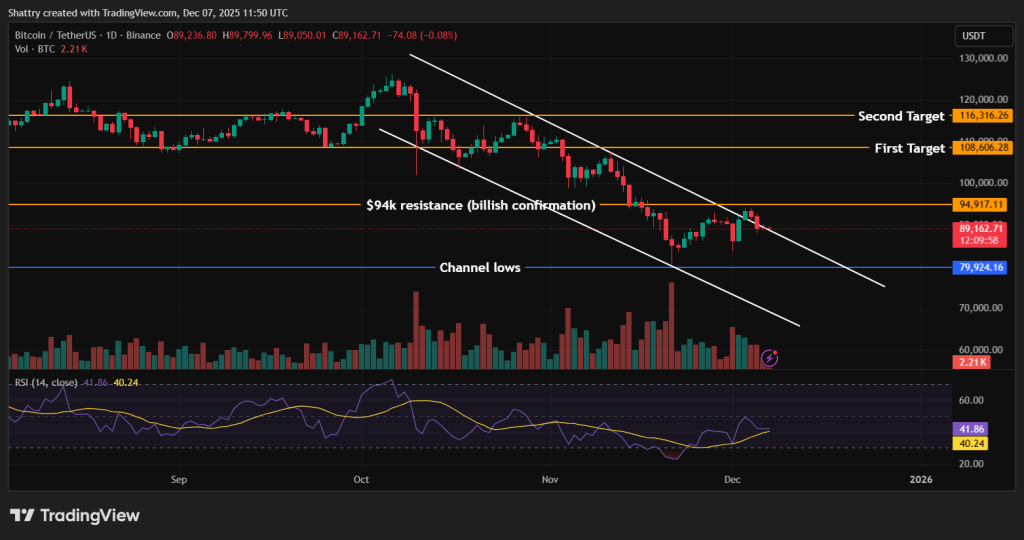
    Technical analysis shows Bitcoin breaking out of a long descending red channel, signalling that the strongest phase of the downtrend has likely ended.

    Price is currently hovering around the $89,000 zone, which sits just beneath a key resistance-turned-support area highlighted in orange.

    Until BTC closes decisively above this zone, sellers can still create short-term pressure.

    Bitcoin Price Analysis - Bitcoin Chart
    Source: TradingView

    The breakout attempt already shows early strength, as BTC bounced from the lower channel region near $79,000 and pushed back toward mid-trend.

    The next major resistance level is around $94,600, and clearing it would confirm bullish continuation.

    If that happens, the chart projects upside targets at $108,000 and eventually $116,000, which align with previous liquidity zones.

    Maxi Doge Presale Capitalizes on Market Momentum

    As Bitcoin positions for a potential comeback driven by Fed rate cuts, presale projects like Maxi Doge (MAXI) are attracting investor attention.

    MAXI is capturing the grassroots momentum that drove Dogecoin’s extraordinary 161,000x rally.

    The project has secured over $4.2 million in funding while building an active community focused on sharing trading strategies and market opportunities.

    Bitcoin Price Analysis - Maxidoge Banner

    Notably, 25% of capital raised will be invested in promising plays, with returns recycled into marketing initiatives and community rewards to accelerate growth.

    Investors can join the presale at $0.000272 by visiting the official Maxi Doge website.

    Then connect an Ethereum-compatible wallet like Best Wallet, and purchase MAXI with ETH, BNB, or USDT.

    Bank card payments are also supported for instant access.

    The post Bitcoin Price Analysis: 92% Fed Rate Cut Probability Sparks Bitcoin Comeback Talk appeared first on Cryptonews.

    Bitcoin “Liveliness” Indicator Rises, Hinting the Bull Cycle May Not Be Over

    By: Amin Ayan

    A key on-chain indicator known as Bitcoin “liveliness” is climbing again, a pattern historically associated with bull market activity, raising the possibility that the current cycle still has room to run, according to analysts tracking long-term blockchain metrics.

    Key Takeaways:

    • Bitcoin’s “liveliness” metric is rising despite stagnant prices, signaling renewed underlying demand.
    • Analysts say dormant coins are moving at unprecedented scale, suggesting a major capital rotation.
    • The indicator’s breakout from a years-long range hints the current bull cycle may not be finished.

    Technical analyst TXMC said on Sunday that liveliness has been “marching higher despite lower prices,” a divergence that suggests steady underlying demand for spot Bitcoin even as market sentiment remains subdued.

    Bitcoin’s Rising “Liveliness” Metric Points to Renewed Bull-Market Demand

    The metric, described as an “elegant” long-term gauge of chain activity, measures the ratio of coins being transacted relative to those being held, weighted by their age.

    It increases when older coins are spent more frequently, and falls when long-term holders accumulate.

    “Liveliness usually rises in bull runs as supply changes hands at higher prices, indicating a flow of newly invested capital,” TXMC explained, noting that the latest upward trend contradicts the muted price action seen in recent weeks.

    Glassnode data shows liveliness pushing into a new peak range, breaking out of the corridor it remained stuck in from the 2017 all-time-high through earlier cycles.

    Analyst James Check said the current spike in liveliness reflects an unprecedented reactivation of dormant Bitcoin supply, surpassing patterns seen during the 2017 bull run, the first cycle characterized by “widespread participation” and a dramatic parabolic surge.

    Liveliness has been range bound since the 2017 peak, up until now.

    The 2017 Bull was special in that it was the first epic parabola with widespread participation, but was also when many old coins transacted to capture the BCH dividend.

    New Liveliness ATHs shows how extreme the… https://t.co/aoVFr2jOsR

    — _Checkmate 🟠🔑⚡☢🛢 (@_Checkmatey_) December 6, 2025

    This time, however, the scale is far larger. While 2017 typically saw transfers measured in the thousands of dollars, Check noted that today’s on-chain value flows often reach into the billions, signaling one of the largest capital rotations Bitcoin has experienced.

    “We have seen an extraordinary volume of coin days destroyed,” Check said. “I am of the view we have just watched one of the greatest capital rotations and changing of the guard in Bitcoin history.”

    BTC Price Stalls, Analysts Eye Breakout Levels

    Bitcoin’s price action remains subdued despite the on-chain strength. BTC briefly dipped below $89,000 early Sunday before recovering to around $89,500, largely unchanged over 24 hours.

    Analyst Michaël van de Poppe said the market is stuck in a consolidation band: “Anything between $86,000 and $92,000 is pretty much noise.”

    Anything between $86-92K is pretty much noise. Not much will happen for $BTC.

    If $92K gets tested, I think we'll break it, but if not, brace yourself for a test at the low $80K range for some sort of double-bottom pattern.

    Again, I don't think we're far off bottoming for… pic.twitter.com/6acTFBAZk4

    — Michaël van de Poppe (@CryptoMichNL) December 6, 2025

    He added that a test of $92,000 could lead to a breakout, while failure could push BTC toward the low $80,000s for a potential double-bottom formation.

    “I don’t think we’re far off bottoming for Bitcoin,” van de Poppe said, predicting a stronger rally heading into late Q4 and early Q1.

    Last week, Bitfinex said the market is showing “seller exhaustion” following a period of heavy deleveraging and panic-driven exits by short-term holders.

    “The combination of extreme deleveraging, capitulation among short-term holders, and early signs of seller exhaustion has created the conditions for a stabilisation phase and a relief bounce,” the firm wrote.

    The post Bitcoin “Liveliness” Indicator Rises, Hinting the Bull Cycle May Not Be Over appeared first on Cryptonews.

    Ether Supply on Exchanges Falls to Record Low, Raising Supply Squeeze Hopes

    By: Amin Ayan

    Ether held on centralized exchanges has fallen to its lowest level in history, fueling speculation that a supply squeeze may be forming beneath the surface of the market.

    Key Takeaways:

    • ETH exchange balances have dropped to a record low of 8.7%, a 43% decline since July.
    • Staking, L2 activity, DATs, and long-term custody are tightening liquid supply.
    • Analysts see hidden buying strength, hinting at potential upward momentum.

    According to Glassnode, exchange balances dropped to 8.7% of total ETH supply last Thursday, the smallest share recorded since Ethereum’s launch in 2015. Levels remained near that low at 8.8% on Sunday.

    ETH Exchange Balances Plunge 43% as Supply Tightens to Record Levels

    The sharp decline represents a 43% drop in ETH exchange balances since early July, coinciding with the acceleration of digital asset treasury (DAT) purchases and growing activity across the broader Ethereum ecosystem.

    Macro research outlet Milk Road said ETH is “quietly entering its tightest supply environment ever,” noting that Bitcoin’s exchange balance remains significantly higher at 14.7%.

    Analysts attributed the shift to structural changes in how ETH is being used. More tokens are flowing into staking, restaking protocols, layer-2 networks, DAT balance sheets, collateralized DeFi positions, and long-term self-custody, destinations that historically do not circulate supply back onto exchanges.

    “Sentiment feels heavy right now, but sentiment doesn’t dictate supply,” Milk Road wrote. “When that gap closes, price follows.”

    Beyond supply metrics, market technicians are spotting signals that buyers may be gaining control. Analyst Sykodelic highlighted an On-Balance Volume (OBV) breakout above resistance late last week, even as price failed to follow.

    $ETH is quietly entering its tightest supply environment ever.

    Exchange balances just fell to 8.84% of total supply, a level we’ve never seen before.

    For context, $BTC is still sitting near 14.8%.

    ETH keeps getting pulled into places that don’t sell, staking, restaking, L2… pic.twitter.com/T7MW3D2bG1

    — Milk Road (@MilkRoad) December 5, 2025

    The divergence, they said, is a classic sign of “hidden buying strength” that sometimes precedes upward moves.

    “This is a sign of buying strength, and typically, the price will follow,” the analyst noted, while cautioning that indicators aren’t guarantees.

    They added that overall price action “looks bullish,” suggesting ETH may revisit higher levels before any meaningful retracement.

    ETH Holds $3,000 as Momentum Builds

    Ether has held above the $3,000 mark for nearly a week but continues to face resistance near $3,200. Over the past 24 hours, ETH has consolidated around $3,050, mirroring the broader market’s indecision.

    The ETH/BTC pair also drew attention last week after breaking above a long-standing downtrend, a move some traders see as an early sign of capital rotating back into Ethereum.

    Meanwhile, BitMine Immersion Technologies, already the largest corporate holder of Ether, has continued aggressively buying the dip even as top traders position for further declines.

    The firm purchased another $199 million in ETH over the past two days, adding to its rapidly expanding reserves.

    BitMine now controls $11.3 billion worth of Ether, roughly 3.08% of the total supply, and is closing in on its long-stated goal of reaching 5%.

    Last month, Tom Lee said Ether may be entering the early stages of the type of explosive growth cycle that propelled Bitcoin to a 100x rally since 2017.

    Lee said the current Ether market resembles Bitcoin’s setup eight years ago, a period marked by deep volatility that ultimately preceded one of the strongest bull cycles in crypto history.

    The post Ether Supply on Exchanges Falls to Record Low, Raising Supply Squeeze Hopes appeared first on Cryptonews.

    ❌