That naturally leads to the final, and perhaps most uncomfortable, question:
Not what the system is, but who the system ultimately rewards.
AI-generated image for illustrative purposes. Not a real photograph.
📡 The Signal Shift: InterLink Enters Its “Institutional Phase”
One of the most misunderstood moments in a network’s life cycle is the arrival of institutions.
Many retail participants see this and panic: “The easy phase is over,” or “The rules will change to favor the big players.”
In InterLink, institutional participation doesn’t make entry easier; it raises the bar. 🚧
When we see Treasury-level language and settlement partnerships, we aren’t seeing “hype” — we are seeing a system preparing for durability.
Institutions don’t enter to gamble. They enter to endure.
To them, InterLink is a tool for two things: Storing Value and Killing Risk.
This changes the game, but not in the way you might expect.
🛑 Why the System Becomes Harder — and Why That’s a Feature
As InterLink matures, the “easy rewards” begin to evaporate.
You’ll notice:
Higher verification standards. 🔍
Zero tolerance for idle or “fake” participation. ⚔️🚫
A heavy emphasis on consistency over random bursts of activity. ⏳
Easy rewards attract noise; hard qualifications protect meaning.
What you lose in short-term convenience, you gain in scarcity created by discipline.
🧍👣 The Individual’s Role: You Are a Node, Not a Miner
The most damaging misunderstanding in Web3 is linguistic. People still call themselves “miners,” implying they are here to extract resources.
InterLink is not optimized for extraction. It is optimized to preserve signal integrity.
Your role is closer to a Network Node than a miner:
You accumulate verified activity over time.
You maintain behavioral consistency.
You build trust relationships (Security Groups).
Every action you take is not a “bet” — it is input data.
The question is no longer “How much did I earn today?” it becomes “What did I prove today?”
🏛️ The Institution’s Role: Custodians, Not Traders
Institutions operate under constraints that retail users often ignore. They cannot rely on sudden exits or narrative volatility.
This is why, inside InterLink, institutions don’t behave like traders — they behave like custodians.
They have no incentive to “dump” ITLG because:
Verified participation is the only gate to settlement access.
Governance rights compound over years, not weeks.
Treasury positioning requires stability, not liquidity spikes.
When both institutions and individuals are punished for impatience, the system achieves a rare economic balance.
🕰️ The Final Axis: Time Is Not Neutral
Most crypto systems pretend that time is neutral or a mere multiplier of interest.
InterLink treats Time as a Filter.
Being “early” guarantees nothing if you are inconsistent.
Having a “large balance” cannot override bad behavior.
Inactivity leads to a decay in relevance.
Time doesn’t reward your optimism; it rewards the records that survive scrutiny.
Not everyone will be early. Not everyone will be large. But anyone can be consistent.
🏁 Conclusion: The Rule That Binds Retail and Institutions Alike
This was never a contest between Retail and Institutions. It was a test of which behaviors survive the same rules.
InterLink does not guarantee returns, protect you from a lack of effort, or flatten outcomes to make everyone “equal.” Instead, it enforces a single, ironclad rule:
Only behavior that survives time is recognized.
If you understand the sequence — qualification before reward — you will find something much rarer than mere “yield.”
You will find Position.
🧭 Series Final Line
InterLink didn’t design a coin economy. It designed the order in which trust is allowed to matter.
About the Author
Done.T is a Web3 analyst specializing in the InterLink ecosystem. He unpacks the underlying logic of the Human Node economy, translating complex system design into actionable, data-driven insights for a global audience.
Disclaimer: This article provides a strategic analysis of InterLink’s publicly available infrastructure and documentation. It is not financial advice. Readers should conduct their own due diligence.
NordFX has been recognised with two additional international awards in 2025, confirming the company’s strong position in execution quality and broker reliability.
✔️ Best Execution Broker 2025 — Forexing Awards ✔️ Most Reliable Forex Broker Asia 2025 — Finance Derivative Awards
These honours reflect NordFX’s continued focus on stable execution, transparent operations, and long-term trust among traders worldwide.
Interest Rates for Traders: The FOMC Playbook Most Beginners Miss
Markets don’t move because interest rates change — they move because expectations do. And every single beginner trader misses that difference.
If you’ve ever watched Bitcoin, stocks, or forex explode before an interest rate decision — or dump after “good news” — you’ve already felt the power of the Federal Open Market Committee (FOMC)… without understanding it.
This article breaks down how interest rates actually move markets, why FOMC meetings are trader liquidity events, and the exact playbook professionals use that beginners never learn.
Whether you trade crypto, equities, indices, or FX, this is the missing framework you need.
What Is the FOMC?
The Federal Open Market Committee (FOMC) is the policy-making arm of the U.S. Federal Reserve responsible for:
Setting interest rates (Fed Funds Rate)
Managing liquidity conditions
Guiding inflation expectations
Influencing global risk assets
Why this matters to traders
The U.S. dollar is the world’s reserve currency.
When the Fed changes policy, every major market reacts:
S&P 500
Nasdaq
Bitcoin & crypto
Gold
Forex pairs
Bonds & yields
Interest rates are the price of money. When that price changes — or is expected to change — capital moves.
Interest Rates Explained Simply
Think of interest rates like gravity.
Low rates → money flows into risk assets
High rates → money flows into safety
What happens when rates rise?
Borrowing becomes more expensive
Liquidity tightens
Valuations compress
Risk assets struggle
What happens when rates fall?
Capital becomes cheaper
Leverage increases
Speculation rises
Risk assets thrive
This is why rate cycles and market cycles are inseparable.
The #1 Mistake Beginner Traders Make With FOMC
Most beginners think:
“If the Fed cuts rates, markets go up. If they hike, markets go down.”
That thinking gets traders liquidated.
Reality:
Markets move based on:
Expectations
Forward guidance
Powell’s tone
Dot plot projections
Liquidity positioning
The decision itself matters less than the surprise.
The FOMC Playbook (How Pros Actually Trade It)
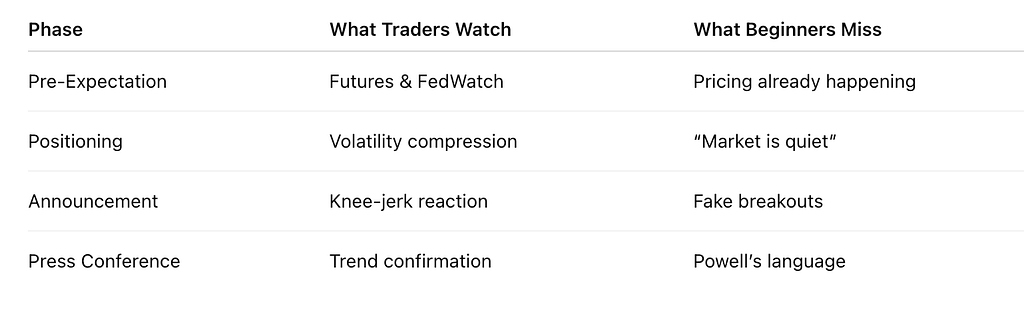
Professional traders break FOMC into four phases:
The FOMC Playbook
Let’s break each one down:
Phase 1: Pre-FOMC Expectations (Weeks Before the Meeting)
Markets price in rate decisions weeks in advance.
Tools professionals use:
CME FedWatch Tool
Treasury yields (2Y & 10Y)
Dollar Index (DXY)
Risk sentiment indicators
Example:
If FedWatch shows a 90% probability of a rate cut, that cut is already priced in.
So when it happens?
Markets often sell the news
Phase 2: Liquidity Positioning (Days Before FOMC)
This is where most traps are set.
What typically happens:
Volatility compresses
Price ranges tighten
Fake breakouts increase
Retail traders over-leverage
This is because:
Institutions wait. Retail trades noise.
This is not the time to predict direction — it’s the time to mark liquidity levels.
Phase 3: The Rate Decision (The 2:00 PM Trap)
At 2:00 PM ET, the Fed releases:
Interest rate decision
Policy statement
Dot plot (quarterly)
What you’ll often see:
Violent spike up
Immediate reversal
Stop hunts in both directions
This is algorithmic trading, not sentiment.
If you trade the first 5 minutes, you’re trading against machines.
Phase 4: Powell’s Press Conference (The Real Trade)
This is where trends are born.
Jerome Powell’s language matters more than the rate decision itself.
Traders listen for:
“Data dependent”
“Restrictive”
“Higher for longer”
“Financial conditions”
“Inflation progress”
Markets move on tone, not headlines.
Real Case Study: FOMC vs Bitcoin (2022–2024)
2022: Aggressive Hiking Cycle
Rates rose rapidly
Liquidity drained
Bitcoin fell from $69K → $15K
Not because of crypto fundamentals — but monetary tightening.
2023: Pause Narrative Begins
Rate hikes slow
Market anticipates cuts
Bitcoin rallies 300%+
Markets moved before cuts happened.
2024: “Higher for Longer” Shock
Powell signals caution
Risk assets stall
Volatility spikes
This is expectations vs reality in action.
Interest Rates and Crypto: The Hidden Correlation
Crypto traders often ignore interest rates — and pay for it.
Why rates matter for crypto
Stablecoin yields compete with DeFi
Liquidity determines speculative appetite
Bitcoin trades like a liquidity asset, not a currency
When real yields rise, crypto struggles. When real yields fall, crypto breathes.
The Economic Calendar Every Trader Must Track
Bookmark this. No excuses.
High-Impact Rate Events:
FOMC Rate Decisions (8x/year)
FOMC Minutes
CPI (Inflation)
PCE Inflation
Non-Farm Payrolls (NFP)
Jackson Hole Symposium
Pro Tip:
Markets often move harder on CPI than FOMC.
Sample FOMC Trading Calendar (Example)
Sample FOMC Trading Calendar
(Always confirm dates via official Fed calendar)
How Beginners Should Trade FOMC (Safely)
This is the beginner-proof framework:
1. Do NOT predict direction
Let the market show its hand.
2. Reduce position size
Volatility kills over-leverage.
3. Trade after confirmation
Not during the announcement.
4. Watch correlated markets
DXY, yields, equities tell the truth.
Advanced Tip: Yield Curves & Risk Assets
Professionals track:
2-Year Treasury Yield
10-Year Treasury Yield
Yield curve steepening / inversion
Because:
Rising short-term yields = tightening
Falling long-term yields = recession risk
Risk assets respond accordingly
The Psychological Edge Most Traders Miss
FOMC events expose emotional traders.
Fear of missing out
Revenge trading
Overconfidence
News addiction
Pros stay flat. Beginners chase candles.
Frequently Asked Questions About Interest Rates & FOMC
Do interest rates affect crypto prices?
Yes. Interest rates influence liquidity, risk appetite, and capital flows, all of which directly impact crypto markets.
Why do markets move before FOMC decisions?
Markets price in expectations ahead of time using futures, yields, and macro data.
Is it safe to trade during FOMC?
For beginners, no. Volatility and algorithmic trading create high liquidation risk.
What matters more: rate decision or Powell’s speech?
Powell’s tone and forward guidance usually matter more than the rate decision itself.
Final Thoughts: Trade the Narrative, Not the Number
Interest rates are not a headline — they’re a system.
If you only watch:
“Rate up or down”
You’ll always be late.
If you understand:
Expectations
Liquidity
Positioning
Narrative shifts
You trade with institutions, not against them.
That’s the FOMC playbook most beginners never learn — until it’s too late.
If this helped you, clap, bookmark and share with another trader who still trades headlines.
Because markets don’t reward predictions — they reward preparation.
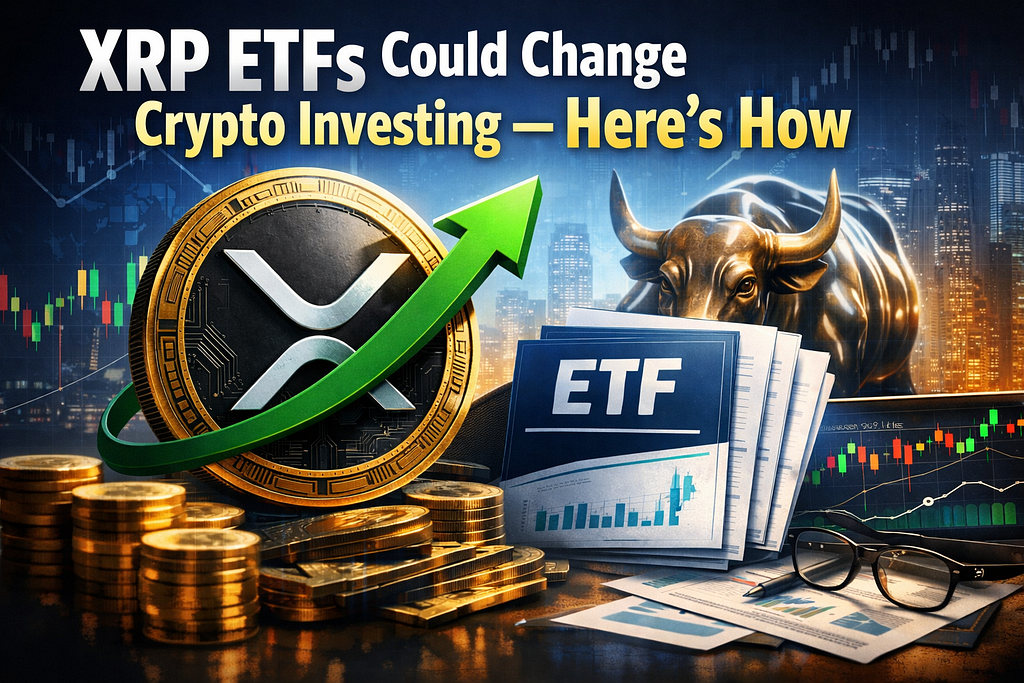
XRP ETFs Could Change Crypto Investing — Here’s How
XRP ETFs
For years, XRP has lived in a regulatory gray zone — debated, sidelined, underestimated. But the rise of XRP ETFs could flip the script entirely, pulling Ripple’s token out of speculation territory and into the heart of institutional finance.
If approved, XRP exchange-traded funds (ETFs) wouldn’t just boost XRP’s visibility — they could reshape how institutions, retirement accounts, and conservative investors gain exposure to crypto.
Just as Bitcoin ETFs unlocked billions in institutional inflows, XRP ETFs may become the next major bridge between Wall Street and blockchain-based assets.
So what does this actually mean for crypto investors, portfolio managers, and long-term wealth builders?
Let’s break it down.
What Is an XRP ETF?
An XRP ETF is a regulated investment fund that tracks the price of XRP and trades on traditional stock exchanges, allowing investors to gain exposure to XRP without directly buying, storing, or managing crypto tokens.
XRP ETFs could:
Increase institutional demand for XRP
Improve market liquidity
Reduce volatility over time
Make XRP accessible to retirement accounts and wealth managers
Why XRP ETFs Matter More Than You Think
Bitcoin ETFs didn’t just boost BTC’s price — they legitimized crypto as an asset class.
XRP ETFs could have an even broader structural impact.
XRP is not positioned as “digital gold” — it’s positioned as financial infrastructure.
Ripple’s core value proposition is cross-border payments, liquidity provisioning, and settlement efficiency for banks and institutions. An ETF structure aligns perfectly with that narrative.
Key difference: Bitcoin ETFs vs XRP ETFs
Key Difference: Bitcoin ETFs vs XRP ETFs
This distinction matters enormously for long-term capital flows.
XRP ETF Institutional Demand: Why Wall Street Is Watching Closely
Institutions cannot easily buy spot XRP today
Many institutions face barriers such as:
Custody risk
Compliance restrictions
Internal policy bans on direct crypto holdings
Accounting complexities
An XRP ETF removes all of these.
What institutions can do with ETFs
Add XRP exposure to balanced portfolios
Allocate via pension funds
Include in 401(k)s and IRAs
Use XRP exposure in risk-managed strategies
This is exactly what happened after Bitcoin spot ETFs launched.
How XRP ETFs Could Impact XRP Price Dynamics
Let’s be clear: ETFs don’t guarantee price appreciation — but they do change market mechanics.
Potential effects of XRP ETFs on price
1. Increased sustained demand
ETFs buy and hold XRP for fund backing
Reduces available circulating supply
2. Lower volatility over time
Institutional capital is typically long-term
Less emotional buying/selling
3. Higher liquidity
Tighter spreads
Deeper order books
4. Narrative re-rating
XRP shifts from “regulatory-risk token” to “regulated investment product”
This narrative shift alone can change how XRP is valued.
Ripple, Regulation, and the ETF Approval Path
No XRP ETF conversation is complete without addressing regulation.
Ripple’s legal battles with the SEC were a major roadblock for years. But regulatory clarity — even partial — changes the landscape dramatically.
Why regulation matters for ETFs
ETFs require clear asset classification
Custodians need regulatory certainty
Issuers avoid legal ambiguity
As regulatory frameworks evolve globally, XRP becomes increasingly ETF-viable, especially in jurisdictions outside the U.S. first.
Global XRP ETFs: The International Advantage
Even if U.S. approval lags, international markets may move faster.
Countries with more crypto-friendly regulatory environments could:
Approve XRP ETFs earlier
Attract global capital
Set precedent for U.S. regulators
This mirrors what happened with Bitcoin ETFs in Canada and Europe before U.S. approval.
Most crypto investors miss this: Price moves follow infrastructure — not the other way around. XRP ETFs aren’t about pumps, they’re about permanent demand.
Save this article if you’re building a long-term crypto strategy, not chasing headlines.
How XRP ETFs Could Change Portfolio Construction
For wealth managers, XRP ETFs unlock a new category.
XRP ETFs fit into portfolios as:
Alternative liquidity assets
Fintech exposure
Blockchain infrastructure allocation
Non-correlated growth instruments
This matters for:
Family offices
Endowments
Hedge funds
Financial advisors
Instead of treating crypto as a single high-risk bucket, XRP ETFs allow segmented crypto exposure.
XRP vs Bitcoin ETFs: Complement, Not Competition
Another misconception is that XRP ETFs would compete with Bitcoin ETFs.
Artificial intelligence was supposed to make businesses leaner, faster, and more profitable.
Instead, for many companies, it has quietly become one of the most expensive line items on the balance sheet — without delivering proportional returns.
I see this pattern over and over again.
Founders proudly announce they’re “AI-powered.” Teams stack subscriptions like badges of innovation. Budgets swell under the assumption that more AI equals more efficiency.
And yet… profit margins shrink.
The truth is uncomfortable:
AI doesn’t kill profit. Bad AI spending does.
This article isn’t anti-AI. Quite the opposite. AI can be one of the most powerful leverage tools in modern business — when used correctly.
But there are five specific AI expenses that quietly drain cash, compound inefficiencies, and erode margins — often without anyone noticing until growth stalls or costs spiral out of control.
If you’re running an online business, agency, SaaS, eCommerce store, or even a content operation, this article may save you thousands — possibly tens of thousands — per year.
Let’s break them down.
1. Paying for AI Tools You’re Not Actually Using
This is the most common and the most invisible profit killer.
It starts innocently.
You sign up for an AI writing tool. Then a design assistant. Then a chatbot platform. Then an automation tool. Then a data analysis AI. Then a “one-click growth” AI you saw on Twitter.
Each one feels cheap on its own.
£19/month £29/month £49/month £99/month
But stack them together, and suddenly you’re burning £400–£1,200 per month on AI software — much of which sits idle.
The Silent Subscription Trap
AI tools are especially dangerous because:
They sell potential, not guaranteed outcomes
Most offer “unlimited” or “pro” tiers that feel necessary
Cancellation friction is intentionally subtle
So what happens?
Teams test the tool for a week
Use it enthusiastically for a month
Then revert to old workflows
But never cancel the subscription
Three months later, the tool is still billing. Six months later, nobody remembers why it was purchased. A year later, it’s still quietly draining profit.
Multiply this by 5–10 tools, and you have a serious leak.
The Fix: Usage-Based AI Audits
Every quarter, ask three brutal questions for every AI tool:
Who used this in the last 30 days?
What specific output did it produce?
Did that output directly save time or generate revenue?
If the answer isn’t clear, measurable, and defensible — cancel it.
AI tools should earn their place on your balance sheet. If they can’t justify their cost, they’re not “innovation.” They’re overhead.
2. Overpaying for “All-in-One” AI Platforms
“All-in-one AI” sounds efficient.
One dashboard. One subscription. One solution for everything.
In reality, these platforms are often bloated, overpriced, and underperforming.
The All-in-One Illusion
Most all-in-one AI platforms promise:
Content creation
Social scheduling
Email marketing
Analytics
Chatbots
Automation
But here’s what they rarely tell you:
They’re mediocre at everything and excellent at nothing.
You end up paying premium prices for:
Features you don’t need
Tools you already have
Capabilities your team doesn’t use
Worst of all, these platforms often lock you into:
Annual contracts
User-based pricing
Artificial limits
So you pay more because you’re growing — even if output doesn’t scale proportionally.
The Hidden Cost: Flexibility
When your AI stack is locked inside a monolithic platform:
You can’t swap tools easily
You can’t optimize per task
You can’t adapt quickly
Your business becomes dependent on one vendor’s roadmap — not your own priorities.
That dependency is expensive.
The Fix: Modular AI Stacks
Instead of one bloated platform, build a lean, modular AI stack:
One strong core model (e.g., text, reasoning, analysis)
One automation layer (only if needed)
One domain-specific tool (design, video, data, etc.)
This approach:
Costs less
Scales better
Gives you control
The goal is precision, not consolidation.
3. Using AI to Automate the Wrong Things
This is where AI spending becomes actively harmful.
Automation is seductive. It feels like progress.
But automating the wrong processes doesn’t save money — it multiplies inefficiency.
Automation Without Strategy
Many businesses jump straight to:
AI chatbots before fixing support workflows
AI content generation before clarifying brand voice
AI ads before validating offers
AI outreach before understanding their ICP
So what happens?
Bad processes become faster
Confusion becomes scalable
Errors propagate automatically
You’re no longer making mistakes manually — you’re making them at scale.
The Cost Nobody Tracks
The expense isn’t just the AI subscription.
It’s:
Lost leads from broken automations
Customer frustration from robotic responses
Brand damage from inconsistent messaging
Team time spent fixing AI-generated problems
These costs don’t show up neatly on a spreadsheet, but they hit revenue directly.
The Fix: Automate Only After Optimization
AI should be the last step, not the first.
Before automating anything, ask:
Is this process already working manually?
Is the output quality acceptable?
Can a human clearly define success?
If the answer is no, AI will not fix it.
AI amplifies systems. It does not repair broken ones.
4. Paying for AI Output That Replaces Cheap Human Work
This one sounds controversial, but it’s critical.
AI is not always cheaper than humans — especially for low-value, repetitive tasks.
The False Economy of AI Replacement
Many businesses replace:
Virtual assistants
Junior content writers
Entry-level designers
Customer support agents
…with AI tools costing hundreds per month.
But let’s do the math.
A part-time VA might cost:
£4–£6 per hour
£300–£500 per month
An AI stack replacing them might cost:
£200–£400 per month
Plus setup
Plus maintenance
Plus supervision
And AI still:
Makes mistakes
Needs prompting
Requires review
So what did you really save?
Often, nothing.
In some cases, you paid more for worse output.
Where AI Actually Wins
AI is best used where:
Human labor is expensive
Speed matters more than perfection
Scale creates compounding value
Examples:
Research synthesis
Drafting (not final writing)
Data analysis
Pattern detection
First-pass ideation
Using AI to replace low-cost human labor is usually a profit trap, not a win.
The Fix: Human-AI Leverage, Not Replacement
The most profitable model is:
Humans do judgment, taste, and decision-making
AI handles volume, speed, and repetition
When AI augments people instead of replacing them, margins improve without quality collapse.
5. Paying for AI Without Clear ROI Metrics
This is the most dangerous expense of all.
AI feels intangible. So businesses treat its cost as “experimental.”
That’s how profit leaks go unnoticed.
The “Innovation Budget” Mistake
AI spending often hides under labels like:
Innovation
R&D
Growth
Digital transformation
These budgets are rarely scrutinized the same way ad spend or payroll is.
As a result:
Tools stay active without evaluation
Costs accumulate quietly
ROI is assumed, not measured
The longer this continues, the harder it becomes to cut — because nobody wants to admit the spend didn’t pay off.
The Fix: Tie AI to One Metric Only
Every AI tool should be linked to one primary metric:
Time saved
Revenue generated
Cost reduced
Error rate lowered
If you can’t point to that metric and say, “This tool improved this number,” then you don’t have an AI strategy — you have a hope.
AI should justify itself like any other investment.
The Real Reason AI Kills Profit (When It Does)
AI doesn’t kill profit because it’s expensive.
It kills profit because:
Businesses buy it emotionally
Implement it randomly
Measure it poorly
AI is often treated as a status symbol instead of a system.
That’s the mistake.
The companies winning with AI aren’t the ones using the most tools. They’re the ones using the fewest, intentionally.
A Simple AI Profit Framework
If you want AI to increase profit instead of eroding it, follow this framework:
Identify one bottleneck
Fix it manually
Apply AI only where it amplifies results
Measure impact monthly
Cut aggressively when ROI fades
That’s it.
No hype. No tool hoarding. No sunk-cost loyalty.
Just disciplined leverage.
Final Thought
AI is not a magic button.
It’s a multiplier.
If your systems are messy, AI multiplies chaos. If your spending is undisciplined, AI multiplies waste. If your strategy is clear, AI multiplies profit.
The difference isn’t the technology.
It’s how — and why — you pay for it.
Just tell me what you want next — and whether this is going into your own publication or a partner one.
I expanded another framework into a step-by-step ebook for all who want to apply it in very good of this version — not. just read about it
January 2026 has delivered a blunt message to investors: the playbook has changed. Gold is trading above $5,000 an ounce for the first time. Bitcoin is stuck below $88,000 and cannot hold the $90,000 level it briefly reclaimed. This gap is not just a weird market moment. It looks like a reset in how capital behaves when geopolitics heats up, and policy direction gets messy.
The numbers underline the shift. Gold rose 64% in 2025 and is already up more than 17% in the first weeks of 2026. Bitcoin, meanwhile, sits roughly 11% below its December 2024 all-time high near $108,000. Over one weekend in late January, total crypto market cap dropped by about $56 billion to roughly $2.92 trillion. This is not random noise. It reflects two different investor instincts playing out in real time.
The Safe-Haven Rush: Why Gold Owns the Narrative Right Now
Gold’s run is not coming from one single driver. It is coming from several forces stacking on top of each other.
Central banks, especially in emerging markets, have been buying gold at a pace that looks more like crisis-era behavior than normal reserve management. ETF inflows have reinforced that demand. Retail and institutions are doing the same thing for the same reason: they want a hedge against currency risk, policy mistakes, and the kind of uncertainty that makes investors second-guess everything.
The geopolitical backdrop is not helping. Trade tensions have moved from headlines into concrete threats and real negotiation pressure. President Donald Trump’s administration has floated 100% tariffs on Canadian goods tied to China-related trade developments, plus potential 200% levies on French wines and champagne. That kind of language changes behavior fast because markets do not wait for policy to become law. They price the risk now.
Currency markets are reflecting the same mood. The Japanese yen strengthened to 153.89 per dollar, its strongest level since November 2025, as traders speculated about possible coordination between U.S. and Japanese authorities. Japan’s top currency diplomat kept timing vague, which tends to make uncertainty worse, not better. The euro pushed to a four-month high near $1.1898 as traders cut dollar exposure ahead of the Fed’s next signals and the possibility of new leadership chatter.
These moves matter because they signal something deeper than FX positioning. They suggest investors are questioning stability and coordination at the top of the global monetary system. When people get nervous about reserve currencies, they often reach for gold. Gold does not pay yield. It does not grow cash flow. It holds value because it still functions as a trust asset when confidence in other systems starts to wobble.
History helps frame the moment. In 2008, gold climbed from roughly $800 to about $1,900 by 2011 as central banks flooded the system with stimulus. In 2020, gold hit new highs above $2,000 during peak pandemic fear. This rally is bigger in both percentage terms and absolute levels, which suggests the market is pricing something more structural than a single shock.
Bitcoin’s Reality Check: Why “Digital Gold” Is Not Acting Like Gold
Bitcoin has spent years carrying the “digital gold” label. This month has exposed how fragile that comparison can be when stress hits.
Gold is absorbing defensive flows. Bitcoin is absorbing selling from people who bought higher and now want out. That difference matters because it changes how rallies behave. When gold rallies in a risk-off environment, it often pulls in more buyers. When Bitcoin rallies in the same environment, it often runs into sellers looking to exit.
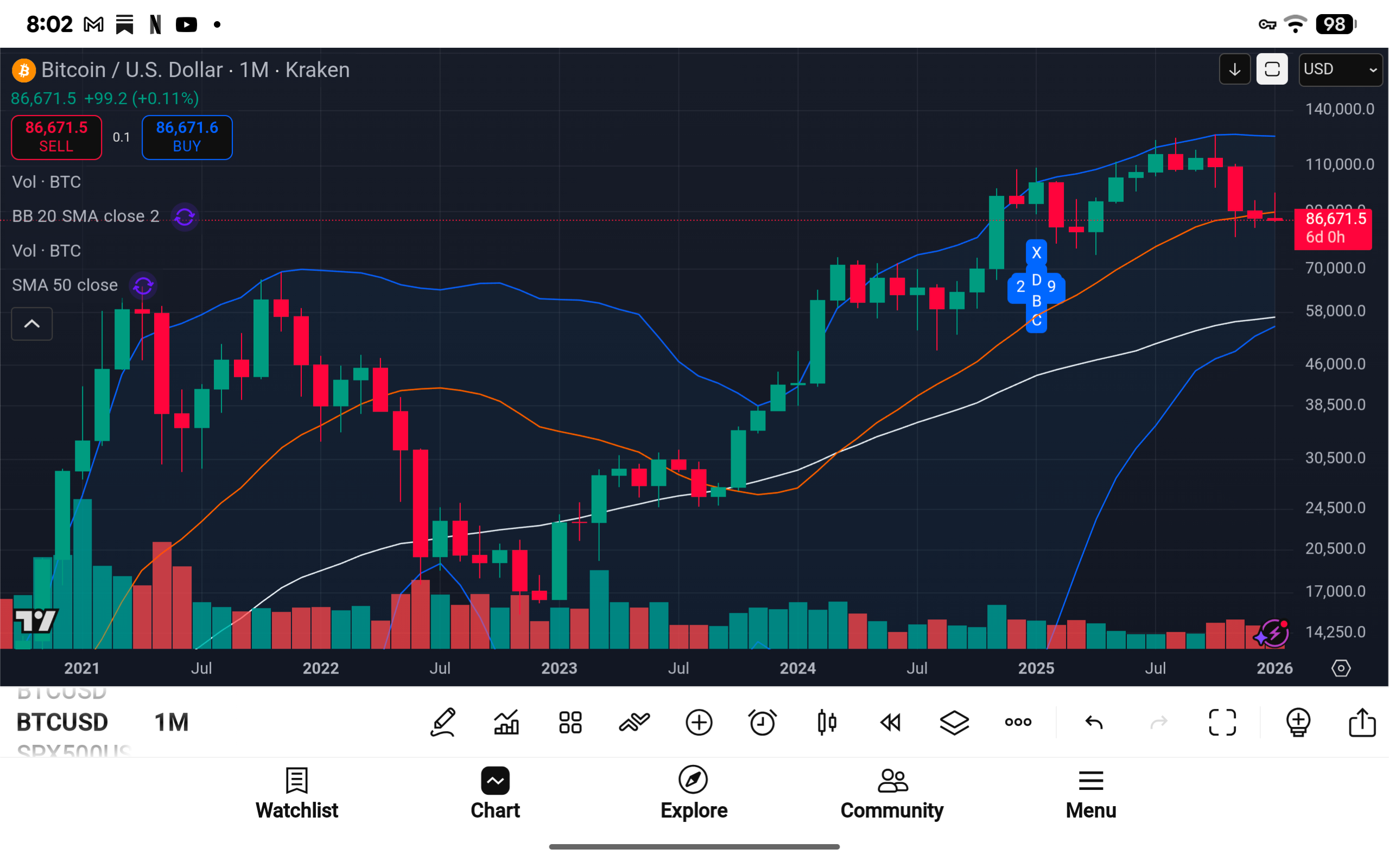
Technically, Bitcoin has been trapped in a structure that has not offered easy upside. Price action has struggled around $87,619 after losing $90,000 during weekend trading. Support sits around $84,698 with resistance near $89,241. If support fails, downside pressure toward $84,000 becomes the obvious target. If resistance holds, $90,000 stays a psychological ceiling rather than a launchpad.
More important than the chart is the behavior underneath it. CryptoQuant data shows Bitcoin holders selling at a loss for the first time since October 2023. That is a shift in tone. In strong bull phases, holders usually ride volatility because they expect higher prices ahead. When people start locking in losses, they are not thinking in bull-market terms. They are managing pain and uncertainty.
Glassnode analysis adds another problem: a heavy supply overhang above $100,000. Many holders are sitting in positions bought between current levels and six figures. When price approaches their entry zones, they sell to break even or limit damage. That creates a supply wall that is hard to clear without fresh demand and strong momentum.
This is not how Bitcoin behaved in 2020 to 2021. Back then, conviction and institutional narratives pushed price from $10,000 to $69,000 in about a year. Today’s structure feels more like rotation and digestion than acceleration. Futures volumes are compressed. Leverage is subdued. Traders are not leaning into upside the way they do when they truly believe the move is imminent.
Prediction markets reflect the change in psychology. Polymarket odds have shown more confidence in gold holding above $5,500 through mid-year than Bitcoin setting new highs over the same window. That is the opposite of the mood in late 2024 when crypto optimism ran hot after Bitcoin crossed $100,000.
The deeper takeaway is uncomfortable for some investors: Bitcoin is not acting like a safe haven right now. It is acting like a high-volatility asset that depends on liquidity, confidence, and risk appetite. That does not kill the long-term thesis, but it changes how investors should frame it in the short term.
Altcoins Under Stress: What Happens When Speculation Hits a Wall
Bitcoin’s weakness looks mild compared to what is happening in altcoins.
Kaia (KAIA) is a clean example. It fell nearly 20% in 24 hours to around $0.0762 after breaking support near $0.0797 and briefly dipping below $0.0721. It held above its 50-day EMA, which offers some technical comfort, but the drop shows how fast liquidity disappears when sentiment cracks.
Altcoins are built for leverage to mood. In bull phases, capital moves from Bitcoin into Ethereum, then into larger alts, then into smaller speculative tokens as investors chase bigger multiples. In corrections, the flow reverses and the weakest assets get hit first. That creates a brutal reality: altcoins can look unstoppable on the way up and untradeable on the way down.
Ethereum has not offered much shelter either. Ether traded near $2,867 in late January, down 2.6% while Bitcoin fell 1.3%. That underperformance signals that investors are not rotating into higher-beta crypto exposure. Thin spot volume and muted derivatives activity support the same conclusion.
The question now is whether this is a pause before another risk cycle or a deeper structural shift. Several factors argue for caution. U.S. regulation is moving, but it still has open questions around token classification and how securities law will apply. Japan may approve crypto ETFs by 2028, with firms like Nomura and SBI expected to launch products on the Tokyo Stock Exchange, but a two-year timeline does not help the next few months.
There is also a credibility problem. Reports of a U.S.-linked crypto theft scandal involving alleged misuse of access to seizure wallets have rattled confidence. ZachXBT has traced funds linked to thefts spanning 2024 and 2025. Incidents like this do not just hurt sentiment for a week. They raise uncomfortable questions about custody, oversight, and the real-world weak points in the ecosystem.
What Institutions Are Actually Doing Right Now
Retail narratives dominate crypto chatter, but institutional behavior usually tells the cleaner story.
Central banks are voting with their balance sheets, and they are choosing gold. Many of them are not willing, or not able, to justify holding an asset that can drop 15% in a week. Their gold buying creates a steady baseline bid that crypto does not have.
Hedge funds and family offices have also turned cautious. Leverage in crypto derivatives remains compressed compared to peak cycles. Open interest in Bitcoin futures exists, but it has not expanded in the way you would expect if large players were building a new bullish stance.
Corporate treasury adoption has not restarted in a meaningful way. During 2020 to 2021, it was easier to sell boards on Bitcoin exposure because liquidity was abundant and narratives were clean. Today, when gold is up 17% year-to-date and Bitcoin is chopping sideways, that boardroom pitch becomes harder.
Pension funds and sovereign wealth funds remain mostly on the sidelines. They move slowly and demand strong regulatory certainty. The U.S. may get there, but it is not there yet.
Right now, institutional money looks like it is waiting, not charging in. That is the simplest read, and it matters because those investors have the best access to research, infrastructure, and policy visibility.
The Fed Variable: Why This Week Can Move Everything
The late-January Federal Reserve meeting matters more than people want to admit. Not because the market expects a surprise rate hike or cut, but because guidance sets tone and liquidity expectations.
If the Fed signals confidence that inflation is easing and hints at future cuts, risk assets usually respond well. Lower rates reduce the opportunity cost of holding gold, and they tend to weaken the dollar, which supports commodity pricing. Crypto would benefit too, mostly through improved liquidity and renewed risk appetite.
If the Fed stays hawkish and emphasizes inflation risk, the market hears “higher for longer.” That hurts speculation. It also pressures gold through higher real yields, though safe-haven demand can sometimes overpower yield dynamics when fear becomes the bigger driver.
Politics adds another layer. Trump has criticized Jerome Powell publicly, and any credible talk of leadership changes introduces a market question about central bank independence. If markets interpret leadership shifts as more accommodative and more political, both gold and Bitcoin could rally on the same narrative: long-term trust risk in fiat management.
FX moves leading into the meeting show the tension. Traders have been trimming dollar exposure. That positioning can unwind quickly after Fed messaging, which would ripple into correlated assets.
Geography Is Not Background Noise in 2026
Regional differences are starting to matter more.
Asia has been mixed. China’s Shanghai index rose slightly while Japanese equities fell on yen strength. That split reflects different policy priorities and economic conditions across the region.
Japan’s currency strength is a headwind for exporters, but the medium-term ETF discussion positions Japan as a potential regulated gateway for crypto exposure, even if the timeline stretches to 2028. Europe has its own stress points, including trade friction with the U.S. The euro’s strength helps imports but hurts export competitiveness. The ECB has moved more dovishly than the Fed, which further changes cross-border capital flows.
The U.S. still dominates crypto market structure, liquidity, and innovation, even with regulatory uncertainty. Any real legislative breakthrough will matter globally because U.S. clarity tends to set the tone for institutions everywhere.
Emerging markets sit at the center of the gold move. They feel currency risk hardest and often have the strongest incentive to seek alternatives. But in practice, gold is still simpler and more accessible than crypto for most investors in those regions, which helps explain why gold is absorbing flows first.
Portfolio Positioning: What Discipline Looks Like in Uncertain Markets
This environment punishes overconfidence.
Gold’s role is straightforward. It is doing what it has historically done in messy periods. A 5% to 10% allocation to physical gold or gold-backed ETFs can make sense for many investors with multi-year horizons. It should protect the portfolio without taking over the entire strategy.
Crypto needs a different label. It is closer to a venture-style exposure to technology adoption than a pure safe haven. That means sizing should be conservative. A 1% to 3% allocation can keep investors engaged in long-term upside without turning short-term volatility into a lifestyle risk.
This is also a moment where patience often beats activity. Large shifts based on short-term moves tend to destroy value. Rebalancing rules matter more than predictions. If gold has grown far beyond its target weight, trimming back to plan can be smarter than chasing the next headline.
Dollar-cost averaging can work for crypto investors who believe in long-term adoption but do not trust the next six weeks. Small, scheduled buys remove emotion and reduce timing risk.
Leverage is the trap. Borrowing to amplify crypto exposure remains one of the fastest ways to blow up in a market like this. Volatility compression often precedes violent expansion. Liquidations do not care about your thesis.
Scenarios for the Next Six Months
Several paths remain plausible through mid-2026.
One scenario is the most boring and arguably the most consistent with current structure: gold keeps rising on safe-haven demand while crypto chops sideways. Gold could press toward $5,500 as tensions and central bank buying persist. Bitcoin could range between $80,000 and $95,000, supported by long-term holders but capped by overhead supply and cautious institutions.
A second scenario requires alignment: easing geopolitical tension plus Fed rate cuts. That would likely rotate capital out of gold and back into risk, lifting crypto meaningfully. Bitcoin could reclaim $100,000 if market structure improves and leverage returns, while gold could pull back but remain elevated above $4,500.
A third scenario is the darker one: economic conditions deteriorate materially. Gold could push toward $6,000 while crypto faces forced liquidations and deeper downside, with Bitcoin potentially testing $70,000 or lower.
A fourth scenario depends on policy competence: a clear U.S. regulatory breakthrough that unlocks institutional capital at scale. It is possible, but the near-term probability remains lower than crypto bulls want.
The most realistic outcome may look like a mix: partial easing in some geopolitical zones, new flashpoints elsewhere, gradual Fed shifts, and crypto alternating between relief rallies and pullbacks without clean direction.
Risk Management Rules That Still Matter
When correlations move and narratives break, basics protect capital.
Position sizing is the first filter. Overallocating to a single theme is the most common failure. Crypto should be sized so that total loss would not change your life. Gold should be sized so it protects the portfolio without trapping you in defensive posture if equities rebound.
Diversification only works when it is real. Ten cryptocurrencies do not diversify if they all move with Bitcoin. Two forms of gold exposure can also behave differently: physical gold, gold ETFs, and miners each carry distinct risks.
Liquidity matters more than people admit. Assets that trade cleanly in calm markets can become thin in stress. Holding enough cash or liquid reserves to avoid forced selling remains a timeless rule.
Discipline is the edge. Volatility is designed to trigger bad decisions. Rules around rebalancing and allocation prevent emotional reactions. Writing down your principles during calm periods and following them during stress is not just advice. It is a practical survival tool.
Taxes also become more important as volatility increases. Crypto gains and losses can be managed strategically through loss harvesting, holding periods, and timing. Gold can have special tax treatment in some jurisdictions. Investors should not wing it.
What Past Divergences Tell Us
This is not the first time asset relationships have shifted.
In 2013’s taper tantrum, gold fell while risk assets also struggled. Safe-haven flow went into dollars, not gold. That episode shows safe haven behavior changes depending on what investors fear.
In 2018, Bitcoin collapsed while gold stayed rangebound, because macro fear was muted. That period shows gold does not automatically benefit from crypto weakness.
In 2020, both rallied after the initial crash because stimulus and inflation fears dominated. That environment is not today’s environment. Today looks more like geopolitical stress plus constrained liquidity, which tends to favor gold over speculative assets.
The lesson is simple: correlations are not laws. They are temporary relationships shaped by the dominant fear in the room.
The Ethereum Problem: Why Number Two Looks Stuck
Ethereum’s underperformance is not just a chart issue. It points to a broader question about smart contract platforms and real adoption.
DeFi activity is down from peak levels. NFT volumes have collapsed. Layer-2 scaling has reduced fees, which is good for users, but it has also fragmented liquidity and attention across multiple networks. That can weaken Ethereum’s network effects, even if the technology continues to improve.
Solana and other platforms have gained share, but they have also struggled during broad risk-off conditions. So this is not just an Ethereum-specific problem. It is a demand problem across crypto applications.
The bigger concern for Ethereum bulls is the application gap. Ethereum has proven it can work. What it has not proven is that it can deliver mainstream use cases that compete with web2 experiences at scale. Many on-chain apps still feel like tools for crypto-native users rather than products built for the public.
Without clear demand drivers, ETH valuation stays tied to speculative appetite. In a market where investors are reducing risk, that is not a great setup.
Regulation: The One Catalyst That Can Reprice Everything
Even with weak price action, regulation remains the biggest potential reset.
U.S. legislative progress is focusing on custody rules, stablecoin frameworks, and exchange registration. Real clarity on token classification would be the unlock. It would reduce existential risk for projects, give institutions rules they can follow, and lower the odds of surprise enforcement events that shake markets.
International coordination is improving too. FATF standards have pushed most major jurisdictions toward common baselines for exchanges and wallet providers. The EU’s MiCA rules bring structure across a large economic bloc. Some elements are heavy, but clear rules often matter more than perfect rules.
Japan’s ETF discussion suggests growing acceptance of crypto as an investment asset class, even if the pace is slow. China remains restrictive on trading, but it continues to pursue blockchain applications and central bank digital currency research.
Regulation will not fix market structure overnight, but it can change who is allowed to participate. That is how market regimes shift.
The CBDC Wildcard
Central bank digital currencies sit in a strange place. They validate the concept of digital money while competing with private crypto rails.
CBDCs are permissioned and controlled. They do not offer the decentralization or supply constraints that define Bitcoin. They can also enable deeper state-level visibility into transactions, which raises privacy concerns.
Still, their development signals something important: central banks agree that the future of money is digital. The question is whether CBDCs simply replicate existing payment rails, or whether they introduce programmable money that could replace some stablecoin and DeFi use cases.
If CBDCs expand surveillance and control, some users may move toward crypto as an opt-out alternative. If CBDCs remain limited and functional, they may coexist without materially disrupting crypto adoption.
The timeline remains unclear. Technical scaling, interoperability, and political pushback will shape how fast democracies move. Authoritarian systems may move quicker, but that experience may not translate cleanly to the U.S. or Europe.
Conclusion: Dealing With Markets That Do Not Follow Narratives
Early 2026 is forcing investors to separate slogans from reality.
Gold is behaving like gold. It is absorbing defensive flows during uncertainty. Bitcoin is behaving like a high-volatility asset that depends on liquidity and confidence. That does not destroy the long-term crypto thesis, but it does change how investors should frame it right now.
Investors should position for the market they have, not the market they want. Gold deserves a role as insurance. Crypto deserves a smaller, deliberate role as a high-upside, high-risk exposure to long-term adoption. Diversification, disciplined sizing, and patience remain the cleanest strategy in a regime where trends are not cooperating.
The next months will reveal whether crypto consolidates before a new growth phase or whether this marks a deeper shift in how capital treats digital assets during stress. Investors who stay disciplined and realistic will be fine either way. Investors who overextend on conviction or trade emotionally will likely learn the same lesson markets teach every cycle.
Markets humble confidence. This divergence is a reminder that assets do not owe anyone the behavior that narratives promised. The investors who accept that and manage risk accordingly will be in the best position for whatever 2026 delivers.
Frequently Asked Questions
1. Why is gold outperforming Bitcoin in early 2026?
Gold is benefiting from geopolitical tension, central bank buying, and currency uncertainty. Bitcoin is behaving like a risk asset, not a safe haven, and is facing selling pressure from recent buyers.
2. Is Bitcoin still considered “digital gold”?
In theory, yes. In practice, not right now. Bitcoin is trading more like a speculative asset that depends on liquidity and risk appetite rather than a defensive store of value.
3. Why did gold cross $5,000 per ounce?
Central banks accelerated gold purchases, investors sought safety amid trade and policy uncertainty, and currency volatility increased demand for non-fiat stores of value.
4. Why are altcoins falling more than Bitcoin?
Altcoins carry higher risk and lower liquidity. When markets turn risk-off, capital exits speculative tokens first, leading to sharper and faster declines.
5. Is Ethereum underperforming Bitcoin in 2026?
Yes. Ethereum has lagged Bitcoin due to weaker demand for DeFi and NFTs, fragmented liquidity from layer-2 solutions, and lack of strong new mainstream applications.
6. What role is the Federal Reserve playing in these markets?
Fed guidance affects liquidity, dollar strength, and risk appetite. Uncertainty around rates and potential leadership changes has increased volatility across gold, crypto, and currencies.
7. Are institutions buying crypto right now?
Most large institutions are cautious. Central banks are buying gold, while hedge funds, pensions, and corporates are largely waiting for clearer regulation and better risk-reward setups.
8. Is now a good time to invest in Bitcoin?
That depends on time horizon and risk tolerance. Short-term conditions favor caution, while long-term investors may prefer small, disciplined allocations using dollar-cost averaging.
9. How much gold or crypto should a portfolio hold in 2026?
Many investors consider 5–10% in gold for protection and 1–3% in crypto for upside exposure, sized according to personal risk tolerance and financial goals.
10. What could change the outlook for crypto in 2026?
Clear U.S. regulation, Fed rate cuts, easing geopolitical tensions, or renewed institutional adoption could improve sentiment. Until then, crypto is likely to remain volatile and range-bound.
Machine learning is no longer confined to research labs or experimental innovation teams. As we move into 2026, machine learning (ML) has become a core operational capability across industries — powering everything from personalized customer experiences to automated decision-making and predictive intelligence.
But as adoption grows, so does complexity.
The role of a machine learning professional today looks very different from what it did just a few years ago. Businesses are no longer searching for generic ML talent. Instead, they want domain-aware, production-ready experts who can design, deploy, and maintain scalable ML systems that drive real business outcomes.
This shift is fundamentally changing how organizations hire machine learning developers, what skills they expect, and how ML roles differ across sectors.
In this in-depth guide, we’ll explore how machine learning roles are evolving across industries, why specialization matters more than ever, and how businesses can adapt their hiring strategies to stay competitive in 2026 and beyond.
Why Machine Learning Roles Are Changing So Rapidly
The evolution of ML roles is driven by three major forces:
ML has moved into production
Industry-specific requirements are increasing
ML systems are now part of core business infrastructure
As a result, companies that continue to hire ML talent using outdated criteria often struggle to achieve ROI. That’s why forward-thinking organizations are rethinking how they hire ML developers — focusing on real-world impact rather than academic credentials alone.
From Generalist to Specialist: A Major Shift in ML Hiring
In the early days of ML adoption, companies hired generalists who could:
experiment with datasets
train models
run offline evaluations
In 2026, that approach no longer works.
Modern ML professionals are increasingly specialized by sector, combining technical expertise with deep domain understanding. This specialization allows them to build models that are not only accurate — but also usable, compliant, and scalable.
Machine Learning Roles in the Technology and SaaS Sector
How the Role Is Evolving
In SaaS and technology companies, ML professionals are no longer “supporting features” — they are shaping product strategy.
ML developers in this sector now focus on:
recommendation engines
personalization systems
AI-powered analytics
intelligent automation
customer behavior prediction
They work closely with product managers, designers, and backend engineers.
What Companies Look For
To succeed, companies must hire machine learning developers who understand:
large-scale data pipelines
real-time inference
A/B testing
MLOps and CI/CD for ML
cloud-native ML architectures
Product-driven ML has become a core differentiator in SaaS businesses.
Machine Learning Roles in Finance and FinTech
How the Role Is Evolving
In finance, ML roles have shifted from pure modeling to risk-aware, regulation-conscious engineering.
ML professionals now build systems for:
fraud detection
credit scoring
risk modeling
algorithmic trading
compliance monitoring
Accuracy alone is not enough — explainability and governance are critical.
What Companies Look For
Financial organizations hire ML developers who can:
balance model performance with transparency
work with sensitive data securely
integrate ML with legacy systems
comply with regulatory standards
This sector heavily favors ML engineers with real-world deployment experience.
Machine Learning Roles in Healthcare and Life Sciences
How the Role Is Evolving
Healthcare ML roles are evolving toward decision support and operational intelligence, not autonomous decision-making.
Use cases include:
diagnostics assistance
patient risk prediction
medical imaging analysis
hospital operations optimization
ML professionals work alongside clinicians, researchers, and compliance teams.
What Companies Look For
Healthcare organizations hire ML developers who understand:
data privacy and security
bias and fairness in models
validation and auditing
human-in-the-loop systems
Domain knowledge is often as important as technical expertise.
Machine Learning Roles in Retail and eCommerce
How the Role Is Evolving
Retail ML roles have expanded from recommendation systems to end-to-end intelligence pipelines.
ML developers now work on:
demand forecasting
dynamic pricing
inventory optimization
customer segmentation
churn prediction
Speed and scalability are essential.
What Companies Look For
Retailers aim to hire ML developers who can:
work with high-volume transactional data
deploy real-time systems
optimize performance and costs
integrate ML into business workflows
Retail ML success depends heavily on production reliability.
Machine Learning Roles in Manufacturing and Supply Chain
How the Role Is Evolving
In manufacturing, ML is increasingly applied to predictive and operational intelligence.
Key applications include:
predictive maintenance
quality control
supply chain optimization
demand planning
anomaly detection
ML developers work with IoT data and complex operational systems.
What Companies Look For
Manufacturing firms hire ML developers who can:
process streaming and sensor data
build robust forecasting models
integrate ML with physical systems
ensure reliability and uptime
This sector values engineers who understand real-world constraints.
Machine Learning Roles in Marketing and Advertising
How the Role Is Evolving
Marketing ML roles have shifted toward personalization and attribution intelligence.
ML developers now build systems for:
customer lifetime value prediction
campaign optimization
attribution modeling
content personalization
These roles combine data science with business insight.
What Companies Look For
Marketing teams hire ML developers who can:
translate data into actionable insights
work with noisy, unstructured data
align ML outputs with KPIs
support experimentation frameworks
Communication skills are critical in this sector.
Machine Learning Roles in Logistics and Transportation
How the Role Is Evolving
Logistics ML roles focus on optimization under uncertainty.
Use cases include:
route optimization
fleet management
demand forecasting
delay prediction
ML professionals work closely with operations teams.
What Companies Look For
Logistics firms hire ML developers who can:
handle time-series and geospatial data
build scalable optimization systems
integrate ML into operational workflows
Reliability and performance matter more than novelty.
Machine Learning Roles in Energy and Utilities
How the Role Is Evolving
In energy, ML supports forecasting, efficiency, and sustainability.
ML developers work on:
load forecasting
predictive maintenance
grid optimization
energy consumption analytics
Systems must be robust and explainable.
What Companies Look For
Energy organizations hire ML developers who understand:
time-series modeling
system reliability
regulatory considerations
long-term operational planning
The Rise of MLOps and Production-Focused ML Roles
Across all sectors, one role is becoming universal: production ML engineer.
Modern ML professionals must understand:
model deployment
monitoring and observability
retraining workflows
cost optimization
cross-team collaboration
This is why companies increasingly prefer to hire machine learning developers with MLOps experience rather than pure researchers.
How Hiring Expectations Have Changed
In 2026, companies no longer hire ML talent based on:
academic background alone
model accuracy in isolation
research publications
Instead, they prioritize:
production experience
system design skills
business alignment
domain understanding
This shift is reshaping ML hiring strategies across industries.
Common Hiring Mistakes Companies Still Make
Despite progress, many organizations struggle by:
hiring generalists for specialized problems
underestimating production complexity
ignoring domain expertise
failing to align ML with business goals
Avoiding these mistakes starts with clarity about the role you actually need.
How to Hire Machine Learning Developers for Modern Industry Needs
To adapt to evolving roles, companies should:
define sector-specific ML requirements
prioritize real-world deployment experience
evaluate communication and collaboration skills
consider dedicated or remote ML teams
This approach leads to stronger outcomes and faster ROI.
Why Many Companies Choose Dedicated ML Developers
Given the growing complexity, many organizations prefer to hire ML developers through dedicated engagement models.
Benefits include:
faster onboarding
flexible scaling
access to specialized expertise
reduced hiring risk
This model is especially effective for long-term ML initiatives.
Why WebClues Infotech Is a Trusted Partner to Hire ML Developers
WebClues Infotech helps businesses adapt to evolving ML roles by providing skilled machine learning developers with cross-industry experience.
Their ML experts offer:
sector-specific ML knowledge
production and MLOps expertise
scalable engagement models
strong collaboration and communication skills
If you’re planning to hire machine learning developers who can deliver real-world impact.
Future Outlook: Where ML Roles Are Headed Next
Looking ahead, ML roles will continue to evolve toward:
greater specialization
tighter integration with business strategy
stronger focus on governance and ethics
increased collaboration with non-technical teams
Companies that anticipate these changes will have a clear advantage.
Conclusion: ML Success Depends on Hiring the Right Talent
Machine learning is no longer a one-size-fits-all discipline.
In 2026, ML success depends on understanding how roles differ across industries — and hiring accordingly. Organizations that adapt their hiring strategies to these evolving roles are the ones turning ML into a true competitive advantage.
If your goal is to build reliable, scalable, and impactful ML systems, the smartest move you can make is to hire machine learning developers who understand both the technology and the sector you operate in.
Because in today’s AI-driven economy, the right ML talent makes all the difference.
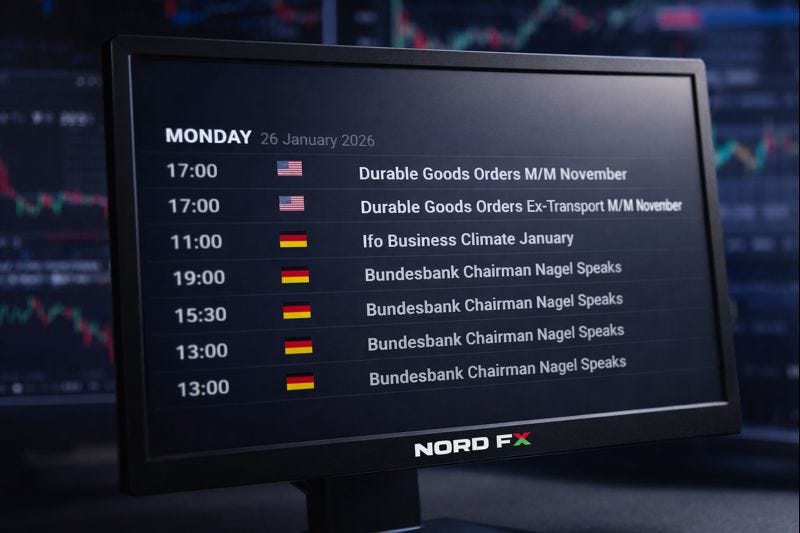
📊 US markets (Friday close): Wall Street finished mixed. The S&P 500 edged slightly higher, the Nasdaq added a small gain, while the Dow slipped as traders stayed selective ahead of a busy macro week.
🌏 Asia-Pacific: Most regional indices are under mild pressure this morning. The yen strengthened sharply, weighing on Japanese exporters and adding a defensive tone across the session.
💱 FX: The US dollar is softer broadly, with markets focused on heightened volatility in USD/JPY and rising intervention risk chatter.
🥇 Gold: Safe-haven demand remains front and centre — gold has pushed above $5,000, hitting fresh record territory amid geopolitical tension and risk-off flows.
🛢️ Oil: Crude is holding near recent highs after last week’s bounce, as traders balance geopolitical risk premia against broader supply expectations.
₿ bitcoin: Crypto is choppy, with risk sentiment and the dollar’s moves continuing to drive short-term direction.
🚀 Trade carefully today: volatility can spike around headlines and top-tier data. Follow NordFX for more updates and stay tuned.
🌅 Morning Update — 26 January 2026 was originally published in Coinmonks on Medium, where people are continuing the conversation by highlighting and responding to this story.
Crypto Airdrop Scams in 2026: Real Examples & Red Flags
In 2026, crypto airdrop scams are no longer amateur phishing attempts — they are professionally engineered traps powered by AI, fake audits, cloned wallets, and social engineering that even experienced traders fall for.
Every week, thousands of users lose wallets, NFTs, stablecoins, and long-term holdings — not because they were careless, but because airdrop scams now look legitimate.
This guide breaks down:
Real airdrop scam examples
How modern airdrop scams actually work
Red flags most people still miss
A practical crypto airdrop scam prevention checklist
How to safely interact with real airdrops in 2026
If you’ve ever searched:
“Is this airdrop legit?”
“How do crypto airdrop scams work?”
“How to avoid fake airdrops?”
This article is your answer.
What Is a Crypto Airdrop Scam?
A crypto airdrop scam is a fraudulent campaign that promises free tokens in exchange for wallet interaction, approvals, or signatures — with the goal of draining funds, stealing NFTs, or compromising wallet security.
Unlike early phishing scams, modern airdrop scams often involve:
Fake smart contracts
Malicious token approvals
Wallet-draining signatures
Cloned websites and social profiles
AI-generated “community” activity
Why Crypto Airdrop Scams Exploded in 2026
Crypto airdrop scams didn’t just increase — they evolved.
1. AI-Generated Legitimacy
Scammers now use AI to:
Clone real project websites
Generate realistic whitepapers
Fake GitHub commits
Simulate Discord & X engagement
Many scams now look more polished than real startups.
2. Multi-Chain Complexity
With Ethereum, Solana, Arbitrum, Base, Sui, Aptos, and Layer 3s, users regularly:
Bridge assets
Sign cross-chain approvals
Interact with unfamiliar contracts
Scammers exploit this confusion.
3. Wallet Fatigue
After years of DeFi, NFTs, and memecoins, users are:
Desensitized to signing messages
Overconfident in wallet security
Unaware of new approval-based exploits
Real Crypto Airdrop Scam Examples (2025–2026)
Example 1: The “Retroactive Reward” Scam
Victims received messages claiming they qualified for a retroactive airdrop due to past DeFi activity.
The trap:
Website cloned from a real Layer 2
Wallet connection required
“Claim” button triggered unlimited token approval
Result: Wallet drained within seconds.
Key lesson: Retroactive airdrops never require urgent action.
Example 2: Fake Token Appears in Wallet
Users suddenly saw a new token in their wallet labeled:
“AIRDROP_ELIGIBLE”
Clicking the token’s website link led to a fake claim portal.
What happened:
Approval signature granted access to all ERC-20 tokens
NFTs transferred out instantly
Wallet labeled “compromised” afterward
Key lesson: Never interact with unsolicited tokens.
Example 3: Discord Moderator Impersonation
Scammers impersonated admins in a real project’s Discord:
Same name
Same profile image
AI-generated chat history
They shared a “private airdrop link” during high traffic events.
Key lesson: Admins never DM airdrop links.
Example 4: NFT Holder Airdrop Trap
NFT holders were targeted with exclusive airdrops:
“Claim your holder reward”
“Limited-time distribution”
The contract approval allowed:
NFT transfer permissions
ERC-20 draining
Key lesson: NFT approvals are just as dangerous as token approvals.
The Most Common Crypto Airdrop Scam Red Flags
Red Flag #1: Urgency or Countdown Timers
Legitimate airdrops don’t rush you.
“Claim within 24 hours or lose eligibility” is a scam signal
Red Flag #2: Wallet Approval Before Verification
If you must approve tokens before seeing eligibility — walk away.
Red Flag #3: Airdrop Links Shared in DMs
Real projects:
Post on official blogs
Use verified X accounts
Pin announcements publicly
Scammers use private messages.
Red Flag #4: No Independent Mentions
Search the airdrop name:
No GitHub?
No Medium post?
No reputable coverage?
That silence is your warning.
Red Flag #5: “Free” Tokens with No Tokenomics
If there’s:
No supply details
No vesting
No utility explanation
It’s bait.
How Wallet Draining Airdrop Scams Actually Work
This is what most people don’t understand.
Step 1: Trust Setup
Scammer builds legitimacy using:
Fake audits
Paid influencers
Bot-driven social proof
Step 2: Wallet Interaction
User connects wallet and signs:
Token approval
Permit signature
Blind message
Step 3: Asset Extraction
Assets are:
Transferred to multiple wallets
Bridged instantly
Mixed or swapped
Step 4: Cleanup
Website disappears.
Discord wiped.
X account renamed.
Crypto Airdrop Scam Prevention Checklist
Before Connecting Your Wallet
Verify project on multiple platforms
Confirm contract address via official sources
Search “[project name] airdrop scam”
Before Signing Anything
Read approval details
Avoid “unlimited” permissions
Reject blind signatures
Wallet Hygiene Best Practices
Use a burner wallet for airdrops
Never use cold wallets for claims
Revoke permissions regularly
After Any Interaction
Monitor wallet activity
Use approval trackers
Move funds if anything feels off
Scammers rely on short memory and fast clicks. You rely on process.
Save this post so you can run this checklist every time a new airdrop appears in your wallet.
Best Tools to Detect Airdrop Scams in 2026
While no tool is perfect, these help:
Wallet approval dashboards
Contract scanners
Browser wallet warnings
Important: Tools are supplements — not substitutes for skepticism.
Are Any Crypto Airdrops Still Legit?
Yes — but they share common traits.
Legit Airdrops Usually:
Are announced publicly
Don’t require urgency
Don’t request unlimited approvals
Are discussed openly by developers
Have clear tokenomics
If an airdrop feels too generous, it probably is.
Why Even Experienced Traders Fall for Airdrop Scams
Because scammers exploit:
FOMO
Fatigue
Overconfidence
Familiar branding
Experience doesn’t eliminate risk — process does.
What To Do If You’ve Been Hit by an Airdrop Scam
Revoke approvals immediately
Move remaining assets
Mark wallet as compromised
Never reuse it
Warn others publicly
Staying Safe in an Era of Sophisticated Crypto Airdrop Scams
In 2026, crypto airdrop scams are one of the largest wealth transfer mechanisms in the industry — from users to criminals.
If you remember one thing, let it be this:
A real airdrop will never pressure you, rush you, or require blind trust.
Use the crypto airdrop scam prevention checklist, stay skeptical, and treat every “free token” as a potential threat.
Your wallet doesn’t need more tokens — it needs better defenses.
With decentralized exchanges (DEXs) taking more and more mindshare from centralized exchanges (CEXs) in trading and spot volumes, competition in this sector is rapidly intensifying. Inspired by the success of Hyperliquid, most of these platforms are running points programs. This is the case for Variational, one of the most promising trading protocols to farm right now.
What Is Variational ?
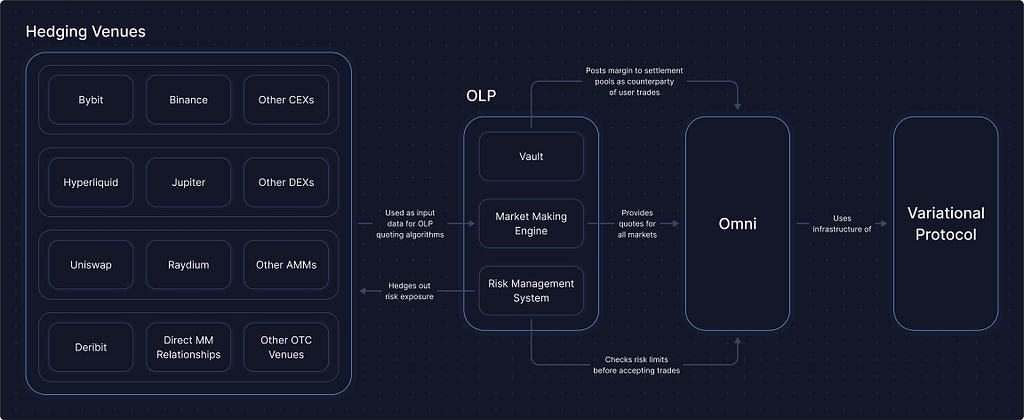
Unlike other perp DEXs like Hyperliquid or Extended that use an order book, Variational uses a Request for Quote (RFQ) model, notably used by large over-the-counter (OTC) venues. This system consists of takers (traders) requesting quotes and makers (market makers) responding with bids and/or offers.
In the case of Variational, the only market maker allowed is the Omni Liquidity Provider (OLP).
Source : Variational Docs
This model have various advantages :
Zero Fees : Since all market making on Omni is done by OLP instead of external market makers, Omni doesn’t need fees to generate revenue.
Complete control over revenues : A portion of the fees are directly red irected to users via various incentives.
Listing Variety : All OLP requires for a new listing is a reliable price feed, a quoting strategy, and a hedging mechanism. This manifests as around 500 tradable tokens on Omni !
The team And Partners
Variational was co-founded by Lucas Schuermann and Edward Yu, they have great experience in trading, having work with Genesis after their hedge fund (Qu Capital) was bought by Digital Currency Group (DCG) in 2019.
Source : Variational docs
They later left in 2021 to create their own proprietary trading firm after raising $10M. After two years, they decided to leverage their experience in trading and OTC exchanges to found the Variational protocol in 2023.
Other team members include many crypto veterans in algorithmic trading, with past experience at major firms such as Google and Goldman Sachs.
In June 2025, they raised an additional $1.5M in a strategic round.
Important Metrics
As mentioned in my previous article about perp DEXs, before farming a project I always analyze whether the opportunity cost is worth it. Let’s go through the key metrics one by one.
Trading Volume
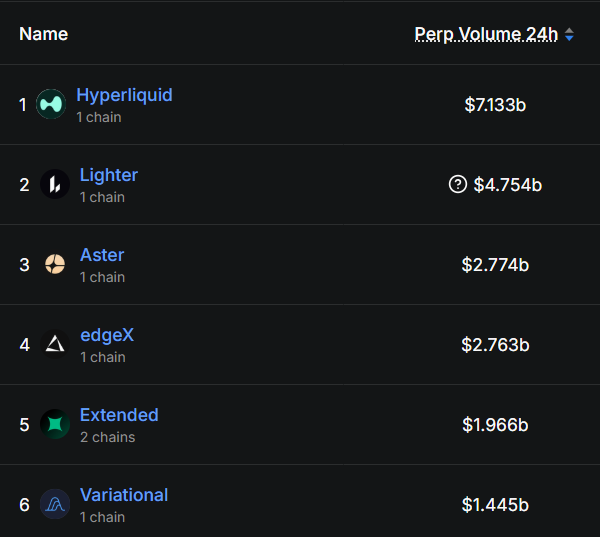
It is important to note that at this time of year, volumes are down across nearly all perp DEXs.
Srouce : DefiLlama
Currently, the 24h trading volume is around $850M, placing Variational in the top 6 alongside major names such as Extended, Hyperliquid, and Lighter. Keep in mind that volume can be manipulated through wash trading, so it should not be used as a standalone indicator. For example, Aster ranks third, but farming its airdrop is not attractive.
Open Interest
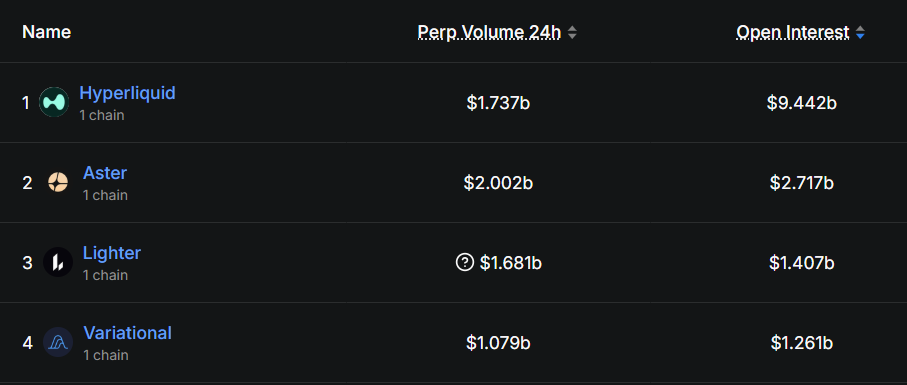
Open interest represents the total value of active long and short contracts. It is a good indicator of project health, as it implies traders are holding positions for longer periods. Like any metric, it can be manipulated, so it should be evaluated alongside others.
Currently, open interest is around $1.26B, placing Variational in the top 6 perp DEXs. One week earlier, when I started writing this article before the Lighter TGE, it stood at $441M.
Source : DefiLlama
TVL
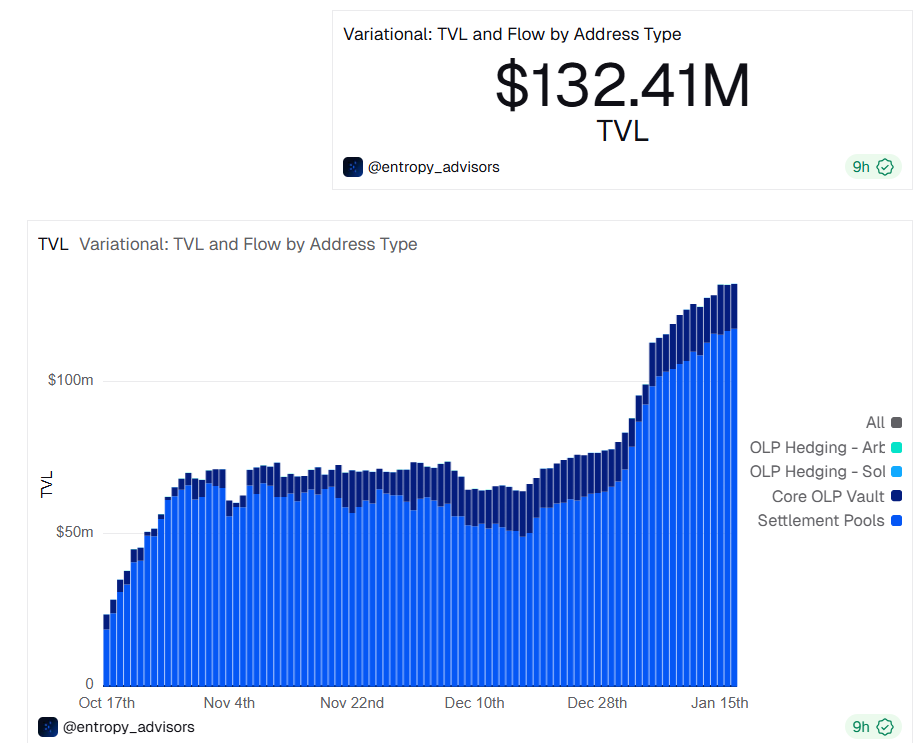
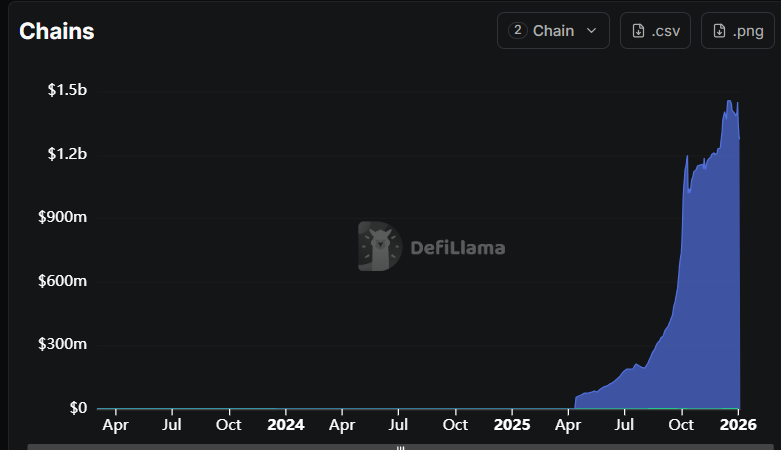
The current TVL is around $132M. While this may seem low compared to projects like Lighter or Extended, it is important to note that the OLP vault has not yet been opened.
For comparison, roughly half of the TVL on Lighter and Extended is stored in their vaults. Based on this, it would be reasonable to expect a TVL of around $260M for Variational once the vault opens. Depending on yield attractiveness, this could attract significant capital.
For a project still officially in private beta, this is already a strong TVL.
Roadmap
What users currently interact with is Omni, where retail traders can trade more than 480 tokens with a zero-fee model and up to 50x leverage on all pairs.
The team also plans to launch Variational Pro, designed for advanced and institutional traders of OTC derivatives. This dual-product approach allows Variational to target both retail traders (via Omni) and institutional entities (via Pro).
At the moment, the OLP vault is not open for public deposits. The team plans to launch it soon, allowing users to earn a share of Omni’s revenues. This is expected to be highly attractive, as Omni generates significant revenue due to the absence of external market makers.
On the trading side, the team plans to expand beyond crypto into other markets such as stocks, and to support additional collateral types beyond USDC, enabling broader cross-margin functionality.
There are many additional smaller features detailed in the documentation.
The Token ($VAR) and Points Program
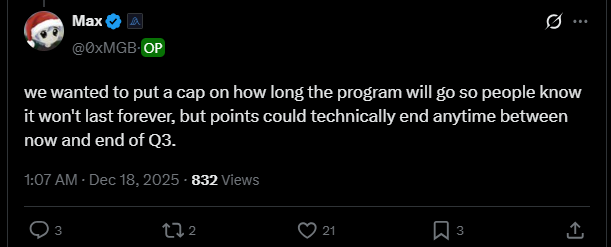
There is limited information available about the token at this stage. The points season is expected to end no later than Q3 2026 and could conclude earlier depending on roadmap progress.
We know that approximately 50% of the token supply will be allocated to the community through multiple incentive mechanisms, rather than a single airdrop. Additionally, the team plans to buy back tokens using at least 30% of protocol revenues.
The points program launched three weeks ago, including a retroactive distribution of 3M points for users who traded before its launch. Going forward, 150,000 points will be distributed every Friday at 00:00 UTC, with snapshots taken every Thursday at 00:00 UTC.
Start now with the best boosted code you can have, allowing you to have a 15% points boost and silver rank :
I don’t have an affiliate code, so I gave you the one I use, which is the best one to start earning those precious points on Variational. If you want to support my work, a simple like is enough.
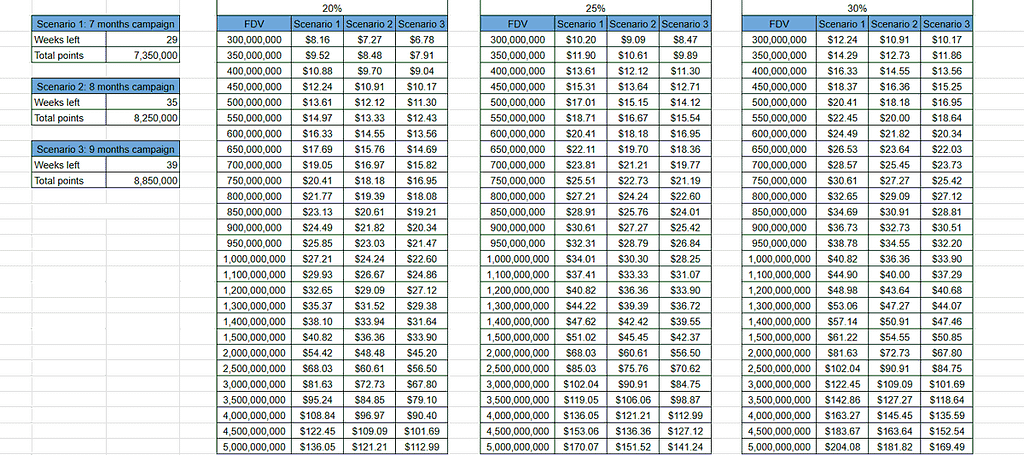
For an estimate of point valuation, there is a strong analysis published by Points Goblin :
My Personal Opinion and Strategy
Following the Lighter TGE, there has been a rapid rotation toward newer perp DEXs such as Variational and Extended. This should not discourage farming these projects as long as the cost per point remains low.
I personally faded Lighter in June when its TVL reached around $170M, assuming it was too late. That assessment was incorrect, as TVL later exceeded $1B
Market conditions are currently pessimistic, with many participants sidelined. If hype returns, earning points will become significantly harder, while existing points are likely to increase in value.
This is why I am currently trading on Variational, mainly farming funding via the FundingView app.
Based on gathered information, points appear to be weighted more heavily toward :
Holding positions for multiple days
Trading low open-interest pairs
Trading newly listed pairs
For additional insights, the following X accounts are worth following:
How to hack Bitcoin? How does the blockchain calculate time? How does mining difficulty change? What happens if two miners mine a block simultaneously? Where are transactions stored before confirmation, how are fees calculated, and is it possible to send a transaction with zero fee? What types of nodes exist in the blockchain, and how do they differ? When can you use mining rewards?
This is roughly how I studied all the information around these topics.
Here I provide deeper answers to these questions because popular materials about Bitcoin either don’t explain these things at all or do so very superficially. To understand this article, you need a minimal understanding of how blockchain works, which you can get here: https://vas3k.com/blog/blockchain/
TL;DR
How to hack Bitcoin? A quantum computer will only be able to derive a private key from a public key after a transaction has been sent. If no transaction has occurred, the wallet is protected. A 51% attack only provides the ability to cancel your own or others’ transactions to double-spend your own coins; gaining control over others’ coins is impossible.
How does mining difficulty change? Difficulty is recalculated every ~2 weeks based on the mining time of the previous two weeks.
What happens if two miners mine a block at the same time? The chain temporarily splits until one branch becomes longer. The longer branch becomes the main one.
When can mining rewards be used? After 100 blocks.
How does the blockchain calculate time? Based on the median time of the past 11 blocks and the system time of the nodes.
Where are transactions stored before confirmation, how is the fee calculated, and can you send without one? They’re stored on nodes for no more than two weeks. A zero-fee transaction is theoretically possible but practically almost impossible to get confirmed.
What nodes are in the blockchain and how do they differ? Full nodes — hold the blockchain data and enforce the rules. Miners — query full nodes for data and build new blocks. Light nodes — often used in wallets on weak devices; they query full nodes for what they need.
What’s the point of Bitcoin (besides speculation), in plain English
At the end of researching.
Bitcoin is an alternative financial system that does not require user trust. When using traditional banks, we must trust them not to steal or lose our money, and if that happens, we must trust the state to be able to return it. We also have to hope that money won’t be blocked at the whim of authorities or bank employees.
The point of Bitcoin is the opposite: everything is tied to strict mathematics that removes the probability of all these potential problems (or drastically reduces), provided you store Bitcoin in a personal non-custodial wallet.
Non-custodial wallet: A wallet controlled only by whoever has the private key; essentially just a small file/program that stores keys and signs transactions.
Custodial wallet: An account on an exchange that controls your assets and stores your funds in its own non-custodial wallets. This allows the exchange to block or seize your funds if you violate its rules or national laws, though the exchange offers more convenient and expanded functionality in return.
Interesting fact: A Bitcoin wallet is not an object inside the blockchain, but a program that stores keys and signs transactions.
The blockchain stores UTXOs (Unspent Transaction Outputs). Each UTXO is “locked” by a condition (program), usually tied to an address (practically, a hash of a public key).
To spend a UTXO, the wallet creates a transaction referencing that UTXO as an input and adds a signature. Network nodes verify the signature and the script’s execution. As a result, the old UTXO becomes spent, and the transaction creates new outputs — new UTXOs for the recipients.
A private key is a number. A public key can be calculated if you have the private key, but the reverse is practically impossible (how that’s attacked is discussed later in the “attacks” section). Using a private key, you can sign data, but this signature cannot be forged with a public key. Meanwhile, the public key can verify that the signature was produced by the corresponding private key.
— — — — —END-PRIVATE-KEY — — — — —
In early versions, the wallet address was the public key. But later, addresses derived as a hash/encoding of the key or script began to be used. This is a crucial point for the section on quantum computer attacks.
Once a transaction is signed, it must be embedded in a block. First, it goes into a general pool of unconfirmed transactions (mempool), where any miner can take it to create a block.
But a transaction can exist only once in the blockchain, so the network can’t allow every miner to create their own block with the same set of transactions and have them all accepted.
Block Header
Each block has a header containing version data, the previous block’s hash, the merkle root (hash of all transactions in the current block), time, bits (mining difficulty), and a nonce.
All of these fields are combined and then hashed via SHA-256.
SHA-256 is a hashing technology: take some data and turn it into a different set of numbers that you can’t convert back into the original data if you only know the hash. But you _can_ verify it, because for a fixed input X the result is always the same output Y. So knowing X gives you Y; knowing Y does not practically give you X back — even with a quantum computer.
You can try hashing any data here. SHA-256 is also one of the core tools in the HTTPS connections we use every day, and it plays a key role in hundreds of internet protocols.
The nonce is needed to find out whose block to record. Miners change the nonce so the header’s hash is less than the target. In our example, the hash has 19 zeros.
Finding such a hash is hard. It takes roughly ~10 minutes of the entire Bitcoin network’s mining power. Blocks should appear roughly every 10 minutes — that’s how Satoshi Nakamoto designed it.
Why exactly this many zeros, and how does mining difficulty change?
Proof of Work in real life
It’s not actually about the zeros, but about the **target**. The target determines mining difficulty: the smaller the target, the higher the difficulty. A valid block header hash must be ≤ the target. Because small target numbers in hexadecimal start with zeros, hashes often appear with many leading zeros (e.g., ~19 or more). The smaller the target, the rarer it is for a random hash to land below it, so mining becomes harder.
Difficulty Calculation Hack: If the difficulty increases by 16 times, the required threshold becomes 16 times lower— often resulting in one additional leading hex-zero.
Difficulty adjustments (retarget) occur every 2016 blocks (roughly 2 weeks, 1 block ~10 minutes). The blockchain uses a simple formula:
Target_new= target_old*T_act/T_exp, 4Texp
Target_new = new target (new difficulty) Target_old = old target T_act = actual time it took to mine the last 2016 blocks T_exp = expected time for 2016 blocks: 2016*600 seconds (10 min = 600 sec) 4T_exp= The change is limited: difficulty can’t shift more than 4× either way.
If, since the last difficulty retarget, the network’s total hash rate (the combined power of all miners) has increased over the past 2,016 blocks, then with near-certainty the average time to mine a block will decrease. That means the actual time to produce those 2,016 blocks T_act will be less than the expected time T_exp, so T_act/T_exp < 1. As a result, the new target Target_new will go down: and the lower the target, the higher the difficulty and the harder it is to mine.
But what to do if two different miners mine a block at the same time?
That happens,and there’s a safety mechanism for it.
In theory, they can make practically identical blocks if the same transactions in the same order fall into each block. But blocks still won’t be identical because the first transaction in every block is the coinbase (the miner reward), and it pays to the miner’s address — so two miners can’t have the exact same block because their addresses differ.
But it is possible that two miners almost simultaneously mine different blocks. If the delay between the creation of a block and its distribution among nodes is 2 seconds, then this means that after the creation of the first block, there is a two-second gap in which a second block can be created. The longer this time, the higher the probability, but with each year this time is reduced. The probability of creating three blocks is almost negligible, but the protection system is the same.
If two blocks are created, they are saved in nodes, and these two chains are passed further. Miners then choose which block to build on — usually the one they saw first. And when they find the next block for one of the chains, it is distributed further and the nodes agree with it, and the shorter version is forgotten. This is the rule of the longer chain. Even if 2, 3, or more blocks in a row are formed in two chains, sooner or later one branch outpaces the other.
Transactions have 3 probable paths:
1. Fall into the chain that wins, then they remain in the blockchain. 2. Fall into both chains, then only the version in the winning chain remains relevant. 3. Fall into the chain that loses, then they go again into the pools of unconfirmed transactions (more on this below).
A few numbers:
Approx. probability of a fork given ~1s delay: 0.17%
A second block on the same competing branch: 0.00028%
Third: 4.6*10^⁻⁹
Fourth: 7.7*10^⁻¹²
That’s why exchanges don’t credit your deposit after 1 confirmation. Typically they wait for 6 confirmations — ~1 hour on average (6 blocks × 10 minutes).
There is no limit to the length of the second/third chain because they disappear quickly. Not counting these two cases:
Reorganization through 53 blocks due to a bug in the software (source).
Another incident with reorganization through 24 blocks (source).
And there is also the possibility of an attack through a second chain, but about this at the very end.
From this follows the next question:
Since the miner receives a reward for mining a block, what happens when two blocks are mined?
Simple: a miner can spend the reward only after 100 blocks.
If you are a miner and mined block № 1000, you will be able to use the reward for this block only starting from block №1100. This looks like a time-lock transaction, but technically it is not one. I will write about the time-lock technology next time, this is already turning into too much text.
Miners add transactions to the blockchain, receiving a fee for this. And from this follow a few more questions:
Where and for how long are unconfirmed transactions stored, and can a transaction with a zero fee pass in theory?
The fee in Bitcoin depends not on the number of tokens sent in the transaction, but on the size of the transaction and the occupancy of the network at the given moment. After sending your transaction from a non-custodial wallet, it goes to the nearest node(s), these nodes decide based on several characteristics whether to accept your transaction or not:
1. Does it comply with the rules and did you not assign yourself non-existent tokens or something else? 2. Is the specified transaction fee sufficient?
If the answer to one of these questions is no, the node will not take the transaction and it will not fall into the blockchain, and your balance will not change. It turns out that a zero fee, in most cases, will not pass into the blockchain, although theoretically a miner can include such a transaction in a block, it is extremely unlikely.
How does a node assign a fee?
The node has a certain amount of memory where it stores such unconfirmed transactions after receiving them, but until the moment they are recorded in the blockchain.
By default, it is limited to 300 MiB of RAM memory and 336 hours of storage. However, if the blocksonly setting is enabled in Bitcoin-Core 25.0, the RAM memory will be reduced to 5 MiB; this is often done for validating the blockchain.
All these data can be changed when setting up the node, but this is often not done, as for most it would be a simple waste of extra resources.
And what will happen if you send a transaction with the minimum allowable fee?
If the node does not throw it out after adoption due to overflow, and if miners will not take this transaction due of small fee, it will be deleted after 336 hours = 2 weeks.
After the transaction is accepted, nodes distribute it to other nodes, and miners insert transactions with the highest fees into the block.
Considering the limits on transaction size of 400,000 weight units ≈ 100KB (but it could be more with SegWit, but those are already too small details). A maximum of 10 such large transactions can fit into 1 block, and ≈ 10,000 of the smallest. But on average it comes out to 2500 transactions per 1 block.
The fee itself is calculated by the formula: fee (sat) = vsize (vB) * feerate (sat/vB)
fee = commission.
vsize = transaction size.
sat = satoshi, in one Bitcoin there are 100,000,000 satoshis.
vB = Virtual Byte.
Your wallet can find out the minimum feerate from the nodes, but this is the lower boundary of whether the transaction will be distributed, not a guarantee of its confirmation. To estimate how much you need to pay now, wallets use mempool statistics and confirmation history.
An average transaction weighs 150vB; if at the given moment the average sat/vB = 2, then the transaction will cost 300 sat. And it will cost $0.27.
For example, for this transaction of 45,177 BTC (several billion $), the fee was less than $1.
The highest sat/vB was in April 2024 during the halving and was from 1795 to 2751 sat/vB (source). On that day, an average transaction would have already cost from $160 to $245, depending on how quickly it needed to be processed.
The busier the network, the higher sat/vB. If you want your transaction to get confirmed faster, you set sat/vB above the current average.
Nodes define the fee as: fee = sum(inputs) — sum(outputs), then they look at the transaction size to check if it fits their internal policies.
Don’t forget about UTXO: if over time you received 10 separate incoming transactions, and now you want to send the entire balance in one transaction, the blockchain sees that as 10 inputs — meaning the transaction is larger and therefore more expensive.
To save on fees in the future, it is useful to sometimes do “consolidation” — sending yourself all small remnants in one transaction when the network is calm and sat/vB is minimal.
Returning to the first topic and the block header, the following question may arise:
How does the blockchain know that ~10 minutes passed, and that miners aren’t lying?
The blockchain receives information about the time from miners and nodes (nodes that store information but do not mine) in UTC format.
Miners write the time in the block header. Nodes have their own clocks and verify the median time received from other nodes.
Bitcoin is a closed system, so the blockchain cannot connect to ntp.org to check if the miners are writing the truth in the block header and the nodes or not.
How can the blockchain check if the nodes and especially the miners aren’t lying?
For this, there is MTP — Median Time Past.
Median Time Past is easier to understand than Past Simple.
Not the average, but precisely the median.
It is calculated from the last 11 blocks arranged in order. For example:
18, 2, 12000 (liar), 14, 6, 20, 10, 4, 16, 12, 8
If we take the average value, then we need to sum all these numbers and divide by 11, we get 1100. Because of the liar who put 12000, everything has changed a lot.
But if we take the median, then first we arrange them in order:
2, 4, 6, 8, 10, 12, 14, 16, 18, 20, 12000 (liar)
And we take the value from the middle, that is, 12. This is how MTP is calculated.
The time of a new block is always greater than the MTP; otherwise, the block will not be accepted by other miners/nodes and will not be inserted into the blockchain.
But if someone wants to go to the future, at what time gap should blocks be rejected?
What will affect my future more, 10 push-ups or this article?
In the past Bitcoin used NAT — Network Adjusted Time (time adjusted by the network), which compared median time from peers. Later NAT was removed as a consensus component.
Now nodes use their own system UTC time to check how far “into the future” a new block is. If a block’s timestamp is more than 2 hours ahead of a node’s local time, that node rejects it.
If some node’s time differs significantly from other nodes, then NAT warns about it — that’s basically the only remaining use.
Miners and other nodes, how do they differ and why are they needed?
There are 3 main types of nodes in Bitcoin: a full node with two variations (archival and pruned), a light node, and a miner.
The other nodes are superstructures on top of these three pillars of the blockchain.
Full archival node: a server that has all the information about the blockchain for all time. Validates or rejects blocks in accordance with the rules of the blockchain.
Full pruned node: also checks blocks but does not store all data, only the UTXO and part of the last blocks.
Relay node: a superstructure on top of a full node, which is connected to other nodes with a large number of peers for fast distribution of information. Like torrent seeders.
Light node: stores only block headers to check their hashes. For transactions, it ask information from full node. Great for phone wallets or weak devices where storing dozens/hundreds of GB is inconvenient.
Miner: takes information from a full node or is one; based on this information, searches for a nonce to produce a valid block, then broadcasts it to the network.
If you need a non-custodial wallet on a PC, then perhaps a full pruned node for this would be the best option. You can choose the one you need here: bitcoin.org/en/choose-your-wallet?step=1
How to hack Bitcoin?
There are many possible attack vectors. If I described all of them, the article would be longer than it already is. But someday I will write. For now, let’s briefly look at two hack variants that are often talked about.
Quantum Computer VS Bitcoin
A quantum computer could derive a private key from a public key — but there’s already partial protection. If you’ve never spent from your address, your wallet is protected because outsiders see only the hash of your public key, not the public key itself.
Even with a quantum computer, it is practically impossible to brute-force the hash of a public key. But after the first outgoing transaction, the public key becomes visible to everyone. Therefore, to protect against quantum attacks, you should use addresses once.
However, there’s still a possible “interception” scenario: if a quantum computer could, after you broadcast a transaction but before it’s confirmed, derive your private key from your revealed public key — it would have very little time, but that’s the idea.
But there are wallets (outputs) of old formats, where the public key is visible immediately, and such wallets can be hacked even if there was not a single transaction from them.
And there are also many “lost” wallets; transactions were made from some, but that was many years ago. And with the help of quantum computers, coins from these wallets will probably fall back into circulation and possibly crash the Bitcoin price. But let’s leave these speculations to analysts who were perfectly described by one satirical channel:
”Last week’s target for Bitcoin at 34 thousand dollars has been revised and now stands at 240 thousand.”
So, a quantum computer will not destroy Bitcoin in this way.
But they are already thinking about creating a reusable quantum-protected wallet. This will require a soft-fork (change of rules), which has been done more than once.
If 1 person has more than 51% of the mining power, it will be easy for him to create a second chain of blocks as he wants. In this case, he will be able to cancel transactions and rewrite the history of his spending.
But even in this case, he will not be able in any way to steal someone else’s coins that were never on his wallet. The older the transactions that need to be rewritten, the longer and harder it will be, and there is no 100% guarantee that it will work and he will be able to make his chain longer and faster than the other 49%.
Such an attack is possible even with 30% and 40%, but the probability is much lower.
How much money will be needed for such an attack? If we attack from scratch, then we essentially have to have a power 0.5% more than the entire power of Bitcoin miners. The hashrate today is approximately 1 ZH/s = 1,000,000,000,000,000,000,000 SHA-256 hash findings per second.
Modern ASICs (mining devices) have a power of approximately 200 TH/s, meaning 5,000,000 of them will be needed. Their efficiency is ≈ 17–20 J/TH. Multiply by 10⁹ and you get 17–20 GW. A bit less than the power of the largest hydroelectric dam in the world.
To this, we add the prices for the ASICs themselves, which comes out to ≈ $7.5 billion. Not counting extra infrastructure which will also be very expensive.
Even all these costs will lead at most to double spending of own coins in the blockchain and censorship of transactions. And even then, it will be visible to everyone and the price will probably crash and the game will not be worth the candle.
One wrong choice between spot and perpetual trading can silently drain your capital — especially on a high-performance platform like Hyperliquid.
Hyperliquid has rapidly emerged as one of the most talked-about decentralized trading platforms in crypto. With lightning-fast execution, deep liquidity, and a fully on-chain order book, it attracts everyone from casual traders to highly leveraged professionals.
But here’s the uncomfortable truth most guides don’t tell you:
Spot and perpetual trading on Hyperliquid are not interchangeable.
They reward completely different mindsets, risk tolerances, and time horizons.
Choosing the wrong one can turn a profitable strategy into a liquidation event.
In this guide, you’ll learn exactly how spot trading and perpetual trading work on Hyperliquid, how they differ, and most importantly, which one aligns with your goals, capital structure, and psychology as a trader.
Whether you’re a long-term crypto holder, an active DeFi participant, or an advanced derivatives trader, this article will help you make smarter, safer, and more profitable decisions on Hyperliquid.
What Is Hyperliquid?
Hyperliquid is a decentralized exchange (DEX) optimized for high-performance spot and perpetual futures trading, built with a custom Layer-1 blockchain designed specifically for trading.
Unlike many DeFi platforms that rely on AMMs (automated market makers), Hyperliquid uses a fully on-chain central limit order book (CLOB) — similar to Binance or OKX, but decentralized.
Key Features of Hyperliquid
Fully on-chain order book
Ultra-low latency execution
Deep liquidity for major trading pairs
Spot trading and perpetual futures in one interface
No KYC required
Non-custodial (you control your funds)
This hybrid design makes Hyperliquid uniquely powerful — but also more complex than typical DeFi platforms.
Understanding spot vs perpetual trading is critical before using it seriously.
Are you servicing a high-interest debt or want better savings?

 Login
Login