Reading view

There are new articles available, click to refresh the page.

Gold Shines But Bitcoin Faces the Music: What 2026 Has in Store for Investors?

January 2026 has delivered a blunt message to investors: the playbook has changed. Gold is trading above $5,000 an ounce for the first time. Bitcoin is stuck below $88,000 and cannot hold the $90,000 level it briefly reclaimed. This gap is not just a weird market moment. It looks like a reset in how capital behaves when geopolitics heats up, and policy direction gets messy.

The numbers underline the shift. Gold rose 64% in 2025 and is already up more than 17% in the first weeks of 2026. Bitcoin, meanwhile, sits roughly 11% below its December 2024 all-time high near $108,000. Over one weekend in late January, total crypto market cap dropped by about $56 billion to roughly $2.92 trillion. This is not random noise. It reflects two different investor instincts playing out in real time.

The Safe-Haven Rush: Why Gold Owns the Narrative Right Now

Gold’s run is not coming from one single driver. It is coming from several forces stacking on top of each other.

Central banks, especially in emerging markets, have been buying gold at a pace that looks more like crisis-era behavior than normal reserve management. ETF inflows have reinforced that demand. Retail and institutions are doing the same thing for the same reason: they want a hedge against currency risk, policy mistakes, and the kind of uncertainty that makes investors second-guess everything.

The geopolitical backdrop is not helping. Trade tensions have moved from headlines into concrete threats and real negotiation pressure. President Donald Trump’s administration has floated 100% tariffs on Canadian goods tied to China-related trade developments, plus potential 200% levies on French wines and champagne. That kind of language changes behavior fast because markets do not wait for policy to become law. They price the risk now.

Currency markets are reflecting the same mood. The Japanese yen strengthened to 153.89 per dollar, its strongest level since November 2025, as traders speculated about possible coordination between U.S. and Japanese authorities. Japan’s top currency diplomat kept timing vague, which tends to make uncertainty worse, not better. The euro pushed to a four-month high near $1.1898 as traders cut dollar exposure ahead of the Fed’s next signals and the possibility of new leadership chatter.

These moves matter because they signal something deeper than FX positioning. They suggest investors are questioning stability and coordination at the top of the global monetary system. When people get nervous about reserve currencies, they often reach for gold. Gold does not pay yield. It does not grow cash flow. It holds value because it still functions as a trust asset when confidence in other systems starts to wobble.

History helps frame the moment. In 2008, gold climbed from roughly $800 to about $1,900 by 2011 as central banks flooded the system with stimulus. In 2020, gold hit new highs above $2,000 during peak pandemic fear. This rally is bigger in both percentage terms and absolute levels, which suggests the market is pricing something more structural than a single shock.

Bitcoin’s Reality Check: Why “Digital Gold” Is Not Acting Like Gold

Bitcoin has spent years carrying the “digital gold” label. This month has exposed how fragile that comparison can be when stress hits.

Gold is absorbing defensive flows. Bitcoin is absorbing selling from people who bought higher and now want out. That difference matters because it changes how rallies behave. When gold rallies in a risk-off environment, it often pulls in more buyers. When Bitcoin rallies in the same environment, it often runs into sellers looking to exit.

Technically, Bitcoin has been trapped in a structure that has not offered easy upside. Price action has struggled around $87,619 after losing $90,000 during weekend trading. Support sits around $84,698 with resistance near $89,241. If support fails, downside pressure toward $84,000 becomes the obvious target. If resistance holds, $90,000 stays a psychological ceiling rather than a launchpad.

More important than the chart is the behavior underneath it. CryptoQuant data shows Bitcoin holders selling at a loss for the first time since October 2023. That is a shift in tone. In strong bull phases, holders usually ride volatility because they expect higher prices ahead. When people start locking in losses, they are not thinking in bull-market terms. They are managing pain and uncertainty.

Glassnode analysis adds another problem: a heavy supply overhang above $100,000. Many holders are sitting in positions bought between current levels and six figures. When price approaches their entry zones, they sell to break even or limit damage. That creates a supply wall that is hard to clear without fresh demand and strong momentum.

This is not how Bitcoin behaved in 2020 to 2021. Back then, conviction and institutional narratives pushed price from $10,000 to $69,000 in about a year. Today’s structure feels more like rotation and digestion than acceleration. Futures volumes are compressed. Leverage is subdued. Traders are not leaning into upside the way they do when they truly believe the move is imminent.

Prediction markets reflect the change in psychology. Polymarket odds have shown more confidence in gold holding above $5,500 through mid-year than Bitcoin setting new highs over the same window. That is the opposite of the mood in late 2024 when crypto optimism ran hot after Bitcoin crossed $100,000.

The deeper takeaway is uncomfortable for some investors: Bitcoin is not acting like a safe haven right now. It is acting like a high-volatility asset that depends on liquidity, confidence, and risk appetite. That does not kill the long-term thesis, but it changes how investors should frame it in the short term.

Altcoins Under Stress: What Happens When Speculation Hits a Wall

Bitcoin’s weakness looks mild compared to what is happening in altcoins.

Kaia (KAIA) is a clean example. It fell nearly 20% in 24 hours to around $0.0762 after breaking support near $0.0797 and briefly dipping below $0.0721. It held above its 50-day EMA, which offers some technical comfort, but the drop shows how fast liquidity disappears when sentiment cracks.

Altcoins are built for leverage to mood. In bull phases, capital moves from Bitcoin into Ethereum, then into larger alts, then into smaller speculative tokens as investors chase bigger multiples. In corrections, the flow reverses and the weakest assets get hit first. That creates a brutal reality: altcoins can look unstoppable on the way up and untradeable on the way down.

Ethereum has not offered much shelter either. Ether traded near $2,867 in late January, down 2.6% while Bitcoin fell 1.3%. That underperformance signals that investors are not rotating into higher-beta crypto exposure. Thin spot volume and muted derivatives activity support the same conclusion.

The question now is whether this is a pause before another risk cycle or a deeper structural shift. Several factors argue for caution. U.S. regulation is moving, but it still has open questions around token classification and how securities law will apply. Japan may approve crypto ETFs by 2028, with firms like Nomura and SBI expected to launch products on the Tokyo Stock Exchange, but a two-year timeline does not help the next few months.

There is also a credibility problem. Reports of a U.S.-linked crypto theft scandal involving alleged misuse of access to seizure wallets have rattled confidence. ZachXBT has traced funds linked to thefts spanning 2024 and 2025. Incidents like this do not just hurt sentiment for a week. They raise uncomfortable questions about custody, oversight, and the real-world weak points in the ecosystem.

What Institutions Are Actually Doing Right Now

Retail narratives dominate crypto chatter, but institutional behavior usually tells the cleaner story.

Central banks are voting with their balance sheets, and they are choosing gold. Many of them are not willing, or not able, to justify holding an asset that can drop 15% in a week. Their gold buying creates a steady baseline bid that crypto does not have.

Hedge funds and family offices have also turned cautious. Leverage in crypto derivatives remains compressed compared to peak cycles. Open interest in Bitcoin futures exists, but it has not expanded in the way you would expect if large players were building a new bullish stance.

Corporate treasury adoption has not restarted in a meaningful way. During 2020 to 2021, it was easier to sell boards on Bitcoin exposure because liquidity was abundant and narratives were clean. Today, when gold is up 17% year-to-date and Bitcoin is chopping sideways, that boardroom pitch becomes harder.

Pension funds and sovereign wealth funds remain mostly on the sidelines. They move slowly and demand strong regulatory certainty. The U.S. may get there, but it is not there yet.

Right now, institutional money looks like it is waiting, not charging in. That is the simplest read, and it matters because those investors have the best access to research, infrastructure, and policy visibility.

The Fed Variable: Why This Week Can Move Everything

The late-January Federal Reserve meeting matters more than people want to admit. Not because the market expects a surprise rate hike or cut, but because guidance sets tone and liquidity expectations.

If the Fed signals confidence that inflation is easing and hints at future cuts, risk assets usually respond well. Lower rates reduce the opportunity cost of holding gold, and they tend to weaken the dollar, which supports commodity pricing. Crypto would benefit too, mostly through improved liquidity and renewed risk appetite.

If the Fed stays hawkish and emphasizes inflation risk, the market hears “higher for longer.” That hurts speculation. It also pressures gold through higher real yields, though safe-haven demand can sometimes overpower yield dynamics when fear becomes the bigger driver.

Politics adds another layer. Trump has criticized Jerome Powell publicly, and any credible talk of leadership changes introduces a market question about central bank independence. If markets interpret leadership shifts as more accommodative and more political, both gold and Bitcoin could rally on the same narrative: long-term trust risk in fiat management.

FX moves leading into the meeting show the tension. Traders have been trimming dollar exposure. That positioning can unwind quickly after Fed messaging, which would ripple into correlated assets.

Geography Is Not Background Noise in 2026

Regional differences are starting to matter more.

Asia has been mixed. China’s Shanghai index rose slightly while Japanese equities fell on yen strength. That split reflects different policy priorities and economic conditions across the region.

Japan’s currency strength is a headwind for exporters, but the medium-term ETF discussion positions Japan as a potential regulated gateway for crypto exposure, even if the timeline stretches to 2028. Europe has its own stress points, including trade friction with the U.S. The euro’s strength helps imports but hurts export competitiveness. The ECB has moved more dovishly than the Fed, which further changes cross-border capital flows.

The U.S. still dominates crypto market structure, liquidity, and innovation, even with regulatory uncertainty. Any real legislative breakthrough will matter globally because U.S. clarity tends to set the tone for institutions everywhere.

Emerging markets sit at the center of the gold move. They feel currency risk hardest and often have the strongest incentive to seek alternatives. But in practice, gold is still simpler and more accessible than crypto for most investors in those regions, which helps explain why gold is absorbing flows first.

Portfolio Positioning: What Discipline Looks Like in Uncertain Markets

This environment punishes overconfidence.

Gold’s role is straightforward. It is doing what it has historically done in messy periods. A 5% to 10% allocation to physical gold or gold-backed ETFs can make sense for many investors with multi-year horizons. It should protect the portfolio without taking over the entire strategy.

Crypto needs a different label. It is closer to a venture-style exposure to technology adoption than a pure safe haven. That means sizing should be conservative. A 1% to 3% allocation can keep investors engaged in long-term upside without turning short-term volatility into a lifestyle risk.

This is also a moment where patience often beats activity. Large shifts based on short-term moves tend to destroy value. Rebalancing rules matter more than predictions. If gold has grown far beyond its target weight, trimming back to plan can be smarter than chasing the next headline.

Dollar-cost averaging can work for crypto investors who believe in long-term adoption but do not trust the next six weeks. Small, scheduled buys remove emotion and reduce timing risk.

Leverage is the trap. Borrowing to amplify crypto exposure remains one of the fastest ways to blow up in a market like this. Volatility compression often precedes violent expansion. Liquidations do not care about your thesis.

Scenarios for the Next Six Months

Several paths remain plausible through mid-2026.

One scenario is the most boring and arguably the most consistent with current structure: gold keeps rising on safe-haven demand while crypto chops sideways. Gold could press toward $5,500 as tensions and central bank buying persist. Bitcoin could range between $80,000 and $95,000, supported by long-term holders but capped by overhead supply and cautious institutions.

A second scenario requires alignment: easing geopolitical tension plus Fed rate cuts. That would likely rotate capital out of gold and back into risk, lifting crypto meaningfully. Bitcoin could reclaim $100,000 if market structure improves and leverage returns, while gold could pull back but remain elevated above $4,500.

A third scenario is the darker one: economic conditions deteriorate materially. Gold could push toward $6,000 while crypto faces forced liquidations and deeper downside, with Bitcoin potentially testing $70,000 or lower.

A fourth scenario depends on policy competence: a clear U.S. regulatory breakthrough that unlocks institutional capital at scale. It is possible, but the near-term probability remains lower than crypto bulls want.

The most realistic outcome may look like a mix: partial easing in some geopolitical zones, new flashpoints elsewhere, gradual Fed shifts, and crypto alternating between relief rallies and pullbacks without clean direction.

Risk Management Rules That Still Matter

When correlations move and narratives break, basics protect capital.

Position sizing is the first filter. Overallocating to a single theme is the most common failure. Crypto should be sized so that total loss would not change your life. Gold should be sized so it protects the portfolio without trapping you in defensive posture if equities rebound.

Diversification only works when it is real. Ten cryptocurrencies do not diversify if they all move with Bitcoin. Two forms of gold exposure can also behave differently: physical gold, gold ETFs, and miners each carry distinct risks.

Liquidity matters more than people admit. Assets that trade cleanly in calm markets can become thin in stress. Holding enough cash or liquid reserves to avoid forced selling remains a timeless rule.

Discipline is the edge. Volatility is designed to trigger bad decisions. Rules around rebalancing and allocation prevent emotional reactions. Writing down your principles during calm periods and following them during stress is not just advice. It is a practical survival tool.

Taxes also become more important as volatility increases. Crypto gains and losses can be managed strategically through loss harvesting, holding periods, and timing. Gold can have special tax treatment in some jurisdictions. Investors should not wing it.

What Past Divergences Tell Us

This is not the first time asset relationships have shifted.

In 2013’s taper tantrum, gold fell while risk assets also struggled. Safe-haven flow went into dollars, not gold. That episode shows safe haven behavior changes depending on what investors fear.

In 2018, Bitcoin collapsed while gold stayed rangebound, because macro fear was muted. That period shows gold does not automatically benefit from crypto weakness.

In 2020, both rallied after the initial crash because stimulus and inflation fears dominated. That environment is not today’s environment. Today looks more like geopolitical stress plus constrained liquidity, which tends to favor gold over speculative assets.

The lesson is simple: correlations are not laws. They are temporary relationships shaped by the dominant fear in the room.

The Ethereum Problem: Why Number Two Looks Stuck

Ethereum’s underperformance is not just a chart issue. It points to a broader question about smart contract platforms and real adoption.

DeFi activity is down from peak levels. NFT volumes have collapsed. Layer-2 scaling has reduced fees, which is good for users, but it has also fragmented liquidity and attention across multiple networks. That can weaken Ethereum’s network effects, even if the technology continues to improve.

Solana and other platforms have gained share, but they have also struggled during broad risk-off conditions. So this is not just an Ethereum-specific problem. It is a demand problem across crypto applications.

The bigger concern for Ethereum bulls is the application gap. Ethereum has proven it can work. What it has not proven is that it can deliver mainstream use cases that compete with web2 experiences at scale. Many on-chain apps still feel like tools for crypto-native users rather than products built for the public.

Without clear demand drivers, ETH valuation stays tied to speculative appetite. In a market where investors are reducing risk, that is not a great setup.

Regulation: The One Catalyst That Can Reprice Everything

Even with weak price action, regulation remains the biggest potential reset.

U.S. legislative progress is focusing on custody rules, stablecoin frameworks, and exchange registration. Real clarity on token classification would be the unlock. It would reduce existential risk for projects, give institutions rules they can follow, and lower the odds of surprise enforcement events that shake markets.

International coordination is improving too. FATF standards have pushed most major jurisdictions toward common baselines for exchanges and wallet providers. The EU’s MiCA rules bring structure across a large economic bloc. Some elements are heavy, but clear rules often matter more than perfect rules.

Japan’s ETF discussion suggests growing acceptance of crypto as an investment asset class, even if the pace is slow. China remains restrictive on trading, but it continues to pursue blockchain applications and central bank digital currency research.

Regulation will not fix market structure overnight, but it can change who is allowed to participate. That is how market regimes shift.

The CBDC Wildcard

Central bank digital currencies sit in a strange place. They validate the concept of digital money while competing with private crypto rails.

CBDCs are permissioned and controlled. They do not offer the decentralization or supply constraints that define Bitcoin. They can also enable deeper state-level visibility into transactions, which raises privacy concerns.

Still, their development signals something important: central banks agree that the future of money is digital. The question is whether CBDCs simply replicate existing payment rails, or whether they introduce programmable money that could replace some stablecoin and DeFi use cases.

If CBDCs expand surveillance and control, some users may move toward crypto as an opt-out alternative. If CBDCs remain limited and functional, they may coexist without materially disrupting crypto adoption.

The timeline remains unclear. Technical scaling, interoperability, and political pushback will shape how fast democracies move. Authoritarian systems may move quicker, but that experience may not translate cleanly to the U.S. or Europe.

Conclusion: Dealing With Markets That Do Not Follow Narratives

Early 2026 is forcing investors to separate slogans from reality.

Gold is behaving like gold. It is absorbing defensive flows during uncertainty. Bitcoin is behaving like a high-volatility asset that depends on liquidity and confidence. That does not destroy the long-term crypto thesis, but it does change how investors should frame it right now.

Investors should position for the market they have, not the market they want. Gold deserves a role as insurance. Crypto deserves a smaller, deliberate role as a high-upside, high-risk exposure to long-term adoption. Diversification, disciplined sizing, and patience remain the cleanest strategy in a regime where trends are not cooperating.

The next months will reveal whether crypto consolidates before a new growth phase or whether this marks a deeper shift in how capital treats digital assets during stress. Investors who stay disciplined and realistic will be fine either way. Investors who overextend on conviction or trade emotionally will likely learn the same lesson markets teach every cycle.

Markets humble confidence. This divergence is a reminder that assets do not owe anyone the behavior that narratives promised. The investors who accept that and manage risk accordingly will be in the best position for whatever 2026 delivers.

Frequently Asked Questions

1. Why is gold outperforming Bitcoin in early 2026?

Gold is benefiting from geopolitical tension, central bank buying, and currency uncertainty. Bitcoin is behaving like a risk asset, not a safe haven, and is facing selling pressure from recent buyers.

2. Is Bitcoin still considered “digital gold”?

In theory, yes. In practice, not right now. Bitcoin is trading more like a speculative asset that depends on liquidity and risk appetite rather than a defensive store of value.

3. Why did gold cross $5,000 per ounce?

Central banks accelerated gold purchases, investors sought safety amid trade and policy uncertainty, and currency volatility increased demand for non-fiat stores of value.

4. Why are altcoins falling more than Bitcoin?

Altcoins carry higher risk and lower liquidity. When markets turn risk-off, capital exits speculative tokens first, leading to sharper and faster declines.

5. Is Ethereum underperforming Bitcoin in 2026?

Yes. Ethereum has lagged Bitcoin due to weaker demand for DeFi and NFTs, fragmented liquidity from layer-2 solutions, and lack of strong new mainstream applications.

6. What role is the Federal Reserve playing in these markets?

Fed guidance affects liquidity, dollar strength, and risk appetite. Uncertainty around rates and potential leadership changes has increased volatility across gold, crypto, and currencies.

7. Are institutions buying crypto right now?

Most large institutions are cautious. Central banks are buying gold, while hedge funds, pensions, and corporates are largely waiting for clearer regulation and better risk-reward setups.

8. Is now a good time to invest in Bitcoin?

That depends on time horizon and risk tolerance. Short-term conditions favor caution, while long-term investors may prefer small, disciplined allocations using dollar-cost averaging.

9. How much gold or crypto should a portfolio hold in 2026?

Many investors consider 5–10% in gold for protection and 1–3% in crypto for upside exposure, sized according to personal risk tolerance and financial goals.

10. What could change the outlook for crypto in 2026?

Clear U.S. regulation, Fed rate cuts, easing geopolitical tensions, or renewed institutional adoption could improve sentiment. Until then, crypto is likely to remain volatile and range-bound.


Gold Shines But Bitcoin Faces the Music: What 2026 Has in Store for Investors? was originally published in Coinmonks on Medium, where people are continuing the conversation by highlighting and responding to this story.

How Machine Learning Roles Are Evolving Across Different Sectors

Hire ML Developers

Machine learning is no longer confined to research labs or experimental innovation teams. As we move into 2026, machine learning (ML) has become a core operational capability across industries — powering everything from personalized customer experiences to automated decision-making and predictive intelligence.

But as adoption grows, so does complexity.

The role of a machine learning professional today looks very different from what it did just a few years ago. Businesses are no longer searching for generic ML talent. Instead, they want domain-aware, production-ready experts who can design, deploy, and maintain scalable ML systems that drive real business outcomes.

This shift is fundamentally changing how organizations hire machine learning developers, what skills they expect, and how ML roles differ across sectors.

In this in-depth guide, we’ll explore how machine learning roles are evolving across industries, why specialization matters more than ever, and how businesses can adapt their hiring strategies to stay competitive in 2026 and beyond.

Why Machine Learning Roles Are Changing So Rapidly

The evolution of ML roles is driven by three major forces:

  1. ML has moved into production
  2. Industry-specific requirements are increasing
  3. ML systems are now part of core business infrastructure

As a result, companies that continue to hire ML talent using outdated criteria often struggle to achieve ROI. That’s why forward-thinking organizations are rethinking how they hire ML developers — focusing on real-world impact rather than academic credentials alone.

From Generalist to Specialist: A Major Shift in ML Hiring

In the early days of ML adoption, companies hired generalists who could:

  • experiment with datasets
  • train models
  • run offline evaluations

In 2026, that approach no longer works.

Modern ML professionals are increasingly specialized by sector, combining technical expertise with deep domain understanding. This specialization allows them to build models that are not only accurate — but also usable, compliant, and scalable.

Machine Learning Roles in the Technology and SaaS Sector

How the Role Is Evolving

In SaaS and technology companies, ML professionals are no longer “supporting features” — they are shaping product strategy.

ML developers in this sector now focus on:

  • recommendation engines
  • personalization systems
  • AI-powered analytics
  • intelligent automation
  • customer behavior prediction

They work closely with product managers, designers, and backend engineers.

What Companies Look For

To succeed, companies must hire machine learning developers who understand:

  • large-scale data pipelines
  • real-time inference
  • A/B testing
  • MLOps and CI/CD for ML
  • cloud-native ML architectures

Product-driven ML has become a core differentiator in SaaS businesses.

Machine Learning Roles in Finance and FinTech

How the Role Is Evolving

In finance, ML roles have shifted from pure modeling to risk-aware, regulation-conscious engineering.

ML professionals now build systems for:

  • fraud detection
  • credit scoring
  • risk modeling
  • algorithmic trading
  • compliance monitoring

Accuracy alone is not enough — explainability and governance are critical.

What Companies Look For

Financial organizations hire ML developers who can:

  • balance model performance with transparency
  • work with sensitive data securely
  • integrate ML with legacy systems
  • comply with regulatory standards

This sector heavily favors ML engineers with real-world deployment experience.

Machine Learning Roles in Healthcare and Life Sciences

How the Role Is Evolving

Healthcare ML roles are evolving toward decision support and operational intelligence, not autonomous decision-making.

Use cases include:

  • diagnostics assistance
  • patient risk prediction
  • medical imaging analysis
  • hospital operations optimization

ML professionals work alongside clinicians, researchers, and compliance teams.

What Companies Look For

Healthcare organizations hire ML developers who understand:

  • data privacy and security
  • bias and fairness in models
  • validation and auditing
  • human-in-the-loop systems

Domain knowledge is often as important as technical expertise.

Machine Learning Roles in Retail and eCommerce

How the Role Is Evolving

Retail ML roles have expanded from recommendation systems to end-to-end intelligence pipelines.

ML developers now work on:

  • demand forecasting
  • dynamic pricing
  • inventory optimization
  • customer segmentation
  • churn prediction

Speed and scalability are essential.

What Companies Look For

Retailers aim to hire ML developers who can:

  • work with high-volume transactional data
  • deploy real-time systems
  • optimize performance and costs
  • integrate ML into business workflows

Retail ML success depends heavily on production reliability.

Machine Learning Roles in Manufacturing and Supply Chain

How the Role Is Evolving

In manufacturing, ML is increasingly applied to predictive and operational intelligence.

Key applications include:

  • predictive maintenance
  • quality control
  • supply chain optimization
  • demand planning
  • anomaly detection

ML developers work with IoT data and complex operational systems.

What Companies Look For

Manufacturing firms hire ML developers who can:

  • process streaming and sensor data
  • build robust forecasting models
  • integrate ML with physical systems
  • ensure reliability and uptime

This sector values engineers who understand real-world constraints.

Machine Learning Roles in Marketing and Advertising

How the Role Is Evolving

Marketing ML roles have shifted toward personalization and attribution intelligence.

ML developers now build systems for:

  • customer lifetime value prediction
  • campaign optimization
  • attribution modeling
  • content personalization

These roles combine data science with business insight.

What Companies Look For

Marketing teams hire ML developers who can:

  • translate data into actionable insights
  • work with noisy, unstructured data
  • align ML outputs with KPIs
  • support experimentation frameworks

Communication skills are critical in this sector.

Machine Learning Roles in Logistics and Transportation

How the Role Is Evolving

Logistics ML roles focus on optimization under uncertainty.

Use cases include:

  • route optimization
  • fleet management
  • demand forecasting
  • delay prediction

ML professionals work closely with operations teams.

What Companies Look For

Logistics firms hire ML developers who can:

  • handle time-series and geospatial data
  • build scalable optimization systems
  • integrate ML into operational workflows

Reliability and performance matter more than novelty.

Machine Learning Roles in Energy and Utilities

How the Role Is Evolving

In energy, ML supports forecasting, efficiency, and sustainability.

ML developers work on:

  • load forecasting
  • predictive maintenance
  • grid optimization
  • energy consumption analytics

Systems must be robust and explainable.

What Companies Look For

Energy organizations hire ML developers who understand:

  • time-series modeling
  • system reliability
  • regulatory considerations
  • long-term operational planning

The Rise of MLOps and Production-Focused ML Roles

Across all sectors, one role is becoming universal: production ML engineer.

Modern ML professionals must understand:

  • model deployment
  • monitoring and observability
  • retraining workflows
  • cost optimization
  • cross-team collaboration

This is why companies increasingly prefer to hire machine learning developers with MLOps experience rather than pure researchers.

How Hiring Expectations Have Changed

In 2026, companies no longer hire ML talent based on:

  • academic background alone
  • model accuracy in isolation
  • research publications

Instead, they prioritize:

  • production experience
  • system design skills
  • business alignment
  • domain understanding

This shift is reshaping ML hiring strategies across industries.

Common Hiring Mistakes Companies Still Make

Despite progress, many organizations struggle by:

  • hiring generalists for specialized problems
  • underestimating production complexity
  • ignoring domain expertise
  • failing to align ML with business goals

Avoiding these mistakes starts with clarity about the role you actually need.

How to Hire Machine Learning Developers for Modern Industry Needs

To adapt to evolving roles, companies should:

  • define sector-specific ML requirements
  • prioritize real-world deployment experience
  • evaluate communication and collaboration skills
  • consider dedicated or remote ML teams

This approach leads to stronger outcomes and faster ROI.

Why Many Companies Choose Dedicated ML Developers

Given the growing complexity, many organizations prefer to hire ML developers through dedicated engagement models.

Benefits include:

  • faster onboarding
  • flexible scaling
  • access to specialized expertise
  • reduced hiring risk

This model is especially effective for long-term ML initiatives.

Why WebClues Infotech Is a Trusted Partner to Hire ML Developers

WebClues Infotech helps businesses adapt to evolving ML roles by providing skilled machine learning developers with cross-industry experience.

Their ML experts offer:

  • sector-specific ML knowledge
  • production and MLOps expertise
  • scalable engagement models
  • strong collaboration and communication skills

If you’re planning to hire machine learning developers who can deliver real-world impact.

Future Outlook: Where ML Roles Are Headed Next

Looking ahead, ML roles will continue to evolve toward:

  • greater specialization
  • tighter integration with business strategy
  • stronger focus on governance and ethics
  • increased collaboration with non-technical teams

Companies that anticipate these changes will have a clear advantage.

Conclusion: ML Success Depends on Hiring the Right Talent

Machine learning is no longer a one-size-fits-all discipline.

In 2026, ML success depends on understanding how roles differ across industries — and hiring accordingly. Organizations that adapt their hiring strategies to these evolving roles are the ones turning ML into a true competitive advantage.

If your goal is to build reliable, scalable, and impactful ML systems, the smartest move you can make is to hire machine learning developers who understand both the technology and the sector you operate in.

Because in today’s AI-driven economy, the right ML talent makes all the difference.


How Machine Learning Roles Are Evolving Across Different Sectors was originally published in Coinmonks on Medium, where people are continuing the conversation by highlighting and responding to this story.
Morning Update — 26 January 2026

By: NordFX

🌅 Morning Update — 26 January 2026

📊 US markets (Friday close): Wall Street finished mixed. The S&P 500 edged slightly higher, the Nasdaq added a small gain, while the Dow slipped as traders stayed selective ahead of a busy macro week.

🌏 Asia-Pacific: Most regional indices are under mild pressure this morning. The yen strengthened sharply, weighing on Japanese exporters and adding a defensive tone across the session.

💱 FX: The US dollar is softer broadly, with markets focused on heightened volatility in USD/JPY and rising intervention risk chatter.

🥇 Gold: Safe-haven demand remains front and centre — gold has pushed above $5,000, hitting fresh record territory amid geopolitical tension and risk-off flows.

🛢️ Oil: Crude is holding near recent highs after last week’s bounce, as traders balance geopolitical risk premia against broader supply expectations.

bitcoin: Crypto is choppy, with risk sentiment and the dollar’s moves continuing to drive short-term direction.

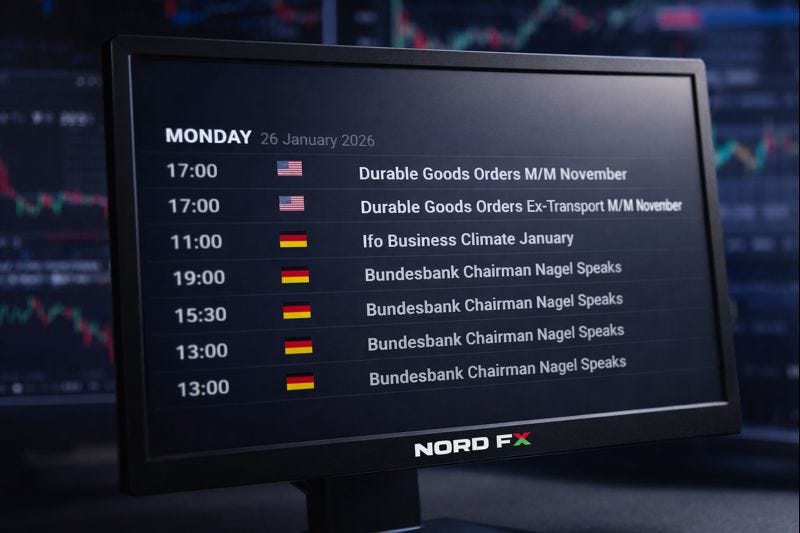
🗓️ Economic Calendar of the Day (Mon, 26 Jan)
🇩🇪 11:00 — Ifo Business Climate (Jan)
🇩🇪 13:00 / 15:30 / 19:00 — Bundesbank Chairman Nagel Speaks
🇺🇸 17:00 — Durable Goods Orders m/m (Nov)
🇺🇸 17:00 — Durable Goods Orders ex-Transport m/m (Nov)

🚀 Trade carefully today: volatility can spike around headlines and top-tier data. Follow NordFX for more updates and stay tuned.


🌅 Morning Update — 26 January 2026 was originally published in Coinmonks on Medium, where people are continuing the conversation by highlighting and responding to this story.

Crypto Airdrop Scams in 2026: Real Examples & Red Flags

By: MintonFin
Crypto Airdrop Scams in 2026: Real Examples & Red Flags

In 2026, crypto airdrop scams are no longer amateur phishing attempts — they are professionally engineered traps powered by AI, fake audits, cloned wallets, and social engineering that even experienced traders fall for.

Every week, thousands of users lose wallets, NFTs, stablecoins, and long-term holdings — not because they were careless, but because airdrop scams now look legitimate.

This guide breaks down:

  • Real airdrop scam examples
  • How modern airdrop scams actually work
  • Red flags most people still miss
  • A practical crypto airdrop scam prevention checklist
  • How to safely interact with real airdrops in 2026

If you’ve ever searched:

“Is this airdrop legit?”

“How do crypto airdrop scams work?”

“How to avoid fake airdrops?”

This article is your answer.

What Is a Crypto Airdrop Scam?

A crypto airdrop scam is a fraudulent campaign that promises free tokens in exchange for wallet interaction, approvals, or signatures — with the goal of draining funds, stealing NFTs, or compromising wallet security.

Unlike early phishing scams, modern airdrop scams often involve:

  • Fake smart contracts
  • Malicious token approvals
  • Wallet-draining signatures
  • Cloned websites and social profiles
  • AI-generated “community” activity

Why Crypto Airdrop Scams Exploded in 2026

Crypto airdrop scams didn’t just increase — they evolved.

1. AI-Generated Legitimacy

Scammers now use AI to:

  • Clone real project websites
  • Generate realistic whitepapers
  • Fake GitHub commits
  • Simulate Discord & X engagement

Many scams now look more polished than real startups.

2. Multi-Chain Complexity

With Ethereum, Solana, Arbitrum, Base, Sui, Aptos, and Layer 3s, users regularly:

  • Bridge assets
  • Sign cross-chain approvals
  • Interact with unfamiliar contracts

Scammers exploit this confusion.

3. Wallet Fatigue

After years of DeFi, NFTs, and memecoins, users are:

  • Desensitized to signing messages
  • Overconfident in wallet security
  • Unaware of new approval-based exploits

Real Crypto Airdrop Scam Examples (2025–2026)

Example 1: The “Retroactive Reward” Scam

Victims received messages claiming they qualified for a retroactive airdrop due to past DeFi activity.

The trap:

  • Website cloned from a real Layer 2
  • Wallet connection required
  • “Claim” button triggered unlimited token approval

Result: Wallet drained within seconds.

Key lesson: Retroactive airdrops never require urgent action.

Example 2: Fake Token Appears in Wallet

Users suddenly saw a new token in their wallet labeled:

“AIRDROP_ELIGIBLE”

Clicking the token’s website link led to a fake claim portal.

What happened:

  • Approval signature granted access to all ERC-20 tokens
  • NFTs transferred out instantly
  • Wallet labeled “compromised” afterward

Key lesson: Never interact with unsolicited tokens.

Example 3: Discord Moderator Impersonation

Scammers impersonated admins in a real project’s Discord:

  • Same name
  • Same profile image
  • AI-generated chat history

They shared a “private airdrop link” during high traffic events.

Key lesson: Admins never DM airdrop links.

Example 4: NFT Holder Airdrop Trap

NFT holders were targeted with exclusive airdrops:

  • “Claim your holder reward”
  • “Limited-time distribution”

The contract approval allowed:

  • NFT transfer permissions
  • ERC-20 draining

Key lesson: NFT approvals are just as dangerous as token approvals.

The Most Common Crypto Airdrop Scam Red Flags

Red Flag #1: Urgency or Countdown Timers

Legitimate airdrops don’t rush you.

“Claim within 24 hours or lose eligibility” is a scam signal

Red Flag #2: Wallet Approval Before Verification

If you must approve tokens before seeing eligibility — walk away.

Red Flag #3: Airdrop Links Shared in DMs

Real projects:

  • Post on official blogs
  • Use verified X accounts
  • Pin announcements publicly

Scammers use private messages.

Red Flag #4: No Independent Mentions

Search the airdrop name:

  • No GitHub?
  • No Medium post?
  • No reputable coverage?

That silence is your warning.

Red Flag #5: “Free” Tokens with No Tokenomics

If there’s:

  • No supply details
  • No vesting
  • No utility explanation

It’s bait.

How Wallet Draining Airdrop Scams Actually Work

This is what most people don’t understand.

Step 1: Trust Setup

Scammer builds legitimacy using:

  • Fake audits
  • Paid influencers
  • Bot-driven social proof

Step 2: Wallet Interaction

User connects wallet and signs:

  • Token approval
  • Permit signature
  • Blind message

Step 3: Asset Extraction

Assets are:

  • Transferred to multiple wallets
  • Bridged instantly
  • Mixed or swapped

Step 4: Cleanup

  • Website disappears.
  • Discord wiped.
  • X account renamed.

Crypto Airdrop Scam Prevention Checklist

Before Connecting Your Wallet

  • Verify project on multiple platforms
  • Confirm contract address via official sources
  • Search “[project name] airdrop scam”

Before Signing Anything

  • Read approval details
  • Avoid “unlimited” permissions
  • Reject blind signatures

Wallet Hygiene Best Practices

  • Use a burner wallet for airdrops
  • Never use cold wallets for claims
  • Revoke permissions regularly

After Any Interaction

  • Monitor wallet activity
  • Use approval trackers
  • Move funds if anything feels off

Scammers rely on short memory and fast clicks. You rely on process.

Save this post so you can run this checklist every time a new airdrop appears in your wallet.

Best Tools to Detect Airdrop Scams in 2026

While no tool is perfect, these help:

  • Wallet approval dashboards
  • Contract scanners
  • Browser wallet warnings

Important: Tools are supplements — not substitutes for skepticism.

Are Any Crypto Airdrops Still Legit?

Yes — but they share common traits.

Legit Airdrops Usually:

  • Are announced publicly
  • Don’t require urgency
  • Don’t request unlimited approvals
  • Are discussed openly by developers
  • Have clear tokenomics

If an airdrop feels too generous, it probably is.

Why Even Experienced Traders Fall for Airdrop Scams

Because scammers exploit:

  • FOMO
  • Fatigue
  • Overconfidence
  • Familiar branding

Experience doesn’t eliminate risk — process does.

What To Do If You’ve Been Hit by an Airdrop Scam

  1. Revoke approvals immediately
  2. Move remaining assets
  3. Mark wallet as compromised
  4. Never reuse it
  5. Warn others publicly

Staying Safe in an Era of Sophisticated Crypto Airdrop Scams

In 2026, crypto airdrop scams are one of the largest wealth transfer mechanisms in the industry — from users to criminals.

If you remember one thing, let it be this:

A real airdrop will never pressure you, rush you, or require blind trust.

Use the crypto airdrop scam prevention checklist, stay skeptical, and treat every “free token” as a potential threat.

Your wallet doesn’t need more tokens — it needs better defenses.


Crypto Airdrop Scams in 2026: Real Examples & Red Flags was originally published in Coinmonks on Medium, where people are continuing the conversation by highlighting and responding to this story.
Variational : Why You Need To Farm It

Variational: Why You Can’t Miss It

With decentralized exchanges (DEXs) taking more and more mindshare from centralized exchanges (CEXs) in trading and spot volumes, competition in this sector is rapidly intensifying. Inspired by the success of Hyperliquid, most of these platforms are running points programs. This is the case for Variational, one of the most promising trading protocols to farm right now.

What Is Variational ?

Unlike other perp DEXs like Hyperliquid or Extended that use an order book, Variational uses a Request for Quote (RFQ) model, notably used by large over-the-counter (OTC) venues. This system consists of takers (traders) requesting quotes and makers (market makers) responding with bids and/or offers.

In the case of Variational, the only market maker allowed is the Omni Liquidity Provider (OLP).

Source : Variational Docs

This model have various advantages :

  • Zero Fees : Since all market making on Omni is done by OLP instead of external market makers, Omni doesn’t need fees to generate revenue.
  • Complete control over revenues : A portion of the fees are directly red irected to users via various incentives.
  • Listing Variety : All OLP requires for a new listing is a reliable price feed, a quoting strategy, and a hedging mechanism. This manifests as around 500 tradable tokens on Omni !

The team And Partners

Variational was co-founded by Lucas Schuermann and Edward Yu, they have great experience in trading, having work with Genesis after their hedge fund (Qu Capital) was bought by Digital Currency Group (DCG) in 2019.

Source : Variational docs

They later left in 2021 to create their own proprietary trading firm after raising $10M. After two years, they decided to leverage their experience in trading and OTC exchanges to found the Variational protocol in 2023.

Other team members include many crypto veterans in algorithmic trading, with past experience at major firms such as Google and Goldman Sachs.

In June 2025, they raised an additional $1.5M in a strategic round.

Important Metrics

As mentioned in my previous article about perp DEXs, before farming a project I always analyze whether the opportunity cost is worth it. Let’s go through the key metrics one by one.

Trading Volume

It is important to note that at this time of year, volumes are down across nearly all perp DEXs.

Srouce : DefiLlama

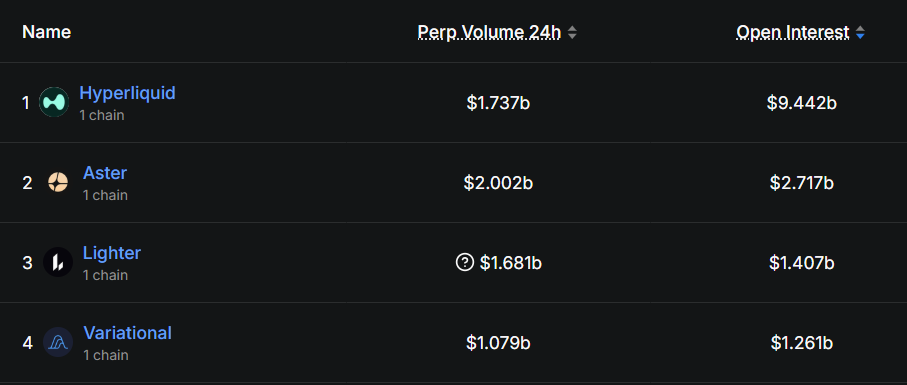
Currently, the 24h trading volume is around $850M, placing Variational in the top 6 alongside major names such as Extended, Hyperliquid, and Lighter. Keep in mind that volume can be manipulated through wash trading, so it should not be used as a standalone indicator. For example, Aster ranks third, but farming its airdrop is not attractive.

Open Interest

Open interest represents the total value of active long and short contracts. It is a good indicator of project health, as it implies traders are holding positions for longer periods. Like any metric, it can be manipulated, so it should be evaluated alongside others.

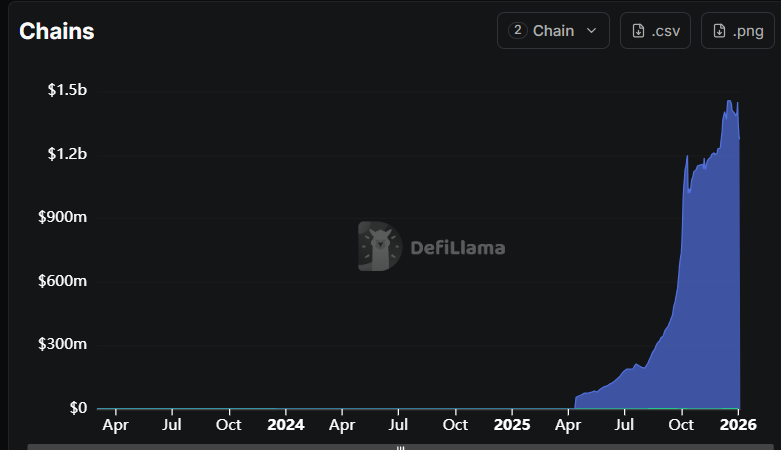
Currently, open interest is around $1.26B, placing Variational in the top 6 perp DEXs. One week earlier, when I started writing this article before the Lighter TGE, it stood at $441M.

Source : DefiLlama

TVL

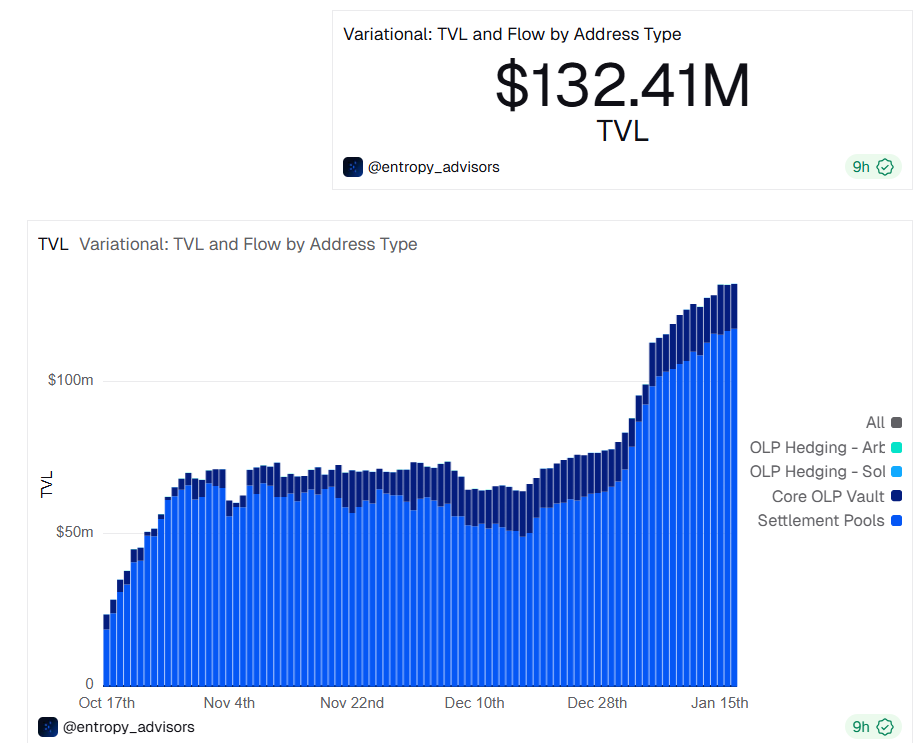
The current TVL is around $132M. While this may seem low compared to projects like Lighter or Extended, it is important to note that the OLP vault has not yet been opened.

Source : Dune

For comparison, roughly half of the TVL on Lighter and Extended is stored in their vaults. Based on this, it would be reasonable to expect a TVL of around $260M for Variational once the vault opens. Depending on yield attractiveness, this could attract significant capital.

For a project still officially in private beta, this is already a strong TVL.

Roadmap

What users currently interact with is Omni, where retail traders can trade more than 480 tokens with a zero-fee model and up to 50x leverage on all pairs.

The team also plans to launch Variational Pro, designed for advanced and institutional traders of OTC derivatives. This dual-product approach allows Variational to target both retail traders (via Omni) and institutional entities (via Pro).

At the moment, the OLP vault is not open for public deposits. The team plans to launch it soon, allowing users to earn a share of Omni’s revenues. This is expected to be highly attractive, as Omni generates significant revenue due to the absence of external market makers.

On the trading side, the team plans to expand beyond crypto into other markets such as stocks, and to support additional collateral types beyond USDC, enabling broader cross-margin functionality.

There are many additional smaller features detailed in the documentation.

The Token ($VAR) and Points Program

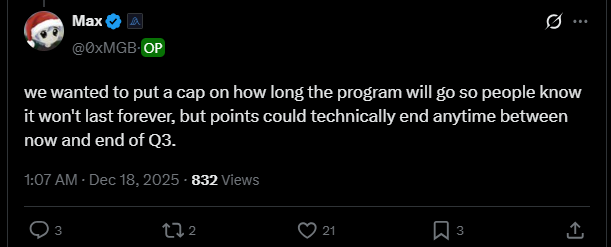
There is limited information available about the token at this stage. The points season is expected to end no later than Q3 2026 and could conclude earlier depending on roadmap progress.

Source

We know that approximately 50% of the token supply will be allocated to the community through multiple incentive mechanisms, rather than a single airdrop. Additionally, the team plans to buy back tokens using at least 30% of protocol revenues.

The points program launched three weeks ago, including a retroactive distribution of 3M points for users who traded before its launch. Going forward, 150,000 points will be distributed every Friday at 00:00 UTC, with snapshots taken every Thursday at 00:00 UTC.

Start now with the best boosted code you can have, allowing you to have a 15% points boost and silver rank :

https://omni.variational.io/?ref=OMNIPANDA

I don’t have an affiliate code, so I gave you the one I use, which is the best one to start earning those precious points on Variational. If you want to support my work, a simple like is enough.

For an estimate of point valuation, there is a strong analysis published by Points Goblin :

My Personal Opinion and Strategy

Following the Lighter TGE, there has been a rapid rotation toward newer perp DEXs such as Variational and Extended. This should not discourage farming these projects as long as the cost per point remains low.

I personally faded Lighter in June when its TVL reached around $170M, assuming it was too late. That assessment was incorrect, as TVL later exceeded $1B

Market conditions are currently pessimistic, with many participants sidelined. If hype returns, earning points will become significantly harder, while existing points are likely to increase in value.

This is why I am currently trading on Variational, mainly farming funding via the FundingView app.

Based on gathered information, points appear to be weighted more heavily toward :

  • Holding positions for multiple days
  • Trading low open-interest pairs
  • Trading newly listed pairs

For additional insights, the following X accounts are worth following:

  • Points Goblin
  • Cllmax

Docs : https://docs.variational.io/

Discord : https://discord.gg/variational

Twitter (X) : https://x.com/variational_io

As always, thank you for reading !

Follow me on medium

Follow me on Twitter to get updates, alpha and much more !

Disclaimer: This is not financial advice, you need to do your own research !


Variational : Why You Need To Farm It was originally published in Coinmonks on Medium, where people are continuing the conversation by highlighting and responding to this story.

Deep Dive into Bitcoin: Answers to the Questions You Rarely Ask

How to hack Bitcoin? How does the blockchain calculate time? How does mining difficulty change? What happens if two miners mine a block simultaneously? Where are transactions stored before confirmation, how are fees calculated, and is it possible to send a transaction with zero fee? What types of nodes exist in the blockchain, and how do they differ? When can you use mining rewards?

This is roughly how I studied all the information around these topics.

Here I provide deeper answers to these questions because popular materials about Bitcoin either don’t explain these things at all or do so very superficially. To understand this article, you need a minimal understanding of how blockchain works, which you can get here: https://vas3k.com/blog/blockchain/

TL;DR

  • How to hack Bitcoin?
    A quantum computer will only be able to derive a private key from a public key after a transaction has been sent. If no transaction has occurred, the wallet is protected.
    A 51% attack only provides the ability to cancel your own or others’ transactions to double-spend your own coins; gaining control over others’ coins is impossible.
  • How does mining difficulty change?
    Difficulty is recalculated every ~2 weeks based on the mining time of the previous two weeks.
  • What happens if two miners mine a block at the same time?
    The chain temporarily splits until one branch becomes longer. The longer branch becomes the main one.
  • When can mining rewards be used?
    After 100 blocks.
  • How does the blockchain calculate time?
    Based on the median time of the past 11 blocks and the system time of the nodes.
  • Where are transactions stored before confirmation, how is the fee calculated, and can you send without one?
    They’re stored on nodes for no more than two weeks. A zero-fee transaction is theoretically possible but practically almost impossible to get confirmed.
  • What nodes are in the blockchain and how do they differ?
    Full nodes — hold the blockchain data and enforce the rules.
    Miners — query full nodes for data and build new blocks.
    Light nodes — often used in wallets on weak devices; they query full nodes for what they need.

What’s the point of Bitcoin (besides speculation), in plain English

At the end of researching.

Bitcoin is an alternative financial system that does not require user trust. When using traditional banks, we must trust them not to steal or lose our money, and if that happens, we must trust the state to be able to return it. We also have to hope that money won’t be blocked at the whim of authorities or bank employees.

The point of Bitcoin is the opposite: everything is tied to strict mathematics that removes the probability of all these potential problems (or drastically reduces), provided you store Bitcoin in a personal non-custodial wallet.

Non-custodial wallet: A wallet controlled only by whoever has the private key; essentially just a small file/program that stores keys and signs transactions.

Custodial wallet: An account on an exchange that controls your assets and stores your funds in its own non-custodial wallets. This allows the exchange to block or seize your funds if you violate its rules or national laws, though the exchange offers more convenient and expanded functionality in return.

Interesting fact: A Bitcoin wallet is not an object inside the blockchain, but a program that stores keys and signs transactions.

The blockchain stores UTXOs (Unspent Transaction Outputs). Each UTXO is “locked” by a condition (program), usually tied to an address (practically, a hash of a public key).

To spend a UTXO, the wallet creates a transaction referencing that UTXO as an input and adds a signature. Network nodes verify the signature and the script’s execution. As a result, the old UTXO becomes spent, and the transaction creates new outputs — new UTXOs for the recipients.

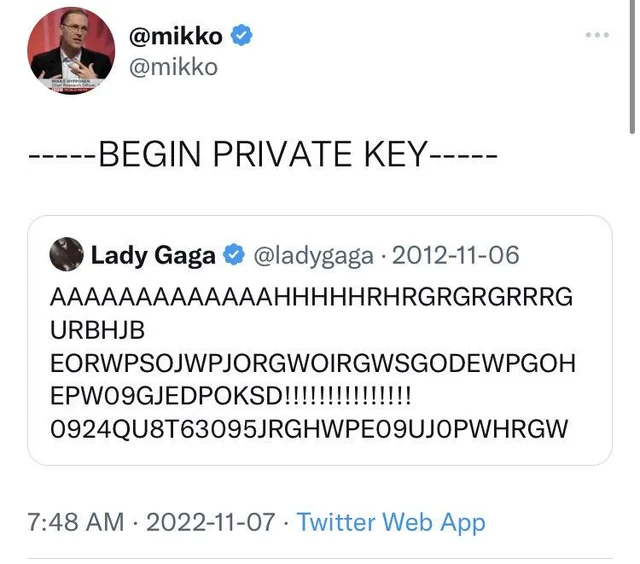
A private key is a number. A public key can be calculated if you have the private key, but the reverse is practically impossible (how that’s attacked is discussed later in the “attacks” section). Using a private key, you can sign data, but this signature cannot be forged with a public key. Meanwhile, the public key can verify that the signature was produced by the corresponding private key.

— — — — —END-PRIVATE-KEY — — — — —

In early versions, the wallet address was the public key. But later, addresses derived as a hash/encoding of the key or script began to be used. This is a crucial point for the section on quantum computer attacks.

Once a transaction is signed, it must be embedded in a block. First, it goes into a general pool of unconfirmed transactions (mempool), where any miner can take it to create a block.

But a transaction can exist only once in the blockchain, so the network can’t allow every miner to create their own block with the same set of transactions and have them all accepted.

Block Header

Each block has a header containing version data, the previous block’s hash, the merkle root (hash of all transactions in the current block), time, bits (mining difficulty), and a nonce.

Here’s an example (block 900K)
• version: 0x20aba000
previous block hash: 0000000000000000000196400396be46d0816dc462df4c3450972f589f4d7d24
• merkle root: 0cfb54e522b07bd1a381adc774ec1851590ef4c3add83958135106534569f970
• time (unix): 1749188499 _(2025–06–06 06:41:39 UTC)_
• bits (nBits): 0x17023774
• nonce: 0x925fd07a

All of these fields are combined and then hashed via SHA-256.

SHA-256 is a hashing technology: take some data and turn it into a different set of numbers that you can’t convert back into the original data if you only know the hash. But you _can_ verify it, because for a fixed input X the result is always the same output Y. So knowing X gives you Y; knowing Y does not practically give you X back — even with a quantum computer.

You can try hashing any data here.
SHA-256 is also one of the core tools in the HTTPS connections we use every day, and it plays a key role in hundreds of internet protocols.

The nonce is needed to find out whose block to record. Miners change the nonce so the header’s hash is less than the target. In our example, the hash has 19 zeros.

Finding such a hash is hard. It takes roughly ~10 minutes of the entire Bitcoin network’s mining power. Blocks should appear roughly every 10 minutes — that’s how Satoshi Nakamoto designed it.

Why exactly this many zeros, and how does mining difficulty change?

Proof of Work in real life

It’s not actually about the zeros, but about the **target**. The target determines mining difficulty: the smaller the target, the higher the difficulty. A valid block header hash must be ≤ the target. Because small target numbers in hexadecimal start with zeros, hashes often appear with many leading zeros (e.g., ~19 or more). The smaller the target, the rarer it is for a random hash to land below it, so mining becomes harder.

Difficulty Calculation Hack: If the difficulty increases by 16 times, the required threshold becomes 16 times lower— often resulting in one additional leading hex-zero.

Difficulty adjustments (retarget) occur every 2016 blocks (roughly 2 weeks, 1 block ~10 minutes). The blockchain uses a simple formula:

Target_new= target_old*T_act/T_exp, 4Texp

Target_new = new target (new difficulty)
Target_old = old target
T_act = actual time it took to mine the last 2016 blocks
T_exp = expected time for 2016 blocks: 2016*600 seconds (10 min = 600 sec)
4T_exp= The change is limited: difficulty can’t shift more than 4× either way.

If, since the last difficulty retarget, the network’s total hash rate (the combined power of all miners) has increased over the past 2,016 blocks, then with near-certainty the average time to mine a block will decrease. That means the actual time to produce those 2,016 blocks T_act will be less than the expected time T_exp, so T_act/T_exp < 1. As a result, the new target Target_new will go down: and the lower the target, the higher the difficulty and the harder it is to mine.

But what to do if two different miners mine a block at the same time?

That happens,and there’s a safety mechanism for it.

In theory, they can make practically identical blocks if the same transactions in the same order fall into each block. But blocks still won’t be identical because the first transaction in every block is the coinbase (the miner reward), and it pays to the miner’s address — so two miners can’t have the exact same block because their addresses differ.

But it is possible that two miners almost simultaneously mine different blocks. If the delay between the creation of a block and its distribution among nodes is 2 seconds, then this means that after the creation of the first block, there is a two-second gap in which a second block can be created. The longer this time, the higher the probability, but with each year this time is reduced. The probability of creating three blocks is almost negligible, but the protection system is the same.

If two blocks are created, they are saved in nodes, and these two chains are passed further. Miners then choose which block to build on — usually the one they saw first. And when they find the next block for one of the chains, it is distributed further and the nodes agree with it, and the shorter version is forgotten. This is the rule of the longer chain. Even if 2, 3, or more blocks in a row are formed in two chains, sooner or later one branch outpaces the other.

Transactions have 3 probable paths:

1. Fall into the chain that wins, then they remain in the blockchain.
2. Fall into both chains, then only the version in the winning chain remains relevant.
3. Fall into the chain that loses, then they go again into the pools of unconfirmed transactions (more on this below).

A few numbers:

  • Approx. probability of a fork given ~1s delay: 0.17%
  • A second block on the same competing branch: 0.00028%
  • Third: 4.6*10^⁻⁹
  • Fourth: 7.7*10^⁻¹²

That’s why exchanges don’t credit your deposit after 1 confirmation. Typically they wait for 6 confirmations — ~1 hour on average (6 blocks × 10 minutes).

There is no limit to the length of the second/third chain because they disappear quickly. Not counting these two cases:

  • Reorganization through 53 blocks due to a bug in the software (source).
  • Another incident with reorganization through 24 blocks (source).

And there is also the possibility of an attack through a second chain, but about this at the very end.

From this follows the next question:

Since the miner receives a reward for mining a block, what happens when two blocks are mined?

Simple: a miner can spend the reward only after 100 blocks.

If you are a miner and mined block № 1000, you will be able to use the reward for this block only starting from block №1100. This looks like a time-lock transaction, but technically it is not one. I will write about the time-lock technology next time, this is already turning into too much text.

Miners add transactions to the blockchain, receiving a fee for this. And from this follow a few more questions:

Where and for how long are unconfirmed transactions stored, and can a transaction with a zero fee pass in theory?

The fee in Bitcoin depends not on the number of tokens sent in the transaction, but on the size of the transaction and the occupancy of the network at the given moment. After sending your transaction from a non-custodial wallet, it goes to the nearest node(s), these nodes decide based on several characteristics whether to accept your transaction or not:

1. Does it comply with the rules and did you not assign yourself non-existent tokens or something else?
2. Is the specified transaction fee sufficient?

If the answer to one of these questions is no, the node will not take the transaction and it will not fall into the blockchain, and your balance will not change. It turns out that a zero fee, in most cases, will not pass into the blockchain, although theoretically a miner can include such a transaction in a block, it is extremely unlikely.

How does a node assign a fee?

The node has a certain amount of memory where it stores such unconfirmed transactions after receiving them, but until the moment they are recorded in the blockchain.

By default, it is limited to 300 MiB of RAM memory and 336 hours of storage. However, if the blocksonly setting is enabled in Bitcoin-Core 25.0, the RAM memory will be reduced to 5 MiB; this is often done for validating the blockchain.

All these data can be changed when setting up the node, but this is often not done, as for most it would be a simple waste of extra resources.

And what will happen if you send a transaction with the minimum allowable fee?

If the node does not throw it out after adoption due to overflow, and if miners will not take this transaction due of small fee, it will be deleted after 336 hours = 2 weeks.

After the transaction is accepted, nodes distribute it to other nodes, and miners insert transactions with the highest fees into the block.

Considering the limits on transaction size of 400,000 weight units ≈ 100KB (but it could be more with SegWit, but those are already too small details). A maximum of 10 such large transactions can fit into 1 block, and ≈ 10,000 of the smallest. But on average it comes out to 2500 transactions per 1 block.

The fee itself is calculated by the formula: fee (sat) = vsize (vB) * feerate (sat/vB)

  • fee = commission.
  • vsize = transaction size.
  • sat = satoshi, in one Bitcoin there are 100,000,000 satoshis.
  • vB = Virtual Byte.

Your wallet can find out the minimum feerate from the nodes, but this is the lower boundary of whether the transaction will be distributed, not a guarantee of its confirmation. To estimate how much you need to pay now, wallets use mempool statistics and confirmation history.

An average transaction weighs 150vB; if at the given moment the average sat/vB = 2, then the transaction will cost 300 sat. And it will cost $0.27.

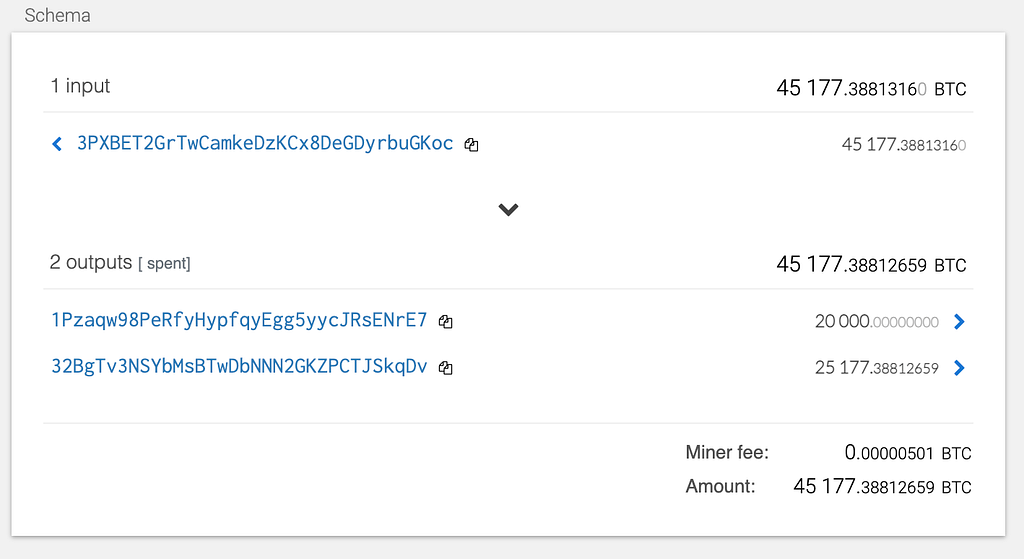
For example, for this transaction of 45,177 BTC (several billion $), the fee was less than $1.

The highest sat/vB was in April 2024 during the halving and was from 1795 to 2751 sat/vB (source). On that day, an average transaction would have already cost from $160 to $245, depending on how quickly it needed to be processed.

The busier the network, the higher sat/vB. If you want your transaction to get confirmed faster, you set sat/vB above the current average.

Nodes define the fee as: fee = sum(inputs) — sum(outputs), then they look at the transaction size to check if it fits their internal policies.

Don’t forget about UTXO: if over time you received 10 separate incoming transactions, and now you want to send the entire balance in one transaction, the blockchain sees that as 10 inputs — meaning the transaction is larger and therefore more expensive.

To save on fees in the future, it is useful to sometimes do “consolidation” — sending yourself all small remnants in one transaction when the network is calm and sat/vB is minimal.

Returning to the first topic and the block header, the following question may arise:

How does the blockchain know that ~10 minutes passed, and that miners aren’t lying?

The blockchain receives information about the time from miners and nodes (nodes that store information but do not mine) in UTC format.

Miners write the time in the block header. Nodes have their own clocks and verify the median time received from other nodes.

Bitcoin is a closed system, so the blockchain cannot connect to ntp.org to check if the miners are writing the truth in the block header and the nodes or not.

How can the blockchain check if the nodes and especially the miners aren’t lying?

For this, there is MTP — Median Time Past.

Median Time Past is easier to understand than Past Simple.

Not the average, but precisely the median.

It is calculated from the last 11 blocks arranged in order. For example:

18, 2, 12000 (liar), 14, 6, 20, 10, 4, 16, 12, 8

If we take the average value, then we need to sum all these numbers and divide by 11, we get 1100. Because of the liar who put 12000, everything has changed a lot.

But if we take the median, then first we arrange them in order:

2, 4, 6, 8, 10, 12, 14, 16, 18, 20, 12000 (liar)

And we take the value from the middle, that is, 12. This is how MTP is calculated.

The time of a new block is always greater than the MTP; otherwise, the block will not be accepted by other miners/nodes and will not be inserted into the blockchain.

But if someone wants to go to the future, at what time gap should blocks be rejected?

What will affect my future more, 10 push-ups or this article?

In the past Bitcoin used NAT — Network Adjusted Time (time adjusted by the network), which compared median time from peers. Later NAT was removed as a consensus component.

Now nodes use their own system UTC time to check how far “into the future” a new block is. If a block’s timestamp is more than 2 hours ahead of a node’s local time, that node rejects it.

If some node’s time differs significantly from other nodes, then NAT warns about it — that’s basically the only remaining use.

Miners and other nodes, how do they differ and why are they needed?

There are 3 main types of nodes in Bitcoin: a full node with two variations (archival and pruned), a light node, and a miner.

The other nodes are superstructures on top of these three pillars of the blockchain.

  • Full archival node: a server that has all the information about the blockchain for all time. Validates or rejects blocks in accordance with the rules of the blockchain.
  • Full pruned node: also checks blocks but does not store all data, only the UTXO and part of the last blocks.
  • Relay node: a superstructure on top of a full node, which is connected to other nodes with a large number of peers for fast distribution of information. Like torrent seeders.
  • Light node: stores only block headers to check their hashes. For transactions, it ask information from full node. Great for phone wallets or weak devices where storing dozens/hundreds of GB is inconvenient.
  • Miner: takes information from a full node or is one; based on this information, searches for a nonce to produce a valid block, then broadcasts it to the network.

If you need a non-custodial wallet on a PC, then perhaps a full pruned node for this would be the best option. You can choose the one you need here: bitcoin.org/en/choose-your-wallet?step=1

How to hack Bitcoin?

There are many possible attack vectors. If I described all of them, the article would be longer than it already is. But someday I will write. For now, let’s briefly look at two hack variants that are often talked about.

Quantum Computer VS Bitcoin

A quantum computer could derive a private key from a public key — but there’s already partial protection. If you’ve never spent from your address, your wallet is protected because outsiders see only the hash of your public key, not the public key itself.

Even with a quantum computer, it is practically impossible to brute-force the hash of a public key. But after the first outgoing transaction, the public key becomes visible to everyone. Therefore, to protect against quantum attacks, you should use addresses once.

However, there’s still a possible “interception” scenario: if a quantum computer could, after you broadcast a transaction but before it’s confirmed, derive your private key from your revealed public key — it would have very little time, but that’s the idea.

But there are wallets (outputs) of old formats, where the public key is visible immediately, and such wallets can be hacked even if there was not a single transaction from them.

And there are also many “lost” wallets; transactions were made from some, but that was many years ago. And with the help of quantum computers, coins from these wallets will probably fall back into circulation and possibly crash the Bitcoin price. But let’s leave these speculations to analysts who were perfectly described by one satirical channel:

”Last week’s target for Bitcoin at 34 thousand dollars has been revised and now stands at 240 thousand.”

So, a quantum computer will not destroy Bitcoin in this way.

But they are already thinking about creating a reusable quantum-protected wallet. This will require a soft-fork (change of rules), which has been done more than once.

A couple of texts on this topic: BIP 0347 and BIP 360.

51% Attack

If 1 person has more than 51% of the mining power, it will be easy for him to create a second chain of blocks as he wants. In this case, he will be able to cancel transactions and rewrite the history of his spending.

But even in this case, he will not be able in any way to steal someone else’s coins that were never on his wallet. The older the transactions that need to be rewritten, the longer and harder it will be, and there is no 100% guarantee that it will work and he will be able to make his chain longer and faster than the other 49%.

Such an attack is possible even with 30% and 40%, but the probability is much lower.

How much money will be needed for such an attack?
If we attack from scratch, then we essentially have to have a power 0.5% more than the entire power of Bitcoin miners. The hashrate today is approximately 1 ZH/s = 1,000,000,000,000,000,000,000 SHA-256 hash findings per second.

Modern ASICs (mining devices) have a power of approximately 200 TH/s, meaning 5,000,000 of them will be needed. Their efficiency is ≈ 17–20 J/TH. Multiply by 10⁹ and you get 17–20 GW. A bit less than the power of the largest hydroelectric dam in the world.

To this, we add the prices for the ASICs themselves, which comes out to ≈ $7.5 billion. Not counting extra infrastructure which will also be very expensive.

Even all these costs will lead at most to double spending of own coins in the blockchain and censorship of transactions. And even then, it will be visible to everyone and the price will probably crash and the game will not be worth the candle.

If you are interested in diving deeper into WEB 3.0 technologies, subscribe to my X (x.com/Paolo3Web) where there will be more content, far from always so long, but no less interesting.


Deep Dive into Bitcoin: Answers to the Questions You Rarely Ask was originally published in Coinmonks on Medium, where people are continuing the conversation by highlighting and responding to this story.

Spot vs Perpetual Trading on Hyperliquid: What Every Trader Must Understand

By: MintonFin
Spot vs Perpetual Trading on Hyperliquid

One wrong choice between spot and perpetual trading can silently drain your capital — especially on a high-performance platform like Hyperliquid.

Hyperliquid has rapidly emerged as one of the most talked-about decentralized trading platforms in crypto. With lightning-fast execution, deep liquidity, and a fully on-chain order book, it attracts everyone from casual traders to highly leveraged professionals.

But here’s the uncomfortable truth most guides don’t tell you:

  • Spot and perpetual trading on Hyperliquid are not interchangeable.
  • They reward completely different mindsets, risk tolerances, and time horizons.
  • Choosing the wrong one can turn a profitable strategy into a liquidation event.

In this guide, you’ll learn exactly how spot trading and perpetual trading work on Hyperliquid, how they differ, and most importantly, which one aligns with your goals, capital structure, and psychology as a trader.

Whether you’re a long-term crypto holder, an active DeFi participant, or an advanced derivatives trader, this article will help you make smarter, safer, and more profitable decisions on Hyperliquid.

What Is Hyperliquid?

Hyperliquid is a decentralized exchange (DEX) optimized for high-performance spot and perpetual futures trading, built with a custom Layer-1 blockchain designed specifically for trading.

Unlike many DeFi platforms that rely on AMMs (automated market makers), Hyperliquid uses a fully on-chain central limit order book (CLOB) — similar to Binance or OKX, but decentralized.

Key Features of Hyperliquid

  • Fully on-chain order book
  • Ultra-low latency execution
  • Deep liquidity for major trading pairs
  • Spot trading and perpetual futures in one interface
  • No KYC required
  • Non-custodial (you control your funds)

This hybrid design makes Hyperliquid uniquely powerful — but also more complex than typical DeFi platforms.

Understanding spot vs perpetual trading is critical before using it seriously.

Are you servicing a high-interest debt or want better savings?

Private credit is becoming the new income solution. Get $300 on first deposit with Insidefinacent.

Spot Trading Explained (Hyperliquid Spot Markets)

What Is Spot Trading?

Spot trading means buying or selling an asset for immediate settlement at the current market price.

When you buy ETH on the spot market:

  • You own the ETH
  • It appears directly in your wallet
  • There is no leverage
  • No liquidation risk

How Spot Trading Works on Hyperliquid

On Hyperliquid’s spot market:

  • You trade crypto pairs (e.g., ETH/USDC)
  • Trades settle instantly on-chain
  • Assets are fully owned by you
  • Profits and losses are unrealized until you sell

Spot Trading Example

If you:

  • Buy ETH at $2,500
  • Hold it for three months
  • Sell at $3,000

Your profit is simply:

($3,000 — $2,500) × ETH amount

No funding rates. No margin calls. No forced liquidation.

Advantages of Spot Trading on Hyperliquid

Spot trading is often underestimated — especially in a derivatives-driven market.

1. Zero Liquidation Risk

Your position cannot be forcibly closed due to volatility.

This makes spot trading ideal for:

  • Long-term investors
  • Conservative traders
  • Portfolio builders

2. Full Asset Ownership

You actually own the underlying crypto, which means:

  • You can withdraw anytime
  • You can move assets to cold storage
  • You can use them in DeFi elsewhere

3. Simple Risk Management

Your maximum loss is limited to your initial investment.

No leverage = no surprise margin calls.

4. Ideal for Market Cycles

Spot trading excels during:

  • Bull markets
  • Accumulation phases
  • Long-term trend formation

Disadvantages of Spot Trading

Despite its safety, spot trading has limitations.

1. Capital Inefficiency

Without leverage:

  • Returns are slower
  • Large capital is needed for meaningful gains

2. No Short Selling (in pure spot)

You cannot profit from falling prices unless:

  • You sell an asset you already own
  • Or rotate into stablecoins

3. Opportunity Cost

Capital tied in spot positions can’t be redeployed quickly for short-term trades.

Perpetual Trading Explained (Hyperliquid Perps)

What Are Perpetual Futures?

Perpetual contracts (perps) are derivative instruments that track the price of an asset without expiration.

You do NOT own the underlying asset.

Instead, you:

  • Open long or short positions
  • Use margin
  • Trade price movement only

How Perpetual Trading Works on Hyperliquid

Hyperliquid’s perpetual markets allow:

  • High leverage
  • Long and short positions
  • Cross-margin and isolated margin
  • Continuous funding payments

Key Components

  • Margin: Collateral posted to open a position
  • Leverage: Borrowed exposure (e.g., 10x, 20x)
  • Funding Rate: Periodic payments between longs and shorts
  • Liquidation Price: Price at which your position is forcibly closed

Perpetual Trading Example

You:

  • Deposit $1,000
  • Open a 10x long on ETH
  • Control $10,000 worth of ETH exposure

If ETH rises 5%:

  • Your profit ≈ 50%

If ETH drops ~10%:

  • Your position is liquidated
  • Your capital is gone

Advantages of Perpetual Trading on Hyperliquid

1. Leverage Amplifies Returns

Perps allow:

  • Faster capital growth
  • Efficient use of capital
  • Aggressive strategies

2. Ability to Short the Market

You can profit from:

  • Bear markets
  • Downtrends
  • Market corrections

This is critical for professional traders.

3. High Liquidity and Tight Spreads

Hyperliquid’s order book provides:

  • Minimal slippage
  • Institutional-grade execution

4. Advanced Trading Strategies

Perpetuals support:

  • Hedging spot positions
  • Delta-neutral strategies
  • Arbitrage opportunities

Risks of Perpetual Trading

Perpetual trading is not forgiving.

1. Liquidation Risk

Small price movements can wipe out positions.

Most retail traders lose money due to:

  • Over-leverage
  • Poor stop placement
  • Emotional trading

2. Funding Rate Costs

Holding perps long-term can:

  • Erode profits
  • Turn winning trades negative

3. Psychological Pressure

Perps amplify:

  • Stress
  • Overtrading
  • Revenge trading

This is why many traders underperform despite good analysis.

Spot vs Perpetual Trading on Hyperliquid (Comparison Table)

Spot vs Perpetual Trading on Hyperliquid

Which Should You Choose on Hyperliquid?

Choose Spot Trading If:

  • You’re building long-term positions
  • You want low stress
  • You prioritize capital preservation
  • You’re new to Hyperliquid

Choose Perpetual Trading If:

  • You understand leverage deeply
  • You actively manage risk
  • You trade intraday or swing short-term
  • You have strict stop-loss discipline

Advanced Strategy: Combining Spot + Perpetuals

Professional traders often use both.

Example Hedging Strategy

  • Hold ETH spot long-term
  • Short ETH perps during market weakness
  • Reduce volatility without selling spot

This approach:

  • Protects capital
  • Preserves upside
  • Requires discipline

This is how professionals trade. Combining spot and perpetuals isn’t advanced — it’s essential.

If this strategy changed how you think about trading, clap to help it reach more serious traders.

Common Mistakes Traders Make on Hyperliquid

  1. Over-leveraging perps
  2. Using perps for long-term holding
  3. Ignoring funding rates
  4. Trading emotionally after losses
  5. Treating perps like spot

Avoiding these mistakes alone can dramatically improve performance.

Is Hyperliquid Safe for Spot and Perpetual Trading?

Hyperliquid’s non-custodial design reduces:

  • Exchange counterparty risk
  • Custody failures

However:

  • Smart contract risk exists
  • Trader behavior is the biggest risk factor

The platform isn’t dangerous — poor risk management is.

Final Thoughts: Spot vs Perpetual Trading on Hyperliquid

Hyperliquid is one of the most powerful decentralized trading platforms available today. But power cuts both ways.

  • Spot trading rewards patience and conviction
  • Perpetual trading rewards precision and discipline

Understanding the difference is not optional — it’s essential.

The traders who thrive on Hyperliquid aren’t the most aggressive. They’re the ones who choose the right tool for the right market condition.

Trade Smarter on Hyperliquid

The difference between surviving and thriving isn’t luck — it’s structure.

  • Save this guide
  • Clap if it added value
  • Follow for more no-nonsense crypto trading breakdowns

Your capital deserves better decisions.


Spot vs Perpetual Trading on Hyperliquid: What Every Trader Must Understand was originally published in Coinmonks on Medium, where people are continuing the conversation by highlighting and responding to this story.

Why 80% of Ride-Hailing Startups Go for Uber Clone Script

The ride-hailing industry is one of the fastest-growing segments in the global transportation market. With increasing smartphone usage, digital payments, and demand for on-demand mobility services, taxi business owners are rapidly shifting toward app-based platforms. In this competitive environment, nearly 80% of ride-hailing startups choose an Uber Clone Script to launch and scale their taxi businesses efficiently. This approach allows entrepreneurs to stay aligned with current market trends while minimizing operational challenges.

Taxi Business Growth and Current Market Trends

The global taxi and ride-hailing market continues to expand at a steady pace. Industry research shows that the ride-hailing market is expected to cross 220 billion dollars by 2028, driven by urbanization and the growing preference for app-based transportation. Today, a large percentage of commuters rely on mobile apps to book taxis due to convenience, transparent pricing, and safety features.

Another major trend shaping the taxi business is the demand for multi-service mobility. Customers now expect platforms that offer bike taxis, auto rickshaws, standard cabs, luxury vehicles, and electric vehicle options within a single app. Additionally, features such as real-time tracking, contactless payments, and driver verification have become standard expectations. Taxi businesses that fail to adapt to these trends risk losing market share to tech-enabled competitors.

What Is an Uber Clone Script?

An Uber Clone Script is a ready-made ride-hailing software solution designed to replicate the core functionality of popular taxi booking apps like Uber. It typically includes a passenger app for booking rides, a driver app for accepting trips and managing earnings, and an admin panel for controlling operations. The script can be customized to match the branding, pricing strategy, and operational needs of a taxi business.

For startups and existing taxi owners, an Uber Clone Script offers a practical way to enter the digital mobility space without building complex technology from scratch.

Why Uber Clone Script Leads Ride-Hailing Startups

One of the key reasons ride-hailing startups prefer Uber Clone Scripts is cost efficiency. In the current market, managing investment and maximizing returns is critical. Custom development of a taxi booking app requires significant capital, long development cycles, and ongoing maintenance. Uber Clone Scripts significantly reduce these costs while offering a stable and tested platform.

Another major factor is the ability to meet modern customer expectations. Uber clone platforms are designed to deliver essential features such as live GPS tracking, accurate fare calculation, multiple payment options, and enhanced safety tools. These features help taxi businesses build trust and improve customer retention.

The proven business model embedded in Uber Clone Scripts is another advantage. The driver-passenger matching system, commission-based revenue model, and trip management workflows have already been validated across global markets. This reduces business risks and allows startups to focus on growth rather than experimentation.

Supporting Multi-Service and Scalable Taxi Operations

Today’s taxi businesses need flexibility and scalability to succeed. Uber Clone Scripts support multiple vehicle categories, allowing taxi owners to expand their services without additional platforms. Whether it is bike taxis for short-distance travel or electric vehicles for eco-conscious users, a single Uber clone platform can handle diverse mobility needs.

Scalability is equally important in the ride-hailing industry. As demand grows, taxi businesses must onboard more drivers, add vehicles, and expand into new locations. Uber Clone Scripts are built with scalable architecture that supports multi-city and multi-region operations while maintaining centralized control through an admin dashboard.

Key Features That Drive Taxi Business Success

A powerful Uber Clone Script plays a critical role in strengthening taxi business operations by offering advanced, market-ready features. These features are designed to enhance customer experience, improve driver efficiency, and give business owners full operational control.

Passenger-focused features include:

  • Seamless user registration and login
  • Real-time GPS-based cab tracking
  • Transparent fare estimation and breakdown
  • Multiple payment options including cash, cards, wallets, and UPI
  • Ride history, invoices, and trip details
  • Emergency SOS and safety support

Driver-oriented features help improve productivity and retention:

  • Smart ride request notifications
  • Built-in navigation and route optimization
  • Real-time earnings dashboard
  • Incentives, bonuses, and performance tracking
  • In-app communication with passengers

Admin and business management features ensure smooth operations:

  • Real-time analytics and business insights
  • Driver, vehicle, and document management
  • Dynamic pricing and surge control
  • Commission and revenue management
  • Customer support and dispute handling tools

These features collectively help taxi businesses streamline operations, improve customer satisfaction, retain drivers, and maximize overall profitability in a competitive ride-hailing market.

Final Thoughts: Grow Your Taxi Business with SpotnRides Uber Clone Script

The reason why 80% of ride-hailing startups choose Uber Clone Scripts is clear — they offer a cost-effective, scalable, and market-ready solution for today’s competitive taxi industry. For taxi business owners looking to build or expand a digital ride-hailing platform, choosing the right technology partner is crucial.

SpotnRides Uber Clone Script is designed specifically to meet current ride-hailing market demands. With a fully customizable white-label solution, advanced features, multi-service mobility support, and scalable infrastructure, SpotnRides helps taxi businesses launch and grow with confidence. By leveraging SpotnRides Uber Clone Script, entrepreneurs can build a future-ready ride-hailing platform that delivers strong performance, customer satisfaction, and long-term business growth.


Why 80% of Ride-Hailing Startups Go for Uber Clone Script was originally published in Coinmonks on Medium, where people are continuing the conversation by highlighting and responding to this story.

Makina’s $4M Hack due to Oracle Manipulation

On January 20, 2026, the Makina DeFi protocol — an execution engine for on-chain yield and asset management — suffered a ~$4 million exploit targeting its Dialectic USD (DUSD)/USDC Curve stableswap pool. The attack stemmed from oracle manipulation via external Curve Finance integrations, where unvalidated pool data was used to calculate assets under management (AUM) and sharePrice.

By leveraging flash loans, the attacker artificially inflated AUM values, manipulated sharePrice calculations, and extracted profit in a single transaction. While the exploit impacted only the DUSD/USDC pool, it highlighted a broader and recurring DeFi risk: over-reliance on external liquidity data without adequate safeguards.

How the Exploit Worked?

The attacker executed a carefully orchestrated multi-step attack using large flash loans sourced from Morpho and Aave V2. These borrowed funds were temporarily injected into multiple Curve pools to distort liquidity balances and pricing assumptions.

First, the attacker added liquidity to Makina’s DUSD/USDC pool and swapped USDC for DUSD, positioning themselves to benefit from price manipulation. They then added substantial liquidity to Curve’s DAI/USDC/USDT and MIM-related pools, receiving LP tokens that were later partially withdrawn to skew pool balances.

These manipulated balances were critical. Makina’s Caliber contract relied on external Curve functions — such as calc_withdraw_one_coin() and pool balance readings—to compute positional AUM. With liquidity temporarily inflated, these calculations produced artificially high values.

Once the attacker called accountForPosition(), the inflated external data propagated through Makina’s accounting system. The protocol’s total AUM jumped significantly, pushing the sharePrice from ~1.01 to ~1.33 within the same transaction.

With the sharePrice distorted, the attacker arbitraged the DUSD/USDC pool, withdrew liquidity, and repeated the cycle until the pool’s USDC reserves were largely drained. After unwinding the flash loans, the attacker converted the stolen funds to ETH and transferred ~1,299 ETH to external addresses.

Notably, part of the transaction was front-run by an MEV bot, which captured a portion of the profit — further illustrating how composability amplifies loss surfaces during exploits.

Root Cause: Unchecked External Data

At its core, the vulnerability lay in Makina’s trust assumptions. External pool data was treated as reliable input for critical accounting logic, without sufficient sanity checks, rate limits, or flash-loan resistance. The use of upgradeable contracts and the absence of time-weighted or delayed AUM calculations compounded the issue.

This exploit reinforces a key DeFi lesson: external data should inform systems — not directly dictate their financial state.

Notably, many of the largest DeFi exploits in 2025 followed similar patterns, where untrusted external data and integration assumptions were repeatedly abused at scale. These recurring failure modes are analyzed in depth in our Web3 2025 Hack Report, which examines how such vulnerabilities continue to dominate real-world attacks.

Want the Full Technical Breakdown?

This summary covers only the high-level mechanics and lessons from the Makina exploit.
If you want a step-by-step transaction flow, detailed root-cause analysis, and mitigation insights, check out our full deep dive: Makina’s $4M Exploit

Aftermath and Response

Following the attack, Makina paused protocol operations, advised LPs on withdrawal options, and coordinated with multiple security firms for investigation and recovery. A 10% whitehat bounty was offered to the exploiter, though no funds had been returned at the time of writing.


Makina’s $4M Hack due to Oracle Manipulation was originally published in Coinmonks on Medium, where people are continuing the conversation by highlighting and responding to this story.
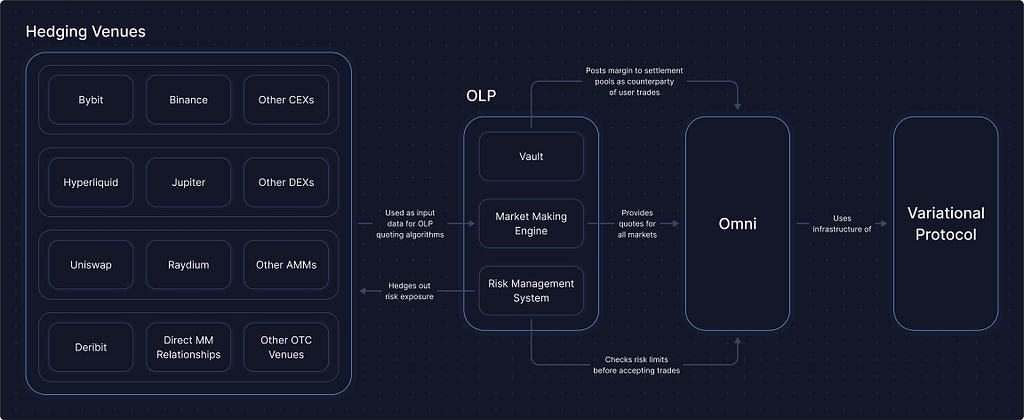
Choosing the Best Cryptocurrency Exchange Development Company: Why ITIO.in Leads the Way

Cryptocurrency exchanges are the backbone of the digital asset economy. They enable users to buy, sell, and trade cryptocurrencies securely while supporting liquidity, price discovery, and market growth.

As the crypto market continues to mature, businesses entering this space or scaling existing platforms must make one critical decision early on:

Choosing the right cryptocurrency exchange development company.

Image is created by ChatGPT

The wrong partner can lead to security gaps, scalability issues, regulatory trouble, and delayed launches. The right one accelerates time-to-market, ensures compliance, and builds long-term competitive advantage.

This guide explores what to look for in a crypto exchange development company and why ITIO Innovex is a preferred choice for businesses worldwide.

Understanding Cryptocurrency Exchange Development Services

Cryptocurrency exchange development services involve building, customizing, and deploying secure platforms that allow users to trade digital assets efficiently.

These services typically include:

Core Features of Cryptocurrency Exchange Development

1. Scalable Platform Architecture

A well-designed exchange must handle high transaction volumes while maintaining performance, uptime, and data integrity. Scalability is critical for future growth.

2. User Interface (UI) & User Experience (UX)

An intuitive, trader-friendly interface improves adoption, reduces friction, and enhances retention especially for first-time users.

3. High-Performance Trading Engine

The trading engine is the heart of the exchange. It must support:

  • Fast order matching
  • Multiple order types
  • Real-time price updates
  • High concurrency

Security & Compliance: Non-Negotiables in Crypto Exchange Development

1. Advanced Security Measures

A reliable exchange integrates:

  • Multi-factor authentication (MFA)
  • End-to-end encryption
  • Cold and hot wallet architecture
  • DDoS protection and monitoring

2. Regulatory Compliance

Adherence to global standards such as:

  • AML (Anti-Money Laundering)
  • KYC (Know Your Customer)

is essential for legal operation and long-term trust.

🔔 Thinking of Launching a Crypto Exchange? Pause Here

Before investing heavily, a short technical review can save months of rework and costly mistakes.

👉 DM us directly or book a free consultation with ITIO Innovex
🌐 https://itio.in/
📩 Message us on LinkedIn or request a callback

https://cal.com/alok01/30min

No sales pressure- just clarity.

Additional Cryptocurrency Exchange Development Services

  • Wallet Integration: Secure hot and cold wallet implementation
  • API Integration: Liquidity providers, algorithmic trading, third-party tools
  • Multi-Currency & Multi-Pair Support
  • Admin Dashboards & Risk Management Tools

How to Choose the Best Cryptocurrency Exchange Development Company

When evaluating development partners, consider the following critical factors:

Industry Experience & Reputation

Choose a company with a proven track record in blockchain and crypto exchange development, backed by real-world deployments.

Customization & Scalability

Your exchange should evolve with market demands. A flexible architecture enables feature expansion and regional adaptation.

Security & Compliance Focus

Security breaches can destroy trust overnight. Your development partner must prioritize security and regulatory readiness from day one.

Technology Stack & Features

Ensure access to:

  • High-performance trading engines
  • Liquidity management solutions
  • Support for multiple cryptocurrencies and networks

Support & Maintenance

24/7 technical support and proactive maintenance are essential for uninterrupted operations.

Why Businesses Choose ITIO for Cryptocurrency Exchange Development

ITIO Innovex stands out as a trusted cryptocurrency exchange development company delivering secure, scalable, and fully customized solutions.

Proven Expertise

With deep experience in blockchain and fintech, ITIO has delivered exchange platforms across diverse business models and global markets.

Customization & Innovation

Every exchange is tailored to your branding, workflows, and growth strategy no rigid templates, no limitations.

Enterprise-Grade Security & Compliance

ITIO integrates advanced encryption, secure wallet systems, and AML/KYC compliance to protect user funds and platform integrity.

Global Reach & Market Readiness

Support for:

  • Multi-currency trading
  • Global payment systems
  • Region-specific compliance requirements

End-to-End Technical Support

From ideation to deployment and ongoing optimization, ITIO’s blockchain experts ensure your exchange operates smoothly and scales confidently.

🚀 Ready to Build or Upgrade Your Crypto Exchange?

Whether you’re launching a new exchange or enhancing an existing one, the right technology partner makes all the difference.

👉 Visit: https://itio.in/
📩 DM us for a quick discussion
📞 Request a callback to explore your exchange strategy

https://cal.com/alok01/30min

Let’s build a secure, scalable, and future-ready crypto trading platform together.

Conclusion

Choosing the best cryptocurrency exchange development company is a strategic decision that directly impacts security, scalability, and long-term success.

By evaluating experience, customization capabilities, compliance readiness, and technical support, businesses can avoid costly missteps. ITIO Innovex delivers all of this making it a reliable partner for cryptocurrency exchange development in today’s fast-evolving digital asset landscape.


Choosing the Best Cryptocurrency Exchange Development Company: Why ITIO.in Leads the Way was originally published in Coinmonks on Medium, where people are continuing the conversation by highlighting and responding to this story.

How to Set Up a Crypto Exchange in 2026

By: lois

Cryptocurrency exchanges continue to be one of the most profitable segments of the digital asset economy. The combination of market maturity, institutional adoption, and regulatory clarity has made exchange platforms viable fintech products for startups, brokerage firms, and enterprise operators.

This guide explains the full process of launching a crypto exchange in 2026— from infrastructure and compliance to liquidity and go-to-market strategy.

1. Define Your Exchange Model

The first step is choosing your platform type. Common models include:

  • Centralized Exchanges (CEX) — spot, margin, futures, leverage
  • P2P Exchanges — peer-matching with escrow
  • OTC Desks — large block trade execution
  • Derivatives Exchanges — perpetuals, options, futures
  • Hybrid Exchanges — on-chain settlement + centralized order matching

Each model influences regulatory scope, liquidity structure, and risk requirements.

2. Choose the Right Development Strategy

There are three primary development routes:

A. Custom Development From Scratch

  • Fully customizable
  • 10–18 months build cycle
  • Highest CAPEX (typically $300K — $1M+)

B. White-Label Exchange Solutions

  • Modular ready-made infrastructure
  • Fraction of the development time
  • Ideal for fast deployment and MVP strategies

C. Pre-Built Exchange Scripts

  • Fastest deployment model
  • Ideal for startups and regional exchanges
  • Lower cost barrier

A good breakdown of how modern exchanges like Binance are engineered is detailed in How to Build a Crypto Exchange Like Binance

3. Core Platform Components

A functional crypto exchange requires several mission-critical layers:

Trading Engine

  • Order matching
  • Order book management
  • Market/limit/stop orders
  • TradingView charting (highly preferred)

Wallet + Custody Layer

  • Multi-asset support (BTC, ETH, USDT, etc.)
  • Hot/cold wallet separation
  • Fiat on/off ramp integration
  • Optional multi-signature custody

Security Protection

Modern security stack includes:

  • DDoS mitigation
  • MFA/2FA authentication
  • Anti-phishing controls
  • Withdrawal whitelisting
  • Custodial signing layers

Compliance & Monitoring

Regulations in 2026 mandate:

  • KYC/KYB onboarding
  • AML/CTF monitoring
  • Travel Rule compliance
  • Risk scoring & sanctions screening

4. Licensing & Jurisdiction Strategy

Crypto licensing remains geography-dependent. Popular operational jurisdictions include:

  • Singapore
  • Lithuania
  • Estonia
  • UAE
  • Malta
  • Hong Kong

Regulators now separate permissions for:
✔ Spot trading
✔ Custody
✔ Derivatives
✔ Brokerage
✔ OTC operations

Early legal consultation is recommended to ensure alignment with regulatory frameworks.

5. Infrastructure & Deployment Architecture

A production-grade exchange architecture typically includes:

  • Web + Mobile Frontend
  • High-performance Matching Engine
  • Wallet & Custodial Layer
  • Compliance Admin Console
  • Liquidity Routing Layer
  • Database + Cloud Stack
  • Monitoring & Security Layer
  • APIs for institutions & partners

AWS, Google Cloud, and bare-metal environments are standard depending on latency requirements.

6. Liquidity Acquisition Strategy

Liquidity is essential for trader confidence. Primary approaches include:

✔ Market maker partnerships
✔ Aggregated liquidity providers
✔ Shared order book feeds
✔ OTC liquidity pools
✔ Institutional routing APIs

Liquidity directly affects spreads, slippage, and execution quality.

7. Audit, Testing & Certification

Before production deployment, mandatory testing phases include:

  • Functional testing
  • Load & stress simulations
  • Wallet audit + reconciliation checks
  • Latency and throughput benchmarking
  • Regulatory compliance simulations
  • Security & penetration testing

Smart contracts (if included) require independent code audits.

8. Launch Strategy & Market Expansion

After technical launch comes adoption. Common go-to-market channels include:

  • Referral & affiliate programs
  • KOL + influencer activation
  • Educational campaigns
  • Token listings & market incentives
  • Regional institutional onboarding
  • Community management & multilingual support

Sustainable exchanges focus on both liquidity growth and user trust.

9. Cost Structure (2026 Estimates)

Cost varies by build strategy, licensing region, and technical scope.

Category

Estimated Range

White-label/software deployment

$25K — $120K

Full custom build

$300K — $1M+

Compliance & licensing

$30K — $500K+

Liquidity services

$10K — $80K/month

Infrastructure

$5K — $30K/month

Marketing

Variable

A deeper analysis is available in Cost to Build a Crypto Exchange Platform

Final Perspective

Building a crypto exchange in 2026 requires mastery across:

✔ Fintech architecture
✔ Regulatory compliance
✔ Security engineering
✔ Liquidity provisioning
✔ Market strategy

For organizations seeking reduced time-to-market, modern Cryptocurrency Exchange Script solutions provide pre-built trading engines, compliance modules, wallet systems, and operator dashboards.


How to Set Up a Crypto Exchange in 2026 was originally published in Coinmonks on Medium, where people are continuing the conversation by highlighting and responding to this story.
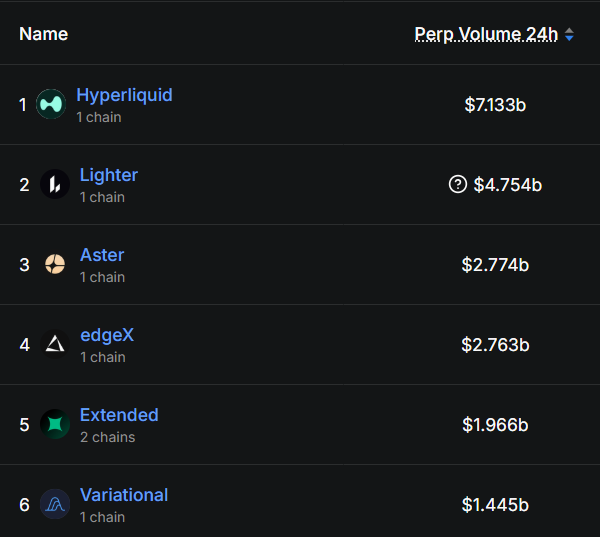
❌