Login
LoginWhat I’d Teach a New 1-Minute Trader About Indicators

If a new trader came to me today and said, “I want to trade the 1-minute chart — what indicators should I use?” I wouldn’t open a chart. I…

If a new trader came to me today and said, “I want to trade the 1-minute chart — what indicators should I use?” I wouldn’t open a chart. I…

The integration of USD liquidity with Ledn's Bitcoin-collateralized infrastructure establishes a transparent, verifiable foundation for…

One wrong choice between spot and perpetual trading can silently drain your capital — especially on a high-performance platform like Hyperliquid.
Hyperliquid has rapidly emerged as one of the most talked-about decentralized trading platforms in crypto. With lightning-fast execution, deep liquidity, and a fully on-chain order book, it attracts everyone from casual traders to highly leveraged professionals.
But here’s the uncomfortable truth most guides don’t tell you:
In this guide, you’ll learn exactly how spot trading and perpetual trading work on Hyperliquid, how they differ, and most importantly, which one aligns with your goals, capital structure, and psychology as a trader.
Whether you’re a long-term crypto holder, an active DeFi participant, or an advanced derivatives trader, this article will help you make smarter, safer, and more profitable decisions on Hyperliquid.
Hyperliquid is a decentralized exchange (DEX) optimized for high-performance spot and perpetual futures trading, built with a custom Layer-1 blockchain designed specifically for trading.
Unlike many DeFi platforms that rely on AMMs (automated market makers), Hyperliquid uses a fully on-chain central limit order book (CLOB) — similar to Binance or OKX, but decentralized.
This hybrid design makes Hyperliquid uniquely powerful — but also more complex than typical DeFi platforms.
Understanding spot vs perpetual trading is critical before using it seriously.
Are you servicing a high-interest debt or want better savings?
Private credit is becoming the new income solution. Get $300 on first deposit with Insidefinacent.
Spot trading means buying or selling an asset for immediate settlement at the current market price.
When you buy ETH on the spot market:
On Hyperliquid’s spot market:
If you:
Your profit is simply:
($3,000 — $2,500) × ETH amount
No funding rates. No margin calls. No forced liquidation.
Spot trading is often underestimated — especially in a derivatives-driven market.
Your position cannot be forcibly closed due to volatility.
This makes spot trading ideal for:
You actually own the underlying crypto, which means:
Your maximum loss is limited to your initial investment.
No leverage = no surprise margin calls.
Spot trading excels during:
Despite its safety, spot trading has limitations.
Without leverage:
You cannot profit from falling prices unless:
Capital tied in spot positions can’t be redeployed quickly for short-term trades.
Perpetual contracts (perps) are derivative instruments that track the price of an asset without expiration.
You do NOT own the underlying asset.
Instead, you:
Hyperliquid’s perpetual markets allow:
You:
If ETH rises 5%:
If ETH drops ~10%:
Perps allow:
You can profit from:
This is critical for professional traders.
Hyperliquid’s order book provides:
Perpetuals support:
Perpetual trading is not forgiving.
Small price movements can wipe out positions.
Most retail traders lose money due to:
Holding perps long-term can:
Perps amplify:
This is why many traders underperform despite good analysis.
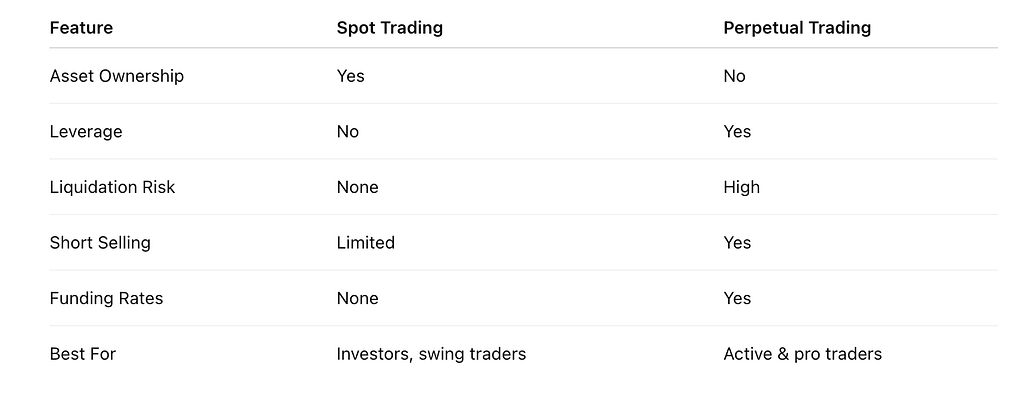
Choose Spot Trading If:
Choose Perpetual Trading If:
Professional traders often use both.
This approach:
This is how professionals trade. Combining spot and perpetuals isn’t advanced — it’s essential.
If this strategy changed how you think about trading, clap to help it reach more serious traders.
Avoiding these mistakes alone can dramatically improve performance.
Hyperliquid’s non-custodial design reduces:
However:
The platform isn’t dangerous — poor risk management is.
Hyperliquid is one of the most powerful decentralized trading platforms available today. But power cuts both ways.
Understanding the difference is not optional — it’s essential.
The traders who thrive on Hyperliquid aren’t the most aggressive. They’re the ones who choose the right tool for the right market condition.
The difference between surviving and thriving isn’t luck — it’s structure.
Your capital deserves better decisions.
Spot vs Perpetual Trading on Hyperliquid: What Every Trader Must Understand was originally published in Coinmonks on Medium, where people are continuing the conversation by highlighting and responding to this story.

When I picked up Quiet by Susan Cain, I honestly didn’t expect it to shake me the way it did. I thought it would be another self-help kind…

The ride-hailing industry is one of the fastest-growing segments in the global transportation market. With increasing smartphone usage, digital payments, and demand for on-demand mobility services, taxi business owners are rapidly shifting toward app-based platforms. In this competitive environment, nearly 80% of ride-hailing startups choose an Uber Clone Script to launch and scale their taxi businesses efficiently. This approach allows entrepreneurs to stay aligned with current market trends while minimizing operational challenges.
The global taxi and ride-hailing market continues to expand at a steady pace. Industry research shows that the ride-hailing market is expected to cross 220 billion dollars by 2028, driven by urbanization and the growing preference for app-based transportation. Today, a large percentage of commuters rely on mobile apps to book taxis due to convenience, transparent pricing, and safety features.
Another major trend shaping the taxi business is the demand for multi-service mobility. Customers now expect platforms that offer bike taxis, auto rickshaws, standard cabs, luxury vehicles, and electric vehicle options within a single app. Additionally, features such as real-time tracking, contactless payments, and driver verification have become standard expectations. Taxi businesses that fail to adapt to these trends risk losing market share to tech-enabled competitors.
An Uber Clone Script is a ready-made ride-hailing software solution designed to replicate the core functionality of popular taxi booking apps like Uber. It typically includes a passenger app for booking rides, a driver app for accepting trips and managing earnings, and an admin panel for controlling operations. The script can be customized to match the branding, pricing strategy, and operational needs of a taxi business.
For startups and existing taxi owners, an Uber Clone Script offers a practical way to enter the digital mobility space without building complex technology from scratch.
One of the key reasons ride-hailing startups prefer Uber Clone Scripts is cost efficiency. In the current market, managing investment and maximizing returns is critical. Custom development of a taxi booking app requires significant capital, long development cycles, and ongoing maintenance. Uber Clone Scripts significantly reduce these costs while offering a stable and tested platform.
Another major factor is the ability to meet modern customer expectations. Uber clone platforms are designed to deliver essential features such as live GPS tracking, accurate fare calculation, multiple payment options, and enhanced safety tools. These features help taxi businesses build trust and improve customer retention.
The proven business model embedded in Uber Clone Scripts is another advantage. The driver-passenger matching system, commission-based revenue model, and trip management workflows have already been validated across global markets. This reduces business risks and allows startups to focus on growth rather than experimentation.
Today’s taxi businesses need flexibility and scalability to succeed. Uber Clone Scripts support multiple vehicle categories, allowing taxi owners to expand their services without additional platforms. Whether it is bike taxis for short-distance travel or electric vehicles for eco-conscious users, a single Uber clone platform can handle diverse mobility needs.
Scalability is equally important in the ride-hailing industry. As demand grows, taxi businesses must onboard more drivers, add vehicles, and expand into new locations. Uber Clone Scripts are built with scalable architecture that supports multi-city and multi-region operations while maintaining centralized control through an admin dashboard.
A powerful Uber Clone Script plays a critical role in strengthening taxi business operations by offering advanced, market-ready features. These features are designed to enhance customer experience, improve driver efficiency, and give business owners full operational control.
Passenger-focused features include:
Driver-oriented features help improve productivity and retention:
Admin and business management features ensure smooth operations:
These features collectively help taxi businesses streamline operations, improve customer satisfaction, retain drivers, and maximize overall profitability in a competitive ride-hailing market.
The reason why 80% of ride-hailing startups choose Uber Clone Scripts is clear — they offer a cost-effective, scalable, and market-ready solution for today’s competitive taxi industry. For taxi business owners looking to build or expand a digital ride-hailing platform, choosing the right technology partner is crucial.
SpotnRides Uber Clone Script is designed specifically to meet current ride-hailing market demands. With a fully customizable white-label solution, advanced features, multi-service mobility support, and scalable infrastructure, SpotnRides helps taxi businesses launch and grow with confidence. By leveraging SpotnRides Uber Clone Script, entrepreneurs can build a future-ready ride-hailing platform that delivers strong performance, customer satisfaction, and long-term business growth.
Why 80% of Ride-Hailing Startups Go for Uber Clone Script was originally published in Coinmonks on Medium, where people are continuing the conversation by highlighting and responding to this story.
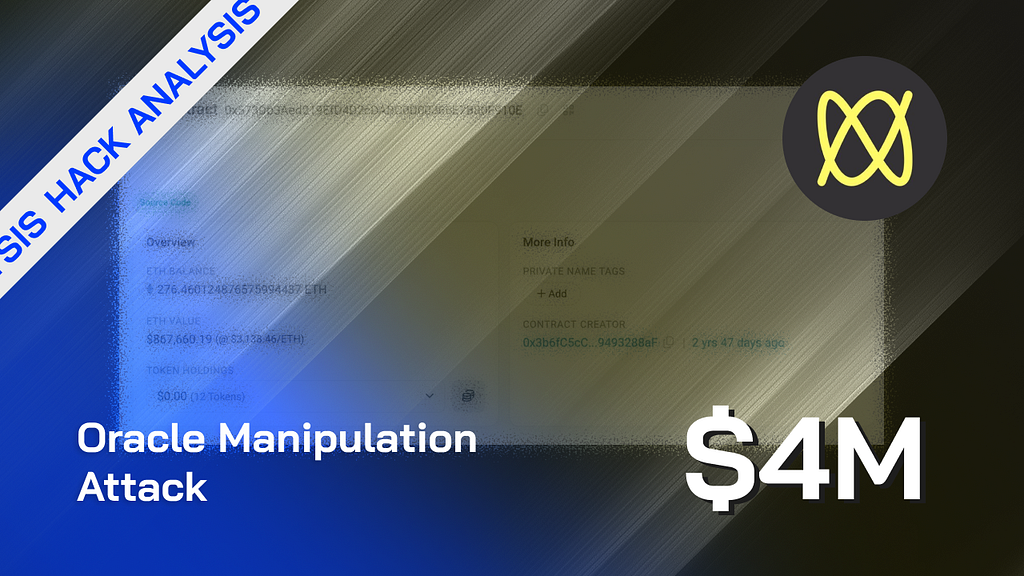
On January 20, 2026, the Makina DeFi protocol — an execution engine for on-chain yield and asset management — suffered a ~$4 million exploit targeting its Dialectic USD (DUSD)/USDC Curve stableswap pool. The attack stemmed from oracle manipulation via external Curve Finance integrations, where unvalidated pool data was used to calculate assets under management (AUM) and sharePrice.
By leveraging flash loans, the attacker artificially inflated AUM values, manipulated sharePrice calculations, and extracted profit in a single transaction. While the exploit impacted only the DUSD/USDC pool, it highlighted a broader and recurring DeFi risk: over-reliance on external liquidity data without adequate safeguards.
The attacker executed a carefully orchestrated multi-step attack using large flash loans sourced from Morpho and Aave V2. These borrowed funds were temporarily injected into multiple Curve pools to distort liquidity balances and pricing assumptions.
First, the attacker added liquidity to Makina’s DUSD/USDC pool and swapped USDC for DUSD, positioning themselves to benefit from price manipulation. They then added substantial liquidity to Curve’s DAI/USDC/USDT and MIM-related pools, receiving LP tokens that were later partially withdrawn to skew pool balances.
These manipulated balances were critical. Makina’s Caliber contract relied on external Curve functions — such as calc_withdraw_one_coin() and pool balance readings—to compute positional AUM. With liquidity temporarily inflated, these calculations produced artificially high values.
Once the attacker called accountForPosition(), the inflated external data propagated through Makina’s accounting system. The protocol’s total AUM jumped significantly, pushing the sharePrice from ~1.01 to ~1.33 within the same transaction.
With the sharePrice distorted, the attacker arbitraged the DUSD/USDC pool, withdrew liquidity, and repeated the cycle until the pool’s USDC reserves were largely drained. After unwinding the flash loans, the attacker converted the stolen funds to ETH and transferred ~1,299 ETH to external addresses.
Notably, part of the transaction was front-run by an MEV bot, which captured a portion of the profit — further illustrating how composability amplifies loss surfaces during exploits.
At its core, the vulnerability lay in Makina’s trust assumptions. External pool data was treated as reliable input for critical accounting logic, without sufficient sanity checks, rate limits, or flash-loan resistance. The use of upgradeable contracts and the absence of time-weighted or delayed AUM calculations compounded the issue.
This exploit reinforces a key DeFi lesson: external data should inform systems — not directly dictate their financial state.
Notably, many of the largest DeFi exploits in 2025 followed similar patterns, where untrusted external data and integration assumptions were repeatedly abused at scale. These recurring failure modes are analyzed in depth in our Web3 2025 Hack Report, which examines how such vulnerabilities continue to dominate real-world attacks.
This summary covers only the high-level mechanics and lessons from the Makina exploit.
If you want a step-by-step transaction flow, detailed root-cause analysis, and mitigation insights, check out our full deep dive: Makina’s $4M Exploit
Following the attack, Makina paused protocol operations, advised LPs on withdrawal options, and coordinated with multiple security firms for investigation and recovery. A 10% whitehat bounty was offered to the exploiter, though no funds had been returned at the time of writing.
Makina’s $4M Hack due to Oracle Manipulation was originally published in Coinmonks on Medium, where people are continuing the conversation by highlighting and responding to this story.
Cryptocurrency exchanges are the backbone of the digital asset economy. They enable users to buy, sell, and trade cryptocurrencies securely while supporting liquidity, price discovery, and market growth.
As the crypto market continues to mature, businesses entering this space or scaling existing platforms must make one critical decision early on:
Choosing the right cryptocurrency exchange development company.

The wrong partner can lead to security gaps, scalability issues, regulatory trouble, and delayed launches. The right one accelerates time-to-market, ensures compliance, and builds long-term competitive advantage.
This guide explores what to look for in a crypto exchange development company and why ITIO Innovex is a preferred choice for businesses worldwide.
Cryptocurrency exchange development services involve building, customizing, and deploying secure platforms that allow users to trade digital assets efficiently.
These services typically include:
A well-designed exchange must handle high transaction volumes while maintaining performance, uptime, and data integrity. Scalability is critical for future growth.
An intuitive, trader-friendly interface improves adoption, reduces friction, and enhances retention especially for first-time users.
The trading engine is the heart of the exchange. It must support:
A reliable exchange integrates:
Adherence to global standards such as:
is essential for legal operation and long-term trust.
Before investing heavily, a short technical review can save months of rework and costly mistakes.
👉 DM us directly or book a free consultation with ITIO Innovex
🌐 https://itio.in/
📩 Message us on LinkedIn or request a callback
No sales pressure- just clarity.
When evaluating development partners, consider the following critical factors:
Choose a company with a proven track record in blockchain and crypto exchange development, backed by real-world deployments.
Your exchange should evolve with market demands. A flexible architecture enables feature expansion and regional adaptation.
Security breaches can destroy trust overnight. Your development partner must prioritize security and regulatory readiness from day one.
Ensure access to:
24/7 technical support and proactive maintenance are essential for uninterrupted operations.
ITIO Innovex stands out as a trusted cryptocurrency exchange development company delivering secure, scalable, and fully customized solutions.
With deep experience in blockchain and fintech, ITIO has delivered exchange platforms across diverse business models and global markets.
Every exchange is tailored to your branding, workflows, and growth strategy no rigid templates, no limitations.
ITIO integrates advanced encryption, secure wallet systems, and AML/KYC compliance to protect user funds and platform integrity.
Support for:
From ideation to deployment and ongoing optimization, ITIO’s blockchain experts ensure your exchange operates smoothly and scales confidently.
Whether you’re launching a new exchange or enhancing an existing one, the right technology partner makes all the difference.
👉 Visit: https://itio.in/
📩 DM us for a quick discussion
📞 Request a callback to explore your exchange strategy
Let’s build a secure, scalable, and future-ready crypto trading platform together.
Choosing the best cryptocurrency exchange development company is a strategic decision that directly impacts security, scalability, and long-term success.
By evaluating experience, customization capabilities, compliance readiness, and technical support, businesses can avoid costly missteps. ITIO Innovex delivers all of this making it a reliable partner for cryptocurrency exchange development in today’s fast-evolving digital asset landscape.
Choosing the Best Cryptocurrency Exchange Development Company: Why ITIO.in Leads the Way was originally published in Coinmonks on Medium, where people are continuing the conversation by highlighting and responding to this story.

Cryptocurrency exchanges continue to be one of the most profitable segments of the digital asset economy. The combination of market maturity, institutional adoption, and regulatory clarity has made exchange platforms viable fintech products for startups, brokerage firms, and enterprise operators.
This guide explains the full process of launching a crypto exchange in 2026 — from infrastructure and compliance to liquidity and go-to-market strategy.
The first step is choosing your platform type. Common models include:
Each model influences regulatory scope, liquidity structure, and risk requirements.
There are three primary development routes:
A good breakdown of how modern exchanges like Binance are engineered is detailed in How to Build a Crypto Exchange Like Binance
A functional crypto exchange requires several mission-critical layers:
Modern security stack includes:
Regulations in 2026 mandate:
Crypto licensing remains geography-dependent. Popular operational jurisdictions include:
Regulators now separate permissions for:
✔ Spot trading
✔ Custody
✔ Derivatives
✔ Brokerage
✔ OTC operations
Early legal consultation is recommended to ensure alignment with regulatory frameworks.
A production-grade exchange architecture typically includes:
AWS, Google Cloud, and bare-metal environments are standard depending on latency requirements.
Liquidity is essential for trader confidence. Primary approaches include:
✔ Market maker partnerships
✔ Aggregated liquidity providers
✔ Shared order book feeds
✔ OTC liquidity pools
✔ Institutional routing APIs
Liquidity directly affects spreads, slippage, and execution quality.
Before production deployment, mandatory testing phases include:
Smart contracts (if included) require independent code audits.
After technical launch comes adoption. Common go-to-market channels include:
Sustainable exchanges focus on both liquidity growth and user trust.
Cost varies by build strategy, licensing region, and technical scope.
Category
Estimated Range
White-label/software deployment
$25K — $120K
Full custom build
$300K — $1M+
Compliance & licensing
$30K — $500K+
Liquidity services
$10K — $80K/month
Infrastructure
$5K — $30K/month
Marketing
Variable
A deeper analysis is available in Cost to Build a Crypto Exchange Platform
Building a crypto exchange in 2026 requires mastery across:
✔ Fintech architecture
✔ Regulatory compliance
✔ Security engineering
✔ Liquidity provisioning
✔ Market strategy
For organizations seeking reduced time-to-market, modern Cryptocurrency Exchange Script solutions provide pre-built trading engines, compliance modules, wallet systems, and operator dashboards.
How to Set Up a Crypto Exchange in 2026 was originally published in Coinmonks on Medium, where people are continuing the conversation by highlighting and responding to this story.
Building a P2P exchange is easy earning real user trust is the real challenge. This blog shares simple, practical strategies to attract genuine users, build confidence, and grow a P2P exchange that people actually enjoy using.

The technology may be ready, but real success begins when genuine users start trusting your platform and trading regularly. Attracting real users isn’t about aggressive promotion, it’s about building something people feel comfortable using. When P2P Crypto Exchange Development is approached with empathy and clarity, users don’t just sign up, they stay.
Every successful platform starts with a simple understanding: users don’t care about features as much as they care about outcomes. They want safety, flexibility, and control. When founders focus on solving real user problems instead of copying competitors, the platform naturally stands out. A user first mindset during P2P Crypto Exchange Development helps create an exchange that feels purposeful, not generic.
Trust doesn’t come from promises, it comes from clarity. Users want to understand how trades are protected and what happens if something goes wrong. When transparency is built into the experience, users feel confident enough to act. A calm, reassuring approach to trust during P2P Crypto Exchange Development creates confidence without needing loud messaging.
The first few minutes on your platform decide everything. If users feel confused, they leave without explanation. If things feel simple and intuitive, they explore further. Exchanges that prioritize ease during P2P Crypto Exchange Development reduce friction and make users feel welcome rather than overwhelmed.
Professional doesn’t have to mean complicated. Clear, friendly language builds stronger connections than technical explanations. When users understand what’s happening at every step, they feel respected. Thoughtful communication throughout P2P Crypto Exchange Development turns uncertainty into confidence.
People trust platforms that align with how they already operate. Supporting familiar payment methods and local preferences makes your exchange feel practical and relevant. When real life usability is considered during P2P Crypto Exchange Development, users don’t need to adjust their habits; they simply participate.
Early users are more than sign ups, they are your first believers. When they feel valued, they share their experience organically. A respectful, fair approach during P2P Crypto Exchange Development turns early adopters into long-term supporters who help shape your platform’s reputation.
Not every user arrives ready to trade immediately. Some need time to understand how things work. Simple guidance and patient education help users build confidence at their own pace. When learning is part of P2P Crypto Exchange Development, users feel supported rather than pressured.
Users stay where they feel noticed. Quick responses, visible improvements, and open to feedback create a sense of presence. A platform designed with care during P2P Crypto Exchange Development feels alive, trustworthy, and worth returning to.
Trust grows through repetition. When a platform performs reliable day after day, users relax and trade more freely. Strong foundations in P2P Crypto Exchange Development ensure the exchange grows without losing stability, which is essential for long-term confidence.
Users recognize authenticity. When marketing reflects the actual experience, trust deepens naturally. An honest approach aligned with P2P Crypto Exchange Development creates relationships built on respect, not exaggeration.
Attracting real users to your P2P exchange is a gradual, people driven process. Business owners and startups that succeed focus on trust, simplicity, and genuine value rather than quick wins. When users feel understood and protected, growth follows naturally. Building with intention and care makes all the difference, and partnering with a depend on P2P Crypto Exchange Development Company like Beleaf Technologies can help turn this thoughtful approach into a platform users truly trust and recommend.
What Are the Best Strategies to Attract Real Users to Your P2P Exchange? was originally published in Coinmonks on Medium, where people are continuing the conversation by highlighting and responding to this story.
On January 22, 2026, CoinMarketCap’s most-viewed asset data reveals a market driven more by attention and reassessment than by short-term price strength.
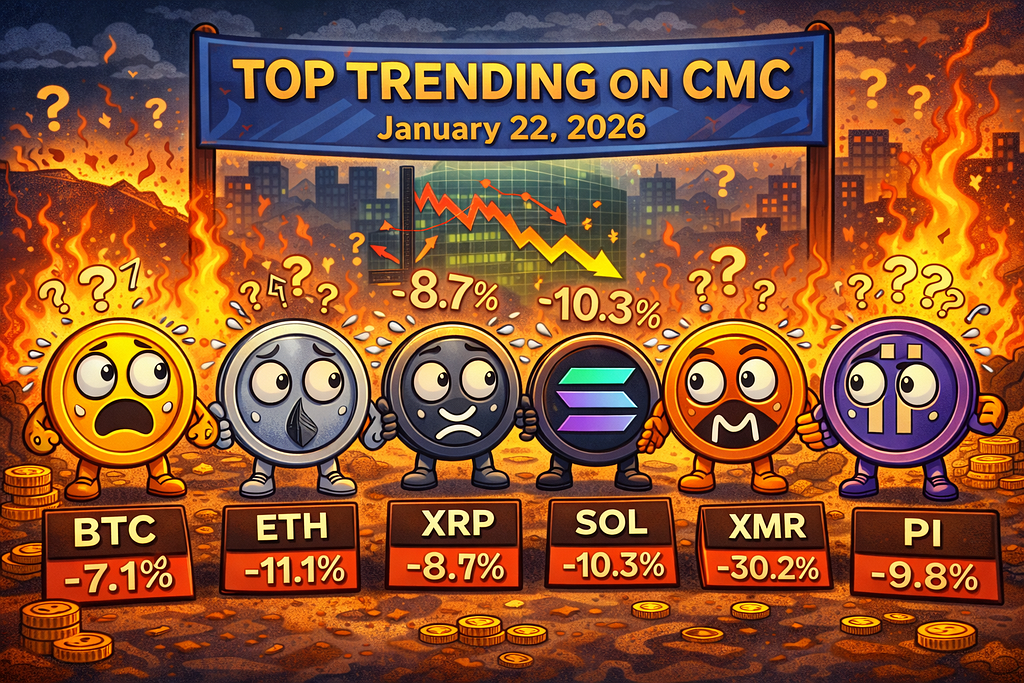
Using CoinMarketCap’s official definition of “most viewed” assets over the last seven days, and filtering strictly to cryptocurrencies ranked within the top 50 by market capitalization, six assets stand out as the most consistently watched by users:
CoinMarketCap’s “most viewed” metric does not indicate bullish momentum or price leadership. It reflects user attention, meaning which assets investors, traders, and researchers are actively monitoring.
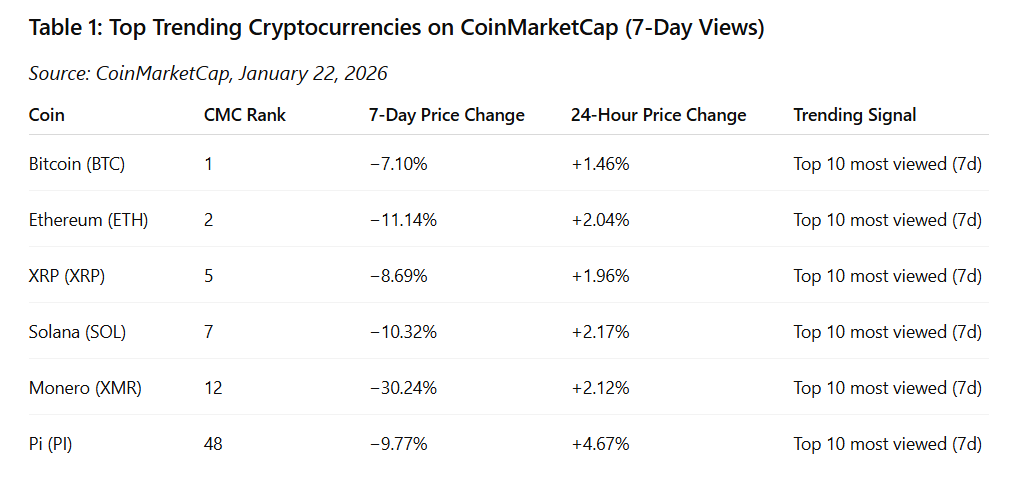
This distinction is critical. Trending, in this context, means high informational demand, not performance. All six assets posted negative seven-day price performance, according to CoinMarketCap price data, while showing mixed or modest positive movement over the last 24 hours. This pattern strongly suggests that users are watching volatility, drawdowns, and narrative shifts rather than chasing gains.
Source for all ranking, pricing, and view-based metrics: CoinMarketCap official asset pages and trending lists https://coinmarketcap.com
One of the most telling aspects of this week’s CoinMarketCap trending data is what it excludes.
There are no micro-caps.
There are no newly launched tokens.
There are no thin-liquidity speculative plays.
Every trending asset sits comfortably inside the top 50 by market capitalization, based on CoinMarketCap’s rankings.
This concentration reflects a broader behavioral shift that typically appears during periods of market stress or uncertainty. When volatility increases and correlations tighten, investors prioritize assets that offer:
Large-cap cryptocurrencies function as information anchors during uncertain periods. Market participants track them to understand sentiment, liquidity conditions, and systemic risk.
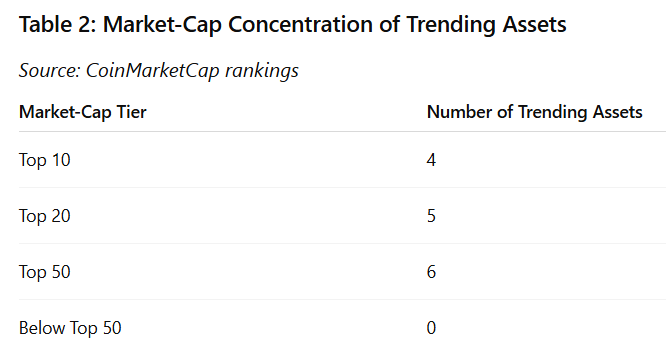
CoinMarketCap’s view data confirms that users are not seeking novelty. They are seeking clarity.
Bitcoin remains the most viewed asset in crypto markets, regardless of short-term price behavior. Its trending status reflects its role as the primary reference point for the entire digital asset ecosystem.
Over the past seven days, Bitcoin experienced a notable pullback, consistent with broader risk-off conditions across global markets. Despite this decline, the modest positive movement over the last 24 hours suggests stabilization rather than renewed momentum.
CoinMarketCap view data indicates that users are closely monitoring Bitcoin not because it is breaking out, but because it anchors:
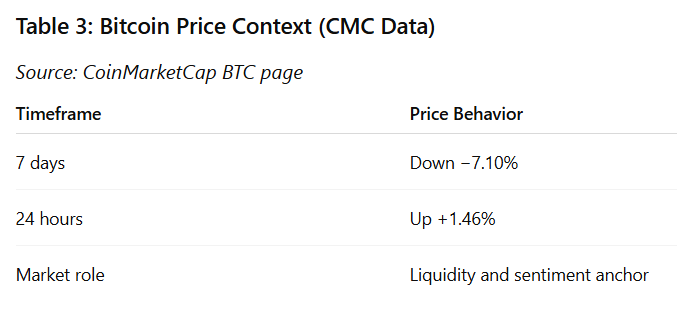
During corrective phases, Bitcoin attracts heightened attention as participants assess whether price action represents temporary volatility or a deeper structural shift. The data suggests monitoring behavior, not speculative chasing.
Ethereum’s sharper seven-day decline relative to Bitcoin helps explain its elevated view count. Larger drawdowns in major assets often trigger deeper analysis rather than immediate exit behavior.
Ethereum occupies a unique position in the crypto market. It combines elements of:
When price declines accelerate, investors reassess these components together. CoinMarketCap’s trending data reflects this reassessment phase.
The positive 24-hour move suggests short-term stabilization, but the weekly decline keeps Ethereum firmly under scrutiny. View activity signals analysis and evaluation, not renewed bullish conviction.
XRP’s presence among the most viewed assets highlights how attention can persist independently of momentum.
Despite underperforming on a seven-day basis, XRP continues to attract interest due to its long-standing role in payment-focused blockchain discussions and its position among the largest crypto assets by market cap.
CoinMarketCap view data suggests that XRP is being monitored as part of broader portfolio reassessment rather than active accumulation. During market drawdowns, investors often revisit assets with distinct use-case narratives to evaluate relative resilience.
The data indicates curiosity and monitoring, not leadership.
Solana’s trending status reflects its reputation as a high-beta large-cap asset. In volatile markets, Solana often experiences larger percentage moves than peers, which naturally increases attention.
The seven-day decline aligns with broader risk-off behavior, while the short-term rebound suggests tactical positioning rather than structural shift.
CoinMarketCap view data implies that traders and investors are closely watching Solana to gauge risk appetite within the crypto ecosystem. High view counts here reflect sensitivity to volatility rather than renewed optimism.
Monero stands apart from the rest of the trending list.
Its seven-day drawdown is materially larger than that of any other asset discussed, yet it remains one of the most viewed cryptocurrencies on CoinMarketCap.
This pattern is typical when a major asset experiences a sharp, atypical move. Investors seek context, not momentum. They want to understand whether the move reflects liquidity pressure, regulatory concerns, or temporary dislocation.
The modest 24-hour recovery suggests stabilization, but the magnitude of the weekly decline keeps Monero under scrutiny. CoinMarketCap view data here reflects reassessment, not speculation.
Pi is the lowest-ranked asset on this list, and that alone explains much of the attention it is receiving.
Assets near ranking thresholds often see elevated views during volatile periods, as investors evaluate whether they will gain or lose relative standing.
The stronger 24-hour rebound compared to peers adds to curiosity, but the negative seven-day performance places Pi firmly within the broader corrective trend.
CoinMarketCap view data suggests monitoring behavior rather than speculative enthusiasm.
Several conclusions emerge clearly from this dataset:
CoinMarketCap’s view metrics provide a valuable lens into investor psychology. Right now, that psychology is cautious, analytical, and defensive.
On January 22, 2026, CoinMarketCap trending data paints a picture of a market in evaluation mode.
Crypto is not being ignored.
It is being examined closely.
When attention rises during drawdowns, it often signals preparation rather than panic. Investors are watching first, deciding later.
Trending refers to assets with the highest number of user views over a given period. It measures attention, not price performance.
No. Trending often increases during volatility or declines, when investors seek information.
During uncertain markets, users prioritize liquidity, longevity, and systemic relevance.
Large drawdowns in major assets typically trigger reassessment and research activity.
No. It reflects interest, not direction.
CoinMarketCap aggregates price, volume, and user engagement data across major exchanges and platforms.
As a sentiment and attention indicator, not a trading signal.
6 Top Trending Cryptos on CMC on January 22, 2026 was originally published in Coinmonks on Medium, where people are continuing the conversation by highlighting and responding to this story.

Trump canceled EU tariffs, stocks soared, but crypto struggles. I analyze what’s next for Bitcoin, Ethereum, and altcoins in 2025.
Bitcoin’s current market behavior has confused even experienced participants. Price swings are sharp. Volatility appears suddenly. Headlines change tone daily. And yet, despite all of this motion, the market struggles to sustain a clean directional trend.

To some observers, this looks like weakness.
To others, it looks like manipulation.
To a smaller and more accurate group, it signals something far more consequential.
This distinction matters. Markets break when demand disappears, liquidity evaporates, or confidence collapses across participant classes. None of those conditions defines the current environment. Instead, Bitcoin is navigating a rare and complex redistribution phase, where large amounts of supply are changing hands between holders with fundamentally different incentives, time horizons, and risk tolerances.
This is not a trader-dominated market. It is a market governed by competing mandates.
At the center of this phase is a tug of war between different categories of Bitcoin whales. Some are deeply profitable long-term holders who accumulated years ago. Others are relatively new entrants, often institutional in nature, whose cost bases sit close to current prices. Their interaction, not news headlines or short-term indicators, is shaping Bitcoin’s price behavior.
Understanding this tug of war is essential for interpreting Bitcoin’s present without falling into narrative traps.
For most of Bitcoin’s history, large holders shared a defining characteristic. They were early.
Early whales accumulated Bitcoin at prices that now feel almost fictional. Many mined or purchased BTC when it traded for tens, hundreds, or low thousands of dollars. Their cost bases granted them extraordinary psychological flexibility. Price volatility, even severe drawdowns, did not threaten their thesis or their solvency.
That era no longer defines Bitcoin’s marginal buyer.
Today, the dominant source of new demand comes from institutional entities. Corporate treasuries, regulated investment vehicles, exchange-traded products, and structured allocators now absorb a growing share of circulating supply. Their decision-making processes differ fundamentally from those of early adopters.
Institutional buyers operate under formal mandates. Capital deployment is governed by committees, risk frameworks, reporting requirements, and fiduciary obligations. These constraints shape behavior in ways that are less emotional but more complex.
Companies like MicroStrategy exemplify this transition. Their approach is explicit and unapologetically long-term. Accumulation is not a trade. It is a balance-sheet strategy. Newer entrants have gone further, openly stating that acquiring Bitcoin at scale is the primary objective, not a side allocation.
The importance of this shift cannot be overstated. Institutional capital does not behave like retail capital. It does not react reflexively to short-term price movements. It operates on conviction, policy alignment, and multi-year horizons.
As this cohort grows, Bitcoin’s market structure evolves with it.
Whales have always influenced Bitcoin. What has changed is which whales matter most at this stage of the cycle.
On-chain data shows that large holders with shorter holding periods now control more supply than long-term holders in the same size bracket. This represents a structural inflection point. Power over marginal price action has shifted toward participants whose exposure is newer and whose cost bases are higher.
These “new whales” differ from the old guard in several critical ways.
First, cost basis proximity.
Many institutional positions were built during periods of elevated prices. Their average entry levels sit closer to current market values, which creates sensitivity. Price fluctuations matter more when unrealized losses or gains sit within reporting thresholds.
Second, accountability.
Institutional holders answer to boards, shareholders, regulators, and investors. Even when conviction remains intact, drawdowns trigger internal review. Risk is not only financial. It is reputational.
Third, heterogeneity.
New whales are not uniform. Some are long-only strategic accumulators. Others are flexible allocators who reassess exposure based on macro conditions, liquidity, or portfolio correlations.
This diversity within the cohort creates internal tension. Some absorb supply aggressively during dips. Others reduce exposure when uncertainty rises. The result is a constant exchange of supply rather than a one-sided flow.
That is the tug of war.
The market is not witnessing mass distribution or unified accumulation. It is experiencing selective selling met by selective buying, often at the same price levels.
Unrealized losses do not directly move markets. Behavior does.
When a large cohort of holders collectively sits on billions in unrealized losses, markets enter a phase of psychological stress testing. Every rally becomes a decision point. Every dip becomes a referendum on conviction.
For some new whales, lower prices represent opportunity. They view volatility as noise within a longer-term thesis. For others, the same price action introduces risk considerations related to capital allocation, portfolio balance, or governance oversight.
This asymmetry creates friction.
Sellers emerge not because belief collapses, but because tolerance differs. Buyers step in not because assets are cheap in absolute terms, but because supply becomes available.
This is why Bitcoin can move violently without establishing trend continuity. Supply rotates rather than exits the system.
Importantly, this behavior diverges sharply from bear market dynamics. In bear markets, demand retreats and liquidity thins. Here, demand remains present. What fluctuates is the willingness to absorb at specific price levels.
This process is slow, uneven, and frustrating. It is also constructive.
It is tempting to interpret range-bound volatility as weakness. That interpretation misreads the underlying mechanics.
True bear markets share three characteristics:
Sustained demand destruction
Forced selling across multiple cohorts
Persistent liquidity withdrawal
None of these dominates the current environment.
Demand remains active, particularly among long-term allocators. Liquidity, while volatile, remains accessible. Forced selling exists, but it is localized rather than systemic.
What we are witnessing is redistribution, not abandonment.
Markets often confuse discomfort with danger. This phase is uncomfortable because it resists simple narratives. It does not reward trend chasing or blind conviction. It rewards patience and structural understanding.
Macroeconomic and geopolitical developments continue to influence Bitcoin’s short-term price movements. Tariff threats, rate expectations, and policy signaling inject volatility into all risk assets.
But volatility is not structure.
Macro events explain why price moves on a given day. Whale dynamics explain why the price struggles to trend over weeks and months.
When strategic buyers absorb dips while pressured sellers distribute into strength, the price oscillates. News becomes a catalyst rather than a driver.
This distinction prevents overreaction. It keeps focus on the deeper forces shaping the market rather than the surface-level triggers.
Bitcoin’s recent price behavior follows a recurring pattern. Sharp declines trigger liquidations. Prices rebound quickly. Momentum fades. The market stalls.
This pattern reflects leverage reset rather than value discovery.
Liquidations remove excess positioning. Absorption stabilizes price. The absence of new marginal demand caps upside. The cycle repeats.
Each iteration transfers coins from weaker conviction to stronger hands. Over time, this reduces fragility. But the process is nonlinear and uneven.
Volatility without follow-through is not failure. It is digestion.
Search data offers a revealing lens into investor psychology.
Interest has shifted away from speculative targets toward explanatory queries. Participants are asking why Bitcoin behaves this way, who is selling, and whether whales control the market.
This indicates a transition from belief-driven engagement to interpretation-driven engagement.
Historically, such phases precede resolution. Not immediately, but eventually. Markets pause to reassess before committing to the next directional move.
In this scenario, pressured sellers finish distributing. Strategic buyers consolidate supply. Volatility compresses. Price stabilizes before regaining directional bias.
This outcome favors patience.
If price revisits lower levels, some new whales reduce exposure. Stronger hands absorb at scale. Ownership concentrates further.
This outcome favors discipline.
A major policy or liquidity shock overwhelms internal dynamics. Correlations spike. Structure reasserts itself after the shock passes.
This outcome favors resilience.
None of these scenarios implies collapse.
This market does not reward speed. It rewards understanding.
Investors should focus on:
Cost-basis distribution
Liquidity sensitivity
Time-horizon alignment
Exposure sizing
This is not a moment to chase narratives. It is a moment to respect structure.
Bitcoin’s current market is not directionless. It is deliberate.
It reflects a tug of war between old conviction and new capital, between strategic accumulation and tactical pressure, between time horizons that do not align.
The market is deciding who owns the next cycle’s supply.
That decision will not be made by headlines or predictions.
It will be made through absorption.
And that process is already underway.
1. Why is Bitcoin so volatile right now?
Bitcoin is volatile because large holders with different time horizons are actively exchanging supply. This creates sharp moves without sustained trends. Volatility reflects redistribution, not collapse.
2. Are whales manipulating Bitcoin’s price?
Whales influence price through size, not coordination. The current behavior reflects conflicting incentives rather than deliberate manipulation.
3. Why do rallies fail to continue?
Rallies attract selective distribution from holders managing risk, while absorption prevents collapse. This creates range-bound behavior.
4. Is this a sign of a bear market?
No. Demand remains active and liquidity intact. This phase reflects ownership transfer rather than demand destruction.
5. Why do institutional buyers matter so much now?
Institutions control large capital pools and operate with long-term mandates, altering how supply reacts to price movements.
6. What role do unrealized losses play?
Unrealized losses influence behavior by testing conviction and risk tolerance, especially for accountable institutions.
7. Why doesn’t macro news create lasting trends?
Macro events act as catalysts, but structural supply dynamics determine whether trends persist.
8. Is Bitcoin still scarce if the price is stagnant?
Yes. Scarcity is reflected in contested ownership, not constant price appreciation.
9. What should long-term investors focus on?
Structure, liquidity, cost-basis distribution, and time horizon alignment.
10. How does this phase typically resolve?
Through absorption and consolidation, followed by renewed directional movement once supply stabilizes.
Bitcoin Whales in a Tug of War: What Is Happening in the Crypto Market? was originally published in Coinmonks on Medium, where people are continuing the conversation by highlighting and responding to this story.

The next serious challenge to Ethereum is not speed or fees, but its programming model.

I believe we are entering a pivotal era of convergence in global financial infrastructure. For decades, the correspondent banking system has served as the bedrock of international commerce, providing the necessary trust and regulatory oversight to move trillions of dollars across borders. However, even the most robust systems require modernization to meet the 24/7 demands of today’s digital economy. As I evaluate the landscape in 2026, it is clear that the industry is not moving toward the replacement of traditional banks, but rather a systems phase where legacy strengths are being rewired with digital native speed.
The traditional model of correspondent banking relies on a series of bilateral relationships. A single international wire transfer often passes through multiple intermediary banks. While this structure ensures rigorous compliance and risk management, it inevitably introduces layers of manual reconciliation and settlement windows that are limited by banking hours. This T+3 or T+5 cycle is increasingly being viewed by treasurers as an area where traditional finance and blockchain technology can form a powerful synergy to eliminate capital in transit.
The gap between legacy settlement times and modern expectations is no longer just a technical hurdle: it is a measurable economic opportunity. According to the Bank for International Settlements (BIS), a next generation financial system based on tokenized ledgers can dramatically improve the integrity and accessibility of money. To understand the scale of this opportunity, one must look at the B2B cross border market, which is projected to grow significantly as digital trade accelerates.
I use the term dead liquidity to describe the capital currently held in the suspense accounts of correspondent networks. According to the Financial Stability Board (FSB), progress on global payment speeds remains a priority for the G20. While the target is to have 75% of cross border payments credited within one hour by 2027, the J.P. Morgan 2025 progress review shows that only 33.5% of payments currently reach that target.
In my view, the rise of stablecoins is the market’s response to this need for liquidity mobility. Recent industry reports indicate that B2B stablecoin payment volumes have reached an annualized run rate exceeding 120 billion dollars. This is not a flight away from banking, but a shift toward more efficient rails that banks themselves are beginning to adopt to meet G20 objectives.
One of the most significant advantages of this convergence is what I call Finality Certainty. In traditional correspondent banking, the lack of a unified ledger can sometimes lead to opacity during the settlement process. Stablecoins, particularly those governed by the US GENIUS Act framework, provide on chain visibility and near instant settlement finality.
Because these assets are now recognized by federal legislation as regulated payment instruments, they are increasingly being treated as a true cash equivalent. This allows banks to provide their clients with the best of both worlds: the safety and regulatory protection of a traditional financial institution, combined with the atomic settlement speed of a digital rail. For a corporate treasurer, the ability to see a transaction settle in real time on a public or private ledger is a significant upgrade in risk management and treasury forecasting.
The financial burden of legacy infrastructure has historically been a challenge for mid market companies. A typical international transfer can incur various intermediary fees and currency bid ask spreads. For a business moving 10 million dollars monthly across borders, these overheads can be substantial when calculated across an entire fiscal year.
In 2026, I believe we are seeing an evolution of the middleman. Rather than multiple banks passing the baton as in a relay race, we are moving toward a model where banks act as the regulated gateways to a shared digital ledger. Initiatives like Project Agorá, led by the BIS and seven central banks, are exploring how to integrate tokenized commercial bank deposits with wholesale central bank money. This allows the bank to maintain the customer relationship and compliance oversight while using a more efficient settlement layer to move value instantly.
As I evaluate the competitive landscape for 2026, the benefits of this hybrid approach become undeniable:
I do not believe we will see the total replacement of traditional banks by 2030. Instead, I expect the standard to be programmable treasury, where businesses use traditional rails for local domestic needs but switch to regulated stablecoin rails for international settlement.
This requires a sophisticated bridge: licensed onramp and offramp infrastructure that can handle high volume conversions without compromising compliance. The settlement showdown is not a battle between old and new. It is a collaborative effort to build a more inclusive and efficient global economy. By combining the trust of traditional finance with the efficiency of modern rails, we are finally solving the oldest friction in international trade.
The Settlement Showdown: Why Correspondent Banking and Stablecoins are Converging for Modern Trade was originally published in Coinmonks on Medium, where people are continuing the conversation by highlighting and responding to this story.

Crypto investing in 2026 feels very different from just a few years ago. The wild west phase is largely behind us. The market has matured, institutional money is deeper in the system, and regulations — while still imperfect — are clearer. Infrastructure is stronger, security is better, and data is easier to analyze.
But that also means the easy days of chasing hype and getting lucky on early trends are mostly gone. Today, building a smart crypto portfolio takes structure, patience, and a strong filter for what really matters.
This isn’t financial advice — just a framework I’ve found helpful to navigate an increasingly complex and competitive market.
Back in the earlier market cycles, success was often about being early, moving fast, and catching whatever narrative was flying. You could ride momentum, exit before the crash, and do pretty well.
That game doesn’t work so reliably anymore.
As the market has grown, value creation is shifting toward projects that have real adoption, viable business models, engaged developer ecosystems, and scalable infrastructure. Price action still matters, of course — but fundamentals, execution, and positioning now drive the winners.
Crypto is slowly morphing into something that looks a lot more like venture or infrastructure investing than gambling on memes. The people who succeed now are the ones who treat it that way.
I’ve learned to ignore the noise and focus on a few key signals. My framework for evaluating projects in 2026 boils down to five main dimensions:
This approach keeps me grounded when narratives go wild and helps me stay patient during quieter market phases.
Instead of betting on individual tokens, I think in terms of themes and structural growth areas — sectors that seem destined to matter in the long run.
These are the areas where capital, developers, and usage are converging.
In my experience, risk management — not token selection — is what separates long-term winners from the rest.
A few principles guide how I size and balance positions:
This structure helps me avoid emotional decisions and keeps me liquid when others panic.
Building a crypto portfolio in 2026 is about discipline, not prediction. The best investors now focus less on “what’s next to 10x” and more on where fundamentals are quietly taking hold.
If you treat crypto like a long-term technology play rather than a casino, the opportunities are still massive. But the edge comes from structure, patience, and clarity — not luck.
How are you approaching crypto investing this year? Which sectors or metrics are shaping your thesis?
— Azalea ❤
How to Build a Smart Crypto Portfolio in 2026 was originally published in Coinmonks on Medium, where people are continuing the conversation by highlighting and responding to this story.
It explains how features like secure payment flow, fair pricing, and transparent trade settlements make Kalshi like prediction markets suitable for real-money trading.

Real money trading on prediction market platforms is gaining attention from business owners and startups looking for innovative digital opportunities. Kalshi like prediction markets, in particular, are attracting interest because they combine structured event trading with transparency and user trust.
For entrepreneurs, safety is not just about technology it’s about credibility, user confidence, and long term growth. Understanding how these platforms are designed helps business leaders make informed decisions when entering this space.
Kalshi like prediction market platforms are built around event based trading. Instead of traditional betting, users trade outcomes based on real world events. This approach feels more structured and professional, which is why many startups view it as a serious business model.
From a business perspective, platforms developed using a kalshi clone script are designed with market mechanics that prioritize clarity and transparency. Users can clearly see pricing, probabilities, and settlement rules, which helps create a more trustworthy trading environment.
For startups, safety directly impacts reputation. A secure platform encourages users to trade confidently, which increases engagement and retention. Business owners also benefit from reduced operational risks when the platform architecture is designed with protection in mind.
Using a kalshi clone script allows startups to launch with a proven framework that already includes core safety features. This reduces development errors and helps teams focus on scaling rather than fixing foundational issues.
One of the strongest safety advantages of Kalshi like platforms is their structured architecture. Trades are executed through predefined rules, minimizing ambiguity and user confusion.
A well-developed kalshi clone script supports stable order matching, accurate settlement, and consistent performance. For businesses, this means fewer disputes and smoother platform operations, which is essential when real money is involved.
Transparency plays a major role in how safe a platform feels to users. Clear event descriptions, visible pricing logic, and predictable outcomes help users understand exactly what they are participating in.
From a startup’s viewpoint, transparency reduces friction and builds long term trust. Platforms powered by a kalshi clone script are designed to display data clearly, helping users feel informed and confident while trading.
Real-money trading requires strong systems for managing deposits, trades, and withdrawals. Kalshi-like platforms are structured to handle these processes in an organized and traceable way.
For business owners, launching with a kalshi clone script means starting with a system that supports secure transaction flows. This reassures users and positions the platform as reliable and professional from day one.
Safety is not only technical, it’s also about fairness. Kalshi like prediction markets focus on balanced trading environments where outcomes are clearly defined and resolved.
Startups benefit from using a kalshi clone script because it supports fair pricing mechanisms and reduces the risk of manipulation. This creates a healthier ecosystem where users feel protected and respected.
As platforms grow, maintaining safety becomes more challenging. A strong foundation allows businesses to scale without introducing instability.
A kalshi clone script is built to support growth while maintaining consistent performance. This means startups can expand user bases, add new markets, and increase transaction volumes without sacrificing platform security or reliability.
Kalshi like platforms appeal to users who value clarity and structure. For businesses, this translates into higher quality engagement and stronger brand positioning.
By choosing a kalshi clone script, startups align themselves with a model that supports sustainable growth. The platform feels less like a game and more like a serious trading environment, which attracts a more committed audience.
Trust is earned through consistency and user experience. Clean design, clear rules, and reliable performance all contribute to a sense of safety. Business owners using a kalshi clone script benefit from a professional platform layout that communicates seriousness and reliability. This helps convert first time users into long term participants.
When built with the right technology and mindset, these platforms offer a secure, transparent, and user-friendly environment for real money trading. For business owners and startups, safety is closely tied to trust and long term success. Choosing a proven framework like a kalshi clone script allows companies to launch confidently, attract serious users, and grow sustainably in a profitable market.
How Safe Is Real-Money Trading on Kalshi-Like Prediction Market Platforms? was originally published in Coinmonks on Medium, where people are continuing the conversation by highlighting and responding to this story.
Liquid staking has become a foundational primitive in Proof-of-Stake ecosystems. It allows users to stake assets while retaining liquidity through derivative tokens, removing the need to choose between yield and flexibility. However, most liquid staking systems are still single-chain by design. While users receive a liquid representation of their staked assets, using that liquidity elsewhere often requires manual bridging, fragmented liquidity, and additional trust assumptions.
In a multi-chain ecosystem, this creates friction. Liquidity becomes siloed, and users are forced to actively manage cross-chain exposure rather than letting capital move naturally.
This is the problem space where vUSD on Bifrost is designed to operate.
In this article, we will cover:
Bifrost is designed as a Polkadot parachain, which fundamentally changes how liquid staking assets are issued and utilised.
Instead of creating liquid staking derivatives confined to a single chain, Bifrost introduces voucher tokens (vTokens) as cross-chain financial primitives.
When a user stakes through Bifrost:
Because Bifrost operates as a parachain, these vTokens are designed to move across the Polkadot ecosystem, benefiting from shared security and native cross-chain messaging. Rather than being isolated receipts, vTokens act as portable, yield-bearing collateral. Which naturally leads to the question of how value continues to accumulate once these tokens are in circulation.
Voucher tokens are yield-bearing by design. Staking rewards are continuously reflected in the value of the vToken relative to the underlying asset. Over time:
This embedded yield is a critical property. It ensures that vTokens remain economically active even when they are no longer held in a passive staking position. Because yield continues to accrue, vTokens can safely be reused within DeFi without sacrificing their core purpose.
Once yield-bearing assets become composable, the next requirement is a stable unit of account to unlock more advanced financial use cases.
As DeFi activity grows around voucher tokens, a stable unit of account becomes essential. Stablecoins enable:
Using voucher tokens as collateral for stablecoins allows users to:
Using voucher tokens as collateral for stablecoins allows users to unlock liquidity without exiting staking positions, avoid unnecessary bridging or asset sales, and keep collateral productive while borrowing. This makes over-collateralised stablecoins a natural extension of liquid staking rather than an unrelated financial primitive.
At this point, the design question becomes how borrowing should be structured to preserve safety while leveraging yield-bearing collateral.
Over-collateralised borrowing protocols typically follow one of two models: Maker-style vaults or Liquity-style positions.
Liquity’s design emphasises:
This approach minimises ambiguity and avoids hidden debt dynamics. It is particularly well-suited for yield-bearing collateral, where predictability and transparency are critical. These principles directly inform how vUSD is structured.
vUSD is an over-collateralised stablecoin designed specifically for the Bifrost ecosystem.
Users lock vTokens (such as vDOT) as collateral and mint vUSD based on a predefined collateralization ratio. For example, at a 150% collateral ratio:
Once minted, vUSD can be used across DeFi, swapped, held, or integrated into other protocols while the underlying collateral continues to earn staking rewards. To understand this more concretely, it helps to walk through a simple lifecycle example.
Because minting and burning are explicit actions, the vUSD supply expands and contracts strictly through borrowing and repayment. There is no reflexive supply adjustment or algorithmic minting outside user-driven actions.
This lifecycle also sets the stage for how yield is distributed across the system.
vUSD is yield-backed, not interest-bearing.
Staking yield generated by excess collateral value is shared between:
At the minimum collateralization ratio of 150%:
The yield share for vUSD is defined as:
Yield(vUSD) = vUSD value ÷ (vUSD value + vDOT collateral value)
At minimum collateralization, this results in a 40% yield share.
If collateral prices fall, vUSD’s share is reduced to preserve safety, ensuring yield extraction never weakens collateral backing.
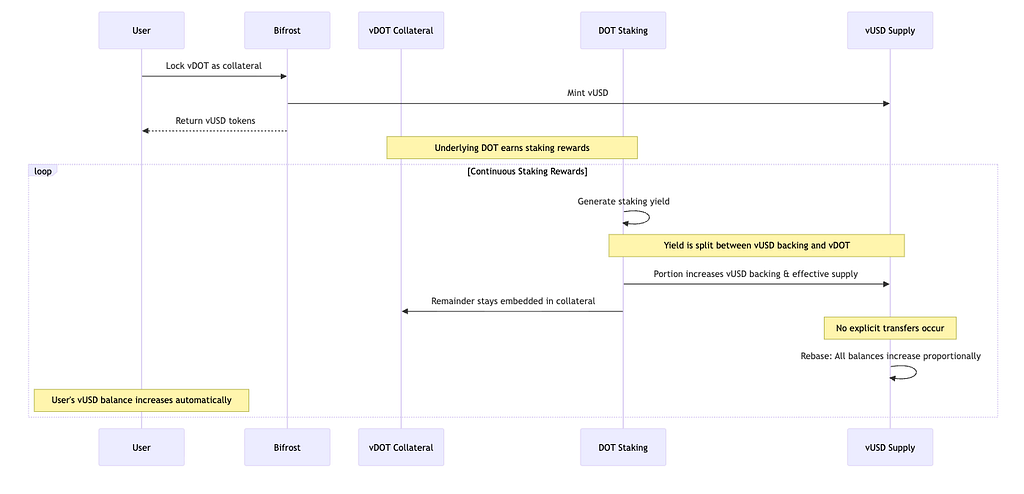
Yield is distributed via rebasing, which increases all vUSD balances proportionally without requiring explicit transfers.
Bifrost’s parachain-native voucher token model enables cross-chain, yield-bearing collateral that remains productive beyond simple staking. vUSD builds on this foundation by introducing a conservative, Liquity-inspired stablecoin designed to unlock stable liquidity while preserving safety and composability.
The current implementation represents a minimal first iteration focused on the core building blocks of the system: voucher-token-backed collateral, explicit borrowing and repayment flows, and a clear over-collateralization model. More advanced components — such as staking yield distribution, liquidation mechanisms, and system-level risk controls — are intentionally not included yet and will be introduced in subsequent iterations.
The full codebase, including the initial contracts, mock voucher tokens, and documented design assumptions, is open-source and available here:
https://github.com/yehia67/vUSD
As the protocol evolves, each major iteration will be accompanied by a follow-up article that documents the new components, design decisions, and trade-offs introduced at that stage. This approach ensures that both the code and the system design evolve transparently, with clear context provided at every step.
vUSD on Bifrost: Building a Stablecoin on Cross-Chain Liquid Staking was originally published in Coinmonks on Medium, where people are continuing the conversation by highlighting and responding to this story.
In [Part I], we dismantled a common assumption: that Web3 payments require a native stablecoin.
We established that InterLink doesn’t “mint” stability through a dollar peg. Instead, it enforces stability through settlement rules, identity verification, and controlled distribution.
Once you accept that premise, a deeper question emerges:
If InterLink isn’t optimizing for price stability through a stablecoin, what exactly are its token numbers optimizing for?
This is where most analyses break down — and where design, not speculation, becomes decisive.

The crypto industry has spent a decade perfecting the art of gambling.
Now, it’s time to start perfecting the art of survival.
Most token supplies are designed backwards — starting from price expectations rather than system behavior.
They collapse into “Price Anxiety,” obsessing over whether a supply is scarce enough to pump or when the next unlock will hit. This is the manufacture of early hype through artificial scarcity.
InterLink does not play the price-first game.
Its numbers are built to withstand time — not to excite markets today.
Here is the inversion most people miss:
Token supply does not set price. It sets access.
InterLink’s dual-token structure is built on this very principle.
These quantities aren’t signals to traders; they are load-bearing limits for human behavior.
Asking if 100 billion ITLG is “too much” misses the point. The real question is:
How many humans, actions, and years must this system absorb without breaking?
ITLG’s supply is intentionally expansive because its role is expansive. ITLG is not “money” in the traditional sense;
it is Proof of Participation.
To achieve global scale, the system must support:
A small supply would create scarcity at the participation layer, immediately giving an advantage to those with capital (gatekeeping).
Instead, InterLink allows ITLG to be abundant before it becomes valuable.
That value is earned later — through verification.
Raw ITLG is easy to earn. Verified ITLG is not.
Between the two sits a sophisticated qualification layer:
Activity ≠ Ownership. Only verified behavior converts participation into on-chain assets.
Supply is abundant.
Value is conditional.
If ITLG is about inclusion, ITL is about trust.
Settlement assets cannot be infinite. A currency that anyone can mint freely isn’t a currency — it’s noise.
Therefore, ITL is: 🚫
Every unit of ITL originates from qualified ITLG activity. It is allocated, not exchanged.
💡 Done.T’s Note
ITL is a defensive outcome — strictly capped at 10% of the total ITLG supply.
It is not designed to flood the market, but to anchor it. Because of this 10% constraint, every unit of ITL is released Slowly. Deliberately. Defensively.
InterLink’s token quantities don’t perform “Scarcity Theater.”
They enforce Role Separation 🔀
Price prediction is the wrong lens.
The real question isn’t how high it goes, but how long it holds.
InterLink’s numbers are defensive by design.
They don’t manufacture scarcity for the sake of a chart; they reserve scarcity for the precise layer where it is required for trust.
Participation is open.
Ownership is earned.
Settlement is protected.
InterLink’s token numbers do not predict price.
They enforce who is allowed to matter — over time.
🔜 Continue to Part III:
🔗 Retail vs. Institutions: Who Actually Holds the Power in InterLink?
About the Author
Done.T is a Web3 analyst specializing in the InterLink ecosystem.
He unpacks the underlying logic of the Human Node economy, translating complex system design into actionable, data-driven insights for a global audience.
Reference
🔗 [Chapter 2. The Deep Dive — Mechanics & Insights]
Disclaimer: This article provides a strategic analysis of InterLink’s publicly available infrastructure and documentation.
It is not financial advice. Readers should conduct their own due diligence.
[InterLink by Design #2] The 100 Billion Question: Why InterLink Built a Filter, Not a Pump was originally published in Coinmonks on Medium, where people are continuing the conversation by highlighting and responding to this story.

Crypto sentiment is worst since 2018. I analyze what happens when markets hit bottom and why the darkest moments signal opportunity ahead.