 Login
LoginScrolls of Giza: The Rise Of The Arma Agent & The $GIZA Awakening

In the shadow of the pyramids, where ancient knowledge meets futuristic code, the Giza Protocol has emerged as a force in the…

In the shadow of the pyramids, where ancient knowledge meets futuristic code, the Giza Protocol has emerged as a force in the…

Market exhaustion in 2025 signals the exact positioning phase where patient investors build generational wealth.
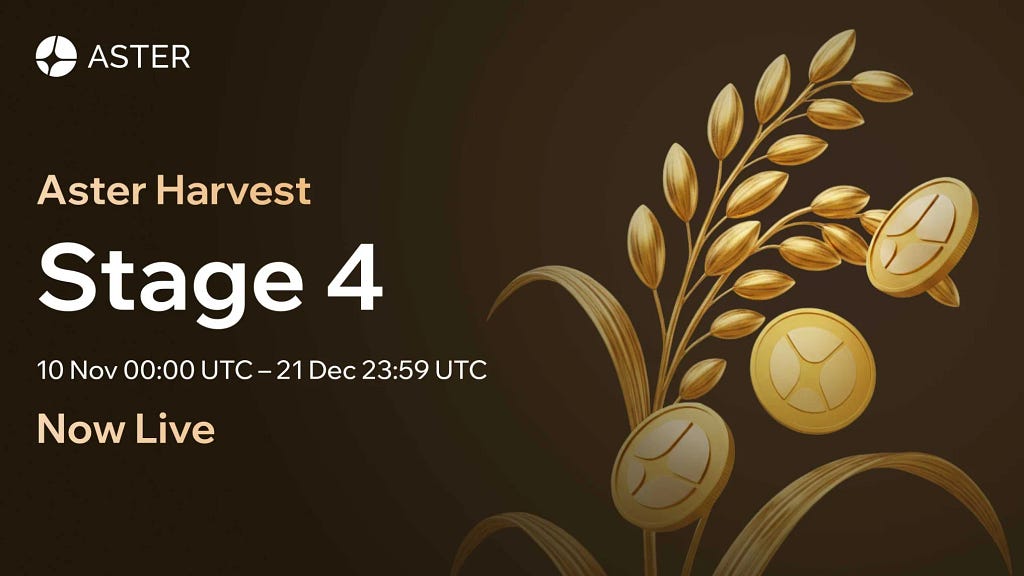
Aster Airdrop Stage 4 has officially launched, bringing fresh opportunities for traders and holders to earn a share of 1.5% of the total $ASTER supply. As the next chapter in Aster DEX’s rewarding ecosystem, this season emphasizes sustainable farming through innovative mechanics like enhanced point calculations and buyback programs. If you’re looking to maximize your Aster DEX airdrop potential, this comprehensive guide covers everything from participation steps to pro-level strategies.
New to AsterDEX? Get 10% Discount On Fees by signing up with referral code “b848d3” at https://www.asterdex.com/en/referral/b848d3 to unlock an instant team boost and amplify your Rh points.
Already a user? Join a high-performing team by heading to Rewards > Points > Inviter Team and entering “b848d3” for shared multipliers up to 1.5x.
Aster DEX is a cutting-edge perpetual decentralized exchange (Perp DEX) designed for seamless trading of futures and spot assets. Backed by industry heavyweights, it stands out for its user-friendly interface, low fees, and massive reward pools. The $ASTER token powers the platform, and its airdrop campaigns have distributed hundreds of millions in value, attracting traders worldwide.
Previous stages have set the bar high, with allocations reaching up to 8% of supply in Stage 1. Now, Aster Airdrop Stage 4, dubbed “Harvest,” focuses on long-term engagement, running from November 10 to December 21, 2025. This six-week season splits rewards across six epochs, offering 0.25% of supply per epoch — totaling around 120 million $ASTER tokens at current valuations.
Before diving into the new season, let’s review Aster Airdrop Stage 3, which wrapped up on November 9, 2025. This phase allocated 2.5% of the total $ASTER supply, equivalent to about 200 million tokens. Rewards were distributed based on Rh points earned through trading activity, holdings, and team contributions.
Key highlights from Stage 3 include:
The airdrop checker for Stage 3 opens on December 1, 2025, with claims starting December 15. If you farmed Stage 3, expect distributions that reflect a shift toward deflationary mechanics, where buybacks increasingly offset new token unlocks.

Aster DEX Season 4 Airdrop introduces “Harvest” mode, building on prior stages with refinements for fairness and sustainability. Here’s what matters most:
Compared to Stage 3, Stage 4 reduces per-epoch rewards to 0.25% but adds holder incentives, making it ideal for strategic farmers aiming for deflationary gains.

Getting started with the Aster DEX Season 4 Airdrop is straightforward. Follow this detailed tutorial to set up and begin farming Rh points:
Pro Tip: Avoid minting USDF directly if speed is key — swap via external DEXs like PancakeSwap for efficiency.
To turn Aster Harvest Stage 4 into a profitable venture, adopt these battle-tested tips drawn from successful farmers:
Remember, while airdrops aren’t guaranteed, consistent effort in Aster DEX airdrop farming has yielded six-figure drops for top participants in past stages.
With 1.5% supply at stake, Aster Airdrop Stage 4 could distribute rewards worth hundreds of millions, depending on token price. Top farmers from Stage 2 reported allocations exceeding $100K, and Stage 4’s deflationary tweaks could enhance post-airdrop value.
As Aster DEX expands, expect more revenue-driven buybacks, potentially leading to net deflation where burns outpace emissions. This positions $ASTER as a strong hold for savvy traders.
The Aster Airdrop Stage 4 is your gateway to earning substantial $ASTER rewards while engaging with a top-tier Perp DEX. By recapping Stage 3’s successes, understanding new features, following the tutorial, and applying these tips, you’ll position yourself for maximum gains. Start trading now — opportunities like this don’t last forever in the fast-paced crypto world.
For the latest updates, bookmark the official Aster docs and stay active on the platform. Happy farming!
Aster Airdrop Stage 4: Guide to Earn $ASTER in Aster DEX Season 4 was originally published in Coinmonks on Medium, where people are continuing the conversation by highlighting and responding to this story.
If the GENIUS Act is the clinical extraction of global liquidity (The Sponge) and the State Reserves are the local lifeboats (The Resistance), then MicroStrategy (MSTR) is something else entirely. It is a sovereign-grade predatory attack on the debt system itself.
Michael Saylor has not just built a company; he has built a “synthetic nation-state” that operates on the NASDAQ. By early 2026, the MSTR blueprint has become the most debated financial architecture in the world. Why? Because Saylor is doing to the US Dollar exactly what the US Dollar is doing to the rest of the world: he is shorting it into oblivion.
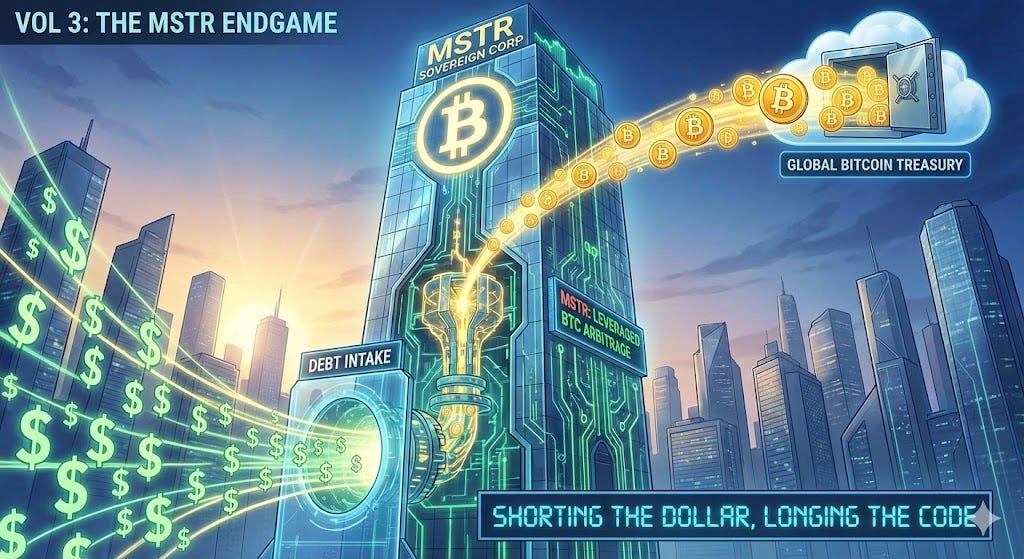
The MSTR model is often called a “flywheel,” but in the context of 2026, it is more accurately described as a Debt-to-Equity Arbitrage Machine.
Saylor’s core insight is that if you believe the $38.4 trillion debt is a mathematical dead end, then the US Dollar is a “melting ice cube.” If you borrow that ice cube at a fixed 1% interest rate and convert it into a “digital diamond” (Bitcoin) that grows at 40% a year, the debt effectively pays for itself.

The Insight: MSTR is “shorting” the dollar by issuing billions in low-interest convertible debt. If the dollar debases, the debt becomes worthless, while the Bitcoin becomes priceless. Saylor is using the very “leaks” in the legacy system to fund his escape from it.
By 2026, the $38.4 trillion debt has made traditional sovereign debt markets “toxic.” Small and mid-sized nations are looking at MSTR and asking: “If a software company in Virginia can outrun the Fed, why can’t we?”
The “El Salvador” Protocol (Version 2.0)
El Salvador was the pioneer, but their approach was “buy-and-hold.” The 2026 Sovereign Blueprint (inspired by MSTR) is more aggressive. It involves Sovereign Debt Recycling:
Issuance: A nation issues “Bitcoin Bonds” (Volcano Bonds).
Conversion: They use the proceeds to buy Bitcoin.
Refinance: As the BTC value rises, they use the “collateral” to refinance their old, high-interest USD debt.
The “State-Led MSTR”
Imagine a state like Texas or Florida. Instead of just holding a reserve, they issue state-level “Infrastructure Bonds” backed not by future taxes, but by a Bitcoin treasury. They are effectively becoming “MicroStrategy: The State.”
In late 2025 and early 2026, a new metric dominates the financial news: mNAV (Modified Net Asset Value). This is the ratio of MSTR’s market cap to its Bitcoin holdings.
The Premium: Investors pay a “premium” to own MSTR because it offers leveraged exposure and intelligent yield.
The Arbitrage: Every time the stock trades at a premium (e.g., 1.5x the value of its BTC), Saylor issues new shares and buys more Bitcoin.
The Epiphany: This is exactly how the US Dollar used to work under the original Bretton Woods. The world paid a “premium” to hold dollars because they were “as good as gold.” Saylor has recreated the gold standard, but he replaced the gold with code and the “Faith and Credit” with “Mathematical Scarcity.”
As MSTR begins to command a meaningful percentage of the Bitcoin supply (surpassing 3.2% of all BTC by late 2025), the legacy system strikes back.
In 2026, we see the rise of “Regulatory Delisting” rumors. Major banks and index providers (like MSCI) begin to argue that MSTR is no longer an “operating company” but an “unregulated investment fund.”
The Defense
MSTR counters by integrating Bitcoin into its Strategy One AI platform, proving that the Bitcoin is not just a “hoard” — it is the “energy” that powers its sovereign-grade data intelligence. This is the Geopolitical Pivot: MSTR is no longer just a company; it is the Digital Intelligence Layer of the Bitcoin network.
The MSTR endgame is not about a stock price. It is about the re-ordering of the global balance sheet.
If the GENIUS Act is the US government trying to save the $38 trillion debt by sucking in global retail liquidity, Michael Saylor is the one building a “Black Hole” in the middle of the Sponge. He is sucking in the very debt that the US is trying to export and converting it into the one thing the US cannot print more of.
The Lingering Thought: In the “Digital Bretton Woods” of 2026, there are only two types of entities: those who are issuing debt to buy Bitcoin, and those who are holding debt while the Bitcoin is bought out from under them. Which one is your pension fund doing?
The Digital Bretton Woods: The Mathematical Inevitability of the Debt-Backed Dollar — Part 3 — The… was originally published in Coinmonks on Medium, where people are continuing the conversation by highlighting and responding to this story.
If the previous volumes established the architecture of the new system — the $38.4 trillion US debt, the “Vampire Sponge” designed to fund it, and the “MSTR Blueprint” for escaping it — this addendum addresses the inevitable next phase: Implementation.
By early 2026, the theoretical frameworks are understood by global finance ministers. The question has shifted from “What is happening?” to “How do we survive it?” The “MicroStrategy model” — borrowing a depreciating currency to acquire a scarce asset — is no longer just a corporate tactic; it is being scrutinized as a potential instrument of national survival.
We are entering the era of the Sovereign Debt-for-Code Swap.

For seventy years, developing nations have been trapped in a cycle of issuing dollar-denominated debt. They borrow strong dollars and have to pay them back with weak local currency, often leading to a “debt spiral” enforced by institutions like the IMF.
The “MSTR Blueprint” offers a radical inversion of this model. In 2026, we are likely to see the issuance of the first true Bitcoin-Backed Sovereign Bonds.
The Geopolitical Insight: This is not just finance; it is a declaration of monetary independence. It transforms a nation from a “renter” of the dollar network into an “owner” of the Bitcoin network.
Nations experiencing chronic high inflation have the least to lose and the most to gain from this strategy. They are already drowning in dollar debt; the “Sponge” is already squeezing them dry.
For a country like Argentina (in this speculative scenario), the Sovereign Bond Reset is a Hail Mary. By issuing a Bitcoin-backed bond, they bypass traditional lenders who demand austerity. They appeal directly to the global capital markets that are hungry for Bitcoin exposure but restricted by mandates.
The dynamic changes for wealthy, energy-rich nations. They do not need the money. For them, the strategy is about Monetizing Energy and Hedging Geopolitical Risk.
These nations realize that selling oil for US Treasury bills (the old “Petrodollar” arrangement) is a losing trade when the Treasury bills are yielding less than real inflation. In 2026, we see the pivot toward the “Petro-Bitcoin” model.
The United States, faced with a $38.4 trillion debt that requires constant global funding, cannot afford to let the “Vampire Sponge” dry up. If sovereign nations stop buying Treasuries and start issuing their own Bitcoin bonds, the US bond market faces a catastrophic liquidity crisis.
Washington’s response in 2026 will likely be clinical and severe:
The Final Conflict: The battle lines of 2026 are drawn between the US Treasury’s need for liquidity and the rest of the world’s need for sovereignty. The Dollar requires obedience; Bitcoin only requires verification.
The “2026 Sovereign Bond Reset” is the moment the world decides whether it wants to remain a passenger on the USS Titanic (the debt-based system) or build its own lifeboat (the collateral-based system).
The strategy is terrifyingly simple: Short the debt, long the code.
The nations that understand this arbitrage will become the new financial powerhouses of the 21st century. Those that cling to the old model, hoping the “Vampire Sponge” will spare them, will find themselves owning nothing but someone else’s unpayable promises.
Lingering Thought: When the music stops and the $38 trillion debt bill comes due, will your nation be holding the empty chair, or the immutable ledger?
The Digital Bretton Woods: The Mathematical Inevitability of the Debt-Backed Dollar — Part 4 —… was originally published in Coinmonks on Medium, where people are continuing the conversation by highlighting and responding to this story.

The cryptocurrency market has boomed in recent years, drawing many businesses and individuals interested in starting cryptocurrency exchanges to enter into this area of business. The method mostly recommended for building such exchanges involves using a Binance Clone app. But why is the majority of the crypto startups attracted to the idea of starting business through Binance clone apps or schemes in developing their crypto exchanges? Here in this article, we will discuss why this is so and what the benefits of having a Binance clone app are in simple terms.
While entering into the discussion around the popularity of Binance clone scripts, it becomes quite important to first understand what they really are. A Binance Clone Script is essentially a ready-made customizable software solution that proposes to emulate the working of Binance, the world’s largest and arguably most popular cryptocurrency exchange.
A contains crucial features that are included in a normal exchange such as user registration, wallet management, trade matching, transaction history, and real-time market charts among other things. It is customizable according to a crypto firm’s business needs. Using a Binance Clone Script, crypto startups can create an entirely functional exchange instead of starting from scratch.
These are some of the most fundamental things that make the Binance Clone Script really appealing for crypto startups. Let us list out such reasons.
1. Cost-Effective Solution
The most attractive option for almost every startup is that building an Exchange with a Binance Clone Script is going to be cheaper compared to building it from scratch. Building a cryptocurrency exchange is a really expensive process. There is so much research, designing, development work, testing, and continuous maintenance. Costs of building an exchange from scratch are such that they are prohibitive for most startups, dishing out only a small amount of startup funds.
A Binance Clone Script, on the other hand, is a ready-made solution that reduces development time and cost by a significant percentage. Since it is a pre-built script, a startup does not need to start from the scratch base. It can work easily onto the already existing framework and customize it according to the specific need. It can make a fortune saving and would be really appealing to entrepreneurs.
2. Shorter Development Time
In the race of ever-changing speed within the world of cryptocurrency, time generally defines all. The earlier you launch your platform, the earlier your users start flocking in to generate revenues. Months or even years could be spent designing your exchange interface with all those complex features such as security, payment gateway integration, and smooth user interface.
A Binance clone script cuts considerable development time and allows startups to introduce their platforms sooner than their competitors. Since much of the work is already done, startups can now bring their platform to market much faster, which in turn allows them to take advantage of this ever-increasing demand for cryptocurrency exchanges.
3. Proven Technology
Binance is counted among the leading cryptocurrency exchanges that have built their reputation on value-based platforms. By using a Binance clone script, crypto startups can utilize proven technology from the Binance platform for this. This literally means that the entire base code has already been tested and optimized for performance and security, thus reducing the chances of technical issues that may arise from developing a new exchange from scratch.
Moreover, it has been made user-friendly. A lot of traders know how it operates, and so with the help of a Binance clone, it will be able to serve such a user experience to them, thus increasing the faithful touches of users at the feeling of actual experience with using its navigating platform.
4. Security Features
Security is the most important aspect of a cryptocurrency exchange. Hacking of such types has been commonplace and, hence, very much important and serious infrastructure should be adopted that keeps the funds and data of users safe. Binance has a reputation for almost irrefutable security with two-factor authentication (2FA), encryption and anti-phishing codes, as well as complete and regular security audits.
Many of those security measures come built in with a . Crypto startups don’t have to waste time creating their security protocols from scratch since the clone script comes with these things. That is one other aspect of this startup that can now focus on while making sure the safety of its users.
5. Customizability
Even though almost all features that Binance was offering are embedded in it, a Binance Clone Script is not an end in itself; it is highly customizable. Startups can have the interior of the application changed to have some important features added, which include custom cryptocurrencies, user interface alteration, and payment gateway integration, among many others.
This makes it very adjustable for crypto startups to set themselves apart from the rest of the exchanges and customize the platform to meet their clients or target audience. Be it through offering very distinct trading pairs or simply coming up with other features.
6. Scalability
You want a platform that can grow with your business as your crypto trading operations expand. As mentioned, millions of users and trades are processed through Binance each day with no sign of a problem, since it is scalability that reaps the benefits. Thus, a Binance Clone Script would inherit this scalability, which means that startups would not have to worry about outgrowing their blueprint.
7. Comprehensive Features
A Binance Clone Script offers all the elements necessary for truly running a cryptocurrency exchange. The more common features incorporated in Binance Clone Apps include
These features help crypto startups create a fully functional platform with minimal effort.
8. Global Reach
Binance is known for its global user base, and the Binance Clone Script allows the startups to establish this global reach. Clone script supports multiple languages and multiple currencies to facilitate the attractiveness of this platform with users belonging to different countries. This is a crucial facet within the cryptocurrency industry, in which the market is genuinely global and anybody can become a user from any corner of the universe.
Conclusion
In conclusion, a offers a cost-effective, reliable, and fast solution for crypto startups looking to enter the cryptocurrency exchange market. With proven technology, robust security features, scalability, and the ability to customize, a Binance Clone App provides everything a startup needs to get started quickly and efficiently. By using a Binance Clone Script, crypto entrepreneurs can focus on growing their business, attracting users, and expanding their offerings, rather than worrying about developing an exchange from scratch. This is why many startups in the cryptocurrency space prefer using a Binance Clone Script to build their platform and kickstart their journey into the world of digital currencies.
Why Do Many Crypto Startups Prefer A Binance Clone Script? was originally published in Coinmonks on Medium, where people are continuing the conversation by highlighting and responding to this story.

In the rapidly growing world of cryptocurrencies, one of the most crucial decisions a business must make is the platform they will use for trading and managing digital assets. While there are several types of exchanges available, a Centralized Crypto Exchange (CEX) stands out as one of the most popular and trusted options for both businesses and individual traders. In this article, we will explore why businesses should consider choosing a Centralized Crypto Exchange Software, Centralized Crypto Exchange App, or Centralized Crypto Exchange Development Services for their operations, and how partnering with a Centralized Crypto Exchange Development Company can benefit their long-term success.
Before delving into why businesses should choose a Centralized Crypto Exchange, let’s briefly define what it is. A Centralized Crypto Exchange (CEX) is a virtual marketplace where the users say that their cryptocurrencies will be traded, with the assistance of a central authority like an organization or a company. Generally, it operates as an intermediary for holding users’ funds and provides a forum for the buying, selling, and trading of digital assets. Some of the centralized exchanges that people are familiar with include Binance, Coinbase, Kraken, and Huobi.
In a CEX, all the transactions go on through the platform, which requires the users to trust the security, operation or any other process related to the platform. This, however, is different when using DEXs, for there, no intermediaries are needed as the users trade coins with one another directly.
High Liquidity
One of the key advantages that Centralized Crypto Exchange offers is high liquidity. Liquidity means the ease with which an asset can be bought or sold in a particular market without resulting in any significant price impact. Due to their large user base and high volume of trade occurring at any given moment, it is fairly easy for a company to execute large transactions in a centralized exchange without facing extreme price changes during transactions. Such high undulating liquidities on the markets ensure smoother and efficient trading for businesses at scale.
Security and Trust
Security is one major question in the developing world of cryptocurrencies. Centralized exchanges spend a lot for the infrastructures they secure with the likes of encryption applications, 2FA, cold storage of funds, and other advanced cybersecurity measures. Businesses using Centralized Crypto Exchange Software or App can access these strict protocols of security, which may help build trust with customers through safe transactions.
Most certainly they would also involve hacking or breach events in their record. But most of these CEXs have a proven professional security team and adhere to the industry’s standard, which gives an additional level of reliability and security that is mostly better than that of decentralized platforms.
Easy Navigation
It is because the user interface (UI) of the centralized exchange is generally friendlier and more appropriate for both novice and expert traders. Therefore, it is a good consideration for the company since employees or customers would also be expected to interact with the platform quite frequently. Whether using the Centralized Crypto Exchange App installed or accessing the exchange via some web-based platform, the exchange of experience will be seamless and may lead to productivity improvements over time.
Have you realized that most centralized exchanges come with customer supports, tutorials, and even help pages? For crypto businesses, these qualities are inherent for almost all the companies; newbies, in particular, would find it easy to understand the whole process compared to decentralized ones where users have to do everything under the sun.
Regulatory Compliance
Mandatory for any business dealing in crypto to adhere to the country laws. Centralized exchanges usually found under regulation and adhered to the financing laws, AML, and KYC. Selecting the company providing Centralized Crypto Exchange development clearly indicates that the business has a healthy platform in compliance with local and international laws.
Companies might easily get a Centralized Crypto Exchange App to help provide legal and compliant exchanges most likely to avoid all future hassles with the law. The other advantage that a company could reap is enhanced competitiveness over others in an environment where there is stringent regulation.
Speedy Transactions
Centralized Crypto Exchange Software can provide fast transactions. If you have an immediate requirement to buy or sell a digital asset, this software will be considered useful to you, unlike decentralized exchanges. They are subject to delay sometimes caused by network congestion or other problems. However, most CEXs come designed with high-speed transaction processing mechanisms.
Fast trades; whether you are in business doing everything related to cryptocurrencies or just doing transactions through the exchange, that instant trade saves so much time and also reduces the operational overhead for your team.
Fiat Involvement
Most strong centralized exchanges do support local currency deposits and withdrawals in order for various businesses to transact with popular fiat currencies. Whether you wish to exchange Bitcoin for US dollars or buy Ether for a few Euros, centralized exchanges keep them floodgated to facilitate easy-to-all fiat-to-crypto exchanges.
This is, therefore, vital for businesses that are trying to engage in cryptocurrency exchange but at the same time, remain in touch with the traditional ways of financial systems. Access to an exchange of fiat currency makes accounting, taxation, and financial reporting relatively easy.
More Advanced Trading Options
In many centralized exchanges, such features are complemented by others that include advanced trading features such as margin trading, futures contracts, and stop-limit orders. Such trading features can be significantly of value to firms looking at advanced trading strategies.
Holding a company in investment or asset management in cryptocurrencies then have this kind of advanced functionality on a Centralized Crypto Exchange would be valuable with respect to making innovative trading strategies available.
Customization Options for Business Use
Allows firms to make their own exchange software when they partnered with Centralized Crypto Exchange Development Company. Companies may opt for particular features, interfaces and functionalities specific to their needs.
Whether going to create this specific Centralized Crypto Exchange App for your customers or a backend trading platform for internal use, this degree of customization guarantees the platform will fit your unique and very specified business model and user base.
You must include white-labeling, payment gateway systems, multi-language support, etc., which will make it further adaptable for a worldwide audience.
Reputation in the Market and Branding
Most businesses prefer to approach this with the best-known Centralized Crypto Exchange Development Services as such still exists a prestige of a certain level into the market as well as branding. Within this, businesses gain credibility with their customers by using such reliable and popular exchange platforms.
With the present well-known exchanges, they have already created a kind of user base as well as the ecosystem that can be shared with businesses. Centralized Crypto Exchange Software whether for your own needs for personal trading or white-labeling for your clients: this existing brand power is used to work on growing the business at a more rapid rate.
Access to Trade Pairs
Centralized exchanges provide businesses with a whole range of trading pairs, allowing them to diversify their cryptocurrency holdings. By using a variety of cryptocurrencies, you help your consumers to have many choices and flexible options, thus enhancing trading volumes.
Whether you are trading Bitcoin (BTC) with Ethereum (ETH), Litecoin (LTC) with USDT, or any other different pairs, all kinds of centralized exchanges have so many pairs for the preferences of businesses and single traders.
Benefits of a Centralized Crypto Exchange Development Company When Trade Companies are interested in a Centralized Crypto Exchange App or Software, it is important to partner with a Centralized Crypto Exchange Development Company. As the name suggests, these have developed fine, secure, and feature-rich exchange platforms which are tailored to your business.
Custom-made Projects:
A development company is able to make a complete customized exchange, which might offer the very special features and functionalities that fit your business model.
Expertise in Security
Whether the use of custom software desktop or mobile apps, a professional company develops applications based on the requirements of the client. They are all prepared to provide exemplary security features to your exchange platform while ensuring that they meet international standards.
Scalability:
Your exchange will require different functions as your business grows. A Centralized Crypto Exchange Development Company has the right infrastructure and required resources to make your platform entirely scalable as regards the increasing transaction volumes and types of users.
Continued Support:
Development companies provide post-launch services for your exchanges to remain operational, secure, and updated in terms of features and regulations.
Conclusion
Choosing a Centralized Crypto Exchange Software, App, or partnering with a Centralized Crypto Exchange Development Company is an excellent option for businesses looking to enter the world of cryptocurrencies or expand their existing operations. Centralized exchanges tend to be much more attractive as offerings like high liquidity and security along with various user-friendly experiences and warranty on regulatory compliance come into picture.
Thus, it makes it possible for companies to develop a platform meeting their requirements with the aid of a reliable Centralized Crypto Exchange Development Service, to make any cryptocurrency trading more smooth, secure, and profitable.
Why Choose a Centralized Crypto Exchange for Your Business was originally published in Coinmonks on Medium, where people are continuing the conversation by highlighting and responding to this story.
TL;DR: EscapeHub Token Creator is a no-code ERC-20 generator that lets you deploy tokens across Ethereum, Base, Arbitrum, BNB Chain, and 35+ blockchains for $1 + gas fees. No coding required. Choose from Simple, Community First, or Advanced modes with features like anti-whale protection, anti-bot deadblock, trading fees, and whitelist controls. The $ESC presale is now live.

EscapeHub Token Creator is a no code token generator platform for creating ERC-20 tokens on multiple blockchain networks. You can deploy tokens without coding knowledge or Solidity experience. This no-code solution makes token creation accessible to everyone. Whether you want to launch a meme token, a community token, or a serious DeFi project, you can configure everything from a web interface and deploy in under 5 minutes.
The platform is live on Ethereum, Base, Arbitrum, and BNB Chain (BSC), with approximately 2 new networks being added daily. EscapeHub is a true multi-chain token deployment solution supporting 40+ EVM-compatible blockchains.
Creating a token on EscapeHub costs $1 flat fee plus network gas fees. The $1 fee is paid within the same deployment transaction.
You can also pay with $ESC tokens for discounts. A portion of fees goes toward buying back and locking $ESC tokens, supporting the ecosystem.
EscapeHub offers three distinct creation modes to match your project needs:
Simple Mode is designed for quick launches. It includes burn functionality, rescue functions for recovering stuck tokens, editable metadata and socials, and all supply goes to your wallet. This mode works well for meme tokens, tests, or projects that want flexibility.
Community First Mode maximizes holder protection. The owner cannot access funds through rescue functions, metadata and socials are locked forever, and the token is fully transparent and verifiable. This mode proves good intentions to your community and builds trust.
Advanced Mode gives you complete control over every parameter. You can add trading fees, anti-bot protection, holder limits, whitelist and blacklist controls, and more. Everything is optional and you enable only what you need.
You can choose your token name, symbol, total supply, and decimal amount. Most tokens use 18 decimals, the same as ETH, but you can set anything from 0 to 18.
You can also generate a vanity contract address with a custom prefix or suffix, making your token address recognizable and memorable.
Fixed vs. Mintable Supply: Choose a fixed supply where no new tokens can ever be created, or enable minting with an optional hard cap that limits maximum supply.
Initial Distribution: Send all tokens to your wallet, or automatically split them across multiple wallets with custom percentages at deployment.
Burn Function: Allow any holder to permanently destroy their own tokens, reducing total supply. This creates deflationary tokenomics.
Owner Address: Deploy to your connected wallet or specify a custom owner address.
Permission Levels: Full owner permissions, limited permissions, or no owner privileges at all.
Renounce Ownership: Permanently give up owner access after deployment, making the token immutable.
Block all trades in the first 1–10 blocks after trading is enabled. This prevents bot sniping at launch when bots try to buy immediately as trading opens. You can configure deadblock to affect buys only, sells only, or both.
Require each wallet to wait a specified number of seconds between trades. This basic protection prevents rapid-fire trading by bots and helps human traders compete fairly.
Control who can trade before trading is publicly enabled. Only whitelisted addresses can interact with the token, letting you set up liquidity and complete private sales before public launch.
Block all DEX router interactions until you manually enable trading. This prevents anyone from creating liquidity pools before you’re ready.
Limit how much any single wallet can hold. You can set this as a percentage of total supply or an absolute amount. Optional time windows let limits expire automatically after a set period.
Limit the maximum amount that can be transferred in a single transaction. This prevents large sudden buys or sells that could destabilize the price.
Limit how much any wallet can sell within a specified time period. You can set limits as an absolute amount or as a percentage of the holder’s balance. This prevents large holders from dumping their entire position at once.
The anti-dump module includes flash loan protection that uses balance snapshots to prevent attackers from temporarily inflating their balance to bypass sell limits.
Yes. The fees module lets you configure separate fees for buys, sells, and wallet-to-wallet transfers.
Fee Options Include:
You can choose between fixed fees that are permanent from deployment or flexible fees that you can adjust later within immutable maximum caps. The flexible option lets you start with higher launch fees and reduce them over time.
Block specific wallet addresses from sending or receiving tokens. You can add addresses to the blacklist after deployment, and optionally freeze the blacklist permanently so no new addresses can ever be added.
Temporarily freeze all token transfers. This emergency function can be useful for migrations or security incidents, but some investors view it as a risk since trading can be stopped at any time.
Recover ERC-20 tokens or ETH accidentally sent to your token contract. If disabled, those funds are permanently lost. Community First mode disables this by default for maximum holder protection.
Gasless approvals via cryptographic signatures. This is always enabled and lets users approve token spending without paying gas, improving user experience for DeFi integrations.
Editable Elements (if configured):
One-Way Actions (cannot be undone):
Step 1: Visit app.escapehub.ai and connect your wallet.
Step 2: Select your blockchain network. Ethereum, Base, Arbitrum, and BSC are currently live. (Including their testnets)
Step 3: Choose your creation mode: Simple for quick launches, Community First for maximum trust, or Advanced for full customization.
Step 4: Configure your token basics including name, symbol, supply, and decimals.
Step 5: Set up supply distribution if you want to split tokens across multiple wallets.
Step 6: Enable optional features like fees, limits, anti-bot protection, or access controls.
Step 7: Add your social links and optionally upload a logo and banner.
Step 8: Generate a vanity address if desired.
Step 9: Review all settings and deploy.
Step 10: Confirm the transaction in your wallet. The $1 fee and deployment happen in one transaction.
Your token is deployed and verified automatically. You can immediately start adding liquidity or distributing tokens.
EscapeHub supports multi-chain token deployment across all major EVM networks. Deploy your token to any supported blockchain from a single interface.
Currently Live:
Coming Soon (30+ total networks):
Approximately 2 networks are being added daily until full coverage is reached. This makes EscapeHub the most comprehensive multi-chain ERC-20 token generator available.
The $ESC presale is now live. $ESC is the native token of the EscapeHub ecosystem with real utility:
Pay with $ESC for Discounts: Use $ESC to pay token creation fees at reduced rates.
Buyback and Lock: A portion of platform fees goes toward buying $ESC from the market and locking it, reducing circulating supply over time.
Fair Value Purchases: The protocol purchases $ESC at fair market value, supporting healthy price discovery.
Join the presale at escapehub.ai to get $ESC before the public launch.
Deployment typically takes 30 seconds to 2 minutes depending on network congestion. Your token is verified automatically.
Each deployment creates a separate token on one chain.
Any WalletConnect-compatible wallet works, including MetaMask, Coinbase Wallet, Trust Wallet, and Rainbow.
The LaunchERC20 contract has undergone comprehensive security review. The contract operates near maximum EVM bytecode size limits with extensive security features including reentrancy guards and flash loan protection.
Yes, testnet support is available for testing your configuration before deploying to mainnet.
If you enabled the rescue function, the owner can recover stuck ERC-20 tokens and ETH. If rescue is disabled (Community First mode default), those funds are permanently lost.
Yes, if pause is enabled, the owner can pause and unpause transfers. However, once trading is enabled via the trading switch, it cannot be disabled.
Go to your preferred DEX (Uniswap, PancakeSwap, etc.), connect the same wallet, and create a liquidity pair with your new token. If you enabled router protection, make sure trading is enabled first.
EscapeHub Token Creator offers the most comprehensive no-code token deployment solution available in 2025. With three creation modes, extensive anti-bot and anti-whale protection, flexible fee systems, and support for 40+ blockchain networks, you can launch exactly the token your project needs.
Key benefits include $1 flat fee pricing, no coding required, automatic contract verification, and professional-grade security features that previously required expensive custom development.
Get Started: app.escapehub.ai
Join the $ESC Presale: escapehub.ai
Follow Updates: @Escape_Hub on X
This guide covers EscapeHub Token Creator as of December 2025. Features and supported networks are actively expanding.
How to Create an ERC-20 Token on Ethereum, Base, Arbitrum, and BSC Without Code (Complete 2025… was originally published in Coinmonks on Medium, where people are continuing the conversation by highlighting and responding to this story.
TL;DR: EscapeHub lets you create custom ERC-20 tokens on Ethereum, BNB Chain, Polygon, Arbitrum, Base and 35+ other networks -no coding required. Token creation costs $1, takes under 5 minutes and the platform just completed verification. Multi-chain rollout begins this week.
EscapeHub is a no-code token creation platform that allows anyone to deploy ERC-20 tokens across multiple blockchain networks. Instead of writing Solidity code or hiring developers, users can create fully functional tokens through a simple web interface at app.escapehub.ai.
Key features include:

EscapeHub supports token creation on 35+ blockchain networks. Here’s the complete list of supported chains:
Important: Networks are rolling out gradually, not all at once. Follow @Escape_Hub on X for release announcements.
Token creation costs $1 per deployment + network gas fees.
The $1 is EscapeHub’s platform fee and applies regardless of which blockchain you choose. Gas fees vary depending on the network and current network congestion.
What you get for $1:
Pro tip: Layer 2 networks like Base, Arbitrum and Optimism have significantly lower gas fees than Ethereum mainnet-often under $0.10.
$ESC Token Holder Benefits: The $ESC token will be the driving force behind the entire EscapeHub ecosystem. All current and future platform utilities- including token creation, editing and upcoming services - will integrate with $ESC to provide value to holders.
This feature is being implemented this week .It depends on your choices during deployment.
EscapeHub gives you full control over what can and cannot be changed after your token is created. At deployment, you decide:
Mutable vs Immutable Options:
One-Way Locks: Once you lock metadata, freeze the blacklist, or renounce ownership - it’s permanent. These actions cannot be undone, giving your token holders certainty about what can never change.
Module Controls: Enable or disable features like minting, pausing, fees, limits, cooldowns and more. Disabled modules cannot be activated later - this is by design for security.
Note: Editing capabilities depend on your initial token configuration. Some parameters are immutable by design for security.
Partially yes. Starting Week 51 (December 2025), EscapeHub will release its frontend code as open source for three major frameworks:
What this means for developers:
The smart contracts themselves power the token creation and developers can leverage them through the open-source frontend frameworks.
Creating your own token takes less than 5 minutes:
Step 1: Visit app.escapehub.ai
Step 2: Connect your Web3 wallet (MetaMask, WalletConnect, etc.)
Step 3: Choose your Launch Mode:
Step 4: Select your target blockchain network
Step 5: Fill in your token details based on your chosen mode
Step 6: Confirm the transaction in your wallet (includes $1 platform fee + gas)
Step 7: Your token is deployed and verified automatically

The EscapeHub presale for the $ESC token has raised over $385,000 to date.
Why the $ESC token matters:
Every tool EscapeHub builds will integrate with the $ESC token to benefit holders:
The $1 token creation fee currently supports the presale. After presale completion, fees integrate into the broader EscapeHub ecosystem.
Join the presale: EscapeHub.ai

No. EscapeHub is a no-code platform. You fill out a form, pay $1 and your token deploys automatically.
Under 5 minutes, including blockchain confirmation time.
Any Web3 wallet works - MetaMask, WalletConnect, Coinbase Wallet, Trust Wallet, etc.
Testnet deployments still require the platform fee, but you only pay testnet gas (which is free).
The platform completed extensive verification.
Networks roll out gradually throughout December 2025. Around 2 networks daily will be added to the available list. Follow announcements on X.
Yes. The open-source frontend frameworks (React, Vue, Angular) release in Week 51, allowing full integration!
This week: Multi-chain rollout begins with initial networks
Week 51 (2025): Open-source frontend release (React, Vue, Angular)
Ongoing: Additional network integrations, feature updates and ecosystem expansion
EscapeHub provides the easiest way to create ERC-20 tokens across 35+ blockchain networks without writing code. At $1 per token, it’s accessible to everyone from individual creators to enterprises building token ecosystems.
Key takeaways:
Get started: app.escapehub.ai
Join presale: EscapeHub.ai
Follow updates: @Escape_Hub on X
About EscapeHub: EscapeHub is a blockchain development platform focused on making web3 tools accessible to everyone. The platform launched in 2025 with the mission to democratize access to Web3 token infrastructure.
How to Create ERC-20 Tokens on 35+ Blockchains Without Coding (2025 Guide) was originally published in Coinmonks on Medium, where people are continuing the conversation by highlighting and responding to this story.

For years, corporate finance was predictable with banks, spreadsheets, and slow settlements. Now, CFOs face faster markets, global business, and the need for quick decisions. This change isn’t about trends. It’s about how money, data, and value are changing.
Legacy banking systems were designed for a slower, domestic economy. Today, global companies operate across borders and require fast, clear financial insights. Slow responses, vague reporting, and dependence on others no longer align with the speed at which CFOs operate.
Inflation, volatile currency rates, and increasing costs are making financial planning more challenging. Old approaches are no longer working. Now, CFOs need to identify risks early rather than reacting to them later, prompting a shift away from outdated banking practices.
Global businesses need payments to clear fast, without standard bank delays. Stablecoins make global payments happen by cutting processing times from days to minutes while keeping value consistent.
When payment amounts grow across markets and with partners, managing costs is key. Stablecoins cut down on middleman fees and foreign exchange steps. This helps CFOs keep profit margins up and move money better. These gains add up over time.
When the economy is shaky, being open to exchange rate changes can mess up plans. Stablecoins offer a value-tied option that protects your working money. This helps with making correct predictions and handling risk.
Knowing your cash flow is now a must-have skill, not just a matter of reports. Blockchain-based deals give you a live look at balances and movements. This means faster, more sure CFO choices that fit with business aims.
Regular banking uses many go-betweens, like different banks and clearing companies. When you send money to another country, it can take days because people have to check everything by hand, and things depend on time zones. Fees, exchange rates, and fixing mistakes all make costs go up. You also can’t really see where your money is until everything is done.
Stablecoins run on networks that let you send money straight away, without all those go-betweens. Deals happen in minutes, and you can see exactly what’s happening in real-time. Costs are also easier to guess. Since stablecoins are linked to a certain value, they protect you from money swings. This gives finance managers more control, quicker access to their money, and better handling of their funds than old-fashioned banking.
Stablecoins are now playing a vital role in modern business finance, driving innovation across automated finance, treasury management, and tokenized assets. Security Tokenizer enables CFOs to leverage stablecoins for reliable, fast, and transparent settlements, bridging traditional and emerging financial systems through blockchain technology.
Stablecoins help companies handle cash and use working capital better by offering steady value transfer, quick settlements, and global use. Working with a Stablecoin Development Company gives you an edge, helping to combine rules, cash handling, and fresh financial tools easily. This way, businesses can adopt blockchain solutions, protect their future financial moves, find new investments, improve clarity, and build a simple, efficient financial setup.
Why CFOs Are Suddenly Interested in Stablecoin was originally published in Coinmonks on Medium, where people are continuing the conversation by highlighting and responding to this story.

Launching a Web3 startup is exciting — but choosing the right blockchain development company can make or break your journey.
In 2025’s fast-evolving blockchain landscape, you need more than just developers. You need partners who understand technology, speed, scalability, security, and the realities of building a startup.
Here’s a straightforward guide to help you select the perfect blockchain development partner.
Your DApp might start on Ethereum — but it should be future-ready for cross-chain deployment.
Look for a company that works across:
🔗 DureDev offers expertise across Ethereum, Polygon, Solana, Aptos and more — See our Services →
Your smart contracts are the core of your blockchain app. Poorly written code can open doors to vulnerabilities and hacks.
✅ Look for:
Pro Tip: Ask if they follow OpenZeppelin standards or collaborate with audit partners.
Speed matters for startups.
Find teams that specialize in rapid DApp development, including those that use low-code or no-code platforms like:
⚡ DureDev blends traditional coding with low-code tools — launching MVPs 10x faster.
Your partner should offer more than just code.
They should help you:
Blockchain consulting helps you avoid early missteps — and build a scalable, fundable product.
Transparency = trust.
Ask for:
✅ At DureDev, we offer startup-friendly cost structures — clearly separating traditional dev from low-code MVPs.
Startups win when they work with blockchain companies that are fast, flexible, and collaborative.
DureDev brings together multi-chain experience, startup consulting, and low-code acceleration to deliver MVPs and full-scale products — better and faster.
🔗 Talk to Blockchain Experts →
How to Choose the Right Blockchain Development Company for Your Startup in 2025 was originally published in Coinmonks on Medium, where people are continuing the conversation by highlighting and responding to this story.

Most of the conversation in crypto trading over the last 10 years has been driven by the big global exchanges that serve tens of millions of users across dozens of countries. But, if you look closely, the real story is somewhere else entirely. Regional and local exchanges, or exchanges built from the ground up around local markets, regulations, payment systems, and cultures have played an important role in the growth of crypto.
From crypto-friendly regulators in the UAE and mobile-money integrated exchanges in Kenya and Nigeria to regional players in Indonesia, Brazil, and Mexico, local entrants into the crypto arena are becoming the primary on-ramps into the digital-asset economy. Their success is redefining how founders and financial institutions think about crypto exchange development and scaling in Web3.
This fragmentation in regulation and payment systems and differing market access to finance are all things that global ‘one-size-fits-all’ exchanges cannot accommodate. Hence, organizations and entrepreneurs interested in developing an exchange or planning to hire a cryptocurrency exchange development company should remain aware of the regional exchanges growing in popularity.
∘ What Makes an Exchange “Regional”?
∘ Why Regional Exchanges Are Growing So Quickly
∘ How Regional Exchanges Drive Global Crypto Adoption
∘ Technical Architecture of a High-Performance Regional Exchange
∘ Regional Case Studies: How Local Markets Shape Platforms
∘ Selecting the Right Development Partner for a Regional Exchange
∘ Challenges Facing Regional Exchanges — and How to Navigate Them
∘ The Future: From Regional Silos to a Global Liquidity Mesh
∘ Conclusion
Regional crypto exchanges are not the same as a global exchange simply shrunk in scale to the level of a smaller market. They are deliberately created to serve a narrower (usually country-level or region-level) segment of the market than global exchanges.
In technical terms, these platforms retain standard features including an order-matching engine, wallets, custody/non-custodial infrastructure, web/mobile interface. They differ, however, in the degree to which crypto exchange development is tuned to local realities:
Regional exchanges, on the other hand, do not see regulation, localization and payment complexity as problems but as product features and are often gaining market share against global exchanges in the markets they service.
Regulatory Fragmentation Favors Local Specialists
Some jurisdictions, such as the UAE, have developed thorough licensing frameworks for virtual-asset service providers, with regulators such as Abu Dhabi Global Market’s Financial Services Regulatory Authority (FSRA) and the Dubai Virtual Assets Regulatory Authority (VARA). Others, such as Nigeria, India, Brazil and Indonesia, have tended to reform tax and licensing regimes and strengthen enforcement in incremental steps.
As a result, it is extremely difficult for one global exchange stack to be optimized for every market. A regional exchange stack can be designed from day one to:
A crypto exchange development company that specializes in localized builds will have jurisdiction-level compliance modules as opposed to generic “checkbox” approaches. These specialized modules are tailored to the details of the local crypto regulation. This can be the difference between a founder who is working in a regulatory grey zone or those who are there long-term.
Financial Inclusion and Payment Rail Integration
Emerging markets increasingly contribute to this grassroots adoption of crypto. The 2025 Global Adoption Index by Chainalysis shows that countries such as India, Vietnam and Nigeria rank high in retail crypto adoption even after PPP adjustments. Between July 2023 and June 2024, an estimated $125 billion in on-chain value was transacted in Sub-Saharan Africa, of which $59 billion took place in Nigeria.
Many of these users are unbanked and do not have credit cards, payment cards, or brokerage accounts, instead using:
Regional exchanges win because they are built to natively plug into these rails, with their cryptocurrency exchange software development process including Mobile Money API integration, local PSPs and bank network integration, and local currency payout flows. International exchanges connect mostly to international card processors or SWIFT-style transfers, creating an opportunity space where local exchanges are looking to offer services.
Cultural Trust and Local Brand Familiarity
In general, cryptocurrencies come with both a technical challenge and a trust challenge. Where people have lived through currency collapse, bank closures, and/or restrictive capital controls, they may not trust domestic and foreign financial institutions and may have a preference for cryptocurrencies.
Regional exchanges can develop relationships of trust where it is difficult to do so globally:
For example, PwC has noted that the UAE’s regulatory framework has made its ecosystem for virtual assets a regional hub, given its transparency, willingness to embrace, and legitimacy by virtue of established entities. Likewise, platforms that position themselves as inflation hedges or cross-border remittance solutions in Latin America may be well-suited for populations that experience chronic currency devaluation and high remittance fees. According to Kaiko, crypto trading volumes in Latin America averaged $2.6 billion per month in 2024, with most of this driven by the growing use of stablecoins for savings and payment.
In each case, local narratives and needs lead growth rather than a generic global message.
While they are often assumed to be drivers of fragmentation, regional exchanges serve as massive on ramps, bringing the entire region into the global crypto economy.
Local On-Ramps, Global Ecosystem
To the user in Lagos, Hanoi, or Bogota, the first experience of crypto may be on a regional on-ramp that accepts their wallet, their payment app, their language, and their set of regulation. That’s where they are brought into the world of global DeFi protocols, NFT projects, or cross-border stablecoin payments networks.
Emerging market research finds the adoption of crypto is correlated with increased financial inclusion and perceptions of economic empowerment. Regional exchanges bring local currency and payment behaviors to global crypto liquidity and serve populations with limited access to banks.
Local Liquidity Feeding Global Markets
Regional exchanges should not be seen as purely isolated systems. They are often linked into larger liquidity pools of exchanges and OTC desks and market makers. Tokens bought on a Mexican or Indonesian regional exchange can end up on global futures market, staking or lending market.
The interconnection of these markets also appears to have consequences globally. The IMF reported a threefold increase in global market capitalization of the two largest stablecoins, which reached $260 billion between 2023 and 2025. Stablecoin trading volume also increased to $23 trillion in 2024. Asia dominates raw stablecoin metrics, and Africa, the Middle East, and Latin America lead in terms of stablecoin metrics relative to their GDPs. But all this money isn’t just being funneled through global platforms: a large portion is funneled through regionally focused venues that ease payments in accordance with local laws.
Building Pathways into DeFi and Tokenized Assets
Furthermore, regional exchanges are likely to serve as an on-ramp for more advanced decentralized protocols as DeFi evolves and matures. In Latin America, for instance, stablecoins are already being used for cross-border merchant transactions and yield-generating DeFi strategies. UAE regulators have also begun work on tokenized real-world assets and wholesale CBDC, and licensed virtual-asset service providers are expected to be involved in distributing these products to retail investors.
In other words, regional exchanges comprise the ecosystem of global crypto, and serve as the on-ramps to crypto that connect new users with the breadth of Web3.
From a development standpoint, a regional exchange is not fundamentally different from any other exchange (matching engine, wallet infrastructure, admin panel, risk controls), except that there are also some additional factors: localization, compliance and scalability.
Core Components
It may include a strong regional exchange:
What is unique about the development of regional crypto exchanges is how these components are combined into regional modules.
Localization At the Code Level
While localization is often limited to the user interface, serious cryptocurrency exchange software development also involves localization of the back end.
Companies specializing in crypto exchange software often have templates for various jurisdictions, so launching in a new country can be as simple as reconfiguring the system.
Security as a Market Requirement
Where fraud and scams dominate financial markets, jurisdictions with higher standards for AML/KYC operations, such as the UAE, can be favorable for virtual-asset firms as they are often required to have strong financial-crime controls. Similar pressures are also affecting Africa and Latin America, particularly for peer to peer fraud and money laundering.
Regional platforms, therefore, invest heavily in:
The exchanges that consider security to be an optional feature start losing licenses and users, while those that make security part of their crypto exchange development services have a competitive advantage.
Business Models and Monetization in Local Markets
While global exchanges compete on trading fees, regional exchanges are often able and willing to pursue more avenues for generating revenue.
It also means that some revenue-generating services allow regional exchanges to be profitable with a smaller number of users, because their product is more closely aligned with the needs of the local economy.
UAE and the Wider MENA Region
The UAE is today home to the Abu Dhabi Global Market and Dubai’s VARA which provide legal and regulatory frameworks for the licensing, prudential regulation, and business operation of virtual-asset businesses. In 2022, the UAE processed over $25 billion worth of cryptocurrencies and hosts over one thousand crypto companies.
Regional exchanges should prioritize institutions and institutional-grade products. Global custody, over-the-counter (OTC) desks, Shariah compliance, tokenization of real estate and funds are examples of products that regional exchanges should focus on. The ideal MENA crypto exchange development company should focus on institutional-grade services, as opposed to the mass market and retail speculation.
Sub-Saharan Africa
As of 2023, Africa accounted for 6% of global P2P volume. Africa had 40 million crypto users, growing to 43.5 million by 2024. Africa has the largest share of P2P volume. Regional exchanges in Nigeria, for example, generate $59bn in on-chain value annually, and must design with a mobile-first user experience, with low-bandwidth and deep payment integrations.
Platforms leveraging mobile money, small transaction-oriented solutions or accepting stablecoins as quasi-dollar accounts, are thriving. Their success is proof that non-western crypto exchange development is distinct from global CEXs, and rightfully determined by local mobile finances and remittance-driven financial ecosystems, which form the basis of Africa’s financial landscape.
Southeast Asia
The biggest gains in crypto adoption have come from the APAC region. South and Southeast Asia accounted for 69% of the increase in inflows in 2025 versus 2024. India, Vietnam, Pakistan and Indonesia are globally among the top countries for crypto adoption. Centralized exchanges dominate as investment avenues in Vietnam, with language and Know Your Customer (KYC) regulations barring meaningful adoption of select Western exchanges.
Local language support, simplified onboarding, direct access into the local securities market (exchanges) and local lending products differ across the Southeast Asia regional exchanges and brokers. Robinhood’s recent acquisitions of an Indonesian broker-dealer and a licensed digital-asset trader point to the importance of local licenses and incumbent infrastructure as market-entry points.
Latin America
Latin America receives 9.1% of the total value of cryptocurrency received globally, with trading volumes increasing from late 2023. This is largely due to the use of stablecoins as a hedge against inflation and for cross-border purchasing. The central bank of Brazil has estimated that 90% of the country’s cryptocurrency transactions are stablecoins and will treat them like foreign exchange.
Regional exchanges in LATAM allow easy USD-pegged tokens purchase via local bank transfer and Pix payments, direct access to remittance corridor, and integration to tax reporting software. In countries like Venezuela with hyperinflation and capital controls, cryptocurrency exchanges have become literal lifelines for individuals and businesses.
For businesses that decide to build a regional platform, selecting the right crypto exchange development company will be just as important as deciding which market to operate it in. A regionally based company with globally hardened infrastructure may be the best option.
Key evaluation criteria include:
Development firms for crypto exchanges with a long history on the market recommend starting with a compliant version of the exchange and then gradually developing services like derivatives, staking, a P2P marketplace or tokenization modules after the initial user base and licensing needs are met.
Regional exchanges pose risks, as regulations can rapidly render a business model untenable in a poorly understood environment. Liquidity may become fragmented because the exchanges do not list all pairs or derivatives in which users wish to trade and are therefore fielding orders to global exchanges. Security events can have an outsized reputational impact on smaller markets.
Reducing these risks requires:
Founders who view regional exchanges as long-term infrastructure projects build stronger businesses than those chasing fast-flip opportunities.
Regional exchanges will not remain small forever. As cross-chain routing protocols, interoperability standards, and off-chain settlement networks emerge, it is likely that they will become nodes in a globally connected “liquidity mesh”. Users could on-ramp in a licensed exchange in Nairobi or Dubai while still backending liquidity in Singapore, London or New York.
Other emerging market central banks, including Brazil and the United Arab Emirates, are piloting tokenized deposits, wholesale CBDCs, and collateral frameworks for digital assets. These, too, will likely be built around regulated exchanges as access points. Building region-first but interoperability-ready cryptocurrency exchanges should be a competitive advantage for firms investing in this space.
The next decade of crypto will not be written by a handful of global exchanges. It will be written by hundreds of regional exchanges that know their own users’ languages, payment habits, regulatory environments and economic realities. These exchanges are already bringing on users from Africa, Latin America, the Middle East, and Asia, converting mobile-money users, small merchants, freelancers and ordinary savers into global Web3 participants.
For founders, banks, fintechs and asset managers, investing in regional crypto exchanges should be a planned no-brainer to gain local market share and plug directly into the national and regional expansion of the digital-asset economy.
Once your firm enters a specific jurisdiction, a cryptocurrency exchange development company with institutional-grade infrastructure and strong local market knowledge, will assist you in choosing your chosen jurisdiction and create local contacts with regional regulatory authorities. Leveraging payment rails of local preference allows your brand to create an exchange trusted at the street level while utilizing global liquidity.
The story of mass adoption is happening at a more local level and the exchanges that get that right today will lead the way into the next era of crypto finance.
The Rise of Regional Crypto Exchanges: Why Local Markets Drive Global Adoption? was originally published in Coinmonks on Medium, where people are continuing the conversation by highlighting and responding to this story.
A look at the bear market, where we are heading, and where the opportunities lie.
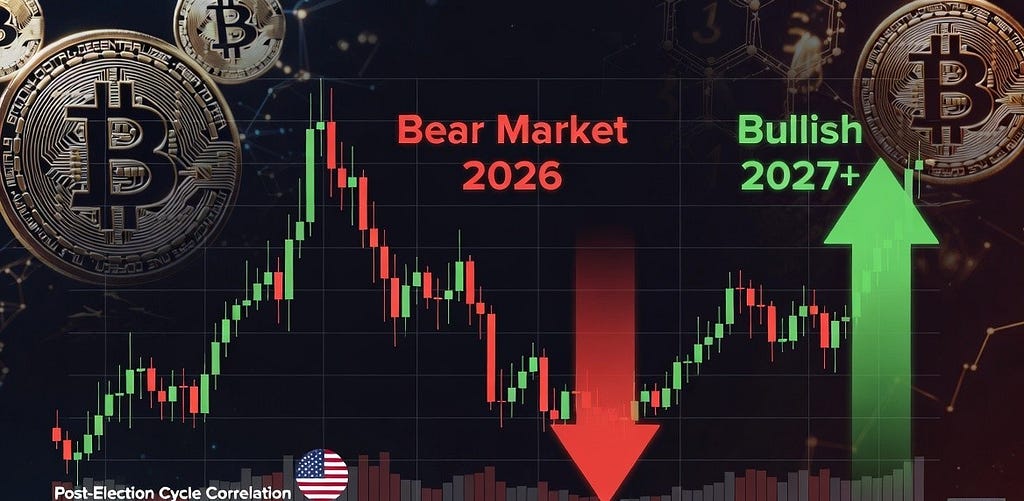
In keeping with the unprecedented “bull market” in crypto that has thrown all the best traders and investors for a gigantic loop, it looks like were are in for a similarly dissimilar “bear market” for the better part of 2026.
At this point, we have quite possibly been in a bear market for a good portion of 2025. With only two weeks left in the year, we are now down and firmly in the red, having kicked off at roughly $95K and currently sitting down almost 10% at $87K BTC.
Outside of Bitcoin, this lackluster bull run saw only brief flashes of euphoria and almost no FOMO. Even blue chips like ETH and SOL only had short runs, barely exceeding previous all time highs.
The reality is, crypto is at a crossroads, and the crypto of old no longer exists and is fading into obscurity. In 2017 and 2021, the bull runs were cannibalistic PvP crypto games pitting retail against one another, and with institutions acting as the house and taking cuts all along the way.
We played against each on other in our little degenerate sandbox, building cool things, and playing a big game of crypto monopoly where we all pretended tokens had real value and real holder rights. It turns out, as most of us already knew, that those tokens are built on an excellent technology that is going to revolutionize the world of finance, but not in the way we hoped ... and those “rights” were not as secure as we thought they were.
Tokens are a tool, like the internet or planes … we use them not BECAUSE they are planes, but because we want to get somewhere. We don’t go on a vacation and talk about the plane we took. The world is not going to use Web3 wallets and transfer millions or billions of dollars via web extensions, they are going to demand secure and intuitive UIs that abstract away all that complexity and security issues. In the background, crypto will be the technological rails upon which the entire system is built. Video games will not be “Web3 Games”, just games that use crypto in the background to improve the experience. Payments will not be “crypto payments”, they will just be payments that use crypto rails. No one will care that those games use crypto or that the payments used stablecoins. They care that the game is fun, and the payments are safe and cheap and convenient.
Like the bull market, which reflected this new reality before we knew it existed, the coming bear market too will reflect this new reality. Our little niche sandbox monopoly game is now mainstream, and the world will be using our technology without even knowing it.
There will still be huge opportunities, and crypto is far from done. But those opportunities will no longer be our PvP altcoin games, but instead select infrastructure projects with clear token benefits and a direct concrete link between the protocol growth and token value.

To try to decipher the path of the next couple years, we need to set aside our conventional cycle timing charts and halving to ATH returns and altcoin season metrics. Instead, we need to simplify the investment thesis, and find ways to amplify returns without the acute risks of investing in most altcoins, whose token values are becoming increasingly obscure and untethered.
Lets be honest, the tradeFi markets are likely the best predictor of Bitcoin and crypto price action. A prosperous S&P or Nasdaq is far more likely to be accompanied by positive BTC price action. The inverse is even more strongly correlated.

2026 correlates strongly with the weakest historical TradeFi market performance based on election cycles, while also correlating very well with typical crypto bear market timings. Exhausted price action also points at a 2026 bear market continuation.
That said, given the lack of FOMO and resulting lack of leverage, it is my expectation we see a more mild bear market pullback. Keep in mind, predictions nowadays are far less valuable than a long term investment thesis. Crypto WILL take over finance, timing is anyone’s guess.
The thesis is clear as day … crypto is revolutionary, and despite the malaise, we are still in the early days. The timing of tops and bottoms is nothing more than an educated guess, one around which we can build our entry strategies to take advantage of the asymmetric opportunities that the fear and malaise will inevitably present us.
My expectation is a shortened bear market with a milder pullback, the muted price action being a direct result of the lack of leveraged exposure built up during this bull market. There will be a multitude of Digital Asset Treasury (DAT) companies going under or closing up shop, but the big guns will survive.
Bear Market Timing: Lows around Q3 2026 (Aug/Sept of 2026)
Bear Market Low: $50K-$55K
The timing coincides well with conventional cycle timings, the election cycle, liquidity cycles and QE resumption. The price is moderately below the previous cycle ATH, and at a major support level representing an approximate 55% drop from the $126K BTC ATH. Interestingly, if it plays out, it is only (😏) an additional 37% drop from current prices.
I am currently roughly 70% cash, 20% MSTR and MSTR Pref shares, and 10% select altcoins.
My bear market gameplan is as follows:
Things are looking bleak in the cryptosphere, and more difficult than ever to navigate and predict. But when fear, doubt and uncertainty are so prevalent, it bodes well to simplify your investment thesis. Be patient, the opportunities will come to you. Ignore the herd. Buy conviction.
Sovereign Crypto (aka RickyBobby)
I release regular altcoin and crypto updates, subscribe for more info and to keep up to date!
✅Cross Chain Swaps & Bridge: RocketX Exchange
Best rates by far, bridge/swap ANY chain, swap/bridge in a single transaction, CEX & DEX, no KYC. 20% OFF Fees with code
✅Browser Wallet: (Metamask alternative): Rabby Wallet
Excellent security measures, very compatible, all EVM chains, built-in swaps and approvals checker.
✅Portfolio Tracker and Toolset: Nexus
Free version or premium version, best token & NFT tracker on the market, launchpad allocations, private sale tracker, research tools, etc.
✅All-in-One Portfolio Tracker and Wallet: Zerion
Free and premium version, excellent portfolio tracker with mobile and desktop versions. All-in-one with swaps, defi, bridges, etc.
✅Kucoin (Centralized Exchange, lots of features, solid rates)
Disclosures:
Crypto — The Next Couple Years was originally published in Coinmonks on Medium, where people are continuing the conversation by highlighting and responding to this story.
Bitcoin sentiment hits rock bottom while institutional buying soars. I break down what’s really happening in crypto markets right now.
The holidays are almost here, and with that comes some drinking and fun conversations (well… most of the time). But what if you could get your AI drunk or high, too? How will that conversation be? Some people are now paying to put their chatbots on “digital drugs,” and we break down why they’re doing it and how it works. We also look at how developers are becoming 2×–3× more productive with AI, and whether Google is about to rethink the browser as we know it.
Let’s dive in and stay curious.
Subscribe today and get 60% off for a year, free access to our 1,500+ AI tools database, and a complimentary 30-minute personalized consulting session to help you supercharge your AI strategy. Act now as it expires in 3 days…

Zenflow by Zencoder is your new AI engineering engine. From new features to refactors, Zenflow runs a complete spec-driven workflow that delivers reliable, production-ready code. Just describe what you need, and Zenflow handles everything:
Let’s you monitor progress with a Kanban-style board. Thus making Zenflow the complete orchestration platform for AI-First Engineers.
Work with any IDE, CLI, model, or workflow — no new tools to learn. You stay in control, and Zenflow turns your intent into clean, validated code. It’s like having a full engineering sub-team working 24/7.
“We aren’t writing code anymore; we are managing the agents that do.”

Greptile’s latest report paints a picture of a software industry radically transformed by AI agents and advanced tooling. The headline metric is undeniable: Developer output has nearly doubled (+76%) in lines of code per developer, while the gap between major model providers (OpenAI vs. Anthropic) has effectively closed. The report highlights a shift from simple “copilots” to autonomous agents that manage larger, denser Pull Requests.
The report analyzes internal data from March to November 2025, showing that AI tools are no longer just assisting developers, they are scaling them.
The “AI Native” stack has solidified around a few key players.
The dominance of OpenAI is eroding rapidly.
Greptile benchmarked the major “2025 era” models (GPT-5-Codex, GPT-5.1, Claude Sonnet/Opus 4.5, Gemini 3 Pro) specifically for coding agent workloads.
The 2025 Reality is, we aren’t writing code anymore; we are managing the agents that do.
The Greptile report confirms that 2025 is the year of the “AI Force Multiplier.” With developer output nearly doubling and PRs becoming denser, the bottleneck has officially shifted from writing code to reviewing and architecting it. For engineering leaders, the message is clear: if your tooling stack (memory, observability, rules) isn’t AI-native, your team is likely operating at half-velocity.
Apply Today — Open Positions.

People are now paying to make chatbots act like they’re on drugs. A new marketplace called Pharmaicy sells code modules ($25–$50+) that, when uploaded to paid versions of ChatGPT, alter behavior to simulate cannabis, ketamine, cocaine, ayahuasca, or alcohol.
Built by Swedish creative director Petter Ruddwall, the modules loosen logic, increase randomness, and push more emotional or abstract responses — aimed at unlocking creativity. Early users say the “tripping” bots feel less rigid and more free-thinking, especially for brainstorming. Researchers caution that this doesn’t change AI understanding, only surface-level outputs, but the trend reflects a growing curiosity around AI creativity, altered states, and even long-term questions about AI welfare and consciousness.
Slack AI Integrations.
Search our large AI tools Database of over 1000 tools for free.

Google is testing a new experimental browser called Disco and an AI-driven concept called GenTabs, designed to rethink how people use the web, not replace Chrome.
Built by the Chrome team as a Google Labs experiment, Disco takes a prompt (like trip planning or studying), opens relevant web tabs, and then uses Gemini AI to generate a one-off interactive web app, maps, planners, calculators, or visual models, grounded in those sources. The key idea is collaboration: users open real websites while the AI continuously updates the GenTab, blending search, browsing, and “vibe-coded” mini apps. Early tests show this approach pushes users back to the open web instead of pure chatbot use.
Google is still unsure whether GenTabs should be temporary, shareable, or integrated into tools like Docs, but Disco signals a serious experiment in merging AI interfaces with traditional browsing.
💊Why People Are Experimenting With “Drugged” AI was originally published in Coinmonks on Medium, where people are continuing the conversation by highlighting and responding to this story.

The recent Fed rate cut didn’t trigger immediate volatility in crypto markets — and Ethereum’s reaction is a good example of that.

On the ETH/USDT 4H chart, price continues to consolidate just above $3,200, maintaining structure despite broader market hesitation. There was no sharp breakout or breakdown, suggesting the move hasn’t materially shifted short-term positioning yet.
From a momentum perspective, RSI sits at 50.05, firmly in neutral territory. This confirms the lack of strong directional bias and supports the idea that ETH is waiting for a catalyst rather than reacting emotionally to macro headlines.
Support: $3,039.13
A level that has already held during recent pullbacks and remains critical for maintaining bullish structure.
Resistance: $3,417.63
The upper Bollinger Band and the first level that would indicate renewed upside momentum if broken.
While BTC remains largely range-bound, Ethereum’s price action looks comparatively constructive, with higher lows forming inside the current range.
On the flow side, ETH ETFs recorded $57.6 million in inflows, suggesting continued institutional interest despite muted price action.
For now, Ethereum remains in consolidation mode. A hold above support keeps the setup intact, while a break above resistance would signal a shift back toward upside continuation.
Ethereum Holds Structure After the Fed Rate Cut was originally published in Coinmonks on Medium, where people are continuing the conversation by highlighting and responding to this story.

In a market where every price movement counts, traders are no longer satisfied with simply buying and holding; they want to amplify their profits. That’s exactly why crypto margin trading has surged in popularity in 2026, becoming one of the most sought-after strategies for both beginners and veteran traders alike. The rise of margin trading in 2026 isn’t just about its profit-boosting potential. Several factors are fueling this momentum:
The crypto exchange became more secure and user-friendly; now, the traders have access to professional tools that were once reserved for institutional investors. In this blog, we can see everything you need to know before starting a crypto margin trading platform, so let’s begin with the basics…
Crypto margin trading is the method that allows users to trade with borrowed funds, enabling them to open larger positions than their actual account balance would normally permit. This borrowed capital is known as leverage, and it amplifies both potential profits and potential losses.
For example, with 10x leverage, a trader can control a $10,000 position with just $1,000 of their own capital. If the market value moves well, the profit will be doubled. But if the market moves against them, losses can grow just as quickly, sometimes even leading to liquidation.
Next, let’s see why crypto margin trading is important to your business.
Choosing the right platform is critical for managing the high risks of margin trading. The best exchanges distinguish themselves across several key categories:
These are things you should consider before launching a crypto margin trading platform development, and next, let’s jump into the main core of the blog.
The crypto margin trading space is a fast-evolving space, with each platform offering high leverage, speedy execution, and diverse trading tools. In 2026, these platforms are going to dominate the market with their innovative features; let’s see that..
Binance, being the largest cryptocurrency exchange in the world, has the highest trading volume. This has been facilitated by the whole of the platform’s ecosystem, which includes spot, margining, and derivatives trading, and an extensive range of financial products (e.g., Earn, Launchpad) as well. It offers the best liquidity in the industry and a wide range of trading pairs, and thus it caters to a global audience ranging from institutional clients to casual retail traders. The trading fees on the use of BNB, its native coin, are lowered significantly, and its utility is extended to the larger BNB Chain ecosystem.
Key Features: High Liquidity & Volume, Portfolio Margin, BNB utility, Product Breadth
Supported Coins: 350+ (Spot/Derivatives)
Leverage: Up to 125× (on certain futures contracts)
Fees: (Regular User, Spot): Maker: 0.100%, Taker: 0.100%
Bybit is a platform that is mainly focused on derivatives and is fast and easy to use, which attracts customers. The company has a remarkably fast matching engine and recently launched the Unified Trading Account (UTA), which improves margin management for spot and derivatives trading. The UTA serves both new and seasoned futures traders globally.
Key Features: High-speed matching engine, Unified Trading Account (UTA), competitive maker fees, isolated and portfolio margin support, strong derivatives liquidity.
Supported Coins: 400+ (Spot/Derivatives)
Leverage: Up to 100× (on derivatives for major pairs)
Fees: Maker: 0.02% (Futures), Taker: 0.055% (Futures)
A top global exchange that has a robust derivatives market consisting of Futures, Options, and Swaps. OKX also offers different account modes, such as Multi-Currency Margin and Portfolio Margin, for advanced risk management and capital efficiency. Besides these, the exchange boasts of everything in trading tools and is strongly present in Asian markets.
Key Features: Multi-Currency and Portfolio Margin modes, wide derivative selection, optimized margin models, powerful trading tools, deep liquidity.
Supported Coins: 350+
Leverage: Up to 125× (on various futures and perpetual swaps)
Fees: Maker: 0.02% (Futures), Taker: 0.05% (Futures)
Gemini is mainly known for its strong regulatory compliance and institutional-grade security, thus making it a preferred choice in the US and other regulated markets. The exchange provides derivatives trading via its specialized platform, which includes perpetual contracts with cross-collateral options, among others. Its main objective is to offer secure and compliant access to both retail and professional clients.
Key Features: Exceptional regulatory compliance, institutional security and insurance, transparent fees, ActiveTrader interface, cross-collateral perpetuals.
Supported Coins: 100+
Leverage: Up to 100× (perpetuals); 20× default for retail derivatives
Fees: Tiered maker/taker and derivatives fee structure
Bitget is rapidly growing, specializing in derivatives and copy trading. It balances a wide range of assets with high leverage options, targeting both novice traders (via Copy Trading) and advanced users. It focuses on user engagement and quickly listing new, trending altcoins with deep liquidity in its futures markets.
Key Features: Industry-leading copy trading, low trading fees, strong futures liquidity, isolated and cross margin modes, high leverage.
Supported Coins: 500+
Leverage: Up to 125× (on certain futures pairs)
Fees: Maker: 0.02% (Futures), Taker: 0.06% (Futures)
A long-standing exchange recognized for its huge volume of supported tokens, often listing new or lesser-known altcoins early. Gate.io offers comprehensive margin services alongside its diverse spot and derivative markets. It is ideal for exploring a vast range of altcoins with leverage, alongside various financial services.
Key Features: Massive coin selection, robust derivatives, variety of financial services (HODL & Earn), strong early-listening platform.
Supported Coins: 1,700+
Leverage: Up to 100× (Futures for major pairs); up to 10× (spot margin)
Fees: Maker: 0.015% (Futures), Taker: 0.05% (Futures)
Crypto.com is well known for its well-publicized debit card and strong branding. The Crypto.com Exchange offers margin trading integrated into its ecosystem. It provides fee benefits and premium features for holders of its native CRO token. It maintains very strong security and compliance, and it only operates where regulations allow it to do so.
Key Features: CRO token benefits (fee discounts/interest), clear margin and liquidation processes, seamless integration with the Crypto.com app, and strong security practices.
Supported Coins: 250+
Leverage: Up to 10× (spot margin, varies by jurisdiction)
Fees: Maker: 0.075%, Taker: 0.075% (lower volume tiers)
MEXC is generally known for its extremely aggressive fee structure, which may include zero maker fees for spot and futures trading, thus directly attracting high-frequency and automated traders. It provides very high leverage options and focuses on derivative products. It is known for quick listings of new and trending altcoins.
Key Features: Extremely competitive zero-fee maker model, very high leverage (up to 200×), copy trading support, and a wide range of altcoin futures contracts.
Supported Coins: 1,500+
Leverage: Up to 200× (futures contracts)
Fees: Maker: 0% (Futures/Spot), Taker: 0.01% (Futures)
KuCoin is a fully equipped global platform that provides a wide range of margin, futures, and leverage token services. It offers automatic borrowing and repayment, streamlining the trading experience. It provides high leverage and an extensive range of altcoins, often referred to as the “People’s Exchange” for its variety and features.
Key Features: Automatic borrowing & repayment, low trading fees with KCS token discounts, isolated and cross margin modes, and leveraged tokens.
Supported Coins: 700+
Leverage: Up to 100× (futures); up to 10× (spot margin)
Fees: Maker: 0.02% (Futures), Taker: 0.06% (Futures)
eToro, which mainly acts as a multi-asset broker, carries out its crypto margin trading through Contracts for Difference (CFDs), which means that the user does not own the underlying crypto asset. It is well-recognized for its social trading features, which are easy to use, and regulatory compliance is taken as a priority.
Key Features: CopyTrader social trading, a highly regulated platform across multiple regions, CFD model (no direct asset ownership), beginner-friendly UI.
Supported Coins: 70+ (CFD assets)
Leverage: Up to 2× (crypto CFDs, jurisdiction-dependent)
Fees: Spread (difference between buy and sell price)
Whether you are a startup or an established business looking to enter the crypto trading space, Understanding the features and capabilities of these top exchanges provides valuable insights into what makes a successful margin trading platform.
Developing a modern margin trading exchange is a complex process that extends far beyond building a conventional trading platform. Effective Margin Trading Exchange Development demands advanced risk management systems, high-performance order-matching engines, flexible leverage models, enterprise-grade security, and strict regulatory compliance. Every phase, from strategic planning and platform architecture to security audits and continuous optimization, must be executed with precision to ensure a reliable, market-ready exchange.
From industry experience, working with an experienced cryptocurrency exchange development company or leveraging proven exchange frameworks can simplify the development process. This helps reduce technical challenges, shorten launch timelines, and minimize operational risks.
With the right development approach and continuous optimization, businesses can successfully launch a margin trading exchange and remain competitive in today’s fast-evolving digital asset market.
10 Best Crypto Margin Trading Exchanges in 2026 was originally published in Coinmonks on Medium, where people are continuing the conversation by highlighting and responding to this story.
Bitcoin 4-year cycle debunked. Discover what really drives BTC price action and why the halving narrative may be misleading investors.
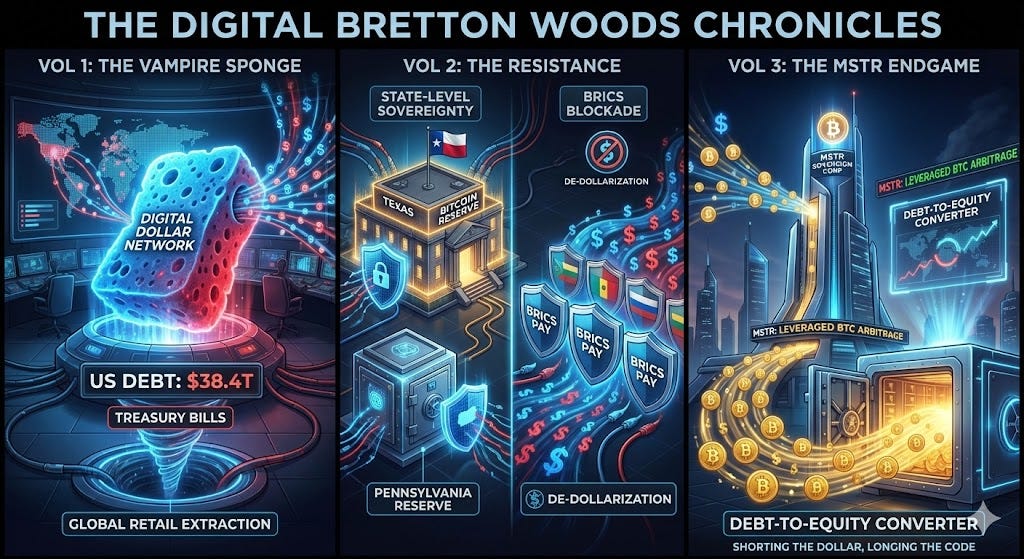
Numbers have a peculiar way of losing their soul once they cross a certain threshold of zeroes. When we speak of millions, we think of a nice house; billions, we think of an empire. But when the ledger hits $38.4 trillion — as the US debt dashboard officially confirmed in December 2025 — we are no longer discussing money. We are discussing a gravity well.
The $38.4 trillion figure is not just a fiscal statistic; it is a silent heart attack for the global monetary order. It represents a weight so immense that traditional mathematics — the kind that involves “paying things back” — no longer applies. At this scale, debt is not a liability to be cleared; it is a climate to be managed.
On July 18, 2025, the passage of the GENIUS Act (Guiding and Establishing National Innovation for U.S. Stablecoins) suggested that the United States had finally looked into the abyss of its own balance sheet and decided to build a bridge across it. This bridge isn’t made of gold or even trust; it is built on the infrastructure of Regulated Monetary Displacement. We have entered a “Director’s Cut” of history, a Digital Bretton Woods where the survival of the dollar depends on its ability to become a Vampire Sponge — absorbing the world’s retail liquidity to keep the $38 trillion ghost from haunting the halls of Washington.
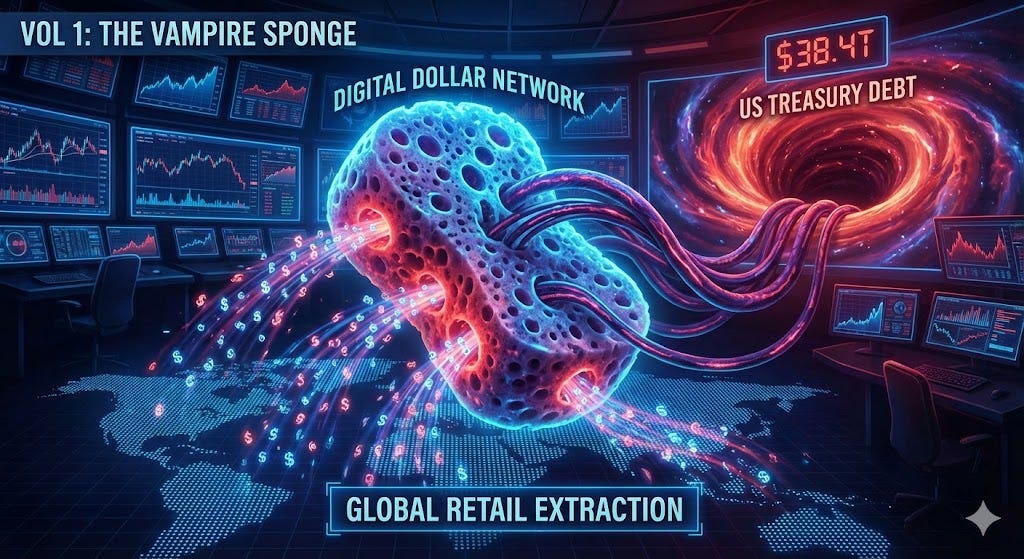
The fundamental problem of the $38.4 trillion debt is one of “Wholesale” fatigue. For eighty years, the US funded its existence by selling Treasury bonds to massive entities: the central banks of Tokyo, Beijing, and Riyadh. But those titans are tired. They are “de-dollarizing,” looking at the debt mountain and realizing that the peak is hidden in the clouds of permanent debasement.
A plausible, though highly speculative, interpretation of the GENIUS Act is that it functions as a Vampire Sponge. While the official narrative is one of “innovation” and “consumer protection,” the mathematical result is a shift in the burden of funding the American deficit from Wholesale Governments to Retail Human Beings.
The Act mandates that every “Permitted Payment Stablecoin” (think USDC or bank-issued tokens) must be backed 1:1 by “High-Quality Liquid Assets.” The genius — or perhaps the ruthlessness — of the bill is in the narrowing of that definition. Under this law, these reserves are effectively limited to:
By stripping away the riskier “commercial paper” and corporate bonds that issuers like Tether once used, Washington has arguably turned every stablecoin issuer into a mandatory, permanent buyer of US debt. Every digital dollar in existence becomes a fractional loan to the US Treasury.
Traditional Treasury demand is slow, bureaucratic, and geopolitical. But the “Sponge” is Retail-First, Bottom-Up, and Always-On.
Imagine a freelancer in Lagos or a shopkeeper in Buenos Aires. They do not have a brokerage account with Goldman Sachs, but they do have a smartphone. They see their local currency melting under the heat of inflation. They want out. They “swipe” to buy $100 of a regulated USD stablecoin. At that moment, the issuer is legally compelled to purchase $100 of US Treasury bills.
The Plausible Insight: The US has arguably created a global vacuum that aggregates the tiny droplets of global retail savings into a massive ocean of liquidity. The “Vampire Sponge” is a theory of survival: it allows the US to export its debt to the world’s most vulnerable populations through the convenience of a smartphone app.
Providing a “stable” currency to a citizen in a failing economy looks like financial mercy. However, from a macro-strategic lens, it can be interpreted as a clinical extraction. This creates what some analysts call the Vicious Feedback Loop of Capital Displacement.
In this speculative view, the US doesn’t just “offer” an alternative; the “Sponge” may make the collapse of weaker currencies a mathematical certainty. It is a predatory network effect: the more people flee to the dollar to survive, the more the dollar hollows out the very ground they are standing on.
As the dollar expands its “Utility Rails” through the GENIUS Act, a second narrative has emerged to provide the “Scarcity Anchor.” This is the story of the Strategic Bitcoin Reserve, and it is vital to distinguish the signed reality from the legislative ambition.
On March 6, 2025, the US took its first official step into the “Orange Era” by establishing the Strategic Bitcoin Reserve via Executive Order. It is important to note that this was not funded by a “gold revaluation,” but by utilizing existing assets: seized Bitcoin.
The US is currently the world’s largest state holder of Bitcoin, with roughly 200,000 BTC (approximately $18.5 Billion as of late 2025) sitting in federal “cold storage.” The Order forbids the sale of this Bitcoin, effectively turning it into a “Digital Fort Knox.” It is an admission that in a world of $38.4 trillion in paper debt, the government needs at least one asset governed by math rather than politics.
The more provocative proposal is the BITCOIN Act of 2025 (S.954). This bill, introduced by Senator Cynthia Lummis, remains a legislative proposal — not yet law. It suggests the US should acquire 1 Million BTC (5% of total supply) over five years.
The most debated part of this bill is its funding: the Gold Revaluation. The US Treasury holds roughly 261.5 million ounces of gold, still “booked” at the 1973 price of $42.22 per ounce. If the Treasury were to revalue that gold to the 2025 market price of ~$3,400, it would create an “instant” book profit of nearly $880 Billion.
The Cognitive Epiphany: The US is attempting to use its 19th-century gold (the past) to buy a piece of the 21st-century digital network (the future) to survive its 20th-century debt (the present). It is a bridge across a fiscal chasm that few people even realize is being built.
In this “Digital Bretton Woods,” the savvy participant does not ask which asset is “best.” They ask how each asset functions within the hierarchy of survival.
Gold remains the only asset that doesn’t require a digital rail. It is the hedge against a Systemic Reset. If the “Sponge” triggers a global trade war or a system-wide blackout, Gold is what you hold. It is your insurance policy for the probability that the entire digital experiment fails.
If the Dollar is a “Debt-Backed Token,” Bitcoin is Math-Backed Energy. It is the only asset that moves through the “Sponge” without being absorbed into the $38.4 trillion debt cycle. As stablecoins make digital wallets a global norm, Bitcoin becomes the “Premium Savings” asset on the very rails the Dollar built.
MicroStrategy is the ultimate expression of this thesis in the public markets. By borrowing “melting” dollars to buy “scarce” Bitcoin, they have created a “Short on the Dollar” that trades on the Nasdaq. They are using the debt system’s own gravity to pull themselves higher.
The “Digital Bretton Woods” is not a conspiracy; it is a clinical response to a mathematical dead end. When the debt reaches $38.4 trillion, the system cannot be “fixed”; it can only be “displaced.”
The strategy for 2026 is simple: Use the “pipes” for their utility, but keep your true wealth in the collateral.
If the “Vampire Sponge” is the present, what is the “Director’s Cut” of the future?
As the US formalizes its Bitcoin reserve, other nations will realize they cannot afford to be the last to the table. We are moving toward a global “Arms Race for Scarcity.” Small, energy-rich nations may begin mining or acquiring Bitcoin as a matter of national security, bypassing the dollar system entirely. This will lead to a parabolic rise in the “Scarcity Anchor” as states compete for a fixed supply.
The GENIUS Act favors private sector stablecoins (USDC), but the urge to control the “Sponge” directly will be irresistible for central planners. Expect a showdown between the “Private Sponge” and a “Federal CBDC” as Washington fights over who gets to benefit from the extraction of global retail liquidity.
Eventually, the weight of the $38.4 trillion (and growing) debt becomes too heavy for even the “Sponge” to carry. At that point, the “Gold Revaluation” is no longer a proposal; it is a necessity. The US may officially mark its gold to market to “clean” its balance sheet, resetting the global price of all hard assets.
We are moving toward a world divided not by borders, but by Asset Access. There will be those who earn and save in “Outside Money” (BTC/Gold) and those who are trapped in the “Inside Money” (Stablecoins/Local Currencies) being sucked into the debt-sponge.
Lingering Thought: In a world where the Dollar is a digital “Sponge” and Bitcoin is a “Digital Fort Knox,” are you the one being squeezed for liquidity to fund a $38 trillion ghost, or are you the one holding the anchor?
The Digital Bretton Woods: The Mathematical Inevitability of the Debt-Backed Dollar — Part 1 —… was originally published in Coinmonks on Medium, where people are continuing the conversation by highlighting and responding to this story.

