Login
LoginThe Myth Of USD Weakness Boosting Bitcoin: Inflation, Liquidity, Or Fear Changes The Outcome
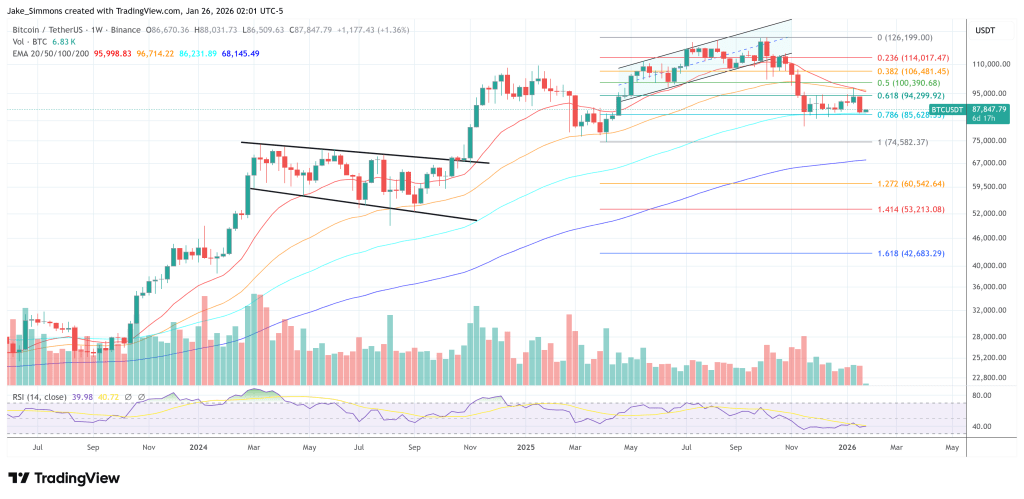
Bitcoin has slipped below the $87,000 level, extending its pullback as selling pressure and macro uncertainty keep traders on the defensive. After multiple failed attempts to regain key resistance zones, BTC is now trading in a fragile range where momentum remains weak, and liquidity conditions can amplify short-term moves. With risk appetite fading, the market is once again questioning whether this decline is a temporary shakeout or the start of a deeper corrective phase.
At the same time, the US dollar has been weakening, reigniting a familiar debate across financial markets: Does a softer dollar automatically lift Bitcoin? The answer is not that simple. A falling dollar can support BTC, but only under the right macro conditions. The driver is not the dollar itself, but why it is falling, and how investors interpret that shift in terms of risk.
In inflation-driven environments, dollar weakness can push capital toward hard assets, allowing Bitcoin to behave more like a “digital gold” narrative. In liquidity-driven cycles, rate cuts and easier financial conditions can also push investors into higher-beta assets like crypto.
But when the dollar declines due to stress, intervention fears, or escalating uncertainty, capital often rotates into traditional safe havens instead—leaving Bitcoin to trade like a risk asset alongside equities.
A Weak Dollar Isn’t Automatically Bullish For Bitcoin
A CryptoQuant report argues that the relationship between a falling US dollar and Bitcoin is indirect and conditional, not mechanical. In other words, a weaker dollar can support BTC, but only under specific macro regimes. The key variable is not the dollar move itself, but the underlying driver behind that devaluation and the broader risk environment investors are reacting to.

CryptoQuant outlines three scenarios. First, if dollar weakness reflects persistent inflation and a growing search for protection, Bitcoin can benefit as investors treat it like a form of “digital gold.” Second, if the decline is driven by rate cuts and excess liquidity, risk assets typically outperform, and cheaper capital can rotate into crypto as investors seek upside in higher-beta markets. In both cases, the dollar weakness aligns with conditions that can lift Bitcoin.
The third scenario, however, is the most important for the current market. If the dollar is weakening due to a confidence shock and extreme risk aversion—such as the present episode tied to rumors of yen intervention—crypto tends to fall alongside equities. In that environment, the weak dollar is only a backdrop, not a bullish engine.
The conclusion is clear: the market is rotating from the dollar into gold, while Bitcoin ETFs see heavy outflows, showing that in panic, investors still choose the traditional refuge. For Bitcoin to thrive, dollar weakness must come from risk appetite, not fear.
Bitcoin Rebounds Keep Failing Below Key Moving Averages
Bitcoin is trading around $87,900 after a volatile decline that dragged price below the $90,000 psychological level and kept bulls under pressure. The chart shows BTC is still trapped in a corrective structure that began after the late-2025 peak, with the downtrend accelerating into November before transitioning into a choppy consolidation phase. Even though price has stabilized above the mid-$80K area, rebound attempts continue to lose strength, suggesting demand remains cautious.
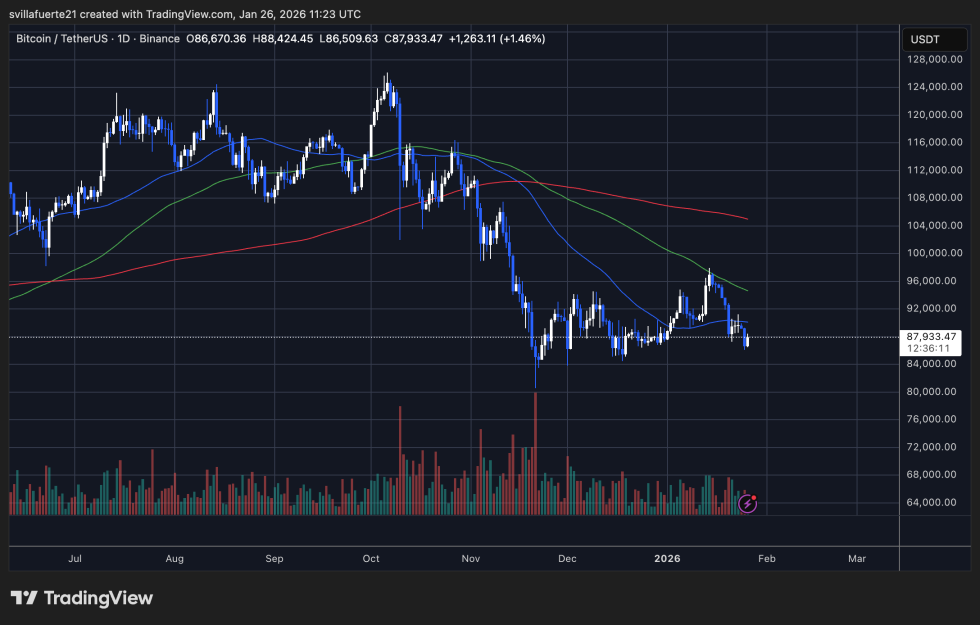
From a trend perspective, Bitcoin is now trading below its major moving averages, reinforcing bearish momentum across multiple timeframes. The 50-period moving average (blue) has turned sharply downward and sits well above the price, acting as dynamic resistance and capping short-term rallies.
The 100-period moving average (green) is also sloping lower, confirming that the broader recovery structure has weakened since BTC failed to sustain moves above $95K. Meanwhile, the 200-period moving average (red) remains the highest overhead level near the low-$100K range, highlighting how much upside would be required to shift the market back into a stronger macro trend.
The recent bounce toward the low-$90K region was rejected quickly, and the price has slipped back into its compression zone. For bulls, reclaiming $90K and then breaking above $92K–$95K is necessary to rebuild momentum. If BTC fails to hold the $87K–$88K region, downside risk remains open toward $84K and potentially the low-$80K zone.
Featured image from ChatGPT, chart from TradingView.com


 BNB (@cz_binance)


 THE FED IS PREPARING TO SELL U.S. DOLLARS AND BUY JAPANESE YEN FOR THE FIRST TIME THIS CENTURY.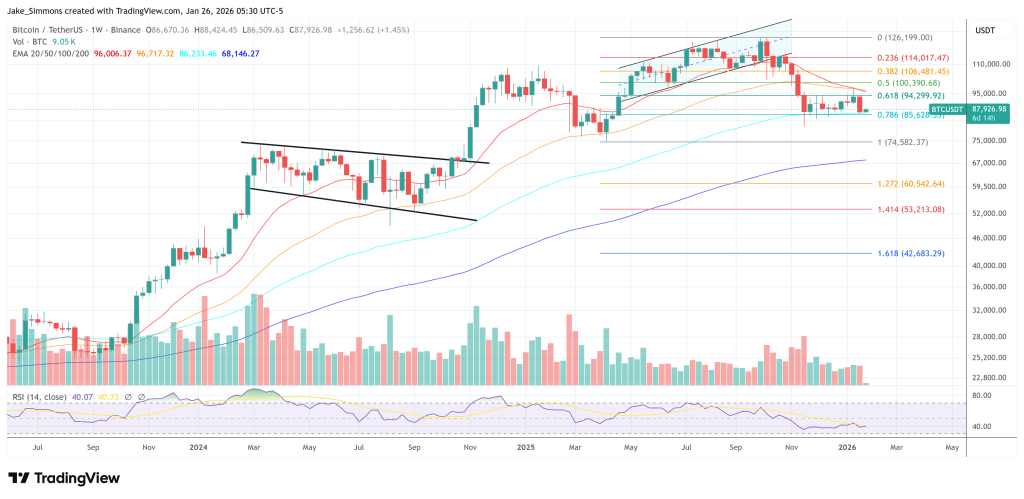






 En primicia, Valora Analitik conoció que Protección se prepara para lanzar desde Colombia un fondo con exposición a Bitcoin. El producto no estará enfocado en la especulación de corto plazo, sino en ampliar las opciones de diversificación con una gestión integral de riesgos y…