Reading view

There are new articles available, click to refresh the page.

Bitcoin Large Holders Lead the Way As BTC Accumulation Picks Up, Is A Rebound Brewing?

Over the weekend, volatility observed across the broader cryptocurrency market intensified, causing the price of Bitcoin to fall back to the $86,000 mark once again. Even with the bearish price action in the past few days, buying activity continues to pick up pace in the market, especially among large BTC holders.

Bitcoin’s Largest Wallets Show Conviction

Bitcoin’s price may have been struggling with heightened volatility as a result of the broader market bearish market action, but bullish sentiment remains present among investors. In the weakening condition, large BTC whales or deep-pocket investors’ sentiment turns positive and are steadily reentering the market.

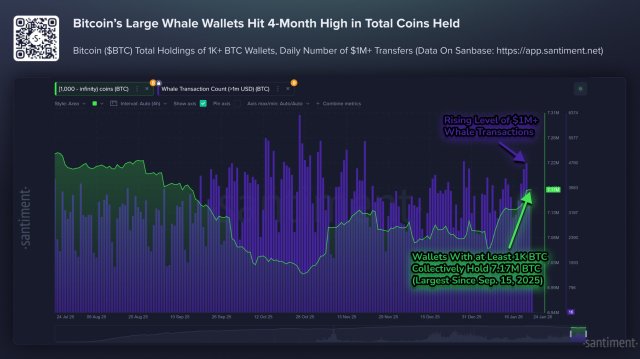
Data from Santiment, a popular market intelligence and on-chain data platform, suggests that these major investors are building positions at an encouraging and steady pace, even though the broader momentum is demonstrating weakening conditions. In the past, long-term whale accumulation has typically happened in uncertain times when prices don’t accurately reflect underlying confidence.

Santiment noted that the buying activity is spotted among wallet addresses holding over 1,000 BTC. After months of consistent buying, the group has now collectively acquired about 104,340 BTC, which represents a more than 1.5% rise. 
Bitcoin

As a result of the recent purchase, the investors’ overall holdings are currently sitting at 7.17 million BTC, marking their largest level since September 15, 2025. These wealthy investors are subtly consuming available supplies rather than distributing into recent market swings, indicating confidence in Bitcoin’s medium- to long-term potential

While buying pressure is growing among large Bitcoin holders, the number of whale transactions has also experienced a massive upswing. Santiment added that the amount of +$1 million daily transfers has exploded, reaching a 2-month high level.

A Continued Drop In BTC Open Interest

A continued drop in Bitcoin’s Open Interest is coinciding with the ongoing drop in price. Darkfost, a market expert and CryptoQuant author, highlighted that open interest is steadily declining, which does not support the emergence of a new trend as seen on the weekly change basis.

Since November, the metric has remained broadly negative, suggesting that the drop has continued for several weeks. Although there was a brief improvement earlier this month, it was followed by a price reaction. 

Overall, when open interest rises, Darkfost stated that it mostly signals trend continuation to even a trend reversal, triggered by an influx of long positions. Furthermore, this is confirmed with funding rates, but this is what happens in most cases.

On Sunday, as BTC displays a steady correction, deleveraging also increased. While this is bearish in the short term, these phases simultaneously aid in cleaning the market of excessive leverage. Thus, it is critical to remember that futures are still the primary source of volume, making keeping an eye on developments there an essential move.

Bitcoin

Major Reasons Why The XRP Price Could Recover And Surge Again

Crypto analyst Darkfost has highlighted reasons why the XRP price could soon witness a bullish reversal and potentially reach new local highs. This comes amid bearish sentiment in the market, which on-chain analytics platform Santiment said could set the stage for a reversal in the altcoin’s price.  

Why The XRP Price Could Soon See A Bullish Reversal 

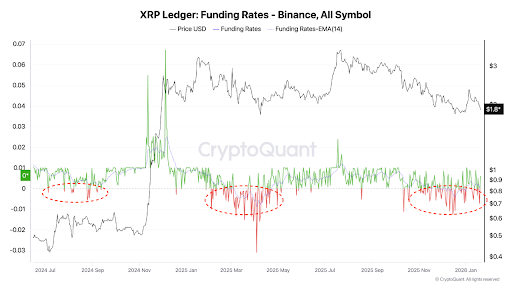
In a CryptoQuant blog post, Darkfost stated that negative funding rates signal a potential XRP price reversal. The analyst noted that the altcoin is currently trading around 47% below its all-time high (ATH) set in July last year. Furthermore, the altcoin is said to have naturally entered a phase of distribution and correction after a gain of over 600% since November 2024. 

Darkfost assured that this type of movement is healthy after such a strong rally for the price. He further remarked that what stands out is the timing of the bearish consensus, as it did not form at the top but rather during a drawdown of more than 50%. Now, there are predominantly short positions on XRP, with funding rates on Binance mostly negative since December, indicating that leveraged short positions have the upper hand. 

XRP

The analyst noted that historically, the market tends to move against a late consensus. As such, while the accumulation of shorts creates short-term selling pressure, it also builds latent buying pressure. Darkfost said that if the XRP price starts to rise, these short positions could be liquidated, fueling the upward move. 

He revealed that a similar pattern has occurred for the token price since 2024. The first was between August and September 2024, and the second was during the April 2025 correction, when funding rates turned negative for a period before a bullish rebound occurred. The analyst stated that this price rebound was due to a shift in investor sentiment and funding rates returning to positive territory. 

A Rally Starter For XRP

In an X post, Santiment stated that XRP traders are showing major FUD, which they claimed is usually a rally starter for the XRP price. The on-chain analytics platform revealed that the altcoin has fallen into ‘Extreme Fear’ territory, with small retail traders becoming pessimistic about the token after a 19% decline from its recent high on January 5th. 

Santiment noted that historically, this level of bearish commentary has led to price rallies. This is based on the belief that prices move in the opposite direction to retail’s expectations more often than not. The altcoin has dropped again following the recent decline in the broader crypto market, led by Bitcoin. BTC fell below $87,000 yesterday on the back of U.S. political tensions, government shutdown risk, and ahead of this week’s FOMC meeting. 

At the time of writing, the XRP price is trading at around $1.88, down in the last 24 hours, according to data from CoinMarketCap.

XRP

70% Of Institutional Investors Aren’t Buying The Bitcoin Top Narrative – Here’s Why

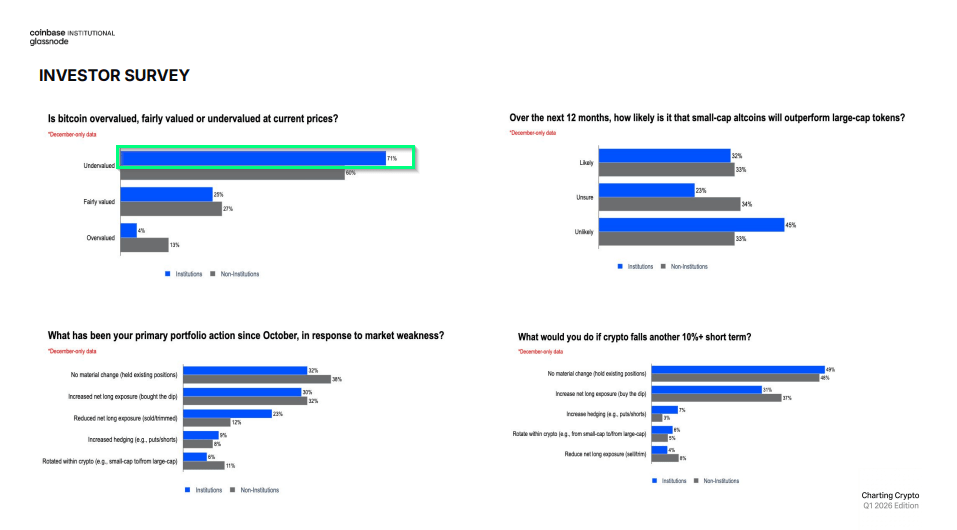
Investors are showing a steady faith in Bitcoin even as money moves elsewhere. According to Coinbase’s Charting Crypto Q1 2026 report, many big players think the current price is a bargain. The mood is cautious, but the view among large institutions leans toward holding for the long run.

Institutional Confidence And Behavior

Reports say about 71% of institutional investors view Bitcoin as undervalued when it sits between $85,000 and $95,000. Independent investors are not far behind, with 60% sharing that view.

A quarter of institutions felt the price was fair, and only a small share thought it was too high. These numbers show a strong tilt toward belief in future gains.

Gold And Silver Are Doing Very Well

Gold has climbed sharply, and silver has more than doubled since last October. That flow into metals has come as investors seek shelter while worries over global tensions rise.

Stocks have not surged as much; the S&P 500 has posted modest gains. The contrast is clear: some money went into traditional hedges instead of crypto.

Geopolitical Friction And Trade Signals

Reports note renewed tariff threats from US President Donald Trump and rising strain between the US and parts of the Middle East.

Such moves have been linked to market nervousness. If energy supply or trade routes are hit, risk assets often wobble. That makes Bitcoin more sensitive than usual to headlines.

Bitcoin Price Action In Context

Bitcoin has been trading in the high $80,000s. It briefly tried to hold above $90K but slipped back, touching nearer $86,000 at times.

Volatility has returned, and liquidations were seen after the big October move. Still, many technical analysts keep longer-term targets on their charts, arguing that the broader trend is not necessarily broken.

Institutional Game Plan

Reports say 80% of those large investors would either keep their stakes or add more if prices fell another 10%. More than 60% have already held or raised their positions since October’s peak.

Over half think the market is in an accumulation phase or still in a bear cycle, which explains why many prefer to buy on weakness rather than sell.

Macro Outlook And Possible Tailwinds

Coinbase expects the Federal Reserve to cut rates twice in 2026, an outlook that could help risk assets if it comes to pass. Consumer inflation has been steady and GDP growth looked strong in the last quarter. These conditions could nudge sentiment back toward risk-taking, though timing is far from sure.

The story is not simply bullish or bearish. On one hand, large investors show clear conviction and are willing to act on dips.

On the other, safe-haven flows and geopolitical shocks keep a lid on rapid re-rating. The near-term path is likely choppy, while the longer view depends on whether macro calm returns and whether demand for crypto picks up again.

Featured image from Unsplash, chart from TradingView

Why Is Japan Going All In On XRP? Expert Exposes What’s Going On Behind The Scenes

Japan appears to be going all in on XRP, as new reports reveal that the country is working toward reclassifying the cryptocurrency. An XRP advocate and expert known on X as ‘SonOfaRichard’ has exposed what’s going on behind the scenes, noting that Japan is now transforming XRP into a real financial infrastructure, formally integrating it into the country’s capital markets. 

Behind Japan’s New Commitment To XRP

For many countries, particularly the US and South Korea, XRP has primarily been viewed as a digital asset for payments and trading, subject to both bullish and bearish price action. However, Japan has recently taken a step further, moving beyond the speculative bubble and aiming to reclassify the altcoin and integrate it into the country’s financial infrastructure. 

In his post on X, SonOfaRichard delved deep into this ongoing development, highlighting the significance and implications of Japan’s involvement in XRP. He said that Japan is not merely expressing bullish sentiment on XRP, as many countries, traders, and analysts do. Instead, it is changing how the cryptocurrency is classified domestically by placing it under the Financial Instruments and Exchange Act (FIEA). This move represents a significant regulatory shift rather than a market-driven endorsement. 

According to the expert, assets under the FIEA are not designed to fuel speculative market pumps. By moving XRP under this new regulatory framework, Japan would effectively position it alongside traditional financial products, such as bonds, funds, and derivatives. This shift removes primary focus on short-term price movements and prioritizes structure and oversight as a pathway toward long-term market development and maturation.

SonOfaRichard has said that Japan’s reclassification of XRP will introduce insider trading controls, custody audits, disclosure standards, and clearer rules for institutional balance sheets. He explained that once the process is complete, it will not be treated as an experiment but as a full infrastructure normalization. He added that institutions that have been waiting for clear regulatory approval may soon receive it, as Japan moves closer to granting final authorization.

Timeline For Japan’s Reclassification

In his post, SonOfaRichard clarified the timeline of Japan’s reclassification of XRP. He explained that it would not be an immediate change, as the process follows Japan’s fiscal-year logic, not the US calendar. Legislative submission is expected in 2026, with full implementation aligned with Japan’s formal fiscal rails and taking effect only after official approval. 

The XRP expert noted that Japan’s regulatory system runs on a fiscal year from April to March, and new rules typically come into effect at the start of the fiscal cycle rather than mid-year.  This means XRP’s reclassification will likely occur sometime in Q2 2026. 

SonOfaRichard also emphasized that the reclassification will focus on institutional treatment, custody, disclosure, and compliance standards. He added that the process represents a massive structural shift and will therefore unfold slowly and deliberately to ensure proper alignment with Japan’s established regulatory frameworks. 

XRP price chart from Tradingview.com

$40 Million+ US Govt Crypto Heist Leads To Contractor Exec’s Son: ZachXBT

On-chain investigator ZachXBT says a $40 million-plus theft from US government crypto seizure wallets may trace back to John Daghita, an alleged threat actor who goes by “Lick,” and a contractor relationship tied to Daghita’s family.

The $40 Million+ Govt Crypto Wallet Robbery

In a Jan. 25 post, ZachXBT pointed to Command Services & Support (CMDSS), describing it as a firm with “an active IT government contract in Virginia,” and alleging it was “awarded a contract to assist the USMS in managing/disposing of seized/forfeited crypto assets.” ZachXBT added: “It still remains unclear at this point how John obtained access from his dad.”

In case you are curious how John Daghita (Lick) was able to steal $40M+ from US government seizure addresses.

John’s dad owns CMDSS, which currently has an active IT government contract in Virginia.

CMMDS was awarded a contract to assist the USMS in managing/disposing of… https://t.co/lzR2a1aidA pic.twitter.com/PV0IkSuhVy

— ZachXBT (@zachxbt) January 25, 2026

The allegation lands against a backdrop of earlier tracing work published Jan. 23, where ZachXBT linked wallet activity and recorded chats to the same persona. “Meet the threat actor John (Lick), who was caught flexing $23M in a wallet address directly tied to $90M+ in suspected thefts from the US Government in 2024 and multiple other unidentified victims from Nov 2025 to Dec 2025,” ZachXBT wrote.

ZachXBT’s thread centers on a dispute in a Telegram group chat between “John” and another threat actor, Dritan Kapplani Jr., in what the community calls “band for band (b4b)”, an on-the-spot contest to prove who controls more funds. ZachXBT said the interaction was “fully recorded,” and claims the footage includes screen-shared wallet balances and contemporaneous transfers that help establish control.

According to the thread, the recording shows John screen-sharing an Exodus wallet displaying a Tron address holding $2.3 million. In a second segment, ZachXBT said “another $6.7M worth of ETH” moved into an Ethereum address while the argument continued.

3/ In part 1 of the recording Dritan mocks John however John screenshares Exodus Wallet which shows the Tron address below with $2.3M: TMrWCLMS3ibDbKLcnNYhLggohRuLUSoHJg pic.twitter.com/jvcjIVEpaE

— ZachXBT (@zachxbt) January 23, 2026

ZachXBT framed the key evidentiary point as ownership continuity across addresses: “The recording captures that John clearly controls both addresses. Additional addresses can likely be found in the recordings. I then began tracing backwards to verify the source of funds.”

That tracing, ZachXBT said, connects the cluster to a March 2024 transfer of $24.9 million from a US government address tied to the Bitfinex crypto hack seizure. He also claimed $18.5 million “currently sits” at a cited address.

Beyond that 2024 linkage, ZachXBT asserted the primary address he tracked was tied to “$63M+ inflows from suspected victims and government seizure addresses in Q4 2025,” listing multiple transactions and chains, and separately flagged an additional 4.17K ETH ($12.4 million) flow from MEXC into the same cluster.

The Jan. 25 post attempts to explain a potential access path: if CMDSS was involved in US Marshals Service crypto asset management, the question becomes whether contractor-side systems, credentials, or processes provided an opening, intentionally or otherwise. ZachXBT stressed that the exact mechanism remains unknown.

Shortly after the post, ZachXBT said CMDSS’s X account, website, and LinkedIn “were all just deactivated,” and claimed Daghita “began trolling again on Telegram.”

On X, the claims drew sharp reactions from prominent Bitcoin commentators. Nakamoto Inc. CEO David Bailey wrote: “The son of the CEO of the company hired by the US Marshalls to safeguard the nation’s Bitcoin, stole $40m from it and now appears to be running. Treasury must secure the private keys from the Justice Department ASAP before more is stolen.”

Prominent Bitcoin advocate and co-founder of the Satoshi Nakamoto Institute Pierre Rochard framed the situation in national-security terms, posting, “This is a national security crisis,” and urging Congress to pass the BITCOIN Act.

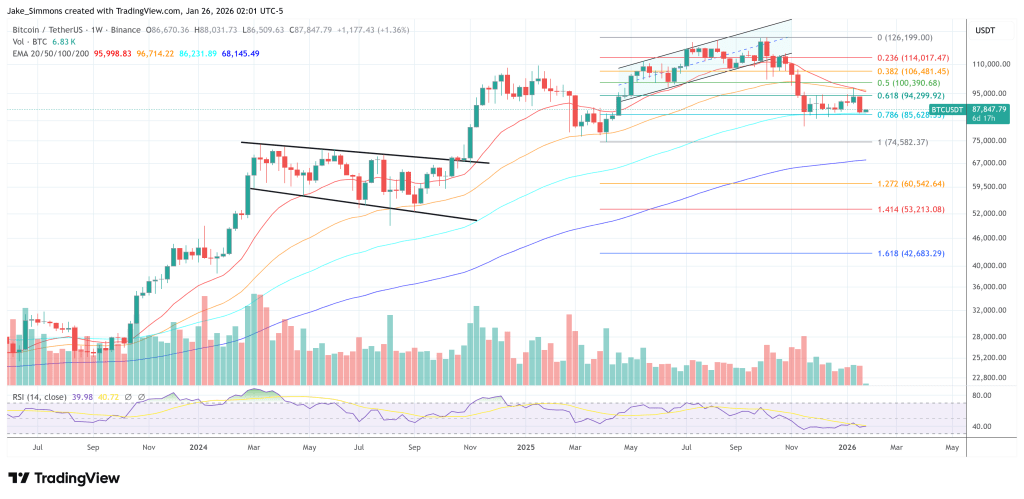
At press time, Bitcoin traded at $87,847.

Bitcoin price chart

Colombia Pension Giant Takes First Step Into Bitcoin – Details

AFP Protección, Colombia’s second-largest private pension manager, is preparing a new product that will give some savers a way to gain exposure to Bitcoin. Reports say the move will be limited, targeted and tied to advisory checks rather than open to every account holder.

Bitcoin As An Option For Qualified Savers

Reports note the fund will be offered only to investors who meet a risk profile and pass a tailored advisory process. That means access won’t be automatic; it will be conditional on an assessment meant to match a person’s tolerance with a small, optional slice of crypto.

The product is designed for long-term allocation and not for quick trading or speculation, according to market coverage. AFP Protección’s executives emphasized that core pension portfolios will remain focused on traditional assets such as bonds and equities, and that any Bitcoin exposure would be a narrow, complementary allocation.

💥 En primicia, Valora Analitik conoció que Protección se prepara para lanzar desde Colombia un fondo con exposición a Bitcoin. El producto no estará enfocado en la especulación de corto plazo, sino en ampliar las opciones de diversificación con una gestión integral de riesgos y… pic.twitter.com/nAO8mbsTLi

— Valora Analitik (@ValoraAnalitik) January 22, 2026

The language used by the firm frames the initiative as diversification rather than a wholesale shift of retirement capital. Juan David Correa, who serves as president of Protección SA, confirmed the plan in an interview with local media outlet Valora Analitik.

Size And Reach Of The Manager

AFP Protección manages assets for millions of clients and has a sizable balance sheet. Reports put its assets under management at roughly 220 trillion Colombian pesos — roughly US$55 billion — and note that the firm serves a broad base of workers through mandatory pensions, voluntary saving plans and severance accounts. The sheer scale of the manager helps explain why even a small, optional product gets wide attention.

Regulation And Reporting

Reports also point to a tightening regulatory backdrop in Colombia. Tax and customs authorities have rolled out new crypto reporting rules that align with international reporting standards.

Those rules are likely to affect how crypto products are structured and how returns or transfers are reported for tax purposes. The change in rules is one reason AFP Protección has framed its product as measured and compliant.

How This Fits A Regional Trend

Across Latin America, some institutional players have been experimenting with limited crypto exposure for years. Colombia’s move follows earlier steps by one or two other local managers and fits a regional pattern where established firms test small, controlled offerings before widening access. The step will be watched closely by investors and regulators overseas.

Reports say potential participants should expect thorough suitability checks, clear disclosures and limits on how much of a retirement portfolio can sit in the new vehicle.

Featured image from Pexels, chart from TradingView

Bitcoin Finds A Real-World Use Case In Las Vegas Stores

Small shops and some bigger chains in Las Vegas are now taking Bitcoin for everyday buys. People scan a QR code, pay from a phone, and the merchant gets paid. According to local reports, owners are trying this out to cut the cost of credit card processing and to attract customers who prefer crypto.

Merchants Cut Costs With Bitcoin

Reports say the move is largely about fees. Credit card processing often takes away 2.5–3.5% of a sale. For many small operators, that is painful. Payment tools that accept Bitcoin — often routed over the Lightning Network or through services that can convert crypto to cash — have lowered that burden for merchants.

According to FOX5, more businesses across Las Vegas are now accepting Bitcoin payments, from chains like Steak ’n Shake to small shops and medical practices. Merchants said Bitcoin helps attract new customers and cut costs, while Square has enabled about 4 million U.S. merchants…

— Wu Blockchain (@WuBlockchain) January 24, 2026

Square’s program, which lets millions of US merchants enable Bitcoin checkout with no processing fee through 2026, helped speed up adoption in the area.

Stores Report Real Transactions

Business owners are reporting real use, not just experiments. Juice stands and cafes have processed payments. Some larger outlets are listed on public payment maps so customers can find them.

This has meant more foot traffic from people who travel with crypto or who prefer to keep their cards for other uses. Reports note both new customers and savings on fees as clear benefits.

Lightning Network Speeds Up Payments

The Lightning Network is being used to make payments faster and cheaper at the cash register. It moves small Bitcoin payments quickly without the long wait a base-layer transfer can cause.

Merchants scan a code or show one on a screen. The payment is then sent from the buyer’s wallet and settled almost instantly. This technical fix has made in-person Bitcoin payments workable for the first time at many spots.

How Owners See It

Owners are balancing savings against new risks. Some keep crypto for a short time, then sell it for cash. Others leave part of their receipts in Bitcoin. Chargebacks, a problem with cards, are reduced when crypto is used.

A few places say small boosts in sales followed their switch to crypto, yet long-term patterns are still being watched. Reports have disclosed these mixed outcomes as part of a slow but clear shift.

Customers Find New Ways To Pay

Shoppers are adapting. Tourists who carry crypto find these spots useful. Locals who are curious try the method at least once. Payment apps and merchant directories make the process easier for everyone.

For those who like simple steps, scanning a QR code and approving a payment on a phone works fine. For others it is a novelty that might stick.

Featured image from Unsplash, chart from TradingView

💾

Las Vegas Valley businesses are accepting Bitcoin as payment as the cryptocurrency continues to grow in popularity.For more Local News from KVVU: https://www...

Does Capital Really Rotate From Gold To Bitcoin? On-Chain Data Offers Insight

“Bitcoin is the digital gold” is one of the most popular narratives in the cryptocurrency industry, reiterating BTC’s growing status as a formidable store of value. However, while the premier cryptocurrency has floundered over the past months, gold and the metals market have largely witnessed explosive growth.

These contrasting performances have led to conversations about capital rotation between Bitcoin and gold, as the crowd expects one to always outperform the other at any given time. Recent data, however, suggests that the relationship between the BTC and gold price action is overrated.

Capital Flow Link Between BTC And Gold Overestimated 

In a January 24 post on the X platform, on-chain analyst with the pseudonym Darkfost weighed in on the discourse surrounding capital rotation between gold and Bitcoin. According to the market pundit, the idea that investor funds flow from gold to Bitcoin is somewhat overblown.

To highlight this overestimation, Darkfost shared a chart showing periods where BTC outperforms or underperforms depending on gold’s trend. This chart typically provides two signals: positive (BTC above the 180-day moving average [MA] and gold below the 180-day MA) and negative (BTC below the 180-day moving average and gold below the 180-day MA).

Bitcoin

As observed in the chart above and stated by Darkfost, the relationship between Bitcoin and gold does not appear to be fully substantiated. The on-chain analyst revealed that there have been as many positive periods as the negative ones, suggesting that the flagship cryptocurrency moves independently of gold.

Darkfost wrote:

This suggests that BTC continues to evolve independently, without clear evidence of a sustained capital rotation from gold.

Furthermore, Darkfost noted that a positive signal does not necessarily mean that capital is flowing out of gold into Bitcoin. According to the on-chain analyst, it is simply not possible to determine whether there is a capital flow relationship between the world’s largest cryptocurrency and gold.

Bitcoin & Gold Price Overview

While Bitcoin started the new year on a pretty strong note, the bullish momentum has pretty much waned over the past two weeks. Meanwhile, the gold price has continued to flourish this year, recently reaching a new all-time high above $4,900 per ounce.

As of this writing, the price of BTC stands at around $89,230, reflecting no significant movement in the past 24 hours. According to data from CoinGecko, the flagship cryptocurrency is nearly 30% adrift its all-time high above the $126,000 level.

Bitcoin

Ethereum Builds Team To Guard Against Quantum Threat

Reports say the Ethereum Foundation has started a new team to prepare the network for possible quantum computer attacks. These machines could one day break the math behind wallets and signatures. The team’s work is moving from research into practical tests and experiments, which has drawn attention across the crypto community.

Ethereum Launches Post-Quantum Team

Based on reports, Thomas Coratger will lead the effort. The team includes cryptographers and engineers already testing new systems on devnets. Some work ties into a project called leanVM and a researcher named Emile, who focuses on building simple quantum-safe tools. The goal is to test new algorithms in real software while keeping current transactions running smoothly.

Today marks an inflection in the Ethereum Foundation’s long-term quantum strategy.

We’ve formed a new Post Quantum (PQ) team, led by the brilliant Thomas Coratger (@tcoratger). Joining him is Emile, one of the world-class talents behind leanVM. leanVM is the cryptographic…

— Justin Drake (@drakefjustin) January 23, 2026

$2 Million In Prizes Encourage Development

A $1 million prize has been set for improvements to the Poseidon hash function. Another $1 million prize supports broader post-quantum research. In total, roughly $2 million are being offered to labs and independent developers to design and test quantum-resistant solutions. Reports say this funding is meant to speed up work and show what can realistically replace current signatures.

Early Tests And Community Involvement

Multi-client devnets are already active. Developers are experimenting with new signature types to see what works and what fails. Biweekly sessions led by researchers like Antonio Sanso let teams share results and update code. A Post-Quantum Day is scheduled for March 2026 before ETHCC, with a larger event planned in October 2026 to show progress and plan next steps.

Quantum computers could, in theory, break the ECDSA and secp256k1 schemes used today. That risk is not immediate but serious enough that Ethereum is acting now. Reports note users should watch for official guidance, follow wallet updates, and avoid reusing addresses once upgrades roll out.

Community reaction has been mixed. Some online discussions praised the careful planning, while traders noticed a small dip in ETH price. Others questioned how upgrades would reach millions of wallets and what happens to old keys. The Foundation’s approach is to test solutions early so users and services are better protected when changes happen.

This step is part of Ethereum’s long-term plan for safety. Tests will continue, standards will be debated, and progress will be shared publicly. By acting now, Ethereum aims to reduce risk and make future transitions smoother for everyday users and the network as a whole.

Featured image from Unsplash, chart from TradingView

Coinbase CEO Shares 6 Takeaways From WEF Davos 2026 – Details

While Binance co-founder and former CEO Changpeng “CZ” Zhao made the headlines following his interview at the just-concluded World Economic Forum, where he called a Bitcoin supercycle in 2026, his crypto counterpart and Coinbase CEO, Brian Armstrong, has come forward with feedback from the global event held in Davos, Switzerland.

Coinbase CEO Praises Trump-Led White House As Most Crypto-Forward Government 

In a January 24 post on the social media platform X, Armstrong shared a few key “themes and takeaways” from the latest edition of WEF. After admitting that the conference offered a productive time of meeting people one-on-one, the Coinbase CEO revealed that the major focus was on pushing crypto adoption globally.

Starting his list of takeaways, Armstrong highlighted that everyone was talking about tokenization, which is beginning to expand to every asset class in the world. The crypto leader said to expect some major progress in the tokenization sector in 2026, especially as the Fortune 500 business leaders continuously lean in.

Secondly, the Coinbase CEO shared that crypto legislation and the CLARITY Act were another area of focus, as the government of the day looks to make the United States the crypto capital of the world. According to Armstrong, most of the bank CEOs he met at the WEF in the past week are actually pro-crypto.

Armstrong wrote on X:

One CEO of a top 10 global bank told me crypto is their number one priority, and they view it as existential.

Furthermore, the Coinbase CEO lauded the Trump administration as the most crypto-forward government in the world at the moment. Armstrong acknowledged their progress with the crypto market structure, stating that these clear rules are crucial for global competitiveness and will put money back in people’s pockets.

In what seemed like a cheeky tone, Armstrong mentioned that ESG (Environmental, Social, and Governance) and DEI (Diversity, Equity, and Inclusion) topics didn’t come up throughout the forum. According to the crypto founder, the week felt productive, as it centered around real, global progress — all thanks to BlackRock CEO and new WEF co-chair Larry Fink.

The Coinbase leader touted crypto and AI (artificial intelligence) as the most talked-about technologies in today’s world. Highlighting their compatibility, Armstrong stated that AI agents will eventually default to using stablecoins for payments, as they cannot be KYC’d like human beings.

Finally, Armstrong revealed that the Coinbase, Circle, and Bermuda partnership to build a fully on-chain economy was announced at WEF Davos 2026. “Excited to make progress on this and create a compelling case study for other nations to follow,” the crypto CEO concluded.

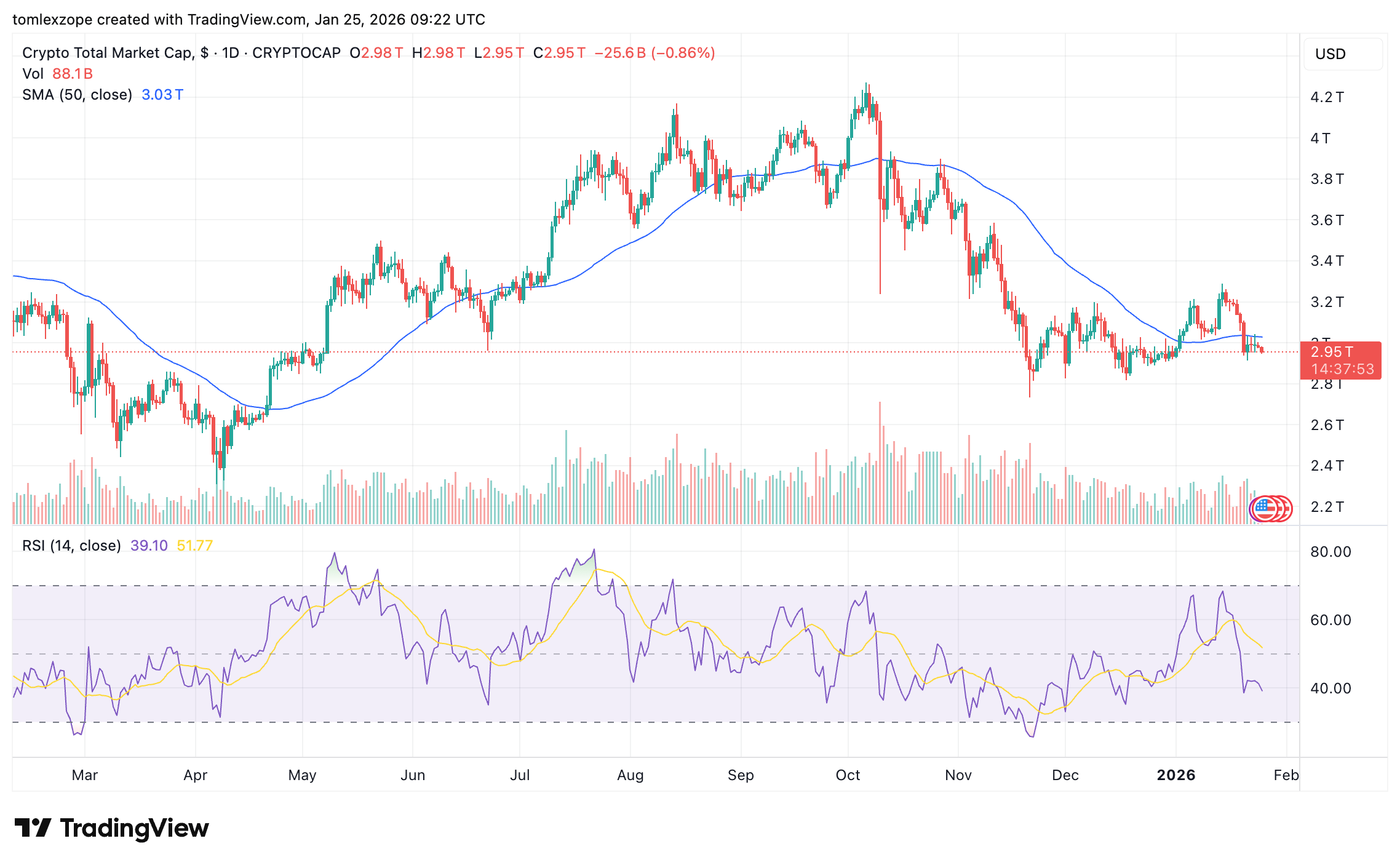
Total Crypto Market Cap At $3.09 Trillion

As of this writing, the global cryptocurrency market has a total capitalization of $3.086 trillion, with Bitcoin retaining its spot as the world’s largest cryptocurrency.

Coinbase

From Boom To Goodbye: NFT Marketplace Nifty Gateway To End Operations

Nifty Gateway, the marketplace that once helped bring NFT drops to a wider audience, will stop running its marketplace on February 23, 2026. The company put the site into a withdrawal-only mode the same day it made the announcement, and users were told they must move any remaining funds and NFTs off the platform before that date.

Withdrawal Window Opens

According to the company, withdrawal tools are available now. Reports note users can pull USD or ETH balances through a linked Gemini Exchange account or send funds to their bank via Stripe.

Emails with step-by-step instructions will be sent to account holders, and a shutdown notice already appears on the Nifty Gateway homepage. The aim, as described by the owner, is to let people retrieve what they own before the platform goes dark.

Today, we are announcing that the Nifty Gateway platform will be closing on February 23, 2026. Starting today, Nifty Gateway is in withdrawal-only mode.

Nifty Gateway was launched in 2020 with the vision of revolutionizing digital art. Since launching, Nifty supported dozens of…

— Nifty Gateway Studio (@niftygateway) January 24, 2026

A Decision To Reassign Resources

Based on reports from Gemini, the closure is meant to let the parent firm concentrate on building one bigger app for customers. The move highlights how interest and trading activity in many NFT markets have cooled from the highs seen in earlier years.

Some collectors and artists are left scrambling to rehome items they once sold or stored on Nifty Gateway.

End Of An Early Player

Nifty Gateway helped make buying NFTs easier for people who preferred credit cards and familiar checkout flows. It launched as a high-profile marketplace and hosted major drops from well-known creators.

The platform supported hundreds of millions in sales at its peak and played a clear part in bringing NFT art into mainstream headlines. Its exit marks the end of an important chapter for that wave of marketplaces.

What Owners Must Do Now

Owners should check their inboxes for the official instructions, confirm where their tokens are stored, and move assets before the deadline. If NFTs are stored in custodial wallets on the site, they will need to be transferred out.

USD and ETH balances should be withdrawn or moved into a connected Gemini account if that option suits the owner. Waiting past the closure date will reduce options.

A Quiet Turning Point

For many collectors, this will feel like another sign that the early boom years have passed. For creators, the change raises questions about where drops and secondary sales will happen next.

Gemini says it will keep supporting NFTs through its other products, including the Gemini Wallet, but the specific ways that creators and buyers reconnect with those audiences will depend on new tools and services that arrive in the next months.

Featured image from Unsplash, chart from TradingView

SEC To Dismiss 3-Year Lawsuit Against Gemini – Details

In a major development, the US Securities and Exchange Commission has filed a joint stipulation with defendant Gemini Trust Company, LLC to terminate its long-running civil enforcement action with prejudice, effectively ending the three-year legal battle over the Gemini Earn crypto lending program.

SEC Vs Gemini

In January 2023, the SEC instituted one of the most controversial crypto-related lawsuits against Gemini Trust Company and its partner, Genesis Global Capital LLC, accusing both parties of illegally offering and selling unregistered securities through the Gemini Earn lending program, a financial product that operated between 2021 and 2022, which allowed customers to lend crypto for interest at 7.4% per annum. 

Following the FTX crash in 2022, Genesis, which had a significant financial exposure to the now-defunct crypto exchange, halted withdrawals on the Gemini Earn Program, effectively locking up $940 million in investor assets. Since then, a series of events has unfolded, including Genesis entering bankruptcy proceedings, and through that process, all Earn investors ultimately recovered 100 percent of their crypto assets in kind. In addition, Gemini has settled related matters with state and federal regulators, paying over $50 million in civil fines. 

In the joint stipulation filed this week, the SEC noted that its decision to seek dismissal “in the exercise of its discretion” took into account the full investor recovery and those regulatory settlements. The dismissal is with prejudice, preventing the SEC from re-filing the same claims, and represents the formal end of one of the most high-profile enforcement actions in the US crypto industry.

US Crypto Regulatory Turnaround

The dismissal of the Gemini case comes amid a broader recalibration of the US crypto regulatory approach under the Donald Trump administration. Several high-profile SEC actions against major platforms, involving Coinbase, Kraken, and Binance, have been dropped or paused, reflecting a shift from a forceful regulatory approach seen under the former chairman, Gary Gensler. 

At the same time, Congress and the White House continue to pursue pro-crypto legislative and policy initiatives. In July 2025, US President Donald Trump signed the GENIUS Act into law, a landmark bill establishing a comprehensive federal framework for stablecoins, aimed at boosting consumer protection and supporting broader adoption of digital assets.

Alongside the GENIUS Act, the highly anticipated Clarity Act, passed by the US House, aims to delineate regulatory responsibilities between agencies like the SEC and the Commodity Futures Trading Commission (CFTC) based on how digital assets function. The US Senate Agriculture Committee is set to observe a markup session of the bill on January 27, indicating steady progress despite recent concerning events, including public outrage by Coinbase founder Brian Armstrong and the Banking Committee’s continued postponement of its own hearing session.

SEC

Bitcoin Spot ETFs Record $1.33 Billion Outflow In 2026 See-Saw Performance

The Bitcoin Spot ETFs continue to witness a volatile start to 2026, with back-to-back weeks showing sharply contrasting performance. After netting a staggering $1.42 billion in weekly netflows on January 16, market momentum soon swung the opposite way in line with a Bitcoin decline, forcing a net outflow of $1.33 billion over the last week. A similar phenomenon was seen in the first two weeks of the year, after an initial net deposit of $458.77 million by January 2 was followed by a net outflow of $681.01 million by January 9. This investor behavior suggests a highly reactive market with little long-term confidence.

No Positive Performance In Bitcoin Spot ETF Market Onslaught

In analyzing the most recent wave of withdrawals in the Bitcoin Spot ETF market, data from SoSoValue shows that the fourth trading week of January recorded no single day with a positive netflow. The heaviest outflows totaled $708.71 million on January 21, followed by the smallest daily outflow of $32.11 million on January 22.

Looking at individual funds, BlackRock’s IBIT, the market leader, suffered the largest net outflows valued at $537.49 million. As usual, Fidelity’s FBTC ranks a close second with redemptions surpassing deposits by $451.50 million. Other Bitcoin Spot ETFs with heavy net outflows also included Grayscale’s GBTC, Bitwise’s BITB, and Ark Invest’s ARKB, which suffered losses estimated at $172.09 million, $66.25 million, and $76.19 million, respectively. 

Meanwhile, VanEck’s HODL, Valkyrie’s BRRR, and Franklin Templeton’s EZBC also experienced net outflows between $6 million and $11 million. Notably, Grayscale’s BTC, Invesco’s BTCO, WisdomTree’s BTCW, and Hashdex’s DEFI recorded the least activity with zero netflows. At press time, total net assets for the Bitcoin Spot ETFs stand at $115.88 billion, with BlackRock’s IBIT accounting for over 54% of these holdings, as the undisputed market leader. Meanwhile, total cumulative net inflow is presently valued at $56.49 billion.

Related Reading: Monero, Zcash, And Dash Prohibited In India Amid Money-Laundering Crackdown

Ethereum Spot ETFs Register $611M Outflows In Market Bloodbath

According to more data from SoSoValue, the Ethereum Spot ETFs also witnessed massive levels of redemptions in the last trading week, resulting in a net outflow of $611.17 million. Similar to its Bitcoin counterpart, the BlackRock ETHA also produced the largest net withdrawals valued at $431.50 million. Presently, the total net assets for the Ethereum Spot ETFs are valued at $17.70 billion, representing 4.99% of Ethereum’s market cap. Meanwhile, the cumulative total net inflow is valued at $12.30 billion.

Bitcoin Spot ETF

$7 Trillion Player Is Moving Into Bitcoin, Can This Trigger A Surge To $200,000?

Swiss banking giant UBS, with assets under management (AuM) of up to $7 trillion, is set to launch Bitcoin trading for some of its clients. This comes amid predictions that regulatory clarity and broader adoption could send the BTC price to as high as $200,000. 

UBS To Offer Bitcoin Trading To Some Wealth Clients

Bloomberg reported that UBS is planning to launch crypto trading for some of its wealth clients, starting with its private bank clients in Switzerland. The bank will reportedly begin by offering these clients the opportunity to invest in Bitcoin and Ethereum. At the same time, the crypto offering could further expand to clients in the Pacific-Asia region and the U.S.

The banking giant is currently in discussions with potential partners, and there is no clear timeline for when it could launch Bitcoin and Ethereum trading for clients. This move is said to be partly due to increased demand from wealth clients for crypto exposure. UBS also faces increased competition as other Wall Street giants are working to offer crypto trading. 

Morgan Stanley, in partnership with Zerohash, announced plans to launch crypto trading in the first half of this year, starting with Bitcoin, Ethereum, and Solana. The banking giant may soon also be able to offer its crypto products, as it has filed with the SEC to launch spot BTC, ETH, and SOL ETFs. 

Furthermore, JPMorgan, another of UBS’ competitors, is considering offering crypto trading to institutional clients, although this plan is still in the early stages. The bank already accepts Bitcoin and Ethereum as collateral from its clients. Last year, it also filed to offer BTC structured notes that will track the performance of the BlackRock Bitcoin ETF.

Can Bank’s Entry Trigger A BTC Rally To $200,000  

Kevin O’Leary predicted that Bitcoin could rally to between $150,000 and $200,000 this year, driven by the passage of the CLARITY Act. His prediction came just as White House Crypto Czar David Sacks said banks would fully enter crypto once the bill passes. As such, there is a possibility that BTC could reach this $200,000 psychological level in anticipation of the amount of new capital that could flow into BTC from these banks once the bill passes. 

BitMine’s Chairman, Tom Lee, also predicted during a CNBC interview that Bitcoin could reach between $200,000 and $250,000 this year, partly due to growing institutional adoption by Wall Street giants. Meanwhile, Binance founder Changpeng “CZ” Zhao said that a BTC rally to $200,000 is the “most obvious thing in the world” to him.

At the time of writing, the Bitcoin price is trading at around $89,600, up in the last 24 hours, according to data from CoinMarketCap.

Bitcoin

Stablecoins Gain Ground In Africa As Remittances Outpace Aid, Ex-UN Official Says

Africa is seeing a quiet shift in how people send and hold value. Mobile phones are central. According to Vera Songwe, a former UN under-secretary-general, millions who lack bank accounts can use stablecoins to protect savings and move money faster. That access matters in places where inflation has been high and bank fees are steep.

Use By Businesses And Everyday People

Reports have disclosed that stablecoins now make up around 43% of all crypto transaction volume in sub-Saharan Africa. Nigeria alone processed nearly $22 billion in dollar-linked stablecoin activity over a recent 12-month span.

That money is used for remittances, payroll and business settlements. Firms and market traders are among the biggest users, but many everyday people are joining in too.

In countries such as Egypt, Nigeria, Ethiopia and South Africa, demand is driven by volatile local currencies and rules that limit access to dollars. Mobile money networks help push adoption along.

Stablecoins Speed Up Cross-Border Payments

Traditional remittances can be costly. At a World Economic Forum panel in Davos, Switzerland on Thursday, Songwe noted that sending $100 through traditional money transfer services in Africa often costs around $6, making cross-border payments both slow and costly.

Stablecoins cut those costs and shorten wait times from days to minutes for many transfers. Small payments and wages can be settled quickly, and that speed changes how businesses plan cash flow.

Local Rules Are Changing Fast

Governments are reacting in different ways. Ghana passed a Virtual Asset Service Providers law to bring trading into a formal framework. On January 13, Nigeria required crypto platforms to link transactions to tax ID numbers, a move meant to bring activity into official records.

South Africa’s central bank has warned that stablecoins and other tokens could pose risks to financial stability as use grows. Policy is being written while users and tech firms keep pushing ahead.

Risks And The Road Ahead

High inflation remains a core reason people are turning to stablecoins. Reports say inflation has exceeded 20% in 12 to 15 countries since the pandemic, and that reality pushes people to look for alternatives to local notes.

Everyday Use, Measured Change

What started as a tech niche has grown into a practical tool for many across the continent. For small and medium businesses, the benefit is clear: faster settlements and lower costs.

For people without bank accounts, a smartphone can now open a route to store value in currencies less tied to local inflation. Adoption will likely keep rising, but how quickly it becomes part of mainstream finance will depend on stronger rules, better safeguards, and the continued spread of simple mobile services that people trust.

Featured image from Unsplash, chart from TradingView

💾

With more stablecoin transfers in 2024 than Visa and Mastercard combined, the asset-pegged token is shifting from niche crypto instrument to a foundational e...

XRP Ledger Enters The AI Era As Ripple Merges Two Mega Trends

The XRP Ledger has entered a new phase of innovation as Ripple integrates to bring together two of the most powerful technology trends shaping the global economy. Long known for its speed, low transaction costs, and enterprise-grade reliability, the Ledger is now expanding beyond payments to data-driven and automated financial applications. By merging AI with decentralized settlement, Ripple is positioning the Ledger to support smarter workflows and more efficient liquidity management.

How Ripple Is Embedding Intelligence Into On-Chain Systems

An analyst known as SMQKE on X has shared a case study of an AI implementation in the cross-border payment, in which Ripple has successfully combined blockchain technology and artificial intelligence to enhance the efficiency, speed, and cost-effectiveness of global transactions.  As a leading provider of real-time cross-border payment solutions, Ripple leverages the XRP Ledger, a decentralized blockchain that enables real-time cross-border settlement. 

Related Reading: Surge In XRP Transactions: 1.45 Million Daily Users Could Signal Price Rally Ahead, Says Expert

What sets this integration apart is the use of AI to optimize transaction flows and routing decisions in real time. Ripple AI-powered systems continuously process large volumes of payment data in real time, allowing financial institutions to make dynamic decisions on the most effective payment paths. 

BlackRock is now using Ripple’s RLUSD as collateral, which is extremely bullish for XRP. JackTheRippler revealed that the altcoin is being positioned as the future infrastructure, which is being built with the potential to hit over $10,000 per coin. With the REAL token launching on January 26th, trillions in global capital could flood into the XRP Ledger. According to JackTheRippler, some projections suggest up to $800 billion could flow into the REAL token on XRP Ledger, potentially sparking a powerful supply shock.

Why The Comeback Feels Different This Time

The rise of the phoenix XRP is here. Crypto analyst Xfinancebull highlighted that Caroline Pham isn’t just another name in crypto. Pham played a role in pushing utility regulation into the Commodity Futures Trading Commission (CFTC), helping shift policy toward real-world use cases. Currently, she is at MoonPlay and posting about the phoenix on X.

Related Reading: How Donald Trump’s Latest Crypto Move Will Boost Demand For XRP

Years ago, Brad Garlinghouse drew that same phoenix, and it became one of the biggest pieces of XRP lore. While the market chased narratives, Ripple has been building institutional-grade crypto products for years. Meanwhile, the token, RLUSD, and the XRP Ledger are now live operating, and recognized among the most compliant blockchain assets in the crypto world.

This is the same asset that survived the SEC’s biggest regulatory battles in crypto history, and is now on the other side with legal clarity, growing integration, and increasing relevance to government infrastructure in its favor. Xfinancebull concluded that Caroline has helped clear the regulatory path, Brad and Ripple built what actually runs on that path, and they have been aligning all along, which is how the real adoption happens.

XRP

XRP Dev Shares How To Retire In A Few Years

A recent statement from an XRP Ledger (XRPL) developer suggests that XRP could be the key to an early retirement shortcut. Unlike steady paychecks or slow-growing investments in traditional assets, cryptocurrencies have the ability to create generational wealth rapidly, due to their penchant for sudden and explosive price moves. Among the thousands of digital assets on the market, the developer highlighted the token as his primary choice for investors seeking substantial returns, even sharing strategies for how the coin can help them retire in a few years. 

XRP Emerges As Shortcut To Early Retirement

A DropCoin XRPL developer, identified as ‘Bird’ on X, announced on Thursday, January 22, that buying and holding XRP at current prices could help investors retire within a few years. The bold claim quickly caught the attention of many in the crypto community, with some asking the developers to elaborate on the strategies involved and the expected timeline for achieving such wealth. 

Related Reading: XRP Price Obliteration Is Not A Matter Of If, New All-Time Highs Are Coming

Not stopping there, Bird claimed that investing in the token could eliminate the need for a job, suggesting that long-term investors may eventually rely on the potential profits from their holdings as a primary source of income. His statements were in response to a post by Watcher.Guru, which the developer directly referenced to support his optimistic long-term outlook. 

In that post, Watcher Guru quoted a statement reportedly made by Binance’s founder ChangPeng Zhao, who also agreed that holding crypto assets over time could make jobs unnecessary and allow investors to retire sooner than planned. The Ledger developer shared a screenshot of Zhao making similar remarks about Artificial Intelligence, suggesting that the Binance founder views both crypto and AI as powerful tools for achieving long-term financial freedom

A crypto community member who responded to Bird’s post questioned how long an investor has to hold XRP before retiring early. The developer answered humorously that it could be held indefinitely, adding that some investors could reach early retirement this year, while others may need a few more years. He emphasized that the timeline ultimately depends on how many tokens an investor holds.  

How High The Altcoin Could Rise To Enable Early Retirement

Addressing questions from the crypto community members, Bird shared his outlook on how high he believes XRP’s price could rise, helping investors achieve early retirement. He predicted that within the next few years, the cryptocurrency could rise to $100 and beyond—a significant jump from its current market price of around $1.90. 

Related Reading: How Donald Trump’s Latest Crypto Move Will Boost Demand For XRP

The Ledger developer suggested that reaching $100 could be a gradual process for the altcoin, forecasting an initial rally to $10 in the First Quarter (Q1) of 2026. Notably, Bird’s remarks reflect a classic buy-the-dip and hold strategy, where investors accumulate during downtrends and patiently wait for the price to rally explosively before taking profits.

XRP

GameStop Transfers Full Bitcoin Stack, Analysts Flag Possible Exit

GameStop moved its entire Bitcoin stash into Coinbase Prime this month, according to blockchain trackers that monitor large transfers.

The wallet associated with the company sent a large deposit to the institutional arm of Coinbase, a platform used by big traders and companies.

Analysts watching on-chain flows immediately flagged the move as a likely setup for a sale, though no confirmed sell orders have been announced.

Big Move To Coinbase Prime

According to on-chain reports, GameStop holds 4,710 BTC that it bought last year, and that full balance was shifted into Coinbase Prime.

The company first bought the coins in May 2025 at prices that averaged near $107,900 per BTC, a buy that cost roughly $504 million at the time.

Moving a corporate treasury from cold storage to an active institutional account is often read as a step toward execution — to sell, hedge, or rebalance — but it is not the same as a sale itself.

GameStop throws in the towel?

Their on-chain wallets just moved all BTC holdings to Coinbase Prime, likely to sell.

Between May 14–23, 2025, they bought 4,710 BTC at an avg. price of $107.9K, investing ~$504M.

Now selling for around $90.8K, potentially realising approximately… pic.twitter.com/Bp7MwRVQ43

— CryptoQuant.com (@cryptoquant_com) January 23, 2026

What Analysts Are Saying

Reports say the math is simple and stark: selling now, with Bitcoin trading closer to the $90,000 area, would lock in a sizable loss versus the initial purchase price.

Several analytics firms put that figure near $76 million if the whole lot were sold at recent market levels. Some market watchers suggest the company could be doing tax-loss harvesting or trimming volatile assets on its books.

Others view it as a pragmatic adjustment to reduce treasury exposure to crypto swings. Still, defenders of the move point out that GameStop’s Bitcoin stake was never a core retail play; it was a treasury experiment meant to diversify.

How Much Has Already Moved

Not all outlets agree on timing or size of day-by-day transfers. Reports note that some transfers earlier this month added up to about half of the original position — roughly 2,396 BTC moved in smaller tranches before the full deposit was flagged.

On-chain sleuths track each shift, and those staggered movements can mean many things: a staged sale, an internal reorganization, or simply routing through a trusted custodian before any trades.

Market And Shareholder Reaction

Share action around GameStop has not mirrored the crypto chatter. While Bitcoin watchers focused on the wallet move, investors were also reacting to company news on other fronts, including fresh share purchases by CEO Ryan Cohen.

Featured image from PeterPhoto, chart from TradingView

Bitcoin Realized Profit/Loss Reveals Underlying Structural Shift — What’s Happening?

Based on data from the weekly price chart, Bitcoin is witnessing a significant loss of over 6% following recent widespread market liquidations. Notably, the premier cryptocurrency has taken on a consolidatory stance in the past day, as if to lend credence to growing hopes of some price recovery. However, a recent on-chain analysis points out that Bitcoin’s outward show of resilience might merely be theatrical and that the flagship cryptocurrency could be facing a dark future ahead.

Bitcoin Enters 30-Day Cumulative Realized Loss Phase Since October 2023

In a recent Quicktake post on CryptoQuant, crypto education and research group XWIN Research Japan dissects the present on-chain situation of Bitcoin, with the center of attraction being the Bitcoin Net Realized Profit/Loss metric, which shows the leading cryptocurrency has recorded a net realized loss on a 30-day basis for the first time since October 2023. 

Bitcoin

However, the losses seen in 2023 were short-lived and rapidly retraced, unlike the current decline, which is broader and more persistent, suggesting a possible structural shift in market dynamics. At this moment, it appears that investors are less-interested in “buying the dip,” nor are they looking to “HODL” through the Bitcoin price action, and are more willing to accept losses.

For this reason, the market can be more plausibly described as being in a state of caution. It is, however, worth mentioning that the present phase does not necessarily precede a market crash. If anything, it reflects that Bitcoin may be entering a more volatile phase, independent of speculative frenzies.

Realized Profits Signal Late-Stage Of Bull Cycle 

XWIN Research further reinforces the hypotheses by referencing the trend in realized profits. According to the market experts, Realized Profits peaked in March 2024 at approximately 1.2 million BTC, and reduced slightly to 1.1 million in December 2024. 

As of July, 2025, realized profits had sharply dropped to 517,000 BTC, reflecting an increasing exit of profit-taking activity within the market. But this pales in comparison to the lower 331,000 BTC recorded in October. The analytics group explained that this contraction occurred despite a rise in prices, thus suggesting an absence of deep upside momentum.

The group further highlights that this is a telltale sign of a late-stage bull market, one which was seen in 2021-2022. In this period, realized profits slowly dropped before the Bitcoin price flipped bearish. More shockingly, the annual timeframe tells a similar story, with annual net realized profits contracting from 4.4 million BTC to 2.5 million BTC, just within October 2025 and early 2026. This is also similar to the phase that preceded the bear market of 2022.

In essence, Bitcoin is in a transitioning phase, from a mature bull phase to a volatile environment. As of this writing, the Bitcoin price stands at $89,462. 

Bitcoin

Featured image from Pexels, chart from Tradingview

Bitcoin Pattern From 2022 That Led To Crash To $20,000 Reappears

Bitcoin (BTC) is mirroring the same setup from its 2022 bull cycle, which led to a massive price crash to $20,000. According to market expert Crypto Bullet, this recurring structure could signal another major correction for BTC ahead. However, this time the leading cryptocurrency could give up almost a quarter of its current value. 

2022 Bitcoin Chart Pattern Signals Over 20% Crash

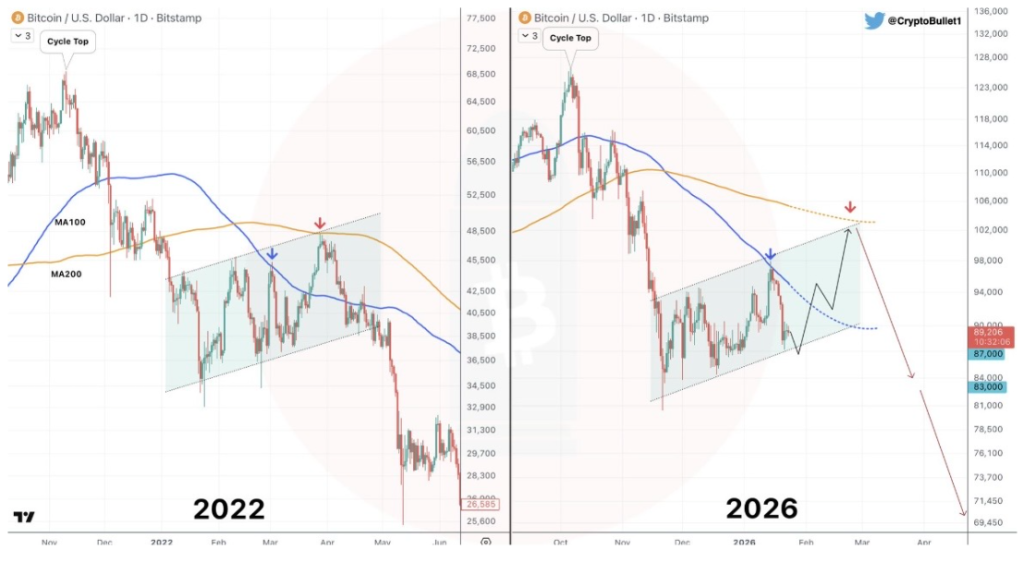
In his technical analysis released on X, Crypto Bullet revealed that Bitcoin is currently repeating a 2022 structure that could lead to a more than 20% decline in its value. To support his bearish outlook, the analyst presented a parallel chart comparing Bitcoin’s price action from 2023-2022 and 2025-2026, highlighting similar technical patterns, price behavior, and Moving Averages (MA). 

During the 2022 cycle, Bitcoin experienced a similar pattern, beginning with a test of the 100-day Moving Average (MA100), highlighted as the blue trendline on the chart. After facing rejection at that level, the price pulled back to a nearby support zone inside a rising channel. From there, BTC staged a sharp rally, surging to fresh highs around $48,500, where it aligned with the 200-day Moving Average (MA200), marked in orange. 

However, the recovery proved short-lived. Bitcoin soon reversed course and failed to reclaim the MA200 as support. Once the cryptocurrency’s price structure was lost, downside momentum accelerated, pushing the price into a much deeper correction toward the $20,000 level. 

According to Crypto Bullet, Bitcoin is repeating this exact pattern in 2026. It has already retested the MA100, gotten rejected, and moved lower into a support zone within a similar ascending channel. The chart also showed that in both cycles, BTC reached a “market cycle top,” first around December 2023 and then again in November 2025, before breaking down and entering a consolidation phase

Given how closely Bitcoin is mirroring its 2022 setup, Crypto Bullet has forecast another dramatic price crash, predicting a more than 23.5% drop from its current price near $89,500 to $68,450. Before this decline happens, the analyst expects BTC to experience a short-term recovery, potentially climbing back above the $100,000 psychological level to reach $102,000. 

Bitcoin Could Still Rally To $92,000

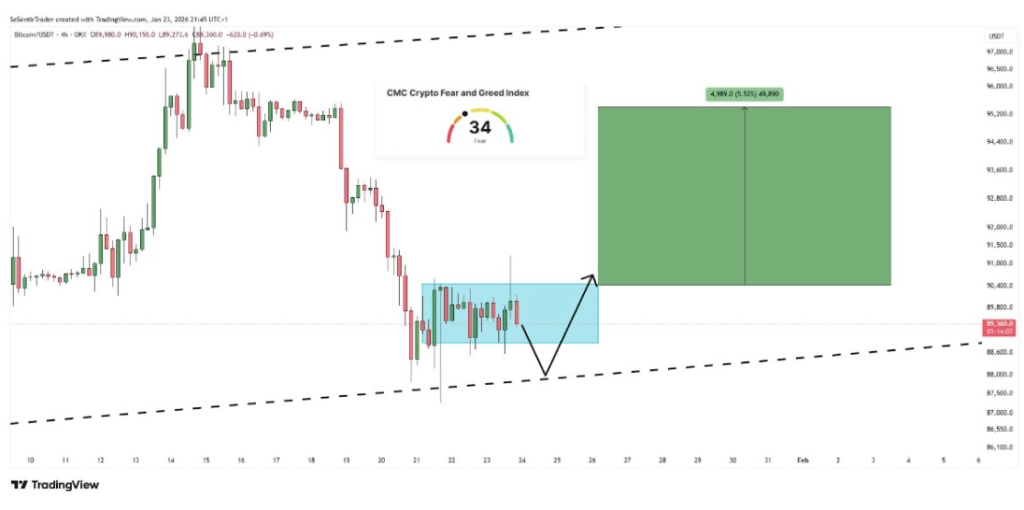
Crypto analyst Tyrex has stated that Bitcoin has been consolidating for the past 48 hours, with price holding above $89,000 for most of that period. Despite the muted price action, he believes that BTC could soon rally to $92,000. The analyst also noted that the broader market is in a state of fear, with many traders anticipating further declines in Bitcoin.

However, the analyst cautions that this expected drop may be a trap. He points out that an ascending channel is forming on Bitcoin’s chart, prompting him to adopt a more bullish outlook despite the prevailing bearish sentiment and sideways price movement.  

Featured image from Unsplash, chart from TradingView

❌