The Federal Deposit Insurance Corporation (FDIC) has announced a new framework that outlines how banks can apply to issue payment stablecoins through subsidiaries as part of the implementation of the country’s stablecoin bill, the GENIUS Act.
FDIC’s First Move On GENIUS Act
In a statement, Acting Chair Travis Hill emphasized that the proposed process is tailored to allow the FDIC to thoroughly evaluate the safety and soundness of applications from banks seeking to enter the stablecoin market.
According to a summary from FDIC staff, banks wishing to issue payment stablecoins will need to submit detailed applications outlining various aspects of their proposed activities.
Each application must include a description of the intended payment stablecoin, along with a comprehensive overview of the subsidiary’s activities.
Additionally, institutions must provide financial information, details regarding the ownership and control structure of the subsidiary, and pertinent policies related to customer agreements, including provisions for custody. Applicants will need to submit an engagement letter from a registered public accounting firm.
30-Day Review Period For Stablecoin Applications
The FDIC aims to promptly review submissions, notifying stablecoin applicants within 30 days whether their application has been deemed substantially complete. Following that, the agency must make a decision on approval within 120 days from the time the application reaches this status.
“This proposed rule is the FDIC’s first action to implement the GENIUS Act,” stated Acting Chairman Travis Hill. He added that in the coming months, the agency plans to introduce proposals to establish the required management standards for subsidiaries of FDIC-supervised institutions that are approved to issue payment stablecoins.
The FDIC is also committed to providing comprehensive regulatory clarity regarding activities associated with digital assets and tokenized deposits. The plan will undergo a public consultation period before it can be finalized.
Featured image from DALL-E, chart from TradingView.com
Following the sudden pullback observed across the cryptocurrency market, the price of XRP has fallen sharply, causing it to revisit the $1.8 threshold. With XRP’s price facing heightened bearish pressure, traders appear to be stepping back, raising questions about the current price action.
Leverage Unwinds Across XRP Markets
XRP’s waning price action is starting to trigger a crucial shift in investors’ action and sentiment toward the leading altcoin. A widely monitored derivatives metric outlined by Arab Chain, an author at CryptoQuant, is still trending lower, suggesting that the market risk balance for the altcoin is subtly recalibrating.
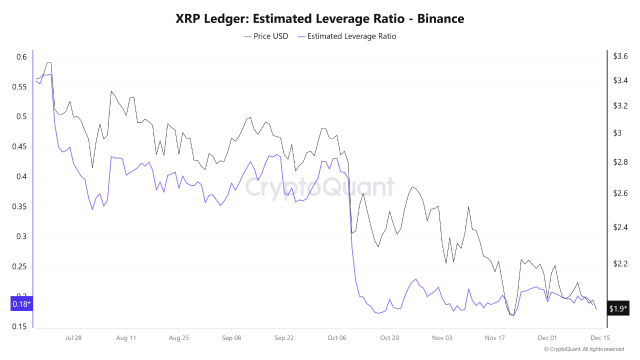
Specifically, the Estimated Leverage Ratio (ELR) for XRP, a metric that monitors the amount of borrowed capital traders use in relation to exchange balances, is showing a persistent downtrend. Typically, a continued decline in the measure is a clear sign of reduced risk in the derivatives market.
After examining the XRP’s ELR on Binance, the world’s largest cryptocurrency exchange, Arab Chain found a persistent decrease to roughly 0.18, reflecting a clear sign of caution in the XRP market on Binance. It is worth noting that this position is one of the lowest levels recorded during the ongoing period, as the price of the token trades close to the $2.00 mark.
Arab Chain highlighted that the drastic decline in the ELR suggests that investors’ reliance on decrease is decreasing, meaning that most of the funded positions have been closed or limited. Structurally, a decline in leverage is seen as an indication of reduced market fragility.
When this occurs, it lowers the likelihood of forced liquidations, which are caused by sudden price movements. As the market tends to lower risk and reset open positions, this behavior usually happens following times of increased volatility or price corrections.
Interestingly, the drop is occurring along with a downward trend in XRP’s price compared to its previous levels above $3.00. This synchronicity is a sign that the accumulation of highly leveraged positions does not fuel the price decline. Rather, it is riven by the unwinding of such positions.
In the past, environments like these typically marked transitional phases. During this period, the market transitions from active speculation to a calmer phase concentrated on rebalancing.
A Stabilization To Kickstart A Rally
Once the metric starts to stabilize again at a relatively low level, Arab Chain noted that it could lay the foundation for more substantial XRP price movements in the future. However, this is expected to happen once liquidity slowly returns to the derivatives market in the absence of excessive leverage.
In other words, low leverage would make any future rally less likely to see a dramatic reversal. While the ELR sits at 0.18, the market is still reconstructing itself and creating a more balanced base prior to calculating its next major direction. Whether it resumes its upside direction or enters a prolonged consolidation phase depends heavily on the metric’s movement.
Crypto pundit Chain Cartel has raised several key points following SWIFT’s latest comment on its move to adopt blockchain technology. The pundit claimed that Ripple’s XRPL network best suits what SWIFT is trying to achieve and suggested that the two firms collaborate.
Pundit Points To Ripple’s XRPL After SWIFT’s Announcement
In an X post, Chain Cartel stated that SWIFT admitted they are building Ripple’s XRPL network, but did not explicitly say so in their announcement. The pundit was referring to an X post from SWIFT highlighting their earlier announcement to add a blockchain-based ledger to their infrastructure.
The pundit explained that SWIFT’s language in the X post suggests that they want to build something like Ripple’s XRPL. He declared that it is not Bitcoin, Ethereum, or any generic blockchain experiment but precisely what Ripple has been building for a decade. Chain Cartel noted that Ripple’s model has always been a neutral settlement layer, real-time atomic finality, shared ledger visibility for institutions, interoperability with legacy rails, and liquidity-first design.
Chain Cartel then alluded to SWIFT’s statement about its plans to build a blockchain-based ledger to be included in its payment infrastructure and provide a single source of truth, enabling instant, 24/7 cross-border payments. He declared that this is Ripple’s blueprints with the XRPL, as the crypto firm uses the network for its payment services.
In line with this, the pundit remarked that SWIFT doesn’t replace rails, but instead coordinates them, and that Ripple doesn’t replace banks, but instead connects them. He added that SWIFT is acknowledging that the future payment stack requires a ledger layer, not just messaging, and that the only model already battle-tested at scale is Ripple’s XRPL.
However, it is worth mentioning that SWIFT doesn’t plan to integrate Ripple’s Ledger. Instead, it is building this blockchain-based ledger in partnership with Consensys and Chainlink. As such, although SWIFT may plan to build a network similar to Ripple’s XRPL, it intends to do so without assistance from the crypto firm.
Ripple Looking To Expand Its Payment Service
Ripple is looking to expand its payment service, as it recently announced plans to begin testing its RLUSD stablecoin on Ethereum layer-2 networks Base, Ink, Optimism, and Unichain. The move comes just days after the OCC granted Ripple a conditional approval to become a bank, which is also a major boost for the firm’s payment service.
Ripple plans to expand its RLUSD stablecoin beyond the Ethereum and XRPL networks to these layer-2 networks through its partnership with Wormhole. The firm noted that the future of crypto is multichain, which is why it is adopting this strategy. This move gives Ripple’s clients greater options when using the RLUSD stablecoin, and it could also attract new users to the stablecoin, which is currently one of the fastest-growing stablecoins.
As volatility weighs heavily on the market, fresh insights are shedding light on who is really driving activity in the XRP ecosystem. A crypto analyst has shared new observations, revealing that a specific demographic continues to dominate XRP trading activity. The analyst explained that this trend has held steady despite the cryptocurrency experiencing notable downside momentum, with prices sliding to new lows amid broader market uncertainty.
Analyst Says Whales Are Dominating XRP
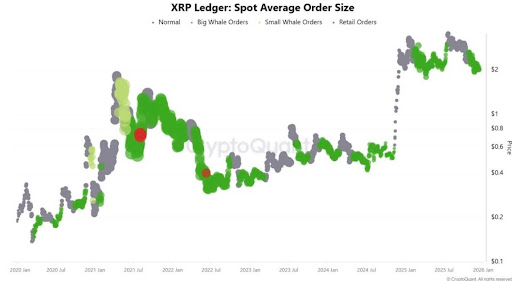
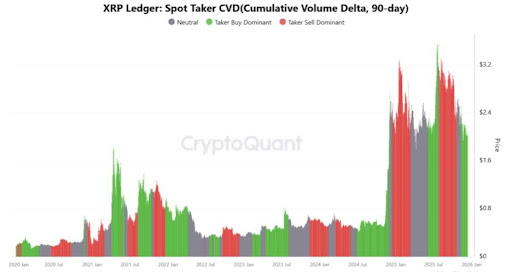
A recent analysis report by market expert Xaif Crypto suggests that whales remain the dominant demographic influencing price action. He shared a chart on X highlighting Spot Average Order Size on the XRP Ledger, showing normal, retail, and big and small whale orders.
The analyst noted that the recent spike in XRP trading has been driven primarily by whales. According to his report, this trend has persisted despite the altcoin entering a period of short-term price weakness. The cryptocurrency has recently declined toward its lowest price levels this year, raising concerns among smaller investors.
Xaif Crypto explained that this type of behavior from whales is often seen during market bottoming phases. He emphasized that large holders typically increase accumulation when prices are depressed and avoid aggressive buying once a strong uptrend is already underway. The analyst also noted that this strategy suggests whales may be positioning themselves ahead of a potential recovery in XRP’s price.
The continued presence of whales has also helped stabilize liquidity to some degree during the ongoing decline. While retail traders may hesitate amid falling prices, whale activity tends to prevent sharp breakdowns by absorbing significant selling pressure.
Buying Sentiment Surges Amid Price Weakness
A CryptoQuant analyst who also highlighted that XRP’s trading activity continues to be dominated by whales has observed a notable change in the cryptocurrency’s Spot Taker CVD. According to the analyst’s report, XRP’s Spot Taker CVD has entered a taker-buy dominant trend. This shift suggests that aggressive buyers are now outweighing sellers, often interpreted as a sign of strengthening market sentiment and potential upside for price action.
At present, XRP is trading around $1.82, down more than 6% over the past 24 hours, according to CoinMarketCap. Over the past week, the cryptocurrency’s price has fallen by nearly 9%, adding to the broader bearish outlook. XRP’s year-to-date performance is also negative, with the cryptocurrency losing about 22% of its value so far.
Despite these severe declines, buying activity has increased significantly. Additionally, daily trading volume has surged by more than 97%, suggesting renewed interest as whales continue to shape the market’s direction.
Биткоин снова уперся в собственный парадокс: чем он ценнее как «база доверия», тем сильнее хочется использовать его не только как хранилище, но и как средство для платежей, DeFi и ончейн‑продуктов. И тут начинаются проблемы. Базовый слой Bitcoin по дизайну медленный, ограниченный по пропускной способности и дорогой в периоды перегрева. На нем далеко не уехать. Да, бывают окна «дешевого» мемпула — но рынок уже понял, что стабильная UX‑модель не строится на удаче.
В 2025‑м эта тема звучит еще громче из‑за дискуссии вокруг «комиссионного будущего» сети. Когда комиссии падают, пользователям приятно, майнерам — не очень, и это запускает неприятные вопросы о долгосрочной устойчивости модели безопасности после халвинга. Cointelegraph, ссылаясь на Galaxy Digital, писал, что дневные комиссии Bitcoin обвалились более чем на 80% относительно апреля 2024 года, а часть блоков фактически «почти бесплатная».
На этом фоне внимание к Bitcoin Layer 2 и инфраструктуре вокруг $BTC выглядит не модой, а прагматикой. Если ликвидность и доверие — в Bitcoin, то где будет исполняться «быстрый» финансовый слой? Именно поэтому такие истории, как Bitcoin Hyper, начинают собирать спрос еще до выхода продукта: рынок покупает не только токен, а ставку на архитектурный сдвиг — исполнение вне L1, финальная безопасность через L1.
Почему нарратив Bitcoin Layer 2 снова возвращается в 2025 году
Ралли интереса к Bitcoin L2 подпитывается сразу двумя силами: UX и экономика. UX — потому что пользователи и билдеры привыкли к почти мгновенным подтверждениям и копеечным комиссиям в других экосистемах. Экономика — потому что «пустой мемпул» звучит хорошо до тех пор, пока вы не задаетесь вопросом: а что будет поддерживать рынок комиссий в долгую? Отсюда и рост обсуждений тезиса про перенос активности, которая генерирует комиссии и удерживает пользователей, в «надстройки» вокруг Bitcoin.
В конкурентном поле тоже происходит любопытное расслоение. Одни команды идут в сторону BitVM/zk‑нарративов и мостов, пытаясь минимизировать доверие к бриджам и повысить безопасность выхода в $BTC. Например, Citrea в 2025 году выкатывала крупные апгрейды тестнета и работала над BitVM‑основанной мостовой архитектурой, параллельно снижая комиссии на уровне системы.
Другие экосистемы делают ставку на «Bitcoin‑ориентированные» смарт‑контракты и ускорение исполнения транзакций поверх Bitcoin‑сеттламента (тот же Stacks исторически двигался в эту сторону через крупные апгрейды). В этом ландшафте Bitcoin Hyper — еще один вариант ставки, но с иной технической интонацией: скорость и девелоперский стек как главный крючок. И, если честно, именно это сейчас лучше всего «продается» разработчикам: меньше ожидания, больше результата.
Почему SVM на Bitcoin может стать настоящим магнитом спроса
У Bitcoin Hyper ставка предельно ясная (и слегка дерзкая): принести Solana Virtual Machine (SVM) в Bitcoin Layer 2 и получить исполнение смарт‑контрактов с экстремально низкой задержкой — проект прямо обещает производительность «быстрее, чем Solana». Это важно, потому что для DeFi, игр и высокочастотных сценариев задержка — не косметика, а экономика продукта: арбитраж, ликвидации, MEV‑динамика, UX в платежах. Чем быстрее «кухня» исполнения, тем выше потолок по сценариям.
Архитектурно месседж тоже попадает в нерв рынка: модульная схема, где Bitcoin L1 выступает базовым слоем, а реальные расчеты уносятся в L2. Да, у модели есть компромисс — заявлен single trusted sequencer с периодическим якорением состояния в L1. Риск тут очевиден: централизация последовательности транзакций и потенциальные точки отказа/цензуры на уровне секвенсора (как бы ни был красив мост и SDK). Но вот что многие упускают: на ранней стадии рынок часто покупает не «идеальную децентрализацию», а скорость выхода экосистемы и время до product‑market fit. Точнее — баланс: чуть меньше идеала сегодня, чтобы не потерять темп завтра.
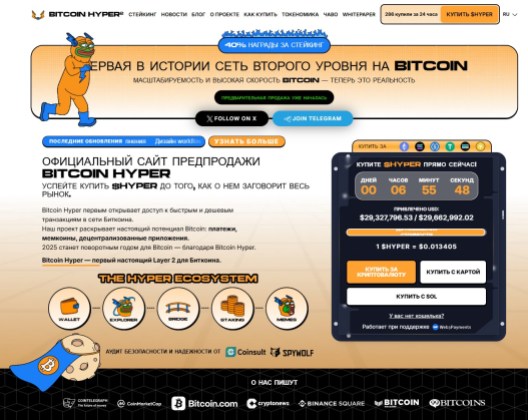
Спрос на историю подкрепляется и цифрами: пресейл уже привлек $29,5 млн при цене токена $0,013435. Вдобавок данные по крупным адресам показывают две заметные покупки примерно на $396 тыс.; самая крупная транзакция — около $53 тыс. (19 ноября 2025 года). Это не гарантия роста, но сигнал: часть капитала явно хочет экспозицию к нарративу «Bitcoin L2 + быстрые смарт‑контракты». И да — для многих это выглядит логичнее, чем просто держать еще один «L1 ради L1».
Дальше будет решать не лозунг, а три метрики: качество бриджа для BTC‑перетоков, реально достижимая задержка/стоимость исполнения и способность привлечь билдеров (Rust‑ориентированный SDK тут играет в плюс). Для понимания полезно сравнить, что именно рынок «покупает» сейчас: технологию, бренд или ликвидность — см. список лучших монет на 2025 год.
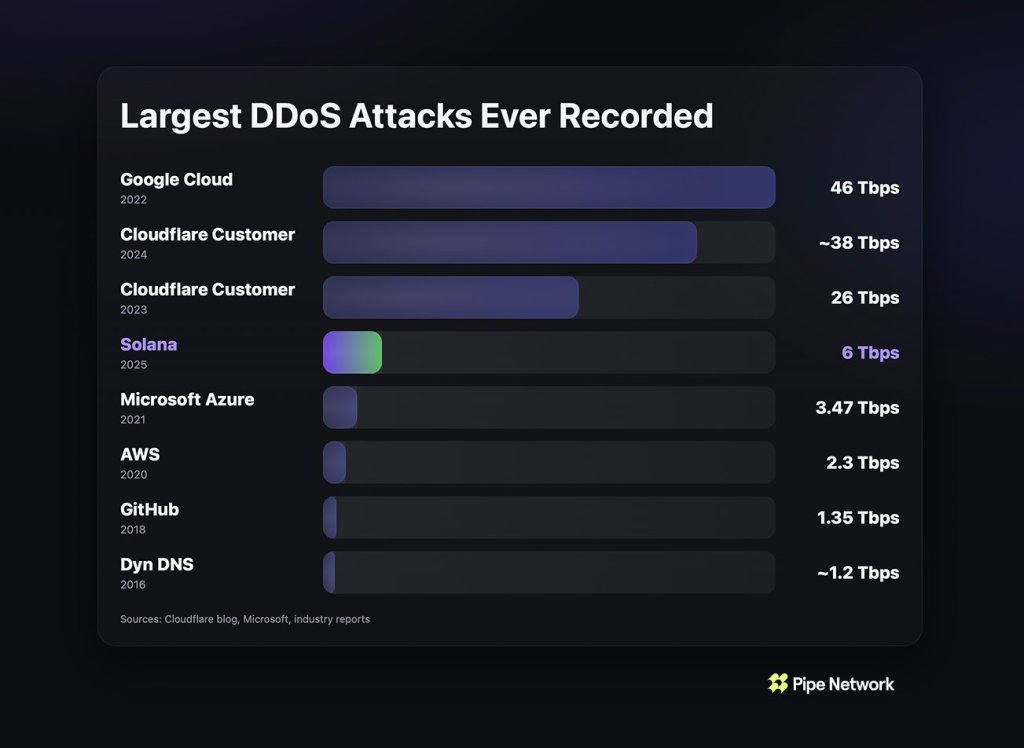
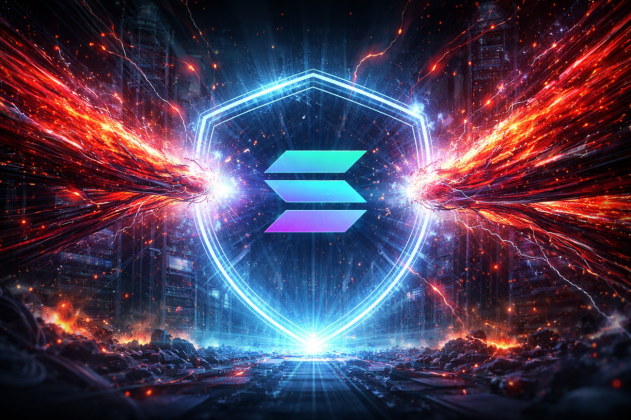
Solana has been battling what some ecosystem builders are calling an internet-scale DDoS campaign — and, despite the usual “Solana is fragile” jokes, the network seems to be shrugging it off.
Pipe Network said of the ongoing attack via X today: “The ongoing DDoS attack on Solana is one of the largest in internet history. 6 Tbps volumetric attack translates to billions of packets per second. Under that kind of load, you’d normally expect rising latency, missed slots, or confirmation delays.”
Pipe further says that’s not what the data is showing. “Median tx confirmation ~450ms,” the team wrote, adding that p90 remains under 700ms and slot latency is holding at 0–1 slots. In other words, if you’re a regular user or trader, you might not even know anything’s happening. Which is kind of the point.
Reactions From The Solana Community
Raj Gokal, Solana Labs’ co-founder and COO, put it more bluntly in a reply to a broader DDoS debate: “have you heard about the ongoing DDOS against Solana that has had zero effect on performance?”
The backdrop here matters. Justin Bons had posted about Sui being DDoS’d yesterday, claiming it triggered “mass delays” and arguing that “127 validators is not enough,” with the broader warning: don’t let validator counts drift too low if you want a chain to be resilient.
Mert Mumtaz, CEO of Helius, largely agreed with the premise — but pushed back on the simplistic “more validators = solved” framing.
“I understand your point & mostly agree with you,” Mert wrote, before adding that “a chain is more resistant to DDoS with 100 professional high powered validators compared to 10k validators run by amateurs.” He also said there are scenarios where higher validator count can help, but emphasized it isn’t the core defense by itself. Then he dropped the key detail: Solana’s attack hasn’t been a one-day headline, it’s been going on for a while.
“And fyi there has been a colossal ddos attack on Solana for weeks now,” Mert wrote, later adding that Solana “has been under a colossal DDoS attack for at least over a week now btw” — and that the fact most users haven’t felt it is “a big testament to the level of engineering present here.”
Solana co-founder Anatoly Yakovenko chimed in with a more technical angle on why validator count can matter in specific leader-hand-off dynamics: “Validators count helps if the previous leader can finish their block while the current one is being hit. Then the cost of ddos approaches the cost of ddos the whole network.”
Translation: if an attacker wants to reliably disrupt block production, they may have to sustain pressure across more of the network, not just pick off a single leader at the wrong moment. That gets expensive fast.
SolanaFloor summed it up via X: “Solana has been under a sustained DDoS attack for the past week, peaking near 6 Tbps, the 4th largest attack ever recorded for any distributed system. Network data shows no impact, with sub second confirmations and stable slot latency. The Sui network was also targeted by a DDoS attack yesterday, resulting in delays in block production and periods of degraded network performance.”
And there’s a more strategic takeaway that’s starting to sound less theoretical each month: blockchains are now juicy targets. David Rhodus, founder of Permissionless Labs (and a contributor to Pipe Network), said: “This puts Solana among the most heavily DDoSed targets in internet history. It reinforces that blockchains are now Tier-1 DDoS targets. This is not “script kiddie” activity — 6 Tbps is industrial-scale.”
If you’re a validator, Mumtaz offered the practical advice you’d expect in a week like this: have backups across multiple hosting providers and regions. Because even if the chain holds, your own infrastructure might not.
The broader point, though, is the new baseline: these networks are getting stress-tested like mainstream internet services now. Solana’s claim today is that it passed — quietly, under load, and without users noticing. That’s the kind of victory that doesn’t look dramatic on a chart. It just […] works.
Кори Айринг, известный покерный игрок и автор популярного контента, запустил необычную рождественскую акцию для своей аудитории. Вместо классического фриролла он предложил подписчикам участие в конкурсе с общим призовым фондом $30 000, главным призом которого стали места в дорогих кеш-играх.
Проект реализуется при поддержке CoinPoker и уже привлек внимание нестандартным подходом к вовлечению игроков и прозрачной механикой отбора.
Как контент-мейкер и амбассадор CoinPoker превратил неудачи на крипторынке в покерный челлендж с реальными бай-инами по $10 000
В основе Christmas Freeroll лежит личная история самого Айринга. В начале года он поставил цель выйти на капитал в $1 млн и сделал крупную ставку на криптовалюты, инвестировав значительную часть своих средств в Bitcoin, Ethereum и Solana. Резкое падение рынка перечеркнуло эти планы, и Айринг оказался перед необходимостью искать альтернативный путь к цели.
В отличие от большинства инфлюенсеров, он не стал ограничиваться мотивационными заявлениями. Айринг решил вернуться в среду, где чувствует себя профессионалом, — в покер, и применить классическую модель бэкинга в необычном формате. Вместо поиска инвесторов он сделал ставку на собственных подписчиков, предложив им шанс сыграть на высоких лимитах за его счет.
Механика отбора построена на игре в кеш на платформе CoinPoker. Участники регистрируются с промокодом CE и играют раздачи в период с 6 по 25 декабря. В рамках акции разыгрываются два бай-ина по $10 000 для игры в The Lodge — техасском покер-руме, которым управляет Даг Полк. Еще $10 000 распределяются между финалистами в виде денежных призов.
Победители определяются в двух категориях. В зачете The Protege ключевую роль играют показатели эффективности и итоговый финансовый результат, тогда как The Grinder ориентирован на объем игры: самые активные участники выходят в отдельный мини-турнир, победитель которого получает второй хайстейкс-бай-ин. Организаторы отдельно подчеркивают, что в расчет принимается только честная игра, без попыток искусственно увеличить количество раздач.
Первый этап уже завершен. Победительницей категории The Protege стала подписчица по имени Кайла, которая получила место в реальной кеш-игре против опытных регуляров. Несмотря на отсутствие большого опыта в подобных составах, ей удалось завершить сессию с прибылью и на практике доказать, что формат работает не только на бумаге, но и за столом.
Вторая путевка пока остается открытой. Борьба за победу в The Grinder продолжается, а финальный турнир запланирован на конец декабря. Для многих участников это редкая возможность без личных вложений проверить себя в условиях, которые обычно доступны лишь профессионалам.
Заключение
Проект Кори Айринга показывает, как личный вызов может превратиться в масштабную медийную и игровую инициативу. Christmas Freeroll объединяет контент, живой покер и реальные деньги, предлагая аудитории не абстрактные обещания, а конкретный шанс сыграть на высоких лимитах.
Для CoinPoker это еще один шаг в сторону нестандартных форматов, а для игроков — возможность войти в хайстейкс через честный и прозрачный отбор.
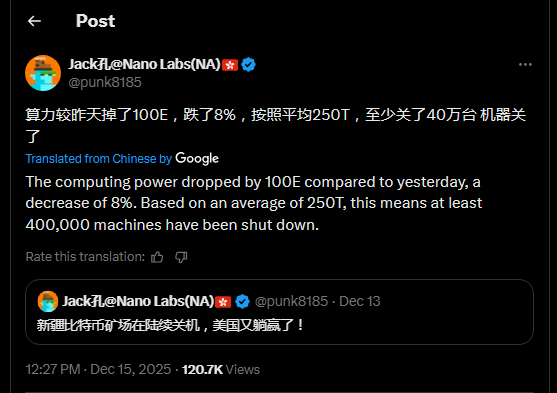
According to a post by former Canaan (a Chinese tech company) executive Jianping Kong, Bitcoin’s estimated hashrate fell roughly 10% in a single day, sliding from about 1,053 TH/s to just under 943 TH/s.
Kong said the decline equated to roughly 100 TH/s to 110 TH/s lost since Sunday and blamed the change on mining farms in China’s Xinjiang region shutting down.
He wrote that “at least 400,000 machines” were taken offline, using an assumed rate of 250 TH/s per ASIC as his basis.
China Mining Instability
Based on reports, China remains a volatile source of hashrate. Before 2021, China supplied a majority of the network’s computing power. Now estimates place its share closer to 14% to 20% depending on the data provider.
Cheap power has drawn miners back, but political and regulatory swings can push large clusters off the grid with little warning.
Kong framed the recent shutdowns bluntly, saying the temporary loss hands an advantage to other countries, adding that “the US wins without lifting a finger.”
Impact On Network
Data recorded the drop from 1,053 TH/s to about 943 TH/s, a decline of just over 110 TH/s and roughly 10%. That kind of move can change mining conditions.
Blocks may be found a little slower until the next difficulty adjustment. The network’s total hashrate is always an estimate inferred from on-chain data, so exact figures are not precise, but the size of this swing is large enough to show how concentrated pockets of mining can still move global metrics.
Kong’s machine-count estimate — and the 250 TH/s-per-ASIC figure he used — are his calculations, not a confirmed inventory count from operators on the ground.
Bitcoin Mining Operations And Market Shifts
Reports have disclosed that US mining companies are expanding capacity as global hashrate reallocates.
Hut 8 announced it is building four new mining sites in Texas, Louisiana and Illinois, adding 1.5 gigawatts of power capacity.
American Bitcoin, a company tied to the Trump family, is now part of that growth story; the firm acquired a fleet of 16,299 Antminer U3S21EXPH units from Bitmain and its board includes Eric Trump, the second-eldest of US President Donald Trump’s three sons. These moves underline a clear shift in where large-scale mining is happening.
Featured image from Unsplash, chart from TradingView
Cardano founder Charles Hoskinson wants crypto to stop acting like it’s permanently stuck in 2021 brain.
In a Dec. 15 livestream titled “Some End of Year Thoughts,” the IOG CEO delivered a blunt year-end diagnosis of a market that, in his telling, lost its retail engine, let politics turn into a sideshow, and drifted back into the easiest (and laziest) narrative in the business: find the next 10x, then dump it on someone else.
“This has been a really [expletive] up year for our industry as a whole,” Hoskinson said from Colorado, describing 2025 as “a donkey of a year” — “an old donkey with a gas problem.”
Cardano’s Hoskinson Warns Of Retail Exodus
His first big complaint was structural, not emotional. The Cardano founder argued that institutional capital did arrive, but much of it got “locked into the Bitcoin layer,” and didn’t rotate into altcoins the way prior cycles did. “So we lost our trickle down effect that we enjoyed in 2021 and in 2017,” he said, framing it as a market-mechanics issue as much as a sentiment one.
Then he pivoted to politics. Hoskinson described a messy set of expectations heading into 2025 — hopes of a more constructive US regulatory posture, then disappointment as crypto became entangled in headline-grabbing memes and what he characterized as erratic signaling. He pointed to the launch of TRUMP coin at the inauguration (as he recounted it), followed by MELANIA, calling them “cash grab situations” that left the broader industry wearing the reputational fallout while still chasing regulatory relief.
The deeper problem, though, was retail. The Cardano founder argued the industry never rebuilt trust after the 2022 wipeout, and that 2025 didn’t offer a compelling reason for everyday participants to come back beyond speculative churn. “Retail showed up in 2021… and then they got screwed again and again and again,” he said. “And now you want them to come back so you can do it again. Will they? No.”
That sets up his core pitch for 2026: a reset framed as a return to “first principles,” with less reliance on governments, celebrity catalysts, or “the cavalry.” His language wasn’t subtle. “No government is coming to save us. No large company is coming to save us. No large investor is coming to save us,” he said. “We are on the island.”
He also tied that reset to a broader, darker worldview — AI, robotics, and a society he worries will drift into a “dystopian hellscape” without credible systems for agency, ownership, and verification. Whether you buy that framing or not, it’s clearly the rhetorical engine he wants crypto to run on: less number-go-up, more “what are we actually building, and who does it help?”
Hoskinson didn’t completely let his own camp off the hook, either. He acknowledged missed predictions — including his past expectation that bitcoin would reach $250,000 in 2025 — and the ongoing criticism he gets for timelines.
“I honestly believed [Bitcoin] would be back in December of 2024. Because I believed that Trump would be good for crypto. I was wrong. I believed it and I was wrong. I’ll admit that. But I do believe in 2026 there’s a path for it to get there. And I do believe we as an industry will pivot and return to retail and rebuild those relationships and get it done. It’ll be a difficult road, but I see a path to make that happen. Leios will ship. We know how to do it. We wrote all the code down. We got it done,” Hoskinson said.
Towards the end, he tried to anchor the “reset” in concrete ecosystem moments, pointing to Midnight’s launch mechanics as an example of retail-first distribution and highlighting heavy trading activity around the token. “The bullshit’s over,” he said. “We’re back to work… in 2026 it’s a return to first principles.”
The Office of the Comptroller of the Currency (OCC) recently sparked a wave of criticism from traditional finance groups following its approval of conditional bank charters for five cryptocurrency firms: Ripple, Circle, BitGo, Paxos, and Fidelity.
Stablecoins Seen As Direct Threat
Following the OCC’s announcement, industry stakeholders quickly voiced their concerns. Traditional banks expressed apprehension that these approvals stretch the definition and historical purpose of the national trust bank charter.
Rebeca Romero Rainey, president and CEO of the Independent Community Bankers of America, stated that the conditional approvals endanger consumers and create institutions that the OCC may not effectively manage.
She further remarked that the new framework allows stablecoin operators access to the federal banking system without the rigorous capital and regulatory requirements that traditional banks must uphold.
Todd Phillips, a professor at Georgia State University and former attorney with the Federal Deposit Insurance Corporation, also noted that stablecoins pose a direct threat to the conventional banking model.
He remarked that banks are reacting aggressively to counter this emerging competition from stablecoins, which are perceived as encroaching on their market share.
In defense of the OCC’s actions, Comptroller of the Currency Jonathan Gould emphasized the benefits of new entrants in the federal banking sector, asserting that they would introduce fresh products and services while enhancing competition. He views this as a positive move for consumers and the broader banking industry.
Banks Raise Alarm Over OCC’s Crypto Trust Charters
One key difference between trust banks and conventional banks is their inability to accept deposits or make loans. Nonetheless, banks are wary that these newly chartered firms may venture beyond merely holding assets to back stablecoins.
Rob Nichols, president and CEO of the American Bankers Association, expressed concern that this expansion of the trust charter blurs the lines defining banking activities and could lead to regulatory arbitrage.
The Bank Policy Institute (BPI) also raised questions about the OCC’s approval process, urging transparency to help the public understand the rationale behind these decisions. Greg Baer, the BPI’s president and CEO, emphasized the need for clarity around the applications.
The current conditional approvals for crypto trust banks present a more viable litigation landscape than earlier fintech charters, according to Andrew Grant, co-founder of Runway Group, a consultancy focused on financial technology.
Many banks are reportedly unhappy about the momentum of the OCC’s recent decisions, suggesting they may take steps to introduce regulatory friction against these new entrants.
Furthermore, the provisions of the GENIUS Act permit the establishment of national banks without deposit insurance, which complicates the ability of traditional banks to mount effective legal challenges against the approved cryptocurrency firms.
Todd Baker, a senior fellow at the Richman Center for Business, Law and Public Policy at Columbia Business School, noted that while litigation may yield some restrictions on crypto-related activities, it is unlikely to impact stablecoin issuance, redemption, or custody.
Featured image from DALL-E, chart from TradingView.com
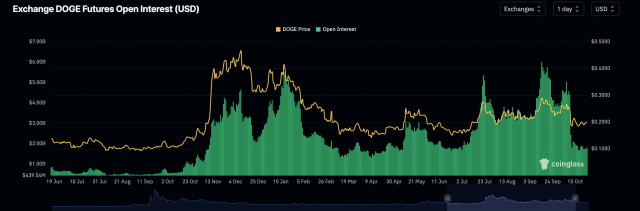
Dogecoin’s open interest has seen a significant decline over the past few months, and the latest push lower has sent the meme coin scraping April 2025 levels. The current trend mirrors the Dogecoin price decline that has persisted even during the Bitcoin price uptrend. Looking at the historical performance of Dogecoin over time, when the open interest has seen a significant crash, it is possible that the meme coin could see a quick bounce at current levels.
Where The Dogecoin Open Interest Is Sitting
Coinglass data points out how much the Dogecoin open interest has declined in recent times, after hitting new all-time highs back in the fourth quarter. The all-time high open interest for the cryptocurrency sits firmly at the $6.01 billion that was recorded back on September 13, showing the stark difference between where it was and where it’s sitting at right now.
The data aggregation website shows that the Dogecoin open interest is currently sitting at $1.8 billion, which shows a 70% decline over the last three months. The last time that the open interest was this low was back in April 2025, following Donald Trump’s tariff wars.
Crypto analyst KrissPas also highlights the Dogecoin open interest performance over this time, showing times where it has spiked this year. So far, the DOGE open interest has crossed the $5 billion mark a total of three times, but each time has ended up in a major crash.
KrissPax explains that the crash in open interest triggered by massive liquidations was a result of different developments. The first of these was the Donald Trump tariff announcements that triggered a major market crash. Next were exchanges and market makers, who inevitably triggered the second and third liquidations before the legendary October 10, 2025, crash.
There Is Still Hope
While the current trend points toward further decline in the Dogecoin price, historical performance suggests that it could bounce quickly. Looking back at the times when the Dogecoin open interest had trended this low, the resultant move has always been more of a bullish run.
This was the case following the April 2025 low, leading into another recovery that saw the price move from below $0.2 to $0.25 before the momentum weakened. Then again, a similar trend was recorded following the July 2025 low, with the Dogecoin price eventually rallying from below $0.2 to reach $0.29 before momentum ran out.
Going by the previous trend of at least a 20% increase in price following the open interest hitting a low, it could mean that the Dogecoin price could see another foray above $0.15. However, this also depends on the bitcoin market performance and how the broader crypto market responds.
The anticipated US crypto market structure bill, seen as a landmark piece of legislation following the GENIUS Act, is unlikely to pass this year as Senate Banking Committee Chair Tim Scott announced the postponement of a committee vote. Instead, discussions regarding the bill are expected to resume in early 2026.
Pushing Crypto Bill Discussions To Next Year
In a statement released on Monday, a spokesperson for Chair Scott, a South Carolina Republican, noted that the Senate Banking Committee is actively negotiating with its Democratic counterparts in pursuit of a bipartisan approach to digital asset market legislation.
“Chairman Scott and the Senate Banking Committee have made strong progress,” said spokesperson Jeff Naft, emphasizing the ongoing efforts to create a robust regulatory framework that would provide clarity for the crypto industry and position the US as a leader in the digital asset space.
The delay comes at a time when the committee has produced multiple draft versions of the bill. However, with Congress preparing to return from its holiday break, the immediate focus will shift to funding the federal government, as the current funding bill is set to expire on January 30.
The negotiations had intensified over the past week, with Republicans from the Banking Committee collaborating with Senate Democrats to find a workable compromise.
Democrats have advocated for additional time in discussions, reflecting concerns about various issues, including financial stability, market integrity, and ethical considerations.
In particular, the ethics concerns have been linked to President Donald Trump and his family’s crypto-related business dealings, which have reportedly increased their wealth.
Regulators Intensify Oversight Of Digital Assets
Despite the legislative stall, federal regulators are continuing to engage with the cryptocurrency sector. The Securities and Exchange Commission (SEC) has issued multiple staff statements and convened roundtable discussions to explore how existing securities laws apply within the crypto market.
In parallel, the Commodity Futures Trading Commission (CFTC) has begun allowing licensed institutions to engage in spot crypto trading and recently granted no-action relief to specific prediction market operators regarding data requirements.
Additionally, the Federal Deposit Insurance Corporation (FDIC) is set to take significant steps towards implementing the country’s stablecoin bill, or most commonly known as the GENIUS Act.
The FDIC board is expected to review a proposed rule that will outline approval requirements for banks issuing payment stablecoins through their subsidiaries, opening the proposal for public commentary and discussion.
Travis Hill, the FDIC chair nominee, who may be confirmed by the Senate as soon as this week, highlighted that the FDIC is are already working on establishing prudential standards for stablecoin issuers under FDIC supervision. These standards would cover areas such as capital requirements, reserves, and risk management.
Featured image from DALL-E, chart from TradingView.com
After receiving a 15-year sentence last week, Terraform Labs’ co-founder and former CEO, Do Kwon, could face another major sentence in a potential second trial if extradited to his home country, South Korea.
Terra’s Do Kwon May Face Second Trial
On Monday, South Korean news media outlets affirmed that the legal troubles of Terraform Labs’ co-founder, Kwon Do-hyung, also known as Do Kwon, may not be over, despite recently being sentenced to over a decade in prison in the US.
According to a report by The Korea Times, government officials and prosecutors stated that the crypto entrepreneur may face a second trial and a major jail sentence in South Korea if he is extradited in the future.
On December 11, Kwon received a 15-year sentence for his involvement in the $40 billion collapse of TerraUSD (UST) stablecoin in 2022. Notably, he first pleaded not guilty in January to a nine-count indictment that charged him with securities fraud, wire fraud, commodities fraud, and conspiracy to commit money laundering.
However, he changed his stance in August, pleading guilty to conspiracy to defraud and wire fraud and apologizing for his actions. As reported by Bitcoinist, the Terra founder previously requested a maximum five-year sentence at the end of November, arguing that he had “suffered substantially for his crimes,” and that anything longer than that was “far greater than necessary to achieve justice.”
Meanwhile, prosecutors had requested a 12-year sentence for Terraform Labs co-founder’s fraudulent actions earlier this month. US District Judge Paul Engelmayer highlighted the severity of his case last Thursday, emphasizing that the given sentence was “the least” he could impose.
Five years would be so implausible it would require appellate reversal. Others must be deterred. People are watching this [live]. There will be future entrepreneurs. This case will serve as a reminder of breaking bad and what happens.
South Korean Verdict Could Double US Sentence
The Korean Times noted that it is widely expected that the Korean national may apply to the International Prisoner Transfer Program after serving half of his 15-year sentence, as US prosecutors agreed not to oppose such a request as part of the August plea deal.
This opens the possibility of Kwon’s extradition to his home country and a separate trial on multiple charges related to violations of the Capital Markets Act, which could result in additional punishment.
With an estimated over 200,000 victims in South Korea, more than $204 million in total losses, and ten alleged accomplices already on trial in the country, authorities affirmed that “Prosecuting Kwon domestically would best serve efforts to compensate local victims.”
“A guilty verdict in Korea could lead to a sentence of more than 30 years,” a senior prosecutor reportedly stated on Monday.
As the report noted, the financial crime unit of the Seoul Southern District Prosecutors’ Office obtained an arrest warrant for Kwon in September 2022. In March 2023, Montenegrin authorities detained him along with Terraform Lab’s former finance officer, Han Chang-joon, for attempting to travel with fake documents.
Notably, the crypto entrepreneur was under Montenegro’s custody for over a year and a half and faced a four-month sentence, later receiving an extra two months at the request of the US and South Korea, which sought to bring him to justice in both jurisdictions.
The two countries started an extended battle to bring Kwon to trial, with Montenegrin authorities initially approving South Korea’s extradition request. However, he was extradited to the US on December 31, 2024, after Montenegro’s interior ministry signed the request, delaying trial in his home country.
Ripple, the issuer of the fast-growing RLUSD stablecoin, has recently announced an ambitious multichain strategy aimed at enhancing its presence in the crypto space.
This initiative will see RLUSD integrated into Layer-2 (L2) solutions on the Ethereum (ETH) blockchain, facilitated by a partnership with Wormhole, one of the largest protocols for cross-chain interoperability.
Ripple Targets Broader Blockchain Integration
In a press release issued on Monday, Ripple and Wormhole detailed their plans to initiate testing on several notable L2 networks, including Optimism (OP), Base, Ink, and Unichain.
The collaboration will leverage Wormhole’s Native Token Transfers (NTT) standard, which is designed to ensure efficient movement of liquidity across various blockchain ecosystems while allowing Ripple to maintain native control over RLUSD.
Originally launched on both the XRP Ledger (XRPL) and Ethereum, RLUSD aims to enhance cross-chain functionalities and decentralized finance (DeFi) opportunities.
Jack McDonald, Senior Vice President of Stablecoin at Ripple, emphasized the significance of stablecoins in the DeFi landscape, stating:
Stablecoins are the gateway to DeFi and institutional adoption. RLUSD is designed from the ground up to be the trusted, liquid medium necessary for users to seamlessly enter, interact with, and exit the entire digital asset economy.
The executive also highlighted that by launching RLUSD as the first US Trust Regulated stablecoin on these L2 networks, Ripple is also setting a standard where compliance meets on-chain efficiency. Looking toward, Ripple plans to launch RLUSD on additional chains, pending final regulatory approval.
Notably, RLUSD has achieved a market capitalization of $1.3 billion in less than a year, making it the third-largest stablecoin among US-regulated options, according to CoinGecko data.
Positioned for compliance with the GENIUS Act, RLUSD’s circulating supply surged by 28% in November alone, crossing the billion-dollar threshold. It currently ranks behind only Circle’s USDC and PayPal’s PYUSD in the US-regulated dollar tokens.
In a significant development in November of this year, Ripple also initiated a new pilot program with traditional finance giants Mastercard, WebBank, and crypto exchange Gemini aimed at facilitating credit card transaction settlements using RLUSD on the XRP Ledger.
This partnership allows WebBank to send RLUSD over the XRPL for instant settlement of daily payment obligations with Mastercard, eliminating the traditional delays associated with bank ACH transfers.
Ripple’s president, Monica Long, described this pilot as a “meaningful step” toward demonstrating how regulated digital assets can expedite institutional payment processes.
XRP, which is also associated with the company, is trading at $1.90. This represents a 5% drop over the past 24 hours, in line with the broader correction in the crypto market cap, which has seen Bitcoin (BTC) and other leading altcoins resume the downtrend witnessed over the past two months.
Featured image from DALL-E, chart from TradingView.com
Monday, 15 December 2025 – Bitcoin Hyper (HYPER) has raised a total of $29.5 million in presale funding, positioning itself by addressing one of Bitcoin’s most persistent constraints without making any changes to the Bitcoin network itself.
With BTC recently dropping back below $90,000, questions are resurfacing about what truly drives Bitcoin’s price. Historically, its value has been anchored more in conviction than in real economic activity, and that limitation is becoming increasingly visible. Bitcoin Hyper aims to push beyond that boundary by creating an environment where BTC can actively move, transact, and scale.
Rather than attempting to modify Bitcoin, the project is designed to operate alongside it. Bitcoin remains unchanged as the ultimate settlement layer, while all the functions it was never built to handle are shifted elsewhere. Transactions and execution occur in a high-speed setting, finally allowing applications to function without restriction.
This structure has drawn growing investor interest to HYPER, a token positioned at the core of Bitcoin’s evolution from a passive store of value into a functioning economic network. Access at the current level remains available for a limited time, with HYPER priced at $0.013425 for the next five hours before the following presale phase begins.
Six-Figure Bitcoin Highlights the Next Challenge
As 2025 approaches its end, it is likely to be remembered as the year Bitcoin firmly entered six-figure price territory. However, the recent pullback has reignited a more fundamental debate: is the store-of-value narrative alone enough to sustain further price growth?
These concerns are also emerging in traditional financial markets. Strategy is facing scrutiny as index providers assess whether its significant Bitcoin exposure still warrants inclusion in major benchmarks, including MSCI indices. Analysts at JPMorgan have cautioned that a potential removal could result in billions of dollars in passive fund outflows.
Meanwhile, Strategy’s stock has declined much more sharply than Bitcoin itself and is now trading closer to the value of the BTC it holds, rather than at the premium investors previously attributed to its Bitcoin-focused treasury approach.
MSCI $MSTR DE-LISTING FEAR MONGERING: THE $2.8 BILLION LIE
First: Strategy is at ZERO risk of being delisted from other indices. Second: J.P. Morgan says an MSCI delisting would trigger a $2.8 Billion forced sell off. They are banking on you not knowing the math.
Scarcity by itself may no longer be sufficient to push Bitcoin’s price higher. For Bitcoin to return to and maintain six-figure levels, and eventually move beyond previous records, the network needs a new driver of demand.
Bitcoin’s base layer was deliberately built to be minimal, conservative, and extremely resistant to change. It functions as a neutral settlement layer that places security and verifiability above all other priorities. This design philosophy is exactly what has allowed Bitcoin to operate for more than a decade without being compromised.
However, that same philosophy also imposes a limitation. If Bitcoin must remain simple, then advanced execution cannot take place on the base layer and must exist elsewhere. There is no alternative approach.
This is the role Bitcoin Hyper is designed to serve. Execution is shifted into a separate environment, while Bitcoin continues to act as the ultimate arbiter of truth.
Bitcoin’s Simplicity Was a Deliberate Choice
Bitcoin was created as an incorruptible form of money one that no government, corporation, or small group could modify, debase, or control. Achieving this required a system that was unbreakable by design, even if that meant giving up speed or flexibility.
That is why Bitcoin depends on something as fundamentally simple as SHA-256: a one-way cryptographic function that avoids complexity but performs its core function exceptionally well. It can be verified instantly but cannot be reversed, and this imbalance forms the foundation of Bitcoin’s security.
FUN FACT: Bitcoin runs on SHA256—a one-way cryptographic function.
It’s what secures your sats with trillions of hashes per second.
Think of Bitcoin as solid bedrock. You don’t dig through bedrock every time you want to construct something new you build on top of it, because the strength underneath is what gives everything above it lasting value.
From the outset, Bitcoin’s base layer was deliberately designed to be minimal and conservative. By limiting moving parts, it reduced potential attack vectors, lowered governance risk, and ensured the system could be verified by anyone without relying on complex logic. That discipline is exactly why Bitcoin has remained the most secure and decentralized network in the crypto ecosystem.
At the same time, bedrock is not meant to be inhabited it is meant to support what’s built above it. Advanced functionality was never intended to reside on Bitcoin’s base layer, and attempting to force it there would weaken the very properties that give Bitcoin its value.
This is the motivation behind Bitcoin Hyper. The project adds an additional layer above Bitcoin, allowing advanced functionality to exist without making any changes to the underlying chain.
That execution layer operates on the Solana Virtual Machine (SVM), removing execution from Bitcoin’s slow base layer and placing it into an environment designed for speed and scalability. In this setting, transactions are fast and inexpensive, and complexity no longer acts as a constraint.
The result goes beyond simple “hybrid apps” and represents a structural shift. Bitcoin no longer remains idle. BTC moves through DeFi, gaming, and real economic activity at Solana-level speeds, while final settlement continues to anchor back to Bitcoin fast on the surface, immutable at its core.
The Infrastructure Bet Behind Bitcoin’s Next Move: HYPER
The Bitcoin Hyper system is built to accomplish something Bitcoin has never been able to do at scale: make BTC usable in everyday economic activity. Within Bitcoin Hyper, applications are designed to accept Bitcoin itself as the medium of exchange. To interact with these applications, users must use BTC.
This is where the shift occurs. When applications depend on BTC to operate, demand is no longer driven solely by speculation or macro narratives it becomes structural. Bitcoin begins to act less like dormant collateral and more like money actively circulating within an ecosystem.
At the same time, Bitcoin Hyper is not only introducing a new use case for BTC. It is also creating a second layer of economic opportunity similar to what early Bitcoin adopters once experienced. That execution layer requires fuel, and that role is fulfilled by HYPER.
HYPER functions as the gas token that powers transactions across the network, the staking asset used to help secure it, and the governance token that guides its long-term development. It is the asset that captures the growth of activity taking place on top of Bitcoin.
This is why more than $29.5 million has already been raised in the presale, with investors making early commitments to the infrastructure they believe Bitcoin will ultimately require to continue moving higher.
At the current presale price of $0.013425, many see HYPER as being valued based on development-stage risk rather than the potential of a fully operational ecosystem.
How to Buy HYPER
To purchase HYPER, visit the Bitcoin Hyper websiteand buy the token using SOL, ETH, USDT, USDC, BNB, or a credit card.
Bitcoin Hyper recommends Best Wallet, one of the leading crypto and Bitcoin wallets available. HYPER is already listed in Best Wallet’s Upcoming Tokens section, allowing users to easily buy, track, and claim the token once it becomes live.
You can also join the Bitcoin Hyper community by following its official channels on Telegramand X.
North Korean-linked hackers are using fake Zoom calls to drain crypto wallets in what security researchers say has become a near-daily threat to the cryptocurrency community. According to multiple security reports, the campaign has already netted roughly $300 million in stolen funds and shows few signs of slowing.
Fake Zoom Meetings Used To Drain Wallets
According to Security Alliance (SEAL) and other researchers, attackers first contact targets through messaging apps such as Telegram. They then invite victims to a video call that looks legitimate.
During the call, the impostors claim there is a problem with sound or video and offer a “fix” — a file or a link that appears to be an official update. When the victim runs the file, malware installs and begins stealing credentials, browser data, and crypto keys.
Several attacks are reported every day, and many follow the same pattern. Researchers say these staged calls let attackers bypass normal caution because people tend to trust someone they see on camera.
SEAL is tracking multiple DAILY attempts by North Korean actors utilizing “Fake Zoom” tactics for spreading malware as well as escalating their access to new victims.
Social engineering is at the root of the attack. Read the thread below for pointers on how to stay secure. https://t.co/2SQGdtPKGx
NimDoor, Other Malware Strains Target macOS And Wallets
Based on reports, one strain tied to these schemes is NimDoor, a macOS backdoor that can harvest keychain items, browser-stored passwords, and messaging data.
Security teams link NimDoor and related tools to BlueNoroff, a group connected to the Lazarus Group network. BlueNoroff has a long record of attacking crypto firms and exchanges.
Once the malware is in place, wallets have been emptied within minutes. Victims often discover the theft only after seeing outgoing transactions on the blockchain.
Deepfakes And Calendar Invites Make Scams More Convincing
Researchers warn that attackers are not simply using fake names. They are also deploying AI-assisted deepfake video and voice tools to impersonate executives or known contacts.
Attackers sometimes send calendar invites that look like genuine meeting requests from platforms such as Calendly, directing targets to attacker-controlled Zoom links.
The level of social engineering makes the calls seem urgent and official, which reduces the time victims take to question what they are being asked to install.
Attackers Target Individuals And Small Firms Alike
Reports have disclosed that victims include individual traders, startup employees, and small teams at crypto companies. Losses are concentrated but widespread, with estimates around $300,000,000.
Some victims have lost funds tied to browser wallets and hot wallets; others had recovery phrases captured and used to drain accounts.
Security teams urge quick action when a suspicious update is offered during a remote session: They warn not to run it, verify separately, and treat unsolicited meeting fixes as high risk.
Featured image from Unsplash, chart from TradingView
Bitcoin treasury company Strategy has announced its latest purchase, taking its total investment in BTC beyond the $50 billion milestone.
Strategy Has Added 10,645 BTC With The Latest Acquisition
As announced by Strategy co-founder and chairman Michael Saylor in a new X post, the company has completed another big Bitcoin acquisition. With this new purchase, it has added 10,645 BTC to its reserves, spending $92,098 per token or $980.3 million in total.
The buy has come just a week after Strategy made another acquisition of a similar level. More specifically, the purchase last Monday saw 10,624 BTC entering the treasury company at a cost basis of $963 million. This buy was the firm’s largest since July, and the latest one is even bigger.
On the Monday coinciding with the start of December, Strategy only added a small amount of Bitcoin to its holdings (130 BTC) and a newly announced $1.44 billion USD reserve instead took the spotlight. Saylor noted that the reserve will better equip the company to navigate short-term market volatility.
The mega BTC buys in the two weeks that have followed since then suggest that despite the existence of the USD reserve, the cryptocurrency is still the priority for the treasury firm.
According to the filing with the US Securities and Exchange Commission (SEC), the new 10,645 BTC acquisition occurred in the period between December 8th and 14th, and was funded using sales of Strategy’s STRF, STRK, STRD, and MSTR at-the-market stock offerings.
The treasury company now holds a total of 671,268 BTC, with an acquisition cost of $50.33 billion. At the current exchange rate, the firm’s holdings are worth $57.56 billion, putting it in a net profit of over 14%.
The new purchase means that 2025 has overtaken 2024 in terms of the USD amount invested by Strategy into Bitcoin, as the chart shared by CryptoQuant community analyst Maartunn showcases.
From the graph, it’s visible that the difference between the two years isn’t much right now, but 2025 still has a couple of weeks to go. It only remains to be seen whether Strategy will buy more in the coming days and if so, whether the purchases will be similar in size to the latest two.
Despite the scale of the acquisition, Bitcoin has plummeted following Strategy’s new announcement, taking both this week’s and last week’s massive purchases into the red.
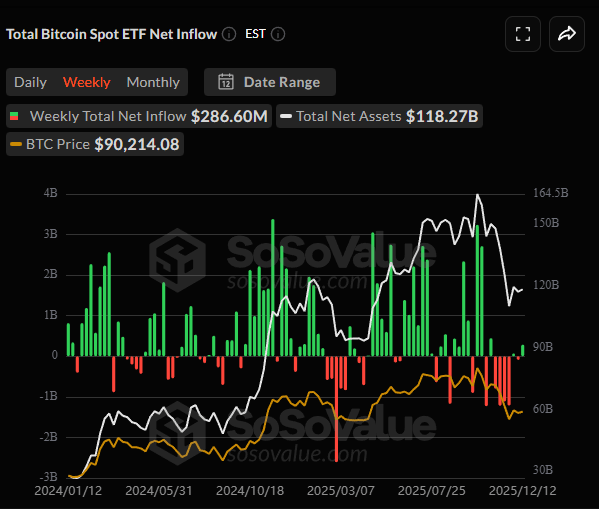
The latest decline in the cryptocurrency has also come despite the fact that the spot exchange-traded funds (ETFs) witnessed a net amount of inflows during the past week, according to data from SoSoValue.
BTC Price
At the time of writing, Bitcoin is floating around $86,000, down around 4.5% over the last seven days.
According to reports, the UK Treasury will extend existing finance laws to cover cryptoasset firms, with the new rules set to take effect in October 2027.
This means exchanges, wallet providers and other crypto service companies will move beyond current anti-money-laundering registration and into the same regulatory space as banks and brokers.
Regulators To Apply Existing Rules
Based on statements from ministers and officials, the Financial Conduct Authority will be the main supervisor for the sector. Firms will be required to meet standards on reporting, governance and customer protections similar to those applied in traditional finance.
The shift is described as bringing clarity for businesses that want to operate long term in the UK, while giving regulators tools to act against fraud and market abuse.
UK TO REGULATE CRYPTO UNDER FINANCIAL LAW FROM 2027
– The UK will bring cryptocurrencies like Bitcoin under full financial regulation from 2027, placing crypto alongside traditional financial products, per Reuters.
Reports have disclosed that one of the core aims is stronger consumer protection. Officials say the changes will help block bad actors and reduce scams, and that the Treasury is also considering tighter rules around political donations made with crypto. The move follows a series of high-profile fraud cases and growing public concern about safety in crypto markets.
The road to full regulation will be gradual. The Treasury has circulated draft legislation and ministers expect complementary rules from the FCA and the Bank of England to be ready by the end of 2026, ahead of the legal regime going live in 2027. Consultations and regulatory sandboxes are under way, giving firms time to adjust.
How This Compares Internationally
Based on reports, the UK’s plan is being framed more like the US approach than the EU’s Markets in Cryptoassets (MiCA), which was introduced in 2024.
Officials say closer alignment with US practice should help international firms that operate across borders, but it also raises questions about how UK rules will differ from both US and EU requirements in practice.
A draft bill has been prepared and it has had only minor edits since first being published, according to government sources.
Industry responses are mixed: some firms welcome the certainty, while lawyers and trade groups want clearer detail on how existing conduct rules will apply to crypto business models. The FCA is running targeted workstreams, including tests for stablecoin issuers and custody providers.
Featured image from Unsplash, chart from TradingView
Ripple, Solana, and XRP are converging at a pivotal moment as Ripple formally repositions XRP for a multichain future that extends well beyond a single partnership. At the Solana Breakpoint event, Ripple leadership outlined how integrating XRP into Solana’s ecosystem represents a strategic inflection point for the asset’s utility, liquidity profile, and long-term relevance within decentralized finance. The move signals a clear transition from chain-specific execution toward cross-ecosystem scalability, with XRP positioned as a portable liquidity layer rather than a siloed network token.
Ripple’s Strategic Play At Solana Breakpoint
The vision of a Ripple-Solana integration was shared on December 13, 2025, by Luke Judges, Ripple’s Global Partner Success Lead, during a presentation at Solana Breakpoint, one of the industry’s most influential conferences focused on blockchain performance and ecosystem collaboration. Judges made it explicit that Ripple’s roadmap no longer treats the XRP Ledger (XRPL) as the sole environment for XRP’s growth. Instead, the company is executing a deliberate multichain strategy designed to embed XRP directly into high-activity DeFi ecosystems.
Central to this announcement was the introduction of wXRP, a wrapped version of XRP that will operate on the Solana network. The initiative is supported by Hex Trust, which handles custody and issuance, and LayerZero, which provides the cross-chain messaging infrastructure. Importantly, wXRP maintains a 1:1 backing with native XRP, ensuring holders retain full price exposure while gaining access to Solana-based applications. This structure allows Ripple to expand XRP’s reach without diluting its underlying value proposition.
Judges emphasized that the integration is aimed at practical market outcomes rather than experimentation. By placing XRP inside Solana’s high-throughput environment, Ripple is targeting deeper liquidity, higher transaction velocity, and sustained demand from users already active in decentralized trading and lending.
XRP Enters A Multichain Era
Ripple’s expansion of XRP into multiple networks marks a shift toward broader blockchain interoperability. Against this backdrop, the operational impact of wXRP becomes clearer. By bringing XRP onto Solana, Ripple is enabling direct participation across decentralized exchanges, lending and borrowing markets, and liquidity protocols. This expansion unlocks yield strategies and advanced trading instruments that were previously out of reach for XRP holders operating solely within the XRP Ledger. At the same time, wallet integrations such as Phantom, which serves roughly 20 million users, significantly extend XRP’s accessibility and day-to-day usability within Solana’s ecosystem.
Beyond Solana, Ripple has made clear that this is a template, not an endpoint. Judges confirmed that similar cross-chain deployments are planned for Ethereum, Optimism, HyperEVM, and other networks aligned with Ripple’s broader DeFi and RLUSD strategy.
That long-term architecture is anchored by the XRP Ledger itself, a point reinforced by J. Ayo Akinyele, Head of Engineering at RippleX. As activity and liquidity extend across multiple chains, XRPL remains the stable foundation supporting these integrations. Through this strategy, Ripple positions XRP as a cross-ecosystem settlement and liquidity asset, capable of supporting multiple networks while anchored by the stability of XRPL.
Tether has seen its Juventus buyout attempt rejected as majority stakeholder Exor has told the stablecoin giant its share is not for sale.
Tether Fails To Acquire Premier Italian Football Club Juventus
On Friday, Tether announced that it had submitted a proposal to acquire Juventus, one of the biggest football brands in the world. The stablecoin firm had previously acquired a 10% minority stake in the club, and with this new plan, it had intended to execute a full buyout.
The first stage had included a proposal to Exor, the holding company of the Agnelli family and majority stakeholder of Juventus. According to Reuters, Tether had offered the firm 2.66 euros per share, a notable premium above the then closing price of 2.19 euros.
In a press release, Exor has responded to Tether, saying that its board has unanimously rejected the bid for its 65.4% controlling stake in Juventus. “Exor reaffirms its previous, consistent statements that it has no intention of selling any of its shares in Juventus to a third party, including but not restricted to El Salvador-based Tether,” noted the company.
Founded in 1897, Juventus has established itself as one of the biggest football clubs globally, with a particularly memorable period of success coming during the 2010s, in which it won nine consecutive titles in the Serie A, the first division of Italian football.
With Exor turning down the deal, the USDT issuer will have to reconsider its approach to the club popularly dubbed as The Old Lady. So far, Tether hasn’t issued any statements in answer.
In the original announcement, Tether had announced that if the firm is able to acquire Exor’s stake, it will move to acquire the remaining shares of the club through a public tender offer at the same share price. This would put the total valuation of Juventus at about $1.17 billion.
Tether had also noted that in the event that the transaction is completed, it will also be prepared to invest 1 billion euros in the football club. “Tether is in a position of strong financial health and intends to support Juventus with stable capital and a long horizon,” said CEO Paolo Ardoino.
While The Old Lady enjoyed a strong period in the last decade, the 2020s haven’t been as kind. Since the 2019-20 season title win, Juventus hasn’t come close to becoming the Italian champion, with its best finish being third place during the 2023-24 season. Juventus also became part of a financial scandal in 2023, with Serie A punishing it with a 10-point deduction for false accounting. Thus, Tether’s interest has arrived when the club has been in a bit of a slump.
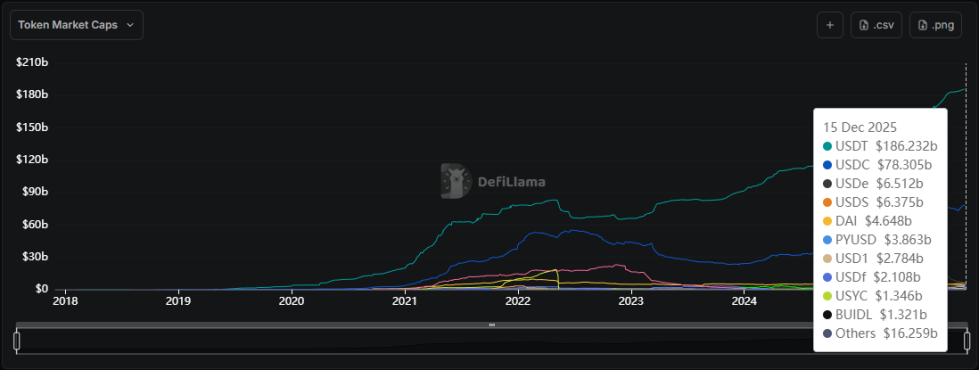
USDT, Tether’s stablecoin, has been experiencing growth recently, with its market cap hitting a new record of $186.23 billion, according to data from DefiLlama.
Bitcoin Price
At the time of writing, Bitcoin is trading around $89,700, down 2.5% over the last week.

 Login
Login