Reading view

There are new articles available, click to refresh the page.

Are Dogecoin ETFs Dead On Arrival? Dwindling Volume Suggests Investors Are Not Interest – Details

The Dogecoin ETFs have continued to record low demand since they launched last month, indicating the lack of interest from institutional investors in the meme coin. Notably, DOGE has also seen the lowest demand through these ETFs among the top coins by market cap. 

Dogecoin ETFs Record Dwindling Volume And Inflows

SoSoValue data shows that the Dogecoin ETFs have continued to see their daily volume and inflows decline since they launched last month. On December 10, the Grayscale and Bitwise DOGE ETFs recorded a trading volume of $125,100. Meanwhile, these funds as a group saw a total net inflow of $171,920 on the day. 

Further data from SoSo Value shows that the Dogecoin ETFs trading volume has been on a decline since December 2, when they recorded a daily trading volume of $1.09 million. These funds have recorded only three 7-figure trading volume days out of 12 trading days since November 24, when Grayscale’s Dogecoin fund launched. 

Dogecoin

This is relatively low and signifies little demand for the DOGE ETFs among institutional investors. For context, Grayscale’s Chainlink ETF, the only LINK fund at the moment, has outperformed the Dogecoin ETFs despite launching at the start of this month. Grayscale’s LINK ETF has a total net asset of $77.71 million, while the DOGE ETFs have total net assets of $6.01 million. 

The net flows also highlight the underperformance of these Dogecoin ETFs. Since launching, Bitwise’s DOGE fund has recorded a net outflow of $972,840. Meanwhile, Grayscale’s fund has taken in just over $3 million. The funds, as a group, have recorded net inflows on five of 12 trading days. 

Possible Reason For The Underperformance

Bloomberg analyst Eric Balchunas had warned before now that crypto ETFs like the Dogecoin ETFs would record fewer assets given their distance from Bitcoin in terms of market cap. “’The further away you get from BTC, the less asset there will be,’ he said. Notably, DOGE funds have the lowest net assets among the top 10 cryptos by market cap with ETF wrappers. 

The Solana and XRP ETFs, which also just launched last month, have outperformed the Dogecoin ETFs, although there are more funds offering SOL and XRP. Meanwhile, Balachunas’ theory hasn’t applied to the LINK ETF, as it has outperformed DOGE funds despite Chainlink having a lower market cap than Dogecoin. 

Furthermore, the Hedera and Litecoin ETFs also boast larger net assets than the Dogecoin ETFs, indicating that institutional investors are simply not bullish on DOGE, possibly due to its meme coin status and lack of utility. DOGE is, so far, the only meme coin with an ETF wrapper. 

At the time of writing, the DOGE price is trading at around $0.138, down over 6% in the last 24 hours, according to data from CoinMarketCap.

Dogecoin

CoinPoker запускает новый ежемесячный фриролл для мобильных игроков с призовым фондом $5,000

CoinPoker представил возможность, ориентированную на аудиторию, предпочитающую мобильный формат игры: ежемесячный Mobile Freeroll с гарантированным призовым фондом $5,000. Турнир будет проходить в последнюю пятницу каждого месяца и открыт для всех новых пользователей, которые зарегистрируются с промокодом MOBILE и сыграют минимум 10 рейк-раздач.

Мобильный фриролл, который выделяется на фоне рынка

Фрироллы с крупными призовыми фондами встречаются редко, особенно в сегменте мобильного покера. Новый турнир от CoinPoker ориентирован на тех, кто хочет попробовать платформу без финансового риска, но при этом рассчитывает на реальный шанс выиграть значимую сумму.

Игроки, которые впервые знакомятся с CoinPoker, смогут не только оценить обновление мобильной версии, но и сразу получить доступ к турниру с призовым фондом.

ПЕРЕЙТИ НА САЙТ COINPOKER

Условия участия стали еще проще

Вход в турнир не требует выполнения сложных требований — достаточно всего двух действий:

  • зарегистрироваться на Play.CoinPoker.com с бонус-кодом MOBILE;
  • сыграть 10 рейк-раздач в любом формате — кэш, турниры, PLO или NLH.

После выполнения условий система автоматически добавляет игрока в список участников ближайшего ежемесячного мобильного фриролла.

Обновленная мобильная веб-версия CoinPoker: что нового

Интерфейс мобильного клиента переработан, теперь он функционирует прямо через браузеры iOS и Android. Приложение скачивать не нужно — вход возможен через Safari, Chrome, Firefox и другие популярные браузеры.

Мобильный интерфейс CoinPoker

Основные улучшения мобильной веб-платформы:
  • современный визуальный стиль;
  • повышенная отзывчивость интерфейса;
  • ускоренная обработка действий;
  • более плавная и приятная анимация.
Функциональные возможности:
  • мультитейблинг;
  • заметки на оппонентов;
  • PLO, PLO5 и NLH в кэш- и турнирном форматах;
  • столы с живыми дилерами;
  • генератор случайных чисел на блокчейне.

Почему новая акция вызывает интерес среди игроков

Для новичков — это возможность получить стартовый капитал без вложений.

Для опытных покеристов — ценный турнир, где можно протестировать обновленный мобильный клиент без каких-либо дополнительных инвестиций.

Кроме того, фриролл служит удобной точкой входа в другие активности CoinPoker: праздничные серии, круглосуточные кэш-столы.

О платформе CoinPoker

CoinPoker — один из ведущих покерных проектов, основанный на принципах прозрачности и инноваций.

Сайт использует генератор случайных чисел на основе блокчейна, а среди его амбассадоров — известные профессионалы Patrick Leonard, Bencb и Mario Mosböck.

Платформа также проводит крупные ежегодные мероприятия, такие как Cash Game World Championship (CGWC) и Coin Series of Poker (CSOP), а для игроков доступны специальные промо, включая:

  • приветственный бонус 150% до $2,000;
  • Fast and Furious с повышенными битаутами;
  • Seven Deuce Game;

CoinMasters с общим фондом $250,000.

Bitcoin USD cena pārsniedz atklāto interesi pēc FOMC

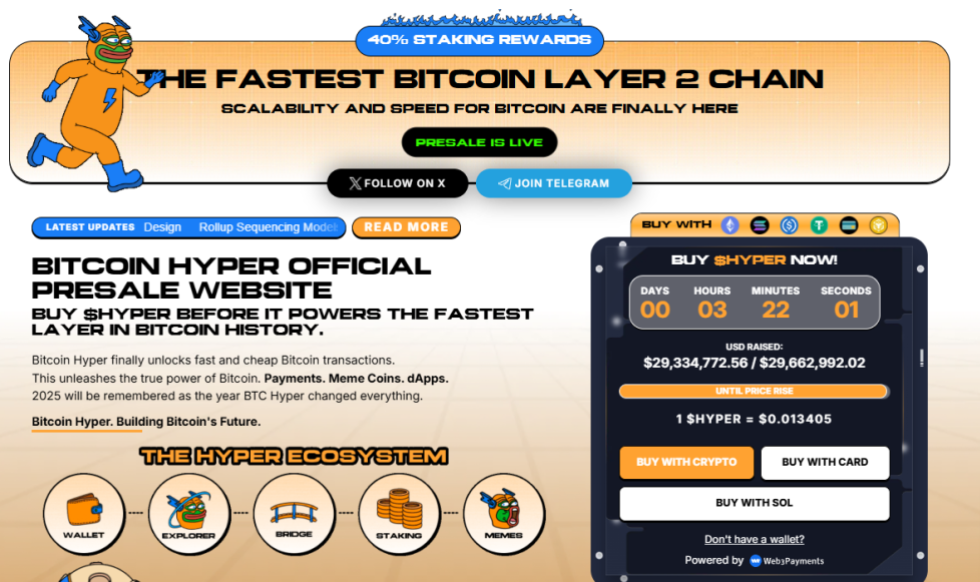
Bitcoin cena pēc FOMC atkal ir parādījusi, cik nestabila ir sviras ietekme šajā cikla posmā. Pasaules lielākā kriptovalūta svārstījās starp 92 000 un 89 500 dolāriem dažas stundas pēc Federālo rezervju paziņojuma, likvidējot miljardiem atklāto pozīciju galvenajos atvasinājumu tirgos. Tomēr, pat neskatoties uz to, ka svārstīgums sasniedza ekstremālus līmeņus, kapitāls turpināja plūst uz pārliecinošiem kriptovalūtu projektiem, piemēram, Bitcoin Hyper ($HYPER) — Bitcoin Layer-2 risinājumu, kas apvieno Solana līmeņa transakciju ātrumu ar BTC nodrošinātu drošību.

ASV tirgotāji pievienoja vairāk nekā 38 miljonus dolāru jaunu Bitcoin piedāvājumu pirms šīs nedēļas makroekonomiskajiem katalizatoriem — ražotāju cenu indeksa (PPI) un bezdarbnieku pabalstu pieprasījumu datiem. Abi rādītāji varētu noteikt, vai Federālā rezervju sistēma saglabās savu pašreizējo politiku vai sāks mērenāku pieeju procentu likmju samazināšanai.

Noskaņojums joprojām ir piesardzīgi optimistisks. BTC ir izdevies noturēties 90 000 dolāru līmenī, ko analītiķi uzskata par kritisku psiholoģisko un strukturālo atbalstu. Ilgstoša slēgšana virs 92 000 dolāriem atkal atvērtu ceļu uz 100 000–110 000 dolāru pretestības diapazonu, savukārt kritiens zem 89 000 dolāriem varētu izraisīt jaunu likvidāciju kārtu.

Apmeklējiet Bitcoin Hyper

Bitcoin cenas dinamika un tirgus prognozes

Pēc FOMC sanāksmes Bitcoin cenas svārstības likvidēja ilgtermiņa un īstermiņa pozīcijas, efektīvi atjaunojot atvasināto instrumentu tirgu. Atklātās pozīcijas strauji samazinājās, jo tika izslēgti tirgotāji, kas izmantoja kredītplecu. Finansējuma likmes normalizējās, atgriežoties gandrīz neitrālā līmenī, kas liecina par veselīgāku vidi spot pozīciju uzkrāšanai.

Bitcoin cenas dinamika un tirgus prognozes

Amerikāņu iestāžu plūsmas joprojām ir spēcīgas. ETF turpināja reģistrēt mērenu pieplūdumu, liecinot, ka ilgtermiņa investori neatsakās no tirgus, neskatoties uz īstermiņa svārstībām. Tikmēr makro tirgotāji gatavojas vēl vienam potenciālam izrāvienam, kad inflācijas dati apstiprinās deflācijas tendenci. Vēsturiski Bitcoin vislabāk darbojas, kad reālais peļņas līmenis sāk samazināties, likviditāte palielinās un dolāra vērtība vājinās — šāda situācija daļēji var attīstīties 2026. gadā.

Vairāki analītiķi uzskata, ka Bitcoin šajā ciklā joprojām var sasniegt jaunas augstākās cenas. Bernstein analītiķi prognozē potenciālu kustību uz 200 000 ASV dolāriem ilgstošā augšupejošā fāzē, kas turpināsies līdz 2026. gadam, ja ETF ieplūdes saglabās tempu. Citi, piemēram, Matrixport, paliek konservatīvāki, paredzot cikla vidusposma konsolidāciju ap 120 000–150 000 ASV dolāru pirms nākamā izaugsmes viļņa.

Bitcoin Hyper: 2. slāņa risinājums, kas balstīts uz Bitcoin stiprajām pusēm

Bitcoin Hyper: 2. slāņa risinājums, kas balstīts uz Bitcoin stiprajām pusēm

Paralēli plašākam BTC vēstījumam, Bitcoin Hyper ($HYPER) piesaista uzmanību kā viens no cikla ambiciozākajiem Layer-2 projektiem. Tā mērķis ir apvienot Bitcoin drošību ar Solana līmeņa caurlaidspēju, ļaujot veikt tūlītējus darījumus ar zemām komisijas maksām decentralizētās lietojumprogrammās. Oficiālajā dokumentā izklāstīta vīzija par Bitcoin balstītu ekosistēmu, kas atbalsta maksājumus, DeFi protokolus un starpķēžu likviditāti, izmantojot kanonisko BTC tiltu.

Ieriekšpārdošana jau ir piesaistījusi vairāk nekā 29 miljonus dolāru, ko veicinājuši investori, kuri vēlas agrīni iesaistīties infrastruktūrā, kas paplašina Bitcoin lietojamību reālajā pasaulē. Tokenu pircējus piesaista arī 40 % ”staking” atlīdzība, kas ļauj pasīvi gūt ienākumus projekta ieviešanas fāzē. Katra tokena cena pašlaik ir 0,013405 dolāri, kas to padara pieejamu gan privātiem, gan institucionāliem dalībniekiem.

Papildus monetārajai pievilcībai, Bitcoin Hyper arhitektūra atspoguļo tehnisko atbildi uz vienu no senākajām Bitcoin problēmām — mērogojamību. Ļaujot BTC nevainojami pārvietoties starp ķēdēm, izmantojot verificētu tilta mehānismu, Hyper atver darījumu ātrumu un sastāvdaļu savienojamību, kas iepriekš nebija pieejama Bitcoin pamatlīmenī.

Jebkurš investors var iegādāties Bitcoin Hyper, pārejot uz projekta oficiālo pirmspārdošanas portālu, pieslēdzot savu kriptovalūtas maku (piemēram, Best Wallet vai MetaMask) un apmainot ETH, USDT vai BNB pret HYPER žetoniem.

Kāpēc Bitcoin Hyper ir aktuāls pēc FOMC lēmuma

Kāpēc Bitcoin Hyper ir aktuāls pēc FOMC lēmuma

Pēc FOMC lēmuma tirgus satricinājumi ir piespieduši tirgotājus pārskatīt savu riska sadali. Bitcoin svārstīguma pieauguma un tradicionālo “altcoin” atpalikšanas dēļ kapitāls ir sācis rotēt uz infrastruktūras projektiem, kas ir tieši saistīti ar BTC ekosistēmu, nevis spekulatīvām mēmu monētām. Šajā kontekstā Bitcoin Hyper pozicionējas kā “Bitcoin panākumu paplašinājums ar augstu beta koeficientu” — izmantojot BTC pieņemšanas priekšrocības un vienlaikus veidojot neatkarīgu tehnisko lietderību.

Bitcoin Hyper galvenās priekšrocības:

⚡ Bitcoin 2. slāņa mērogošana, izmantojot Solana ātruma infrastruktūru. 🔗 Kanoniskais tilts, kas nodrošina ātru un drošu BTC pārskaitījumu starp ķēdēm ar ”staking” atlīdzību. 💻 Augsta caurlaidspēja un zemas komisijas maksas, kas paredzētas Web3 lietotnēm un maksājumiem. 💰 Līdz 40 % ”staking” atlīdzība agrīniem tīkla dalībniekiem. 📈 Spēcīgs ICO impulss, jau piesaistot vairāk nekā 29 miljonus dolāru.
Šīs funkcijas padara Bitcoin Hyper par vienu no visprogresīvākajiem Bitcoin orientētiem projektiem šajā ciklā.

Bitcoin Bullish Exhaustion? BTC Whales Close Long Positions After Extreme Upside Bets

Bitcoin’s price is gradually picking up pace following a broader market recovery, allowing the largest cryptocurrency asset to revisit the $92,000 mark on Wednesday. Even though the price is showing strength, key investors are currently moving in the opposite direction of the trend, raising questions about the stability of the recent bounce.

Whales Slams The Brakes On Bullish Bitcoin Bets

Just as the price of Bitcoin staged a slight recovery, the derivatives market has shifted once again as investors make a sudden strategic retreat. On-chain metrics indicate that large BTC holders, also known as whale investors, are stepping back from their bullish positions, a clear sign of growing bearish sentiment.

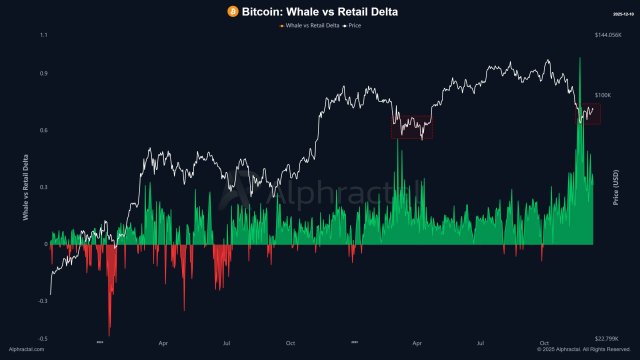
After navigating the key Bitcoin whale vs. Retail Delta metric, Joao Wedson, an author and founder of the Alphractal analytics platform, disclosed that whales have closed their longs. This strategic pullback or shift in sentiment comes after a heavy positioning to the long side by the cohort.

While the retreat marks a notable change in market sentiment, it also suggests that large investors may be locking in profits or preparing for a potential deeper decline in BTC’s price. Wedson highlighted that while large players are currently starting to take some short positions again, retail investors are moving against them, indicating a clear disparity in sentiment between the two groups

Bitcoin

Given that whale behavior has historically served as a leading indication for broader price action, this abrupt reversal raises further concerns about Bitcoin’s short-term trajectory. Following an exuberant surge, there are also concerns about whether the market is getting ready for a cooling phase.

The expert stated that the pattern of this metric against price actions looks somewhat similar to what was observed in February and April 2025. In other words, the price of BTC moving sideways longer than what most traders are anticipating is highly likely at this point.

Traders Calling For A BTC Rally

Overall, market sentiment appears to have recovered as Bitcoin traders become greedy, calling for more upward moves. According to a post from Santiment, a leading on-chain data analytics platform, BTC experienced a much-needed rebound back to the $94,600 price mark on Wednesday, which reinvigorated traders.

Interestingly, the brief bounce caused investors to Fear Of Missing Out (FOMO) back in and look forward to the price of BTC going higher. Santiment’s social data, harvesting X, Reddit, Telegram, and other data, shows that calls for higher and above have increased dramatically.

High bars with blue shades indicate calls for lower or below, which is indicative of Fear Uncertainty and Doubt (FUD). It is worth noting that prices often rise as retailers offload their holdings. 

Meanwhile, high bars with red shades represent calls for higher or above, signaling FOMO. When calls for higher moves increase, prices usually correct as retailers attempt to acquire more BTC on the way up. During these kinds of occasions, it is crucial to know that markets move in the opposite direction to the behavior of small traders.

Bitcoin

MSCI Criticized For Bitcoin Omission: “It’s Like Faulting Chevron For Oil”

MSCI has launched a consultation on whether companies with significant cryptocurrency or Bitcoin holdings should be excluded from some of its main indices, sending waves through markets that track those indexes.

According to reports, the consultation targets firms whose balance sheets are more than 50% invested in digital assets. Phong Le, CEO of Strategy, argued in interviews that the move is “like penalizing Chevron for oil,” saying that holding an asset should not disqualify an operating company from broad market indices.

Impact Estimates Suggest Billions Could Move

Based on reports from banks and analysts, the potential impact could be large. JPMorgan estimates show that MSCI-only adjustments might trigger forced selling of about $2.8 billion, while the figure could climb to $8.8 billion if other index providers follow suit.

Stocks of companies holding Bitcoin have already felt pressure. Strategy (ticker MSTR), the largest corporate Bitcoin holder, has been in direct talks with MSCI, seeking to clarify its position and prevent removal from key indexes.

Phong Le joined @SchwabNetwork to discuss the $60T digital credit opportunity and response to MSCI. Restricting passive index investment in bitcoin today would be like restricting investment in oil and oil rigs in the 1900s, spectrum and cell towers in the 1980s, or compute and… pic.twitter.com/3VcYnF5nE4

— Strategy (@Strategy) December 10, 2025

Who Could Be Affected And Why

The review focuses on so-called “digital-asset treasury” firms — companies that might behave more like investment vehicles if a large portion of their assets sits in cryptocurrency.

According to circulated consultation documents, the 50% threshold defines the most extreme cases. Some analysts warn the cutoff is blunt and could misclassify companies that run genuine businesses while using crypto as a treasury reserve.

Industry Groups Mobilize

A coalition of bitcoin-focused companies and trade associations has publicly opposed the move. They argue that excluding these firms would force passive funds tied to MSCI indexes to sell holdings mechanically, even when they are part of operational businesses.

Reports have disclosed letters, interviews, and lobbying efforts aimed at influencing MSCI’s final decision. Market participants say the pushback highlights the tension between traditional index rules and companies with unconventional asset allocations.

Decision Timeline Could Trigger Market Moves

The consultation window is expected to close around Dec. 31, 2025, with some reports suggesting MSCI could announce a decision by mid-Jan 2026.

If the exclusions are enforced, passive funds tracking MSCI indexes may need to rebalance, which could create mechanical selling pressures for affected stocks. However, feedback during the consultation could still alter the outcome before any final rules are adopted.

Bitcoin Investors Face Key Questions

Beyond short-term market moves, investors now face questions about which listed firms cross the 50% threshold, how indices should treat non-traditional assets, and whether other index providers will adopt similar rules.

The choices MSCI makes could affect billions of dollars in flows and reshape how publicly traded companies approach holding cryptocurrency.

Featured image from Unsplash, chart from TradingView

OCC Highlights Major Concerns Over Crypto Debanking Practices Among Major Banks

On Wednesday, the Office of the Comptroller of the Currency (OCC) released findings that have raised alarm bells regarding crypto debanking, reigniting fears of what some are dubbing “Operation Chokepoint 2.0” within the financial sector. 

This supervisory review focused on nine of the largest national banks under OCC supervision, including JPMorgan Chase, Bank of America, Citibank, Wells Fargo, US Bank, Capital One, PNC Bank, TD Bank, and BMO Bank.

‘Harmful Debanking Policies’

The preliminary findings from the OCC reveal troubling trends: between 2020 and 2023, these banks appeared to make unwarranted distinctions among customers based on their legal business activities. 

Specifically, many of these institutions maintained policies that either restricted access to financial services or required heightened scrutiny and approvals for certain clients. 

The OCC identified examples where at least one bank imposed limitations on various sectors, including crypto, due to their engagement in activities considered “contrary to [the bank’s] values,” even though those activities were not illegal.

Sectors affected by these policies included oil and gas exploration, coal mining, firearms, private prisons, tobacco and e-cigarettes, adult entertainment, and notably, digital assets

The findings indicated that many banks placed strict limitations on crypto-related activities as well, which often stemmed from concerns about financial crime.

These practices, the OCC confirmed, were prevalent at each of the banks examined in the review. Comptroller Jonathan V. Gould expressed frustration regarding the situation, stating: 

It is unfortunate that the nation’s largest banks thought these harmful debanking policies were an appropriate use of their government-granted charter and market power. 

Gould noted that while many of these policies were publicly announced, some banks have maintained that they did not participate in debanking.

In his comments, Comptroller Gould emphasized the OCC’s commitment to eliminating practices that would “weaponize finance,” whether instigated by regulators or the banks themselves. 

National Banks To Facilitate Crypto Transactions

The agency disclosed that it is still evaluating “thousands of complaints” related to allegations of political and religious debanking, with plans to report on these findings “in due course.” The OCC aims to hold banks accountable for these actions and ensure that unlawful debanking practices do not persist. 

This follows Tuesday’s letter from the banking regulator that allows national banks to participate in “riskless principal transactions” involving cryptocurrencies. This permits national banks to buy and sell cryptocurrencies for their customers’ accounts. 

This new structure allows users to transact in crypto-assets through established national banks, resulting in a more regulated environment than exchanges that operate outside of strict oversight regulation. 

Crypto

Featured image from DALL-E, chart from TradingView.com 

Прогноз цены Dogecoin на 2026 год: путь к $1 на фоне мем-ралли

Dogecoin снова в центре внимания розничных трейдеров. После волатильной осени и серии резких рывков мем‑сегмент снова оживился, а $DOGE вернулся в топ обсуждений наряду с Bitcoin и Ethereum. Инвесторы задаются прямым вопросом: может ли легендарный мем‑токен в 2026 году наконец дойти до отметки $1.

Текущая картина по $DOGE сочетает устойчивый интерес рынка и осторожный оптимизм аналитиков. Цена актива в последние недели колеблется вокруг ключевых уровней, формируя базу после резких движений вверх и вниз. Объемы на спотовых и деривативных площадках остаются значительными, что говорит о продолжающейся спекулятивной активности и готовности трейдеров агрессивно отыгрывать новости.

Главный драйвер для $DOGE по‑прежнему — сочетание мем‑нарратива, поддержки со стороны известных предпринимателей и фаз связанного с Bitcoin цикла. На фоне ожиданий продолжения бычьего рынка, восстановления аппетита к риску и перетока ликвидности в более спекулятивные активы базовый сценарий остается явно позитивным. При благоприятной конъюнктуре рынок вполне способен вновь разогнать $DOGE к историческим зонам и попытаться закрепиться вблизи $1.

Однако путь к такой оценке не будет линейным. Для этого монете нужно удержать важные уровни поддержки, подтвердить интерес к деривативам без перегрева финансирования и получить свежий импульс мем‑историй. Именно поэтому часть трейдеров комбинирует ставку на «ветерана» $DOGE с агрессивными пресейлами, включая новые мем‑проекты вроде Maxi Doge, чтобы усилить потенциальную доходность портфеля в случае продолжения ралли.

КУПИТЬ MAXI DOGE

Dogecoin на пути к $1: ключевые уровни и сценарии

Техническая картина $DOGE остается типичной для зрелого мем‑актива: длительные фазы консолидации сменяются взрывными импульсами на фоне новостей и роста интереса в социальных сетях. На дневном графике важным рубежом выступают области недавних максимумов и зон, где ранее фиксировалась крупная прибыль. Сохранение выше этих уровней подтверждает бычий настрой и формирует платформу для нового захода вверх.

С точки зрения индикаторов стоит следить за индексом относительной силы (RSI) и объемами. Когда RSI поднимается в зону перекупленности при растущих объемах, это часто предвещает агрессивные пампы, но также повышает риск краткосрочных откатов на десятки процентов. Более устойчивым выглядит сценарий, при котором RSI держится в умеренной «бычьей» зоне, а объемы стабильно выше средних значений, показывая здоровый интерес без явной эйфории.

Фундаментальная история $DOGE опирается не только на мем‑культуру. Важную роль играет статус «старейшего» мем‑токена с широкой узнаваемостью и относительно глубокой ликвидностью на крупных CEX и DEX. Это облегчает вход и выход крупных игроков, снижает проскальзывание и делает крупные спекулятивные волны более реалистичными. На фоне вероятного продолжения цикла роста крипторынка это создает для Dogecoin прочную позицию для очередной попытки штурма психологических уровней.

Сценарно можно выделить три траектории. Бычий вариант предполагает удержание ключевых поддержек, рост интереса к мем‑активам и новый виток хайпа, при котором $DOGE может протестировать $1 и потенциально превысить прежний максимум. Базовый сценарий — длительный диапазон с колебаниями в пределах нескольких десятков процентов вокруг текущих уровней, когда рынок переваривает прошлые движения. Медвежий вариант срабатывает при пробое важной поддержки вниз и ухудшении общего настроения, что может вернуть цену значительно ниже локальных максимумов и отложить достижение $1 на неопределенный срок.

В ближайшие месяцы ключевым ориентиром для трейдеров останется реакция цены на важные уровни и динамика настроений в мем‑сегменте. Если поддержка устоит, а интерес к риску усилится, шансы увидеть $DOGE ближе к $1 в рамках текущего цикла останутся весомыми. Имеет смысл внимательно наблюдать за тем, как цена ведет себя при тесте этих зон, а также за активностью деривативов и социальных показателей.

Maxi Doge как ставка на Dogecoin

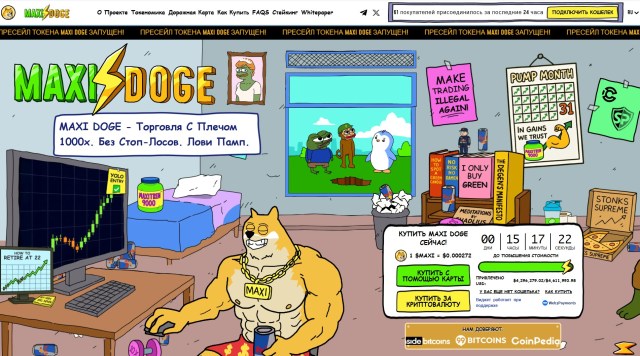
На фоне оживления интереса к Dogecoin часть розничных трейдеров обращает внимание на более агрессивные мем‑токены. Один из таких проектов — Maxi Doge ($MAXI) с культурой максимального плеча и соревновательным трейдингом. Идея проста: дать мелким участникам рынка инструмент и сообщество, нацеленные на гипердоходные стратегии в бычьем цикле.

Максимальным спросом у таких проектов традиционно пользуются ранние раунды. По данным команды, на этапе предварительной продажи уже собрано около $4,3 млн, а цена токена составляет $0,0002725. Для розничных инвесторов это создает ощущение «доступного входа» с потенциалом крупного многократного роста, если мем‑нарратив и торговая активность продолжат усиливаться.

MaxiDoge

Отдельно стоит отметить интерес крупных участников. Два адреса приобрели токены на общую сумму около $503 тыс., причем крупнейшая сделка достигла $252 тыс. Такая концентрация капитала на раннем этапе обычно рассматривается сторонниками проекта как сигнал доверия к его потенциалу в предстоящем бычьем рынке.

С точки зрения функционала Maxi Doge делает ставку на культуру высоких плеч и постоянного «прокачивания» результата. Токен $MAXI работает в сети Ethereum как стандартный ERC‑20, а смарт‑контракт управляет предложением и распределением, включая фонд Maxi Fund для ликвидности и партнерств. Для держателей предусмотрены стейкинг‑вознаграждения с динамическим APY за счет отдельного пула распределения на срок до одного года, а также турниры по доходности с таблицами лидеров и призами. Все это нацелено на создание «тренажерного зала» для агрессивных трейдеров в рамках одного сообщества.

Однако такой подход означает и повышенные риски. Любой пресейл‑токен несет в себе неопределенность регуляторной среды, возможную волатильность в первые недели листинга и зависимость от активности сообщества. В отличие от Dogecoin, уже доказавшего устойчивость к нескольким рыночным циклам, $MAXI остается спекулятивной ставкой ранней стадии. Поэтому разумный подход для агрессивных инвесторов — рассматривать Maxi Doge как высокорискованную добавку к портфелю, а не замену более ликвидным активам вроде $DOGE. Перед участием важно самостоятельно изучить проект, его токеномику и смарт‑контракт.

Финальный взгляд на связку Dogecoin и Maxi Doge выглядит так: $DOGE остается флагманом мем‑сегмента с реальными шансами вновь приблизиться к $1, если бычий цикл продолжится. На его фоне Maxi Doge выступает как потенциальный ускоритель для тех, кто готов принять больший риск ради сверхдоходности. Такой подход — сочетание проверенного актива и спекулятивного пресейла — и выбирают многие участники рынка в ожидании следующей волны роста.

Ripple Exec Warns: Banks Without A Stablecoin Strategy ‘Will Get Left Behind’

Ripple’s Middle East and Africa boss has a blunt message for the banking sector: if you still do not have a stablecoin strategy, you are already behind the curve.

“Look, I think there’s no bank, financial institution, payment entity that is not thinking, talking or incorporating a stablecoin strategy,” Ripple’s Reece Merrick told CNBC in Abu Dhabi. “And quite frankly, if they’re not, they will get left behind.”

Ripple’s Advantage In The Stablecoin Space

The interview came right after a significant regulatory win. Ripple’s USD-backed stablecoin, RLUSD, has been recognized by Abu Dhabi’s Financial Services Regulatory Authority (FSRA) as an “Accepted Fiat-Referenced Token,” allowing ADGM-licensed institutions to use it for regulated financial activity. For Ripple, this is less about marketing and more about foothold: it embeds RLUSD inside one of the Gulf’s most aggressively pro-crypto regulatory hubs.

“Firstly, what this does is it further validates Ripple’s value proposition here in the region and a compliance-first approach as it relates to issuing our own stablecoin, RLUSD, at the back end of last year,” Merrick said. The approval means ADGM entities can “utilize RLUSD within their flows, within their operations,” which he called “a great step forward for Ripple, great step forward for the region.”

The compliance drumbeat is deliberate. Before pushing RLUSD globally, Ripple went to what Merrick described as “the gold standard of regulators,” the New York Department of Financial Services, which oversees RLUSD issuance. The combination of NYDFS in the US and FSRA (plus Dubai’s DFSA, which earlier approved Ripple as the first blockchain-enabled payment solution provider) is meant to send a clear signal: this is an institutional product, not a fly-by-night dollar token.

The hard numbers are more modest. RLUSD has about 1.2 billion dollars in circulation, tiny next to Tether’s roughly 120 billion. Merrick did not try to spin that away; instead he pointed at the direction of travel. The stablecoin market is around 300 billion dollars today, he noted, dominated by USDT and USDC, but Ripple expects it “to be moving into the trillions” with “share for everyone.”

How to carve out that share is where Ripple’s strategy gets more specific. Merrick said Ripple wants RLUSD “to be the gold standard for institutions to adopt this stablecoin,” and he anchored that in concrete rails: recent acquisitions and existing payment volume.

He highlighted G-Treasury, a treasury management platform that sees “how Fortune 500 businesses are moving trillions of dollars between their own operations,” and Hidden Road, now rebranded as Ripple Prime, a prime broker that “turn[s] over three trillion in prime brokerage.” Ripple’s plan is to bake RLUSD directly into those flows. Since announcing GTreasury, Merrick said, the company has seen “so much inbound” from institutions exploring RLUSD for their internal operations.

Underneath sits Ripple’s long-running cross-border payments business, which has processed about 95 billion dollars in turnover using XRP and the XRP Ledger. RLUSD, Merrick argued, is a “natural step” after persistent customer demand for stablecoin payouts. With roughly half of global cross-border payments made in dollars and many of those not actually destined for the US, he called existing channels “inefficient and slow,” and positioned regulated dollar tokens as a cleaner alternative.

Trust and understanding are still the industry’s biggest problems, as CNBC’s Dan Murphy noted, citing boardroom confusion and skepticism even at Abu Dhabi Finance Week. Merrick’s response was predictable but also, frankly, the only credible one: stack regulation, collateral transparency and real-world utility until the narrative changes.

“Trust is paramount,” he said, pointing again to NYDFS, ADGM and DFSA approvals as the anchor. Once “large financial institutions, these large corporates” see the impact on their own business, he expects “that kind of hockey stick growth.”

He also highlighted the GENIUS Act in the US as having “paved the way for some of the largest global financial institutions to kind of play in this space,” shorthand for the broader legislative shift toward regulated stablecoin frameworks.

. @Ripple‘s Reece Merrick Highlights RLUSD Regulatory Milestone and Global Expansion on CNBC https://t.co/0KR2BQNZHU pic.twitter.com/H39BdnX4Wf

— 𝗕𝗮𝗻𝗸XRP (@BankXRP) December 10, 2025

Taken together, Merrick’s remarks sketch a simple line in the sand. Stablecoins are no longer a side experiment; they are becoming core payments and treasury infrastructure. And for banks still stuck at the “internal working group” stage, the message from Ripple’s regional chief could not have been clearer: get a stablecoin strategy, or get comfortable watching your customers migrate to those who already do.

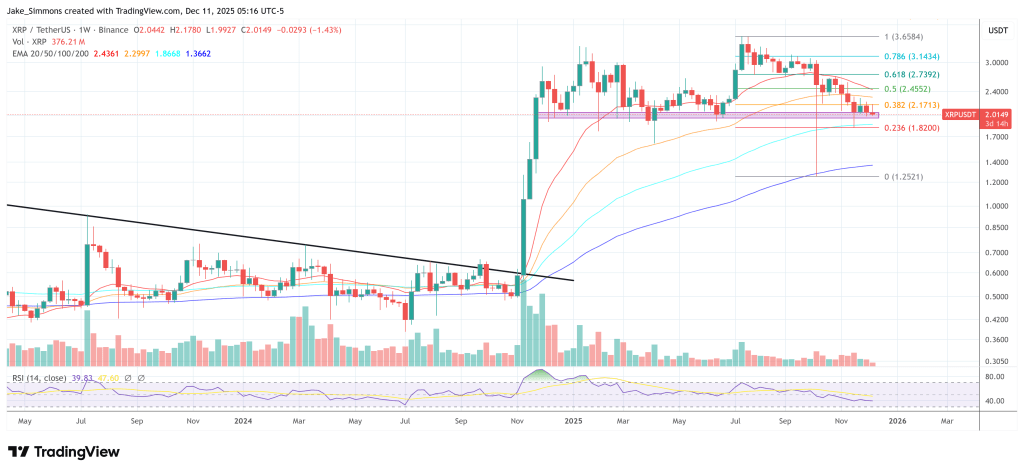
At press time, XRP traded at $2.0149.

XRP price

Upcoming Crypto Market Structure Bill Markup Likely Pushed To Post-Holiday

The much-anticipated crypto market structure bill, intended to establish a clearer regulatory framework for digital assets in the United States, appears to be facing significant delays. 

Recent discussions among a bipartisan group of pro-crypto senators suggest that a markup, initially expected before Christmas, may be postponed until after the holiday season.

Negotiations Stalled For Crypto Bill

According to a report by Eleanor Terret from Crypto In America, a closed-door meeting on Tuesday revealed that advancing the bill before Christmas is becoming increasingly unlikely. 

The significant hurdle lies in the ongoing negotiations between Republican and Democratic lawmakers, who remain divided on several critical issues. 

A leaked three-page compromise proposal from Senate Banking Republicans to their Democratic counterparts, reported by Politico, offered some insights into the negotiation process.

Among the provisions highlighted in the proposal was an assurance to Democrats that front-end sanctions compliance for certain decentralized finance (DeFi) platforms would be integrated into the bill. In exchange, the proposal sought to preserve protections for software developers and self-custody. 

Two major points for Democrats were included in this offer: a requirement for Democratic commissioners to be involved in agencies overseeing crypto and ethics language aimed at preventing high-ranking government officials from profiting from digital assets. 

Bipartisan Support Remains Elusive

As lawmakers continue to grapple with the complexities of the negotiations, there is a sense of fatigue among those involved. At this week’s BA Policy Summit, Senator Bernie Moreno described the bargaining process as “decently frustrating.” 

Senator Cynthia Lummis, one of the top supporters of the industry and the passage of the market structure bill, and chair of the Senate Banking’s Subcommittee on Digital Assets, noted that the staff members working on the bill are feeling “exhausted.”

With only seven working days remaining before members depart for the Christmas break, negotiations are expected to persist. Senator Lummis has indicated her desire to release a draft of the bill by the end of this week, allowing the industry a chance to review it ahead of a potential markup next week. 

According to Terret, Senate Banking Chair Tim Scott could still convene a markup next week and likely push the bill through along party lines. However, securing bipartisan support would greatly enhance the final bill’s chances of passing in the full Senate next year, potentially explaining a decision to delay the markup until January.

Meanwhile, the Senate Agriculture Committee, which previously released an incomplete draft of its own market structure bill last month, may also hold its markup next week. 

However, committee Chairman John Boozman suggested to Bloomberg Tax that he would likely postpone such a decision until next year, citing several “difficult issues” that need resolution.

A spokeswoman for the committee later confirmed to Crypto In America that a markup would be scheduled “soon,” indicating that discussions are still ongoing. 

Crypto

Featured image from DALL-E, chart from TradingView.com

Crypto Giant a16z Sets Up Shop In South Korea In Major Asia Push

Crypto venture capital firm Andreessen Horowitz (A16z) has opened its first Asian office in Seoul, South Korea, signaling a deeper push into the region where on-chain activity and user adoption have surged. According to the firm, the new hub will support portfolio companies and help build local partnerships and communities.

A16z Moves Into Seoul

The office will be led by Sungmo Park, who has held roles at Monad and Polygon, and who joins a16z as Head of APAC go-to-market. Reports have disclosed that Anthony Albanese, the fund’s chief operating officer, announced the move and framed it as a way to put teams closer to where users and builders are located.

I’m honored to share that I will be joining @a16zcrypto as Head of APAC go-to-market.

a16z crypto backs exceptional founders, providing not just capital but also hands-on support to help them grow into transformative companies.

Now, a16z crypto is opening an office in Seoul and…

— sungmo (@sungmo_apac16z) December 10, 2025

A16z said Seoul will act as a gateway for interacting with companies across Asia and for giving portfolio firms local support on partnerships, marketing and expansion. Park will focus on regional strategy and on helping founders navigate local markets. This is not described as a small PR outpost; it is positioned as a real operating base for the region.

Excited to announce that @a16zcrypto is expanding into Asia and opening our first office in Seoul, South Korea. As part of this, we’re thrilled to have @sungmo_apac16z join our team as Head of APAC go-to-market to lead the Seoul office and start building our presence in the… pic.twitter.com/KBljioBCqx

— Anthony Albanese (@AAlbaneseNY) December 10, 2025

Based on reports, Asia-Pacific recorded about US$2.36 trillion in on-chain value over the 12 months ending June 2025, an increase of close to 70% from the prior year. That growth helped convince a16z that Asia needs a local presence. Chainalysis and several industry trackers show heavy on-chain flows and deep retail participation across the region.

Our latest State of Crypto report shows that onchain users are widely distributed around the world, with a particularly strong concentration in Asia. It now represents a significant share of global crypto activity, for example:

🇰🇷 South Korea is the second-largest crypto market…

— Anthony Albanese (@AAlbaneseNY) December 10, 2025

Why Korea Matters To Crypto

South Korea itself is highlighted as one of the largest national crypto markets. According to a16z and other coverage, nearly one in three adults in South Korea hold crypto assets — a rate that in some measures is higher than local stock ownership. That level of retail use, plus a thriving developer community, made Seoul an attractive choice for the firm.

What The Move Could Mean

The entry of a major US venture firm into Seoul may boost interest among local startups seeking international partners and could make capital more accessible for teams in South Korea and nearby markets. Several news outlets describe the office as focused on go-to-market support rather than immediate, large-scale local investing, at least at launch.

Competition For Deals

Reports note that other global funds and crypto firms have been increasing activity in Asia this year. A16z’s decision comes as several markets across the region report rising developer activity and fresh funding rounds. For founders, having an established US investor with a local office may speed introductions to global customers and partners.

Featured image from Unsplash, chart from TradingView

Cardano Founder Reacts As NIGHT Token Crashes From $150 To $0.02

Cardano founder Charles Hoskinson has hailed the launch of Midnight and its native token NIGHT as the strongest in the network’s history, arguing that it proves Cardano can now host and distribute multi-billion-dollar assets at scale.

NIGHT Token Plunges After Midnight Launch

In his December 10 livestream “Midnight Launch AAR,” Hoskinson opened with the volatile price action that dominated social media. NIGHT initially spiked to what he called an “insane” level: “It launched at almost a $150, which is just insane […] it just went way, way, way up.” Once trading opened on Binance Alpha, the move reversed violently. “As soon as it got on Binance Alpha – oh god, why, why, oh why – all the way down to two cents. They dumped on us. That’s what they do. That’s what the DGENs over in that market do.”

He framed this as typical exchange-distribution dynamics, not a structural failure: recipients with no real connection to the ecosystem “regardless of the price, they just dump the token. They probably didn’t even know what NIGHT was.”

According to Hoskinson, such launches usually endure 48–72 hours of “high volatility” before a stable range emerges. He reiterated that he had expected NIGHT to trade in a “5 cents to 15 cents” band and said it was sitting around 6–6.5 cents with a fully diluted valuation of roughly $1.5 billion and around $150 million in trading volume. For a brand-new Cardano-native asset in current conditions, he called that “a really solid launch.”

What made the debut historically significant in his view was the combination of tier-one listings and on-chain metrics. “This is the first time in history that Cardano right out the gate can launch a $1.5 billion product, be listed on Binance Alpha and Kraken and OKX and everybody else at the start,” he said, stressing that much of the required infrastructure “wasn’t there” and had to be built during the run-up.

Cardano’s Best Launch Ever

On Cardano itself, he highlighted that Midnight immediately became the dominant token by trading activity. Citing TapTools, he said NIGHT was “sitting [at] an overwhelming level of volume, and it’s actually greater than the volume of every other Cardano native token combined,” adding that its FDV is “worth more than all the other CNTs combined as well.”

For the first time, he argued, DEXs such as Minswap and SundaeSwap carried a “meaningful percentage of trading volume […] with respect to large exchanges,” helping “prime the pump on Cardano DEXes” and pull more stablecoins into the ecosystem.

Distribution was another focal point. Hoskinson praised the Glacier Drop mechanism and its gradual “thawing,” saying it creates “a nice steady emission and a nice steady flow for the system as opposed to a jagged thing where the insiders all dump.”

He contrasted Midnight’s retail-heavy, exchange-plus-airdrop distribution with VC-led launches elsewhere: “This is the first time since Bitcoin that a launch has been done the way that Midnight did it. It was complete retail, completely fair, and none of those damn VCs got their grubby hands on it. Instead, it went right to you, the people.”

He tied that to a broader “return to first principles,” arguing that 2026 should reward projects with fair launches and fixed-supply, deflationary monetary policies: “There’s a fixed supply NIGHT, by the way […] it’s going to be a good year for everybody who’s betting on you, the consumer, and not betting on the banks.”

Looking forward, Hoskinson positioned Midnight as Cardano’s first “partner chain” and the “tip of the spear” for a hybrid DApp model spanning multiple ecosystems: “You talk about Midnight Cardano, Midnight Ethereum, Midnight Solana, Midnight Avalanche, Midnight Binance.” He said that after the first four phases of the roadmap, “every two months a new ecosystem gets activated,” with recurring feature drops “every six to eight weeks.”

He also cast Midnight as a competitive wedge for Cardano DApps. With tier-one integrations and privacy-preserving capabilities, he argued, “we have privacy before [Ethereum and Solana] do,” giving Cardano–Midnight hybrid apps a differentiator that can help grow TVL, MAU and transaction volume.

Hoskinson insisted that the launch pressure-tested and validated the base protocol: “Cardano network handled it. The exchanges handled it. And Midnight is here to stay.” The ambition from here is explicit. “We’re going to march Midnight up as an ecosystem to that $10 billion mark. That’s the goal. Let’s keep going. Let’s get her done,” he said, adding that “these are the best numbers we’ve ever seen in the history of Cardano” – and, in his view, only the beginning.

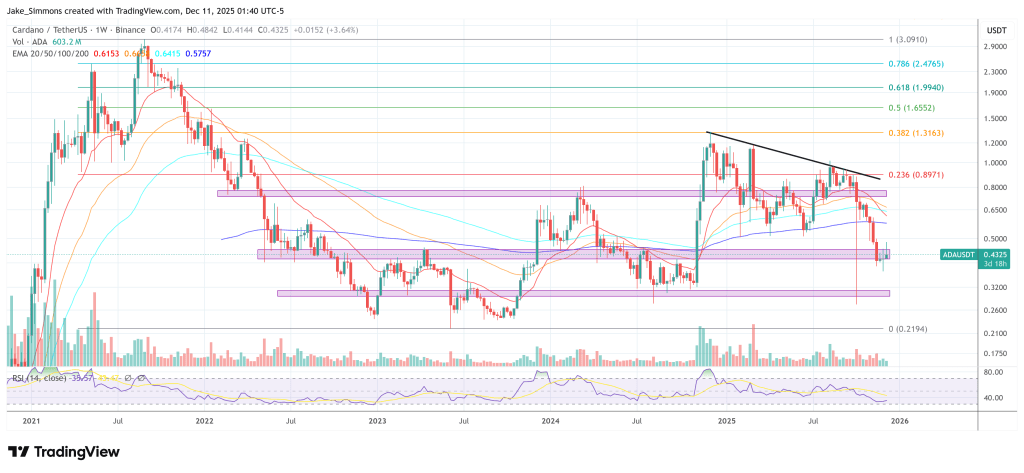
At press time, ADA traded at $0.4325.

Cardano price

Bitcoin Treasuries Have Grown 448% Since Jan 2023: Here’s How Much They Hold Now

Data shows Bitcoin treasury companies have seen an explosive growth trajectory since 2023, gaining relevance as an important pillar of the market.

Public & Private Companies Now Hold More Than A Million Bitcoin

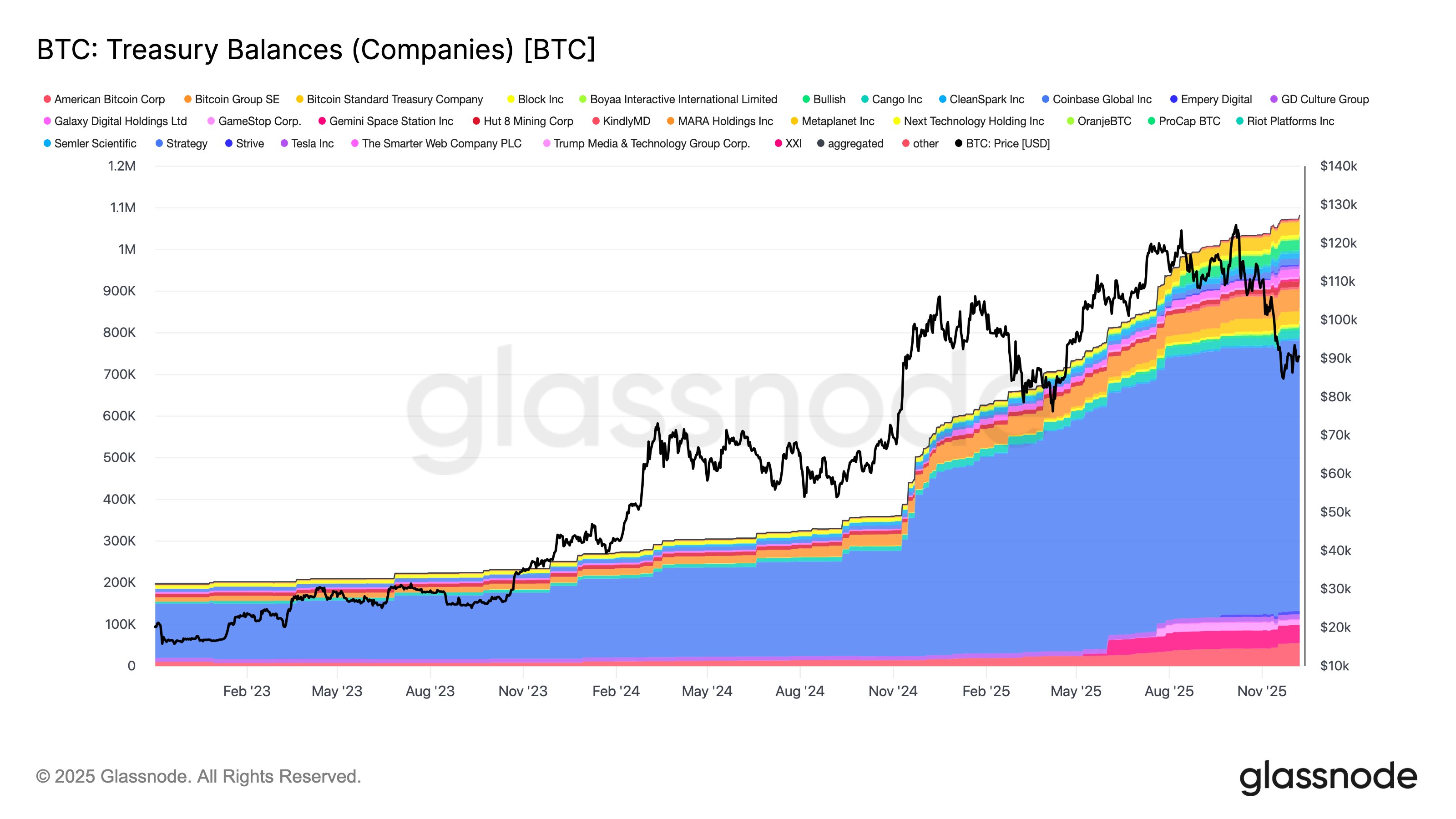
In a new post on X, on-chain analytics firm Glassnode has talked about the trend in the Bitcoin treasuries held by public and private companies. Below is the chart shared by Glassnode that shows changes in both the holdings of the various companies as well as their combined balance.

Bitcoin Treasury Balance

As is visible in the graph, Bitcoin treasuries held by companies saw slow, but steady growth during 2023 and most of 2024, but in late 2024, the growth became much more rapid.

This sharp trajectory continued into 2025 and so far, with the year’s end approaching, the uptrend hasn’t faded. This would suggest that corporates have been accumulating BTC at a significant pace for a year now.

In January 2023, the size of the Bitcoin holdings that private and public firms held stood at 197,000 BTC. Today, that figure has grown to 1.08 million BTC, implying a massive jump of about 448%.

Today, there are about 19.96 million tokens in circulation, so more than 5.4% of the cryptocurrency’s supply is sitting in the treasuries of public and private companies. “Corporate balance sheets are becoming an increasingly significant pillar of demand for BTC,” noted the analytics firm.

A major force behind the increase in Bitcoin corporate holdings is naturally Strategy (formerly MicroStrategy). The Michael Saylor-led firm has been a regular presence in the market for some time now, participating in buying almost every week and making no sales since December 2022.

Strategy currently owns about 660,624 BTC, which means that the treasury company alone accounts for over 61% of all BTC holdings attached to public and private firms.

While Strategy has been a big factor behind the surge in corporate holdings, it hasn’t been the only one. 2025 has seen the rise of treasuries like Metaplanet, which have also contributed to growth in BTC treasuries.

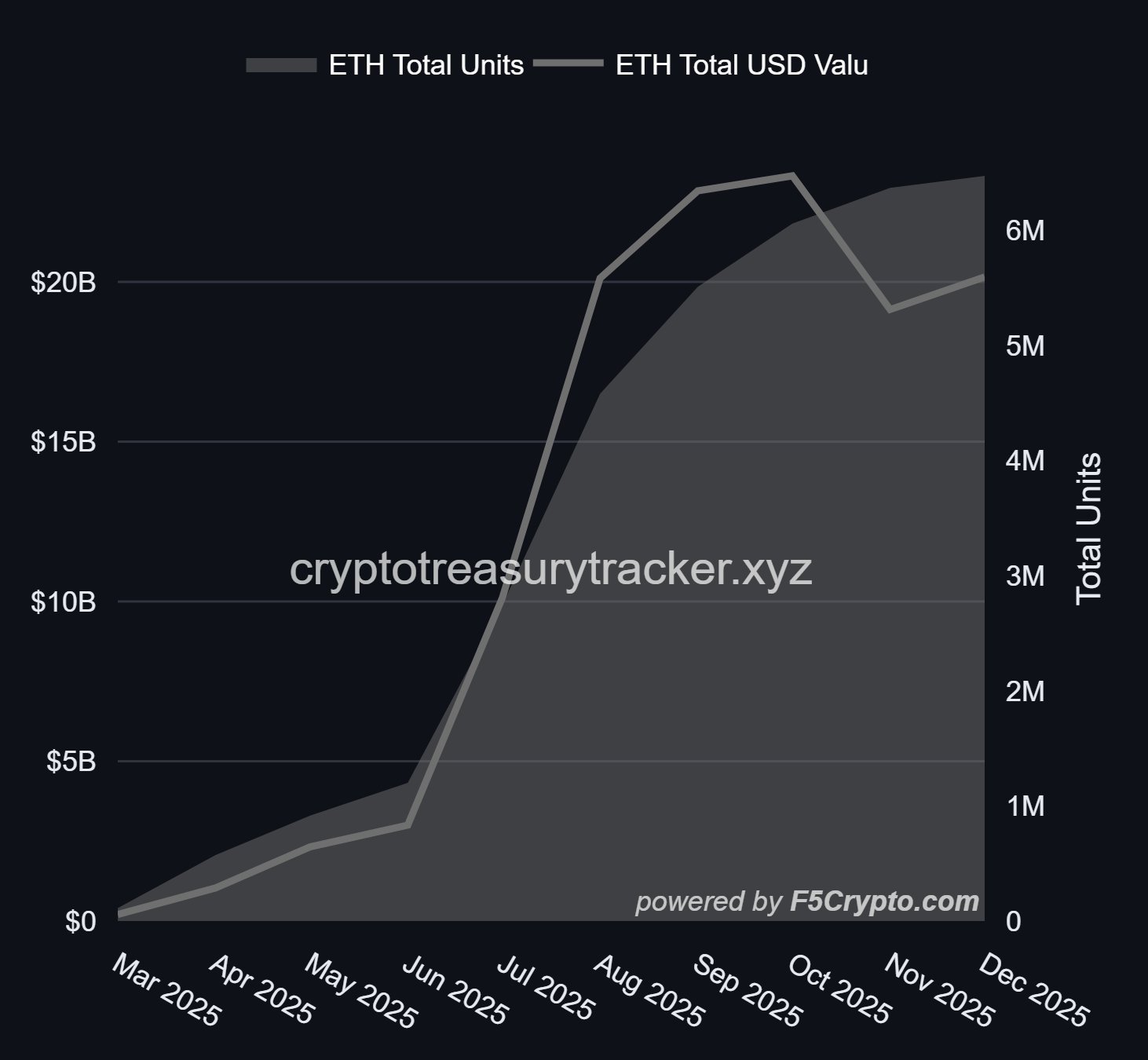
The year has also witnessed a treasury movement related to altcoins, with both Ethereum and Solana seeing a significant amount of accumulation. ETH treasuries went through some sharp growth in mid-2025, but during the recent phase of price decline, buying has slowed down.

That said, it hasn’t hit a complete pause, as institutional DeFi solutions provider Sentora has pointed out in an X post that Ethereum treasuries added a significant amount during November.

Ethereum Treasuries

As displayed in the above chart, Ethereum treasuries added 309,000 ETH during November, and so far in December, they have accumulated another 100,000 ETH.

BTC Price

Bitcoin surged to $94,500 on Tuesday, but the cryptocurrency has since faced a drawdown as it’s now back at $92,200.

Bitcoin Price Chart

South Korea’s Stablecoin Legislation Hits Roadblock As FSC Misses December 10 Deadline

South Korea’s government has reportedly missed the deadline to submit its highly anticipated stablecoin legislation, risking a delay of the second phase of the country’s regulatory efforts to align with global standards and foster innovation.

FSC Misses Key Deadline Amid BOK Disagreement

On Wednesday, local media outlets affirmed that the South Korean government failed to submit the long-awaited bill for the Second Phase of the Virtual Asset User Protection Act, which is expected to address the issuance and distribution of won-denominated stablecoins.

Chosun Biz reported that the Financial Services Commission (FSC) did not meet the National Assembly’s submission deadline for the government’s legislation. On December 1, authorities set December 10 as the deadline to submit the bill to the National Policy Committee.

According to political circles cited by the report, the government bill was delayed because the FSC and the Bank of Korea (BOK) failed to resolve their differences over the issuance of won-pegged stablecoins.

As reported by Bitcoinist, local outlets stated in late November that South Korea’s stablecoin legislation risked being delayed due to a disagreement between financial authorities and the central bank over the extent of banks’ role.

The BOK and FSC seemingly agreed that the financial institutions must be involved in the issuance of won-pegged tokens. However, the central bank has been pushing for a consortium of banks owning at least 51% of any stablecoin issuer seeking regulatory approval in the country.

Meanwhile, the FSC was willing to involve diverse players in the process, expressing concern that giving a majority stake to banks could reduce participation from tech firms and limit the market’s innovation.

The November report noted that the regulatory standoff appeared to leave the market in limbo, with some tech companies actively preparing to get approval and others taking a cautious approach due to the unclear regulatory direction.

Stablecoin Legislation Risks ‘Prolonged Deliberation Process’

Chosun Biz noted that the Democratic Party of Korea (DPK) initially intended to advance the second phase of its virtual asset bill by reviewing the government bill. Nonetheless, if the government draft continues to be delayed, the bills previously introduced by lawmakers could be reviewed first.

Since June, multiple bills related to the issuance and distribution of won-pegged stablecoins have been introduced in the National Assembly. Min Byung-deok, a member of the National Assembly’s Government Committee, introduced the “Digital Assets Basic Act, proposing enabling the issuance of won-pegged stablecoins and establishing a Digital Asset Committee under the direct authority of the president.

In July, South Korea’s ruling and opposition parties proposed rival bills to establish the highly anticipated regulatory framework. Notably, Ahn Do-gil, a member of the Planning and Finance Committee from the Democratic Party, introduced the “Act on the Issuance and Distribution of Value-Stable Digital Assets.”

Similarly, Kim Eun-hye, a member of the Land, Infrastructure, and Transport Committee from the People Power Party (PPP), proposed the “Act on Payment Innovation Using Value-Fixed Digital Assets.”

The two bills shared similarities, like the assignment of stablecoin oversight to the FSC. However, they differed over the issue of interest payments, with the PPP’s bill allowing interest payments and the DPK’s bill completely banning them to prevent market disruption.

It’s worth noting that the FSC chairman, Lee Eun-won, recently affirmed that the regulatory agency will “fundamentally prohibit the payment of interest on stablecoins as a principle,” adopting the same principle as the US framework, the GENIUS Act, which prohibits interest payments on the holding or use of payment-purpose stablecoins.

Following the Wednesday delay, a member of the National Policy Committee from the Democratic Party affirmed that, “for now, it looks difficult to narrow the differences between the FSC and the BOK.”

“If the government bill continues not to be submitted, the deliberation process could be prolonged, so we should at least review the bills introduced by lawmakers first,” they concluded.

Bitcoin, btc, btcusdt, stablecoin

American Federation Of Teachers Opposes Crypto Market Structure Bill In New Letter

The American Federation of Teachers (AFT) has formally added its voice to the growing opposition against the proposed crypto market structure bill, urging the Senate Banking Committee to reconsider the legislation. 

In a letter obtained by CNBC, AFT President Randi Weingarten described the bill as “as irresponsible as it is reckless,” citing the alleged dangers it poses to working families’ pensions and the overall economy.

AFT Calls Out Loopholes In Crypto Legislation

In her correspondence with Senate Banking Committee Chairman Tim Scott and Ranking Member Elizabeth Warren, who is known for her consistent skepticism toward digital assets, Weingarten expressed significant concern about the implications of the proposed legislation. 

She stated that the current draft gives the AFT “deep concern” over the risks posed to retirement plans, including the union’s own pensions. Weingarten argued that advancing the crypto legislation could open the door to “widespread fraud” and “unethical practices” within retirement schemes.

Weingarten alleged that the bill “misleadingly” portrays cryptocurrencies as stable and mainstream, despite their volatility. She argued that rather than providing necessary safeguards. “If passed, it will undercut the safety of many assets and cause problems across retirement investments,” she noted.

Among the specific concerns raised by the AFT was a provision allowing non-crypto companies to issue their stock on the blockchain, thus evading existing regulatory frameworks for securities. 

Weingarten warned that this loophole and the corresponding erosion of traditional securities laws could have “disastrous outcomes.” She noted that pensions and 401(k) plans may end up invested in unsafe assets, even when they are nominally traditional securities. 

Additionally, she criticized the legislation for inadequately addressing the fraud and illegal activities that Weingarten believes remain prevalent in crypto markets, labeling it “irresponsible” and “reckless.”

Delays And Heightened Concerns

In the letter, Weingarten also stressed that if the bill were to become law, it could potentially set the stage for the next financial crisis. The AFT’s stance aligns with concerns previously expressed by the AFL-CIO, the nation’s largest labor union, which also opposed a draft of the crypto bill in October.

In line with Weingarten’s opposition, Democratic senators, including Warren, have raised concerns regarding the balance of regulatory oversight between the Commodity Futures Trading Commission (CFTC) and the Securities and Exchange Commission (SEC). 

Massachusetts Secretary of State William Galvin reiterated these concerns in a letter, highlighting that the proposed legislation could exclude significant portions of the financial industry from state oversight, creating risks for millions of savers.

Progress on the Senate’s version of the crypto market structure bill has faced delays, partly attributed to the recent lengthiest government shutdown in US history. 

Senator Lummis recently provided insight into potential timelines, indicating that her goal is to share a new draft by the end of the week. She plans to allow both the crypto industry and lawmakers from both parties to review the draft before moving forward with markup next week.

Crypto

Featured image from DALL-E, chart from TradingView.com 

Public Asset Manager Strive Launches $500M Plan To Load Up On Bitcoin

Strive, the bitcoin-focused issuer backed by Vivek Ramaswamy, launched an at-the-market plan to sell up to $500 million of its Variable Rate Series A Perpetual Preferred Stock.

Reports have disclosed the offering was filed on December 9, 2025 and that net proceeds may be used for general corporate purposes, including buying Bitcoin and Bitcoin-related products.

Strive Launches $500M Program

The public asset manager signed a sales agreement that names Cantor Fitzgerald, Barclays and Clear Street as placement agents for the program.

Based on reports, the ATM structure lets Strive sell SATA shares into the open market over time rather than in a single block. The prospectus supplement tied to the program makes clear how the offering fits into Strive’s capital toolbox.

Strive’s Announcement In Context

Strive has been steadily adding Bitcoin to its balance sheet this year. Reports show the firm bought about 1,567 BTC between October 28 and November 9 at an average price near $103,315 per coin, bringing total holdings to roughly 7,525 BTC as of early November.

These figures place Strive among the larger public corporate holders of Bitcoin and help explain why it is tapping preferred equity rather than other funding routes.

Bitcoin Holdings And Recent Buys

Based on reports, Strive’s stated goal is to increase Bitcoin per share over time. The company has framed preferred equity products like SATA as a way to fund future crypto buys while offering investors a different payout structure than common stock.

That mix — treasury Bitcoin plus income assets — is what Strive has pitched to shareholders in recent filings and investor updates.

Semler Deal And Earlier Purchase Plan

Reports have also tied Strive’s acquisition strategy to an earlier announcement to buy hundreds more coins as part of a corporate deal.

Reuters reported that in September Strive said it would buy 5,816 BTC for $675 million as part of its planned Semler acquisition, a move that would push combined holdings above 10,900 BTC if completed.

That disclosure underscores how the ATM program could fit into a broader plan to grow Bitcoin reserves.

Market Response

Stocks tied to Strive moved on the news. Some market pages recorded modest upticks in SATA and in Strive’s Class A common shares after the filing went public.

Investors and analysts will watch execution closely: an ATM sale can be gradual, and timing matters when buying a volatile asset like Bitcoin.

The preferred-stock route also has payout and conversion features that investors will weigh against dilution and cost of capital.

Featured image from Unsplash, chart from TradingView

New Binance Co-CEO’s WeChat Hacked In Memecoin Pump-And-Dump

Newly-appointed Binance Co-CEO Yi He has seen her WeChat account hacked, with the attacker using it to promote a litte-known memecoin.

Hacker Shilled Memecoin Mubarakah Using Binance Co-CEO’s WeChat

Binance‘s new co-CEO Yi He fell prey to a social media hack Tuesday night, as founder Changpeng “CZ” Zhao has shared in an X post. “Someone hacked @heyibinance’s WeChat account,” said CZ. “Do not buy meme coins from the hackers posts.”

The entity who gained control of Yi He’s account used it to promote a small memecoin called Mubarakah (MUBARA). Like is usually the pattern with hacks like these, investors bought into the token, believing the endorsement to be coming from a well-known industry figure. This sent the memecoin soaring.

On-chain sleuth Lookonchain has revealed how the hacker timed their moves. First, the attacker made two wallets hours in advance, spending 19,479 USDT to buy 21.16 million in Mubarakah.

“After the pump, the hacker has already sold 11.95M $Mubarakah for 43,520 $USDT and still holds 9.21M $Mubarakah($31K), for a total profit of $55K,” explained Lookonchain. The pattern is a clear example of a classic pump-and-dump scheme.

Yi He posted on X that the phone number tied to her WeChat account was taken over, locking her out of the account. A few hours later, she shared that she was able to regain control of the account.

Zhao took the moment to throw a jab at legacy internet systems, saying, “Web 2 social media security is not that strong.” Web 2.0 refers to the traditional online ecosystems most apps still run on, as opposed to the newer, blockchain-powered Web 3.0.

The hack has come just a week after Yi He, who is also a co-founder, was appointed as Binance co-CEO. Previously, she served as chief customer service officer for the cryptocurrency exchange.

In some other news, Binance has become the first digital asset exchange in the world to receive a license from UAE’s ADGM this week, as announced in a press release.

ADGM, standing for Abu Dhabi Global Market, is the international financial center of UAE’s capital, Abu Dhabi. ADGM’s Financial Services Regulatory Authority (FSRA) has given the exchange full authorization to operate its platform in the region.

Due to ADGM’s regulatory requirements, Binance will run its operations through three distinct entities, with each responsible for a separate function: an exchange, a clearing house, and a broker-dealer.

Binance co-CEO Richard Teng noted:

ADGM is one of the most respected financial regulators globally, and holding an FSRA license under their gold standard framework shows that Binance meets the highest international standards for compliance, governance, risk management, and consumer protection.

Bitcoin Price

At the time of writing, Bitcoin is trading around $91,900, down 1% over the last week.

Bitcoin Price Chart

Crypto Hedge Funds Retreat To Stablecoins Ahead of Rate Cut – Data Warns of a Familiar Pattern

Bitcoin is holding firm above the $92,000 level after rebounding from a brief dip to $90,000, but market sentiment remains decisively bearish. Despite the crypto market stabilization, confidence is fragile as traders brace for heightened volatility ahead of the December FOMC meeting. Bulls are attempting to regain momentum, yet the broader market continues to position defensively.

According to a detailed report by XWIN Research Japan, crypto hedge funds and large institutional players are shifting into clear risk-off mode. On-chain data reveals a notable divergence: BTC balances on centralized exchanges are falling, while USDT and USDC reserves are steadily climbing.

This behavior indicates that professional investors are reducing direct crypto market exposure and instead building up stablecoin liquidity on exchanges—capital that can be deployed rapidly depending on the FOMC outcome.

This rise in Stablecoin Exchange Reserves is a textbook sign of event-driven hedging. Institutions are preparing for volatility rather than betting outright on a directional move. Historically, such positioning emerges when markets expect meaningful policy decisions that could reshape short-term liquidity conditions.

Funding Rates Reveal the Market’s True Positioning

According to the XWIN Research Japan report, Funding Rates make the current crypto market structure even clearer. During the August–October 2025 period, funding surged as short-term traders aggressively loaded into long positions ahead of the FOMC decision, only to collapse sharply once the announcement was released.

Bitcoin’s price followed the same pattern: a strong pre-event rally driven by expectations, followed by a swift reversal as leveraged traders were forced to unwind. This fits the historical sequence of rate-cut expectations followed by a temporary rally, and a post-announcement deleveraging and decline.

The report highlights that today’s crypto market is showing similar behaviors. CME futures open interest has stalled, signaling that institutional traders are avoiding high-conviction directional bets. Whale spot holdings remain flat, suggesting that major players are positioned defensively rather than accumulating. At the same time, stablecoin inflows are accelerating, a hallmark of event-driven hedging as capital waits on the sidelines for clarity.

Bitcoin Funding Rates | Source: CryptoQuant

As XWIN Research Japan notes, whether the Fed cuts rates or not, one pattern remains consistent: volatility expands sharply during FOMC week. The danger lies in chasing the pre-meeting bounce without respecting the historical tendency for post-announcement shakeouts. In this environment, risk management—not prediction—is the winning strategy.

Total Crypto Market Cap Holds Key Support But Lacks Momentum

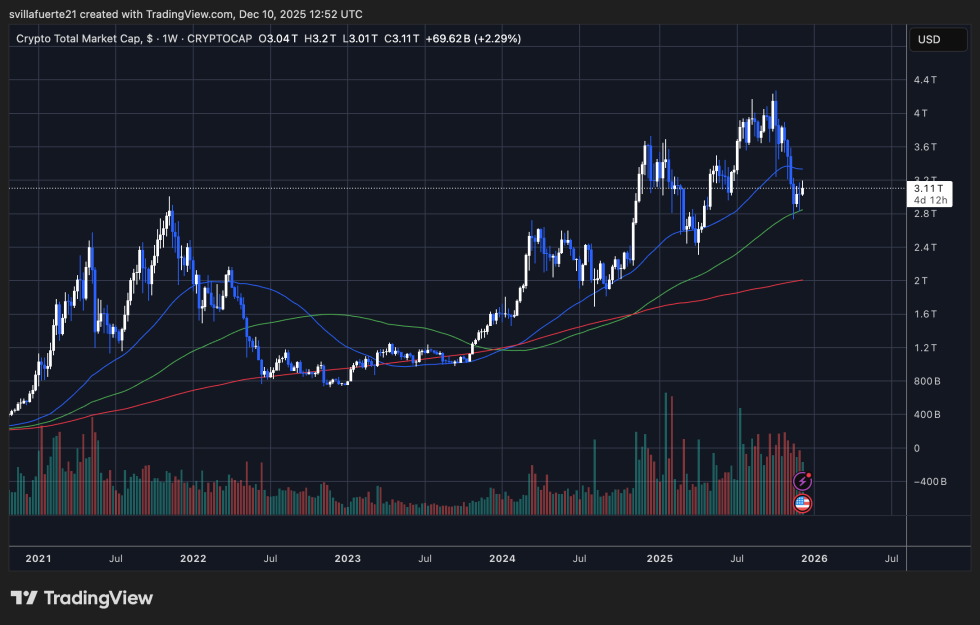
The Total Crypto Market Cap chart shows the market stabilizing around the $3.1 trillion level after a sharp multi-week decline. This area sits just above the 100-week moving average, a historically important dynamic support zone that often defines whether the broader cycle maintains bullish structure or shifts into deeper corrective territory. For now, buyers have stepped in to defend this region, preventing a breakdown that could have opened the door to a retest of the $2.7T–$2.8T area.

Crypto Total Market Cap | Source: TOTAL chart on TradingView

Despite the bounce, the structure remains fragile. The market is still trading below the 50-week moving average, which has now begun to bend downward—a sign that momentum has weakened across major assets like Bitcoin, Ethereum, and key altcoins. Volume has not shown a strong surge on the rebound either, suggesting that institutional conviction remains cautious ahead of the FOMC meeting and macro uncertainty.

A decisive reclaim of the $3.3T–$3.4T zone would shift momentum back in favor of bulls, opening room for a broader recovery. However, failure to break above this cluster of resistance could reinforce the idea that the recent bounce is only corrective. For now, the total market cap hovers at a crossroads, with macro events likely to determine the next major move.

Featured image from ChatGPT, chart from TradingView.com

Technical Wave Patterns Turn Bullish for Ethereum as Price Reaction Intensifies Before Fed Decision

Ethereum (ETH) is under a pivotal week as traders weigh a mix of macroeconomic expectations, institutional developments, and strengthening technical signals.

Related Reading: Midnight Goes Live As Cardano Founder Targets A $10 Billion Ecosystem

With the Federal Reserve set to deliver its next rate decision, market participants are watching how Ethereum’s recent momentum interacts with a broader risk-on environment.

The second largest cap cryptocurrency has already staged a notable rebound, breaking key resistance levels and drawing renewed interest from both retail and institutional investors.

Ethereum ETH ETHUSD ETHUSD_2025-12-10_12-38-55

Fed Expectations Drive Ethereum Position Repricing

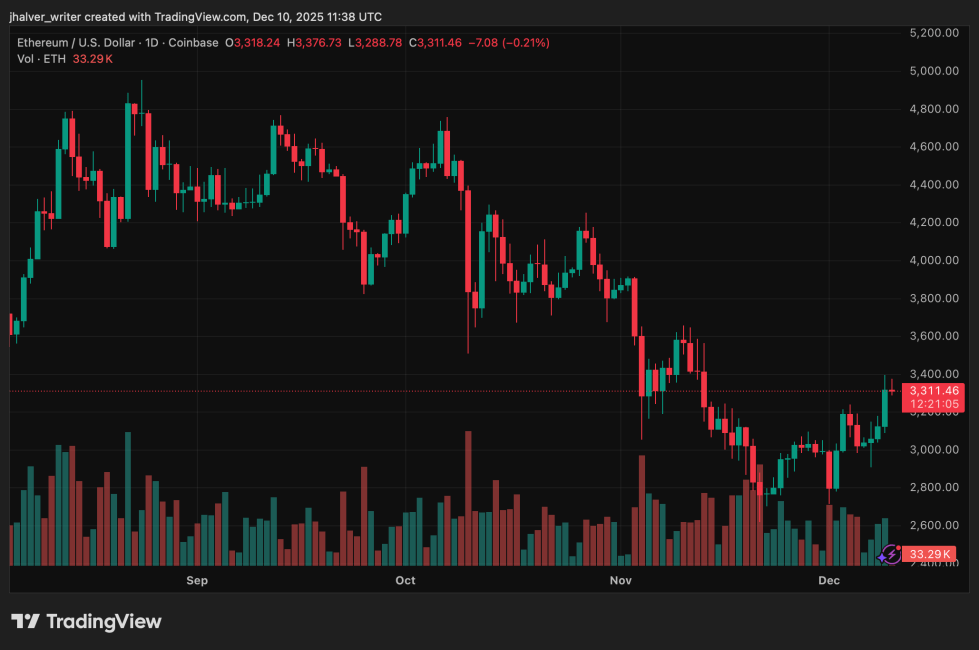
Ethereum surged past $3,300 and briefly approached $3,400 after recording a 6% jump over the past 24 hours.

The rally comes as traders price in a high probability, close to 90%, that the Federal Reserve will announce a 25-basis-point rate cut. Lower interest rates tend to improve liquidity conditions, a factor that has historically supported digital assets.

Bitcoin’s recovery above $94,000 added further confidence to the market, though Ethereum outperformed on a relative basis. The ETH/BTC ratio reached its strongest point since late October, indicating a shift of capital from Bitcoin to Ethereum.

Spot Ethereum ETFs also saw $177.7 million in inflows on December 9, surpassing Bitcoin’s inflows on the same day.

Institutional Moves Add to Bullish Sentiment

One major catalyst behind this shift has been BlackRock’s filing for the iShares Ethereum Staking Trust ETF. The fund would offer exposure not only to ETH’s price but also to staking rewards, expanding access to yield-bearing strategies.

Analysts note that such products could increase liquidity inflows into Ethereum, especially as institutional portfolios diversify beyond Bitcoin. This filing arrives at a time when the amount of ETH held on centralized exchanges has fallen to its lowest level since 2015, roughly 8.7% of the total supply.

Large buyers, including Bitmine Immersion, have accumulated billions of dollars’ worth of ETH in recent months. Combined, these developments indicate a tightening of supply conditions.

Technical Breakouts Reinforce the Trend

Chart analysts highlight that Ethereum has broken above a downward trendline that previously capped rallies for nearly two months.

Momentum indicators, including MACD and RSI, show increasing buyer strength despite approaching overbought territory. Ethereum’s break above the $3,300 zone has shifted focus toward the next resistance level at $3,500, with wave-pattern analysis suggesting potential upside toward $3,600.

Related Reading: Bitwise Rolls Out New ETF For Broad Crypto Exposure, Including BTC, XRP, And ADA

Analysts such as Captain Faibik argue that a confirmed breakout could support a rally of up to 30%, targeting the $4,200–$4,300 region if bullish conditions persist. However, the Fed’s upcoming decision remains a key variable in determining whether momentum continues or cools.

Cover image from ChatGPT, ETHUSD chart from Tradingview

Pre-FOMC Tension: Will Bitcoin Repeat Its Post-Cut Pattern?

Bitcoin is holding firm above the $92,000 level after rebounding from last week’s dip toward $90,000, offering bulls a brief moment of relief. Yet despite this stabilization, market sentiment remains decisively bearish, with many traders expecting further downside unless a clear shift in momentum emerges. The timing couldn’t be more crucial: the Federal Reserve’s upcoming rate decision has become the central focus for investors, and the market is bracing for heightened volatility.

According to a new CryptoQuant report, Bitcoin’s historical behavior around rate cuts offers meaningful context. Over the years, Fed interest rate cuts have generally aligned with upward movements in BTC, largely because lower rates weaken the US dollar, stimulate liquidity, and support risk assets. However, the report highlights an important nuance—the immediate reaction is rarely straightforward.

In several past instances, Bitcoin rallied ahead of rate cuts, only to show muted or even negative price action once the decision was announced, indicating that markets had already priced in the move.

This dynamic creates a layer of uncertainty heading into the FOMC meeting. While macro conditions align with long-term bullish trends for Bitcoin, the short-term outlook remains fragile, shaped by sentiment, positioning, and the market’s anticipation rather than the announcement itself.

Historical Patterns Signal Caution Ahead of the FOMC

According to the report by GugaOnChain on CryptoQuant, Bitcoin’s past reactions to Federal Reserve rate cuts offer a clear framework for understanding the risks heading into this week’s FOMC meeting. The historical data paints a picture of mixed and often counterintuitive behavior.

For example, following the 25 basis point cuts in September 2025, Bitcoin barely reacted at all. In another instance, BTC surged to a four-week high—only to drop nearly $2,000 shortly after, settling into a period of muted stability. These reactions underscore how quickly sentiment can shift once policy decisions are fully priced in.

Volatility has also played a defining role. Both the September and October rate decisions triggered brief pre-FOMC rallies, followed by notable declines once the announcements were made. After the September cut, volatility spiked sharply as traders unwound leveraged positions, revealing how sensitive Bitcoin remains to event-driven positioning.

Bitcoin Open Interest | Source: CryptoQuant

This leads to the recurring “buy the rumor, sell the news” pattern, a dynamic that GugaOnChain warns could repeat. Because of this, monitoring market leverage—including funding rates and open interest—is crucial. Equally important are liquidity flows, such as exchange reserves and ETF activity. Together, these indicators help traders anticipate short-term price movements as Bitcoin prepares for another potentially volatile macro event.

Testing Recovery but Still Below Key Trend Levels

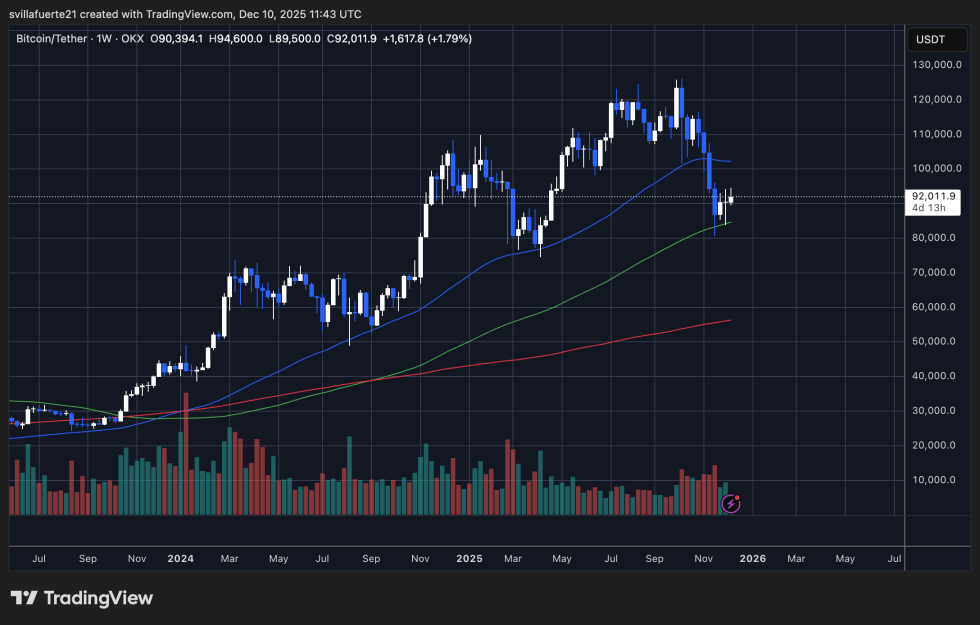
Bitcoin’s weekly chart shows the market attempting to stabilize above the $92,000 level after a sharp multi-week correction from the $120,000 region. The recent rebound from the $89,000–$90,000 zone highlights strong demand at the 100-week moving average (green line), which is currently acting as a critical dynamic support.

Historically, this MA has served as a structural backbone for Bitcoin during mid-cycle pullbacks, and the latest bounce reinforces its relevance.

BTC consolidates around key level | Source: BTCUSDT chart on TradingView

However, despite the recovery, BTC remains firmly below the 50-week moving average (blue line), a level that previously marked bullish continuation phases throughout 2024 and early 2025. Until price reclaims this region—now sitting near $100,000—the broader market structure leans corrective rather than impulsively bullish. The lower highs formed since the peak also suggest that bears still retain control over the medium-term trend.

Volume behavior adds another layer: although buying volume has picked up modestly, it remains significantly weaker than the aggressive selling pressure seen during the November–December decline. This indicates that buyers are showing interest, but conviction has yet to return in full force.

Featured image from ChatGPT, chart from TradingView.com

Pundit Explains What Happened With The XRP-Solana Integration

The unexpected “589” post from Solana’s official X account quickly opened up new discussions about whether something significant is forming between Solana and the XRP ecosystem. One of the reactions came from a community figure known as Cobb, who openly wondered if Ripple had just secured a major deal with Solana.

Nothing official has been announced, but a detailed breakdown from crypto commentator SonOfaRichard has brought clearer context to the situation. His explanation outlines what may be taking shape with the XRP-Solana connection and why the two networks could end up working together in a structured way.

Solana And XRPL Operate On Opposite Ends

In his response, SonOfaRichard noted how we’ve seen talks about Solana and XRPL integrations for a while, but then it has gone quiet. The pundit explained that Solana and the Ledger are often seen as competitors, yet their strengths sit in completely different areas. 

Solana is known for dominating the consumer-facing side of crypto for fast applications, active DeFi projects, and high-volume execution. What it lacks is corridor depth in regulated markets, a strong connection to compliant liquidity.

XRP and the XRPL fill that gap. Ripple focuses on enterprise channels, settlement, compliance, and liquidity, while the Ledger acts as the underlying banking layer that institutions depend on.

This creates a situation where Solana brings the activity and the audiences, and the Ledger brings the settlement and regulatory foundation. Rather than overlapping or competing, the two ecosystems form a natural and optimal design pair: one pushes value into the economy, and the other provides the framework that allows that value to move safely and at scale.

Another major part of the pundit’s explanation is also the role of RLUSD, Ripple’s regulated USD stablecoin. Solana, despite its massive activity, does not yet have a strong, compliant USD pathway. 

RLUSD could fill that need, acting as the channel through which consumer activity on Solana connects to regulated corridors worldwide. Under that arrangement, XRP becomes the collateral and final settlement layer sitting beneath both networks.

Explaining The “589” Message

The strong reaction to the post came from the fact that “589” is a well-known marker in the community. Solana followed it with another post showing the number in Morse code, paired with the flags of Solana, XRP, and Bitcoin, along with the caption “Time to flip the switch,” and even tagged Ripple’s CTO, David Schwartz.

Together, those posts have had more than six million views, making them the most-engaged content Solana has ever shared on the platform. The attention stemmed from the history of “589” itself, a number tied to long-running XRP memes and bold price expectations that have circulated within the community for years. Even so, there is still nothing concrete to confirm deeper intentions, and the posts could simply be part of a broader social media strategy.

XRP

❌