Bitcoin (BTC) began the new trading week on the back foot, slipping below the $90,000 mark as investors adopted a cautious stance ahead of a dense slate of U.S. economic data and key global central bank decisions.
After reaching an all-time high of $126,000 in October, the world’s top cryptocurrency has struggled to regain momentum, instead entering a period marked by tight ranges, low volatility, and subdued trading volumes.
Market movers appear reluctant to commit to new positions as uncertainty builds around the direction of macroeconomic trends. Bitcoin was trading near $89,600 during early Monday sessions, extending weekend losses and reflecting a broader risk-off mood across global markets.
Bitcoin Volatility Compresses as Technical Levels Tighten
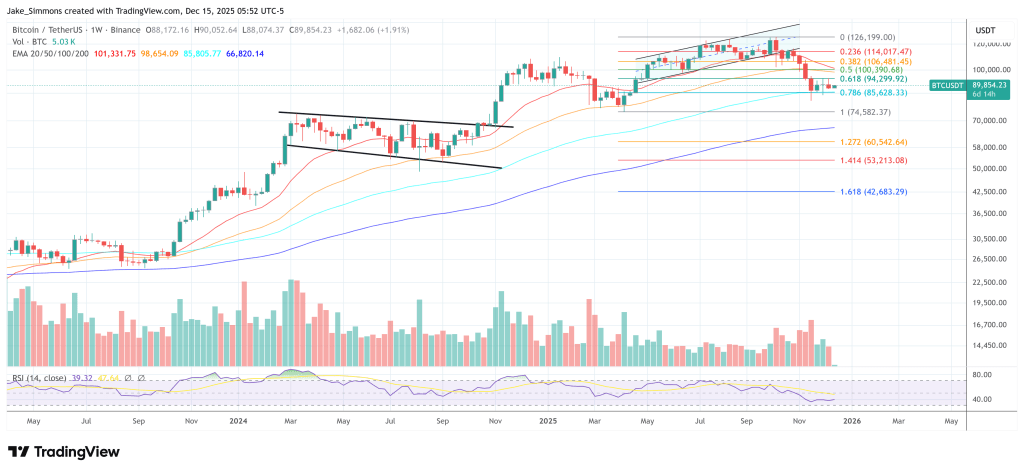
Bitcoin’s recent price behavior has been defined by historically low volatility, with the asset hovering in a narrow band just below $90,000.
Analysts note that such compression often precedes a sharper move. Technical analyst Aksel Kibar has identified a critical setup on the daily chart, suggesting that a decisive breakout or breakdown could be imminent.
On the downside, failure to hold current levels could open the door to a decline toward the $86,000 area, with deeper support seen between $73,700 and $76,500. On the upside, a sustained break above resistance near $94,600 could shift momentum and put the $100,000 level back into focus.
Other traders have echoed calls for patience, advising investors to wait for a confirmed move outside the current range before taking positions.
On-Chain Signals and Liquidity Raise Caution
Beyond chart patterns, on-chain data has reinforced a more cautious outlook. Analysts at CryptoQuant have highlighted weakening demand and selling pressure near key moving averages, suggesting that recent rebounds have lacked conviction.
Declining liquidity following the Federal Reserve’s recent rate cut has also weighed on Bitcoin and the broader crypto market, according to market makers.
Still, not all signals are uniformly bearish. Data from Glassnode shows that some digital asset treasury firms have quietly resumed Bitcoin accumulation, despite prices struggling to stabilize. This mixed backdrop underscores the market’s current indecision.
Macro Data and Central Banks in Focus
Attention now turns to a busy macroeconomic calendar. Investors are watching delayed U.S. jobs data, inflation reports, retail sales figures, and flash PMI readings for clues on growth and interest rate expectations. Speeches from Federal Reserve officials later in the week could further influence sentiment.
Globally, central bank meetings add another layer of uncertainty. Decisions from the European Central Bank, Bank of England, and especially the Bank of Japan, where a rate hike is widely expected, are being closely monitored for their impact on global liquidity.
With volatility compressed and key catalysts approaching, Bitcoin appears poised at a crossroads as markets await clearer signals on economic and policy direction.
Cover image from ChatGPT, BTCUSD chart from Tradingview
The lawsuit between Ripple and the US Securities and Exchange Commission (SEC) had dominated headlines for years, with XRP in the spotlight over its potential classification as a security. Now that the legal dispute is over and XRP has been definitively cleared as non-security, experts argue that Ripple’s greatest success extends far beyond XRP regulation.
Ripple’s True Victory Beyond XRP Regulation
A crypto market expert operating under the name “Stellar Rippler” on X has shared a compelling report that reassesses what truly constitutes Ripple’s biggest win. The analyst highlighted that the real win for Ripple was not regulatory approval but an intellectual shift in how the project is perceived.
The expert highlighted that while he favors XRP, he has historically been skeptical of Ripple’s intentions. However, he stated that the recent approval of the crypto company’s bank charter by the Office of the Comptroller of the Currency (OCC) speaks volumes about Ripple’s long-term vision in the financial sector.
Last week, on December 12, the OCC granted conditional approval to five crypto-related firms, including Ripple, to obtain national trust bank charters. This achievement marked a significant milestone for Ripple, reinforcing its legitimacy in traditional finance despite the numerous oppositions.
In his post, the analyst compares XRP and XLM, noting that the debate between the two cryptocurrencies has often been driven by emotion. He said that discussions were frequently centered on conflicts between retail and institutions, accusations of token dumpings, and differing visions for the future.
According to the expert, XRP and XLM have always been structurally similar, both designed for fast, low-cost settlement, cross-border liquidity, interoperability, and real-world financial infrastructure. However, he notes that the primary difference between the two cryptocurrencies has always been strategy rather than values.
He explained that while Ripple prioritized tackling regulatory hurdles, banking, and building institutional partnerships first, Stellar focused on grassroots adoption and open networks. With the new OCC bank charter, the expert emphasizes that Ripple’s strategic approach is now clearly validated and undeniable.
Stellar Rippler highlighted that Ripple did not abandon its crypto principles but took on the regulatory responsibility to ensure its network could operate at scale. He stated that this milestone shows that history favors builders who solve foundational problems rather than those who focus on tribal disputes.
Stellar Expert Shifts Stance After Ripple Gains OCC Approval
In a previous post, Stellar Rippler publicly announced a significant change in perspective on Ripple following news that the company had received conditional approval for a national bank charter. He admitted he was wrong in his past views, describing the recent development as a full submission to the highest level of federal and state oversight in the United States.
The Stellar expert now believes that Ripple is firmly committed to long-term global finance, stating that a company would not take such a path if it were not building something designed to last decades. He added that this milestone represents maturity and legitimacy for Ripple and strengthens confidence in XRP.
The price of XRP may be declining as volatility extends, but a lot of the leading altcoin has been observed leaving cryptocurrency exchanges at a rapid rate. With the token heavily leaving exchanges during the bearish phase, this raises the possibility of an anticipated supply shock.
Is An XRP Supply Shock Incoming?
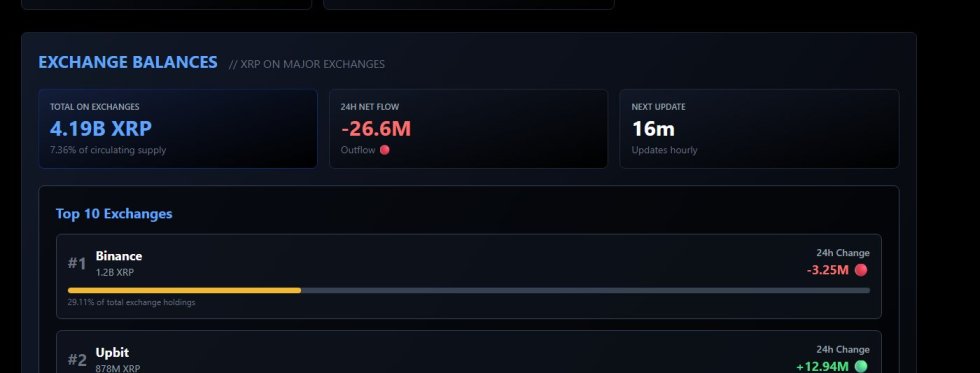
As XRP battles with bearish movements, its presence on centralized exchanges is subtly shrinking, which is starting to attract notable attention in the market. A report from Ripple Bull Winkle, a market expert and the founder of Lux Lions NFT, shows that the token has been consistently leaving crypto exchanges, even with fading price momentum.
This decline in supply on exchanges signals that investors may be transferring their coins into long-term storage or self-custody rather than making them easily accessible for trading. While these investors maintain the trend, it is often considered a strategic move in order to position themselves for potential upward spikes in price.
In the post on the X platform, Ripple Bull Winkle highlighted that the supply of XRP on exchanges is now totaled at 4 billion. Despite the massive coins still available on crypto exchanges, the figure only represents nearly 8% of the total supply circulating in the market.
As the altcoin exchange supply shrinks, the trend is sparking fresh debate about its possible implications for price behavior in the upcoming weeks. In the past, it has frequently preceded times of decreased sell pressure, shifting liquidity dynamics, and increased demand sensitivity.
Ripple Bull Winkle noted that the majority of the supply on exchanges is not for sale liquidity. Such thin float with growing institutional demand is likely to lead to explosive conditions, allowing XRP to kick off another sharp rally. According to the expert, this trend could be a sign of a supply shock because they do not show warnings; instead, they just detonate.
Taking a look at another post, Ripple Bull Winkle revealed a massive withdrawal from crypto exchanges, indicating rising conviction and reducing sell-offs. During the weekend, over 30 million XRP were withdrawn from exchanges, which was carried out in a single day.
The expert claims that this is how supply shocks are kicked off quietly, and the price does not move first. “Liquidity disappears first. Most people won’t notice until sellers are gone,” the expert added.
ETFs Market Is Thriving
XRP continues to experience significant demand both from retail and institutional investors via its Spot Exchange-Traded Funds. X Finance Bull highlighted that the funds are the only ETFs without any daily outflows over the last 30 days.
Currently, the funds hold the line with $1.34 billion and 669 million XRP locked. While others rotate their capital, institutions are building up on the token with conviction. According to the expert, institutional investors understand that the token is shaping up to be the liquidity layer for global finance, but retailers fail to. Meanwhile, this is how smart money moves prior to a paradigm shift.
Когда $BTC в один день может резко просесть и так же быстро отскочить, рынок снова вспоминает простую истину: в крипте цена часто движется не только фундаменталом, но и настроением толпы. На прошлой неделе Associated Press описало эпизод, когда биткоин кратковременно опускался ниже $85 000, а затем стабилизировался около $86 650, на фоне ухода инвесторов в «тихие гавани» и фиксации прибыли.
Нетрудно понять, почему старший руководитель крупной инвестиционной компании Vanguard Джон Амэрикс раскритиковал первую криптовалюту, назвав ее цифровым аналогом игрушки Лабубу.
В такие периоды мем‑сегмент ведет себя особенно показательно. Когда «серьезные деньги» осторожничают, розничные трейдеры чаще ищут не «идеальный актив», а историю, в которую легко поверить и которую легко обсуждать. И если рынок становится «одним большим мемом», то выигрывают проекты, которые прямо превращают торговлю в игру, а участие — в принадлежность к сообществу.
На этом фоне неудивительно, что внимание перетекает в мем‑токены с «культурой трейдинга»: они не обещают решить все проблемы мира, но решают более приземленную — удерживают интерес, когда хочется действия. В этой логике Maxi Doge становится не «еще одним мемом», а попыткой упаковать азарт высокорисковой торговли в понятный, вирусный и соревновательный формат.
У многих розничных игроков одна и та же боль: «киты» двигают рынок объемом, а им остается либо догонять движение, либо искать способ усилить свой результат через дисциплину, стратегию и сообщество на биржах криптовалют. Именно здесь проекты вроде Maxi Doge стараются сыграть роль «социального рычага», который компенсирует нехватку капитала вовлеченностью и механиками.
Почему мем‑рынок снова превращается в арену для трейдеров
Последние месяцы показали, что спекулятивные нарративы возвращаются волнами: как только биткоин перестает быть «прямой линией вверх», аудитория разбивается на два лагеря. Одни уходят в ожидание и кеш. Другие — в краткосрочную охоту за доходностью, где мем‑сектор становится витриной настроений и риска.
Статистические обзоры рынка отмечают, что в 2025 году дневные объемы торгов мем‑монетами регулярно превышали $5 млрд, а сама категория переживала резкие ускорения роста в отдельные периоды. Это не гарантия доходности, но маркер спроса на «истории», которые быстро распространяются и быстро конвертируются в сделки.
Отсюда и конкуренция форматов. Одни мем‑проекты делают ставку на «картинку и шутку». Другие — на геймификацию, турниры, стимулы для удержания и социальные механики. В такой гонке Maxi Doge — лишь один из вариантов, но он вписывается в тренд «мем как торговое сообщество».
Как Maxi Doge упаковывает «культуру 1000x» в соревнование
Центральная идея Maxi Doge — культ «королевского» плеча. С практической стороны проект делает акцент на соревновательной механике: закрытые для участников конкурсы по результативности торговли с таблицами лидеров и наградами. Это важный сдвиг для мем‑сегмента: внимание удерживается не только обещанием пампа, но и регулярным событием. Вокруг него строится активность сообщества.
Триггеры интереса уже заметны в цифрах. Предпродажа привлекла $4,3 млн, а токены предлагаются по $0,000273 — это дает четкую метрику спроса, которую рынок обычно отслеживает в реальном времени.
При этом данные по крупным покупкам тоже подогревают историю: трекеры показывают 2 значимые транзакции на общую сумму $503K. Крупнейшая — на $251K от 11 октября 2025 года.
$MAXI подойдет тем, кто ищет мем‑проект, который делает ставку на дисциплину, турниры и культуру трейдинга.
Legendary analyst Peter Brandt has criticized XRP investors, describing them as uneducated. His criticism comes amid the drop below the psychological $2 level, despite recent fundamentals that paint a bullish picture for the altcoin.
Peter Brandt Describes XRP Investors As “Uneducated”
In an X post, Brandt stated that XRP investors, who are permabulls, are the most uneducated and biased set of people he has seen over his 50 years of trading. The veteran trader classified this set of investors alongside those who trumpet Silver. He also highlighted how this was a big deal considering that he has traded thousands of contracts of every commodity, stock indexes, and many cryptos.
XRP has, over the years, been known to have one of the strongest crypto communities, which commonly refer to themselves as the ‘XRP Army.’ Brandt has, on several occasions, been criticized by some investors over some of his bearish predictions for the altcoin. This has led to him calling them out in the past whenever he makes such predictions.
It is worth mentioning that Brandt had also earlier in the month asserted that the “most madly obsessed perma-bulls” on earth are bulls. Although the veteran trader didn’t state an exact reason for making these statements, some pundits have developed a knack for making outlandish price predictions.
An example of such a pundit is Barry C, who recently stated that the price will skyrocket from $2 to $1,000 a lot sooner than people anticipate. The pundit has in the past alluded to banks’ potential adoption of the token as a factor that could spark the rally to $1,000. He recently highlighted the OCC’s grant of a conditional approval to Ripple to operate as a bank, which provides a boost for the altcoin.
Largest IQ Holder Is Now A Bull
XRP pundit Zach Rector clapped back against Brandt’s statement, noting that the largest IQ holder is now an XRP bull. The largest IQ holder, Young Hoon Kim, recently revealed that he had started buying the token, having become bullish on the altcoin. He also predicted that the altcoin could reach a new all-time high (ATH) before the year ends.
Meanwhile, in his latest X post, Kim opined that the price could potentially reach $100 over the next five years. However, he didn’t mention what could spark such a parabolic price surge for the altcoin. It is worth mentioning that such predictions have raised eyebrows because of what the altcoin’s market cap will be if it reaches such price targets. A $100 price target would give XRP a market cap of almost $10 trillion.
At the time of writing, the token’s price is trading at around $1.98, down over 2% in the last 24 hours, according to data from CoinMarketCap.
Один из самых обсуждаемых игроков хайстейкс-сцены, Ник Эйрболл, официально стал амбассадором CoinPoker.
Партнерство было объявлено в символичный момент — сразу после его громкой победы в Million Dollar Marathon на Hustler Casino Live, где он заработал $1,35 млн менее чем за 10 часов игры.
В честь сотрудничества CoinPoker и Ник Эйрболл запускают крупный розыгрыш для новых игроков, подчеркивая амбиции рума закрепиться в статусе площадки номер один для онлайн-покера высоких ставок.
Хайстейкс-звезда Hustler Casino Live присоединился к CoinPoker после выигрыша $1,35 млн и уже сыграл в топовых онлайн-играх платформы
CoinPoker объявил о подписании Нихила «Nik Airball» Аркота в качестве нового амбассадора бренда. Эйрболл — одна из самых ярких фигур современной живой покерной сцены США, прославившийся благодаря бескомпромиссной и агрессивной игре в дорогих кеш-играх Hustler Casino Live. Его спокойствие на фоне шестизначных колебаний банка и готовность играть против сильнейших соперников сделали его любимцем зрителей и ключевым персонажем хайстейкс-трансляций.
В рамках сотрудничества Ник Эйрболл разыгрывает 1% от своего недавнего выигрыша — $13 500. Принять участие в акции могут новые игроки CoinPoker, зарегистрировавшиеся с промокодом AIRBALL. Розыгрыш продлится в течение декабря, а победители будут объявлены в социальных сетях Эйрболла и CoinPoker. По масштабам это один из крупнейших розыгрышей среди амбассадорских кампаний рума.
Сам Ник отметил, что его привлек подход CoinPoker к развитию онлайн-покера, акцент на этике и прозрачности. Эти ценности совпадают с позиционированием платформы как «дома хайстейкс-покера». CoinPoker регулярно предлагает игры с лимитами вплоть до NL и PLO $1 000/$2 000, а также проводит Cash Game World Championship — серию, ориентированную на сильнейших кеш-регуляров.
Показательно, что Эйрболл уже принял участие в VIP-игре CGWC на CoinPoker, где сыграл против таких известных профессионалов, как Jungleman, в формате Seven Deuce Game на лимитах $50/$100. Это стало первым сигналом того, что партнерство будет сопровождаться не только маркетинговыми активностями, но и реальным хайстейкс-контентом.
Заключение
Сотрудничество Ника Эйрболла и CoinPoker выглядит логичным шагом для обеих сторон: харизматичный хайстейкс-игрок усиливает медийное присутствие рума, а CoinPoker предоставляет ему онлайн-платформу, соответствующую его уровню и стилю игры.
Розыгрыш $13 500 и участие Эйрболла в топовых играх подчеркивают стремление CoinPoker конкурировать за внимание серьезных игроков и укреплять свои позиции на рынке онлайн-покера.
Quantum risk has become a recurring stress point in Bitcoin discourse, often framed as an existential threat. The claim usually follows a familiar arc: quantum computing is advancing quickly, cryptography is vulnerable, and Bitcoin isn’t adapting fast enough.
Marty Bent doesn’t buy that framing. In his Dec. 14 episode, Bent acknowledged that quantum computing represents a genuine risk — not just for Bitcoin, but for any system built on modern cryptography — while pushing back on the idea that Bitcoin developers are ignoring the issue.
“Short answer is yes, it is a risk,” Bent said. “But it’s not only a risk for Bitcoin. It’s a risk for any system that depends on cryptography for security.”
What Developers Are Doing To Make Bitcoin Quantum-Safe
What tends to get lost, he argued, is the work already underway. Bent pointed to ongoing developer discussions and, more recently, a research paper published by Blockstream’s Jonas Nick and Mikhail Kutunov examining hash-based, post-quantum signature schemes tailored specifically for Bitcoin.
“I just wanted to make this video to push back on that notion,” Bent said, referring to claims that Bitcoin isn’t moving fast enough. “Because I think it’s pretty clear if you’ve been following Bitcoin development discussions over the last year, the quantum risk is certainly being taken seriously and the conversations have started.”
Nick summarized the paper in a Dec. 9 post on X, describing it as an analysis of post-quantum schemes optimized for Bitcoin’s constraints rather than generic cryptographic benchmarks. Bent described the work as a signal that research is shifting from abstract concern to concrete design space.
Hash-based signatures are conceptually simple and rely solely on hash functions, which is a primitive Bitcoin already trusts.
While NIST has standardized SLH-DSA (SPHINCS+), we investigate alternatives that are better suited to Bitcoin’s specific needs.
Nick wrote via X: “Hash-based signatures are conceptually simple and rely solely on hash functions, which is a primitive Bitcoin already trusts. While NIST has standardized SLH-DSA (SPHINCS+), we investigate alternatives that are better suited to Bitcoin’s specific needs. We explore in detail how various optimizations and parameter choices affect size and performance. Signature size can be reduced to ~3-4KB, which is comparable to lattice-based signature schemes (ML-DSA).”
The challenge, Bent emphasized, isn’t a lack of candidate solutions. It’s that Bitcoin is a globally distributed system with nearly 17 years of operational history, and changes at the protocol level come with heavy trade-offs.
“Bitcoin is a globally distributed peer-to-peer system that depends on consensus protocol rules that are very hard to change,” Bent said. “And you really don’t want to change them too often.”
That reality complicates any transition to quantum-resistant signatures. Existing address types, HD wallets, multisig setups, and threshold schemes all need to be considered. And beyond compatibility, there’s the question of performance.
“One of the biggest hurdles when approaching this problem in Bitcoin is that many quantum-resistant schemes are very data intensive,” Bent said. “Yes, there are many different schemes that can be implemented. However, they come with trade-offs — particularly verification and bandwidth trade-offs.”
Larger signatures can slow block propagation and make it more expensive to run a full node, which directly impacts decentralization. The Blockstream paper focuses heavily on that tension, exploring optimizations that could reduce signature sizes to a few kilobytes while keeping verification costs manageable.
“They feel pretty confident that they’ve done the research to find signature schemes that would have a nice trade-off balance,” Bent said. “You get quantum resistance, but at the same time it remains conducive for people to download full nodes and verify transactions without needing a significant amount of bandwidth and data storage.”
Bent was careful not to frame the research as a finished solution. Instead, he described it as groundwork — mapping the problem space early so the network isn’t caught flat-footed if quantum capabilities advance faster than expected.
“This is by no means like, ‘hey, we solved the problem,’” he said. “But we are taking this problem seriously, doing research and beginning to figure out ways in which we could solve the quantum risk that may or may not manifest in the medium to long term.”
He also noted that BTC tends to be singled out in quantum discussions, even though most of the internet relies on cryptographic assumptions that would face similar pressure in a true post-quantum scenario.
“If quantum computers do come, Bitcoin is not the only thing,” Bent said. “Almost everything you touch on the internet is depending on some cryptographic security at some point.”
Everyone’s panicking about quantum computing killing bitcoin.
For now, Bent’s takeaway was measured. Quantum risk exists. Progress in quantum computing is real. But the narrative that developers are ignoring the issue doesn’t align with what’s happening in technical circles.
“Very smart developers, cryptographers more importantly, are researching the problem,” he said. “If you know where to look, it’s pretty clear that people are preparing for this.” Not solved. Not ignored. Just quietly being worked on.
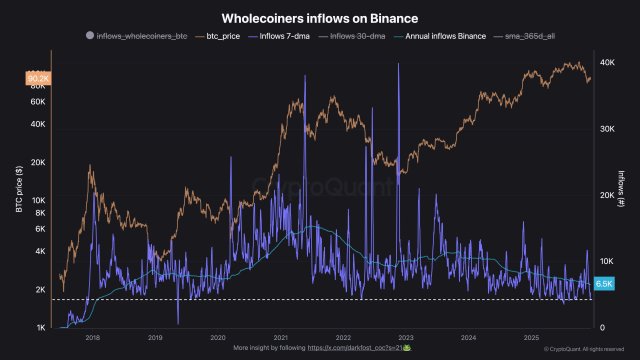
Bitcoin’s bounce last week was quickly cut off by growing volatility in the broader crypto market, causing the price to fall below the pivotal $90,000 mark once again. Given the recent price fluctuations, investors’ sentiment, especially those on crypto exchanges, has shifted as inflows from BTC wholecoiners plummet.
Binance Sees Sharp Drop In BTC Wholecoiner Inflows
While the price of Bitcoin pulls back this new week, there is one key metric that is currently standing out. This metric is the BTC Wholecoiners Inflows on Binance, which is starting to tell a different story about investors on the largest cryptocurrency exchange in the world.
After examining this metric, Darkfost, a market analyst and author at CryptoQuant, revealed that on the Binance platform, wholecoiner deposits are drying up. Specifically, wholecoiner inflows imply transactions larger than 1 BTC, which provides vital insight into both current selling pressure and the broader evolution of the market.
Data shows that the inflows from this cohort are declining when compared to past years. Presently, BTC’s yearly average now sits around 6,500 BTC, representing a level not seen since 2018. Meanwhile, on the shorter time frame, the weekly average is situated near 5,200 BTC, marking one of its lowest readings of this cycle.
While the wholecoiner inflows dry up, the pattern that inflows have followed this cycle in comparison to previous ones is very intriguing. Even as Bitcoin continued to rise, wholecoiner inflows to Binance have steadily decreased rather than rising as they once did.
Beyond indicating that investors with sizable Bitcoin holdings are less inclined to sell, this trend could also point to a deeper structural shift in the market. With Bitcoin’s valuation experiencing a steady increase, owning a full BTC has become extremely difficult, which naturally decreases the total number of transactions larger than 1 BTC.
At the same time, Darkfost highlighted that there are now more options available in the ecosystem for owning or trading Bitcoin. Even crypto exchanges have multiplied, and the steady growth of Decentralized Finance (DeFi) provides more venues, a trend that is likely to redirect flows that previously went nearly exclusively to major exchanges such as Binance.
BTC Still Trading Below Short-Term Cost Basis
Bitcoin is still trading below the Short-Term Holder Cost Basis located at $105,400. What this means is that the crypto king has been trading below the level for nearly 2 months now. However, Darkfost stated that staying beneath the level for such an extended period is not uncommon.
During previous corrections, the duration of these phases has ranged from two months to over four months, making the present correction fall well within a typical range. However, since this indication tends to stay negative for much longer after the market actually enters a bear phase, it would be crucial to prevent Bitcoin from declining any further.
In the meantime, this does not invalidate the notion that these periods remain a signal for accumulation opportunities. Nevertheless, caution is still crucial, and access points should be carefully optimized. Darkfost believes that an accumulation of this type is only appropriate for long-term investors.
Fanatics, a leading global sports platform, has launched Fanatics Markets, a fan-led prediction market platform developed through a strategic partnership with Crypto.com, bringing together sports, finance, and culture.
Fanatics Markets is a simple, user-friendly platform built to let people trade on the moments shaping sports, finance, and culture. Through the partnership, the platform introduces customers to markets and pricing offered by Crypto.com | Derivatives North America (CDNA), a CFTC-registered exchange and clearinghouse and affiliate of Crypto.com. The platform provides users with a way to pick a side and potentially profit on outcomes that matter most, including sporting events, movements in the price of gold, and cultural moments. The Fanatics Markets app is available on iOS and Android.
Users are able to trade contracts across sports, finance, economics, and politics, including event outcomes such as whether a team will score more than 20 points or whether a cultural storyline will unfold. Crypto.com’s CFTC-registered derivatives exchange provides institutional-grade security, while Fanatics Markets maintains control over the user experience and interface design. The platform features a sleek and intuitive design that reflects real-time market sentiment and is live in multiple U.S. states, including California, Texas, Florida, and Washington.
Travis McGhee, Global Head of Predictions at Crypto.com, said that Crypto.com was the first to launch sports prediction markets and continues to grow its reach through partnerships with platforms such as Fanatics. He added that the partnership provides fans with a safe and compliant way to access prediction markets.
Matt King, Chief Executive Officer of Fanatics Betting and Gaming, said Fanatics Markets offers fans a safe, intuitive, and rewarding way to engage with moments that move sports and culture, while allowing them to pick a side and potentially profit if their prediction is correct.
Fanatics Markets is launching in two phases. The first phase is live with event contracts across sports, finance, economics, and politics. The second phase, launching early next year, will expand the platform to include event contracts related to crypto, stocks and IPOs, climate, pop culture, technology and AI, movies, and music.
The Fanatics Markets app is available today in Alaska, Delaware, Hawaii, Idaho, Maine, New Hampshire, North Dakota, Rhode Island, South Dakota, and Utah. Additional launches are planned in states including Alabama, California, Florida, Georgia, Minnesota, Mississippi, Nebraska, New Mexico, Oklahoma, Oregon, South Carolina, Texas, Washington, and Wisconsin.
Fanatics Markets will include consumer protections and provide tools that allow customers to manage exposure, trade responsibly, and make informed trading decisions, including deposit limits, session limits, timeouts, and self-exclusion.
Fanatics joins other brands collaborating with Crypto.com to offer access to prediction markets, following recent partnerships announced with Underdog, Truth Social, Hollywood.com, and MyPrize.
After hitting a new all-time high back in October 2025, the Bitcoin price has been in what appears to be a consistent downtrend, pushing it to new yearly lows. The first wave was triggered by sell-offs from large accounts, coinciding with the 10/10 crash. Since then, each recovery attempt has been met with more sell-offs, preventing the Bitcoin price from reclaiming $100,000. As sentiment continues to trend low, the chances of a meaningful recovery grow slimmer by the day.
Bitcoin Price Correction May Not Be Over
A crypto analyst on the TradingView website has highlighted where the Bitcoin price is and the next decision levels for the cryptocurrency. Right now, it continues to trend low, favoring the bears. Nevertheless, there is still the opportunity for the bulls to take over if momentum picks up.
The first major level that the Bitcoin price must reclaim lies at $90,000, which is now a stronghold for bears. As the crypto analyst explains, the digital asset would have to reclaim and hold this level for the price to bounce. In the case of a bounce, then the cryptocurrency is expected to maintain its bullish structure.
The bullish continuation would see the first major resistance being retested at $97,000. Once beaten, then the bulls could move on quickly to $100,000, a psychological level that could trigger the influx of investors back into the market.
However, with the Bitcoin price already falling below $90,000 over the weekend, it is more likely that the bearish part of the prediction will play out. As the post explains, failing to hold $90,000 is incredibly bearish for the price and would be the beginning of another decline.
Once the Bitcoin price begins to fall, there is not much holding it before it reaches the next major resistance at $78,000. This means it is likely that the Bitcoin price will fall by over 20% before eventually finding its footing above $78,000 and readying for another bounce. “This is the point where the next major direction gets decided,” the analyst said.
Referral Feature to Enable Users to Earn and Track CRO Rewards Through App-Based Referrals
Crypto.com App Referral Feature December 2025 – Crypto.com, a global leader in cryptocurrency services, today announced an updated App Referral feature to expand user participation across the Crypto.com platform and enable users to earn CRO rewards through app-based referrals.
The updated App Referral feature, which aims to allow users to earn CRO by inviting friends to join the Crypto.com App, marks a significant step in broadening participation in Crypto.com’s ecosystem. The referral feature is designed to provide users with clearer visibility into referral activity and reward progression, while enabling both existing and newly referred users to track CRO rewards more effectively within the app. Additionally, the updated feature prioritizes ease of use, transparent tracking, and scalable participation, making it accessible for a broad range of users.
“We are pleased to introduce updates to the App Referral feature to help expand user participation across the Crypto.com platform through a more structured and transparent referral experience,” said a Crypto.com representative. “The updated referral feature reinforces our commitment to providing users with clear tools to track rewards and engage more actively with the Crypto.com App.”
“Providing more ways for users to engage with cryptocurrency services remains central to our vision of further mainstreaming crypto,” said Eric Anziani, President and COO of Crypto.com. “The App Referral feature update enables users to participate more directly in the growth of the Crypto.com ecosystem while earning CRO rewards tied to referral activity.”
Under the updated referral feature, users can earn up to US$100 in CRO for every friend successfully referred to the Crypto.com App. The feature includes a dedicated dashboard, which allows users to track referred friends, monitor earnings milestones, and view total CRO rewards earned through referrals, all in one place. The updated dashboard provides a consolidated view of referral activity, enabling users to monitor progress more efficiently.
The referral feature also introduces trading-based earning, under which CRO rewards increase based on the trading activity of referred users. As referred users generate trading volume within the Crypto.com App, referral rewards progress accordingly, allowing for smoother reward accumulation and structured milestone tracking.
In addition, the updated referral feature provides more personalised ways to share referral codes and links, enabling users to distribute referrals more easily across supported channels. These updates are intended to allow users to grow their referral networks while maintaining a consistent and streamlined sharing experience within the app.
The referral feature update applies to both existing Crypto.com users and newly referred users. Referred users are also eligible to earn up to US$100 in CRO, track their reward progress more easily, and begin referring additional users themselves once eligible, expanding participation across the Crypto.com ecosystem.
This referral feature update follows Crypto.com’s continued efforts to enhance user experience and expand access to cryptocurrency services across its platform.
About Crypto.com
Founded in 2016, Crypto.com is trusted by millions of users worldwide and is the industry leader in regulatory compliance, security and privacy. Our vision is simple: Cryptocurrency in Every Wallet. Crypto.com is committed to accelerating the adoption of cryptocurrency through innovation and empowering the next generation of users to participate in a more accessible digital ecosystem.
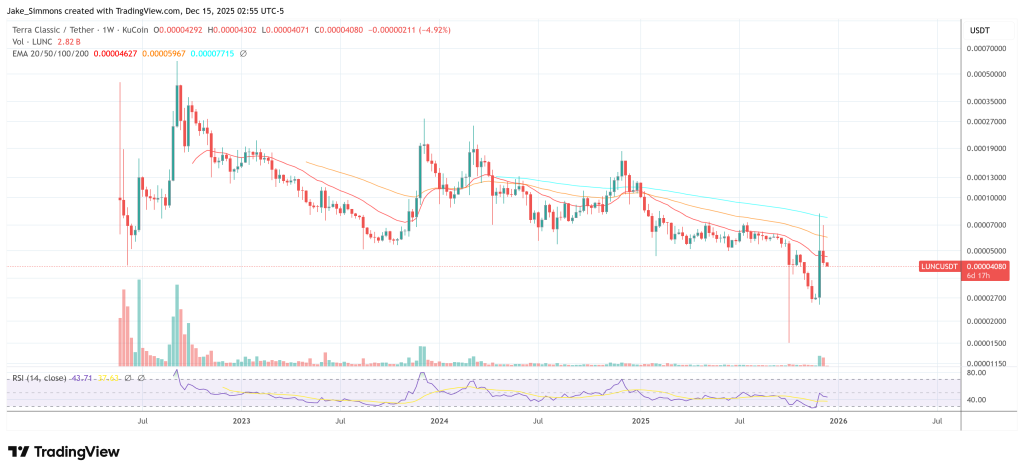
Former Terraform Labs developer Will Chen argued in a Dec. 13 X thread that the fraud case against Do Kwon was built on a “backwards” theory, days after a court sentenced Kwon to 15 years in prison on Friday, Dec. 15.
Chen framed his post as a critique of the legal mechanics, not a character defense. “I wanted Do to fail. I wanted him punished. I thought he was arrogant and reckless and I told him so to his face multiple times,” he wrote. “I’m not here to defend Do Kwon the person. But the legal case is broken.”
Do Kwon Conviction Misframed Terra’s Collapse
He described Judge Engelmayer as “sympathetic” and “extremely methodical,” but argued the guilty plea boxed Kwon into the government’s framing: “Do taking the guilty plea means admitting to the government’s charges as is. There’s no debating afterward.” Chen said he found it “incredibly ironic” that Do Kwon didn’t contest the case.
At the center of Chen’s critique is prosecutors’ theory around Terra’s May 2021 depeg. As Chen summarized it, the government argued that Kwon claimed the algorithm “self-healed” while failing to disclose that Jump Trading stepped in to buy UST and help restore the peg, making his public statements deceptive and therefore fraudulent.
Chen’s rebuttal is that this logic runs in the wrong direction. “Fraud is when you claim your system has safety mechanisms it doesn’t have, and people invest trusting that fake safety, and then they lose money when the danger you hid materializes,” he wrote, contrasting it with the allegation here: “But what the government is alleging is the inverse. Do said ‘no reserves, the algorithm alone handles it’ when he actually did have Jump as a backstop.”
In Chen’s view, that means Do Kwon was “claiming less safety than he actually had,” adding: “If he’d disclosed Jump, investors would have been more confident, not less.” He distilled his conclusion bluntly: “You don’t defraud someone by hiding additional safety mechanisms. The direction is backwards.”
Chen also disputed how prosecutors interpreted a reported private remark attributed to Do Kwon — that Terra “might’ve been fucked without Jump” — as proof Kwon knew the mechanism was broken. “Might’ve been fucked is uncertainty about an unknowable counterfactual,” Chen wrote. “Knew it would have failed is a claim of definite knowledge.”
He argued the only way to truly know the algorithm would not have recovered is to not intervene and watch it die, which he suggests is inconsistent with operating a live financial system. “The algorithm was working during that period,” Chen wrote. “Arbitrage was happening. UST was being burned for LUNA. Jump was also buying. Both things were true.”
Even the non-disclosure itself, Chen argued, could be framed as strategic rather than deceptive. “Algorithmic stablecoins operate in adversarial conditions,” he wrote, suggesting that publicizing the size and nature of defenses can make an attack easier to price. “If attackers know your exact defense capabilities, they can calculate whether an attack is profitable,” Chen said, arguing that “uncertainty about defense resources is itself a defense.”
He compared the idea to “strategic ambiguity” used by central banks and warned that public transparency around reserves can become a tactical disadvantage: “Would disclosing Jump have made Terra more or less secure? Attackers could have calculated exactly how much force was needed to overwhelm the defense.”
Chen then challenged whether the case established investor reliance and causation in a market saturated with information. “Do’s statements were one signal in an incredibly noisy channel,” he wrote, pointing to years of public debate around Terra’s risks, open-source code, and prominent critics. “The risk was described in the original white paper. The code was open source. The potential failure mode was publicly debated for years,” Chen wrote, arguing prosecutors “never established direct causation between Do’s specific statements and investor decisions.”
He also drew a sharp line between the May 2021 episode and the May 2022 collapse, arguing the information environment changed materially in between. “By May 2022, investors knew about backstops,” he wrote, pointing to Luna Foundation Guard’s public launch in January 2022 and the visibility of reserves on-chain. In Chen’s view, that breaks the causal chain: “The May 2021 non-disclosure about Jump is causally disconnected from May 2022 losses because the information environment had completely changed by then.”
One of Chen’s most forceful objections was the scope of losses attributed to Do Kwon. “One thing I can’t get over is the fact that Do signed off on pleading guilty to causing $40 billion in loss,” he wrote. “Market cap decline is not fraud loss.” He offered a simple example to illustrate what he sees as a category error: “If I buy LUNA at $1 and it goes to $100 and then back to zero, my loss is $1. The $99 was paper gains I never realized.” Treating peak-to-trough market cap evaporation as damages, he argued, “sets a terrible legal precedent for the industry.”
While disputing the overarching fraud theory, Chen did not claim Terraform Labs’ messaging was clean across the board. He said “the Chai stuff has more merit as an actual fraud claim,” while arguing the government’s portrayal was still overstated. “That’s not entirely accurate,” he wrote of claims Chai didn’t use Terra, adding that Chai “did use Terra for accounting,” that “Terra wallet was integrated into the app,” and “you could top up Chai with KRT,” while conceding Do Kwon “probably stretched the truth early on” about on-chain payment settlement.
Anchor, Chen wrote, was “harder to defend.” Promoting the roughly 20% yield as sustainable while reserves depleted was “reckless,” and he said Do Kwon knew “the 20% couldn’t last forever without a plan.” Still, Chen argued that even if yield marketing was misleading, the catastrophic losses were driven by the depeg: “If UST had held, people would’ve just earned less interest. They wouldn’t have lost their principal.”
The ex-Terra developer also contrasts Do Kwon to Sam Bankman-Fried: “SBF literally stole customer deposits and used them for other purposes. That’s why SBF victims are being repaid. The money was taken and still exists somewhere. Terra victims can’t be repaid because the value was destroyed in a crash, not stolen and moved to a different account. Treating these situations as equivalent is wrong.”
Chen closed with a broader warning about precedent and builder behavior. “If founder confidence plus project failure equals fraud, we’ve criminalized entrepreneurship,” he wrote, arguing it exposes founders who publicly express optimism about products that later fail. His final framing returned to process: whatever one thinks of Do Kwon personally, Chen argues the plea locked in prosecutors’ narrative without the kind of contested defense that might have narrowed both the theory and the scope of damages.
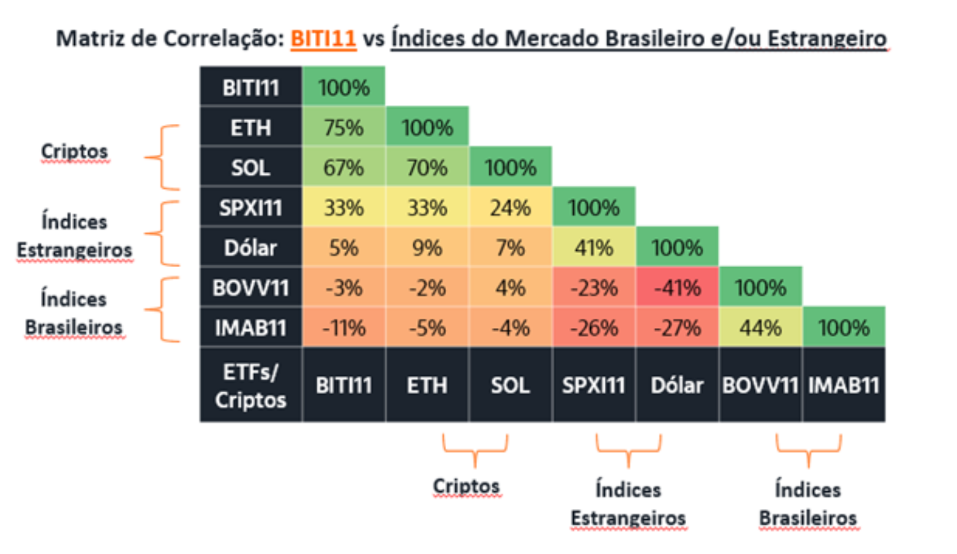
According to Itaú Asset Management, Brazil’s largest private bank, investors should consider holding 1%–3% of their portfolios in Bitcoin starting in 2026. The recommendation came in a research outlook released this week and frames Bitcoin as a small, complementary holding rather than a main bet.
Itaú Backs Small Bitcoin Positions
The bank’s note points to Bitcoin’s low correlation with many traditional assets and to currency risks that hit local investors hard this year. Itaú also moved to build the infrastructure behind that view: in September 2025 it created a dedicated crypto division and named former Hashdex executive João Marco Braga da Cunha to lead the team. That new unit sits alongside the bank’s existing products and is meant to help clients access regulated crypto tools.
Access Through Local Products
Brazilian savers can already reach Bitcoin via products tied to Itaú. The bank is part of the team that launched the IT Now Bloomberg Galaxy Bitcoin ETF, known by its ticker BITI11, which began trading on November 10, 2022. The ETF gives investors a spot-like route to Bitcoin inside the local market, and it sits alongside unit trusts and pension products that offer crypto exposure.
Small But Existing Crypto Footprint
Itaú says its regulated crypto suite manages roughly R$850 million across several funds and ETFs, a modest amount compared with its wider business but still a clear signal of product readiness. The bank’s asset arm is large: it manages more than 1 trillion reais for clients, which helps explain why its guidance on allocations draws wide attention.
Market Context And Timing
Itaú’s move arrives after a year in which currency swings amplified losses for some Brazilian holders of foreign assets. That reality appears to be part of the math behind recommending a 1%–3% position — a small buffer for those worried about local-currency shocks, not a bet meant to replace stocks or bonds. The bank frames the position as a disciplined, long-term allocation, not a short-term trade.
What This Means For Investors
For ordinary investors the guidance is simple to read: keep exposure small and controlled. A 1% position will hardly change a diversified portfolio on its own, while 3% is still within what many institutions have called a “satellite” slot. Based on reports, Itaú expects to offer more choices — from low-volatility wrappers to riskier strategies — through the new unit as demand grows.
Featured image from La Nación, chart from TradingView
Bitcoin is heading into a critical window as the Bank of Japan prepares what could be its most consequential policy move in decades. The central bank is widely expected to raise interest rates by 25 basis points to 0.75% at its December 18-19 meeting, a level not seen since 1995 and a clear signal that Japan is continuing its exit from ultra-loose monetary policy.
This upcoming event is causing a few conversations among crypto traders because similar policy moves from Japan have repeatedly coincided with the start of Bitcoin price crashes.
Japan’s Rate Hikes And The Repeating Bitcoin Sell-Off Pattern
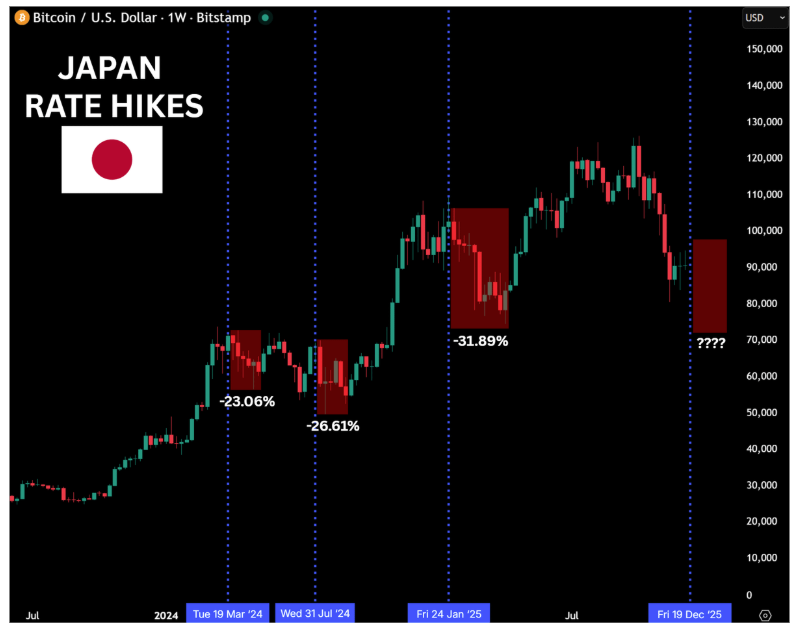
Crypto market observers have been quick to highlight an uncomfortable pattern relating to Bitcoin and the BOJ. Each time the bank has raised rates since 2024, Bitcoin’s price action has experienced a deep and relatively fast correction.
For example, March 2024 saw Bitcoin fall by about 23% following Japan’s first rate hike since 2007. A similar rate spike move in July was followed by a drop of around 26%, while the January 2025 hike preceded a steeper decline of more than 30%.
Crypto analyst 0xNobler expressed concern, noting that if this historical trend repeats itself, Bitcoin could be headed below the $70,000 level shortly after the upcoming December decision. The chart he shared illustrates how each rate hike has aligned with a local market top, followed by a pronounced leg lower. The consistency of these moves has turned what might otherwise be dismissed as coincidence into a data point many traders are now taking seriously.
The pressure extends beyond reactions by the crypto industry alone. Japan is the largest foreign holder of US government debt, and any tightening from the Bank of Japan reverberates across global liquidity markets. Higher Japanese rates strengthen the yen, and this, in turn, reduces excess capital that might otherwise flow into risk assets.
Echoing this view, another crypto commentator known as AndrewBTC pointed to Bitcoin’s repeated 20% to 31% declines following each BOJ hike since 2024. He warned that another rate increase in December could produce a similar outcome and also identified $70,000 as the possible downside target if the pattern repeats itself.
Bitcoin Above Long-Term Support: Not Everyone Is Bearish
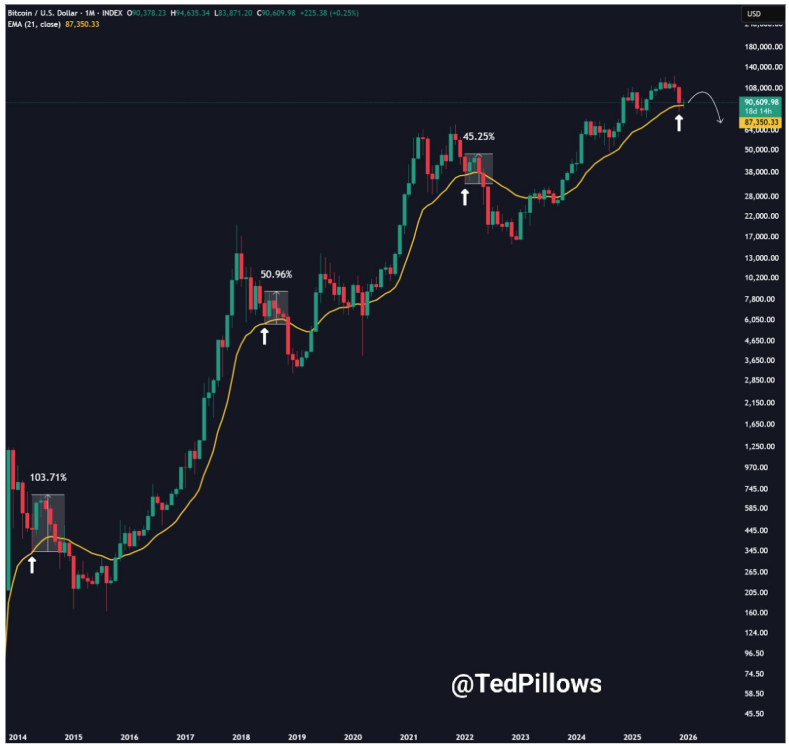
Despite the growing anxiety towards the Bank of Japan’s rate increase, the outlook for Bitcoin is not universally negative. For instance, analyst Ted Pillows pointed out that Bitcoin is currently interacting with its monthly EMA-21, a level that has always acted as a launchpad in prior cycles.
Based on this structure, Pillows predicted that Bitcoin could still surge to between the $100,000 and $105,000 range in the near term before there’s another price dump.
As the December meeting approaches, Bitcoin finds itself caught between a troubling pattern and a resilient technical support. Whether Japan’s next rate hike leads to another immediate sell-off or allows for a temporary upside push may define how Bitcoin and the rest of the crypto market close out the year.
While the XRP price displays a clear bearish structure, momentum pushing the price downwards appears to be cooling. A recent analysis into underlying on-chain activity has revealed a shift in investor behavior, providing context to the recently slowed momentum seen.
XRP Holdings Decline To 2024 Low Of 2.6 Billion
In a QuickTake post on CryptoQuant, the on-chain analytics group Arab Chain explains how the XRP market is experiencing certain shifts in liquidity dynamics. The analysis revolved around data obtained from the XRP Ledger: Exchange Reserve metric, which tracks the total amount of XRP held in wallets associated with centralized cryptocurrency exchanges (in this case, Binance).
According to Arab Chain, XRP’s exchange reserves on the Binance platform have declined, reaching an approximate 2.6 billion reading, the lowest level seen since 2024. Typically, a fall in exchange reserve numbers indicates the tokens’ movement out of centralized platforms into personal wallets for long-term holding or merely transferred out for other on-chain uses.
Notably, the steady contraction of Binance’s XRP reserves points out that market participants might be more inclined towards holding, as opposed to having a growing selling appetite. Arab Chain cites historical data, explaining that increased outflows from exchanges can be interpreted as a sign of easing bearish pressure. This is because coins outside exchanges are less prone to rapid liquidation events. Also, such a decline during periods where prices remain stable could signal growing accumulation tendencies among investors.
The analytics group further revealed a unique trait of current data. The present decline in reserves came after previous sharp growths in the XRP exchange reserves. It then becomes clear that the market may simply be “rebalancing its supply structure, with a reduced amount of XRP available for day-to-day trading.”
It’s worth noting that the contraction in reserves puts the market in a delicately bullish position. In this scenario, the re-entry of buyers into the XRP market could translate into a faster and sharper bullish momentum. On the other hand, a sustained absence of growing reserves dampens the chances of any large-scale sell-off in the short term.
XRP Price Overview
For most of December, XRP has traded within the $2.123–$2.000 price levels. Popular market analyst, Ali Martinez, however, recently took to X to report that $XRP has to prevail above $2.0, for any hopes of a price recovery to be realistic. In the scenario where $2.0 fails to hold, the altcoin could spiral downwards to as low as $1.20.
As of this writing, XRP trades at approximately $2.02, with CoinMarketCap data reporting a % 0.64% growth over the last 24 hours.
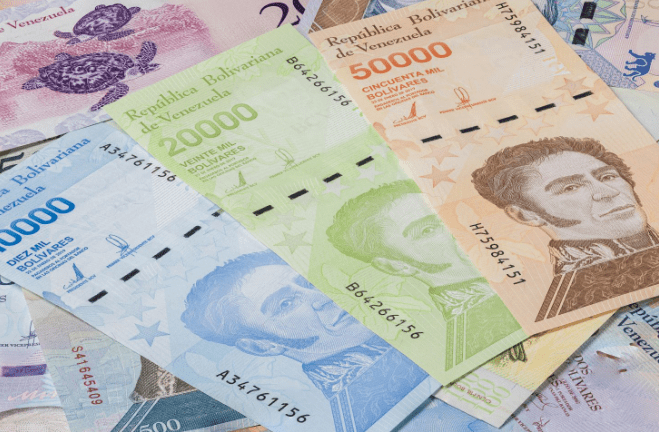
Venezuela’s cash is losing value quickly. People and businesses are shifting to US-dollar stablecoins, especially USDT, to protect savings and make everyday payments.
According to market data, the peso-like bolívar has quoted around 267 per US dollar on December 12, 2025, after roughly 254 on December 5, showing how fast the local currency can move.
Why The Shift Is Accelerating
Based on reports from exchanges and on-chain firms, inflation has been estimated in the 100s–200s% range year-on-year in 2025. Prices rise fast under those conditions.
Wages lose value within days, sometimes hours. To avoid that loss, workers, freelancers and small shops are turning to stablecoins tied to the US dollar, which hold value better than the local currency.
Stablecoins As Daily Money
USDT is now being used for groceries, rent and even salaries in several cities. Peer-to-peer platforms and small crypto desks help users swap between bolívars and stablecoins without relying on traditional banks.
In some neighborhoods, merchants accept stablecoins directly, cutting out currency exchange altogether. Payments that once required cash stacks or quick conversions are now handled through mobile wallets.
Rising On-Chain Flows And Regional Trends
Blockchain analytics firms tracking activity across Latin America have reported a sharp rise in stablecoin volumes during 2024 and 2025.
TRM Labs and similar groups point to higher transaction counts and more active wallets linked to dollar-backed tokens. These increases match what residents describe on the ground. Crypto is not just held. It is being spent, saved and passed along as money.
Many Venezuelans receive remittances from abroad and convert them into USDT before bringing value back home. Others sell goods or services and ask to be paid in stablecoins to avoid sudden losses.
Conversion usually happens through messaging apps, local brokers or P2P platforms. The process is simple, but it depends heavily on trust and access to liquidity.
Government Reaction And Market Risks
Authorities have responded in mixed ways. Some unofficial dollar markets have been targeted, while limited crypto-based currency conversions have been allowed in certain cases.
Reports have also linked state-owned firms to crypto use for accessing foreign funds. At the same time, sudden rule changes remain a risk. Crackdowns, new compliance demands or exchange restrictions can disrupt access overnight.
Featured image from Pexels, chart from TradingView
The US government continues to advocate for cryptocurrency adoption after the Securities and Exchange Commission published a retail investor guide centered around various means of custody. In the bulletin released on Friday, the SEC provides a detailed education on the available ways investors can safeguard their cryptocurrency investments and the associated risks.
SEC Addresses Crypto Custody As Regulatory Acceptance Takes Shape
The Donald Trump-led administration has taken multiple steps in supporting the growth of the digital asset industry in line with the US President’s electoral manifesto. Under the current crypto-friendly stance, the US SEC has adopted a more accommodating regulatory approach compared to the regulation-by-enforcement strategy seen under the Biden administration.
This shift has led to several key developments, including the formation of a dedicated task force, the termination of multiple lawsuits initiated under Biden’s crackdown, and the launch of a new regulatory initiative known as “Project Crypto.” In another encouraging move towards the nascent industry, the regulator has recently released a set of guidelines on proper custody of cryptocurrency.
In this document, the SEC’s Office of Investor Education and Assistance defines a crypto asset as “an asset that is generated, issued, and/or transferred using a blockchain or similar distributed ledger technology network, including assets known as ‘tokens,’ ‘digital assets,’ ‘virtual currencies,’ and ‘coins.’”
Meanwhile, custody is defined as how and where investors store and access their crypto assets. The Commission touches on the importance of private keys, which they define as an alphanumeric code that allows users to gain access to their digital assets using programs known as crypto wallets. The US regulators also drew comparisons between self-custody and third-party custody, highlighting their peculiarities in terms of control and security responsibility. Other aspects of crypto custody discussed by the SEC include types of crypto wallets (hot and cold), seed phrase, and public key.
Crypto Community Reacts To SEC’s Educational Efforts
Unsurprisingly, the SEC’s published bulletin on crypto custody has drawn applause from many crypto enthusiasts. For example, a market analyst with X username X Finance Bull describes the custody education post as another lever of regulatory acceptance.
The analyst said:
The SEC just released an official guide on crypto asset custody for retail investors. Months after dropping the $XRP case, the posture keeps shifting. from resistance to education. I’ve seen this movie before. This is what quiet acceptance looks like.
At press time, the total crypto market cap is valued at $3.04 trillion, after a minor 0.29% growth in the past day.
Standard Chartered and Coinbase announced an expanded collaboration on December 12, 2025, to develop a suite of services aimed at institutional investors.
Based on reports from both firms, the work will look at trading, prime services, custody, staking and lending for banks, funds and other large players.
Building On Existing Work
The firms said the push grows out of an existing arrangement in Singapore where Standard Chartered provides banking links that let customers move Singapore dollars in real time to and from Coinbase. That setup helped power Coinbase’s move into the island city’s business market on November 12, 2025.
What They Plan To Explore
Coinbase and Standard Chartered described five areas they will explore together: trading, prime services, custody, staking and lending. These cover order execution, financing and custody options that big clients typically demand.
Both sides framed the effort as trying to give institutional users safer, regulated ways to hold and move digital assets.
Why The Move Matters
Institutional investors have been asking for services that resemble what they get in traditional markets — custody with strong controls, credit and financing options, and execution tools tied to regulated banking rails.
Standard Chartered already rolled out spot trading for Bitcoin and Ether for its institutional clients earlier in the year, an effort that showed the bank is building its own crypto capabilities as demand grows.
Middle Ground For Banks And Crypto Firms
Coinbase brings its institutional trading platform and market access; Standard Chartered brings global payment rails, FX handling and a bank’s compliance framework.
The result, the partners say, should be a way for large investors to trade and custody digital assets while sticking to familiar banking rules and procedures.
Other banks and prime brokers are also striking ties with crypto firms or building in-house services, so this announcement is part of a broader push to give big clients regulated choices.
For institutional traders, having multiple, regulated routes to trade and settle crypto helps reduce single-point dependency and may lower operational risk.
Public Launch Date Or Pricing
Neither company provided a timetable or fee details when they announced the expansion. For now, the plan is to develop and test product ideas for institutional clients across regions where each firm operates.
The announcement underlines how more traditional finance players and crypto firms are working together to meet demand from large customers.
Featured image from Standard Chartered, chart from TradingView
Crypto promoter Rodney Burton, popularly known as “Bitcoin Rodney,” is facing new charges for his alleged role in the $1.8 billion HyperFund pyramid scheme. This development comes almost two years after the US Department of Justice brought criminal charges against two of the co-founders of the crypto Ponzi scheme.
In January 2024, the US DOJ charged Xue Lee (Sam Lee) and Brenda Chunga (Bitcoin Beautee) for their roles in HyperFund. According to the prosecutors, the founders falsely claimed that the scheme’s investors would receive substantial returns paid from non-existent crypto mining operations.
The fraudulent scheme, which also drew the attention of the US Securities and Exchange Commission (SEC), collapsed in 2022, leaving investors unable to withdraw their money. The SEC filed a civil action against the founders, stating that HyperFund lacked any real revenue source apart from investors’ funds.
US DOJ Adds Wire Fraud Charge To HyperFund’s Promoter
On Friday, December 12, the US Attorney’s Office for the District of Maryland announced new indictment charges against 56-year-old Burton for actively promoting the fraudulent HyperFund scheme. The new charges include conspiracy to commit wire fraud, two counts of wire fraud, seven counts of money laundering, and one count of operating an unlicensed money transmitting business.
The 56-year-old crypto promoter, who was initially facing two counts related to unlicensed money transmission, is now staring down at a protracted prison sentence if found guilty on all counts; a maximum of 20 years in federal prison for the wire fraud conspiracy and each wire fraud count, 10 years for each money laundering count, and five years for the unlicensed money transmission enterprise.
The superseding indictment also accused Burton of misappropriating investors’ funds in the purchase of luxury condo homes, sports cars, and a yacht. The crypto influencer managed to build a crypto community following while hosting various celebrities, including Akon, Jamie Fox, and Rick Ross.
According to court filings, Burton claimed that he was made to believe that he was operating a legitimate enterprise, causing him to mislead investors. The crypto influencer’s trial is expected to start by March 2026.
Crypto Market At A Glance
As of this writing, the total cryptocurrency market is valued at around $3.05 trillion, reflecting a 0.2% jump in the past 24 hours.
Strategy (formerly MicroStrategy) has kept its place in the Nasdaq 100 during this year’s reshuffling—its first since joining the index in a similar event last December. This comes as a piece of good news as the Bitcoin corporate buyer contends with the risk of possible exclusion from Morgan Stanley Capital International (MSCI)’s indexes.
MSTR Survives First Nasdaq 100 Reshuffling
On Friday, December 12, Reuters revealed that Strategy (with the ticker MSTR), the largest corporate holder of Bitcoin, survived its first Nasdaq 100 rebalancing since joining the index. As its name suggests, the Nasdaq 100 tracks the performance of 100 of the largest non-financial companies listed on the Nasdaq stock exchange.
According to the report, this reshuffling saw Biogen, CDW, GlobalFoundries, Lululemon, On Semiconductor, and Trade Desk lose their places in the index. At the same time, Alnylam Pharmaceuticals, Ferrovial, Insmed, Monolithic Power Systems, Seagate, and Western Digital made it into the Nasdaq 100.
These changes to the Nasdaq 100 index are expected to come into effect on Monday, December 22.
Despite the positive nature of this development, the MSTR price closed the day on a nearly 4% decline, which has been the theme for the stock as of late. According to the latest market data, the Strategy stock is down by almost 25% in the past month.
Strategy Urges MSCI To ReconsiderIndex Criteria
Furthermore, this positive event comes at a time when other index providers are reevaluating their inclusion criteria. As Bitcoinist earlier reported, global index provider MSCI stated that it is considering the exclusion of companies with business models that focus heavily on holding crypto assets.
However, Strategy’s cofounder and chairman, Michael Saylor, stated that his firm is not merely a passive Bitcoin holding entity but rather a software firm with a proactive financial strategy. According to Saylor, the firm is in discussions with MSCI regarding its plans to exclude companies whose crypto holdings exceed 50% of total assets from its indices.
In a recent letter endorsed by Saylor and CEO Phong Le, Strategy voiced its support for MSCI’s intentions to establish consistent eligibility criteria across its indices. Nevertheless, the firm urged MSCI to reconsider its plan to delist companies with over 50% digital asset holdings from its Global Investable Market Indexes.
While Saylor has countered their evaluation, saying an exclusion “won’t make any difference,” JP Morgan analysts estimate that Strategy alone might face outflows of up to $2.8 billion as a direct consequence of MSCI’s decision.

 Login
Login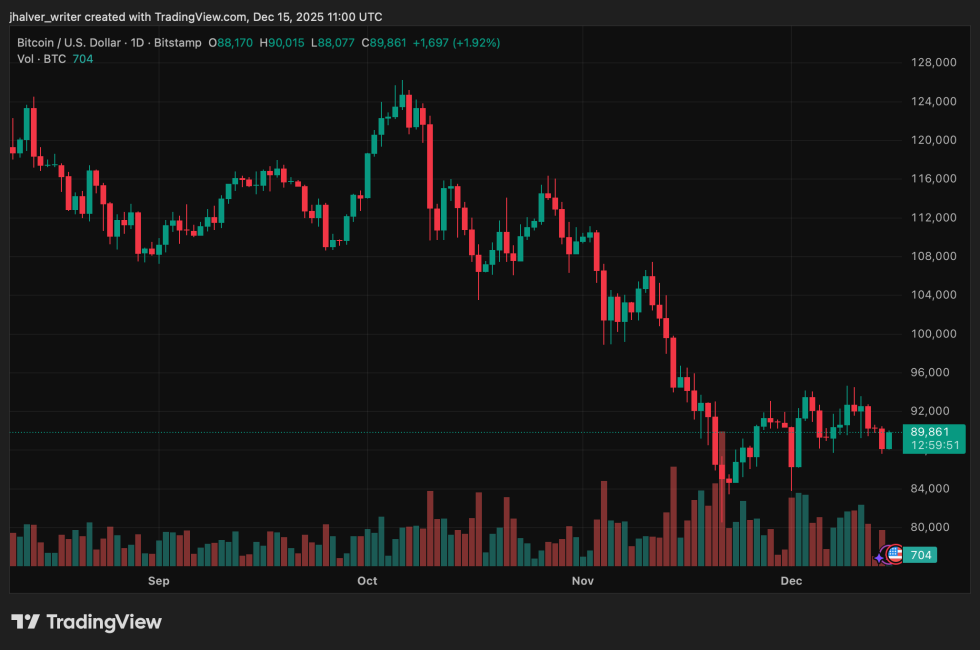








 . Crypto.com is committed to accelerating the adoption of cryptocurrency through innovation and empowering the next generation of users to participate in a more accessible digital ecosystem.