Reading view

There are new articles available, click to refresh the page.

Crypto Giant a16z Sets Up Shop In South Korea In Major Asia Push

Crypto venture capital firm Andreessen Horowitz (A16z) has opened its first Asian office in Seoul, South Korea, signaling a deeper push into the region where on-chain activity and user adoption have surged. According to the firm, the new hub will support portfolio companies and help build local partnerships and communities.

A16z Moves Into Seoul

The office will be led by Sungmo Park, who has held roles at Monad and Polygon, and who joins a16z as Head of APAC go-to-market. Reports have disclosed that Anthony Albanese, the fund’s chief operating officer, announced the move and framed it as a way to put teams closer to where users and builders are located.

I’m honored to share that I will be joining @a16zcrypto as Head of APAC go-to-market.

a16z crypto backs exceptional founders, providing not just capital but also hands-on support to help them grow into transformative companies.

Now, a16z crypto is opening an office in Seoul and…

— sungmo (@sungmo_apac16z) December 10, 2025

A16z said Seoul will act as a gateway for interacting with companies across Asia and for giving portfolio firms local support on partnerships, marketing and expansion. Park will focus on regional strategy and on helping founders navigate local markets. This is not described as a small PR outpost; it is positioned as a real operating base for the region.

Excited to announce that @a16zcrypto is expanding into Asia and opening our first office in Seoul, South Korea. As part of this, we’re thrilled to have @sungmo_apac16z join our team as Head of APAC go-to-market to lead the Seoul office and start building our presence in the… pic.twitter.com/KBljioBCqx

— Anthony Albanese (@AAlbaneseNY) December 10, 2025

Based on reports, Asia-Pacific recorded about US$2.36 trillion in on-chain value over the 12 months ending June 2025, an increase of close to 70% from the prior year. That growth helped convince a16z that Asia needs a local presence. Chainalysis and several industry trackers show heavy on-chain flows and deep retail participation across the region.

Our latest State of Crypto report shows that onchain users are widely distributed around the world, with a particularly strong concentration in Asia. It now represents a significant share of global crypto activity, for example:

🇰🇷 South Korea is the second-largest crypto market…

— Anthony Albanese (@AAlbaneseNY) December 10, 2025

Why Korea Matters To Crypto

South Korea itself is highlighted as one of the largest national crypto markets. According to a16z and other coverage, nearly one in three adults in South Korea hold crypto assets — a rate that in some measures is higher than local stock ownership. That level of retail use, plus a thriving developer community, made Seoul an attractive choice for the firm.

What The Move Could Mean

The entry of a major US venture firm into Seoul may boost interest among local startups seeking international partners and could make capital more accessible for teams in South Korea and nearby markets. Several news outlets describe the office as focused on go-to-market support rather than immediate, large-scale local investing, at least at launch.

Competition For Deals

Reports note that other global funds and crypto firms have been increasing activity in Asia this year. A16z’s decision comes as several markets across the region report rising developer activity and fresh funding rounds. For founders, having an established US investor with a local office may speed introductions to global customers and partners.

Featured image from Unsplash, chart from TradingView

Cardano Founder Reacts As NIGHT Token Crashes From $150 To $0.02

Cardano founder Charles Hoskinson has hailed the launch of Midnight and its native token NIGHT as the strongest in the network’s history, arguing that it proves Cardano can now host and distribute multi-billion-dollar assets at scale.

NIGHT Token Plunges After Midnight Launch

In his December 10 livestream “Midnight Launch AAR,” Hoskinson opened with the volatile price action that dominated social media. NIGHT initially spiked to what he called an “insane” level: “It launched at almost a $150, which is just insane […] it just went way, way, way up.” Once trading opened on Binance Alpha, the move reversed violently. “As soon as it got on Binance Alpha – oh god, why, why, oh why – all the way down to two cents. They dumped on us. That’s what they do. That’s what the DGENs over in that market do.”

He framed this as typical exchange-distribution dynamics, not a structural failure: recipients with no real connection to the ecosystem “regardless of the price, they just dump the token. They probably didn’t even know what NIGHT was.”

According to Hoskinson, such launches usually endure 48–72 hours of “high volatility” before a stable range emerges. He reiterated that he had expected NIGHT to trade in a “5 cents to 15 cents” band and said it was sitting around 6–6.5 cents with a fully diluted valuation of roughly $1.5 billion and around $150 million in trading volume. For a brand-new Cardano-native asset in current conditions, he called that “a really solid launch.”

What made the debut historically significant in his view was the combination of tier-one listings and on-chain metrics. “This is the first time in history that Cardano right out the gate can launch a $1.5 billion product, be listed on Binance Alpha and Kraken and OKX and everybody else at the start,” he said, stressing that much of the required infrastructure “wasn’t there” and had to be built during the run-up.

Cardano’s Best Launch Ever

On Cardano itself, he highlighted that Midnight immediately became the dominant token by trading activity. Citing TapTools, he said NIGHT was “sitting [at] an overwhelming level of volume, and it’s actually greater than the volume of every other Cardano native token combined,” adding that its FDV is “worth more than all the other CNTs combined as well.”

For the first time, he argued, DEXs such as Minswap and SundaeSwap carried a “meaningful percentage of trading volume […] with respect to large exchanges,” helping “prime the pump on Cardano DEXes” and pull more stablecoins into the ecosystem.

Distribution was another focal point. Hoskinson praised the Glacier Drop mechanism and its gradual “thawing,” saying it creates “a nice steady emission and a nice steady flow for the system as opposed to a jagged thing where the insiders all dump.”

He contrasted Midnight’s retail-heavy, exchange-plus-airdrop distribution with VC-led launches elsewhere: “This is the first time since Bitcoin that a launch has been done the way that Midnight did it. It was complete retail, completely fair, and none of those damn VCs got their grubby hands on it. Instead, it went right to you, the people.”

He tied that to a broader “return to first principles,” arguing that 2026 should reward projects with fair launches and fixed-supply, deflationary monetary policies: “There’s a fixed supply NIGHT, by the way […] it’s going to be a good year for everybody who’s betting on you, the consumer, and not betting on the banks.”

Looking forward, Hoskinson positioned Midnight as Cardano’s first “partner chain” and the “tip of the spear” for a hybrid DApp model spanning multiple ecosystems: “You talk about Midnight Cardano, Midnight Ethereum, Midnight Solana, Midnight Avalanche, Midnight Binance.” He said that after the first four phases of the roadmap, “every two months a new ecosystem gets activated,” with recurring feature drops “every six to eight weeks.”

He also cast Midnight as a competitive wedge for Cardano DApps. With tier-one integrations and privacy-preserving capabilities, he argued, “we have privacy before [Ethereum and Solana] do,” giving Cardano–Midnight hybrid apps a differentiator that can help grow TVL, MAU and transaction volume.

Hoskinson insisted that the launch pressure-tested and validated the base protocol: “Cardano network handled it. The exchanges handled it. And Midnight is here to stay.” The ambition from here is explicit. “We’re going to march Midnight up as an ecosystem to that $10 billion mark. That’s the goal. Let’s keep going. Let’s get her done,” he said, adding that “these are the best numbers we’ve ever seen in the history of Cardano” – and, in his view, only the beginning.

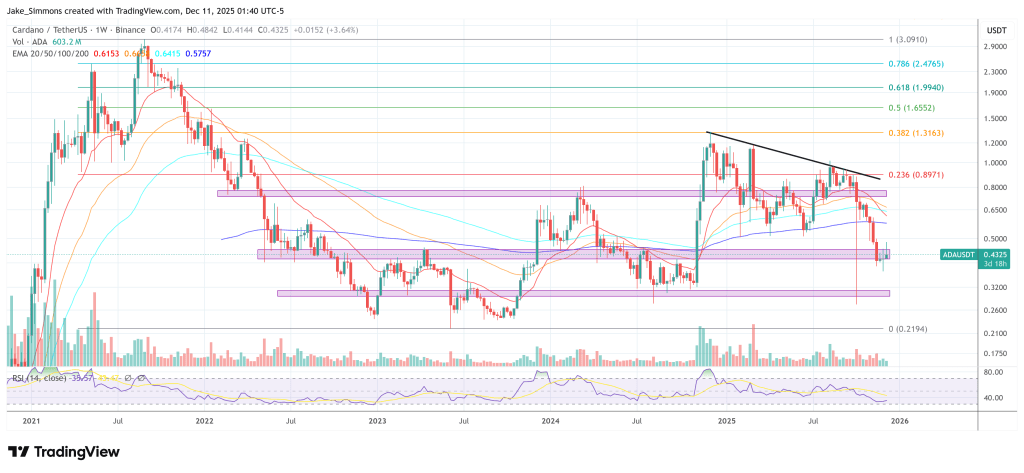
At press time, ADA traded at $0.4325.

Cardano price

Bitcoin Treasuries Have Grown 448% Since Jan 2023: Here’s How Much They Hold Now

Data shows Bitcoin treasury companies have seen an explosive growth trajectory since 2023, gaining relevance as an important pillar of the market.

Public & Private Companies Now Hold More Than A Million Bitcoin

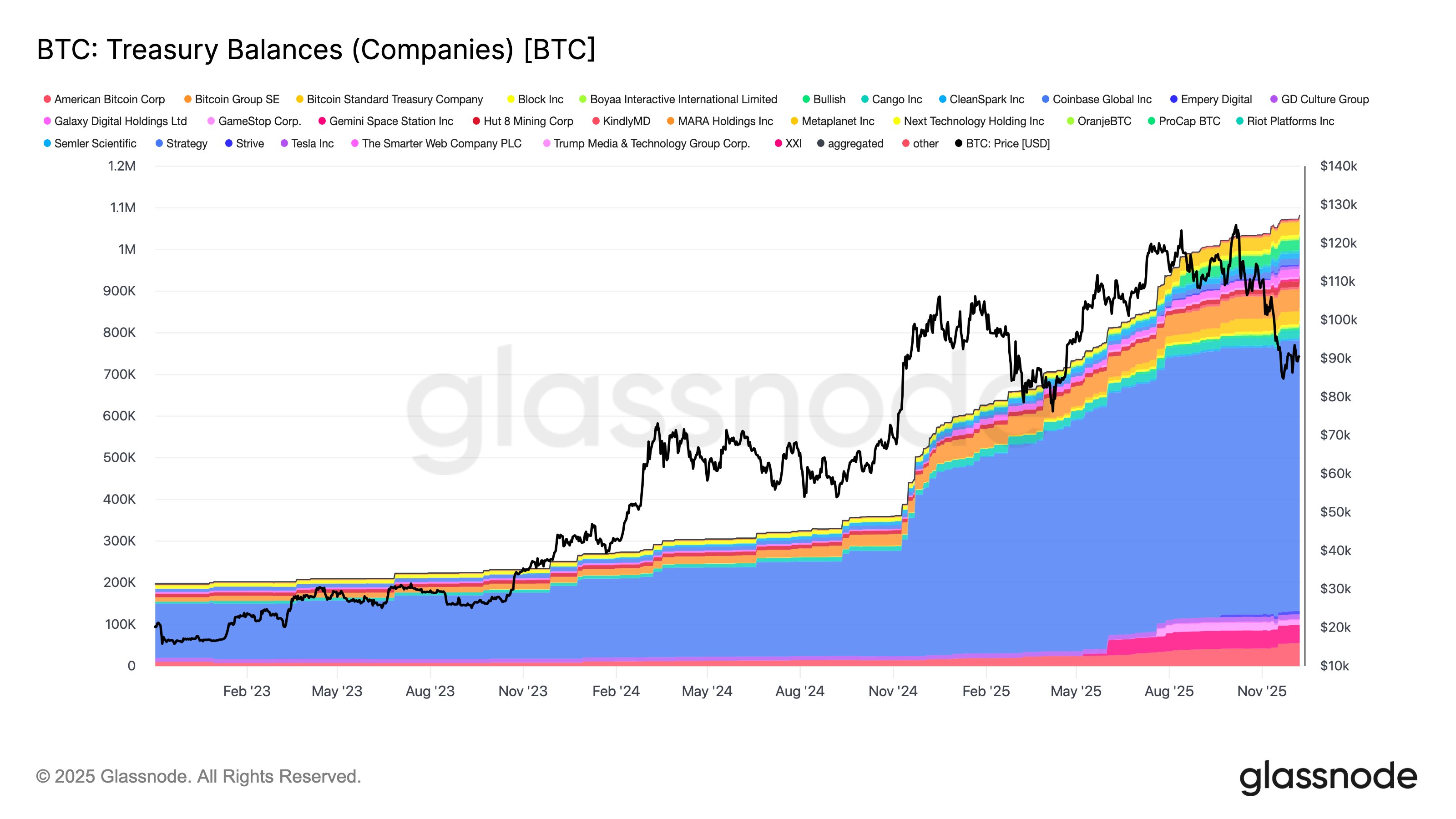
In a new post on X, on-chain analytics firm Glassnode has talked about the trend in the Bitcoin treasuries held by public and private companies. Below is the chart shared by Glassnode that shows changes in both the holdings of the various companies as well as their combined balance.

Bitcoin Treasury Balance

As is visible in the graph, Bitcoin treasuries held by companies saw slow, but steady growth during 2023 and most of 2024, but in late 2024, the growth became much more rapid.

This sharp trajectory continued into 2025 and so far, with the year’s end approaching, the uptrend hasn’t faded. This would suggest that corporates have been accumulating BTC at a significant pace for a year now.

In January 2023, the size of the Bitcoin holdings that private and public firms held stood at 197,000 BTC. Today, that figure has grown to 1.08 million BTC, implying a massive jump of about 448%.

Today, there are about 19.96 million tokens in circulation, so more than 5.4% of the cryptocurrency’s supply is sitting in the treasuries of public and private companies. “Corporate balance sheets are becoming an increasingly significant pillar of demand for BTC,” noted the analytics firm.

A major force behind the increase in Bitcoin corporate holdings is naturally Strategy (formerly MicroStrategy). The Michael Saylor-led firm has been a regular presence in the market for some time now, participating in buying almost every week and making no sales since December 2022.

Strategy currently owns about 660,624 BTC, which means that the treasury company alone accounts for over 61% of all BTC holdings attached to public and private firms.

While Strategy has been a big factor behind the surge in corporate holdings, it hasn’t been the only one. 2025 has seen the rise of treasuries like Metaplanet, which have also contributed to growth in BTC treasuries.

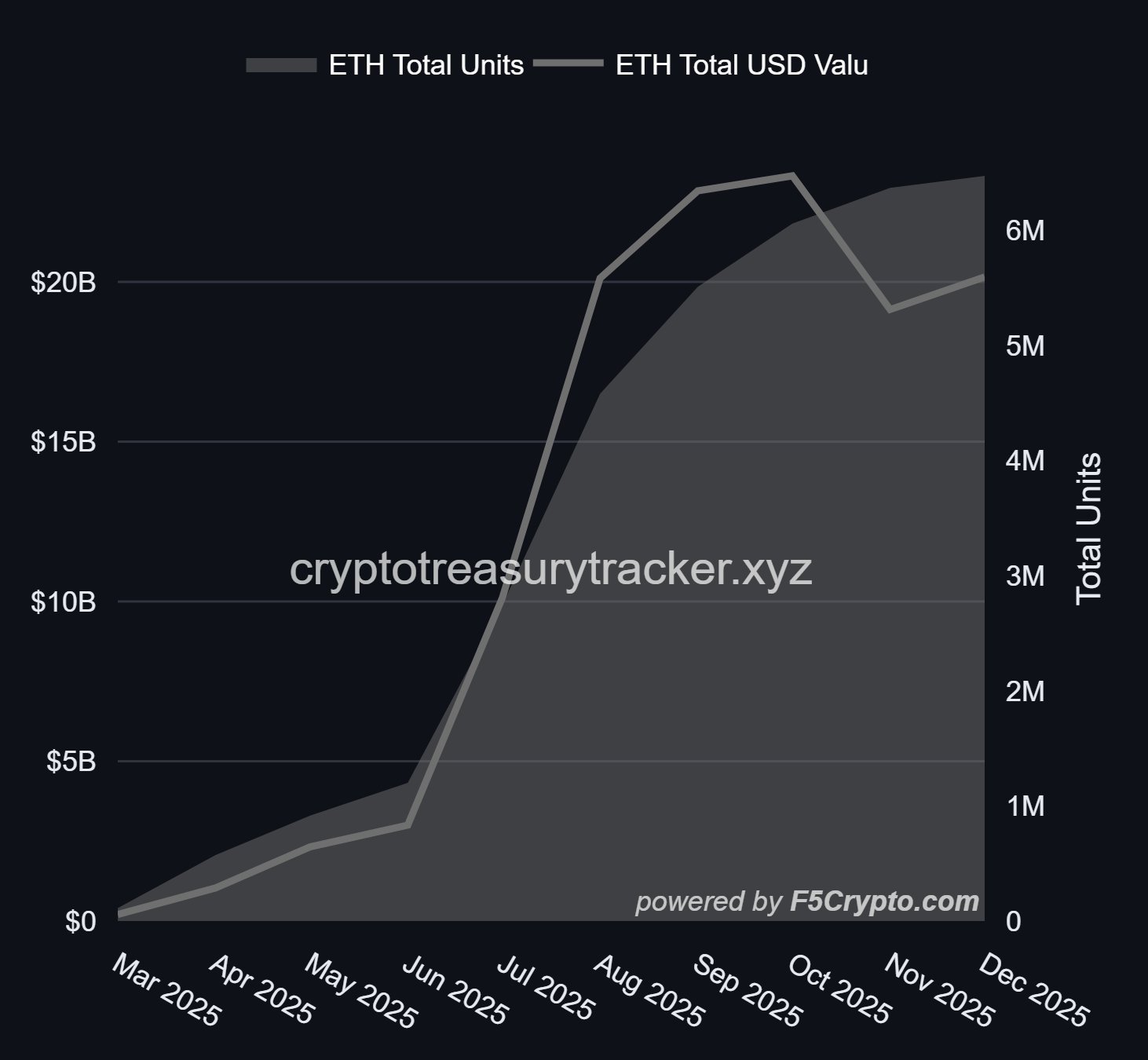
The year has also witnessed a treasury movement related to altcoins, with both Ethereum and Solana seeing a significant amount of accumulation. ETH treasuries went through some sharp growth in mid-2025, but during the recent phase of price decline, buying has slowed down.

That said, it hasn’t hit a complete pause, as institutional DeFi solutions provider Sentora has pointed out in an X post that Ethereum treasuries added a significant amount during November.

Ethereum Treasuries

As displayed in the above chart, Ethereum treasuries added 309,000 ETH during November, and so far in December, they have accumulated another 100,000 ETH.

BTC Price

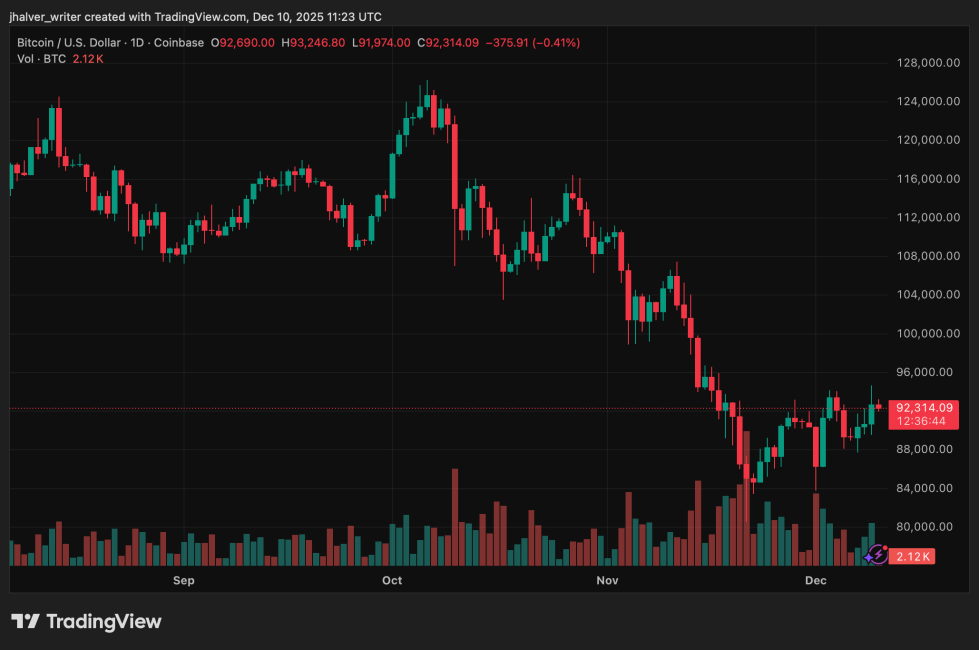
Bitcoin surged to $94,500 on Tuesday, but the cryptocurrency has since faced a drawdown as it’s now back at $92,200.

Bitcoin Price Chart

South Korea’s Stablecoin Legislation Hits Roadblock As FSC Misses December 10 Deadline

South Korea’s government has reportedly missed the deadline to submit its highly anticipated stablecoin legislation, risking a delay of the second phase of the country’s regulatory efforts to align with global standards and foster innovation.

FSC Misses Key Deadline Amid BOK Disagreement

On Wednesday, local media outlets affirmed that the South Korean government failed to submit the long-awaited bill for the Second Phase of the Virtual Asset User Protection Act, which is expected to address the issuance and distribution of won-denominated stablecoins.

Chosun Biz reported that the Financial Services Commission (FSC) did not meet the National Assembly’s submission deadline for the government’s legislation. On December 1, authorities set December 10 as the deadline to submit the bill to the National Policy Committee.

According to political circles cited by the report, the government bill was delayed because the FSC and the Bank of Korea (BOK) failed to resolve their differences over the issuance of won-pegged stablecoins.

As reported by Bitcoinist, local outlets stated in late November that South Korea’s stablecoin legislation risked being delayed due to a disagreement between financial authorities and the central bank over the extent of banks’ role.

The BOK and FSC seemingly agreed that the financial institutions must be involved in the issuance of won-pegged tokens. However, the central bank has been pushing for a consortium of banks owning at least 51% of any stablecoin issuer seeking regulatory approval in the country.

Meanwhile, the FSC was willing to involve diverse players in the process, expressing concern that giving a majority stake to banks could reduce participation from tech firms and limit the market’s innovation.

The November report noted that the regulatory standoff appeared to leave the market in limbo, with some tech companies actively preparing to get approval and others taking a cautious approach due to the unclear regulatory direction.

Stablecoin Legislation Risks ‘Prolonged Deliberation Process’

Chosun Biz noted that the Democratic Party of Korea (DPK) initially intended to advance the second phase of its virtual asset bill by reviewing the government bill. Nonetheless, if the government draft continues to be delayed, the bills previously introduced by lawmakers could be reviewed first.

Since June, multiple bills related to the issuance and distribution of won-pegged stablecoins have been introduced in the National Assembly. Min Byung-deok, a member of the National Assembly’s Government Committee, introduced the “Digital Assets Basic Act, proposing enabling the issuance of won-pegged stablecoins and establishing a Digital Asset Committee under the direct authority of the president.

In July, South Korea’s ruling and opposition parties proposed rival bills to establish the highly anticipated regulatory framework. Notably, Ahn Do-gil, a member of the Planning and Finance Committee from the Democratic Party, introduced the “Act on the Issuance and Distribution of Value-Stable Digital Assets.”

Similarly, Kim Eun-hye, a member of the Land, Infrastructure, and Transport Committee from the People Power Party (PPP), proposed the “Act on Payment Innovation Using Value-Fixed Digital Assets.”

The two bills shared similarities, like the assignment of stablecoin oversight to the FSC. However, they differed over the issue of interest payments, with the PPP’s bill allowing interest payments and the DPK’s bill completely banning them to prevent market disruption.

It’s worth noting that the FSC chairman, Lee Eun-won, recently affirmed that the regulatory agency will “fundamentally prohibit the payment of interest on stablecoins as a principle,” adopting the same principle as the US framework, the GENIUS Act, which prohibits interest payments on the holding or use of payment-purpose stablecoins.

Following the Wednesday delay, a member of the National Policy Committee from the Democratic Party affirmed that, “for now, it looks difficult to narrow the differences between the FSC and the BOK.”

“If the government bill continues not to be submitted, the deliberation process could be prolonged, so we should at least review the bills introduced by lawmakers first,” they concluded.

Bitcoin, btc, btcusdt, stablecoin

American Federation Of Teachers Opposes Crypto Market Structure Bill In New Letter

The American Federation of Teachers (AFT) has formally added its voice to the growing opposition against the proposed crypto market structure bill, urging the Senate Banking Committee to reconsider the legislation. 

In a letter obtained by CNBC, AFT President Randi Weingarten described the bill as “as irresponsible as it is reckless,” citing the alleged dangers it poses to working families’ pensions and the overall economy.

AFT Calls Out Loopholes In Crypto Legislation

In her correspondence with Senate Banking Committee Chairman Tim Scott and Ranking Member Elizabeth Warren, who is known for her consistent skepticism toward digital assets, Weingarten expressed significant concern about the implications of the proposed legislation. 

She stated that the current draft gives the AFT “deep concern” over the risks posed to retirement plans, including the union’s own pensions. Weingarten argued that advancing the crypto legislation could open the door to “widespread fraud” and “unethical practices” within retirement schemes.

Weingarten alleged that the bill “misleadingly” portrays cryptocurrencies as stable and mainstream, despite their volatility. She argued that rather than providing necessary safeguards. “If passed, it will undercut the safety of many assets and cause problems across retirement investments,” she noted.

Among the specific concerns raised by the AFT was a provision allowing non-crypto companies to issue their stock on the blockchain, thus evading existing regulatory frameworks for securities. 

Weingarten warned that this loophole and the corresponding erosion of traditional securities laws could have “disastrous outcomes.” She noted that pensions and 401(k) plans may end up invested in unsafe assets, even when they are nominally traditional securities. 

Additionally, she criticized the legislation for inadequately addressing the fraud and illegal activities that Weingarten believes remain prevalent in crypto markets, labeling it “irresponsible” and “reckless.”

Delays And Heightened Concerns

In the letter, Weingarten also stressed that if the bill were to become law, it could potentially set the stage for the next financial crisis. The AFT’s stance aligns with concerns previously expressed by the AFL-CIO, the nation’s largest labor union, which also opposed a draft of the crypto bill in October.

In line with Weingarten’s opposition, Democratic senators, including Warren, have raised concerns regarding the balance of regulatory oversight between the Commodity Futures Trading Commission (CFTC) and the Securities and Exchange Commission (SEC). 

Massachusetts Secretary of State William Galvin reiterated these concerns in a letter, highlighting that the proposed legislation could exclude significant portions of the financial industry from state oversight, creating risks for millions of savers.

Progress on the Senate’s version of the crypto market structure bill has faced delays, partly attributed to the recent lengthiest government shutdown in US history. 

Senator Lummis recently provided insight into potential timelines, indicating that her goal is to share a new draft by the end of the week. She plans to allow both the crypto industry and lawmakers from both parties to review the draft before moving forward with markup next week.

Crypto

Featured image from DALL-E, chart from TradingView.com 

Public Asset Manager Strive Launches $500M Plan To Load Up On Bitcoin

Strive, the bitcoin-focused issuer backed by Vivek Ramaswamy, launched an at-the-market plan to sell up to $500 million of its Variable Rate Series A Perpetual Preferred Stock.

Reports have disclosed the offering was filed on December 9, 2025 and that net proceeds may be used for general corporate purposes, including buying Bitcoin and Bitcoin-related products.

Strive Launches $500M Program

The public asset manager signed a sales agreement that names Cantor Fitzgerald, Barclays and Clear Street as placement agents for the program.

Based on reports, the ATM structure lets Strive sell SATA shares into the open market over time rather than in a single block. The prospectus supplement tied to the program makes clear how the offering fits into Strive’s capital toolbox.

Strive’s Announcement In Context

Strive has been steadily adding Bitcoin to its balance sheet this year. Reports show the firm bought about 1,567 BTC between October 28 and November 9 at an average price near $103,315 per coin, bringing total holdings to roughly 7,525 BTC as of early November.

These figures place Strive among the larger public corporate holders of Bitcoin and help explain why it is tapping preferred equity rather than other funding routes.

Bitcoin Holdings And Recent Buys

Based on reports, Strive’s stated goal is to increase Bitcoin per share over time. The company has framed preferred equity products like SATA as a way to fund future crypto buys while offering investors a different payout structure than common stock.

That mix — treasury Bitcoin plus income assets — is what Strive has pitched to shareholders in recent filings and investor updates.

Semler Deal And Earlier Purchase Plan

Reports have also tied Strive’s acquisition strategy to an earlier announcement to buy hundreds more coins as part of a corporate deal.

Reuters reported that in September Strive said it would buy 5,816 BTC for $675 million as part of its planned Semler acquisition, a move that would push combined holdings above 10,900 BTC if completed.

That disclosure underscores how the ATM program could fit into a broader plan to grow Bitcoin reserves.

Market Response

Stocks tied to Strive moved on the news. Some market pages recorded modest upticks in SATA and in Strive’s Class A common shares after the filing went public.

Investors and analysts will watch execution closely: an ATM sale can be gradual, and timing matters when buying a volatile asset like Bitcoin.

The preferred-stock route also has payout and conversion features that investors will weigh against dilution and cost of capital.

Featured image from Unsplash, chart from TradingView
New Binance Co-CEO’s WeChat Hacked In Memecoin Pump-And-Dump

Newly-appointed Binance Co-CEO Yi He has seen her WeChat account hacked, with the attacker using it to promote a litte-known memecoin.

Hacker Shilled Memecoin Mubarakah Using Binance Co-CEO’s WeChat

Binance‘s new co-CEO Yi He fell prey to a social media hack Tuesday night, as founder Changpeng “CZ” Zhao has shared in an X post. “Someone hacked @heyibinance’s WeChat account,” said CZ. “Do not buy meme coins from the hackers posts.”

The entity who gained control of Yi He’s account used it to promote a small memecoin called Mubarakah (MUBARA). Like is usually the pattern with hacks like these, investors bought into the token, believing the endorsement to be coming from a well-known industry figure. This sent the memecoin soaring.

On-chain sleuth Lookonchain has revealed how the hacker timed their moves. First, the attacker made two wallets hours in advance, spending 19,479 USDT to buy 21.16 million in Mubarakah.

“After the pump, the hacker has already sold 11.95M $Mubarakah for 43,520 $USDT and still holds 9.21M $Mubarakah($31K), for a total profit of $55K,” explained Lookonchain. The pattern is a clear example of a classic pump-and-dump scheme.

Yi He posted on X that the phone number tied to her WeChat account was taken over, locking her out of the account. A few hours later, she shared that she was able to regain control of the account.

Zhao took the moment to throw a jab at legacy internet systems, saying, “Web 2 social media security is not that strong.” Web 2.0 refers to the traditional online ecosystems most apps still run on, as opposed to the newer, blockchain-powered Web 3.0.

The hack has come just a week after Yi He, who is also a co-founder, was appointed as Binance co-CEO. Previously, she served as chief customer service officer for the cryptocurrency exchange.

In some other news, Binance has become the first digital asset exchange in the world to receive a license from UAE’s ADGM this week, as announced in a press release.

ADGM, standing for Abu Dhabi Global Market, is the international financial center of UAE’s capital, Abu Dhabi. ADGM’s Financial Services Regulatory Authority (FSRA) has given the exchange full authorization to operate its platform in the region.

Due to ADGM’s regulatory requirements, Binance will run its operations through three distinct entities, with each responsible for a separate function: an exchange, a clearing house, and a broker-dealer.

Binance co-CEO Richard Teng noted:

ADGM is one of the most respected financial regulators globally, and holding an FSRA license under their gold standard framework shows that Binance meets the highest international standards for compliance, governance, risk management, and consumer protection.

Bitcoin Price

At the time of writing, Bitcoin is trading around $91,900, down 1% over the last week.

Bitcoin Price Chart

Crypto Hedge Funds Retreat To Stablecoins Ahead of Rate Cut – Data Warns of a Familiar Pattern

Bitcoin is holding firm above the $92,000 level after rebounding from a brief dip to $90,000, but market sentiment remains decisively bearish. Despite the crypto market stabilization, confidence is fragile as traders brace for heightened volatility ahead of the December FOMC meeting. Bulls are attempting to regain momentum, yet the broader market continues to position defensively.

According to a detailed report by XWIN Research Japan, crypto hedge funds and large institutional players are shifting into clear risk-off mode. On-chain data reveals a notable divergence: BTC balances on centralized exchanges are falling, while USDT and USDC reserves are steadily climbing.

This behavior indicates that professional investors are reducing direct crypto market exposure and instead building up stablecoin liquidity on exchanges—capital that can be deployed rapidly depending on the FOMC outcome.

This rise in Stablecoin Exchange Reserves is a textbook sign of event-driven hedging. Institutions are preparing for volatility rather than betting outright on a directional move. Historically, such positioning emerges when markets expect meaningful policy decisions that could reshape short-term liquidity conditions.

Funding Rates Reveal the Market’s True Positioning

According to the XWIN Research Japan report, Funding Rates make the current crypto market structure even clearer. During the August–October 2025 period, funding surged as short-term traders aggressively loaded into long positions ahead of the FOMC decision, only to collapse sharply once the announcement was released.

Bitcoin’s price followed the same pattern: a strong pre-event rally driven by expectations, followed by a swift reversal as leveraged traders were forced to unwind. This fits the historical sequence of rate-cut expectations followed by a temporary rally, and a post-announcement deleveraging and decline.

The report highlights that today’s crypto market is showing similar behaviors. CME futures open interest has stalled, signaling that institutional traders are avoiding high-conviction directional bets. Whale spot holdings remain flat, suggesting that major players are positioned defensively rather than accumulating. At the same time, stablecoin inflows are accelerating, a hallmark of event-driven hedging as capital waits on the sidelines for clarity.

Bitcoin Funding Rates | Source: CryptoQuant

As XWIN Research Japan notes, whether the Fed cuts rates or not, one pattern remains consistent: volatility expands sharply during FOMC week. The danger lies in chasing the pre-meeting bounce without respecting the historical tendency for post-announcement shakeouts. In this environment, risk management—not prediction—is the winning strategy.

Total Crypto Market Cap Holds Key Support But Lacks Momentum

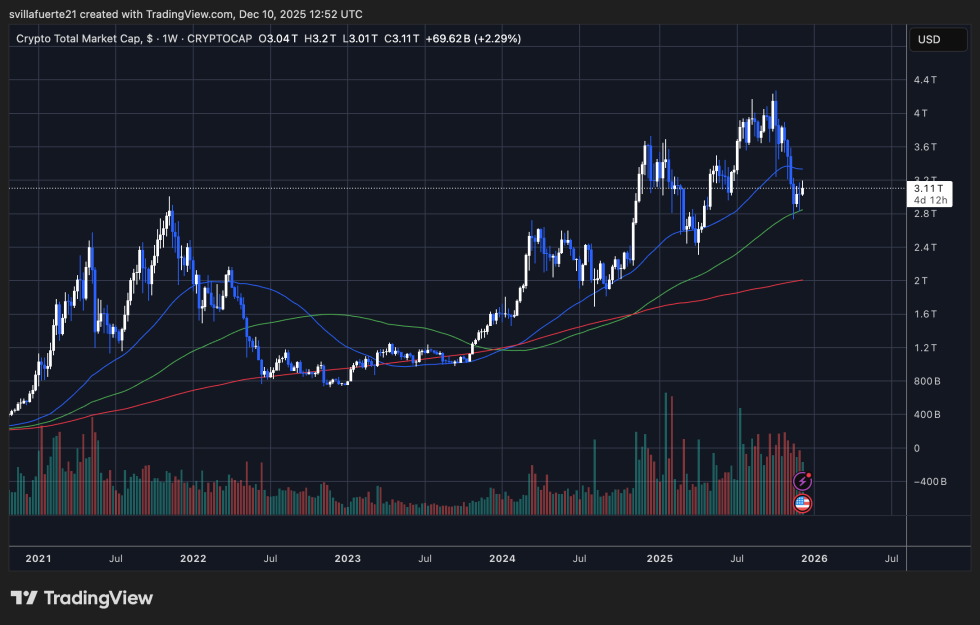
The Total Crypto Market Cap chart shows the market stabilizing around the $3.1 trillion level after a sharp multi-week decline. This area sits just above the 100-week moving average, a historically important dynamic support zone that often defines whether the broader cycle maintains bullish structure or shifts into deeper corrective territory. For now, buyers have stepped in to defend this region, preventing a breakdown that could have opened the door to a retest of the $2.7T–$2.8T area.

Crypto Total Market Cap | Source: TOTAL chart on TradingView

Despite the bounce, the structure remains fragile. The market is still trading below the 50-week moving average, which has now begun to bend downward—a sign that momentum has weakened across major assets like Bitcoin, Ethereum, and key altcoins. Volume has not shown a strong surge on the rebound either, suggesting that institutional conviction remains cautious ahead of the FOMC meeting and macro uncertainty.

A decisive reclaim of the $3.3T–$3.4T zone would shift momentum back in favor of bulls, opening room for a broader recovery. However, failure to break above this cluster of resistance could reinforce the idea that the recent bounce is only corrective. For now, the total market cap hovers at a crossroads, with macro events likely to determine the next major move.

Featured image from ChatGPT, chart from TradingView.com

Technical Wave Patterns Turn Bullish for Ethereum as Price Reaction Intensifies Before Fed Decision

Ethereum (ETH) is under a pivotal week as traders weigh a mix of macroeconomic expectations, institutional developments, and strengthening technical signals.

Related Reading: Midnight Goes Live As Cardano Founder Targets A $10 Billion Ecosystem

With the Federal Reserve set to deliver its next rate decision, market participants are watching how Ethereum’s recent momentum interacts with a broader risk-on environment.

The second largest cap cryptocurrency has already staged a notable rebound, breaking key resistance levels and drawing renewed interest from both retail and institutional investors.

Ethereum ETH ETHUSD ETHUSD_2025-12-10_12-38-55

Fed Expectations Drive Ethereum Position Repricing

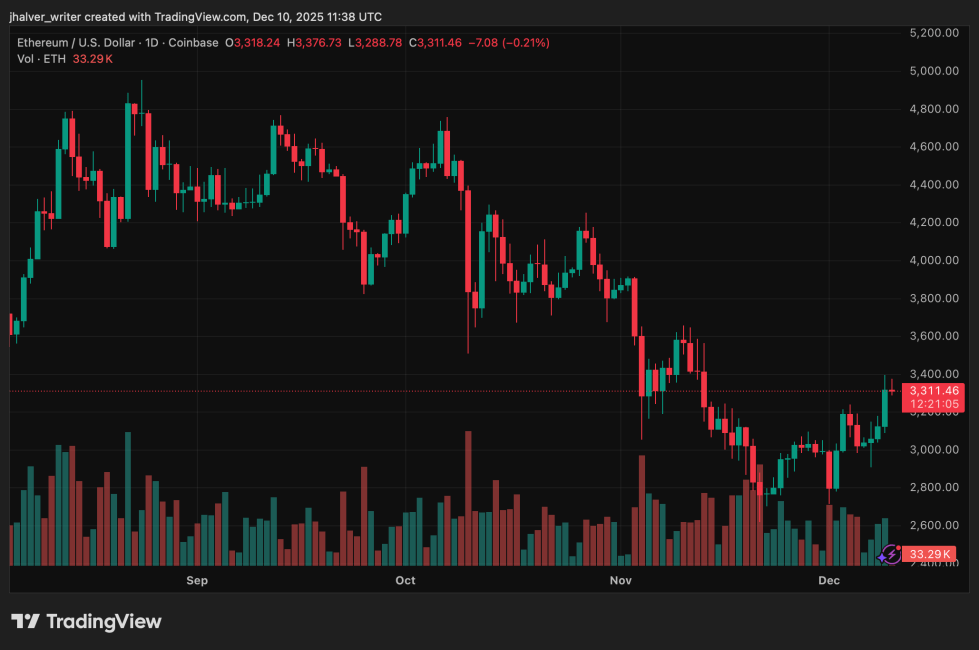
Ethereum surged past $3,300 and briefly approached $3,400 after recording a 6% jump over the past 24 hours.

The rally comes as traders price in a high probability, close to 90%, that the Federal Reserve will announce a 25-basis-point rate cut. Lower interest rates tend to improve liquidity conditions, a factor that has historically supported digital assets.

Bitcoin’s recovery above $94,000 added further confidence to the market, though Ethereum outperformed on a relative basis. The ETH/BTC ratio reached its strongest point since late October, indicating a shift of capital from Bitcoin to Ethereum.

Spot Ethereum ETFs also saw $177.7 million in inflows on December 9, surpassing Bitcoin’s inflows on the same day.

Institutional Moves Add to Bullish Sentiment

One major catalyst behind this shift has been BlackRock’s filing for the iShares Ethereum Staking Trust ETF. The fund would offer exposure not only to ETH’s price but also to staking rewards, expanding access to yield-bearing strategies.

Analysts note that such products could increase liquidity inflows into Ethereum, especially as institutional portfolios diversify beyond Bitcoin. This filing arrives at a time when the amount of ETH held on centralized exchanges has fallen to its lowest level since 2015, roughly 8.7% of the total supply.

Large buyers, including Bitmine Immersion, have accumulated billions of dollars’ worth of ETH in recent months. Combined, these developments indicate a tightening of supply conditions.

Technical Breakouts Reinforce the Trend

Chart analysts highlight that Ethereum has broken above a downward trendline that previously capped rallies for nearly two months.

Momentum indicators, including MACD and RSI, show increasing buyer strength despite approaching overbought territory. Ethereum’s break above the $3,300 zone has shifted focus toward the next resistance level at $3,500, with wave-pattern analysis suggesting potential upside toward $3,600.

Related Reading: Bitwise Rolls Out New ETF For Broad Crypto Exposure, Including BTC, XRP, And ADA

Analysts such as Captain Faibik argue that a confirmed breakout could support a rally of up to 30%, targeting the $4,200–$4,300 region if bullish conditions persist. However, the Fed’s upcoming decision remains a key variable in determining whether momentum continues or cools.

Cover image from ChatGPT, ETHUSD chart from Tradingview

Pre-FOMC Tension: Will Bitcoin Repeat Its Post-Cut Pattern?

Bitcoin is holding firm above the $92,000 level after rebounding from last week’s dip toward $90,000, offering bulls a brief moment of relief. Yet despite this stabilization, market sentiment remains decisively bearish, with many traders expecting further downside unless a clear shift in momentum emerges. The timing couldn’t be more crucial: the Federal Reserve’s upcoming rate decision has become the central focus for investors, and the market is bracing for heightened volatility.

According to a new CryptoQuant report, Bitcoin’s historical behavior around rate cuts offers meaningful context. Over the years, Fed interest rate cuts have generally aligned with upward movements in BTC, largely because lower rates weaken the US dollar, stimulate liquidity, and support risk assets. However, the report highlights an important nuance—the immediate reaction is rarely straightforward.

In several past instances, Bitcoin rallied ahead of rate cuts, only to show muted or even negative price action once the decision was announced, indicating that markets had already priced in the move.

This dynamic creates a layer of uncertainty heading into the FOMC meeting. While macro conditions align with long-term bullish trends for Bitcoin, the short-term outlook remains fragile, shaped by sentiment, positioning, and the market’s anticipation rather than the announcement itself.

Historical Patterns Signal Caution Ahead of the FOMC

According to the report by GugaOnChain on CryptoQuant, Bitcoin’s past reactions to Federal Reserve rate cuts offer a clear framework for understanding the risks heading into this week’s FOMC meeting. The historical data paints a picture of mixed and often counterintuitive behavior.

For example, following the 25 basis point cuts in September 2025, Bitcoin barely reacted at all. In another instance, BTC surged to a four-week high—only to drop nearly $2,000 shortly after, settling into a period of muted stability. These reactions underscore how quickly sentiment can shift once policy decisions are fully priced in.

Volatility has also played a defining role. Both the September and October rate decisions triggered brief pre-FOMC rallies, followed by notable declines once the announcements were made. After the September cut, volatility spiked sharply as traders unwound leveraged positions, revealing how sensitive Bitcoin remains to event-driven positioning.

Bitcoin Open Interest | Source: CryptoQuant

This leads to the recurring “buy the rumor, sell the news” pattern, a dynamic that GugaOnChain warns could repeat. Because of this, monitoring market leverage—including funding rates and open interest—is crucial. Equally important are liquidity flows, such as exchange reserves and ETF activity. Together, these indicators help traders anticipate short-term price movements as Bitcoin prepares for another potentially volatile macro event.

Testing Recovery but Still Below Key Trend Levels

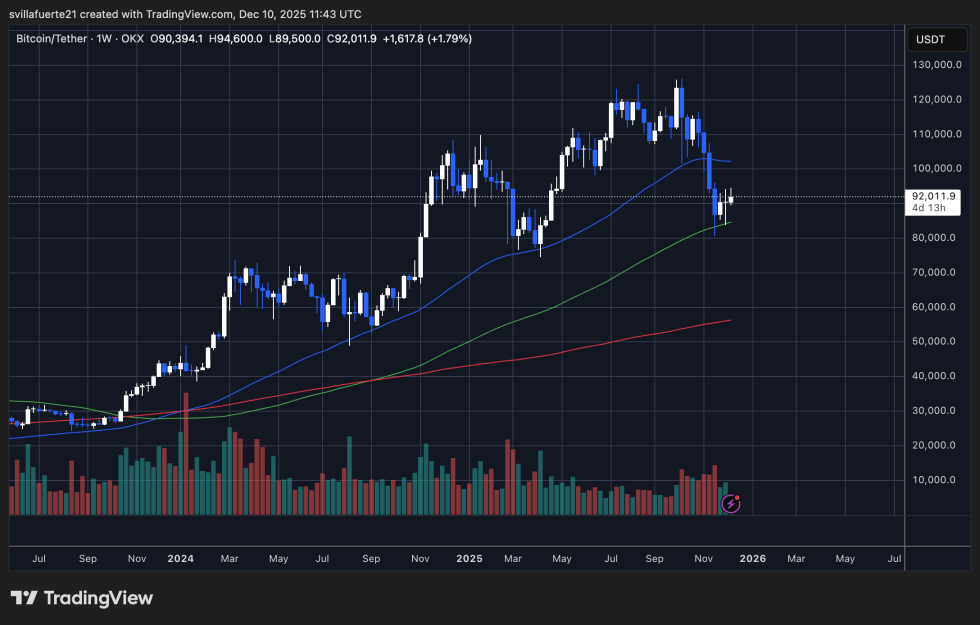
Bitcoin’s weekly chart shows the market attempting to stabilize above the $92,000 level after a sharp multi-week correction from the $120,000 region. The recent rebound from the $89,000–$90,000 zone highlights strong demand at the 100-week moving average (green line), which is currently acting as a critical dynamic support.

Historically, this MA has served as a structural backbone for Bitcoin during mid-cycle pullbacks, and the latest bounce reinforces its relevance.

BTC consolidates around key level | Source: BTCUSDT chart on TradingView

However, despite the recovery, BTC remains firmly below the 50-week moving average (blue line), a level that previously marked bullish continuation phases throughout 2024 and early 2025. Until price reclaims this region—now sitting near $100,000—the broader market structure leans corrective rather than impulsively bullish. The lower highs formed since the peak also suggest that bears still retain control over the medium-term trend.

Volume behavior adds another layer: although buying volume has picked up modestly, it remains significantly weaker than the aggressive selling pressure seen during the November–December decline. This indicates that buyers are showing interest, but conviction has yet to return in full force.

Featured image from ChatGPT, chart from TradingView.com

Pundit Explains What Happened With The XRP-Solana Integration

The unexpected “589” post from Solana’s official X account quickly opened up new discussions about whether something significant is forming between Solana and the XRP ecosystem. One of the reactions came from a community figure known as Cobb, who openly wondered if Ripple had just secured a major deal with Solana.

Nothing official has been announced, but a detailed breakdown from crypto commentator SonOfaRichard has brought clearer context to the situation. His explanation outlines what may be taking shape with the XRP-Solana connection and why the two networks could end up working together in a structured way.

Solana And XRPL Operate On Opposite Ends

In his response, SonOfaRichard noted how we’ve seen talks about Solana and XRPL integrations for a while, but then it has gone quiet. The pundit explained that Solana and the Ledger are often seen as competitors, yet their strengths sit in completely different areas. 

Solana is known for dominating the consumer-facing side of crypto for fast applications, active DeFi projects, and high-volume execution. What it lacks is corridor depth in regulated markets, a strong connection to compliant liquidity.

XRP and the XRPL fill that gap. Ripple focuses on enterprise channels, settlement, compliance, and liquidity, while the Ledger acts as the underlying banking layer that institutions depend on.

This creates a situation where Solana brings the activity and the audiences, and the Ledger brings the settlement and regulatory foundation. Rather than overlapping or competing, the two ecosystems form a natural and optimal design pair: one pushes value into the economy, and the other provides the framework that allows that value to move safely and at scale.

Another major part of the pundit’s explanation is also the role of RLUSD, Ripple’s regulated USD stablecoin. Solana, despite its massive activity, does not yet have a strong, compliant USD pathway. 

RLUSD could fill that need, acting as the channel through which consumer activity on Solana connects to regulated corridors worldwide. Under that arrangement, XRP becomes the collateral and final settlement layer sitting beneath both networks.

Explaining The “589” Message

The strong reaction to the post came from the fact that “589” is a well-known marker in the community. Solana followed it with another post showing the number in Morse code, paired with the flags of Solana, XRP, and Bitcoin, along with the caption “Time to flip the switch,” and even tagged Ripple’s CTO, David Schwartz.

Together, those posts have had more than six million views, making them the most-engaged content Solana has ever shared on the platform. The attention stemmed from the history of “589” itself, a number tied to long-running XRP memes and bold price expectations that have circulated within the community for years. Even so, there is still nothing concrete to confirm deeper intentions, and the posts could simply be part of a broader social media strategy.

XRP

Is Trump About To Shake Up Crypto Gaming? New ‘Billionaires Club’ Set For Release

US President Donald Trump’s name is back in the headlines this week as a Trump-branded mobile game tied to the TRUMP memecoin prepares to go live at the end of the month.

The title, called Trump Billionaires Club, is being marketed as a board-style mobile game that will let players buy virtual properties, trade NFT collectibles and use the TRUMP token inside the app.

Launch Set For December 30 On App Stores

According to the game’s public pages and several crypto outlets, the developer expects an App Store release on December 30, 2025, with pre-registration already open for players who want early access.

Reports have disclosed that the project is led by Bill Zanker and built by a studio using the name Freedom 45 Games, with licensing that allows use of Trump’s branding while noting the product is not created or distributed by his businesses.

$1,000,000 in $TRUMP Coin Rewards! Join the waitlist.

Roll the dice. Make huge deals. Build your empire!

The Official Trump Mobile Game Is COMING SOON!

Go To https://t.co/3GPTowXqFj NOW! Don’t Miss Out! pic.twitter.com/o6vcj11Wbn

— TrumpMeme (@GetTrumpMemes) December 9, 2025

A $1M Token Pool To Draw Players

The launch campaign will include a $1 million pool of $TRUMP tokens set aside for early players and leaderboard winners as part of pre-launch promotions and airdrops.

The game’s marketing highlights play-to-earn style rewards and tradable NFT items such as statues and pins, which are billed as in-game collectibles that can be bought and sold.

Crypto Connection: Game Tied Directly To TRUMP Coin

The title is explicitly linked to the TRUMP Coin ecosystem: users will be able to fund accounts with cash, crypto, or the TRUMP token, and in-game transactions are expected to use that token as currency.

That integration is part of an effort by promoters to give the memecoin “utility” beyond simple trading. Some early demos show a digital New York board where players roll dice, build and trade, while token balances move behind the scenes.

Token’s Sharp Drop Raises Questions

Reports have also pointed out that the TRUMP token has shed much of its market value since launch, with coverage noting an about 87% decline from peak levels — a collapse that adds urgency to promoters’ push to revive interest via gaming.

Observers and some crypto market analysts warn that giveaways and gimmicks can boost short-term attention but do not guarantee lasting demand or fair returns for buyers.

Featured image from Gemini, chart from TradingView
💾

Pre-register NOW:TrumpBillionairesClub.com

Upbit Shifts Nearly All Assets to Cold Storage as Exchange Responds to Security Concerns

In the aftermath of a hack that saw attackers steal 44.5 billion won (approximately $30 million) from a Solana hot wallet, Upbit has begun shifting nearly all customer assets into cold storage, a move that now places it among the most conservative platforms globally in terms of online asset exposure.

This transition marks one of the strongest security pivots by a major exchange, signaling a broader industry conversation about balancing rapid withdrawals with the need to reduce attack surfaces.

As digital asset markets continue to expand, Upbit’s response provides a real-time glimpse into how platforms balance operational liquidity against systemic cyber risks.

Stellar XLM XLMUSD BTCUSD_2025-12-10_12-23-17

Upbit Pushes Hot Wallet Usage Toward Zero

Following its internal review and system overhaul, Upbit confirmed that it now stores approximately 99% of user assets in cold wallets, with hot wallet exposure reduced to about 1% and expected to decrease further.
As of late October, the exchange held 98.33% of customer funds offline, a rate already well above the 80% minimum required under South Korea’s Virtual Asset User Protection Act.

This shift follows a pattern of rising caution. The recent breach was Upbit’s second significant attack, occurring on November 27, mirroring a 2019 incident that saw more than 342,000 ETH drained from its systems.

This year’s Solana-based attack resulted in withdrawals across 24 tokens within less than an hour, prompting an immediate shutdown of hot wallet operations and emergency transfers to cold storage. Upbit has pledged to fully reimburse affected users from corporate reserves.

Domestic data suggests that the exchange already leads the market in cold storage usage, maintaining the lowest hot wallet ratio among local competitors, whose cold wallet shares range from 82% to 90%.

Security Benchmark Sets Pressure on Global and Local Exchanges

Upbit’s near-99% cold wallet ratio surpasses the standards of major global exchanges. Coinbase stores about 98% of its funds offline, while Kraken’s ratio sits between 95% and 97%.

Several Asian exchanges, including OKX and Gate.io, maintain similar levels. With Upbit’s latest update, the platform now stands at the forefront of global cold storage practices.

Industry observers note that the move aligns with broader regulatory momentum. South Korea’s Financial Services Commission is considering new rules that would require exchanges to compensate users for losses resulting from hacks, regardless of fault, similar to the standards imposed on banks.

Liquidity Questions Linger in a Restricted Market

While security is at the center of Upbit’s restructuring, analysts caution that running with minimal hot wallet reserves may slow withdrawals during periods of heightened market volatility.

South Korea’s crypto market is largely closed to foreign participants, restricting arbitrage and creating conditions where delays can exacerbate price discrepancies, commonly known as the “Kimchi premium.”

During last month’s temporary withdrawal suspension, liquidity was effectively trapped, resulting in sharply widening price gaps between the Korean and global markets. Still, Upbit maintains that its rebuilt systems and predictive models will ensure sufficient liquidity under normal trading conditions.

Cover image from ChatGPT, BTCUSD chart from Tradingview

The 40-Year Bitcoin Hold: Strategy Exec Reveals How Long The Company Will Hold Over 600,000 BTC

The Chief Executive Officer (CEO) of Strategy, Phong Le, has revealed the company’s long-term approach to its staggering Bitcoin (BTC) holdings. According to the Strategy executive, the firm currently has no immediate plans to sell any of its 650,000 BTC soon. He emphasized that only dire circumstances could force a Bitcoin sell-off—a scenario he projects will not occur for at least 40 years.   

Strategy CEO Confirms 40-Year Bitcoin Hold

In an interview with CNBC on December 6, Le addressed questions about Strategy’s approach to Bitcoin and the future of its massive BTC bet. When asked whether the firm would ever sell its BTC stash of 650,000 tokens ($60.29 billion), Le emphasized that they intended to hold onto their holdings for as long as possible.

The Strategy CEO emphasized that selling would only occur under extreme market conditions, such as losing access to liquidity or US dollars, or if Bitcoin derivatives could no longer be traded. He noted that such a scenario is unlikely until 2065 and, even then, would be considered only in the event of a prolonged 40-year market downturn. 

In another interview earlier this month, Le stated that if there is a sustained 3-year down cycle in Bitcoin in which the mNAV of MSTR trades below 1x, MicroStrategy may have to sell BTC. This means the earliest the company could sell a portion of its massive holdings is in 2029. 

Moving on, the CNBC interview touched on Strategy’s role in public capital markets and whether the company has become a proxy for BTC. Le explained that their Bitcoin treasury strategy, which began in 2020, was designed to give investors access to BTC through public equities. He noted that while the introduction of Spot Bitcoin ETFs in 2024 slightly changed the landscape, Strategy remains a significant part of the crypto and BTC ecosystem. 

Growing FUD And Long-Term BTC Growth

In the interview, Le revealed that Strategy had recently raised $1.44 billion in just over a week for its US dollar reserve, covering 21 months of dividends. The CEO explained that they raised substantial capital to address rising Fear, Uncertainty, and Doubt (FUD) about the company’s ability to meet dividend obligations

Le stressed that, despite the current market downturn, the company had no plans to sell its Bitcoin stash to cover dividends, reassuring investors that its long-term holding strategy remains intact. He supported his views with a historical review of BTC’s broader performance, emphasizing that the leading cryptocurrency has grown by an average of 45% per year over the past five years. 

When asked about his price outlook for Bitcoin, the Strategy CEO expressed confidence in the cryptocurrency’s future, predicting that BTC will likely continue to rise over the next 20 years. He acknowledged that after 20 years, the market could evolve and innovations might emerge, but for now, Bitcoin has a long runway.

Bitcoin

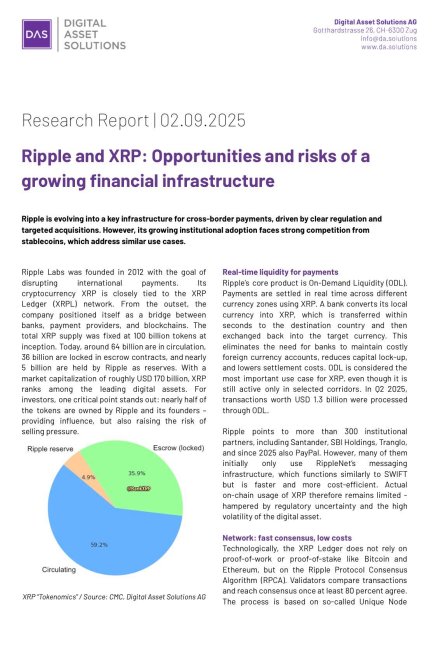
XRP’s Long-Term Path Gains Clarity After Major DAS Research Revelation – Here’s Where It’s Headed

A fresh update from a crypto expert has emerged regarding XRP and Ripple’s next trajectory, sparking a debate in the community. In recent years, this update has turned out to be one of the most accurate in determining the future of the leading altcoin, reinforcing the significance of the update.

New Research Outlines XRP’s Direction

In a post on the X platform shared by Stern Drew, a crypto expert, Digital Asset Solutions (DAS) Research has delivered what many XRP watchers have been waiting for and finding difficult to determine. The Research seems to have offered insights and provided a clear data-driven signal that breaks through months of conjecture and market noise.

According to the expert, DAS Research just presented the most convincing evidence so far of where XRP is headed. While their analysis offers a clear view of the future direction, it shows that the altcoin and Ripple, an American-based payment firm, are no longer competing in crypto. 

Ripple and XRP are shifting into a global payment infrastructure, one that is used by banks, Fintechs, and cross-border networks that seek speed, scale, and settlement transparency. Looking at the Research, there are 3 core realities that are likely to shape the next trajectory of the asset and the payment firm.

XRP

The first scenario is that XRP boosts the structural advantage, which includes fast settlement, low cost, neutral bridge asset, globally distributed ledger, and institutional-grade reliability. Drew stated that this is the reason adoption is growing in the midst of enterprises that seek predictable value transfer, and not speculation.

Secondly, the Research highlights the transformation of stablecoins, as these coins are becoming strategic assets, not competitive ones. Instead of opposing them, Ripple is absorbing stablecoins, which are becoming a key part of the crypto and financial landscape

Ripple’s integration of stablecoins is evidenced by its RLUSD, a dollar-pegged token acting as the fiat anchor. Meanwhile, XRP serves as the liquidity and bridge asset that ties everything together. In the current landscape, this connection is precisely how scaled settlement ecosystems develop.

Catalysts To Drive The Next Future

With key updates and achievements of Ripple, the Research noted that the catalysts to spur the next phase are already forming. Some of these catalysts include RippleNet’s partnership expansion, RLUSD corridors opening, and institutional custody maturing. Even Exchange-Traded Fund (ETF) structures are entering the conversation.

Each of these catalysts raises the likelihood that regulated financial plumbing will incorporate XRP. Meanwhile, direct bank-level chain utilization is the only sector that is currently lagging behind. However, this is exactly what worldwide licensing pushes, ZK-enabled identity layers, Ripple Prime, and RLUSD are meant to open.

Drew believes that DAS is creating awareness of what investors are unable to see. Behind the scenes, XRP is cementing its position as infrastructure, not a trade, and the competition is not other tokens, but the existing payment system, which is starting to shift.

XRP

Ethereum Founder Buterin Slams Elon Musk As Anti-Europe Attacks Ignite

Ethereum founder Vitalik Buterin has issued a sharp public warning to Elon Musk over how X is being used to direct increasingly aggressive rhetoric at Europe, arguing that the platform is drifting from a free-speech ideal toward orchestrated hostility.

Ethereum Founder Calls Out Elon Musk

In a series of posts on X, Buterin said that “the attacks on Europe I’ve seen here the last couple of days, including from people I’ve generally considered interesting and sophisticated, have been getting unhinged.”

He acknowledged that the European Union has serious shortcomings, listing “GDPR clickthroughs are dumb, Chat Control is awful, they need to be less bureaucratic and supportive toward entrepreneurs,” and criticizing what he called Europe’s selective moral stance, noting that its “kindness toward Ukraine often doesn’t extend well to Gaza or Sudan or other places.” He also described “people saying mean things about criminals getting longer sentences than the criminals” as “just crazy.”

Despite that, the Ethereum founder argued that the way some users on X are talking about Europe has moved well beyond legitimate criticism. He described “the apocalyptic attitude about the issues, evoking imagery of barbarians pillaging Rome etc,” as “really over the top” and said it “feels more like a coordinated attempt to delegitimize than constructive criticism.”

He rejected the idea that the real target is only Brussels-based institutions, writing: “I don’t believe the line that ‘the target is not Europe, it’s the EU’: I’ve seen many instances of London specifically being targeted in the hate session, so no, much of it is an attack on Europe.” This, he argued, does not match his experience from “spending an average of two months every year there for the last decade.”

The central confrontation came in a direct reply to Musk. Addressing the X owner’s self-positioning as a defender of free speech, the Ethereum founder wrote: “I think you should consider that making X a global totem pole for Free Speech, and then turning it into a death star laser for coordinated hate sessions, is actually harmful for the cause of free speech. I’m seriously worried that huge backlashes against values I hold dear are coming in a few years’ time.”

Buterin Hints At Russian Involvement

The thread sparked pushback from some users who argued that his framing underplays European complicity in current conflicts. One critic responded that “’not extending kindness’ is an incredible way to frame funding, arming and politically backing a genocide,” and claimed that it is “hilarious to think the US doesn’t suffer from many of the same things or worse that Americans say about the EU.”

The Ethereum founder replied that Europe is “a genuinely mixed bag,” emphasizing that “different countries in Europe have very different policies,” and pointing out that the continent “also hosts ICC, which is under a lot of pressure (see: judges being financially deplatformed).”

Other replies widened the lens to geopolitics. Commenting on a suggestion that the current discourse looks like “a coordinated campaign due to the Kremlin liking the new US ‘going back to Monroe’ global security policy,” Buterin answered “yeah basically” and added that “a lot of powerful people really like the vision that the world should just be 5–20 adults who have their spheres and sometimes get together in a room to hash out any differences, and everyone else can be shut out because they are annoying and inconvenient.”

At the same time, Buterin restated his support for the European project as an institutional experiment. “I have a lot of respect for the idea of EU, as an experiment in trying to get the benefits of a superstate, without the homogenization, becoming an aggressive ‘great power’, and other downsides,” he wrote, while stressing that “the experiment does need to be adjusted in a lot of ways; eg. we see not enough unity in its external policy and too much unity on top-down bureaucracy and surveillance at the same time.” If improved, he argued, “it’s a model that could set a really good example for the world.”

On the technical side, the Ethereum founder used the debate over “gdpr clickthroughs” to propose a different approach to online control, calling for “more sophisticated user-side software (browsers, local LLMs…) that helps the user navigate the internet and make intelligent decisions about what requires confirmations from the user.” In contrast to the centralized dynamics he criticizes on X, he is effectively pointing back to user-empowering, decentralized tools as the way to reconcile regulation, usability and free expression.

Musk Vs. The European Union

Notably, Musk’s anti-EU outburst comes after the Commission has issued a fine of €120 million to X for breaching its transparency obligations under the Digital Services Act (DSA). Musk wrote via X that “The ‘EU’ imposed this crazy fine not just on @X, but also on me personally, which is even more insane!” and says it would be “appropriate to apply our response not just to the EU, but also to the individuals who took this action against me.”

In subsequent posts he escalated further, declaring that “The EU should be abolished and sovereignty returned to individual countries,” calling to “Dissolve the EU and return power to the people,” and even asserting that “The EU commissars are responsible for the murder of Europe.”

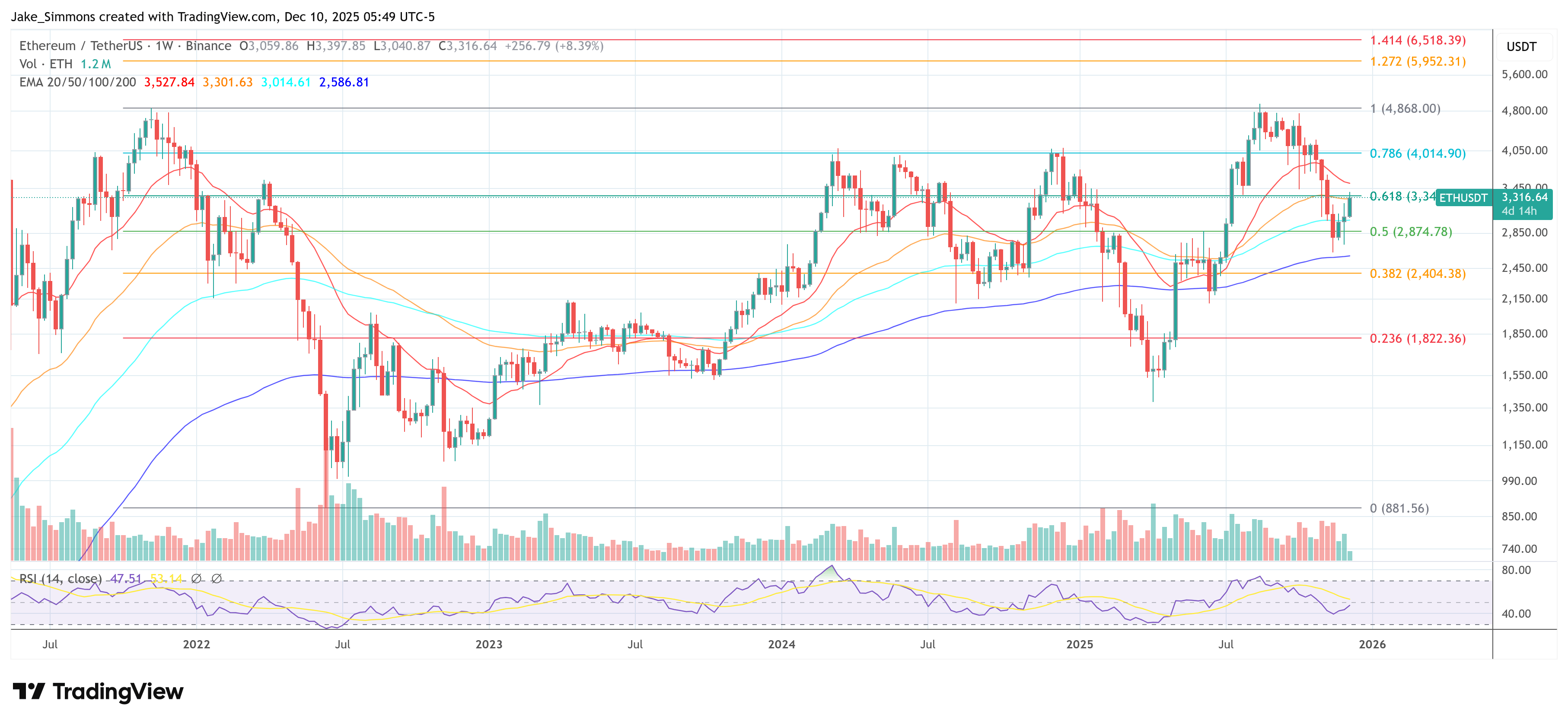
At press time, Ethereum traded at $3,316.

Ethereum price

What Ripple’s CEO Appearance At The Banking Committee Means For XRP

Crypto pundit JackTheRippler recently drew the community’s attention to Ripple CEO Brad Garlinghouse’s appearance at the Senate Banking Committee hearing. The CEO spoke about XRP amid his talk on how his company is building the “internet of value.”

Ripple CEO Talks About XRP During Banking Committee Appearance

In an X post, JackTheRippler shared a video of the Ripple CEO at the Banking Committee hearing, where he spoke about Ripple and XRP. Garlinghouse stated that they were building the internet of value, where money moves as easily as information. He added that their payment services were made possible through the use of the XRP Ledger (XRPL) and its native token XRP. 

The Ripple CEO further noted that XRP is built to enable fast, low-cost, and highly scalable transactions, which makes it suitable as the bridge currency for their cross-border payment services. Garlinghouse made these comments in relation to his testimony on the need for “smart” crypto regulations, including market-structure legislation, to eliminate regulatory uncertainty and advance innovation in the U.S. 

The CEO mentioned that his company was among the notable victims of the previous SEC administration’s regulation-by-enforcement approach. The commission had sued the crypto firm, arguing that XRP was a security and that the firm had violated securities laws through institutional sales of the token. 

However, as the CEO noted, Judge Torres ruled that XRP was not a security in itself. Garlinghouse believes that the crypto market structure legislation will help the crypto industry progress while also protecting consumers, like XRP holders, who were affected by the SEC vs. Ripple lawsuit. XRP’s price was affected by uncertainty about its legal status at the time of the lawsuit, which spanned over four years. 

DAS Research Provides Bull Case For XRP

In an X post, market expert Stern Drew highlighted a report from DAS Research, which provided a bull case for XRP. Drew highlighted how the report stated that XRP and Ripple are no longer competing in crypto. Instead, they are evolving into a global payment infrastructure, which will be adopted by banks, fintechs, and cross-border networks that demand speed, scale, and settlement certainty. 

Drew further pointed out three core realities highlighted by the report. The first is that XRP is said to have the structural advantage with fast settlement, low cost, being a neutral bridge asset on a globally distributed ledger, and with institutional-grade reliability. 

The expert noted that this is why adoption is rising among enterprises that need predictable value transfer. The other two realities are Ripple’s integration of the RLUSD stablecoin and its institutional partnerships, which will help boost XRP’s utility. 

At the time of writing, the XRP price is trading at around $2.08, up in the last 24 hours, according to data from CoinMarketCap.

XRP

Ethereum Rewards Keep Rolling In As SharpLink Posts Fresh Staking Gains

Many major companies continue to lock in on Ethereum, the second-largest digital asset, despite the ongoing volatile action of the altcoin’s price. One of the methods currently adopted by these companies to grow their ETH portfolios is via Ethereum Staking, where they earn notable rewards.

SharpLink Scores Another Major Ethereum Staking

In the ever-evolving world of cryptocurrency, the Ethereum staking economy is still demonstrating its durability. As the staking economy gains traction, SharpLink Gaming, a leading public company, is once again at the center of this wave, with massive rewards from its ETH staking positions.

Being the first publicly traded company to adopt ETH as its primary treasury reserve asset, SharpLink continues to increase its exposure to Ethereum, as evidenced by its staking gains. A recent post on the X platform by the company reveals another round of significant staking rewards in the past week.

This development showcases the power of ETH’s proof-of-stake network in general as well as the company’s increasing yield performance. Furthermore, the most recent gains are bolstering confidence in long-term staking plans, which comes at a time when investors are keeping a closer eye on on-chain returns than ever.

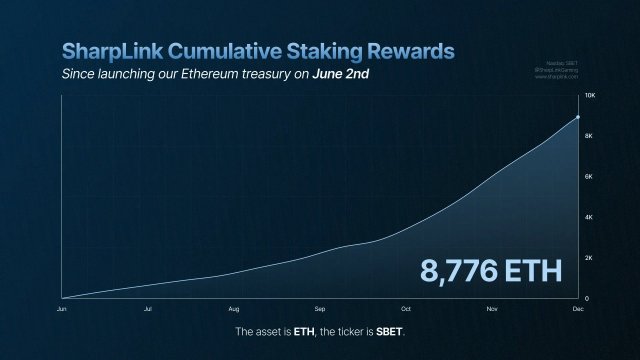
As seen in the latest report, SharpLink scooped in over 446 ETH from staking rewards just last week. It was worth noting that since the company launched its ETH treasury in June 2025, they has experienced a persistent rise in their cumulative staking rewards.

Ethereum

Following the recent gains, the total cumulative rewards have reached 8,776 ETH, which seems to have ignited a frenzy in the community. The firm’s ETH holdings remain 100% staked in an institutional-grade manner and maintain compounding value for the treasury.

Mlik Road, a crypto enthusiast, highlighted that at current prices and holdings, SharpLinks’ latest staking reward in one week is valued at $1.38 million. Interestingly, this amounts to around $70 million in income for the gaming firm annually.

As rewards keep rolling in, the important part of this development is that this figure is only expected to continue growing. When the price of ETH rises, the staking revenue of SharpLink will increase. In addition, when the firm’s ETH holdings increase, its staking income will multiply.

Whales Are Adding More ETH To Their Wallets

Ethereum’s bounce appears to have shifted the sentiment of investors, especially large investors or whales, toward a bullish standpoint. According to Santiment, a leading market intelligence and on-chain data analytics platform, ETH was a notable gainer on Tuesday, with a rise of +8.5% and an optimistic accumulation trend from whales and sharks.

Related Reading: Ethereum Emerges As A Dollar Settlement Powerhouse, Outpacing Traditional Payment Networks – Details

While these big investors have resumed ETH accumulation, retail holders have been offloading their holdings at a fast rate. Data shared by Santiment shows a massive accumulation of 949,240 ETH worth $3.15 billion in the past 3 weeks by whales. Meanwhile, small retail investors have gone on a selling spree, dumping 1,041 ETH over the past week.

Ethereum

ETF на Dogecoin фиксирует худшую активность трейдеров с начала работы

Торговая активность вокруг Dogecoin в этом цикле все заметнее смещается от крупных институциональных продуктов к более спекулятивным и «игровым» форматам. Падение объемов в биржевом фонде на Dogecoin показывает: интерес розницы к пассивному экспозиционному инструменту уходит, тогда как тяга к риску никуда не делась.

Для многих трейдеров Dogecoin давно превратился из мема в «голубую фишку» среди шуточных токенов, но именно это со временем убивает адреналин. Если ETF показывает минимальные объемы с момента запуска, значит, трейдерам становится скучно просто держать DOGE через традиционный фонд. Им нужен драйв, плечо и комьюнити, где рост ощущается физически.

Одновременно рынок мем‑токенов продолжает кипеть: появляются новые персонажи, трейдинговые сообщества, формируются собственные субкультуры. Там, где институциональный продукт дает лишь хранилище стоимости, розница ищет идентичность, игру и возможность «выжать максимум» из каждого движения рынка. Это особенно заметно по всплескам активности на платформах с деривативами и соревнованиями по доходности, а также по подборкам топ‑мем‑токенов на профильных ресурсах.

Именно на этом пересечении — усталость от «официального» Dogecoin и жажда экстремального риска — появляется Maxi Doge ($MAXI). Проект предлагает не просто мем, а культ пампа, совмещая образ пса‑качка с культурой предельного плеча и соревновательными механиками для розничных трейдеров.

КУПИТЬ MAXI DOGE

Почему мем‑токены и трейдинговые комьюнити смещают фокус с Dogecoin

Снижающиеся объемы ETF на Dogecoin показывают, что классическая модель «купил и забыл» перестает быть центром внимания розницы. В условиях бычьего рынка трейдеры все чаще выбирают активы с возможностью многократного роста и активного участия, а не скучный биржевой продукт.

MaxiDoge

В сегменте мем‑токенов усиливается конкуренция: рядом с Dogecoin и Shiba Inu выстраивается целая линейка новых монет с агрессивным маркетингом, игровыми механиками и собственными культами силы. Здесь важны не только котировки, но и вовлеченность в чаты, таблицы лидеров, турниры и совместные акции с площадками деривативов. 

На этом фоне возникает спрос на проекты, которые напрямую заточены под розничного инвестора с «макси‑менталитетом»: стремление к высокой доходности, готовность к риску и желание соревноваться. Maxi Doge выступает одним из таких вариантов, соединяя мем, культуру экстремального трейдинга и инструменты для геймификации доходности, не подменяя это скучной институциональной игрой.

Maxi Doge как ответ на усталость от пассивного Dogecoin

Трейдеры розничного сегмента часто не обладают ни капиталом, ни уверенностью крупных игроков, но стремятся к сопоставимым результатам. Maxi Doge строит на этом целую философию: пес-качок символизирует 1000‑кратное плечо, где каждый участник сообщества соревнуется, а не просто наблюдает за графиком.

Ключевая идея — «Leverage King Culture»: токен и бренд передают энергию предельного плеча и постоянного соревнования среди трейдеров. Закрытые соревнования для держателей с таблицами лидеров по доходности, распределением призов и партнерскими событиями с площадками деривативов превращают владение $MAXI в постоянную игру на результат, а не пассивное хранение.

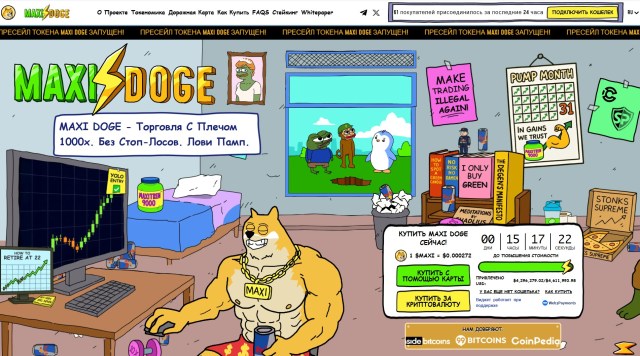
Токен работает на сети Ethereum с управлением предложения и распределения через смарт‑контракт. Создан казначейский Maxi Fund, который поддерживает ликвидность и финансирует партнерства. Уже на этапе предварительной продажи собрано $4,3 млн при цене около 0,0002725 доллара за $MAXI, что сигнализирует о заметном интересе к концепции мем‑токена с трейдинговым уклоном.

Дополнительный слой — механика стейкинга с динамической доходностью: ежедневное автоматическое распределение наград смарт‑контрактом из специально выделенного пула в 5% на протяжении до одного года. В совокупности с мем‑маркетингом и подчеркнутой целью обойти по динамике даже оригинальный DOGE, это позиционирует $MAXI как инструмент для тех, кто не хочет мириться с вялой статистикой ETF.

US Banking Giants Are Quietly Piling Into Bitcoin Credit, Claims Michael Saylor

At Bitcoin MENA 2025 in Abu Dhabi, Michael Saylor used his keynote to deliver a clear message: major US banks have quietly pivoted from excluding Bitcoin to actively building products on top of it – and they are now coming directly to him.

“In the past six months I have noted and been approached by BNY Mellon, by Wells Fargo, by Bank of America, by Charles Schwab, by JP Morgan, by Citi,” the Strategy (MSTR) executive chairman said. “They are all starting to issue credit against either Bitcoin or against Bitcoin derivatives like IBIT.”

JUST IN: Michael Saylor says he got approached by all the major banks recently to launch #Bitcoin products and services.

Banks are here 🙌 pic.twitter.com/AcHQRCaP7y

— Bitcoin Magazine (@BitcoinMagazine) December 9, 2025

Big Banks Now Want Bitcoin Exposure

Saylor contrasted that with the situation a year earlier, when “all of the large banks in the United States” still refused to bank Bitcoin. Now, he said, the sector is moving toward custody and credit. “Wells Fargo and Citi have both public announced intent to allow the custody of Bitcoin within the banks and in the year 2026 they’ll start to extend credit,” he told the audience.

Saylor framed this as the institutional expression of a broader policy shift in Washington, which he described as treating BTC as “digital gold” and, more broadly, “digital capital.” He claimed there is now “a profound consensus amongst everyone running the United States” – from the president and vice president to the Treasury, SEC and other top officials – that Bitcoin is a strategic digital asset.

“The United States is the most influential financial regulator in the world,” he said. “Whatever the US banking system does and the US security market does ripples through South America […] Europe […] the Middle East […] even Hong Kong. Even the Chinese will copy what the US is doing.”

Against that backdrop, Saylor positioned Strategy as “the world’s first digital treasury company,” whose business model is to industrialize BTC-backed credit. He reported that the company now holds 660,624 BTC, including 10,600 BTC acquired “yesterday,” and is currently buying “in the range of $500 million to a billion a week” in Bitcoin. “We’re not stopping,” he said. “I think that we can buy more Bitcoin than the sellers can sell. And we’re going to take it all. And we’re going to take it out of circulation.”

The core of his argument is the conversion of volatile “digital capital” into more stable “digital credit.” Strategy over-collateralizes its credit instruments “five-to-one or ten-to-one,” aiming to protect principal even if BTC falls 90%. In return, it targets yields around 8–12.5% in its preferred and note structures, funded by BTC’s expected long-term appreciation.

Saylor presented MSTR equity as “amplified Bitcoin” because issuing credit and reinvesting in BTC can, in his model, double BTC-per-share roughly every seven years. For investors who “don’t trust anybody,” he argued, holding BTC directly remains rational; for those wanting yield and lower volatility, he pitched BTC-backed credit as the superior choice.

He then extended the logic further, outlining a path from digital credit to “digital money.” By constructing a fund that is mostly composed of short-duration BTC-backed credit (such as his “Stretch” structure), buffered with fiat instruments and cash, Saylor claimed one can create a $1 instrument with near-zero volatility and an estimated yield around 8%, distributed as tax-deferred dividends. “I could create what looks like a stablecoin […] a $1 stablecoin stable to six significant digits that pays you 8% yield tax-deferred but powered by Bitcoin,” he said, adding that banks, asset managers or crypto firms could wrap this into coins, funds or deposit-like accounts.

The speech ended as a direct appeal to sovereign wealth funds and regulators in the region. Saylor urged nations that “want to be the Switzerland of the 21st century” to let banks custody Bitcoin, extend BTC-backed credit and ultimately offer digital-money accounts that pay several hundred basis points above the risk-free rate. “If you give people money that’s better than every other bank on Earth, all of the capital in the world will flow into that country, that bank,” he said.

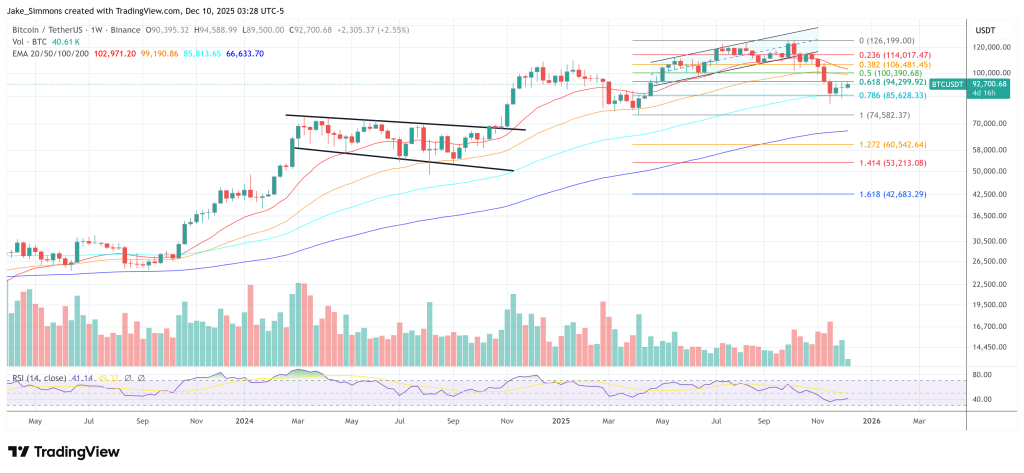
At press time, BTC traded at $92,700.

Bitcoin price

❌