Reading view

There are new articles available, click to refresh the page.

XRP ETFs Shatter Records With Their Biggest Weekly Inflows To Date, Wall Street Flocking In?

Despite a recent bounce and the broader cryptocurrency market gradually turning bullish, the price of XRP remains confined between the $2 and $2.12 range. XRP’s price may be experiencing sideways movements, but both retail and institutional investors are still showing heightened appetite for the leading alctoin via the Spot Exchange-Traded Funds (ETFs).

A Record-Breaking Week For The XRP ETFs

In the world of digital asset investments, XRP is emerging as one of the major assets that is gaining serious attention among investors and traders. Following a significant inflow of cash into exchange-traded funds linked to the leading cryptocurrency, it is once again in the limelight of crypto investment.

A crypto enthusiast known as XRP Update on the social media platform X has outlined that the altcoin is currently undergoing massive validation. While the broader market cools down, Spot XRP Exchange-Traded Funds (ETFs) record their largest weekly inflows since the products were launched.

A massive wave of capital flowing into a fund indicates that sentiment among investors, especially institutions, is undergoing a powerful shift. In addition, it suggests that major investors may be actively preparing for the altcoin’s next notable move upward rather than remaining on the sidelines.
XRP

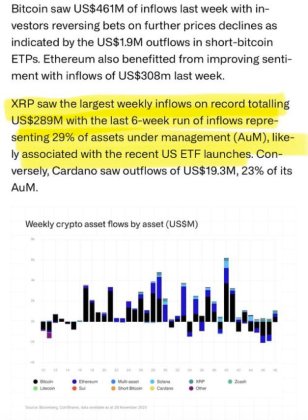
According to the data shared by the enthusiast, the funds amassed inflows valued at $289 million in a single week, marking its most successful week ever. After this week of bullish trading for the funds, they have now recorded massive inflows in 6 consecutive weeks. 

These 6-week inflows currently represent nearly 30% of the total Assets Under Management (AUM), which is likely associated with the recent United States ETF launches. When ETF inflows surge, it typically implies that institutional demand is increasing again, indicating that high-net-worth investors are exploring the token.

The Fund Takes The Lead In Cryptocurrency Spot ETF

XRP has just reached a major milestone that reflects its growing position as a valuable and reliable investment strategy. Brad Garlinghouse, the Chief Executive Officer (CEO) of Ripple, announced that the token has emerged as the fastest-moving crypto Spot ETF on the market.

After more than 4 weeks of launch, the fund continues to record inflows, reaching $1 billion in AUM in the US, making it the fastest ETF. This type of growth was last seen with its Ethereum counterpart, which launched late last year. With over 40 crypto ETFs introduced this year in the US alone, Garlinghouse has offered his take on what the development means, highlighting two key takeaways. 

According to the Ripple CEO, demand for regulated cryptocurrency goods is pent up. Additionally, millions more people who don’t need to be experts may now use crypto thanks to Vanguard’s offering of access to regular retirement and trading accounts for Americans.

For this new generation of off-chain crypto holders, Garlinghouse noted that durability, stability, and community are all important but often overlooked factors.

XRP

Popular Crypto Analyst Reveals New Bitcoin Price Target That Has Got The Community Moving

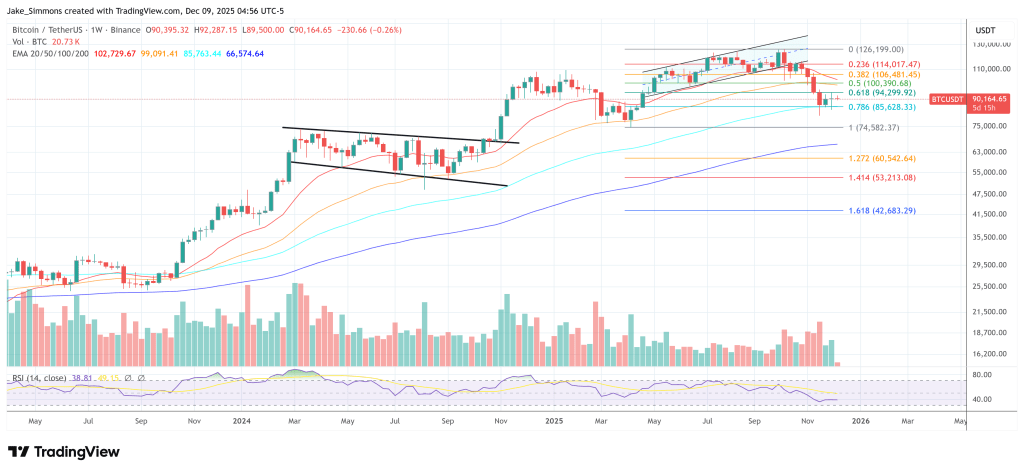
Renowned analyst Peter Brandt has unveiled a new set of Bitcoin price targets that have quickly sparked discussion across trading communities. His updated technical roadmap comes as BTC shows signs of cooling, prompting traders to reassess its recent price movement. With Bitcoin slipping beneath the structure that supported its multi-month climb, Brandt’s projected corrective zones have become a central focus in the market’s debate over where the asset may be headed next.

Bitcoin Price’s Structural Breakdown Raises The Stakes For Crypto Traders

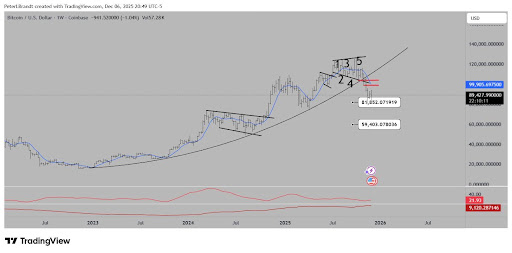
In a recent post on X, Brandt outlined his latest outlook, highlighting a completed five-leg advance — a classic sequence often linked to trend exhaustion when price stretches too far without meaningful resets. In this case, the formation appears as a rising wedge, a pattern known for producing sharp shifts once its lower boundary is breached. That breach has now happened, marking what Brandt interprets as a structural turning point rather than a panic-driven drop.

Bitcoin price

From the breakdown, two corrective regions emerge: near $81,852 and $59,403. These targets are drawn directly from the proportions of Bitcoin’s recently completed structure, giving them a grounded, technical foundation. Brandt frames the pullback as a normalization event, one that fits neatly into Bitcoin’s historical rhythm of expansions followed by methodical cooldowns. Instead of portraying the situation as a threat to long-term strength, the analysis positions the zones as potential resting points where the market could stabilize before setting its next course.

There is also a familiar pattern echoing through the charts — a reminder of late 2021, when sentiment surged ahead of structural reality and the market eventually recalibrated. While conditions today are not identical, the resemblance underscores how expectations and chart formations often move in parallel. In both scenarios, a strong run gave way to a controlled corrective period.

Brandt’s roadmap follows a clear sequence: formation completion, slope-line violation, and defined landing zones. Each step reinforces the next, forming a cohesive narrative that explains why this chart has quickly gained traction among crypto traders monitoring short-term volatility.

Brandt’s Targets Offer Strategic Guidance For Crypto Traders

Bitcoin is currently trading at $90,175, reflecting a 1.9% dip over the past 24 hours alongside a 4.4% gain across the last seven days. The price sits close to the level where the structural break first appeared, amplifying interest in Brandt’s outlined targets. Traders are now assessing whether the asset is preparing for a deeper corrective sweep or simply entering a consolidation phase before another directional move.

Ultimately, Brandt’s targets are intended to guide traders rather than alarm them. They highlight likely equilibrium zones during routine market resets, offering reference points where Bitcoin could stabilize after extended rallies. By framing the analysis this way, traders are encouraged to approach the market with a measured strategy and sharper precision, rather than reacting impulsively to short-term fluctuations.

Bitcoin price chart from Tradingview.com

BTC остановился на уровне $90 000, ФРС подает мягкие сигналы

Биткoин снова в центре внимания: после стремительного роста первая криптовалюта закрепилась около отметки $90 000, а мягкая риторика ФРС снижает давление на рисковые активы. Для долгосрочных держателей это редкий момент, когда макроэкономический фон и крипторынок наконец начинают играть в одну сторону.

Важная деталь: при такой цене биткоин остается в основном «цифровым золотом». Он отлично хранит стоимость, но плохо справляется с ролью базовой инфраструктуры для децентрализованных приложений и массовых платежей. Высокие комиссии и ограниченная пропускная способность не исчезают только потому, что цена пошла вверх.

Одновременно растет интерес к инфраструктурным решениям, которые позволяют использовать безопасность Bitcoin без его технических ограничений. Пользователи ищут быстрые платежи в BTC, DeFi-протоколы с понятной доходностью, игры и NFT-платформы, работающие поверх сети с репутацией Bitcoin, а не на малоизвестных сетях.

На этом фоне логичным выглядит сдвиг внимания к новым решениям уровня второй сети. Вы уже видели всплеск интереса к альтернативным сетям и расширению функций обычных криптовалютных кошельков. Следующий шаг понятен: слой, который снимает ограничения Bitcoin, но сохраняет его доверие и безопасность. Именно здесь появляется Bitcoin Hyper с токеном $HYPER.

КУПИТЬ BITCOIN HYPER

Bitcoin Hyper приносит скорость svm в экосистему bitcoin

Bitcoin Hyper заявляет амбицию стать первым в истории уровнем второй сети для Bitcoin с интеграцией Solana Virtual Machine. Это означает не технический эксперимент, а практическую возможность использовать Bitcoin в тех сценариях, где все привыкли видеть Solana: скоростные транзакции, интерактивные приложения и активные DeFi-платформы.

Проект делает акцент не на теории, а на пользовательском результате: высокоскоростные платежи в обернутом BTC с минимальными комиссиями, протоколы кредитования и обмена, сервисы стейкинга и запуск NFT- или игровых приложений через понятный разработчикам набор инструментов на Rust. В отличие от решений вроде Stacks, Bitcoin Hyper прямо целится в скорость уровня Solana и выше.

bitcoin hyper

Сейчас интерес рынка к этим возможностям уже подтверждается цифрами: предпродажа собрала $29 221 693,58 при цене токена $0,013395. Для инфраструктурного проекта, который выходит в момент исторического ралли Bitcoin и смягчения политики ФРС, это сигнал не только розничного, но и стратегического спроса со стороны участников, мыслящих горизонтом нескольких лет. 

Потенциал $HYPER 

Если Bitcoin Hyper займет хотя бы 5% рынка решений уровня второй сети для Bitcoin, токен $HYPER теоретически может достичь около $3,36, что дало бы примерно 250-кратный рост от текущей цены предпродажи $0,013395. Это спекулятивный сценарий, но он показывает масштаб возможного эффекта при умеренной доле рынка.

Крупный капитал уже начал занимать позиции в токене. Умные деньги не ждут окончательного запуска, они входят, когда соотношение риска и потенциальной доходности выглядит максимально перекошенным. По данным отслеживания крупных адресов, два обеспеченных криптоинвестора суммарно приобрели токенов на $396 000, при этом самая крупная единичная сделка достигла $53 000 в недавний период и была зафиксирована на блокчейне.

Дополнительный слой интереса формирует обещанная программа стейкинга с повышенным уровнем годовой доходности, доступная сразу после генерации токена и семидневного периода блокировки для участников предпродажи. Вознаграждения распределяются за активность сообщества и участие в управлении протоколом, что делает $HYPER не просто спекулятивным активом, а рабочим элементом экосистемы.

Финальный акцент прост: рынок Bitcoin стоит на новых высотах, регулятор смягчает тон, а инфраструктурный дефицит вокруг Bitcoin только растет. В такой точке цикла решения вроде Bitcoin Hyper получают шанс стать тем слоем, который соединяет надежность «цифрового золота» с удобством современных DeFi и приложений.

Big Bitcoin Move: Galaxy Digital Sends 900 BTC To New Address

Galaxy Digital, a major crypto services firm, transferred 900 BTC to a wallet that was created shortly before the move on December 9, 2025, according to on-chain monitoring shared by blockchain analysts.

The coins were valued at close to $81.60 million at the time of the transfer, implying an average price near $90,656 per Bitcoin.

Large Bitcoin Transfer Logged

According to on-chain trackers, the receiving address showed no prior history, which caught attention because transfers of this size tend to leave a clear trail and invite scrutiny.

The initial notice came from blockchain sleuths who flagged the transaction and published the receiving address for public view. No public statement has come from Galaxy Digital to explain the move.

What The Move Could Mean

Based on reports, big transfers by firms like Galaxy Digital often involve custody reshuffles, client orders, or trades arranged off-exchange. That said, a transfer to a brand-new address does not by itself prove a sale took place.

A newly created wallet received 900 $BTC($81.59M) from Galaxy Digital 2 hours ago.https://t.co/Ahrqpn4Hip pic.twitter.com/EIWmMXyWJZ

— Lookonchain (@lookonchain) December 9, 2025

The coins might be placed into cold storage, moved between internal wallets, or prepared for an over-the-counter trade. Public data show only the on-chain flow; the motive behind it remains unconfirmed.

Background On Galaxy Digital

Galaxy Digital has handled several very large transactions this year, and that track record adds context to the latest move.

Earlier in 2025 the firm facilitated a notably large transfer tied to a long-dormant early Bitcoin holder, a sequence of transactions that amounted to tens of thousands of BTC and drew wide market attention.

Those prior actions showed Galaxy operating as a major intermediary when big holders decide to move or sell coins.

Market Reaction And Risks

Traders watched price action closely after the transfer was flagged, but the mere movement of BTC between wallets does not always trigger market swings.

If the coins entered an exchange or were offered for public sale, price impact would be more likely. If they remained in custody or were split into smaller distributions, the market effect could be muted.

For now, there is no public evidence that the transfer caused immediate selling or that the funds were liquidated.

What To Watch Next

Observers will look for follow-up on-chain flows — for instance, whether the new address sends coins onward, or whether linked wallets show signs of exchange deposits.

Analysts will also watch for any official comments from Galaxy Digital or disclosures tied to client mandates.

Until then, the facts are limited to the Bitcoin transaction record itself and the valuation snapshot reported when the move was first spotted.

Featured image from Unsplash, chart from TradingView

Michael Saylor Pitched Bitcoin To ‘Every’ Middle East Sovereign Wealth Fund

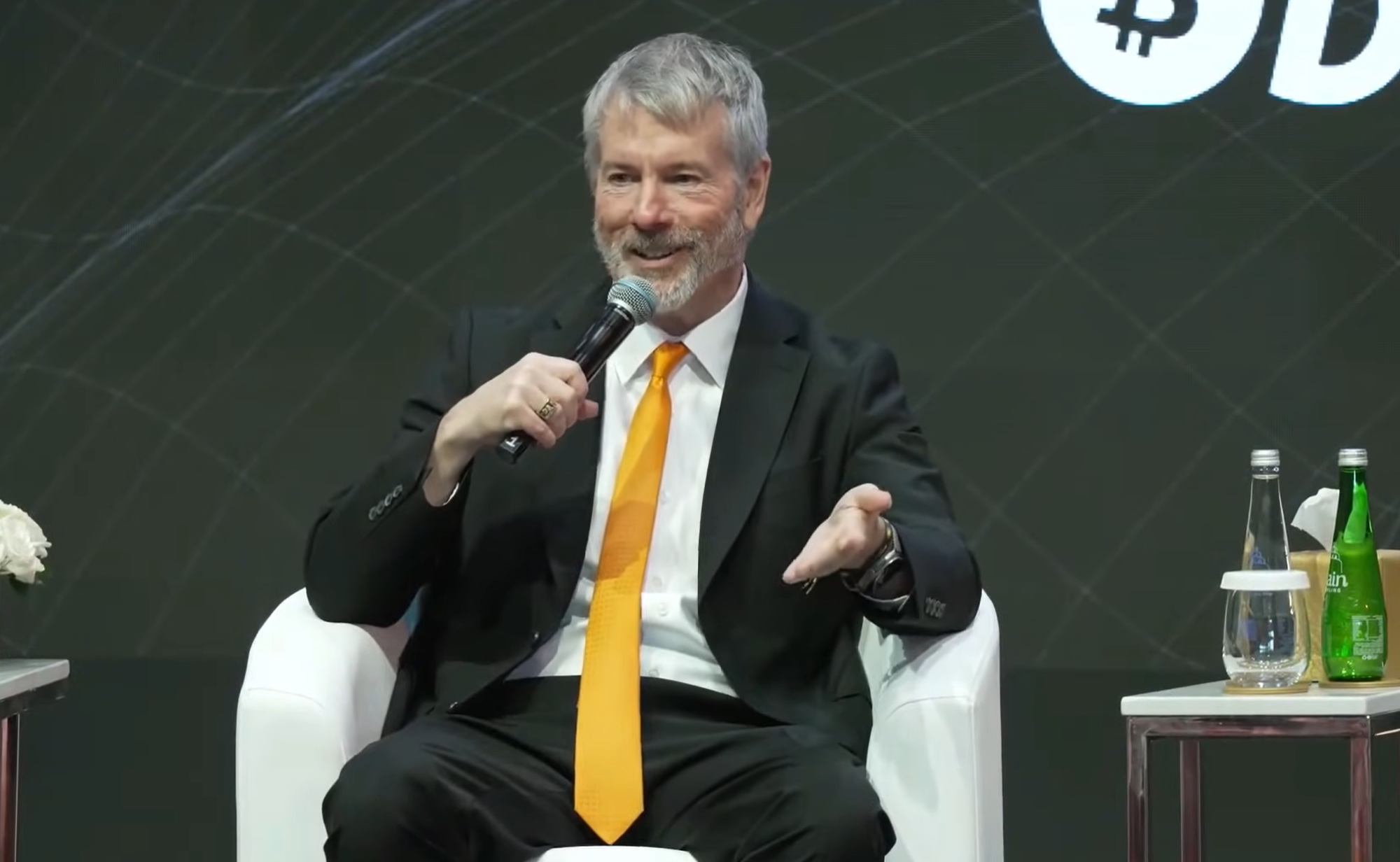
In a fireside chat with Metaplanet CEO Simon Gerovich at BTC MENA 2025, Michael Saylor turned a technical conversation about Bitcoin treasuries into a direct pitch to the Middle East’s sovereign wealth funds and banks, outlining how a nation or large financial institution could attract tens of trillions of dollars and become the “Switzerland” of digital capital.

Saylor and Gerovich began by framing Bitcoin as “digital capital.” As Saylor put it, “Our company pursued a strategy of accumulating digital capital. Bitcoin is digital capital. What do you do when you have capital? You issue credit against it.” Both MicroStrategy and Metaplanet are building balance sheets of Bitcoin and then issuing perpetual preferred instruments as “digital credit” backed by that capital.

Gerovich described Japan as a massive but yield-starved market. “There’s $7 trillion of cash sitting on personal bank accounts, bank balance sheets earning nothing, and corporates have another $4 or $5 trillion.” A Japanese family that puts money in the bank gets “zero.” Even as deflation fades, investors remain “accustomed to zero” and are “desperately looking for yield.”

Metaplanet’s answer is to connect that idle capital to Bitcoin. It launched “Mercury,” a perpetual preferred paying 4.9% in yen with convertibility into equity, which Gerovich called “probably one of the cheapest call options on Bitcoin out there.” Its follow-up product, “Mars” – Metaplanet Adjustable Rate Securities – is designed as a high-yield, Bitcoin-backed instrument that Japanese investors can hold in their securities accounts as a kind of supercharged bank deposit.

Inside Saylor’s Bitcoin Talks With Sovereign Funds

Saylor used this as a template for the Middle East, explaining that he has been on an intensive tour of the region’s power centers. “I’ve been meeting with all the sovereign wealth funds. I’ve been meeting with, I don’t know, 50, 100 different investors, hedge funds, family office investors… I’ve been meeting with regulators in every jurisdiction.” His message is “very, very straightforward”: “We now have digital capital. Bitcoin is digital capital, is digital gold. On top of digital capital, we have a new asset class called digital credit. Digital credit strips the volatility from the capital and provides yield, income.”

To illustrate the appeal, he contrasted capital and credit. Giving a child $1 million of Manhattan land is pure capital with no cash flow. “Or you can give them a credit instrument that pays them $10,000 a month forever, starting now. And so most people want the credit instrument. They don’t want the capital instrument… They’d rather have 10% non-volatile than 30% volatile with no cash flows.” Treasury companies like MicroStrategy and Metaplanet “exist to convert capital into credit.”

Saylor then laid out the blueprint for any ambitious bank in the region: “Have the bank custody Bitcoin. Everybody talks about self-custody. Self-custody for the bank in the country. Buy Bitcoin, have your bank custody the Bitcoin, and then start to offer credit networks on top of the Bitcoin.” If a national bank extends loans such as “SOFR plus 50 basis point loans on Bitcoin,” he argued, then as Bitcoin’s market grows from $2 trillion to $20 trillion, that bank could attract “5% or 10% of it,” pulling in “a trillion dollars or a few trillion dollars” simply because “most big conventional regulated banks don’t handle Bitcoin.”

The “biggest idea” is to turn Bitcoin-backed credit into a bank account that outcompetes the entire global deposit system. By taking digital credit instruments like Stretch or Mars, placing them in a fund that is mostly credit with a currency buffer and reserve layer, Saylor envisions a regulated account that pays around 8% with “vol of zero.” In that setup, “I wire you my billions of dollars or tens of billions of dollars, and you pay me 8% interest every day, zero vol, in a regulated bank, powered by digital credit, which is in turn powered by a treasury company with 5x as much digital capital, over-collateralized.”

In such a regime, he argued, “you could presumably attract 20 trillion dollars or 50 trillion dollars.” For depositors, “the perfect product is a bank account with zero volatility that pays you 400 basis points more than the risk-free rate in your favorite currency.” For Saylor, that account is “the lightsaber of money, the laser beam of money, the nuclear fusion reactor of money.”

He framed it as an open race: “The question is, who wants to be the Switzerland of the 21st century and attract all the money in the world?” In his view, “the answer is going to be whoever appreciates money the most, wants the money the most, that understands technology the best, that is willing to take a courageous stance of conviction with a degree of clarity,” he said.

He concluded: “That is the opportunity, and all the conversations have been extraordinarily energetic, enthusiastic, and I couldn’t be more excited. I think it will happen somewhere in this region. We’ll see where.”

At press time, Bitcoin traded at $90,164.

Bitcoin price

💾

In this powerful fireside chat from the Bitcoin for Corporations Symposium at Bitcoin MENA December 2025, Michael Saylor Executive Chairman of Strategy and S...

Analyst Predicts Bitcoin Price Crash To $15,000 Using Gold Chart

Following the Bitcoin price crash below $100,000 back in November, different bearish predictions have begun to make the rounds in the crypto community. For some, this crash signifies the end of the bull market, ushering in the dreaded bear market. While some of the predictions have been conservative, putting the pioneer cryptocurrency somewhere around $50,000 at the bottom, one analyst in particular has predicted a deeper crash, and this was done using the gold chart.

Why A Crash Could Be Coming For The Bitcoin Price

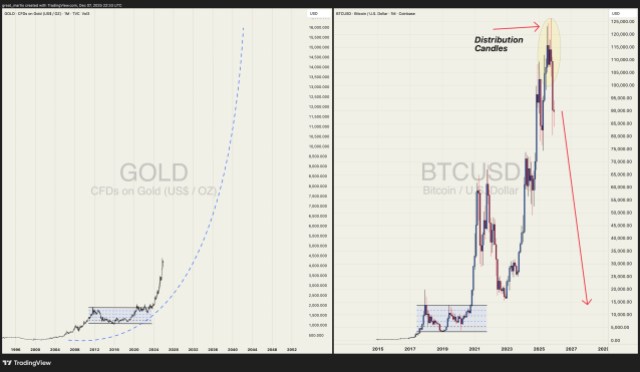
Crypto analyst The Great Martis took to X (formerly Twitter) to share their prediction of where the Bitcoin price is headed next. The chart shows a possible decline that could send Bitcoin moving below $20,000, before eventually reaching a bottom at around $15,000. Although this is not out of the ordinary for analysts to predict such crashes, the reason why Mathis believes this is possible is what is interesting.

The crypto analyst points out that the gold performance, which has seen the asset hitting new all-time highs this year, was being driven by speculation. Martis explains that the Fed’s intervention is something that will continue to drive the price of gold higher, and this could, in turn, continue to push down the Bitcoin price.

Furthermore, the analyst expects that the gold price will rise into the $12,000 territory, putting it in the same region that the Bitcoin price was in back in 2021. The interesting thing to note about Bitcoin in 2021 is that this was the year that the digital asset went on one of its most explosive rallies so far.

Bitcoin price gold

If Bitcoin continues to perform inversely to gold, then a rise to 5-digits for gold would mean a bearish market for Bitcoin. A crash to $15,000 would translate to a more than 70% decrease in price from the current level, and an almost 90% decline from its $126,000 all-time high.

So far, this year, gold has been the better performer of the two when compared side-by-side. For context, the gold price is already up over 55% in the year 2025; meanwhile, the Bitcoin price suffered a major 30% drop in price after hitting $126,000 back in October.

While both of these assets continue to lead in their respective sectors, gold continues to remain the standard for what investors consider a “safe” investment compared to Bitcoin, which is known for its wild price fluctuations.

Bitcoin price chart from Tradingview.com

New CFTC Crypto Initiative: Bitcoin, Ethereum, To Serve As Collateral In Derivatives Trading

Caroline Pham, the acting chair of the US Commodity Futures Trading Commission (CFTC), has announced the launch of a pilot program allowing Bitcoin (BTC), Ethereum (ETH), and USD Coin (USDC) to be utilized as collateral in US derivatives markets. 

New CFTC Guidance For Crypto

The pilot program was unveiled on Monday, accompanied by new guidance regarding the use of tokenized collateral. The CFTC’s Market Participants Division, Division of Market Oversight, and Division of Clearing and Risk outlined their stance on tokenized assets in today’s announcement, emphasizing that the agency’s regulations are technology-neutral. 

Key topics covered in the guidance include eligible tokenized assets, legal enforceability, custody arrangements, valuation methods, and operational risks. The new directives also encompass tokenized real-world assets (RWAs), like US Treasury securities and money market funds. 

In a move designed to provide regulatory clarity, the CFTC issued a no-action position regarding certain requirements for Futures Commission Merchants (FCMs) that accept non-securities crypto assets as customer margin collateral or that hold stablecoins in segregated accounts. 

This position aims to promote a clearer understanding of the application of segregation and capital requirements for FCMs integrating digital assets into their operations.

CFTC Withdraws Outdated Advisory

Under this pilot program, FCMs will be permitted to accept BTC, ETH, and USDC as margin collateral for an initial three-month period. During this time, the firms must provide weekly reports on the amount of digital assets held in customer accounts, detailing each asset type. 

Additionally, they are required to inform CFTC staff of any significant issues that arise concerning the use of these digital assets as collateral. 

The CFTC has also withdrawn Staff Advisory No. 20-34, which previously restricted FCMs from accepting cryptocurrencies as customer collateral. 

The statement asserts that the advisory had become outdated due to the substantial advancements in the digital asset landscape and the enactment of the GENIUS Act, making it no longer relevant. Acting Chair Pham emphasized the importance of these changes, stating:

Under my leadership this year, the CFTC has led the way forward into America’s Golden Age of Innovation and Crypto. This imperative has never been more important given recent customer losses on non-U.S. crypto exchanges. Americans deserve safe U.S. markets as an alternative to offshore platforms.” 

Pham added that the initiative to allow spot crypto trading on CFTC-registered exchanges and the establishment of a digital assets pilot program set clear guardrails for protecting customer assets, while enhancing the monitoring and reporting capabilities of the CFTC.

Through these initiatives, Pham aims to provide regulatory clarity for tokenized collateral related to real-world assets and respond to the needs of the broader cryptocurrency market.

Crypto

Featured image from DALL-E, chart from TradingView.com 

Tether Pours Funds Into Italian Humanoid Robots Aiming For A Smarter Future

Tether Investments has joined a €70 million funding round for Generative Bionics, a company spun out of the Italian Institute of Technology.

According to the announcement, the move is aimed at speeding work on humanoid robots and Physical AI systems built for industry use.

The deal brings private capital to a project that grew from two decades of university research and a large team of engineers.

Generative Bionics’ Research Roots

Based on reports, Generative Bionics draws directly from two decades of robotics work at IIT. The firm claims about sixty advanced humanoid prototypes were developed and tested during that period.

It has assembled roughly 70 engineers and AI scientists from IIT into its core technical team. That team is said to bring a combined experience of more than 600 years in physical robotics and related AI work. The company also holds exclusive licenses for key technologies created at the institute.

Tether Invests in Generative Bionics as Part of Funding Round to Advance Intelligent “Made in Italy” Humanoid Robots

🤖 Read more:https://t.co/q5PHCV3zvy

— Tether (@Tether_to) December 8, 2025

Plans For Production And Field Use

Tether’s funding will support edge AI development, industrial validation, and the first production facility. Generative Bionics is preparing initial industrial deployment programs that it expects to announce in early 2026.

Reports indicate the company intends to place robots in manufacturing, logistics, healthcare, retail, and other areas where human-like machines could help with repetitive or risky tasks. The first full humanoid concept from Generative Bionics is set to appear at CES in Las Vegas.

How This Fits Into Tether’s Broader Strategy

Tether Investments, based in El Salvador, says it uses profits and reserves to back technologies that connect digital systems with physical infrastructure.

The firm’s recent moves include funding work on brain-computer interfaces through Blackrock Neurotech and teaming up with Northern Data and Rumble to build a 20,000-GPU global compute network for open, privacy-focused AI development.

According to the announcement, the Generative Bionics deal is part of a wider push into physical systems that complement software and compute.

The investment also signals a shift by a major stablecoin-related company into long-term industrial bets. Tether presents this as a way to expand its footprint beyond financial tools and into areas that could deliver practical, real-world utility.

That said, critics will point out that robotics is capital intensive, and turning research prototypes into reliable, certified machines for everyday workplaces is difficult and slow.

Market Potential And Risks

Analysts cited in the announcement estimate the humanoid robotics sector could top €200 billion by 2035 and may reach as much as €5 trillion by 2050.

Those figures show why governments, universities, and private groups are racing to commercialize advanced robots.

Featured image from Unsplash, chart from TradingView

CEOs Of Leading Banks To Discuss Crypto Market Structure With US Senators This Week

In the wake of the GENIUS Act, which was signed into law by President Donald Trump in July, attention is now turning to the CLARITY Act, commonly known as the crypto market structure bill. This legislation has encountered substantial delays, exacerbated by the recent government shutdown and a lack of consensus in Congress.

Bank Leaders To Engage With Congress On Key Crypto Topics

This week, the CEOs of Citigroup, Wells Fargo, and Bank of America are scheduled to meet with both Republican and Democratic senators to discuss the evolving legislation surrounding crypto market structure. 

The meetings are set for Thursday, and congressional staff have indicated that the CEOs would welcome the chance to share insights on US Global Systemically Important Bank (GSIB) market structure priorities.

The bank leaders are anticipated to hold separate discussions with lawmakers from both parties, emphasizing collaboration to shape effective policies that position the United States as a leader in crypto assets. Among the topics on the agenda are bank permissibility, interest payments, and concerns surrounding illicit finance. 

Senate Faces Hurdles

Recent updates on social media platform X (previously Twitter) from Eleanor Terret of Crypto In America, also indicate that obtaining a markup for the crypto market structure bill before the Christmas break poses challenges. 

Senator Mark Warner has expressed concerns about pending language from the White House regarding two critical components of the bill—ethics and quorum. 

Warner noted the importance of addressing these issues thoughtfully, stating that bipartisan discussions are ongoing, yet productive progress is essential.

The Senate’s approach to the legislation is further complicated by its division into two committees: the Banking Committee, which oversees securities laws, and the Agriculture Committee, which focuses on commodities law

Both committees have released drafts of their work during the fall, with markup sessions—the process for voting on amendments before a full Senate vote—upcoming. However, both committees are proceeding cautiously due to unresolved issues.

Senators Demand Conflict Of Interest Provisions

The most pressing concerns include the treatment of stablecoin yields, potential conflicts of interest, and the regulatory approach to decentralized finance (DeFi). 

Some Democratic senators have indicated that they will not support the legislation unless it includes provisions addressing any possible conflicts relating to the President’s family and their business involvements in the crypto realm. 

Moreover, while market structure legislation primarily targets centralized platforms managing user funds, there is a push from the traditional finance sector to classify virtually all crypto-related entities, including developers and validators, as intermediaries.

Market analyst MartyParty provided an encouraging update on December 4, noting that the bipartisan crypto market structure bill is gaining momentum in Congress. 

A markup session with the Senate Banking Committee has been tentatively scheduled for December 17-18, just prior to the holiday recess.

Crypto

Featured image from DALL-E, chart from TradingView.com 

Wall Street Storms Ripple In Explosive $500 Million Deal

Ripple has become the most aggressively structured bet in blue-chip crypto after a group of major Wall Street firms wired about $500 million into the company in November, lifting its valuation to roughly $40 billion and making it one of the highest-valued private players in the sector. Bloomberg reported that Ripple’s share sale brought in some of the biggest names of Wall Street but only after investors secured a suite of downside protections.

Wall Street Goes All-In On Ripple

The investor line-up reads like a who’s who of modern market structure: Citadel Securities, Fortress Investment Group, Marshall Wace, Brevan Howard–linked vehicles, Galaxy Digital and Pantera Capital all participated, treating the round at least as much as a structured credit trade as a venture bet.

According to multiple accounts of the deal, several funds underwrote Ripple essentially as a concentrated exposure to XRP itself. Bloomberg’s reporting states that multiple investors concluded at least 90% of Ripple’s net asset value was tied to XRP, with the company controlling about $124 billion of the token at market prices in July.

That XRP cushion has already been tested. XRP is down roughly 40% from its mid-July peak and about 15–16% since late October, yet even after that drawdown, estimates in deal coverage still put the company’s XRP treasury in the tens of billions of dollars, with a large portion locked in escrow and released gradually over time.

The protection that Wall Street insisted on has become the defining feature of the deal. Investors secured the right to sell their shares back to Ripple after three or four years at a guaranteed 10% annualized return, unless the company has gone public by then.

Ripple, conversely, can force a buyback in those same windows only by delivering about 25% annually. On top of that, the funds negotiated a liquidation preference, giving them priority over legacy shareholders in a sale or insolvency.

The numbers involved are non-trivial. FinTech Weekly estimates that if the put option were exercised in full at the four-year mark, Ripple’s cash outlay would approach $700 million–$730 million, irrespective of operating performance or token prices at the time. Those obligations sit alongside an already heavy capital agenda: Ripple has agreed to buy prime-brokerage platform Hidden Road for roughly $1.3 billion and corporate-treasury specialist GTreasury for about $1 billion, while also confirming it has repurchased more than 25% of its outstanding shares.

Banks and trading desks are now treating the November round as a new reference point for crypto credit risk. FinTech Weekly reports that “those terms are now shaping how banks, funds, and trading desks assess Ripple’s balance sheet, exit risk, and future liquidity,” with the three- and four-year exit windows being modeled explicitly alongside XRP price scenarios and rate curves.

Ripple’s management maintains there is “no plan, no timeline” for an IPO, but the structure of the deal effectively date-stamps its private capital: either the company lists or finds new liquidity on favorable terms before the put windows open, or it must fund a secured, fixed-return exit for some of the most sophisticated players on Wall Street.

At press time, XRP traded at $2.0498.

Ripple XRP price

Strategy Not Slowed Down By USD Reserve—Drops Nearly $1 Billion On Bitcoin

Just a week after announcing its $1.44 billion USD Reserve, Strategy has made a Bitcoin purchase of nearly $1 billion, one of the largest for 2025.

Strategy Has Made Its Ninth Largest Bitcoin Buy Of The Year

In a new post on X, Strategy co-founder and chairman Michael Saylor has shared info related to the latest routine Monday Bitcoin purchase made by the treasury company.

While the timing of the buy is routine, its scale is not. In total, Strategy has added 10,624 BTC to its holdings with the acquisition. This is the biggest purchase since July’s 21,021 BTC mega-buy.

The new acquisition has cost the firm $90,615 per token or $962.7 million in total. In USD terms, this is the ninth largest addition to the company’s Bitcoin reserves.

This big purchase has come a week after Strategy announced a new shift for the company with its $1.44 billion USD reserve. Saylor said that the reserve will better position the firm to navigate short-term volatility.

The announcement was also accompanied by the usual Monday Bitcoin buy, but at just 130 tokens, it was a relatively small one. If the latest acquisition is to go by, however, the USD reserve doesn’t seem to be stopping Strategy in hoarding more of the cryptocurrency.

According to the filing with the US Securities and Exchange Commission, the new buy, which occurred in the period between December 1st and 7th, was funded using sales of the firm’s STRD and MSTR at-the-market (ATM) stock offerings.

Strategy now holds a total of 660,624 BTC, with an average cost basis of $74,696 per coin or total investment of $49.35 billion. At the current price of the asset, the Bitcoin treasury company’s holdings are worth about $59.68 billion, which means that it’s sitting on a profit of nearly 21% right now.

In some other news, while Strategy has continued its Bitcoin accumulation, the same hasn’t been true for another side of the sector: the spot exchange-traded funds (ETFs).

The spot ETFs refer to investment vehicles that allow investors to gain indirect exposure to BTC. That is, the funds hold the cryptocurrency on behalf of the investors, enabling them to invest into the asset without having to bother with the on-chain side of things.

Since mid-October, the US Bitcoin spot ETFs have mostly faced waves of net outflows as the cryptocurrency’s price has followed a bearish trajectory. The last week of November registered a small positive netflow, however, breaking a streak of four consecutive weeks of outflows.

This turnaround didn’t last, though, with the latest week once again ending with net outflows, as the below chart from SoSoValue shows.

Bitcoin ETFs

The outflows were only modest, coming out at about $87.8 million, but still indicate lingering pessimism in the market.

BTC Price

Bitcoin broke above $92,000 earlier in the day, but the coin has since faced a pullback as it’s now back at $89,900.

Bitcoin Price Chart

US SEC Closes Biden-Era Investigation Into Ondo Finance Without Charges

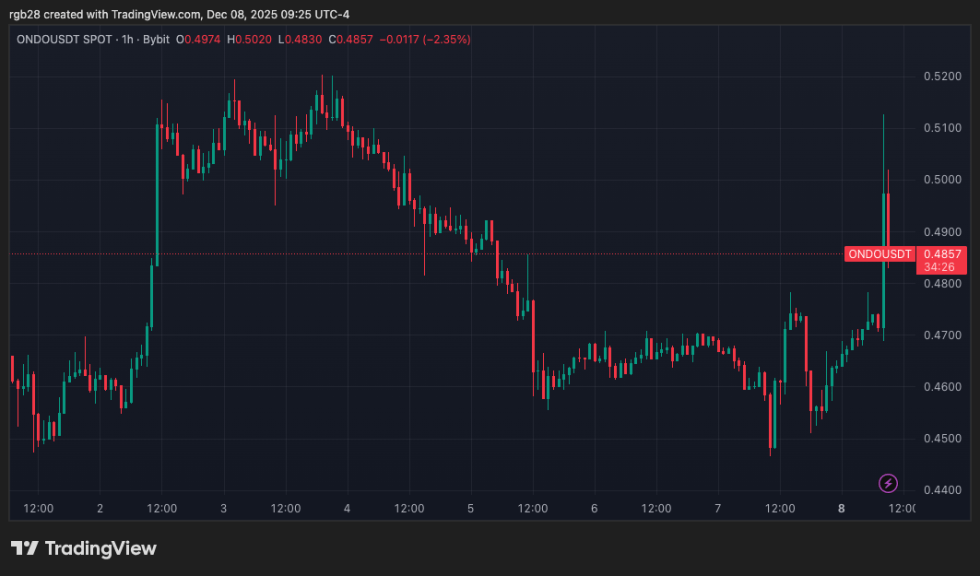
The US Securities and Exchange Commission (SEC) concluded its Biden-era probe into DeFi platform Ondo Finance, and whether its tokenized products complied with federal securities laws, without any charges, following the Trump administration’s pro-industry approach and focus on tokenization.

Case Closes: SEC Ends Ondo Finance Probe

On Monday, Ondo Finance announced it had received formal notice that the US SEC’s two-year investigation into the platform, which started during the Biden administration, had concluded in late November with no charges.

The platform now joins the list of crypto companies that have seen their cases and probes dismissed or closed without any enforcement actions this year, including Gemini, Kraken, Ripple, Coinbase, and Uniswap Labs.

The SEC initiated the probe in 2024 to examine whether firms’ tokenization of Real-World Assets (RWA) complied with federal securities laws, the platform explained. Additionally, it sought to determine whether the ONDO token was a security.

“Ondo’s growth and leadership in the emerging tokenization category made us a focus, but not a justified target,” the announcement added. At the time, the US regulatory environment was characterized by a “regulation by enforcement” approach, which led to caution and confusion.

Nonetheless, they “remained steadfast in its conviction that regulated, transparent tokenization models like Ondo’s are not only compatible with investor-protection principles, but can strengthen them.”

To Ondo Finance, this marks a “meaningful milestone” for the broader tokenization industry, which will push innovation, compliance, security, and investor protection forward, as the sector gains momentum and becomes a priority on the federal agency’s agenda.

It’s worth noting that Ondo has solidified its position as a leader in the RWA sector with strategic partnerships, expansions, and the launch of its own Layer-1 blockchain, which aims to bridge the gap between traditional finance and decentralized finance.

As reported by Bitcoinist, the firm aims to advance its mission to “democratize” access to high-quality US financial assets and ensure tokenized assets move seamlessly across major blockchains.

A New Chapter For Tokenized Securities

In the Monday statement, the platform also highlighted that the SEC’s decision reflects a broader shift in US policy, with regulators reassessing the methods used during the Biden era for the crypto industry. Earlier this year, a White House report recognized the sector as foundational to the future of the global financial system and named Ondo Finance among the key players.

Notably, the regulatory agency has added tokenization to its formal agenda. In the SEC’s Investor Advisory Committee meeting last week, the regulatory agency affirmed it is evaluating tokenization to modernize the issuance, trading, and settlement of public equities.

In his remarks, SEC chairman Paul Atkins stated, “Distributed ledger technology and the tokenization of financial assets, including securities, have the potential to transform our capital markets. Our financial markets have long been the envy of the world, and to ensure that they remain so, U.S. firms and investors must have the opportunity to leverage this technology as they lead the future of global capital markets.”

Atkins added that the agency’s role is to enable market participants to operate and innovate under clear guardrails, ensuring that the US markets remain the most dynamic, transparent, and trusted in the world.

“The resolution of the SEC inquiry marks the end of one chapter for Ondo and the beginning of another. Put simply, the time is now for tokenized securities to become a core part of U.S. capital markets. The future of global finance, including U.S. capital markets, will be onchain and Ondo will help lead that transition,” the announcement concluded.

ondo, ondousdt

Coinbase Is Back In India—And It Wants 30% Crypto Tax Reconsidered

Digital asset exchange Coinbase has restarted crypto trading in India after a two-year absence, with fiat deposits planned to arrive in 2026.

Coinbase Has Returned To India For The First Time Since 2023

As reported by TechCrunch, Coinbase has resumed user onboarding in India for the first time since pulling out of the country back in 2023, more than two years ago. The American crypto exchange ranks as the largest public digital asset company in the world, hosting around $516 billion in assets on its platform.

Initially, the exchange first entered India in 2022, but only a few days after beginning services, it had to suspend UPI payments. UPI, short for Unified Payments Interface, is the most widely adopted real-time digital payments instrument in India. The National Payments Corporation of India (NPCI) had said shortly after Coinbase’s launch that it wasn’t aware of any crypto exchange using UPI.

With UPI access gone, Coinbase users no longer had a way to purchase digital assets on the platform using fiat. The exchange stopped new user signups in June 2023, with a complete discontinuation of services happening in September 2023.

“We had millions of customers in India, historically, and we took a very clear stance to off-board those customers entirely from overseas entities, where they were domiciled and regulated,” said Coinbase’s APAC director, John O’Loghlen, at India Blockchain Week (IBW). O’Loghlen added that the decision to pull out didn’t come without hesitation.

Fast-forward to 2025, and Coinbase announced in March that it had registered with India’s Financial Intelligence Unit (FIU), allowing it to provide crypto services in the country. The platform opened in early access in October, and now, it has seen a full public launch. So far, users can only access crypto-to-crypto trading, but according to O’Loghlen, a fiat on-ramp is planned to become available next year. This would allow users to buy digital assets using the Indian Rupee (INR).

While India isn’t closed off to cryptocurrencies like its northern neighbor, China, it still has a relatively strict digital-asset regulation regime. The nation collects a 30% tax on investor crypto profits and allows for no offsets against losses. Additionally, it charges a 1% Tax Deducted at Source (TDS) on all transactions, as a method of tracking digital asset activity.

Naturally, this taxation regime isn’t ideal for crypto companies, as it directly affects adoption. O’Loghlen said that Coinbase is hoping the Indian government will relax the tax to make it more convenient for investors to hold digital assets.

Reopening its exchange isn’t the only move that Coinbase has made in the subcontinent recently. As announced on its blog, the platform has made an investment in Indian crypto exchange CoinDCX. “Taken together, these steps reflect a clear commitment: we believe India and its neighbors will help shape the future of the global onchain economy,” noted the post.

Bitcoin Price

At the time of writing, Bitcoin is trading around $91,800, up more than 7% over the last week.

Bitcoin Price Chart

Bitcoin Back In Argentina: Central Bank Removes 3-Year Restrictions

Argentina’s central bank is preparing to let commercial banks offer regulated cryptocurrency services, ending a three-year restriction that kept traditional lenders out of the market, according to recent reports.

The change would allow banks to handle trading and custody of a limited set of digital assets under tighter rules and monitoring.

Banks Could Reopen Crypto Desks Under New Rules

Reports have disclosed that the Banco Central de la República Argentina (BCRA) is reviewing a regulatory framework that would permit banks to provide crypto trading and custody, but only within a controlled, licensed setup.

The move responds to heavy use of Bitcoin and stablecoins by many Argentines as a shield against peso weakness and inflation.

Analysts say banks would likely need separate units, stronger custody systems and clear compliance checks before they can serve customers.

🇦🇷 ARGENTINA’S CENTRAL BANK JUST ANNOUNCED BANKS CAN OFFER #BITCOIN AND CRYPTO SERVICES

HERE WE GO!! pic.twitter.com/0yCYXLT4MA

— Vivek Sen (@Vivek4real_) December 8, 2025

Background: Why Banks Were Barred

The prohibition dates back to May 2022, when the central bank barred banks from transacting in or offering services for cryptocurrencies that were not formally regulated by the authorities.

BREAKING: Argentina’s central bank is drafting rules to let banks offer crypto trading and custody, putting them in direct competition with exchanges under tighter KYC rules.

Huge move for Argentina 🚀 pic.twitter.com/RMz2icnC81

— Conor Kenny (@conorfkenny) December 8, 2025

That rule effectively prevented lenders from listing crypto products inside their apps or taking custody on behalf of clients. The ban pushed most retail activity toward registered Virtual Asset Service Providers (VASPs) and overseas platforms.

What The New System Would Build On

Based on reports, any shift would build on the country’s recent steps to regulate VASPs. The Comisión Nacional de Valores (CNV) has already issued registration criteria and AML/CFT requirements for local crypto firms, including technical rules on custody and “travel rule” compliance.

Those existing rules are likely to form the baseline for the bank licensing regime, with extra safeguards for depositors and liquidity.

How This Could Affect Users And The Market

For everyday savers who turned to digital coins to protect savings, a bank-led service could mean easier access through familiar apps and possibly stronger institutional custody — though it would not erase price risk.

Regulators are expected to insist on explicit risk disclosures and limits; client holdings in crypto would not automatically carry the same guarantees as insured bank deposits.

Market players say initial offerings may focus on major assets such as Bitcoin and established stablecoins, rather than a wide array of tokens.

Featured image from Unsplash, chart from TradingView

Crypto Watchlist: Key Events To Watch In The Week Ahead

The coming week concentrates macro and protocol-specific catalysts into a tight window, with the Federal Reserve’s FOMC decision and several high-profile project events landing between December 10 and 12.

#1 Crypto On Alert: Fed’s Dec. 10 Rate Decision

The US Federal Reserve’s FOMC interest rate decision on Dec. 10 looms as a key macro catalyst for crypto. Markets overwhelmingly expect a 25 bps rate cut – about an 87% probability according to Fed funds futures– which would lower the target rate to ~3.5–3.75%. Such a move would be the third cut in as many meetings, signaling a pivot to easing as the Fed prioritizes a faltering job market over inflation.

Bitcoin (BTC) has historically reacted sharply to Fed surprises: BTC often faces downward pressure into FOMC announcements, then significant volatility as markets parse the Fed’s language. Indeed, ahead of this meeting, BTC dipped below $88,000 over the weekend on “FOMC nerves” but quickly jumped back above $91,000.

If the Fed delivers the expected 0.25% cut, it could bolster crypto by improving liquidity conditions and risk appetite. Easing financial conditions have been core to the recent crypto rebound. Any dovish signals may prompt a relief rally in BTC and the broader crypto market.

However, a hawkish surprise – if the Fed were to hold rates steady or sound cautious – risks upsetting this fragile optimism. As reported on NewsBTC, a special focus will be on whether the Fed announces a new program for Treasury bill purchases.

#2 Solana’s Breakpoint (Dec. 11–13)

Solana’s Breakpoint conference kicks off Dec. 11 in Abu Dhabi, and traders are eyeing SOL’s price action around this flagship event. Breakpoint has a track record of stirring excitement – and volatility – in SOL. At the 2023 conference in Amsterdam, for example, SOL surged over 20% to a 14-month high (~$45) as a “flurry of announcements” (like Jump Crypto’s Firedancer client and Google Cloud integrations) dropped during the event.

This year, investors are anticipating major updates once again. The full launch of Firedancer (a high-performance Solana validator) and new ecosystem partnerships are rumored, and Breakpoint acts on investors like a magnet, usually triggering strong FOMO ahead of anticipated news.

If Solana’s team delivers headline-worthy developments, SOL could rally, as happened last year when announcements at Breakpoint corresponded with a price spike. Conversely, if the conference hype fades without new catalysts, short-term traders might take profit. Still, sentiment is clearly bullish going in.

#3 Do Kwon Sentencing (Dec. 11)

The long-awaited sentencing of Terraform Labs co-founder Do Kwon on Dec. 11 could mark a climactic chapter in the Terra/Luna saga. Kwon’s legal fate is largely sealed after he pleaded guilty to fraud in August, but the severity of punishment matters for the market psyche.

US prosecutors have asked for the maximum 12-year prison term for Kwon’s role in the $40 billion Terra meltdown. Paradoxically, traders have taken this bad news as bullish fuel: when the DOJ’s 12-year recommendation hit headlines, LUNC spiked 130% in a day, suggesting speculators see a tough sentence as a form of closure.

The actual sentencing on Dec. 11 could thus be a “sell the news” moment if those gains are purely hype-driven. Any outcome within expectations may prompt profit-taking after the event.

#4 Bittensor’s First TAO Halving (Dec. 12)

Bittensor (TAO), an AI-focused blockchain network, will undergo its inaugural token halving around Dec. 12–14, a pivotal event that echoes Bitcoin’s quadrennial cycle. After this “maturation milestone”, TAO’s issuance rate will be cut from 7,200 tokens per day to 3,600.

The halving cements Bittensor’s hard cap of 21 million TAO (just like BTC’s 21M) and is seen as a key milestone in the network’s maturation”. In the community, bulls have been hyping the “halving = scarcity” narrative for months – daily supply dropping 50% overnight is expected to “fuel scarcity narratives” and amplify TAO’s appeal as the base asset of a decentralized AI economy.

#5 Avalanche Spot ETF Decision

Avalanche (AVAX) could make history this week, as the US SEC faces a Dec. 12 deadline to approve or reject VanEck’s spot Avalanche ETF. This is the final decision date after multiple delays. Approval would mark one of the first mainstream investment vehicles for a “Ethereum-killer” layer-1 token, potentially unlocking new capital for AVAX.

Regulatory watchers are optimistic – Bloomberg ETF analysts Eric Balchunas and James Seyffart put the odds around 90% for approval. They argue that a spot AVAX fund would likely follow the path of recent Bitcoin and Ether ETFs.

#6 Aster’s S4 Buyback Program (Dec. 10)

Aster (ASTER), a DeFi protocol on BNB Chain, is commencing its Season 4 (S4) token buyback program on Dec. 10. Under this program, Aster will allocate 60–90% of all fees collected in Season 4 to buying back ASTER tokens from the open market.

This aggressive buyback scheme is designed to reduce supply and support the token’s price. In fact, the team announced it is accelerating the Phase 4 buybacks, with execution ramped up to roughly $4 million worth of ASTER purchases per day as of Dec. 8. Aster’s developers stated that this acceleration allows them to quickly deploy the fees accumulated since Nov. 10 onto the blockchain to prop up the market “during periods of volatility.”

By their estimates, it will take 8–10 days of these heightened buybacks to catch up, after which daily buybacks will continue at a steady 60–90% of the prior day’s fee revenue for the remainder of Season 4. A dedicated on-chain wallet for the buybacks is to be made public, ensuring transparency as the protocol executes what is essentially a large-scale, programmatic share (token) repurchase.

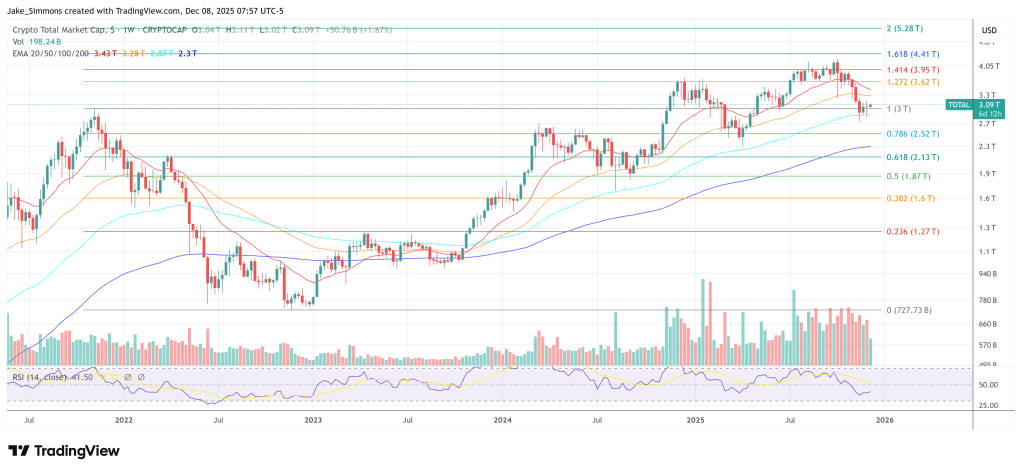
At press time, the total crypto market cap stood at $3.09 trillion.

Total crypto market cap

FOMC Week Playbook: Bitcoin Has Followed the Same Pattern Twice—Will History Repeat?

Bitcoin started the week attempting to reclaim the $92,000 level, a move that hints at early signs of recovery after weeks of volatility and uncertainty. This renewed strength arrives at a critical moment for global markets, as investors turn their attention to one event: the upcoming FOMC meeting. According to a new CryptoQuant report by XWIN Research Japan, the central question is whether the Federal Reserve will finally begin cutting interest rates—a decision that could reshape market expectations heading into 2026.

Historical data provides an important context. During the last two rate-cut announcements on September 17 and October 29, Bitcoin followed a strikingly similar pattern. Prices climbed in the days leading up to each meeting, reflecting optimism and speculation.

Immediately after the announcements, the market experienced a brief bounce, only to fall sharply soon after. This behavior highlights a common reaction in macro-driven markets: although rate cuts are usually seen as bullish, they often fuel a “buy the rumor, sell the news” dynamic in the short term as traders lock in profits.

With Bitcoin hovering below major resistance and macro uncertainty rising again, the coming days may determine whether this attempted recovery evolves into momentum—or fades into another corrective swing.

Market Positioning Meets Macro Reality

Rather than simply repeating past rate-cut reactions, the current setup requires placing Bitcoin’s behavior in the broader macroeconomic landscape—a landscape that looks very different from previous cycles. While XWIN Research highlights the historical “up first, down later” pattern around FOMC cuts, the real story lies in how today’s liquidity conditions interact with on-chain signals.

Stablecoin exchange reserves now reflect not just crypto sentiment but the macro backdrop. With the US nearing the end of quantitative tightening and global liquidity subtly improving, rising stablecoin reserves would confirm that investors are preparing to deploy capital into risk assets.

If reserves remain flat or decline, it may indicate hesitation tied to uncertainty over inflation persistence or concerns about policy missteps.

Funding rates, meanwhile, must be interpreted through the lens of a market recalibrating after a 36% correction while still operating in a high-rate environment. Excessive long leverage during a macro turning point—especially if the Fed cuts earlier than expected—creates the perfect setup for volatility spikes.

Neutral or mildly positive funding, however, would suggest traders are not overextended, allowing Bitcoin to absorb macro news more smoothly.

Bitcoin Funding Rates | Source: CryptoQuant

Ultimately, Bitcoin’s reaction to the FOMC will depend on the interplay between improving macro liquidity conditions and the internal positioning of the market. This cycle’s environment is more complex—and potentially more supportive—than prior rate-cut events, making risk-managed positioning more crucial than prediction.

Weekly Chart Shows Stabilization But Trend Still Vulnerable

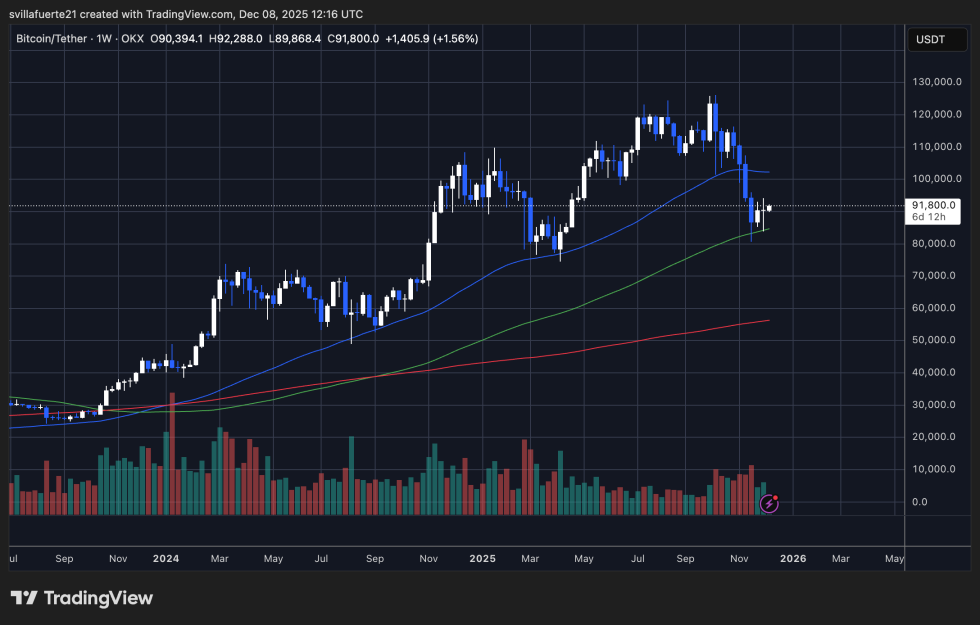
Bitcoin’s weekly chart shows the market attempting to stabilize after a sharp multi-week correction, with price hovering around $91,800. The current candle is printing a modest rebound, signaling that buyers are stepping in near the green 100-week moving average, a level that has acted as a cyclical support zone in past downturns. This reaction suggests that long-term participants are defending the structure, even as momentum remains weak.

BTC consolidates above $90K level | Source: BTCUSDT chart on TradingView

Despite the bounce, BTC continues to trade well below the 50-week moving average, which has curled downward—evidence that medium-term trend pressure still leans bearish. The breakdown from the $110K–$100K region triggered a decisive shift in sentiment, and the latest consolidation under $95K reflects a market still searching for direction rather than forming a clear recovery trend.

Volume also tells an important story: selling spikes in recent weeks have been met with noticeably softer buy-side volume, indicating that bulls are present but not yet aggressive. Until a sustained surge in demand appears, rallies near the 50-week MA are likely to face resistance.

If Bitcoin holds the 100-week MA and forms higher weekly lows, a recovery phase could build. Failure to maintain this zone, however, would expose deeper downside levels and confirm a broader trend reversal.

Featured image from ChatGPT, chart from TradingView.com

Wall Street Turns Ultra-Bullish on Ethereum as Institutional Demand Rises and Fee Reform Advances

Ethereum (ETH) is entering a phase that analysts say resembles the early stages of its strongest market cycles, driven by institutional accumulation, shrinking exchange supply, and new proposals aimed at stabilizing the network’s economics.

Related Reading: ‘Something Big’ Is Coming For XRP, Says Toroso Investments Portfolio Manager

As large investors deepen their presence and developers explore changes that could make transaction fees more predictable, sentiment on Wall Street has shifted sharply recently. For many, the combination of tightening supply and improving fundamentals has created conditions that could support a meaningful repricing.

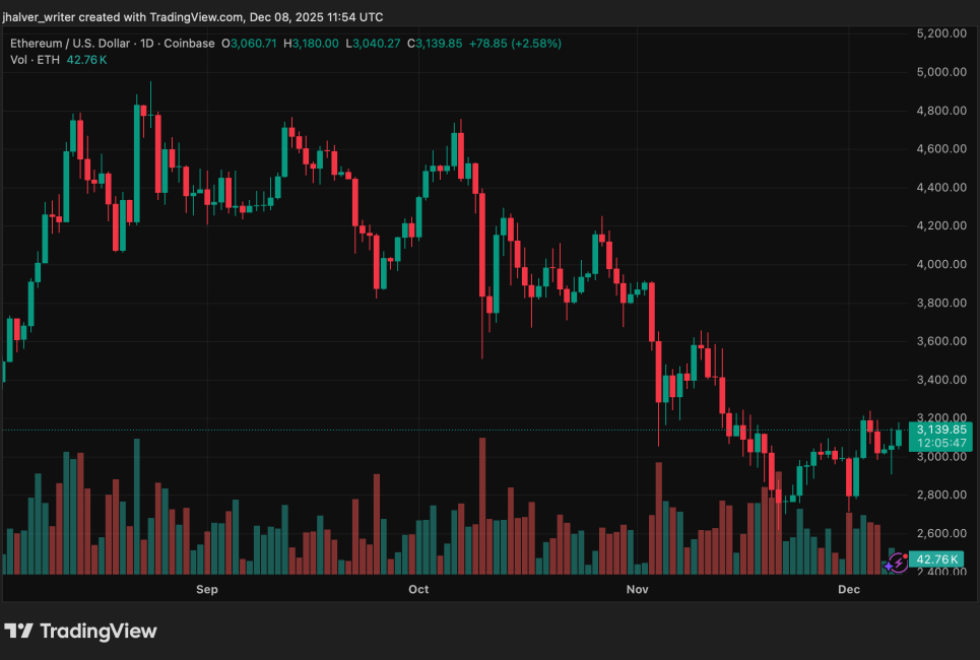
Ethereum ETHUSD_2025-12-08_12-54-13_620ab9

Exchange Supply Tightens as Institutions Accelerate Accumulation

Ethereum held on centralized exchanges has fallen to its lowest level since the network launched in 2015. Glassnode data shows that balances dropped to 8.7% of the total supply last week, marking a 43% decline since July.

The reduction is tied to staking, layer-2 migration, institutional custody, and long-term treasury allocations, destinations that rarely send tokens back to exchanges.

BitMine Immersion Technologies, now the largest corporate holder of Ether, expanded its position by another $199 million over the weekend. The firm controls $11.3 billion in ETH, representing about 3.08% of supply, and continues buying toward its 5% target.

ETFs have also contributed to the drawdown, with cumulative inflows now above $12 billion. Analysts note that nearly 40% of all ETH is locked in staking or institutional products, creating one of the tightest supply environments the asset has experienced.

Technical analysts point to hidden signs of accumulation. Recent On-Balance Volume readings have broken above resistance, even as the price lingers near $3,050, a divergence that some interpret as indicating buying pressure.

Fee Reform Pushes Forward as Vitalik Buterin Proposes Gas Futures Market

Alongside market activity, a new economic proposal from Vitalik Buterin is drawing attention. The Ethereum co-founder outlined a system for onchain gas futures that would allow users to lock in transaction fees for future time periods.

The mechanism resembles traditional futures markets and is designed to help traders and developers hedge against sudden increases in network demand.

Buterin argues that clearer forward pricing could support businesses that rely on predictable costs, particularly as activity expands across staking, tokenization, and decentralized applications. Although still in its early stages, the idea is viewed as part of a broader effort to make Ethereum more stable as it scales.

Analysts See Conditions Forming for a Larger Cycle

Market commentators increasingly cite a combination of shrinking supply, rising institutional involvement, and improving network efficiency as reasons Ethereum may outperform in the next major cycle.

Some compare current dynamics to Bitcoin eight years ago, noting that Ethereum’s evolving economic model and expanding role in tokenized finance give it a broader set of drivers than in previous cycles.

Related Reading: Trump’s New Security Strategy Leaves Crypto And Blockchain Out

Whether these developments immediately translate into price gains remains uncertain. But with exchange balances at record lows and institutions steadily accumulating, analysts agree that Ethereum is entering a structurally different phase, one defined less by speculation and more by sustained demand.

Cover image from ChatGPT, ETHUSD chart from Tradingview

Where Are the Sellers? Low Bitcoin Inflows Hint At Holder Conviction Amid Deepest Pullback of 2025

Bitcoin is attempting to reclaim the $92,000 level as bullish momentum gradually returns after weeks of uncertainty. The market has spent nearly two months in a corrective phase, shedding roughly 36% from its highs, yet signs of stabilization are beginning to emerge. A new CryptoQuant report from analyst Darkfost highlights a striking deviation from typical mid-cycle correction behavior—one that may explain why sentiment is starting to shift.

According to the report, inflows of cryptocurrencies onto Binance remain unusually low, even as Bitcoin has experienced one of its deepest pullbacks of the cycle. Historically, during significant corrections, investors tend to send large amounts of BTC and other assets to exchanges, signaling growing willingness to sell and escalating market fear. This pattern appeared repeatedly in past downturns, often marking periods of capitulation.

But this time, the data suggests something different: investors are not rushing to offload their holdings. Instead, they appear more comfortable holding through volatility, showing patience rather than panic. Such low inflows contrast sharply with prior mid-cycle resets and hint at a more resilient market structure beneath the surface—one where holders may be preparing for the next phase rather than abandoning ship.

A Shift in Inflows Reveals Unusual Investor Behavior

Darkfost notes that today’s data shows a markedly different behavior from what Bitcoin typically displays during major corrections. Instead of focusing on BTC alone, the analysis aggregates total inflows of all cryptocurrencies sent to Binance, offering a broader view of market intent. The logic behind this metric is straightforward: rising inflows signal growing selling pressure, while shrinking inflows indicate that investors prefer to hold rather than exit their positions.

Binance Total Coins Inflows | Source: CryptoQuant

During previous downturns, inflows surged. In April 2024, right after Bitcoin hit a new all-time high at $73,800, total inflows exceeded 200 million coins, reflecting intense selling pressure. A similar spike appeared in December 2024, as BTC broke above $100,000, signaling that investors were preparing to lock in profits.

Today’s environment looks nothing like those periods. Despite experiencing a much deeper correction, inflows are five times lower—and notably stable. Investors are not sending coins to exchanges, which means they’re not eager to sell. Instead, they are sitting through the decline, showing patience rather than panic.

This unusual calm suggests a more confident market structure. If selling pressure continues to fade, this investor restraint could become one of the most constructive signals supporting a future bullish recovery once the correction runs its course.

Bitcoin Price Action Shows Early Signs of Stabilization

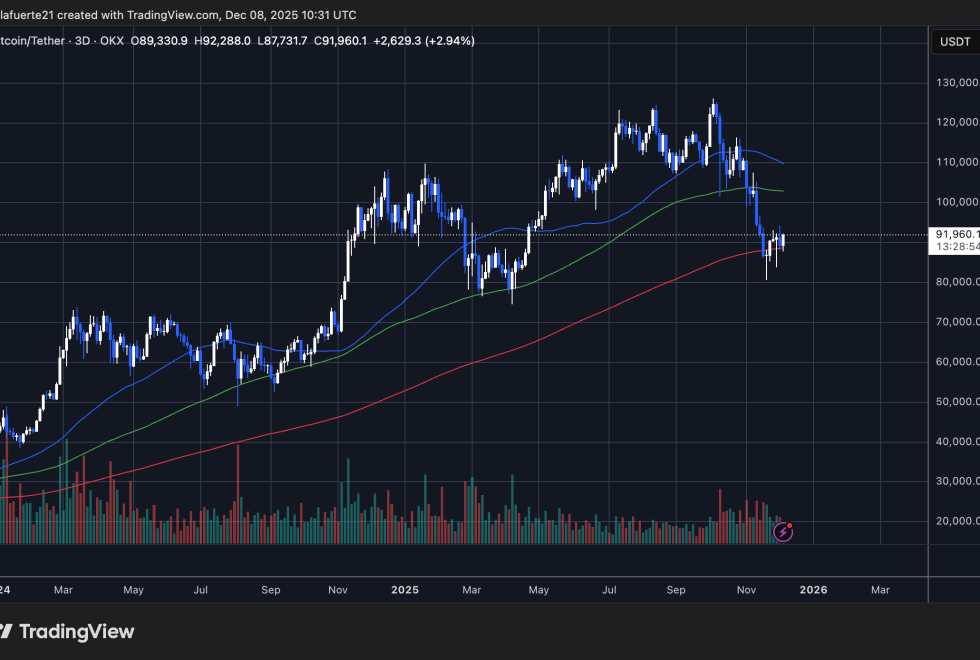
Bitcoin’s latest 3-day chart shows the market attempting to stabilize after a sharp two-month correction that pushed the price from above $120,000 to the recent lows near $84,000. The current rebound toward $91,960 reflects improving short-term sentiment, but the broader structure still leans bearish until key levels break.

Bitcoin testing critical level | Source: BTCUSDT chart on TradingView

One of the most important developments is BTC’s interaction with the 200-day moving average (red line). The price dipped below it during the flush-out but has now reclaimed it slightly, a signal that sellers may be losing momentum. Historically, regaining the 200MA on high timeframes marks the first stage of recovery after major corrections. However, confirmation requires follow-through and stronger volume—something that remains limited for now.

The 50MA and 100MA sit well above price, reflecting the depth of the recent decline and acting as overhead resistance. The clustering of these moving averages between $100,000 and $110,000 forms a heavy supply zone. Bulls would need several consecutive strong candles to break back into that region.

Volume has decreased notably during the rebound, suggesting that buyers are still cautious. Until BTC reclaims the $96K–$98K area—where structural resistance and realized-price bands align—this move remains a relief bounce rather than a confirmed bullish reversal.

Featured image from ChatGPT, chart from TradingView.com

Crypto Community Reacts as U.S. Strategy Push AI While Leaving Digital Assets Undefined

The United States’ new national security strategy has renewed debate across the crypto community after omitting any direct reference to digital assets or blockchain technology.

Released by the Trump administration, the document outlines the nation’s long-term security priorities and technological ambitions, yet its silence on crypto stands in contrast with both market momentum and recent political statements.

As global financial systems increasingly integrate digital assets, many observers see the absence as a signal of policy uncertainty at a time when regulatory clarity is becoming more important for industry growth.

Crypto Ethereum ETH ETHUSD ETHUSD_2025-12-08_12-54-13

Why Has AI Taken the Spotlight

Across its 33 pages, the strategy places artificial intelligence, biotechnology, and quantum computing at the center of America’s next-generation competition.

The administration states that U.S. technology and standards must “drive the world forward,” underscoring a focus on advanced computing rather than decentralized finance. Digital assets, which had gained prominence through previous remarks from officials, receive no explicit mention.

This stands at odds with comments from President Trump in recent months. In a CBS 60 Minutes interview, he warned that China should not become the global leader in virtual assets and insisted that Bitcoin mining should remain within U.S. borders.

A Subtle Reference, but No Clear Policy

While crypto is not named in the strategy, the document does reference strengthening American “leadership in digital finance and innovation.”

Analysts view this as a broad gesture rather than a firm policy direction, but it leaves open the possibility that digital assets may still influence future regulatory or economic strategies.

This ambiguity comes despite a year of significant pro-crypto actions. Measures such as the GENIUS Act for stablecoin oversight, the formation of a crypto enforcement task force, reduced regulatory pressures on exchanges, and opposition to a central bank digital currency have all shaped expectations.

The establishment of a national Bitcoin reserve, funded through forfeited digital assets, further signals that crypto remains a strategic consideration even if not formally acknowledged in the latest blueprint.

Market Response and Broader Implications

Currently trading around $91,900, Bitcoin briefly fell below $90,000 following the release of the strategy, a move compounded by broader macroeconomic pressures and anticipation of a Federal Reserve rate decision.

The administration’s call for increased defense spending among NATO allies has also raised questions about inflation and monetary policy, factors that could influence investor appetite for digital assets.

For now, the omission leaves the industry navigating a familiar gap of strong political rhetoric, scattered policy initiatives, but no comprehensive framework. As the U.S. centers its priorities around AI and quantum computing, crypto’s position in national strategy remains undefined. Is this the end of the ‘Crypto Administration’?

Cover image from ChatGPT, ETHUSD chart from Tradingview

Betting Big On XRP: Billion-Dollar Asset Manager Confirms What Smart Money Has Been Doing

Institutional investors are quietly reshaping the narrative around XRP, with the latest analysis report from the billion-dollar asset manager WisdomTree confirming what insiders have long suspected. According to the report, XRP is garnering institutional interest and demand on a global scale. While retail traders debate short-term price movements, smart money capital inflows into XRP are surpassing those of almost every other altcoin. 

XRP Dominates Institutional Inflows Across Europe And The Globe

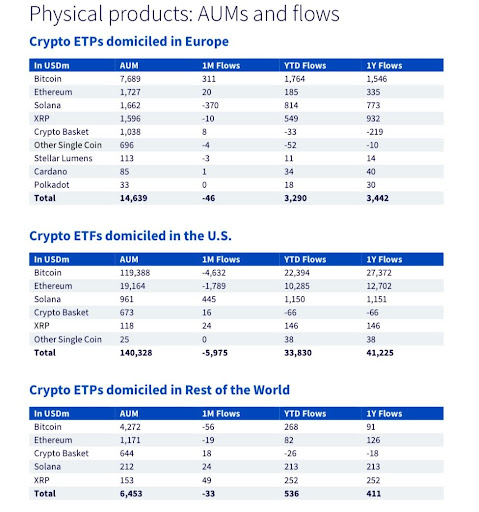
According to an X post by crypto expert Stern Drew, the latest WisdomTree report shows that XRP is the only digital asset attracting consistent institutional demand worldwide. In Europe, XRP has attracted over $549 million in new institutional capital this year, more than three times the inflows into Ethereum. This figure surpasses the total for every altcoin in the market and multi-asset products except Bitcoin. 

In a continent traditionally known for conservative investment strategies, these flows into XRP represent a decisive vote of confidence from European institutional investors. Drew has revealed that the demand for XRP has also extended beyond Europe. Outside the United States, XRP has captured roughly $252 million in fresh institutional capital just this year. 

XRP

By comparison, Bitcoin products absorbed only $268 million in smart money capital. Given that BTC products are more than 25 times the size of XRP products, this suggests that institutions have directed nearly 25 times more new capital into XRP than into Bitcoin. Drew has suggested that this increase in flows indicates careful, deliberate positioning rather than short-term speculative activity, which highlights the market’s growing preference for XRP

US Adoption Signals Broader Shift

In his post, Drew also revealed the growing institutional interest in XRP within the US. This year, a new synthetic XRP product attracted $241 million, surpassing flows into Solana and all other altcoin products in the same category. This surge came at a time when the two largest cryptocurrencies, Bitcoin and Ethereum, collectively saw $6.4 billion exit their ETF structures

Drew revealed that the dramatic outflows from BTC and ETH signaled that institutional investors were diversifying from established assets while selectively accumulating XRP. The WisdomTree report also showed that, excluding Europe and the US, regions such as Asia and other global markets are increasing their exposure to XRP. 

Surprisingly, this surge in global institutional demand is occurring during periods of market stress rather than euphoric rallies. The XRP price is currently down by more than 15% this year and trading at just $2.1. The cryptocurrency has also been experiencing significant choppy action over the past few months, failing to reclaim former highs above $3.

Despite this structural weakness, institutions continue to accumulate XRP in large quantities, indicating a clear bias toward the cryptocurrency. Drew has also revealed that smart money views XRP as a settlement-grade asset, well-suited for integration into the future architecture of regulated digital finance. He highlights that, as global institutional preference increasingly concentrates on XRP, price movements might follow later.

XRP

❌