Metamask, the popular Ethereum and DeFi wallet, announces Bitcoin integration as the company continues its expansion into multiple chains other than Ethereum. The wallet boasts 143 million downloads and over 30 million monthly active users, making it one of the most popular crypto wallets in the world.
Developed by Consensys, an Ethereum-born software development arm, Metamask has become a beast of its own, achieving massive success and adoption in the crypto industry. Having operated for over a decade, Metamask defined the user experience of in-browser wallets, copied by many of its competitors. Up until recently, Metamask was an Ethereum-only wallet, focusing on helping users move their wealth across Ethereum bridges, but in October, the wallet announced its planned expansion into Solana, and now Bitcoin has entered the list of blockchains it supports natively.
The Bitcoin integration was made possible in part thanks to the Bitcoin Development Kit, an open-source Bitcoin wallet library designed to make Bitcoin app development very easy.
Metamask’s Bitcoin integration marks a major milestone for the growing Bitcoin DeFi ecosystem, which was previously thought to be a niche only available to new blockchains like Ethereum, thanks to their smart contracting capabilities. In recent years, however, projects like Ordinals revealed that there are very powerful scripting tools available in Bitcoin, which drew the attention of DeFi developers across the industry.
As a result, a variety of layer two projects of all kinds have been launched, bootstrapping an integration and cross-collaboration between Bitcoin and the broader EVM-based (Ethereum virtual machine) DeFi ecosystem. Some examples of Bitcoin DeFi platforms include BOB, Botanix, Rootstock, and the Liquid Network.
Metamask has also announced in October this year that it is preparing to go public in the U.S. markets, and has launched a variety of mainstream-facing features, such as a crypto-powered debit card or Metamask Card, in partnership with the Linea network, as well as “one of the largest on-chain rewards programs ever built”.
Over the last two months, the broader bitcoin market has bled to semi-surprising lows and it seems like fear has crept into the forefront of market sentiment. But Strategy’s Michael Saylor, in true Saylor fashion, just put his head down and bought more bitcoin.
Over the past two weeks, Strategy has spent nearly $2 billion just on Bitcoin.
Strategy has steadily expanded their Bitcoin treasury over the years, now holding 671,268 BTC — equivalent to 3.2% of all Bitcoin ever expected to exist, the company says.
The firm’s average purchase price for its holdings sits at roughly $75,000 per BTC, with a total acquisition cost of $50 billion and a current Bitcoin net asset value of $60 billion.
Strategy has added Bitcoin in every quarter since Q3 2020, totaling 90 separate acquisitions.
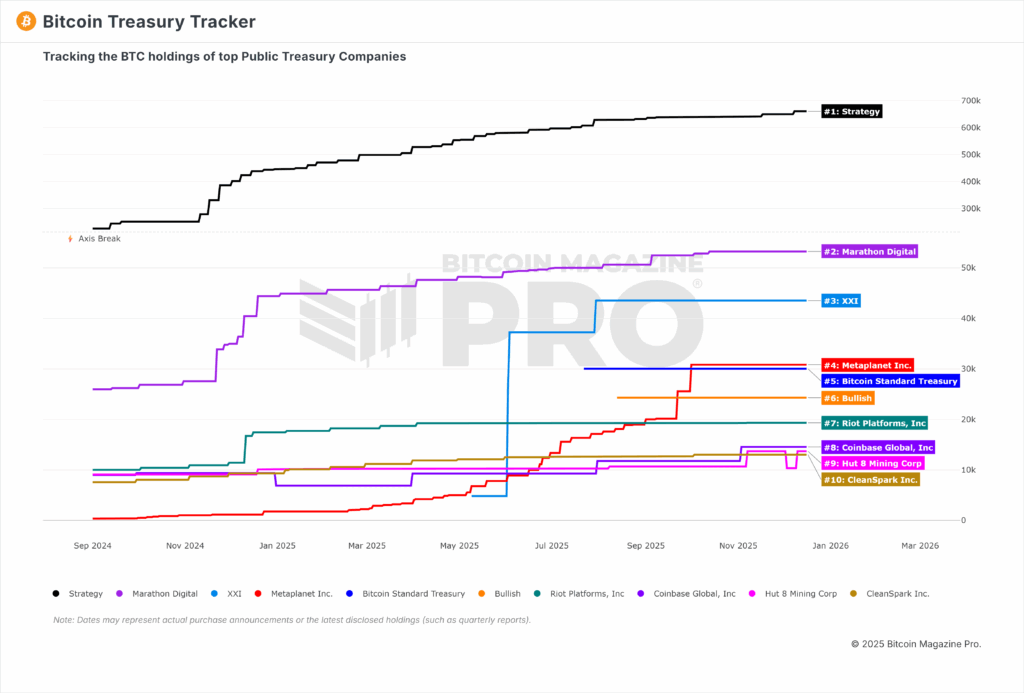
Per Bitcointreasuries.net, Strategy’s Bitcoin holdings tower over every other publicly traded treasury, owning 12 times the next largest holder, MARA Holdings.
While most companies in the top 10 hold between 13,000 and 53,000 BTC, Strategy’s accumulation dwarfs them, underscoring its unprecedented scale of BTC holdings.
Earlier this month, Strategy created a $1.44 billion cash reserve to safeguard future dividends and interest payments, in an effort to reassure investors it would not need to sell any of its roughly $56 billion in Bitcoin amid broader Bitcoin market weakness.
Funded by recent Class A stock sales, the reserve initially covered 21 months of obligations, with plans to extend to 24 months. CEO Phong Le said the move sharply reduced the likelihood of BTC liquidation, addressing fears from prior comments.
JUST IN: Michael Saylor's Strategy now owns 3.2% of all Bitcoin ever to be in existence pic.twitter.com/R907KnHsee
Strategy wants more bitcoin: ‘We are going to buy all of it’
At the Bitcoin MENA conference, Saylor discussed his bitcoin beliefs more, saying that Bitcoin was the foundation of a new digital capital and credit era. Addressing sovereign wealth funds, banks, and investors, Saylor framed Bitcoin as “digital capital,” contrasting it with traditional assets like gold, real estate, and equities, and emphasizing its potential as a core store of value in the digital economy.
Saylor emphasized the growing institutional adoption of Bitcoin, with major U.S. banks—including Bank of America, Wells Fargo, JP Morgan, and Citi—now offering custody solutions and credit against Bitcoin.
He also cited bipartisan government support from agencies like the Treasury, SEC, and CFTC.
Central to Strategy’s vision is converting volatile Bitcoin into predictable, yield-generating credit. Through over-collateralized instruments like STRK (8% dividend) and STRF (10% perpetual bond), Strategy delivers steady cash flows while enhancing long-term Bitcoin exposure.
Saylor claimed these mechanisms allow the company to double Bitcoin per share every seven years, creating liquidity and aligning corporate growth with investor returns. He likened Bitcoin-backed credit to gold-backed financial systems, envisioning a global shift toward digital gold-supported credit integrated into traditional banking.
Earlier this week, news came out that Strategy will retain its spot in the Nasdaq 100 index despite an annual reshuffle that removed six companies and added three.
Strategy’s Michael Saylor speaking at Bitcoin Amsterdam
Tether, the issuer of the world’s largest stablecoin USDT, announced a strategic investment in Speed1, Inc. (“Speed”), a payments infrastructure company leveraging the Bitcoin Lightning Network and stablecoins to build instant, global settlement rails.
Tether led the company’s $8 million funding round alongside ego death capital, signaling a strong push to expand Bitcoin-aligned financial infrastructure and increase the real-world utility of USDT.
Speed provides payment solutions for a diverse range of users, including consumers, creators, platforms, and enterprise merchants. The company processes over $1.5 billion in annual payment volume and serves roughly 1.2 million users through its Speed Wallet and Speed Merchant products.
These tools enable near-instant settlement in both bitcoin and USDT while offering global routing capabilities optimized for enterprise-level integrations.
The company’s architecture combines Lightning-based transaction execution with stablecoin settlement, addressing key challenges in cross-border payments such as speed, cost, and price volatility.
This combination allows users and merchants to transact efficiently while maintaining price stability when required, making it suitable for international transfers, creator payouts, merchant payments, and platform-level settlements.
Bitcoin networks are ready for mainstream commerce
“Speed is showing what Lightning can achieve when paired with a stable, liquid digital dollar like USDT,” said Paolo Ardoino, CEO of Tether.
“We support teams building practical infrastructure that reduces friction in payments and expands access to reliable settlement rails. Speed’s execution and adoption signal that Bitcoin-rooted networks are ready for mainstream commerce,” Ardoino said.
Niraj Patel, CEO of Speed, added, “Crypto has lived in the world of speculation for too long. Speed is making it usable – instantly, globally, and at scale. Lightning gives us speed; stablecoins give us universal access; our infrastructure brings it all together for consumers, creators, and merchants.”
Tether likes to hold bitcoin
This move aligns with Tether’s ongoing diversification strategy. Earlier this year, the company acquired nearly 8,889 BTC, bringing its primary treasury holdings to over 86,000 BTC, and expanded into physical assets such as gold and agribusiness through a 70 percent stake in Adecoagro.
Per BitcoinTreasuries.net, Tether holds 87,475 bitcoin.
Per the companies, the $8 million funding will support Speed’s infrastructure expansion and additional integrations with merchants and platforms, further solidifying its role in building the next generation of global financial rails anchored in Bitcoin and USDT.
American Bitcoin Corp. (Nasdaq: ABTC) has entered the top 20 publicly traded bitcoin treasury companies by holdings after growing its strategic reserve to approximately 5,098 BTC as of December 14, according to company disclosures.
The Miami-based firm said its bitcoin was accumulated through a combination of in-house mining and strategic market purchases. The total includes bitcoin held in custody as well as BTC pledged as collateral for miner purchases under a supply agreement with hardware manufacturer Bitmain, per the company release.
Based on rankings from BitcoinTreasuries.net, the milestone places American Bitcoin among the largest public bitcoin holders globally, just over three months after its Nasdaq listing.
As part of its treasury reporting, the company also highlighted growth in its proprietary Satoshis Per Share (SPS) metric, which measures the amount of bitcoin attributable to each outstanding common share. As of December 8, SPS stood at 507 satoshis per share, representing a more than 17% increase in just over one month.
American Bitcoin is also introducing a new disclosure metric, Bitcoin Yield, which tracks the percentage change in SPS over a defined period. The company said the combined metrics are intended to give investors clearer insight into both per-share bitcoin exposure and how that exposure evolves over time.
“I am incredibly proud of our tremendous growth,” said Eric Trump, co-founder and chief strategy officer of American Bitcoin. “In just over three months since our Nasdaq listing, we have surged past dozens of companies — propelling us into the top 20 publicly traded bitcoin treasury companies.”
Earlier this month, American Bitcoin reported adding roughly 416 BTC in a single week, lifting holdings from approximately 4,783 BTC as of December 8.
The company said its accumulation strategy prioritizes long-term bitcoin exposure over short-term price movements, supported by an operating model designed to maximize BTC retention.
JUST IN: Trump family backed American #Bitcoin increases its BTC holdings to 5,098 BTC.
In early December, the American Bitcoin stock (ABTC) plunged more than 50% shortly after markets opened, triggering multiple trading halts and erasing months of speculative gains.
The stock fell to an intraday low of $1.75 before recovering slightly, though it remained down over 35% at the time of writing.
The sell-off followed a broader downturn in crypto markets, with bitcoin sliding into the mid-$85,000 range. Nearly $1 billion in leveraged crypto positions were liquidated the day before, worsening already fragile market conditions.
Now, with Bitcoin trading above $87,000, $ABTC shares trade down at $1.61 per share.
Bitcoin treasury companies have been hit hard by Bitcoin’s disappointing price action throughout 2025. Publicly traded firms holding significant BTC reserves are suffering the most, with leaders like (Micro)Strategy pushing aggressive accumulation amid headwinds—yet most now trade below net asset value, creating a rare opportunity for risk-tolerant strategic investors.
Figure 1: Tracking BTC holdings of the top public Bitcoin Treasury Companies. View live chart.
The Bitcoin Treasury Companies Landscape
Not all Bitcoin treasury companies are created equally. Strategy stands apart as the industry standard-bearer, the “Bitcoin among treasury companies,” as it were. The company has maintained its accumulation discipline even as its stock has suffered, recently announcing a $1.44 billion USD reserve specifically designed to pay dividends and debt obligations without forcing Bitcoin sales.
This capital buffer theoretically eliminates the need for excessive dilutive share issuance or forced BTC liquidation, a critical distinction from weaker competitors. Many will likely face shareholder pressure and potential forced selling as their stock prices decline, creating a cascade of supply pressure that could paradoxically benefit the strongest players like MSTR.
Valuation Dynamics of Bitcoin Treasury Companies
The most compelling aspect of current treasury company valuations is that they now trade below net asset value on a per-share basis. In practical terms, you can currently purchase one dollar’s worth of Bitcoin for less than one dollar through treasury company stock. This represents an arbitrage opportunity for investors, though one accompanied by elevated volatility and company-specific risks.
Figure 2: Bitcoin Magazine Pro’s top 20 public Bitcoin Treasury Company HODLboard. View live table.
Strategy currently sits at a net asset value premium of less than 1, meaning the company’s market capitalization is below the value of its Bitcoin holdings alone. The upside scenario is striking. If Bitcoin reclaims its previous all-time high around $126,000, Strategy continues accumulating toward 700,000 BTC, and the market assigns even a modest 1.5x to 1.75x net asset value premium, Strategy could approach the $500 region per share.
From Weak to Strong: The Future of Bitcoin Treasury Companies
Examining Strategy’s performance during the previous Bitcoin bear market and overlaying it onto the current cycle reveals eerie alignment. The bar patterns suggest current price levels represent reasonable support, with only a catastrophic final flush justified by Bitcoin weakness providing reason to expect substantially lower levels.
As weaker treasury companies face forced selling, a consolidation thesis emerges, that Strategy and similar strong-positioned players will potentially accumulate cheap Bitcoin from distressed sellers, further concentrating holdings in the most disciplined accumulators. This dynamic mirrors Bitcoin’s own consolidation process, weaker hands sell, stronger hands accumulate, and the asset becomes more concentrated among conviction holders.
Conclusion: Opportunity in Bitcoin Treasury Companies
Bitcoin treasury companies have for the most part delivered disappointing returns in 2025, but this performance has created a window of exceptional opportunity for disciplined investors. At current valuations, Strategy is essentially selling one dollar of Bitcoin for approximately 90 cents, a discount that becomes even more attractive if Bitcoin experiences one final capitulation flush. The probability of this scenario combined with Strategy’s positioned upside creates asymmetric risk-reward worthy of small, carefully-sized positions within aggressive portfolios.
Disclaimer: This article is for informational purposes only and should not be considered financial advice. Always do your own research before making any investment decisions.
President Donald Trump said he’ll review the case of Keonne Rodriguez, co-founder of Samourai Wallet, as questions mount over the federal conviction of the Bitcoin privacy software developer.
When asked about Rodriguez’s upcoming prison sentence, Trump said, “I’ve heard about it. I’ll look at it.”
“I don’t know anything about it,” President Trump said. “But we’ll take a look.”
Rodriguez publicly acknowledged Trump’s sentiment, tweeting “Your continued noise is working. Thank you to everyone pushing @realDonaldTrump to pardon Bill and me. Let’s get this over the line. #pardonsamourai”
Rodriguez, along with co-founder William “Bill” Hill, was convicted of conspiracy to operate an unlicensed money transmitting business, a charge stemming from Samourai Wallet, a Bitcoin privacy tool that allowed users to mix coins and maintain financial anonymity without giving up custody of their funds.
JUST IN: President Trump says he will consider a pardon for the CEO of privacy-focused Bitcoin wallet Samourai.
The case, which began under the Biden administration and continued through the Trump Justice Department, culminated in Rodriguez receiving a five-year sentence and Hill four years, though Hill’s age and recent autism diagnosis led to a reduced sentence.
Critics of the prosecution argue the case represents a dangerous precedent for the cryptocurrency industry. The U.S. Department of Justice claimed that Samourai Wallet facilitated over $2 billion in unlawful transactions and laundered more than $100 million from criminal sources. However, only the “unlicensed money transmission” charge survived a high-profile trial, raising questions about the strength of the case.
Samourai Wallet’s mixing services, Whirlpool and Ricochet, were designed to obscure the origin of criminal proceeds from activities including drug trafficking, darknet marketplaces, fraud, cybercrime, and murder-for-hire operations.
Court documents reveal the developers actively encouraged criminal use, describing the service as “money laundering for bitcoin” and promoting its tools on darknet forums.
The Department of Justice framed the case as part of a broader crackdown on crypto mixing services. Rodriguez had requested a light sentence, but the court imposed the statutory five-year maximum.
Trump’s comments come amid his campaign promises to defend the right to self-custody and financial privacy. During the 2024 Bitcoin Conference in Nashville, he pledged to end what he described as the “anti-crypto crusade” of the prior administration.
With Rodriguez set to report to prison on December 18 and Hill already sentenced, the Trump administration faces a high-profile decision that could shape the future of financial privacy, software development, and cryptocurrency regulation in the United States.
Bitcoin and the broader crypto market is heading into 2026 with more questions than clear answers.
A new outlook from Fidelity urges caution for investors chasing short-term gains, while arguing that long-term holders may still have room to enter the market.
The message reflects a broader shift: crypto is no longer just a high-beta trade for speculators. It is being treated as a strategic asset by governments, corporations, and institutional investors.
That shift accelerated this year.
This year, more governments and companies added digital assets to their treasuries, creating a new source of demand that didn’t exist in prior cycles.
In March, President Donald Trump signed an executive order establishing a Strategic Bitcoin Reserve for the United States. The order formally designated BTC and select cryptocurrencies already held by the federal government as reserve assets.
The long-term impact of that decision remains unclear. But the symbolism matters. BTC is now officially recognized by the U.S. government as a store of value. That recognition is feeding debate over whether crypto’s familiar four-year market cycle still applies, the report argued.
Is Bitcoin’s four-year cycle over?
Bitcoin has historically moved in boom-and-bust patterns tied loosely to its halving schedule. Major tops formed in 2013, 2017, and 2021. Each was followed by deep drawdowns. Today, prices are again pulling back around the four-year mark, raising the question of whether the current bull market has already peaked.
JUST IN: Fidelity reports that Bitcoin's 4 year cycle may be over
Investors "believe we could be entering a supercycle…For reference, a supercycle in commodities in the 2000s spanned nearly a decade." pic.twitter.com/SVQs61lz7N
Some investors think the cycle is breaking down. The argument is simple: structural demand is changing. Sovereign adoption and corporate balance sheet buying could dampen volatility and reduce the severity of future bear markets.
Others go further, suggesting bitcoin may be entering a “supercycle” that extends higher for years, with only shallow corrections along the way.
Fidelity Digital Asset’s Chris Kuiper isn’t convinced cycles are dead. Human behavior hasn’t changed, he notes, and fear and greed still drive markets. If the four-year pattern holds, bitcoin would need to have already set its cycle high and be entering a sustained bear market.
So far, it’s too early to say. The recent drawdown could mark the start of a downturn. Or it could be another mid-cycle shakeout.
Governments and corporations are buying Bitcoin
Also, government adoption adds another layer of complexity. A growing number of countries already hold crypto, but few have formally designated it as a reserve asset.
That may change. Kyrgyzstan passed legislation establishing a crypto reserve in 2025. In Brazil, lawmakers advanced a proposal that would allow up to 5% of foreign reserves to be held in bitcoin.
Kuiper points to game theory. If one country adopts bitcoin as a reserve, others may feel pressure to follow. Any incremental demand, he says, could support prices, though the scale matters and selling pressure can offset buying.
Corporations are also playing a larger role. More than 100 publicly traded companies now hold crypto, with roughly 50 firms controlling over one million bitcoin combined, per Fidelity. Strategy remains the most visible buyer, but it’s no longer alone. For some firms, bitcoin offers a way to access capital markets and arbitrage investor demand for exposure.
That demand cuts both ways. Corporate buying can lift prices. Forced selling in a downturn could amplify losses.
So, is it too late to buy?
Fidelity’s Kuiper says it depends on the time horizon. Short-term investors may face poor odds if the cycle is near its end. Long-term holders face a different equation. On a multi-decade view, Kuiper argues bitcoin’s fixed supply remains its core appeal. If that holds, the question isn’t timing the cycle. It’s whether adoption continues. In 2026, that answer is still unfolding.
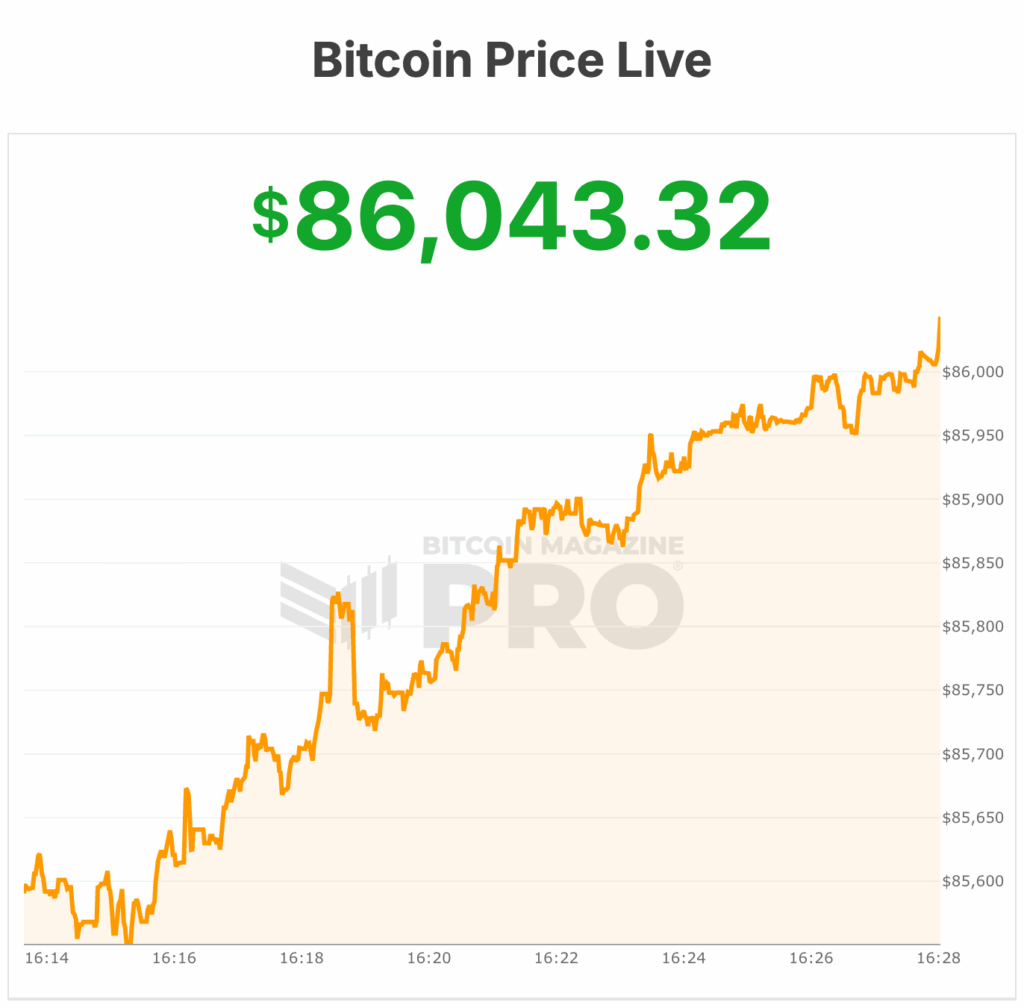
At the time of writing, Bitcoin’s price is rapidly dipping near $86,000.
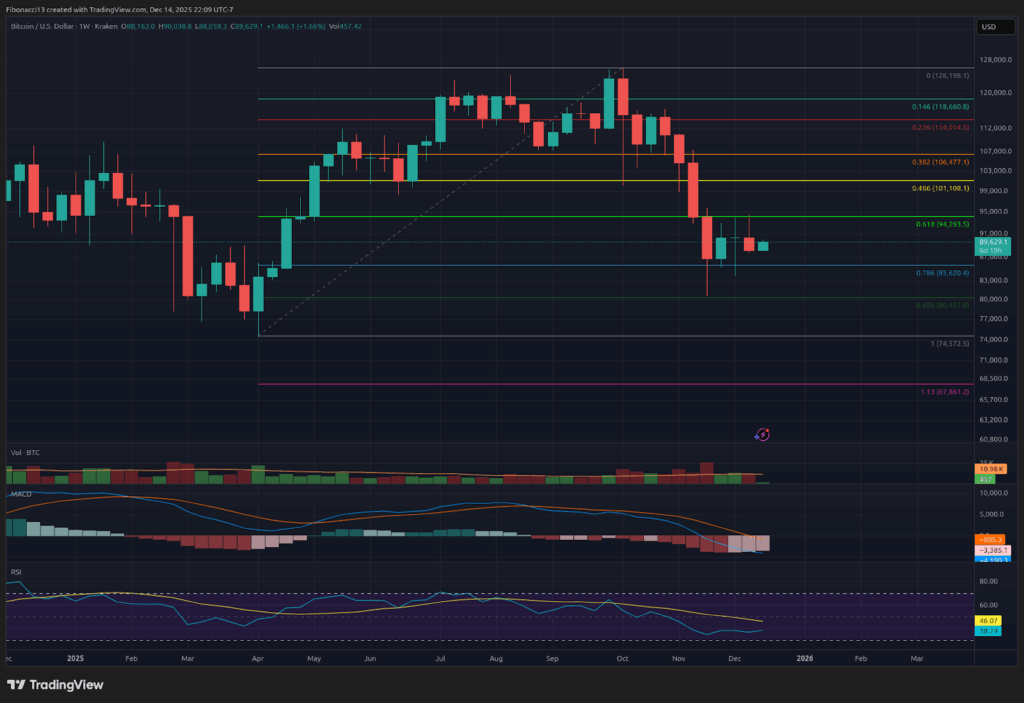
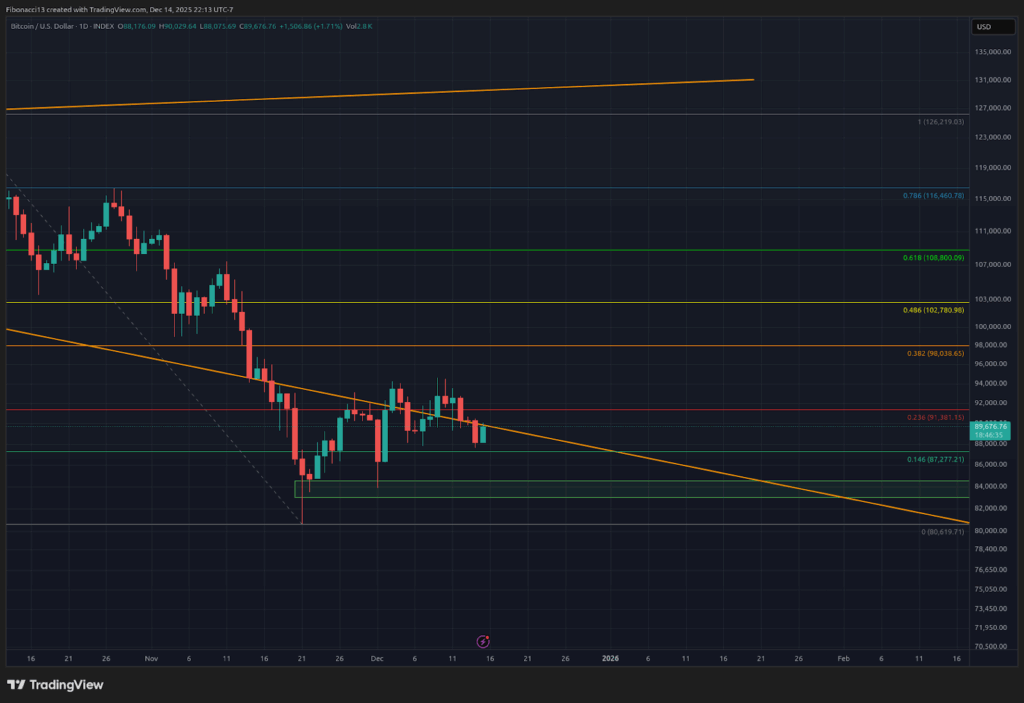
Bitcoin price is looking lethargic heading into this week. Last week saw prices reject once again from the $94,000 resistance level. The bulls were not able to gain any momentum whatsoever as the price bled down into Sunday to close at $88,170. This week, the bears will look to break the $84,000 support level and take the price into the low $70,000 range. The bulls will desperately try to hold onto this $84,000 level as support, but it may not be able to survive another test.
Key Support and Resistance Levels Now
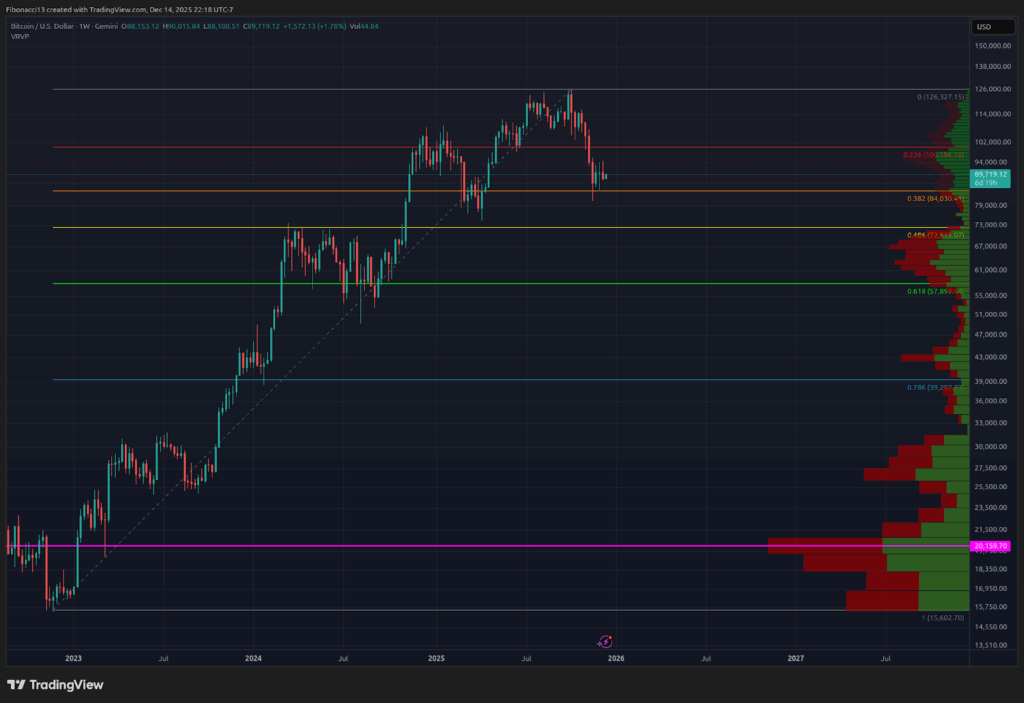
With the $84,000 support level again under pressure this week, the bears will look to finally drive the price down below it. There’s a small chance bulls may be able to defend $85,000, but it’s unlikely to hold here unless we see big buying volume step in. The $72,000 to $68,000 support zone below should be a solid floor on initial tests, so it would likely take a few weeks to break down through this level if we get there. Below here, bulls will look to hang onto the 0.618 Fibonacci retracement support at $57,000.
Up higher, we have a blanket of resistance now from $94,000 all the way up to $118,000. If bulls can manage to finally conquer $94,000, they will look to $101,000 next, although sellers should step in strongly above $97,000. Above $101,000, it should be a slow go all the way to $107,000. Even more buying pressure would be necessary above $107,000 to push through this thick zone all the way to $118,000. None of these levels seem attainable anytime soon with the current price action, however.
Outlook For This Week
Bitcoin’s weekly red candle close was not what the bulls wanted to see last week. The bears got a much-needed rest over the past few weeks and should see renewed strength this week. Look for the bears to attempt to break the $84,000 support level at some point this week, with bulls potentially trying to put in a bounce to maintain higher lows around the $87,000 to $85,000 area. If price drops below $84,000 this week, I would expect to see acceleration down to at least $75,000 and likely into the low $70,000 area.
Market mood: Extremely Bearish – Bulls had some time to try to push the price above short-term support over the last couple of weeks and failed to do so. The bears are in control and should be well rested for renewed selling strength to the downside.
The next few weeks Sellers received a much-needed break over the past few weeks, while buyers were only able to pause the bearish momentum. Bears should take advantage here to take out the $84,000 support level. In the next few weeks, look for the support zone in the $72,000 to $68,000 area to be hit. However, we should see a strong bounce from this area after an initial test. So if this zone is touched, look for price to at least re-test the $84,000 level from down there, with potential for an even stronger bounce. This zone is a potential area for a reversal out of the bear market, but if the “4-Year Cycle” holds true, then the price would likely test lower later into 2026.
Terminology Guide:
Bulls/Bullish: Buyers or investors expecting the price to go higher.
Bears/Bearish: Sellers or investors expecting the price to go lower.
Support or support level: A level at which the price should hold for the asset, at least initially. The more touches on support, the weaker it gets and the more likely it is to fail to hold the price.
Resistance or resistance level: Opposite of support. The level that is likely to reject the price, at least initially. The more touches at resistance, the weaker it gets and the more likely it is to fail to hold back the price.
Fibonacci Retracements and Extensions: Ratios based on what is known as the golden ratio, a universal ratio pertaining to growth and decay cycles in nature. The golden ratio is based on the constants Phi (1.618) and phi (0.618).
SEC Chairman Paul S. Atkins just addressed the ongoing SEC Crypto Task Force Roundtable on Financial Surveillance and Privacy by touching on the dual nature of public blockchain technology and the need to balance government oversight with individual privacy rights.
Atkins underscored that public blockchains are “more transparent than any legacy financial system ever built,” with every transaction recorded on a ledger accessible to anyone.
Atkins also said that chain analytics firms are already adept at linking on-chain activity to off-chain identities, warning that, if misapplied, crypto could become “the most powerful financial surveillance architecture ever invented.”
The chairman cautioned against a regulatory approach that treats every wallet as a broker and every transaction as reportable, which he said could transform the ecosystem into a “financial panopticon.”
JUST IN: SEC Chair Paul Atkins says "public blockchains are more transparent than any legacy financial system ever built." pic.twitter.com/NfvKhsDPJx
Such transparency, Atkins explained, could also disrupt traditional market functions: real-time visibility of orders, hedges, and portfolio adjustments could incentivize front-running, copycat strategies, and other dynamics that make market-making and underwriting less attractive.
Privacy in crypto and blockchain
At the same time, Atkins highlighted the privacy-preserving capabilities of blockchain technology. He pointed to blockchain that allow users to demonstrate compliance without revealing their entire financial history.
Such tools, he said, could enable regulated platforms to screen users while avoiding permanent, detailed tracking of individual transactions.
“Shielding the lawful activity of our citizens from bulk surveillance while still ensuring that our government can perform essential functions is the best way to protect both national security and our basic civil liberties while also giving room for innovation to flourish,” Atkins said.
He concluded by stressing the importance of creating a regulatory framework that protects Americans’ privacy without stifling technological or financial innovation.
Although he could not remain for the entire roundtable, Atkins expressed confidence that the discussions would help shape policies that uphold both security and personal freedom.
In later opening comments, Commissioner Hester Peirce emphasized that tokenized securities and other crypto assets allow transactions to occur without traditional intermediaries like brokers, reducing the flow of information to government surveillance channels.
She noted that while disintermediated transactions limit traditional oversight, public blockchains remain fully transparent, creating both opportunities and challenges for monitoring.
Peirce argued that the U.S. financial system’s longstanding erosion of privacy is overdue for reassessment, with crypto pushing the conversation forward.
As crypto adoption grows, Peirce called for thoughtful reevaluation of how and when financial transactions are surveilled, balancing the need to protect consumers from bad actors with preserving privacy rights.
mNAV, or market net asset value, is a valuation metric that expresses the real-time economic value of a company’s bitcoin reserves. It adjusts the company’s holdings to the current market price of bitcoin, accounts for liquid cash and debt, and factors in share dilution.
mNAV provides a clearer picture of a bitcoin treasury company’s true financial position than conventional accounting standards. It has become the standard tool for evaluating corporate bitcoin strategies because it centers the analysis on bitcoin itself, rather than legacy accounting conventions that can distort value.
Key Takeaways
Real-Time Precision: mNAV reflects the current market value of a company’s bitcoin reserves on a per-share basis, updated in real-time rather than quarterly.
Economic Reality: It provides investors with a transparent measure of reserve value that cuts through GAAP reporting lags.
Market Sentiment: Premiums and discounts to mNAV reveal how the market interprets a company’s execution, governance, and capital efficiency.
Valuation Anchor: mNAV is essential for analyzing public bitcoin treasury companies and access vehicles.
Purpose: Why We Need mNAV
The purpose of mNAV is to provide an accurate, real-time valuation anchor for companies that hold bitcoin.
Historically, under US accounting rules (GAAP), bitcoin was treated strictly as an intangible asset. This required companies to recognize impairments when the price fell but prevented them from recognizing gains until the asset was sold. While recent updates to FASB rules (ASU 2023-08) now allow companies to report bitcoin at fair value, GAAP financial statements remain retrospective—snapshots taken only once per quarter.
Bitcoin markets move 24/7. A quarterly earnings report is often stale the moment it is published.
mNAV fills this gap. It replaces static quarterly reporting with dynamic, market-based valuation. Investors gain a consistent, transparent, and economically meaningful measure of the company’s bitcoin position that adjusts with the market. This provides a reliable basis for evaluating performance, governance, risk, and capital strategy.
Mechanics: How mNAV Works
mNAV is straightforward to calculate, but precision is key. It treats the company effectively as a holding vehicle, netting out debts and cash to find the “naked” value of the bitcoin per share.
1. Holdings in BTC
Companies disclose their bitcoin reserves in BTC terms. This is the foundational input. Because bitcoin’s supply is fixed, the quantity held is the primary driver of long-term value.
2. Market Pricing
The real-time spot price of bitcoin is applied to the company’s total BTC holdings to determine the gross value of the reserves.
3. Net Debt (Cash vs. Liabilities)
To get an accurate “Net Asset” value, you must account for the balance sheet.
Add Cash: Cash and cash equivalents are added to the bitcoin value.
Subtract Debt: Total debt (including convertible notes and senior secured notes) is subtracted.
Note: For operating companies (like software firms), this formula is conservative. It effectively values the operating business at zero, assuming its cash flows exist primarily to service the debt.
4. Fully Diluted Share Count
The result is divided by the fully diluted number of shares. This includes outstanding shares, options, Restricted Stock Units (RSUs), and shares underlying convertible notes if they are “in the money.”
Formula for mNAV per share
The output is a reserve-based valuation per share. Investors compare the stock price to this benchmark to understand if they are paying a premium (paying for future execution) or a discount (pricing in risk).
Background and Origins
mNAV emerged as a practical necessity once corporations began holding bitcoin in material size. Early adopters like MicroStrategy (now Strategy) revealed that standard accounting could not capture the reality of bitcoin’s market behavior. Impairment charges made healthy balance sheets look distressed, while massive unrealized gains went unreported.
Analysts began circulating market-value-adjusted figures to understand the true strength of these companies. Even as accounting rules modernize, mNAV remains the dominant metric because it is simple, comparable across companies, and focused on BTC terms rather than accounting classification.
Why Companies Trade Above or Below mNAV
Companies rarely trade exactly at mNAV. The market applies premiums or discounts based on how it interprets execution quality, treasury discipline, and capital structure.
Capital Market Arbitrage & Accretive Issuance: Some companies excel at transforming capital markets into bitcoin acquisition engines. They issue equity or debt at attractive terms to buy more bitcoin.
Notably, if a company trades at a premium to mNAV, it can issue new shares to buy bitcoin, effectively increasing the bitcoin-per-share for existing holders. The market often rewards this “accretive loop” with a sustained premium, as it accelerates the accumulation of reserves.
Bitcoin-Backed Financial Instruments: Companies with deep bitcoin reserves can issue financial products backed by those holdings, such as bitcoin-backed notes or yield-generating instruments. Markets reward the ability to use bitcoin to build new financial infrastructure.
Global Market Access: Large pools of institutional capital still cannot buy or custody bitcoin directly. Treasury companies offer a familiar entry point through equity and fixed income. This utility increases demand for shares, often pushing valuations above mNAV.
Discounts: The Market Referendum: Discounts often signal distress. If a company trades below mNAV, it implies investors are worried about governance, management fees, excessive leverage, or the inability to hold bitcoin long-term.
Premiums to mNAV
A premium to mNAV indicates that investors value the company’s capabilities beyond the raw value of its current holdings.
A premium is a vote of confidence. It suggests investors believe the company will:
Generate Accretion: Issue capital efficiently to grow bitcoin-per-share.
Mitigate Risk: Manage leverage intelligently to avoid forced selling.
Create Utility: Build products or services on top of the bitcoin stack.
Premiums contract when confidence fades. Poor execution or deterioration in capital efficiency can reduce demand for the shares, causing valuations to drift back toward—or below—mNAV.
Example: Strategy ($MSTR)
Strategy is the largest and most studied bitcoin treasury company. Because its strategy involves active capital market management (issuing convertibles and equity to buy BTC), analysts, plebs and investors routinely track mNAV to interpret its valuation.
Strategy often trades at a significant premium to mNAV. This premium reflects the market’s valuation of its ability to borrow cheaply and buy bitcoin that appreciates faster than the cost of that debt. When the company successfully executes this arbitrage, the premium tends to hold. If market conditions weaken or leverage concerns rise, the stock may drift closer to mNAV.
For current data on Strategy’s mNAV, premium, and BTC Yield, view the Strategy’s Company Metrics on BitcoinMagazinePro.com.
mNAV vs. Book Value
Book value reflects historical cost based on accounting rules. It is a lagging indicator, whilst mNAV reflects current economic reality. mNAV replaces historical cost with live market data and adjusts for dilution.
For a bitcoin treasury, Book Value is more suitable for the accountants; and mNAV is preferred by investors.
Frequently Asked Questions
Does mNAV work like NAV in an ETF?
No. ETFs have an arbitrage mechanism (Authorized Participants) that forces the price to match NAV. Operating companies do not have this. Their shares float freely based on sentiment, allowing for significant premiums and discounts.
Does mNAV apply to private companies?
It can be calculated if the private company discloses holdings and liabilities, but it is most useful for public companies with transparent, liquid share counts.
Why do discounts appear?
Discounts usually reflect risk. If the market fears the company may be forced to sell bitcoin to pay debts, or if the management structure is poor, the stock may trade at a discount to the raw value of the assets.
Related Concepts
Bitcoin Strategic Reserve – A deliberate long-term allocation of bitcoin used to defend against fiat dilution and preserve capital over time. Treasury companies typically build this into their core strategy.
Bitcoin Treasury Company – Bitcoin treasury companies are redefining capital preservation. By placing bitcoin at the center of their balance sheet strategy, these firms unlock access to capital and absorb bitcoin’s supply.
Final Thoughts
mNAV has become one of the most important valuation tools in corporate bitcoin adoption. It reveals the true economic value of bitcoin reserves and gives investors a consistent benchmark for evaluating companies that anchor their balance sheets in the hardest monetary asset available.
As more firms adopt bitcoin strategies, mNAV will remain the central metric for understanding how capital markets integrate with sound money.
Bitcoin extended its weekend slide on Sunday, dropping below $87,000 as a fresh wave of liquidations swept through the crypto market, wiping out roughly $200 million in leveraged positions over the past 60 minutes, per Coinglass data.
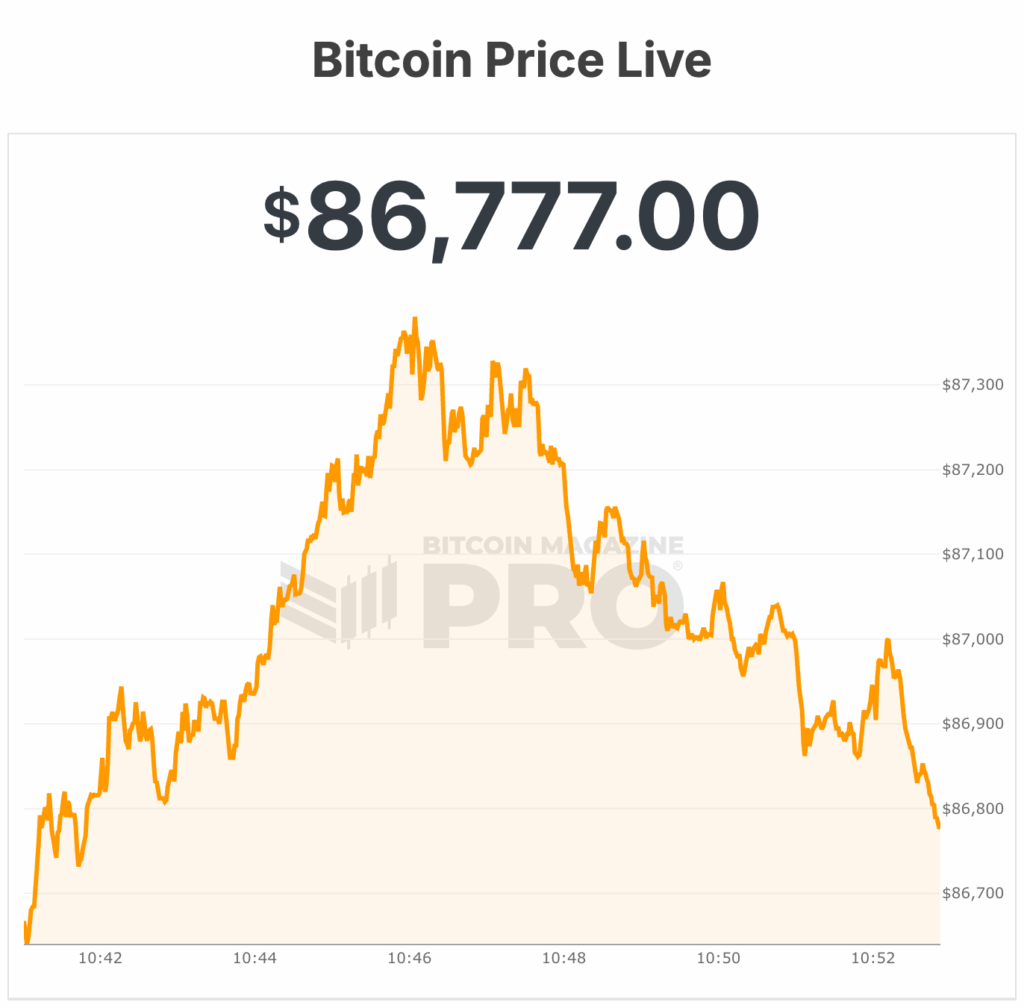
At the time of writing, the bitcoin price stood at $86,751, down about 2% over the past 24 hours, according to market data.
Trading volume totaled roughly $38 billion, while BTC was down 4% from its seven-day high near $89,935 and hovering just above its weekly low around $87,152.
BTC’s circulating supply currently sits at 19.96 million BTC, with a fixed maximum of 21 million, giving the network a market capitalization of approximately $1.73 trillion, down 2% on the day, according to Bitcoin Magazine Pro data.
The latest leg lower follows another grim weekend for price action. Bitcoin bled from the low-$92,000 range on Thursday to weekend lows near $87,000, as thin liquidity and persistent sell pressure weighed on risk appetite.
The decisive move below $90,000 occurred during typically illiquid Sunday trading, amplifying downside volatility as traders positioned cautiously ahead of a dense slate of U.S. economic data and central bank events this week.
Strategy, the world’s largest publicly traded BTC holder, added nearly $1 billion in bitcoin last week, acquiring 10,645 BTC at an average price of $92,098 per coin.
This marks the company’s second consecutive mega-purchase, bringing its total holdings to 671,268 BTC, purchased for $50.33 billion at an average cost of $74,972 each.
The acquisition was primarily funded through equity issuance, with $888.2 million raised via common stock sales and the remainder through STRD preferred shares, despite ongoing shareholder concerns about dilution.
Historically, the company’s weekly purchases had been modest due to fundraising constraints, but Executive Chairman Michael Saylor has recently accelerated buying, signaling renewed conviction despite market volatility.
Bitcoin price endured another grim weekend, bleeding from the low-$92,000 range on Thursday to weekend lows near $87,000 as thin liquidity and sell pressure weighed on risk appetite.
The move below $90,000 came during typically illiquid Sunday trading, amplifying downside volatility as traders positioned cautiously ahead of a dense slate of U.S. economic data and central bank events this week.
At the lows, the bitcoin price was down roughly 7% on the month, continuing a choppy consolidation that has defined price action since October’s all-time high, per Bitcoin Magazine Pro data.
Broader crypto markets showed little sign of strength.
Major altcoins including Solana, XRP, Dogecoin and Cardano continued to slide, extending double-digit monthly losses and reinforcing bitcoin’s dominance near 57% of total crypto market capitalization. Volumes remained muted, reflecting a lack of conviction rather than outright capitulation.
Macro overhangs remain front and center. In the U.S., traders are bracing for employment data, inflation prints, PMI readings and Fed commentary that could reshape rate expectations.
Globally, attention is turning to Japan, where the Bank of Japan is widely expected to raise rates later this week — an event that could pressure yen-funded carry trades that have helped support risk assets, including bitcoin, over the past year.
Technically, analysts are watching the mid-$80,000s closely. A sustained break below that zone could invite a deeper correction, while holding it would reinforce the idea that the bitcoin price remains range-bound rather than entering a new bear phase.
How low will the Bitcoin price go?
Despite the uneasy backdrop, some of the loudest bearish calls are running far ahead of the data. Bloomberg Intelligence strategist Mike McGlone warned this week that the bitcoin price could collapse as much as 90% from its peak, potentially revisiting $10,000 in a future deflationary downturn.
The forecast echoes prior bearish calls and comes as leveraged long positions continue to unwind, with roughly $230 million in bitcoin longs liquidated over the past 24 hours.
On-chain data, however, tells a far more nuanced story.
Bitcoin Magazine Pro’s Price Forecast Tools — built on network fundamentals rather than sentiment — suggest the market is trading below fair value, not on the brink of structural collapse.
Aggregated indicators such as CVDD, Balanced Price and the Bitcoin Cycle Master currently point to a fair market value near $106,000, with long-term downside risk clustering closer to the $80,000 range rather than anywhere near five figures.
Historically, these metrics have aligned closely with cycle tops and bottoms, offering a framework that cuts through short-term noise.
While macro conditions will continue to dictate volatility, on-chain signals suggest the current drawdown looks more like late-cycle consolidation than the start of a generational unwind.
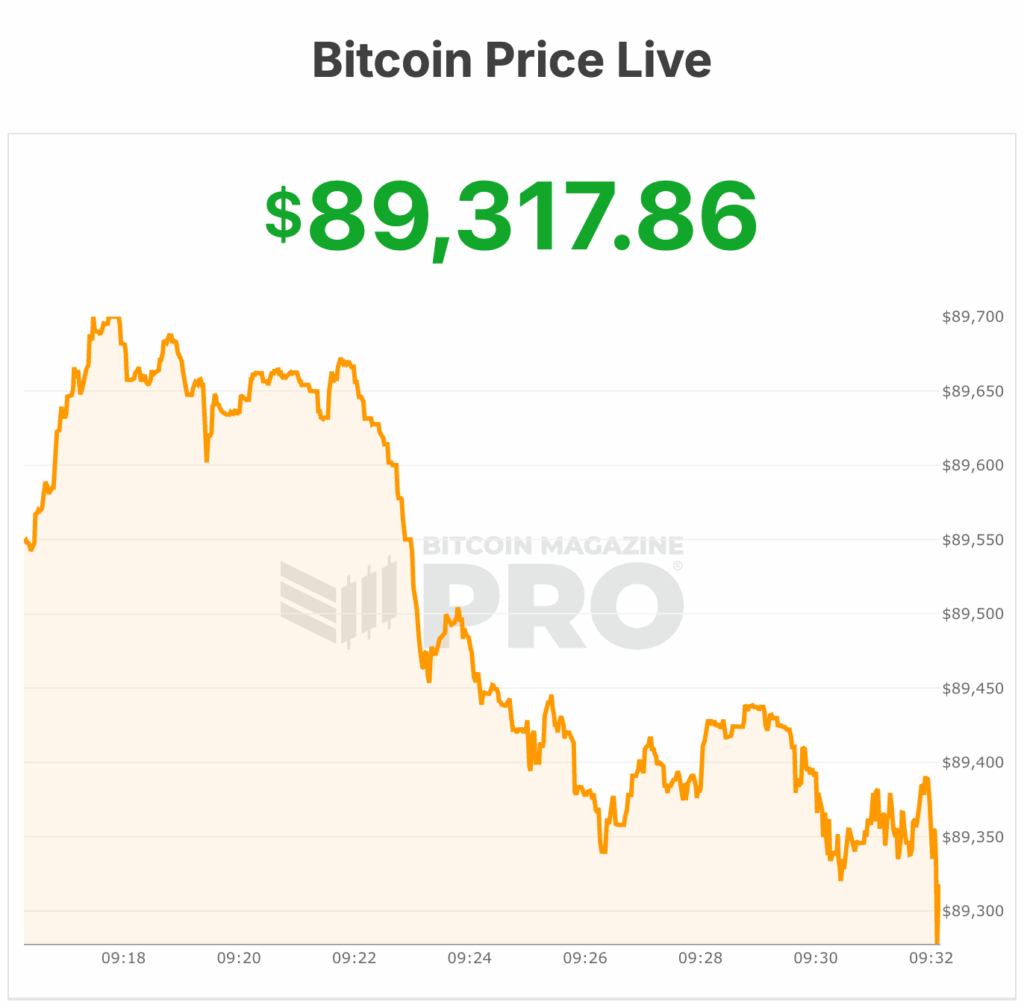
At the time of writing, the bitcoin price is $89,317.
Strategy, the world’s largest publicly traded bitcoin holder, added nearly another $1 billion worth of BTC last week, marking its second consecutive mega-purchase as bitcoin prices pulled back toward the $90,000 level.
The company acquired 10,645 bitcoin for approximately $980.3 million, paying an average price of $92,098 per BTC, according to a filing released Monday.
Strategy now holds 671,268 bitcoin, purchased for a total of $50.33 billion, giving it an average acquisition cost of $74,972 per coin.
As with recent purchases, the acquisition was funded primarily through equity issuance. The company raised $888.2 million through sales of common stock, with the remainder coming from sales of its STRD preferred shares.
Despite ongoing concerns around shareholder dilution, the company has aggressively leaned on equity markets to increase its bitcoin exposure.
The latest buy comes amid a broader pullback in bitcoin, which dipped below $90,000 over the weekend before stabilizing near $89,600. MSTR shares were flat in premarket trading Monday.
The purchase stands out not only for its size, but for its timing. While Strategy has been a steady buyer throughout 2025, most of its weekly acquisitions in recent months were relatively modest due to fundraising constraints.
Over the past two weeks, however, Executive Chairman Michael Saylor has ramped up purchases, signaling renewed conviction despite volatility in both bitcoin and Strategy’s stock.
Strategy ($MSTR) stays on the Nasdaq 100
Separately, MSTR confirmed it will remain a constituent of the Nasdaq 100, maintaining its position in the index under the technology category.
The company has also pushed back against proposals from index provider MSCI, which is reviewing whether to exclude bitcoin treasury companies from its benchmarks.
In the letter, Strategy argued that their proposed digital asset threshold is “misguided” and would have “profoundly harmful consequences.”
MSCI is expected to make a final decision in January.
The company, formerly known as MicroStrategy, pivoted from enterprise software to a bitcoin-focused treasury strategy in 2020. The model has since been replicated by dozens of firms, though critics argue these companies increasingly resemble bitcoin investment vehicles rather than operating businesses.
Still, Saylor has remains unapologetic and bold in his purchasing decisions. As of December 14, 2025, Strategy reports a year-to-date BTC yield of 24.9%, showing its commitment to accumulating bitcoin regardless of short-term market or equity price pressures.
At the time of writing, bitcoin is trading near $89,650.
Coinbase is reportedly preparing to launch its own prediction markets, powered by U.S.-based operator Kalshi, in a move that could expand the types of assets available on the exchange amid cooling investor interest in cryptocurrencies, according to reporting from Bloomberg and CNBC.
The announcement is expected to come next week, coinciding with Coinbase’s “Coinbase System Update” showcase on Dec. 17. While the exchange declined to confirm specifics, it encouraged users to tune into the livestream for updates.
Rumors of the new prediction markets have been circulating for nearly a month. In mid-November, tech researcher Jane Manchun Wong shared a screenshot of what appeared to be Coinbase’s prediction markets dashboard.
The Information first reported the planned launch on Nov. 19, and Bloomberg later cited a source saying the event would also feature the rollout of tokenized stocks.
Coinbase as an ‘everything’ exchange
Coinbase’s moves align with CEO Brian Armstrong’s long-stated vision of building an “everything exchange” — a single platform offering access to crypto tokens, tokenized equities, and event-based contracts.
Armstrong told investors in May that Coinbase aims to become a leading financial services app within the next decade.
The exchange is accelerating these initiatives amid rising competition from firms such as Robinhood, Gemini, and Kraken
Over the past year, these platforms have expanded tokenized stock offerings outside the U.S. and explored prediction markets, reflecting growing demand for alternative trading instruments.
The timing also comes as investor sentiment toward digital assets has cooled. A wave of liquidations in highly leveraged positions in mid-October triggered a crypto market pullback, prompting some investors to shift capital into safer assets.
For Kalshi, the partnership marks another step in its strategy to integrate event contracts into mainstream trading platforms.
Earlier this year, the company embedded its prediction markets into Robinhood, and it is reportedly in discussions with other brokers, including those in crypto, to expand its reach.
Prediction markets let users speculate on outcomes ranging from elections to sports games, and they have grown increasingly popular over the past year. Traditional exchanges and crypto platforms alike are now exploring them as a new way to engage traders.
Gemini recently received approval to roll out its own prediction markets, while Crypto.com has partnered with the Trump Media & Technology Group on similar initiatives.
Coinbase’s planned in-house tokenized stock offerings would put it on par with competitors like Robinhood and Kraken, which currently offer similar products outside the U.S.
The bitcoin price was trading in the $92,000 range earlier today but has now dropped back toward $90,000, reflecting continued volatility despite the U.S. Federal Reserve’s 25-basis-point rate cut.
After briefly spiking above $93,000 yesterday, the crypto fell below $90,000 and stabilized around $90,600 at the time of writing.
The pullback comes amid mixed signals from the Fed. While the rate cut to 3.50%–3.75% was widely anticipated, Fed Chair Jerome Powell’s cautious remarks and a 9–3 split among FOMC members — one favoring a deeper 50-basis-point cut and two opposing any reduction — tempered enthusiasm for risk assets, including BTC.
Analysts described the decline as a “sell the fact” reaction, since markets had already priced in the move.
On top of this, Vanguard Group has begun allowing clients to trade spot Bitcoin exchange-traded funds (ETFs), marking a notable expansion in access to crypto products for the $12 trillion asset manager’s investors.
Yet, Vanguard’s senior leadership emphasized that its fundamental view of BTC and other cryptocurrencies remains skeptical.
John Ameriks, Vanguard’s global head of quantitative equity, said Thursday at Bloomberg’s ETFs in Depth conference that Bitcoin is better seen as a speculative collectible than a productive asset.
Comparing it to a viral plush toy, Ameriks highlighted that BTC lacks income, compounding potential, and cash-flow generation — the core attributes Vanguard looks for in long-term investments.
“Absent clear evidence that the underlying technology delivers durable economic value, it’s difficult for me to think about Bitcoin as anything more than a digital Labubu,” he said, according to Bloomberg.
Despite this caution, Vanguard’s decision to allow trading of BTC ETFs on its platform was influenced by the growing track record of such products since the first BTC ETF launched in January 2024.
Ameriks said the firm wanted to ensure these ETFs accurately reflect their advertised holdings and perform as expected.
Banks engaging with bitcoin
Earlier this week, PNC Bank became the first major U.S. bank to offer direct spot bitcoin trading to eligible Private Bank clients through its digital platform, using Coinbase’s Crypto-as-a-Service infrastructure.
The launch follows a strategic partnership announced in July and reflects a growing trend among U.S. banks to integrate bitcoin into wealth management services.
Also last week, the Bank of America urged its wealth management clients to allocate 1% to 4% of their portfolios to digital assets, signaling a major shift in its approach to Bitcoin exposure.
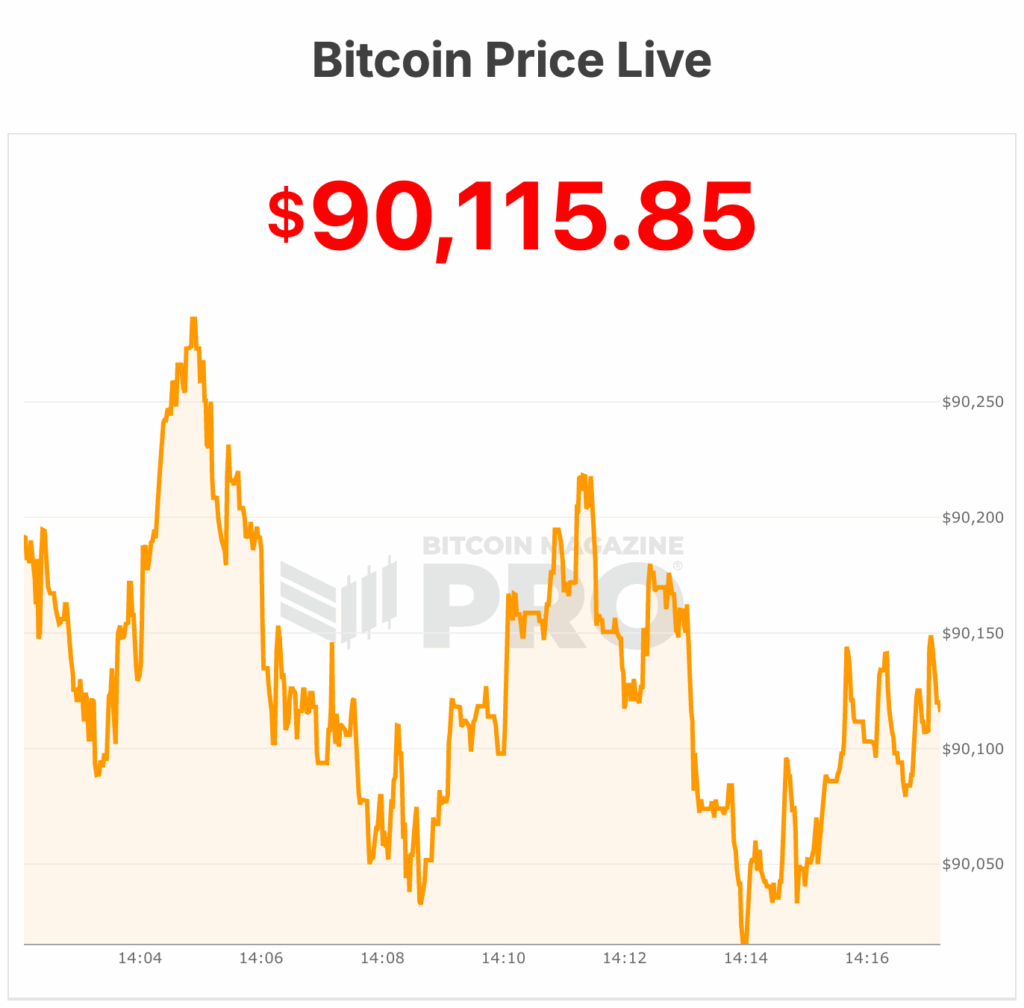
As of today, Bitcoin is trading at approximately $90,115.85, with a circulating supply of nearly 19.96 million BTC and a market cap of $1.81 trillion.
Prices have fluctuated modestly over the past week, reflecting the broader market’s volatility.
The U.S. Office of the Comptroller of the Currency (OCC) has granted conditional approvals for five digital asset firms — Ripple, Circle, Fidelity Digital Assets, BitGo, and Paxos — to become federally chartered national trust banks, marking a major milestone in the integration of cryptocurrency into traditional finance.
Once finalized, these institutions will join roughly 60 other national trust banks regulated by the OCC, gaining the ability to offer fiduciary and custody services nationwide.
Unlike larger national banks, trust banks cannot accept cash deposits or make loans, but they can hold and manage customers’ digital assets.
‘Huge news’ for crypto
Circle, issuer of the $78 billion USDC stablecoin, said the charter would enhance the safety and regulatory oversight of its reserves while enabling fiduciary digital asset custody for institutional clients.
CEO Jeremy Allaire emphasized that the federal charter would provide “greater clarity and confidence” to institutions building on Circle’s platform as stablecoins gain mainstream adoption.
Paxos, known for PYUSD and the consortium-backed Global Dollar (USDG), said federal oversight would allow businesses to issue, custody, trade, and settle digital assets with clarity and confidence.
The firm, which has operated under a New York Department of Financial Services (NYDFS) charter since 2015, first applied for a federal charter in 2020.
BitGo, a South Dakota–based crypto custodian, said the federal charter would allow it to expand services nationwide, including trading, staking, stablecoin, and treasury offerings for institutions. BitGo has also filed to go public, reporting $4.19 billion in revenue for the first half of 2025, up from $1.12 billion during the same period in 2024.
The approvals reflect a broader trend toward federal oversight of digital assets, coming after Anchorage Digital became the first federally chartered crypto bank in the U.S. Other firms, including Coinbase, Bridge (owned by Stripe), and Crypto.com, have also applied for federal charters.
OCC Comptroller Jonathan V. Gould emphasized that new entrants into the federal banking sector benefit consumers, foster competition, and promote innovation.
“The OCC will continue to provide a path for both traditional and innovative approaches to financial services to ensure the federal banking system keeps pace with the evolution of finance and supports a modern economy,” Gould said.
On December 18th, days before Christmas, Keonne Rodriguez, co-founder of the Bitcoin Samourai Wallet, will have to surrender to prison. His crime? Creating a software tool that gave Bitcoin users comparable privacy to that which banks are expected to provide. Samourai Wallet, the brand and technology stack built by Rodriguez and William Lonergan Hill, was shut down by the U.S. Government in April 2024 on a variety of charges, including money laundering, but only one charge stuck after a high-profile trial, the weakest charge of all, “unlicensed money transmission”.
What does it mean to transmit money? According to prosecutors, custodial control over user funds is no longer a requirement to need an MSB license; “a USB cable transfers data from one device to another, and a frying pan transfers heat from a stove to the contents of the pan, although neither situation involves exercising ‘control’ over what is being transferred.” If the DoJ can indict a frying pan, then USB manufacturers better lawyer up!
While I’m no genius, the Supreme Court has emphasized that laws should be clear enough for an AVERAGE PERSON to understand
Let’s get into the minutiae of the specific subsection of the charge they pled to
Remarkably, even FinCEN disagrees with the DoJ’s novel legal interpretation of what constitutes a money transmitter, as guidance at the time said non-custodial services could not be money transmitters because they do not exert control over money flows. FinCEN reasserted this fact to the DoJ prosecutors in a written statement, but they went forward with the charges anyway. This critical fact was withheld from the defense for almost a year, when it was finally revealed, “the judge denied the motion to present this evidence in the hearings, without even any argument,” according to Rodriguez. Critics argue this misconduct by the DoJ prosecutors is a violation of Brady v. Maryland, denying access to material that could have undermined the unlicensed money transmission charges, or, as Donald J. Trump would put it, this prosecution was rigged.
Zack Shapiro, head of policy at the Bitcoin Policy Institute, warns the Trump administration and American software industry about the potential ramifications of this legal case, arguing that “collapsing the distinction between developing a tool and operating a service would introduce an untenable level of risk for anyone building privacy-enhancing or security-critical software.”
“Rodriguez and Hill ultimately accepted plea agreements in the face of substantial sentencing exposure, even though government records undermined the central regulatory theory of the case,” Shapiro added in a letter published on the BPI website, asking the Trump admin to pardon the Samourai Wallet devs.
Fundamentally, the prosecutorial approach in the Samourai Wallet case risks establishing an influential precedent that threatens the financial privacy of American citizens and stifles innovation in the U.S. crypto industry. It could shape future prosecutions and regulatory developments, potentially reclassifying non-custodial services as money transmitters under federal law—requiring national MSB registration with FinCEN—and prompting stricter state-level licensing in jurisdictions like New York or California.
Echoing the trial against Ross Ulbricht a decade earlier, this rigged case against Samourai Wallet was set up during the Biden administration with support from anti-crypto politicians whom Trump defeated in the 2025 elections with the popular mandate. During his campaign at the 2024 Bitcoin Nashville speech, Trump said, “I will always defend the right to self-custody,” and got major support from the Bitcoin and crypto industries through the shared vision of making the United States the crypto capital of the world.
“I pledge to the Bitcoin community that the day I take the oath of office, Joe Biden and Kamala Harris’ anti-crypto crusade will be over,” – Donald J. Trump, Nashville 2024.
David Sacks, the venture capitalist and White House A.I. & Crypto Czar, should also pay attention to this issue; otherwise, what does it even mean to be the Crypto Czar? If Bitcoin wallets end up regulated the same as banks, despite having no counterparty risk, then whose interests are really being served, Mainstreet’s or Wallstreet’s?
While the Trump admin has been very conservative during the DoJ’s prosecution and trial of the Samourai Wallet devs — and perhaps, understandably so — that stage of the legal battle is over.
It is time for the Trump administration to meet its promise to the American public and defend self-custody and the crypto industry in America. It is time for Trump to set the record straight and pardon Keonne Rodriguez and William Lonergan Hill, as well as the Tornado Cash devs, while we are at it, lest we have another Ross Ulbricht-style miscarriage of justice.
The Bitcoin and crypto industry is well behind this effort and has begun gathering signatures at Change.org, totaling over 5000 so far and growing, with the only official fundraising campaign at GiveSendGo.
Should Trump pardon the Samourai Wallet devs, he would be sending a clear signal to those who want surveillance-based, central bank digital currency systems to enslave Americans and the world that Americans will not stand for it. That the United States stands with the fundamental human right to privacy, dignity, due process, and the presumption of innocence, and not the tactics of intimidation developed by the likes of Joseph Gorbles, where privacy is a crime. Mass, indiscriminate surveillance, without a warrant, without due process, that is the real crime.
Sangha Renewables announced the energization of its 19.9-megawatt bitcoin mining facility in Ector County, West Texas today, in partnership with Links Genco and TotalEnergies.
The project operates behind-the-meter on a 150-megawatt solar farm, combining renewable energy generation with digital infrastructure to explore new revenue streams for the energy sector.
The facility, developed with support from Links Genco, uses bitcoin mining to provide dispatchable industrial demand that aligns with variable renewable output.
Links Genco provided energy structuring and grid compliance services, helping Sangha configure a load profile that complements solar generation while mitigating exposure to transmission constraints and local curtailment, according to a note shared with Bitcoin Magazine.
Back in May, Sangha broke ground on the bitcoin mining facility. The project, developed with an independent power producer, now known as TotalEnergies, was built on an existing solar site in efforts to turn underutilized renewable assets into profitable bitcoin-generating operations.
The opening was marked by a ribbon-cutting ceremony that just wrapped up in West Texas. The event brought together company representatives, local officials, and industry partners, including Links Genco and TotalEnergies.
Under the project agreement, Sangha will own and operate the mining data center, deploy high-efficiency hardware, and manage the load to maximize utilization during periods of excess solar generation.
TotalEnergies will supply comprehensive retail power solutions, including balancing services, supplemental grid power during non-solar hours, and structured energy products designed to address price volatility while maintaining operational reliability.
By situating the mining facility at the point of generation, Sangha is trying to capture value that may otherwise be lost in areas with transmission congestion.
Bitcoin mining as a means for new energy value streams
The approach also offers a framework for scalable, location-agnostic load, potentially providing additional revenue streams for renewable energy producers and supporting broader grid stability.
“This project highlights how bitcoin mining can become a tool to unlock new value streams for the energy sector,” said Spencer Marr, co-founder and president of Sangha Renewables.
Marr emphasized that partnerships with energy providers like TotalEnergies demonstrate how digital infrastructure can be integrated into long-term energy planning.
Simon Binet, vice president of Trading U.S. Gas & Power at TotalEnergies, described the arrangement as aligned with the company’s goals to provide innovative energy solutions that support decarbonization efforts in energy-intensive industries.
The ribbon-cutting ceremony included opening remarks from Sangha Renewables, Links Genco, and Judge Dustin Fawcett of Ector County, followed by a guided tour of the mining facility, press interviews, and a photoshoot.
Pakistan is moving to formalize its place in the global digital-asset economy, signing a memorandum of understanding with Binance to explore the tokenization of up to $2 billion in state-owned assets while granting early regulatory clearances to both Binance and HTX.
Together, the initiatives reflect one of the country’s most ambitious pushes yet to merge sovereign finance with blockchain-based infrastructure.
According to Pakistan’s finance ministry, the MoU with Binance will allow the government to assess tokenising sovereign bonds, treasury bills, and commodity reserves — including oil, gas, and metals — as it seeks new tools to boost liquidity and expand market reach.
Tokenization would create digital representations of real-world assets on blockchain networks, potentially widening investor access and supporting secondary-market efficiency.
JUST IN: Binance founder CZ met with Pakistan’s Finance Minister and Minister of State.
Finance Minister Muhammad Aurangzeb described the agreement as a signal of Pakistan’s reform trajectory and a step toward a “long-term partnership” aimed at drawing global participation into the country’s debt and commodity markets, according to Reuters.
Binance founder Changpeng “CZ” Zhao called the MoU an important marker for both Pakistan and the broader blockchain sector, suggesting it clears the way for deeper experimentation with digital asset rails at the sovereign level.
Pakistan is embracing bitcoin and crypto
The tokenisation initiative comes in parallel with a regulatory milestone. Pakistan’s newly formed Virtual Assets Regulatory Authority (PVARA) has issued No Objection Certificates (NOCs) to Binance and HTX after a multi-agency review of each exchange’s governance, compliance, and risk-management systems.
The NOCs allow both firms to register with the Financial Monitoring Unit’s goAML platform, begin local incorporation, and prepare full license applications once the country finalizes its virtual-asset framework.
PVARA emphasized that the early clearances are not operating licenses but the first step in a phased, FATF-aligned path toward full authorization.
“Strong governance, AML and CFT compliance remain central as Pakistan builds a trusted digital-asset ecosystem,” the regulator said. Chair Bilal bin Saqib added that compliance rigor—not size—will determine which exchanges advance through the licensing process.
The developments are part of a broader digital-finance overhaul that the country has compressed into a few months.
That includes establishing PVARA, forming the Pakistan Crypto Council (PCC), drafting licensing and taxation rules, and laying groundwork for a central bank digital currency pilot in 2025.
The country has also signed a letter of intent with U.S.-based World Liberty Financial to explore stablecoin infrastructure and tokenised financial rails.
Saqib’s thoughts at Bitcoin MENA
Saqib, who serves as minister of state for digital assets, has repeatedly argued that Pakistan must treat Bitcoin, tokenization, and blockchain as foundational elements of future financial architecture.
At the Bitcoin MENA conference, Saqib argued that bitcoin serves as a practical tool for millions of Pakistanis rather than a speculative bet.
His case was grounded in everyday economic realities. With the Pakistani rupee losing more than half its value in five years, he said people aren’t seeking lessons in monetary theory — they’re looking for protection.
For many, “bitcoin is not theory, it’s a relief,” offering a hedge against inflation driven by political decisions and chronic currency mismanagement.
Access is the other major issue. Pakistan has a population of about 240 million, yet more than 100 million people remain unbanked. In that context, Bin Saqib said bitcoin provides a pathway to basic financial services that the traditional system has failed to deliver.
At a fireside chat, Saqib tied these grassroots use cases to a broader national strategy. Pakistan, he said, is not trying to “chase the future” but to build a new one. With roughly 70% of the population under the age of 30, the country cannot rely on outdated economic models.
Saqib said Bitcoin and blockchain-based payment rails enable Pakistani workers to get paid globally without friction, delays or excessive fees. Digital assets, and bitcoin in particular, are being viewed as infrastructure rather than speculation — new financial rails for the Global South.
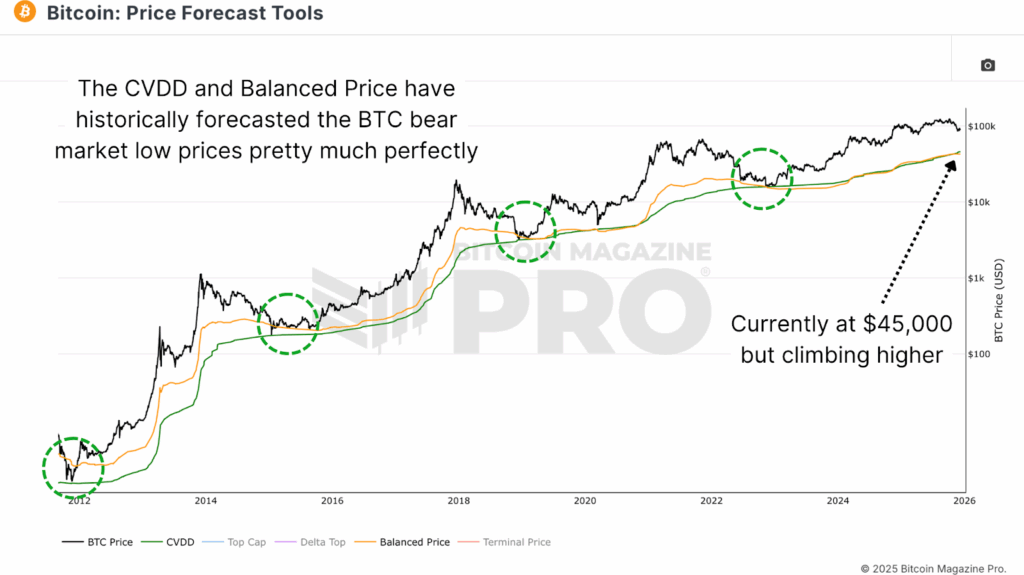
The Bitcoin Magazine Pro Price Forecast Tools chart provides a comprehensive framework for identifying potential price floors during bear cycles and forecasting upside targets based on on-chain fundamentals and network-derived data points. By aggregating multiple metrics, this methodology has historically called Bitcoin market cycle peaks and bottoms with remarkable accuracy. Can these tools continue to provide a basis for reliable BTC price forecasting over the next 12 months and beyond?
The Cumulative Value Days Destroyed (CVDD) metric has historically called Bitcoin price cycle lows almost to perfection across every cycle since Bitcoin’s inception. This metric begins with Coin Days Destroyed, a measure that weights Bitcoin transfers by the duration they were held before movement. For example, holding 1 Bitcoin for 100 days produces 100 coin days destroyed when transferred, while holding 0.1 Bitcoin for the same result requires 1,000 days of holding. Large spikes indicate that the network’s most experienced long-term holders are transferring significant amounts of Bitcoin.
Figure 1: The convergence of the CVDD and Balanced Price with BTC price has historically aligned with bear market lows.View Live Chart
The CVDD takes this one step further by measuring the USD valuation at the time of transfer rather than just the coin days destroyed quantity alone. This value is then multiplied by 6 million to produce the final metric. When examined across Bitcoin’s entire history, the CVDD has indicated bear market lows with accuracy extending across every cycle. Currently, the CVDD sits at approximately $45,000, though this level trends upward over time as the metric naturally evolves with new transfers and Bitcoin’s price appreciation.
The Balanced Price metric complements this downside projection by subtracting the Transferred Price (its calculation methodology is explained later) from the Realized Price, the cost basis or average accumulation price for all bitcoin holders, providing another historically accurate bear cycle low signal.
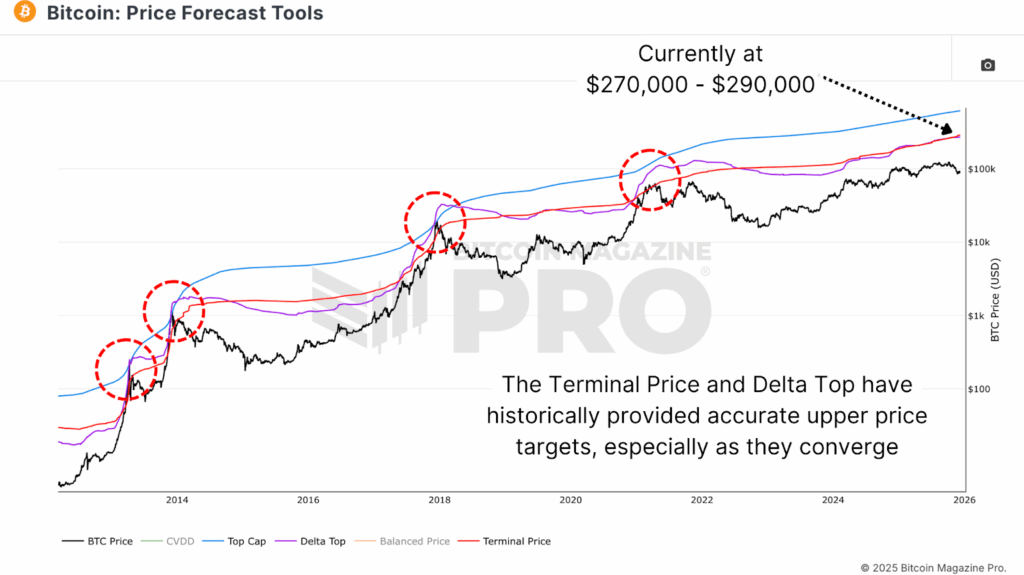
The Top Cap metric begins with the all-time average cap, the cumulative sum of Bitcoin’s market capitalisation divided by the number of days Bitcoin has existed. This all-time weighted moving average is then multiplied by 35 to produce the Top Cap. Historically, this metric has been remarkably accurate for calling bull market peaks, though in recent cycles it has exceeded actual price action, currently projecting to a seemingly unattainable ~$620,000.
The Delta Top refines this approach by using the realized cap. The realized cap currently stands at approximately $1.1 trillion. Delta Top is calculated by subtracting the average cap from the realized cap and multiplying by 7. This metric has been accurate historically, though it was slightly off during the 2021 cycle, and it is looking more likely that it will not be reached in the current cycle, currently sitting at approximately $270,000.
Figure 2: Delta Top and Terminal Price metrics have frequently aligned with market tops.View Live Chart
The Terminal Price metric provides another layer of sophistication. It calculates the Transferred Price, the sum of Coin Days Destroyed divided by the Circulating Bitcoin Supply, and multiplies this by 21 (the maximum Bitcoin supply). This produces a price level based on the fundamental assumption of total network value distributed across all 21 million Bitcoins. Historically, the Terminal Price has been one of the most accurate top-calling tools, marking previous cycle peaks nearly to perfection. This metric currently sits at approximately $290,000, not too far above Delta Top’s current value.
Bitcoin Cycle Master: Aggregated Bitcoin Price Fair Value Framework
Integrating all these individual metrics into a unified framework produces the Bitcoin Cycle Master chart, which combines these on-chain forecast tools for confluence. This has helped to identify where Bitcoin may be in a cycle, either close to bull or bear market highs, or oscillating around its ‘Fair Market Value’.
Figure 3: The Bitcoin Cycle Master currently indicates a Fair Market Value of approximately $106,000.View Live Chart
Examining the past two cycles demonstrates the utility of this framework. When Bitcoin trades above the Fair Market Value band, bull markets have historically entered exponential growth phases. When beneath this band, Bitcoin typically signals bear market conditions where defensive positioning and aggressive accumulation become appropriate strategies.
By extracting raw data from the price forecast tools and projecting the slope of both the CVDD and Terminal Price forward to the end of 2026, two scenarios emerge. The CVDD, which has moved at a predictable rate of change over the past 90 days, projects to approximately $80,000 by December 31, 2026. This level could represent a potential bear cycle floor, though Bitcoin has already traded beneath this level during recent downward moves, suggesting current prices may already offer compelling value.
Figure 4: Extrapolating the CVDD and Terminal Price metrics across 2026 provides a considerable range for potential BTC price action.
The Terminal Price, extrapolating its current upward trend, could reach over $500,000 by the end of 2026, though this projection could only be a realistic outcome with a bullish macro environment with significant liquidity injections and broad realization of Bitcoin’s fundamental value proposition.
Conclusion: What Bitcoin Price Forecast Tools Are Signaling for 2025–2026
These Bitcoin price forecast tools, formulated using on-chain fundamental and network-derived data points rather than psychological levels or traditional technical analysis applicable to equities and commodities, have historically provided exceptional accuracy in calling market cycle peaks and bottoms. Forecasting based on their current values suggests a potential bear cycle floor in the $80,000 range by the end of 2026, with upside targets potentially reaching over $500,000, depending on macro conditions and capital flows.
While these projections represent extrapolations of current trends rather than certainties, the historical accuracy and on-chain foundation of these metrics warrant serious consideration. Investors and traders should continue monitoring both the raw price forecast tools and the aggregated Bitcoin Cycle Master framework to identify fair valuation levels, extreme overvaluation warnings, and attractive accumulation zones within the current cycle. However, all projections change daily as new data emerges, making reactive analysis superior to long-term prediction.
Disclaimer: This article is for informational purposes only and should not be considered financial advice. Always do your own research before making any investment decisions.

 Login
Login






 Trump family backed American





















 Binance founder CZ met with Pakistan’s Finance Minister and Minister of State.