Login
LoginIBM Patches Over 100 Vulnerabilities
Most of the 100 vulnerabilities resolved this week, including critical flaws, were in third-party dependencies.
The post IBM Patches Over 100 Vulnerabilities appeared first on SecurityWeek.

Most of the 100 vulnerabilities resolved this week, including critical flaws, were in third-party dependencies.
The post IBM Patches Over 100 Vulnerabilities appeared first on SecurityWeek.
South Korea’s largest online retailer, Coupang, has been rocked by a massive data breach that exposed the personal details of nearly 34 million customers, forcing CEO Park Dae-jun to resign amid mounting scrutiny from regulators and the public.
The breach, one of the most severe in South Korea’s history, reportedly included names, email addresses, phone numbers, and shipping details. While Coupang said that payment and login credentials were not compromised, the scale of the exposure has prompted police raids and a government-led investigation. The company has since apologised and appointed Chief Administrative Officer Harold Rogers as interim CEO while pledging to overhaul its cybersecurity practices.
According to Paul German, CEO at Certes, this incident is emblematic of a much broader trend. “2025 has, unfortunately, been the year of the high-profile data breach. Millions, no, billions, of dollars have been squandered in terms of reputational damage, lost sales and productivity, not to mention judicial penalties. When you factor in the knock-on effects across supply chains and third-party suppliers, the true cost of data exposure becomes staggering.”
German says Coupang’s leadership change underscores a critical lesson for corporate boards everywhere: data protection is no longer just a technical concern but a boardroom responsibility. “The CEO’s resignation is a stark reminder that data protection is not an IT issue, but an executive issue,” he adds. “Ultimately, it is the Board’s duty to ensure the company’s data is protected, wherever it resides. For any CEO, failure to do so risks not just the organisation’s trust, but their own career.”
As Coupang works to regain customer confidence, the company’s turmoil serves as a cautionary tale for global business leaders: in an era where cyber incidents can destroy reputations overnight, executive accountability for data security is non-negotiable.
The post Coupang CEO Resigns Following Major Data Breach Exposing 34 Million Customers appeared first on IT Security Guru.
In 2025, the stakes changed. CISOs were hauled into courtrooms. Boards confronted a wave of shareholder lawsuits. And the rise of autonomous systems introduced fresh ambiguity and risk around who’s accountable when algorithms act.
… (more…)
The post LW ROUNDTABLE: Lessons from 2025 — Cyber risk got personal; accountability enters a new phase first appeared on The Last Watchdog.
The post LW ROUNDTABLE: Lessons from 2025 — Cyber risk got personal; accountability enters a new phase appeared first on Security Boulevard.
What is the Personal Data Protection Act (PDPA) of Thailand? The Personal Data Protection Act, B.E. 2562 (2019), often referred to by its acronym, PDPA, is Thailand’s comprehensive data privacy and protection law. Enacted to safeguard the personal data of individuals, it is heavily influenced by international privacy standards, most notably the European Union’s General […]
The post Thailand’s Personal Data Protection Act appeared first on Centraleyes.
The post Thailand’s Personal Data Protection Act appeared first on Security Boulevard.
Overview On December 10, NSFOCUS CERT detected that Microsoft released the December Security Update patch, which fixed 57 security issues involving widely used products such as Windows, Microsoft Office, Microsoft Exchange Server, Azure, etc., including high-risk vulnerability types such as privilege escalation and remote code execution. Among the vulnerabilities fixed by Microsoft’s monthly update this […]
The post Microsoft’s December Security Update of High-Risk Vulnerability Notice for Multiple Products appeared first on NSFOCUS, Inc., a global network and cyber security leader, protects enterprises and carriers from advanced cyber attacks..
The post Microsoft’s December Security Update of High-Risk Vulnerability Notice for Multiple Products appeared first on Security Boulevard.
Microsoft addressed over 1,100 CVEs as part of Patch Tuesday releases in 2025, including 40 zero-day vulnerabilities.
Microsoft’s Patch Tuesday, a monthly release of software patches for Microsoft products, has just celebrated its 22nd anniversary. The Tenable Research Special Operations Team (RSO) first covered the 20th anniversary in 2023, followed by our 2024 year in review publication, covering the trends and significant vulnerabilities from the 2024 Patch Tuesday releases.
In 2025, Microsoft patched 1,130 CVEs throughout the year across a number of products. This was a 12% increase compared to 2024, when Microsoft patched 1,009 CVEs. With another year of Patch Tuesday releases behind us, Microsoft has yet to break its 2020 record with 1,245 CVE’s patched. However, this is the second year in a row that Microsoft crossed the 1,000 CVE threshold, and the third time since Patch Tuesday’s inception.

In 2025, Microsoft broke its record for the most CVEs patched in a month twice. The year started off with the largest Patch Tuesday release with 157 CVEs patched. This record was broken again in October with 167 CVEs patched.
Each month, Microsoft categorizes vulnerabilities into four main severity levels: low, moderate, important and critical.

Over the last three years, the bulk of the Patch Tuesday vulnerabilities continue to be rated as important. In 2025, 91.3% of all CVEs patched were rated important, followed by critical at 8.1%. Moderate accounted for 0.4%, while there were no CVEs rated as low in 2025.
In addition to severity levels, Microsoft also categorizes vulnerabilities by seven impact levels: remote code execution (RCE), elevation of privilege (EoP), denial of service (DoS), information disclosure, spoofing, security feature bypass and tampering.
In 2024, RCE vulnerabilities led the impact category, however 2025 saw EoP vulnerabilities taking the lead with 38.3% of all Patch Tuesday vulnerabilities. RCE accounted for 30.8%, followed by information disclosure flaws at 14.2% and DoS vulnerabilities at 7.7%. In a strange coincidence, this year there were only 4 CVEs categorized as tampering, which was the same in 2024. In both 2024 and 2025, tampering flaws accounted for only 0.4%.

In 2025, Microsoft patched 41 CVEs that were identified as zero-day vulnerabilities. Of the 41 CVEs, 24 were exploited in the wild. While not all zero-days were exploited, we classify zero-days as those vulnerabilities that were disclosed prior to being patched by the vendor.
Looking deeper at the 24 CVEs that were exploited in the wild, 62.5% were EoP flaws. EoP vulnerabilities are often leveraged by advanced persistent threat (APT) actors and determined cybercriminals seeking to elevate privileges as part of post-compromise activity. Following EoP flaws, RCEs were the second most prominent vulnerabilities across Patch Tuesday, accounting for 20.8% of zero-day flaws.

While only a small number of zero-days were addressed as part of 2025’s Patch Tuesday releases, we took a deeper dive into some of the more notable zero-days from the year. The table below includes these CVEs along with details on their exploitation activity.
| CVE | Description | Exploitation Activity |
|---|---|---|
| CVE-2025-24983 | Windows Win32 Kernel Subsystem Elevation of Privilege Vulnerability | Used with the PipeMagic backdoor to spread ransomware. |
| CVE-2025-29824 | Windows Common Log File System Driver Elevation of Privilege Vulnerability | Exploited by Storm-2460, also known as RansomEXX. Abused by the PipeMagic backdoor in order to spread ransomware. |
| CVE-2025-26633 | Microsoft Management Console Security Feature Bypass Vulnerability | Exploited by Water Gamayu (aka EncryptHub, Larva-208) to deploy the MSC EvilTwin trojan loader. The attack campaigns also saw several malware variants abused, including EncryptHub stealer, DarkWisp backdoor, SilentPrism backdoor, Stealc and the Rhadamanthys stealer. |
| CVE-2025-33053 | Internet Shortcut Files Remote Code Execution Vulnerability | Exploited by the APT known as Stealth Falcon (aka FruityArmor, G0038) to deploy Horus Agent malware. |
| CVE-2025-49704 | Microsoft SharePoint Remote Code Execution Vulnerability | Exploited by multiple APTs and nation-state actors including Linen Typhoon (aka Emissary Panda), Violet Typhoon, Storm-2603 and Warlock ransomware (aka GOLD SALEM). Chained with CVE-2025-49706 in an attack dubbed ToolShell. |
| CVE-2025-49706 | Microsoft SharePoint Server Spoofing Vulnerability | Exploited by multiple APTs and nation-state actors including Linen Typhoon (aka Emissary Panda), Violet Typhoon, Storm-2603 and Warlock ransomware (aka GOLD SALEM). Chained with CVE-2025-49704 in an attack dubbed ToolShell. |
With 2025’s Patch Tuesday releases in our rear-view mirror, it’s evident that we continue to see an upward trend in the number of vulnerabilities addressed year over year by Microsoft. With the lion's share of the market for operating systems, it’s imperative that defenders are quick to apply patches on the monthly release of Patch Tuesday updates. Attackers are often opportunistic and ready to capitalize on the latest exploitable vulnerabilities. As always, the RSO team will continue our monthly cadence of Patch Tuesday blogs, ensuring our readers have the actionable information necessary to take immediate action and improve their organization's security posture.
Join Tenable's Research Special Operations (RSO) Team on Tenable Connect and engage with us in the Threat Roundtable group for further discussions on the latest cyber threats.
Learn more about Tenable One, the Exposure Management Platform for the modern attack surface.
The post Microsoft Patch Tuesday 2025 Year in Review appeared first on Security Boulevard.
Cisco Vulnerability Management (formerly Kenna) has long been a valuable partner for security teams. With its end-of-life now underway, Tenable One offers a clear path forward, delivering end-to-end unified exposure management for the future of risk management.
Security teams are used to change, The way organizations think about risk is evolving, and many cybersecurity leaders and practitioners are realizing that the tools built for yesterday’s vulnerability management — while essential for their operations — aren’t enough for today’s exposure.
For years, risk-based vulnerability management (RBVM) tools like Cisco Vulnerability Management (formerly Kenna) have helped teams aggregate data from different security scanners into one place. But simple aggregation is now table stakes; the security requirements of most organizations have outgrown it. Seeing one-dimensional findings of risk creates more noise from those same tools. What’s lacking is connectivity across all risk, a view of exposures created from the sum of the parts, together. Modern security programs need insight — how assets, vulnerabilities, misconfigurations, and identity relationships are connected. The same view threat actors have by probing and connecting these pieces together to create the next breach.
Moving towards exposure management can help. It meets the modern security organization’s needs, going beyond listing CVEs to focus on the real story behind your risk: how everything in your environment interacts, so you can identify your most toxic combinations based on analysis of the insights provided by your various security tools.
With Cisco entering end-of-life and end-of-sale for Cisco Vulnerability Management, Vulnerability Intelligence, and their Application Security Module, many teams are finding themselves at a decision point. Cisco announced on Dec. 9 that there is no replacement available for the Cisco Vulnerability Management, Vulnerability Intelligence, and Application Security Module (formerly known as Kenna.VM, Kenna.VI, and AppSec) at this time. The key EoL / EoS dates are as follows:
Organizations of all backgrounds and maturity have the chance to treat this moment not as a replacement project, but as an opportunity to change how they approach proactive security.
Although risk-based vulnerability management provides a solid foundation, it hits a natural limitation. At best, it aggregates the data, showing only a handful of disconnected severity scores.
While RVBM offers a new lens through which to view your environment, the core challenge still remains the same: security teams are stuck sifting through various findings across tools. Sure, it’s all in one place but it’s impossible to make a true “apples to apples” comparison because the findings aren’t normalized and deduplicated. Visibility alone is insufficient for effective exposure prioritization; the missing detail that RBVM lacks is insight.
Tenable’s take on exposure management breaks that barrier by connecting the findings from your various security tools to create insights from your entire environment. You can see the big picture. It’s the difference between staring at isolated findings with different risk scores and truly understanding how your entire attack surface looks to an adversary at any given time.
Insight comes from connecting context, not just critical severity scores, which is where exposure management distinguishes itself.
Let’s look at a simple example. There is a stark difference between:
In the first example, security teams waste time deciphering which handful of the 100 Windows servers are the most at risk, wasting resources and efforts working with IT to remediate. In reality, the biggest threat is the one server everyone saw, but no one thought about. How could they? It’s a single step in a multi-chained attack path.
By mapping out how different flaws connect to compromise your critical assets, you can ignore the noise of consolidated tools and zero in on the specific toxic combinations that leave your organization exposed. This shifts your team from constantly reacting to seemingly critical fire drills to preemptively shutting down the most dangerous attack paths — the ones you wouldn’t be able to piece together using simple aggregation tools.
Tenable is elevating how organizations of all sizes and maturity levels can identify their exposure.
One of the most compelling aspects of exposure management is that it isn’t reserved for organizations with bottomless budgets or sprawling security teams; it meets you exactly where you are. Whether your program is currently in a reactive "fire drill" phase — scrambling to patch whatever feels urgent today — or you have a robust set of tools that unfortunately don't talk to each other, exposure management offers a structured path forward.
Tenable’s maturity model highlights that every security program sits somewhere on a spectrum, from "ad hoc" teams keeping the lights on to "standardized" operations that have reached a complexity ceiling. Exposure management creates a unified fabric across these stages, allowing even smaller teams to shift from chaotic, siloed scanning to a more cohesive view of their attack surface without needing to rip-and-replace their entire stack overnight.
If you’re making a change, you want to be confident in where you’re heading. Tenable was recently named a Leader in the first-ever 2025 Gartner® Magic Quadrant™ for Exposure Assessment Platforms, ranking highest in both execution and vision.
Tenable was also named a Leader in the IDC MarketScape: Worldwide Exposure Management 2025 Vendor Assessment and The Forrester Wave™️: Unified Vulnerability Management, Q3 2025.
Simply put, Tenable isn’t catching up to exposure management — it’s leading it.
With 300+ integrations and an open, flexible architecture, Tenable One connects with the security tools you already rely on. Instead of forcing you into a new ecosystem, it strengthens the one you’ve built. Think of Tenable One as the central hub of your security program — the place where everything finally comes together in a clear, contextual view.
Shifting to Tenable One isn’t just about finding a new home for your vulnerability data. It’s about stepping into the next generation of risk management.
Exposure management changes the security conversation from “What vulnerabilities do we have?” to “What combinations of risk create the highest exposure ?”
Ready to see what Tenable One can do? View the demo below:
The transition from Cisco VM (Kenna) doesn’t have to be disruptive. It can be transformative. If you’re ready to see how Tenable One can elevate your security program, request a demo of Tenable One today.

The post Preparing for Cisco Vulnerability Management (formerly Kenna) End-of-Life: How Tenable Can Help appeared first on Security Boulevard.

The Chrome zero-day does not have a CVE and it's unclear who reported it and which browser component it affects.
The post Google Patches Mysterious Chrome Zero-Day Exploited in the Wild appeared first on SecurityWeek.
Attackers are planning around your holidays. The question is whether you’ve done the same.

How Are Non-Human Identities Revolutionizing Cybersecurity? Have you ever considered the pivotal role that Non-Human Identities (NHIs) play in cyber defense frameworks? When businesses increasingly shift operations to the cloud, safeguarding these machine identities becomes paramount. But what exactly are NHIs, and why is their management vital across industries? NHIs, often referred to as machine […]
The post What makes smart secrets management essential? appeared first on Entro.
The post What makes smart secrets management essential? appeared first on Security Boulevard.
Can Agentic AI Revolutionize Cybersecurity Practices? Where digital threats consistently challenge organizations, how can cybersecurity teams leverage innovations to bolster their defenses? Enter the concept of Agentic AI—a technology that could serve as a powerful ally in the ongoing battle against cyber threats. By enhancing the management of Non-Human Identities (NHIs) and secrets security management, […]
The post How does Agentic AI empower cybersecurity teams? appeared first on Entro.
The post How does Agentic AI empower cybersecurity teams? appeared first on Security Boulevard.
AI is transforming enterprise productivity and reshaping the threat model at the same time. Unlike human users, agentic AI and autonomous agents operate at machine speed and inherit broad network permissions and embedded credentials. This creates new security and compliance … Read More
The post Ring-fencing AI Workloads for NIST and ISO Compliance appeared first on 12Port.
The post Ring-fencing AI Workloads for NIST and ISO Compliance appeared first on Security Boulevard.
Very little new information has been released since Rahmanullah Lakanwal murdered West Virginia National Guard member Sarah Beckstrom in Washington, DC, two weeks ago. He also shot and injured Andrew Wolfe, another National Guardsman, in the same attack. Prosecutors have since charged Lakanwal with murder, assault with intent to kill while armed, and possession of a firearm during a violent crime. Terrorism charges are absent because prosecutors do not yet know his motives. The FBI is conducting a terrorism investigation to discover those.
In federal courtrooms across America, a pattern has emerged in cases in which immigrants are being rounded up and jailed without a hearing. That’s a departure from fundamental constitutional protections in the U.S. that provide the right to a hearing before indefinite imprisonment.


Session 5C: Federated Learning 1
Authors, Creators & Presenters: Phillip Rieger (Technical University of Darmstadt), Alessandro Pegoraro (Technical University of Darmstadt), Kavita Kumari (Technical University of Darmstadt), Tigist Abera (Technical University of Darmstadt), Jonathan Knauer (Technical University of Darmstadt), Ahmad-Reza Sadeghi (Technical University of Darmstadt)
PAPER
SafeSplit: A Novel Defense Against Client-Side Backdoor Attacks in Split Learning
Split Learning (SL) is a distributed deep learning approach enabling multiple clients and a server to collaboratively train and infer on a shared deep neural network (DNN) without requiring clients to share their private local data. The DNN is partitioned in SL, with most layers residing on the server and a few initial layers and inputs on the client side. This configuration allows resource-constrained clients to participate in training and inference. However, the distributed architecture exposes SL to backdoor attacks, where malicious clients can manipulate local datasets to alter the DNN's behavior. Existing defenses from other distributed frameworks like Federated Learning are not applicable, and there is a lack of effective backdoor defenses specifically designed for SL. We present SafeSplit, the first defense against client-side backdoor attacks in Split Learning (SL). SafeSplit enables the server to detect and filter out malicious client behavior by employing circular backward analysis after a client's training is completed, iteratively reverting to a trained checkpoint where the model under examination is found to be benign. It uses a two-fold analysis to identify client-induced changes and detect poisoned models. First, a static analysis in the frequency domain measures the differences in the layer's parameters at the server. Second, a dynamic analysis introduces a novel rotational distance metric that assesses the orientation shifts of the server's layer parameters during training. Our comprehensive evaluation across various data distributions, client counts, and attack scenarios demonstrates the high efficacy of this dual analysis in mitigating backdoor attacks while preserving model utility.
ABOUT NDSS
The Network and Distributed System Security Symposium (NDSS) fosters information exchange among researchers and practitioners of network and distributed system security. The target audience includes those interested in practical aspects of network and distributed system security, with a focus on actual system design and implementation. A major goal is to encourage and enable the Internet community to apply, deploy, and advance the state of available security technologies.
Our thanks to the Network and Distributed System Security (NDSS) Symposium for publishing their Creators, Authors and Presenter’s superb NDSS Symposium 2025 Conference content on the Organizations' YouTube Channel.
The post SafeSplit: A Novel Defense Against Client-Side Backdoor Attacks In Split Learning appeared first on Security Boulevard.
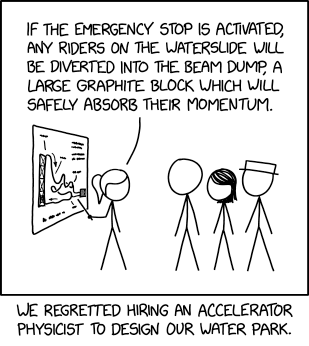
via the comic artistry and dry wit of Randall Munroe, creator of XKCD
The post Randall Munroe’s XKCD ‘Beam Dump’ appeared first on Security Boulevard.