 Login
LoginThis founder cracked firefighting — now he’s creating an AI gold mine
The nozzle is just the beginning – what company founder Sunny Sethi calls "the muscle on the ground.”


 Jason Lemkin / SaaStr:
Many AI founders now find it necessary to raise at valuations requiring absolute domination of the field; Brex, once valued at $12B, shows the downsides of this — Capital One just announced it's acquiring Brex for $5.15 billion. An incredible, top .1% “exit” in less than 10 years …
I use Plex almost every day, and I’ve noticed several massive “improvements” over the last year. While I’m happy with most of the changes, one of my favorite features—and very underrated—was on the wrong end of them. Allow me to explain.



Read more of this story at Slashdot.


Bethan Staton / Financial Times:
A profile of Mercor, which pays about $2M daily to ~30K experts training AI models at $95/hour on average, with roles like radiologists earning up to $375/hour — Tens of thousands of professionals are joining tech start-up Mercor to hone technology in their skills — At first Lola thought the job ads were fake.
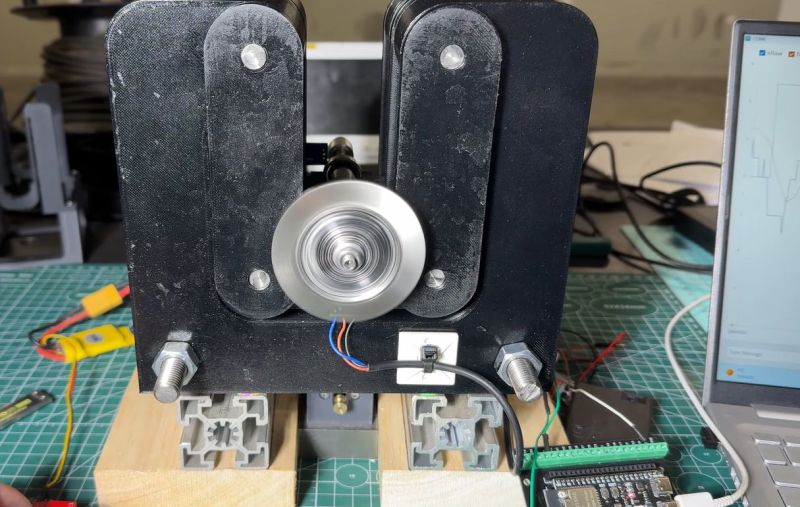
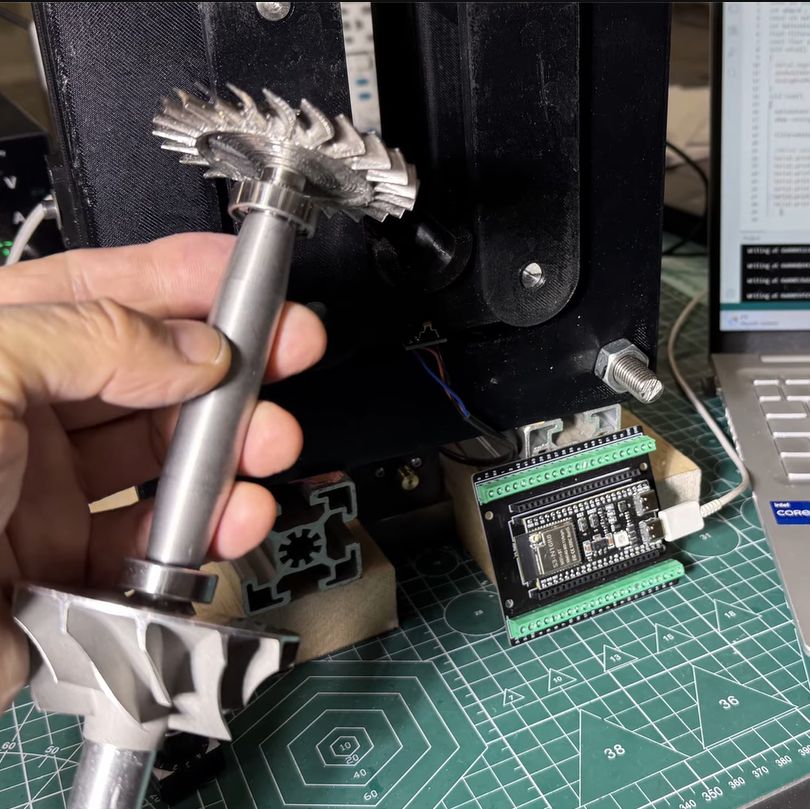 Although jet engines are theoretically quite simple devices, in reality they tread a fine line between working as intended and vaporizing into a cloud of lethal shrapnel. The main reason for this is the high rotational speed of the rotors, with any imbalance due to poor manufacturing or damage leading to undesirable outcomes. It’s for this reason that [AlfMart CNC Garage] on YouTube decided to spend some quality time building a balancer for his DIY RC turbine project and making sure it can prevent such a disaster scenario.
In the previous part of the series the turbine disc was machined out of inconel alloy, as the part will be subjected to significant heat as well when operating. To make sure that the disc is perfectly balanced, a dynamic balancing machine is required. The design that was settled on after a few failed attempts uses an ADXL335 accelerometer and Hall sensor hooked up to an ESP32, which is said to measure imbalance down to ~1 mg at 4,000 RPM.
A big part of the dynamic balancing machine is the isolation of external vibrations using a bearing-supported free-floating structure. With that taken care of, this made measuring the vibrations caused by an imbalanced rotor much easier to distinguish. The ESP32 is here basically just to read out the sensors and output the waveforms to a connected PC via serial, with the real work being a slow and methodical data interpretation and balancing by hand.
What's the biggest smart home device that you own? For many of us, the answer may come as a surprise, despite the fact that the smart capabilities of this device are explicitly included in its name.

Never underestimate the chilling powers of grainy grayscale imagery and ethereal whooshing sounds. Outside Parties asks, "What if I Spy, but in an alien hell dimension?", and it is impressively unnerving despite the fact that nothing's really happening at any given time. It goes all in on atmosphere, to great effect. This is the Playdate horror game that I've been waiting for.
Adams Immersive's Outside Parties is a sort of scavenger hunt across a massive image of a realm called the Outside, which can only be visited by astral travel, according to the lore. There are lots of unknowns about what or where it really is, though explorers have mapped it fairly extensively through out-of-body excursions and they've encountered thousands of different entities there, including the spirits of the dead. As the player, you have come across a Hellscryer K5 — the communication device, psychic camera and recorder used for these trips — and now you're combing through the mission logs, getting sucked into the mystery of it all. Think of the K5 as your Playdate, except powered by blood and runes.
At the center of Outside Parties is a 1.44 gigapixel, 360-degree panoramic HDR image which has dozens of eerie scenes hidden within it: skeletons of human, animal and paranormal origin; scary robed figures and occult symbols etched all around; what appear to be fountains and rivers of blood; a Stonehenge of teeth. These are the targets you're meant to track down, and as you hone in and check them off your list, voice signals attached to each one will reveal more and more of the explorer's spellbinding story.
But this isn't a straightforward "find the object" puzzle game by any means. When you first look at the zoomed-out photo, it's akin to a strip of TV static with some heavily shadowed areas throughout. You can zoom to up to 64 times magnification to get a better look at specific zones, but you also have to adjust the image brightness using the crank to improve the clarity of the objects. Making it brighter or darker will reveal more objects in certain spots while simultaneously obscuring others. There are 150 targets according to the developer, which should take players somewhere from 10-20 hours to complete. I've been at it for hours and still have plenty left to find. (If you're stuck, you can turn to the helpful target lookup page, which provides hints with varying degrees of specificity.)
All the while as you're hunched over your Playdate, laser-focused on the screen to find targets that are buried in a sea of fuzz, unsettling audio transmissions are cutting in and out, disturbing images are flashing on-screen at random and a constant atmospheric whooshing is playing in your ear. The sound design of this game is seriously brilliant — it's worth playing for that alone, not to mention all the other cool stuff. From the startup page to the menus where you'll find bits of a background story, to the creepy clips of people wailing and ominously reciting numbers, the sounds of Outside Parties make for a truly immersive, disconcerting experience that I previously wouldn't have thought possible on a Playdate. It's really something special.
Outside Parties also comes with a screensaver that once again makes me yearn for the Playdate Stereo Dock. Pop on the Void Monitor, sit back, and enjoy the horrifying sights and sounds of the Outside.

©


I love shiny gadgets as much as the next person, but few things bring me as much joy as splitting wood. As someone conditioned to look at specs, I thought a bigger chainsaw would be a better chainsaw for the job, but I’ve since purchased a tiny one, and I’m quite glad I did.

If you're looking to upgrade your home theater setup, you've likely encountered the terms 5.1 and 5.2 (or 7.1 and 7.2) being tossed around. So, what's the difference between these two systems, and more importantly, does it actually matter?


Microsoft issued another out-of-band update to fix a bug that caused Outlook to crash for Windows 11 users. This second emergency patch addresses issues seen with Outlook and files stored in the cloud following Microsoft's January 2026 Windows security update.
According to Microsoft, this update fixes a bug where some apps that "open or save files stored in cloud-backed locations" became unresponsive or displayed error messages. Some users also experienced Outlook crashing or not opening when PST files are stored in cloud-based options like OneDrive.
This is the second time this year that Microsoft had to issue a last-minute fix for bugs related to its January security update. Last week, some Windows 11 devices couldn't shut down or hibernate, while other devices running Windows 10 or 11 couldn't log in through remote connections. For more context, Microsoft only issues out-of-band updates when there's a serious issue that can't wait until its regular update cycle. Fortunately, the latest out-of-band update is cumulative, so you only need to download and install this one to fix the issues seen with the January update.
This article originally appeared on Engadget at https://www.engadget.com/computing/microsoft-releases-second-emergency-windows-11-update-to-fix-outlook-crashes-192012812.html?src=rss©
© Microsoft


