Reading view

There are new articles available, click to refresh the page.

Next-gen lunar spacesuit redefines mobility

As NASA gears up to send four astronauts on a crewed flight around the moon in the imminent Artemis II mission, Axiom Space is carefully preparing its AxEMU spacesuit for the highly anticipated endeavor that will follow. Artemis III, which NASA is targeting for no earlier than 2027, will land astronauts on the lunar surface […]

The post Next-gen lunar spacesuit redefines mobility appeared first on Digital Trends.

Washington State May Mandate 'Firearm Blueprint Detection Algorithms' For 3D Printers

Adafruit managing director Phillip Torrone (also long-time Slashdot reader ptorrone ) writes: Washington State lawmakers are proposing bills (HB 2320 and HB 2321) that would require 3D printers and CNC machines to block certain designs using software-based "firearms blueprint detection algorithms." In practice, this means scanning every print file, comparing it against a government-maintained database, and preventing "skilled users" from bypassing the system. Supporters frame this as a response to untraceable "ghost guns," but even federal prosecutors admit the tools involved are ordinary manufacturing equipment. Critics warn the language is overbroad, technically unworkable, hostile to open source, and likely to push printing toward cloud-locked, subscription-based systems—while doing little to stop criminals.

Read more of this story at Slashdot.

Hackaday Links: January 25, 2026

By: Tom Nardi
Hackaday Links Column Banner

If predictions hold steady, nearly half of the United States will be covered in snow by the time this post goes live, with the Northeast potentially getting buried under more than 18 inches. According to the National Weather Service, the “unusually expansive and long-duration winter storm will bring heavy snow from the central U.S. across the Midwest, Ohio Valley, and through the northeastern U.S. for the remainder of the weekend into Monday.” If that sounds like a fun snow day, they go on to clarify that “crippling to locally catastrophic impacts can be expected”, so keep that in mind. Hopefully you didn’t have any travel plans, as CNBC reported that more than 13,000 flights were canceled as of Friday night. If you’re looking to keep up with the latest developments, we recently came across StormWatch (GitHub repo), a slick open source weather dashboard that’s written entirely in HTML. Stay safe out there, hackers.

Speaking of travel, did you hear about Sebastian Heyneman’s Bogus Journey to Davos? The entrepreneur (or “Tech Bro” to use the parlance of our times) was in town to woo investors attending the World Economic Forum, but ended up spending the night in a Swiss jail cell because the authorities thought he might be a spy. Apparently he had brought along a prototype for the anti-fraud device he was hawking, and mistakenly left it laying on a table while he was rubbing shoulders. It was picked up by security guards and found to contain a very spooky ESP32 development board, so naturally he was whisked off for interrogation. A search of his hotel room uncovered more suspicious equipment, including an electric screwdriver and a soldering iron. Imagine if a child had gotten their hands on them?


But the best part of the story is when Sebastian tries to explain the gadget’s function to investigators. When asked to prove that the code on the microcontroller wasn’t malicious, he was at a loss — turns out our hero used AI to create the whole thing and wasn’t even familiar with the language it was written in. In his own words: “Look, I’m not a very good hardware engineer, but I’m a great user of AI. I was one of the top users of Cursor last year. I did 43,000 agent runs and generated 25 billion tokens.” Oof. Luckily, the Swiss brought in a tech expert who quickly determined the device wasn’t dangerous. He was even nice enough to explain the code line-by-line to Sebastian before he was released. No word on whether or not they charged him for the impromptu programming lesson.

It wasn’t hard for the Swiss authorities to see what was inside the literal black box Sebastian brought with him, but what if that wasn’t possible? Well, if you’ve got an x-ray machine handy, that could certainly help. The folks at Eclypsium recently released a blog post that describes how they compared a legit FTDI cable with a suspect knock-off by peering at their innards. What we thought was particularly interesting was how they were able to correctly guess which one was the real deal based on the PCB design. The legitimate adapter featured things like ground pours and decoupling caps, and the cheap one…didn’t. Of course, this makes sense. If you’re looking to crank something out as cheaply as possible, those would be the first features to go. (Editor’s note: sarcasm.)

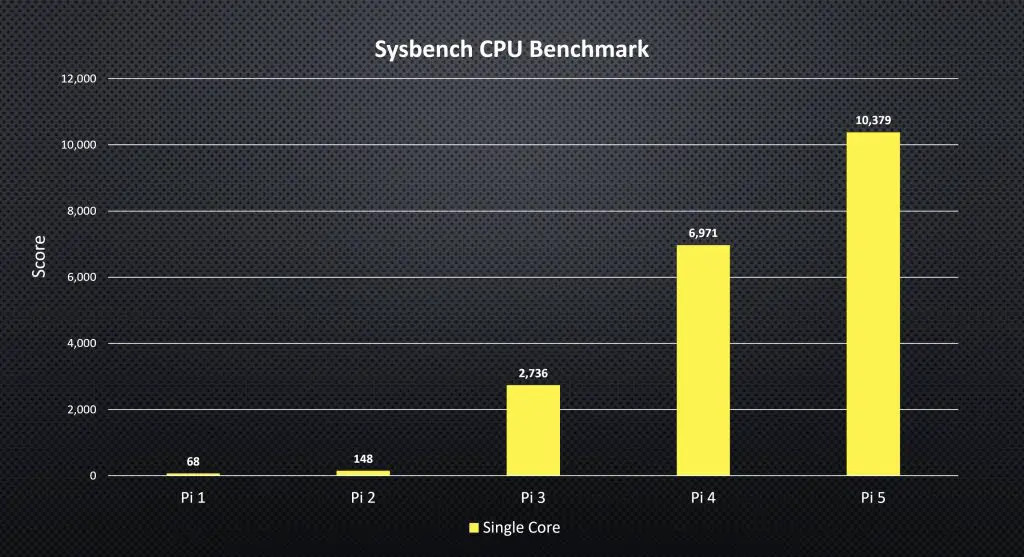
It doesn’t take an x-ray machine or any other fancy equipment to figure out that the Raspberry Pi 5 is faster than its predecessors. But quantifying just how much better each generation of Pi is compared to the other members of the family does require a bit more effort, which is why we were glad to see that The DIY Life did the homework for us. It’s not much of a spoiler to reveal that the Pi 5 won the head-to-head competition in essentially every category, but it’s still interesting to read along to see how each generation of hardware fared in the testing.
Finally, Albedo has released a fascinating write-up that goes over the recent flight of their Very Low Earth Orbit (VLEO) satellite, Clarity-1. As we explained earlier this week, operating at a lower orbit offers several tangible benefits to spacecraft. One of the major ones is that such an orbit decays quickly, meaning a spacecraft could burn up just months or even days after its mission is completed. For Albedo specifically, they’re taking advantage of the lower altitude to snap closeup shots of the Earth. While there were a few hiccups, the mission was overall a success, providing another example of how commercial operators can capitalize on this unique space environment.


See something interesting that you think would be a good fit for our weekly Links column? Drop us a line, we’ve love to hear about it.

Move into real AI productivity with lifetime access to this multi-model tool

Laptop at desk

TL;DR: 1min.AI gives you lifetime access to many of today’s most popular AI models and creative tools — text, images, audio, video, and PDFs — for a single $74.97 payment (reg. $540) through Jan. 31.


Using AI casually might have worked a year ago, but today, professionals need more than one chatbot and a few prompts. The 1min.AI Advanced Business Plan is built for people who want real, repeatable results from AI, without juggling multiple subscriptions.

For a limited time, you can get lifetime access for $74.97 (reg. $540) through Jan. 31.

Mashable Deals
Be the first to know!
Get editor selected deals texted right to your phone!
By signing up, you agree to receive recurring automated SMS marketing messages from Mashable Deals at the number provided. Msg and data rates may apply. Up to 2 messages/day. Reply STOP to opt out, HELP for help. Consent is not a condition of purchase. See our Privacy Policy and Terms of Use.
Thanks for signing up!

What sets 1min.AI apart is its multi-model approach. Instead of locking you into a single AI engine, it gives you access to many of the most popular models in one place, including GPT-4o, Claude 3, Gemini Pro, Llama, Mistral, and more. That flexibility matters when different tasks benefit from different strengths.

The platform goes well beyond chat. You’ll find writing and SEO tools for blogs, rewrites, summaries, and brand voice creation; image generation and editing tools for everything from background removal to 3D images; and document features that let you chat with, summarize, or translate PDFs.

There’s also a full suite of audio and video tools, including text-to-speech, voice cloning, captions, YouTube summarization, and even video face swapping.

Everything lives in one dashboard, designed to speed up workflows instead of adding complexity. Weekly updates and a public roadmap mean the tool keeps evolving long after you’ve paid.

For creators, marketers, founders, and teams, it offers a practical edge with no recurring fees and one simple lifetime plan.

Get lifetime access to the 1min.AI Advanced Business Plan for just $74.97 (reg. $540) through Jan. 31.

StackSocial prices subject to change.

Google Discover Replaces News Headlines With Sometimes Inaccurate AI-Generated Alternatives

An anonymous reader shared this report from The Verge: In early December, I brought you the news that Google has begun replacing Verge headlines, and those of our competitors, with AI clickbait nonsense in its content feed [which appears on the leftmost homescreen page of many Android phones and the Google app's homepage]. Google appeared to be backing away from the experiment, but now tells The Verge that its AI headlines in Google Discover are a feature, one that "performs well for user satisfaction." I once again see lots of misleading claims every time I check my phone... For example, Google's AI claimed last week that "US reverses foreign drone ban," citing and linking to this PCMag story for the news. That's not just false — PCMag took pains to explain that it's false in the story that Google links to...! What does the author of that PCMag story think? "It makes me feel icky," Jim Fisher tells me over the phone. "I'd encourage people to click on stories and read them, and not trust what Google is spoon-feeding them." He says Google should be using the headline that humans wrote, and if Google needs a summary, it can use the ones that publications already submit to help search engines parse our work. Google claims it's not rewriting headlines. It characterizes these new offerings as "trending topics," even though each "trending topic" presents itself as one of our stories, links to our stories, and uses our images, all without competent fact-checking to ensure the AI is getting them right... The AI is also no longer restricted to roughly four words per headline, so I no longer see nonsense headlines like "Microsoft developers using AI" or "AI tag debate heats." (Instead, I occasionally see tripe like "Fares: Need AAA & AA Games" or "Dispatch sold millions; few avoided romance.") But Google's AI has no clue what parts of these stories are new, relevant, significant, or true, and it can easily confuse one story for another. On December 26th, Google told me that "Steam Machine price & HDMI details emerge." They hadn't. On January 11th, Google proclaimed that "ASUS ROG Ally X arrives." (It arrived in 2024; the new Xbox Ally arrived months ago.) On January 20th, it wrote that "Glasses-free 3D tech wows," introducing readers to "New 3D tech called Immensity from Leia" — but linking to this TechRadar story about an entirely different company called Visual Semiconductor... Google declined our request for an interview to more fully explain the idea. The site Android Police spotted more inaccurate headlines in December: A story from 9to5Google, which was actually titled 'Don't buy a Qi2 25W wireless charger hoping for faster speeds — just get the 'slower' one instead' was retitled as 'Qi2 slows older Pixels.' Similarly, Ars Technica's 'Valve's Steam Machine looks like a console, but don't expect it to be priced like one' was changed to 'Steam Machine price revealed.' At the time, we believed that the inaccuracies were due to the feature being unstable and in early testing.... Now, Google has stopped calling Discover replacing human-written headlines as an "experiment." "Google buries a 'Generated with AI, which can make mistakes' message under the 'See more' button in the summary," reports 9to5Google, "making it look like this is the publisher's intended headline." While it is obvious that Google has refined this feature over the past couple of months, it doesn't take long to still find plenty of misleading headlines throughout Discover... Another article from NotebookCheck about an Anker power bank with a retractable cable was given a headline that's about another product entirely. A pair of headlines from Tom's Hardware and PCMag, meanwhile, show the two sides of using AI for this purpose. The Tom's Hardware headline, "Free GPU & Amazon Scams," isn't representative of the actual article, which is about someone who bought a GPU from Amazon, canceled their order, and the retailer shipped it anyway. There's nothing about "Amazon Scams" in the article.

Read more of this story at Slashdot.

Gasoline Out of Thin Air? It's a Reality!

Can Aircela's machine "create gasoline using little more than electricity and the air that we breathe"? Jalopnik reports... The Aircela machine works through a three-step process. It captures carbon dioxide directly from the air... The machine also traps water vapor, and uses electrolysis to break water down into hydrogen and oxygen... The oxygen is released, leaving hydrogen and carbon dioxide, the building blocks of hydrocarbons. This mixture then undergoes a process known as direct hydrogenation of carbon dioxide to methanol, as documented in scientific papers. Methanol is a useful, though dangerous, racing fuel, but the engine under your hood won't run on it, so it must be converted to gasoline. ExxonMobil has been studying the process of doing exactly that since at least the 1970s. It's another well-established process, and the final step the Aircela machine performs before dispensing it through a built-in ordinary gas pump. So while creating gasoline out of thin air sounds like something only a wizard alchemist in Dungeons & Dragons can do, each step of this process is grounded in science, and combining the steps in this manner means it can, and does, really work. Aircela does not, however, promise free gasoline for all. There are some limitations to this process. A machine the size of Aircela's produces just one gallon of gas per day... The machine can store up to 17 gallons, according to Popular Science, so if you don't drive very much, you can fill up your tank, eventually... While the Aircela website does not list a price for the machine, The Autopian reports it's targeting a price between $15,000 and $20,000, with hopes of dropping the price once mass production begins. While certainly less expensive than a traditional gas station, it's still a bit of an investment to begin producing your own fuel. If you live or work out in the middle of nowhere, however, it could be close to or less than the cost of bringing gas to you, or driving all your vehicles into a distant town to fill up. You're also not limited to buying just one machine, as the system is designed to scale up to produce as much fuel as you need. The main reason why this process isn't "something for nothing" is that it takes twice as much electrical energy to produce energy in the form of gasoline. As Aircela told The Autopian " Aircela is targeting >50% end to end power efficiency. Since there is about 37kWh of energy in a gallon of gasoline we will require about 75kWh to make it. When we power our machines with standalone, off-grid, photovoltaic panels this will correspond to less than $1.50/gallon in energy cost." Thanks to long-time Slashdot reader Quasar1999 for sharing the news.

Read more of this story at Slashdot.

Balancing a Turbine Rotor to 1 mg With a DIY Dynamic Balancer

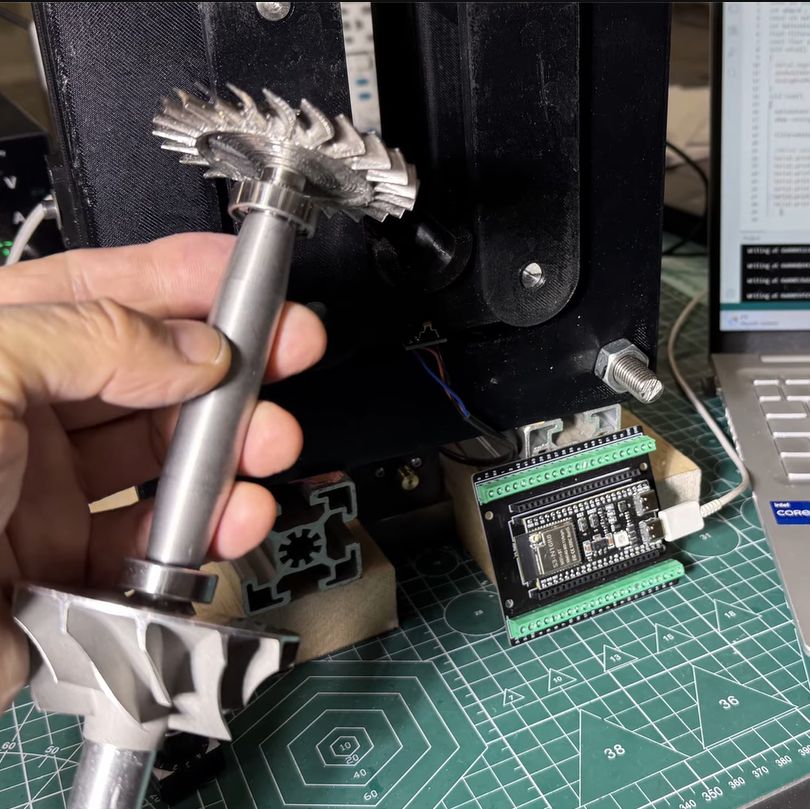
Although jet engines are theoretically quite simple devices, in reality they tread a fine line between working as intended and vaporizing into a cloud of lethal shrapnel. The main reason for this is the high rotational speed of the rotors, with any imbalance due to poor manufacturing or damage leading to undesirable outcomes. It’s for this reason that [AlfMart CNC Garage] on YouTube decided to spend some quality time building a balancer for his DIY RC turbine project and making sure it can prevent such a disaster scenario.

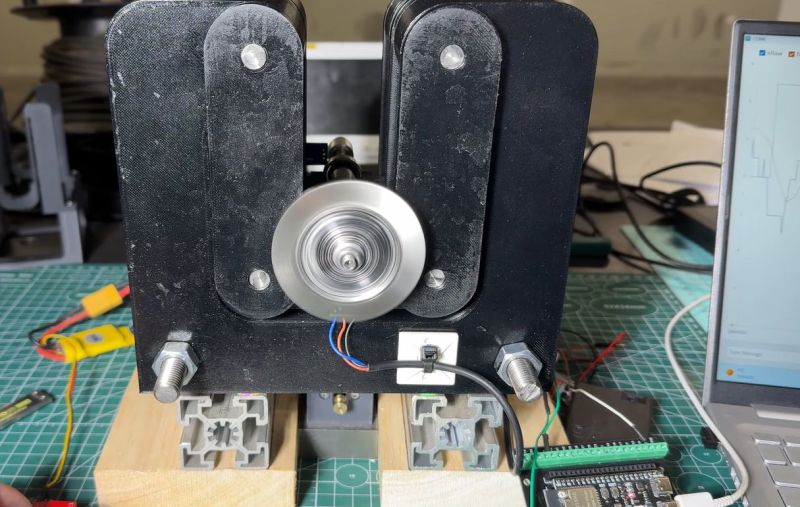
In the previous part of the series the turbine disc was machined out of inconel alloy, as the part will be subjected to significant heat as well when operating. To make sure that the disc is perfectly balanced, a dynamic balancing machine is required. The design that was settled on after a few failed attempts uses an ADXL335 accelerometer and Hall sensor hooked up to an ESP32, which is said to measure imbalance down to ~1 mg at 4,000 RPM.

A big part of the dynamic balancing machine is the isolation of external vibrations using a bearing-supported free-floating structure. With that taken care of, this made measuring the vibrations caused by an imbalanced rotor much easier to distinguish. The ESP32 is here basically just to read out the sensors and output the waveforms to a connected PC via serial, with the real work being a slow and methodical data interpretation and balancing by hand.

❌