Users can view and share photos and comments about restaurants they’ve visited, discover content from others, and follow people just like on any social network.
OpenAI rolls out GPT Image 1.5 for ChatGPT, promising 4x faster generation, better instruction-following, and precise edits. The launch escalates its rivalry with Google Gemini.
Luminar says trouble with Volvo started as early as 2022, and that the Swedish automaker made -- but then backed away from -- large orders of its lidar sensors.
Amazon data centers in the Portland area in 2022. (AWS Photo / Noah Berger)
Three U.S. senators have launched an investigation into whether tech giants, driven by soaring AI energy demands, are raising residential power bills. Separately, Amazon released a white paper Tuesday stating that its data centers are not the problem, and that in some regions it actually pays more than required for energy use.
The Democratic senators sent letters to Amazon, Microsoft, Google, Meta and three data center firms, according to the New York Times. The lawmakers raised concerns that energy demand driven by artificial intelligence was forcing utilities to deploy new power plants and upgrade the grid — with local ratepayers helping foot the bill.
“We write in light of alarming reports that tech companies are passing on the costs of building and operating their data centers to ordinary Americans as A.I. data centers’ energy usage has caused residential electricity bills to skyrocket in nearby communities,” the senators said, according to the Times.
Elizabeth Warren of Massachusetts, Chris Van Hollen of Maryland and Richard Blumenthal of Connecticut issued the letters.
Amazon offered a much different take in an analysis that examined the potential benefits, costs and risks that large energy loads created by data centers have on electric utilities.
The Amazon-funded study found that in some locations, the power bills currently being paid by the company more than cover the utility impacts. A typical 100 megawatt data center was estimated to pay an additional $3.4 million beyond the costs associated with its electricity use, which also include a utility’s infrastructure upgrades, deployment of new energy generation, operations and maintenance.
Utilities can use that surplus “to reduce rates for other ratepayers, but how this potential benefit is realized will differ across jurisdictions,” the study stated.
The assessment examined Amazon data center campuses in Oregon, California and Mississippi and was performed by E3, an independent economic consulting firm.
The white paper said the benefit to the utilities and other customers should continue into 2030, but noted that utilities will need to adjust their rates in the future to ensure that ratepayers are not subsidizing tech operations.
“To continue to prevent cross-subsidization, utilities must keep pace and leverage the full range of tools available to them to mitigate these risks…” the document states.
The rapid growth of the sector is central to the debate. A Department of Energy report projected that data center energy use, which was more than 4% of U.S. electricity consumption in 2023, could triple by 2028. This forecast is fueled by tech giants’ expanding investment: Microsoft and Amazon each reported nearly $35 billion in capital expenditures in the third quarter, much of it on data center infrastructure.
The tech giants are also investing globally in new wind and solar power and energy storage, while pursuing more costly power sources including nuclear.
In October, a group of U.S. representatives raised similar concerns to the senators’, asking the Federal Energy Regulatory Commission, Edison Electric Institute and the Data Center Coalition for information regarding data center impacts on residential power bills “to help ensure everyday Americans and small businesses aren’t bearing the brunt of data center energy costs.”
Washington representatives Kim Schrier and Adam Smith as well as Oregon Rep. Andrea Salinas were among the 20 lawmakers who made the request.
The investigations come amid a general rise in household expenses, making the allocation of utility costs particularly contentious. Residential electricity costs nationwide are on the rise, according to federal data. Power bills rose more than 7% on average when comparing September rates to a year earlier.
But the causes of the increase are complicated. A study this month in a peer-reviewed journal concluded that multiple factors impact electricity prices, including inflation, fluctuating gas prices and natural disasters such as hurricanes, storms and wildfires.
Washington and 35 other states reached a settlement with Hyundai and Kia in which the automakers will provide restitution to consumers and fixes to millions of eligible vehicles nationwide that lacked industry-standard, anti-theft technology.
Washington Attorney General Nick Brown’s office announced details of the settlement Tuesday, in which Hyundai and Kia have agreed to:
Equip all future vehicles sold in the U.S. with engine immobilizer anti-theft technology;
Offer free zinc-reinforced ignition cylinder protectors to owners or lessees of eligible vehicles, including vehicles that previously were only eligible for the companies’ software updates;
Provide up to $4.5 million in restitution to eligible consumers whose cars are damaged by thieves; and
Pay $4.5 million to the states to defray the costs of the investigation.
Eligible car owners can receive up $4,500 for a total loss or up to $2,250 for a partial loss, according to compensation details on the settlement website. The claim deadline is March 31, 2027.
An engine immobilizer prevents thieves from starting a vehicle’s engine without the vehicle’s “smart” key, which stores the vehicle’s electronic security code. The lack of the necessary tech on cars resulted in “an epidemic of car thefts and joy riding” across Washington and the country,
“Security is a key piece for families looking to buy a vehicle, but Hyundai and Kia spent years selling people cars that lacked the industry’s standard protections,” Brown said in a statement. “Year after year, consumers have been easily victimized because of the automakers’ failure here.”
In late 2020, teenage boys began posting videos on social media describing how to steal the cars simply by removing a plastic piece under the steering wheel and using a USB cord. Posts with the hashtag “Kia Boys” racked up more than 33 million views on TikTok by September 2022, according to CNBC. The videos included teens engaged in reckless driving of the stolen vehicles.
Despite years of evidence, Hyundai and Kia waited until 2023 to launch a service campaign to update the software on most of the affected vehicles, Brown’s office said. The update was easily bypassed by thieves.
Seattle City Attorney Ann Davison filed a similar lawsuit against Kia and Hyundai in January 2023.
“Kia and Hyundai chose to cut corners and cut costs at the expense of their customers and the public. As a result, our police force has had to tackle a huge rise in vehicle theft and related problems with already stretched resources,” Davison said in a statement at the time.
In May 2023, Hyundai and Kia agreed to a consumer class-action lawsuit settlement worth $200 million over rampant thefts of the Korean automakers’ vehicles. The Seattle City Attorney’s Office said at the time that it was a “good first step for consumers” but that the settlement involving individual owners “does not include the litigation brought by the City.”
We reached out to the City Attorney for comment on Tuesday and will update when we hear back.
Under the new multistate settlement, eligible consumers will be notified by the companies that they will have one year from the date of the notice to make an appointment to have the zinc-reinforced ignition cylinder protector installed at their local Hyundai or Kia authorized dealerships. Consumers are urged to schedule the installation of the zinc-reinforce ignition cylinder protector as soon as possible.
Consumers who previously installed the software update on their vehicles (or were scheduled to do so) but nonetheless experienced a theft or attempted theft of their vehicle on or after April 29, 2025, are eligible to file a claim for restitution for certain theft and attempted-theft related expenses. For more information about eligibility and how to submit a claim visit these sites for Hyundai and Kia.
I love first builds! They say so much about a person, because you see what’s paramount to them in a keyboard. You can almost feel their frustration at other keyboards come through their design choices. And the Lobo by [no-restarts] is no exception to any of this.
There’s just something about this Corne-like object with its custom case and highly-tappable and variously tilted keycaps. The list of reasons for being begins innocently enough with [no-restarts] wanting a picture of their dog on the case.
Image by [no-restarts] via redditFrom there, things get really personal. You may notice the thumb cluster is slightly different — [no-restarts] doesn’t like the thumb tuck required by the Corne to reach the innermost keys. I really dig the homing bumps on the middle thumb keys. Another difference is the splayed layout, as [no-restarts] is especially prone to pinky splay. Finally, there are a pair of OLEDs hiding on the inner sides of the case, which are designed to be visible when tented.
Overall, [no-restarts] is happy with it, but has some ideas for revision. Yep, that sounds about right. The Lobo is all hand-wired, and there’s a PCB with hot swap sockets in its future. If you’re interested in the case files, GitHub is your friend.
Image by [kurisutofujp] via redditEssentially, this thing is made for using while you wander around the office (or the Metaverse). You can hold it in mid-air, secured in your Gargoyle-ness with a pair of straps, your fingers wrapped around to hit the alphas.
But you don’t have to use it that way, see. You can stand it up on the desk if you don’t want to type in mid-air. It can also be opened sort of halfway and used like a SafeType vertical keyboard.
If none of this excites you, GrabShell can also be laid flat on the desk. The distance between the two halves in this configuration is quite generous, and frankly, I’m a bit jealous.
So let’s talk about the generous thumbing-around area. As you’ll see in the video below, the left has a joystick and a toggle switch that flips it from arrow keys to mouse cursor. There’s a serious-looking scroll wheel beneath that. All three of these can be pushed in for additional inputs.
The right side of the thumb panel has a sweet-looking trackball that’s housed in a really cool-looking way. Another cool thing: there’s a frigging I2C port on the top, just exposed and hanging out because reasons.
Switch-wise, the board is a mix of hot-swappable Gateron G Pro browns and low-profile Gaterons under double-shot ABS keycaps. I think it sounds nice in the video below; others say it sounds cheap and hollow. To each their own.
The Centerfold: ZMK Dongle Repackaged As Vintage Computer
Image by me using images by [mharzhyall] via redditIt’s just so cute, that’s why it’s here. The buttons, they do nothing, but that’s okay — they might could do something in the future.
This is a ZMK dongle, like I said in the subheading, and [mharzhyall] put a new case around it. Basically it lets you connect keyboards wirelessly.
Do you rock a sweet set of peripherals on a screamin’ desk pad? Send me a picture along with your handle and all the gory details, and you could be featured here!
Historical Clackers: the Edland Typewriter Was a Total Flop
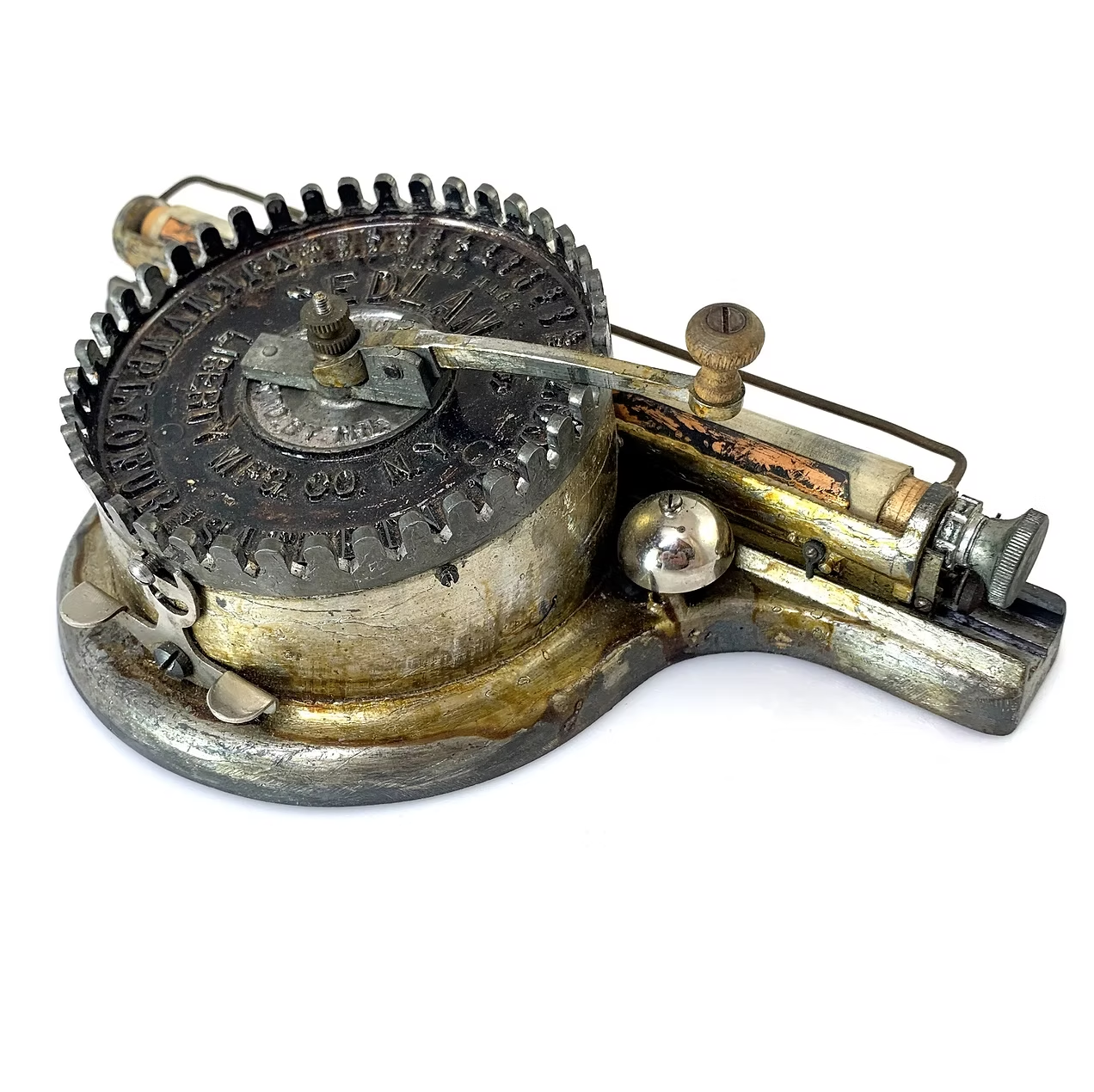
Produced between 1891 and 1893 by the Liberty Mfg. Company, the machine was conceived by Joseph Laurentius Edland of Brooklyn, NY. All seemed lost until 1964, when a handful of Edlands were found languishing in a warehouse in Galway, NY.
Although only made for two years, there were three different versions developed. The one pictured here is the second, with a metal base and embossed index, whereas the first had a wood base and flat index.
The third version, the Typewheel Edland, had a typewheel for a print element à la the Blick. Edlands cost a semi-reasonable $5 at the outset, but eventually doubled in price.
So, why the absolute failure? It was no better or worse a machine than its contemporaries, but perhaps just wasn’t well-marketed. Another theory is that the Edland failed because they were made of pot metal. Seems reasonable. Want to know how to use one? RTFM (PDF).
Finally, a Keyboard with a Mechanical Watch Movement
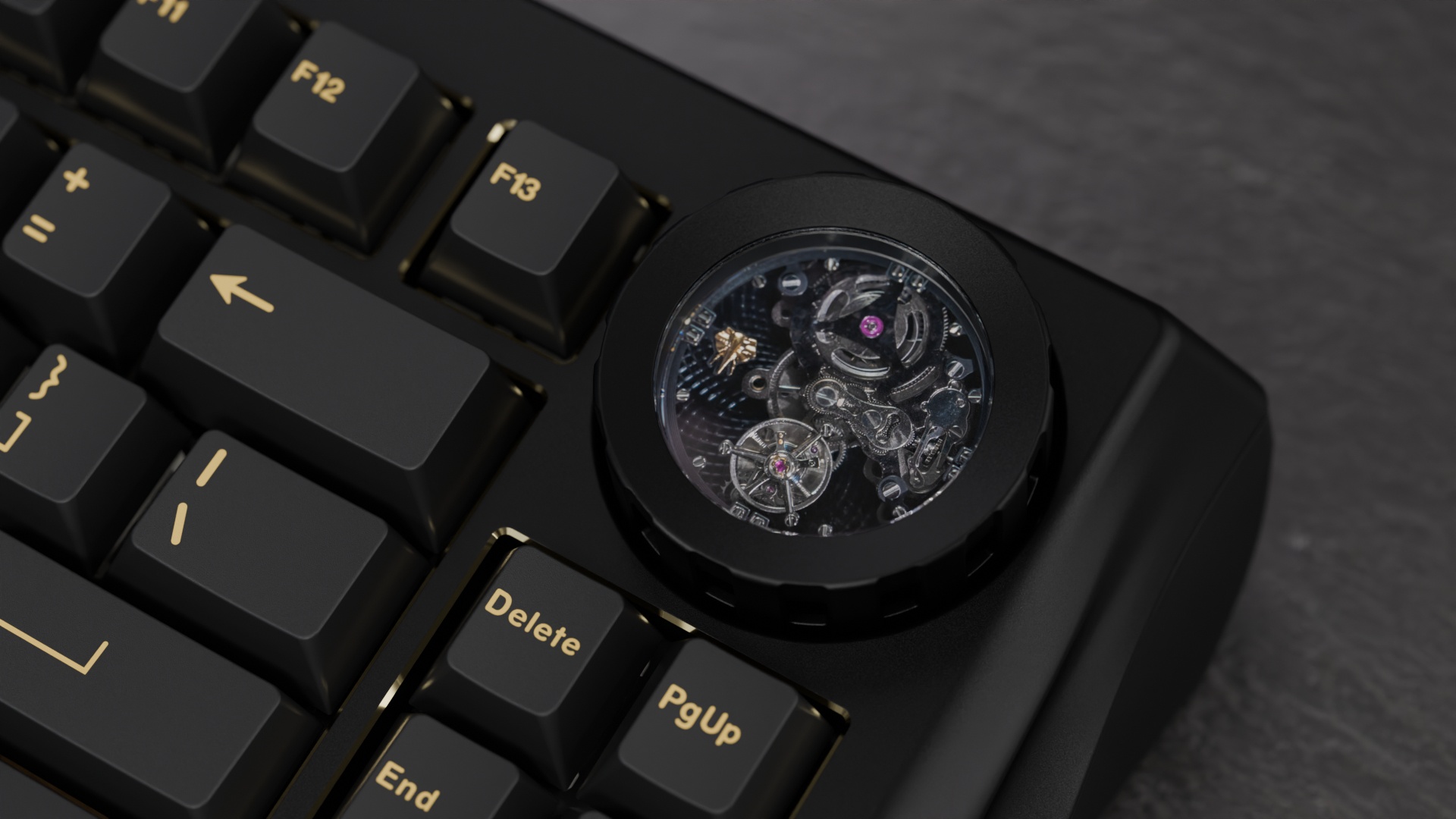
Wait, what? Why though? Well, it ticks along as you type, is that cool? It might be fun to see if you can keep up a certain number of keystrokes per second. Okay, I’m warming up to this idea pretty quickly, can you tell?
The Nama keyboard, dubbed after the scientific term for the mammoth, is appropriately named. It can weigh up to an astonishing 19.4 lbs (8.8 kg) depending on the case material. (Consider that a Model M, a proper bludgeoning device in its own right, weighs just 5 lbs (2.2 kg).)
This Nama has a tourbillion movement, the granddaddy of them all. Image by Wuque Studio via Notebook Check
Nama comes from Wuque Studio, and was built as an ode to their manufacturing capabilities. Now this is starting to make more sense. They are the Banana Republic to vendor Chilkey’s Old Navy, who are the brand behind the ND75, if that rings any bells.
Now the Nama looks like your basic mechanical keyboard on the surface, but five years of design decisions went into this line. You can get it with an aluminium case (14.5 lbs / 6.6 kg) or a brass CNC’d case (18.95 lbs / 8.6 kg), which of course is what makes it so heavy.
But yeah, the defining feature is definitely the watch movement. You bet your Backspace it’s fully functional except as a watch, and it doubles as a volume control knob, so you don’t have to settle for touching it with just your eyeballs.
Yeah, so the astute among you will have noticed that there are no numbers or hands on the watch movement, which would be, what, tacky? I don’t know anymore. At any rate, it’s protected by a piece of sapphire glass, which should keep Cheetos dust and such out of there.
Oh, you want to know the cost? $749 for the bare-bones with no movement, and $1299 for the brass-bottomed boy with the tourbillion. That’s… actually not that bad for a tourbillion movement.
A new, modular infostealer called SantaStealer, advertised on Telegram with a basic tier priced at $175 per month, promises to make criminals' Christmas dreams come true. It boasts that it can run "fully undetected" even on systems with the "strictest AntiVirus" and those belonging to governments, financial institutions, and other prime targets.…
 Login
Login




 Robert Hart / The Verge:





![A three-panel shot of a Apple ][-inspired ZMK dongle.](https://hackaday.com/wp-content/uploads/2025/12/ZMK-dongle-centerfold.png)