There are free trials for watching tonight's MNF game, and Sling will let you watch for $5. See all of your options for watching or streaming the game.
Looking for the perfect laptop or tablet to give for the holidays? We've spent hundreds of hours testing the most popular devices, and these are the ones we'd actually recommend for gaming, working, content creation and more.
Amazon filed a new notice with Washington state Monday morning signaling that it’s cutting 84 jobs, but the individual separations are part of the regular course of business, unrelated to the 14,000 corporate layoffs it announced globally in October.
The company said each of its businesses regularly reviews its organizational structure and may make adjustments as a result. It’s a routine process, the company said, not tied to broader workforce actions.
The notice stems from a new state law that requires employers to disclose all terminations occurring within 90 days of a prior notice under the state’s new “mini” version of the Worker Adjustment and Retraining Notification Act, known as the WARN Act.
“We’ve informed a relatively small number of employees that their roles will be eliminated as the result of individual business decisions,” said Amazon spokesperson Brad Glasser. “We don’t make decisions like this lightly,” he added, noting that the company is providing affected employees with 90 days of full pay and benefits, transitional health coverage, and job placement services.
According to the filing, the separations are scheduled to occur between Feb. 2 and Feb. 23, 2026, across more than 30 Seattle and Bellevue office locations, plus six remote workers based in Washington. They include software development engineers, program managers, recruiters, HR specialists, and UX designers, ranging from entry-level to directors and principals.
Amazon noted in the filing that employees were notified starting in early November and received at least 89 days’ advance notice, exceeding the 60-day minimum required under the law. Those who find internal transfers before their separation date won’t be laid off.
Amazon HR chief Beth Galetti signaled additional cuts could continue into 2026. Reuters has reported the total could ultimately reach 30,000 — which would surpass the 27,000 positions eliminated in 2023 and mark the largest overall layoff in company history.
The University of Washington’s Red Square. The UW is one of the state institutions that employs H1-B visa holders. (GeekWire Photo / Lisa Stiffler)
Washington state is part of a newly filed lawsuit against the Trump administration, challenging the legality of a $100,000 fee for new H-1B visas that allow highly-skilled individuals to work temporarily in the U.S.
Attorneys general from 20 states claim the U.S. Department of Homeland Security set the fee at an arbitrary amount that does not reflect the agency’s costs, and that the fee was enacted without going through a required notice-and-comment process.
The visa is meant to recruit employees from abroad who have specialized expertise not found in sufficient numbers in the U.S. workforce.
Seattle-based Amazon has roughly 20,000 employees working under H-1B visas nationwide. Microsoft, which is based in Redmond, Wash., nationally employs more than 6,200 H-1B visa holders. Washington’s public universities and agencies have nearly 500 H-1B visa holders on their payrolls, according to federal data and state analysis.
Employers are responsible for paying H-1B fees, which used to run between $960 and $7,595, said Washington State Attorney General Nick Brown’s office. Raising the fees, the state warned, will result in empty university labs and science discoveries “will be made somewhere else.”
“These institutions will lose their competitive edge, particularly in the areas of artificial intelligence, cybersecurity, and medical fields,” said a press release from Brown’s office.
In announcing the increased fee in September, the Trump administration said the visa was being abused by employers to supplant Americans with “lower-paid, lower-skilled labor.”
“The large-scale replacement of American workers through systemic abuse of the program has undermined both our economic and national security,” said a White House memo addressing restrictions of nonimmigrant workers.
The notice called out high-tech companies, saying they “have prominently manipulated the H-1B system, significantly harming American workers in computer-related fields.”
Xiao Wang, CEO of Boundless, a Seattle-based startup providing immigration support, noted that while tech giants are targeted for criticism, the visa also allows for doctors, nurses and researchers to work in the U.S. — echoing some of the concerns raised by Washington’s attorney general.
“Adding a $100K fee for all foreign talent trying to enter Washington to work in these fields would all but eliminate this pathway for anyone outside of the most valuable companies in the world and would leave the state with a significant shortage of important roles,” Wang said by email.
He added that putting a nurse and an AI engineer in the same visa category highlights an overdue need for immigration reform.
Wang called on Americans to demand that Congress “pass new immigration regulations to stay competitive as a country.”
Steve Clayton speaks at a Microsoft 8080 Books event in Redmond in April 2025. (GeekWire File Photo / Todd Bishop)
Steve Clayton has emerged as a retro renegade at Microsoft, seeking to show that print books and magazines still matter in the digital age. Now he’s turning the page on his own career.
Clayton, most recently Microsoft’s vice president of communications strategy, announced Monday morning that he’s leaving the Redmond company after 28 years to become Cisco’s chief communications officer, starting next month, reporting to CEO Chuck Robbins.
“In some ways, it feels like a full-circle moment: my career began with the rise of the internet and the early web — and Cisco was foundational to that story,” he wrote on LinkedIn, noting that AI makes infrastructure and security all the more critical.
He leaves behind two passion projects: 8080 Books, a Microsoft publishing imprint focused on thought leadership titles, and Signal, a Microsoft print magazine for business leaders. He said via email that both will continue after his exit. He’s currently in the U.K. wrapping up the third edition of Signal.
Clayton joined Microsoft in 1997 as a systems engineer in the U.K., working with commercial customers including BP, Shell, and Unilever. He held a series of technical and strategy roles before moving to Seattle in 2010 to become “chief storyteller,” a position he held for 11 years.
That put Microsoft ahead of the curve on a trend now sweeping corporate America: The Wall Street Journal reported last week that “storyteller” job postings on LinkedIn have doubled in the past year.
As chief storyteller, Clayton led a team of 40 responsible for building technology demonstrations for CEO Satya Nadella, helping shape Microsoft’s AI communications strategy, running the corporate intranet, and overseeing social media and broader culture-focused campaigns.
In 2021, Clayton moved into a senior public affairs leadership role. During that period, he was involved in companywide efforts related to issues including AI policy and the Microsoft–Activision deal, before transitioning to his current communications strategy role in 2023.
In his latest position, Clayton has focused on using AI to transform how Microsoft runs its communications operations, reporting to Chief Communications Officer Frank Shaw.
Tetrodotoxin (TTX) is best known as the neurotoxin of the puffer fish, though it also appears in a range of other marine species. You might remember it from an episode of The Simpsons involving a poorly prepared dish at a sushi restaurant. Indeed, it’s a potent thing, as ingesting even tiny amounts can lead to death in short order.
Given its fatal reputation, it might be the last thing you’d expect to be used in a therapeutic context. And yet, tetrodotoxin is proving potentially valuable as a treatment option for dealing with cancer-related pain. It’s a dangerous thing to play with, but it could yet hold promise where other pain relievers simply can’t deliver.
Poison, or…?
A license to prepare fugu (pufferfish) issued by Tokyo authorities. Credit: Nesnad, CC BY SA 3.0
Humans have been aware of the toxicity of the puffer fish and its eggs for thousands of years. It was much later that tetrodotoxin itself was chemically isolated, thanks to the work of Dr. Yoshizumi Tahara in 1909.
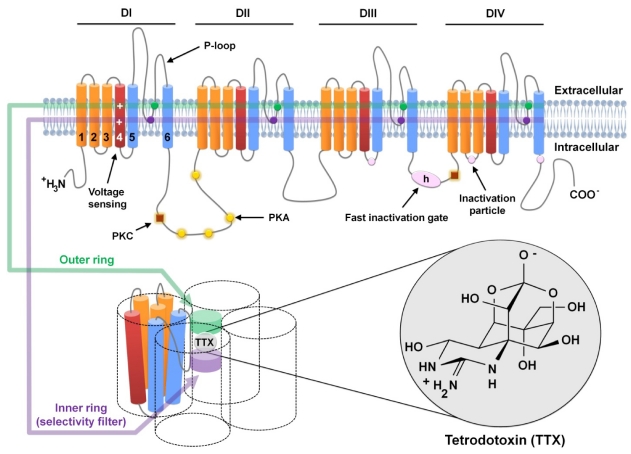
Its method of action was proven in 1964, with tetrodotoxin found to bind to and block voltage-gated sodium channels in nerve cell membranes, essentially stopping the nerves from conducting signals as normal. It thus has the effect of inducing paralysis, up to the point where an afflicted individual suffers respiratory failure, and subsequently, death.
Tetrodotoxin is most closely associated with pufferfish, though it’s also present in other deadly species, like the blue-ringed octopus. Thankfully, nobody is crazy enough to try to eat those. Credit: NPS, public domain
It doesn’t take a large dose of tetrodotoxin to kill, either—the median lethal dose in mice is a mere 334 μg per kilogram when ingested. The lethality of tetrodotoxin was historically a prime driver behind Japanese efforts to specially license chefs who wished to prepare and serve pufferfish. Consuming pufferfish that has been inadequately prepared can lead to symptoms in 30 minutes or less, with death following in mere hours as the toxin makes it impossible for the sufferer to breathe. Notably, though, with the correct life support measures, particularly for the airway, or with a sub-fatal dose, it’s possible for a patient to make a full recovery in mere days, without any lingering effects.
The effects that tetrodotoxin has on the nervous system are precisely what may lend it therapeutic benefit, however. By blocking sodium channels in sensory neurons that deal with pain signals, the toxin could act as a potent method of pain relief. Researchers have recently explored whether it could have particular application for dealing with neuropathic pain caused by cancer or chemotherapy treatments. This pain isn’t always easy to manage with traditional pain relief methods, and can even linger after cancer recovery and when chemotherapy has ceased.
Tetrodotoxin is able to block voltage-gated sodium channels, which is the basis of both its pain-relieving abilities and its capacity to paralyze and kill. Credit: research paper
The challenge of using a toxin for pain relief is obvious—there’s always a risk that the negative effects of the toxin will outweigh the supposed therapeutic benefit. In the case of tetrodotoxin, it all comes down to dosage. The levels given to patients in research studies have been on the order of 30 micrograms, well under the multi-milligram dose that would typically cause severe symptoms or death in an adult human. The hope would be to find a level at which tetrodotoxin reduces pain with a minimum of adverse effects, particularly where symptoms like paralysis and respiratory failure are on the table.
A review of various studies worldwide was published in 2023, and highlights that tetrodotoxin pain relief does come with some typical adverse effects, even at tiny clinical doses. The most typical reported symptoms involved nausea, oral numbness, dizziness, and tingling sensations. In many cases, these effects were mild and well-tolerated. A small number of patients in research trials exhibited more serious symptoms, however, such as loss of muscle control, pain, or hypertension. At the same time, the treatment did show positive results — with many patients reporting pain relief for days or even weeks after just a few days of tetrodotoxin injections.
While tetrodotoxin has been studied as a pain reliever for several decades now, it has yet to become a mainstream treatment. There have been no large-scale studies that involved treating more than 200 patients, and no research group or pharmaceutical company has pushed hard to bring a tetrodotoxin-based product to market. Research continues, with a 2025 paper even exploring the use of ultra-low nanogram-scale doses in a topical setting. For now, though, commercial application remains a far-off fantasy. Today, the toxin remains the preserve of pufferfish and a range of other deadly species. Don’t expect to see it in a hospital ward any time soon, despite the promise it shows thus far.
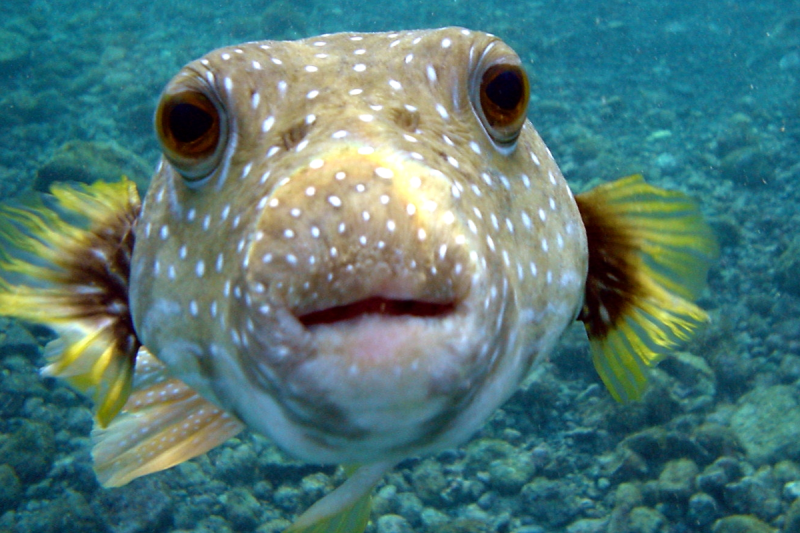
Featured image: “Puffer Fish DSC01257.JPG” by Brocken Inaglory. Actually, not one of the poisonous ones, but it looked cool.
Mobile traffic now accounts for nearly half of requests
Global internet traffic grew by 19 percent during 2025, while nearly half of traffic now comes from mobile devices. A significant and growing portion also comes from bots, many designed to train AI.…
At least five more Chinese spy crews, Iran-linked goons, and financially motivated criminals are now attacking the React2Shell, a maximum-severity flaw in the widely used React JavaScript library, according to Google.…
Paris Buttfield-Addison literally wrote books on Swift
Apple has blocked a long-time developer from his Apple ID after he failed to redeem what support suggested was a dodgy $500 gift card, leaving him unable to work, cut off from personal files, and barred from what he calls his "core digital identity." …
 Login
Login




 Andrew J. Hawkins / The Verge: