Gift shopping often requires a budget. If you're looking for a gift that's impactful to your loved ones and friend but not to your wallet, check out these gifts under $150.
A subcontractor says he was crushed by a metal support, breaking his hip, knee, and tibia. He's suing SpaceX and the construction company who employed him.
— T-Mobile appointed Jon Freier as its new chief operating officer. He succeeds Srini Gopalan, who was named CEO of the Bellevue, Wash., telecom giant in a surprise move that took effect last month.
Freier joins the C-suite from his previous position as president of the T-Mobile Consumer Group, a title he has held since 2021. But he has been with the company for much longer: Freier began his professional career at Western Wireless in 1994 when he was 19 years old. That business became T-Mobile after Germany’s Deutsche Telekom took over as majority shareholder in 2001.
The company disclosed Freier’s promotion in a filing. T-Mobile has undergone additional leadership reshuffling in recent months, expanding the role of its chief technologist and marking the departure of its chief communications and corporate responsibility officer and its business group president.
Alex Berezhnyy. (LinkedIn Photo)
— Alex Berezhnyy is now chief technology officer for RentSpree, a Seattle company that supports the rental application and screening process, and helps manage lease documents and payments.
Berezhnyy was previously at the real estate platform Redfin for more than a decade, leaving the role of vice president of engineering. Prior to that, he was at Amazon where he served in a variety of software development manager roles in retail systems and Kindle education.
“[Berezhnyy] brings deep technical expertise, a track record of building strong teams, and a bold vision for how AI will shape the future of renting,” RentSpree posted on LinkedIn.
Paige Johnson. (LinkedIn Photo)
— Paige Johnson has left her role as Microsoft’s vice president of Education. She is relaunching EdCatalyst Group, an Oregon-based consulting business that she previously ran for nearly three years that supports companies, nonprofits and public organizations in using AI to expand their impact.
“My years at Microsoft were an extraordinary chapter. I learned so much about how AI is reshaping industries — from education and media to public sector and financial services,” Johnson said on LinkedIn.
Earlier in her career, Johnson was with Intel for nearly two decades, creating and scaling a professional development program that trained millions of teachers worldwide.
James Newell, (LinkedIn Photo)
— James Newell is chief financial officer of WayTrade, a commodity trading company focused on renewable fuels including sustainable aviation fuel.
Newell, who will work remotely from Seattle, was previously a general partner with Voyager Capital, an investor in early stage companies in the Pacific Northwest.
“I found the perfect opportunity to make a meaningful impact at a company that itself makes a meaningful impact, and I get to do so alongside incredible people,” Newell said on LinkedIn.
Julien Ellie. (LinkedIn Photo)
— After 15 years with Amazon Web Services, Julien Ellie has resigned from his job as senior principal engineer. Ellie praised his colleagues who helped shape cloud computing, but said the company he joined and what AWS has become are no longer the same.
“From where I sit, process has taken precedence over customers, and rules have replaced high judgment. The culture has shifted from high trust to low trust, and from impact-driven to ‘who you know.’ That doesn’t align with the builder mindset that brought me here,” Ellie said on LinkedIn.
Prior to Amazon, Ellie was at Microsoft for nearly a decade.
Jonathan Assayag. (LinkedIn Photo)
— Jonathan Assayag has left his Sunnyvale, Calif., role with Amazon where he served as general manager and director of the company’s smart eyewear program. During more than nine years at the tech giant, Assayag worked on products including Echo Frames and Smart Delivery Glasses.
“These were true zero-to-one efforts that pushed ambient computing, Voice AI, and AI-assisted workflows into new territory. They challenged me both as a builder and a leader, sharpening how I think, make decisions, and drive impact,” he said on LinkedIn.
Assayag also thanked his team members and company leaders. He did not share his next move.
Lisa Haubenstock. (LinkedIn Photo)
— Gravyty, a Seattle-based company that facilitates alumni donations and higher ed student engagement, named Lisa Haubenstock as its new chief customer officer. Haubenstock joins Gravyty from shipping logistics company Truckstop, and has held roles at Amazon and the education company Everfi.
“Gravyty presents an opportunity to tie together so much of my previous experience with a truly dedicated global team working to build something great,” Haubenstock said on LinkedIn.
— Bobby Franzo is now CEO of WatchMeGrow, a Lacey, Wash.-based company that provides cameras and live video streaming in the childcare, pet-care and senior-care spaces. He succeeds John Lewison, who led the company for 24 years and is now a board member and advisor.
Franzo is the founder of PB&J TV (Peanut Butter and Jelly TV), a streaming service that merged with WatchMeGrow earlier this year.
“What started as an idea to give families peace of mind has evolved into a company shaping how technology supports safety and quality during the most important years of a child’s development,” Lewison said on LinkedIn. He added that Franzo “is exactly what the company needs at this moment, and I’m thrilled he’s at the helm.”
— CreateMe, a California-based clothing manufacturer using robotic assembly lines, announced two leadership changes:
Nick Chope, who is located in Portland, Ore., has been promoted to chief engineer and head of manufacturing. Chope has worked in robotics and automation at Microsoft, Apple, his own firm and elsewhere.
Seattle’s Natasha Chand is now executive advisor, having previously worked as the global CEO of Amazon Softlines Private Label, which includes clothes, footwear and accessories.
— Lauren Weinberg is now a board advisor at Adora, a Seattle-based marketing technology startup that emerged from stealth in October. Her past roles include leadership positions at Peleton Interactive, Square, Yahoo and elsewhere.
The basic concept of human intelligence entails self-awareness alongside the ability to reason and apply logic to one’s actions and daily life. Despite the very fuzzy definition of ‘human intelligence‘, and despite many aspects of said human intelligence (HI) also being observed among other animals, like crows and orcas, humans over the ages have always known that their brains are more special than those of other animals.
Currently the Cattell-Horn-Carroll (CHC) theory of intelligence is the most widely accepted model, defining distinct types of abilities that range from memory and processing speed to reasoning ability. While admittedly not perfect, it gives us a baseline to work with when we think of the term ‘intelligence’, whether biological or artificial.
This raises the question of how in the context of artificial intelligence (AI) the CHC model translate to the technologies which we see in use today. When can we expect to subject an artificial intelligence entity to an IQ test and have it handily outperform a human on all metrics?
Types Of Intelligence
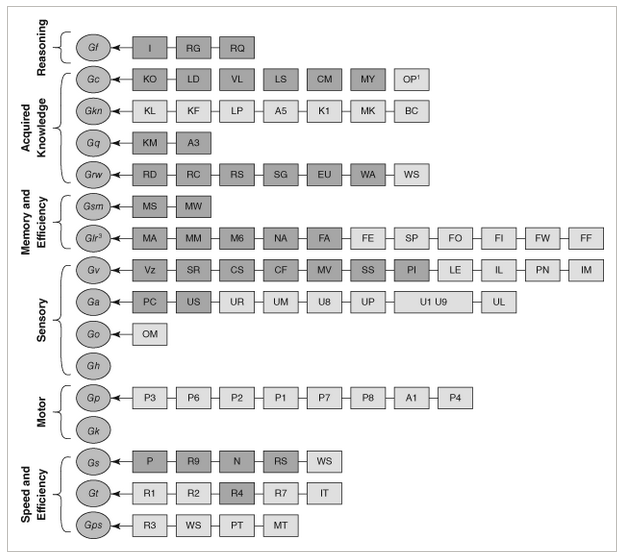
While the basic CHC model contains ten items, the full model is even more expansive, as can be seen in the graphic below. Most important are the overarching categories and the reasoning for the individual items in them, as detailed in the 2014 paper by Flanagan and McGrew. Of these, reasoning (Gf, for fluid intelligence), acquired knowledge and memory (long and short term) are arguably the most relevant when it comes to ‘general intelligence’.
Current and expanded CHC theory of cognitive abilities. Source: Flanagan & McGrew (1997).
Fluid intelligence (Gf), or reasoning, entails the ability to discover the nature of the problem or construction, to use a provided context to fill in the subsequent steps, and to handle abstract concepts like mathematics. Crystallized intelligence (Gc) can be condensed to ‘basic skills’ and general knowledge, including the ability to communicate with others using a natural language.
The basic memory abilities pertain to short-term (Gsm) and long-term recall (Glr) abilities, in particular attention span, working memory and the ability to recall long-term memories and associations within these memories.
Beyond these basic types of intelligence and abilities we can see that many more are defined, but these mostly expand on these basic four, such as visual memory (Gv), various visual tasks, speed of memory operations, reaction time, reading and writing skills and various domain specific knowledge abilities. Thus it makes sense to initially limit evaluating both HI and AI within this constrained framework.
Are Humans Intelligent?
North American Common Raven (Corvus corax principalis) in flight at Muir Beach in Northern California (Credit: Copetersen)
It’s generally considered a foregone conclusion that because humans as a species possesses intelligence, ergo facto every human being possesses HI. However, within the CHC model there is a lot of wriggle room to tone down this simplification. A big part of IQ tests is to test these these specific forms of intelligence and skills, after all, creating a mosaic that’s then boringly reduced to a much less meaningful number.
The main discovery over the past decades is that the human brain is far less exceptional than we had assumed. For example crows and their fellow corvids easily keep up with humans in a range of skills and abilities. As far as fluid intelligence is concerned, they clearly display inductive and sequential reasoning, as they can solve puzzles and create tools on the spot. Similarly, corvids regularly display the ability to count and estimate volumes, demonstrating quantitative reasoning. They have regularly demonstrated understanding water volume, density of objects and the relation between these.
In Japanese parks, crows have been spotted manipulating the public faucets for drinking and bathing, adjusting the flow to either a trickle or a strong flow depending on what they want. Corvids score high on the Gf part of the CHC model, though it should be said that the Japanese crow in the article did not turn the faucet back off again, which might just be because they do not care if it keeps running.
When it comes to crystallized intelligence (Gc) and the memory-related Gsm and Glr abilities, corvids score pretty high as well. They have been reported to remember human faces, to learn from other crows by observing them, and are excellent at mimicking the sounds that other birds make. There is evidence that corvids and other avian dinosaur species (‘birds’) are capable of learning to understand human language, and even communicating with humans using these learned words.
The key here is whether the animal understands the meaning of the vocalization and what vocalizing it is meant to achieve when interacting with a human. Both parrots and crows show signs of being able to learn significant vocabularies of hundreds of words and conceivably a basic understanding of their meaning, or at least what they achieve when uttered, especially when it comes to food.
Whether non-human animals are capable of complex human speech remains a highly controversial topic, of course, though we are breathlessly awaiting the day that the first crow looks up at a human and tells the hairless monkey what they really think of them and their species as a whole.
The Bears
The bear-proof garbage bins at Yosemite National Park. (Credit: detourtravelblog)
Meanwhile there’s a veritable war of intellects going on in US National Parks between humans and bears, involving keeping the latter out of food lockers and trash bins while the humans begin to struggle the moment the bear-proof mechanism requires more than two hand motions. This sometimes escalates to the point where bears are culled when they defeat mechanisms using brute force.
Over the decades bears have learned that human food is easier to obtain and fills much better than all-natural food sources, yet humans are no longer willing to share. The result is an arms race where bears are more than happy to use any means necessary to obtain tasty food. Ergo we can put the Gf, Gc and memory-related scores for bears also at a level that suggests highly capable intellects, with a clear ability to learn, remember, and defeat obstacles through intellect. Sadly, the bear body doesn’t lend itself well to creating and using tools like a corvid can.
Despite the flaws of the CHC model and the weaknesses inherent in the associated IQ test scores, it does provide some rough idea of how these assessed capabilities are distributed across a population, leading to a distinct Bell curve for IQ scores among humans and conceivably for other species if we could test them. Effectively this means that there is likely significant overlap between the less intelligent humans and smarter non-human animals.
Although H. sapiens is undeniably an intelligent species, the reality is that it wasn’t some gods-gifted power, but rather an evolutionary quirk that it shares with many other lifeforms. This does however make it infinitely more likely that we can replicate it with a machine and/or computer system.
Making Machines Intelligent
Artificial Intelligence Projects for the Commodore 64, by Timothy J. O’Malley
The conclusion we have thus reached after assessing HI is that if we want to make machines intelligent, they need to acquire at least the Gf, Gc, Gsm and Glr capabilities, and at a level that puts them above that of a human toddler, or a raven if you wish.
Exactly how to do this has been the subject of much research and study the past millennia, with automatons (‘robots’) being one way to pour human intellect into a form that alleviates manual labor. Of course, this is effectively merely on par with creating tools, not an independent form of intelligence. For that we need to make machines capable of learning.
So far this has proved very difficult. What we are capable of so far is to condense existing knowledge that has been annotated by humans into a statistical model, with large language models (LLMs) as the pinnacle of the current AI hype bubble. These are effectively massively scaled up language models following the same basic architecture as those that hobbyists were playing with back in the 1980s on their home computers.
With that knowledge in mind, it’s not so surprising that LLMs do not even really register on the CHC model. In terms of Gf there’s not even a blip of reasoning, especially not inductively, but then you would not expect this from a statistical model.
As far as Gc is concerned, here the fundamental flaw of a statistical model is what it does not know. It cannot know what it doesn’t know, nor does it understand anything about what is stored in the weights of the statistical model. This is because it’s a statistical model that’s just as fixed in its functioning as an industrial robot. Chalk up another hard fail here.
Finally, although the context window of LLMs can be considered to be some kind of short-term memory, it is very limited in its functionality. Immediate recall of a series of elements may work depending on the front-end, but cognitive operations invariably fail, even very basic ones such as adding two numbers. This makes Gsm iffy at best, and more realistically a complete fail.
Finally, Glr should be a lot easier, as LLMs are statistical models that can compress immense amounts of data for easy recall. But this associative memory is an artefact of human annotation of training data, and is fixed at the time of training the model. After that, it does not remember outside of its context window, and its ability to associate text is limited to the previous statistical analysis of which words are most likely to occur in a sequence. This fact alone makes the entire Glr ability set a complete fail as well.
Piecemeal Abilities
Although an LLM is not intelligent by any measure and has no capacity to ever achieve intelligence, as a tool it’s still exceedingly useful. Technologies such as artificial neurons and large language models have enabled feats such as machine vision that can identify objects in a scene with an accuracy depending on the training data, and by training an LLM on very specific data sets the resulting model can be a helpful statistical tool, as it’s a statistical model.
These are all small fragments of what an intelligent creature is capable of, condensed into tool form. Much like hand tools, computers and robots, these are all tools that we humans have crafted to make certain tasks easier or possible. Like a corvid bending some wire into shape to open a lock or timing the dropping of nuts with a traffic light to safely scoop up fresh car-crushed nuts, the only intelligence so far is still found in our biological brains.
All of which may change as soon as we figure out a way to replicate abstract aspects such as reasoning and understanding, but that’s still a whole kettle of theoretical fish at this point in time, and the subject of future articles.
If the timeline of events isn't exactly how you remember, fret not. Razer technically got its start as a subsidiary of kärna LLC in 1998 and released the Boomslang shortly after. Some say the original Boomslang was the world's first purpose-built gaming mouse, but all I can remember for certain...
Google is dramatically expanding the early access program for its new Gemini for Home voice assistant. This expands availability to millions of users and adds support for third-party speakers. This is great news for anyone who owns a non-Google smart speaker and felt left out of the initial rollout.
Sometimes the right tool for the job is whatever is within arm's reach, like a utility knife that's always in your pocket. While Milwaukee is most known for its wide array of M12 and M18 power tools, the company also makes some great hand tools, including this Milwaukee multi-function utility knife.
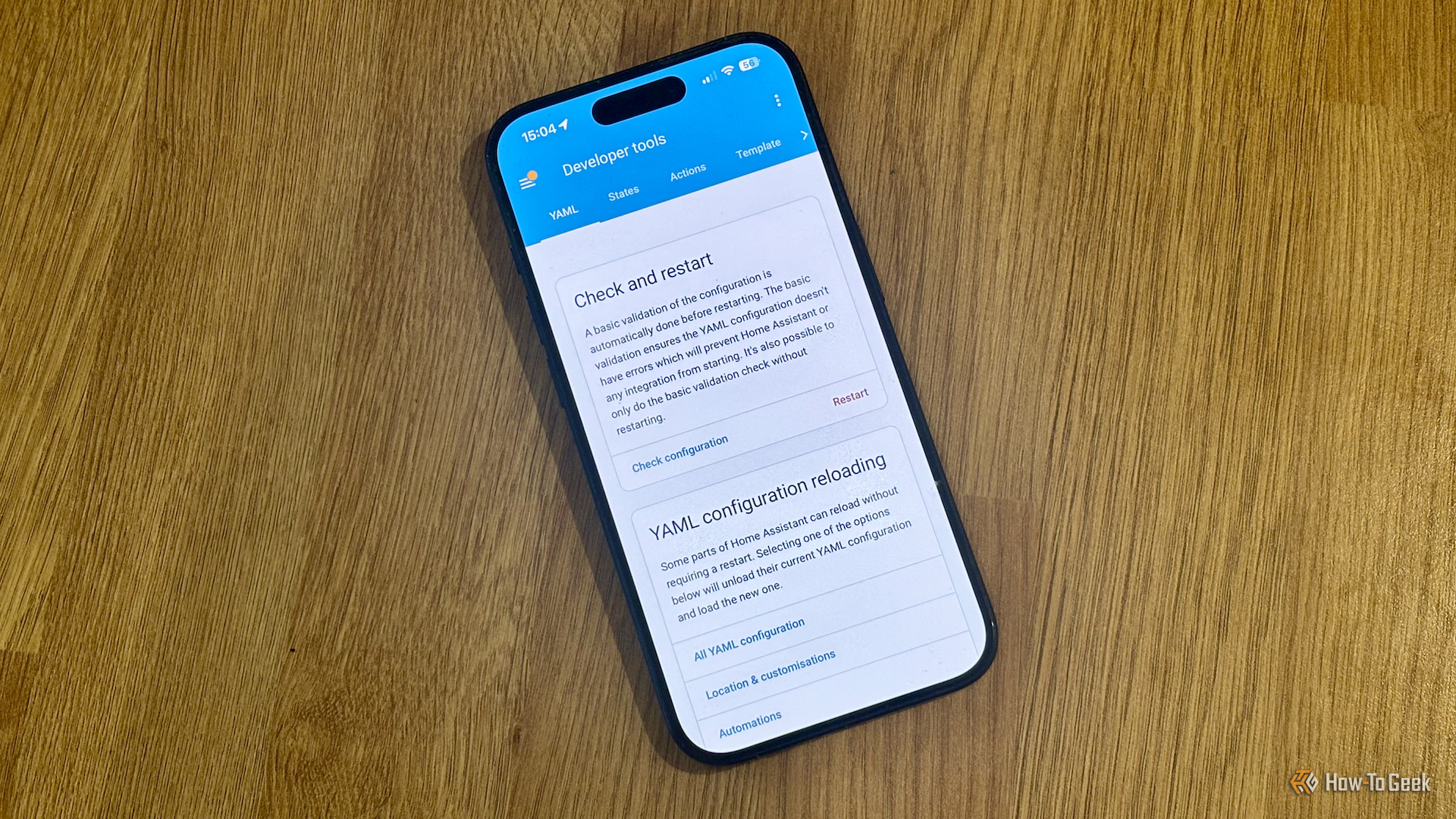
One of the downsides of Home Assistant is that, because it can do so much, it's all too easy to completely miss some of the most useful features. You may never have ventured into the "Developer tools" section, for example. If so, you're missing out, as it holds some incredibly useful tools.
You may have noticed people discussing GitHub alternatives recently. In particular, several projects have migrated to a competitor called Codeberg. Having investigated further, I’m convinced it’s a solid alternative, and it’s not the only one.
 Login
Login




 Peter Chapman / Bloomberg: