Reading view

There are new articles available, click to refresh the page.

House drama over the defense bill sets the stage for a high-stakes December on Capitol Hill


Interview transcript

Terry Gerton Lawmakers are scrambling to bring the NDAA to the floor this week amid partisan clashes. The Senate is preparing a vote on health care subsidies, but appropriations bills remain stalled. At the same time, a Supreme Court case on Humphreys Executor looms large in the background. Loren Duggan, Deputy News Director at Bloomberg Government, is here with the Inside Scoop. Loren, thanks so much for joining me.

Loren Duggan Thank you for having me.

Terry Gerton This might be a big week on the Hill. The House is planning to bring the National Defense Authorization Act to the floor for a vote. It’s obviously a topic we talk a lot about, but last week there were a lot of let’s just say, conversations about what might be in it and how it might go. So tell us about what’s going on behind the scenes.

Loren Duggan Well, this bill is a must pass piece of legislation. They’ve been doing it for decades and they always want to get it done by the end of the year. And this year there aren’t a lot of other end-of-year vehicles, so it’s kind of become an attractive venue for discussions about a number of issues. So that’s kind of what’s been going on. It’s probably less about the core part of the NDAA and more about some of the ancillary things or related things that people want to get in there or keep out of there as the case may be. We saw a particularly big dust up you might be referring to between Elise Stefanik, who’s a member of leadership, but was mad at her own leader, Speaker Mike Johnson, about trying to keep something out. And in the end they worked something out and that was getting resolved toward the end of the week. But that was just one of the flashpoints that leaders were dealing with trying to assemble this very important bill.

Terry Gerton It is normally a bipartisan bill. Is there a chance that, you know, that that’s not going to be true this time, even with the slim majority in the House?

Loren Duggan It may still be bipartisan because they do try to work things out. And, you know, sometimes the initial versions that come out of the House are particularly partisan because of writers or language that the minority party might not like. But they were reaching for consensus here. They were trying to get the four corners to agree on things before they went in. That’s the chairman and ranking member of the House and Senate committees, not just the defense committees in this case, but sometimes the other committees that had legislation that was in the mix. So they’re trying to get a bipartisan package that can get through because you might lose people on either side, but maybe you have the consensus you need to get something through. So we’ll be watching that vote counting very closely as they move toward the vote.

Terry Gerton Is there any aspect of the move forward on the NDAA that is also impacted by the hearings on the Hill last week about the counter drug operations in the Caribbean?

Loren Duggan Those two things seem to be on different tracks. I mean, obviously they’re related. It’s about the Defense Department and the defense secretary and what people might think there. But the legislation and setting policy is sort of moving in one direction, but some of the same players are also very much involved in reviewing what had happened with the ordering of these strikes and the chain of command and all the issues. We had the members watching the video over on the Senate side and reacting to that last week. I think that will continue. It may be brought up in the context of the debate or larger questions, but I think the bill will move regardless of that. And Congress can because they do this every year, revisit it in next year’s NDAA or perhaps in other legislation because we’ve already seen members talking again about maybe war powers or other things they might tap into there.

Terry Gerton Well we’ll see how that comes about. But speaking of votes, there is also supposed to be a vote in the Senate this week on the health care premium subsidy extensions. What’s the prognosis there?

Loren Duggan Well, this was part of the agreement to reopen the government was that there would be a vote by I think December twelfth was it, so Friday, on some sort of vote around the ACA extensions that are expiring at the end of the year. Chuck Schumer, the Democratic leader in the Senate, said he’d aim for a three-year extension, which would take us obviously beyond the next election. That’s a different proposal and one of many proposals that are floating around. We’ll be watching to see, does the GOP answer with their own proposal, and what does this mean for the House, if anything? So, going toward the end of last week, there was still no consensus on how this would be fixed. It will have to be bipartisan, obviously, to get over the line and we may not be there by the end of the week. But maybe we’ll have some discussion and votes ahead of that.

Terry Gerton And Mike Johnson’s trying to put a package together on the House side as well, right?

Loren Duggan Right. And there’s more than just the ACA being talked about here. There’s health savings accounts ideas or other things that members might want to pursue. You kind of got this short term issue of, what do you do with the subsidies for next year, but then there are a lot of people who are trying to bring in, what does this mean overall about the Affordable Care Act, the nature of the markets, does there need to be a broader sweep of changes? … There’s not really consensus on anything broader than this. And we’ll have to see if there can even be consensus on the smaller question of what to do with the subsidies.

Terry Gerton I’m speaking with Loren Duggan, deputy news director at Bloomberg Government. Well, Loren, at this time of year, every time we talk, we talk about the status of the rest of the appropriations. Shutdown, or [the] continuing resolution expires at the end of January. What are you seeing in terms of the move forward on the other bills?

Loren Duggan I’m sort of seeing a kind of a whimper on that going into the end of the year. To be honest with you, January 30 is a long time away. There’s been a lot of talk about what would be in a next minibus package that the Senate might consider, but that hasn’t been moving forward. Votes haven’t been scheduled. And without that sort of end-of-the year deadline or mid-December deadline that often drives that activity, they have more time, and usually work expands to the time allotted. And I think we might see that here. So, not clear that we’ll get more votes by the end of the year on that. There are a lot of issues they’re trying to work through. But that will be, if they don’t do it now, obviously top of mind when they return in early January, ’cause the clock will be ticking.

Terry Gerton Loudly at that point. A different topic, and we don’t cover the court very often, but there’s a very important case on the Supreme Court docket for today dealing with the president’s effort to fire a member of the Federal Trade Commission. Tell us what your team is watching there.

Loren Duggan Well, part of our organization is Bloomberg Law and they cover many court developments around the country and certainly at the Supreme Court. They’re watching this very closely because it has huge implication for independent regulators. As you mentioned, Kelly Slaughter, who was a FTC commissioner, was fired by the president and has had a court battle that’s now reached all the way up there. And it goes back to a precedent called, I think it’s Humphrey’s executor — which there are many people in this building who are far more versed than I in that. But it’s gonna be closely watched because what is the nature of an independent regulator? What is their power vis-a-vis the rest of the executive branch? Big questions there that have effects on a lot of different institutions, and therefore a lot of different regulated entities by those institutions. So we’ll be watching the arguments and then the decision whenever that comes will be very closely watched.

Terry Gerton So what else are you watching for the coming week?

Loren Duggan Well, we’re watching the Senate try to move forward on another batch of nominees. I think it’s 90 or so. They tried to do it last week, but there was a procedural hiccup, so they’re starting over. But that would be, if they could get that done, another 90 Trump appointees on the job by the end of the year, which Republicans would like. And we’re also watching, you know, hearings. There’s a lot of other nominees going through and there’d be a flash of celebrity. Gene Simmons of KISS is actually scheduled to be up on the Hill. So we’d be watching to see what he brings. Always interesting when you have kind of that celebrity star power trying to shine light on an issue.

Terry Gerton That’s a hearing near and dear to the heart of radio broadcasters everywhere. So we’ll be watching it as well.

Loren Duggan Excellent.

The post House drama over the defense bill sets the stage for a high-stakes December on Capitol Hill first appeared on Federal News Network.
© Getty Images/Tanarch

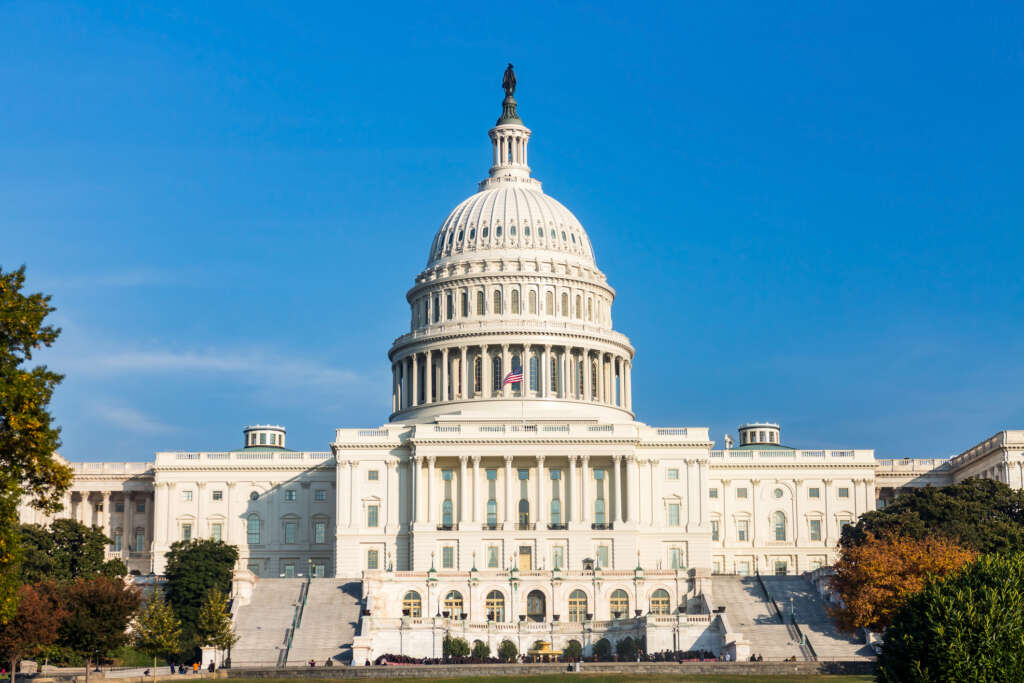
U.S. Capitol building

What China’s ‘World-Class Navy’ Means for the U.S. and Asia


DEEP DIVE — On a Wednesday in November, with Chinese President Xi Jinping looking on, the People’s Liberation Army Navy (PLAN) commissioned the 80,000-ton Fujian, the country’s third aircraft carrier and largest to date, in a ceremony that also featured its latest Navy stealth fighters, helicopters and command aircraft. A week later, China’s Ministry of Defense announced that the Sichuan, one of the world’s largest amphibious assault ships, had completed initial sea trials and would be ready for deployment next year. And last week, Shanghai is hosted “Marintec China,” the largest maritime conference in the world.

These are all signs of China’s continued rise as a maritime power and challenger to U.S. supremacy on the seas. And they have happened at a lightning-fast pace.

China now has “a world-class Navy,” retired Rear Admiral Mike Studeman, a former Commander of the Office of Naval Intelligence, told The Cipher Brief. “It's not, ‘Hey, we're going to achieve this in 2049.’ And it's just not in the numbers, it's in the quality. These ships are modern by any standard.”

The recently commissioned Fujian is the first Chinese carrier (and only the second in the world, after the U.S. Gerald R. Ford) to be equipped with electromagnetic catapults for launching aircraft. As for the new amphibious vessel, the Sichuan, experts have been impressed both by its sophistication and the fact that it was built in just over two years.

Top U.S. Navy officials are taking note. On an Asia-Pacific tour last month, Admiral Daryl Caudle, the U.S. Chief of Naval Operations, acknowledged the new carrier and assault ship and the overall “impressive” growth of China’s Navy.

“How they utilize those aircraft carriers globally is, of course, a concern of mine,” Adm. Caudle said in Japan. As for the Sichuan assault vessel, Adm. Caudle said, “We’ll watch that very closely and see what they’re going to do there. That’s a large ship, very capable.”

Experts say the recent milestones are the latest evidence of gains that have seen China’s Navy surpass the U.S. fleet in overall numbers while boosting the quality of its vessels as well.

“It's impressive,” former Rear Admiral, Mark Montgomery, told The Cipher Brief. “They're building a hundred merchant ships for every one we build, and two warships for every one we build. And they have quantitatively exceeded the size of our U.S. naval ship numbers.”

Montgomery was quick to add that China’s advances “don’t mean they have a more capable Navy” than the U.S. In terms of the quality of submarines and destroyers and carriers – “your choice, ship class after ship class,” as he put it – the U.S. remains without peer. But Montgomery and others say that China has rapidly narrowed the quality gap, and already changed the strategic equation for any potential conflict over the South China Sea or Taiwan.

China is “building a lot of ships, but the technological sophistication of those vessels has also significantly increased,” said Matthew Funaiole, Senior Fellow at the China Power Project at the Center for Strategic and International Studies (CSIS). “They're really trying to compete with other countries – and they obviously have their sights set on the U.S. in terms of maritime dominance in the region.”

The Trump Administration issued an executive order in April to jumpstart the U.S. shipbuilding industry and restore “American maritime dominance,” but experts say the U.S. has work to do to match the urgency of the Chinese buildup.

“The shipbuilding capacity in China now dwarfs that of the United States,” Emmanouil Karatarakis wrote in a recent analysis for The Cipher Brief. Citing estimates that China's overall shipbuilding capability (armed and unarmed) is now hundreds of times larger than the U.S.'s, he added, “This imbalance has far-reaching implications for long-term strategy and wartime readiness.”

Subscriber+Members are invited to join in an exclusive virtual conversation on Monday, December 8 at 2:30p ET on Russia’s Gray Zone Operations in Europe with former leaders from the Department of Defense, CIA, NATO and the British Foreign Office. Members receive links to register via email.

Not a Subscriber+Member? Let’s fix that.

China’s maritime rise

As with many elements of China’s rise as a global power, this one began in the early 1990s. At the time, China’s Navy was deployed primarily to guard its coastline – and while precise figures are hard to come by, estimates of its 1990 force range from 350-400 vessels, most of which were small patrol craft. Back then, the PLAN had no modern destroyers or submarines, and when China first put a carrier to water – in 2012 – it was a retrofitted Soviet vessel (the ship had actually been built in the 1980s, in the then-Soviet republic of Ukraine).

Today, China’s Navy boasts more than 1,000 vessels, including roughly 370 warships and submarines in what the Pentagon calls China’s “battle force” capability. The bulk of this rags-to-riches rise in maritime assets has come during the tenure of Xi Jinping.

“Xi Jinping has always been clear-eyed about the fact that a great power is a maritime power,” RADM Studeman said. “He personally understands that China, in order to be the leading power in the world, needs to have a maritime capability bar none. And that's the course they're on.”

Beijing has taken advantage of a booming commercial shipbuilding industry and the fact that – unlike in the U.S. – the civilian and military sectors in China are intertwined. Shipbuilding was included in the 10 core technologies in Beijing’s “Made in China 2025” industrial strategy, a blueprint for competing with global leaders in key industrial sectors.

A CSIS report offered staggering evidence of China’s maritime rise: the country’s share of global shipbuilding has jumped from 5% in 1999 to roughly 50%, while the U.S. now builds fewer than 1% of commercial ships globally. China’s largest state-owned shipbuilder built more commercial vessels by tonnage in 2024 than the entire U.S. shipbuilding industry had built since the end of World War II.

As for warships, China is now on track to have a 425-ship fleet by 2030, while the U.S. Navy currently has fewer than 300 deployable battle-force vessels – a total which experts worry may drop as aging ships are retired faster than new ones are put to water. “The growing size and sophistication of China’s Navy, combined with Beijing’s increasing assertiveness,” the CSIS report said, “poses major challenges to U.S. and allied military readiness and deterrence in the Indo-Pacific.”

Strategic implications

Experts say there are two basic strategic aims behind China’s maritime growth: preparing for potential conflict in the region, and adding a critical element for the country’s projection of global power and influence.

For the latter goal, the Fujian adds a major “chess piece,” as RADM Studeman put it, helping the PLAN expand its growing “blue-water” capabilities and extend its reach well beyond China’s Southeast Asian neighbors.

“They have been going up into the Bering Sea and parts of the Arctic and Antarctic,” Studeman said. “And they've been able to expand their footprint and develop their capabilities in an evolutionary way, which has been remarkable to see.”

The new carrier group might also be used in a maritime blockade of Taiwan, global humanitarian missions, and show-of-force deployments far from China’s shores.

“China wants to have the ability to operate globally,” Funaiole told The Cipher Brief. “I don’t think they want to do the same things the U.S. does, which is to have forward-positioned fleets all over the world. But they do want the ability to operate in different regions that are further and further away from the Chinese mainland, and you need to have a blue-water Navy in order to do that. It's the key to power projection.”

As far as a potential Taiwan conflict is concerned, the Sichuan – the newly-minted amphibious vessel, would be the more important “chess piece.” It’s an assault ship built to provide launch platforms for large combat drones, helicopters, and amphibious equipment, according to China’s Ministry of Defense.

“The carriers are less important for a Taiwan contingency than a lot of the other assets,” Funaiole said. “The amphibious ships are critical for that being successful.”

RADM Montgomery echoed the point, calling the new carrier group “a muscle flex and power projection,” while noting that the Sichuan and other assets would bring more concrete benefits in a regional conflict.

“The rest of their Navy [beyond the carrier group] isn't a muscle flex,” he said. “This is actually building a capability and capacity to push the United States farther and farther away from the area of crisis and contingency, whether in the East China Sea around the Senkaku [Islands] with Japan, in Taiwan, or in the South China Sea. The idea is to keep our Navy as far away as possible with a mix of missiles, aircraft, submarines, surface ships, all of that.” Those elements have been developed “at close to breakneck speed,” Montgomery said. “They've done a fantastic job of identifying, developing, resourcing and fielding a Navy air and missile force that places the US Navy and US Air Force at risk.”

U.S. Navy commanders have also warned that in the event of a Pacific war, China would be better equipped to replace lost ships – by virtue of geography and its more efficient shipbuilding. Taiwan war scenarios have shown that China would be able to absorb far heavier warship losses than the U.S.

Save your virtual seat now atThe Cyber Initiatives Group Winter Summit on December 10 from 1p – 4p ET for expert-led conversations on cyber, AI and the future of national security.

Can the U.S. turn the tide?

The White House’s April order, issued under the heading “Restoring America’s Maritime Dominance,” marked a recognition of China’s rise and a high-profile effort to reverse the erosion of U.S. shipbuilding. As The Cipher Brief has reported, the order mandates a whole-of-government push to jump-start the domestic shipbuilding industry.

The order called for the creation of an “Office of Shipbuilding” within the National Security Council, and said that within 210 days, the Assistant to the President for National Security Affairs “shall submit a Maritime Action Plan (MAP) to the President…to achieve the policy set forth in this order.”

That 210-day deadline has passed (November 5 was the 210th day), and there has been no public announcement of such a plan. The White House did not respond to requests for comment.

RADM Studeman acknowledged that even in the best-case scenario, these goals would take years to achieve, but added that he was disappointed by a slow pace of progress since the order was signed.

I expected to see more frankly,” he said. “I think that they're incredibly good ideas that were in that directive, and unless it's going on very quietly, I haven't seen enough progress in each of the areas.”

RADM Montgomery agreed.

“I know it's expectation management, but I'm disappointed,” he said, adding that he worries that future U.S. budgets may not provide the funds he believes are needed to kickstart the warship-building industry.

“China has modernized shipyards, as have Japan and Korea, who equally outpace us,” Montgomery said. “We do not have modernized shipyards for a number of reasons. We have not properly invested in that. Our labor costs are significantly higher, and that's particularly true in shipbuilding and defense manufacturing.”

He and others hold out hope that investments and expertise from Korea and Japan will help boost the U.S. output. The authors of the CSIS report urged a blend of punitive measures against China and long-term investments in U.S. and allied shipbuilding capacity. “U.S. Navy leaders have begun intensive outreach to allies like Japan and South Korea to support U.S. shipbuilding efforts,” the report stated, “an effort that President Trump has indicated he supports. However, much work remains to be done.”

“You need basically startup VC capital to get things going on it,” Funaiole said. “And it's not just the technical part or the physical infrastructure. We also have a lack of expertise and shipbuilding in this country. And so there also needs to be personnel training investments and exchange programs with other countries as well and specialization into new areas.”

Experts agree on this much: failure to address these issues risk damage to U.S. national security.

“As tensions rise,” the CSIS report said, “leaders in Beijing may calculate that China’s superior shipbuilding capacity would be a material benefit to outlasting adversaries in a protracted military conflict.”

Read more expert-driven national security insights, perspective and analysis in The Cipher Brief because National Security is Everyone’s Business.


❌